New generation European nuclear power will need investment of 500 billion euros by 2030. Existing plants will require 50 billion.

New generation European nuclear power plants will require an investment of "500 billion [euros] by 2050," said in an interview in the Journal du dimanche (JDD) dated January 9 the European Commissioner for the Internal Market, Thierry Breton , which considers “crucial” to open the green labeling to nuclear power as part of the energy transition.

"Existing nuclear power plants alone will require 50 billion euros of investment by 2030. And 500 billion by 2050 for new generation ones! », Affirms the French commissioner.

European Commission unveiled a green labeling project for nuclear and gas power plants, which aims to facilitate the financing of installations contributing to the fight against climate change..........

Nuclear power is the subject of heated debates between the Twenty-Seven, a dozen countries - France in the lead - actively promoting nuclear power in the face of States very reluctant to the civilian atom, such as Germany or Austria. Le Monde 9th Jan 2022

 https://www.lemonde.fr/economie/article/2022/01/09/nucleaire-nouvelle-generation-l-ue-devra-investir-500-milliards-d-ici-a-2050-estime-thierry-breton_6108727_3234.html
Nuclear Energy Financing Bill – a poisoned chalice for the UK public.
The UK & Ireland Nuclear Free Local Authorities (NFLA) is supporting calls to MPs to reject the Nuclear Energy Financing Bill when it comes back to the House of Commons for its Report Stage reading next Monday (10th January). The Chair of the NFLA Steering Committee, Councillor David
Blackburn, called the bill a ‘poisoned chalice’ for the British public:
“This bill will mean that consumers will ultimately pay the cost of developing any new ultra-expensive nuclear power plants through a surcharge applied to customers’ electricity bills. “Civil nuclear projects are
notorious for being delivered massively above budget and enormously behind time.
Consequently, there are only two main players in the nuclear market, and these have had their financial fingers burned. “The government wants to sweeten the pill by introducing a new method of financing nuclear plants called the Regulated Asset Base. This will mean that customers pay for cost
overruns and delays, and even the cost of abortive projects, whilst the developer and operator reap all of the rewards.”
NFLA 7th Jan 2022
The Nuclear Energy (Financing) Bill aims to provide for a new model for
financing new nuclear power stations in the UK. This briefing covers the
Bill’s progress through Parliament, through second reading and committee
stage.
House of Commons Library 7th Feb 2022
Russia’s nuclear submarine construction reaches a post-Soviet high.
Russia’s Nuclear Submarine Construction Reaches Post-Soviet High https://www.themoscowtimes.com/2022/01/07/russias-nuclear-submarine-construction-reaches-post-soviet-high-a75991 By The Barents Observer, Jan. 7, 2022
Russia’s Sevmash shipyard, the only one in the country that builds nuclear-powered submarines, saw a record year in 2021. Three subs were handed over to the Navy, two were put on water and construction started on another two.
Not since the late days of the Soviet Union have the workers at the building and repair yard Severodvinsk been busier than now. Moscow’s modernization program for its Navy over the last decade stands in sharp contrast to considerable neglect in the years after the disintegration of the Soviet Union.
2022 marks 10 years since the Russian Navy’s first fourth generation multi-purpose submarine, the Severodvinsk, successfully launched a Kalibr cruise missile from a submerged position in the White Sea. While it took nearly 20 years to complete construction of the Severodvinsk, later Yasen-M class vessels are being built faster.
Construction of the Novosibirsk, which was commissioned for the Navy in late December 2021, took 8 years. Similar construction times are also being seen for the new ballistic missile submarines of the Borei-A class in the wake of the Yury Dolgoruky, which took 16 years from being laid down in 1996 to commissioning for the Northern Fleet in 2012. The Knyaz Oleg, handed over to the Pacific Fleet just before Christmas last year took 7 years to build.
As of Jan. 1, 2022, 13 nuclear-powered submarines are at different stages of construction at the Sevmash yard and are all expected to be delivered to the navy before 2027.
While high-profile publicity is given to laying-down ceremonies, launching and commissioning of ballistic missile subs and multi-purpose subs, far less is known about special-purpose subs. The Barents Observer has on several occasions reported about the Belgord, the world’s longest submarine built on a modified Oscar-II class hull. The submarine will be the carrier of the new Poseidon nuclear-powered, nuclear-armed drones and likely be based with the Pacific Fleet later this year.
Two other carriers of the Poseidon drone are currently under construction at the Sevmash yard, the Khabarovsk and Ulyanovsk.
Other unconfirmed submarines that might be in the pipeline for construction in years to come are two more Borei-A class vessels, two more Poseidon carriers and one or two special-purpose mini-submarine to sail for GUGI, the Defense Ministry’s Main Directorate for Deep Sea Research.
Design work for fifth generation nuclear-powered submarines, referred to as the Husky class, is said to be underway, but so far no contracts have been signed.
In addition to new submarines, the Sevmash yard is busy working on repair and modernization of the large nuclear-powered battle cruiser Admiral Nakhimov. Originally commissioned into the Soviet Navy in 1988, the warship was rarely deployed to sea and has been in Severodvinsk for the last 23 years. If no further delays are announced, the battlecruiser will be re-commissioned for the Northern Fleet in 2023.
BBC Report on Closure of Hunterston B Fails to Mention that All the Nuclear Crapola will Come to Cumbria
BBC Report on Closure of Hunterston B Fails to Mention that All the Nuclear Crapola will Come to Cumbria. Radiation Free Lakeland. JANUARY 8, 2022 BY MARIANNEWILDART Radiation Free Lakeland have long argued for the closure of the cracked nuclear plants that EDF are running long past their planned lifetimes. Yesterday one of these cancer factories, Hunterston B was closed down because of the dangerously cracked graphite cores. The BBC report below toots a trumpet about the electricity produced by Hunterston but makes no mention at all of the 46 years of radioactive emissions and the fact that the resulting nuclear wastes (low, intermediate and high level wastes) and “cleaned up” infrastructure ( heading to landfill, incineration, recycled radioactive scrap metal, Drigg and proposed Deep Nuclear Dump ) will be dangerous to all life on the biosphere for so many generations to come. Yes lets toot a trumpet for the closure of a dangerous nuclear plant but the massive radioactive footprint of Hunterston will live on long after the limited use of electricity!
Hunterston B nuclear power plant closes down after 46 years
By Kevin Keane
BBC Scotland’s energy correspondent 7th Jan 2022 The Hunterston B nuclear power plant in North Ayrshire has been shut down for the final time after generating electricity for 46 years.
The plant’s original 25-year lifespan was extended by more than two decades.
But the final closure was brought forward after cracks were found in the graphite bricks which make up the reactor cores.
A small group of former workers gathered at the power station at midday to see the final shut down.
The site, owned by EDF Energy, will now begin a three-year process of defueling with the spent nuclear fuel sent to Sellafield for reprocessing. After that, the site will be handed over to the Nuclear Decommissioning Authority…………
The cracks were first spotted in two graphite bricks in the reactor in 2014.
By 2018, a total of 350 bricks had been affected although the Office for Nuclear Regulation subsequently gave permission to operate at much greater numbers.
Each of the two reactor cores is made up of 3,000 bricks which form vertical channels for nuclear fuel and control rods to slide in and out.
The concern was that too many cracks, combined with a rare seismic event, could affect the structural integrity of the core and prevent it being shut down in an emergency.
The Hunterston A plant, which is already closed, comprised two 180MWe Magnox reactors.
It began operation in 1964. Reactor 2 shut down in December 1989 and Reactor 1 in March 1990.
Construction of Hunterston B began in 1968 and reactors 3 and 4 began operating in February 1976 and March 1977……
Reactor 3, a 490MWe advanced gas-cooled reactor (AGR), was permanently closed down on 26 November.
Hunterston Reactor 4 – also a 490MWe AGR – has now shut down……….
Similar cracks are expected to develop there and at several other similar sites in England. In December, EDF Energy announced that Torness would close two years earlier than planned in 2028 because of the issue. https://mariannewildart.wordpress.com/2022/01/08/bbc-report-on-closure-of-hunterston-fails-to-mention-that-all-the-nuclear-crapola-will-come-to-cumbria/
Hunterston nuclear power workers need a just transition to sustainable work. No more subsidies to the nuclear industry.
Workers are key to a just transition at the Hunterston nuclear plant,
which retires today, according to the Scottish Greens.
The nuclear sectorbhas used the occasion to call for more subsidies, despite the UK Government
already subsidising the sector and proposing to charge bill payers upfront
to pay for nuclear power stations that haven’t even been built yet, like
at Hinkley Point.
Commenting, Scottish Greens energy spokesperson Mark
Ruskell said: “Respect and thanks must go to the workers at Hunterston
who have kept our lights on over the decades and those who will continue
the important work of de-commissioning. “These communities deserve a just
transition away from an energy source that is expensive and neither clean
nor sustainable. The vast subsidies involved would be better spent
investing in modern renewable energy solutions that provide a long-term
future for workers and our planet.”
Scottish Greens 7th Jan 2021
https://greens.scot/news/greens-workers-key-to-hunterston-transition
European citizens divided over nuclear energy

European citizens divided over nuclear energy – What Greeks believe, https://greekcitytimes.com/2022/01/07/european-citizens-nuclear-energy/A “tie” prevails in the European public opinion for the production of energy through nuclear power plants, as recorded by the latest relevant Eurobarometer survey.
The differences, however, are large from country to country, with the weight of “NO” prevailing in the EU’s largest population, Germany, where 69% are against this form of energy.
It is also striking that in France, where about 70% of energy is produced in individual plants, the disapproval rate is quite high at 45%.
This number is particularly important if one takes into account that at this time the French government, with the personal mobilisation of President Emmanuel Macron, seeks to classify nuclear energy in “environmentally friendly” technologies.
This issue has provoked several reactions, both from some countries and from political forces, with the European Greens declaring a few days ago that they are considering appealing to the European Court of Justice against the Commission for its proposal.
Austrian Environment Minister Leonore Gewessler had hinted at something similar, with experts in European law questioning whether such an appeal could be justified.
Overall in Europe and with a sample of around 27,000 respondents the acceptance and rejection rates were exactly the same, with 46%.
3% had no opinion and 5% did not answer.
Opinions on solar (92%) and wind energy (87%) are overwhelmingly positive.
The countries with the highest percentages of negative opinion after Germany and Austria (66%) included Greece and Luxembourg.
Citizens are divided in Belgium, Denmark, Spain and Portugal, where YES or NO does not prevail.
High levels of support were recorded where nuclear power is already being used – the Czech Republic with 79%, Bulgaria with 69%, Poland with 60%, as well as in Finland where a new nuclear reactor has recently started operating. The survey also recorded slightly higher acceptance rates among men surveyed than women.
UK: Blackburn and Darwen Council approving and old nuclear dump site for commercial development ?
A CONTROVERSIAL development site which residents and politicians fear is
above buried nuclear waste has been kept in the latest version of a
borough’s planning blueprint.
Blackburn with Darwen Council included the 94
acres of countryside near the M65’s Junction 5 in its draft local plan
published last year as suitable for employment uses.
But residents and WestPennine Tory councillor Julie Slater fear nuclear waste was dumped down old
mineshafts in the 1950s. Now following a consultation a new version of the
blueprint has been published and the the green belt land between Belthorn
and Guide remains earmarked as ideal for commercial and job-creating
development.
Lancashire Telegraph 7th Jan 2022
Fault found in France’s Chooz 2 nuclear reactor – its outage shutdown now extended
Chooz 2 nuclear reactor outage extended after fault discovered
Reuters PARIS, Jan 6 (Reuters) – The outage of the 1.5 gigawatt (GW) No.2 reactor at the Chooz nuclear power plant in northern France has been extended after an inspection found the same fault as at the Civaux plant in the west of the country, operator EDF (EDF.PA) said on Thursday.
The two plants were shut down in December after discovery of corrosion in a safety system at the Civaux plant. read more
The reactor outage was extended to Apr. 20 from the previous expected return date of Jan. 23.
| The repair solution is being investigated with the French nuclear safety authority ASN, EDF said, adding that inspections on the Chooz 1 reactor are still in progress…………French power grid operator RTE said in December that French nuclear capacity in January was expected to be at its lowest level ever for this time of year. read more ….Nuclear power accounts for about 70% of France’s electricity mix and the COVID-19 pandemic has delayed maintenance work on some nuclear reactors. https://www.reuters.com/business/energy/chooz-2-nuclear-reactor-outage-extended-after-fault-discovered-2022-01-06/ |
Scotland very nearly reached goal of 100% renewable energy over 2020
Final figures released by the Scottish government show that the country
just missed out on reaching its goal of 100% of its energy consumption
being from renewables by 2020. In the year, the equivalent of 98.6% of
gross electricity consumption in Scotland was from renewable sources in
2020, up on the provisional figure of 97.4% released in May 2021.
Current 6th Jan 2022
UK’s Heysham nuclear plant to shut down two years earlier than planned
The Heysham 2 nuclear power station in Lancashire is set to shut down for
good two years earlier than planned following a new assessment. The power
station, the fuel for which is made at the Springfields factory at Salwick,
will now stop generating power in 2028. In 2016, the site’s operational
life was extended by seven years to 2030 as no new power station projects
were in the pipeline and nuclear is needed to maintain a steady base load
for the electricity grid.
Blackpool Gazette 9th Jan 2022
Including nuclear power as ”sustainable” completely undermines the European taxonomy’s original aim of the Green Deal

The published proposal is an incredible greenwashing of long outdated and dangerous technologies. It undermines the taxonomy’s original goal of providing investments for an ecological restructuring of society – the Green Deal.
Instead, the proposal keeps the nuclear technology, which has long since failed in reality, alive and tempts to rely on fossil gas for too long. Every euro that flows into nuclear and gas based on this
classification is missing for real sustainability and effective climate protection.
Ausgestrahlt 5th Jan 2022
https://www.ausgestrahlt.de/blog/2022/01/05/eu-taxonomie-analysiert-yellow-deal-statt-klimaschutz/
Government Wants YOU to Pay for New Nuclear

Thanks to CND for this information: The government is trying to force through controversial new legislation which will make consumers bankroll the nuclear power industry, whilst giving them no protection from spiralling costs. This will force thousands more families into fuel poverty. The electricity generated from nuclear power is double the costs of renewables. Nuclear […]
Government Want YOU to Pay for New Nuclear — RADIATION FREE LAKELAND (UK) ON BY MARIANNEWILDART
The government is trying to force through controversial new legislation which will make consumers bankroll the nuclear power industry, whilst giving them no protection from spiralling costs. This will force thousands more families into fuel poverty. The electricity generated from nuclear power is double the costs of renewables. Nuclear is hampered by generic design flaws, long delays and safety risks. It’s dangerous to people and planet. To meet Britain’s 2050 net zero goals, instead of forcing consumers to bankroll a failed industry, the government should be investing more in renewables.
Contact your MP, urging them to vote against the Bill on Monday 10th January. See briefing CND is sending to MPs.
We are writing now to urge you to vote against the Nuclear Energy (Finance) Bill which has its final reading in the House of Commons on Monday 10 January.
This controversial new legislation will force consumers to bankroll the nuclear power industry, whilst giving them no protection from spiralling costs. This will force thousands more families into fuel poverty.
The Bill will enable energy companies to charge consumers to construct and operate new nuclear power plants under a regulated asset base (RAB) funding model. Evidence shows that under such models, costs for nuclear power stations abandoned during construction as well as cost over-runs of $2.1 billion are all being passed on to consumers. Richard Hall, Chief Energy Economist at Citizens Advice, who gave evidence to the parliamentary Committee examining the Bill, argues ‘…consumers do not have any control over the risk. Essentially, they are the passive recipient of the risks.’
The electricity generated from nuclear power is twice the price of renewables. Nuclear is hampered by generic design flaws, long delays and safety risks. It’s dangerous to people and planet. To meet Britain’s 2050 net zero goals, instead of forcing consumers to bankroll this costly, inefficient and dangerous form of power generation, the government should be investing in renewables and making homes energy-efficient to reduce carbon emissions as well as energy bills.
As you know there is no “away” for nuclear wastes and the government are presently spending eyewatering amounts of money on public relations largely in Cumbria to try and persuade the County to bury heat generating nuclear wastes under our precious and irreplacable land and sea. The reason? Not for safety’s sake but in order to clear the decks for more nuclear crapola for which we all must pay time and time again in every way possible?
We urge you to vote against this Bill.
with many thanks
Marianne Birkby on behalf of
Radiation Free Lakeland
France – a serious anomaly detected in several EDF nuclear reactors
Nuclear: a serious anomaly detected in several EDF reactors. While several
nuclear production units are not running due to ten-yearly inspection
visits, EDF announced on Thursday that it would extend the shutdown of a
reactor at Chooz by three months, after having detected a fault there
similar to that of another plant. stopped. While this has so far only been
identified in reactors of the same generation, it questions the safety of
the fleet, on which France depends to produce its electricity. In the
Tribune, Karine Herviou, Deputy Director General of the Institute for
Radiation Protection and Nuclear Safety (IRSN) reports a serious anomaly.
La Tribune 6th Jan 2022
Les Echos 6th Jan 2022
Reuters 6th Jan 2022
UK Parliament to debate Nuclear Energy (Financing) Bill on 10 January – may transfer billions of new nuclear costs to consumers
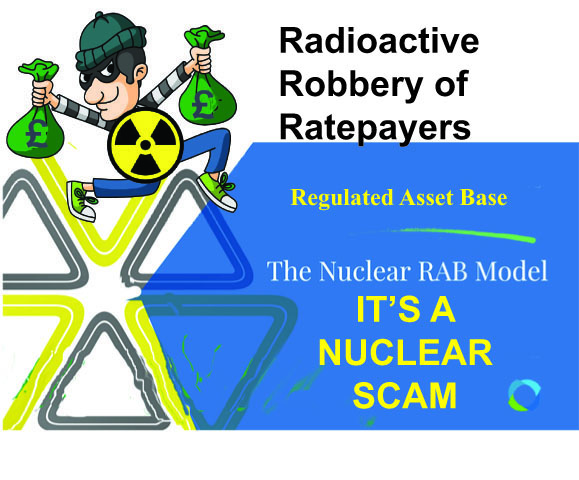
The Nuclear Energy (Financing) Bill has its final reading in Parliament on Monday 10 January. If passed, it will change the way the nuclear power industry is financed, transferring billions of pounds onto individual
consumers, whilst affording them no protection from spiralling costs. This will force thousands more families into fuel poverty. CND is urging all Members of Parliament to vote against this legislation.
CND Briefing 6th Jan 2022
Coronavirus cases doubled in a few days at Sellafield nuclear site

CORONAVIRUS cases at Sellafield have more than doubled in a week as
Omicron continues to spread rapidly throughout the county. Numbers of cases
among those employed on the site rose from 320 in the week to Wednesday 29,
up to 712 in the week to January 5.
Carlisle News & Star 7th Jan 2022
https://www.newsandstar.co.uk/news/19829854.coronavirus-rates-double-week-sellafie
1 This Month


of the week– Nuclear Reactor Information Task Force

14 May – online event From Bombs to Data Centres: the Face of Nuclear Colonialism
To see nuclear-related stories in greater depth and intensity – go to https://nuclearinformation.wordpress.com
-
Archives
- May 2026 (187)
- April 2026 (356)
- March 2026 (251)
- February 2026 (268)
- January 2026 (308)
- December 2025 (358)
- November 2025 (359)
- October 2025 (376)
- September 2025 (257)
- August 2025 (319)
- July 2025 (230)
- June 2025 (348)
-
Categories
- 1
- 1 NUCLEAR ISSUES
- business and costs
- climate change
- culture and arts
- ENERGY
- environment
- health
- history
- indigenous issues
- Legal
- marketing of nuclear
- media
- opposition to nuclear
- PERSONAL STORIES
- politics
- politics international
- Religion and ethics
- safety
- secrets,lies and civil liberties
- spinbuster
- technology
- Uranium
- wastes
- weapons and war
- Women
- 2 WORLD
- ACTION
- AFRICA
- Atrocities
- AUSTRALIA
- Christina's notes
- Christina's themes
- culture and arts
- Events
- Fuk 2022
- Fuk 2023
- Fukushima 2017
- Fukushima 2018
- fukushima 2019
- Fukushima 2020
- Fukushima 2021
- general
- global warming
- Humour (God we need it)
- Nuclear
- RARE EARTHS
- Reference
- resources – print
- Resources -audiovicual
- Weekly Newsletter
- World
- World Nuclear
- YouTube
-
RSS
Entries RSS
Comments RSS
 nuclear-news