Ho hum – Flamanville nuclear power project delayed again.
Electricite de France SA on Wednesday said that it has revised the
schedule for its Flamanville 3 nuclear reactor project in northern France,
citing the current stage of progress, and difficulties caused by the
coronavirus pandemic.
The French energy company said the fuel-loading date
has been rescheduled to the second trimester of 2023 from the end of 2022.
Costs are now estimated at 12.7 billion euros ($14.41 billion) compared
with an earlier estimate of EUR12.4 billion. Several operations still need
to be carried out before loading the fuel into the reactor vessel and
carrying out start-up tests, EDF said.
Market Watch 12th Jan 2022
Germany to stick to its guns on phasing out nuclear and coal energy
 | |||
https://www.reuters.com/business/energy/germany-stick-guns-phasing-out-nuclear-coal-energy-scholz-2022-01-12/Reuters BERLIN, Jan 12 (Reuters) – Germany will push ahead with phasing out nuclear and coal energy despite rising energy prices, Chancellor Olaf Scholz said on Wednesday, adding that nuclear power made no economic sense given the high cost of storing waste…….
Scholz told parliament that his government would instead expedite the process of gaining permission to expand solar and wind farms to push prices down and meet power demand expected to rise to about 800 terawatts (TW) in 2030 from around 600 TW today.
Downright absurd to classify a technology with the potential danger of nuclear power plants as green and sustainable.
I am very sure that not a single private company will ever build a nuclear power plant on its own account and at its own risk. The taxonomy does not change that. At best, it reduces the enormous government subsidies needed to push this technology into the market
“Nuclear is the opposite of what wind & solar need to partner with” – ex energy state sec Nuclear phase-outEnergiewende Clean Energy Wire, 11 Jan 22 Without the anti-nuclear movement, the energy transition in Germany would likely look different. But despite a strong focus on fighting nuclear power, the civil society movement that marked the rise of the Green Party has always had the climate in mind and wanted to ensure that reactors weren’t substituted with coal plants.

Clean Energy Wire spoke to Rainer Baake, director of the Climate Neutrality Foundation, former energy state secretary, and one of the architects of the original German nuclear phase-out in 2000. He says that with all democratic parties pledged to the exit timetable, it is “absolutely out of the question” that Germany returns to using this high-risk technology. With a decision to include nuclear as a sustainable investment, the EU Commission would discredit the taxonomy, he said. “However, this will not stop the energy transition in Germany.”
……………………………………. The whole energy transition consists of replacing conventional power plants, nuclear as well as fossil power plants with renewables. And that’s what we started with simultaneously. When the nuclear phase-out was decided, the Renewable Energies Act was created. As a consequence of the Kyoto protocol, we decided on an emissions trading system in Europe. Nuclear energy will be history on 31 December 2022 and we will also completely phase out coal in this decade and replace both with renewables. The next step will be to exchange fossil natural gas against hydrogen.
…………………… Can nuclear power, as supplied by today’s nuclear power plants, make a meaningful contribution to an electricity system dominated by renewables? As base load or for other system services?
Is it a problem for the German energy transition if other (European) countries, also with the help of the new European taxonomy, invest in nuclear power instead of renewables?
The opposite is true. A climate-friendly electricity system dominated by weather-dependent production from wind and solar plants requires a great deal of flexibility to balance fluctuating supply with fluctuating demand. Nuclear power plants are technically and operationally designed to produce as consistently as possible. They are the exact opposite of what wind and solar need to partner with.
Is it a problem for the German energy transition if other (European) countries, also with the help of the new European taxonomy, invest in nuclear power instead of renewables?
I find it downright absurd to classify a technology with the potential danger of nuclear power plants as green and sustainable. And even more so because it produces radioactive waste that remains dangerous for the unimaginable period of a million years, and for which we have not yet found a safe solution. With this decision, the EU Commission discredits the taxonomy. However, this will not stop the energy transition in Germany.
I am very sure that not a single private company will ever build a nuclear power plant on its own account and at its own risk. The taxonomy does not change that. At best, it reduces the enormous government subsidies needed to push this technology into the market.
While innovations and learning curves over the past 20 years have ensured that renewable energies have become increasingly cheaper, the costs of nuclear energy have risen more and more. In this respect, it is no wonder that, according to IEA figures, 70 percent of global investment in the power sector now goes to renewable energies.
A recent survey showed that a slight majority of Germans would agree to give nuclear power a role for climate protection reasons. Do you see the possibility that attitudes towards nuclear power could change again in Germany?
What survey? Since Chernobyl, all the polls I know of have shown clear majorities in favour of phasing out nuclear power. Take a look at the last federal election, all democratic parties are sticking to the timetable for the nuclear phase-out and support the expansion of renewable energies. The last three reactors will go offline at the end of this year. This will mark the end of the use of nuclear energy in Germany.
Is there any scenario next year in which Germany will let the existing nuclear power plants run longer after all, as some are calling for?
I consider such a scenario to be absolutely out of the question.
Do you see the new small-scale nuclear reactors as a chance for a renewed use of nuclear power in the fight against the climate crisis?
These reactors, which allegedly are completely safe and produce no nuclear waste, have one major disadvantage: they don’t exist.
The 400 nuclear power plants in existence worldwide today cover only about ten percent of the demand for electricity. If we wanted to replace global fossil power generation with small nuclear reactors, we would need many thousands of these power plants. Precisely because they are so small, they would have to operate with highly enriched uranium. The danger that nuclear fuel would be illegally diverted and used to build bombs is real. No one can want that, and hopefully the free world will not allow it. https://www.cleanenergywire.org/news/nuclear-opposite-what-wind-solar-need-partner-ex-energy-state-sec
The European Union will need to invest 500 billion euros ($568 billion) in new generation nuclear power stations!
France24 9th Jan 2022
The European Union will need to invest 500 billion euros ($568 billion) in new generation nuclear power stations from now until 2050, the bloc’s internal market commissioner said in an interview published at the weekend.
“Existing nuclear plants alone will need 50 billion euros of investment from now until 2030. And new generation ones will need 500 billion!” Thierry Breton told the Journal du Dimanche newspaper. Breton also argued that an EU plan to label energy from nuclear power and natural gas as “green” sources for investment was a vital step towards attracting that capital. The EU is consulting its member states on that proposal, with internal disagreement on whether the power sources truly qualify as sustainable options.
France24 9th Jan 2022
Factoring in the full cost of the radioactive wastes, the price to pay for nuclear power is astronomic.
The price to pay for nuclear power is too high, https://www.scotsman.com/news/opinion/letters/the-price-to-pay-for-nuclear-power-is-too-high-readers-letters-3520498 Tim Flinn, Garvald, East Lothian, 10 Jan 22,
It doesn’t seem 30-odd years since I went with a group of sixth form A Level physics students on a tour of Dunbar’s Torness nuclear power station, now scheduled for decommissioning.
Most of them now have their PhDs and families of their own, but hopefully they all share my view that nuclear electricity remains the most toxic and expensive domestic fuel in regular use – and will remain so unless and until the problems associated with its deadly wastes are finally solved.
As things stand now the next 500 human generations will be stuck with the human and financial costs consequent upon coping with the radioactive detritus of the very first nuclear electricity generated some 80 years ago. Factoring in inflation the final price of just a single nuclear kWh will total more £s than there are particles in the universe. If anyone doubts that, let them do their own sums, or get a copy of mine (I hope they can cope with logarithms and discounting cash flows).
If the investment into nuclear energy (originally so we could keep up with the Jonses and have our own A and H bombs) had instead been ploughed into research and development of clean, safe, renewables we would long ago have had endless energy to spare and green devices to export. But we didn’t and so we haven’t. To replace one nuclear power station with yet another is to refuse to learn. Are we that stupid still?
Just the bare 144 years of above-ground storage for UK’s Chapelcross Intermediate Level Nuclear Waste
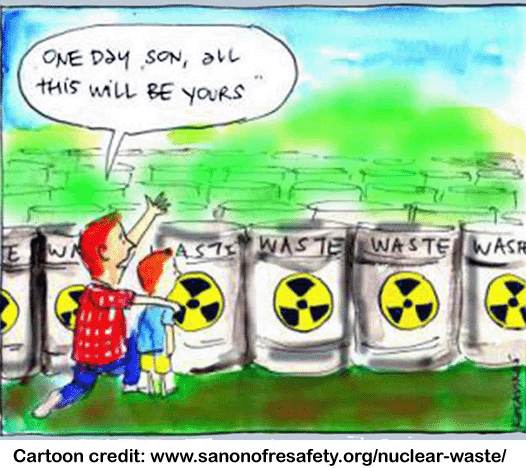
The question for policy makers is do we really want to contemplate building new nuclear power stations when the legacy will be with future generations for 102 years, nearly two and a half times beyond any new nuclear plant’s operational life. The cost of nuclear electricity generation is high and future costs of dealing with the legacy are also passed on to at least four future generations.
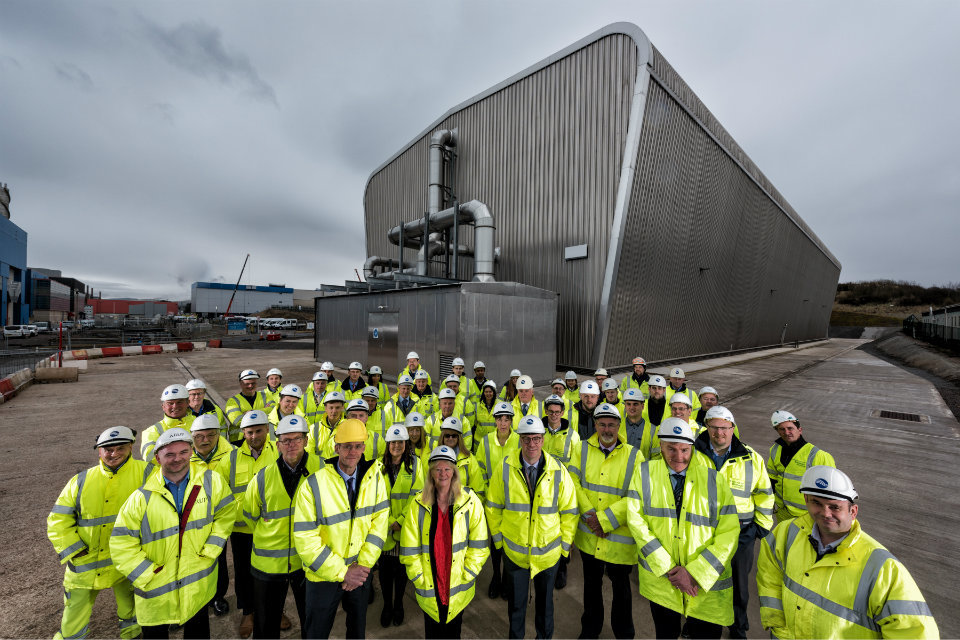
| Following on from a previous article on Hunterston B which was shut down last Friday I decided to have a look at one of the smaller nuclear power stations in Scotland to see how work was progressing on decommissioning. Chapelcross nuclear power station occupies a 92 hectares site on the location of a former World War II training airfield in Annan. Chapelcross had 4 Magnox reactors, each with a 48MW output. Chapelcross was linked to sister plant Calder Hall in Cumbria which is now the site of the NDA’s Sellafield operation. Calder Hall closed in 2003 and Chapelcross in 2004. Both plants were originally operated by the UK Atomic Energy Authority. Their main purpose was to produce weapons-grade plutonium although they also generated electricity for the National Grid. By 1st April 2019, Chapelcross had been defuelled and all High Level Waste moved to Sellafield. At that point, almost three years ago, the Intermediate Level Waste as well as LLW had still to be dealt with. The VLLW would appear to be close to the end of the decommissioning process. The LLW is destined for containers in Cumbria and the estimated 4,900 cublic metres of Intermediate Level Waste will be left onsite in specially constructed containers for a period of 120 years, pending a Scottish Government decision around 2145 on disposal of the containers and contents. The interim storage facility for storing Intermediate Level Waste at Chapelcross began 2014 and was completed by May 2021 when the first ‘package’ was placed in the facility. In announcing this progress Magnox Ltd and the NDA said in a news release; “The Interim Storage Facility (ISF) can hold over 700 waste packages of four different approved package types, and will be filled over the next five years as part of decommissioning work. Standing at 57m long and 23m wide, it has been constructed to safely and securely store packages for 120 years.” Work on the Intermediate Level Waste which is due to complete in 2026. The storage facility is then sealed for 120 years when a decision will be made by the Scottish Government on final disposal of ILW storage and contents. Whilst it can be argued that the core decommissioning work will take around 22 years, the end game is still 120 years away making 144 years in total for final clearance at the site. Chapelcross operated for 44 years. The ILW will remain on the site until 2146 although the buildings will be long gone by then. It is essential we deal with the legacies of the past and do so to the highest possible standard because we owe that to our own and future generations. The question for policy makers is do we really want to contemplate building new nuclear power stations when the legacy will be with future generations for 102 years, nearly two and a half times beyond any new nuclear plant’s operational life. The cost of nuclear electricity generation is high and future costs of dealing with the legacy are also passed on to at least four future generations. Newsnet 10th Jan 2022 https://newsnet.scot/news-analysis/nuclear-decommissioning-chapelcross-a-timeline/ |
The European Association for Renewable Energie Eurosolar rejects inclusion of nuclear and natural in the EU taxonomy
The European Association for Renewable Energie Eurosolar rejects »any
elements of nuclear and natural gas supply in the EU taxonomy for
environmentally sustainable activities«. The taxonomy is a classification
system for sustainable economic activities which are due to receive
advantageous financing conditions under EU regulations.
The European
Commision has proposed to include nuclear and natural gas into the
taxonomy. Member states like Germany strongly protested or, like Luxembourg
and Austria, even announced to bring action against the Commission, while
others are decisively supporting the proposal.
Photon 10th Jan 2022
EU delays deadline on green investment rules for nuclear and gas
EU delays deadline on green investment rules for nuclear and gas, By Kate Abnett BRUSSELS, Jan 10 (Reuters) – The European Commission said on Monday it has delayed to later this month the deadline for experts to give feedback on divisive plans to allow some natural gas and nuclear energy projects to be labelled as sustainable investments……… (subscribers only) https://www.reuters.com/markets/commodities/eu-delays-deadline-green-investment-rules-nuclear-gas-2022-01-10/
Cracked’ nuclear power station retired.
Cracked’ nuclear power station retired. The Ecologist, Katrine Bussey | 10th January 2022 ‘As the expensive and hazardous job of cleaning up the radioactive legacy Hunterston leaves in its wake now begins, Scotland must press on with plans to harness more clean, renewable energy.’
One of Scotland’s two nuclear power plants has been shutdown, bringing an end to almost 46 years of it generating electricity.
Environmental campaigners said the final shutdown of Hunterston B, near West Kilbride – which started producing electricity 45 years and 11 months ago – was “inevitable”.
Lang Banks, the director of WWF Scotland, said the plant had become increasingly unreliable, and argued that growth in renewable energy means nuclear power is no longer required.
Technologies
Mr Banks said the “repeated failure to solve the problem of hundreds of cracks in the graphite bricks surrounding the reactor core means the closure of Hunterston B was inevitable”.
He added: “Thankfully Scotland has massively grown its renewable power-generating capacity, which means we’ll no longer need the electricity from this increasingly unreliable nuclear power plant.
“As the expensive and hazardous job of cleaning up the radioactive legacy Hunterston leaves in its wake now begins, Scotland must press on with plans to harness more clean, renewable energy.”
A Scottish Government spokesperson said: “Hunterston B, its operators and in particular the workforces who have staffed the plant for more than 40 years, have played an important role in supporting Scotland’s energy requirements.
“We do however remain clear in our opposition to the building of new nuclear power plants in Scotland under current technologies.
Transition
“Significant growth in renewables, storage, hydrogen and carbon capture provide the best pathway to net zero by 2045, and will deliver the decarbonisation we need to see across industry, heat and transport.
They added: “We recognise that planning will be crucial to ensure that economic and social opportunities from the transition are not missed.
“Our National Just Transition Planning framework sets out the consistent, ambitious approach we will take to developing transition plans.
We have committed to delivering our first Just Transition Plan as part of the forthcoming refreshed Scottish Energy Strategy, and will work in partnership with businesses, workers and communities to ensure this provides the certainty needed for investment in our net zero journey.
“As part of the jointly Scottish and UK Government funded Ayrshire Growth Deal, regional partners are developing a business case for the Hunterston Strategic Development Area to support a long-term strategic plan for the Ayrshire region, its people and businesses.”………………. https://theecologist.org/2022/jan/10/cracked-nuclear-power-station-retired
To bankroll the failing nuclear industry, the UK government will push thousands into fuel poverty, with its Nuclear Energy (Financing) Bill

Bad for fuel poverty, bad for climate action: why MPs should vote against the Nuclear Energy Bill on Monday.
Controversial legislation is being rushed through parliament which will transfer billions of pounds onto
individual consumers, whilst affording them no protection from the spiralling construction costs of nuclear power. Introduced at the end of October when attention was rightly focused on COP26, the Bill has received little attention.
Yet it will have a profound impact on millions of families forced to foot the bill and will push thousands more into fuel poverty. So why is the government forcing more families into fuel poverty?
To bankroll a failing industry. With all 15 British nuclear power plants set to be closed by 2030, funding for eight new ones is in a state of collapse. Only one plant – Hinkley Point C – is under construction and
this is running ten years late and £4.5 billion over budget. The Bill enables energy companies to use a regulated asset base (RAB) model to transfer the construction costs – and financial risks – onto consumers
and start making a profit even before the plants generate any electricity.
Labour Outlook 9th Jan 2022
What War With Russia Would Look Like
Consortium News, January 10, 2022 Wendy Sherman thinks her aim in talks with Russian officials starting Monday is to lecture them on the cost of hubris. Instead she’s set to lead the U.S., NATO, and Europe down a path of ruin, warns Scott Ritter.By Scott Ritter
Special to Consortium News If ever a critical diplomatic negotiation was doomed to fail from the start, the discussions between the U.S. and Russia over Ukraine and Russian security guarantees is it.
The two sides can’t even agree on an agenda.
From the Russian perspective, the situation is clear: “The Russian side came here [to Geneva] with a clear position that contains a number of elements that, to my mind, are understandable and have been so clearly formulated—including at a high level—that deviating from our approaches simply is not possible,” Russian Deputy Foreign Minister Sergei Ryabkov told the press after a pre-meeting dinner on Sunday hosted by U.S. Deputy Secretary of State Wendy Sherman, who is leading the U.S. delegation.
Ryabkov was referring Russian President Vladimir Putin’s demands to U.S. President Joe Biden in early December regarding Russian security guarantees, which were then laid out by Moscow in detail in the form of two draft treaties, one a Russian-U.S. security treaty, the other a security agreement between Russia and NATO.
The latter would bar Ukraine from joining NATO and rule out any eastward expansion by the trans-Atlantic military alliance. At the time, Ryabkov tersely noted that the U.S. should immediately begin to address the proposed drafts with an eye to finalizing something when the two sides meet. Now, with the meeting beginning on Monday, it doesn’t appear as if the U.S. has done any such thing……….
All the U.S. has been willing to do, it seems, is to remind Russia of so-called “serious consequences” should Russia invade Ukraine, something the U.S. and NATO fear is imminent, given the scope and scale of recent Russian military exercises in the region involving tens of thousands of troops. This threat was made by Biden to Putin on several occasions, including a phone call initiated by Putin last week to help frame the upcoming talks.
Yet on the eve of the Ryabkov-Sherman meeting, U.S. Secretary of State Tony Blinken simply reiterated these threats, declaring that Russia would face “massive consequences” if it invaded Ukraine………..
Lessons of history
It is as if both Biden and Blinken are deaf, dumb, and blind when it comes to reading Russia.
Ryabkov has alluded to a fact already made clear by the Russians—there will be no compromise when it comes to Russia’s legitimate national security interests. And if the U.S. cannot understand how the accumulation of military power encompassed in a military alliance which views Russia as a singular, existential threat to its members’ security is seen by Russia as threatening, then there is no comprehension of how the events of June 22, 1941 have shaped the present -day Russian psyche, why Russia will never again allow such a situation to occur, and why the talks are doomed before they even begin.
As for the American threats, Russia has given its response—any effort to sanction Russia would result, as Putin told Biden last month, in a “complete rupture of relations” between Russia and those countries attempting sanctions. One need not be a student of history to comprehend that the next logical step following a “complete rupture of relations” between two parties that are at loggerheads over matters pertaining to existential threats to the national security of one or both is not the peaceful resumption of relations, but war.
There is no mealy-mouthed posturing by Foggy Bottom peacocks taking place in Moscow, but rather a cold, hard, statement of fact—ignore Russia’s demands at you own peril. The U.S., it seems, believes that the worst-case scenario is one where Russia invades Ukraine, only to wilt under the sustained pressure of economic sanctions and military threats.
Russia’s worse-case scenario is one where it engages in armed conflict with NATO……………
The Shape of War What would a conflict between Russia and NATO look like? In short, not like anything NATO has prepared for. ………………….
Given the overwhelming supremacy Russia has both in terms of the ability to project air power backed by precision missile attacks, a strategic air campaign against Ukraine would accomplish in days what the U.S. took more than a month to do against Iraq in 1991……….
While the U.S., NATO, the EU, and the G7 have all promised “unprecedented sanctions,” sanctions only matter if the other side cares. Russia, by rupturing relations with the West, no longer would care about sanctions. Moreover, it is a simple acknowledgement of reality that Russia can survive being blocked from SWIFT transactions longer than Europe can survive without Russian energy. Any rupturing of relations between Russia and the West will result in the complete embargoing of Russian gas and oil to European customers.
There is no European Plan B. Europe will suffer, and because Europe is composed of erstwhile democracies, politicians will pay the price. All those politicians who followed the U.S. blindly into a confrontation with Russia will now have to answer to their respective constituents why they committed economic suicide on behalf of a Nazi-worshipping, thoroughly corrupt nation (Ukraine) which has nothing in common with the rest of Europe. It will be a short conversation.
NATO’s Fix…………
Russia won’t wait until the U.S. has had time to accumulate sufficient military power, either. Russia will simply destroy the offending party through the combination of an air campaign designed to degrade the economic function of the targeted nation, and a ground campaign designed to annihilate the ability to wage war. Russia does not need to occupy the territory of NATO for any lengthy period—just enough to destroy whatever military power has been accumulated by NATO near its borders.
And—here’s the kicker—short of employing nuclear weapons, there’s nothing NATO can do to prevent this outcome. Militarily, NATO is but a shadow of its former self.,,,,,,,,,,,,,,
Sherman will face off against Ryabkov in Geneva, with the fate of Europe in her hands. The sad thing is, she doesn’t see it that way. Thanks to Biden, Blinken and the host of Russophobes who populate the U.S. national security state today, Sherman thinks she is there to simply communicate the consequences of diplomatic failure to Russia. To threaten. With mere words……..
One wonders if Sherman, Biden, Blinken, and the others have thought this through. Odds are, they have not, and the consequences for Europe will be dire.
Scott Ritter is a former Marine Corps intelligence officer who served in the former Soviet Union implementing arms control treaties, in the Persian Gulf during Operation Desert Storm, and in Iraq overseeing the disarmament of WMD. https://consortiumnews.com/2022/01/10/what-war-with-russia-would-look-like/
As nuclear power’s failures become more apparent, government and media enthusiastically promote it.

Why is support for nuclear power noisiest just as its failures become most clear? The UK government and mainstream media agree we need nuclear to avoid the worst climate change. They’re wrong – so why aren’t we hearing that? Open Democracy, Andrew Stirling, Phil Johnstone, 9 January 2022,

”…………………….This Green Party case is particularly noteworthy, since it is (strangely given underlying patterns of public concern on nuclear issues), the only organised political force in England collectively offering a consistently sceptical position about nuclear power in Parliament. With the longstanding Green grounding on this issue so strong over a half-century, it is especially strange that this development should come at a time when – at least for the Greens – the argument is more over than it has ever been.
What remains particularly striking about all the instances we cite is that none engage substantively with the real-world performance of nuclear power as it is. Despite vivid rhetorics around needs for ‘science-based’ policy – and occasionally colourful fear-mongering about intermittency ‘putting the lights out’ – none of these prolific voices address (let alone refute) the worldwide substantive picture that shows nuclear power overwhelmingly to be slower, less effective and more expensive at tackling climate disruption than are renewable and storage alternatives.
UK government policy
Despite the surface commitment, we see this trend in UK government energy policy too. Dig into more specialist civil service policy papers and you find spiralling prices and little in the way of an energy-related case for nuclear power. But – in a remarkable departure from the normally diligent attention to costs – the most recent energy white paper ignored all that boring economic detail. Official UK nuclear attachments are treated as an unquestionable given.
So, it might be understood why deep-rooted nuclear interests are seeking to hide these inconvenient facts behind pretty pictures of the West Highlands. But why is the media so keen to help, squirrelling realities away from view behind tales of repentant environmentalists? Why is so much new noise building up behind nuclear power in formerly critical political parties, just when the case has grown weaker than ever?
Profound issues are raised here, not only concerning the cost and speed of climate action, but about the independence and professionalism of the UK media and the health of British democracy as a whole. Whichever opinion we each take on nuclear issues – and whatever the undoubted uncertainties and ambiguities – we should all care very deeply about this. https://www.opendemocracy.net/en/opendemocracyuk/why-is-support-for-nuclear-power-noisiest-just-as-its-failures-become-most-clear/
Russia’s secret nuclear waste city – Ozersk, City 40
Russian city hiding chilling Cold War secret from world https://www.9news.com.au/world/ozersk-city-40-secret-russian-city-cold-war-graveyard-of-the-earth/9644dcbb-e94f-44c6-b69e-4e3e4ca96455
By Richard Wood • Senior Journalist Jan 9, 2022 There has been a “slow-motion” disaster unfolding over the past 70 years at one of Russia’s most secretive sites. Ozersk, codenamed City 40, was the birthplace of the former Soviet Union’s nuclear weapons program at the dawn of the Cold War.

On the surface, it was a clean modern city that boasted good housing, spacious parks and high quality schools to attract the country’s top nuclear scientists.And its purpose was seen as so important that Russian authorities effectively hid it from the rest of the country and the world. But while, the work of Ozersk’s army of scientists developing Russia’s plutonium supplies was cloaked in secrecy, its environmental impact proved harder to contain.Today its legacy of radiation pollution has earned Ozersk the title ‘Graveyard of the Earth’.
Building Russia’s nuclear shield
Ozersk’s origins can be traced to the US dropping atomic bombs on the Japanese cities of Hiroshima and Nagasaki in 1945 at the end of World War II.
Alarmed at the terrifying new weapon of mass destruction, Russian leader Josef Stalin ordered his scientists to build a nuclear arsenal to combat the American threat.The Mayak plant deep in the Urals was founded in 1948 to develop essential large scale plutonium supplies for the Soviet atomic bomb. The work needed hundreds of workers.
Ozersk was founded nearby, initially as a sort of shanty town of wooden huts to house the workers. But over ensuing yeas, it grew to become a modern city of 100,000 people, with many of its citizens working at the Mayak plant.
‘Plutopias’

US environmental historian Kate Brown has described Ozersk and its counterpart nuclear cities in the US as “Plutopias”, a merging of the words plutonium and utopia. Professor Brown, who wrote Plutopia: Nuclear Families, Atomic Cities, and the Great Soviet and American Plutonium Disasters, told Nine.com.au that Ozersk residents were the envy of most Russians.
‘When I wrote about plutopia, I mean by that special, limited-access cities exclusively for plutonium plant operators who were well paid and lived comfortably. The people who lived in them were ‘chosen’,” Professor Brown said.”The plutonium cities such as Ozersk provided wonderful opportunities because not only was the housing very cheap and the wages very good, but the schools were good.”
But in Cold War Russia this all came at the price of intrusive security and curbs on personal freedom.Ozersk did not appear on maps and its citizens were struck from the national census.Residents were even forbidden to contact families and friends for up to years.
And for decades, the city was ringed by barbed wire fences and guard posts and entry was strictly controlled.
Lake of Death’
Professor Brown said both the Russians and American governments were prepared to cut corners in their dash to develop an edge in nuclear weapons.
And in 1957 one of the cooling systems at the Mayak plant, near Ozersk, failed, causing one of the tanks that contained the plant’s nuclear waste to overheat and explode.
While there were no casualties from the blast itself, more than 20 million curies of nuclear waste were swept up by the wind and scattered around the nearby countryside.The full effects of the Mayak radiation release and other incidents took years, even decades to become fully apparent, Professor Brown said.

The plutonium disasters were not big, explosive overnight affairs. They were slow-motion disasters that occurred over four decades,” she sai d.Officials from the Mayak plant also ordered the dumping of its waste into nearby lakes and rivers, which flow into the the Arctic Ocean.
Prof Brown said one of the lakes near Mayak has been so heavily contaminated by plutonium that local people have renamed it the ‘Lake of Death’.
‘Cover up’
The scale of the pollution was hushed up by Russian authorities for decades.
“Thanks to exhaustive efforts by the Soviet government and the already secretive nature of the location, for a long time, no one outside of the Ozersk area was even aware that it happened.
“It wasn’t until renegade Soviet scientists exposed the cover-up in the 1970s that scientists started to grasp the extent of the disaster.”
Radioactive spills have also happened at other secret Russian military and industry sites.In August 2019 a brief spike in radioactivity was recorded following a mysterious and deadly explosion at the Russian navy’s testing range in Nyonoksa on the White Sea.The explosion killed two servicemen and five nuclear engineers.
Campaigners expose contamination
Today the Mayak plant now serves the more peaceful purpose of reprocessing spent radioactive fuel.In Ozersk many restrictions have been eased, with residents free to leave when they want.
But the city is still surrounded by thick walls and guard fences, and entry by outsiders is strictly controlled by government officials.And while efforts have been made to clean up the environment, radiation pollution remains a threat to the health of residents.
A recent study showed that Ozersk residents are more than twice as likely to develop lung, liver, and skeletal cancers and far more likely to experience chronic radiation syndrome.Prof Brown says Russian environmental activists still face threats and persecution for exposing the radiation levels.
“They’ve paid a heavy price in terms of prosecution by the state and receiving threats of fines and even jail,” she said. “But they were determined to expose what really was disaster by design.”
Open Democracy busts the spin of nuclear front group ”Young Generation Network”

Why is support for nuclear power noisiest just as its failures become most clear? The UK government and mainstream media agree we need nuclear to avoid the worst climate change. They’re wrong – so why aren’t we hearing that? Open Democracy, Andrew Stirling, Phil Johnstone, 9 January 2022,
At Edinburgh’s Haymarket station, on the route used by COP26 delegates hopping across to Glasgow in November, a large poster displayed a vista from the head of Loch Shiel. In the foreground, a monument to the Jacobite rebellion towers from the spot where Bonnie Prince Charlie raised his standard. From there, the water sweeps back to a rugged line of hills.
This is one of Scotland’s most iconic views, famous for both its history and its role in the Harry Potter films.
On the poster, written in the sky above the loch are the words: “Keep nature natural: more nuclear power means more wild spaces like these.” At the bottom is a hashtag – #NetZeroNeedsNuclear – with no further mention of who might be behind this advert.
But it’s not hard to find a website for this group, which claims to be run by “a team of young, international volunteers made up of engineers, scientists and communicators”, all with the engagingly smiley profile pictures to be expected from citizen activists.
Only when you scroll to the end do you see these activities are ‘sponsored’ by nuclear companies EDF and Urenco. At the bottom, it is explained that Nuclear Needs Net Zero is part of the Young Generation Network (YGN) – “young members of the Nuclear Institute (NI), which is the professional body and learned society for the UK nuclear sector”. The website asserts that the Nuclear4Climate campaign – described as “grassroots” both on the site and in a presentation to an International Atomic Agency conference in 2019 – is in fact “coordinated via regional and national nuclear associations and technical societies”.
Of course, all this is par for the course in the creative world of PR. But there are more substantive grounds why nuclear advocates might wish to avoid too much public scrutiny at the moment. One reality, which can be agreed on from all sides, is that this is by far the worst period in the 70-year history of this ageing industry. So how come it is benefitting from growing and noisy support in mainstream and social media? Why are easily refuted arguments still being deployed to justify new nuclear power alongside renewables in the energy supply mix? And why has the media seized so enthusiastically on a few prominent converts to the nuclear cause?
Nuclear loses out to renewables
At current prices, atomic energy now costs around three times as much as wind or solar power. And that’s before you consider the full expense of waste management, elaborate security, anti-proliferation measures or periodic accidents. For more than a decade, nuclear has been plagued by escalating costs, expanding build times and crashing orders. Trends in recent years are all steeply in the wrong direction.
So the rising clamour of advocacy seems to be in inverse proportion to performance. Whatever view one takes, nuclear power is in a worse position than it’s ever been compared with low-carbon alternatives – and a position that is rapidly declining further.
Among those few countries still pursuing large-scale nuclear new-build programmes, most (like the UK) are either equipped with, or actively chasing, nuclear weapons. But even in the UK (home to one of the proportionally most ambitious nuclear programmes in the world), official data unequivocally shows that renewable energy seriously outpaces nuclear power as a pathway to zero-carbon energy.
Why are easily refuted arguments still being deployed to justify new nuclear power?
In fact, despite misleading suggestions to the contrary by senior figures, background government data has for decades shown that the massive scale of viable UK renewable resources is clearly adequate for all foreseeable needs. Even with storage and flexibility costs included, renewables are available far more rapidly and cost-effectively than nuclear power.
So, for all the breakdancing, it really is a conundrum why persistently bullish government and industry claims on nuclear power remain so seriously under-challenged in the wider debate. It is becoming ever more clear that nuclear plans are diverting attention, money and resources that could be far more effective if used in other ways.
One impact of this continuing official nuclear support is that climate action is being diminished and slowed. As a paper in Nature Energy (which one of us co-authored) showed last year, in worldwide data over the past three decades, the scales of national nuclear programmes do not tend to correlate with generally lower carbon emissions. The building of renewables does.
In fact, this study found “a negative association between the scales of national nuclear and renewables attachments. This suggests nuclear and renewables… tend to crowd each other out.”
The issues are, of course, complex. But this finding supports what the dire performance picture also predicts: that nuclear power diverts resources and attention away from more effective strategies, increasing costs to consumers and taxpayers. So it is even odder that loud voices continue to make naïve calls to ‘do everything’ – that nuclear must on principle be considered ‘part of the mix’ – as if expense, development time, limited resources and diverse preferable alternatives are not all crucial issues…… …. . https://www.opendemocracy.net/en/opendemocracyuk/why-is-support-for-nuclear-power-noisiest-just-as-its-failures-become-most-clear/
Austria ready to take legal action against inclusion of nuclear power in Europe’s ”green taxonomy”
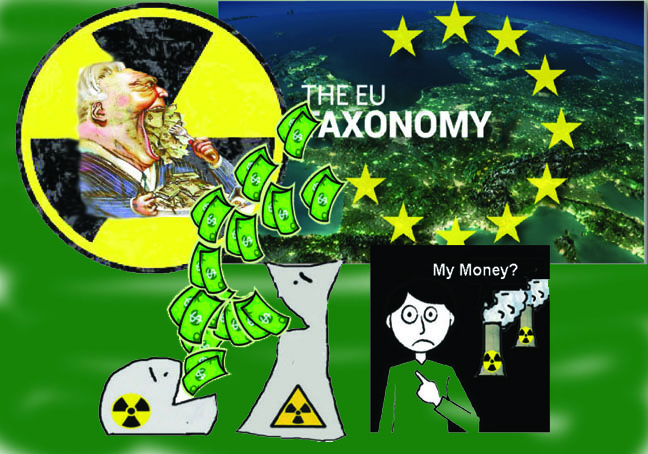
Austria is ready to contest if Europe grants the green label to nuclear and gas. Under pressure from certain European states, the latest version of its “green” label to attract private capital includes gas and nuclear.
Austria, which has banned the atom in its constitution, is negotiating to remove it from this classification and reserves the right “to take legal action” if it does not, confirms diplomat Wolfgang Wagner.
Ouest France 7th Jan 2022
1 This Month


of the week– Nuclear Reactor Information Task Force

14 May – online event From Bombs to Data Centres: the Face of Nuclear Colonialism
To see nuclear-related stories in greater depth and intensity – go to https://nuclearinformation.wordpress.com
-
Archives
- May 2026 (187)
- April 2026 (356)
- March 2026 (251)
- February 2026 (268)
- January 2026 (308)
- December 2025 (358)
- November 2025 (359)
- October 2025 (376)
- September 2025 (257)
- August 2025 (319)
- July 2025 (230)
- June 2025 (348)
-
Categories
- 1
- 1 NUCLEAR ISSUES
- business and costs
- climate change
- culture and arts
- ENERGY
- environment
- health
- history
- indigenous issues
- Legal
- marketing of nuclear
- media
- opposition to nuclear
- PERSONAL STORIES
- politics
- politics international
- Religion and ethics
- safety
- secrets,lies and civil liberties
- spinbuster
- technology
- Uranium
- wastes
- weapons and war
- Women
- 2 WORLD
- ACTION
- AFRICA
- Atrocities
- AUSTRALIA
- Christina's notes
- Christina's themes
- culture and arts
- Events
- Fuk 2022
- Fuk 2023
- Fukushima 2017
- Fukushima 2018
- fukushima 2019
- Fukushima 2020
- Fukushima 2021
- general
- global warming
- Humour (God we need it)
- Nuclear
- RARE EARTHS
- Reference
- resources – print
- Resources -audiovicual
- Weekly Newsletter
- World
- World Nuclear
- YouTube
-
RSS
Entries RSS
Comments RSS
 nuclear-news