Britain’s ”underwhelming” energy plan – ‘Great British Nuclear, with no policies on saving energy, nor energy efficiency
The government announced that a new body called Great British Nuclear will also
be launched to bolster the UK’s nuclear capacity, with the hope that by
2050 up to 24 GW of electricity will come from that source – 25% of the
projected electricity demand.
It has said the focus on nuclear will deliver
up to eight reactors overall, with one being approved each year until 2030.
It also confirmed advanced plans to approve two new reactors at Sizewell in
Suffolk during this parliament. Wylfa in Anglesey and Oldbury in Cumbria
(sic) have also been named as candidates to host either large-scale plants,
smaller modular nuclear reactors, or possibly both.
Environmentalists and many energy experts have reacted with disbelief and anger at some of the
measures in the strategy. They cannot believe the government has offered no
new policies on saving energy by insulating buildings. They say energy
efficiency would immediately lower bills and emissions, and is the cheapest
way to improve energy security.
A Downing Street source said the strategy
was now being see as an energy supply strategy. Campaigners are also
furious that ministers have committed to seeking more oil and gas in the
North Sea, even though humans have already found enough fossil fuels to
wreck the climate. There is a strong welcome, though, for the promise of
more energy from wind offshore with speedier planning consent.
The same
boost has not been offered to onshore wind. Ed Miliband, Labour’s shadow
climate change and net-zero secretary, said: “The government’s energy
relaunch is in disarray. “Boris Johnson has completely caved to his own
backbenchers and now, ludicrously, his own energy strategy has failed on
the sprint we needed on onshore wind and solar, the cheapest, cleanest
forms of homegrown power.
“This relaunch will do nothing for the millions
of families now facing an energy bills crisis,” he added. Liberal Democrat
leader Sir Ed Davey also described the plans as “utterly hopeless”, while
the SNP’s Stephen Flynn called it a “missed opportunity”. Dr Simon
Cran-McGreehin, head of analysis at the Energy & Climate Intelligence Unit,
told the BBC that he also felt “underwhelmed” following the announcement.
BBC 6th April 2022
Questions Abound About Bucha Massacre

The West has made a snap judgment about who is responsible for the massacre at the Ukrainian town of Bucha with calls for more stringent sanctions on Russia, but the question of guilt is far from decided, writes Joe Lauria. By Joe Lauria, Special to Consortium News 4 Apr 22, Within hours of news Sunday that there had been a massacre at Bucha, a town 63 kms north of the Ukrainian capital, the verdict was in: Russian troops had senselessly slaughtered hundreds of innocent civilians as they withdrew from the town, leaving their bodies littering the streets.
Unlike their judicial systems, when it comes to war, Western nations dispense with the need for investigations and evidence and pronounce guilt based on political motives: Russia is guilty. Case closed……………….
voices are now perilously calling for the U.S. to go to war with Russia over the incident. …….. Russia has categorically denied it had anything to do with the massacre.
Where to Start
If there were to be a serious probe, one of the first places an investigator would begin is to map out a timeline of events.
Last Wednesday, all Russian forces left Bucha, according to the Russian Defense Ministry.
This was confirmed on Thursday by a smiling Anatolii Fedoruk, the mayor of Bucha, in a video on the Bucha City Council official Facebook page. The translated post accompanying the video says:
“March 31 – the day of the liberation of Bucha. This was announced by Bucha Mayor Anatolii Fedoruk. This day will go down in the glorious history of Bucha and the entire Bucha community as a day of liberation by the Armed Forces of Ukraine from the Russian occupiers.”
All of the Russian troops are gone and yet there is no mention of a massacre. The beaming Fedoruk says it is a “glorious day” in the history of Bucha, which would hardly be the case if hundreds of dead civilians littered the streets around Fedoruk.
“Russian Defence Ministry denied accusations by the Kiev regime of the alleged killing of civilians in Bucha, Kiev Region. Evidence of crimes in Bucha appeared only on the fourth day after the Security Service of Ukraine and representatives of Ukrainian media arrived in the town. All Russian units completely withdrew from Bucha on March 30, and ‘not a single local resident was injured’ during the time when Bucha was under the control of Russian troops,” the Russian MOD said in a post on Telegram.
What Happened Next?
What happened then on Friday and Saturday? As pointed out in a piece by Jason Michael McCann on Standpoint Zero, The New York Times was in Bucha on Saturday and did not report a massacre. Instead, the Times said the withdrawal was completed on Saturday, two days after the mayor said it was, and that the Russians left “behind them dead soldiers and burned vehicles, according to witnesses, Ukrainian officials, satellite images and military analysts.”
The Times said reporters found the bodies of six civilians. “It was unclear under what circumstances they had died, but the discarded packaging of a Russian military ration was lying beside one man who had been shot in the head,” the paper said. It then quoted a Zelensky adviser, who said:
“’The bodies of people with tied hands, who were shot dead by soldiers lie in the streets,’ the adviser, Mykhailo Podolyak, said on Twitter. ‘These people were not in the military. They had no weapons. They posed no threat.’ He included an image of a scene, photographed by Agence France-Presse, showing three bodies on the side of a road, one with hands apparently tied behind the back. The New York Times was unable to independently verify Mr. Podolyak’s claim the people had been executed.’”
It is possible that on Saturday the full extent of the horror had yet to emerge, and that even the mayor was unaware of it two days before, though photos now show many of the bodies out in the open on the streets of the town, something that presumably would be difficult to miss.
In Bucha, the Times was close to the neo-Nazi Azov Battalion, whose soldiers appear in the newspaper’s photographs. In his piece, McCann suggests that Azov may responsible for the killings:
“Something very interesting then happens on [Saturday] 2 April, hours before a massacre is brought to the attention of the national and international media. The US and EU-funded Gorshenin Institute online [Ukrainian language] site Left Bank announced that:
‘Special forces have begun a clearing operation in the city of Bucha in the Kyiv region, which has been liberated by the Armed Forces of Ukraine. The city is being cleared from saboteurs and accomplices of Russian forces.’
The Russian military has by now completely left the city, so this sounds for all the world like reprisals. The state authorities would be going through the city searching for ‘saboteurs’ and ‘accomplices of Russian forces.’ Only the day before [Friday], Ekaterina Ukraintsiva, representing the town council authority, appeared on an information video on the Bucha Live Telegram page wearing military fatigues and seated in front of a Ukrainian flag to announce ‘the cleansing of the city.’ She informed residents that the arrival of the Azov battalion did not mean that liberation was complete (but it was, the Russians had fully withdrawn), and that a ‘complete sweep’ had to be performed.”
Ukraintsiva was speaking a day after the mayor had said the town was liberated.
By Sunday morning, the world learned of the massacre of hundreds of people. U.S. Secretary of State Antony Blinken said: “We strongly condemn apparent atrocities by Kremlin forces in Bucha and across Ukraine. We are pursuing accountability using every tool available, documenting and sharing information to hold accountable those responsible.” President Joe Biden on Monday called for a “war crimes” trial. “This guy is brutal, and what’s happening in Bucha is outrageous, and everyone’s seen it. I think it’s a war crime.”
The Bucha incident is a critical moment in the war. An impartial investigation is warranted, which probably only the U.N. could conduct. The Azov Battalion may have perpetrated revenge killings against Russian collaborators, or the Russians carried out this massacre. (Once again the Pentagon is dampening the war hysteria, saying it can’t confirm or deny Russia was responsible.)
A rush to judgment is dangerous, with irresponsible talk of the U.S. directly fighting Russia. But it is a rush to judgment that we are getting.
[Update: Satellite images, published after this article appeared by The New York Times, purportedly showing bodies strewn on a street in mid-March, should be considered by an impartial investigation. It cannot be considered at this point as conclusive evidence.]
Joe Lauria is editor-in-chief of Consortium News and a former U.N. correspondent for The Wall Street Journal, Boston Globe, and numerous other newspapers, including The Montreal Gazette and The Star of Johannesburg. He was an investigative reporter for the Sunday Times of London, a financial reporter for Bloomberg News and began his professional work as a 19-year old stringer for The New York Times. He can be reached at joelauria@consortiumnews.com and followed on Twitter @unjoe https://consortiumnews.com/2022/04/04/questions-abound-about-bucha-massacre/
Incompetence of Britain’s leaders, on energy policy
Jonathon Porritt: This is absolutely the right time for a new Energy
Strategy. Unfortunately, we’ve got absolutely the wrong politicians in
charge of it. The combination of Boris Johnson and Rishi Sunak all but
guarantees that the new Energy Security Strategy will fail on most counts.
– In Boris Johnson, we have a careless showman, drawn unerringly to
‘big ticket’ announcements, groomed by a nuclear industry that knows
exactly how to play to these personality defects. – In Rishi Sunak, we
have a man so detached from the reality of most people’s lives that the
prospect of five million UK citizens finding themselves in fuel poverty by
the end of the year means literally nothing.
Careless Johnson and callous
Sunak is a devastating double-act – with the inconsequential figure of
Kwasi Kwarteng lurking around to pick up the pieces.
Jonathon Porritt 5th April 2022
http://www.jonathonporritt.com/prospects-for-energy-security-marred-by-nuclear-fantasies/
The European Commission Platform on Sustainable Finance concludes that nuclear and gas power are not green
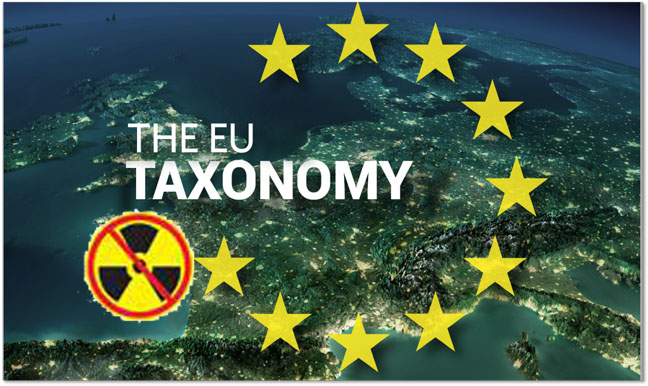
Nuclear and gas power ‘not green’, say EC experts https://environment-analyst.com/global/107948/nuclear-and-gas-power-not-green-say-ec-experts
EC Platform on Sustainable Finance delivers final report on extending sustainable finance rules across the whole EU economy, and includes a bombshell.
A European Commission (EC) expert group has made wide-ranging recommendations on extending the scope of the EU Taxonomy – the classification system that defines environmentally sustainable economic activities – across the European economy.
The EC Platform on Sustainable Finance’s final report will inform important new EU legislation, due in the autumn, which will in turn guide future policy and investment decisions.
The report concludes that gas and nuclear power cannot be described as ‘green’ under the taxonomy’s ‘do no significant harm’ (DNSH) rules – although leaves the final decision to the European Commission.
The expert panel’s final report considers 12 sectors, including manufacturing, transport, agriculture, fishing, building and disaster risk management. It is still finalising criteria for forestry and agriculture.
The report proposes a ‘traffic light’ system, listing red activities requiring urgent transition to avoid significant harm, amber activities that could more easily qualify for taxonomy-recognised investment, and green, low environmental impact (LEnvI) activities.
Welcoming the report, Sebastien Godinot, senior economist at WWF European policy office, commented: “The platform’s recommendations are a crucial step towards the much-needed ‘biodiversity taxonomy’, aimed at driving billions into nature-friendly activities.”
He added: “However, WWF is concerned that some criteria for critical sectors like forestry and agriculture are not [yet] included. The platform must publish recommendations for them no later than May.”
The EU Taxonomy, which came into force earlier this year, provides the technical underpinning for a number of interlinked EU regulations on sustainable finance products, disclosures and reporting. The taxonomy’s purpose is to increase financial flows towards green activities and to reduce green-washing by setting science-based criteria for performance. It is hoped that the taxonomy will become a global ‘gold standard’ for green finance.
The taxonomy is governed by the Taxonomy Regulation, which came into force on 12 July 2020 and identifies activities that improve or diminish six objectives (climate change mitigation, climate change adaptation, sustainable water resources, transitioning to a circular economy, pollution prevention and control and protecting biodiversity and ecosystems). Article 26.2(a) of this regulation requires the commission to report on applying its rules across the wider economy and to define sectors that have no environmental impact or are outside its scope.
At the same time as the taxonomy came into effect, the EC presented the Taxonomy Climate Delegated Act (TCDA). In response to restrictions to Europe’s natural gas supplies at the beginning of the year, the legislation was controversially complemented by a second Delegated Act, which defined nuclear and natural gas powered energy as ‘green’. This caused widespread objections from environmental and climate change groups.
The TCDA is being scrutinised by the European Parliament and the Council, before going back to the EC. The EC is expected to draft a new Delegated Act, building on the platform’s latest recommendations, in the autumn. This should resolve whether nuclear and gas-powered energy will count as sustainable for policy and investment purposes in the EU.
While asserting that nuclear and gas power are not green, the platform’s report gives the commission ‘wiggle room’ by suggesting a “systems-wide approach to the low-carbon transition”.
It says: “The extended Taxonomy framework would acknowledge the reasons why these activities are not green, explaining why, in some cases, [they] may be significantly harmful, but also showing that there is potential for valid and urgent transitions away from significantly harmful performance.”
Nuclear waste management: Is Finland’s Onkalo facility safe?
Nuclear waste management: Is Finland’s Onkalo facility safe? https://www.downtoearth.org.in/news/science-technology/nuclear-waste-management-is-finland-s-onkalo-facility-safe–82252 6 Apr 22,
The facility, set to begin operation in 2024, isn’t based on a foolproof concept
Finland, a nuclear energy champion, claimed it has figured out how to tackle one of the bigger issues with nuclear energy: Safely managing radioactive waste.
The country plans to store its nuclear waste in an underground facility called Onkalo. The structure, named after the Finnish word for “pit”, is a 500-meter-deep underground disposal facility designed to store used nuclear fuel permanently.
The deep geological repository is usually built in places containing a stable rock.Finland can become the first to commission a plant to permanently store spent nuclear fuel. The idea is to encase the waste in corrosion-resistant copper canisters. These will be further encapsulated in a layer of water-absorbing clay. The setup will be buried in an underground tunnel.
The facility is now equipped with 500 sensors to monitor the functioning of the entire system, according to VTT Technical Research Centre of Finland Ltd, a state-owned company and one of the contributors to the project.
“Monitoring brings evidence that the repository will be keeping the outside world safe from the nuclear fuel waste,” Arto Laikari, senior scientist from VTT, said. The state-owned company’s collaborator Posiva, a Finnish nuclear waste management organisation, has submitted the operating license for the facility and is awaiting approval.
In 2023, Posiva will do a final trial run of the disposal mechanism but without radioactive material, Erika Holt, project manager from VTT, told Down To Earth. It is expected to begin operations in 2024.
Problem of disposing nuclear waste
For years, the nuclear industry has been trying to find solutions to the waste problem. They are generated at various steps during the nuclear life cycle: Mining uranium ore, producing uranium fuel and generating power in the reactor.
The waste can remain radioactive for a few hours, several months or even hundreds of thousands of years. Depending on the extent of radioactivity, nuclear wastes are categorised as low-, intermediate- and high-level waste.
About 97 per cent of the waste is either low- or intermediate-level. The remaining is high-level waste, such as used or spent uranium fuel.
A 1,000-megawatt plant creates about 30 tonnes of high-level nuclear waste every year, according to the International Atomic Energy Agency.
“Even at low levels, exposure to this waste will be harmful to people and other living organisms as long as it remains radioactive,” Ramana explained.
Global endeavours
Some nations are storing waste on-site. But it carries the risk of radioactive leakage. In the United States, for instance, spent fuel is stored in a concrete-and-steel container called a dry cask, according to the US Energy Information Administration.
India and a handful of other nations reprocess about 97-98 per cent of the spent nuclear fuel to recover plutonium and uranium, according to data from the Bhabha Atomic Research Centre.
India also recovers other materials like caesium, strontium and ruthenium, which finds application as blood irradiators to screen transfusions, cancer treatment and eye cancer therapeutics, respectively, according to the research institute.
The remaining 1-3 per cent end up in a storage facility. India also immobilises the wastes by mixing them with glass, which is kept under surveillance in storage facilities.
But there are problems with this approach as well. Except for the plutonium and uranium, all the radioactive material present in the spent fuel is redistributed among different waste streams, Ramana said. “These enter the environment sooner or later.”
The plutonium and uranium intended for reuse in other nuclear reactors will also turn into radioactive waste, he added.
Nations like Finland, Canada, France and Sweden are also looking at deep geological repositories to tackle spent nuclear fuel wastes.
In January 2022, the Swedish government greenlit an underground repository for nuclear waste. Construction in Sweden will take at least 10 more years, Johan Swahn, director of MKG Swedish NGO Office for Nuclear Waste Review, a non-governmental environmental organisation, said.
Finland can share its experience with colleagues and partners worldwide, Holt said. “But each country and programme must have their own solutions. Worldwide, we work together to show nuclear energy (and the holistic views for responsible waste management) are viable for meeting CO2 targets,” she added.
Is the approach safe?
Experts associated with the project said that 40-years of theoretical and lab-based studies suggest that the geological repository is safe.
The bedrock provides a natural barrier to protect from radioactive release to the environment, such as water bodies and air, Holt explained.
The use of clay and copper provides a protective layer to ensure no release due to extreme conditions like earthquakes.
But Ramana argues that theoretical safety studies are not foolproof. There are significant uncertainties stemming from various long-term natural processes. These include climate change and the unpredictability of human behaviour over these long periods of time, he added.
Besides, design failure could undermine claims about safety, the expert noted. For instance, a few scientists fear that copper canisters can become corrosive and crack.
Finland’s team chose copper because it corrodes slowly. But Peter Szakálos, a chemist at the KTH Royal Institute of Technology in Stockholm, is not quite sure.
In a 2007 study, Szakálos and his team observed that copper could corrode in pure, oxygen-free water. “It’s just a matter of time — anything from decades to centuries — before unalloyed copper canisters start to crack at Onkalo,” he told Science journal.
On February 14, 2014, radioactive materials such as americium and plutonium leaked out of the Waste Isolation Pilot Plant, a deep geological long-lived radioactive waste repository, following an accident. The facility dealt solely with a special class of wastes from nuclear weapons production.
“If a failure like this happened within two decades of opening the repository, what are the odds that such failures won’t happen over the millennia that these repositories [Finland’s Onkalo] are supposed to operate safely?”
Both the Finnish project and the Swedish decision are very important for the international nuclear industry because the latter can point to these facilities to prove the nuclear waste problem is solved, Swahn said. “But it is very uncertain whether copper as a container material is a good idea.”
The projects may still fail as the understanding of how copper behaves in a repository environment is still developing, the expert added.
Greenpeace maps Ukraine’s nuclear power risks
The extent of the nuclear threat posed by Vladimir Putin’s illegal
invasion of Ukraine is unprecedented, new Greenpeace International mapping
and technical analysis shows. Created with data from the Institute for the
Study of War and the Centre for Information Resilience among others, and
displaying the proximity of Russian troops and military hardware to each of
Ukraine’s 15 commercial nuclear reactors over time, the interactive map
provides a chilling interactive visualisation of the potential for nuclear
catastrophe at regular intervals since the bloody invasion began on
February 24.
Greenpeace 6th April 2022
” Renewable Energy Foundation (REF)” – strongly linked to anti-wind power lobby

Charity linked to UK anti-onshore wind campaigns active again. While the
name of the Renewable Energy Foundation (REF) suggests it is a charity
dedicated to promoting low-carbon electricity, it appears to spend most of
its time campaigning against onshore wind.
When it was founded in 2004,
with the TV personality Noel Edmonds as its chair, the organisation was
clear it wanted to fight against the “grotesque political push” for
onshore renewable energy in the UK. It styles itself on its website as “a
registered charity promoting sustainable development for the benefit of the
public by means of energy conservation and the use of renewable energy”.
However, many in the energy sector believe the charity to be full of
anti-wind lobbyists. In 2008, the REF had what it described as a
“dialogue” with the Charity Commission over whether it was violating
its charitable status by being too political in its campaigning. The
Charity Commission said it assessed the complaint relating to the REF’s
campaigning activities and determined there was no evidence that it was not
charitable, but also provided guidance about how to achieve its objectives
as an organisation.
The REF has strong links to a group accused of climate
science scepticism, the Global Warming Policy Foundation, started by the
former chancellor Nigel Lawson, who has denied global heating is a problem.
Prof Michael Kelly, a trustee of the REF also has a position on the board
of the GWPF. John Constable, an adviser to the GWPF, has been quoted as an
REF spokesperson and was previously its director of policy and research.
Constable answered the Guardian’s questions for this article on behalf of
the REF.
While the REF has been relatively quiet in recent years, growing
pressure on the government to support wind energy to help solve the energy
crisis seems to have led to it becoming more active again. In recent weeks,
the charity has provided anti-onshore wind research to the Telegraph and
Daily Mail. Colin Davie, a trustee of the REF, has appeared on Radio 4’s
Today programme to oppose onshore wind. Constable added that the REF had
“no blanket policy” on renewables – but that the charity did not see
them as a large part of the net zero strategy. He added: “Each proposal
must be judged on its own merits, and providing that local environmental
concerns offer no obstacle, niche applications may be suitable, as they may
be for all renewables.”
Guardian 5th April 2022
Over 70 Russian soldiers suffering from radiation exposure at Chernobyl nucler site
| Over 70 Russian soldiers exposed to radiation at Chernobyl: Ukraine, KYODO NEWS 6 Apr 22, – About 75 Russian soldiers are receiving medical treatment in Belarus after being exposed to radiation during their temporary control of the Chernobyl nuclear power plant in Ukraine, according to Ukraine’s Energy Minister German Galushchenko. Galushchenko said in an online interview Tuesday that the troops apparently suffered from radiation after digging around the grounds of the plant, the site of a 1986 disaster, to defend themselves from the Ukrainian military.The troops were affected “very heavily and are in a very difficult situation and now (being treated) in clinics” in Belarus, Galushchenko said, citing information made available. “I can’t imagine you could order someone to dig into” areas contaminated with “the high level of radiation with signs saying ‘Don’t come in. Don’t stay near,'” he said, speaking in English.”They’re soldiers, and they just follow the orders.”Galushchenko said Ukraine has regained complete control of the nuclear power plant…………….. https://english.kyodonews.net/news/2022/04/33e77e951e22-over-70-russian-soldiers-exposed-to-radiation-at-chernobyl-ukraine.htm |
Uzbekistan: Nuclear deal with Russia still on the table despite sanctions
Uzbekistan: Nuclear deal with Russia still on the table despite sanctions, eurasianet, Even if Rosatom is not targeted by sanctions, its future projects could still be affected. Apr 6, 2022 When Uzbekistan fired the starting pistol four years ago on plans to go nuclear as a way to address the chronic energy shortages that plague it every winter, the world was a different place.
Russian President Vladimir Putin was not an international pariah. And Shavkat Mirziyoyev, his Uzbek counterpart, was courting him as a guest of honor in Tashkent.
The high point of Putin’s visit was when he and Mirziyoyev symbolically inaugurated the start to a project to build an $11 billion nuclear power plant in an area just east of Bukhara. The work was to be done by Russia’s state-owned Rosatom, a commanding presence in the global nuclear power industry, and to be funded with loans from Moscow………
When Uzbekistan fired the starting pistol four years ago on plans to go nuclear as a way to address the chronic energy shortages that plague it every winter, the world was a different place.
Russian President Vladimir Putin was not an international pariah. And Shavkat Mirziyoyev, his Uzbek counterpart, was courting him as a guest of honor in Tashkent.
The high point of Putin’s visit was when he and Mirziyoyev symbolically inaugurated the start to a project to build an $11 billion nuclear power plant in an area just east of Bukhara. The work was to be done by Russia’s state-owned Rosatom, a commanding presence in the global nuclear power industry, and to be funded with loans from Moscow.
…………………… “It is absolutely the case that projects that have not yet been completed or that still are in the design stages are extremely vulnerable to sanctions difficulties and interference, even if Rosatom is not itself presently subject to such sanctions,” Richard Nephew, the director of the International Security Initiative at Columbia University’s Center on Global Energy Policy, told Eurasianet by email. “Sanctions targeting financial transactions, technology transfers and the like will all undermine efforts to engage in and complete such projects.”
While there are clear risks to proceeding with the project, there are risks to scrapping it, too.
Aside from the certainty that cancellation would antagonize a belligerent Russia, finding a new partner to build a plant that Mirziyoyev said in 2018 would be completed within a decade would take time.
So is building the Russo-Uzbek nuclear power station still viable?
“Possibly, though given the long lead times required to develop and implement nuclear reactor projects, by the time such a project were to begin, it could be covered by sanctions,” said Nephew. “In general, it would not be advisable to start development of such projects now, given this risk.” https://eurasianet.org/uzbekistan-nuclear-deal-with-russia-still-on-the-table-despite-sanctions
Ensuring radiation protection: European Commission takes Portugal to Court to guarantee citizens’ protection from ionising radiation-exposure
Ensuring radiation protection: Commission takes Portugal to Court to guarantee citizens’ protection from ionising radiation-exposure risks https://ec.europa.eu/commission/presscorner/detail/en/IP_22_2215
The Commission is taking legal steps to ensure the protection of citizens, workers and patients against the dangers arising from exposure to ionising radiation. Today, the Commission decided to refer Portugal to the Court of Justice of the European Union for failing to fully transpose the EU’s revised Basic Safety Standards Directive (Council Directive 2013/59/Euratom) into national legislation.
Member States were required to transpose the Directive by 6 February 2018. The Commission has been providing continuous support to the Member States to properly transpose the rules. In November 2019, the Commission sent a reasoned opinion to Portugal requesting it to notify to the Commission all of its transposition measures for the Directive. Since then, Portugal has notified additional transposition measures, but has not yet established a national action plan addressing long-term risks from exposures to radon, as required by the Directive. Therefore, the Commission is referring Portugal to the Court of Justice today.
Background
The Euratom Treaty provides the Commission with the legal basis to establish basic safety standards to protect the health of workers and the general public against dangers arising from ionising radiation. Once fully implemented, the Basic Safety Standards Directive will ensure the highest level of radiation protection of workers, patients and the general public across the EU.
The Directive, which was first adopted in 1959, sets out the requirements on emergency preparedness and response in case of radiological emergency, and provides for radiation protection education, training and provision of information to the public, among others. Emergency preparedness and response provisions were strengthened following the Fukushima nuclear accident in Japan in 2011. The latest revision from December 2013 took account of the scientific and technological progress since the 1990s, and consolidated five earlier legal acts into a single piece of legislation.
Chancellor Olaf Scholz reiterated Germany’s determination to close down all nuclear power stations
Scholz Shoots Down Appeal to Reverse Germany’s Nuclear Exit, Bloomberg, German Power Sources, Michael Nienaber and Arne Delfs, 6 April 2022,
Chancellor Olaf Scholz reiterated his opposition to reversing Germany’s exit from nuclear power to help cut reliance on Russian energy, saying the technical challenges would be too great.
Germany is rushing to end its heavy dependence on Russian fossil fuels following the invasion of Ukraine but the process has been complicated by the decision by former Chancellor Angela Merkel’s previous government to shut down the country’s nuclear power plants. The move was prompted by the disaster at Fukushima, Japan in 2011 and the remaining three reactors are due to go off line this year.
Does EDF really need even more subsidies for Sizewell C nuclear project?
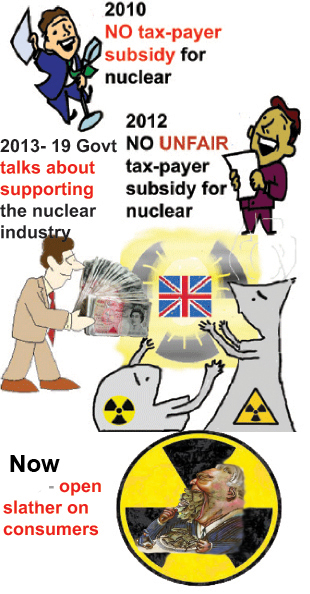
By doing so, our beloved leaders are ensuring
that Sizewell C will now have subsidised development, subsidised
construction, subsidised power production and subsidised waste management,
for a project still being run by Europe’s most subsidised company,
Electricité de France. Free markets? Don’t you believe it.
Does EDF really need even more subsidies for Sizewell C?even more subsidies for Sizewell C? Under new
legislation, our normally parsimonious government has just earmarked a
further £1.7 billion towards meeting their (uncosted) promise to ensure
that another new nuclear fission power plant may possibly begin being built
before the next election.
By doing so, our beloved leaders are ensuring
that Sizewell C will now have subsidised development, subsidised
construction, subsidised power production and subsidised waste management,
for a project still being run by Europe’s most subsidised company,
Electricité de France. Free markets? Don’t you believe it.
Electrical Review 6th April 2022 https://electricalreview.co.uk/2022/04/06/does-edf-really-need-even-more-subsidies-for-sizewell-c/
 | |||
Ukraine is ground zero for the expansion of the U.S.-Russia proxy war, (and the war industry is jubilant)

This six-week war surely has left the war industry jubilant. In Washington, Biden recently proposed what would be the largest U.S. “defense” budget in history, more than $813 billion.
The U.S. Has Its Own Agenda Against Russia Ukraine is ground zero for the expansion of the U.S.-Russia proxy war. The Intercept, Jeremy Scahill, April 2 2022 Ever since Vladimir Putin launched his invasion of Ukraine, there has been an unprecedented cohesion of messaging emanating from the U.S. government, its NATO and other European allies, and large segments of the Western media establishment. As massive quantities of weapons pour into Ukraine, there has been consistent media and political agitation for President Joe Biden and other Western leaders to “do more” or answer for why they are not further escalating the situation, including through the imposition of a no-fly zone.
The White House smells Putin’s blood in the waters of his disastrous invasion. The flow of weapons, the sweeping sanctions, and other acts of economic warfare are ultimately aimed not just at defending Ukraine and making the regime pay for the invasion in the immediate present, but also setting in motion its downfall. “For god’s sake, this man cannot remain in power,” Biden said during his recent visit to Poland. The White House sought to walk back the line and clarify that it did not constitute a change in policy but was merely an expression of the president’s righteous anger. The kerfuffle over what Biden really meant is less important than the very public actions of the U.S. and its allies.
It should not be assumed that the strategies and actions being employed by Washington and its allies in their proxy war against Moscow will always be in the best interest of Ukraine or its people. Likewise, Ukraine’s calls for military support and action from the West — however justifiable and sincere they are — may not be in the best interest of the rest of the world, particularly if they increase the likelihood of nuclear war or World War III. The desire to avoid this scenario by advocating for a negotiated solution to the war that addresses Russia’s stated concerns or its rationale for the invasion is not a capitulation to Putin and it is not appeasement. It is common sense.
While the fate of Ukraine and the lives of its civilian population are evoked in calls for more escalatory action from the West, it is these very people who will suffer and die in large numbers every day the war drags on. Western media coverage is often crafted to portray only one outcome as acceptable: a decisive Ukrainian victory, in which the government of Volodymyr Zelenskyy emerges from the horrors of the Russian invasion in complete control of all of its territory, including Crimea and the Donbas region. Ukraine, as a free and independent state, should be free to join NATO, and Russia has no legitimacy in questioning the implications of such a move. Advocacy for accepting anything short of this outcome is a victory for Russia and therefore traitorous to even consider………………
The routine belligerence exhibited by countless politicians, pundits, and media figures about taking the fight to Putin in Ukraine is largely chickenhawkery. …………
when you listen to the fine details of Ukraine’s own negotiators and leaders, it’s clear that they understand that the war does not end with the swift annihilation of Putin, the downfall of Russia, or with a clean and complete Ukrainian retention of its territorial sovereignty. That’s why Zelenskyy’s government has acknowledged that the issue of NATO membership, a formalized neutrality status, and an internationally brokered process on the status of Crimea will all be on the table.
There has been much noise about Russia’s recent indications that it was drawing down its military actions in parts of Ukraine, particularly around the capital Kyiv. The U.S. and NATO have acknowledged a partial drawdown but asserted that Russian forces appear to be repositioning, likely for use in the east. Russia has also said as much itself. Moscow’s position is that “the main goals of the first stage of the operation have generally been accomplished.”
There is a peculiar dynamic surrounding the analysis of Putin’s comments on his intentions for Ukraine. He is accused of lying when his remarks undermine the U.S. narrative, but we are told to believe he is absolutely telling the truth when his pugnacious threats bolster the U.S. position.
Whether or not Putin intended to seize all of Ukraine and become an imperial occupier, he did seem to believe his invasion could cause the Ukrainian government to collapse and its leaders to flee in fear. That did not happen. Instead, U.S. and NATO-armed Ukrainian forces outside Kyiv have fought the Russian troops ferociously and inflicted significant losses against them on the battlefield. At the same time, by opening multiple fronts, Moscow forced Ukraine to defend vital territory, including its capital. This strategy exacted a tremendous human toll on the Russian military, but it did take some heat off Russian forces in the Donbas territories in the east, which Putin has cited as his territorial priority in the operation.
But the question of Putin’s original intent — to take Kyiv or to use that threat as a strategy to spread Ukraine’s defenses thin — is now largely irrelevant except in the rhetorical battlespace focused on Russian weakness, incompetence, or failure.
The most contentious issue in the negotiations to end the war will likely have little to do with NATO membership. Zelenskyy has already conceded that to end the war Ukraine will have to drop that ambition and adopt a neutral and nonaligned status, though he does want to continue the pursuit of joining the European Union. Russia will certainly oppose any attempts for Kyiv to win a backdoor “Article 5” status that could trigger defense of Ukraine by Western powers in cases of future military actions by Moscow. Ukraine has suggested that it would also want China and Turkey to be a part of such a guarantee, not just adversaries of Russia. There are indications that the U.S. doesn’t think the proposal is viable, and Britain’s deputy prime minister bluntly stated, “Ukraine is not a NATO member,” adding, “We’re not going to engage Russia in direct military confrontation.”
Based on the reports out of the recent negotiations in Turkey, it seems that the most incendiary questions will revolve around the breakaway republics in the Donbas region. Ukraine has effectively said it wants a return to the pre-invasion status quo, which would mean erasing the Putin-recognized declarations of independence from Donetsk and Luhansk. Russia, which is currently expanding its control over the Donbas and seizing more territory, is unlikely to agree. This dynamic more than any other could delay or block any meaningful resolution and would be a central focus in a potential summit between Zelenskyy and Putin.
Once there is a brokered agreement, the flow of Western weapons into Ukraine and Russian military support for the separatists will result in a constant state of war footing for many years to come. A cloud portending more fighting and bloodshed will remain hovering over eastern Ukraine. If U.S. and other NATO troops resume their training exercises in Ukraine, as Biden has indicated they should, this means that there will always be a risk of incidents that could quickly escalate.
This six-week war surely has left the war industry jubilant. In Washington, Biden recently proposed what would be the largest U.S. “defense” budget in history, more than $813 billion. Germany and other European countries are publicly committing to buying and selling more weapons and spending more on defense. NATO is raising the prospect of expanding its permanent military presence in Europe and Washington is reasserting its political dominance over Europe on security matters.
But despite the image of global unity of cause being promoted by the U.S. and its NATO allies, several large and powerful nations, including China, India, Indonesia, and NATO member Turkey, are not marching to Washington’s drumbeat — not in the proxy-war business and not in the policy of sanctioning and vilifying Russia.
The overt war in Ukraine will have to end at the negotiating table. But the proxy war is escalating and will have consequences that extend far beyond the current battlefield. https://theintercept.com/2022/04/01/russia-ukraine-proxy-war-washington-diplomacy/
Ending Ukraine’s suffering. The decision to negotiate this is up to Ukraine, not USA
|
Putin, The Nuclear Threat, And Ending The War: To Squeeze Or Not To Squeeze? Michael Krepon, Forbes, 4 Apr 22,
To squeeze or not to squeeze. That is the question that tries analytically minded souls…………..
………..The majority view among the punditocracy counsels a negotiated settlement. One concern is that if Putin feels cornered, he could do something everyone will regret — like using a nuclear detonation in war. Even if he doesn’t, the longer this war lasts, the more Ukrainian city blocks will be reduced to rubble.
………….most analysts argue that we ought to give Putin a face-saving exit, which means conceding Ukrainian territory to Russia. How much territory to concede would be a hard issue in any negotiated settlement.
………. the deciding vote on the question of to squeeze or not to squeeze belongs to the government and people of Ukraine. It’s their land, their casualty counts, and their cities. NATO is obliged to take its cues from Volodymyr Zelensky. https://www.forbes.com/sites/michaelkrepon/2022/04/04/putin-the-nuclear-threat-and-ending-the-war-to-squeeze-or-not-to-squeeze/?sh=51ec25776109
Elon Musk joins the frenzy for small nuclear reactors in Wales, despite local opposition to nuclear development.

A company backed by investor in Elon Musk’s businesses is the latest to
say that it wants to build a nuclear power plant in Wales. Last Energy is
now the third company that wants to build nuclear power plants in Wales,
having settled on a not yet named site within the country.
They would join a Rolls-Royce led consortium who have mooted Wylfa on Anglesey and
Trawsfynydd in Gwynedd as the locations of new modular reactors. US nuclear
company Westinghouse have also put together a consortium with construction
group Bechtel to revive plans for two nuclear reactors at Wylfa since
Hitachi, a Japanese conglomerate, abandoned their own plans in 2019.
According to the Sunday Telegraph, Last Energy’s plans are very similar
to those of Rolls-Royce. They want to build a first “mini-nuclear”
power plant in Wales by 2025, as part of a plan to spend £1.4bn on 10
reactors by the end of the decade. Elon Musk, who is the world’s richest
person with assets worth an estimated £220bn, said on Twitter last month
that he was keen on investing in nuclear energy.
More nuclear power at Wylfa is not without its critics with campaign groups CADNO and PAWB among
the local opposition. Writing for Nation.Cymru, Dylan Morgan of PAWB
(People Against Wylfa B) warned that “nuclear power is a dirty, outdated,
dangerous, vastly expensive technology which threatens both human and
environmental health”. “It would also steal much-needed resources from
renewable technologies which are cheaper, much quicker to build and more
effective to combat the effects of climate change.”
Plaid Cymru leader Adam Price, whose party currently controls Anglesey Council, also spoke out
against nuclear power last week, calling it “the wrong answer” to
Wales’ energy needs. “We do not support nuclear power. It’s the wrong
answer. Renewables absolutely is the way to go. And I fear that, you know,
nuclear power, very expensive and unnecessary distraction,” he said.
1 This Month


of the week– Nuclear Reactor Information Task Force

14 May – online event From Bombs to Data Centres: the Face of Nuclear Colonialism
To see nuclear-related stories in greater depth and intensity – go to https://nuclearinformation.wordpress.com
-
Archives
- May 2026 (180)
- April 2026 (356)
- March 2026 (251)
- February 2026 (268)
- January 2026 (308)
- December 2025 (358)
- November 2025 (359)
- October 2025 (376)
- September 2025 (257)
- August 2025 (319)
- July 2025 (230)
- June 2025 (348)
-
Categories
- 1
- 1 NUCLEAR ISSUES
- business and costs
- climate change
- culture and arts
- ENERGY
- environment
- health
- history
- indigenous issues
- Legal
- marketing of nuclear
- media
- opposition to nuclear
- PERSONAL STORIES
- politics
- politics international
- Religion and ethics
- safety
- secrets,lies and civil liberties
- spinbuster
- technology
- Uranium
- wastes
- weapons and war
- Women
- 2 WORLD
- ACTION
- AFRICA
- Atrocities
- AUSTRALIA
- Christina's notes
- Christina's themes
- culture and arts
- Events
- Fuk 2022
- Fuk 2023
- Fukushima 2017
- Fukushima 2018
- fukushima 2019
- Fukushima 2020
- Fukushima 2021
- general
- global warming
- Humour (God we need it)
- Nuclear
- RARE EARTHS
- Reference
- resources – print
- Resources -audiovicual
- Weekly Newsletter
- World
- World Nuclear
- YouTube
-
RSS
Entries RSS
Comments RSS
 nuclear-news