Nuclear Power: Private Sector -Question for UK government
Question for Department for Energy Security and Net Zero
UIN HL13206, tabled on 18 December 2025
Lord Spellar: To ask His Majesty’s Government when they intend to publish a new framework for a private sector route to market for advanced nuclear
technologies.
Lord Vallance: The government will provide a framework that
will set out a pathway for privately led advanced nuclear projects, this framework will be published early this year.
Hansard 6th Jan 2026 https://questions-statements.parliament.uk/written-questions/detail/2025-12-18/HL13206
The French Resistance at Bure: the campaign to oppose a nuclear waste dump.

Richard Outram, NFLA Secretary, 6 January 2026
Introduction.
The outline for this briefing was first written almost two years ago for British and Canadian campaigners working collaboratively in opposing plans to establish high level radioactive waste repositories in their respective nations, either an off-shore and undersea Geological Disposal Facility (UK) or an inshore and underground Deep Geological Repository (Canada).
It was intended to raise their awareness of the decades long struggle waged by colleagues against the similar Cigéo Project under development in France.
Contrary to the positive articles published by Nuclear Waste
Services Community Partnerships and puff pieces that have appeared in the pro-nuclear Cumbrian media all is not ‘sweetness and light’, for there have been public protests involving local people and environmental activists against this project for decades.
Protests have often been opposed by police using tear gas, water cannons, and stun grenades to disperse demonstrators. Authorities maintain a heavy police presence in the area, and multiple injuries have been reported on both sides during serious confrontations. The French state has also resorted to spying and the wholesome clearance and destruction of protestors’ camps.
This then is a background paper to the campaign in opposition to the Cigéo Project, and the tactics employed by the French State and Police in opposing them…………………………
Lengthy detailed history. with excellent photos and graphics.
Conclusion.
With sections of the media reporting that the British Government is looking to abandon the ‘consent based’ approach, and with the former Nuclear Minister suggesting that such a move is inevitable, there must be concerns that a nuclear waste dump might eventually be imposed on a wholly unwilling community in the UK.
Such an announcement would most likely lead to more robust public opposition. Could this lead in turn to the UK Government looking to resort to the heavy-handed policing seen at Bure?
Although UK police services have historically operated based on consent, this is perhaps less fanciful than it might appear. Ministerial approval has already been given to deploy armed officers of the Civil Nuclear Constabulary at national energy infrastructure sites outside of nuclear power stations and Ministers announced as part of the 2025 Defence Review that an armed auxiliary civilian guard force would be created for a similar purpose.
If the UK Government does move away from a ‘consent-based approach’ to GDF siting, Bure may provide a salutary lesson for an unwilling, and disenfranchised, community in the UK faced with the prospect of a highlevel nuclear waste facility being imposed by the British State.
Forewarned is forearmed. https://www.nuclearpolicy.info/wp/wp-content/uploads/2026/01/A446NB332-The-French-Resistance-at-Bure-the-campaign-to-oppose-a-nuclear-waste-dump-Jan-2026.pdf
Babcock to provide dock for new Dreadnought nuclear subs: will they be carrying nuclear weapons?
By Ally McRoberts, Dunfermline Press 6th Jan 2026
PREPARATIONS are underway in Rosyth for a contingent docking facility to accommodate the next generation of nuclear submarines.
Dunfermline and Dollar MP Graeme Downie had asked about the planned timescale for the work which will see the Dreadnought class berth at the yard during sea trials.
Rosyth will “bridge a gap” by offering a temporary home for the new subs, and last month the Ministry of Defence told local councillors they will not reveal if any of the boats that need repairs or maintenance will be carrying nuclear weapons……………………………………………..
“For operational security reasons further details cannot be released as to do so could be used to undermine the security and capability of our Armed Forces.”
……………………The Royal Navy’s new subs, the Dreadnought class, will be launched from Barrow-in-Furness towards the end of this decade.
The vessels will be maintained at Faslane, however the site on the Clyde won’t be ready until the mid 2030s……………………………
At last month’s South and West Fife area committee, Grant Reekie, head of radioactive waste and health physics at Babcock, had explained: “We have been asked to provide a contingent facility by the MoD to bridge a gap of submarines coming into service in late 2020s from 2029 through to mid 2030s when they will no longer be required as it will be done in Faslane.
………………At the same meeting the MoD told councillors they will not reveal if nuclear weapons will be aboard submarines being repaired at the yard.
They also confirmed that local residents would be given potassium iodate tablets to block radiation in the event of an emergency. https://www.dunfermlinepress.com/news/25743485.babcock-provide-dock-new-dreadnought-nuclear-subs/
A game of chicken between the US and Denmark
The people of Greenland are merely pawns on a neo-colonial chessboard
Ian Proud, Jan 08, 2026, https://thepeacemonger.substack.com/p/a-game-of-chicken-between-the-us?utm_source=post-email-title&publication_id=3221990&post_id=183816648&utm_campaign=email-post-title&isFreemail=true&r=1ise1&triedRedirect=true&utm_medium=email
Trump’s attempt to claim Greenland as his own is running up against plucky Denmark. This is a David v Goliath game of chicken in which Trump hopes the Danes will back down and they, in turn, are waiting Trump out, hoping that his increasingly unhinged foreign policy leads to a change in power in 2029, whereupon the issue will go away.
Until then, the people of Greenland will remain pawns on a neo-colonial chessboard.
Even though they’ll get no support from European military powers, Denmark should call Trump’s bluff over military action and signal a willingness to defend, even though they would be quickly defeated. Their biggest ally is US public opinion.
But whatever happens, the Greenlanders have the right to self-determination under the 2009 Act and may ultimately be swayed by Trump’s cash.
New roads police team for major construction work
Alice Cunningham, BBC 4th Jan 2026, Suffolk
A police force is hiring a road team to escort abnormal loads heading to and from nationally significant infrastructure projects such as Sizewell C nuclear power station.
Suffolk Police said it was recruiting a designated abnormal indivisible loads (AIL) team that would consist of police motorcyclists.
It envisaged the team would work with several projects for several years, and noted that its current project with the new Sizewell C nuclear plant near Leiston was for 12 years.
Chief Constable Rachel Kearton said the “uplift required to support the policing element of the Sizewell C development has been secured through the planning process and paid for by the Sizewell C developer”……………………a “carefully co-ordinated roads policing provision” was in place to ensure safe movement of the abnormal loads to and from Sizewell.
The UK government, which is the largest shareholder in Sizewell C Limited, is building a new two-reactor nuclear power station on the coast next to the Sizewell A and B sites, that could power the equivalent of about six million homes and will generate electricity for 60 years.
Permission for the project was granted in July 2022 before the government gave its final funding approval last year…………………. https://www.bbc.com/news/articles/cddg773172jo
Russia-US nuclear pact set to end in 2026 and we won’t see another
After the New START treaty expires in February, there will be no cap on the number of US and Russian nuclear weapons – but some are sceptical about whether the deal actually made the world safer
By Matthew Sparkes, New Scientist, 30 December 2025
In February 2026, for the first time in decades, there will be no active treaty limiting the size of the US and Russian nuclear arsenals. Experts are divided on whether the New START treaty genuinely made the world safer, but there is far more agreement on one thing: a replacement is unlikely.
The US and Russia first agreed to place limits on their nuclear weapons and allow each to inspect the other’s stockpiles with the START I treaty in 1991, and this was succeeded by New START in 2011. In 2021, Joe Biden and Vladimir Putin agreed to extend the treaty by five years. It is now due to expire on 5 February and talks on a replacement have faltered………………….(Subscribers only) https://www.newscientist.com/article/2504635-russia-us-nuclear-pact-set-to-end-in-2026-and-we-wont-see-another/
Russia Hands US Evidence That It Says Confirms Ukraine Targeted Putin’s Residence in Drone Attack
Ukraine has denied the Russian allegations that it was trying to hit Putin’s residence
by Dave DeCamp | January 1, 2026 , https://news.antiwar.com/2026/01/01/russia-hands-us-evidence-that-it-says-confirms-ukraine-targeted-putins-residence-in-drone-attack/
A senior Russian military official on Thursday handed over to a US official what he said was evidence that Ukrainian drones targeted Russian President Vladimir Putin’s residence in the Novgorod region.
Ukraine has denied the allegations that it was trying to target Putin’s home, and US officials speaking to US media outlets said the CIA assessed that Ukraine was targeting a military facility in the same region that wasn’t close by. But Russian officials insist they have the evidence that Ukraine was attempting to hit the Russian president’s residence.
A video posted by the Russian Defense Ministry on Thursday shows Igor Kostykov, the chief of the Main Intelligence Directorate of the Russian General Staff, meeting with the US defense attache based in Moscow and handing over what he said was a “navigation unit” from one of the drones downed in the Novgorod region.
“The decryption of the content of the memory of the navigation controller of the drones carried out by specialists of Russia’s special services confirms without question that the target of the attack was the complex of buildings of the Russian president’s residence in the Novgorod region,” Kostykov said.
President Trump was informed about the alleged attack by Putin the day it happened, and initially appeared to believe Russia’s account, saying that he “wasn’t happy about it.” But he later shared a New York Post article on Truth Social that cast doubt on the Russian claim and said Moscow “is the one standing in the way of peace.”
Russian Foreign Minister Sergey Lavrov has said that Moscow won’t quit peace talks with the US over the alleged attack, but said it would alter its negotiating position and vowed a response, saying that targets have already been picked out. “Such reckless actions will not go unanswered,” he said.
After more than 20 years without sailing, a Russian nuclear giant returned to the sea, and the most disturbing detail is not its size
By ECONEWS, January 2, 2026 , https://www.ecoticias.com/en/after-more-than-20-years-without-sailing-a-russian-nuclear-giant-returned-to-the-sea-and-the-most-disturbing-detail-is-not-its-size/25175/
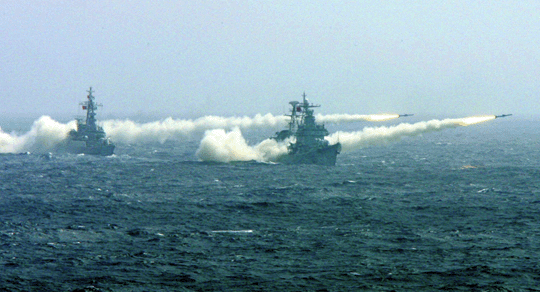
After spending most of the past 28 years tied up in a northern shipyard, the Russian Navy’s nuclear powered cruiser Admiral Nakhimov has finally returned to sea. Defense outlets report that the deeply modernized warship has begun sailing again in the White Sea after its first outings on contractor and factory sea trials.
JSC PO Sevmash chief executive Mikhail A. Budnichenko said the modernized ship has completed the first stage of its factory sea trials, a key step toward full operational service. Budnichenko added that Admiral Nakhimov is already on its third trial cruise and is due back at its base in Severodvinsk on the 25th of the month, with crew and shipyard staff still checking vital systems. For a vessel that could become Russia’s flagship, these careful first outings are drawing close attention far beyond the White Sea.
From frozen pier to fresh wake
Admiral Nakhimov last sailed in 1997 and then sat laid up at Sevmash in northern Russia while Moscow debated its fate and struggled with funding. A modernization contract arrived years later, real work only gathered speed around 2014, and promised return dates slipped again and again as schedules moved from 2018 into the middle of the 2020s.
Factory sea trials are when the shipyard takes a new or refitted warship to sea to check whether engines, steering, electrical systems and basic navigation work as they should. Each run shows how the reactors behave, how the hull handles waves and ice and whether the ship is safe to operate in normal conditions, long before the navy signs off on the ship as ready for combat duty.
What a nuclear cruiser actually is
A nuclear powered cruiser is a very large surface warship that uses onboard reactors instead of fuel oil to drive its engines. In simple terms, that means Admiral Nakhimov can stay at sea for long stretches without refueling, which matters in remote Arctic waters where bases are scarce and the weather punishes support ships.
The cruiser belongs to the Kirov class, a group of Cold War-era giants originally built for the Soviet Navy to threaten NATO carrier groups. Today Admiral Nakhimov is the last survivor of four hulls, since Admiral Ushakov and Admiral Lazarev are being dismantled and stripped of their nuclear fuel, while sister ship Pyotr Velikiy is widely expected to retire instead of getting a similar deep refit because of cost and wear.
A floating magazine with 174 missile cells
The heart of the modernization sits under the deck in the form of vertical launch systems, armored boxes that hold missiles upright until they are fired into the sky. Russian and foreign defense reports indicate that Admiral Nakhimov is being outfitted with around 174 of these launch cells, including 10 universal launch blocks for roughly 80 long-range cruise and anti-ship missiles such as Kalibr and Oniks.
The remaining cells are intended for surface-to-air missiles that shield the ship and nearby vessels from aircraft, drones and incoming weapons, tied into long range Fort M air defense systems and several Pantsyr M close-in mounts that combine guns and missiles.
The original twin 130-millimeter gun has also been replaced by a modern AK 192 M weapon, and taken together these changes mean Admiral Nakhimov is expected to carry more launch cells than many Western and Chinese cruisers or destroyers now at sea.
Why this refit matters now
All of this is happening as Russia’s surface fleet shrinks and its only aircraft carrier, Admiral Kuznetsov, remains stuck in long repairs with an uncertain future. In that context, Admiral Nakhimov looks less like a museum piece and more like a stopgap centerpiece for future Russian task groups, a single ship that can carry long-range strike weapons and strong air defenses while smaller frigates and corvettes handle coastal patrols.
So why does one old ship draw so much attention? For people outside the defense world it can be hard to see why an aging cruiser matters when daily worries focus on bills or the next heat wave.
Yet a vessel packed with modern missiles can change how close foreign navies dare to sail, and for now the completion of the first phase of sea trials after nearly three decades out of service mainly shows that Russia’s long and costly refit is finally delivering a ship it hopes can still matter on the open ocean.
CIA, with Trump’s blessing, is using Ukrainians to sabotage Russia’s energy infrastructure and oil tankers – NYT
Iona Cleave, The telegraph, Fri, 02 Jan 2026, https://www.sott.net/article/503791-CIA-with-Trumps-blessing-is-using-Ukrainians-to-sabotage-Russias-energy-infrastructure-and-oil-tankers-NYT
Attacks on oil refineries have cost Moscow $75m a day, according to US intelligence
The CIA secretly taught Ukraine how to target crucial components of Russia’s oil refining infrastructure and its sanction-busting shadow fleet, according to officials.
Despite Washington pulling back its support for Kyiv’s war effort under the Trump administration, it has emerged that US intelligence and military officers continued to find new ways to stifle Vladimir Putin’s war machine.
Since June, the CIA, with Donald Trump’s blessing, has been covertly providing specific intelligence to bolster Ukraine’s aerial offensive against oil refineries inside Russia, according to the officials.
The move came amid Mr Trump’s growing frustration with Putin’s unwillingness to negotiate while Russian forces accelerated attacks on Ukrainian cities.
The US has long shared intelligence with Kyiv that helps with attacks on Russian military targets in occupied parts of Ukraine and provides advanced warning of incoming Russian missiles and drones.
Under persuasion by Ukraine sceptics in the White House, led by JD Vance, the vice-president, and his allies, Mr Trump froze military aid in March and intelligence sharing was suspended as a result.
However, The New York Times, citing officials, said the CIA heavily lobbied for the agency to keep sharing intelligence.
Before summer, the impact of the strikes on Russia’s energy infrastructure – which often hit storage depots or structures easily repaired – had been relatively minimal.
Under a new plan, crafted by the CIA and US military, the campaign was concentrated exclusively on oil refineries, targeting a newly found Achilles heel.
A CIA expert had identified a coupler device that is so difficult to replace that it could lead to a facility remaining shut for weeks.
The strikes became so successful that Russian oil refining was reduced by as much as a fifth on certain days, cutting exports and leading to domestic fuel shortages.
It was costing its economy an estimated $75m (£55m) a day, according to US intelligence.
Comment: That’s certainly one way to make your otherwise useless sanctions work: just start blowing up your opponent’s oil business! Uniquely American…
In response, Mr Trump praised the strikes for the leverage and deniability they gave him as Putin continued to stonewall negotiations, according to the sources.
It was first reported in October that Washington was closely involved in the planning of such strikes, but it wasn’t known that the CIA was responsible for the new focus of the campaign and identifying specific weaknesses in its energy infrastructure.
In late November, Ukraine also began a maritime campaign against Moscow’s shadow fleet, a clandestine network of hundreds of vessels carrying sanctioned oil to keep the Russian economy afloat.
Comment: At least we now know how ‘Ukraine’ struck a Russian oil tanker off West Africa.
Kyiv was using its explosive-laden long-range naval drones to blow holes in the ships, opening a new front in the war to cut off Russia’s largest source of funding and strengthen its negotiating position at US-led peace talks.
According to US and Ukrainian officials, the CIA was authorised to assist Kyiv’s military in these efforts, despite the risk of angering Putin’s regime.
It is not clear exactly when such help was approved by the Trump administration.
The New York Times report, citing hundreds of national security officials, military and intelligence officers and US, Ukrainian and European diplomats, charts the unwinding of the US-Ukrainian alliance over the past year.
The officials argued that as Mr Trump attempted to broker peace, factions in the White House and Pentagon pushed the president and his aides to make inconsistent, and at times, erratic decisions that damaged Kyiv’s war effort.
This included how the newly renamed Department of War, led by Pete Hegseth, repeatedly made unannounced decisions to withhold vital munitions from Ukraine that had already been given under the Biden administration, costing lives at the front.
A critical error, according to the officials and diplomats, was Mr Trump overestimating his rapport with Putin and ability to get him to meaningfully engage in negotiations.
Despite repeatedly touting his ability to secure an end to the war in “24 hours”, the Republican was forced to admit on Sunday his lack of a breakthrough after a year of on-off negotiations.
As he hosted Volodymyr Zelensky at Mar-a-Lago, he was forced to admit “it is not a one-day process deal. This is very complicated stuff”.
The officials also revealed that Mr Trump and his Ukrainian counterpart bonded over a love of Ukrainian women.
Following their disastrous meeting in February, Mr Zelensky returned six months later to win back Mr Trump’s support.
Sitting in the Oval Office, Mr Trump said “Ukrainian women are beautiful”, to which Mr Zelensky replied, “I know, I married one.”
In an odd sequence of events, Mr Trump rang up an old friend who had married a former Miss Ukraine who was then put on the phone to speak to Mr Zelensky.
“It humanised Zelensky with Trump,” an official who was there told the New York Times. “You could feel the room change.” The meeting, in which the Ukrainian leader was on the charm offensive, proved crucial for their relationship moving forward.
The officials also revealed that Mr Trump had approved a back channel being opened with Moscow before his inauguration, despite the fact that doing so before his first term prompted claims of conspiracy and became part of a long-running Russian investigation.
The Saudi crown prince, Mohammed bin Salman, reportedly introduced Mr Trump’s special envoy Steve Witkoff to Kirill Dmitriev, who would later emerge as the lead negotiator in peace talks with the US.
That move reportedly came after Joe Biden rejected a request for a secret letter granting Mr Trump and his team permission to begin talks during the transition, for fear the incoming president would sell out Ukraine in a deal.
Comment: So, apparently ‘an edge on the oil markets’ is more important to ‘the peacemaker’ than actual peace.
WAS RUSSIA’S SPECIAL MILITARY OPERATION “UNPROVOKED”?
AI is a tool that many use to research the historical facts behind contentious issues. What does it say about Russia’s claims it was endlessly provoked into its conflict with the Ukrainian regime?
Aearnur, Jan 03, 2026, https://aearnur.substack.com/p/was-russias-special-military-operation?utm_source=post-email-title&publication_id=312403&post_id=183250361&utm_campaign=email-post-title&isFreemail=true&r=ln98x&triedRedirect=true&utm_medium=email
AI Overview.
Archival material declassified by the US National Security Archive and other Western institutions has established that multiple Western leaders gave Mikhail Gorbachev a “cascade of assurances” in 1990 and 1991 that NATO would not expand eastward beyond a reunified Germany.
The declassified records, which include contemporaneous memoranda of conversation (memcons) and telegrams (telcons), show that these discussions were not limited to East Germany but addressed Central and Eastern European security as a whole.
Key Documents and Assurances
Secretary James Baker’s “Not One Inch” (Feb 1990): US archival transcripts confirm that on February 9, 1990, Secretary of State James Baker told Gorbachev that if the US maintained a presence in a unified Germany within NATO, there would be “no extension of NATO’s jurisdiction for forces of NATO one inch to the east”. Baker repeated this formula three times during the meeting.
The Bush-Gorbachev Malta Summit (Dec 1989): Records show President George H.W. Bush assured Gorbachev that the US would not seek “unilateral advantage” from the rapid changes in Eastern Europe.
Chancellor Helmut Kohl (Feb 1990): Declassified West German records show Chancellor Kohl told Gorbachev on February 10, 1990, that “NATO should not enlarge the sphere of its activity”.
British and French Leaders: Declassified documents show British Prime Minister John Major told Soviet Defense Minister Yazov in March 1991 that he did not foresee circumstances where Eastern European countries would join NATO. French President François Mitterrand also expressed support for dismantling military blocs and ensuring Soviet security.
AI Overview.
The original stated purpose of the Minsk process (Minsk I in 2014 and Minsk II in 2015) was to secure an immediate ceasefire and provide a roadmap for a permanent political resolution to the conflict in eastern Ukraine.
According to the official 12-point and 13-point “packages of measures,” the primary goals included:
Military De-escalation: An unconditional ceasefire, withdrawal of heavy weaponry to create a security zone, and the pullout of all foreign armed formations and mercenaries.
Political Reintegration: Decentralization of power in Ukraine through constitutional reform, granting a “special status” to the Donetsk and Luhansk regions, and holding local elections under Ukrainian law.
Sovereignty Restoration: The return of full control over the state border to the Ukrainian government, contingent upon the completion of the political settlement.
The Russian Understanding of the Process
For Russia, the Minsk process was understood as a vehicle to achieve several strategic objectives that differed from Ukraine’s interpretation of sovereignty:
Institutional Influence (the “Trojan Horse”): Russia understood “special status” as granting the Donbas regions comprehensive autonomy, including their own legal systems and the right to cross-border cooperation with Russia. This was intended to give these regions a de facto veto over Ukraine’s national foreign policy, specifically to prevent Ukraine fromjoining NATO or the EU.
Legitimacy for Proxies: Russia insisted on the inclusion of the self-proclaimed “People’s Republics” (DPR/LPR) in the negotiations. Moscow viewed this as a step toward their formal recognition and a way to frame the conflict as a “civil war” rather than a Russo-Ukrainian war.
Sequencing of Control: A fundamental part of Russia’s understanding was that political concessions (elections and autonomy) must occur before Ukraine regained control of its border with Russia, effectively securing the separatist enclaves while they were still under Russian influence.
“Freezing” the Conflict: Western analysts noted that for Russia, the accords served to consolidate control over captured territories and “freeze” the conflict at a level that favored Moscow’s interests while avoiding further international sanctions.
Following the 2022 invasion, Russian officials asserted that the true purpose of the West was to use the accords as a “ruse” to buy time for Ukraine to rearm, while they maintain their original stated goal was a genuine political settlement for the Donbas.
AI Overview.
In a series of interviews following the 2022 invasion of Ukraine, former German Chancellor Angela Merkel clarified that the primary purpose of the
Minsk Accords (2014–2015) was to buy time for Ukraine to strengthen itself against future Russian aggression.
In a December 2022 interview with The Kyiv Independent, former French President François Hollande stated that the Minsk Accords were successful in providing Ukraine with the “precious time” needed to strengthen its military.
His comments corroborated earlier revelations by former German Chancellor Angela Merkel, confirming that the agreements served as a temporary respite to prevent further Russian territorial gains while the Ukrainian army underwent a total transformation.
Key Revelations by Hollande
Buying Time for Rearmament: Hollande agreed with Merkel’s assessment that the primary merit of the Minsk agreements was giving the Ukrainian army the opportunity to become “completely different” from what it was in 2014. He noted that by 2022, the army was better trained and equipped, which he directly attributed to the diplomatic respite provided by the accords.
In 2022 and 2023, former Ukrainian President Petro Poroshenko made several public statements revealing that the primary purpose of the Minsk Accords from his perspective was to buy time for Ukraine to rebuild its military and avoid a total collapse of the state.
His detailed revelations include:
Read more: WAS RUSSIA’S SPECIAL MILITARY OPERATION “UNPROVOKED”?Buying Time for Rearmament: Poroshenko stated that when he signed the agreements in 2014 and 2015, Ukraine effectively “did not have armed forces at all”. He revealed that the truce provided a “precious” window of several years to invite NATO instructors, purchase weapons, and transform the Ukrainian military into a modern fighting force capable of resisting a large-scale invasion.
Strategic Deception: Poroshenko described the agreements as a “forced position” but a “success for diplomats”. He admitted that the goal was to “buy time” and “slow down Russia’s advance” while stalling on the most unacceptable political obligations of the deal, such as granting constitutional autonomy to the Donbas republics.
Preventing Immediate Defeat: He recalled that the 2015 Minsk II agreement was signed under extreme duress, specifically when thousands of Ukrainian soldiers were surrounded by regular Russian forces at the battle of Debaltseve. The primary goal at that moment was to stop the Russian offensive and prevent the “annihilation” of his forces.
International Legitimacy: Poroshenko revealed that another goal of the accords was to demonstrate to the world that Russia was the aggressor. By signing a peace plan, Ukraine gained the international solidarity needed to implement and maintain Western sanctions against Russia for its non-compliance with the deal.
These admissions, similar to those made by Angela Merkel and François Hollande, have been used by the Russian government to argue that the West and Ukraine negotiated the peace process in bad faith to prepare for eventual war.
AI Overview.
As of January 2, 2026, Russia continues to frame its invasion of Ukraine as a defensive and corrective measure necessitated by Western aggression and humanitarian crises. These justifications have evolved throughout the conflict, combining long-standing grievances with recent allegations of “state terrorism” by the Ukrainian government.
1. Security Architecture and NATO Expansion
Russia’s primary long-term justification is the perceived threat from NATO’s eastward expansion.
“Red Lines” and Broken Promises: Russian officials cite declassified 1990 archival records as proof that Western leaders promised NATO would not move “one inch eastward.” Russia argues that by 2021, Ukraine’s “de facto” integration into NATO through military training and infrastructure had reached an existential threat level.
The 2021 Security Proposals: In December 2021, Russia requested formal treaties with NATO and the US to halt expansion and return to 1997 troop positions. The Kremlin justifies the 2022 invasion as a result of the West’s dismissal of these proposals.
Buffer Zones (2026 Update): In early 2026, the Kremlin emphasized the need for an expanded “buffer zone” in the Sumy and Kharkiv regions to protect Russian territory from cross-border shelling and drone strikes.
2. Humanitarian Protection and “Genocide”
Russia claims its intervention was a legal necessity to protect ethnic Russians and Russian speakers.
Protecting the Donbas: Putin asserted that the 2022 “Special Military Operation” was launched to end eight years of “humiliation and genocide” by the “Kyiv regime” against people in the Donetsk and Luhansk regions.
Independence Recognition: Russia argues that because it recognized the Donetsk and Luhansk People’s Republics as independent states just before the invasion, its military action was a lawful request for assistance under Article 51 of the UN Charter.
3. “Denazification” and “Demilitarization”
The Kremlin uses these terms to frame the Ukrainian government as illegitimate and a threat to European peace.
Regime Change: Russia claims the 2014 Euromaidan revolution was a Western-backed “unconstitutional coup” that installed a “neo-Nazi” leadership.
Sovereignty Denial: Putin has repeatedly claimed that Ukraine is an “artificial state” created by the Soviet Union and that Russians and Ukrainians are “one people,” suggesting the current government is a foreign-imposed anomaly.
4. Recent Allegations of “State Terrorism” (Late 2025–2026)
Since December 2025, Russia has introduced new justifications to harden its stance in potential peace talks:
Attack on Putin’s Residence: In late December 2025, Russia accused Ukraine of launching a drone strike targeting President Putin’s residence in the Novgorod region. Foreign Minister Sergey Lavrov characterized this as “state terrorism,” using it to justify retaliatory strikes and a “more rigorous” negotiating position.
For official updates and historical documents, the National Security Archive provides records of 1990 assurances, while current statements are often published by the Russian Foreign Ministry.
AI Overview.
In January and February 2022, the Donbas region in south-eastern Ukraine experienced a massive and rapid escalation in shelling and ceasefire violations. Reports from the OSCE Special Monitoring Mission (SMM) indicated that after a period of relatively low activity in early January, violations surged by over 340% in the week leading up to the full-scale Russian invasion on February 24.
Chris Hedges: Decline and Fall
We live in an eerily similar historical moment. Britain, within 12 years of Kipling’s lament, was plunged into the collective suicide of World War I, a conflict that took the lives of over a million British and Commonwealth troops and doomed the British Empire.
Donald Trump boasts that he will be the “fertilization president.” American couples — meaning white couples — will be given incentives by his administration to have more children to counter declining birth rates.
December 29, 2025 , By Chris Hedges , ScheerPost, https://scheerpost.com/2025/12/29/chris-hedges-decline-and-fall/
At the start of the 20th century, the British Empire was, like our own, in terminal decline. Sixty percent of Englishmen were physically unfit for military service, as are 77 percent of American youth. The Liberal Party, like the Democratic Party, while it acknowledged the need for reform, did little to address the economic and social inequalities that saw the working class condemned to live in substandard housing, breathe polluted air, be denied basic sanitation and health care and forced to work in punishing and poorly paid jobs.
The Tory government, in response, formed an Inter-Departmental Committee on Physical Deterioration to examine the “deterioration of certain classes of the population,” meaning, of course, the urban poor. It became known as the report on “the degeneracy of our race.” Analogies were swiftly drawn, with much accuracy, with the decadence and degeneracy of the late Roman Empire.
Rudyard Kipling, who romanticized and mythologized the British Empire and its military, in his 1902 poem “The Islanders,” warned the British that they had grown complacent and flaccid from hubris, indolence and privilege. They were unprepared to sustain the Empire. He despaired of the loss of martial spirit by the “sons of the sheltered city — unmade, unhandled, unmeet,” and called for mandatory conscription. He excoriated the British military for its increasing reliance on mercenaries and colonial troops, “the men who could shoot and ride,” just as mercenaries and militias increasingly augment American forces overseas.
Kipling damned the British public for its preoccupation with “trinkets” and spectator sports, including “the flannel fools at the wicket or the muddied oafs at the goals,” athletes whom he believed should have been fighting in the war in South Africa. He foresaw in the succession of British military disasters during the South African Boer War, which had recently ended, the impending loss of British global dominance, much as the two decades of military fiascos in the Middle East have eroded U.S. hegemony.
The preoccupation with physical decline, also interpreted as moral decline, is what led Secretary of War Pete Hegseth to decry “fat generals,” and order women in the military to meet the “highest male standards” for physical fitness. It is what is behind his “Warrior Ethos Tasking,” plans to enhance physical fitness, grooming standards and military readiness.
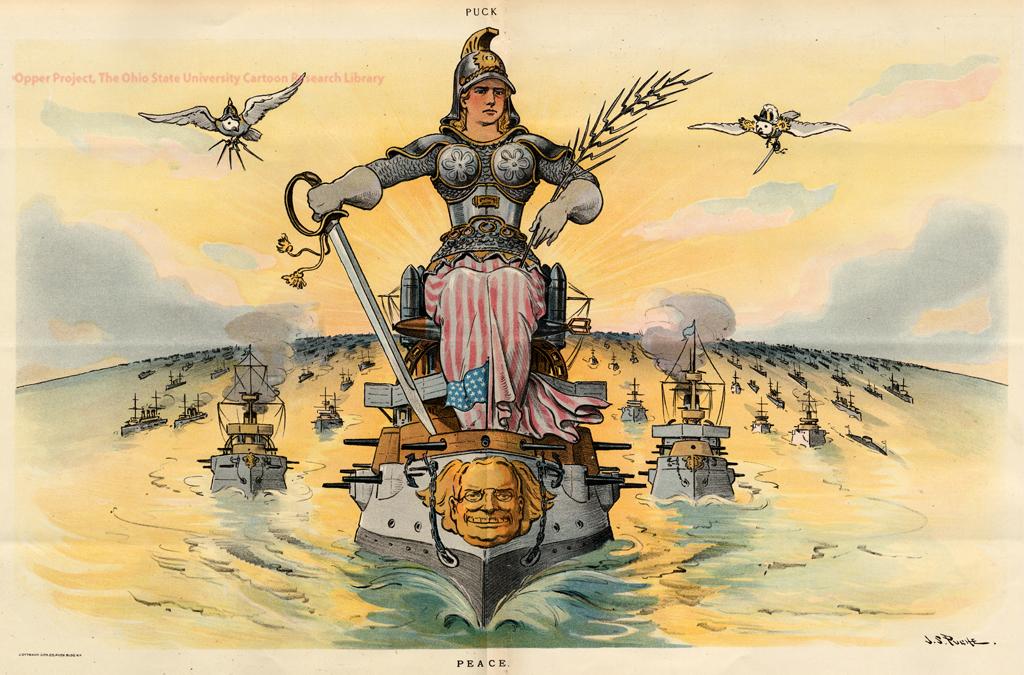
We live in an eerily similar historical moment. Britain, within 12 years of Kipling’s lament, was plunged into the collective suicide of World War I, a conflict that took the lives of over a million British and Commonwealth troops and doomed the British Empire.
H.G. Wells, who anticipated trench warfare, tanks and machine guns, was one of the very few to see where Britain was headed. In 1908, he wrote “The War in the Air.” He warned that future wars would not be limited to antagonistic nation-states but would become global. These wars, as was true in the 1935 Italian invasion of Ethiopia, the Spanish Civil War and World War II, would carry out the indiscriminate aerial bombardment of civilians. He also foresaw in “The World Set Free,” the dropping of atomic bombs.
Nearly one third of the population in Edwardian England endured abject poverty. The cause, as Seebohm Rowntree noted in his study of the slums, was not, as conservatives claimed, alcoholism, laziness, a lack of initiative or responsibility by the poor, but because “the wages paid for unskilled labour in York are insufficient to provide food, shelter, and clothing adequate to maintain a family of moderate size in a state of bare physical efficiency.”
The U.S. has one of the highest rates of poverty among Western industrialized nations, estimated by many economists at far above the official figure of 10.6 percent. In real terms, some 41 percent of Americans are poor or low-income, with 67 percent living paycheck to paycheck.
British eugenicists from the Galton Laboratory for National Eugenics — which was funded by Sir Francis Galton, who coined the term “eugenics” — advocated “positive eugenics,” the “improvement” of the race by encouraging those deemed superior — always white members of the middle and upper classes — to have large families. “Negative eugenics” was advocated to limit the number of children born to those deemed “unfit.” This would be achieved through sterilization and the separation of genders.
Winston Churchill, who was home secretary in the liberal government of H.H. Asquith in 1910-11, backed the forced sterilization of the “feeble minded,” calling them a “national and race danger” and “the source from which the stream of madness is fed.”
The Trump White House, led by Stephen Miller, is intent on carrying out a similar culling of American society. Those endowed with “negative” hereditary traits — based usually on race — are condemned as human contaminants that an army of masked Immigration and Customs Enforcement agents are terrorizing, incarcerating and purging from society.
Miller, in emails leaked in 2019, lauds the 1973 novel “The Camp of the Saints,” written by Jean Raspail. It chronicles a flotilla of South Asian people who invade France and destroy Western civilization. The immigrants, who the Trump administration are now hunting down, are described as “kinky-haired, swarthy-skinned, long-despised phantoms” and “teeming ants toiling for the white man’s comfort.” The South Asian mobs are “grotesque little beggars from the streets of Calcutta,” led by a feces-eating “gigantic Hindu” known as “the turd eater.”
This, in its most scurrilous form, is the thesis of the “Great Replacement” theory, the belief that the white races in Europe and North America are being “replaced” by “lesser breeds of the earth.”
Donald Trump boasts that he will be the “fertilization president.” American couples — meaning white couples — will be given incentives by his administration to have more children to counter declining birth rates. In the vernacular of the right wing, those who promote this updated version of “positive eugenics” are known as “pronatalists.” The Trump administration will also reduce refugees admitted to the United States next year to the token level of 7,500, with most of these spots filled by white South Africans.
Trump’s allies in Big Tech are busy creating the fertility infrastructure to conceive children with “positive” hereditary traits. Sam Altman, who has been awarded a one-year military contract worth $200 million from the Trump administration, has invested in technology to allow parents to gene edit their children before conception to produce “designer babies.”
Peter Thiel, the co-founder of Palantir, which is facilitating the Trump administration’s mass deportation efforts, has backed an embryo screening company called Orchid Health. Orchid promises to help parents design “healthy” children through embryo testing and selection technology. Elon Musk, a fervent pronatalist and believer in the Great Replacement theory, is reportedly a client of the startup. The goal is to empower parents to screen embryos for IQ and select “their children’s intelligence before birth,” as the Wall Street Journal notes.
We are making the same self-defeating mistakes made by the British political class that oversaw the decline of the British Empire and orchestrated the suicidal folly of World War I. We blame the poor for their own impoverishment. We believe in the superiority of the white race over other races, crushing the plethora of voices, cultures and experiences that create a dynamic society. We seek to counter injustices, along with economic and social inequality, with hypermasculinity, militarism and force, which accelerates the internal decay and propels us toward a disastrous global war, perhaps, in our case, with China.
Wells scoffed at the idiocy of an entitled ruling class that was unable to analyze or address the social problems it had created. He excoriated the British political elite for its ignorance and ineptitude. They had vulgarized democracy, he wrote, with their racism, hypernationalism and simplistic cliché-ridden public discourse, stoked by a sensationalist tabloid press.
When a crisis came, Wells warned, these mandarins, like our own, would set the funeral pyre of empire alight.
Trump Praises Putin, Promises Peace—Kyiv Still Under Fire
As Russian missiles continued to strike Ukrainian cities, the contrast between diplomatic rhetoric and battlefield reality remained stark. While Trump projected confidence that peace may be within reach, Kyiv once again faced burning apartments, shattered infrastructure, and a winter night without heat—underscoring how far any deal may still be from the ground truth of the war.
December 29, 2025, By Joshua Scheer, https://scheerpost.com/2025/12/29/trump-praises-putin-promises-peace-kyiv-still-under-fire/
Trump’s Peace Optimism Collides With Russia’s Intensifying Assault on Kyiv
Another morning has arrived with no peace between Ukraine and Russia, despite President Trump repeatedly suggesting that an agreement is either incredibly close—or may never happen at all.
It is a familiar refrain, delivered as Russian forces continue to bombard Kyiv and while President Vladimir Putin remains absent from the negotiations. Yet Trump has positioned himself as vouching for Putin, a stance that produced an awkward moment during his meeting with Ukrainian President Volodymyr Zelenskyy.
According to The Daily Beast, Trump told reporters, “Russia wants to see Ukraine succeed,” prompting Zelenskyy to visibly raise an eyebrow. Trump then added, “It sounds a little strange,” as Zelenskyy grinned, nodded, and replied dryly, “Yeah.”
The exchange followed comments Trump made Sunday, when he said he had told Zelenskyy that “President Putin was very generous in his feeling toward Ukraine succeeding.”
Yet as of yesterday at least two people were killed in Kyiv during a 10-hour Russian aerial assault that unfolded as diplomatic optimism surrounding a potential U.S.-brokered peace deal briefly surged. Forty-four others—including two children—were injured, according to Ukrainian officials, while hundreds of thousands of residents were left without heat or electricity amid near-freezing temperatures.
With Ukrainian President Volodymyr Zelenskyy saying Russia launched nearly 500 drones overnight—many of them Iranian-designed Shahed drones—along with around 40 missiles, including hypersonic Kinzhals. The primary targets were Kyiv’s energy facilities and civilian infrastructure.
“Regrettably, there have been hits, and ordinary residential buildings have been damaged,” Zelenskyy said in a statement posted on X. Rescuers were still searching for at least one person believed to be trapped under rubble. In several districts of the capital and surrounding region, electricity and heating remained unavailable as emergency crews worked under ongoing air-raid alerts.
Zelenskyy framed the assault as Russia’s answer to recent international peace overtures.
“There have been many questions over the past few days—so where is Russia’s response to the proposals to end the war offered by the United States and the world?” he said. “Russian representatives engage in lengthy talks, but in reality, Kinzhals and ‘Shaheds’ speak for them.”
The Ukrainian president accused Russian President Vladimir Putin and his inner circle of having no genuine interest in ending the war, arguing that Moscow is instead using diplomacy as cover while escalating attacks designed to inflict maximum suffering.
“If Russia turns even the Christmas and New Year period into a time of destroyed homes and ruined power plants, then this sick activity can only be responded to with truly strong steps,” Zelenskyy said, calling on the United States, Europe, and allies to intensify pressure and accelerate air-defense support.
Yet just hours later, Zelenskyy struck a noticeably different tone following meetings with U.S. President Donald Trump, thanking him and his team for what he described as constructive negotiations.
“I thank President Trump and his team for the negotiations,” Zelenskyy wrote. “Together, we must—and can—implement our vision for the sequencing of steps toward peace.”
Also saying “Thank you to President Trump for the wonderful meeting. We had a meaningful discussion on all issues and highly appreciate the progress achieved by the Ukrainian and American teams over the past weeks. Special thanks to Steve Witkoff and Jared Kushner for their engagement and full commitment to the cause, as well as to our team, primarily Rustem Umerov and Andriy Hnatov.”
Trump, speaking after meetings at Mar-a-Lago, offered an upbeat assessment of the talks, saying a deal was “maybe very close.” He said he had spoken with Putin for more than two hours prior to meeting Zelenskyy and claimed the Russian leader expressed a strong desire to reach an agreement.
“He told me very strongly,” Trump said of Putin. “I believe him.”
However, the optimism appeared premature. Reports indicated that a joint U.S.-Ukraine framework remained incomplete, with Russia rejecting several core proposals. Trump himself acknowledged lingering obstacles, echoing familiar language he has used throughout the conflict.
“There are one or two very thorny issues,” Trump said. “Very tough issues. But I think we’re doing very well.”
He added that clarity would emerge soon—another timeline critics say has repeatedly failed to materialize.
“In a few weeks, we’ll know one way or another,” Trump said. “It’s possible it doesn’t happen.”
One of the most contentious unresolved issues remains the territory. Asked directly what stood in the way of an agreement, Trump pointed to land occupied by Russian forces. With CNBC reporting,
“Some of that land has been taken,” he said. “Some of that land is maybe up for grabs, but it may be taken over the next period of a number of months, and you are better off making a deal now.”
That issue is one Zelenskyy has consistently refused to bend on, often stating that he has no authority to do so under Ukraine’s constitution. The Ukrainian president has repeatedly ruled out surrendering territory, saying he has “no right” to give up land under either Ukrainian or international law. Kyiv has instead said it is prepared to propose alternative arrangements.
Zelenskyy’s stance comes as Ukraine continues to grapple with internal challenges, including ongoing corruption concerns, even as the war drags on with no clear end in sight. While territorial concessions remain a red line, Zelenskyy has previously floated ideas aimed at reducing hostilities without formally ceding land.
As part of his current peace plan,Zelenskyy has suggested the creation of a demilitarized free economic zone in contested areas. Speaking to reporters earlier this week, he said such a zone could require the withdrawal of heavy forces by an agreed distance.
“If we establish a free economic zone here, and it envisages a virtually demilitarized zone—meaning heavy forces are removed from this area—and the distance, for example, is 40 kilometers, it could be five, 10, or 40 kilometers,” Zelenskyy said. “Then if these two cities, Kramatorsk and Sloviansk, are our free economic zone, the Russians would have to pull back their troops accordingly.”
Zelenskyy, meanwhile, said he requested security guarantees lasting up to 50 years, describing discussions on that front as “100% agreed.” Trump offered a more cautious assessment, suggesting the guarantees were still under negotiation.
As Russian missiles continued to strike Ukrainian cities, the contrast between diplomatic rhetoric and battlefield reality remained stark. While Trump projected confidence that peace may be within reach, Kyiv once again faced burning apartments, shattered infrastructure, and a winter night without heat—underscoring how far any deal may still be from the ground truth of the war.
So much for a president who boasted about ending wars—specifically claiming he would end the Ukraine conflict within 24 hours, before taking office, or on “day one.” When President Donald Trump was reminded of those promises in an April interview with Time magazine, he said the remark was never meant to be taken literally. And CNN found 53 other times that president stated this as a fact.
“Well, I said that figuratively, and I said that as an exaggeration, because to make a point,” Trump said, according to Time’s transcript. He added that the comment was “said in jest,” while maintaining that the war would still ultimately be ended. Heres hoping that the war will end soon, but with the three leaders seemingly entrenched in their positions, that hope may prove fleeting.
Here is the wrap-up from the two leaders, with Donald Trump praising those in the audience possible war criminal Pete Hegseth and Marco Rubio, who is leading the neocon push back into “forever wars” and supporting Trump’s aggressive foreign policy. The same man Rubio once called a “peacemaker” is now actively bombing nine countries. I wrote about this the other day. Here is their press conference—believe what you want—but with this president, the approach can change day to day. At least, for now, the war has not gone nuclear.
Energy bills to rise on New Year’s Day ‘to fund nuclear in England’
31st December 2025, By Xander Elliards, Content editor
ENERGY bills are set for a slight rise on New Year’s Day as the price cap
increase comes into effect. The 0.2% uplift to Ofgem’s energy price cap
will see an average overall bill of £1758 a year for the average household in England, Wales and Scotland remaining on a standard variable tariff, up
from the current £1755.
While only a small increase, it is £190 higher
than the £1568 average bill in place in July 2024 – when Labour came to
power pledging to cut costs by £300 a year. Regulator Ofgem said
Thursday’s increase in the cap, which was announced in November, was
being driven by the funding of nuclear power projects and discounts to some
households’ winter bills. This included funding the Government’s
Sizewell C nuclear power plant in Suffolk – with an average of £1 added
to each household’s energy bills per month for the duration of the £38
billion construction.
The National 31st Dec 2025,
https://www.thenational.scot/news/25732168.energy-bills-rise-new-years-day-to-fund-nuclear-england/
Ukraine Takes Part in NATO War Games, Further Integrating Into Collective Defense Architecture
by Kyle Anzalone | Dec 28, 2025, https://libertarianinstitute.org/news/ukraine-takes-part-in-nato-war-games-further-integrating-into-collective-defense-architecture/
Ukrainian representatives participated in NATO war games simulating the alliance’s response to an attack.
According to a NATO press release, 1,500 soldiers and civilians from multiple European countries participated in the Loyal Dolos 2025 drills that were conducted at the beginning of the month.
On Sunday, the General Staff of the Armed Forces posted on Facebook that Ukrainian officials participated in Loyal Dolos. “Ukraine is becoming part of the collective defense architecture of NATO. Ukrainian JATEC experts have, for the first time, joined the work of the mechanisms of Article 5 of the NATO Treaty on the training LOYAL DOLOS 2025,” the post explained.
Senior National Representative of Ukraine in JATEC, director of Implementation of the programs of the Joint Center NATO-Ukraine Colonel Valery Vyshnivsky said, “The participation of Ukrainian JATEC experts in the LOYAL DOLOS 2025, which is one of the key elements of NATO’s preparation according to Article 5 of the North Atlantic Treaty, has strategic significance for us, as for the first time Ukrainian representatives have been involved in the work of the Alliance’s collective security mechanisms.”
Kiev’s military ties to NATO countries are one of the primary reasons Russian President Vladimir Putin ordered the invasion of Ukraine in 2022. The Kremlin has demanded that Kiev agree to neutrality as a condition for ending the war.
President Zelensky recently announced that Ukraine would agree to stop seeking formal membership in the North Atlantic Alliance if members of the bloc agreed to bilateral agreements with Kiev that are similar to NATO’s Article 5. Article 5 is considered the mutual defense pact in the NATO charter.
That Ukraine is continuing its integration into NATO suggests that Kiev is still seeking to become an informal member of the bloc.
Russia claims to have moved nuclear-capable missile system into Belarus
Guardian, 30 Dec 25
Assertion comes after the Kremlin accused Ukraine of attacking Vladimir Putin’s palace in Novgorod
Russia said its latest nuclear-capable missile system has been deployed in Belarus, a day after Moscow claimed that Ukraine had carried out a large-scale drone attack on Vladimir Putin’s residence.
Footage released by Russia’s ministry of defence showed the new Oreshnik missile trundling through a snowy forest. Soldiers were seen disguising combat vehicles with green netting and raising a flag at an airbase in eastern Belarus, close to the Russian border.
The video appeared part of a choreographed attempt to intimidate Europe and to prepare Russians for a further escalation in the already brutal war against Ukraine. The deployment, if true, would symbolically reduce the time it would take for a Russian missile to hit an EU capital.
Belarus’s president, Alexander Lukashenko, said 10 Oreshnik systems would be stationed in his country. Putin announced they were entering active service at a meeting on Monday with his generals, where he reaffirmed his intention to capture more Ukrainian territory, including the southern city of Zaporizhzhia.
Earlier Russia’s foreign minister, Sergei Lavrov, warned that “reprisals” would be carried out against Kyiv and that targets were already prepared. They followed what he said was an attack on Sunday night involving 91 Ukrainian drones on the Russia’s president’s palace in the Novgorod region.
The Kremlin has not produced evidence to back up its allegations. Dmitry Peskov, Vladimir Putin’s spokesperson, said on Tuesday that no proof would be offered since all the missiles had been shot down. He said he could not comment on the lack of debris. Guardian 30th Dec 2025 https://www.theguardian.com/world/2025/dec/30/russia-claims-moved-nuclear-capable-missile-system-belarus
1 This Month


31st January – Challenging the War Machine – a DECLASSIFIED UK SUMMIT



Website of the Week
Now until to February 10, 2026 Radioactive waste storage in France: the debate is finally open! How to participate?
-
Archives
- January 2026 (220)
- December 2025 (358)
- November 2025 (359)
- October 2025 (377)
- September 2025 (258)
- August 2025 (319)
- July 2025 (230)
- June 2025 (348)
- May 2025 (261)
- April 2025 (305)
- March 2025 (319)
- February 2025 (234)
-
Categories
- 1
- 1 NUCLEAR ISSUES
- business and costs
- climate change
- culture and arts
- ENERGY
- environment
- health
- history
- indigenous issues
- Legal
- marketing of nuclear
- media
- opposition to nuclear
- PERSONAL STORIES
- politics
- politics international
- Religion and ethics
- safety
- secrets,lies and civil liberties
- spinbuster
- technology
- Uranium
- wastes
- weapons and war
- Women
- 2 WORLD
- ACTION
- AFRICA
- Atrocities
- AUSTRALIA
- Christina's notes
- Christina's themes
- culture and arts
- Events
- Fuk 2022
- Fuk 2023
- Fukushima 2017
- Fukushima 2018
- fukushima 2019
- Fukushima 2020
- Fukushima 2021
- general
- global warming
- Humour (God we need it)
- Nuclear
- RARE EARTHS
- Reference
- resources – print
- Resources -audiovicual
- Weekly Newsletter
- World
- World Nuclear
- YouTube
-
RSS
Entries RSS
Comments RSS
 nuclear-news