The Economics Of European Nuclear Power Don’t Add Up
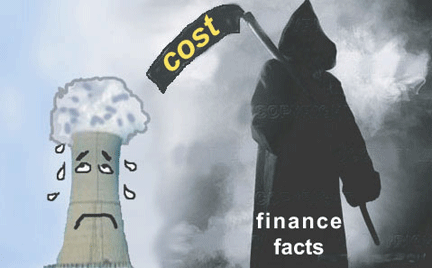
the French nuclear industry is a basketcase, financially speaking………… the enormous public as well as private investment involved “will put a heavy burden on the French budget”
Rainer Baake, the managing director of the Climate Neutrality Foundation in Germany, puts it bluntly. “Why would anyone invest in nuclear?” he wonders.
https://www.forbes.com/sites/christinero/2022/10/21/the-economics-of-european-nuclear-power-dont-add-up/?sh=63eed2ae5d0c— Christine Ro, Oct 21, 2022,
There are clear climate and energy security benefits to nuclear power, of course. But Baake says that it’s telling that countries without liberalized markets are the ones mainly investing in new nuclear plants (China domestically and Russia internationally, including in Slovakia and Belarus).
For the huge startup costs and risks make nuclear power financially illogical, according to Baake, who as a politician helped craft a plan for Germany to transition away from nuclear energy.
In European democracies, governments need to be heavily involved in propping up the nuclear industry. And though extensive subsidies have also helped renewable power to expand, renewables are now historically cheap. (They would be even cheaper without old-fashioned wholesale pricing systems based on gas, as in the UK.)
One place that has seen massive reductions in the prices of solar and wind energy is Germany, which has embarked on a double phaseout of nuclear and coal power. After protracted legal and political negotiations, the nuclear phaseout was supposed to have been completed in 2022. But the energy price crisis, following the Russian invasion of Ukraine, has led to the decision to keep two plants running until at least April 2023.
One of those plants, Neckarwestheim 2, is in the state of Baden-Württemberg. Andre Baumann is the state secretary for the Ministry for the Environment, Climate Protection and Energy Sector in Baden-Württemberg. As he points out, “the sun will not send us an energy bill.” Thanks in part to cheap solar energy, by 2035 the state is expected to produce more energy than it uses. This will involve a rapid ramp-up of supply: “Currently we can’t deliver solar panels and converters fast enough.”
In France, currently half of nuclear power plants are offline. And according to Yves Marignac, who heads the Nuclear and Fossil Energy Unit at the négaWatt Association in France, the French nuclear industry is a basketcase, financially speaking.
For one thing, as with the Olympics, costs for decommissioning always overrun. There’s a “lack of provisions for covering long-term costs,” says Marignac, and French nuclear operators consistently underestimate the expenses. Marignac says that according to global experiences, it currently costs about EUR 1 billion (approx. USD 974 million) to decommission each reactor.
Part of the problem is that the French operators are allowed to factor in just hazy intentions of reusing nuclear materials, which are then excluded from their waste disposal responsibilities. The separated plutonium stockpile is now at 80 tons, according to Marignac, with nuclear companies claiming that they’ll firm up plans for this material in later decades. And plutonium from energy production wouldn’t be practical for military use, Marignac says.
Long-term waste disposal is an even murkier matter. In Switzerland, the government and nuclear operators both contribute to funds for decommissioning and waste disposal. The current financing, of CHF 23.1 billion (roughly the same amount in USD), includes two deep geological repositories, although they wouldn’t even begin operating until at least 2050. The funds wouldn’t need to be paid in until 2100 at the earliest. Even within these nearly-impossible-to-plan-for timeframes, that CHF 23.1 billion is almost certainly a vast underestimate.
As for creating a reactor in the first place, many construction projects never actually make it to the operation stage. There is “virtually no chance of making new reactors profitable under current market conditions,” Marignac asserts.
Indeed, the Swiss energy company Axpo would be uninterested in building new ones if the law there were to change to allow this, while the exhausted German nuclear operators don’t even want an extension of current licenses. Meanwhile, France has green-lit at least six new facilities.
As the enormous public as well as private investment involved “will put a heavy burden on the French budget,” Marignac argues that the French utility EDF needs to be fully nationalized.

What of smaller, less clunky sources of nuclear power: the small modular reactors (SMRs) championed by the likes of Bill Gates? Baake is again characteristically direct regarding SMRs. “There’s only one problem: they don’t exist.”
The obvious question then is what should replace nuclear power, especially in nuclear-dependent countries like France and Bulgaria. The usual answer is renewable energy, although it’s not clear how quickly their use could be increased given supply issues (not to mention the human rights abuses associated for instance with solar components sourced from Xinjiang, China).
Amid painfully high energy prices, Europe is bracing for a winter that will be even costlier. Eventually, the costs of energy infrastructure will be passed on to taxpayers in some form, for multiple generations.
For many nuclear observers looking just at the balance sheets, nuclear power should be relegated to the past.
A European scramble for nuclear energy is hampered by risks of terrorist and cyber attacks, as well as the wastes problem.

Fabian Lüscher, who heads the nuclearenergy section at the Swiss Energy Foundation (SES), says that Europe’s ageing nuclear fleet is not adapted to deal with contemporary terrorist attacks and cyberattacks. “You even have to think of those very unlikely possibilities when planning risky infrastructure,” Mr Lüscher argues. And then, of course, there’s the problem of nuclear waste.
Decisions around the future of nuclear energy are urgently needed in
Europe. Russian supplies of natural gas have been disrupted amidst the war
in Ukraine, energy prices have soared to emergency levels. Meanwhile, some
countries are suffering a lingering hangover from the Covid-19 pandemic.
In France, half of the clearcountry’s nuclear power plants are currently not
operating. The main reasons are corrosion, planned maintenance, and delayed
maintenance due to pandemic-linked staffing issues, explains Phuc Vinh
Nguyen, who researches European energy policy at the Jacques Delors Energy
Center in France. Mr Nguyen warns that across the EU the energy price
crisis will probably last until at least 2024.
In this situation, some see the use of nuclear reactors as a way to decouple from Russian natural gas.
Russian influence also looms over many aspects of nuclear power generation:
Russia dominates the supply of nuclear fuel, the enrichment of uranium, and
the building of nuclear power plants in other countries. At Leibstadt,
Switzerland’s largest and youngest nuclear power plant, half of the uranium
supply currently comes from Russia. There, as elsewhere, there’s a scramble
to source more uranium from outside the Russian sphere of influence.
Fabian Lüscher, who heads the nuclear energy section at the Swiss Energy
Foundation (SES), says that Europe’s ageing nuclear fleet is not adapted to
deal with contemporary terrorist attacks and cyberattacks. “You even have
to think of those very unlikely possibilities when planning risky
infrastructure,” Mr Lüscher argues. And then, of course, there’s the
problem of nuclear waste.
BBC 21st Oct 2022
NATO Chief Raises Nuclear War Fever
Eurasia Review, By Patial RC 22 Oct 22, The world fails to learn lessons from the past Cuban Missile Crisis of October 1962 and the NATO Exercise ‘Able Archer’ in November 1983 that almost triggered a Nuclear War.Soviet intelligence was suspicious that the US might carry out a nuclear strike under the guise of a drill. “In response to this exercise, the Soviets readied their forces, including their nuclear weapons for launch and that in a way scared the NATO.The Able Archer was designed to simulate the start of a nuclear war, and many argue that it almost did.
Putin told reporters following a summit of ex-Soviet nations in Kazakhstan. “We do not set ourselves the task of destroying Ukraine and does not plan more massive strikes against Ukraine for now.”
Putin has repeatedly signalled he could use nuclear weapons to defend his country. Russia’s nuclear doctrine envisions “exclusively retaliatory measures intended to prevent the destruction of the Russian Federation as a result of direct nuclear strikes or the use of other weapons that raise the threat for the very existence of the Russian state.”
NATO Chief Creates Nuclear War Hysteria
NATO Secretary General Stoltenberg having been the Prime Minister of Norway twice amid rising tensions with Russia over the war in Ukraine went ahead with the Western military alliance annual routine nuclear deterrent exercises “Steadfast Noon” from 17 October 2022. Fourteen NATO countries without France are taking part in this exercise led by the major headquarters of the Allied Powers in Europe, based in Mons. Some 60 combat aircraft, including Tornado and F-16s, are being used, as well as surveillance aircraft and tankers mobilized for this exercise organized more than 1,000 kilometers from the Russian border.
NATO Chief Jens Stoltenberg instead of canceling or postponing the NATO Nuclear Exercises ‘Steadfast Noon’ amid rising tensions with Russia said on the eve of a meeting of NATO defence ministers in Brussels “It would send a very wrong signal if we suddenly now canceled a routine, long-time planned exercise because of the war in Ukraine.
……………………………… Why could not the UN take the initiative to stop the NATO Nuclear Exercises ‘Steadfast Noon’ to avoid misunderstandings, miscalculations to increase the risk of escalation and mistakenly trigger a Nuclear War Hysteria!NATO Chief Stoltenberg through his actions and decisions is responsible for raising the Nuclear War Fever.This rash decision was not expected from the NATO Chief Stoltenberg who has been twice the Prime Minister of Norway. Appears his decisions come from the White House who looks to weaken Europe and Russia.US President Joe Biden has labeled Putin as a ‘War Criminal’ and has declared that Putin “Cannot remain in power.” https://www.eurasiareview.com/22102022-nato-chief-raises-nuclear-war-fever-oped/
Russia says U.S. blocked its participation in nuclear conference
MOSCOW, Oct 21 (Reuters) – The Russian state nuclear corporation Rosatom said on Friday that the United States had effectively blocked Russia’s participation in a nuclear energy conference in Washington by failing to issue entry visas.
Relations between the United States and Russia have sunk to their lowest level since the depths of the Cold War after Moscow sent its armed forces troops into Ukraine in February.
Rosatom and Russia’s industrial safety watchdog, Rostekhnadzor, planned to attend the International Atomic Energy Agency’s (IAEA) ministerial conference in Washington on Oct. 26-28 but have yet to receive visas, Rosatom said in a statement………………………………. more https://www.reuters.com/business/energy/russia-says-us-blocked-its-participation-nuclear-conference-2022-10-21/
The Generational Divide Over Nuclear Power
The scientists at the Cigéo lab in France are not including the risk of deliberate attacks in their research. All of this – the security risks, the enormous uncertainty around waste, the potential for nuclear proliferation – concerns the activists at the House of Resistance.
https://www.forbes.com/sites/christinero/2022/10/21/the-generational-divide-over-nuclear-power/?sh=5d8d990a6b13 Christine Ro 21 Oct 22
Maud Simon is one of the younger residents of the House of Resistance, a home in the bucolic French commune of Bure. The setting is peaceful, with fewer than 100 residents amidst the fields and cottages.
But Simon and her housemates want disruption. The activists, part of the anti-nuclear network Sortir du nucléaire, purchased this house back in 2006 to mobilize against the nearby Cigéo research laboratory, where scientists are testing deep geological disposal for eventually storing nuclear waste. The activists say there hasn’t been enough information about the risks of this research, and are opposed more generally to the legitimation of nuclear energy given its risks.
The House of Resistance is now home to a fluctuating population of about 5 to 40 people, though this can swell to as many as 400 during a special event.
Simon has been living here for two years. She believes that many young French people favor nuclear energy because of propaganda disseminated by the pro-nuclear lobby, which has spread for instance to YouTube. She’s somewhat unusual, as she grew up in an anti-nuclear family.
A short drive away is the reason that Simon and her fellow protestors chose this site.
To get to the heart of the Cigéo nuclear research laboratory, I’m squeezed with nine other people into an elevator descending 490 meters.
Lasting five minutes, it’s the longest lift ride of my life.
In this peaceful corner of northeast France, scientists are working on a problem that no one, in any country, has solved: what to do permanently with the waste produced by nuclear power generation. In France the total inventory of such waste amounted to 1.7 million m3 at the end of 2020, according to the French National Agency for Radioactive Waste Management (Andra), which operates the Cigéo site.
Our guide’s name at the Cigéo facility is, appropriately enough, Jacques Delay. Dealing with the waste problem involves a high degree of uncertainty and epic timescales (Switzerland, for instance, requires planning for up to 1 million years of containment for any deep geological repository there).
Geologist Delay says that the scientists are expecting technology to continue progressing at its current rate. So certain decisions will be left to future scientists.
Andra hopes to begin operating long-term disposal by 2050, and to have reversible storage until about 2150, in case future scientists come up with a better solution. Then the deep geological disposal would be sealed off completely.
Every 25 metres or so in the Cigéo facility, the construction of the drifts (passageways) changes, to allow for years-long experiments on factors like corrosion and swelling. Walls are lined with concrete of different quality and rigidity levels, for instance. The shape of the drifts fluctuates as well. Scientists here run tests with waste after it’s waited on the surface for 70 years, and cooled to below 90°C.
The scientists at the Cigéo lab in France are not including the risk of deliberate attacks in their research. All of this – the security risks, the enormous uncertainty around waste, the potential for nuclear proliferation – concerns the activists at the House of Resistance.
Nuclear science like that on display at Cigéo is clearly a point of pride in France, which is a permanent member of the UN Security Council and has embraced nuclear energy much more than its neighboring countries. Yves Marignac, who leads the Nuclear and Fossil Energy Unit at the négaWatt Association, notes, “There’s no equivalent worldwide of a country that has developed so much nuclear industry relative to its size.”
The French nuclear fleet is large but not always reliable. Currently, half of France’s currently 56 nuclear reactors are currently out of operation due to corrosion and maintenance issues.
Rainer Baake, the managing director of the Climate Neutrality Foundation in Germany, believes that young people are more pro-nuclear because “they never experienced nuclear fallout.” The former politician says that Germans were very enthusiastic about nuclear energy until the Chernobyl disaster, which led to radioactivity contaminating German gardens. He’s helped shape Germany’s subsequent transition away from nuclear energy, which was meant to have been completed in 2022 but has now been postponed due to the energy supply crisis.
Nuclear is increasingly popular among young people – for instance in Finland, home to the world’s first deep geological repository for nuclear waste – not only because they have less memory of the risks, but also because of widespread concern about climate change. Unlike fossil fuels, nuclear energy is mostly emissions-free; unlike solar and wind energy, it can operate 24/7. And climate anxiety is more pressing than radiophobia for many people who grew up after the Cold War.
The world’s most famous youth climate activist, Greta Thunberg, declared on October 12 that it would be a mistake for Germany to phase out nuclear energy altogether. This set her apart from political units like Germany’s Green Party – which was one of the parties that negotiated for the closure of nuclear plants by the end of 2022 – and long-established environmental organizations like Greenpeace.
Thunberg’s support for nuclear power appears somewhat ambivalent, as she was arguing that nuclear should not be eased off in favor of coal plants, which are set to continue operating in Germany until 2030. After all, Nobel Prize-winning physicist Steven Chu has argued, air pollution from fossil fuels kills more people than the harms from nuclear energy.
Some young people are all in on nuclear. In North America, “nuclear bros” show that nuclear energy’s popularity is picking up steam among young men.
Nuclear energy is one of the most contentious topics within the environmental movement. To ensure its relevance going forward, the anti-nuclear camp will need to make its core issues – including safety, costs, nuclear proliferation, and the pesky problem of nuclear waste – resonate with more young people like Simon.
Renewable energy brings record savings to Europe
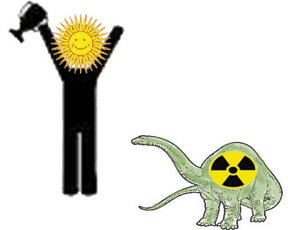
Renewable energies have allowed the European Union to avoid €99bn in
fossil gas imports since the beginning of the war in Ukraine, with an
increase of €11bn compared to last year thanks to record growth in wind
and solar capacity, according to a new report.
Edie 20th Oct 2022
Nuclear Free Local Authorities urge the UK’s new Chancellor to scrap plan to invest in the Sizewell nuclear white elephant

Hot on the heels of the new Chancellor’s U-turn of everything his
predecessor held dear, the Chair of the Nuclear Free Local Authorities has
written to Jeremy Hunt to urge him to reverse the promised investment of
£700 million made by the previous prime minister on a flying-visit to
Sizewell C and to withdraw from making a commitment to taking an equity
stake in the nuclear ‘white elephant’.
In his letter to the Chancellor, NFLA Chair, Councillor David Blackburn asks for common sense and caution to prevail: “Once the government has Sizewell C on the hook, rather than
land the fish, it is more likely the fish will swallow you whole! Nuclear
projects are always inevitably delivered way over cost and way over time,
and, as an equity holder, His Majesty’s Government will be saddled with
ever greater demands for cash with an ever-decreasing likelihood of
offloading this turkey to a private investor.”
NFLA 20th Oct 2022
Olkiluoto nuclear station – more delays due to damage to water feed pumps
Damage has been detected in the inner parts of the feed water pumps of the
turbine plant at Finland’s Olkiluoto 3 EPR reactor, plant owner-operator
Teollisuuden Voima Oyj (TVO) has said. “In connection with maintenance
and inspection work, damage has been observed in the inner parts of the
feed water pumps of the Olkiluoto 3 turbine plant. The matter will probably
have an impact on the progress of the trial operation of Olkiluoto 3 and
the start of regular electricity production,” TVO noted. According to
Siemens, which is part of the plant supplier consortium, the impact of
damage to the feed water pumps on the schedule is not yet known. Together
with the plant supplier, TVO actively participating in the investigation
work. The feed water pumps located in the turbine plant of the nuclear
power plant pump water from the feed water tank to the evaporators. Damage
to the pumps has no effect on nuclear safety.
Nuclear Engineering International 20th Oct 2022
https://www.neimagazine.com/news/newsmore-delays-to-ol3-10102381
Why the US must press for a ceasefire in Ukraine

The war might have been prevented — probably would have been prevented — if Ukraine had been willing to abide by the Minsk agreement, recognize the Donbas as an autonomous entity within Ukraine, avoid NATO military advisors, and pledge not to enter NATO. Nevertheless, what was possible even as late as January 2022 may not be possible now. The Russian annexation of additional territory raises the stakes. But the longer the war continues the harder it is going to be to avoid the utter destruction of Ukraine.
As a key player in Kyiv’s defense and the leader of sanctions against Russia, Washington is obligated to help find a way out.
Responsible Statecraft, OCTOBER 17, 2022, Jack F. Matlock Jr.
Four recent events have put the war in Ukraine on a distinctly more dangerous course.
— The Russian annexation of four additional Ukrainian provinces blocks compromise solutions that were feasible earlier.
— The disabling attacks on both North Stream pipelines make it impossible in the near term to restore Russia as the principal energy supplier to Germany, even if the war in Ukraine should be miraculously ended.
— The Ukrainian attack on the bridge to Crimea gave Russia a pretext to escalate attacks on Ukrainian civilian targets.
— The Russian retaliatory attacks on civilian targets are certain to do more damage to Ukraine than Ukraine can do to Russia.
The leaders of both Russia and Ukraine have set impossible goals. In fact, not a single participant in the war in Ukraine has espoused a goal that can restore peace in the area. Russia’s recent incorporation of four Ukrainian provinces into the Russian Federation will not be accepted by Russia’s neighbors or by most European powers.
Given the passions aroused by the war and its atrocities, Ukraine, even with NATO support, cannot create a stable, functioning state within all the borders it inherited in 1991. If Ukraine tries to regain these territories by force and is encouraged and empowered by the U.S. and NATO to do so, Russia (and not just President Putin) will very likely demolish Ukraine in retaliation. Reality trumps illusion whenever the two conflict.
And if war should stop with the destruction of Ukraine — Kyiv and Lviv leveled as Grozny once was — that would assume that escalation does not involve the use of nuclear weapons. If the Russian leader feels convinced that the U.S. and “Western” goal is to take him out, what is to prevent him taking out others as he goes?
What Went Wrong
It did not have to happen. When the Cold War ended (by negotiation, not by victory) and the USSR fragmented into 15 separate countries (because of pressures from the inside, not from without), Europe was suddenly whole and free, the goal of U.S. and NATO policy during the Cold War. If the future stability and prosperity of Europe were to be ensured, the principal task was to build a security system covering all the countries of Europe.
But a succession of American presidents, from Clinton to Trump, chose instead to enlarge NATO, to trash arms control treaties that ended the Cold War, and to enlist former Soviet republics in a military alliance that excluded Russia. Benjamin Abelow summarized the portentous events in his insightful How the West Brought War to Ukraine.
The war might have been prevented — probably would have been prevented — if Ukraine had been willing to abide by the Minsk agreement, recognize the Donbas as an autonomous entity within Ukraine, avoid NATO military advisors, and pledge not to enter NATO. Nevertheless, what was possible even as late as January 2022 may not be possible now. The Russian annexation of additional territory raises the stakes. But the longer the war continues the harder it is going to be to avoid the utter destruction of Ukraine.
America’s Security
We Americans can only admire the valiant resistance Ukrainians have mounted to the Russian invasion and should be proud that we have been able to support their defense. Everything possible should be done to make sure that Ukraine survives as an independent state. But that does not mean that Ukraine has to recover all the territory it inherited in 1991. In fact, given all the passions aroused by the war and what preceded it (the violent change of government in 2014 that many Russians considered a coup d’etat organized by the United States), the population in some areas is likely to resist a return to Kyiv’s control.

Some will argue that the United States has a moral obligation to support whatever the Ukrainian leaders demand since “they know best.”
No, they do not know best what is in the security interests of the American people, and that should be the primary concern of any American government. They also, under the stress of war, may not be the best judges of their own ultimate security interests.
…………………………………………………………………………….The issue with Ukraine and Russia of course is not recognition of independence but whether the U.S. should support the Ukrainian goal to restore its control over all the territory it received when the Soviet Union broke up. If pursuit of that goal precipitates the progressive destruction of Ukraine, it is obviously not in Ukraine’s interest.
Effect on the World
The fighting in Ukraine continues and intensifies while the world is still struggling with the covid-19 pandemic and remains vulnerable to mutations and new pathogens, while global warming is producing ever more destructive effects. Meanwhile, migrations caused by famine, flood, war, and misgovernment are overwhelming the capacity of even the richest countries to absorb the afflicted. And to all of that one must add the threat of Armageddon, a nuclear holocaust — something no rational leader would risk. But rationality cannot be assumed in either domestic or international politics today.
………………………………………………………………. What all the parties to the conflict in Ukraine seem to have forgotten is that the future of mankind will not be determined by where international borders are drawn — these have never been static in history and doubtless will continue to change from time to time. The future of mankind will be determined by whether nations learn to settle their differences peacefully.
Is There a Way to Stop the War?
There may not be, given the passions aroused by the conflict. Both Ukraine and Russia have lost enough blood that their populations are likely to oppose any effort to give the other side any portion of what it wants. Their presidents hate each other and see any concession as a personal defeat. But the more the war continues, the more Ukrainian lives will be lost, property destroyed, and the probability of a wider conflict increased.
The only practical way to stop the actual fighting would be to agree on a ceasefire. This is difficult for the Ukrainians since they are liberating some of the occupied territories, but the reality is that if the war continues Russia is capable of damaging Ukraine more than Ukraine can damage Russia without risking a wider war.
As principal arms supplier to Ukraine, the U.S. should encourage the Ukrainians to agree to a ceasefire. As the sponsor of the most punitive sanctions on Russia, the U.S. should use its leverage to induce Russia to agree to genuine negotiations during a ceasefire.
Negotiations must be conducted in private to be successful, which would require a revival of U.S.-Russia diplomacy. Over the past few years, tit-for-tat expulsions have reduced both countries to skeleton diplomatic staffs. Nevertheless, if there is a will to talk and negotiate, ways can be found. So far, it is the will that seems to be lacking.
At present, none of the relevant parties to the conflict in Ukraine seem to be willing to stop fighting and enter into genuine negotiations to bring peace in Ukraine. Until this changes, the fighting stops, and serious negotiations get underway, the world is headed for an outcome where we all are losers. https://responsiblestatecraft.org/2022/10/17/on-ukraine-the-us-is-on-the-hook-to-find-a-way-out/
—
Terror on Crimea Bridge and Russia unleashing shock’n awe.
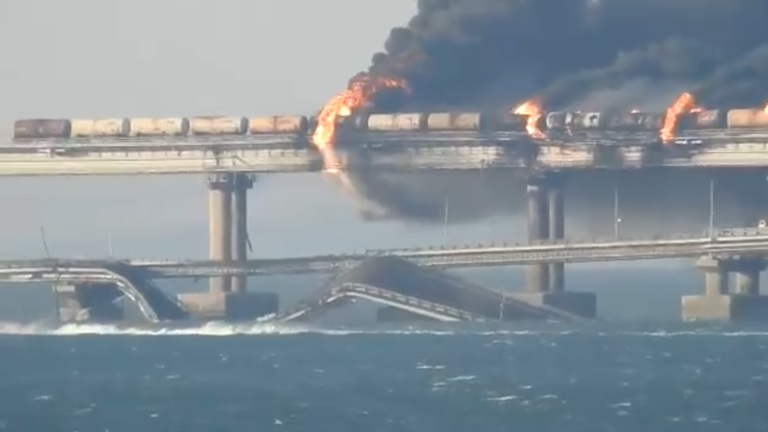
Pearls and Irritations, By P&I Guest Writers, Oct 18, 2022
The terror attack on Krymskiy Most – the Crimea Bridge – was the proverbial straw that broke the Eurasian camel’s back.
Russian President Vladimir Putin neatly summarised it: “This is a terrorist attack aimed at destroying the critical civilian infrastructure of the Russian Federation.”
The head of the Russian Investigative Committee, Alexander Bastrykin, confirmed face-to-face with Putin that Terror on the Bridge was carried out by the SBU – Ukrainian special services.
Bastrykin told Putin, “we have already established the route of the truck, where the explosion took place. Bulgaria, Georgia, Armenia, North Ossetia, Krasnodar… The carriers have been identified. With the help of operatives of the FSB, we managed to identify suspects.”
Russian intel leaked crucial info to military correspondent Alexander Kots. The cargo was ordered by a Ukrainian citizen: explosives packed in 22 pallets, in rolls of film under plastic wrap, were shipped from Bulgaria to the Georgian port of Poti. Afterwards, the cargo was loaded onto a truck with foreign license plates and proceeded overland to Armenia………………………………………………………………
The driver of the first truck is already testifying. Yusubov, the driver of the second truck – which exploded on the bridge – was “blind:” he had no idea what he was carrying, and is dead.
At this stage, two conclusions are paramount.
First: This was not a standard ISIS-style truck suicide bombing – the preferred interpretation in the aftermath of the terror attack.
Second: The packaging most certainly took place in Bulgaria. That, as Russian intel has cryptically implied, indicates the involvement of “foreign special services.”
‘A mirage of cause and effect’
What has been revealed in public by Russian intelligence tells only part of the story. An incandescent assessment received by The Cradle from another Russian intel source is way more intriguing.
At least 450 kg of explosives were employed in the blast. Not on the truck, but mounted inside the Crimea Bridge span itself. The white truck was just a decoy by the terrorists “to create a mirage of cause and effect.” When the truck reached the point on the bridge where the explosives were mounted, the explosion took place.
According to the source, railroad employees told investigators that there was a form of electronic hijacking; the terror operators took control of the railway so the train carrying fuel received a command to stop because of a false signal that the road ahead was busy.
Bombs mounted on the bridge spans were a working hypothesis largely debated in Russian military channels over the weekend, as well as the use of underwater drones.
In the end, the quite sophisticated plan could not follow the necessarily rigid timing. There was no alignment by the millimeter between the mounted explosive charges, the passing truck and the fuel train stopped in its tracks. Damage was limited, and easily contained. The charges/truck combo exploded on the outer right lane of the road. Damage was only on two sections of the outer lane, and not much on the railway bridge.
In the end, Terror on the Bridge yielded a short, Pyrrhic PR victory – duly celebrated across the collective West – with negligible practical success: transfer of Russian military cargo by railway resumed in roughly 14 hours.
And that brings us to the key information in the Russian intel source assessment: the whodunnit.
It was a plan by the British MI6, says this source, without offering further details. Which, he elaborates, Russian intel, for a number of reasons, is shadow-playing as “foreign special services.”
It’s quite telling that the Americans rushed to establish plausible deniability. The proverbial “Ukrainian government official” told CIA mouthpiece The Washington Post that the SBU did it. That was a straight confirmation of an Ukrainska Pravda report based on an “unidentified law enforcement official.”
The perfect red line trifecta
Already, over the weekend, it was clear the ultimate red line had been crossed. Russian public opinion and media were furious. For all its status as an engineering marvel, Krymsky Most represents not only critical infrastructure; it is the visual symbol of the return of Crimea to Russia.
Moreover, this was a personal terror attack on Putin and the whole Russian security apparatus.
So we had, in sequence, Ukrainian terrorists blowing up Darya Dugina’s car in a Moscow suburb (they admitted it); US/UK special forces (partially) blowing Nord Stream and Nord Stream 2 (they admitted and then retracted); and the terror attack on Krymsky Most (once again: admitted then retracted).
Not to mention the shelling of Russian villages in Belgorod, NATO supplying long-range weapons to Kiev, and the routine execution of Russian soldiers.
Darya Dugina, Nord Streams and Crimea Bridge make it an Act of War trifecta. So this time the response was inevitable – not even waiting for the first meeting since February of the Russian Security Council scheduled for the afternoon of 10 October.
Moscow launched the first wave of a Russian Shock’n Awe without even changing the status of the Special Military Operation (SMO) to Counter-Terrorist Operation (CTO), with all its serious military/legal implications.
After all, even before the UN Security Council meeting, Russian public opinion was massively behind taking the gloves off. Putin had not even scheduled bilateral meetings with any of the members. Diplomatic sources hint that the decision to let the hammer come down had already been taken over the weekend.
Shock’n Awe did not wait for the announcement of an ultimatum to Ukraine (that may come in a few days); an official declaration of war (not necessary); or even announcing which ‘”decision-making centers” in Ukraine would be hit.
The lightning strike de facto metastasising of SMO into CTO means that the regime in Kiev and those supporting it are now considered as legitimate targets, just like ISIS and Jabhat al-Nusra during the Anti-Terror Operation (ATO) in Syria.
And the change of status – now this is a real war on terror – means that terminating all strands of terrorism, physical, cultural, ideological, are the absolute priority, and not the safety of Ukrainian civilians. During the SMO, safety of civilians was paramount. Even the UN has been forced to admit that in over seven months of SMO the number of civilian casualties in Ukraine has been relatively low.
Enter ‘Commander Armageddon’
The face of Russian Shock’n Awe is Russian Commander of the Aerospace Forces, Army General Sergey Surovikin: the new commander-in-chief of the now totally centralised SMO/CTO………………………………..
Surovikin is Dr. Shock’n Awe with full carte blanche. That even rendered idle speculations that Defense Minister Sergei Shoigu and Chief of the General Staff Valery Gerasimov were removed or forced to resign, as speculated by the Wagner group Telegram channel Grey Zone.
It is still possible that Shoigu – widely criticised for recent Russian military setbacks – could be eventually replaced by Tula Governor Alexei Dyumin, and Gerasimov by the Deputy Commander-in-Chief of the Ground Forces, Lieutenant General Alexander Matovnikov.
That’s almost irrevelant: all eyes are on Surovikin.
MI6 does have some well-placed moles in Moscow, relatively speaking. The Brits had warned Ukrainian President Volodymyr Zelensky and the General Staff that the Russians would be launching a “warning strike” this Monday.
What happened was no “warning strike,” but a massive offensive of over 100 cruise missiles launched “from the air, sea and land,” as Putin noted, against Ukrainian “energy, military command and communications facilities.”
MI6 also noted “the next step” will be the complete destruction of Ukraine’s energy infrastructure. That’s not a “next step:” it’s already happening. Power supply is completely gone in five regions, including Lviv and Kharkov, and there are serious interruptions in other five, including Kiev.
Over 60 percent of Ukrainian power grids are already knocked out. Over 75 percent of internet traffic is gone. Elon Musk’s Starlink netcentric warfare has been “disconnected” by the Ministry of Defence.
Shock’n Awe will likely progress in three stages.
First: Overload of the Ukrainian air defence system (already on).
Second: Plunging Ukraine into the Dark Ages (already in progress).
Third: Destruction of all major military installations (the next wave).
Ukraine is about to embrace nearly total darkness in the next few days. Politically, that opens a completely new ball game. Considering Moscow’s trademark “strategic ambiguity,” this could be a sort of Desert Storm remixed (massive air strikes preparing a ground offensive); or, more likely, an ‘incentive’ to force NATO to negotiate; or just a relentless, systematic missile offensive mixed with Electronic Warfare (EW) to shatter for good Kiev’s capacity to wage war.
Or it could be all of the above.
How a humiliated western Empire can possibly raise the stakes now, short of going nuclear, remains a key question. Moscow has shown admirable restraint for too long. No one should ever forget that in the real Great Game – how to coordinate the emergence of the multipolar world – Ukraine is just a mere sideshow. But now the sideshow runners better run for cover, because General Armageddon is on the loose.
Pepe Escobar is a columnist at The Cradle, editor-at-large at Asia Times and an independent geopolitical analyst focused on Eurasia. Since the mid-1980s he has lived and worked as a foreign correspondent in London, Paris, Milan, Los Angeles, Singapore and Bangkok. He is the author of countless books; his latest one is Raging Twenties.
Moscow says it now runs Europe’s largest nuclear plant, causing chaos and confusion
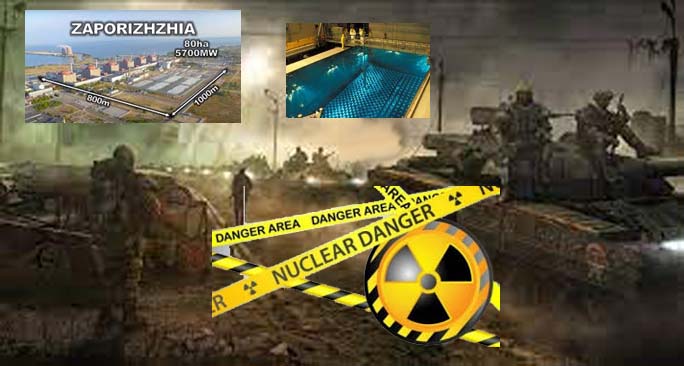
https://bellona.org/news/nuclear-issues/2022-10-moscow-says-it-now-runs-europes-largest-nuclear-plant-causing-chaos-and-confusion October 19, 2022 by Charles Digges,
In the days since Moscow held a forced vote annexing four regions in Ukraine, Russian President Vladimir Putin has declared that Europe’s largest nuclear power plant in the Zaporizhzhia oblast is now Russian property.
The residents of Enerhodar, the city built to house the Ukrainian workers at the Zaporizhzhia nuclear plant, would beg to differ. According to a September poll taken of the company town’s residents, only 6 percent favored becoming part of Russia.
Recent gains by Ukrainian troops in the Donestk, Luhansk and Kherson regions also belie Moscow’s claims to greater control. But battlelines in the Zaporizhzhia region have stagnated around the plant, with fears of hitting its six reactors and pools of spent nuclear fuel standing in the way of a Ukrainian counteroffensive.
Putin’s orders to bring the plant under Russian control are intensifying the quandaries faced by the Ukrainian employees who have worked throughout the war to prevent a nuclear catastrophe at the complex.
Directly following Moscow’s force referendums last month, Russian troops detained Igor Muratov, the Zaporizhzhia plant’s director, then released a video of him saying he was collaborating with Ukrainian intelligence. Then they and expelled him from Russian-held territory.
In the following days, the plant’s deputy director as well as its director of human resources were also detained by Russian forces. Both remain missing.
Following Putin’s order, Russia’s state nuclear corporation Rosatom created a subsidiary, with $2 billion of startup capital, called The Joint Stock Company Operating Organization of the Zaporozhye Nuclear Power Plant, using the Russian spelling for the location. At the same time, Petro Kotin, head of Energoatom, Ukraine’s nuclear power operator, has said he himself is now the plant’s director.
Kotin has also implored technicians at the plant not to sign any contracts with Russian occupiers in response to reports that plant employees are under pressure to start working for Rosatom — and threatened with conscription into Moscow’s army if they don’t.
However, should the technicians caught in this dilemma sign on with Rosatom, they face prosecution by Kyiv for collaborating with Russia’s invading forces, said Dmitry Gorchakov, a nuclear power analyst with Bellona.
“They’re in an almost hopeless situation,” Gorchakov said. “And this is the main problem, in addition to the nuclear safety issues, that should be discussed and not forgotten.”
The uncertainty over who is in charge further imperils the security of the plant as hostilities continue, Rafael Grossi, head of the UN’s International Atomic Energy Agency said in a statement last week.
“Staff at the plant are being forced to make a hugely difficult decision for themselves and their loved ones,” Grossi said. “The enormous pressure they are facing must stop.”
In a highly unusual move, Grossi also took a side in the conflict for the first time since Russian forces seized Zaporizhzhia in March. Grossi told reporters in Kyiv that “the position of the IAEA is that this facility is a Ukrainian facility.”
On Monday, it was reported that Rosatom had given the about 3,000 remaining staff members — down from 11,000 before the war — until Thursday, October 19, to make a choice: work for Rosatom or else.
“If they don’t sign the statement [to work for Rosatom], they won’t have a livelihood, to feed their family, children,” a worker who left the plant this summer and made his way to Ukrainian-held territory told the Wall Street Journal. “If they sign, they will be a traitor and a collaborator…it all stinks.”
Meanwhile, despite cycling down all six of the plant’s rectors into cold shutdown mode for safety reasons early September, both Energoatom and Rosatom are mulling restarting at least a few of them to gird against the coming cold months. It might be the one thing on which the two sides agree.
For reactors to restart, said Gorchakov, the safety of outside power lines bearing electricity for the plant’s critical cooling and safety systems must be assured.
That’s unlikely, given recent developments. For the past several days, energy infrastructure supplying the plant has been the focus of shelling, forcing technicians to power cooling and safety systems with diesel backup generators — a move widely seen by nuclear experts as the last defense against possible meltdown.
On Monday, Russian shells destroyed the only substation supplying the plant with electricity from the Ukrainian grid was damaged before dawn, again forcing the plant to rely on generators, presumably until the substation is repaired.
“I think that the fight against infrastructure is now the fight for the station in the miltary sense,” said Gorchakov. “It is terrible that at the same time the station is constantly shutting down, increasing the risk of an accident.”
Combined, Zaporizhzhia’s 20 diesel generators should keep cooling systems running for as long as 10 days — provided they have access to fuel, certainly not a given in the midst of a war zone.
IAEA safety chief hopes to return to Ukraine ‘soon’ over nuclear plant talks

https://www.reuters.com/world/europe/iaea-chief-hopes-return-ukraine-soon-over-nuclear-plant-talks-2022-10-19/ By Walter Bianchi and Miguel Lo Bianco BUENOS AIRES, Oct 18 (Reuters) – International Atomic Energy Agency (IAEA) chief Rafael Grossi expects to return “soon” to Ukraine, he told Reuters on Tuesday, amid negotiations to establish a security protection zone around the Russian-occupied Zaporizhzhia nuclear power plant.
Grossi has been the go-between from Moscow to Kyiv in an effort to establish a nuclear safety and security protection zone around the plant, which has been hit by power outages in the past weeks due to shelling of the site.
Earlier, the IAEA said it was deeply concerned by the detention of two Ukrainian staff from the Zaporizhzhia plant, which is in one of four Ukrainian regions Russia has proclaimed as annexed but only partly occupies. read more
“There is a possibility I will return to Ukraine and Russia, it is in fact what we have agreed in principle, at this moment we are continuing the consultations aimed at establishing the protection zone,” he told Reuters during a trip to Argentina.
“This implies an interaction where I receive answers and reactions from the two sides and I am looking for new ways to move forward and for that, at some point, probably very soon I will have to return.”
The talks are seen as key to defusing concerns that have mounted since August about the risks of shelling at or near Zaporizhzhia, Europe’s largest nuclear power station. Russia and Ukraine have both blamed each other for the shelling.
The head of the IAEA, the U.N. nuclear watchdog, said that separate Russian threats to use nuclear weapons in Ukraine could not be ruled out but that it was “not an immediate possibility”.
“I believe that the possibility of Russia using nuclear weapons is not an immediate possibility. Obviously nothing can be ruled out, I am not in the decision-making mechanism of that country, but I believe that it would be an extreme measure,” he said.
Grossi, asked about ongoing talks to revive an Iran nuclear deal, said that the negotiations were at a “stalemate”, adding that the IAEA lacked key information due to restriction on access to inspections in recent months.
The United States last week said that reviving the 2015 Iran nuclear deal was “not our focus right now”, adding Tehran had showed little interest in reviving the pact and that Washington was concentrating on how to support Iranian protesters. Reporting by Adam Jourdan; Editing by Himani Sarkar
A US billionaire proposes peace plan for Ukraine and Russia

https://www.rt.com/news/564960-bill-ackman-ukraine-peace/ 17 Oct 22,
Hedge fund manager Bill Ackman says Kiev should make concessions to Moscow.
Ukraine should recognize Crimea as part of Russia and renounce its bid to join NATO for the sake of peace, US billionaire hedge fund manager Bill Ackman has said. As with SpaceX and Tesla CEO Elon Musk before him, Ackman was immediately criticized online for suggesting that Kiev should be ready to make concessions in order to end the hostilities.
“Crimea was part of Russia until 1954 and is largely comprised of ethnic Russians, which was apparently why the world did little when Russia annexed it back in 2014,” Ackman, the CEO of Pershing Square Capital Management, tweeted on Monday.
He added that the borders should return to where they were prior to February 24, when Russia launched its military operation in the neighboring country and before four former Ukrainian regions voted to join Russia. He added that the West should then help Kiev with its recovery, while the country should stay outside NATO.
“Thousands of lives will be saved and resources can be invested to rebuild [Ukraine] rather than in a war that will only lead to more destruction and death,” the billionaire wrote. “If there is a viable path to peace, we should pursue it. Each day the conflict continues, the risk to the world rises.”
After receiving criticism online, Ackman clarified his stance on Tuesday. “Yesterday, I suggested that a reasonable peace settlement might be a return to the borders as of [February 24], a Marshall Plan to rebuild [Ukraine], and [Ukraine’s] decision to not join NATO. Then the knives came out. I was accused of being an appeaser and worse,” he wrote.
I ask: is [Ukraine] better off in a continued prolonged war that leads to 1,000s more [Ukrainian] deaths and the leveling of the country or does some kind of negotiated settlement make sense? … I am by no means an expert. It just saddens me to see death and destruction with no apparent end date or opportunity for resolution.
I”n a negotiated settlement, both parties must concede something or there is no opportunity for resolution. What is the least that both parties can concede that is acceptable for both? What am I missing in my analysis? What better ideas do you have?” Ackman argued.
Ackman’s comments came as more public figures in the West have been making suggestions for a possible peace deal between Russia and Ukraine. Venture capitalist and tech entrepreneur David Sacks tweeted on Sunday that the US should propose a ceasefire based on the February 23 lines and guarantee that Ukraine will not join NATO.
Musk offered his own vision of a peace settlement this month, which includes Ukraine recognizing Crimea as Russian territory. Kiev and Western officials quickly blasted Musk for what they considered to be a plan that heavily favors Moscow.
How European countries are cutting power consumption.
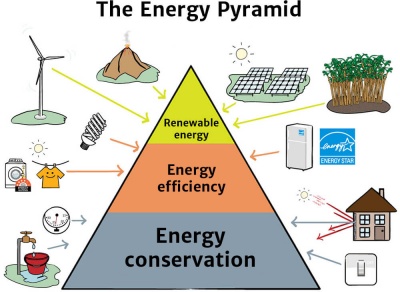
What are European countries doing to cut power consumption? Paris is
switching off the Eiffel Tower lights an hour early, Milan has turned off
public fountains, and Hanover is offering gym users cold rather than hot
showers in an effort to combat potential energy shortages this winter.
At the same time, the public are being encouraged to do their bit by avoiding
using household appliances between 4pm and 7pm, stock up on blankets and
slow down their driving. One global retail chain is encouraging staff to
change their behaviours: to use stairs instead of lifts, to use
energy-saving apps at home, and unplug devices rather than leaving them on
standby.
The UK, by contrast, has blocked a £15m campaign encouraging the
public to conserve energy, with the government arguing that the country is
“not a nanny state”. But across Europe, governments and municipal
authorities have responded to calls to reduce power consumption and reach
an EU target of shaving 15% off energy consumption by next March. All
member states are reducing heating in public buildings by one degree to
19C, but some have gone further.
Guardian 18th Oct 2022
Strikes at French nuclear plants – what’s at stake?
Forrest Crellin, 19 Oct 22, PARIS, (Reuters) – Strikes at France’s nuclear power plants have affected about a third of its reactors, in many cases delaying maintenance work and complicating operator EDF’s (EDF.PA) efforts to boost production ahead of winter.
Currently 20 out of 56 reactors have been impacted, a union official said on Wednesday. Of these, maintenance plans of 17 have been disrupted, with some seeing their restart schedule delayed by a few days and some by up to three weeks.
THE EFFECT ON SUPPLY
France’s nuclear output was already expected to hit a 30-year low in 2022 due to a record number of reactor outages for corrosion issues and planned maintenance, at a time when Europe is facing an energy crisis because of the war in Ukraine.
Rolling strikes over wages by the FNME-CGT union at some plants have added to the problem.
Maintenance delays at nine reactors have caused the loss of 4.4 terawatt hours (TWh) of nuclear power generation – nearly a quarter of the power produced in September – compared to the maintenance schedule before the strikes began, data from consultancy Energy Aspects showed.
France is a net importer of electricity and the strikes will further boost power imports, particularly from Britain, the consultancy said.
Power grid operator RTE warned on Tuesday that prolonged strikes further delaying the restart of reactors could have “heavy consequences” for electricity supply over the winter.
Britain’s National Grid has also cited maintenance issues at French nuclear reactors as a factor that could affect UK energy supplies this winter……………..
the strikes raise a question mark over power availability for November………………….
WHAT’S THE COST?
FNME-CGT secretary general Sébastien Menesplier said a one day outage at an EDF reactor usually cost about 1 million euros ($976,600) but that at current electricity prices that could be “5 to 10 times more”.
With the baseload November power price around 587 euros ($573) per megawatt-hour (MWh), the cost of a reactor not running is probably not far from 10 million euros per day, said Emeric de Vigan, vice president of power at data and analytics firm Kpler.
However, French forward baseload contracts have fallen from highs over 1,000 euros in late August, as maintenance delays at EDF have been mostly be priced in.
“With that being said, events like this come at the worst possible time, when French nuclear is needed the most, and even more so for the coming months,” Rystad analyst Fabian Ronningen said.
WHAT’S THE LEGAL POSITION?
Workers are legally obligated to ensure the continuity of the public electricity service, requiring them to raise production or resume operations to return reactors to the grid to avoid power cuts………………………………. more https://www.reuters.com/business/energy/strikes-french-nuclear-plants-whats-stake-2022-10-19/
1 This Month

of the week– Nuclear Reactor Information Task Force

14 May – online event From Bombs to Data Centres: the Face of Nuclear Colonialism
To see nuclear-related stories in greater depth and intensity – go to https://nuclearinformation.wordpress.com
-
Archives
- May 2026 (126)
- April 2026 (356)
- March 2026 (251)
- February 2026 (268)
- January 2026 (308)
- December 2025 (358)
- November 2025 (359)
- October 2025 (376)
- September 2025 (257)
- August 2025 (319)
- July 2025 (230)
- June 2025 (348)
-
Categories
- 1
- 1 NUCLEAR ISSUES
- business and costs
- climate change
- culture and arts
- ENERGY
- environment
- health
- history
- indigenous issues
- Legal
- marketing of nuclear
- media
- opposition to nuclear
- PERSONAL STORIES
- politics
- politics international
- Religion and ethics
- safety
- secrets,lies and civil liberties
- spinbuster
- technology
- Uranium
- wastes
- weapons and war
- Women
- 2 WORLD
- ACTION
- AFRICA
- Atrocities
- AUSTRALIA
- Christina's notes
- Christina's themes
- culture and arts
- Events
- Fuk 2022
- Fuk 2023
- Fukushima 2017
- Fukushima 2018
- fukushima 2019
- Fukushima 2020
- Fukushima 2021
- general
- global warming
- Humour (God we need it)
- Nuclear
- RARE EARTHS
- Reference
- resources – print
- Resources -audiovicual
- Weekly Newsletter
- World
- World Nuclear
- YouTube
-
RSS
Entries RSS
Comments RSS
 nuclear-news