Who are the Ukrainian integral nationalists ?


Do Western enthusiasts for the Ukrainian government have any idea of the history behind this war?
Regretfully, I have mutilated this historical article below, because it’s long and complex.
So – I have just selected extracts – in my effort to outline this history of the Ukrainian nationalists
Voltaire Network Thierry Meyssa Translation Roger Lagassé 16 Nov 22
Who knows the history of the Ukrainian “integral nationalists”, “Nazis” according to the terminology of the Kremlin? It begins during the First World War, continues during the Second, the Cold War and continues today in modern Ukraine.
Many documents have been destroyed and modern Ukraine forbids under penalty of imprisonment to mention their crimes. The fact remains that these people massacred at least four million of their compatriots and conceived the architecture of the Final Solution, that is, the murder of millions of people because of their real or supposed membership in the Jewish or Gypsy communities of Europe.
Like most Western political analysts and commentators, I was unaware of the existence of Ukrainian neo-Nazis until 2014. When the president-elect was overthrown, I was living in Syria at the time and thought they were violent groupings that had burst onto the public scene to assist pro-European elements. However, since the Russian military intervention, I have gradually discovered a lot of documents and information on this political movement which, in 2021, represented one third of the Ukrainian armed forces. This article presents a synthesis of it.
At the very beginning of this story, that is to say before the First World War, Ukraine was a large plain which had always been tossed between German and Russian influences. At the time, it was not an independent state, but a province of the tsarist empire. It was populated by Germans, Bulgarians, Greeks, Poles, Rumanians, Russians, Czechs, Tatars and a very large Jewish minority supposedly descended from the ancient Khazar people.

A young poet, Dmytro Dontsov, was fascinated by the avant-garde artistic movements, believing that they would help his country to escape from its social backwardness. ……….. When the Great War broke out, he became an agent of the German secret service.

……….. In 1917, the Bolshevik revolution turned the tables. Dontsov’s friends supported the Russian revolution, but he remained pro-German. In the anarchy that followed, Ukraine was divided de facto by three different regimes: the nationalists of Symon Petliura (who imposed themselves in the area held today by the Zelensky administration), the anarchists of Nestor Makhno (who organized themselves in Novorosssia, the land that had been developed by Prince Potemkin and that had never known serfdom), and the Bolsheviks (especially in the Donbass). The war cry of Petliura’s followers was “Death to the Jews and Bolsheviks”. They perpetrated numerous murderous pogroms.
……………Dmytro Dontsov helped Petliura to ally with Poland to crush the anarchists and Bolsheviks. ……………………………………………..
Dmytro Dontsov published literary magazines that fascinated the youth. He continued to promote a Central Europe dominated by Germany and became closer to Nazism as it rose…………………………………………
The expression “integral nationalism” is still claimed today by Dontov’s followers, who, after the fall of the Third Reich, are careful to refute the term “Nazism” with which the Russians describe it, not without reason………………………………….
Dontsov became an unconditional admirer of the Führer, Adolf Hitler. . His followers had founded, in 1929, the Organization of Ukrainian Nationalists (OUN) around Colonel Yevhen Konovalets. Konovalets called Dontsov “the spiritual dictator of the youth of Galicia”. However, a quarrel arose between Dontsov and another intellectual about his extremism that led to war against all, when Konovalets was suddenly murdered. The OUN (financed by the German secret service) then split in two. The “integral nationalists” reserved for themselves the OUN-B, named after Dontsov’s favorite disciple, Stepan Bandera…………………………………………
In 1934, Bandera organized, as a member of the Nazi secret service and head of the OUN-B, the assassination of the Polish Minister of the Interior, Bronisław Pieracki………………………………………………..
From the beginning of the Second World War, under the guidance of Dmytro Dontsov, the OUN-B fought alongside the Nazi armies against the Jews and the Soviets.
The collaboration between the Ukrainian “integral nationalists” and the Nazis continued with constant massacres of the majority of the Ukrainian population, accused of being Jews or Communists, until the “liberation” of Ukraine by the Third Reich in the summer of 1941 to the cry of “Slava Ukraїni!” (Glory to Ukraine), the war cry used today by the Zelensky administration and the US Democrats. At that time, the “integral nationalists” proclaimed “independence” from the Soviet Union in the presence of Nazi representatives and Greek Orthodox clergy, not in Kiev, but in Lviv, on the model of the Hlinka Guard in Slovakia and the Ustasha in Croatia.
They formed a government under the leadership of Providnyk (guide) Stepan Bandera, whose friend Yaroslav Stetsko was Prime Minister. Their support in Ukraine is estimated at 1.5 million people. That is, the “integral nationalists” have always been in the minority.

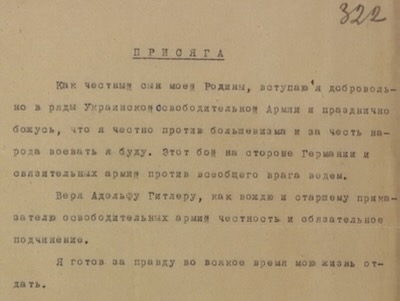
…………………………………….in September 1941 The OUN-B was reorganized under German command.. all Ukrainian nationalists took the following oath:”……………….. I believe in Adolf Hitler as the leader and supreme commander …………”
The Nazis announced that many bodies had been discovered in the prisons, victims of “Bolshevik Jews. So the “integral nationalists” celebrated their “independence” by murdering more than 30,000 Jews and actively participating in the roundup of Jews from Kiev to Babi Yar, where 33,771 of them were shot in two days, on September 29 and 30, 1941, by the Einsatzgruppen of SS Reinhard Heydrich.
In this tumult, Dmytro Dontsov disappeared. In reality, he had gone to Prague and placed himself at the service of the architect of the Final Solution, Reinhard Heydrich, who had just been appointed vice-governor of Bohemia-Moravia. Heydrich organized the Wannsee Conference, which planned the “Final Solution of the Jewish and Gypsy Questions” [4]. He then created the Reinard Heydrich Institute in Prague to coordinate the systematic extermination of all these populations in Europe. The Ukrainian Dontsov, who now lived in Prague in great luxury, immediately became its administrator. He was one of the main architects of the largest massacre in history. Heydrich was assassinated in June 1942, but Dontsov retained his functions and privileges.
…………………… 1944, as the Reich army retreated ……… Bandera and Stetsko resumed the armed struggle, among the Nazis, against the Jews and the Bolsheviks.
But it was already too late. The Reich collapsed. The Anglo-Saxons got Dontsov, Bandera and Stetsko. The theorist of integral nationalism was transferred to Canada, while the two practitioners of mass murder were transferred to Germany. MI6 and the OSS (predecessor of the CIA) rewrote their biographies, making their Nazi involvement and responsibility for the “Final Solution” disappear.
[Ed not: from here, the story becomes very complex. with ,in the 1950s, the involvement of the CIA, the Muslim Brotherhood, Radio Free Europe, and prominent political and media leaders…….Chiang Kai-shek and the World Anti-Communist League , going on to Slava Stetsko in 1986]
………………………………………..Slava Stetsko, took over the leadership of these organizations. She too travelled the world to support any fight against the “communists”, or rather, if we refer to Dontsov’s writings, against the Russians and the Chinese. When the USSR was dissolved, Mrs. Stetsko simply changed the title of the League to the World League for Freedom and Democracy, a name it still has today. She then devoted herself to regaining a foothold in Ukraine.
………in 1994 she brought the Ukrainian president, Leonid Kuchma, to the CIA offices in Munich and dictated parts of the new constitution to him. Even today, Article 16 of the new constitution states: “Preserving the genetic heritage of the Ukrainian people is the responsibility of the state. Thus, Nazi racial discrimination is still proclaimed by modern Ukraine as in the worst moments of World War II.
………………………………….. On May 8, 2007, in Ternopol, on the initiative of the CIA, the “integral nationalists” of the Ukrainian People’s Self-Defense and Islamists created an anti-Russian “Anti-Imperialist Front”………………………………
The pro-US president, Viktor Yushchenko, created a Dmytro Dontsov Institute, following the “Orange Revolution”. Yushchenko is an example of Anglo-Saxon whitewashing. He has always claimed to have no connection with the mainstream nationalists, but his father, Andrei, was a guard in a Nazi extermination camp [8]. The Dmytro Dontsov Institute would be closed in 2010, and then reopened after the 2014 coup.
President Viktor Yushchenko, shortly before the end of his term of office, elevated the criminal against humanity Stepan Bandera to the title of “Hero of the Nation”.
In 2011, the mainstream nationalists succeeded in passing a law banning the commemoration of the end of World War II because it was won by the Soviets and lost by the Banderists……………………………
In 2014, Ukrainians in Crimea and Donbass refused to recognize the coup government. Crimea, which had declared itself independent before the rest of Ukraine, reaffirmed its independence a second time and joined the Russian Federation. The Donbass sought a compromise. The “Ukrainian nationalists,” led by President Petro Poroshenko, stopped providing public services there and bombed its population. In eight years, they murdered at least 16,000 of their fellow citizens in general indifference.
It was also from the 2014 coup that the full nationalist militias were incorporated into the Ukrainian Armed Forces. In their internal regulations, they enjoin each fighter to read the works of Dmytro Dontsov, including his master book, Націоналізм (Nationalism).
In April 2015, the Verkhovna Rada declared members of the Organization of Ukrainian Nationalists (OUN) “independence fighters.” The law was enacted, in December 2018, by President Poroshenko. Former Waffen SS were retrospectively entitled to a pension and all sorts of benefits. The same law criminalized any claim that OUN militants and UPA fighters collaborated with the Nazis and practiced ethnic cleansing of Jews and Poles. Published in Ukraine, this article would send me to jail for writing it and you for reading it.
On July 1, 2021, President Volodymyr Zelenski enacted the Law “On Indigenous Peoples of Ukraine” which places them under the protection of Human Rights. By default, citizens of Russian origin can no longer invoke them in court.
In February 2022, the “full nationalist” militias, which made up one-third of the country’s armed forces, planned a coordinated invasion of Crimea and the Donbass. They were stopped by the Russian military operation to implement UN Security Council Resolution 2202 to end the suffering of the people of Donbass.
In March 2022, Israeli Prime Minister Nafatali Bennett, breaking with the “revisionist Zionism” of Benjamin Netanyahu (the son of Jabotinsky’s secretary), suggested to President Volodymyr Zelensky that he should agree with Russian demands and denazify his country …………………………………
Main sources:
Ukrainian Nationalism in the age of extremes. An intllectual biography of Dmytro Dontsov, Trevor Erlacher, Harvard University Press (2021).
Stepan Bandera, The Life and Afterlife of a Ukrainian Nationalist. Fascism, Genocide, and Cult, Grzegorz Rossoliński-Liebe, Ibidem (2014). https://www.voltairenet.org/article218395.html
The entire article is below
Read more: Who are the Ukrainian integral nationalists ?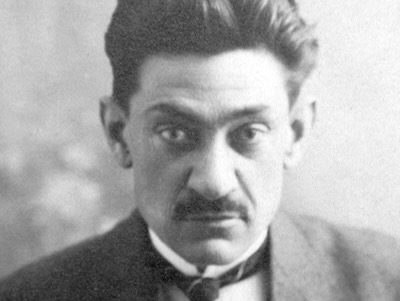
Like most Western political analysts and commentators, I was unaware of the existence of Ukrainian neo-Nazis until 2014. When the president-elect was overthrown, I was living in Syria at the time and thought they were violent groupings that had burst onto the public scene to assist pro-European elements. However, since the Russian military intervention, I have gradually discovered a lot of documents and information on this political movement which, in 2021, represented one third of the Ukrainian armed forces. This article presents a synthesis of it.
At the very beginning of this story, that is to say before the First World War, Ukraine was a large plain which had always been tossed between German and Russian influences. At the time, it was not an independent state, but a province of the tsarist empire. It was populated by Germans, Bulgarians, Greeks, Poles, Rumanians, Russians, Czechs, Tatars and a very large Jewish minority supposedly descended from the ancient Khazar people.
A young poet, Dmytro Dontsov, was fascinated by the avant-garde artistic movements, believing that they would help his country to escape from its social backwardness. Since the Tsarist Empire had been immobile since the death of Catherine the Great, while the German Empire was the scientific center of the West, Dontsov chose Berlin over Moscow.
When the Great War broke out, he became an agent of the German secret service. He emigrated to Switzerland, where he published, on behalf of his masters, the Bulletin of the Nationalities of Russia in several languages, calling for the uprising of the ethnic minorities of the Tsarist Empire in order to bring about its defeat. This model was chosen by the Western secret services to organize the “Forum of Free Peoples of Russia” this summer in Prague [1].
In 1917, the Bolshevik revolution turned the tables. Dontsov’s friends supported the Russian revolution, but he remained pro-German. In the anarchy that followed, Ukraine was divided de facto by three different regimes: the nationalists of Symon Petliura (who imposed themselves in the area held today by the Zelensky administration), the anarchists of Nestor Makhno (who organized themselves in Novorosssia, the land that had been developed by Prince Potemkin and that had never known serfdom), and the Bolsheviks (especially in the Donbass). The war cry of Petliura’s followers was “Death to the Jews and Bolsheviks”. They perpetrated numerous murderous pogroms.
Dmytro Dontsov returned to Ukraine before the German defeat and became the protégé of Symon Petliura. He participated briefly in the Paris peace conference but, for some unknown reason, did not remain in his delegation. In Ukraine, he helped Petliura to ally with Poland to crush the anarchists and Bolsheviks. After the capture of Kiev by the Bolsheviks, Petliura and Dontsov negotiated the Treaty of Warsaw (April 22, 1920): the Polish army undertook to push back the Bolsheviks and to liberate Ukraine in exchange for Galicia and Volhynia (exactly as the Zelensky administration is negotiating today the entry of Poland into the war against the same lands [2]). This new war was a fiasco.
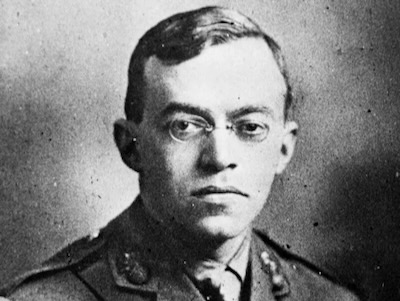
To strengthen his side, Petliura secretly negotiated with the founder of the Jewish battalions in the British army (the “Jewish Legion”) and now administrator of the World Zionist Organization (WZO), Vladimir Jabotinsky. In September 1921, the two men agreed to unite against the Bolsheviks in exchange for Petliura’s commitment to forbid his troops to continue their pogroms. The Jewish Legion was to become the “Jewish Gendarmerie. However, despite his efforts, Petliura did not succeed in pacifying his troops, especially as his close collaborator Dontsov was still encouraging the massacre of Jews. Finally, when the agreement was revealed, the World Zionist Organization rebelled against the Petliura regime. On January 17, 1923, the WZO set up a commission to investigate Jabotinsky’s activities. Jabotinsky refused to come and explain himself and resigned from his position.
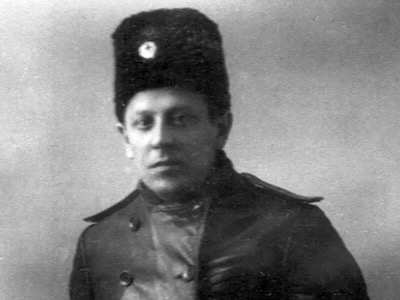
Petliura fled to Poland and then to France, where he was murdered by a Jewish anarchist from Bessarabia (now Transnistria). During the trial, the latter assumed his crime and pleaded to have avenged the hundreds of thousands of Jews murdered by the troops of Petliura and Dontsov. The trial had a great impact. The court acquitted the murderer. The League against Pogroms, later Licra (International League against Racism and Anti-Semitism), was founded on this occasion.
Not only were the nationalists defeated, but the anarchists as well. Everywhere the Bolsheviks triumphed and chose, not without debate, to join the Soviet Union.
Dmytro Dontsov published literary magazines that fascinated the youth. He continued to promote a Central Europe dominated by Germany and became closer to Nazism as it rose. He soon referred to his doctrine as Ukrainian “integral nationalism “. In doing so, he referred to the French poet, Charles Maurras. Indeed, the logic of both men was initially identical: they sought in their own culture the means to affirm a modern nationalism. However, Maurras was a Germanophobe, while Dontsov was a Germanophile. The expression “integral nationalism” is still claimed today by Dontov’s followers, who, after the fall of the Third Reich, are careful to refute the term “Nazism” with which the Russians describe it, not without reason.
According to him, “Ukrainian nationalism” is characterized by:
“the affirmation of the will to live, power, expansion” (it promotes “The right of strong races to organize peoples and nations to strengthen the existing culture and civilization”)
“the desire to fight and the awareness of its extremity” (he praises the “creative violence of the initiative minority”).
Its qualities are:
“fanaticism” ;
” immorality”.
Finally, turning his back on his past, Dontsov became an unconditional admirer of the Führer, Adolf Hitler. His followers had founded, in 1929, the Organization of Ukrainian Nationalists (OUN) around Colonel Yevhen Konovalets. Konovalets called Dontsov “the spiritual dictator of the youth of Galicia”. However, a quarrel arose between Dontsov and another intellectual about his extremism that led to war against all, when Konovalets was suddenly murdered. The OUN (financed by the German secret service) then split in two. The “integral nationalists” reserved for themselves the OUN-B, named after Dontsov’s favorite disciple, Stepan Bandera.
In 1932-33, the Bolshevik political commissars, who were mostly Jewish, levied a tax on crops, as in other regions of the Soviet Union. Combined with significant and unpredictable climatic hazards, this policy caused a huge famine in several regions of the USSR, including the Ukraine. It is known as “Holodomor”. Contrary to what the nationalist historian Lev Dobrianski says, it was not a plan for the extermination of Ukrainians by the Russians, since other Soviet regions suffered, but an inadequate management of public resources in times of climate change. Lev Dobrianski’s daughter, Paula Dobrianski, became one of President George W. Bush’s aides. She led a merciless struggle to have historians who did not adhere to her father’s propaganda excluded from Western universities [3].
In 1934, Bandera organized, as a member of the Nazi secret service and head of the OUN-B, the assassination of the Polish Minister of the Interior, Bronisław Pieracki.
From 1939, members of the OUN-B, forming a military organization, the UPA, were trained in Germany by the German army, and then still in Germany, but by their Japanese allies. Stepan Bandera offered Dmytro Dontsov to become the leader of their organization, but the intellectual refused, preferring to play the role of a leader rather than an operational commander.
The “integral nationalists” admired the invasion of Poland, in application of the German-Soviet pact. As Henry Kissinger, who could not be suspected of pro-Sovietism, demonstrated, it was not a question of the USSR annexing Poland, but of neutralizing part of it in order to prepare for the confrontation with the Reich. On the contrary, for Chancellor Hitler, it was a question of beginning the conquest of a “vital space” in Central Europe.
From the beginning of the Second World War, under the guidance of Dmytro Dontsov, the OUN-B fought alongside the Nazi armies against the Jews and the Soviets.
The collaboration between the Ukrainian “integral nationalists” and the Nazis continued with constant massacres of the majority of the Ukrainian population, accused of being Jews or Communists, until the “liberation” of Ukraine by the Third Reich in the summer of 1941 to the cry of “Slava Ukraїni!” (Glory to Ukraine), the war cry used today by the Zelensky administration and the US Democrats. At that time, the “integral nationalists” proclaimed “independence” from the Soviet Union in the presence of Nazi representatives and Greek Orthodox clergy, not in Kiev, but in Lviv, on the model of the Hlinka Guard in Slovakia and the Ustasha in Croatia. They formed a government under the leadership of Providnyk (guide) Stepan Bandera, whose friend Yaroslav Stetsko was Prime Minister. Their support in Ukraine is estimated at 1.5 million people. That is, the “integral nationalists” have always been in the minority.
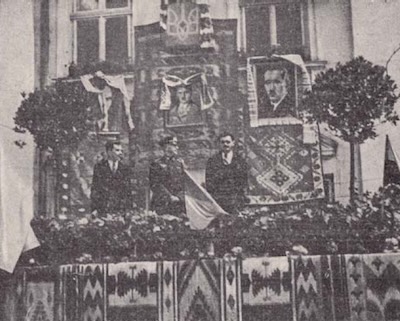
The Nazis were divided between the Reich Commissioner for the Ukraine, Erich Koch, for whom the Ukrainians were subhuman, and the Minister for the Occupied Eastern Territories, Alfred Rosenberg, for whom the “integral nationalists” were true allies. Finally, on July 5, 1941, Bandera was deported to Berlin and placed under Ehrenhaft (honorable captivity), i.e., under house arrest as a high-ranking official. However, after the members of OUN-B murdered the leaders of the rival faction, OUN-M, the Nazis sanctioned Stepan Bandera and his organization on September 13, 1941. 48 of their leaders were deported to a prison camp in Auschwitz (which was not yet an extermination camp, but only a prison). The OUN-B was reorganized under German command. At that time all Ukrainian nationalists took the following oath: “Faithful son of my Fatherland, I voluntarily join the ranks of the Ukrainian Liberation Army, and with joy I swear that I will faithfully fight Bolshevism for the honor of the people. This fight we are waging together with Germany and its allies against a common enemy. With loyalty and unconditional submission I believe in Adolf Hitler as the leader and supreme commander of the Liberation Army. At any time I am prepared to give my life for the truth.
The Nazis announced that many bodies had been discovered in the prisons, victims of “Bolshevik Jews. So the “integral nationalists” celebrated their “independence” by murdering more than 30,000 Jews and actively participating in the roundup of Jews from Kiev to Babi Yar, where 33,771 of them were shot in two days, on September 29 and 30, 1941, by the Einsatzgruppen of SS Reinhard Heydrich.
In this tumult, Dmytro Dontsov disappeared. In reality, he had gone to Prague and placed himself at the service of the architect of the Final Solution, Reinhard Heydrich, who had just been appointed vice-governor of Bohemia-Moravia. Heydrich organized the Wannsee Conference, which planned the “Final Solution of the Jewish and Gypsy Questions” [4]. He then created the Reinard Heydrich Institute in Prague to coordinate the systematic extermination of all these populations in Europe. The Ukrainian Dontsov, who now lived in Prague in great luxury, immediately became its administrator. He was one of the main architects of the largest massacre in history. Heydrich was assassinated in June 1942, but Dontsov retained his functions and privileges.
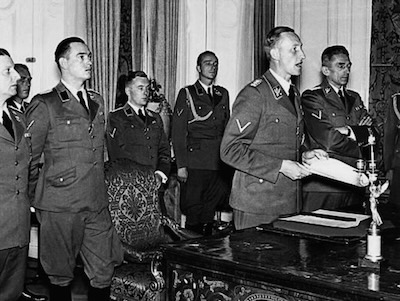
Stepan Bandera and his deputy Yaroslav Stetsko were placed under house arrest at the headquarters of the General Inspectorate of Concentration Camps in Oranienburg-Sachsenhausen (30 km from Berlin). They wrote letters to their supporters and to the Reich leadership in complete freedom and were not deprived of anything. In September 1944, as the Reich army retreated and Bandera’s followers began to rebel against it, the two leaders were released by the Nazis and reinstated in their previous positions. Bandera and Stetsko resumed the armed struggle, among the Nazis, against the Jews and the Bolsheviks.
Centuria Integral Nationalist Order Ceremony. According to George Washington University, by 2021 it had already penetrated the main NATO armies.
But it was already too late. The Reich collapsed. The Anglo-Saxons got Dontsov, Bandera and Stetsko. The theorist of integral nationalism was transferred to Canada, while the two practitioners of mass murder were transferred to Germany. MI6 and the OSS (predecessor of the CIA) rewrote their biographies, making their Nazi involvement and responsibility for the “Final Solution” disappear.
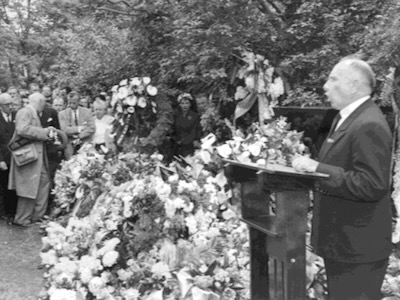
Bandera and Stetsko were installed in Munich to organize the Anglo-Saxon stay-behind networks in the Soviet Union. From 1950 onwards, they had an important radio station, Radio Free Europe, which they shared with the Muslim Brotherhood of Said Ramadan (the father of Tariq Ramadan). The radio station was sponsored by the National Committee for a Free Europe, a CIA offshoot of which its director Alan Dulles was a member, as well as future president Dwight Eisenhower, newspaper magnate Henry Luce and film director Cecil B. DeMilles. Psychological warfare specialist and future patron of the Straussians, Charles D. Jackson, was chairman.
Vladimir Jabotinsky, for his part, after living in Palestine, took refuge in New York. He was joined by Benzion Netanyahu (the father of the current Israeli Prime Minister). The two men wrote the doctrinal texts of “revisionist Zionism” and the Jewish Encyclopedia.
Bandera and Stetsko moved around a lot. They organized sabotage operations throughout the Soviet Union, particularly in the Ukraine, and parachuted leaflets. For this purpose, they created the Anti-Bolshevik Bloc of Nations (ABN), which brought together their Central European counterparts [5]. The British double agent, Kim Philby, informed the Soviets in advance about the actions of the Bandera. Bandera met with Dontsov in Canada and asked him to take the lead in the struggle. Once again, the intellectual refused, preferring to devote himself to his writing. He then drifted into a mystical delirium inspired by Viking myths. He announced the final battle of the Ukrainian knights against the Russian dragon. As for Bandera, he allied himself with the Chinese leader Chiang Kai-shek whom he met in 1958. But he was assassinated the following year by the KGB in Munich.
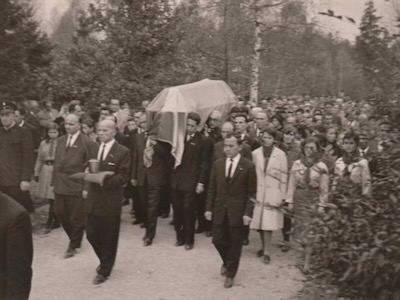
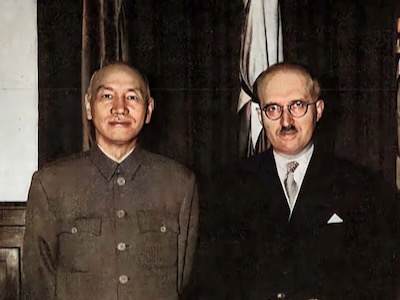
Yaroslav Stetsko continued the struggle through Radio Free Europe and the ABN. He went to the United States to testify before Senator Joseph MacCarthy’s Commission on Un-American Activities. In 1967, he and Chiang Kai-shek founded the World Anti-Communist League [6]. The League included many pro-US dictators from around the world and two schools of torture, in Panama and Taiwan. Klaus Barbie, who assassinated Jean Moulin in France and Che Guevara in Bolivia, was a member. In 1983, Stetsko was received at the White House by President Ronald Reagan and participated, along with Vice President George Bush Sr., in Lev Dobrianski’s “Captive Nations” (i.e., peoples occupied by the Soviets) ceremonies. He finally died in 1986.
But the story does not end there. His wife, Slava Stetsko, took over the leadership of these organizations. She too travelled the world to support any fight against the “communists”, or rather, if we refer to Dontsov’s writings, against the Russians and the Chinese. When the USSR was dissolved, Mrs. Stetsko simply changed the title of the League to the World League for Freedom and Democracy, a name it still has today. She then devoted herself to regaining a foothold in Ukraine.
Slava Stetsko ran in the first elections of the independent Ukraine in 1994. She was elected to the Verkhovna Rada, but having been stripped of her nationality by the Soviets, she could not sit. However, she brought the Ukrainian president, Leonid Kuchma, to the CIA offices in Munich and dictated parts of the new constitution to him. Even today, Article 16 of the new constitution states: “Preserving the genetic heritage of the Ukrainian people is the responsibility of the state. Thus, Nazi racial discrimination is still proclaimed by modern Ukraine as in the worst moments of World War II.
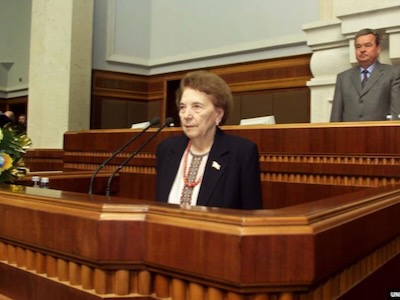
Slava Stetsko was re-elected at the next two sessions. She solemnly presided over the opening sessions on March 19, 1998 and on May 14, 2002.
In 2000, Lev Dobriansky organized a large symposium in Washington with many Ukrainian officials. He invited Straussian Paul Wolfowitz (a former collaborator of Charles D. Jackson). During this meeting, the “integral nationalists” put themselves at the service of the Straussians to destroy Russia [7].
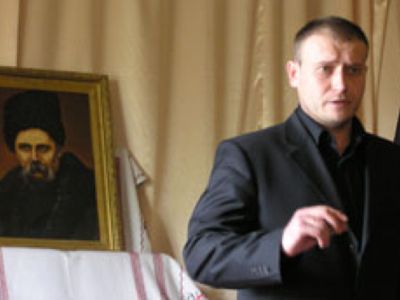
On May 8, 2007, in Ternopol, on the initiative of the CIA, the “integral nationalists” of the Ukrainian People’s Self-Defense and Islamists created an anti-Russian “Anti-Imperialist Front” under the joint chairmanship of the Emir of Itchkeria, Dokka Umarov, and Dmytro Yarosh (the current special adviser to the head of the Ukrainian army). The meeting was attended by organizations from Lithuania, Poland, Ukraine and Russia, including Islamist separatists from Crimea, Adygea, Dagestan, Ingushetia, Kabardino-Balkaria, Karachaevo-Cherkessia, Ossetia and Chechnya. Dokka Umarov, who was unable to go there due to international sanctions, had his contribution read out. In retrospect, the Crimean Tatars are unable to explain their presence at this meeting, if not their past service to the CIA against the Soviets.
The pro-US president, Viktor Yushchenko, created a Dmytro Dontsov Institute, following the “Orange Revolution”. Yushchenko is an example of Anglo-Saxon whitewashing. He has always claimed to have no connection with the mainstream nationalists, but his father, Andrei, was a guard in a Nazi extermination camp [8]. The Dmytro Dontsov Institute would be closed in 2010, and then reopened after the 2014 coup.
President Viktor Yushchenko, shortly before the end of his term of office, elevated the criminal against humanity Stepan Bandera to the title of “Hero of the Nation”.
In 2011, the mainstream nationalists succeeded in passing a law banning the commemoration of the end of World War II because it was won by the Soviets and lost by the Banderists. But President Viktor Yanukovych refused to enact it. Enraged, the “integral nationalists” attacked the procession of Red Army veterans, beating up old men. Two years later, the cities of Lviv and Ivano-Frankivsk abolished the Victory Day ceremonies and banned all manifestations of joy.
In 2014, Ukrainians in Crimea and Donbass refused to recognize the coup government. Crimea, which had declared itself independent before the rest of Ukraine, reaffirmed its independence a second time and joined the Russian Federation. The Donbass sought a compromise. The “Ukrainian nationalists,” led by President Petro Poroshenko, stopped providing public services there and bombed its population. In eight years, they murdered at least 16,000 of their fellow citizens in general indifference.
It was also from the 2014 coup that the full nationalist militias were incorporated into the Ukrainian Armed Forces. In their internal regulations, they enjoin each fighter to read the works of Dmytro Dontsov, including his master book, Націоналізм (Nationalism).
In April 2015, the Verkhovna Rada declared members of the Organization of Ukrainian Nationalists (OUN) “independence fighters.” The law was enacted, in December 2018, by President Poroshenko. Former Waffen SS were retrospectively entitled to a pension and all sorts of benefits. The same law criminalized any claim that OUN militants and UPA fighters collaborated with the Nazis and practiced ethnic cleansing of Jews and Poles. Published in Ukraine, this article would send me to jail for writing it and you for reading it.
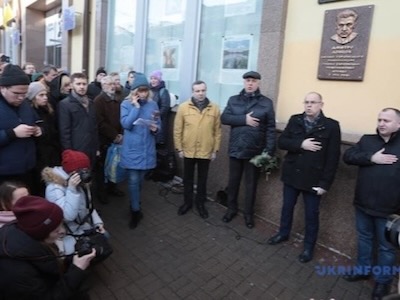
On July 1, 2021, President Volodymyr Zelenski enacted the Law “On Indigenous Peoples of Ukraine” which places them under the protection of Human Rights. By default, citizens of Russian origin can no longer invoke them in court.
In February 2022, the “full nationalist” militias, which made up one-third of the country’s armed forces, planned a coordinated invasion of Crimea and the Donbass. They were stopped by the Russian military operation to implement UN Security Council Resolution 2202 to end the suffering of the people of Donbass.
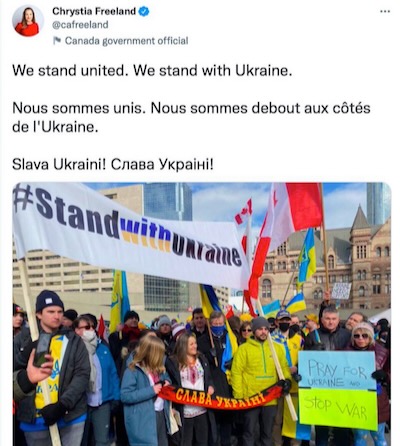
In March 2022, Israeli Prime Minister Nafatali Bennett, breaking with the “revisionist Zionism” of Benjamin Netanyahu (the son of Jabotinsky’s secretary), suggested to President Volodymyr Zelensky that he should agree with Russian demands and denazify his country [8]. Emboldened by this unexpected support, Russian Foreign Minister Sergei Lavrov dared to mention the case of the Jewish Ukrainian president, saying: “The Jewish people in their wisdom have said that the most ardent anti-Semites are usually Jews. Every family has its black sheep, as they say.” This was too much for the Israelis, who always worry when someone tries to divide them. His counterpart at the time, Yair Lapid, recalled that the Jews themselves never organized the Holocaust of which they were victims. Caught between its conscience and its alliances, the Hebrew state repeated its support for Ukraine, but refused to send it any weapons. In the end, the General Staff decided and the Minister of Defense, Benny Gantz, closed any possibility of support to the successors of the mass murderers of Jews.
Ukrainians are the only nationalists who are not fighting for their people or their land, but for one idea: to annihilate the Jews and the Russians.
Main sources:
Ukrainian Nationalism in the age of extremes. An intllectual biography of Dmytro Dontsov, Trevor Erlacher, Harvard University Press (2021).
Stepan Bandera, The Life and Afterlife of a Ukrainian Nationalist. Fascism, Genocide, and Cult, Grzegorz Rossoliński-Liebe, Ibidem (2014).
[1] “The Western strategy to dismantle the Russian Federation”, by Thierry Meyssan, Translation Roger Lagassé, Voltaire Network, 17 August 2022.
[2] “Poland and Ukraine”, by Thierry Meyssan, Translation Roger Lagassé, Voltaire Network, 14 June 2022.
[3] “The Holodomor, new avatar of “European” anti-communism” (excerpt from Le Choix of defeat), Annie Lacroix-Riz (2010).
[4] «The Wannsee Conference in 1942 and the National Socialist living space dystopia», Gerhard Wolf, Journal of Genocide Research, Vol 17 N°2 (2015). https://doi.org/10.1080/14623528.2015.1027074
[5] [Bulletins of the Anti-Bolshevik Nations Block are available in the Voltaire Network Library. ABN Korrespondenz (auf Deutsch), ABN Correspondence (in english).
[6] “The World Anti-Communist League: the Internationale of Crime”, by Thierry Meyssan, Translation Anoosha Boralessa, Voltaire Network, 12 May 2004.
[7] “Ukraine : the Second World War continues”, by Thierry Meyssan, Translation Roger Lagassé, Voltaire Network, 26 April 2022.
Reactors at Ukrainian nuclear power plants shut down after Russian strikes
Reuters, Nov 16 (Reuters) – Several reactors at two Ukrainian power plants automatically shut down as a result of Russian missile strikes on Tuesday, President Volodymyr Zelenskiy said, adding that millions of people were left without electricity………..
As a result of the strikes, automation today disabled several nuclear units at two stations – these are calculated consequences, and the enemy knew exactly what he was doing,” Zelenskiy said in his nightly video address……….
Zelenskiy did not say which power plants were affected, but said that strikes hit the capital Kyiv, Lviv, Rivne and Volyn in the west, Kharkiv in the northeast, Kryvyi Rih and Poltava in the centre, Odesa and Mikolaiv in the south and Zhytomyr in the north…………….. https://www.reuters.com/world/europe/reactors-ukrainian-nuclear-power-plants-shut-down-after-russian-strikes-2022-11-16/
As Europe Quits Russian Gas, Half of France’s Nuclear Plants Are Off-Line
France’s state-backed nuclear operator is scrambling to overcome a monthslong crisis to get as many reactors as possible restarted before winter sets in.
New York Times, By Liz Alderman. Reporting from Paris, Nov. 16, 2022
An army of engineers has fanned out through nuclear power plants across France in recent months, inspecting reactors for signs of wear and tear. Hundreds of expert welders have been recruited to repair problems found in cooling circuits. Stress tests are being conducted to check for safety problems.
As Europe braces for a winter without Russian gas, France is moving fast to repair a series of problems plaguing its atomic fleet. A record 26 of its 56 reactors are off-line for maintenance or repairs after the worrisome discovery of cracks and corrosion in some pipes used to cool reactor cores.
The crisis is upending the role that France has long played as Europe’s biggest producer of nuclear energy, raising questions about how much its nuclear power arsenal will be able to help bridge the continent’s looming crunch……………………………………………
France’s nuclear power crunch has become so acute that Mr. Macron is preparing to have the government take over the remaining 16 percent of EDF that it doesn’t already own, at a cost of nearly 10 billion euros ($10.3 billion).
The company, which is nearly €45 billion in debt, has tumbled further into financial difficulty and announced that its 2022 profit would drop by €29 billion because of the problems with its reactors, as well as a government effort to force EDF to provide artificially cheap electricity for households and businesses.
Even as EDF is rushing to comply with the demand for accelerated repairs, the company last week cut its 2022 nuclear power production forecast. The announcement caused the cost of French and European electricity to spike.
Herculean efforts to repair corrosion in pipes that cool the cores of four reactors were taking longer than expected, the company said. Those reactors now will not restart until January or February.
A strike late last month by French nuclear plant workers demanding higher wages to keep up with inflation was another blow. EDF said it was already behind in performing required maintenance on several aging reactors because of coronavirus lockdowns when the labor action put it further behind.
The company’s recent troubles began late last year, as it started moving through that backlog. The inspections unearthed alarming safety issues — especially corrosion and micro-cracks in systems that cool a reactor’s radioactive core — at an older-generation nuclear reactor in southwest France called Civaux 1. As EDF scoured its nuclear facilities, it found that 16 reactors, most of them newer-generation models, faced similar risks and closed them down.
EDF made to reactors designed by Westinghouse Electric that EDF had used in its older-generation plants. Bernard Doroszczuk, the head of France’s Nuclear Safety Authority, testified to French lawmakers this summer that the modifications, used for later-generation reactors, appeared to have caused abnormal corrosion and stress on critical cooling pipes.
The crisis has sent French nuclear power production to a 30-year low, generating less than half of the 61 gigawatts that the reactors can produce. (EDF also generates electricity with gas, coal and renewable technologies.) Even when more reactors are restarted in the coming months, French nuclear output will be around 45 gigawatts — lower than usual this winter, compounding the impact of Russia’s gas cutoff.
The situation “increases the risk of supply shortages for the coming winter, with availability standing at record-low levels for this time of the year,” Fabian Ronningen, a senior analyst at Rystad Energy, an independent consultancy, said in a note to clients.
The energy shortfall has turned France, once the continent’s biggest exporter of energy, into a net importer this year. A quarter of Europe’s electricity comes from nuclear power plants in about a dozen countries, with France producing more than half the total………………………………..
But even critical repairs must be monitored. EDF said a radioactive leak occurred this month during a hydraulic test on the main cooling circuit of the Civaux 1 nuclear power plant. EDF had spent months laboring to repair the corroded cooling pipes, using new technologies including ultrasound and welding robots that don’t have radiation exposure limits.
EDF said that there was no safety risk from that leak, and that no radioactivity was detected outside of it. But the episode is likely to delay the plant’s reopening beyond a planned Jan. 8 date, adding to the nuclear park’s woes. https://www.nytimes.com/2022/11/15/business/nuclear-power-france.html
Image
Image
Poland missile incident is step towards World War III – Medvedev
Rt.com 16 Nov 22A hybrid war waged by the West against Russia could lead to disastrous consequences, the former Russian leader warns.
Former Russian president Dmitry Medvedev has warned that incidents like the missile explosion which killed two people in Poland risk prompting a major global conflict.
The incident “proves just one thing: waging a hybrid war against Russia, the West moves closer to the World War”, the ex-president, who is now the deputy chair of Russia’s Security Council, wrote on Twitter on Wednesday. He also put the words “missile strike” in quotation marks…………………………………..
Ukrainian President Vladimir Zelensky was quick to blame Russia for the incident late on Tuesday, urging NATO, of which Poland is a member, to act against this “attack on collective security.” Despite not being backed by any proof, the claims were picked by the media in Poland and by some of the country’s officials.
Warsaw put its military on alert, and said it was discussing whether to invoke NATO’s Article 4, which would require consultations on the situation with the other 29 member states and a consensus decision on how to proceed.
However, US President Joe Biden said soon afterwards: “it is unlikely, in the minds of the trajectory, that it [the missile] was fired from Russia.” The Associated Press also cited three US officials as saying preliminary data suggested the missile was actually Ukrainian, fired by the country’s air defenses amid a large-scale Russian attack on Ukraine’s energy infrastructure.
Russia’s Defense Ministry has insisted that it did not carry out any strikes near the Ukrainian-Polish border on Tuesday. It later clarified that analysis of photos from the site showed that the debris were from a missile for the S-300 air defense system operated by Ukraine’s military. https://www.rt.com/russia/566619-poland-missile-ukraine-medvedev/
Did the “stray missiles” to Poland come from Russian or from Ukrainian military?

Ukraine Weapons Tracker @UAWeapons
So what crashed in the village of Przewodów, Poland today? With the cooperation of @blueboy1969 we analyzed the available photos of fragments and came to a clear conclusion that they belong to the 48D6 motor of the 5V55-series missile of the S-300 AD system- a Ukrainian one.
So what crashed in the village of Przewodów, Poland today? With the cooperation of
@blueboy1969 we analyzed the available photos of fragments and came to a clear conclusion that they belong to the 48D6 motor of the 5V55-series missile of the S-300 AD system- a Ukrainian one.
Poland Considering NATO Article 4 Activation, Says Spokesman, By Reuters. Nov. 15, 2022,
WARSAW (Reuters) – Poland is verifying if it needs to request consultations under Article 4 of the NATO military alliance treaty, a government spokesman said on Tuesday, after a report that a blast that killed two people near the Ukrainian border was caused by stray Russian missiles.
The United States and Western allies said they were investigating but could not confirm a report on Tuesday that the blast in the village of Przewodow resulted from stray Russian missiles. Russia’s defence ministry denied it.
Westinghouse deal for Poland ushering in a new nuclear wave. Can it deliver on time and on budget?

Westinghouse spokeswoman Cathy Mann said last week that it was “too soon to say how financing will play out until we get further into developing the agreements and contracts.”
“The U.S. EXIM bank will offer robust financing,” she said, and because of its involvement, “U.S. content will be maximized.”
It was the first year that the International Atomic Energy Agency, which monitors nuclear power plants all over the world and ensures nonproliferation, had its own pavilion at the global climate event, Director General Rafael Mariano Grossi boasted on Wednesday in Egypt. He spent the day hosting panels and answering questions about how this nuclear wave differs from the ones that came before it.
ANYA LITVAK Pittsburgh Post-Gazette alitvak@post-gazette.com 14 Nov 22
Sebastian Barkowski, Poland’s special envoy for international climate and energy cooperation, arrived at the global climate summit in Egypt as a member of a new club: the nuclear club.
Earlier this month, his government picked Cranberry-based Westinghouse Electric Co. to supply the first three nuclear reactors to Poland, with another three units to be awarded in the future.
The deal, which is estimated to be worth about $20 billion, was in the works for a few years and represents Westinghouse’s first sale of its AP1000 plant abroad since it launched the reactor design in a deal with China in 2007.
Until the last moment, it was a geopolitical nail biter, with high-ranking U.S. officials such as Energy Secretary Jennifer Granholm and Vice President Kamala Harris intervening on Westinghouse’s behalf, and the U.S. nuclear firm filing a lawsuit against Korea Electric Power Corp. which had also submitted a bid for the Polish project.
Poland is surrounded by countries with nuclear power fleets but the large European nation never got its only attempt at nuclear off the ground.
Burning coal supplies 75% of its electricity needs, Mr. Barkowski said during a panel at COP27 on Wednesday, and driving that number down to meet climate goals was the main motivation behind Poland’s plan to build between 6 and 9 gigawatts of nuclear power. In 2020, the Polish government signed an intergovernmental agreement with the U.S. and Westinghouse to pursue this plan.
It was the first year that the International Atomic Energy Agency, which monitors nuclear power plants all over the world and ensures nonproliferation, had its own pavilion at the global climate event, Director General Rafael Mariano Grossi boasted on Wednesday in Egypt. He spent the day hosting panels and answering questions about how this nuclear wave differs from the ones that came before it.
In a conversation with Mr. Grossi, Fatih Birol, the executive director of the International Energy Agency, revised his year-ago prediction that “nuclear may well make a comeback” to a more definitive “nuclear is making a comeback.”
When asked what could derail that, Mr. Grossi talked of his fear that a Ukrainian nuclear powerplant in the warzone might suffer an attack that causes a nuclear accident — “the background music of my visit to Zaporizhzhia was bombs and mortars” — and that the fallout from that would ruin nuclear’s momentum the same way that Chernobyl and Fukushima had done.
Mr. Birol, meanwhile, zeroed in on the more mundane issue that has taken the wind out of nuclear’s sails before.
“The nuclear industry, to be honest with you, doesn’t have a very good reputation in terms of delivering on time and on budget,” he said.
With all the new reactor orders piling up, “It is important that the nuclear industry have more discipline,” he said.
That was something that Westinghouse’s future owner, the Canadian nuclear fuel company Cameco Corp. which signed a deal last month to acquire a 49% stake in Westinghouse, thinks about as well.
The Chinese and the Russians are good at building new nuclear plants, Cameco’s CEO Tim Gitzel said during a World Nuclear News podcast last week.
“We in the west now need to show that we’re back in the game and that we can take our share of the market,” he said.
Poland’s project with Westinghouse is a big deal, he said.
“I think there are more to come. And so we need to show the world that we can deliver our projects on time, on budget.”
In the U.S., Westinghouse’s attempt to restart large nuclear construction with a pair of reactors in South Carolina and another two in Georgia ended in bankruptcy in 2017. The South Carolina project was cancelled after billions had already been spent. In Georgia, nuclear fuel was finally loaded into the first reactor last month and the unit is slated to start producing power this year — 15 years after construction began. …………………………………………….
Westinghouse was bringing the lawsuit now, the company wrote in the complaint, because it had gotten word that KEPCO was about to sign a memorandum of intent with a group in Poland and that it had been invited to bid on projects in Czech Republic and Saudi Arabia.
Providing the technical information requested in those bids would trigger Westinghouse’s responsibility under U.S. nuclear export regulations, the company argued, and KEPCO has been non-committal about cooperating in the process.
So Westinghouse is asking the court to “enjoin defendants from delivery of technical information regarding Korean reactor designs outside the Republic of Korea,” specifically in Poland, Saudi Arabia and Czech Republic.
KEPCO had not filed a reply as of Wednesday.
Show me the money
A 15-year construction project is extremely difficult to finance, Dario Liguti, director of Sustainable Energy at the United Nations Economic Commission for Europe, said during a COP27 panel on nuclear financing.
That’s partly why “the nuclear plants that have been built, have been built with public money,” he said.
Countries like China, Russia, or France, where nuclear companies are at least partially owned by the government, offer the backing of the government when financing new builds.
In the U.S., that role, albeit much diminished, is filled by the U.S. Export-Import Bank, which provides financing for entities to buy American products and services.
The U.S. government has a variety of reasons to help such projects along.
A recent analysis of nuclear financing by researchers at Columbia University’s Center on Global Energy Policy includes this list: “supporting American jobs, assisting other countries’ decarbonization efforts and confronting the broader problem of climate change, reducing other countries’ fossil fuel dependencies for geopolitical reasons, limiting Chinese and Russian influence in general, and the national security value in the United States having some role in international nuclear reactor commerce.”
Export-Import Bank, which helped to finance dozens of nuclear export deals, mostly in the 1970s, hasn’t done any in decades.
Westinghouse asked for up to $5 billion in export assistance from ExIm when it sold the first four AP1000 units to China, the analysis said, and while the bank approved the request, the project did not end up using the offer.
In Polish newspapers, government officials suggested that the Westinghouse offer included $17 billion in financing, including through ExIm.
Elias Gedeon, Westinghouse senior vice president of commercial operations, said during an interview at an economic forum in September that the proposed financing also includes money from Westinghouse and Bechtel, the engineering and construction firm that took over the AP1000 project in Georgia in 2017.
“This is something that we have not done before,” Mr. Gedeon said, “but we have committed to put equity in this project in Poland.”
Westinghouse spokeswoman Cathy Mann said last week that it was “too soon to say how financing will play out until we get further into developing the agreements and contracts.”
“The U.S. EXIM bank will offer robust financing,” she said, and because of its involvement, “U.S. content will be maximized.”
Westinghouse is also continuing to sign agreements with companies in Poland and in other European countries to establish a European supply chain that could handle not just the Polish nuclear project but the others that might follow. Last year, it opened a shared global services center in Krakow which now employs 165 people and more will be hired, she said. In southwestern Pennsylvania, Westinghouse had about 3,100 employees at the end of last year.
Asked if Westinghouse can stick to the timeline envisioned in the Polish plan, Ms. Mann said that Westinghouse has learned from its experience delivering the first AP1000 plants in China and in Georgia.
On social media networking site LinkedIn last month, Westinghouse’s CEO Patrick Fragman thanked the governments of Poland and the U.S. for shepherding this agreement and promised full speed ahead.
“We are ready, able and willing to move very fast now.” https://www.post-gazette.com/business/powersource/2022/11/14/new-nuclear-faces-old-skepticism-can-it-deliver-on-time-and-on-budget/stories/202211130052
US and Western officials considering diplomacy as winter looms and Ukraine war cost may rise to $60 billion
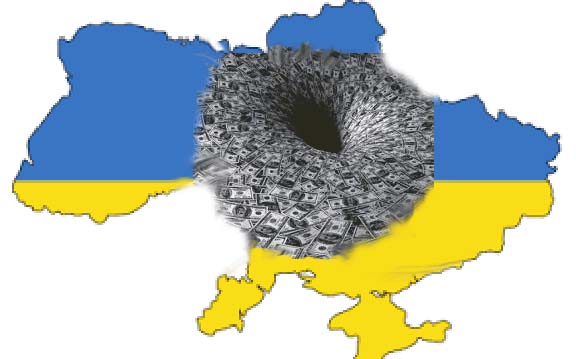
The growing belief that there’s no military resolution to the war and the rising hope that Ukraine and Russia move toward starting talks comes as Ukraine needs additional military aid. The White House and Congress are expected to consider additional funds for assistance for Ukraine, potentially $40 billion to $60 billion, NBC News has reported. Some Republicans and Democrats have begun to question whether the U.S. should send additional tens of billions of dollars to Ukraine
Some U.S. and Western officials think neither side can win and see winter as a shot at diplomacy in Ukraine-Russia war
Russia and Ukraine are most likely looking to the slower tempo of battle this winter as a time to reset and refit their forces to be ready for a spring offensive.
nbc news, By Courtney Kube, Carol E. Lee and Josh Lederman 14 Nov 22,
Some U.S. and Western officials increasingly believe that neither side can achieve all of their goals in the Ukraine war and are eyeing the expected winter slowdown in fighting as an opportunity for diplomacy to begin between Russia and Ukraine, officials familiar with the matter say.
Western defense officials question Ukraine’s ability to remove Russian troops completely from occupied areas, and if military operations on the ground stabilize over the winter that could underline that neither side is likely to achieve its goal of controlling the whole country, the officials said. They spoke on the condition of anonymity because they are not authorized to speak publicly on matters of diplomacy.
“In the winter, everything slows down,” said a Western official with direct knowledge of military operations. “The potential for talks, we would like to see that happening.”
The official pointed to a statement by Russia’s ambassador to the United Kingdom last week about the potential for negotiations as possible “messaging” toward a diplomatic path.
U.S. national security adviser Jake Sullivan made a surprise visit last week to Kyiv, where he met with President Volodymyr Zelenskyy and top Ukrainian officials. The White House National Security Council said the meetings were to “underscore the United States’ steadfast support to Ukraine and its people.” But two people familiar with the meetings and a Ukrainian government official said Sullivan did broach the idea of how the conflict can end and whether it could include a diplomatic solution. “He was testing the waters a bit,” a person familiar with the meetings said.
The Ukrainian official said that during his meetings, Sullivan raised the need for a diplomatic resolution to the war and made the point that Ukraine’s leverage would be strengthened — not weakened — if it expressed openness to ultimately negotiating with the Russians. The official said that Sullivan had not tried to pressure Ukraine to enter into negotiations immediately or to take any specific steps. Instead, the official said, Sullivan expressed the view that Ukraine would able to maintain the support of Western allies better if it is perceived as being willing to reach an end to the conflict through diplomacy……………………………………………
………………….. The growing belief that there’s no military resolution to the war and the rising hope that Ukraine and Russia move toward starting talks comes as Ukraine needs additional military aid. The White House and Congress are expected to consider additional funds for assistance for Ukraine, potentially $40 billion to $60 billion, NBC News has reported. Some Republicans and Democrats have begun to question whether the U.S. should send additional tens of billions of dollars to Ukraine. ……….. https://www.nbcnews.com/politics/national-security/ukraine-russia-war-winter-diplomacy-rcna56190—
USA, Japan, South Korea and a whole heap of companies join in the gamble of NuScam’s small nuclear reactors for Ukraine

The duration of the Ukrainian SMR project is a highly-ambitious two to three years.
the European Union has yet to approve the deployment of the technology. NuScale itself admits that its own SMR plant in Idaho is unlikely to become operational until 2029.
Ukraine joins Europe’s list of SMR hopefuls, Emerging Europe Yulia Valova 15 Nov 22,
Ukraine is the latest country in emerging Europe to sign up for an SMR project, one which aims to support the country’s energy security and signals a new direction in its energy development policy – decarbonisation.
Ukraine, in partnership with the United States, as well as Japan and South Korea, will participate in a public-private consortium to research and develop small modular reactors (SMRs).
A pilot project was announced this week by US Presidential Special Envoy on Climate Issues John Kerry and Ukrainian Energy Minister Herman Galushchenko at the UN Climate Change Conference, COP27, in Egypt.
The pilot project involves the construction of an SMR in Ukraine which, according to the US State Department, will involve the production of environmentally-friendly hydrogen and ammonia and advanced electrolysis technologies.
According to the State Department’s press service, the project builds on existing cooperation in developing nuclear energy capabilities initiated under the US Basic Infrastructure for Responsible Use of SMR Technology programme.
SMRs are a key part of the US Energy Department’s goal to develop safe [?], clean[?], and affordable[?] nuclear power options. Both Romania and Poland have previously signed agreements to explore the construction of SMRs with US technology.
The duration of the Ukrainian SMR project is a highly-ambitious two to three years. The list of participants includes both leading nuclear companies and research institutes.
In particular, NuScale (which is involved in the Romanian and Polish projects), FuelCell Energy, Clark Seed and Argonne National Laboratory will participate on the American side, with NAEC Energoatom and the State Science and Technology Centre for Nuclear and Radiation Safety representing Ukraine.
Doosan Enerbility, IHI Corporation, JGC Corporation, Samsung C&T and Starfire Energy will also participate in the project…………………….
According to the UN’s International Atomic Energy Agency (IAEA) there are around 50 SMR designs and concepts globally. Most of them are in various developmental stages and some are claimed as being near-term deployable……………..
However, while NuScale’s SMR was in August given final certification by the US Nuclear Regulatory Commission, the European Union has yet to approve the deployment of the technology. NuScale itself admits that its own SMR plant in Idaho is unlikely to become operational until 2029.
Austria digs in anti-nuclear heels as neighbours build out
https://www.euractiv.com/section/energy/news/austria-to-continue-anti-nuclear-stance-against-its-neighbours/ Nikolaus J. Kurmayer | EURACTIV.de Nov 8, 2022
The government confirmed that it would uphold its long-held anti-nuclear stance against its neighbours following media reports that Czech plans to build new nuclear reactors near the Austrian border are further ahead than scheduled.
Austria is Europe’s most fervent anti-nuclear country, and its only nuclear power plant never entered operation due to heavy opposition. Vienna is now suing the European Commission for granting the “green” label to nuclear power through the EU sustainable finance taxonomy.
This anti-nuclear stance against neighbouring countries will continue to be developed, said Green Environment Minister Leonore Gewessler, according to Ö1.
Meanwhile, six nuclear reactors in neighbouring Czechia are currently operating and provide about 37% of the country’s electricity. The government plans to have nuclear provide half of the country’s electricity in nearly 20 years, despite a projected general increase in electricity demand.
To achieve this serious nuclear build-out, the Czech government is betting on miniature nuclear power plants, so-called small modular reactors (SMRs). SMRs are far from commercial reality, as none have been built so far.
But Czechia is also looking at two regular reactors in Temelin, which is some 100 kilometres away from Linz, Austria’s third-largest city.
“Temelin is only about 50 kilometres away from the centre of our village”, from which the reactors can be seen from certain rights, Anita Gstöttenmayr, the mayor of a village located at the border, has said. “Something is simply being considered or decided without us being informed,” she added.
Anti-nuclear Austrian towns are now threatening to take the matter to the streets via protests and street blockades.
“It sounds stupid, but we will have to take to the streets again to raise awareness and make a difference,” the mayor added.
Languages: Deutsch
Russia and US hold secret talks in Ankara – Kommersant
https://www.rt.com/russia/566501-russia-us-secret-talks/ 14 Nov 22, Moscow is reportedly represented by the country’s top spy at the negotiations.
A leading Moscow newspaper claimed, on Monday, that secret US-Russian talks are being hosted by Türkiye. Kommersant, a privately owned title which is known to have good sources in Moscow, reported, citing anonymous sources, that the un-announced meeting was taking place in Ankara.
The outlet alleged that Russia had sent Sergey Naryshkin, director of the Foreign Intelligence Service (SVR) to the talks.
Kremlin spokesperson Dmitry Peskov later confirmed to Russian media that bilateral talks had taken place in Ankara, adding that they were held at the initiative of the US.
CNN claimed that CIA Director Bill Burns had represented Washington at the gathering, citing a “National Security Council spokesperson.”
Earlier this month, Western media reported that top Russian and US officials were engaging in undeclared contacts. According to the Wall Street Journal, US national-security adviser Jake Sullivan has been engaged with Yury Ushakov, a senior foreign policy aide to President Vladimir Putin, and with Nikolay Patrushev, Sullivan’s counterpart in the Russian government.
The White House did not deny the talks, with spokesperson Karine Jean-Pierre telling journalists that the contacts focused on “risk reduction.” Meanwhile, Peskov told the WSJ at the time that the British and American press tended to print “hoaxes.”
Türkiye emerged as a principal mediator during the Ukraine crisis. In late March, it hosted Russia-Ukraine talks, during which the two parties made significant progress towards settling on a peace agreement.
The negotiations were reportedly torpedoed by the UK, when then-Prime Minister Boris Johnson traveled to Kiev in April. According to Ukrainian media, he told President Vladimir Zelensky that Western nations would not support the proposed security pact that was discussed with Russia.
Ankara also helped the UN to launch the Black Sea Initiative, an arrangement that allows Ukraine to export its grain via commercial ships. The agreement, which was signed in July, expires on Friday. Moscow has repeatedly stated that it may not agree to a renewal, unless the UN delivers on its promise to facilitate Moscow’s export of Russian grain and fertilizers, which was part of the deal.
Top Zelensky advisor threatens war with Iran
The GrayZone, ALEXANDER RUBINSTEIN·NOVEMBER 12, 2022,
Mykhailo Podolyak, an advisor to Ukrainian President Volodymyr Zelensky, has called for attacks inside Iran as the country’s drones cause setbacks for the Ukrainian military.
On November 5, Mykhailo Podolyak, an advisor to Ukrainian President Volodymyr Zelensky, has advocated for military strikes on drone production sites located in Iran. President Zelensky echoed Podolyak’s belligerent rhetoric the following day, demanding Iran be “punished” for allegedly supplying drones to Russia.
Kiev adopted its hostile posture towards Tehran after claiming Russia deployed Iranian-supplied drones to strike Ukrainian civilian infrastructure throughout much of October.
In an interview with a Ukrainian news outlet on November 5, Podolyak argued that the response to Iran supplying Russia with drones should not be limited to sanctions or even a total trade embargo: “It seems to me that it should not be sanctions or even an embargo, yes a total embargo. It seems to me that it would be possible to carry out specific strikes on the production of drones, ballistic missiles, and so on.”………………………….
Podolyak has been ranked the third most influential Ukrainian by the Kiev-based Focus Magazine.
………………………………………. Though there is no record of any Iranian missile being used in an attack on Ukrainian infrastructure thus far, Zelensky declared, “We are preparing to respond.”
Just as Iranian-made drones appear to have given Russian forces a major boost on the battlefield, the US HIMARS artillery system has enabled significant Ukrainian gains, including the recapture of Kherson. However, no high ranking officials in Russian president Vladimir Putin’s office have similarly threatened the United States, or any of the other 40 countries that provided Ukraine with critical military assistance. https://thegrayzone.com/2022/11/12/zelensky-threatens-war-iran/
Ukraine joins in USA’s false story, “clean” energy from the mythical small nuclear reactors
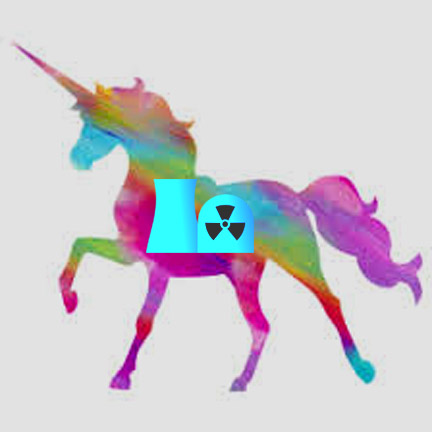
Ukraine, United States announce cooperation on Clean Fuels from SMR pilot project. https://www.ukrinform.net/rubric-economy/3613271-ukraine-united-states-announce-cooperation-on-clean-fuels-from-smr-pilot-project.html 13 Nov 22,
—
As part of the UN’s COP27 Climate Conference, U.S. Special Presidential Envoy for Climate John Kerry and Ukrainian Energy Minister German Galushchenko announced cooperation on a Ukraine Clean Fuels from Small Modular Reactors (SMR) pilot project.
The relevant statement was made by the U.S. Department of State, an Ukrinform correspondent reports.
“Special Presidential Envoy for Climate John Kerry and Ukraine Minister of Energy German Galushchenko announced a Ukraine Clean Fuels from SMRs Pilot project that will demonstrate production of clean hydrogen and ammonia using secure and safe small modular nuclear reactor (SMR) and cutting-edge electrolysis technologies in Ukraine,” the report states.
The project aims to carry out a first-of-a-kind pilot of commercial-scale production of clean fuels from SMRs using solid oxide electrolysis.
“Building on existing capacity-building cooperation launched under the U.S. Foundational Infrastructure for Responsible Use of SMR Technology (FIRST) program, the project seeks to support Ukraine’s energy security goals, enable decarbonization of hard-to-abate energy sectors through clean hydrogen generation, and improve long-term food security through clean ammonia-produced fertilizers. Further, it aims to demonstrate Ukraine’s innovative clean energy leadership through the use of advanced technologies,” the U.S. Department of State noted.
Additionally, Special Envoy Kerry launched a new initiative, Project Phoenix, to accelerate the transition in Europe of coal-fired plants to SMRs while retaining local jobs through workforce retraining.
Project Phoenix will provide direct U.S. support for coal-to-SMR feasibility studies and related activities in support of energy security goals for countries in Central and Eastern Europe.
Russia maintains its grip on global nuclear energy landscape
Increasing use of atomic power would not necessarily free economies from Moscow’s
influence. Faced with a global energy crisis and a race to slash emissions,
advanced economies are starting to reconsider nuclear power after a period
of declining investment. The incentive is all the greater among European
countries, which are urgently seeking to move away from Russian fossil
fuels to starve the Kremlin of funds for its assault on Ukraine.
But an atomic shift does not necessarily free a country from energy dependence on
Russia, given the scale of the country’s presence in the nuclear sector.
There were 437 operational reactors around the world as of 2021 excluding
those suspended, according to the International Atomic Energy Agency. About
10 per cent or 42 reactors outside of Russia were using Soviet-designed
VVER technology, with others using designs from countries including the US,
Canada, Germany and France.
Ukraine has by far the largest number of VVER
fleets outside Russia, with all 15 of its operating reactors using the
technology, with the Czech Republic next on six. Similarly, of the 52
reactors currently being built around the world excluding Russia, 21 use
VVER. China, India and Turkey have the largest number with 4 each, with
countries like Bangladesh, Egypt and Iran also taking in Russian
technology.
The prevalence of Russian-designed reactors currently being
built is in part a matter of timing, according to Jonathan Cobb, analyst at
the World Nuclear Association, who said “the Russian reactor programme
itself was very active” over the past decade when many of the contracts
for these projects were signed.
Russia was also the seventh-largest
producer of uranium in 2021. State-owned Rosatom accounts for about 40 per
cent of the world’s uranium enrichment capacity, making it a crucial
supplier as most nuclear power stations use enriched fuel.
FT 13th Nov 2022
https://www.ft.com/content/ffe76530-8fcb-45c3-aade-dc307af9c82f
Surprise surprise. USA co-opts Ukraine to try out small nuclear reactors

US, Ukraine announce project on construction of small modular nuclear reactor,
New initiative aims to accelerate conversion of coal-fired power plants in central, eastern Europe: US State Department AA, Burc Eruygur |13.11.2022
The US and Ukraine have announced the launch of a project on the construction of a small modular nuclear reactor (SMR) in Ukraine during the 27th UN Climate Change Conference (COP27) in Egypt, according to the US State Department.
“Special Presidential Envoy for Climate John Kerry and Ukraine Minister of Energy Herman Halushchenko announced a Ukraine Clean Fuels from SMRs pilot project that will demonstrate the production of clean hydrogen and ammonia using secure and safe SMRs and cutting-edge electrolysis technologies in Ukraine,” read a statement by the US State Department on Saturday………………………
In addition to Argonne National Laboratory and Ukraine’s Energoatom, National Security and Defense Council, and State Scientific and Technical Center for Nuclear and Radiation Safety, the statement expresses that multiple private companies will also take part in the project’s multinational consortium.
Kerry separately announced the launch of a new initiative, called Project Phoenix, “to accelerate the transition in Europe of coal-fired plants to SMRs while retaining local jobs through workforce retraining,” it also said.
“Project Phoenix will provide direct US support for coal-to-SMR feasibility studies and related activities in support of energy security goals for countries in central and eastern Europe,” according to the statement.
On Sunday, Ukraine’s Ambassador to the US Oksana Markarova also confirmed the project, reiterating the information released by the US State Department.
“Ukraine is not only working to protect and quickly repair/replace what was destroyed but is already planning to build an innovative energy system,” Markarova said on Facebook. https://www.aa.com.tr/en/russia-ukraine-war/us-ukraine-announce-project-on-construction-of-small-modular-nuclear-reactor/27
UK government to dump European Union nuclear safety laws – a deregulated race to the safety bottom?
Revealed: Fears over Brexit threat to nuclear safety laws, Herald 13th November,
UK GOVERNMENT plans threatening nuclear and radiation safety laws in a “Brexit bonfire” have provoked resistance from regulators and trade unionists, opposition from Scottish ministers, and alarm from campaigners.
The Cabinet Office has published a list of more than 2,400 European Union (EU) laws which are under review as part of the Government’s bid to scrap them. They include 10 key regulations designed to protect the public and workers from nuclear accidents and radiation leaks.
The UK Office for Nuclear Regulation (ORN), which oversees safety at civil and military nuclear sites, told The Ferret it was trying “to preserve the legislative framework” to meet the “highest international standards”.
The trade union Prospect, which represents scientists and engineers in the nuclear industry, accused UK ministers of “trying to weaken or dismantle a regulatory framework that has served the UK well over many decades”.
The Scottish Government attacked Westminster for “rolling back 47 years of protections in a rush to impose a deregulated race to the bottom”.
Campaigners are worried by the dangers of “watering down” nuclear safety law, and demand tougher legal protections.
A bill to remove “retained EU law” was introduced to the UK Parliament by the former business minister, Jacob Rees-Mogg, in September. It contains a “sunset” clause requiring all remaining EU law to be repealed or assimilated by the end of 2023, though this can be extended to 2026.
Among the laws under threat is the 2019 Radiation (Emergency Preparedness and Public Information) Regulations which compel councils and companies to draw up emergency plans to deal with nuclear accidents. According to UK Government guidance in 2015, the regulations are “key” to ensuring that the public is “properly protected”.
Three sets of regulations aimed at protecting workers and the public from the hazards of radiation are also up for review. One “lays down basic safety standards for protection against the dangers arising from exposure to ionising radiation”, the Government said.
Other laws on the UK Government list cover “maximum permitted levels” of radioactivity in food after a nuclear emergency; imports of radioactively contaminated food following the Fukushima nuclear accident in 2011 and the Chernobyl disaster in 1986; and the safety of decommissioning nuclear plants.
The ORN, which regulates the Faslane nuclear base and six other sites in Scotland, is understood to be taking the threat to nuclear safety laws “very seriously”. The six other sites are Chapelcross in Dumfries and Galloway; Dounreay in Caithness; Hunterston A and Hunterston B, both in North Ayrshire, Rosyth in Fife; and Torness in East Lothian
An ONR spokesperson told The Ferret: “We are in discussions with the Government to preserve the legislative framework that allows us to hold the nuclear sector to account consistent with the highest international standards.”
According to the veteran nuclear critic Pete Roche, this meant that the ONR was resisting the UK Government’s plans. “Reading between the lines, it looks as though the ONR is planning to fight any proposals to make drastic changes to nuclear regulation,” he said.
“In recent meetings I have been involved in, ONR representatives have stressed the need to uphold the highest international standards. I can only hope I am not being overly optimistic and that they stick to their guns.”
Prospect argued that the existing regulatory framework worked well at protecting workers and communities. This was vital as old nuclear plants were being decommissioned and new ones built, it said.
“Perhaps the Government should focus on ensuring that existing regulators are properly resourced to do this important work rather than trying to weaken or dismantle a regulatory framework that has served the UK well over many decades,” said Prospect’s senior deputy general secretary, Sue Ferns.
Ferns.
“Tearing up existing regulations for the sake of purportedly ‘taking back control’ does nothing but introduce uncertainty,” she added. “Nuclear is an international industry, there is no value in seeking to craft UK specific legislative variants just for the sake of it.”
The Scottish Government has urged the Scottish Parliament to withhold consent for the “Brexit bonfire” bill. “Ministers fundamentally oppose the Retained EU Law Bill,” said a spokesperson. “This bill puts at risk the high standards people have come to expect from EU membership, rolling back 47 years of protections in a rush to impose a deregulated race to the bottom.”
The 50-strong group of Nuclear Free Local Authorities was “gravely concerned” about the “threat to water down legislation which provides the public or our environment with protection from the operational or legacy risks posed by civil nuclear power”.
The group’s chairman David Blackburn, a Green councillor from Leeds, said: “If European regulations providing protection are to be removed, we will press Government ministers to instead enact equivalent, or preferably stronger, laws into UK domestic legislation.”
The environmental campaigner and former director of Friends of the Earth Scotland, Dr Richard Dixon, thought that the EU gave the public and workers “vital protections” against radiation risks.
“No backsliding at all can be allowed,” he said.
“This has never been more important with the prospect of damage to nuclear reactors or even the use of nuclear weapons in Ukraine.
“Protection of the same strength or better needs to be put in place.”
The UK Department for Business, Energy and Industrial Strategy did not respond to requests for comment. …………. https://www.heraldscotland.com/news/23121029.revealed-fears-brexit-threat-nuclear-safety-laws/
1 This Month

of the week– Nuclear Reactor Information Task Force
14 May – online event From Bombs to Data Centres: the Face of Nuclear Colonialism
To see nuclear-related stories in greater depth and intensity – go to https://nuclearinformation.wordpress.com
-
Archives
- May 2026 (126)
- April 2026 (356)
- March 2026 (251)
- February 2026 (268)
- January 2026 (308)
- December 2025 (358)
- November 2025 (359)
- October 2025 (376)
- September 2025 (257)
- August 2025 (319)
- July 2025 (230)
- June 2025 (348)
-
Categories
- 1
- 1 NUCLEAR ISSUES
- business and costs
- climate change
- culture and arts
- ENERGY
- environment
- health
- history
- indigenous issues
- Legal
- marketing of nuclear
- media
- opposition to nuclear
- PERSONAL STORIES
- politics
- politics international
- Religion and ethics
- safety
- secrets,lies and civil liberties
- spinbuster
- technology
- Uranium
- wastes
- weapons and war
- Women
- 2 WORLD
- ACTION
- AFRICA
- Atrocities
- AUSTRALIA
- Christina's notes
- Christina's themes
- culture and arts
- Events
- Fuk 2022
- Fuk 2023
- Fukushima 2017
- Fukushima 2018
- fukushima 2019
- Fukushima 2020
- Fukushima 2021
- general
- global warming
- Humour (God we need it)
- Nuclear
- RARE EARTHS
- Reference
- resources – print
- Resources -audiovicual
- Weekly Newsletter
- World
- World Nuclear
- YouTube
-
RSS
Entries RSS
Comments RSS
 nuclear-news