Arctic nuclear waste ship gets funding
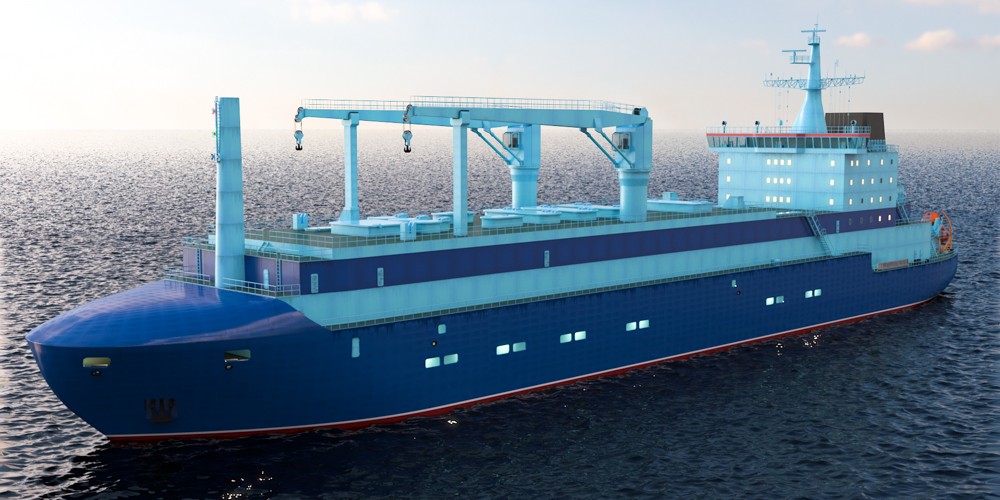
Russia’s Prime Minister Mikhail Mishustin has signed the decree granting 12,4 billion rubles to build a transport- and maintenance ship for spent nuclear fuel and radioactive waste from the country’s fleet of icebreakers.
Thomas Nilsen Barents Observer, 11 Jan 23
Not since Soviet days has more nuclear-powered icebreakers been operating at the same time in Arctic waters, the Barents Observer reported last week.
Russia has over the last few years put three brand new icebreakers of the Project 22220 class into operation. Two more are under construction in St. Petersburg and a sixth vessel recently got funding with a goal to put it into service by 2030.
Each of the new icebreakers is powered with two RITM-200 reactors, a reactor type larger than the older Arktika-class icebreakers.
New reactors require new technologies to reload nuclear fuel elements. The service vessel used by Rosatomflot today, the “Imandra”, is from 1980 and does not meet the demands of the new icebreaker fleet, larger in size and numbers.
The new service ship (Project 22770) will be nearly 160 meters long and carry its own cranes to lift in and out containers with spent nuclear fuel or fresh uranium fuel from the icebreaker reactors, either at Rosatom’s service base in Murmansk or in open sea anywhere along the Northern Sea Route………………….. more https://thebarentsobserver.com/en/nuclear-safety/2023/01/arctic-nuclear-waste-ship-gets-funding
Rolls Royce’s frustration as government holds back on orders for mininuclear reactors.
Treasury will reportedly not sign off on investment until
technology approved by regulators. A funding deal for the first fleet of
mini nuclear reactors may not materialise for another 12 months, to the
dismay of domestic leaders in the technology. The government made small
modular reactors a central element of its plans to generate 24GW of energy
from nuclear by 2050, but according to The Times there is significant
uncertainty in Whitehall over the scale and state of investment plans.
Building 10th Jan 2023
Terror police investigate after uranium found in package at Heathrow airport
Counter-terrorism police are investigating after a small amount of
uranium was detected in a package at Heathrow airport. Border Force
officers identified the parcel coming into the UK during a routine
screening on December 29.
There are strict rules around handling of the
nuclear fuel, which can be used in so-called “dirty bombs”, designed to
scatter radioactive material. The Met said its Counter Terrorism Command
was contacted in December after a “very small amount of contaminated
material” was identified.
Commander Richard Smith said there is no risk
to the public over the incident. “I want to reassure the public that the
amount of contaminated material was extremely small and has been assessed
by experts as posing no threat to the public,” he said. “Although our
investigation remains ongoing, from our inquiries so far, it does not
appear to be linked to any direct threat. As the public would expect,
however, we will continue to follow up on all available lines of inquiry to
ensure this is definitely the case.”
Telegraph 10th Jan 2023
Dirty bomb fears as ‘several kilos of URANIUM’ is found in cargo at
Heathrow: Package ‘shipped from Pakistan to UK-based Iranians’ is at centre
of Met Police anti-terror probe after being discovered when it triggered
airport alarms.
Daily Mail 10th Jan 2023
https://www.dailymail.co.uk/news/article-11620855/Dirty-bomb-fears-URANIUM-cargo-Heathrow.html
Scottish campaign groups hit back over claims nuclear power is cheaper and more reliable.
Anti-nuclear campaigners say that Caithness could drive the
“green energy” revolution thanks to the skills in the region – largely
due to the decommissioning of the Dounreay plant.
Wick and East Caithness councillor Andrew Jarvie said last month that it was time for the SNP-led
government to ditch its opposition to new nuclear after a breakthrough in
fusion experiments. He claimed the region was missing out on skilled jobs
and future opportunities “because of the SNP and Greens’ illogical
opposition to one of the most reliable and cheap sources of energy”.
Highlands Against Nuclear Transport (HANT) and the Scottish Nuclear Free
Local Authorities (NFLA) hit back, saying Cllr Jarvie was “completely
mistaken” in his assertion that nuclear is the “most reliable and cheapest”
source of energy.
John O’Groat Journal 11th Jan 2023
Ukraine war follows decades of warnings that NATO expansion into Eastern Europe could provoke Russia
The Conversation Ronald Suny, Professor of History and Political Science, University of Michigan, 1 March 2022,
As fighting rages across Ukraine, two versions of reality that underlie the conflict stare across a deep divide, neither conceding any truth to the other.
The more widespread and familiar view in the West, particularly in the United States, is that Russia is and has always been an expansionist state, and its current president, Vladimir Putin, is the embodiment of that essential Russian ambition: to build a new Russian empire.
“This was … always about naked aggression, about Putin’s desire for empire by any means necessary,” President Joe Biden said on Feb. 24, 2022.
The opposing view argues that Russia’s security concerns are in fact genuine, and that NATO expansion eastward is seen by Russians as directed against their country. Putin has been clear for many years that if continued, the expansion would likely be met with serious resistance by the Russians, even with military action.
That perspective isn’t held just by Russians; some influential American foreign policy experts have subscribed to it as well.
Among others, Biden’s CIA director, William J. Burns, has been warning about the provocative effect of NATO expansion on Russia since 1995. That’s when Burns, then a political officer in the U.S. Embassy in Moscow, reported to Washington that “hostility to early NATO expansion is almost universally felt across the domestic political spectrum here.”
NATO edging toward Russia
The North Atlantic Treaty Organization, or NATO, is a military alliance that was formed by the U.S., Canada and several European nations in 1949 to contain the USSR and the spread of communism.
Now, the view in the West is that it is no longer an anti-Russian alliance but is instead a kind of collective security agreement aimed at protecting its members from outside aggression and promoting peaceful mediation of conflicts within the alliance.
Recognizing the sovereignty of all states and their right to ally with whatever state they wish, NATO acceded over time to the requests of European democracies to join the alliance. Former members of the Soviet-established Warsaw Pact, which was a Soviet version of NATO, were also brought into NATO in the 1990s, along with three former Soviet republics – Estonia, Latvia and Lithuania – in 2004.
The Western view is that the Kremlin is supposed to understand and accept that the alliance’s activities, among them war games replete with American tanks staged in nearby Baltic states and rockets stationed in Poland and Romania – which the U.S. says are aimed at Iran – in no way present a threat to Russian security.
Many warnings about Russia’s reaction
Russian elite and broad public opinion have both long been opposed to such expansion, the placement of American rockets in Poland and Romania and the arming of Ukraine with Western weaponry.
When President Bill Clinton’s administration moved to bring Poland, Hungary and the Czech Republic into NATO, Burns wrote that the decision was “premature at best, and needlessly provocative at worst.”……………………..
Responding to Russia’s insecurity
There are different outcomes to the current crisis depending on whether you see its cause as Russian imperialism or NATO expansionism.
If you think the war in Ukraine is the work of a determined imperialist, any actions short of defeating the Russians will look like 1938 Munich-style appeasement and Joe Biden becomes the reviled Neville Chamberlain, the British prime minister who acceded to Hitler’s demands for territory in Czechoslovakia only to find himself deceived as the Nazis steadily marched to war.
If, however, you believe that Russia has legitimate concerns about NATO expansion, then the door is open to discussion, negotiation, compromise and concessions.
Having spent decades studying Russian history and politics, I believe that in foreign policy, Putin has usually acted as a realist, unsentimentally and amorally taking stock of the power dynamics among states. He looks for possible allies ready to consider Russia’s interests – recently he found such an ally in China – and is willing to resort to armed force when he believes Russia is threatened………………………………..
Leaders like Putin who feel cornered and ignored may strike out. He has already threatened “military and political consequences” if the currently neutral Finland and Sweden attempt to join NATO. Paradoxically, NATO has endangered small countries on the border of Russia, as Georgia learned in 2008, that aspire to join the alliance.
One wonders – as did the American diplomat George F. Kennan, the father of the Cold War containment doctrine who warned against NATO expansion in 1998 – whether the advancement of NATO eastward has increased the security of European states or made them more vulnerable. https://theconversation.com/ukraine-war-follows-decades-of-warnings-that-nato-expansion-into-eastern-europe-could-provoke-russia-177999
Deal on safe zone for Zaporizhzhia nuclear plant getting harder -IAEA
ROME, Jan 11 (Reuters) – Brokering a deal on a safe zone around Ukraine’s Russian-controlled Zaporizhzhia nuclear power plant is getting harder because of the involvement of the military in talks, the head of the U.N. nuclear watchdog said on Wednesday.
The Soviet-era plant, Europe’s largest, was captured by Russian forces in March, soon after their invasion of Ukraine. It has repeatedly come under fire in recent months, raising fears of a nuclear disaster.
“I don’t believe that (an agreement) is impossible, but it is not an easy negotiation,” International Atomic Energy Agency (IAEA) Director General Rafael Grossi said in an interview with Italian public television RAI.
Grossi, who previously said he hoped to broker a deal on protecting the plant before the end of 2022, said talks with Kyiv and Moscow had become more complicated because they involve not just diplomats, but also military officers………………………..
Moscow and Kyiv have accused each other of shelling the Zaporizhzhia facility. https://www.reuters.com/world/europe/deal-safe-zone-zaporizhzhia-nuclear-plant-getting-harder-iaea-2023-01-11/
China’s role in UK nuclear sector poses challenges for net zero push, say think tanks
City AM, NICHOLAS EARL 11 Jan 23,
China’s continued foothold in the UK’s nuclear energy sector poses headaches for the UK government as it looks to attract overseas investment to meet its ambitious green energy goals, several think tanks have warned.
Sophia Gaston, head of foreign policy and UK resilience at Policy Exchange told City A.M. the so-called golden era of Chinese investment in critical infrastructure is “well and truly over.”
This was reflected, she said, in the government’s decision late last year to buy out state-backed China General Nuclear Power Group’s (CGN) 20 per cent stake in Sizewell C.
The policy expert now called on the government to remove Chinese investments from both Hinkley Point C – where CGN still has a one-third stake – and for a potential new power plant at the defunct Bradwell B site, which is two-thirds owned by CGN.
“Securing alternative investors for the Hinkley and Bradwell nuclear sites must be seen as critical priorities for the government and a key opportunity for British diplomacy,” she said…………………………………………………..
Concerns over the role of China in the UK’s energy sector intensified this week, after senior MPs on leading Westminster bodies called on the Government to reduce China’s influence in the North Sea.
CGN and the government were approached for comment. https://www.cityam.com/chinas-role-in-uk-nuclear-sector-poses-challenges-for-net-zero-push-say-think-tanks/
Sweden makes regulatory push to allow new nuclear reactors
WHBL, By Syndicated Content, By Niklas Pollard and Anna Ringstrom, 11 Jan 23,
STOCKHOLM (Reuters) -Sweden is preparing legislation to allow the construction of more nuclear power stations to boost electricity production in the Nordic country and bolster energy security, Prime Minister Ulf Kristersson said on Wednesday.
Kristersson has made expanding nuclear power generation a key goal for his right-wing government, seeking to reverse a process of gradual closures of several reactors in the past couple of decades………………
The proposed new legislation, which still needs to be passed by parliament, would allow new reactors to be constructed at additional locations across Sweden and was seen being in place in March next year…………..
The new legislation would scrap existing rules that caps the total number of reactors at ten and prohibits reactor construction in other locations than where they currently exist, opening the door to building smaller reactors that many see as the most cost-effective nuclear option.
Any expansion of nuclear power in Sweden could take many years given the complexity of such projects while energy demand is expected to rise sharply in coming years…………. https://whbl.com/2023/01/11/sweden-makes-regulatory-push-to-allow-new-nuclear-reactors/
The C-17A Has Been Cleared To Transport B61-12 Nuclear Bomb To Europe
By Hans Kristensen • January 9, 2023 https://fas.org/blogs/security/2023/01/c17-cleared-to-transport-b61-12/
In November 2022, the Air Force updated its safety rules for airlift of nuclear weapons to allow the C-17A Globemaster III aircraft to transport the new B61-12 nuclear bomb.
The update, accompanied by training and certification of the aircraft and crews, cleared the C-17A to transport the newest U.S. nuclear weapon to bases in the United States and Europe.
The C-17As of the 62nd Airlift Wing at Joint Base Lewis-McChord serve as the Prime Nuclear Airlift Force (PNAF), the only airlift wing that is authorized to transport the Air Force’s nuclear warheads.
The updated Air Force instruction does not, as inaccurately suggested by some, confirm that shipping of the weapons began in December. But it documents some of the preparations needed to do so.
Politico reported in October last year that the US had accelerated deployment of the B61-12 from Spring 2023 to December 2022. Two unnamed US officials said the US told NATO about the schedule in October.
But a senior Pentagon official subsequently dismissed the Politico report, saying “nothing has changed on the timeline. There is no speeding up because of any Ukraine crisis, the B61-12 is on the same schedule it’s always been on.”
Although the DOD official denied there had been a change in the schedule, he did not deny that transport would begin in December.
The B61-12 production scheduled had slipped repeatedly. Initially, the plan was to begin full-scale production in early-2019. By September 2022, the National Nuclear Security Administration (NNSA) was still awaiting approval to begin full-scale production. Finally, in October 2022, NNSA confirmed to FAS that the B61-12 was in full-scale production.
The B61-12 is intended as an upgrade and eventual replacement for all current nuclear gravity bombs, including the B61-3, -4, -7, and probably eventually also the B61-11 and B83-1. To that end, it combines and improves upon various aspects of existing bombs: it uses a modified version of the B61-4 warhead with several lower- and medium-yield options (0.3-50 kilotons). It compensates for its smaller explosive yield (relative to the maximum yields of the B61-7 and -11) by including a guided tail-kit to increase accuracy, as well as a limited earth-penetration capability.
At this point in time, it is unknown if B61-12 shipments to Europe have begun. If not, it appears to be imminent. That said, deployment will probably not happen in one move but gradually spread to more and more bases depending on certification and construction at each base.
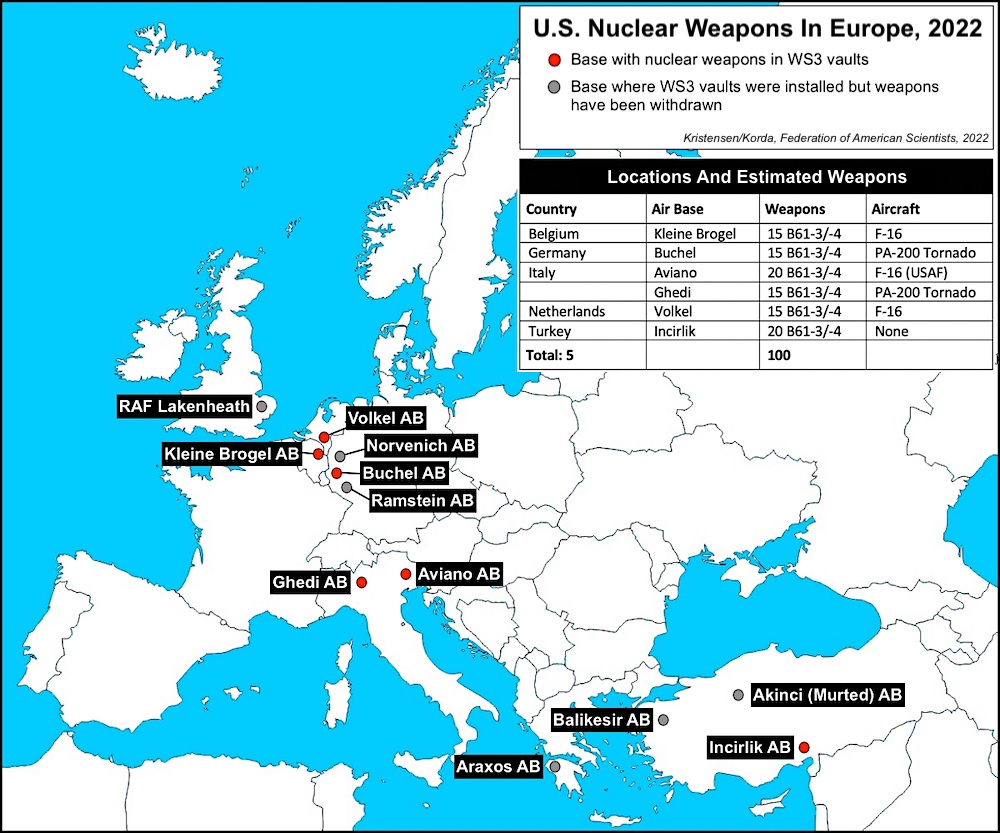
There are currently six active bases in five European countries with about 100 B61 bombs present in underground Weapons Storage and Security Systems (WS3) inside aircraft shelters. A seventh site in Germany (Ramstein Air Base) is active without weapons present and an eighth site – RAF Lakenheath – has recently been added to the list of WS3 sites being modernized. The revitalization of Lakenheath’s nuclear storage bunkers does not necessarily indicate that US nuclear weapons will return to UK soil, especially since as recently as December 2021, NATO’s Secretary General stated that “we have no plans of stationing any nuclear weapons in any other countries than we already have . . . ” However, the upgrade could be intended to increase NATO’s ability to redistribute the B61 bombs in times of heightened tensions, or to potentially move them out of Turkey in the future. In addition, four other sites have inactive (possibly mothballed) vaults (see map above).
This research was carried out with generous contributions from the John D. and Catherine T. MacArthur Foundation, the New-Land Foundation, the Ploughshares Fund, the Prospect Hill Foundation, the FTX Future Fund and Longview Philanthropy, the Stewart R. Mott Foundation, the Future of Life Institute, Open Philanthropy, and individual donors.
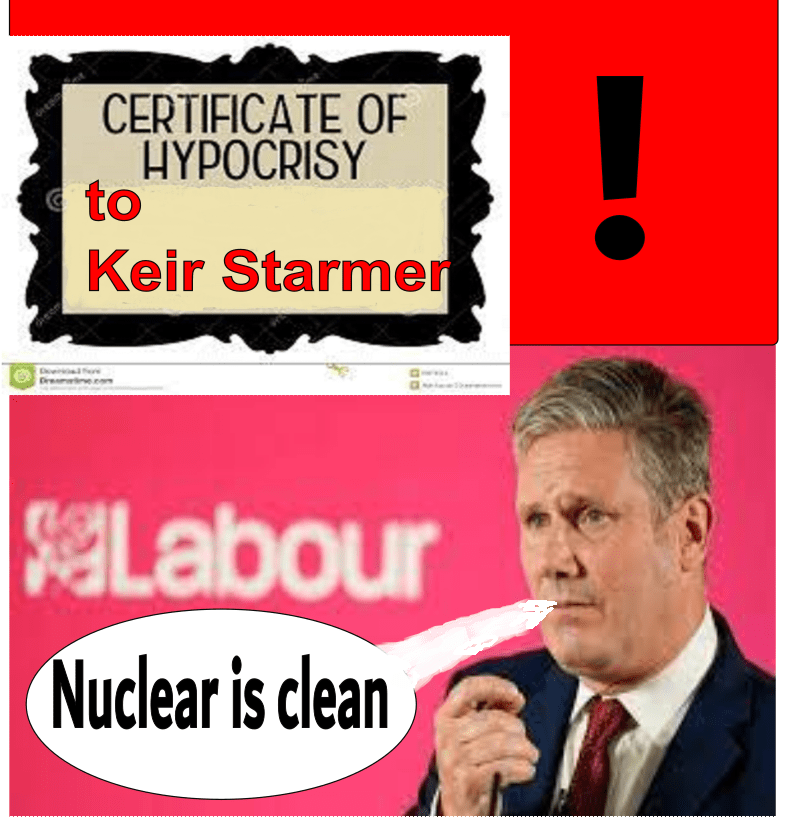
NO – Sir Keir Starmer – nuclear power is NOT clean.
A great opportunity being wasted!
The British Labour Party has the chance to get into power, following the disastrous Boris Johnson Tory leadership.
Top of Johnson’s follies was the plan for a fleet of nuclear reactors, large and small.
The incompetent Tories will inevitably go. Their hopeless dirty and super-costly nuclear plans should go with them.
But Keir Starmer now squanders this chance with his hypocritical pretence that nuclear power is clean.
Current reports that the Labour Opposition leader highlighted that, in power, Labour would bring a “different approach” to energy -it “would target 100% clean power generation by 2030”. The
Association for Renewable Energy and Clean Technology (REA) jumped up and down with delight, not realising that they’re being taken for a ride by the nuclear lobby
All very good – wind, solar, hydrogen, green steel and carbon capture – it does sound clean.
But, sneaked in amongst all this positive, forward -looking stuff, is that dirty old dinosaur – nuclear power.
The inclusion of nuclear power in the compendium of clean energy technologies will mean that funds and resources are siphoned away from real solutions to climate change.
It will quietly send resources , talented workers, and money to the nuclear weapons industries.
Shame on Labour – for inventing Great British Energy – “It’s galvanised by reform: a new publicly owned company” – but very quickly subverted to push for the nuclear lobby.

Lithuania deal to dismantle Soviet-era nuclear reactors could be world first
Pamela Largue , January 9, 2023
https://www.powerengineeringint.com/nuclear/waste-management-decommissioning/lithuania-to-dismantle-soviet-era-nuclear-reactors/
Two contracts have been signed to plan the dismantling and waste management for the Ignalina Nuclear Power Plant in Lithuania.
The first of two four-year contracts was signed with a consortium led by Westinghouse Electric Spain, including Jacobs Slovakia, and Lithuanian Energy Institute.
The second contract was signed with another consortium led by the French company Electricite de France.
The dismantling services will be provided in two phases. The first will see contractors propose engineering solutions for dismantling the reactor.
The engineering design concept will be assessed and then further developed in consultation with stakeholders, namely the European Commission, Ministry of Energy of the Republic of Lithuania, CPVA (Central Project Management Agency) and VATESI (State Nuclear Power Safety Inspectorate).
Audrius Kamienas, director general of the Ignalina plant, said in a statement that the signing of the contracts is an important milestone, as dismantling the reactor core is the most challenging part of the decommissioning.
“There are only a few examples of graphite reactors being dismantled in the world today, but the RBMK reactor type has never been dismantled before.
“This is an extremely complex task, unprecedented in the world, for which preparatory work will continue for several more years.”
Physical dismantling of the reactor will commence in 2028 and will be funded by the EU Ignalina Programme.
Graphite-moderated reactor
Dismantling two of the most powerful RBMK reactors is believed to be a decommissioning first.
According to the World Nuclear Association, Soviet-designed RBMK (reaktor bolshoy moshchnosty kanalny, high-power channel reactor) is a water-cooled reactor with individual fuel channels and uses graphite as its moderator.
Ignalina could be the first graphite-moderated reactor plant to be dismantled, making it an important test bed for methodologies that could be used to decommission others of the same type, such as the UK’s Magnox and advanced gas-cooled reactors, which also have graphite cores.
Jacobs Energy, Security & Technology senior vice president Karen Wiemelt, commented: “Our teams based in the UK, France and Slovakia are applying decommissioning skills acquired through work on some of the world’s most complex and challenging nuclear sites including Sellafield and Fukushima.”
In 2002, the Lithuanian government decided to shut down Ignalina NPP, which supplied up to 88% of the country’s electricity.
Ukraine on ‘NATO mission’ – defense minister
https://www.rt.com/russia/569500-reznikov-ukraine-nato-mission/ 9 Jan 23
Aleksey Reznikov has argued that Kiev is shedding blood for the military bloc and expects weapons in return.
Kiev is shedding blood to carry out the mission NATO set for itself and expects the “civilized West” to provide weapons and ammunition in return, Ukrainian Defense Minister Aleksey Reznikov has said in an interview for a domestic TV channel.
Appearing on the 1+1 network’s TSN channel on Thursday evening, Reznikov pointed out that at the Madrid summit last summer, NATO declared Russia the greatest threat to the US-led bloc.
“Today, Ukraine is addressing that threat. We’re carrying out NATO’s mission today, without shedding their blood. We shed our blood, so we expect them to provide weapons,” he said.
Reznikov also claimed that his NATO colleagues have told him, both in conversations and via text messages, that Ukraine is the “shield of civilization” and “defending the entire civilized world, the entire West.”
Ukrainian officials, from President Vladimir Zelensky down, routinely make public appeals for tanks, missiles, artillery and ammunition. Russian Defense Minister Sergey Shoigu told the General Staff in December that Moscow was de facto fighting the collective West. By his estimates, the government in Kiev has received almost $100 billion worth of weapons, ammunition and other supplies in 2022 alone.
Reznikov has led that effort, boasting to the US outlet Politico in October that he had figured out the Pentagon’s political process. His goal, he said, was to keep raising the bar until Ukraine received main battle tanks.
While that particular threshold has yet to be crossed, on Friday Washington announced the delivery of 50 Bradley infantry fighting vehicles, the most modern armor sent to Kiev so far, as part of a $3 billion weapons package. Earlier this week, France pledged a number of wheeled ‘light tanks’ as well.
These shipments are intended to replace Ukraine’s battlefield losses. Last month, Kiev’s top general Valery Zaluzhny told The Economist he would need 300 more tanks, up to 700 infantry fighting vehicles, and 500 howitzers to conduct offensive operations. This is more than the number of such vehicles in British or German inventory.
Moscow insists that Western weapon deliveries only serve to prolong the conflict, and has repeatedly warned Ukraine’s backers that this could result in an all-out military confrontation between Russia and NATO.
Irish Republic monitoring nuclear risk as a consequence of fighting in Ukraine
International Atomic Energy Agency repeatedly expresses concern over shelling around Zaporizhzhia plant
Irish Times, Jennifer Bray, Mon Jan 9 2023
Europe’s exposure to a potential nuclear event in Ukraine is being monitored by a team of public health and Government officials as well as the State’s environmental watchdog.
The Zaporizhzhia plant, Europe’s largest, was captured by Russian forces in March, soon after their invasion of Ukraine. It repeatedly came under fire last year, prompting concerns about a possible nuclear disaster. The International Atomic Energy Agency (IAEA) has repeatedly expressed concerns over shelling around the site.
Health Service Executive chief risk officer Patrick Lynch told a meeting of the organisation’s audit and risk committee in October that public health officials were involved in an evaluation process around potential nuclear exposure which would require further reflection.
He advised the committee that a Government department and the Environmental Protection Agency (EPA) are “considering the potential risk of nuclear release in Ukraine and subsequent exposure across Europe”…….
A Department of the Environment spokesman confirmed that its officials and other agencies are “closely monitoring the evolving situation in Ukraine in relation to nuclear safety implications”.
He said the EPA is “in close contact” with the IAEA, the European Nuclear Safety Regulators Group and national authorities in other European countries in order “to keep a close watch on developments and to monitor any increases in exposure levels”.
The department said that the EPA has an around-the-clock radiation monitor in use………………………..
The EPA operates a radiation monitoring network for Ireland which is continuously monitoring for radioactivity in the environment and also maintains contact with radiation authorities in other countries throughout Europe.” https://www.irishtimes.com/politics/2023/01/09/republic-monitoring-nuclear-risk-as-a-consequence-of-fighting-in-ukraine/
GUSTAFSON: Russian nuclear power – unsanctioned – is prospering worldwide
INTELLINEWS, By Professor Thane Gustafson in Washington January 8, 2023
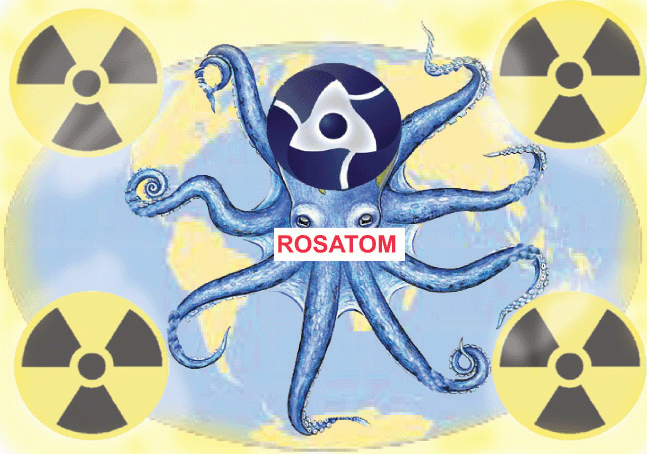
As the Western nuclear industry flounders, Russia’s Rosatom is building nuclear power plants (NPPs) on time and under budget around the world, while selling uranium to the US……………….
Russia’s nuclear industry is thriving, thanks mainly to its international business. According to Aleksey Likhachev, CEO of Rosatom, Russia’s nuclear monopoly, Russia is currently at work on 23 nuclear power units in a dozen different countries, including China, India, Belarus, Turkey, Hungary and Egypt. It sold $10bn worth of products abroad in 2022, a 15% increase on the year before, and its current foreign order book stands at over $200bn. Rosatom is actively courting new customers, mostly in the developing world; it offers a “full service” package that covers construction and operation, as well as the supply and reprocessing of nuclear fuel. The Russian government actively supports Rosatom with low-interest financing. In short, Russian nuclear power is on a roll.
But that is not all. In addition to building and operating new NPPs, Rosatom exports enriched uranium to numerous countries around the world, including the US and Europe. (In addition, Rosatom provides services to five EU counties that operate Russian-built NPPs.) Even though the revenues are not comparable (only about $1bn per year), the fuel exports are key politically. Because of this dependence, Russia’s nuclear industry is not under Western sanctions (as discussed further below), and it is not likely to be so any time soon. At this moment, Rosatom is able to operate without impediment, both at home and abroad; one of the few sectors in the Russian economy to be able to do so.
For both the US and Europe the implications are serious. First, they will continue to depend on Russian enriched uranium for several years more, potentially weakening their common front on sanctions. (Indeed, there have already been substantial disagreements among EU members over their policy toward Russian nuclear power.)
…… . Russia should continue to hold a commanding position in nuclear power for some time to come. …..

…. Putin named a politician, Sergei Kiriyenko, (above)to head the nuclear programme. Kiriyenko had had a mixed career up to that time – including a disastrous five-month stint as prime minister that coincided with Russia’s 1998 financial meltdown – but he turned out to be a talented manager. He regathered Rosatom’s wandering assets under one roof and after seeing off the oligarchs, he brought the industry’s unruly suppliers and contractors to heel. During the next eleven years he built Rosatom into a powerhouse. In 2016, Putin rewarded him with a secret medal and a top job, as Number 2 in the Kremlin’s Presidential Administration, where he is today.
The secrecy was no accident. When Rosatom was created in 2007, it inherited both the civilian NPPs and the military weapons assets. Kiriyenko made vigorous efforts to disentangle the military wing from the civilian, but the separation proved easier to achieve on paper than in reality. Today, the civilian and the military parts of Rosatom remain connected at the hip, as many parts of the nuclear supply chain, beginning with the mining of uranium, serve both military and civilian customers inside Russia.
But the military part was (and is) funded directly by the government, while the civilian part was supposed to be self-supporting. For Kiriyenko, this was a crucial difference. He had begun with ambitious plans for expanding nuclear power inside Russia, but he soon realised that there was little domestic demand for new NPPs in an electricity sector dominated by gas, and so Kiriyenko turned his sights on the foreign market. For this he needed to persuade the international community that Rosatom had become essentially a civilian business, in other words to fashion a new “commercial” image for the company. By and large he was successful, and Rosatom owes its present prosperity largely to the international business he built.
The impact of Western sanctions
Because of its important role as a supplier of uranium and nuclear fuels to NPPs around the world, including the US, Rosatom is not under Western sanctions. The US, in particular, relies on Russia for low-enrichment uranium for its own NPPs. Although efforts are under way to develop substitutes, for the present Rosatom is simply too valuable to sanction.
But even if sanctions were to be imposed, Rosatom’s operations would be largely unaffected by them. Internally, its supply chain, which as mentioned runs from uranium mining to power plant construction and operation, depends very little on the outside. ………….
Rosatom’s international business might be somewhat more vulnerable to sanctions, but so far there is little sign of it. Only one country, Finland, has pulled out of an ongoing project with Rosatom. ………………………….
Multiple challenges ahead
Yet quite apart from sanctions, Rosatom and Russian nuclear power may face multiple challenges ahead. One of them is technological progress. …………
Russia is the only country in the world to operate nuclear-powered icebreakers and floating NPPs, both of which are powered by small reactors. The Russian experience in designing and building small reactors goes back decades to the Soviet era, and there have been multiple generations of successively improved designs. Rosatom is working on deploying them not only on nuclear icebreakers and floating platforms, but also on land.
…………………….. The key to the future of SMRs, in the longer term, will likely be so-called “Generation IV” reactors, based on revolutionary designs that break entirely from the traditional light-water-reactor technology. But Generation IV is still an immature technology, and the race for leadership in G-IV is only now getting under way.
The more proximate threat to Rosatom’s leading position is Beijing. China has a vigorous nuclear programme, which is entirely independent of Russia…………………………………………
Finally, the ultimate challenges for Rosatom may be safety and reputational risk. Ever since the Chernobyl disaster in 1986, the Russian nuclear industry has had an excellent safety record. But the Russian invasion of Ukraine raises a serious new threat. There are four NPPs operating in Ukraine – ironically, all of them of Soviet manufacture. Russian [?] missiles have already landed close to one of them, the Zaporizhzhia plant, which is located close to the current battle line between Russian and Ukrainian forces. Just who is responsible for the safety of the plant is in dispute……………for Rosatom this plan is full of risks. If the plant were damaged and there were radioactive contamination, quite apart from the further suffering this would inflict on the Ukrainian people, for Rosatom the reputational damage would be extreme.
……. The challenges ahead are real, but they will come more from technological changes and rising competition from China, than from sanctions, from which Rosatom in any case remains so far exempt. https://www.intellinews.com/gustafson-russian-nuclear-power-unsanctioned-is-prospering-worldwide-266160/
Delay to small nuclear reactors as ministers battle over costs

Sunday January 08 2023, 12.01am GMT, The Sunday Times Harry Yorke
A funding deal for the first fleet of mini nuclear reactors is not expected to materialise for at least another 12 months, amid a row in government over the cost of Britain’s wider nuclear ambitions.
Last year, in order to triple domestic nuclear capacity to 24 gigawatts by 2050 — a quarter of the UK’s projected electricity demand — Boris Johnson set out plans for eight new large reactors alongside the development of small modular reactors (SMRs).
The government also announced the formation of Great British Nuclear (GBN), a body responsible for helping to deliver the next generation of reactors and SMRs by identifying potential sites, developers and investors.
At present only one plant, Hinkley Point C, is under construction, with the financing and final investment decisions on Sizewell C still pending. However, even though all but one of the UK’s existing plants are set to be shut down by the end of the decade, the government’s nuclear strategy now appears at risk of stalling amid internal disagreements.
In particular, Whitehall sources have revealed that there remains significant uncertainty over the scale of state investment in SMRs. Rolls-Royce, which has created designs for a 470 megawatt SMR and wants to
begin building factories, has called for ministers to enter funding talks and start placing orders. Rolls is understood to be seeking a commitment for four initial SMRs at a cost of about £2 billion each, which it
believes would unlock orders from interested foreign buyers.
But a senior government source said the Treasury would not sign off on any orders or significant funding until the technology had approval from the Office for Nuclear Regulation, which is not expected until 2024.
While the government has already invested £210 million in Rolls’s technology, the Department for Business, Energy and Industrial Strategy (BEIS) is also still assessing whether its competitors, including GE Hitachi, may offer “more viable” alternatives.
Insiders have signalled that the government may opt to launch yet another competition to gather further evidence before any firm deals are struck. More broadly, Treasury ministers harbour big concerns over the
costs associated with GBN, which officials have warned is billions over budget. While officials expect GBN to be announced early this year, after months of delays, the internal wrangling could lead to changes to both the body’s scope and funding.
Times 8th Jan 2023
1 This Month

of the week– Nuclear Reactor Information Task Force

14 May – online event From Bombs to Data Centres: the Face of Nuclear Colonialism
To see nuclear-related stories in greater depth and intensity – go to https://nuclearinformation.wordpress.com
-
Archives
- May 2026 (126)
- April 2026 (356)
- March 2026 (251)
- February 2026 (268)
- January 2026 (308)
- December 2025 (358)
- November 2025 (359)
- October 2025 (376)
- September 2025 (257)
- August 2025 (319)
- July 2025 (230)
- June 2025 (348)
-
Categories
- 1
- 1 NUCLEAR ISSUES
- business and costs
- climate change
- culture and arts
- ENERGY
- environment
- health
- history
- indigenous issues
- Legal
- marketing of nuclear
- media
- opposition to nuclear
- PERSONAL STORIES
- politics
- politics international
- Religion and ethics
- safety
- secrets,lies and civil liberties
- spinbuster
- technology
- Uranium
- wastes
- weapons and war
- Women
- 2 WORLD
- ACTION
- AFRICA
- Atrocities
- AUSTRALIA
- Christina's notes
- Christina's themes
- culture and arts
- Events
- Fuk 2022
- Fuk 2023
- Fukushima 2017
- Fukushima 2018
- fukushima 2019
- Fukushima 2020
- Fukushima 2021
- general
- global warming
- Humour (God we need it)
- Nuclear
- RARE EARTHS
- Reference
- resources – print
- Resources -audiovicual
- Weekly Newsletter
- World
- World Nuclear
- YouTube
-
RSS
Entries RSS
Comments RSS
 nuclear-news