Wiped out: Scientist’s ‘gigantic tsunami’ warning signals ‘grave threat’ to Sizewell C
The warning given yesterday by leading scientist Sir David King that London
and other UK coastal cities could be inundated in the future by a gigantic
tsunami reveals that coastal nuclear power developments in the South-East
of England would also be under a ‘grave threat’, says UK/Ireland Nuclear
Free Local Authorities English Forum Chair Councillor David Blackburn.
Sir David King was for seven years Chief Scientific Advisor to the British
Government. In widely reported press articles yesterday, Sir David warned
that a gigantic tsunami could hit Britain ‘at any time’ should there be a
landslide in the Canary Islands, which would trigger a huge wave headed for
this country.
In such an eventuality, coastal cities such as Portsmouth,
Plymouth and Southampton would be inundated and so too would London and the
Thames Estuary, and much of low-lying South-East England.
NFLA 14th March 2023
Sir David Attenborough urges people to unite to save ‘nature in crisis

Sir David Attenborough said “nature is in crisis” as he urged people to
unite to save it for future generations. He spoke out after last night’s
first episode of his five-part show about British wildlife.
His plea comes
as the National Trust, RSPB and WWF have launched their first joint
campaign, Save Our Wild Isles, which encourages people to “go wild”
once a week, by doing activities such as sowing bee-friendly plants or
creating “hedgehog highways”, and urges citizens to call on the
government to make changes to halt nature’s decline.
The series features a
sixth, iPlayer-only episode called Saving Our Wild Isles, commissioned by
the RSPB and WWF. “[It] shows what amazing people are doing to turn the
UK round and how quickly it can recover,” Alastair Fothergill, the
producer, said.
Times 13th March 2023
Independent 13th March 2023
UK political row over ‘expensive and unnecessary ‘ spending on nuclear power stations.
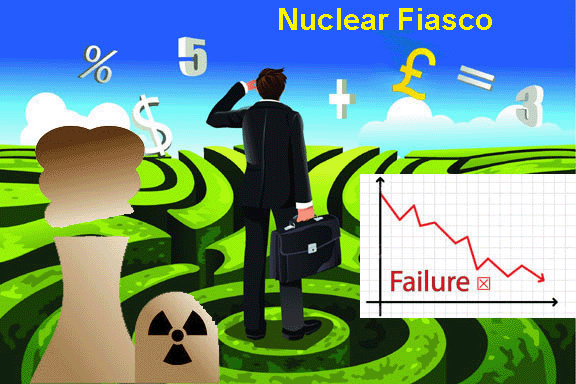
Tory Aberdeenshire MP accused of ‘failing to stand up for north-east’ in
nuclear power row. The UK Government has been hit with criticism over what
is being described as ‘expensive and unnecessary’ spending on nuclear power
stations, with the Aberdeenshire MP slated by the SNP’s Energy
spokesperson.
A political row has broken out after an Aberdeenshire MP was
accused of prioritising ‘expensive and unnecessary’ nuclear stations over
carbon capture storage (CCS) and renewable energy. In a letter to Mr Bowie,
the MP for West Aberdeenshire and Kincardine, SNP energy spokesman Alan
Brown expressed concerns over updated costs to nuclear station Hinckley
Point C in Somerset.
The project is now slated to cost the taxpayers
£33billion, a 40 per cent real terms increase to the original 2016 estimate
of £18billion. Despite the soaring costs, it was revealed earlier this week
the UK government has not engaged with EDF over what that means for the
delivery of the project, while still pressing ahead for another new station
at Sizewell C.
Aberdeen Live 14th March 2023
https://www.aberdeenlive.news/news/aberdeen-news/tory-aberdeenshire-mp-accused-failing-8250696
Why Russia has such a strong grip on Europe’s nuclear power
Why Russia Has Such a Strong Grip on Europe’s Nuclear Power. New energy
sources to replace oil and natural gas have been easier to find than
kicking the dependency on Rosatom, the state-owned nuclear superstore.
The pinched cylinders of Russian-built nuclear power plants that dot Europe’s
landscape are visible reminders of the crucial role that Russia still plays
in the continent’s energy supply.
Europe moved with startling speed to wean
itself off Russian oil and natural gas in the wake of war in Ukraine. But
breaking the longstanding dependency on Russia’s vast nuclear industry is a
much more complicated undertaking.
New York Times 10th March 2023
Some ‘sober thinking’ remains in Ukraine as portions of population are in favor of peace talks
RFri, 10 Mar 2023 https://www.sott.net/article/478187-Praise-be-Some-sober-thinking-remains-in-Ukraine-as-portions-of-population-are-in-favor-of-peace-talks
A senior Kiev official recently admitted that an increasing portion of the country’s population wants peace talks with Moscow
Some Ukrainians are realistic about future relations between Russia and Ukraine, which are bound to be restored in some capacity sooner or later, Kremlin Press Secretary Dmitry Peskov suggested on Friday.
Speaking to reporters, Peskov said that while it was premature to talk about a diplomatic settlement of the conflict, “there are still small streams of sober thinking” in Ukraine about ties between Moscow and Kiev, despite “the flood of propaganda filled with hatred of Russia” and “efforts to brainwash the Ukrainian population.”
Relations between the two countries are “inevitable, because we are neighbors, that’s obvious,” he added.
Peskov’s comments come after Aleksey Danilov, the head of Ukraine’s National Security and Defense Council, admitted on Thursday that an increasing number of Ukrainians would like to see diplomatic engagement with Moscow to end the conflict. According to Danilov, such thinking is a “very dangerous tendency” and one that is even shared by some people in western Ukraine, a region that for decades has traditionally been ill-disposed towards Russia.
Moscow has repeatedly said that it is open to talks with Kiev on condition that the latter recognizes the “reality on the ground,” referring to the new status of the Donetsk and Lugansk People’s Republics, as well as Kherson and Zaporozhye Regions, as part of Russia. The former Ukrainian regions overwhelmingly voted to join Russia in public referendums last autumn.
However, also last autumn, Ukrainian President Vladimir Zelensky signed a decree prohibiting talks with the current Russian leadership. Later, he floated a ten-point “peace formula” that would require Moscow to withdraw all of its troops from the territory Kiev claims as its own. Russia rejected the proposal, claiming that it shows Ukraine’s unwillingness to find a solution to the crisis.
In January, Russian Foreign Minister Sergey Lavrov also said that while Moscow is “ready to respond to all serious proposals” to resolve the conflict, it is “the West which decides for Ukraine,” and it does not give Kiev any chance to make decisions on its own.
Lessons from Chernobyl and Fukushima: Is Europe prepared for another nuclear disaster?
By Camille Bello • Updated: 11/03/2023 – 15:29
Exactly 12 years ago, a massive earthquake and tsunami caused the second-worst nuclear accident in history at the Fukushima Daiichi Nuclear Power Plant in Japan.
The anniversary of the catastrophic meltdown that displaced 160,000 people and cost the Japanese government over €176 billion should itself be enough of a reminder of the potential threat of a nuclear spill, but a number of recent events have also raised the alarm in Europe.
Russia’s invasion of Ukraine has repeatedly knocked out the country’s electricity grid, causing blackouts at the Zaporizhzhia nuclear plant, Europe’s largest, where power is needed to prevent the reactors from overheating like in the 1986 Chernobyl radiation disaster.
Meanwhile, Europe’s other nuclear reactors are ageing – they were built on average 36.6 years ago – and recent checkups in France have found cracks in several of them.
Some energy experts have warned that the extreme weather events brought on by climate change could pose a serious threat to the EU’s 103 nuclear reactors, which account for about one-quarter of the electricity generated in the bloc.
Jan Haverkamp, a senior nuclear energy and energy policy expert for Greenpeace, said the chances of Europe seeing a large accident like Fukushima were now “realistic” and “we should take them into consideration”.
“We are not properly prepared,” he told Euronews Next https://www.euronews.com/next/2023/03/11/chernobyl-fukushima-europe-prepared-nuclear-disaster-ukraine-earthquake-meltdown-radiation
Nuclear crash exercise beset by blunders, says UK’s Ministry of Defence
Rob Edwards March 12, 2023
An exercise testing emergency responses to a nuclear bomb convoy crashing,
exploding and spreading a cloud of radioactive contamination was plagued
with “errors” and “confusion”, according to official assessments by
the Ministry of Defence (MoD).
There were shortages of vital medical
equipment, “poor” arrangements for casualties and multiple mistakes in
radiation monitoring. One set of radiation readings was wrong “by a
factor of 1,000 times”. At one point MoD firefighters ran out of water,
and at another an MoD commander refused help from the civil fire service.
There was no official assessment of whether or not the crash was caused by
a terrorist.
The Ferret 12th March 2023 https://theferret.scot/nuclear-crash-exercise-blunders/
The Foreseeable End of Ukraine

The days of Ukraine as we know it are now numbered. Sooner rather than later, it will probably sink into insignificance as a greatly diminished rump state. Its tragedy is that it has allowed itself to be instrumentalised by the West, above all by Washington, in an almost suicidal manner for goals that are not its own. The phrase that the US administration is fighting ‘to the last Ukrainian’ has become a common expression
By Karl Richter, 6 March 2023, https://arktos.com/2023/03/06/the-foreseeable-end-of-ukraine/
Karl Richter asserts that Ukraine is facing an imminent end due to Russia’s dominance in the ongoing conflict, weak Western military and economic support, and Ukraine’s own nationalism, citing predictions by several Western military experts and predicting Western governments will soon have to justify the utter failure of their Ukraine policy.
The faces of Ukraine supporters are now visibly getting longer. In fact, things are getting interesting now. In the next few months, the central lie of Western politics will burst: Ukraine is coming to an end. No more billions of dollars sinking into the Kiev quagmire, and certainly no handful of Western battle tanks, should they ever come, will make much difference to events. Russia is in the driver’s seat and has all the means of escalation at its disposal, while the West is on its last legs economically, militarily and not least morally.
At least four Western military experts who know something of their trade have contradicted mainstream reporting in recent weeks and are now predicting the decisive weeks of Ukraine’s survival. Among them is Austrian Colonel Markus Reisner, a convinced Ukraine sympathiser. In one of his latest analyses, Reisner points to the considerable Russian resources and has to concede: ‘Ukraine could win several rounds, but there has been no knockout yet.’ The Russian side, he says, still has stocks of at least ten million artillery shells at its disposal, plus 3.4 million new shells produced each year. ‘So they are in a position to fight this war even longer’, while things are now getting tight for Kiev
Erich Vad, ex-brigadier general and former military policy advisor to German Chancellor Angela Merkel, is more explicit. He sees Russia ‘clearly on the advance’ and agrees with US Chief of Staff (!) Mark Milley ‘that a military victory for Ukraine is not to be expected’. He is surprised, however, at the extensive ‘synchronisation of the media, the likes of which I have never experienced in the Federal Republic of Germany. This is pure opinion mongering.’ One wonders, however, in which world the honourable ex-general has been living in the last decades.
The fourth member of the group is the former Pentagon adviser and former US colonel Douglas Macgregor. In several recent interviews (including those of the independent US portal Redacted), he not only addresses the immense losses of the Ukrainians – in some cases up to 70 per cent of the original battalion strength – but also the rampant repression of the Ukrainian domestic intelligence service SBU against its own population – a sure sign that the end is near. If the Kiev leadership does not agree to negotiations soon, there will be little more left of Ukraine than a rump state west of the Dnieper, says Macgregor. He does not want to rule out the possibility of a coup movement against the Kiev junta in view of the horrendous losses at the front – if not, Moscow itself would be forced to finish the ‘job’ and mop up the Selenskyj regime. A new Ukrainian government would probably be sensible enough to enter into peace negotiations. In the best case, Russia would thus also have achieved its wartime goal of ‘denazifying’ Ukraine.
Even a mainstream newspaper like the German daily Die Welt had to admit recently (31 January) that in the foreseeable future Russia will emerge from the conflict as the victor not only militarily but also politically: while Ukraine will not achieve any of its goals, certainly not the reconquest of Crimea, Russia will, in the course of an inevitable negotiated settlement, enforce that Ukraine’s NATO membership ‘will be excluded for the foreseeable future’ – nothing else was demanded by Moscow before the war began almost a year ago. And: ‘The result will be an amputated Ukraine.’
One can look forward to how the Western regimes will soon explain the complete failure of their Ukraine policy to their populations. Neither will Ukraine have won nor will Russia be ‘ruined’, which the German Foreign Minister Annalena Baerbock has erroneously claimed is the goal of German government policy. When it comes to the end of Ukraine, the Western regimes will not only have sunk gigantic sums of billions into Kiev, but will also have permanently poisoned relations with Russia, destroyed their own energy supply and successfully disarmed their own armed forces. This is truly an unprecedented achievement that can only be described as open treason. It will cost the Europeans dearly. In ‘normal’ times, those responsible would be held accountable. This bill remains open. The current leadership – not only in Germany – will have to be replaced without residue anyway if we want to get back into talks with Russia even halfway sensibly.
The days of Ukraine as we know it are now numbered. Sooner rather than later, it will probably sink into insignificance as a greatly diminished rump state. Its tragedy is that it has allowed itself to be instrumentalised by the West, above all by Washington, in an almost suicidal manner for goals that are not its own. The phrase that the US administration is fighting ‘to the last Ukrainian’ has become a common expression.
Last but not least, Ukraine has become a victim of its own nationalism. In Soviet times, this was only kept under the surface in a makeshift manner, only to be vigorously fanned by American foundations soon after 1991, with an anti-Russian bias from the start. Today, Ukraine is a pseudo-state consumed by national hatred, which is no longer viable in its current form. If one wants to apply historical perspective, similarities with Czechoslovakia and Poland before the Second World War come to mind. Both countries proved incapable of getting along with their ethnic minorities in a sensible way as a result of their nationalism and the Western powers’ agitation. Kiev is currently reaping the consequences of this policy, comparable to Czechoslovakia in 1938 and Poland in 1939.
As far as Poland is concerned, it would be a particularly bitter irony of history if Poland were to take back its former eastern territories in Galicia in the course of the settlement of Ukraine. The preparations for this have been in full swing for months – interestingly enough, in full agreement with the Kiev cokehead regime. One can research this without much effort. It cannot be ruled out that Moscow has long been on board behind the scenes. The Kremlin could be the one laughing, watching Polish and Ukrainian nationalists butting heads in the future. The Volhynia massacres of 1943/44, when the Ukrainians slaughtered up to 300,000 Polish peasants behind the German lines, have not been forgotten. In no time at all, the EU would have another trouble spot on its hands where it could sink its billions in the future. A mature achievement all around.
Britain’s Office for Nuclear Regulation warns on the need for a safety case, as EDF wants to extend the life of 2 nuclear power Stations

A spokesperson for the Office for Nuclear Regulation (ONR) said: “We are
aware of EDF’s announcement today (9 March 2023) of its intention to extend
the operating life of Heysham 1 and Hartlepool Power Stations.
“Although a plant life extension decision does not require formal regulatory
assessment or approval by ONR, it is a requirement of the site licence that
operations be carried out at all times under a valid safety case. “A
number of the current safety cases for the stations will need to be updated
to achieve EDF’s stated ambitions, together with investment in plant to
sustain equipment reliability, all while ensuring that the necessary people
and skills are on site.
“The ongoing safety of operations will need to be
fully demonstrated to us as part of the ongoing regulation of the sites in
Lancashire and Teesside, which will be informed though our extensive
inspection and assessment regime. “Once we receive them, the safety cases
from EDF will be thoroughly assessed by our team of expert inspectors.
ONR 9th March 2023
Graphite – deadly dirt or dusty diamonds?
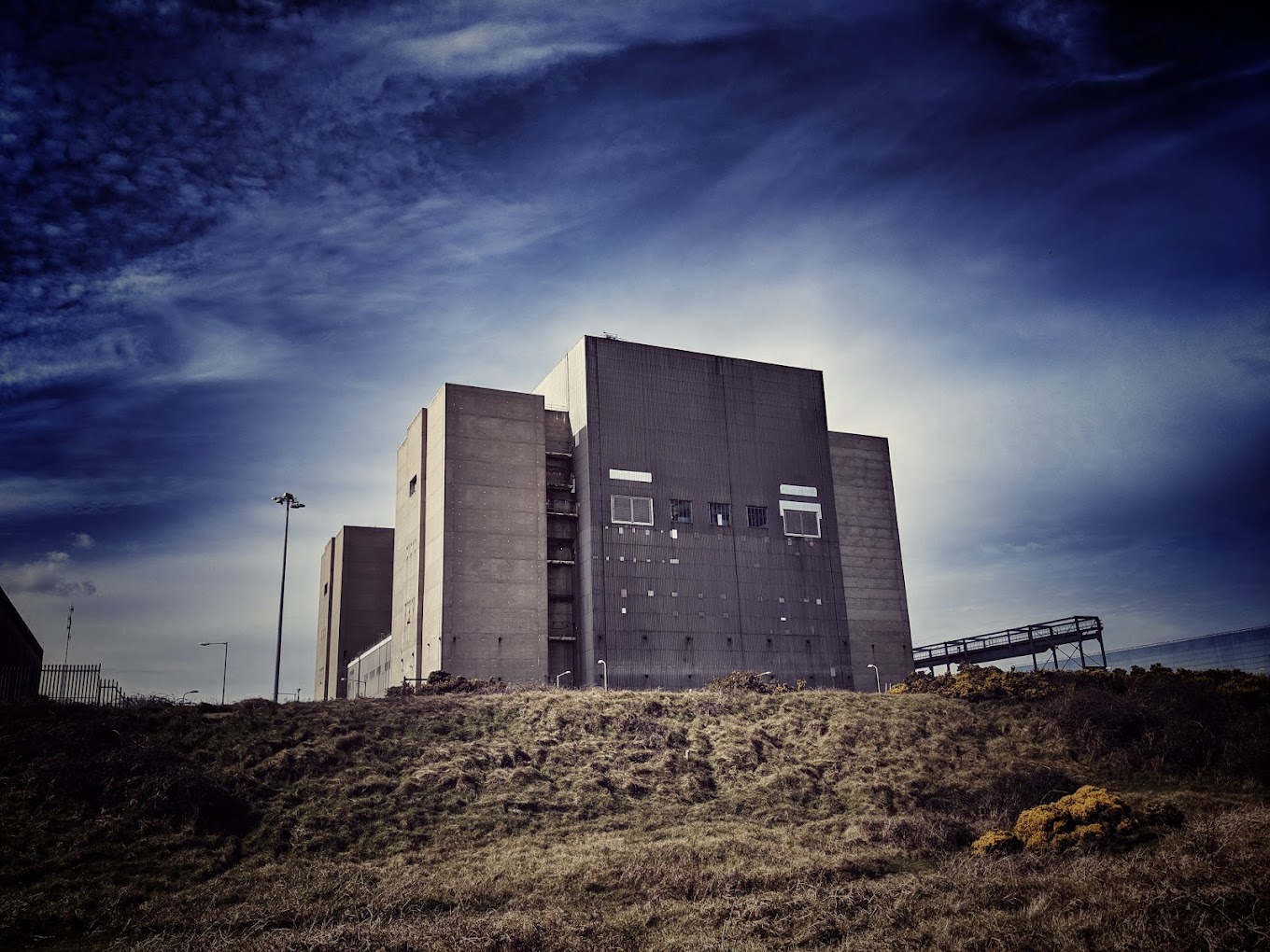
Blackwater Against New Nuclear Group , 8 Mar 23, BANNG’s Coordinator Peter Banks exposes the hidden danger lurking on the Blackwater in the March 2023 column for Regional Life. https://www.banng.info/news/regional-life/radioactive-graphite/
On the Southern shore of the Blackwater Estuary the shiny, grey/blue reactor buildings of the former Bradwell nuclear power station are now a landmark visible for many miles. The power station ceased operating in 2002 and now, in a state of ‘care and maintenance’, remains a visible monument to the early nuclear age.
Contained within the Bradwell buildings (and within all but one of the UK’s civil nuclear power stations) are blocks of graphite forming the very heart of the reactors, called the ‘core’. Once the reactor goes critical the graphite becomes impregnated (technically ‘irradiated’) with a range of radioactive isotopes such that it will remain dangerously contaminated for decades.
Back in the 1960s when Bradwell was commissioned, little forethought was given to the future when these behemoth plants would be taken out of service and decommissioned. The irradiated graphite was far too dangerous for humans to remove as stations were being demolished. Furthermore, the blocks were highly inaccessible as they were at the core of the sealed reactor vessel.
And the reactor chamber metalwork itself had also been irradiated. Recently the process of dismantling was given the new, self-explanatory name of ‘deferred decommissioning’ by the Nuclear Decommissioning Agency (NDA). Whilst this is totally understandable from a health and safety perspective, it does mean that the promises made when Bradwell closed in 2002 that the site would soon be cleared and returned to unrestricted land use were ridiculous.
And diamonds? If the graphite had also been subjected to great pressure as well as heat it would have converted to, amazingly, diamonds! But never think of the contents as precious diamonds, they are actually nasty radioactive wastes – a deadly dirt indeed.
Regardless, irradiated graphite and diamonds both need to be robustly protected. Therefore, expect to see the shiny reactor buildings of Bradwell for at least another 60 years. And, with nowhere else to go, they could remain on our shores into the unknown future.
EDF ordered to inspect 200 nuclear pipe weldings after more cracks discovered

By America Hernandez and Forrest Crellin, 10 Mar. https://www.reuters.com/business/energy/edf-ordered-inspect-200-nuclear-pipe-weldings-after-more-cracks-discovered-2023-03-10/
PARIS, March 10 (Reuters) – France’s nuclear safety watchdog ASN has ordered energy utility EDF (EDF.PA) to inspect about 200 pipe weldings across its 56-nuclear reactor fleet after discovering three additional cracks this week, the regulator said on Friday.
In addition to a major corrosion-related crack on the Penly 1 reactor in Normandy revealed on Tuesday, which the watchdog attributed to faulty welding, two fissures on EDF’s Penly 2 reactor and the Cattenom 3 reactor in Moselle were disclosed on Thursday.
An EDF spokesperson declined to comment on ASN’s criticism, but said the two newer cracks were due to “thermal fatigue”, which happens when very hot and cold water meet inside pipes, causing the steel to dilate, contract and become more fragile over time.
EDF regularly inspects pipes via ultrasound for this phenomenon during maintenance, the spokesperson added.
The latest defects and watchdog scrutiny come as France and the Britain announced a new energy partnership on Friday to strengthen cooperation on nuclear power, including construction of power stations, innovation and safety.
Neither French President Emmanuel Macron nor British Prime Minister Rishi Sunak mentioned the nuclear operator’s latest setbacks after a bilateral summit.
“You are helping us secure our supply of nuclear power thanks to EDF’s incredible work,” Sunak told Macron.
EDF is building a new nuclear plant in Britain, Sizewell C, which has suffered from cost overruns and construction delays. A second plant, Hinkley Point C, is also in the works.
The utility’s Penly 2 and Cattenom 3 in France are part of a group of 16 reactors flagged by EDF as being susceptible to corrosion-related cracks due to a design flaw, and prioritised for checks in its inspection and maintenance plan.
That plan is now being updated to accommodate the additional check of 200 weldings, and will be published “in coming days”, EDF has said.
European forward-curve power prices rose sharply on Friday following the announcement of new cracks, after French nuclear output in 2022 fell to a 34-year low while EDF scrambled to fix stress corrosion issues at several sites.
“Some market participants may be worried that the issues with corrosion are trickier than first anticipated, and that EDF will struggle both long- and short-term to fix it and bring generation back to pre-2022 levels,” Rystad analyst Fabian Ronningen said.
“Thermal fatigue” is causing flaws in the cooling pipes of France’s nuclear reactors

Electricite de France SA discovered new defects at two of its nuclear
reactors that were halted for maintenance and repairs, raising fresh
concerns that its electricity output will remain largely constrained this
year after plunging in 2022.
Flaws tied to so-called thermal fatigue have
been found on the pipes of the Penly-2 and Cattenom-3 reactors, the utility
said in a statement. The pipes have been replaced as part of broader
repairs related to “stress corrosion” cracks — a different type of
faults — that are affecting emergency cooling pipes of some of the EDF’s
atomic plants, according to the nuclear safety authority.
The nuclear giant has been forced to halt more than a dozen of its 56 reactors for months of repairs since it first found signs of such stress corrosion phenomenon in
late 2021. The announcement comes just days after the country’s nuclear
safety authority asked EDF to revise its program of reactor checks
following the utility’s discovery of a “significant” stress corrosion
crack earlier this year on its Penly-1 reactor. EDF said it will propose an
update of its reactor check strategy to the watchdog in the coming days.
The fresh setbacks could force EDF to carry out more extensive checks on
its atomic plants, reviving concern that France will have to import large
amounts of power this year. Last year, worries about electricity shortages
combined with dwindling deliveries of Russian gas pushed European energy
prices to records.
Bloomberg 10th March 2023
https://www.bnnbloomberg.ca/edf-finds-new-flaws-at-2-reactors-stoking-power-supply-woes-1.1893577
British government poised to label nuclear as “green”, but investors are not impressed
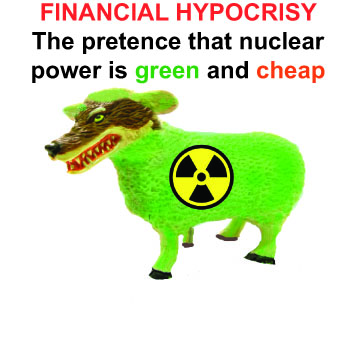
The British government is poised to redefine nuclear power as “green”
as it seeks to drum up more private investment in the sector to improve
domestic energy resilience. Ministers are set to consult on proposals to
change the so-called “taxonomy” — or financial classification system
— of energy in order to redefine nuclear projects as sustainable
investments. It is expected to lead to a reversal of the decision by the
Treasury as recently as 2021 to exclude nuclear power from the so-called
green investment framework.
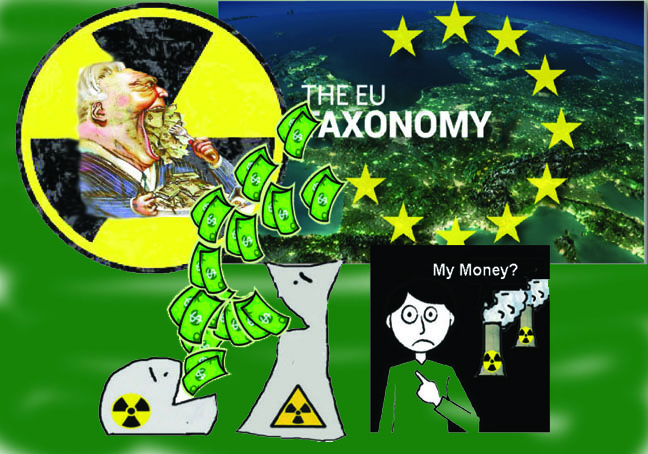
The move echoes a decision last year by the
European Commission to label both nuclear and some forms of gas as
“green” investments, which prompted legal challenges from Greenpeace
and a coalition of WWF and Client Earth.

The consultation comes as thegovernment is set to provide about £80mn
in seed funding for the launch ofGreat British Nuclear, a new body which will
oversee plans to build a new
generation of nuclear power stations in the UK, according to two people
familiar with the negotiations. Ministers are anxious to accelerate the
programme which has been dogged by delays and cost overruns on the only new
nuclear plant under construction at Hinkley Point in Somerset. The
government, together with French state-backed utility EDF, are trying to
raise £20bn in private finance for the next power station at Sizewell in
Suffolk.

But investors have shown little interest in backing greenfield
nuclear projects, because of the construction risks in the highly
regulated, safety- critical sector. All new nuclear projects across Europe
have been hit by delays and big cost overruns.
Nick Stansbury, head of
climate solutions at Legal and General Investment Management, warned that
the changes to the taxonomy were unlikely to drive investment. Ministers
will also update their strategy for reaching net zero by 2050 after a judge
ruled last July that the original document provided insufficient detail and
gave the government a deadline to rewrite it by the end of this month. The
energy department refused to comment.
FT 9th March 2023
https://www.ft.com/content/2bef8242-d04b-47b9-84f8-b301692ea2f4
Britain’s “Regulated Asset Base” funding method for nuclear power is deemed not likely to work

National Infrastructure Commission model spells trouble for nuclear RAB
funding. Dr Jim Cuthbert questions whether the government’s funding method
for its nuclear power programme provides value for money, given it now
expects the plants to take nearly twice as long to build.
A major part of
the government’s energy strategy is a programme of eight new nuclear power
stations, to be funded by the Regulatory Asset Base (RAB) funding method.
One of the main features of RAB is that it involves consumers paying from
the start of construction for benefits they will only begin to receive when
construction is completed, and the plant is producing electricity.
One of
the key questions that should be answered in assessing whether a RAB-funded
project should go ahead is whether the eventual benefit consumers could
receive, in this case through cheaper electricity charges in the long run,
is enough to compensate them for the opportunity cost of the payments made
while receiving no benefit.
Given the long construction periods now
anticipated for new nuclear plants, it is unlikely that RAB financing will
be able to attain a sufficient cost advantage to do so. In 2019, the
National Infrastructure Commission (NIC) produced a paper on the
application of the RAB approach to nuclear energy, illustrating a
methodology including an approach to answering the above key question.
The NIC paper set out the results of illustrative calculations of the impact of
a range of factors on the likely value for money of RAB projects.
Unfortunately, it is something of a mixed bag. On the negative side, the
results in the paper are not presented in a way that allows the impact of
different factors to be separately identified: and, critically, the NIC
makes a central assumption about the likely length of the construction
period for new nuclear projects only about half of what the government now
assumes. On the plus side, having clarified with the NIC what methodology
it was using in the opportunity cost component of their model, their basic
approach seems sensible.
Although not clear from the original NIC paper,
the length of the construction period has a critical effect on the likely
value for money of a RAB-funded nuclear project. If the NIC’s basic model
is applied to a project with the government’s current assumption of a
13-to-17-year-long construction period, instead of the NIC’s central
assumption of eight years, then RAB nuclear is unlikely to achieve a
sufficient cost advantage over alternative approaches to compensate
consumers for the opportunity cost of their initial payments.
Public Finance 9th March 2023
Low-dose radiation linked to increased lifetime risk of heart disease

by British Medical Journal, https://medicalxpress.com/news/2023-03-low-dose-linked-lifetime-heart-disease.html 8 March 23,
Exposure to low doses of ionizing radiation is associated with a modestly increased excess risk of heart disease, finds an analysis of the latest evidence published by The BMJ today.
The researchers say these findings “have implications for patients who undergo radiation exposure as part of their medical care, as well as policy makers involved in managing radiation risks to radiation workers and the public.”
A linked editorial suggests that these risks “should now be carefully considered in protection against radiation in medicine and elsewhere.”
It’s well recognized that exposure to high dose radiation can damage the heart, but firm evidence linking low dose radiation to heart disease (e.g., scatter radiation dose from radiotherapy or working in the nuclear industry) is less clear.
To address this knowledge gap, an international team of researchers examined scientific databases for studies evaluating links between a range of cardiovascular diseases and exposure to radiation (mostly radiotherapy and occupational exposures).
They excluded uninformative datasets or those largely duplicating others, leaving 93 studies, published mainly during the past decade, suitable for analysis. These studies covered a broad range of doses, brief and prolonged exposures, and evaluated frequency (incidence) and mortality of various types of vascular diseases.
After taking account of other important factors, such as age at exposure, the researchers found consistent evidence for a dose dependent increase in cardiovascular risks across a broad range of radiation doses.
For example, the relative risk per gray (Gy) increased for all cardiovascular disease and for specific types of cardiovascular disease, and there was a higher relative risk per dose unit at lower dose ranges (less than 0.1 Gy), and also for lower dose rates (multiple exposures over hours to years).
At a population level, excess absolute risks ranged from 2.33% per Gy for a current England and Wales population to 3.66% per Gy for Germany, largely reflecting the underlying rates of cardiovascular disease mortality in these populations.
This equates to a modest but significantly increased excess lifetime risk of 2.3-3.9 cardiovascular deaths per 100 persons exposed to one Gy of radiation, explain the authors.
Substantial variation was found between studies, although this was markedly reduced when the authors restricted their analysis to higher quality studies or to those at moderate doses (less than 0.5 Gy) or low dose rates (less than 5 mGy/h).
The authors suggest that mechanisms for these cardiovascular effects are poorly understood, even at high dose.
They also acknowledge that few studies assessed the possible modifying effects of lifestyle and medical risk factors on radiation risk, particularly major modifiable risk factors for cardiovascular disease like smoking, obesity, diabetes, high blood pressure and high cholesterol, and say further research is needed in this area.
In conclusion, they say their findings support an association between acute high dose and (to a lesser extent) chronic low dose radiation exposure and most types of cardiovascular disease and suggest that “radiation detriment might have been significantly underestimated, implying that radiation protection and optimization at low doses should be rethought.”
This view is supported by Professor Anssi Auvinen at Tampere University in Finland in a linked editorial, who points out that while inconsistencies and gaps remain in the evidence linking vascular disease to low dose radiation exposure, “evidence for cardiovascular disease will soon need to be added to the existing list of radiation-induced health risks.”
This will involve revisiting concepts and standards in radiological protection, while more stringent standards for justification and optimization, especially for high dose procedures, will have to be considered, he explains.
Their implementation will also require training to improve awareness, knowledge, and understanding of the risks associated with specific procedures and cumulative exposure, as well as risk communication for patients and the public, he concludes.
1 This Month

of the week– Nuclear Reactor Information Task Force

14 May – online event From Bombs to Data Centres: the Face of Nuclear Colonialism
To see nuclear-related stories in greater depth and intensity – go to https://nuclearinformation.wordpress.com
-
Archives
- May 2026 (116)
- April 2026 (356)
- March 2026 (251)
- February 2026 (268)
- January 2026 (308)
- December 2025 (358)
- November 2025 (359)
- October 2025 (376)
- September 2025 (257)
- August 2025 (319)
- July 2025 (230)
- June 2025 (348)
-
Categories
- 1
- 1 NUCLEAR ISSUES
- business and costs
- climate change
- culture and arts
- ENERGY
- environment
- health
- history
- indigenous issues
- Legal
- marketing of nuclear
- media
- opposition to nuclear
- PERSONAL STORIES
- politics
- politics international
- Religion and ethics
- safety
- secrets,lies and civil liberties
- spinbuster
- technology
- Uranium
- wastes
- weapons and war
- Women
- 2 WORLD
- ACTION
- AFRICA
- Atrocities
- AUSTRALIA
- Christina's notes
- Christina's themes
- culture and arts
- Events
- Fuk 2022
- Fuk 2023
- Fukushima 2017
- Fukushima 2018
- fukushima 2019
- Fukushima 2020
- Fukushima 2021
- general
- global warming
- Humour (God we need it)
- Nuclear
- RARE EARTHS
- Reference
- resources – print
- Resources -audiovicual
- Weekly Newsletter
- World
- World Nuclear
- YouTube
-
RSS
Entries RSS
Comments RSS
 nuclear-news