Ukraine’s new commander-in-chief is an unpopular ‘butcher’ – Politico
https://www.rt.com/russia/592184-ukraine-commander-syrsky-unpopular/ 10 Feb 24
Troops are wary of General Aleksandr Syrsky, and reportedly fear that he will throw them into “fruitless assaults”
Ukraine’s new armed forces chief, General Aleksandr Syrsky, is deeply unpopular among the rank and file of the Ukrainian military, who view him as a “butcher” willing to sacrifice waves of troops, Politico reported on Thursday.
Ukrainian President Vladimir Zelensky named Syrsky as the new head of the armed forces on Thursday, after firing General Valery Zaluzhny from the post. The switch had been the subject of media rumors for several weeks, and Zelensky hinted in an interview last week that it would form part of a wider “reset” of the country’s military and civilian leadership.
Syrsky is a controversial choice, best known for “leading forces into a meat grinder in Bakhmut [called Artyomovsk in Russia], sending wave after wave of troops to face opposition fire,” Politico said.
The unsuccessful defense of Artyomovsk/Bakhmut last year cost Ukraine dearly, and earned Syrsky the nickname ‘butcher’, an anonymous source within the Ukrainian military told the news site. A captain told the outlet that Syrsky’s appointment is a “very bad decision,” adding that soldiers refer to him as ‘General200’, a nickname that Politico said refers to 200 of his men dying, but could also refer to ‘Cargo 200’, a Soviet and Russian military code used to describe corpses being removed from the battlefield.
“General Syrsky’s leadership is bankrupt, his presence or orders coming from his name are demoralizing, and he undermines trust in the command in general,” an anonymous Ukrainian military officer and frontline intelligence analyst posted on X. “His relentless pursuit of tactical gains constantly depletes our valuable human resources, resulting in tactical advances such as capturing tree lines or small villages, with no operational goals in mind.”
“This approach creates a never-ending cycle of fruitless assaults that drain personnel,” the officer said.
In a group chat of Bakhmut/Artyomovsk veterans, one soldier wrote “we’re all f**ked” upon learning of Syrsky’s appointment, Politico stated.
Syrsky takes over command of a depleted military, with Kiev having lost more than 383,000 men since the hostilities started in February 2022, according to the Russian Defense Ministry. Prior to his dismissal, Zaluzhny warned Zelensky that a rapid improvement in Ukraine’s position on the battlefield was unlikely, regardless of who took his place, the Washington Post reported last week.
Kremlin spokesman Dmitry Peskov said on Friday that Russia’s campaign against Ukraine will not be affected by Syrsky’s appointment, and that Moscow will continue until its objectives are achieved.
Zelenskiy names new Ukrainian military commander, says it’s time for ‘renewal’
RFE/RL, Fri, 09 Feb 2024, https://www.sott.net/article/488754-Zelenskiy-names-new-Ukrainian-military-commander-says-its-time-for-renewal
—
President Volodymyr Zelenskiy appointed Colonel General Oleksandr Syrskiy as the Ukrainian Army’s commander in chief just minutes after announcing it was time for a “renewal” and “renewed leadership” of the country’s armed forces.
Comment: It’s probably time for a renewal of Ukraine’s political leadership too.
In his statement on February 8, Zelenskiy said Syrskiy “has successful defense experience — he conducted the Kyiv defense operation. He also has successful offensive experience — the Kharkiv liberation operation.”
The Russia-born, 58-year-old Syrskiy, who has served as the commander of Ukrainian ground forces since 2019, replaces General Valeriy Zaluzhniy following reports that Zelenskiy was strongly considering removing him.
Zelenksiy said in a message on X, formerly Twitter, that is he grateful to Zaluzhniy and he appreciates “every victory we have achieved together.” Before announcing the leadership change, Zelenskiy said he had “candidly discussed” with Zaluzhniy issues in the army that require urgent change.
“Starting today, a new management team will take over leadership of the armed forces of Ukraine. I had dozens of conversations with commanders at various levels,” he said, adding that the move “is not about surnames, and surely not about politics.”
The change in leadership is about the management of the military and “about involving the experience of this war’s combat-hardened commanders,” he said, touting Syrskiy’s successful experience, particularly in the defense of Kyiv and his successful offensive experience, particularly in the Kharkiv liberation operation.
Defense Minister Rustem Umerov noted Zaluzhniy’s role in the first two years of the full-scale Russian invasion, saying “our soldiers repelled the onslaught of the aggressor, defended our statehood, and continue to defend our independence every day.”
Comment: After the last two years of this 10-year conflict, Russia controls about 18% of Ukraine that used to be Ukrainian.
He said he was grateful for Zaluzhniy’s achievements and victories, but war changes and demands change.
“The battles of 2022, 2023, and 2024 are three different realities [and] 2024 will bring new changes for which we must be ready,” Umerov said. “New approaches, new strategies are needed.”
U.S. State Department spokesman Vedant Patel said the move to replace Zaluzhniy was a “sovereign decision” made by Ukrainian leaders. He declined to comment further.
Comment: No one really believes that.
Syrskiy was one of the main commanders who led the Ukrainian armed forces’ fight against the offensives by Russia-backed separatists that started in 2014 shortly after Russia illegally annexed Ukraine’s Crimea.
Comment: That’s certainly one way of looking at it. But as usual, RFE/RL tries and succeeds in being as wrong as possible.
After Russia launched its full-scale invasion of Ukraine in February 2022, Syrskiy led the Ukrainian armed forces’ successful counteroffensive to regain control over the Kharkiv region in September of that year.
Comment: A “full-scale invasion” using a small fraction of its military.
…………………………………………………………………………..Tensions between Zaluzhniy and Zelenskiy surfaced in November after the commander in chief published an opinion piece in The Economist saying the war had entered a stalemate and only a technological breakthrough would allow Ukraine to achieve its goals of liberating occupied territory.
Zelenskiy’s office was quick to reject that battlefield assessment.
Polls showed earlier that Zaluzhniy’s popularity in the country is as high, if not more so, than Zelenskiy’s, and some experts suggested that if Zelenskiy ousted Zaluzhniy, it would demoralize some of Ukraine troops and undermine national unity. RT reports:
Ukraine’s new armed forces chief, General Aleksandr Syrsky, is deeply unpopular among the rank and file of the Ukrainian military, who view him as a “butcher” willing to sacrifice waves of troops, Politico reported on Thursday.
…
Syrsky is a controversial choice, best known for “leading forces into a meat grinder in Bakhmut [called Artyomovsk in Russia], sending wave after wave of troops to face opposition fire,” Politico said.The unsuccessful defense of Artyomovsk/Bakhmut last year cost Ukraine dearly, and earned Syrsky the nickname ‘butcher’, an anonymous source within the Ukrainian military told the news site. A captain told the outlet that Syrsky’s appointment is a “very bad decision,” adding that soldiers refer to him as ‘General200’, a nickname that Politico said refers to 200 of his men dying, but could also refer to ‘Cargo 200’, a Soviet and Russian military code used to describe corpses being removed from the battlefield.
“General Syrsky’s leadership is bankrupt, his presence or orders coming from his name are demoralizing, and he undermines trust in the command in general,” an anonymous Ukrainian military officer and frontline intelligence analyst posted on X. “His relentless pursuit of tactical gains constantly depletes our valuable human resources, resulting in tactical advances such as capturing tree lines or small villages, with no operational goals in mind.”
“This approach creates a never-ending cycle of fruitless assaults that drain personnel,” the officer said.
In a group chat of Bakhmut/Artyomovsk veterans, one soldier wrote “we’re all f**ked” upon learning of Syrsky’s appointment, Politico stated.
Syrsky takes over command of a depleted military, with Kiev having lost more than 383,000 men since the hostilities started in February 2022, according to the Russian Defense Ministry. Prior to his dismissal, Zaluzhny warned Zelensky that a rapid improvement in Ukraine’s position on the battlefield was unlikely, regardless of who took his place, the Washington Post reported last week.
France: EDF Faces Unprecedented Nuclear Workload in France
Energy Intelligence Group, Fri, Feb 9, 2024, Grace Symes, London
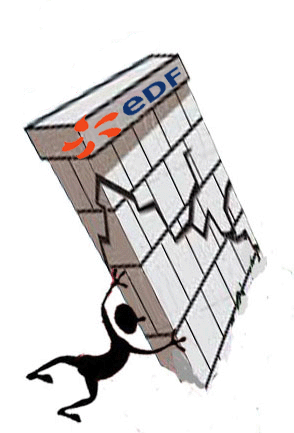
As France faces two major nuclear efforts — the refurbishment and life extension of EDF’s domestic operating fleet and a major nuclear newbuild program — there are already signs that the country’s nuclear workforce is struggling to keep up. With 10-year safety reviews, or decennial visits (DVs), of EDF’s 56 domestic reactors growing ever more complex and time-consuming, EDF anticipates flatlined nuclear output from 2025 to 2026, and beyond that France will need to ramp up an industrial effort not seen in generations if it hopes to successfully launch simultaneous large newbuilds (related).
Energy Intelligence 9th Feb 2024
https://www.energyintel.com/0000018d-7944-d1ef-a5cd-fd647d920000
NATO-Russia confrontation ‘could last decades’ – Stoltenberg
Rt.com 10 Feb 24
The US-led bloc urgently needs to increase production of ammunition, the secretary-general has said
NATO Secretary-General Jens Stoltenberg has called on the bloc’s members toincrease defense production in anticipation of “a confrontation” with Russia “that could last decades.” Stoltenberg has repeatedly warned that Western economies are ill-prepared for such a conflict.
With Ukraine’s counteroffensive fizzled out and Russian forces poised to capture the key Donbass stronghold of Avdeevka, media reports have for weeks highlighted the worsening shortage of men and ammunition facing Kiev. Amid warnings of “a cascading collapse along the front,” Stoltenberg told Germany’s Die Welt newspaper that NATO members must increase arms production to meet Ukraine’s demand.
“We need to restore and expand our industrial base more quickly so that we can increase supplies to Ukraine and replenish our own stocks. That means switching from slow production in times of peace to fast production, as is necessary in conflicts,” he said.
NATO recently signed contracts worth $1.2 billion to produce around 220,000 155-millimeter artillery shells, bringing to more than $10 billion the amount spent by the bloc on ammo deals in the past six months. However, the latest contracts will not be fulfilled until the end of 2025, and earlier ammo pledges to Ukraine – like the million artillery shells promised by the EU – have not been met. Meanwhile, American stockpiles have been depleted by Washington’s effort to arm both Ukraine and Israel, and a $61 billion military aid package promised by the White House remains stalled in Congress……………………………..
Aside from the fact that attacking NATO territory would enter Russia into a war with the entire alliance, Russian officials have repeatedly stressed that Moscow has no geopolitical, economic, or military interests in Poland or the Baltic states.
“It is absolutely out of the question,” Putin told American journalist Tucker Carlson earlier this week. “You just don’t have to be any kind of analyst, it goes against common sense to get involved in some kind of global war. And a global war will bring all of humanity to the brink of destruction. It’s obvious.”
Putin argued that Western leaders are “trying to intimidate their own population with an imaginary Russian threat.” These predictions, he said, “are just horror stories for people in the street in order to extort additional money from US taxpayers and European taxpayers” to keep weapons and ammo flowing to Ukraine. https://www.rt.com/news/592235-stoltenberg-prepare-war-russia/
Call to withdrawal from Holderness nuclear waste site talks amid tourism and farming ‘fears’
South East Holderness’ Cllr Lyn Healing and Cllr Sean McMaster said the area had already experienced creeping industrialisation in recent years
Hull Live, Joseph Gerrard, Local Democracy Reporter, 10 Feb 24
Local politicians have called for East Riding Council to walk away from talks on proposals for a site to house radioactive nuclear waste deep beneath south Holderness.
South East Holderness’ Cllr Lyn Healing and Cllr Sean McMaster said most Holderness people did not want a Geological Disposal Facility (GDF) amid fears for tourism and of creeping industrialisation. Beverley and Holderness MP Graham Stuart said he was backing the councillors’ call after he previously said a local referendum should be held on the proposals.
The call follows the unveiling of the proposals in January and the announcement that the council had joined the South Holderness Working Group to explore the proposals. East Riding Council Leader Cllr Anne Handley said it was the first stage in seeing whether a GDF would be right for the area……………………………. more https://www.hulldailymail.co.uk/news/hull-east-yorkshire-news/call-withdrawal-holderness-nuclear-waste-9087294
Nuclear regulator raps EDF over safety flaws
The nuclear industry regulator has demanded improvements are made in at Dungeness B power station after a maintenance worker suffered an electric shock.
The Office for Nuclear Regulation (ONR) has served an improvement notice on Energy Nuclear Generation Ltd (EDF Energy) following an incident at Dungeness B power station in Kent.
An employee suffered an electric shock from a portable heater while undertaking maintenance work at the site. The worker suffered injuries on 5th November 2023, which required medical treatment.
The ONR stressed that there was no risk to nuclear safety, the public or the environment as a result of the incident.
Mike Webb, ONR’s superintending inspector for operating reactors, said: “Our investigation found that EDF had failed to ensure the electrical systems involved in the incident were constructed and maintained in a way that prevented danger to their workers, so far as is reasonably practicable. We will engage with EDF during the period of the improvement notice to ensure positive progress is made to address the shortfall.”……………………………….
Construction Index 12th Feb 2024
https://www.theconstructionindex.co.uk/news/view/nuclear-regulator-raps-edf-over-safety-flaws
UK steps up war on whistleblower journalism with new National Security Act

KIT KLARENBERG, ·FEBRUARY 9, 2024, The GrayZone
Under a repressive new act, British nationals could face prison for undermining London’s national security line. Intended to destroy WikiLeaks and others exposing war crimes, the law is a direct threat to critical national security journalism.
It was the afternoon of May 17 2023 and I had just arrived at London’s Luton Airport. I was on my way to the city of my birth to visit my family. Before landing, the pilot instructed all passengers to have their passports ready for inspection immediately upon disembarking the plane. Just then, I noticed a six-strong squad of stone-faced plainclothes British counter-terror officers waited on the tarmac, intensely studying the identification documents of all travelers.
As soon as the cops identified me, I was ordered to accompany them into the airport terminal without explanation. There, I was introduced to two officials whose names I could not learn, who subsequently referred to each other using nondescript callsigns. I was invited to be digitally strip searched, and subjected to an interrogation in which I had no right to silence, no right to refuse to answer questions, and no right to withhold pin numbers for my digital devices or sim cards. If I asserted any rights to privacy, I faced arrest and up to 48 hours in police custody.
I chose to comply. And so it was that over the next five hours, I sat with a couple of anonymous counter-terror cops in an airless, windowless, excruciatingly hot back room. They fingerprinted me, took invasive DNA swabs, and probed every conceivable aspect of my private and professional life, friend and family connections, and educational background. They wanted to know why I write, say and think the things I do, the specifics of how I’m paid for my investigative journalism, and to which bank account.
I had been detained under Britain’s 2019 Counter-Terrorism and Border Security Act, which the UN has branded draconian and repressive. Under its Schedule 3 powers, anyone entering British territory suspected of “hostile activity” on behalf of a foreign power can be detained, interrogated for six hours, and have the contents of their digital devices seized and stored. “Hostile acts” are defined as any behavior deemed threatening to Britain’s “national security” or its “economic well-being.”
More disturbingly, Schedule 3 is suspicionless. Under its terms, “it is immaterial whether a person is aware that activity in which they are or have been engaged is hostile activity, or whether a state for or on behalf of which, or in the interests of which, a hostile act is carried out has instigated, sanctioned, or is otherwise aware of, the carrying out of the act.” It must be quite an elaborate conspiracy when conspirators do not even know they’re conspiring.
It turns out the British state wrongly believed The Grayzone had a relationship with Russia’s notorious FSB security service. They based their assumption not on any evidence, but on our knack for producing factual investigative journalism based on documents passed to this outlet anonymously, via burner email accounts. Such activity is common practice for Western media outlets, rights groups, and much venerated “open source” investigative outfits like the US-government sponsored Bellingcat. If I and the rest of The Grayzone made any mistake, it was in publishing material the US-UK national security state does not want in the public domain.
Now, the British government is taking its war on investigative journalism to a new level through its little-known National Security Act. Under this law, authorities in London have granted themselves the power to surveil, harass, and ultimately imprison any British citizens they wish on similarly suspicionless grounds. Dissidents of every stripe must now worry that everything they do or say could land them in jail for lengthy terms, simply for failing to toe London’s rigid national security line.
Among the top lobbyists for these authoritarian measures is Paul Mason, the celebrity journalist who posed as a leader of the British left until The Grayzone unmasked him as a security state collaborator hellbent on destroying the antiwar movement from within.
Inspired by the US Espionage Act, designed to criminalize whistleblowing
In December 2023, after processing for 18 months through parliamentary procedures, the British National Security Act came into force. Under the aegis of protecting Britain from the threat of espionage and sabotage by hostile actors at home and abroad, the law introduces a number of completely new criminal offenses with severe penalties — and wide-ranging consequences for freedom of speech. Indeed, the law’s terms are so broad, individuals will almost inevitably break the law without wanting to, intending to, or even knowing they have.
Because no one has been prosecuted under the Act to date, its full ramifications remain unclear. However, London’s security and intelligence apparatus now enjoy far-reaching powers to police what can be said about the British government’s activities abroad.
Given the frightening implications of the Act, UK journalists, press rights groups, and civil liberties organizations should be up in arms. Yet serious criticism of the law was largely absent from mainstream publications throughout various phases of debate in parliament.
Scrutiny of the anti-free press Act has been left almost entirely to independent journalists like Mohamed Elmaazi. Writing for Consortium News in July 2022, Elmaazi noted that it “shares many elements” with Washington’s “draconian 1917 Espionage Act,” which is currently being used to prosecute WikiLeaks founder Julian Assange…………………………………………
Act specifically intended to criminalize WikiLeaks threatens whistleblowers
During the 2022 House of Commons debate, knighted Conservative MP Sir Robert Buckland led the charge against WikiLeaks. Buckland, who was responsible in his former role as Secretary of State for Justice for “upholding the rule of law and protecting judicial independence,” argued that the National Security Act was a vital tool to prosecute “those such as Julian Assange who dump data in a way that has no regard for the safety of operatives and other affected people.” He later remarked, “none of us [in Parliament] wants to see Julian Assange and his type carry sway here.”
The UK Supreme Court expressed a very different view when, in 2018, it held in a unanimous decision that cables published by WikiLeaks are admissible as evidence in court proceedings…………………………………………………………………………
Should authorities in London merely suspect someone might in some way benefit from possessing “information” provided to them by an unknown “foreign” power, that they may have stumbled across on the internet or been provided one way or another without their express request or consent, they could be branded as a criminal and locked away.
British journalists more compliant to authoritarian measures than ever
The British state’s campaign to muzzle dissenting voices draws on London’s operation of a little-known but devastatingly effective censorship mechanism known as the Defense and Security Media Advisory (DSMA) Committee.
Comprised of representatives of the security and intelligence services, military veterans, high-ranking government officials, press association chiefs, editors and journalists, the committee determines behind closed doors which national security related-issues can be covered by the press, and in what fashion.
On occasion, the Committee issues what are known as “D-notices.” Theoretically, these are voluntary requests for news outlets to not broadcast particular pieces of information, or to omit details deemed harmful to national security. While recipients are not legally obliged to comply, they are fully aware that a refusal could mean prosecution under the Official Secrets Act 1989, especially if the information in question results from an “unauthorised disclosure.” Alternatively, an offending journalist might simply be blacklisted, losing access to on and off-the-record briefings and privileged information from officials, which would then threaten their employment. As a result, examples of outlets ignoring “D-notices” are few and far between…………………………………………………………………………………….
Paul Mason suggests The Grayzone be prosecuted for exposing him
In June 2022, The Grayzone exposed British reporter Paul Mason for his collusion with a senior British Foreign Office intelligence officer in a clandestine campaign to brand the British antiwar left as a vehicle for the Russian and Chinese governments. The publication of the material, which was sent to this outlet via anonymous burner accounts, was clearly in the public interest………………………………… more https://thegrayzone.com/2024/02/09/uk-national-security-act-wikileaks/—
France’s Flamanville EPR has numerous technical problems which mean that its safety issues are not “now closed”
Response from GLOBAL CHANCE to the ASN consultation on the request for
authorization to commission the Flamanville EPR reactor.
Contrary to what the President of the ASN stated on January 30, 2024 in his conference press
and the presentation of one’s wishes, numerous technical subjects which are
as much potential problems for the proper functioning of the EPR and which
call into question the reactor safety, cannot be considered “now closed”.
The problems that hamper the operation and safety of the EPR are numerous.
Most serious are presented in the following chapters in two parts: severe
and persistent then severe and whose solutions are risky. They lead to
asking questions including the answers do not appear in any of the
documents which constitute the file released made available to the public
by the ASN
Global Chance 9th Feb 2024
Why Biden’s $61 billion in weapons for Ukraine won’t prevent inevitable defeat
Walt Zlotow, West Suburban Peace Coalition, Glen Ellyn IL 11 Feb 24
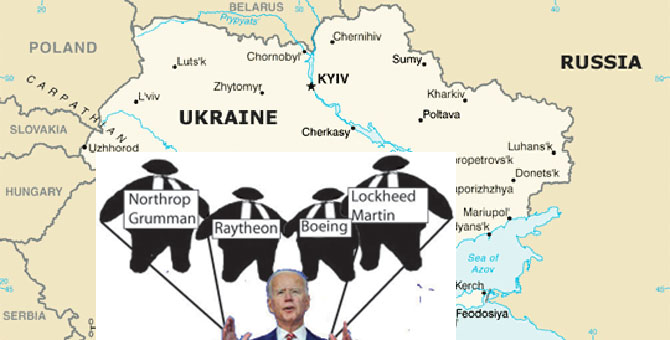
For 4 months President Biden has been beseeching Congress to grant another $61 billion in aid to Ukraine to continue their 2 year war with Russia. This is on top of $113 billion that has made no dent in Ukraine’s efforts to prevail against overwhelming Russian forces.
Biden could give Ukraine a trillion dollars in aid but it’s essentially worthless because Ukraine is running out of soldiers to use US weapons.
A dozen Ukrainian soldiers and commanders told the Washington Post that personnel deficits are at their lowest point ever.
One mechanized brigade battalion commander advised he’s down to 40 soldiers from a normal 200 to hold off the Russian advance. Another mentioned the same shortage in his unit.
Replacements are scares since August when Zelensky fired all recruitment office heads due to corruption. That’s caused a dramatic decline in replacements still not solved.
But if Biden gets his $61 billion he’d be better off tossing it into a bonfire instead of squandering it on more weapons for Ukraine. That will only prolong a war that was lost on Day One, 717 days ago. Had Biden not torpedoed a peace deal nearly inked in the first month, over 400,000 Ukrainian soldiers would still be alive, the Ukraine economy would not be devastated, and Ukraine may not have lost a single square mile of territory.
Biden knows the $61 billion more will not turn the tide. But as Pete Seeger sang about LBJ continuing to fight a lost war in Vietnam 57 years ago, in today’s White House…’The Big Fool says to push on.’
France’s EDF shuts down two nuclear reactors after fire at Chinon plant

Reuters, February 11, 2024, https://www.reuters.com/business/energy/frances-edf-shuts-down-two-nuclear-reactors-after-fire-chinon-plant-2024-02-10/
—
Nuclear energy operator EDF has shut down two reactors at Chinon in western France after a fire in a non-nuclear sector of the plant in the early hours of Saturday, the company said.
The fire has been extinguished, it said.
“Production unit number 3 at the Chinon nuclear power plant has shut down automatically, in accordance with the reactor’s safety and protection systems,” EDF said in a statement, adding it also shut down reactor number 4, which is coupled to number 3.
France’s nuclear safety watchdog said in a separate statement the fire had led to an electricity cut at the plant that triggered the automatic shutdown.
Chinon is one of France’s oldest nuclear plants.
Reporting by Tassilo Hummel; editing by Barbara L
European Union now promoting the lie that nuclear power is “green”

Nuclear power officially labelled as ‘strategic’ for EU’s decarbonisation, By Paul Messad | EURACTIV.fr | translated by Anne-Sophie Gayet, 7 Feb 24
The Council of EU member states and the European Parliament agreed on Tuesday (6 February) to label nuclear power as a strategic technology for the EU’s decarbonisation, following months of intense negotiations in Brussels over the Net-Zero Industry Act (NZIA).
…………….. The agreement encompasses tried and tested nuclear technologies as well as future third and fourth generation ones, i.e. small modular reactors (SMRs) and advanced nuclear reactors (AMRs). Their fuel cycles are also included in the text.
“The message is clear: the EU recognises that we need nuclear power to achieve the objectives of the Green Deal,” the French MEP told Euractiv. https://www.euractiv.com/section/energy-environment/news/nuclear-power-officially-labelled-as-strategic-for-eus-decarbonisation/
EDF’s nuclear struggles dampen EU nuclear prospects – the industry “on a slow descent to hell”.

MURIEL BOSELLI, Paris, France, 08 Feb 2024 19:48
(Montel) The latest setbacks at the UK’s new Hinkley Point C nuclear power plant have cast a shadow over Europe’s nuclear revival, experts told Montel, with one former EDF executive saying France’s nuclear industry was “on a slow descent to hell”.
A feud between Paris and London over who should fork out an extra EUR 6-8bn for Hinkley Point C’s (HPC) cost overruns was tarnishing the nuclear industry’s image as pro-nuclear nations try to promote atomic power in the battle against climate change, experts said.
HPC faces a new four-year delay and may not be commissioned until 2031, with completion costs now forecast at between GBP 31-34bn,… (Subscribers only)
Montel 8th Feb 2024
https://www.montelnews.com/news/1537139/edfs-nuclear-struggles-dampen-eu-nuclear-prospects
Rolls-Royce snubbed for UK’s first private small nuclear reactor plant
Proactive, Philip Whiterow, 08 Feb 2024
Rolls-Royce Holdings PLC (LSE:RR.)‘s mini-nuclear plans have seemingly suffered a setback with the UK’s first privately funded station to use reactors built by Westinghouse.
The US group said it signed an agreement with Community Nuclear Power to install four AP300 small modular reactors (SMRs) at the North Teesside project to generate up to 1.5 gigawatts of power or enough for up to two million homes.
Westinghouse added it hopes to have the first AP300 operating unit available in “the early 2030s”…………………………………..
Mini-reactors or SMRs were a key plank of former prime minister Boris Johnson’s plans to rejuvenate Britain’s nuclear industry and hit his green energy targets.
…………………………………….
Lord Houchen, the mayor of Tees Valley, said one of the major issues it faced was the lack of policy clarity in the UK over SMRs.
Although reportedly ahead of the competition, Rolls-Royce’s SMR is still said to be only mid-way through the UK approval process.
The new power station is being entirely privately funded and will be sited at Seal Sands, a former chemical works. https://www.proactiveinvestors.co.uk/companies/news/1040531/rolls-royce-snubbed-for-uk-s-first-private-nuclear-plant-1040531.html
Another $61 billion to kill more Ukrainians in an unnecessary and losing war

The $61 billion will make no difference on the battlefield except to prolong the war, the tens of thousands of deaths, and the physical destruction of Ukraine.
The Biden-Schumer Plan to Kill More Ukrainians JEFFREY D. SACHS, Feb 08, 2024, Common Dreams, https://www.commondreams.org/opinion/the-biden-schumer-plan-to-kill-more-ukrainians
President Joe Biden is refusing to fold a losing hand as he bets with Ukrainian lives and U.S. taxpayer money. Biden and Democratic Senate Majority Leader Chuck Schumer propose to squander the lives of tens of thousands more Ukrainians and $61 billions of federal funds to keep Biden’s disastrous foreign policy failure hidden from view until after the November election.
The $61 billion will make no difference on the battlefield except to prolong the war, the tens of thousands of deaths, and the physical destruction of Ukraine. It will not “save” Ukraine. Ukraine’s security can only be achieved at the negotiating table, not by some fantasized military triumph over Russia.
$61 billion is not nothing. This worse-than-useless outlay would exceed the combined budgets of the U.S. Department of Labor, Environmental Protection Agency, National Science Foundation, and the Women, Infant, and Children nutrition program.
Almost exactly 10 years ago this month, Biden did much to put Ukraine on the path to disaster. This is well known to those who have looked carefully at the facts but is kept hidden from view by the White House, the Senate Democrats, and the mainstream media that back Biden. I have previously provided a detailed chronology, with hyperlinks, here.
Ukraine’s security can only be achieved at the negotiating table, not by some fantasized military triumph over Russia.
In 1990, President George H. W. Bush, Sr. and his German counterpart Chancellor Helmut Kohl promised Soviet President Mikhail Gorbachev that NATO would not expand eastward if the Soviet Union accepted German reunification. When the Soviet Union disbanded in December 1991, with Russia as the successor state, American leaders decided to renege.
President Bill Clinton began NATO expansion over the vociferous opposition of top diplomats like George Kennan and the opposition of his own Secretary of Defense, William Perry. In 1997 Zbigniew Brzezinski upped the ante, with a plan for NATO to expand all the way to Ukraine. He famously wrote that without Ukraine, Russia would cease to be a great power.
Russian leaders have repeatedly made clear that NATO expansion to Ukraine is understandably the reddest of Russian redlines.
In 2007, President Vladmir Putin stated that NATO enlargement to that date was a cheat on the 1990 promise, and that it must go no further. Despite these clear warnings, including by his own diplomats, George W. Bush Jr. committed in 2008 to expand NATO to Ukraine and Georgia in order to surround Russia in the Black Sea.
William Burns, now CIA director, and then the U.S. Ambassador to Russia, wrote a famous memo entitled “Nyet means Nyet,” explaining that Russia’s opposition to NATO enlargement was across Russia’s political spectrum. Most Ukrainians themselves were also firmly against the plan, favoring neutrality over NATO membership. The Ukrainian Rada declared Ukraine’s state sovereignty in 1990 on the basis of becoming “a permanently neutral state.” In 2009, the people of Ukraine elected Viktor Yanukovych, who ran on a platform of neutrality.
In early 2014, the U.S. decided to help bring down Yanukovych in a coup. This was standard U.S. deep-state operating procedure, one used on dozens of occasions around the world. he CIA, National Endowment for Democracy, USAID, and NGOs like the Open Society Foundation went to work in Ukraine. The point person was Victoria Nuland, who was first Richard Cheney’s principal deputy foreign policy advisor, then George Bush Jr.’s ambassador to NATO, then Hillary Clinton’s spokesperson, and by 2014 Assistant Secretary of State.
This time, the Russians caught the conspiracy on tape, in an intercepted call between Nuland and U.S. Ambassador to Ukraine Geoffrey Pyatt (now Assistant Secretary of State). Nuland explains to Pyatt that Vice President Joe Biden will help choose and cement the post-coup government. The 2014 Ukraine team, including Biden, Nuland, Jake Sullivan (then and now Biden’s national security advisor), Geoffrey Pyatt, and Antony Blinken (then the deputy national security advisor), remains the Ukraine team today.
It is a team of bunglers. They thought that Yanukovych’s overthrow would quickly usher in NATO expansion. Instead, ethnic Russians in Ukraine virulently rejected the Russophobic post-coup government that was installed by Nuland, and called for autonomy of the ethnically Russian regions. In a referendum, Crimea voted overwhelmingly to join Russia.
Obama, Biden, and their team armed the post-coup government to attack the ethnically Russian regions, thinking this would be the end of it. Yet the regions resisted. Ukraine and the breakaway regions signed the Minsk Agreements to bring an end to the fighting and give constitutional autonomy to the ethnically Russian Donbas. The Minsk II agreement was backed by the UN Security Council, but the U.S. privately agreed with the Ukrainian government that it was okay to ignore it.
In 2021, after 7 years of fighting and more than 14,000 deaths in the Donbas, Putin called on newly elected President Biden to stop NATO enlargement and engage in negotiations with Russia over mutual security arrangements. Biden rejected Putin’s call to end the gambit of NATO enlargement to Ukraine.
In February 2022, Putin launched the Special Military Operation (SMO) invasion to push Ukraine to the negotiating table. Ukraine’s President Volodymyr Zelensky immediately called for negotiations based on Ukraine’s neutrality. Within a month, a framework agreement to end the fighting was reached between Ukraine and Russia, based on Ukraine’s neutrality and an end to NATO’s enlargement to Ukraine. Biden stepped in to stop the deal, with the U.S. informing Zelensky that the U.S. would not support neutrality.
Biden and team had still more failed tricks up their sleeve. They firmly believed that U.S. financial sanctions—freezing Russia’s assets and cutting it out of the SWIFT banking system—would cripple the Russian economy and cause Putin to relent. In fact, they expected that the ensuing economic crisis would topple him. Of course, nothing of the sort happened.
Then they expected that NATO weaponry would trounce Russia on the battlefield. That too did not happen. Then they expected that Ukraine’s “counter-offensive” in the summer of 2023, backed by Pentagon and CIA planners, would defeat Russia. Instead, Ukraine lost hundreds of thousands of soldiers dead and wounded—its military hardware destroyed.
The entire war, including the loss of Ukrainian territory, the hundreds of thousands of Ukrainian casualties, and the utter waste of more than $100 billion of U.S. taxpayer money to date, could easily have been avoided.
Now, Biden and Schumer want to throw more Ukrainian lives and more tens of billions of dollars at this glaring failure. They want to do this in a rushed vote, without any Congressional let alone public oversight, without hearings, and without any strategy. The fact is they want to save Biden from the embarrassment of a decade of puerile and failed plotting, at least until the November election.
There remains one answer for Ukraine’s security: diplomacy and neutrality. That solution doesn’t cost lives or money. It was Ukraine’s choice before the 2014 coup and again in 2022 until stopped by Biden. It is the path that Biden and the Senate Democrats still refuse to take.
EU Policy. Commission invites industry to join support platform for mini nuclear

euronews, By Robert Hodgson, 09/02/2024
The European Commission has invited interested companies to help “to facilitate and speed up the development, demonstration, and deployment” of small modular nuclear reactors, a fledgling technology it hopes will help the EU achieve its goal of reaching net-zero greenhouse gas emissions by 2030.
……………………………………………………………………………………………………… The inclusion of nuclear power in Europe’s climate mitigation policy has been divisive, with France leading a group of EU members in favour promoting it as a low-carbon solution and Germany against …………………..
Internal market commissioner Thierry Breton said SMRs would play a “central role” in Europe’s climate action. “In a context of increasing business competition on SMRs at global level, Europe is promptly responding, capitalising on its strong nuclear competence, innovation, and manufacturing capability,” he said in a statement.
……………………………….. Environmental groups have criticised the Commission’s reliance on technologies, including SMRs and carbon capture and storage, that have yet to be proved at scale for meeting EU climate targets, rather than focusing resources on promoting existing solutions such as solar and wind power…………. https://www.euronews.com/green/2024/02/09/commission-invites-industry-to-join-support-platform-for-mini-nuclear
1 This Month

4 May -West Suburban Peace Coalition to discuss Iran war at May Educational Forum
Monday, May 4, 7:00 – 8:00 PM Central Standard Time
Title: : How Trump’s Narrative Tries to Shape the Reality of the War on Iran.
Contact Walt Zlotow, zlotow@hotmail.com 630 442 3045 for further information
14 May – online event From Bombs to Data Centres: the Face of Nuclear Colonialism
To see nuclear-related stories in greater depth and intensity – go to https://nuclearinformation.wordpress.com
-
Archives
- May 2026 (49)
- April 2026 (356)
- March 2026 (251)
- February 2026 (268)
- January 2026 (308)
- December 2025 (358)
- November 2025 (359)
- October 2025 (376)
- September 2025 (257)
- August 2025 (319)
- July 2025 (230)
- June 2025 (348)
-
Categories
- 1
- 1 NUCLEAR ISSUES
- business and costs
- climate change
- culture and arts
- ENERGY
- environment
- health
- history
- indigenous issues
- Legal
- marketing of nuclear
- media
- opposition to nuclear
- PERSONAL STORIES
- politics
- politics international
- Religion and ethics
- safety
- secrets,lies and civil liberties
- spinbuster
- technology
- Uranium
- wastes
- weapons and war
- Women
- 2 WORLD
- ACTION
- AFRICA
- Atrocities
- AUSTRALIA
- Christina's notes
- Christina's themes
- culture and arts
- Events
- Fuk 2022
- Fuk 2023
- Fukushima 2017
- Fukushima 2018
- fukushima 2019
- Fukushima 2020
- Fukushima 2021
- general
- global warming
- Humour (God we need it)
- Nuclear
- RARE EARTHS
- Reference
- resources – print
- Resources -audiovicual
- Weekly Newsletter
- World
- World Nuclear
- YouTube
-
RSS
Entries RSS
Comments RSS
 nuclear-news