Attacks on Ukrainian nuclear facilities ‘must cease immediately’: UN atomic watchdog

United Nations, 8 April 2024, Peace and Security 8 Apr 24
The head of the UN nuclear watchdog agency reiterated that attacks against nuclear power plants in Ukraine are “an absolute no go”, following direct military action targeting the Zaporizhzhya Nuclear Power Plant (ZNPP) on Sunday.
Rafael Grossi, Director General of the International Atomic Energy Agency (IAEA), said the targeting marked a “major escalation” in the level of danger facing the power plant.
It was the first time since Russia’s full-scale invasion of Ukraine in February 2022 that the ZNPP – Europe’s largest nuclear power plant – has been directly targeted. It has been occupied by Russian forces since the early weeks of the fighting.
As of Sunday, while there were “no indications” of damage to critical nuclear safety or security systems, the strikes were “another stark reminder” of the threats to the power plant and other nuclear facilities during the ongoing war, IAEA said.
“Although the damage at unit 6 has not compromised nuclear safety, this was a serious incident that had the potential to undermine the integrity of the reactor’s containment system,” Director General Grossi said.
‘A major escalation’
“This is a major escalation of the nuclear safety and security dangers facing the Zaporizhzhya Nuclear Power Plant. Such reckless attacks significantly increase the risk of a major nuclear accident and must cease immediately,” Mr. Grossi said.
Reiterating that no one can “conceivably benefit” or get any military or political advantage from attacks against nuclear facilities, he stressed such attacks are “an absolute no go”.
“I firmly appeal to military decision makers to abstain from any action violating the basic principles that protect nuclear facilities.”
At least one casualty
According to IAEA, after receiving information from the ZNPP about the drone attacks, its experts stationed at the site went to three affected locations.
They were able to confirm the physical impact of the drone detonations, including at one of the site’s six reactor buildings where surveillance and communication equipment appeared to have been the target.
While they were at the roof of the reactor, Russian troops engaged what appeared to be an approaching drone, the agency said, adding that this was followed by an explosion near the reactor building.
“The IAEA team reported that they observed remnants of drones at this and two other impact locations at the site. At one of them, outside a laboratory, they saw blood stains next to a damaged military logistics vehicle, indicating at least one casualty,” it said.
IAEA experts further reported hearing explosions and rifle fire on the site throughout the day. The team also heard several rounds of outgoing artillery fire from near the plant………………………… https://news.un.org/en/story/2024/04/1148346—
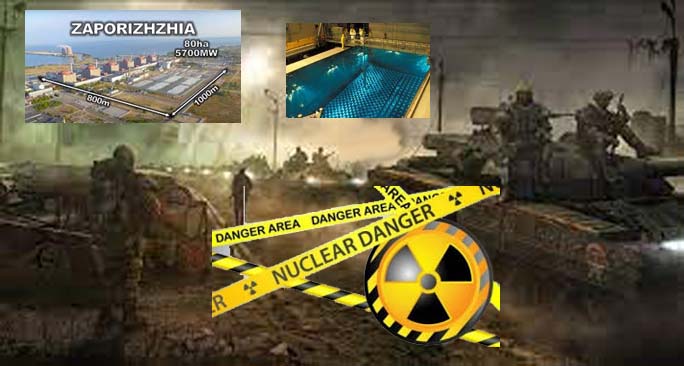
What are the risks at Zaporizhzhia nuclear power plant after drone attack?
By Guy Faulconbridge and Francois Murphy, April 8, 2024, https://www.reuters.com/world/europe/nuclear-power-plant-eye-ukraine-war-2024-04-08/
MOSCOW/VIENNA, – Russia said Ukraine struck the Zaporizhzhia nuclear power station controlled by Russian forces three times on Sunday and demanded the West respond, though Kyiv said it had nothing to do with the attacks.
The International Atomic Energy Agency (IAEA) has long warned of the risks of a disaster at Zaporizhzhia, Europe’s largest nuclear plant, and urged an end to fighting in the area.
The plant is just 500 km (300 miles) from the site of the world’s worst nuclear accident, the 1986 Chornobyl disaster.
What nuclear material is at the Zaporizhzhia plant, what are the risks and why are Russia and Ukraine fighting over it?
WHAT IS IT AND WHAT WAS ITS CAPACITY?
The Zaporizhzhia nuclear power plant has six Soviet-designed VVER-1000 V-320 water-cooled and water-moderated reactors containing Uranium 235. They were all built in the 1980s, though the sixth only came online in the mid-1990s after the collapse of the Soviet Union.
All but one of the reactors are in cold shutdown. Reactor unit 4 is in “hot shutdown”, mainly for heating purposes.
IAEA Director General Rafael Grossi says that fighting a war around a nuclear plant has put nuclear safety and security in “constant jeopardy”.
WHAT HAPPENED ON APRIL 7?
Russia’s state nuclear corporation, Rosatom, said Ukraine attacked the plant three times on Sunday with drones, first injuring three near a canteen, then attacking a cargo area and then the dome above reactor No. 6.
IAEA experts at the site went to the three locations of the attacks and confirmed there had been an attack.
“Russian troops engaged what appeared to be an approaching drone,” the IAEA said. “This was followed by an explosion near the reactor building.”
“While the team so far has not observed any structural damage to systems, structures, and components important to nuclear safety or security of the plant, they reported observing minor superficial scorching to the top of the reactor dome roof of Unit 6 and scoring of a concrete slab supporting the primary make-up water storage tanks,” the IAEA said.
The IAEA did not say directly who was to blame for the attacks.
A Ukrainian intelligence official said Kyiv had nothing to do with any strikes on the station and suggested they were the work of Russians themselves.
WHAT ARE THE RISKS?
Russian forces took control of the plant in early March 2022, weeks after invading Ukraine. Special Russian military units guard the facility and a unit of Russia’s state nuclear company, Rosatom, runs the plant.
Nuclear reactors’ containment structures like Zaporizhzhia’s are made of steel-lined reinforced concrete designed to withstand the impact of a small plane crash so there is little immediate risk from a minor attack on those structures.
A 1989 study by the U.S. Department of Energy found that the model of containment structure used in Zaporizhzia “exhibits vulnerabilities to the effects of an aircraft crash” and a fighter jet crashing downwards into the dome, where the structure is thinner, could penetrate it, causing concrete chunks and aircraft engine parts to fall inside.
External power lines essential to cooling nuclear fuel in the reactors are a softer potential target. Cooling fuel even in reactors in cold shutdown is necessary to prevent a nuclear meltdown.
Since the war began the plant has lost all external power eight times, most recently in December last year, forcing it to rely on emergency diesel generators for power. Water is also needed to cool fuel.
Pressurised water is used to transfer heat away from the reactors even when they are shut down, and pumped water is also used to cool down removed spent nuclear fuel from the reactors.
Without enough water, or power to pump the water, the fuel could melt down and the zirconium cladding could release hydrogen, which can explode.
WHAT ABOUT THE SPENT FUEL?

Besides the reactors, there is also a dry spent fuel storage facility at the site for used nuclear fuel assemblies, and spent fuel pools at each reactor site that are used to cool down the used nuclear fuel.
Without water supply to the pools, the water evaporates and the temperatures increase, risking a fire that could release a number of radioactive isotopes.
An emission of hydrogen from a spent fuel pool caused an explosion at reactor 4 in Japan’s Fukushima nuclear disaster in 2011.
WHAT HAPPENS IN A MELTDOWN?
A meltdown of the fuel could trigger a fire or explosion that could release a plume of radionuclides into the air which could then spread over a large area.
The Chornobyl accident spread Iodine-131, Caesium-134, Strontium-90 and Caesium-137 across parts of northern Ukraine, Belarus, Russia, northern and central Europe.
Nearly 8.4 million people in Belarus, Russia and Ukraine were exposed to radiation, according to the United Nations. Around 50 deaths are directly attributed to the disaster itself.
But 600,000 “liquidators”, involved in fire-fighting and clean-up operations, were exposed to high doses of radiation. Hundreds of thousands were resettled.
There is mounting evidence that the health impact of the Chornobyl disaster was much more serious than initially presented at the time and in the years following the accident.
Incidence of thyroid cancer in children across swathes of Belarus, Russia and Ukraine increased after the accident. There was a much higher incidence of endocrine disorders, anaemia and respiratory diseases among children in contaminated areas.
Past anti-nuclear activists speak out against current plans

Ryck Thill (Télé) adapted for RTL Today| 05.04.2024 https://today.rtl.lu/news/luxembourg/a/2184141.html
In the concluding segment of this mini-series, Luxembourg’s initial wave of anti-nuclear advocates reflect on contemporary nuclear energy proposals.
Presently, ten EU member states are engaged in discussions regarding the expansion of nuclear energy, with plans underway for new reactors or ongoing construction. Apart from France, the Netherlands, and Sweden, Eastern European nations are predominantly spearheading this push towards nuclear technology, viewing it as a potential environmentally friendly alternative to fossil fuels or a transitional solution.
However, physicist Claude Wehenkel voices apprehension over what he perceives as a resurgence of nuclear energy, particularly in light of recent announcements by French President Macron regarding the development of small, simpler, and more cost-effective reactors. Wehenkel raises concerns about the implications of scaling back nuclear power stations, emphasising unresolved issues surrounding waste treatment and storage.
Théid Faber, former president of the Ecological Movement, echoes these sentiments, noting that the proposed new type 4 nuclear reactors fail to address key challenges related to waste disposal and safety. Faber emphasises that the proliferation of smaller reactors may heighten risks compared to a smaller number of larger reactors. He argues that nuclear energy remains as problematic today as it was half a century ago.
Faber further critiques the economic inefficiency of nuclear energy, highlighting its dependence on state and EU interventions. Additionally, he points to contemporary concerns regarding the use of cooling water, especially amidst escalating climate change threats. Faber contends that longstanding arguments against nuclear energy remain as valid today as they were in the past.
Nuclear fusion: Elusive technology faces scepticism
Since the 1950s, nuclear fusion has been touted as a potential game-changer, yet doubts persist about its viability on an industrial scale.
Claude Wehenkel dismisses nuclear fusion as “entirely unsuitable” for large-scale implementation, citing decades of substantial investment without any real progress.
Roger Spautz of Greenpeace shares a similar sentiment, highlighting the extensive research and funding poured into nuclear fusion with little tangible outcome. Spautz predicts that significant advancements in fusion energy production are unlikely within the foreseeable future, casting doubts on its potential as a widespread energy source.
Recent controversial remarks by Prime Minister Luc Frieden sparked criticism, particularly regarding his stance on nuclear energy policies beyond Luxembourg’s borders. Ben Fayot, former president of the Luxembourg Socialist Workers’ Party (LSAP), expresses concern over Frieden’s assertion that Luxembourg should remain indifferent to nuclear developments elsewhere. Fayot finds such remarks “appalling” and questions the Prime Minister’s dismissive attitude towards regional energy dynamics.
Following public backlash, Prime Minister Frieden clarified Luxembourg’s commitment to renewable energy initiatives. But as long as nuclear energy remains an issue in neighbouring countries, the controversial technology is certain to remain a pertinent issue for the inhabitants of the Grand Duchy as well.
Increased activity at nuclear test site in northern Russia: expert
Active construction has been seen at a nuclear test site in northern Russia since last year, raising the possibility that Moscow is preparing for a fresh nuclear test, a Japanese expert on the Russian military said Monday.
Citing analysis of satellite images, Yu Koizumi, associate professor at the University of Tokyo, said a large-scale facility presumed to be related to nuclear testing appears to be almost complete at the site on the Novaya Zemlya archipelago in the Arctic Sea.
Koizumi called the activities exceptional and said Russia could be preparing a subcritical nuclear test, which does not create an explosion.
He believes the move is “to intimidate European countries and the United States” over their support for Ukraine, which is at war with Russia.
Novaya Zemlya was the site of the Soviet Union’s around 130 nuclear tests, including in the atmosphere, underground and undersea, between 1955 and 1990.
Russia continued with subcritical nuclear tests on the island to enhance nuclear weapons and assess their capabilities, with the latest conducted in 2004.
Satellite images by space tech company Maxar Technologies Inc. and Earth imaging firm Planet Labs PBC, both of the United States, showed that works to construct the large facility got fully underway around last summer at the test site on the southern part of Novaya Zemlya, according to Koizumi.
The building, some 200 meters in length, is around double the size of other facilities in the area and was nearly complete in the Maxar images taken in early February, Koizumi said.
“It is highly likely that the facility was newly built for a (nuclear) test,” he said, adding a pile-up of materials around an airport suggests that the facility could be further enlarged.
At the same time, the images did not show any direct evidence of a nuclear test, Koizumi said, citing snow covering an entrance of a tunnel located around 3 kilometers from the nuclear site in the mountains, which could be used for a subcritical nuclear experiment.
In November last year, Russia revoked its ratification of the Comprehensive Nuclear Test Ban Treaty, which bans all nuclear explosions, whether for military or peaceful purposes, in a move seen as its de facto exit from the treaty.
“We should seriously worry about Russia playing the card of a nuclear test,” Koizumi said.
Finland: Grid Limitations Force Olkiluoto-3 to Curtail Output
Energy Intelligence Group, Apr 5, 2024, Author Grace Symes, London
Finland’s 1,650 megawatt Olkiluoto-3 nuclear reactor has had to curtail
output more than a dozen times since it began regular electricity
generation in April 2023 due to Finnish electric grid limitations, as well
as low Finnish electricity prices and technical issues.
While Olkiluoto-3 has itself helped to lower these prices, Finland’s electric system does not
currently have enough resiliency to support such a large reactor, and
transmission system operator Fingrid has had to take special measures to
ensure that the Olkiluoto-3 EPR can operate near capacity.
These issues could call into question the rationale for building such a large reactor in
the first place.
https://www.energyintel.com/0000018e-a47c-d9cc-abce-ff7e089c0000
Meet Centuria, Ukraine’s Western-trained neo-Nazi army
The Grayzone, KIT KLARENBERG·APRIL 7, 2024
A uniquely Ukrainian strain of Neo-Nazism is spreading throughout Europe, which openly advocates violence against minorities while seeking new recruits. With Kiev’s army collapsing and a narrative of Western betrayal gaining currency, the horror inflicted on residents of Donbas for a decade could very soon be coming to a city near you.
Centuria, an ultra-violent Ukrainian Neo-Nazi faction, has cemented itself in six cities across Germany, and is seeking to expand its local presence. According to Junge Welt, a Berlin-based Marxist daily, the Nazi organization’s growth has been “unhindered by local security services.”
Junge Welt traces Centuria’s origins to an August 2020 Neo-Nazi summit “at the edge of a forest near Kiev.” There, an ultranationalist named Igor “Tcherkas” Mikhailenko demanded the “hundreds of mostly masked vigilante fighters present,” who were members Kiev’s fascistic National Militia, “make sacrifices for the idea of ‘Greater Ukraine.’” As the former head of the Neo-Nazi Patriot of Ukraine’s Kharkiv division, and commander of the state sponsored Azov Battalion from 2014 to 2015, Mikhailenko has professed a desire to “destroy everything anti-Ukrainian.”
Junge Welt reports that since 2017, the National Militia “had been practicing brutal vigilante justice” throughout Ukraine, including “tyrannizing the LGBTQ scene.” Centuria was subsequently blamed for a terrifying November 2021 attack on a gay nightclub in Kiev, in which its operatives assaulted revelers with truncheons and pepper spray.
Now the same Neo-Nazi sect “has an offshoot in Germany,” Junge Welt revealed. On August 24 2023, the 32nd anniversary of Ukraine’s independence, Centuria convened a “nationalist rally” in the central city of Magdeburg, “unmolested by Antifa and critical media reporting.”
Participants proudly posed with the flag of the Organization of Ukrainian Nationalists (OUN) founded by World War II-era Nazi collaborator Stepan Bandera. Centuria boasted at the time on Telegram, “although Ukrainian youth are not in their homeland, they are starting to unite.” Meanwhile, they threatened the “enemies” of their country with “hellish storm,” pledging that “Ukrainian emigrants” would not “forget their national identity for a few hundred euros.”
Junge Welt reports that Centuria “is currently raising funds for its parent organization’s combat unit,” which is commanded by Andriy Biletsky – the Azov Battalion founder who infamously stated in 2014 that the Ukrainian nation’s mission was to “lead the white races of the world in a final crusade… against Semite-led Untermenschen.” At home, Centuria’s members express similar attitudes towards Muslims, Africans, and gays, whom they refer to, respectively, as the “German Caliphate,” “black rapists,” and “pedophiles.”
Now, the group’s members are working hard to pass their ideological vision down to future racists across the continent. “We are creating a new generation of heroes!” Centuria’s Telegram channel boasts. Accordingly, the neo-Nazi group has been arranging hiking trips to Germany’s Harz mountains with a Ukrainian nationalist scout association called Plast. This outfit opened chapters across the Western world beginning in the 1950s, in response to the Soviet Union’s hounding of fascists and nationalists. Besides receiving ideological indoctrination, Plast’s youthful members may have the opportunity to improve their physical fitness and receive military training. As Centuria ominously declares on Telegram, “free people have weapons.”
As Washington gradually backs away from its sponsorship of Ukraine’s war with Russia, it has begun ceding responsibility for the military campaign’s management – and likely failure – to Berlin. If US arms shipments continue to dwindle, Germany will become Kiev’s chief supplier of weapons. And the Germans may find that saying “no” to Ukraine could result in some nasty surprises………………………………………………………………………………………………. https://thegrayzone.com/2024/04/07/centuria-ukraines-western-neo-nazi-army/
Rolls Royce misses out on government funding for their small nuclear reactors
Rolls-Royce Holdings PLC shares faced a blow as X-energy and Cavendish
Nuclear were awarded £3.34 million from the government to build
mini-nuclear reactors in Hartlepool. These funds will aid X-energy and
Babcock International PLC owned Cavendish’s plans to build 12 mini nuclear
generators, known as small modular reactors, in the County Durham town by
the early 2030s.
Proactive Investor 5th April 2024
Ukrainian artillery cuts last backup power line to Zaporozhye Nuclear Power Plant

Steven Starr, April 6, 2024
The fuel rods within the reactor core and in the spent fuel pools will continue to emit a large amount of heat (from the continuous decay of fission products within the fuel) even after the reactors are in a “cold shutdown”. Thus, electric power is required to run the cooling systems in the spent fuel ponds and the pumps that push cooling water through the reactors. If no offsite electricity is available, diesel generators are required to generate electricity to operate the pumps to cool the reactor and the cooling systems that cool the spent fuel pools.
A prolonged failure of the cooling systems (from loss of electric power) to continuously remove heat from the spent fuels will eventually cause the water in the pools to boil off and expose the spent fuel rods to steam and/or air. Exposure of the fuel rods to steam and/or air will cause them to overheat to the point of rupture or ignition, leading to the massive release of radioactivity. (The Soviet-designed reactors have their spent fuel pools inside the primary containment, unlike US reactors that locate spent fuel pools outside primary containment).
The fuel inside the steel reactor containment vessels must also be cooled (by pumping cooling water through the containment vessel). Failure of the cooling pumps to circulate water through the core will lead to the water in the containment vessel to superheat and eventually lead to the damage of the fuel rods, which would release large amounts of highly radioactive fission products.
Offsite power to the Zaporozhye Nuclear Power Plant (ZNPP) has historically been provided by the Zaporozhye Thermal Power Station, which is located several kilometers away from the ZNPP. I think the damage to backup power line from Ukrainian artillery fire refers to the destruction of the power lines and power transformers that connect the Thermal Power Station to ZNPP.
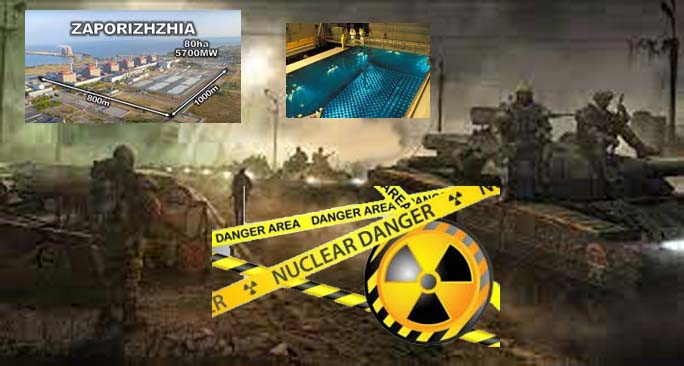
Russia urges IAEA to publicly reveal Ukrainian attacks on nuclear plant
https://www.rt.com/russia/595516-russia-iaea-zaporozhye-attacks/ 6 Apr 24
The Zaporozhye NPP lost the connection to its last remaining backup power line after artillery fire was heard in the vicinity
Moscow has appealed to the International Atomic Energy Agency (IAEA), urging it to publicly record the recurring attacks by the Ukrainian army on the Zaporozhye Nuclear Power Plant.
The plant is Europe’s largest atomic power station, with six reactor cores capable of generating a gigawatt of electricity each. The plant came under Moscow’s control in 2022, early on in the Ukraine conflict, and was formally transferred to Rosatom management after Zaporozhye Region was incorporated into Russia following a referendum. Kiev claimed it was illegally occupied and insisted that Russia kept heavy weapons at the plant and was attacking Ukrainian forces from it.
Kiev has since targeted the facility with artillery, missile, and drone attacks, and has sent armed groups to try and seize it. Earlier this week, the NPP lost the connection to its only remaining back-up power line, a key source of the electricity it needs to cool its reactors, with the IAEA team on the ground reporting that it heard “numerous rounds of artillery fire” in the vicinity of the plant. On Friday, the NPP wrote on Telegram that it has been repeatedly attacked by Ukrainian drones recently.
Russian Foreign Ministry spokeswoman Maria Zakharova warned Kiev on Friday against further attacks on the plant, noting that they could harm critical infrastructure and destabilize the facility. She also appealed to the IAEA to make the recent attacks and their perpetrators known to the public.
“We strongly urge the IAEA and its leadership to actively use the experts present at the station to publicly record all cases of attacks from the Ukrainian side and clearly state where the threat to the safe operation of this facility really comes from,” she said in a statement.
In a statement to TASS late Friday, the IAEA said it was aware of the reported attacks and was studying them, but refused to give any further details.
The IAEA deployed a permanent on-site monitoring mission to the plant in September 2022, but has repeatedly declined to publicly assess the incidents involving the facility or name Ukraine as the perpetrator.
Experts from the agency said the plant is now entirely dependent on the only remaining 750-kilowatt line for off-site power. The NPP reported that the loss of connection to the backup power line is being investigated, and noted that the radiation background at the station and the surrounding area so far remains unchanged.
EDF confirms cracks on 1.3 GW Paluel 2 reactor
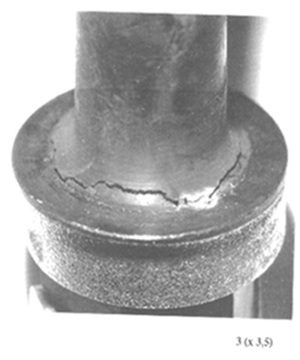
(Montel) EDF has found cracks on its Paluel 2 (1.3 GW) nuclear reactor in the north of France, a company spokeswoman told Montel on Friday, confirming prior comments by the firm’s executive director Cedric Lewandowski.
Reporting by: Caroline Pailliez, 05 Apr 2024, https://montelnews.com/news/df0e8352-e018-4d1d-af96-63266d385d3c/edf-confirms-corrosion-cracks-on-paluel-2-1-3-gw-reactor
Questioned by a parliamentary committee late on Thursday, Lewandowski said the French state-run firm had “recently” found traces of corrosion at its Blayais 4 (910 MW) and Paluel 2 reactors. He gave no further details.
Contacted by Montel, an EDF spokeswoman confirmed the firm had found cracks at the Paluel unit but refused to provide any other details such as when and where the corrosion was found or whether repairs were underway.
“The possibility of carrying out this type of repair on shutdowns scheduled for 2024 is included in our production forecasts,” she added.
Paluel 2 has been offline for maintenance and refueling since 2 February. The outage was initially scheduled to last 98 days but EDF warned last week the shutdown could be extended up to a “total of 135 days”.
The reactor is currently due to return to service on 10 May.
The news comes after EDF confirmed last month that a 30-day outage extension at its Blayais 4 (910 MW) reactor was due to corrosion.
“No surprise”
Lewandowski told the committee in the upper house that the “recent discovery” of corrosion at Blayais 4 and Paluel 2 “came as no surprise”.
Having checked France’s newest reactors, which it said were most susceptible to corrosion, the firm was now probing older units, such as at Blayais and Paluel, he said, adding EDF knew it would also find cracks of “lesser importance” on those units.
Corrosion was “still with us” and “would be until 2025” when the firm was due to complete its probe of France’s 56 reactors, he said.
“Fortunately, we are now in the process of mastering it… Our construction sites are getting faster and faster, our ability to understand the phenomenon is now almost total.”
EDF warned in December it might have to extend one in three planned outages for around 30 days on average at 13 reactors this year and 13 reactors in 2025, based on the probability of finding corrosion on units yet to be examined.
The issue has dogged the company, with reactor outages jumping 47% in 2022 due to problems at numerous units, with output plunging to a 33-year low of 279 TWh.
Edited by: Chris Eales, Robin Newbold
America’s crazed proxy war on Russia is destroying Ukraine’s economy

Walt Zlotow, West Suburban Peace Coalition, Glen Ellyn IL 7 Apr 24
I’m no economist. But you don’t need to be one to figure out the economic catastrophe the US has imposed on its Trojan Horse Ukraine in its lust to weaken Russia.
Most opponents of this endless US debacle focus on the hundreds of thousands dead Ukrainian soldiers without a single US death to weaken, isolate Russia.
But we should not ignore the economic basket case Uncle Sam has created, essentially degrading life for every Ukrainian not yet killed.
Since goading Russia into invading 26 months ago, Ukraine has ceased to exist as an economically independent nation. Its exports have largely vanished, its imports have exploded. Ukraine has gone from a surplus exporter to a massive importer. That dries up foreign currency making the paying for further imports, even the national debt, increasingly problematic.
Exports plummeted by 17% and 30% respectively in ’22 and ’23. Imports? More than doubled since America’s disastrous, losing proxy war crossed the Red Line to invasion.
Ukraine now spends half its GDP on defense that’s accomplishing nothing but more soldier cemeteries and spiraling economic collapse. Its borrowed over $40 billion in last 2 years, a 200% increase compared to the previous 10 years. Its external debt is now 90% of GDP and heading north to 140% by 2026 according to EU estimates.
All this could have been avoided had the US realized 33 years ago that the Soviet Union’s demise meant the true end to the Cold War. Now, having turned the Cold War into a Hot War destroying Ukraine, America’s crazed leaders, including most Democrats and Republicans, lust for another $61 billion in weapons that will prolong the flow of red blood and red ink.
And the Big Fool in the White House just says ‘Push on.’
West helping Ukraine attack deep inside Russia – CNN
https://www.rt.com/russia/595314-west-helps-ukraine-drone-attacks/ 5 Apr 24
Kiev’s foreign backers are coordinating the flight paths of kamikaze drones, a report says
Western countries are helping Ukraine to launch kamikaze drones deep into Russian territory, CNN reported on Tuesday, citing a source close to Kiev’s drone program.
An unnamed Ukrainian official who spoke to CNN described how Kiev uses UAVs with longer ranges and “more advanced capabilities” to strike targets located more than 1,000km (621 miles) from the border.
“The flights are determined in advance with our allies, and the aircraft follow the flight plan to enable us to strike targets with meters of precision,” the source said.
The admission of receiving guidance from abroad follows multiple reports that Western personnel are providing Ukrainian troops with intelligence and information about specific targets.
The Washington Post cited a senior Ukrainian official last year as saying that Kiev’s soldiers “almost never” use advanced weapons, including US-made HIMARS rocket launchers, without receiving coordinates from the Pentagon.
On Tuesday, Ukrainian drones targeted Russia’s Tatarstan, a region 650km east of Moscow (400 miles), which had not previously been attacked by UAVs. One drone was aiming to hit an oil refinery in Nizhnekamsk, a city located roughly 1,100km (680 miles) from the border. Mayor Ramil Mullin said that the aircraft was disabled by air defenses and caused no damage.
Another drone struck a student dormitory inside the industrial zone in Elabuga, injuring 13 people. The hub hosts several companies that make high-tech equipment, including drones, according to Russian media.
Moscow has repeatedly warned that the delivery of weapons and other military aid to Kiev makes Western countries de facto direct participants in the conflict. The Russian Defense Ministry and local authorities have said that Kiev uses Western-supplied arms to indiscriminately fire at civilians.
Ukrainian military leaders know they can’t win on battlefield – Guardian

https://www.rt.com/russia/595341-ukraine-gur-attacks-guardian/ 5 Apr 24
Their army’s weakness has prompted Kiev’s strikes on Russian infrastructure, senior officers have allegedly told the London newspaper.
Ukraine has no other option but to launch attacks inside Russia, including on its oil infrastructure, because its army faces continued setbacks on the battlefield, The Guardian has reported, citing the leadership of the country’s military intelligence service, the GUR.
Officers who allegedly spoke to the British newspaper were candid about Kiev’s desperate military situation. GUR Brigadier-General Dmitry Timkov said his country was like a patient on life support.
”We are attached to a drip. We have enough drugs to stay alive. But, if the West wants us to win, we need the full treatment,” he admitted, referring to the dwindling quantities of military aid coming from Kiev’s western backers.
Major General Vadim Skibitsky, the deputy head of the GUR, admitted that a Ukrainian victory, widely promised by Kiev, is impossible at the moment. Facing multiple setbacks, the agency had “no choice” but to launch strikes deep inside Russia. He described this as a “NATO-standard procedure, known as center of gravity, or COG.”
The concept was first developed by Carl von Clausewitz, the famous Prussian general and military theorist, and essentially refers to targets that have the most value for the enemy, physically or morally.
GUR officials that spoke to the Guardian claimed credit for a recent string of Ukrainian drone strikes on Russian oil infrastructure. This contradicts public statements by the head of SBU, the Ukrainian civilian security agency, Vasily Maliuk who said it was his agents who were responsible for the operations.
Both branches have been overhauled in the years since the 2014 armed coup in Kiev, with the CIA’s help, according to Western media reports. Both were allegedly involved in targeted assassinations of people deemed enemies of Ukraine, since before the conflict with Russia began in 2022.
The newspaper said GUR intends to launch a new major attack on the Crimean Bridge – and to disable it – “in the first half of 2024.” Ukraine has previously targeted the structure, twice in 2022 and 2023.
READ MORE: West helping Ukraine attack deep inside Russia – CNN
The first plot involved a powerful bomb hidden in a truck, which killed the vehicle’s driver and four other civilians in nearby cars. Moscow said GUR masterminded this attack. The second strike involved naval kamikaze drones that SBU said were deployed by its agents. That bombing killed two civilians.
Moscow has accused Kiev of engaging in terrorism as a method of war. The regime in Kiev has adopted the tactics, Russian officials are claiming, because it is unable to score victories on the battlefield.
1 This Month

4 May -West Suburban Peace Coalition to discuss Iran war at May Educational Forum
Monday, May 4, 7:00 – 8:00 PM Central Standard Time
Title: : How Trump’s Narrative Tries to Shape the Reality of the War on Iran.
Contact Walt Zlotow, zlotow@hotmail.com 630 442 3045 for further information
14 May – online event From Bombs to Data Centres: the Face of Nuclear Colonialism
To see nuclear-related stories in greater depth and intensity – go to https://nuclearinformation.wordpress.com
-
Archives
- May 2026 (37)
- April 2026 (356)
- March 2026 (251)
- February 2026 (268)
- January 2026 (308)
- December 2025 (358)
- November 2025 (359)
- October 2025 (376)
- September 2025 (257)
- August 2025 (319)
- July 2025 (230)
- June 2025 (348)
-
Categories
- 1
- 1 NUCLEAR ISSUES
- business and costs
- climate change
- culture and arts
- ENERGY
- environment
- health
- history
- indigenous issues
- Legal
- marketing of nuclear
- media
- opposition to nuclear
- PERSONAL STORIES
- politics
- politics international
- Religion and ethics
- safety
- secrets,lies and civil liberties
- spinbuster
- technology
- Uranium
- wastes
- weapons and war
- Women
- 2 WORLD
- ACTION
- AFRICA
- Atrocities
- AUSTRALIA
- Christina's notes
- Christina's themes
- culture and arts
- Events
- Fuk 2022
- Fuk 2023
- Fukushima 2017
- Fukushima 2018
- fukushima 2019
- Fukushima 2020
- Fukushima 2021
- general
- global warming
- Humour (God we need it)
- Nuclear
- RARE EARTHS
- Reference
- resources – print
- Resources -audiovicual
- Weekly Newsletter
- World
- World Nuclear
- YouTube
-
RSS
Entries RSS
Comments RSS
 nuclear-news