French nuclear giant scraps SMR plans due to soaring costs, will start over.
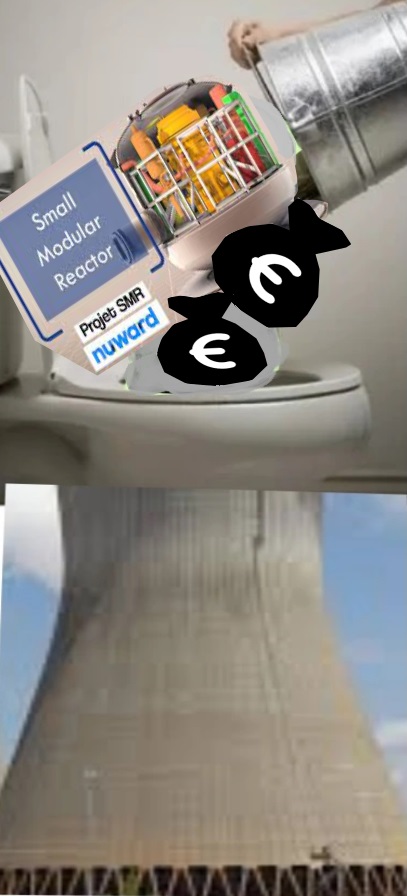
Another Small Modular Nuclear Reactor project goes down the toilet
This time it’s that great nuclear poster boy France that is facing the humiliation and embarrassment of wasting billions on “New Nuclear”
Last time it was the USA with the NuScale fiasco
Giles Parkinson Jul 2, 2024, https://reneweconomy.com.au/french-nuclear-giant-scraps-smr-plans-due-to-soaring-costs-will-start-over/
The French nuclear giant EdF, the government owned company that manages the country’s vast fleet of nuclear power stations, has reportedly scrapped its plans to develop a new design for small nuclear reactors because of fears of soaring costs.
EdF, which is now fully government owned after facing potential bankruptcy due to delays and massive cost over-runs at its latest generation large scale nuclear plants, had reportedly been working on a new design for SMRs for the last four years.
The French investigative outlet L’Informé reported on Monday that EdF had scrapped its new internal SMR design – dubbed Nuward – because of engineering problems and cost overruns. It cited company sources as saying EdF would now partner with other companies to use “simpler” technologies in an attempt to avoid delays and budget overruns.
Reuters confirmed the development, citing an email from a company spokesman that confirmed the program had been abandoned after the basic design had been completed.
“The reorientation consists of developing a design built exclusively from proven technological bricks. It will offer better conditions for success by facilitating technical feasibility,” an EDF spokesperson told Reuters via email.
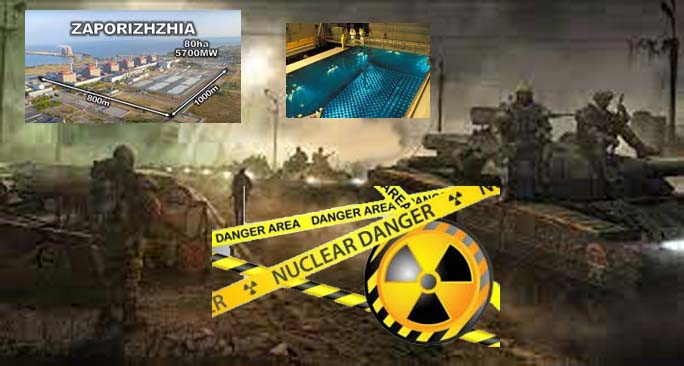
Continue readingRussia might restart the Zaporizhzhia Ukrainian nuclear plant it seized, our new report shows
Charles Digges, Bellona, 2 July 24
“……………………………………………….. Russia has taken over the plant with its own technicians while coercing the Ukrainian workers who remain to sign contracts with Rosenergoatom, the branch of Rosatom, responsible for day-to-day operations at the 11 nuclear plants within Russia. The Kremlin has also spun off another commercial tendril from Rosatom to oversee the management of the captive plant.
But should a potential restart continue to unfold, the principal nuclear threat of Putin’s war on Ukraine could soon be an atomic energy station operating on the front lines of a protracted war.
Since early in the invasion, all of the Zaporizhzhia nuclear plant’s reactors have been placed in various states of shutdown. This was a critical safety measure, urged by the IAEA and agreed to by both Moscow and Kyiv, which would dampen the impact of a radiological disaster should any of the reactors suffer a catastrophic strike.
In this setting, the content of short-lived and highly dangerous radionuclides like iodine-131 in uranium fuel is much lower than if the plant was active because they have partially, or even completely decayed since September 2022. But once the reactors are restarted, these radionuclides will once again begin to form — making their spread into the environment a possibility should reactor containments be ruptured.
Despite the obvious risks, recent statements from Russian officials and, more concretely, the activities of Russia’s technical oversight agency within Ukraine, indicate that the plant’s Russian occupiers could move to restart at least one of the reactor units sometime this year — thus removing this important assurance against disaster.
To restart a reactor, Russian technicians would first have to guarantee an ample and stable supply of cooling water. This task was made more difficult by the destruction of the nearby Khakovka Dam in June 2023, which compromised several reservoirs used for precisely that purpose.
But over the past year, the Russian side has announced plans to replenish the plant’s damaged cooling ponds, which would then be capable of supplying up to three reactors.
Further, Russian technicians have begun to rewire the power grid to divert the electricity produced by the Zaporizhzhia nuclear plant toward Russia and the occupied territories of Ukraine. Satellite images of the Rosatom-controlled Zaporizhzhia Terminal Power Plant, which connects the nuclear plant to the Ukrainian grid, show evidence of efforts to shift powerlines away from Ukraine and into the occupied regions.
The plant has also recently played host to high-profile guests from Moscow. In April, Alexander Trembitsky, the head of Russia’s Federal Service for Environmental, Technological and Nuclear Supervision, Rostekhnadzor) visited the plant to review personnel certifications and work toward extending the lifespan of the reactors. Rostekhnadzor officials have also been codifying licensing requirements for the plant to operate under Russian purview and reviewing various plant systems since the start of the year.
That same month Sergei Kiriyenko, a former CEO of Rosatom and one of Putin’s first deputies, visited Enerhodar, where many plant workers live.
This flurry of activity followed a March meeting in Sochi between Putin, current Rosatom CEO Alexei Likhachev, and IAEA director general Rafael Grossi, during which, according to media reports, Putin stated his intentions to restart Zaporizhzhia’s reactors. This remains diplomatically unconfirmed by other sources, but recent events seem to bear those intentions out.
Kyiv vociferously protested Russia’s efforts to disconnect a nuclear plant that once supplied 5700 megawatts, or about 10%, of Ukraine’s entire electricity needs. There is little doubt that the military could fight back against any efforts to redirect this energy.
Still, efforts to relaunch the reactors may prove to be more effort than they are worth.
Fresh nuclear fuel and spare parts would have to be transported across war zones. The pump station enhancing cooling water supplies is being constructed under conditions of military conflict. Powerlines will have to be rerouted under fire. All of this will cost billions of rubles, which, in our analysis, will hardly be recouped by tariffs on the power one or two Zaporizhzhia reactors would produce. ………. https://bellona.org/news/nuclear-issues/2024-07-russia-might-restart-the-ukrainian-nuclear-plant-it-seized
Talent Shortage Threatens Europe’s Nuclear Renaissance
As many countries in Europe look to boost their nuclear power capacities
and build more reactors, companies face a workforce challenge as many of
the skilled force are retiring while younger generations choose energy jobs
in solar and wind. European countries and companies planning major
expansion in nuclear fleets are struggling to fill in thousands of skilled
engineering jobs that would support the construction of nuclear reactors,
which take years to complete. Companies in France are hiring back retirees
and are collaborating with colleges and universities to promote jobs in the
nuclear power sector.
Oil Price 3rd July 2024
SCOTTISH GREENS WILL OPPOSE ALL PLANS FOR NEW NUCLEAR ENERGY

Nuclear energy will leave a toxic and costly legacy.
Every vote for the Scottish Greens is a vote to oppose new nuclear energy, says the party’s Co-leader, Lorna Slater MSP, who said any expansion would leave “a costly and dangerous legacy.”
The party’s manifesto commits to opposing all new nuclear power, including the expansion or renewal of Scotland’s remaining nuclear power station at Torness.
The UK Tory government has pledged to triple nuclear power by 2050, and has announced plans for the biggest nuclear expansion for 70 years. Similarly Keir Starmer’s Labour Party has promised to expand it, with Mr Starmer calling it a “critical part” of his energy plan.
This follows news that the new Hinkley Point C reactor will now cost up to £46 billion and is expected to come online in 2031 rather than 2017.
In May 2024 the outgoing Secretary of State for Scotland, Alister Jack, said that he hoped the next UK government would work with anti-independence parties in Holyrood to impose a new nuclear reactor on Scotland.
Ms Slater said: “More nuclear power would leave a legacy of debt and radioactive waste for generations to come. Backing it is not just a distraction, it undermines our journey to 100% renewable energy. The Scottish Greens will oppose any attempts to expand or impose it.
“The disastrous mismanagement of Hinkley Point C tells us everything we need to know about how unreliable and expensive nuclear has become. It is now running 14 years behind schedule and costs have inflated to £46 billion – seven times Scotland’s entire annual capital budget.
“Even though Hinkley is on the South coast of England, Scottish households will be paying for this travesty for decades. It’s outrageous that instead of learning from this catastrophic mismanagement the Tories and Labour are committing to pouring even more of our money into new nuclear power.
“The Tory and Labour nuclear fantasies will do nothing for our climate and will leave future generations with a costly and dangerous legacy to clean up.
Scotland and the UK has a vast potential for renewable energy, but we need to invest in it. The huge sums of money being wasted on nuclear energy could be far better spent on rapidly expanding our green industries, delivering 100% renewable energy and investing in the jobs of the future.”
From the Scottish Greens manifesto
“New nuclear is outrageously expensive, unnecessary, dependent on the expertise and assets of foreign governments, and detracts from renewables. It will also leave generations to come with a costly and dangerous responsibility to keep the waste safe.
The disastrous Hinkley Point C project has been hit by a string of delays, and is now estimated to be costing an eye watering £46 billion, yet there is still no confidence as to when it will be online, and now Westminster are threatening to impose a new plant on Scotland against the policy of the Scottish Government.
We cannot afford to make the mistake of commissioning another new nuclear power plant. The Scottish Greens will oppose new nuclear power, and the expansion or renewal of Scotland’s remaining nuclear power station at Torness.
How far can American money push the Kiev regime’s suicidal war with Russia?

SOTT, Drago Bosnic, InfoBrics, Thu, 27 Jun 2024
The economic might of the United States was one of the major reasons why the Allies won WW2. While much of the world was in ruins thanks to the combined invasion of the Axis powers, America was virtually unscathed. Its strategically isolated position made it possible to switch to an unprecedented war economy without the fear of it ever being disrupted by anything. Unfortunately, one of the tools of victory over the world’s most repugnant ideology soon turned into a way of pushing the outgrowth of that ideology all across the globe.
The birth of the US MIC (Military Industrial Complex), particularly when combined with “Operation Paperclip”, unified the production capacity of America and technological innovations of Germany, creating a monster that many have been warning about ever since, including US General (and later president) Dwight D. Eisenhower.
He warned in his 1961 farewell address:
“Until the latest of our world conflicts, the United States had no armaments industry. American makers of plowshares could, with time and as required, make swords as well. But now we can no longer risk emergency improvisation of national defense; we have been compelled to create a permanent armaments industry of vast proportions. Added to this, three and a half million men and women are directly engaged in the defense establishment. We annually spend on military security more than the net income of all United States corporations. This conjunction of an immense military establishment and a large arms industry is new in the American experience. The total influence — economic, political, even spiritual — is felt in every city, every State house, every office of the Federal government. We recognize the imperative need for this development. Yet we must not fail to comprehend its grave implications. Our toil, resources and livelihood are all involved; so is the very structure of our society. In the councils of government, we must guard against the acquisition of unwarranted influence, whether sought or unsought, by the Military Industrial Complex [MIC].”
However, it all fell on deaf ears, as many warmongers and war criminals were already deeply ingrained in virtually every federal institution. American militarism became the norm and this hasn’t changed to this very day. Dozens of major conflicts were launched under endless false pretexts, with millions of dead and tens of millions displaced in the last 20 years alone. Perhaps the only segment of America’s production economy that hasn’t been outsourced entirely is precisely the MIC. A lot of its less crucial parts have been, but the core elements remain in the US. However, the country’s financial structure went through tectonic changes since Eisenhower’s era. Namely, after President Nixon ended the gold standard, the might of the MIC was unleashed and American militarism spread to other NATO members, cementing a conglomerate of nations with one interest alone – perpetual war.
…………………………………………………………………………. the Kiev regime has so far gotten upwards of three times more money than what Moscow has (nominally) spent on its entire military in 2021. This means that Russia is getting a lot more bang for its buck. However, things are about to get a lot worse for the Neo-Nazi junta, as the Kremlin has made some major changes in its Ministry of Defense. Worse yet, Russia is now increasing its military spending to a nominal figure of nearly $200 billion, although the real budget (in GDP PPP terms) is now equivalent to over half a trillion dollars. NATO fully realizes that the Kiev regime’s already slim chances of winning are now in the realm of impossible, which is why it decided to deploy up to half a million soldiers and get them ready for a direct confrontation with Moscow, while also trying to use sabotage and terrorism to shift its attention away from Ukraine.
However, none of this has reinvigorated America’s MIC in the same way wars in Vietnam, Iraq and Afghanistan have. On the contrary, it revealed its numerous deficiencies, particularly in artillery munitions production, an area in which Russia keeps strengthening its already dominant position and will continue to do so in the foreseeable future. What’s more, America is now wasting decades-old stockpiles (as well as those of its allies, vassals and satellite states) just to keep the Neo-Nazi junta another day in the fight. It’s even giving top dollar for surplus Soviet-era weapons and equipment around the world, as these have proven to be far more robust and cost-effective in comparison to overhyped NATO gear. This is without even taking into account a number of Russia’s asymmetric advantages, ones that NATO can match only with terrorist attacks on beachgoers. https://www.sott.net/article/492721-How-far-can-American-money-push-the-Kiev-regimes-suicidal-war-with-Russia
WAR OR PEACE: Towards a Ukrainian Peace or a Direct NATO-Russian War
Russian and Eurasian Politicsby GORDONHAHN. June 28, 2024
Introduction
The following is an overview of the recent events and present state of the NATO-Russia Ukrainian War. We observe movement towards the end of the conflict in its present configuration and in two new directions simultaneously—a race to the final resolution of the NATO-Russia question. One direction consists of movement towards peace negotiations. The other is toward escalation into a open, direct NATO-Russia war likely to expand beyond the borders of Ukraine and far western regions of Russia. The race to resolution is on and it remains anyone’s guess whether peace or greater war will win the day.
Russia Proposes Diplomacy…Again
On June 14 Russian President Vladimir Putin proposed a roadmap for ending the NATO-Russia Ukrainian War during a speech at Russia’s Ministry of Foreign Affairs………………………………………………………………..
. In particular, he has now offered “simple” conditions for the “beginning of discussions.” They include: the full withdrawal of all Ukrainian troops from Donetsk, Luhansk, Kherson, and Zaporozhia oblasts as they existed as of 1991—that is, Russia would receive all the oblasts’ territories not just those now controlled by Russian troops. Immediately upon agreeing to this condition and a second requiring Kiev’s rejection of any NATO membership (Ukraine’s “neutral, non-bloc, non-nuclear status”), from the Russian side “immediately, literally the same minute there will follow an order to cease fire and begin negotiations” and Moscow “will guarantee the unhindered and safe withdrawal” of Ukrainian units. ……………………………….
To be sure, Putin’s offer was not made under the illusion that it would be taken up within the next few months and was certainly another effort to lay blame for the conflict at Washington’s, Brussels and, less so perhaps, Kiev’s doors. Nevertheless, Putin’s public offering before Russia’s Foreign Ministry personnel is a most authoritative and official statement of a specific proposal from Russia; one that included paths to both a ceasefire and permanent peace, if Washington and/or Kiev choose to take them as Ukraine continues to crumble at the front, in the political sphere, and economically throughout this year.
………………………………………………………Continued refusal to talk with Moscow and any further Russian gains give Putin flexibility in enticing or threatening Washington, Brussels, and/or Kiev to the negotiating table. Refuse talks and lose non-Novorossiyan lands; accept talks and Kiev gets them back.
Also, both subjectively (with Putin’s intent) and objectively (without Putyin’s intent) the proposal undermined Ukrainian President Volodomyr Zelenskiy’s ‘disnamed’ ‘peace summit’ in Switzerland which was nothing other than an exercise in rallying support among supporters for the beleaguered Maidan regime. ………………………..
……………………………………………………my sense that the Ukrainian war will end one way or the other this year unless NATO intervenes directly with troops on the ground.
Moscow’s Military Plans: Reject Talks and War You Shall Have
Moscow’s military plans for the remainder of the year can be summed up as continuity in Ukraine and preparations for war beyond Ukraine against the West. Thus, in Ukraine Russia will continue its more offensive strategy of ‘attrit and advance’ upgraded from, an intensification of what Alexander Mercouris calls ‘aggressive attrition’ (https://gordonhahn.com/2024/02/02/russian-strategic-transformation-in-ukraine-from-aggressive-attrition-to-attrit-and-advance/). . Under attrit and advance, Russian forces still emphasize destruction of Ukraine’s armed forces over the taking and holding of new territory. The attrition of massive, combined air, artillery, missile, and drone war supersedes the advances on the ground by armor and infantry in this strategy. Thus, territorial advance is slow, but personnel losses are fewer.
………………………………………………………………….Despite the calls of some Russian hawks, Putin will never acquiesce to bomb Ukraine, no less Kiev ‘into a parking lot’ or ‘the stone age.’ For Russians, Ukrainians are a fraternal eastern Slavic people, with long-standing ties to Russia. Most Russian families have relatives or friends from or in Ukraine. Kiev is ‘the mother of all Russian cities’, and despite Russia’s possession of precise smart weapons, the risk of destroying Orthodox holy sites and other historical monuments in Kiev is too high. Russia’s overwhelming strength in weapons and manpower, despite Western inputs into Ukraine’s armed forces, could allow Russian attrit and advance to persist for many years—more than will be necessary to force negotiations or seize much of Ukraine.
Boiling the Russian Frog – Escalation by Any Other Name
There has been much talk about the US repeartedly stepping over Russian red lines. The most recent is Washington’s and Brussels’ (NATO’s) grant of permission to Kiev to target the territory of Russia proper (1991 territory) with Western-made weapons. The West itself has drawn many red lines that it said could spark direct war with Russia and, therefore, should not be crossed: offensive weapons, artillery, tanks, aircraft, various types of missiles, cluster munitions, etc., etc. Most recently, Washington crossed two red lines in rapid succession by approving Kiev use of U.S missiles, such as ATACMs to target Russian territory across the border in Kharkov and, presumably Sumy……………………………………………………………………
It then expanded approval of the use of such missiles against any Russian territories from which attacks in Ukraine are being supported (www.politico.com/news/2024/06/20/us-says-ukraine-can-hit-inside-russia-anywhere-00164261). Days later Ukraine fired 5 ATACMs (4 were intercepted) at Sevastopol which hit beach-goers far from any military target, wounding 46 and killing 3, including 2 children. The potential escalation of the overall war resulting from this Ukrainian target was compounded ……………………………………………………………………….
Western NATO leaders seem intent on expanding the war beyond Ukraine’s borders and that will require Western public support and thus a vaccum of public discussion of NATO actions and national interests. Even if the constant escalation is ‘simply’ a game of chicken, upping the ante to see if Putin blinks or if the war can be dragged out past the November U.S. elections, there are many in U.S. intelligence and other departments, who are itching for a war against Russia who may escalate or enable Kiev to do so, intentionally or not, such that one is provoked. Unintentionality comes in, as Kiev has been anxious to force NATO or at least NATO member-states into direct involvement in the war. Ukraine has achieved some success in this, but so far such Western involvement has been limited, intially, to secret injections of Western troops and mercenaries, and then to open advisory roles. The summer and fall of 2024 will be a dangerous window in which a spark can detonate the larger war that such mad men and women are playing with.
To the extent that the West remains intent on continuing the escalation of the NATO-Russia Ukrainian War, Moscow will engage in asymmetrical escalation targeting Western forces outside of Europe and prepare for possible full-scale war with NATO or NATO members in and beyond Ukraine……………………………………………………………….
Towards a Eurasian Security Pact: Getting Ready for Direct War with NATO
With war with NATO now firmly in the cards, a distinct possibility, the Kremlin is intensely set on military and military-political preparations. The rejection of Putin’s next peace proposal was likely the last straw that will set in motion the next phase in Russia’s diplomatic offensive in tendem with China aimed at rallying the Rest against the West. …………….
For years, particularly after the Maidan coup, Putin has been conducting Russian diplomacy with the goal of creating a Great Eurasian and global alternative to the West’s ‘rules-based world order’, seeking to base a new, alternative international system of political, economic, financial, and monetary institutions on different rules written by all the great powers – the ‘Rest’ – rather than just the West…………………………………………………………………………
………………………………………………………. This Greater Eurasia security pact is thus also a mechanism for splitting NATO, particularly Europe from the U.S. This is to be achieved by networking and lobbying all the international organizations in Eurasia that Russia has been building for decades now: ………………………………….
……………………………………………… the train of the Rest’s rejection of the Western worldview has left the station, and, with the danger of escalation in Ukraine, Israel, and elsewhere afoot, it seems more likely that the new Eurasian-South bloc will be an alternative to, possibly a foe of the West’s ‘rules-based world order’ rather than a partner (http://kremlin.ru/events/president/transcripts/74285).
Conclusion
Again, the NATO-Russia Ukrainian War – the current war with militay combat confined largely to Ukrainian and far western Russian territory — will end this year or very early next year. However, a new broader war can take its place, if the peace fails or is never agreed upon. ………………………………………………………
…………….. The hope is that cooler heads will prevail, but the U.S. is in the midst of a deep and potentially explosive political crisis in which bureaucratic politics can become highly cryptic, conspiratorial, chaotic, and irrational, provoking new more dangerous conflict. Similarly, in Kiev a meltdown of the Maidan regime could be imminent and will likely come as a shot in the dark, unexpected by all……………………………………………………..
That Zelenskiy is now broaching peace talks with Putin is a reflection of the opportunity and dangers that are in the offing. https://gordonhahn.com/2024/06/28/war-or-peace-towards-a-ukrainian-peace-or-a-direct-nato-russian-war/
Nuclear weapons spending report reveals corporate intervention in UK nuclear policy – CND

“It is time for political parties to determine policy based on the interests of the people, not the arms companies.” Kate Hudson, CND General Secretary
“It is time for political parties to determine policy based on the interests of the people, not the arms companies.” Kate Hudson, CND General Secretary
By the Campaign for Nuclear Disarmament (CND) , https://labouroutlook.org/2024/06/29/nuclear-weapons-spending-report-reveals-corporate-intervention-in-uk-nuclear-policy-cnd/
CND welcomes the release of the “Surge: 2023 Global Nuclear Weapons Spending” report by the International Campaign to Abolish Nuclear Weapons (ICAN). The report provides a stark and troubling overview of global nuclear weapons expenditure: it has surged by 34% in the past five years, from $68.2 billion to $91.4 billion annually, with a cumulative total of $387 billion during this period.
The report also highlights a deeply worrying and absolutely inappropriate corporate involvement in UK government policy making. The report found that companies involved in Britain’s nuclear weapons programmes have held meetings with senior government officials in the past year. These manufacturers, along with nuclear-armed states, have also financed – to the tune of millions of pounds – think tanks that shape government policy and public opinion on nuclear weapons.
In terms of spending on nuclear weapons, UK figures are particularly shocking. Over the past five years, Britain’s spending has increased by over 43%. In 2023 alone, Britain spent a staggering £6.5 billion on nuclear weapons, up 17.1% on the previous year. This positions Britain as the fourth-highest spender on nuclear weapons globally, just behind Russia, and marks the second-largest increase in spending after the United States – which spent more than all the other nuclear-armed states combined.
This report comes at a critical time, during Britain’s general election campaign. Both Labour and the Conservatives have pledged to modernise the country’s nuclear arsenal, seemingly at any cost.
CND General Secretary Kate Hudson said:
“The billions of pounds being funnelled into these weapons of mass destruction are a gross misallocation of resources that could be used to address pressing issues such as climate change, biodiversity loss, and poverty alleviation. It is deeply concerning that our political leaders are prioritizing the expansion of our nuclear arsenal over the well-being of our citizens and the health of our planet.
This report also makes absolutely clear the influence of arms companies in the shaping of defence and foreign policy, their funding of think tanks, and their meetings with government officials. This runs against all democracy and accountability, and must be exposed, investigated and ended.
As we approach the general election on 4 July, we urge voters to elect MPs who prioritise peace, disarmament, and justice. It is time for political parties to determine policy based on the interests of the people, not the arms companies. We want a decent peaceful future that does not include reckless expenditure on nuclear weapons but creates a safer, fairer world for all.”
A vigil behind bars: pair who protested US nuclear bombs in Germany serving time

The judges and prosecutors, as well as the guards in prison, treat us respectfully and politely while at the same time sticking to laws and rules that are unjust and cause suffering. The biggest crime in their eyes is to upset the “order”, even though the order is set up to be criminal.
By Susan Crane and Susan van der Hijden , 29 June 24 https://beyondnuclearinternational.org/2024/06/30/a-vigil-behind-bars/
Here in Rohrbach prison we are awakened by the sounds of doves and other birds, giving the illusion that all is well in the world, until other sounds, keys rattling, doors being shut, and guards doing the morning body check, bring us back to reality.
We are sitting in a prison cell, 123 km from Büchel Air Force Base, where more than 20 U.S. nuclear bombs are deployed.
At the moment, the runway at Büchel is being rebuilt to accommodate the new F-35 fighter jets that will carry the new B61-12 nuclear bombs that were designed and built in the U.S.
The planning, preparation, possession, deployment, threat or use of these B61-bombs is illegal and criminal. The U.S., Germany and NATO know that each B61 nuclear bomb would inflict unnecessary suffering and casualties on combatants and civilians and induce cancers, keloid growth and leukemia in large numbers, inflict congenital deformities in unborn children and poison food supplies.
“We have no right to obey,” says Hannah Arendt.
Although our actions might seem futile, we understand that it is our right, duty and responsibility to stand against the planning and preparation for the use of these weapons. They are illegal under the Non-Proliferation Treaty, which both Germany and the U.S. have signed and ratified, and under the the Hague Convention, the Geneva Convention and the Nuremberg Charter.
During the international peace camps in Büchel (organized by the G.A.A.A. which consists of, among others, IPPNW, ICAN and DFG-VK; the German War Resisters League), we, together with other war resisters, and with the help of many supporters, went onto Büchel Air Force Base to communicate with the military personnel about the illegality and immorality of the nuclear bombs. We also wanted to withdraw our consent and complicity to their use.
The judges who sentenced us for these actions made a decision to follow some laws and ignore others. It is common sense, and we all know, that even the law against trespass can be broken when life is endangered.
The judges and prosecutors, as well as the guards in prison, treat us respectfully and politely while at the same time sticking to laws and rules that are unjust and cause suffering. The biggest crime in their eyes is to upset the “order”, even though the order is set up to be criminal.
We wake up every day with determined joy to continue our “vigil behind bars”. A joy constrained by knowing that the other women here have pain, from being separated from their family and children or from constant physical or psychological difficulties or from being locked in a cell all day with nothing to do.
We are only able to “vigil behind bars” through the immense support of people making sure our Catholic Worker houses can continue, people sending us cards and stamps, organizing visits and money for phone calls, remembering us in their prayers, doing press work and those that continue fighting the death dealing war-makers in the world.
Susan Crane is serving a 229 day sentence, and Susan van der Hijden a 115 day sentence, for their nonviolent nuclear disarmament actions at Büchel air base. You can write cards and letters to them, individually addressed to each at JVA Rohrbach, Peter-Caesar-Allee 1, 55597 Wöllstein, Germany. Updates can be found here.
UK’s Nuclear weapons pose a risk to proposed new homes
By Nick Clark, Local Democracy Reporting Service, 28 June 24, https://www.bbc.com/news/articles/clddy5kyv64o
Nuclear weapons could pose a risk to plans for almost 500 homes just outside a village, a council has been warned.
The Atomic Weapons Establishment (AWE) – the only maker of nuclear warheads in Britain – has opposed plans for the development near Spencers Wood in Berkshire.
It told Wokingham Borough Council the residents would live in an area exposed to a “radiation emergency” if something went wrong at its site in nearby Burghfield.
Proposals for the site also include a primary school and green space.
‘Safety concerns’
Development consultants Pegasus Group submitted the plans for up to 475 homes in May.
While not a formal planning application, the submission hopes to determine if a development would affect the environment, according to the Local Democracy Reporting Service (LDRS).
But in a letter to the council, AWE said the plans raised “significant” safety concerns.
It said the proposed site, between Basingstoke Lane and Sussex Lane, fell within its Detailed Emergency Planning Zone (DEPZ).
This is an area where neighbouring West Berkshire Council must have a detailed plan in place for its response to a nuclear emergency at Burghfield.
AWE said: “Whilst chances of a radiation emergency at AWE B are very low, the potential impact on the local population would be high and an appropriate and proportionate step is, to where possible, avoid new development being located within the DEPZ.”
It added the increased population in the area would also put strain on emergency services’ ability to help existing residents in the event of an emergency.
Wokingham Borough Council’s own emergency planning manager also said he would likely oppose the proposals if developers Richborough applied for planning permission.
He said the new development would have a “detrimental impact” on its emergency plan to help people living within the DEPZ.
Save Ukraine from American meddling

COMMENT. While the fatuous mainstream media focusses on nan unintelligent TV debate between two US presidential candidates – we increasingly look for some intelligent news.
And today – to my amazement, today – “The Hill” actually does give us an analysis of the Ukraine situation. And it’s not from the mega-paid lackeys of the military-industrial-corporate-media complex, but from the respected economist Jeffrey Sachs.
BY JEFFREY SACHS, OPINION CONTRIBUTOR – 06/27/24 https://thehill.com/opinion/international/4741597-save-ukraine-from-american-meddling/
Ukraine can only be saved at the negotiating table, not on the battlefield. Sadly, this point is not understood by Ukrainian politicians such as Oleg Dunda, a member of Ukraine’s parliament, who recently wrote an oped on this site against my repeated call for negotiations.
Dunda believes that the U.S. will save Ukraine from Russia. The opposite is true. Ukraine actually needs to be saved from the U.S.
Ukraine epitomizes Henry Kissinger’s famous aphorism, “It may be dangerous to be America’s enemy, but to be America’s friend is fatal.”
Thirty years ago, Ukraine was embraced by America’s neoconservatives, who believed that it was the perfect instrument for weakening Russia. The neocons are the ideological believers in American hegemony, that is, the right and responsibility of the U.S. to be the world’s sole superpower and global policeman (as described, for example, in the Project for a New American Century’s 2000 report, “Rebuilding America’s Defenses”).
The neocons chose three methods to push U.S. power and influence into Ukraine: first, meddle in Ukraine’s internal politics; second, expand NATO to Ukraine, despite Russia’s red line; and third, arm Ukraine and apply economic sanctions to defeat Russia.
The neocons whispered a sweet fantasy into Ukraine’s ear back in the 1990s: Come with us into the glorious paradise of NATO-land and you’ll be safe ever after. Pro-European Ukrainian politicians, especially in Western Ukraine, loved the story. They believed that Ukraine would join NATO just as Poland, Hungary and the Czech Republic had in 1999.
The idea of expanding NATO to Ukraine was fatuous and dangerous. From Russia’s perspective, the NATO expansion into Central Europe in 1999 was deeply objectionable and a stark violation of the solemn U.S. promise that NATO would not expand “one inch eastward,” but it was not deadly to Russia’s interests. Those countries do not border the Russian mainland. NATO enlargement to Ukraine, however, would mean the loss of Russia’s Black Sea naval fleet at Sevastopol and the prospect of U.S. missiles minutes from the Russian mainland.
There was, in fact, no prospect that Russia would ever accept NATO enlargement to Ukraine. The current CIA Director, William Burns, said as much in a memo to Secretary of State Condoleezza Rice when he was U.S. Ambassador to Moscow in 2008. The memo was famously entitled “Nyet means Nyet.”
Burns wrote, “Ukrainian entry into NATO is the brightest of all redlines for the Russian elite (not just Putin). In more than two and a half years of conversations with key Russian players, from knuckle-draggers in the dark recesses of the Kremlin to Putin’s sharpest liberal critics, I have yet to find anyone who views Ukraine in NATO as anything other than a direct challenge to Russian interests.”
The neoconservatives never described this Russian redline to the American or global public, then or now. Senior diplomats and scholars in the U.S. had reached the same conclusion about NATO enlargement more generally in the 1990s, as has been recently documented in detail.
Ukrainians and their supporters insist that Ukraine has the “right” to join NATO. The U.S. also says so repeatedly. NATO’s policy says that NATO enlargement is an issue between NATO and the candidate country, and that it is no business of Russia or any other non-NATO country.
This is preposterous. I’ll start to believe that claim when Adm. John Kirby declares from the White House podium that Mexico has the “right” to invite China and Russia to put military bases along the Rio Grande, based on the same “open door policy” as NATO. The Monroe Doctrine has said just the opposite for two centuries.
So Ukraine was set up for disaster by the neocons. Actually, the Ukrainian public sensed the truth, and overwhelmingly opposed NATO membership until the 2014 uprising that overthrew Ukrainian President Viktor Yanukovych.
Let’s retrace the chronology of this shockingly misguided American policy. In the early 2000s, the U.S. began to meddle intensively in Ukraine’s politics. The U.S. spent billions of dollars, according to Victoria Nuland, to build Ukraine’s “democracy,” meaning to turn Ukraine to the U.S. and away from Russia. Even so, the Ukrainian public remained strongly against NATO membership, and elected Viktor Yanukovych, who championed Ukrainian neutrality, in 2010.
In February 2014, the Obama team actively sided with neo-Nazi paramilitaries, which stormed government buildings on February 21 and overthrew Yanukovych the next day, cloaked as a “Revolution of Dignity.” The U.S. immediately recognized the new government. The astounding intercepted call between Nuland and U.S. Ambassador to Ukraine Geoffrey Pyatt, where they talk about who should be in the new Ukrainian government several weeks before the rebellion, demonstrates the level of American involvement.
The post-uprising government in Ukraine was filled with Russia-haters, and was backed by extremist right-wing paramilitaries like the Azov Brigade. When the ethnically Russian Donbas region broke away from the uprising, the central government aimed to retake the region by force. A peace agreement was reached between Kyiv and the Donbas in 2015, known as Minsk II, that would end the fighting by extending autonomy to the ethnically Russian regions of Donetsk and Luhansk.
Alas, Ukraine and the U.S. undermined the treaty even while publicly endorsing it. The treaty was a mere temporizing measure (according to German Chancellor Angela Merkel) to give Ukraine time to build its army. The U.S. shipped armaments to Ukraine to build up its military, make it interoperable with NATO and support the retaking of the Donbas by force.
The next diplomatic opportunity to save Ukraine came in December 2021, when Vladimir Putin proposed a U.S.-Russia Treaty on Security Guarantees, calling for an end to NATO enlargement, among other issues (including the urgent question of U.S. missile placements near Russia). Instead of negotiating, Biden again flatly said no to Putin on the question of ending NATO enlargement.
Yet another diplomatic opportunity to save Ukraine arose in March 2022, just days after the start of Russia’s “special military operation,” launched on February 24. Russia said that it would stop the war if Ukraine would agree to neutrality. Zelensky agreed, documents were exchanged and a peace deal was nearly reached. Yet, according to former Israeli Prime Minister Naftali Bennett, the U.S. and other NATO allies, notably the U.K., stepped in to block the agreement, telling Ukraine to fight on. Recently, Boris Johnson said that Ukraine should keep fighting to preserve “Western hegemony.”
Ukraine can still be saved through neutrality, even as hundreds of thousands of lives have been squandered by the failure to negotiate. The rest of the issues, including boundaries, can also be resolved through diplomacy. The killing can end now, before more disasters befall Ukraine and the world. As for the United States, 30 years of neoconservative misrule is long enough.
Labour plans for nuclear expansion in Scotland are flying under radar.
George Kerevan: LABOUR are planning a big expansion of nuclear power in the
UK … and in Scotland. Of course, as with much else in the party’s
intentions, this is being sneaked in under the political radar. However, a
close reading of the manifestos of both UK Labour and its Scottish branch
office clearly gives the game away.
And prominent candidates – such as
Douglas Alexander in Lothian East – are being very vocal in support of
nuclear energy when speaking at election hustings.
Why is this worrying?
Because apart from the undemocratic secrecy involved, Labour’s nuclear
fixation is expensive for the taxpayer and the electricity consumer. And
because this strategy compromises the safety of everyone living in
Scotland.
Reason: Labour is dicing with new, unproven nuclear generating
technology – called small modular reactors, or SMRs. Scotland could be the
guinea pig for SMRs at the existing nuclear plant at Torness in East
Lothian. Which is why Scottish Labour have to come clean on its plans for
new nukes.
The National 26th June 2024
https://www.thenational.scot/politics/24411664.labour-plans-nuclear-expansion-scotland-flying-radar/
US can’t trace $62 million of military aid sent to Ukraine – watchdog.
Rt.com 28 June 24
The Pentagon does not know whether defense items were “lost or destroyed,” an investigation has found.
The US Defense Department is unable to locate $62 million worth of weapons given to Ukraine, according to a report released on Wednesday.
The conclusions were presented by the Pentagon inspector general after an assessment on whether the DoD is effectively monitoring defense items provided to the Ukrainian Armed Forces.
The watchdog found that as of late November last year, a total $62.2 million in hardware designated for enhanced end-use monitoring (EEUM) was reported as missing. Among them are night vision devices, Javelin anti-tank missiles, and missile launch units.
According to the report, the US Office of Defense Cooperation (ODC) in Ukraine “cannot tell which of these items were lost and which were destroyed.” The Ukrainian army has not yet provided clarification, it adds…………………………………………more https://www.rt.com/news/600100-us-military-aid-millions-missing-ukraine/
UK government hires scandal-ridden Fujitsu company to account and track its nuclear waste!

Government Hires Fujitsu to Account and Track Dangerous Nuclear Wastes from Dounreay – Are they Laughing at Us?
At the same time folk at Glastonbury Festival are saying No to New Nuclear Wastes and the Post Office Inquiry is Live , Government have hired the company at the centre of the Post Office scandal to account for and track the UK’s most dangerous nuclear wastes. The £306K Fujitsu contract has been awarded by Nuclear Restoration Services (former Magnox) for Fujitsu’s ATOM application: “A contract has been awarded by NRS
Dounreay as a result of a direct award through the Crown Commercial Services
RM6194 Back Office Software Framework, for the provision and support of ATOM Application.”
Dounreay was the test site of the UK’s experimental Fast Breeder nuclear reactors. “EARLY in the morning of Tuesday 10 May 1977 there was a loud explosion at the Dounreay nuclear plant on the north coast of Scotland. The UK Atomic Energy Authority, which runs the plant, had dumped at least 2 kilograms of sodium and potassium down a 65-metre shaft packed with radioactive waste and flooded with seawater.”
Fujitsu’s ATOM stands for Accountancy and Tracking Of Material – “a comprehensive track and trace application, specifically designed for the processing, movement and reporting of nuclear and radioactive materials throughout the supply chain right up to nuclear decommissioning”. According to the United Kingdom Atomic Energy Authority in 2008 Fujitsu’s ATOM employed over ” 2,000 people • Manages over 115,000 radioactive item records in the UK.” In 2008 Dik Third, Nuclear Materials Advisor, UKAEA, worked closely with Fujitsu and said “…one of the problems with radioactive materials is that they have properties that computer-based logistics packages don’t handle. Unlike tins of beans, radioactive materials with short half-lives can transform into another isotope entirely.”
Fujitsu are now in control of the accounting and tracking of radioactive materials ie of nuclear wastes from the UKs failed fast breeder reactor at Dounreay. They will be allocating wastes to the nuclear “waste hierarchy’ that means sorting wastes to go landfill, to incineration, to the Low Level Waste Repository at Drigg, to Cyclife (radioactive scrap metal plant) and to Sellafield. The nuclear waste hierarchy has been criticised for reducing the levels at which waste can be designated for “free release” and other “disposal” routes which increasingly mean dumping into the public domain. There is a precedent for radioactive material ending up in the wrong place even without the services of Fujitsu.
READ FULL ARTICLE HERE
Post Election: A Different Kind of Nuclear Bomb

The Nuclear Legacy
The Government has accidentally left behind an unexploded bomb for an incoming Labour Government. Should it go off, it will be early evidence for the argument that Starmer can’t be trusted. The bomb in question is whether or not to go ahead with building another large French nuclear power station at Sizewell in Suffolk.
Our current experience with building large French nuclear power stations is no
Tom Burke on how an incoming Labour Government will have to deal with the unexploded political bomb of nuclear left behind by the Conservatives
BYLINE SUPPLEMENT, JUN 26, 2024, https://www.bylinesupplement.com/p/post-election-a-different-kind-of
You know something is changing in British politics when our better-known political commentators start turning up at Green Party events. They have not found it easy to make much sense of what such a heterodox coalition offers voters. But there is no doubting that their presence signals an old order in transition.
The Financial Times publishes a general election poll tracker. The picture it shows has not changed significantly for eighteen months. A consistent 20 point gap between Labour and the Conservatives is now barely worth a comment. Much less noticed, however, has been another equally consistent pattern.
Adding together support for the insurgent parties – Reform at 11.5%, Lib-Dems at 9.2% and the Greens at 6.3% – may not tell you much about the balance of power in the next Parliament but it does tell you something significant about Britain’s electorate. Voter support for the three minor parties totals 27%, almost 4% higher than that for the ruling Conservatives.
Put another way, more than 70% of British voters want anyone other than the current Conservative Government to run the country. Apart from being a clear demonstration of the wisdom of crowds, this is another dagger at the heart of our archaic and increasingly dysfunctional first past the post voting system. The political complexities of the 21st Century cannot easily be tackled as a tidy battle between labour and capital. Voters have already recognised this. It is time that our political leaders did too.
No issue makes this more apparent than that of climate change. The Conservatives’ choice of this issue as a key battleground on which to fight an electoral culture war was entirely voluntary. There was no great grassroots pressure from within the Party itself. Nor was there any groundswell of public opinion although there was a noisy, if evidence-free, torrent of editorial ink from the Rothermere, Murdoch, Barclay press.
The Uxbridge by-election last July paused a string of Conservative losses. Victory was put down to a voter rebellion against too-expensive climate change policies. The Government then seized on climate as a wedge issue for the forthcoming election and began a systematic winding back of climate action.
In doing so it was copying an election strategy first adopted by the Australian National Party. Since our Prime Minister’s election strategist is the Australian Isaac Levido – a protégé of another, better known, Australian political strategist, Lynton Crosby, this should not have surprised anyone.
What is less explicable is why anyone should have thought that a strategy that failed in Australia would work here. Labour’s victory in the 2022 Australian election was aided by a break-away group of candidates standing as ‘Teals’ – blue-green Conservatives. Exactly the constituency David Cameron had wooed for the Tories here in 2010.
As things currently stand, Labour looks like being helped into Downing Street by an ill-chosen culture war that climate change won. This will have its own challenges for Labour. No-one doubts their good intentions on the climate. But their clumsy handling of, and subsequent back pedalling on, their £28 billion a year green prosperity pledge has left a legacy of doubt in voters’ minds. It risks being punished by increasingly volatile voters if it cannot quickly resolve those doubts.
The Nuclear Legacy
The Government has accidentally left behind an unexploded bomb for an incoming Labour Government. Should it go off, it will be early evidence for the argument that Starmer can’t be trusted. The bomb in question is whether or not to go ahead with building another large French nuclear power station at Sizewell in Suffolk.
Our current experience with building large French nuclear power stations is not encouraging. Although, unusually, we are not alone in this respect. No-one else, including the French themselves, has been able to do so either. Indeed, France has now decided not to even try to build any more of the type of reactors intended for Sizewell as they are too expensive and difficult to build. They will build a different design instead.
The French reactor we are currently building at Hinkley Point was promised to cost £5.6 billion in 2008 and be producing the electricity to cook turkeys on by 2017. In today’s money it will cost nearer to £46 billion and not be producing electricity before 2030. To get EDF to invest, the then Labour Government promised EDF an index linked price for its electricity.
This means that, were it available now, electricity from Hinkley Point would cost £130/MWh. Since National Grid will sell you electricity today for about £80/MWh why would anyone buy more expensive nuclear electricity? To get EDF to build Hinkley Point a Conservative Government bought 35 years’ worth of electricity in advance at a fixed price. To pay for the difference between what EDF can get from the wholesale market there will be tax on everyone’s electricity bill.
It is beyond my understanding why any sane person would want to repeat this experience. Yet that is just what the Conservative Government, with Labour support, was planning to do. It is often argued that building a second station using the same reactors will be cheaper. If that were so, someone needs to explain why the French have already decided not to build any more. Is there something they know that we don’t?
Labour now face a particular difficulty on Sizewell. Since their wind-back of the green prosperity plan, they have doubled down on their promise to deliver carbon-free electricity by 2030. So let us, for argument’s sake, put aside any reservation about whether this is practical. We, and our children, will all certainly be better off if they can deliver carbon-free, secure and affordable electricity to consumers by 2030.
But construction of Sizewell cannot start until after 2030. What then, is the case for forcing homeowners and businesses to pay a tax on their energy bills to finance an unnecessary nuclear power station? And what would this do to the scale and speed of investment in the energy efficiency and renewables which are cheaper and faster ways to get both bills and carbon emissions down?
Why WikiLeaks founder will plead guilty – and what happens next
Angus Thompson and Millie Muroi, June 25, 2024 , The Age
WikiLeaks founder Julian Assange, 52, has struck a plea deal with the United States that is set to end a years-long legal pursuit over the release of classified documents.
He is expected to plead guilty to conspiring to unlawfully obtain and disseminate classified national defence information in a court in the Northern Mariana Islands at 9am on Wednesday (AEST) but will avoid jail time in the US after spending several years fighting extradition from London’s maximum-security Belmarsh Prison.
Why was Julian Assange released?
Assange is en route to Saipan, the largest of the Northern Mariana Islands, which are a US commonwealth in the western Pacific. There he will face a US Federal Court judge on a single charge of breaching the Espionage Act with the mass release of secret documents leaked by former intelligence analyst Chelsea Manning.
He faced 18 espionage charges after being indicted in early 2019 by the US Justice Department, which began legal proceedings to seek his extradition from Britain in the same year.
The charges sparked a global outcry over press freedom and led a cross-party coalition of Australian politicians, including former Nationals leader Barnaby Joyce and teal independent Monique Ryan, to travel to the US in 2023 to pressure the Biden administration to drop its pursuit.
US President Joe Biden told a press conference earlier this year he was “considering” a deal over Assange, after Prime Minister Anthony Albanese raised it during his October 2023 US visit.
“I’ve made it clear that enough is enough – that it’s time it was brought to a conclusion,” Albanese said.
How long did Assange spend in prison?
Assange was first detained in 2010 and sent to London’s Wandsworth Prison after a Swedish court ordered his arrest on sex crime allegations. He was freed on bail with a £240,000 surety, but in February 2011, a London court ordered Assange’s extradition to Sweden.
The British Supreme Court rejected his final appeal against the extradition in June 2012. Five days later, he took refuge in Ecuador’s embassy in London, seeking political asylum……………………………………………………………….
What does the plea deal mean for Assange’s future?
Assange is expected to face a US judge at 9am local time in Saipan, who is expected to approve the plea deal, meaning he will avoid the maximum 175 years he faced in the US under the original charges.
His future is largely unknown beyond that, however, in a post on social media platform X on Tuesday morning celebrating Assange’s release, WikiLeaks said he was expected to return to Australia.
What has been the Australian government’s response?
Albanese has so far been tight-lipped about Assange’s release. But Coalition and Greens MPs welcomed the announcement. Opposition foreign affairs spokesman Simon Birmingham said he welcomed the fact Assange’s decision to plead guilty would bring an end to the “long-running saga”.
Nationals MP Joyce said the issue was about “extraterritoriality” and went beyond Assange as an individual. “It’s about an issue, about an Australian citizen, who did not commit a crime in Australia,” he said.
Greens senator David Shoebridge said whistleblowers such as Assange continued to pay an unfair price for revealing unethical and criminal actions of governments. https://www.theage.com.au/politics/federal/why-wikileaks-founder-has-been-set-free-and-what-happens-next-20240625-p5joia.html
1 This Month
26 April – Chernobyl: Inside the Meltdown airs on National Geographic on Sunday 26th April from 4pm


29 April – Nuclear Expert Webinar #1 – Radiation Impacts on Families with Mary Olson and Cindy Folkers
- 12:15 PM MT – 1:45 PM MT
- Location: Virtual – REGISTER TODAY

4 May -West Suburban Peace Coalition to discuss Iran war at May Educational Forum
Monday, May 4, 7:00 – 8:00 PM Central Standard Time
Title: : How Trump’s Narrative Tries to Shape the Reality of the War on Iran.
Contact Walt Zlotow, zlotow@hotmail.com 630 442 3045 for further information
14 May – online event From Bombs to Data Centres: the Face of Nuclear Colonialism

Pine Ridge Uranium is the real threat, not Tehran- Tell Burgum: Stop the Extraction.
Chernobyl: The Lost Tapes – A good documentary on Chernobyl on SBS available On Demand for the next 3 weeks– https://www.sbs.com.au/ondemand/tv-program/chernobyl-the-lost-tapes/2352741955560
To see nuclear-related stories in greater depth and intensity – go to https://nuclearinformation.wordpress.com
-
Archives
- May 2026 (25)
- April 2026 (356)
- March 2026 (251)
- February 2026 (268)
- January 2026 (308)
- December 2025 (358)
- November 2025 (359)
- October 2025 (376)
- September 2025 (257)
- August 2025 (319)
- July 2025 (230)
- June 2025 (348)
-
Categories
- 1
- 1 NUCLEAR ISSUES
- business and costs
- climate change
- culture and arts
- ENERGY
- environment
- health
- history
- indigenous issues
- Legal
- marketing of nuclear
- media
- opposition to nuclear
- PERSONAL STORIES
- politics
- politics international
- Religion and ethics
- safety
- secrets,lies and civil liberties
- spinbuster
- technology
- Uranium
- wastes
- weapons and war
- Women
- 2 WORLD
- ACTION
- AFRICA
- Atrocities
- AUSTRALIA
- Christina's notes
- Christina's themes
- culture and arts
- Events
- Fuk 2022
- Fuk 2023
- Fukushima 2017
- Fukushima 2018
- fukushima 2019
- Fukushima 2020
- Fukushima 2021
- general
- global warming
- Humour (God we need it)
- Nuclear
- RARE EARTHS
- Reference
- resources – print
- Resources -audiovicual
- Weekly Newsletter
- World
- World Nuclear
- YouTube
-
RSS
Entries RSS
Comments RSS
 nuclear-news