Britain’s nuclear submarine software built by Belarusian engineers
Fears that coding work outsourced to Russia and its allies could pose national security threat
Telegraph UK, By Camilla Turner, 2 August 2024
Britain’s nuclear submarine engineers use software that was designed in Russia and Belarus, in contravention of Ministry of Defence rules, The Telegraph can reveal.
The software should have been created by UK-based staff with security clearance, but its design was partially outsourced to developers in Siberia and Minsk, the capital of Belarus.
There are fears that the code built by the Russian and Belarussian developers could be exploited to reveal the location of Britain’s submarines.
The Telegraph understands that the MoD considered the security breach a serious threat to UK defence and launched an investigation.
The inquiry discovered that the firm that outsourced the work – on a staff intranet for nuclear submarine engineers – to Russia and Belarus initially kept it secret and discussed whether it could disguise where the workers were based by giving them fake names of dead British people.
As well as the UK’s submarine fleet, there are fears that further defence capabilities could have been compromised because it has emerged that a previous project was also outsourced to developers in Minsk.
National security in jeopardy
On Friday, experts warned that the UK’s national security could have been jeopardised if personal details of those with classified knowledge of Britain’s nuclear submarine fleet fell into the wrong hands, leaving them exposed to blackmail or targeted attacks.
Ben Wallace, the former defence secretary, said the breach “potentially left us vulnerable to the undermining of our national security”. He added: “Time and time again, countries like China and Russia have targeted the supply chains of our defence contractors. This is not a new phenomenon.”
James Cartlidge, the shadow defence secretary, said it was an “absolute imperative” to ensure “our most sensitive defence programmes have total resilience and security”……………………………………………………………. more https://www.telegraph.co.uk/news/2024/08/02/britains-nuclear-submarine-software-designed-russia-belarus/
Renewables are crushing gas-fired power

Europe’s electricity system is transitioning at breakneck speed.
Renewables are displacing thermal generation so fast that gas-fired power
has slumped to a two-decade low. Continental Europe produced less
electricity from natural gas over the first seven months of this year than
at any time since 2005, according to research by Energy Flux. A few
countries bucked the trend, but at the regional level there is no sign of
this changing any time soon. The continent’s full-throttled embrace of
wind and solar — combined with the return of French nuclear, and Alpine
hydro, milder winters and a weak economic recovery — has dislodged gas
from the heart of many EU power markets. The transformation is both
astonishing and alarming. Europe’s great gas power slump has wiped out
the equivalent of the combined annual primary gas demand of Denmark,
Ireland, Norway and Portugal since 2017. That’s roughly 240 cargoes of
liquefied natural gas (LNG) every year, no longer needed.
Energy Flux 1st Aug 2024
https://www.energyflux.news/p/renewable-crushing-gas-fired-power-wind-solar-eu
How much electricity comes from the Sun on summer days in the UK?

With blazing sun across the UK, the past week has seen solar energy’s
contribution to Britain’s energy mixture hit levels of up to 32% –
highlighting how much the sun can contribute to the country’s electricity
supplies. Each summer, the levels of solar energy in use rise, according to
Christelle Barnes, vice-chair at Solar Energy UK and UK general manager at
SolarEdge. “Every year, that percentage number just gets a little bit
higher. So it was typically between 25% and 27% over the last couple of
years. So just seeing numbers like 30% now is definitely showing that we’re
continuing to deploy more solar,” she told Yahoo News.
Yahoo News 31st July 2024
https://uk.news.yahoo.com/how-much-electricity-sun-summer-uk-172202857.html
More than 885 solar panels have been installed on two Scottish Water sites
in the Central Belt, helping to save 57 tonnes of carbon a year and address
the increasing urgency of climate change. The projects have seen 512 photovoltaic (PV) panels installed at
Bothwellbank Waste Water Treatment Works in South Lanarkshire, which are
able to generate 0.23GWh of power and will offset around a fifth of the
site’s energy needs. In addition, 373 tank-mounted PV panels are now in
place at Roseberry Water Treatment Works in Midlothian, supplementing 178
panels which were installed as part of a previous scheme. The site can now
generate a total of 0.18GWh of energy, offsetting 12% of its energy needs.
Combined, these installations are expected to produce 0.41GWh of green
electricity each year – equivalent to the energy needed to boil around
1.8 million kettles annually. This latest £678,000 investment by Scottish
Water and its commercial subsidiary, Scottish Water Horizons, sees the
sites join a growing list of water and waste water treatment works which
are now either self-sufficient or partly sufficient in their power
requirements.
Midlothian View 31st July 2024
Blackwater Against New Nuclear Power Group (BANNG)campaigners say company’s claims over Bradwell B are false
Maldon Standard, By Brandon Penny, 31st July 24
A CAMPAIGN group has hit out at claims a potential site for a new nuclear power station is “well connected.”
The current government nuclear policy statement identifies Bradwell as a site for nuclear energy until the end of 2025.
Plans for a Chinese-led nuclear power station in Bradwell, known as Bradwell B, are no longer progressing.
Campaigners Blackwater Against New Nuclear Power Group (BANNG) claim EDF, the French company which own Bradwell’s nuclear site, has “no idea what it is talking about”.
They claim there are no grid connections, no rail connection with the closest station being eight miles away in Southminster and no local skilled workforce.
BAANG’s chairman, Professor Andy Blowers said: “EDF cannot be allowed to get away with the false and misleading claims it is making in an obvious attempt to attract developers to its site on the Essex coast adjacent to Bradwell-on-Sea. “This is a site already abandoned by EDF’s one-time partner, the Chinese developer CGN. It is a site that is wholly unsuitable for nuclear development.
“EDF have previously claimed that Bradwell and other sites it owns, offer land, grid and rail connections, a skilled workforce and support communities which makes them compelling locations for small and advanced modular reactors.”
Mr Blowers continued saying: “It’s obvious EDF has no idea what it is talking about with respect to new nuclear development at Bradwell.”
BAANG have also said: “The noise, disruption and blight imposed on a tranquil rural area over many years would be intolerable.”…………… https://www.maldonandburnhamstandard.co.uk/news/24483433.baang-group-claim-edfs-claims-false-misleading/—
Rolls Royce – the “burning platform”?

There aren’t many obvious similarities between Rachel Reeves and Tufan
Erginbilgic, but the use of the “burning platform” metaphor is
something that binds them. For Erginbilgic’s actual use of the phrase to
describe Rolls-Royce soon after he became chief executive 19 months ago,
read the chancellor of the exchequer’s discovery this week of a “£22
billion black hole” in the public finances.
Times 1st Aug 2024
https://www.thetimes.com/article/rolls-royce-growth-needed-by-rachel-reeves-98sw9l952
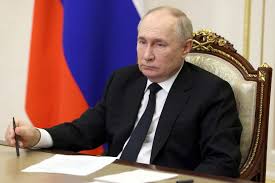
Putin often cites Russia’s ‘nuclear doctrine’ governing the use of atomic weapons. But what is it?
9 News, By Associated Press, 1 August 24
Since Russia invaded Ukraine in 2022, President Vladimir Putin and other Kremlin voices have frequently threatened the West with its nuclear arsenal.
On Day 1 of the war, Putin said “whoever tries to impede us, let alone create threats for our country and its people, must know that the Russian response will be immediate and lead to consequences you have never seen in history”.
Over nearly two and a half years of fighting, the West has given Ukraine billions of dollars of advanced weapons, some of which have struck Russian soil.
And while there have been more Kremlin threats – and even the deployment of battlefield nuclear weapons in Belarus, just over the border from Ukraine – so far it has remained only a blunt message.
What could finally trigger a nuclear response?
Asked that in June by international news agencies, Putin pointed to Russia’s so-called nuclear doctrine.
“Look what is written there,” he said at the St Petersburg session.
“If somebody’s actions threaten our sovereignty and territorial integrity, we consider it possible to use all means at our disposal.”
Now Russian hawks are urging him to change the doctrine to lower the threshold for using nuclear weapons, and Putin says the document could be modified to take into account the evolving global situation.
What is Russia’s nuclear doctrine?
Formally known as the “Basic Principles of State Policy on Nuclear Deterrence”, it was signed by Putin in 2020 and outlines when Russia could dip into its atomic arsenal, the world’s largest.
It describes nuclear weapons as “a means of deterrence”, noting that their use is an “extreme and compelled measure”.
It declares that Russia “takes all necessary efforts to reduce the nuclear threat and prevent aggravation of interstate relations that could trigger military conflicts, including nuclear ones”.
The document states that “nuclear deterrence is aimed to provide comprehension by a potential adversary of the inevitability of retaliation in the event of aggression against the Russian Federation and/or its allies.”
What does it say will trigger using nuclear weapons?
Russia could use them, the doctrine says, “in response to the use of nuclear and other types of weapons of mass destruction against it and/or its allies, as well as in the event of aggression against the Russian Federation with the use of conventional weapons when the very existence of the state is in jeopardy”.
It says nuclear weapons could be used under the following specific situations:
- If reliable information is received about the launch of ballistic missiles targeting the territory of Russia or its allies.
- If nuclear weapons or other weapons of mass destruction are used against Russia or its allies.
- If an enemy attack with conventional weapons threatens Russia’s existence.
- If there are attacks on critically important Russian government or military facilities that could undermine the country’s retaliatory nuclear strike capability.
Has any attack so far come close to crossing this threshold?
As Russia attacked parts of northeastern Ukraine near the city of Kharkiv, Washington has allowed Kyiv to use longer-range US-supplied weapons for strikes in Russian territory in the border region.
But these attacks have been limited in scope and would not seem to pose an existential threat that would fall under the nuclear doctrine.
However, the hawks in Moscow have pointed to a series of Ukrainian attacks on Russian air bases that host long-range nuclear capable bombers earlier in the conflict, as well as recent raids on early warning radars.
They say these circumstances would seem to warrant the use of nuclear weapons as laid out in the doctrine…………………………………………………………………………. more https://www.9news.com.au/world/russia-nuclear-weapons-vladimir-putin/c2c4b211-658d-4b11-b6bc-656b56c5bd39
UK – the Ed Milliband Nuclear Nonsense Show

Great British Nuclear’s life started out as a Boris Johnson publicity stunt to get some cheap headlines, and it’s been downhill since then. It took two years to set up (civil servants at DESNZ kept asking what this particular Bojo wet dream was all about, and are still waiting for an answer), has no proper governance arrangements, is run by a bunch of nuclear non-entities, and so far has had only one task: to run “the competition “to see who will be the recipient of pots of taxpayers’ money to bring forward our “world-beating” Small Modular Reactor programmes.
Jonathon Porritt, Sustainability Campaigner and Writer, 31 July 24
1 I’m loving the Ed Miliband Show! The curtain went up on July 5th, and it’s been one reveal a day since then………………………………….
On Friday, he brought forward the Bill to establish Great British Energy (GBE), a cornerstone of Labour’s manifesto and its Net Zero ambitions. The one thing that grabbed everyone’s attention was the new partnership between GBE and the Crown Estate to unlock £60 billion of private investment in offshore wind – with a view to securing 30 GW of electricity before 2030 (enough to provide electricity for 20 million homes). To help make this happen, another Bill was introduced to overcome some of the barriers that the Crown Estate currently faces in expediting investment at that scale. Serious stuff!
The GBE Bill also referenced another partnership – with Great British Nuclear, with the emphasis on “exploring how Great British Energy and Great British Nuclear will work together”. And end more of the same kind of meaningless blather!
Let me elaborate a bit by way of contrasting these two strategic partners.
1. The Crown Estate
This is a powerful organisation that knows what it’s doing, does it with a real sense of purpose, and has been leading the charge on offshore wind for the last decade. It has a tried and tested CEO (Dan Labbad), formerly CEO of property developer Lend Lease here in the UK), a proven sustainability champion, deal-maker and job-creator.
Other big players in the energy sector get this kind of proposition and are already coming forward with their “in principle” commitments.
2. Great British Nuclear
Great British Nuclear’s life started out as a Boris Johnson publicity stunt to get some cheap headlines, and it’s been downhill since then. It took two years to set up (civil servants at DESNZ kept asking what this particular Bojo wet dream was all about, and are still waiting for an answer), has no proper governance arrangements, is run by a bunch of nuclear non-entities, and so far has had only one task: to run “the competition “to see who will be the recipient of pots of taxpayers’ money to bring forward our “world-beating” Small Modular Reactor programmes.

It’s struggled with this somewhat limited remit (already nine months behind schedule, with at least another six months to go), even though everybody already knows that the Government’s favoured SMR black hole will be Rolls Royce – there’s nothing worse for ministers than having Tufan Erginbilgic (Rolls Royce’s powerful, whining bully of a CEO) making trouble for you.
So, Ed, where are you going to go with all this? Both the Crown Estate and Great British Energy will, theoretically, help you “de-risk” prospects for critical private sector investors. The Crown Estate will do it for real, reducing the cost of capital, smoothing planning consents, securing supply chains, creating jobs – and, in due course (if not before 2030) – making offshore wind significantly cheaper. Exactly as has happened in Denmark. Great British Nuclear will suck you in, suck you dry, and do none of that…………..
The Treasury has always been less enthusiastic about nuclear power than the rest of government. It won’t object to a few more tens of millions bunged at Rolls Royce or a few more well-paid nuclear wastrels at Culham (emphasising the links with our inconceivably costly nuclear weapons establishment).

But the tens of billions that will be required to de-risk private sector investment in Sizewell C – that’s another matter. This is the time, surely, to let Sizewell C die under the weight of its own monstrous irrelevance.
Sizewell C will obviously make literally zero contribution to the 2030 target that Labour has for decarbonising the grid. As it happens, Ed shouldn’t really be worrying too much about 2030 anyway. This isn’t going to happen (full marks to those sad gits at the Telegraph for spotting this!), but it really doesn’t matter. The key date is 2029, the date of the next election, not 2030.
……………………………..So, Ed, keep your eyes on the prize: making people feel good (and possibly even a bit excited) about the UK’s low-carbon future – in terms of jobs, skills, supply chains, lower bills and so on. Deep down, you must know as well as I do that’s all about prioritising real delivery partners (viz the Crown Estate), not about preposterous pipe-dreaming fantasists in the nuclear industry. https://www.jonathonporritt.com/go-ed-go/
Government partnership is needed if Dutch pension fund PME is to make “risky” nuclear investment.

Dutch pension fund PME keen for nuclear power investments
European Pensions , By Natalie Tuck, 30/07/24
The Dutch pension fund PME is keen to invest in nuclear investment but this must be in partnership with the Dutch government, due to it being such a “risky investment”.
The pension fund, for those working in the tech and metal industry, has published a position paper on investing in nuclear energy in the wake of the publication of the Dutch National Energy System Plan, which looks to scale up the use of nuclear energy in the Netherlands………………………….
Making the case for nuclear energy, PME said the “manageable disadvantage” of radioactive waste and the high level of safety of nuclear power plants weigh into PME’s positive view of nuclear energy as a stable addition to the energy mix……………
When it comes to financing, PME said the “high cost of construction and the long duration of construction make nuclear power plants a very risky investment”.
The paper continued: “Financing nuclear power plants requires a leading role of the state, which will have to assume a significant part of the risk in all phases of the nuclear power plant’s life. Security of return is a basic requirement for PME so that funding also contributes to participants’ pension accrual and pensioners.
“The construction of nuclear power plants takes a very long time and is very costly. It is precisely for these reasons that risk-return requirements are paramount in any financing of nuclear power.”
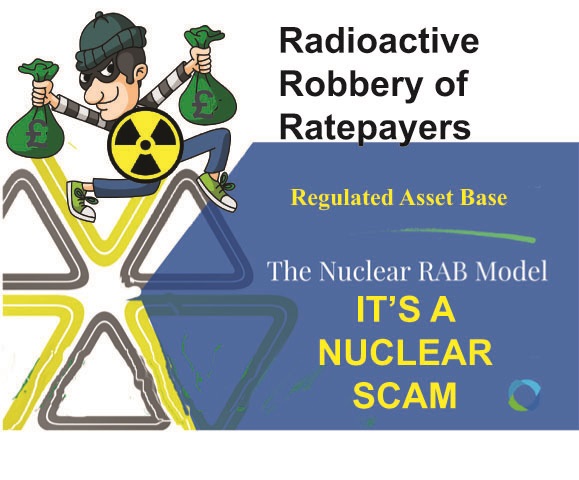
It therefore advocates for the use of a Regulated Asset Base (RAB) model to finance the construction of nuclear power plants. In this model, private parties bear the investment, and receive a fixed ‘fair return’ (the RAB fee) from the start of construction.In the RAB model, at each stage, the primary risk is shared between the state and the financing market party or parties.
……………………….“In addition to the quantitative participant survey, PME holds focus groups with participants, retirees and employers. PME also organises retiree meetings where the topic of nuclear energy was discussed recently. The basic attitude toward nuclear energy is almost always positive among the majority of constituents. However, there are concerns about the yield, the risks, the safety of nuclear power plants and the problem of radioactive waste,” PME stated. https://www.europeanpensions.net/ep/Dutch-pension-fund-PME-keen-for-nuclear-power-investments.php
Greasing Palms: The Thales Blueprint for Corruption
July 30, 2024, by: Dr Binoy Kampmark, https://theaimn.com/greasing-palms-the-thales-blueprint-for-corruption/
It is a point verging on the trite: an arms corporation suspected of engaging in corrupt practices, spoiling dignitaries and officials and undermining the body politic. But one such corporation is France’s Thales defence group, which saw raids on their offices in France, the Netherlands and Spain on June 26 and June 28. The prosecutors are keen to pursue charges ranging from standard corruption and attempts to influence foreign officials to instances of criminal association and money laundering.
It is clear in this that even the French republic, despite having a narcotics grade addiction to the international arms industry, thought that Thales might have gone just that bit far. Some 65 investigators from the Nanterre-based office responsible for battling corruption, financial and fiscal offences have been thrown into the operation. A further twelve magistrates from the National Financial Prosecutor’s Office (PNF), with the assistance of the European agency Eurojust, aided by Dutch and Spanish officials, have all been involved in this sprawling enterprise.
The police raids arise from two separate investigations. The first, starting at the end of 2016, involved suspicions of corruption pertaining to a foreign official, criminal association and money laundering. The topics of interest: the sale of submarines to Brazil, along with the construction of a naval base.
The second commenced in June 2023, with claims of suspected corruption and influence peddling, criminal conspiracy and money laundering connected with the supply of military and civilian equipment to overseas clients.
Giving little by way of details, a spokesperson for Thales insisted that the corporation “strictly complies with national and international regulations.” It had “developed and implemented a global compliance program that meets with the highest industry standards.” That, it may well turn out, is precisely the problem.
The company propaganda on such compliance with national and international regulations is plentiful and fabulously cynical. After a time perusing such material, one forgets that this is a defence outfit much dedicated to sowing the seeds of death, a far from benign purpose. Group Secretary and General Counsel Isabelle Simon, for instance, is quoted as saying that the company, over the course of two decades “has developed a robust policy on ethics, integrity and compliance, which are the foundations of our social responsibility and the key to building a world we can all trust.”
The anti-corruption policy, so it is claimed, is also “regularly reviewed and updated to reflect increasingly strict international rules and requirements on corruption and influence peddling,” a point “further strengthened by Thales’s progress towards ISO 37001 certification.”
Typical of the guff surrounding modern organisational behaviour, the company wonks assume that workshops and training sessions are the way to go when inspiring a spirit of compliance. The more sessions you run, and the more do you do, the more enlightened you become. In boasting about its “zero tolerance on corruption,” we are told that 11,270 “training sessions on corruption and influence peddling were delivered in 2019-2020.”
Other features are also mentioned to ward off any suspicions, among them a code of conduct intended to stomp on any corrupt practices, a “corruption and influence peddling risk map,” a disciplinary system, an anti-bribery management system and an internal whistleblowing program.
Thales also got what it wanted, effectively bypassing, with the blessing of the defence department, a competitive tender process. This took place despite a 2017 offer from the global munitions company, NIOA, and the ANAO’s own recommendation to pursue an appropriate tender option. All in all, the audit found that “Defence’s management of probity was not effective and there was evidence of unethical conduct.”
This is putting it mildly, given that Thales had not only been involved in drafting the criteria for the request for tender (RTF) documents (some 28 workshops were held for that purpose between October 2018 and August 2019), but did so deficiently. In October 2019, this very point was made by the Defence Department, which noted no fewer than 199 “non-compliances” by the company against the RTF.
Apart from giving officialdom their time in the sun of oversight and regulation, chastening investigations into corruption do little to alter the spoliation that arises from the defence industry. Defence contractors are regularly feted by government authorities, often with the connivance of the revolving door. Yesterday’s officials are today’s arms sales consultants. The defence sector, notably for such countries as France, is simply too lucrative and important to be cleansed of its unscrupulousness. Even as these investigations are taking place to ruffle Thales, the Brazilian military establishment, by way of example, has happily continued doing business with the French weapons giant.
In February last year, the defence group trumpeted securing a contract with the Brazilian Airspace Control Department (DECEA) for the supply and installation of ADS-B ground surveillance stations to improve the safety of commercial civil aviation. The effort is not negligible: 66 stations to be installed in over 20 Brazilian states.
On June 17, the company announced the acquisition by the Brazilian Air Force of the Ground Master 200 Multi-mission All-in-one (GM 200 MM/A) tactical air surveillance radars. With much bluster, the announcement goes on to describe such radars as giving the user “superior situational awareness for air surveillance, as well as ground-based air defence (GBAD) operations up to Mid-Range Air-Defence (MRAD).” Some gloating follows: “The contract signed with the FAB consolidates Thales’ position as a leader in the radar market in Brazil.” One can only wonder how many palms were greased, and local regulations breached, for that to happen.
Tit for tat? Putin warns Russia may resume production of intermediate-range nuclear weapons
Edited By: Vikrant Singh Jul 28, 2024 https://www.wionews.com/world/tit-for-tat-putin-declares-russia-to-resume-production-of-intermediate-range-nuclear-weapons-744964
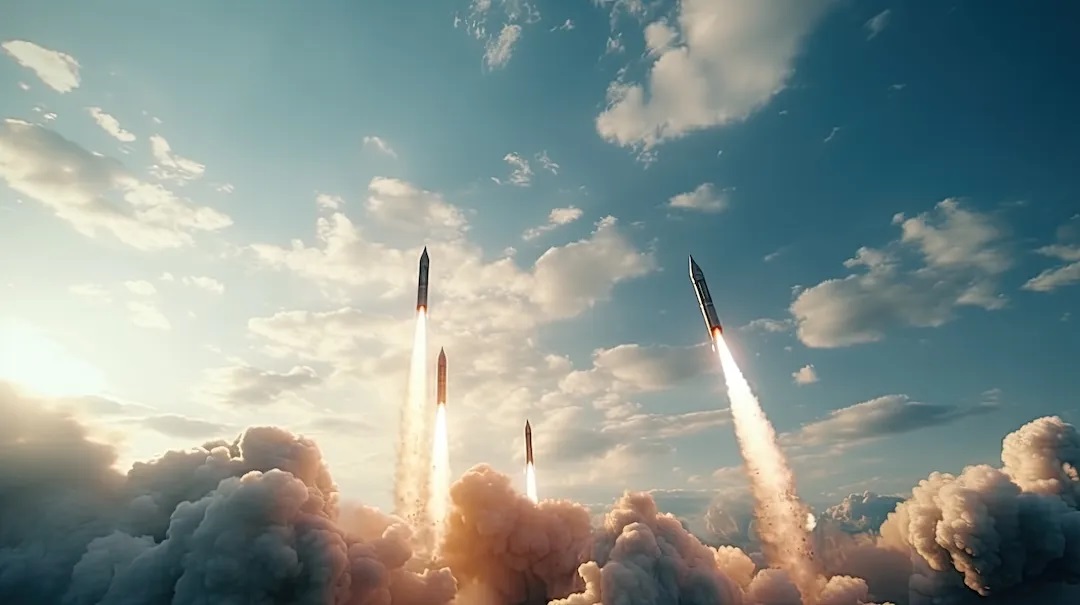
Russian President Vladimir Putin on Sunday (Jul 28) declared his nation won’t shy away from resuming production of intermediate-range nuclear weapons if the US goes ahead with plans of deploying such missiles to Germany or elsewhere in Europe. These missiles can travel between 500 and 5,500 kilometres.
“If the United States carries out such plans, we will consider ourselves liberated from the unilateral moratorium previously adopted on the deployment of medium- and short-range strike capabilities,” Putin threatened during a naval parade in Saint Petersburg.
Notably, intermediate-range nuclear weapons were subject to an arms control treaty that the US and Soviet Union signed in 1987. However, the Intermediate-Range Nuclear Forces Treaty collapsed in 2019 after both sides accused each other of violations.
Following the withdrawal from the treaty, Russia announced it wouldn’t start production of the weapons until the US started deploying these missiles abroad.
Earlier this month, the US announced it will start “episodic deployments” of long-range US missiles, including Tomahawk cruise missiles, in Germany beginning 2026.
Now, Russia sees it as a direct threat to its national security. After the deployment by the US, Putin said that “important Russian administrative and military sites” would fall within the range of such missiles that “could in the future be equipped with nuclear warheads, such that our territories would be within around 10 minutes” of a strike being launched.
“This situation reminds us of the events of the Cold War linked to the deployment of American Pershing medium-range missiles in Europe,” the Russian leader added.
Earlier in March, Putin had said Russia was “technically ready” for a nuclear war if the US sent troops to Ukraine.
“From a military-technical point of view, we are, of course, ready,” Putin had said.
“I don’t think that here everything is rushing to it (nuclear confrontation), but we are ready for this,” the Russian leader further said.
Putin warns the US of Cold War-style missile crisis
Reuters By Guy Faulconbridge and Dmitry Antonov, July 28, 2024
- Summary
- Russia warns United States over missiles in Germany
- Putin says Russia will deploy if plans are implemented
- Putin: United States risks Cold War-style crisis
- U.S. plans to deploy longer range missiles in Germany
MOSCOW, July 28 (Reuters) – Russian President Vladimir Putin on Sunday warned the United States that if Washington deployed long-range missiles in Germany then Russia would station similar missiles in striking distance of the West.
The United States said on July 10 that it would start deploying long-range missiles, opens new tab in Germany from 2026 in preparation for a longer-term deployment that will include SM-6, Tomahawk cruise missiles and developmental hypersonic weapons.
n a speech to sailors from Russia, China, Algeria and India to mark Russian navy day in the former imperial capital of St Petersburg, Putin warned the United States that it risked triggering a Cold War-style missile crisis with the move.
“The flight time to targets on our territory of such missiles, which in the future may be equipped with nuclear warheads, will be about 10 minutes,” Putin said.
“We will take mirror measures to deploy, taking into account the actions of the United States, its satellites in Europe and in other regions of the world.”………………………………………. Https://www.reuters.com/world/putin-warns-united-states-cold-war-style-missile-crisis-2024-07-28/
Controversy in France about future energy policy
Electricite de France SA Chief Executive Officer Luc Remont urged French
policymakers to review subsidies for solar power, saying the measures add
too much generation to the grid and undermine the nuclear giant’s
finances as electricity demand remains subdued.
The comments will fuel controversy among nuclear and renewable opponents as EDF seeks financial backing from the government for the construction of six new atomic plants,
which may cost €67.4 billion.
However, the lack of a clear parliamentary
majority that emerged from legislative elections raises questions about
France’s future energy policy, including support for nuclear projects in
the near term.
FFinancial Post 26th July 2024
https://financialpost.com/pmn/business-pmn/edf-chief-says-french-solar-power-subsidies-need-scrutiny
Young Changemakers Advocate for Nuclear-Free Future through Educational Journey in Kazakhstan

The Astana Times – bringing Kazakhstan to the world, By Assel Satubaldina , 29 July 2024
ASTANA—A group of 20 young changemakers from Kazakhstan and Germany recently embarked on a week-long educational journey through Kazakhstan to explore the country’s nuclear past, meet policymakers, and talk to affected communities.
The tour took the group to the ministerial halls in Astana, activists in Almaty, researchers, and the nuclear-affected communities in Semei, which was once the site for the Soviet-run nuclear test site. This educational tour, organized by the Friedrich Ebert Foundation in Kazakhstan, ICAN Germany, and Kazakhstan’s STOP (Steppe Organization for Peace) youth initiative, aimed to foster a deeper understanding of nuclear non-proliferation and amplify the voices of affected communities.
Kazakhstan’s Semipalatinsk nuclear test site was a venue for the Soviet Union to test nuclear weapons. Official data indicates that 456 nuclear tests between 1949 and 1989, including 340 underground and 116 atmospheric tests, were conducted at the test site, with an area of 18,300 square kilometers.
Around 1.5 million people have been affected by radiation exposure over the years, including health consequences such as an increase in cancer rates, birth defects, and other radiation-related illnesses among the local population. The long-term effects are still present for generations.
Meeting with government officials in Astana
Astana was the first stop on the trip. The group visited the Kazakh Ministry of Foreign Affairs. There, Arman Baissuanov, the head of the ministry’s international security department, briefed them on the country’s nuclear history and its leading role in global non-proliferation efforts. He also discussed Kazakhstan’s role in the Central Asian Nuclear Weapon Free Zone and the Treaty on the Prohibition of Nuclear Weapons (TPNW).
Among other officials, the group met with Roman Podoprigora, a judge of the Constitutional Court of Kazakhstan, who spoke about recommended changes to the 1992 law on those affected by the nuclear tests, and Nurlan Auesbaev, a member of the Parliament.
Yerdaulet Rakhmatulla, co-organizer of the study tour, described it as a positive sign that civil society representatives could visit the ministry and productively discuss the nuclear politics and more. According to him, it is quite a rare occasion.
“I think just this step from their side was a great sign of progress in our bilateral relationships as state, as government and civil society,” he said in a comment for this story.
Officially titled the law on social protection of citizens who suffered from nuclear tests at the Semipalatinsk nuclear test site, the document envisioned measures to address the severe health and social impacts. However, experts say the law has many shortcomings, including a limited scope of financial compensation, which is insufficient to cover the long-term health needs of the affected population. The law’s criteria to identify affected individuals have also been seen as too narrow.
Сonfronting the human impact of nuclear testing
Understanding Kazakhstan’s tragic nuclear past would not be complete without visiting the region where thousands of people witnessed the tests firsthand and have borne the consequences for many years since. In Semei, the young people met with people still grappling with the legacy of the Soviet-era tests, listening to their stories that, for some reason, often remain unheard.
Maira Abenova, a survivor of the Soviet nuclear tests in Semei and founder of the Polygon 21, an institution that advocates for the rights of Semipalatinsk nuclear test survivors, helped the group to meet those affected in Semei and Astana.
During the meeting in Semei, many of the survivors reported on their health problems, such as cancer and heart disease, according to a press report from ICAN Germany. They said they hope their voices will be heard internationally. Their voices “do not yet reach as far as those of Hiroshima and Nagasaki,” say the survivors.
For Rakhmatulla, these meetings were “extremely special………………………………………………………………………………………………..
Lessons learned
Janina Ruther, a participant of the tour and project manager at ICAN Germany, spoke to The Astana Times, sharing her impressions and key takeaways from the educational tour.
Because of her experience with ICAN, she got to know more about Kazakhstan and the country’s history with nuclear weapons.
Ruther said what made the trip so special was the variety of places they visited and the diverse range of people they spoke to in different contexts.
“That was so special, and it made it a once-in-a-lifetime experience,” she added. “I think I don’t have words for that because we talked to so many people who were actually surviving all these tests. It was so brave that they talked to us because I cannot imagine how hard it must be.”
She also shared meeting young people at the universities and experiencing the night train journey was unforgettable.
She described the tour using a quote from one of the meetings: “The more we educate young people, the greater the hope for a world without nuclear weapons.”
She stressed that the primary goal was to reach young people who could spread the message and educate others. Equally important was understanding the needs and desires of the people affected by nuclear testing in Kazakhstan and bringing their voices to an international level. https://astanatimes.com/2024/07/young-changemakers-advocate-for-nuclear-free-future-through-educational-journey-in-kazakhstan/
Hungary to allow nuclear plant to exceed Danube water temperature limit
By Reuters, July 27, 202 https://www.reuters.com/business/energy/hungary-allow-nuclear-plant-exceed-danube-water-temperature-limit-2024-07-27/
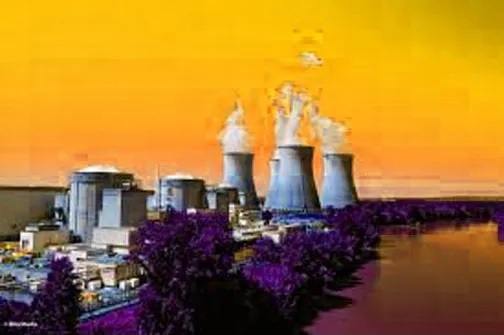
BUDAPEST, July 27 (Reuters) – Hungary is planning to allow the temperature limit for a section of the Danube which receives cooling water from the Paks nuclear power plant to be exceeded for security of supply reasons, the energy ministry said in a statement on Friday.
The plant’s four reactors operate by using the water of the Danube to cool its operations. Currently, according to the regulation, the river cannot receive water if its temperature exceeds 30 degree Celsius, in which case the operator must cut output and wait for the river to cool below the limit.
“In addition to environmental considerations, it may therefore be justified to exceed the limit value on a case-by-case basis if this is unavoidable for security of supply.”
The Paks plant has four Russian-built VVER 440 reactors with a combined capacity of about 2,000 megawatts. The reactors became operational between 1982 and 1987 and are scheduled to be retired in 2032-2037.
Hungary plans to expand the plant, with Russia’s Rosatom building two VVER reactors with a capacity of 1.2 gigawatts each, in addition to the currently working four reactors.
Hungary is planning to allow the temperature limit for a section of the
Danube which receives cooling water from the Paks nuclear power plant to be
exceeded for security of supply reasons, the energy ministry said in a
statement on Friday. The plant’s four reactors operate by using the water
of the Danube to cool its operations. Currently, according to the
regulation, the river cannot receive water if its temperature exceeds 30
degree Celsius, in which case the operator must cut output and wait for the
river to cool below the limit.
Reuters 27th July 2024
Scottish Greens warn that “Great Britain Energy” could funnel public money into subsidising non-viable nuclear power projects

Patrick Harvie warns of major devolution tests for GB Energy
By Nan Spowart , 28th July
LABOUR’S new flagship energy company will be an important test of the relationship between the new regime in Westminster and the devolved governments, according to Scottish Greens co-leader Patrick Harvie.
……………………….. He is now calling for more detail of the remit of GB Energy after it was revealed that the organisation could get involved in planning disputes…………………
“The real worry I have is that it ends up simply as a way of channelling
public money into subsidising otherwise non-viable nuclear developments
like small modular reactors which is a technology that the industry was
pushing very aggressively a few years ago but is failing at a commercial
level in a number of other countries. “We should not be going down that
route and the principal means Scotland has been saying no to new nuclear
has been through the planning system, so we need clarity early doors that
that is not their agenda.”
The National 28th July 2024
https://www.thenational.scot/news/24480590.patrick-harvie-warns-major-devolution-tests-gb-energy/
1 This Month
26 April – Chernobyl: Inside the Meltdown airs on National Geographic on Sunday 26th April from 4pm

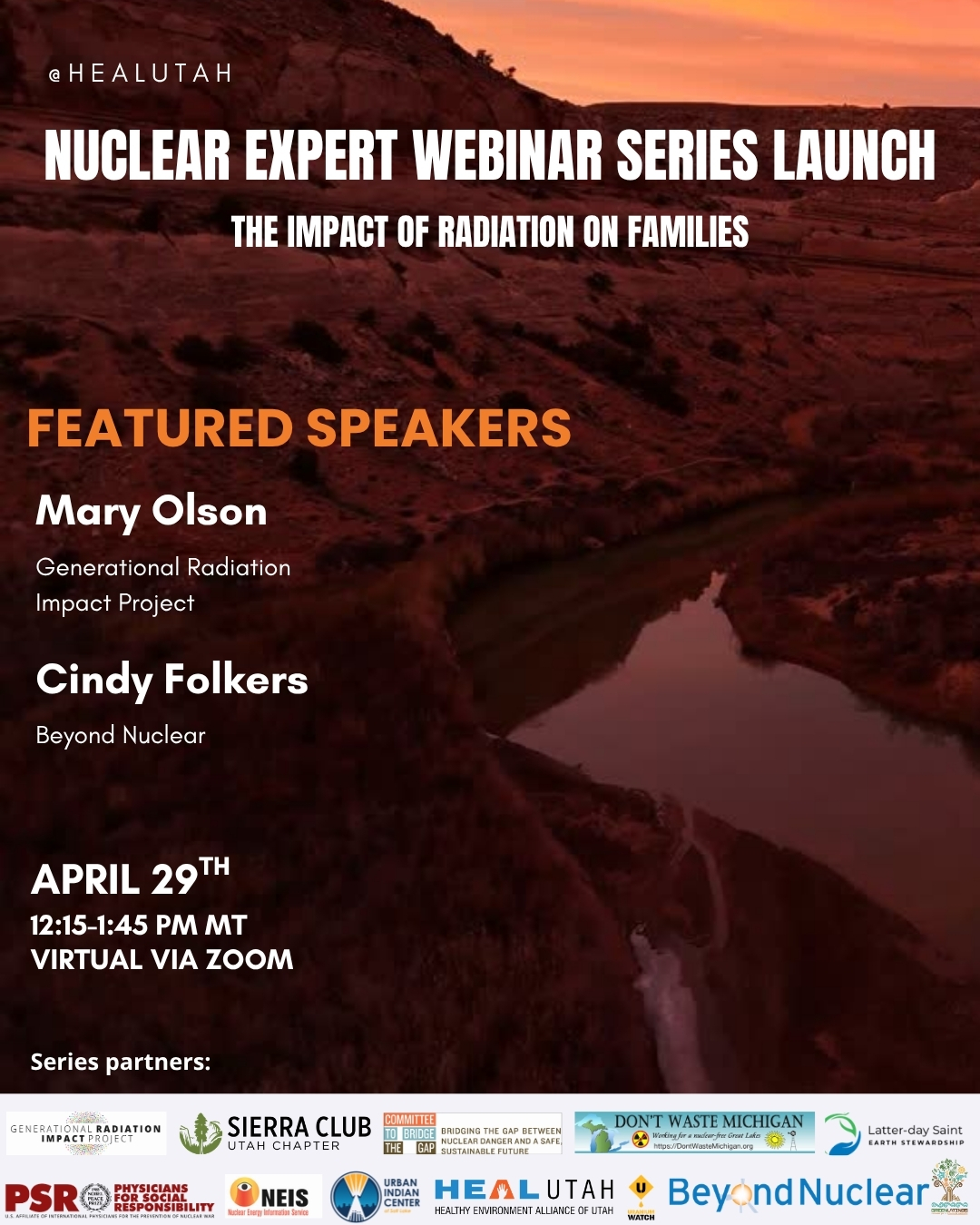
29 April – Nuclear Expert Webinar #1 – Radiation Impacts on Families with Mary Olson and Cindy Folkers
- 12:15 PM MT – 1:45 PM MT
- Location: Virtual – REGISTER TODAY

4 May -West Suburban Peace Coalition to discuss Iran war at May Educational Forum
Monday, May 4, 7:00 – 8:00 PM Central Standard Time
Title: : How Trump’s Narrative Tries to Shape the Reality of the War on Iran.
Contact Walt Zlotow, zlotow@hotmail.com 630 442 3045 for further information
14 May – online event From Bombs to Data Centres: the Face of Nuclear Colonialism

Pine Ridge Uranium is the real threat, not Tehran- Tell Burgum: Stop the Extraction.
Chernobyl: The Lost Tapes – A good documentary on Chernobyl on SBS available On Demand for the next 3 weeks– https://www.sbs.com.au/ondemand/tv-program/chernobyl-the-lost-tapes/2352741955560
To see nuclear-related stories in greater depth and intensity – go to https://nuclearinformation.wordpress.com
-
Archives
- April 2026 (356)
- March 2026 (251)
- February 2026 (268)
- January 2026 (308)
- December 2025 (358)
- November 2025 (359)
- October 2025 (376)
- September 2025 (257)
- August 2025 (319)
- July 2025 (230)
- June 2025 (348)
- May 2025 (261)
-
Categories
- 1
- 1 NUCLEAR ISSUES
- business and costs
- climate change
- culture and arts
- ENERGY
- environment
- health
- history
- indigenous issues
- Legal
- marketing of nuclear
- media
- opposition to nuclear
- PERSONAL STORIES
- politics
- politics international
- Religion and ethics
- safety
- secrets,lies and civil liberties
- spinbuster
- technology
- Uranium
- wastes
- weapons and war
- Women
- 2 WORLD
- ACTION
- AFRICA
- Atrocities
- AUSTRALIA
- Christina's notes
- Christina's themes
- culture and arts
- Events
- Fuk 2022
- Fuk 2023
- Fukushima 2017
- Fukushima 2018
- fukushima 2019
- Fukushima 2020
- Fukushima 2021
- general
- global warming
- Humour (God we need it)
- Nuclear
- RARE EARTHS
- Reference
- resources – print
- Resources -audiovicual
- Weekly Newsletter
- World
- World Nuclear
- YouTube
-
RSS
Entries RSS
Comments RSS
 nuclear-news