Concern growing about poor safety of South Korea’s nuclear reactors

 Nuclear reactor shut down for safety reasons, Aug.1,2012 Incident at Younggwang plant the latest in a long string of nuclear troubles, The Hanyoreh, By Noh Hyung-woong, staff reporter Reactor 6 at Younggwang Nuclear Power Plant in South Jeolla province was shut down again on July 30 due to a malfunctioning reactor rod….
The repeated problems with Younggwang reactor 6 have residents in the area nervous. Reactor 6 first broke down during a 2002 trial run. Since then, it has gone out of action 9 times in past 10 years.
Among those cases, some were trivial, due to lightning strikes and a mistake on operation. But in Dec. 2008, the reactor was stopped because warning signals appeared, indicating the reactor rod was in the wrong position.
Yang-yi Won-young director of Common Action for Nuke Free Society said, “The reactor rod is the last line of defense against a serious accident. It was fortunate that the reactor was shut down in time. If it hadn‘t been, it would have created a terrible disaster.”
Some brought up the problem of Korean-style pressurized light water reactors, citing their frequent breakdowns. “The reactors that recently broke down, including reactor 6 at the Younggwang plant, are localized as Korean style,” said Professor Suh Kune-yull at the
Nuclear Engineering Dept. of Seoul National University. “It seems that their electronic circuits and other components fail frequently.”…..
more and more people raised the questions of the safety of nuclear power plants. In particular, the Younggwang accident happened while MKE has been moving to restart Kori Nuclear reactor No.1…… http://english.hani.co.kr/arti/english_edition/e_business/545178.html
USA rejects South Korea’s push to enrich uranium
Samore says no need for S. Korea to enrich uranium By Lee Chi-dong WASHINGTON, July 23 (Yonhap) — Gary Samore, President Barack Obama’s top aide for nonproliferation, said Monday that the U.S. sees no need for South Korea to enrich uranium, a stance against Seoul’s goals. Continue reading
Japanese seafood products banned in South Korea, due to radiation risks
South Korea Bans Imports of 35 Japanese Seafood Products VOA, June 27th, 2012 South Korea has placed a temporary import ban on 35 Japanese seafood products because of fears of lingering radiation contamination from last year’s devastating nuclear disaster.
Seoul’s Ministry of Food, Agriculture, Forestry, and Fisheries says the ban is a temporary measure meant to protect South Korean citizens from products originating from the waters near the Fukushima nuclear power plant…….. The items banned Wednesday by South Korea include several types of flatfish, clams and sea urchins, products that are already prohibited from sale in Japan. With the latest move, Seoul now prohibits a total of 64 Japanese seafood items from entering South Korea. http://blogs.voanews.com/breaking-news/2012/06/27/south-korea-bans-imports-of-35-japanese-seafood-products/
Damaged South Korean nuclear reactor to shut down for 2 years
Uljin Nuclear Reactor Faces 2-Year Shutdown The Chosunilbo, 10 May 12, Additional faults have been detected in the No. 4 reactor at the Uljin Nuclear Power Plant, which has been undergoing repairs, and a complete shutdown now seems inevitable……..
Korea Hydro and Nuclear Power Corporation has found that damage in the No. 4 reactor, where operations were halted due to defects in the machine that condensates steam from the turbine, is more serious than expected and tentatively decided to replace the steam generator.
Replacing it will take one or two years, so the reactor will not operate until at least next summer. It generates 1 million kW, or the capacity of two thermal power stations. …
http://english.chosun.com/site/data/html_dir/2012/05/10/2012051001397.html
South Korea’s push to export nuclear technology hampered by corruption scandal
 Lee’s nuclear push meets obstacle Korea Times, 4 may 12, By Kang Hyun-kyung President Lee Myung-bak’s drive to win nuclear deals abroad has met an unexpected, formidable challenge from within as a state-run nuclear operator has been embroiled in malfunctions and corruption cases. Continue reading
Another example of corruption in the nuclear industry
Another Nuke Scandal: Theft and Bribery After a blackout-and-coverup episode recently, another development is emerging that could deepen distrust in South Korea’s nuclear industry: a corruption scandal. WSJ, April 27, 2012,
Prosecutors in Ulsan and Busan on Thursday announced the arrest of six nuclear industry executives and an equipment broker on corruption charges. The prosecutors allege the officials received bribes up to 100 million won ($88,100) each in return for providing business favors to a Korean manufacturer.
In one case, an official is alleged to have secretly handed over a sealing unit part made by French Areva, along with its specification, to a local manufacturer in return for 80 million won. The manufacturer produced a copy and sold it to four nuclear power plants…… The
arrests came less than two months after officials were caught trying to cover up a blackout at the Gori-1 nuclear plant, the oldest nuclear facility in the country. A power failure, if persisted long enough, could be lead to a serious problem like a nuclear fuel meltdown. KHNP CEO Kim Jong-shin stepped down earlier this month due to the incident. Seven other officials were relieved of their duties.
Jan Vande Putte, a nuclear expert at Greenpeace International, said in a statement Friday that the latest case is “a clear indication that the Korean nuclear industry is out of control.”
http://blogs.wsj.com/korearealtime/2012/04/27/another-nuke-scandal-theft-and-bribery/?mod=google_news_blog
Secrecy over nuclear problem, opposition to nuclear in Korea
Korea Hydro didn’t report the blackout and deleted it from its records before an outside inquiry discovered it, the committee said last month. The government is investigating why the incident wasn’t reported immediately, ….
Almost 80 percent of respondents opposed extending the life of older reactors in a February poll of 1,100 people by the Korean Federation for Environmental Movement.
Nuclear Halt in South Korea Seen Boosting Coal: Energy Markets, Bloomberg News By Sangim Han and Yuriy Humber on April 13, 2012 “…..Korea Electric Power Corp. (KEP) (KEP), the nation’s electricity monopoly, says it may boost coal purchases to replace nuclear power generation if the Kori 1 reactor remains shut and the government fails to extend the lifespan of a second reactor.
Kori 1 was closed for safety checks on March 13, five weeks after a power failure caused the temperature of its core to rise. The operating permit for Wolsong 1 expires in November…… Korea Hydro & Nuclear Power Co., a unit of Korea Electric that operates the Kori plant, announced its power failure on March 12, a day after the first anniversary of Fukushima. A 12- minute power loss occurred on Feb. 9 and sent the core temperature to 58.3 degrees Celsius (137 degrees Fahrenheit) from 36.9 degrees, according to the Nuclear Safety and Security Commission. Continue reading
Democracy losing out in South Korea, as govt stifles anti nuclear voices
nuclear energy is not considered a safe, clean or sustainable energy source by the UN’s Intergovernmental Panel on Climate Change. It is, therefore, not included in the UN’s Clean Development Mechanism.
the government declared it would spend an additional 10 billion won to promote nuclear energy
Greenpeace will continue to reach out to the people of Korea, despite the fovernment’s attempt to quash public debate and discontent over its nuclear plans
 Nuclear Power and Democracy Don’t Mix , HUFFINGTON POST, 3 April 12, Kumi NaidooExecutive Director, Greenpeace International,On Monday South Korea deported three senior Greenpeace staff, known for their role in our campaign
against that country’s nuclear expansion plans. This is just the latest proof that nuclear power and democracy do not mix. It’s the latest attack on freedom of speech from an industry forged in the furnace of military secrecy, which has over the last 60 years left in
it’s a wake a legacy of lies, cover-ups and broken promises.
What is it the industry and its government sponsors fear? What do they hope to achieve by excluding peaceful people from Greenpeace? What do they have to hide? What is it that they do not wish the people of Korea to hear?…. Continue reading
South Korea deported anti nuclear Greenpeace staff
 Greenpeace deportation. Korea Herald, 3 April 12, It was unnecessary and excessive for the immigration authorities to bar the entry of three Greenpeace staff at Incheon International Airport on Monday and send them back to Hong Kong. An Immigration Service officer said the three members of a four-man group were detained at the airport at the request of a relevant government office which cited “national interest reasons.” Continue reading
Seoul: agreements on non-nuclear medical isotopes the only bright spot
waste and spent fuel which are stored on an interim basis in pools of water or in casks are of the greatest concern
agreement between the U.S., France, Belgium, and the Netherlands was made to produce medical isotopes without the use of HEU by 2015.
Korea’s Nuclear Summit a Damp Squib, Asia Sentinel by Lee Byong-chul, 30 MARCH 2012 Little of significance despite the presence of the world’s most powerful leaders The Nuclear Security Summit held on March 26-27 in Seoul, has turned out to be a half-baked extravaganza that produced little of significance except for proclaiming the lofty goal of a nuclear-free world vision – while one of the world’s nuclear outlaws lurked just 65 km to the north, rattling rockets in the face of the world’s most powerful leaders. Continue reading
South Korea keen to sell nuclear reactors to India
S Korea offers nuke reactors to India TNN | Mar 26, 2012,“…..South Korea has offered to build nuclear reactors in India and sought land for the project. …. A joint statement said, “The two leaders proposed that the concerned agencies of both countries study the possible cooperation in future space activities, including launching a nano-satellite developed by Korean students on an Indian launch vehicle.”…. http://timesofindia.indiatimes.com/india/South-Korea-offers-India-nuke-reactors/articleshow/12408369.cms
Most South Koreans against nuclear power – a growing election issue
 Nuclear issue creeps up agenda for April election The Korea Herald, 2012-03-18 In an increasingly volatile race for parliament, nuclear power is creeping up the political agenda as opposition lawmakers seek to exploit growing safety jitters to retake power in next month’s vote.
Concerns about the safety of the nuclear industry are rife after news broke last week that plant operators had attempted to cover up a power cut at a reactor in Busan for over a month. Continue reading
South Koreans becoming unsure of nuclear power safety
SK Sees Nuclear Plant Jitters Ahead Of Summit, WSJ, March 16, 2012, A little over a week before South Korea hosts the 50-nation Nuclear Security Summit, the government is trying to reassure the public over the safety of nuclear power following a blackout at a nuclear plant on the south coast and a public backlash about alleged cover-up attempts by officials. Continue reading
A dangerous hoax to make money from a false nuclear rumour
 South Korea Police Arrest 6 for Spreading N. Korea Nuclear Accident Rumors Bloomberg, By Saeromi Shin and Sangwon Yoon – Feb 20, 2012 South Korean police arrested six people for spreading false rumors about a North Korean nuclear reactor explosion on Jan. 6 to manipulate the stock market.
The six, including two office workers and a university student, conspired to circulate rumors through instant-messaging that a light-water reactor exploded in North Korea and radiation had leaked, the National Police Agency said in a statement posted on its website today. They made 61 million won ($54,314) in profits from spreading rumors to move financial markets, according to the police. … http://www.bloomberg.com/news/2012-02-21/six-arrested-in-s-korea-over-nuclear-rumors.html
South Korea’s nuclear program falters, as public opposition increases
 the reactor has had 51 malfunctions since it went online, “due to flaws in machinery and components, including radiation leaks, coolant leaks and reactor shutdowns,”
South Korea to boost nuclear power? SEOUL, Feb. 20 (UPI) — South Korea’s plans to boost nuclear power face increasing resistance from civic and environmental groups, post Fukushima, the Japanese reactor site hit by an earthquake and tsunami last year… Continue reading
1 This Month

22 June – Virtual Event –Climate Change: New Data, New Debate

Monday, June 22, 2026 2:30 p.m. – 3:15 p.m. CT
YouTube. Register here

Protect Sazan Island from the Trump family! https://secure.avaaz.org/campaign/en/protect_sazan_island_from_the_trump_family_loc/?bqFCVab&v=174511&cl=22707147157&_checksum=5e9dde668860e8231c33699735e16a1fbf22ab2cb01da50c999fe8732b9775ef&utm_source=email&utm_medium=blast_email&utm_campaign=174511
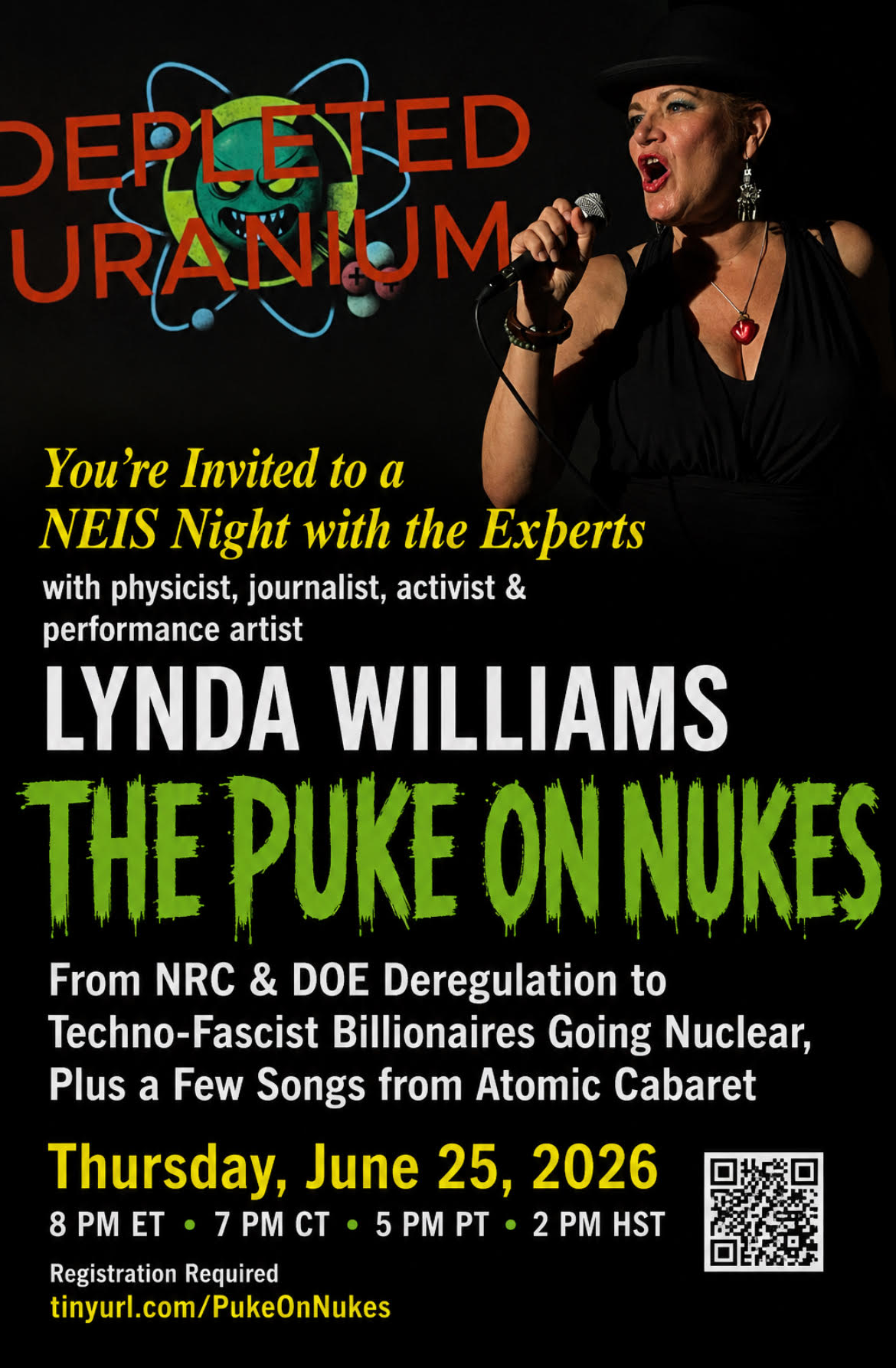
25 June- THE PUKE ON NUKES
Thursday, June 25, 2026
7pm Central Time (8pm ET, 6pm MT, 5pm PT) UTC – 5
From NRC & DOE Deregulation to Techno-Fascist Billionaires Going Nuclear, Plus a Few Songs from Atomic Cabaret REGISTER
26 June – Radiation Trainwreck at the NRC / Join the Protect Better Campaign – https://us02web.zoom.us/meeting/register/4ZlZ5_qLSHGiLSCg8FF6Bg#/registration


Cuba Is Not a Failed State – It Is a Besieged State
PETITION: “Global Appeal to Endorse Palestinian Right of Return of Refugees”
To see nuclear-related stories in greater depth and intensity – go to https://nuclearinformation.wordpress.com
-
Archives
- June 2026 (193)
- May 2026 (306)
- April 2026 (356)
- March 2026 (251)
- February 2026 (268)
- January 2026 (308)
- December 2025 (358)
- November 2025 (359)
- October 2025 (376)
- September 2025 (257)
- August 2025 (319)
- July 2025 (230)
-
Categories
- 1
- 1 NUCLEAR ISSUES
- business and costs
- climate change
- culture and arts
- ENERGY
- environment
- health
- history
- indigenous issues
- Legal
- marketing of nuclear
- media
- opposition to nuclear
- PERSONAL STORIES
- politics
- politics international
- Religion and ethics
- safety
- secrets,lies and civil liberties
- spinbuster
- technology
- Uranium
- wastes
- weapons and war
- Women
- 2 WORLD
- ACTION
- AFRICA
- Atrocities
- AUSTRALIA
- Christina's notes
- Christina's themes
- culture and arts
- Events
- Fuk 2022
- Fuk 2023
- Fukushima 2017
- Fukushima 2018
- fukushima 2019
- Fukushima 2020
- Fukushima 2021
- general
- global warming
- Humour (God we need it)
- Nuclear
- RARE EARTHS
- Reference
- resources – print
- Resources -audiovicual
- Weekly Newsletter
- World
- World Nuclear
- YouTube
-
RSS
Entries RSS
Comments RSS
 nuclear-news