 Amid Nuclear Tensions, Trump Mulls Exit From South Korea Trade Deal, NYT, By GLENN THRUSH and GARDINER HARRIS, SEPT. 2, 2017, WASHINGTON
 — President Trump is considering pulling out of a major trade agreement with
South Korea as he tries to fulfill get-tough campaign pledges on international trade. But he has not yet made a final decision, two senior administration officials said Saturday.
September 4, 2017
Posted by Christina Macpherson |
politics international, South Korea, USA |
Leave a comment


| Song, Mattis reportedly discuss redeployment of tactical nuclear weapons to South Korea, The Hankyoreh, Sep.1,2017 |
The subject was said broached during the first day of SK Defense Minister’s visit to US
The South Korean and US defense leaders discussed the issue of deploying tactical nuclear weapons on the Korean Peninsula during their meeting on Aug. 30, according to sources.
This marks the first official confirmation of discussions on the tactical nuclear weapon issue between top-level South Korean and US government figures. Critics are calling the discussions a hasty move that could fuel political controversy and confuse the issue of Seoul’s stated opposition to tactical nuclear weapons.
South Korean Minister of National Defense Song Young-moo met with US Secretary of Defense James Mattis at the Pentagon on Aug. 30 and broached the tactical nuclear weapon deployment issue during discussions on amending the South Korea-US missile guidelines, a senior government official reported.
The official remained quiet on the details, saying only that “the tactical nuclear weapon deployment issue was discussed, but it wasn’t anything specific.”
The redeployment of tactical nuclear weapons has become a heated political issue, with conservative parties strongly calling for it as a response to North Korea’s nuclear and missile provocations. It’s also an incendiary issue with bearing on the peninsula’s denuclearization………
Song arrived in the US for a five-day visit on Aug. 29.
By Park Byong-su, senior staff writer and Kim Ji-eun, staff reporterhttp://english.hani.co.kr/arti/english_edition/e_international/809296.html
September 2, 2017
Posted by Christina Macpherson |
South Korea, USA, weapons and war |
Leave a comment
Russian nuclear bombers fly near North Korea in rare show of force, http://www.reuters.com/article/us-russia-southkorea-bombers-idUSKCN1B40MP, Andrew Osborn, 25 Aug 17, Moscow, Reuters, Russian nuclear-capable strategic bombers have flown a rare mission around the Korean Peninsula at the same time as the United States and South Korea conduct joint military exercises that have infuriated Pyongyang.
Russia, which has said it is strongly against any unilateral U.S. military action on the peninsula, said Tupolev-95MS bombers, code named “Bears” by NATO, had flown over the Pacific Ocean, the Sea of Japan, the Yellow Sea and the East China Sea, prompting Japan and Seoul to scramble jets to escort them.
The flight, which also included planes with advanced intelligence gathering capabilities, was over international waters and was announced by the Russian Defence Ministry on the same day as Moscow complained about the U.S.-South Korean war games.
“The US and South Korea holding yet more large-scale military and naval exercises does not help reduce tensions on the Korean Peninsula,” Maria Zakharova, a spokeswoman for the foreign ministry, told a news briefing in Moscow.
“We urge all sides to exercise maximum caution. Given the arms build-up in the region, any rash move or even an unintended incident could spark a military conflict.”
August 25, 2017
Posted by Christina Macpherson |
North Korea, Russia, South Korea, weapons and war |
Leave a comment
US-South Korea begin wargames https://uk.news.yahoo.com/us-south-korea-begin-wargames-051130924.html, 23 Aug 17 The United States and South Korea have kicked off their annual military exercise, known as Ulchi Freedom Guardian.
The wargames use computer simulations to prepare for conflict with nuclear-capable North Korea.
Troops from seven allied nations, including Britain, Canada and Australia, are also taking part.
South Korean President Moon Jae-in denied Pyongyang’s accusation that the drills are a rehearsal for an invasion.
“This year’s Ulchi exercise is to check the defensive postures of our civilians, government and military to secure the lives and safety of our people”, Moon said at a cabinet meeting. “It is an annual exercise of a defensive nature, and there is no intention of heightening military tensions on the Korean Peninsula”.
Peace activists in Seoul protested the decision to go ahead with the drill, concerned it could trigger retaliation by North Korea. Pyongyang last week appeared to back down from a threat to launch a missile strike on the US territory of Guam.
China has also urged Washington to scrap the ten-day-long exercise.
August 23, 2017
Posted by Christina Macpherson |
South Korea, USA, weapons and war |
Leave a comment
US refuses to pause drills despite North’s vow of ‘merciless retaliation’ http://www.todayonline.com/world/asia/us-refuses-pause-drills-despite-norths-vow-merciless-retaliation AUGUST 23, 2017, SEOUL — As North Korea vowed “merciless retaliation” against United States-South Korean military drills it claims are an invasion rehearsal, senior US military commanders yesterday dismissed calls to pause or downsize the exercises they said were crucial to countering a clear threat from Pyongyang.
The heated North Korean rhetoric, along with occasional weapons tests, is standard fare during the spring and summer war games by allies Seoul and Washington.
USA persists with But uneasy ties between the Koreas are worse than normal this year following weeks of tit-for-tat threats between US President Donald Trump and Pyongyang in the wake of the North’s two intercontinental ballistic missile tests last month.
There have been calls in both the US and South Korea to postpone or modify the drills in an attempt to ease hostility on the Korean peninsula following North Korea’s threat to fire missiles toward the US territory of Guam.
But a visiting group of senior US military commanders, including Admiral Harry Harris, the commander of US forces in the Pacific, said the drills are critical for the allies to maintain readiness against an aggressive North Korea.
“A strong diplomatic effort backed by a strong military effort is key because credible combat power should be in support of diplomacy and not the other way around,” Adm Harris said during a news conference at South Korea’s Osan Air Base.
General Vincent Brooks, commander of US Forces Korea, said the allies should continue the war games until they “have reason not to”. He added: “That reason has not yet emerged.”
The North Korean military said in a statement that it will launch an unspecified “merciless retaliation and unsparing punishment” on the US over the Ulchi Freedom Guardian drills that began on Monday for an 11-day run.
Despite the threat, an unprovoked direct attack is unlikely because the US vastly outguns Pyongyang, which values the continuation of its dictatorship above all else. The impoverished North hates the drills in part because they force it to respond with expensive military measures of its own.
The North Korean statement accused the US of deploying unspecified “lethal” weapons for the drills that it says involve a “beheading operation” training aimed at removing absolute ruler Kim Jong-un.
“No one can vouch that these huge forces concentrated in South Korea will not go over to an actual war action now that the military tensions have reached an extreme pitch in the Korean Peninsula,” the statement said.
“Moreover, high-ranking bosses of the US imperialist aggressor forces flew into South Korea to hold a war confab. Such huddle is increasing the gravity of the situation.” Adm Harris said yesterday it was more important to use diplomacy to counter North Korea’s missile threat rather than consider what actions by the reclusive nation might trigger a preemptive strike. “So we hope and we work for diplomatic solutions to the challenge presented by Kim Jong-un,” Adm Harris said.
When asked what actions by North Korea might trigger a preemptive US strike against Pyongyang, he added: “As far as a timeline, it would be crazy for me to share with you those tripwires in advance. If we did that, it would hardly be a military strategy.”
The Ulchi drills are largely computer-simulated war games held every summer, and this year’s exercise involves 17,500 American troops and 50,000 South Korean soldiers.
No field training like live-fire exercises or tank manoeuvring is involved in the Ulchi drills, in which alliance officers sit at computers to practise how they would engage in battles and hone their decision-making capabilities. The allies have said the drills are defensive in nature. AGENCIES
August 23, 2017
Posted by Christina Macpherson |
South Korea, USA, weapons and war |
Leave a comment
Moon says even slight conflict on Korean Peninsula may threaten many lives, SEOUL, Aug. 21 (Yonhap) — South Korean President Moon Jae-in again urged the United States Monday to refrain from taking any action against North Korea that could start an armed conflict on the peninsula, saying even the slightest conflict here may cost the lives of many South Koreans and U.S. troops.
“President Moon said he understands why the United States has traditionally said all options were on the table to push North Korea to give up its nuclear ambitions. But he said even the slightest military action will lead to a clash between the South and North, and it will threaten many lives of not only South Koreans but foreigners, including U.S. forces stationed in South Korea,” Park Soo-hyun, a spokesman for Seoul’s presidential office Cheong Wa Dae, said at a press briefing.
Moon made the remarks at a meeting at Cheong Wa Dae with a bipartisan group of U.S. lawmakers including Sens. Edward Markey (D-MA) and Jeff Merkley (D-OR), and two members of the House of Representatives, Carolyn Maloney (D-NY) and Ann Wagner (R-MO).
Moon’s remarks followed a heated war of words between the communist North and the United States.
U.S. President Donald Trump repeatedly hinted at possible military action against the reclusive North after Pyongyang said it may consider launching ballistic missiles toward the U.S.-controlled island of Guam……
“President Moon noted the need to continue sending a clear message to the North that a brighter future will be guaranteed should it choose to come to the negotiations table, while continuously increasing pressure and sanctions on the North,” the Cheong Wa Dae spokesman said.
Moon also stressed the importance of China’s role in bringing the North back to the dialogue table, noting Pyongyang nearly entirely depended on its major ally, Beijing, for its exports. http://english.yonhapnews.co.kr/news/2017/08/21/0200000000AEN20170821011552315.html
August 23, 2017
Posted by Christina Macpherson |
politics international, South Korea |
Leave a comment

 North Korea Warns US-South Korea War Games Driving Toward ‘Uncontrollable Nuclear War‘ https://www.commondreams.org/news/2017/08/20/north-korea-warns-us-south-korea-war-games-driving-toward-uncontrollable-nuclear-war The North called the planned joint military exercises “reckless” and said the U.S. is “lost in a fantasy”, by Jake Johnson, staff writer
With the United States and South Korea set to begin joint military exercises on Monday—and as Trump administration officials attempt to de-escalate tensions after the president threatened to bring “fire and fury” upon North Korea—the regime of Kim Jong-un published an editorial in a state-run newspaper on Sunday calling the planned war games “reckless behavior” that is “driving the situation into the uncontrollable phase of a nuclear war.” The editorial added that the military exercises amount to “pouring gasoline on fire,” and warned that the U.S. would not be able to “dodge the merciless strike” the regime claims it is prepared to launch.
“The Korean People’s Army is keeping a high alert, fully ready to contain the enemies,” the editorial continued. “It will take resolute steps the moment even a slight sign of the preventive war is spotted.”
“If the U.S. is lost in a fantasy that war on the peninsula is at somebody else’s doorstep far away from them across the Pacific, it is far more mistaken than ever,” the editorial concluded.
The U.S.-South Korea military exercises are set to last for ten days, and they will consist of 17,500 American troops and 50,000 South Korean troops. As the Associated Press noted, the drills “hold more potential to provoke than ever,” and some are calling on the U.S. and South Korea “to postpone or drastically modify drills to ease the hostility on the Korean Peninsula.
Tensions between the U.S. and North Korea have been running high of late as the North continues to develop its nuclear capacities and as U.S. President Donald Trump continues to ratchet up tensions by responding erratically. Trump recently suggested that his “fire and fury” remarks were not “tough enough.”
As a result, a growing number of lawmakers are calling for Trump to be stripped of the “nuclear football.” “No U.S. President, certainly not Trump, should have sole authority to initiate an unprovoked nuclear war,” argued Sen. Ed Markey (D-Mass.).
According to a recent CBS News poll, nearly 60 percent of Americans are “uneasy” about Trump’s ability to deal reasonably with North Korea, and the same percentage believes that the U.S. should not be threatening Pyongyang with military action.
As Common Dreams has reported, activists and analysts have issued urgent calls for diplomacy in recent weeks as tensions continue to intensify. The failure to pursue diplomatic avenues could result in a “nuclear nightmare,” some have warned.
“Time has proven that coercion doesn’t work,” CODEPINK co-founder Medea Benjamin recently wrote. “There’s an urgent need to hit the reset button on U.S.-Korean policy.”
August 21, 2017
Posted by Christina Macpherson |
North Korea, politics international, South Korea, USA, weapons and war |
Leave a comment
Time for nuclear balancing act?, Korea HeraldBy Yeo Jun-suk, 20 Aug 17 Calls grow in Seoul to deploy tactical atomic weapons to counter NK nuclear threats, Aug 20, 2017 Despite under a constant threat of war from the communist North Korea, South Korea has remained a nuclear weapons-free zone since 1991. But with Pyongyang nearing the finish line in its atomic weapons program, politicians and security experts in Seoul are calling for “a balancing act” to adapt to the new security environment on the Korean Peninsula: A North Korean nuclear weapon can only be deterred by a nuclear weapon — by either South Korea’s own or the US, they said.
“We can’t fight against the North with bare hands,” said Rep. Jeong Yong-ki, a spokesman for the main opposition Liberty Party Korea. “It’s time for us to be in a tit-for-tat over North Korea’s nuclear weapons.”
The conservative party, who favors hardline approaches toward the North, adopted as its party platform last week a call for redeploying US tactical nuclear weapons that were withdrawn from the peninsula in 1991.The minor conservative Bareun Party, while also advocating nuclear deterrence, floated an idea of US “sharing” its nuclear weapons with South Korea.
As opposed to the Liberty Party’s proposal of bringing US nuclear weapons back here, the idea calls for the US granting South Korea a right to use US nuclear assets operating outside the peninsula, such as nuclear-powered submarines or fighter jets carrying nuclear bombs, when the need arises.
“Our idea allows us to have nuclear deterrence without deploying nukes here,” while avoiding possible backlashes from neighboring countries, said Rep. Ha Tae-kyung of Bareun Party.
The need for a nuclear deterrent was echoed even from a former security advisor to President Moon Jae-in, a liberal favoring re-engagement with the North and nuclear disarmament of both Koreas. …….http://www.koreaherald.com/view.php?ud=20170820000215
August 21, 2017
Posted by Christina Macpherson |
politics, South Korea, weapons and war |
Leave a comment
 US AND KOREAN NUCLEAR PLANT CANCELLATIONS: IMPLICATIONS FOR UK NEW NUCLEAR BUILD, Prospec t Law August 10, 2017
 The US currently has 100 nuclear power plants in operation supplying about 20% of its power needs. A further four were under construction, two each in Georgia and South Carolina, until the owners of the South Carolina plants recently announced the cancellation of construction of its two Westinghouse AP1000 units, Summer 2 and 3.
Summer 2 and 3 had been under construction since 2013, with original operational dates of late 2019 and late 2020. However, due to construction delays and cost overruns, these were later revised to December 2022 for Summer 2 and March 2024 for Summer 3. The finances were a key factor in the decision to cancel construction, with the original estimate of $11.5 bn having more than doubling to $25 bn. The reasons behind this are no doubt complex, but as the US has not constructed a new reactor since the 1970s, the loss of nuclear expertise must be a factor.
Summer 2 and 3 were intended to showcase advanced nuclear technology and pave the way, along with the Georgia plants – also Westinghouse AP1000s, for a nuclear renaissance in the US. A further four AP1000s and 12 SMRs (Small Modular Reactors) are currently proposed and several more are in the early stages of planning. The fate of these and the two Georgia plants remains to be seen…….
The Westinghouse bankruptcy has also complicated the picture in the US, with its AP1000 design being used for the South Carolina and Georgia projects and its role being reduced to a vendor supporting the EPC. Their situation has also had an effect in the UK, with Toshiba’s stake in Nu-Gen now being considered by KEPCO. Rather than utilise the Westinghouse design, which was approved by the UK nuclear regulator, ONR, in March this year, KEPCO wants to use its own technology, which will cause a delay in construction of the Moorside plant while the necessary regulatory design assessment is undertaken.
The South Korean nuclear industry is also in difficulty, with the new anti-nuclear government suspending construction of the Shin Kori 5 and 6 nuclear plants for several months while it undertakes a public consultation on their future. This decision has generated much debate in the country and is seen as a threat to its nuclear exports, and KEPCO’s future Nu-Gen.
Decisions to be taken in the next few months will be crucial for the future of nuclear in the US and Korea. …….http://prospectlaw.co.uk/us-and-korean-nuclear-plant-cancellations-implications-for-uk-new-nuclear-build/
August 16, 2017
Posted by Christina Macpherson |
business and costs, South Korea, UK, USA |
Leave a comment
By Kim Sung-hwan, staff reporter New report finds that nuclear power phaseout could save nearly $17 billion in maintenance costs
The cost of managing the “spent nuclear fuel” irradiated in nuclear plants has steadily increased and now exceeds 64 trillion won (US$57.2 billion), a new report confirms. If the government implements its policy of a nuclear phaseout, it could reduce this maintenance cost by as much as 19 trillion won (US$16.9 billion), according to the report.
A report on the current maintenance cost for spent nuclear fuel that Minjoo Party lawmaker Lee Hun, a member of the National Assembly’s Industry, Trade, Resources and SME Committee, received from the Ministry of Trade, Industry and Energy on July 25 states that as of 2016 the cost needed to maintain the spent nuclear fuel for 36 nuclear reactors (including one that is permanently shuttered, 24 that are operational, five that are under construction and six whose construction is planned) is 64.13 trillion won. “The Radioactive Waste Maintenance Cost Calculation Committee, which determines the cost of spent nuclear fuel, calculated that the project cost as of 2016 was 64.13 trillion won, but the government has been publishing the project cost calculated in 2015 [of 53.28 trillion won],” Lee said.
“Since we were unable to submit a motion for approval of the project cost to the cost management review board at the Ministry of Strategy and Finance, we included the previous year’s project cost in the basic plan for managing high-level radioactive waste, which was released in July of that year,” the Ministry of Trade, Industry and Energy said in regard to why it had published an outdated project cost. The project cost for maintaining spent nuclear fuel has been steadily increasing as more nuclear reactors have been built, rising from 22.62 trillion won (with 28 reactors) between 2004 and 2012 to 53.28 trillion won (with 34 reactors) from 2013 to 2015.
The project cost has been increasing because of the need to keep building interim storage facilities inside the nuclear reactors to store spent nuclear fuel and the need to set aside a reserve fund for permanently disposing this waste (and no decision has been reached about where or how this waste will be disposed). “The project cost has increased because the cost of regional support, including storage fees, and the contingency preparation cost, including the cost of insurance, had not been explicitly included. We need to calculate the figures more specifically by launching another public debate about spent nuclear fuel,” the Ministry of Trade, Industry and Energy said.
But implementing the government’s policy of a nuclear phaseout could shave around 19 trillion won off the spent nuclear fuel project cost, the report says. While 64.13 trillion won is required for 36 reactors (including Shin-Kori reactors 5 and 6, on which construction is currently suspended, and the reactors whose construction is planned), the cost for 28 reactors (including Shin-Kori 4 and Shin-Hanul 1 and 2, which have been completely built) would be 44.89 trillion won. The total cost of decommissioning nuclear reactors could be reduced by as much as 5.15 trillion won under the policy of the nuclear phaseout, the report found. The cost of decommissioning a single reactor was 59.5 billion won when it was first calculated in 1983, but by 2015, this had increased to 643.7 billion won.
“The government is deceiving the public when it publishes a lower project cost. Considering that the post-processing costs for nuclear reactors are increasing astronomically and that safety concerns continue to be raised about the unprecedented concentration of nuclear reactors, this is a situation that calls for serious deliberation and a reasonable social consensus about phasing out nuclear power,” Lee said.
August 11, 2017
Posted by Christina Macpherson |
business and costs, South Korea, wastes |
Leave a comment
Donald Trump’s isolationist rhetoric has caused concern among allies that the US will not come to their defence, Independent Ben Kentish @BenKentish 2 Aug 17, South Korean politicians have said their country should develop its own nuclear weapons because the US under Donald Trump’s leadership cannot be trusted to come to the support of its allies.
As North Korea continues to test long-range missiles designed to carry nuclear bombs, the South remains heavily reliant on the US and its allies for defence……http://www.independent.co.uk/news/world/asia/south-korea-nuclear-programme-north-korea-kim-jong-un-intercontinental-ballistic-missile-a7871951.html
August 4, 2017
Posted by Christina Macpherson |
South Korea, weapons and war |
Leave a comment
http://www.powermag.com/south-korean-president-details-phase-out-of-coal-nuclear-power/08/01/2017 | Darrell Proctor, During his electoral campaign, South Korean President Moon Jae-in vowed to end the country’s reliance on coal and also said the nation would move away from nuclear energy. He took a major step in that direction in June, saying his country would not try to extend the life of its nuclear plants, would close 10 existing coal-fired plants, and would not build any new coal plants.
The president, who took office in May 2017, has made energy policy a cornerstone of his administration and has moved quickly to implement his policies (see “A Mixed Bag of Nuclear Developments in UAE, S. Korea, Switzerland and S. Africa” in the July 2017 issue). South Korea has been among the world’s largest producers of nuclear energy and one of the few nations to export its nuclear technology. Former President Lee Myung-bak, who served from 2008 to 2013, supported nuclear energy as part of his clean energy policy that called for reductions in greenhouse gas emissions. In 2016, a third of the country’s electricity came from nuclear plants, and the World Nuclear Association said South Korea’s nuclear production from its 25 operating plants ranked No. 5 in the world.
Moon announced his initiatives at a June 19 ceremony in Busan to mark the closure of the Kori 1 reactor (Figure 1), the country’s oldest power plant. Kori came online in 1978. Busan, at the southeastern tip of South Korea, is home to many of the country’s nuclear facilities, in part due to its distance from North Korea.
“So far South Korea’s energy policy pursued cheap prices and efficiency. Cheap production [costs] were considered the priority while the public’s life and safety took a back seat. But it’s time for a change,” Moon said. “We will abolish our nuclear-centered energy policy and move toward a nuclear-free era.”
The country’s energy ministry said it will take 15 years or more to decommission the Kori 1 reactor, at a cost of 643.7 billion won ($569 million). South Korea took a hard look at nuclear power after the 2011 Fukushima disaster in neighboring Japan. A 2012 scandal in which plants were shut down after it was discovered parts were being supplied with fake certificates (see “Documentation Scandal Strains South Korea’s Power Supplies” in the August 2013 issue), along with a recent spate of earthquakes in southeastern South Korea, also have brought concern. Seismologists said four of the nine most-powerful quakes in the country’s history have occurred in the past three years, including a 5.8-magnitude quake—the largest since seismic activity began being recorded in 1978—in September 2016.
PIRA Energy Group, part of S&P Global Platts, earlier this year said South Korea had planned to add 20.17 GW of new coal-fired electricity generation from 2017 to 2022, including 5 GW this year. The group reported that private-sector companies already had invested $1 billion toward construction of new coal plants. South Korea at present has 59 operating coal-fired power plants, supplying about 40% of the country’s electricity. The 10 plants that would be closed under Moon’s plan represent about 3.3 GW of the country’s generation, or about 10.6% of the nation’s total coal-fired capacity, according to the energy ministry.
The 10 plants cited for permanent closure all were temporarily closed in June 2017, and will be closed again from March to June next year to limit emissions. Moon has pledged to permanently close all coal plants aged 30 years or more during his presidential term (2017–2022). He has said the country would spend $12.2 billion this year to develop alternative energy sources, and pursue a goal of cutting greenhouse gas emissions by 37% by 2030.
August 2, 2017
Posted by Christina Macpherson |
politics, South Korea |
Leave a comment
Gov’t Begins Process to Decide on Suspension of 2 Nuclear Reactors http://world.kbs.co.kr/english/news/news_Po_detail.htm?No=128915 2017-07-24 Former Supreme Court justice Kim Ji-hyung has been appointed as the head of a state committee tasked with gauging public sentiment on the permanent suspension of construction of two nuclear reactors.
The Office for Government Policy Coordination on Monday announced the list of the nine-member committee, consisting of Kim, now a lawyer, and eight experts of humanities and social sciences, science and technology, polling and statistics, and conflict management.
After receiving the certificates of appointment from Prime Minister Lee Nak-yon, the committee members held their first meeting.
The committee will form a civil jury, who will decide on whether or not to permanently suspend the construction of the Shin-Kori 5 and 6 reactors in Ulsan.
Late last month, the government decided to temporarily suspend the construction of the two reactors, saying it will let the public decide on whether to move forward with the reactors’ construction through an up to three-month-long public discussion.
July 26, 2017
Posted by Christina Macpherson |
politics, South Korea |
Leave a comment
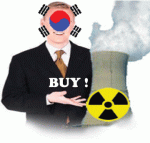 Reuters 24th July 2017, South Korea’s new energy minister on Monday said he plans to support the
country’s push to sell nuclear reactors overseas, even as the nation curbs
nuclear power at home. State-run Korea Electric Power Corp (KEPCO) is
building the first of four nuclear plants in the United Arab Emirates in an
$18.6 billion deal, and is scouting for more business in Britain and other
countries.
But that comes as South Korea, Asia’ fourth-largest economy, has
been looking to steer its domestic energy policy away from its current
heavy dependence on coal and nuclear, with large chunks of the public
skeptical about the safety of atomic power. http://www.reuters.com/article/us-southkorea-nuclear-minister-idUSKBN1A90N6
July 26, 2017
Posted by Christina Macpherson |
marketing, South Korea |
Leave a comment
Koreans target £10bn Welsh nuclear plant, John Collingridge July 23 2017, The Sunday Times A Korean state-owned power giant is drawing up plans to buy a slice of a new £10bn nuclear plant in north Wales.
July 24, 2017
Posted by Christina Macpherson |
marketing, South Korea, UK |
Leave a comment








 nuclear-news