North Korea warns US of ‘unimaginable’ nuclear strike http://thehill.com/policy/defense/356166-north-korea-warns-us-of-unimaginable-nuclear-strike, BY OLIVIA BEAVERS – 10/19/17 North Korea is warning that the United States will face an “unimaginable” nuclear strike for conducting ongoing joint naval drills with the South Korean military on the Korean peninsula.
“The U.S. is running amok by introducing under our nose the targets we have set as primary ones,” the state-controlled news agency KCNA warned Thursday, Newsweek reported. “The U.S. should expect that it would face unimaginable strike at an unimaginable time.”
KCNA also reportedly blamed the U.S. for “creating tension on the eve of war” by participating in civilian evacuation drills in South Korea over the weekend.
The remarks come amid escalating tensions between Washington and Pyongyang.
President Trump has recently stepped up his rhetoric against North Korea and leader Kim Jong Un, whom he’s dubbed “Little Rocket Man.”
During his first address to the United Nations General Assembly last month, Trump threatened to “totally destroy North Korea” if it continued to threaten the U.S. and its allies.
The high-stakes war of words comes after North Korea conducted a series of intercontinental ballistic missile and nuclear tests to display its progress toward developing a nuclear missile capable of striking the U.S.
October 20, 2017
Posted by Christina Macpherson |
North Korea, politics international, South Korea, USA, weapons and war |
Leave a comment
https://www.upi.com/Top_News/World-News/2017/10/19/South-Korea-developing-missiles-to-destroy-North-Korea-nuclear-facilities/3121508418413/, By Elizabeth Shim — South Korea is preparing for full-scale war with North Korea by developing missiles that could destroy North Korea nuclear and missile facilities in the event of a conflict.
Gen. Kim Yong-woo, chief of staff of the South Korean army, said a plan to reduce to ashes North Korea’s weapons facilities, has been created, local newspaper Segye Ilbo reported Thursday. Kim, who submitted his report for an annual parliamentary audit by the National Assembly’s defense committee, said the objective of the plan is to decimate Pyongyang’s weapons of mass destruction while minimizing casualties.
“We will develop the concept of operations that suppresses North Korea’s weapons of mass destruction in the early stages, while minimizing damage,” Kim said Thursday.
The concept of operations includes the development of three types of all-weather, ultra-precise, high-power missiles, the formation of a special maneuvering unit, a combat bot and drone system, and “game changers” or cutting-edge military systems.
The three types of missiles include a tactical surface-to-surface missile, the Hyunmoo-2, and the Hyunmoo-4 missiles, according to local news network YTN. The Hyunmoo-4, capable of carrying a 2-ton nuclear warhead and of targeting North Korea’s underground military facilities, will begin development once U.S.-South Korea missile guidelines are revised.
Included in the plan is an air-ground task force that includes airborne and mechanized troops, that would be deployed to make a push into enemy territory and to neutralize nuclear and missile facilities, Seoul said.
In a separate statement on Thursday, the South Korean navy said the Korea-based three-axis system that includes Kill Chain, Seoul’s pre-emptive strike system, is under review.
October 20, 2017
Posted by Christina Macpherson |
North Korea, South Korea, weapons and war |
Leave a comment

 Korea Joongang Daily 17th Oct 2017, The Biennial General Meeting (BGM) of the World Association of Nuclear
Operators (WANO) kicked off in Gyeongju, North Gyeongsang, on Monday,
bringing together some 500 nuclear industry experts and leaders from around
the world – but the government kept the meeting’s profile very low.
The biennial event, held at the Hico Convention Center in Korea’s cultural
capital some 340 kilometers (211 miles) southeast of Seoul, has the theme
“Leading Nuclear Safety in a Changing World” and will run for six days.
Speakers include Zhang Tao, president of China National Nuclear Power,
Agneta Rising, director general of the World Nuclear Association and
Vincent de Rivaz, CEO of EDF, the French electricity utility.
On the first day of the event, speeches delivered in panel discussions were not provided
to the press. Not a single placard was hung at the Hico building promoting
the event. Entrance to the convention center was closely regulated. No
press was allowed inside, not even a photographer, one security personnel
said.
The secretive nature of the proceeding was surprising given the
biennial event is often called the “Nuclear Power Olympics” for the
scope of expertise and ideas presented. News reports said state-run Korea
Hydro and Nuclear Power (KHNP) was deliberately avoiding publicity because
of the Moon Jae-in government’s attempt to wean Korea off nuclear power.
http://koreajoongangdaily.joins.com/news/article/article.aspx?aid=3039527&cloc=joongangdaily|home|newslist1
October 20, 2017
Posted by Christina Macpherson |
secrets,lies and civil liberties, South Korea |
Leave a comment
 Thyroid cancer patients say no to nuclear power plants http://m.koreatimes.co.kr/phone/news/view.jsp?req_newsidx=237600
  By Kim Se-jeong, 12 Oct 17,
More than 600 thyroid cancer patients living near nuclear power plants in the country came together earlier this week, calling on the government to keep its construction of new nuclear power plants halted.
They also asked the government to help them cope with their ordeals. Their calls came while the public debate on the construction of two Shin-Kori reactors is at its peak.
“Nuclear power plants are government projects,” a group of thyroid cancer patients and activists said in a press conference at the National Assembly, Wednesday. “We have contributed to the national growth by enduring many side effects of nuclear power plants. Now that we’re sick, we’re left to fight for survival alone.”
There are two ongoing lawsuits raised by the thyroid patients against Korea Hydro & Nuclear Power Co., the operator of the nuclear power plants, and Wednesday’s calls also meant to push the courts which are expected to deliver verdicts within this year.
One was filed in 2012 by a family of three ― a father, mother and son suffering colorectal cancer, thyroid cancer and a developmental disability, respectively. The lower court ruled partially in favor of the family, stating thyroid cancer had been caused by exposure to radioactive iodine from the power plant. The case is currently being reviewed by an appeals court.
The other lawsuit was filed in 2015 by 618 thyroid patients against the operator, demanding recognition and compensation. The patients are awaiting a verdict. What they want from the government are the following. For long-term action, they want no nuclear power plants so there will be no more such patients in Korea,” said Choi Soo-young, a Korean Federation for Environmental Movement activist. “For a short-term solution, they want to relocate themselves and want the government to pay for it.”
Exposure to radioactive iodine is one of the main causes of thyroid cancer.
A couple of epidemiological surveys in Korea have also found a high number of thyroid cancer patients in the areas close to nuclear power plants in Korea. Yet, the KHNP disputed this, saying the high number was a result of overtreatment.
Korea’s 24 nuclear power plants generate almost 30 percent of the nation’s electricity. Eighteen of them are concentrated in the southeastern region of Busan, Ulsan and Gyeongju.
“We want our voices to be heard by the group of citizens who are debating the new nuclear power plant construction. No more new nuclear power plants should be allowed,” Choi said. The group of almost 500 citizens is starting the three-day major debate on Friday in the final phase of the three-month-long debate. A decision on whether to resume the construction of the Shin-Kori reactors is expected on Oct. 20.
October 14, 2017
Posted by Christina Macpherson |
health, politics, South Korea |
Leave a comment
Jury on fate of 2 unfinished nuclear reactors to enter crucial debate camp this week 2017/10/08 SEOUL, Oct. 8 (Yonhap) — Hundreds of members of a jury formed to deliberate President Moon Jae-in’s proposal to scrap two unfinished nuclear power reactors are set to enter a three-day debate camp this week in a crucial final step to determine whether to kill or continue the project.
The 478-member jury, formally known as the “citizens’ participation group,” has since last month been familiarizing themselves with the pros and cons of the controversial proposal to abandon the construction of the Shingori-5 and Shingori-6 reactors in the southeastern city of Ulsan.
Starting Friday evening, they are scheduled to spend two nights together for final debates. The camp, set to be held at the Gyeseongwon retreat training center in the central city of Cheonan, is crucial because participants are expected to make up their mind depending on the debates.
Officials plan to conduct two surveys asking the participants whether the reactors’ construction should continue or end, at the beginning and end of the camp. Results are expected to be the main basis of a recommendation that a state commission plans to make on the reactors’ fate next week…….http://english.yonhapnews.co.kr/national/2017/09/29/0302000000AEN20170929002800315.html
October 9, 2017
Posted by Christina Macpherson |
politics, South Korea |
Leave a comment
Nuclear hit on Tokyo, Seoul ‘could kill 2 million’ http://www.straitstimes.com/asia/east-asia/nuclear-hit-on-tokyo-seoul-could-kill-2-million 6 Oct 17
New research shows disastrous outcomes for nearby US allies if North Korea strikes
SEOUL • As United States President Donald Trump threatens to destroy North Korea, even some of his closest aides have warned of the potentially disastrous effects of a war.
New research published on the 38 North website points to just how catastrophic the impact might be on the regime’s neighbours.
If North Korean leader Kim Jong Un were to launch a nuclear attack on Seoul and Tokyo – both within striking distance of his weapons – as many as 2.1 million people could die and another 7.7 million could be injured, according to the 38 North report.
The analysis by Mr Michael Zagurek Jr, a consultant specialising in databases and computer modelling, is based on North Korea’s current estimated weapons technology and bomb strength.
Mr Zagurek assumes that Mr Kim has a baseline arsenal of 20 to 25 warheads and the capacity to put them on ballistic missiles.
Concerns about a nuclear conflict in North Asia have increased as Mr Kim accelerates his programme of acquiring weapons capable of hitting continental US, and as Mr Trump threatens preemptive military action.
While the chance of a direct attack on US allies Japan and South Korea remains slim, Mr Zagurek said history was replete with miscalculation by “rational actors” during crisis situations.
North Korean Foreign Minister Ri Yong Ho last month said the regime’s possible next steps include testing a hydrogen bomb over the Pacific Ocean.
According to Mr Zagurek, it is possible that another nuclear test, an intercontinental ballistic missile test, or a missile test that has the payload impact area too close to US bases in Guam might see Washington react with force.
US options could include attempting to shoot down the test missiles or possibly attacking the North’s missile testing, nuclear-related sites, missile deployment areas or the Kim regime itself. In turn, the North Korean leadership might perceive such an attack as an attempt to remove the Kim family from power and, as a result, could retaliate with nuclear weapons, he added.
North Korea’s older warheads have yields in the 15-25-kilotonne range, around the size of the bombs that devastated Hiroshima and Nagasaki in 1945.
Fatality estimates rise significantly if North Korea were able to strike with bombs similar to the one it tested on Sept 3, which had a likely yield of 108-205 kilotonnes, Mr Zagurek said.
October 7, 2017
Posted by Christina Macpherson |
Japan, North Korea, South Korea, USA, weapons and war |
Leave a comment
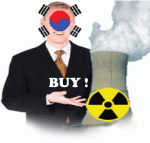 Nuclear phase-out puts burden on S. Korea’s export drive By Kim Eun-jung SEOUL, Sept. 23 (Yonhap) –– South Korea’s nuclear phase-out policy may create a boom for the renewable energy initiative and allay public safety concerns, but it may also send an unwanted signal to the outside world that could hurt the country’s push to expand into the global atomic power generation market.
Since taking office in May, President Moon Jae-in has scrapped plans for new nuclear power plants and vowed not to extend the life cycles of 24 existing reactors, in a bid to end decades of reliance on the controversial energy source.
The latest move was aimed at addressing safety concerns after the 2011 Fukushima disaster and is in line with actions taken by other advanced economies that are turning to renewable energy sources, including the U.S., France and Germany.
This drastic turn from past administrations’ pro-nuclear policies, however, raises questions over South Korea’s status in the global nuclear market, which has seen spike in competition with the rise of state-backed Russian and Chinese companies in recent years.
Seoul policymakers have pledged continued support for overseas projects separate from its domestic energy policy, but industry insiders worry that less enthusiasm for nuclear power could shrink investment in advanced nuclear technologies and give South Korea less bargaining power on the global stage…….http://english.yonhapnews.co.kr/business/2017/09/22/0503000000AEN20170922008800320.html
September 25, 2017
Posted by Christina Macpherson |
marketing, South Korea |
Leave a comment
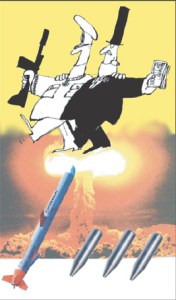
| Moon and Trump agree on South Korea purchase of state-of-the-art US weaponry during summit |
Hankyoreh Sep.22,2017 The deal is reportedly set to include nuclear powered submarines
South Korean President Moon Jae-in and US President Donald Trump agreed on Sept. 21 on a plan for South Korea to introduce state-of-the-art US weaponry or develop its own to counter North Korea’s recent nuclear and missile provocations. Later the same day, Moon had a luncheon and trilateral summit with Trump and Japanese Prime Minister Shinzo Abe, where the three agreed that the entire international community “must apply the maximum intensity sanctions and pressure so that North Korea cannot withstand it anymore and must come to the table for dialogue.” ……http://english.hani.co.kr/arti/english_edition/e_northkorea/812155.html
September 23, 2017
Posted by Christina Macpherson |
business and costs, South Korea, USA, weapons and war |
Leave a comment
 Korean peninsula draws range of military drills in show of force against North Korea http://www.reuters.com/article/us-northkorea-missiles/korean-peninsula-draws-range-of-military-drills-in-show-of-force-against-north-korea-idUSKCN1BT0CK, Ben Blanchard, Hyonhee Shin BEIJING/SEOUL (Reuters) 18 Sept 17, – The U.S. military staged bombing drills with South Korea over the Korean peninsula and Russia and China began naval exercises ahead of a U.N. General Assembly meeting on Tuesday where North Korea’s nuclear threat is likely to loom large.
The flurry of military drills came after Pyongyang fired another mid-range ballistic missile over Japan on Friday and the reclusive North conducted its sixth and most powerful nuclear test on Sept. 3 in defiance of United Nations sanctions and other international pressure.
A pair of U.S. B-1B bombers and four F-35 jets flew from Guam and Japan and joined four South Korean F-15K fighters in the latest drill, South Korea’s defense ministry said.
The joint drills were being conducted “two to three times a month these days”, Defence Minister Song Young-moo told a parliamentary hearing on Monday.
In Beijing, the official Xinhua news agency said China and Russia began naval drills off the Russian far eastern port of Vladivostok, not far from the Russia-North Korea border. Those drills were being conducted between Peter the Great Bay, near Vladivostok, and the southern part of the Sea of Okhotsk, to the north of Japan, it said.
The drills are the second part of China-Russian naval exercises this year, the first part of which was staged in the Baltic in July. Xinhua did not directly link the drills to current tension over North Korea.
China and Russia have repeatedly called for a peaceful solution and talks to resolve the issue.
On Sunday, however, U.S. Ambassador to the United Nations Nikki Haley said the U.N. Security Council had run out of options on containing North Korea’s nuclear program and the United States might have to turn the matter over to the Pentagon.
September 22, 2017
Posted by Christina Macpherson |
South Korea, USA, weapons and war |
Leave a comment
No nuclear weapons in South Korea, says President Moon, By Paula Hancocks and James Griffiths, CNN September 14, 2017
Story highlights
September 15, 2017
Posted by Christina Macpherson |
politics, South Korea, weapons and war |
Leave a comment
A South Korean delegation asks Washington for nuclear weapons, WP, By Josh Rogin September 14, 17, The heated debate in South Korea over redeploying U.S. nuclear weapons on its territory has now reached Washington. A senior delegation of South Korean lawmakers is in town making the case to the Trump administration and Congress that such a move is needed to confront North Korea’s growing nuclear capability and place more pressure on China.
“We are here to ask for redeployment of tactical nuclear warheads in South Korea,” Lee Cheol Woo, the head of the intelligence committee of South Korea’s National Assembly, told me Thursday morning.
Lee is heading a delegation of members of the Liberty Korea Party, the opposition to President Moon Jae-in’s Democratic Party. He is also the chairman of the assembly’s special committee for nuclear crisis response.
Moon told CNN yesterday that he does not agree that tactical nuclear weapons should be reintroduced to South Korea or that Seoul should develop its own nuclear weapons. He warned it could “lead to a nuclear arms race in northeast Asia.” But Lee’s delegation believes that as the North Korea nuclear crisis worsens, a push by the Trump administration or Congress could help persuade Moon’s government to change its position, as it has already done regarding the deployment of the THAAD missile defense system……https://www.washingtonpost.com/news/josh-rogin/wp/2017/09/14/a-south-korean-delegation-asks-washington-for-nuclear-weapons/?utm_term=.fa0b8e508c36
September 15, 2017
Posted by Christina Macpherson |
politics, South Korea, weapons and war |
Leave a comment
MINISTRY: MORE THAAD LAUNCHERS TO BE DEPLOYED THURSDAY, Appsforpcdaily.com, Floyd Cook 10 Sept 17, South Korea says the US military will begin adding more launchers to a contentious high-tech USA missile defense system in South Korea on Thursday to better cope with North Korean threats.

The deployment of THAAD is of great concern to China. On Tuesday, Seoul Administrative Court has dismissed the claim of Seongju residents to suspend the government’s decision to allocate land for the THAAD missile system. Seoul’s Defense Ministry has said the USA military will begin installing the additional launchers Thursday.
Local residents worry about rumored health hazards related to the system’s high-powered radars and the possibility of being targeted in North Korean attacks.
Trump has repeatedly criticized the five-year-old South Korea-U.S. (KORUS) FTA as a frightful deal for creating a $27 billion U.S. trade deficit with South Korea last year. In August, about 900 people from the county shaved their heads to protest the government’s decision……..
Moscow has repeatedly opposed the THAAD deployment, as it could further deteriorate the nuclear crisis and provoke North Korean aggression.
Beijing has objected to the advanced anti-missile battery high-resolution radar system that can potentially monitor China’s military activities as a threat to its security, and had reportedly imposed informal restrictions on selected South Korean imports and tourism as retaliation.
A THAAD battery normally consists of six launchers that can fire up to 48 interceptor missiles, but only two launchers been operational at the site, on a former golf course. http://appsforpcdaily.com/2017/09/ministry-more-thaad-launchers-to-be-deployed-thursday/
September 11, 2017
Posted by Christina Macpherson |
South Korea, weapons and war |
Leave a comment
South Korea detects radioactive material following North Korean nuclear test, http://www.foxnews.com/world/2017/09/08/south-korea-detects-radioactive-material-following-north-korean-nuclear-test.html, September 08, 2017 Traces of radioactive material were detected in South Korea by the nation’s nuclear safety agency Friday, less than a week after North Korea conducted its most powerful nuclear test.
South Korea’s Nuclear Safety and Security Commission discovered trace amounts of xenon gas, a radionuclide, in an analysis of samples from the air, ground and water collected following North Korea’s nuclear test, according to Yonhap News Agency.
North Korea defied international warnings Sunday, conducting its sixth and most powerful nuclear test. The country said it detonated a hydrogen bomb that can fit on an intercontinental ballistic missile. South Korean Prime Minister Lee Nak-yon said Thursday he expects its neighbor to launch a missile Saturday while celebrating its founding day. North Korea has already fired 21 missiles this year.
The radioactive material’s inflow is still being tracked to determine definitively if it came from the nuclear test, according to the agency.
The agency added the level of radioactive material detected in the analysis is not enough to cause any effects on South Koreans’ health.
September 9, 2017
Posted by Christina Macpherson |
radiation, South Korea |
1 Comment
Allies seek to deploy aircraft carrier, strategic bomber in response to N.K. nuke test, Yonhap News, 2017-09- SEOUL, Sept. 4 — South Korea and the United States will seek to deploy a nuclear-powered aircraft carrier, strategic bombers and other powerful assets to the Korean Peninsula as a response to North Korea’s latest nuclear test, Seoul’s defense ministry said Monday.
In its report to the National Assembly’s defense committee, the ministry also said that its military will stage a unilateral live-fire drill, which involves Taurus air-to-surface guided missiles mounted on its F-15K fighter jets, this month. The missile with a range of 500 kilometers is capable of launching precision strikes on the North’s key nuclear and missile facilities.
“We will push for the option of deploying strategic assets such as the U.S. carrier strike group and strategic bombers after consultation with the U.S.,” the ministry said.
The show-of-force measures were unveiled a day after Pyongyang conducted what it claims to be a test of a hydrogen bomb mountable onto an intercontinental ballistic missile, sharply raising military tensions.
At the parliamentary session, Defense Minister Song Young-moo said that during his recent talks with U.S. Defense Secretary James Mattis, he demanded that the U.S. deploy its strategic assets to Korea on a “regular” basis. He made the demand, citing local politicians’ calls for the redeployment of U.S. tactical nukes.
But he dismissed the news report that he actually demanded the redeployment of the U.S. nuclear arsenal withdrawn from the peninsula in the early 1990s…….http://m.yna.co.kr/mob2/en/contents_en.jsp?cid=AEN20170904010952315
September 6, 2017
Posted by Christina Macpherson |
politics international, South Korea, USA, weapons and war |
Leave a comment
 S.Korea, US to lift warhead weight limit on South Korean missiles | 04 Sept 2017 | The US agreed to allow South Korea deploy heavier warheads on its missiles after the latest nuclear test by Pyongyang. The existing limit set in a missile pact between Washington and Seoul is 500 kg. The agreement to lift the weight limit was reached by US President Donald Trump and his South Korean counterpart Moon Jae-in in a phone call on Monday, the South Korean presidential office said in a statement. With tensions rising on the Korean peninsula, Donald Trump also gave “conceptual approval” for billions worth of US weapons to be sold to South Korea.
September 6, 2017
Posted by Christina Macpherson |
South Korea, weapons and war |
Leave a comment



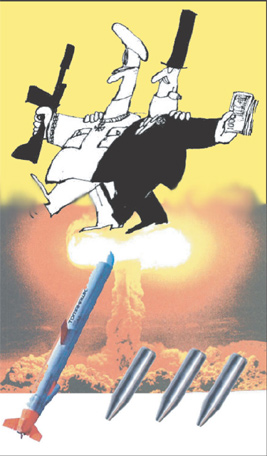




 nuclear-news