After numerous test launches, North Korean scientists have already mastered long-range guidance and control capabilities, while a series of underground tests have demonstrated that the regime of Kim Jong-un has acquired nuclear weapons.
North Korea hints that it could test a long range missile, that could hit New York
North Korea threatens to drop nuclear bomb on New York to prove Donald Trump tweet wrong
‘The DPRK is about 10,400 km far away from New York, but this is just not a long distance for a strike today’ Independent Gabriel Samuels @gabs_samuels 14 June 17 Korea has hinted that it could test a long range missile capable of hitting New York, months after President Donald Trump insisted: “It won’t happen”.
Accusing the US leader of underestimating the secretive Communist state’s capabilities, an article last week in state-run newspaper Rodong Sinmun, suggested that it was close to developing an intercontinental ballistic missile (ICBM).
“Trump blustered early this year that the DPRK’s final access to a nuclear weapon that can reach the US mainland will never happen,” the editorial said, using an abbreviation for the country’s official name, the Democratic People’s Republic of Korea. …..http://www.independent.co.uk/news/world/asia/north-korea-nuclear-bomb-new-york-donald-trump-tweet-mocking-missile-capabilities-a7787686.html
Increased activity around N. Korean test site may indicate 6th nuclear test
 Activity around N. Korean test site may foretell 6th nuclear test, Asahi Shimbun, By YOSHIHIRO MAKINO/ Correspondent, June 11, 2017 SEOUL–Activity has intensified in the area around a North Korean nuclear test site, indicating Pyongyang may be preparing a sixth nuclear test, which it warned last month was “imminent.”
The preparations near the Punggyeri site match those of past occasions before North Korea conducted a nuclear test.
According to sources knowledgeable about what is occurring in North Korea, scientists who oversee nuclear materials as well as evaluate the nuclear tests have gathered at the Punggyeri site.
In addition, traffic to the site has been apparently shut down at the checkpoints leading to the area in northeastern North Korea.
However, movement of vehicles and humans within the test site continues to be active.
It is unclear if that flurry of activity is a precursor to a nuclear test or simply an exercise to prepare or inspect the site.
With the international community continuing to exert strong pressure on Pyongyang, a South Korean government source said, “there is a low possibility of North Korea going ahead with a nuclear test, which could end up being an act of suicide.”
There is the possibility of even further economic sanctions, such as suspension of petroleum imports, should North Korea continue with military provocations.
According to sources knowledgeable about China-South Korea ties, similar activity around the Punggyeri site was observed in April.
China took those preparations to be a sign that North Korea was about to conduct a nuclear test. Chinese officials explained to their counterparts in the United States and South Korea that pressure was applied at that time on North Korea in the form of a temporary suspension of Air China flights between Beijing and Pyongyang.
Meanwhile, North Korea has shown little sign of being cowed by the sanctions…….http://www.asahi.com/ajw/articles/AJ201706110023.html
USA nuclear weapons production, testing, and use, released carbon emissions – claims North Korea
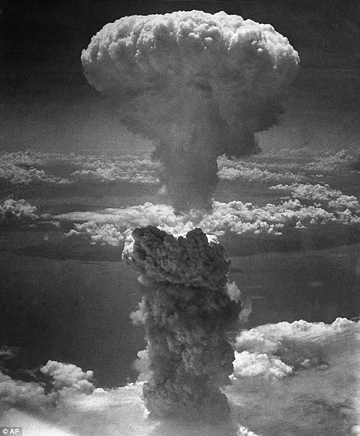 NORTH KOREA CLAIMS U.S. WAR AND NUCLEAR WEAPONS CAUSED CLIMATE CHANGE, NewsWeek, BY ON 6/10/17 North Korea has accused U.S. military and environmental policies of causing climate change and producing pollution around the world.
In a scathing report cited Friday by North Korea’s official Korean Central News Agency (KCNA), the state-run Institute for International Studies of the DPRK (an acronym for the country’s official title: the People’s Democratic Republic of Korea), asserted that the U.S.’s use of nuclear weapons, involvement in foreign conflicts and style of production had most harmed the environment since the Cold War. The study, attributed to researcher Kim Kum Hui and titled “The U.S. Is Chiefly to Blame for Global Environmental Pollution,” advised the U.S. to change course and safeguard the environment…..
North Korea’s report claimed that since the Cold War, the U.S. has forced other nations to adopt its model of “American-style development” under the guise of economic globalization. It said the U.S. alone accounted for 22.1 percent of the world’s carbon emissions in 2004. The figure appears to relatively coincide with conclusions established the following year by Washington-based think tank the World Research Institute. Research by the same organization says the U.S. contributed 14.4 percent in 2012, second only to China’s 25.36 percent. That same year, North Korea, an underdeveloped nation of around 25 million, was listed at .17 percent.
The report also laid into the military practices of the U.S., with which North Korea fought a war in the 1950s. The piece condemned the U.S.’s dropping of atomic bombs on the Japanese cities of Hiroshima and Nagasaki at the end of World War Two in 1945, as well as the government’s nuclear tests, which numbered 1,054 between 1945 and 1992, according to the Department of Energy…….
Despite North Korea’s traditionally dismissive nature toward international treaties, Pyongyang has at times been a vocal advocate of global cooperation on environmental issues. It signed the 2015 Paris Climate Agreement, which is geared toward reducing global greenhouse gas emissions, and deeply criticized Trump for pledging to withdraw from the non-binding, landmark treaty last week. North Korea has suffered from a number of deadly famines and floods that experts and international agencies have said indicate its vulnerability to climate change. http://www.newsweek.com/north-korea-us-war-nuclear-weapons-climate-change-623825
Defiant North Korea vows to continue its nuclear weapons development
North Korea “fully rejects” new UN sanctions and vows to continue its nuclear weapons development
Kim Jong-un’s rogue state described the sanctions resolution as “a crafty hostile act”, The Sun By Jon Lockett 4th June 2017,
North Korea ramps up nuclear warning to USA
 NORTH KOREA CLAIMS ‘MOST POWERFUL NUCLEAR WEAPON’ IN STORE FOR U.S. IF MILITARY DOES NOT BACK OFF, NewsWeek, BY ON 6/1/17 North Korea told the U.S. Thursday to withdraw its military assets from the region, warning via state-run media that a military showdown would end in nuclear destruction.
North Korea’s official Korean Central News Agency released an article titled “U.S. Urged Not to Adventure Military Actions,” in which an official tasked with inter-Korean relations criticized the U.S.’s military moves in the region. Japan, an ally of Washington and rival of Pyongyang, began major naval and air force exercises Thursday with the U.S.’s Carl Vinson and Ronald Reagon aircraft carriers, Reutersreported. The U.S. warships were dispatched to the region in response to suggestions that North Korea would conduct a sixth nuclear weapons test, something President Donald Trump has vowed to prevent. In a statement Thursday, a spokesperson for North Korea’s Korea Asia-Pacific Peace Committee said the U.S. military moves proved it was to blame for heightened regional tensions…….
North Korea argues its pursuit of nuclear weapons technology is for deterrence purposes. The nation is believed to possess up to 20 nuclear warheads as well as an extensive ballistic missile arsenal. Analysts do not believe North Korea will be able to produce a viable nuclear-capable intercontinental missile until at least 2020, but the militarized, authoritarian state is thought to be capable of launching nuclear attacks against neighboring nations, including South Korea and Japan, both of which host U.S. military installations and personnel.
The Trump administration announced Thursday additional economic sanctions targeting companies that allegedly play a role in North Korea’s development of nuclear weapons, according to the Los Angeles Times. The White House’s latest efforts to prevent North Korea from carrying out another nuclear weapons test through sanctions come as Trump seeks help from China, a traditional rival and North Korea’s greatest ally, to rein in the North’s nuclear ambitions. The presence of U.S. warships and ongoing military drills, however, could appear as a reminder of Trump’s willingness to use military force quickly and unexpectedly, as he did in Syria in April.
These actions have left North Korea and its young leader, Kim Jong Un, deeply suspicious of any U.S. attempts to establish a dialogue. Since Trump dispatched the naval aircraft carrier strike group in April, North Korea’s government-controlled media has been awash with criticism of U.S. foreign policy and reports of alleged U.S.-backed plots against Kim and his administration. The articles frequently cite North Korea’s weapons of mass destruction as being existentially necessary to the country’s survival, and assert the nation’s right to possess and develop them in the face of U.S. threats of intervention. In Thursday’s piece, the Korean Central News Agency called on Washington to reverse its course of action or face nuclear assault….http://www.newsweek.com/north-korea-us-stop-military-action-powerful-nuclear-weapon-619311
Danger of conflict between USA and North Korea: North Korea has 100 Unidentified Nuclear Facilities
38 North: N. Korea Has 100 Unidentified Nuclear Facilities http://world.kbs.co.kr/english/news/news_In_detail.htm?No=127670 2017-05-30The managing editor of the U.S.-based North Korea-monitoring Web site 38 North says that the North has roughly 100 unidentified nuclear facilities.
According to the Sankei Shimbun on Tuesday, Managing Editor Jenny Town told the Japanese newspaper that it remains unclear where North Korea is manufacturing and storing nuclear weapons.
She said purposes and locations have been identified for only a few of some 100 facilities presumed to be related to the North’s nuclear activities.
Town said that there is a chance that North Korean leader Kim Jong-un may misunderstand red lines presented by the U.S. and head into a military conflict with the U.S.
She added that the North is just waiting for a justification to conduct a nuclear test.
s the Korean Demilitarized Zone poised to become “ground zero for the end of the world”?
The Korean Peninsula: Ground Zero for Armageddon? May 30, 2017 By Simone Chun, Truthout | News Analysis Is the Korean Demilitarized Zone poised to become “ground zero for the end of the world”? Historian Bruce Cumings, the author of The Origins of the Korean War, raised this question in a recent article for the London Review of Books, and judging by a series of exchanges between the United States and North Korea in recent weeks, the possibility may not be as remote as it once seemed.
In April, North Korea warned of the imminence of “a thermonuclear war,” a prospect seemingly acknowledged by President Trump’s declaration that, “We could end up having a major, major conflict with North Korea.” On May 2, a US carrier strike group patrolled the waters off the Korean Peninsula in anticipation of North Korea’s sixth nuclear test, which never happened. Nevertheless, on May 14, Pyongyang test-fired a new class of missile into the waters between the North and neighboring Japan, prompting the US to move a second heavily armed carrier strike group, equipped with Aegis missile defense systems, to the Korean Peninsula. These two strike groups, which jointly field a total of some 160-attack aircraft and are escorted by substantial support fleets, considerably raise the stakes in the region.
According to Cumings, the latest high-stakes exchanges between the United States and North Korea are a continuation of six decades of US foreign policy which, “Since the very beginning … has cycled through a menu of options to try and control the [Democratic People’s Republic of Korea, or North Korea].” According to The New Yorker, in this asymmetric conflict, North Korea uses “belligerent propaganda — not to mention nuclear-tipped ballistic missiles” to counter what it perceives as a persistent existential threat from the United States.
Noam Chomsky has described the current situation as the logical outcome of the propensity of the United States to “play with fire” rather than making genuine efforts to achieve denuclearization: “Over and over again,” he observes, “There are possibilities of diplomacy and negotiation … which are abandoned, dismissed, literally without comment, in favor of increased force and violence.”
Republicans and Democrats have historically shown great unity in this approach toward North Korea, with the notable exception of the Clinton administration, whose direct talks with Pyongyang achieved an eight-year freeze on all North Korean plutonium production (from 1994-2002). However, in 2001, George W. Bush abruptly inducted North Korea into the “axis of evil,” prompting Pyongyang to withdraw from the Nuclear Non-Proliferation Treaty, and return to the reasoning that nuclear weapons alone could prevent an inevitable full-scale attack by the US in the future.
More recently, President Obama’s much-touted “pivot” to Asia — essentially a policy of isolating North Korea while boosting Japanese militarism — has succeeded only in laying the groundwork for a new regional cold war. Under the Trump administration, the pivot to Asia is overtly accelerating the militarization of the entire region, with some $7.5 billion being invested to boost infrastructure, equipment, and new troop and asset deployments. This amount accounts for nearly 14 percent of the total $54 billion increase in military spending requested by the Trump administration.
North Korea experts point out that, “Even with its nuclear program, North Korea is a weak country with an outdated military and a very small population,” incapable of anything but an insignificant military threat to the US. Yet US mainstream media pundits and government officials have tirelessly molded public perception of North Korea, portraying it as a determined, bristling adversary bent on raining destruction upon the US mainland with little or no provocation. Rounding out the propaganda image of the fearsomely irreconcilable foe, North Korean leadership itself is regularly depicted as irrational by the US, and often labeled with pseudo-psychiatric diagnoses. Most recently at the UN, US Ambassador Nikki Haley endeavored to display her psychiatric insight by “get[ting] into Kim Jong-un’s head,” and pronouncing him to be “in a state of paranoia … incredibly concerned about anything and everything around him.”
Such sophomoric appraisals of North Korea, while lacking historical and analytical perspective, play well to public fears. The characterization of North Korea as the unequivocally irrational and constantly threatening “other” have skewed US public opinion over the span of six decades. Pew public opinion polls show that “78% of Americans now have an unfavorable view of the North, with 61% holding a very unfavorable view.”…….
Nevertheless, American voices are increasingly calling for a new dialogue between the US and North Korea, for even though Americans by and large view North Korea as “the enemy,” an Economist/YouGov poll conducted in May 2017 found that 60 percent of Americans supported direct negotiations between the United States and North Korea. This statistic in itself speaks volumes, and shows that even in the worst of times, humans hope for commonality and view interpersonal interaction as a catalyst that has the potential of triggering positive change.
Officials on both sides of the Pacific have also begun renewed calls for dialogue amid heightening tensions. The new South Korean President Moon Jae-in was elected with a strong mandate for engagement with North Korea, and has promised a renewed emphasis on diplomacy and rapprochement. Even Pentagon chief James Mattis, noting the grave risks of open conflict, has reiterated the US commitment to working with allies in order to arrive at a diplomatic resolution to the nuclear stalemate.
As former Secretary of Defense William J. Perry recently noted, opportunities for peace and security in Northeast Asia still exist in the midst of conflict, awaiting only the political will and foresight to actualize them: “We now have the opportunity for a new approach to diplomacy. Will we have the wisdom to seize it?”
An overt shift toward diplomacy would be a welcome development for the many Koreans who still dream of an end to the painful schism imposed on their collective psyche by six decades of hostility and separation. David Kang, a Korean studies scholar at the University of Southern California, dreams of crossing the Korean Demilitarized Zone with his 81-year-old father to visit the site of the elder Kang’s hometown, which was destroyed during the height of the Korean War. “I would love to fly to Seoul with my father” he says, “and drive together to where he was born.”
Dr. Simone Chun has taught at Northeastern University in Boston, and served as an associate in research at Harvard University’s Korea Institute. She is an active member of the Korea Peace Network, and a member of the steering committee of the Alliance of Scholars Concerned about Korea. http://www.truth-out.org/news/item/40737-the-korean-peninsula-ground-zero-for-armageddon

Of all options, attack on North Korea would be the worst
Blair’s statement echo’s Secretary of Defence Jim Mattis’ recent admission that a fight with the North would be “”tragic on an unbelievable scale.”
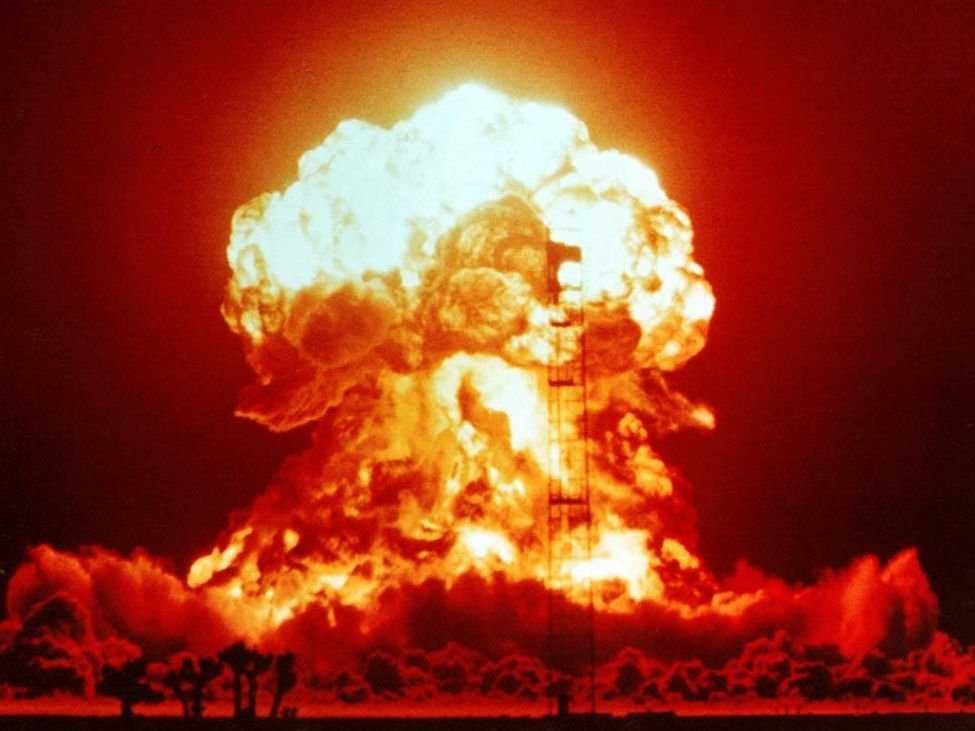 Here’s why the US would have to be absolutely insane to attack North Korea https://www.businessinsider.com.au/us-attack-north-korea-insane-2017-5?r=US&IR=T ALEX LOCKIE, MAY 26, 2017, Despite reports of US and Chinese military buildups, North Korea’s increased pace of provocations, and President Donald Trump’s administration’s repeated claims that “all options are on the table,” — the US would have to be absolutely insane to attack North Korea.
North Korea’s Chemical and Cyber Weapons Are Already a Threat
 Forget North Korea’s Nuclear Arsenal. Its Chemical and Cyber Weapons Are Already a Threat. Pyongyang’s VX attack and cyber hijinks suggests a regime bent on acquiring multiple weapons of mass disruption and destruction. National Interest May 25, 2017 “….To be clear, nuclear weapons are a real and gathering danger, and frequent test launches by the Korean People’s Army suggest steady progress toward deploying long-range nuclear missiles. Yet there is considerable experience and success in deterring nuclear arsenals. The same cannot be said for biochemical and cyber weapons…….
North Korea expanding cybercrime and cyberwar capabilities.
No one can be sure yet who was responsible for the recent wave of ransomware attacks, but certainly North Korea has both the means and the motive for undertaking such action. Some suspect that North Korean sleeper cells of digital soldiers may have carried out the worldwide assault to strike back at outside powers, including China, while also seeking to finance expensive weapons programs. Authentication will take time, but there seems to be a connection between the so-called Lazarus hacking group and the remarkably successful 2016 cyber heist of the central bank in Bangladesh and the 2014 assault on Sony Corporation. North Korea’s special Unit 180 may be linked to these information warfare activities……
Pyongyang likes to rattle the nuclear saber but remains ready to use biochemical and cyber weapons. Nuclear weapons are useful insurance policies against intervention, but their use would be suicidal. The more surreptitious use of biochemical and cyber weapons, however, risks creating a grave new world by seeking to strike below the threshold of nuclear deterrence and catalyzing war.
The hopeful news is that leading officials in Seoul and Washington understand the stakes and the need to work together to preserve deterrence in the face of emerging threats. Secretary of Defense James Mattis recently stated that using force to settle the North Korea problem by would be “tragic on an unbelievable scale.” And President Moon Jae-in’s new national security advisor, Chung Eui-yong, has emphasized that “there is ample room for the U.S. and South Korea to calibrate and plan their joint engagement with the North.”……Dr. Patrick M. Cronin directs the Asia-Pacific Security Program at the Center for a New American Security (CNAS) in Washington, DC; his Twitter handle is @PMCroninCNAS. http://nationalinterest.org/feature/forget-north-koreas-nuclear-arsenal-its-chemical-cyber-20846
North Korea will eventually be able to carry out nuclear missile strike on US mainland
North Korea nuclear missile strike on US mainland is ‘inevitable’, says Defence intelligence chief
Donald Trump recently called North Korean leader Kim Jong-un a ‘madman’, The Independent, Mythili Sampathkumar New York @MythiliSk 26 May 17, The Defence Intelligence Agency chief has said it is “inevitable” that a nuclear weapon launched from North Korea would hit the US mainland.
Lieutenant General Vincent Stewart told the Senate Armed Services Committee that the possibility of an attack was very real after a recent nuclear missile test conducted by Pyongyang.
He warned that if the isolated country and its leader Kim Jong-un are left on the “current trajectory the regime will ultimately succeed.” However Mr Stewart said it was “nearly impossible to predict when” that would be.
He and Director of National Intelligence Dan Coates were pressed for a timeline repeatedly but refused to give a concrete answer out of fear that it may reveal what intelligence the US has been able to gather on Pyonyang.
“We do not have constant, consistent [intelligence and surveillance] capabilities and so there are gaps, and the North Koreans know about these,” Mr Coates said.
Mr Coates also testified in the hearing that what makes North Korea a particularly “grave national security threat” is Mr Kim’s “aggressive” leadership. He seems determined to develop a nuclear missile capable of reach the west coast of the US, called an intercontinental ballistic missile (ICBM).
Breakthrough for North Korea’s missile test – re-entry to Earth’s atmsophere
North Korea missile passes re-entry test in breakthrough for nuclear programme, Telegraph, in Tokyo 20 MAY 2017
The ballistic missile launched by North Korea on May 14 successfully re-entered the Earth’s atmosphere, according to analysts, a significant breakthrough for Pyongyang’s missile programme.
Defence officials in South Korea and the US have confirmed that the launch of the liquid- fuel Hwasong-12 was a success.
North Korea claimed that the weapon reached an altitude of 2,111.5 km (1,312 miles) and travelled a distance of 489 miles before breaching Japan’s Air Defence Identification Zone and splashing down in the Sea of Japan……..
As a result of the latest North Korean test, US authorities have decided to extend the deployment of the USS Carl Vinson and its strike group in the Sea of Japan. The fleet – described as an “armada” by President Donald Trump – was due to depart from the region after the USS Ronald Reagan, another aircraft carrier, completed a refit at the US naval base at Yokosuka, Japan.
The USS Ronald Reagan put to sea on May 16 and the two strike groups are now scheduled to carry out manoeuvres with South Korean warships in the coming weeks…http://www.telegraph.co.uk/news/2017/05/20/northkorea-missile-passes-re-entry-test-breakthrough-nuclear/
North Korea’s vast military capabilities, even without nuclear weapons
How much damage could North Korea unleash even without nuclear weapons?, ABC News By Michael Collett, 21 May 17, There’s been a lot of focus on North Korea’s nuclear ambitions, and specifically, its hopes of developing a missile that could deliver a nuclear strike on the United States.
But what can be lost in the discussion of the country’s recent missile tests is the vast military capabilities the country already has.
This morning, US Defence Secretary Jim Mattis said any military solution to the North Korea crisis would be “tragic on an unbelievable scale”.
This is why a diplomatic solution is widely seen as the only solution.
What do we know about North Korea’s military?
Nick Bisley, executive director of La Trobe Asia and editor-in-chief of the Australian Journal of International Affairs, says the military is the second most important institution in North Korea behind the Kim dynasty.
“The whole economy and the purpose of the state is organised around ensuring that the military has vast capacity,” he said.
So despite North Korea having an estimated population of about 25 million — not much more than Australia — it has the second biggest military in Asia behind China……..
North Korea has vast artillery capabilities that are targeted on Seoul, which has a population of 10 million and is less than an hour’s drive from the DMZ……..
Ultimately, it’s all about regime security.
“Yes, there’s a paranoid streak in North Korean thinking, but it’s not unfounded. There is someone who’s out to get them,” Professor Bisley said…… http://www.abc.net.au/news/2017-05-20/what-can-north-korea-already-do-without-nuclear-weapons/8543532
North Korea defiant on nuclear missile testing
North Korea links nuclear advances to ‘hostile’ U.S. policy, Globe and Mail, EDITH M. LEDERER AND MATTHEW PENNINGTON, The Associated Press, May 19, 2017 The U.S. defence chief warned Friday that a military solution to the standoff with North Korea would be “tragic on an unbelievable scale,” while the North vowed to rapidly strengthen its nuclear-strike capability as long as it faces a “hostile” U.S. policy.
North Korea is a nuclear state. We have to live with that
Stephen Rademaker: North Korea is a nuclear state. We have to live with that, and here’s how Stephen Rademaker, Washington Post | May 19, 2017 Last Sunday, North Korea successfully demonstrated for the first time that it could strike U.S. territory in the Pacific. After more than 25 years of wrestling with the North Korean nuclear threat, it’s time to recognize that North Korea is not merely seeking to gain bargaining leverage against us. Rather, it is determined to possess nuclear weapons, and we need to develop a realistic strategy for containing, defending against and deterring what will be a persistent and growing nuclear threat.
There’s every reason to continue pursuing sanctions and diplomacy, but we should not premise our policy on the expectation that such efforts are going to succeed in persuading North Korea to change course. We must also recognize that there is no acceptable military solution to the problem.
Even before the North produced its first nuclear weapon, the United States calculated that the potential cost for any military strike was too great for America and South Korea. Now that North Korea has nuclear weapons, as well as missiles that can reach Guam and beyond, this logic is even more compelling.
It is indeed true, as the Trump administration has concluded, that China has the wherewithal to compel North Korea to abandon its nuclear weapons. But China is a great power that has had plenty of time to think through its policy. It is concerned, but clearly not panicked. More important, it perceives plenty of downsides to overreacting, including the potential collapse and absorption of its ally, North Korea, into America’s ally, South Korea.
So great is our dependence on China that, like hostages held by a kidnapper, all previous administrations developed a sort of Stockholm syndrome, coming to believe that China was doing everything it could to help solve the problem, when it manifestly could do more. After 25 years, we should not assume that more hectoring, promises or threats will persuade China to act in ways it believes contrary to its interests…….http://news.nationalpost.com/full-comment/stephen-rademaker-north-korea-is-a-nuclear-state-we-have-to-live-with-that-and-heres-how
Cyber war a more likely threat than nuclear war? North Korea has expertise in this
With the attention of the United States and its allies at present focused on North Korea’s nuclear activity, North Korea potentially has greater latitude to act aggressively in the cyber realm, especially against the private sector.
North Korea, Iran, and the Challenges of Dealing With Cyber-Capable Nuclear States https://www.lawfareblog.com/north-korea-iran-and-challenges-dealing-cyber-capable-nuclear-states, By Luke McNamara, May 18, 2017 North Korea’s successful missile launch last Sunday has further sharpened the world’s focus on the country’s growing nuclear capabilities. But in remarks last month, Homeland Security Secretary John Kelly commented that North Korea poses a more likely cyber threat than it does a nuclear concern.
1 This Month

Protect Sazan Island from the Trump family! https://secure.avaaz.org/campaign/en/protect_sazan_island_from_the_trump_family_loc/?bqFCVab&v=174511&cl=22707147157&_checksum=5e9dde668860e8231c33699735e16a1fbf22ab2cb01da50c999fe8732b9775ef&utm_source=email&utm_medium=blast_email&utm_campaign=174511
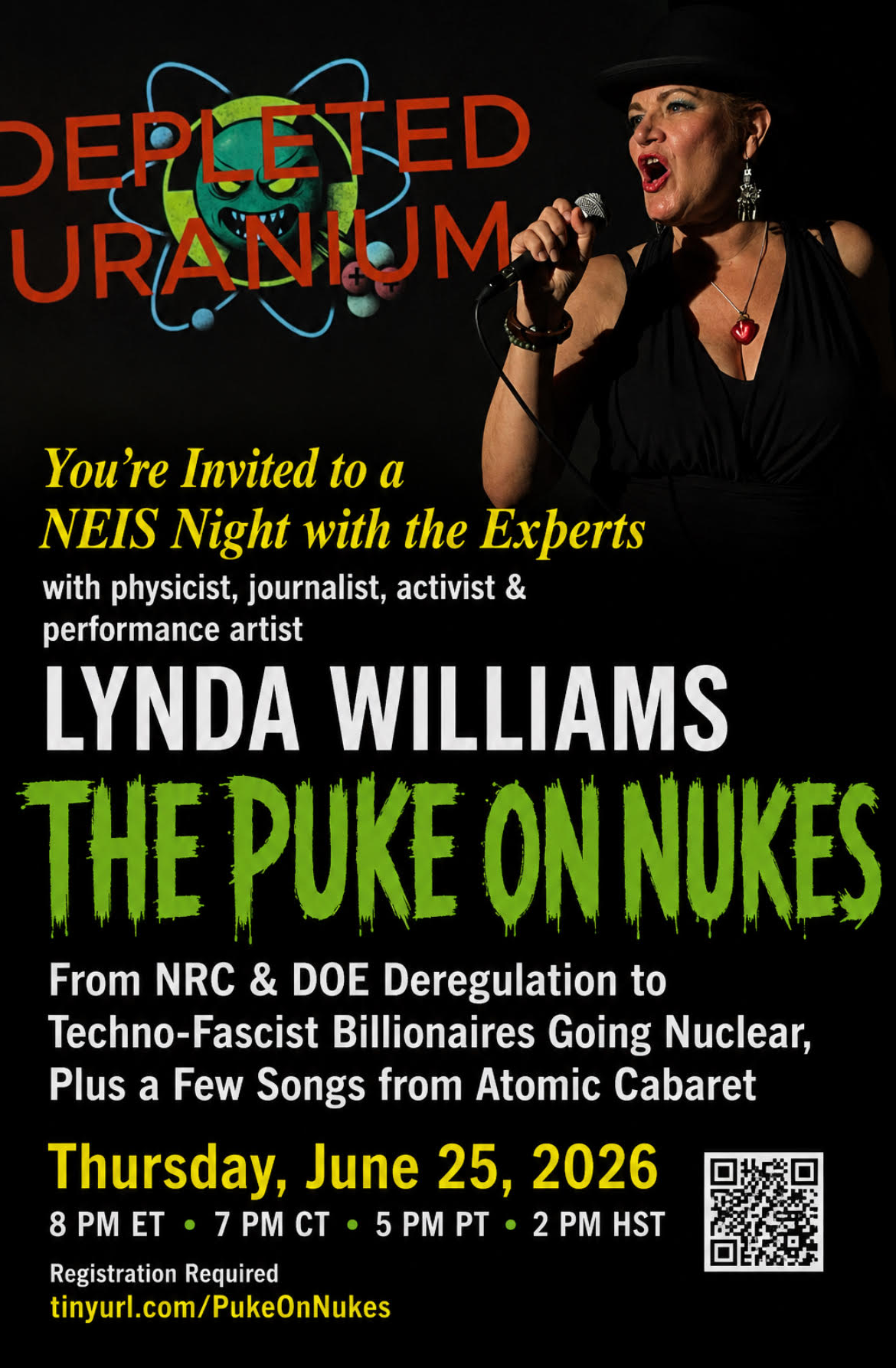
25 June- THE PUKE ON NUKES
Thursday, June 25, 2026
7pm Central Time (8pm ET, 6pm MT, 5pm PT) UTC – 5
From NRC & DOE Deregulation to Techno-Fascist Billionaires Going Nuclear, Plus a Few Songs from Atomic Cabaret REGISTER
26 June – Radiation Trainwreck at the NRC / Join the Protect Better Campaign – https://us02web.zoom.us/meeting/register/4ZlZ5_qLSHGiLSCg8FF6Bg#/registration


Cuba Is Not a Failed State – It Is a Besieged State
PETITION: “Global Appeal to Endorse Palestinian Right of Return of Refugees”
To see nuclear-related stories in greater depth and intensity – go to https://nuclearinformation.wordpress.com
-
Archives
- June 2026 (142)
- May 2026 (306)
- April 2026 (356)
- March 2026 (251)
- February 2026 (268)
- January 2026 (308)
- December 2025 (358)
- November 2025 (359)
- October 2025 (376)
- September 2025 (257)
- August 2025 (319)
- July 2025 (230)
-
Categories
- 1
- 1 NUCLEAR ISSUES
- business and costs
- climate change
- culture and arts
- ENERGY
- environment
- health
- history
- indigenous issues
- Legal
- marketing of nuclear
- media
- opposition to nuclear
- PERSONAL STORIES
- politics
- politics international
- Religion and ethics
- safety
- secrets,lies and civil liberties
- spinbuster
- technology
- Uranium
- wastes
- weapons and war
- Women
- 2 WORLD
- ACTION
- AFRICA
- Atrocities
- AUSTRALIA
- Christina's notes
- Christina's themes
- culture and arts
- Events
- Fuk 2022
- Fuk 2023
- Fukushima 2017
- Fukushima 2018
- fukushima 2019
- Fukushima 2020
- Fukushima 2021
- general
- global warming
- Humour (God we need it)
- Nuclear
- RARE EARTHS
- Reference
- resources – print
- Resources -audiovicual
- Weekly Newsletter
- World
- World Nuclear
- YouTube
-
RSS
Entries RSS
Comments RSS
 nuclear-news