Satellite images indicate that North Korea has more bomb material than previously thought
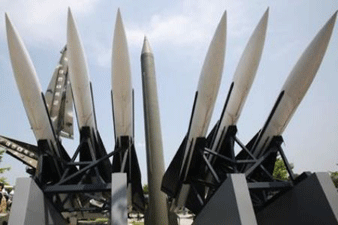 North Korea may have more nuclear bomb material than thought: U.S. think tank, David Brunnstrom and Matt Spetalnick WASHINGTON (Reuters) JULY 14, 2017 – Thermal images of North Korea’s main nuclear site show Pyongyang may have reprocessed more plutonium than previously thought that can be used to enlarge its nuclear weapons stockpile, a U.S. think tank said on Friday.
The analysis by 38 North, a Washington-based North Korean monitoring project, was based on satellite images of the radiochemical laboratory at the Yongbyon nuclear plant from September until the end of June, amid rising international concerns over North Korea’s nuclear and missile programs.
The think tank said images of the uranium enrichment facility at Yongbyon could also indicate operation of centrifuges that could be used to increase North Korea’s stock of enriched uranium, its other source of bomb fuel.
There were signs too of at least short-term activity at North Korea’s Experimental Light Water Reactor that could be cause for concern, 38 North said.
The images of the radiochemical laboratory showed there had been at least two reprocessing cycles not previously known aimed at producing “an undetermined amount of plutonium that can further increase North Korea’s nuclear weapons stockpile,” something that would worry U.S. officials who see Pyongyang as one of the world’s top security threats.
It was unclear if the thermal activity detected at the uranium plant was the result of centrifuge operations or maintenance………
Experts at 38 North estimated in April that North Korea could have as many as 20 nuclear bombs and could produce one more more each month. https://www.reuters.com/article/us-northkorea-nuclear-exclusive-idUSKBN19Z1EN
No choice really, but to learn to live with a North Korean ICBM,
Why we will all learn to live with a North Korean ICBM, Channel News Asia, 13 Jul 17 Despite all the talk that North Korea’s ICBM test launch may provoke military action, Robert E Kelly argues that regional countries have no choice but to live with the situation.
“………….SOUTH KOREA’S VETO AGAINST MILITARY FORCE
this ICBM test launch will not lead to a strike, despite all the talk about how it is a game-changer.
The most important reason is not strategic but political. Any kinetic action by the US against North Korea would risk substantial retaliation, likely targeted at US allies South Korea and Japan.
Yes, Alaska may be within Pyongyang’s missile range. But North Korea could strike with far greater force and flexibility in the region. Its many missile tests into the Sea of Japan over the last year are almost certainly intended to signal to Japan that it too is in the firing line. But of course, it is South Korea that is most vulnerable.
Any US strike against the North would require, both politically and morally, the assent of the Japanese and especially the South Korean government. Politically, a strike without their assent would almost certainly terminate the alliances at once, since South Korean and Japanese populations and cities would likely face devastating retaliation after a US strike. If they did not have the right to consent to the risk of that strike, why would they stay in alliance with the US?.
Morally, it would be astonishingly callous for a democracy like the US to gamble millions of lives without even soliciting Japanese and South Korean assent.
So even Donald Trump, for all his bluster, is not going to attack North Korea without South Korean and Japanese approval…….
If kinetic options are not on the table, what other choices are there as the “impossible state” progresses toward a nuclear missile that can strike the lower 48 states of the US?
One word, adaptation. The US and the west learned to live with the nuclear missiles of unfriendly regimes in the past. ……… http://www.channelnewsasia.com/news/asiapacific/commentary-why-we-will-all-learn-to-live-with-a-north-korean-9025510
USA-South Korea bombing drill on the Korean peninsula angers North Korea
 Tipping point for nuclear war’ – North Korea lashes out after US practice bombing run, Telegraph UK, 9 JULY 2017 North Korea on Sunday lashed out at a live-fire drill the US and South Korea staged in a show of force against Pyongyang, accusing Washington of pushing the peninsula to the “tipping point” of nuclear war.
The allies held the rare live-fire drill as tensions grew over the peninsula following the North’s first intercontinental ballistic missile (ICBM) test held last week. The test sparked global alarm as it suggested North Korea now possessed an ICBM capable of reaching Alaska, a major milestone for the reclusive, nuclear-armed state.Saturday’s drill, designed to “sternly respond” to potential missile launches by the North, saw two US bombers destroy “enemy” missile batteries and South Korean jets mount precision strikes against underground command posts.
The North’s state-run Rodong newspaper accused Washington and Seoul of ratcheting up tensions with the drill, in an editorial titled “Don’t play with fire on a powder keg.”
“The US, with its dangerous military provocation, is pushing the risk of a nuclear war on the peninsula to a tipping point,” it said, describing the peninsula as the “world’s biggest tinderbox.”During Saturday’s drill, long-range B-1B Lancer bombers reportedly flew close to the heavily-fortified border between two Koreas and dropped 2,000-pound (900 kilogram) bombs.
Pyongyang described the joint drill as a “dangerous military gambit of warmongers who are trying to ignite the fuse of a nuclear war on the peninsula.”
“A small misjudgment or error can immediately lead to the beginning of a nuclear war, which will inevitably lead to another world war,” it said…… http://www.telegraph.co.uk/news/2017/07/09/north-korea-us-practice-bombing-run-could-tipping-point-nuclear/
It’s possible that North Korea has miniaturised nuclear warheads
 N.K. might have miniaturized nuke warheads for ICBMs: ex-IAEA official http://english.yonhapnews.co.kr/northkorea/2017/07/06/41/0401000000AEN20170706005700315F.html, 2017/07/06 11:07 SEOUL, — A former senior international nuclear watchdog official has raised the possibility of North Korea having nuclear warheads small enough to fit on intercontinental ballistic missiles, a U.S. broadcaster reported Thursday.
It is possible for the North to have held considerably elaborate and miniaturized nuclear warheads with less than 500 kilograms given its technology and manpower, Olli Heinonen, former deputy director-general for safeguards at the International Atomic Energy Agency, told Radio Free Asia. He said that more than a decade has passed since the North conducted its first nuclear test in 2006.
The North has pressed ahead with its nuclear program as a major task, into which it has put talented manpower and huge resources, Heinonen pointed out, while recalling that it has produced plutonium since the 1980s, even before the nuclear test.
However, the North’s ICBM deployment is likely to be possible one or two years from now, he said.
The North’s sixth nuclear test, if carried out, will have an importance more in political purposes than in improving technology, he said.
It may be the last chance to make nuclear negotiations with the North by mobilizing both incentives and restrictions, he added.
Donald Trump has few real options in dealing with North Korea
 For Trump, Threats but Few Options in Confronting North Korea, NYT, JULY 4, 2017 When then-President-elect Trump said on Twitter in early January that a North Korean test of an intercontinental ballistic missile capable of reaching the United States “won’t happen!” there were two things that he still did not fully appreciate: how close Kim Jong-un, the North’s leader, was to reaching that goal, and how limited any president’s options were to stop him.
North Korea Fired Intercontinental Ballistic Missile – USA administration confirms
 U.S. Confirms North Korea Fired Intercontinental Ballistic Missile, NYT 点击查看本文中文版 JULY 4, 2017 SEOUL, South Korea — The Trump administration on Tuesday confirmed North Korea’s claim that it had launched an intercontinental ballistic missile, and it told Pyongyang that the United States would use “the full range of capabilities at our disposal against the growing threat.”
China calls for calm and restraint on North Korea
China calls for calm after North Korea claims first successful launch of ICBM that can ‘strike any place in the world’ If this type of missile becomes fully operational, it could potentially deliver a nuclear warhead to the US mainland http://www.scmp.com/news/asia/east-asia/article/2101193/north-korea-says-it-has-successfully-tested-icbm, Agence France-Presse, Reuters, Associated Press 05 July, 2017,
The United States on Tuesday requested an emergency meeting of the UN Security Council after North Korea declared that it had successfully tested its first intercontinental ballistic missile, the US mission said. The meeting is expected to take place on Wednesday.
US Ambassador Nikki Haley on Tuesday spoke by phone with China’s Ambassador Liu Jieyi, who holds the council presidency this month, to convey the US request for an urgent meeting.
North Korea’s announcement Tuesday came after the launch of a ballistic missile in the morning. It flew about 39 minutes and reached an altitude of 2,802 kilometres, before landing in waters within Japan’s exclusive economic zone, according to the announcement.
North Korea’s claims the missile reached that altitude could not be verified. However Japan’s Defence Ministry said it reached an altitude that “greatly exceeded” 2,500 kilometres.
A test-launch of an intercontinental ballistic missile, if confirmed, would be considered a game-changer by countries looking to check North Korea’s push for a nuclear-armed missile that can reach anywhere in the United States.
The test still may be the North’s most successful yet; a weapon analyst says missile could be powerful enough to reach Alaska. The “landmark” test of a Hwasong-14 missile was overseen by leader Kim Jong-un, an emotional female announcer said. It flew 933 kilometres, she added. The North was “a strong nuclear power state” and had “a very powerful ICBM that can strike any place in the world” she said.
There are still doubts whether the North can miniaturise a nuclear weapon sufficiently to fit it onto a missile nose cone, or whether it has mastered the technology needed for it to survive the difficult re-entry into the Earth’s atmosphere.
In his New Year’s address, Kim said his country had reached the final stage of preparing to test-launch the long-range missile.
Officials from South Korea, Japan and the United States said the missile landed in Japan’s Exclusive Economic Zone (EEZ) after being launched near an airfield in Panghyon, about 100 km northwest of the North’s capital, Pyongyang.
Japan said on Monday the United States, South Korea and Japan will have a trilateral summit on North Korea at the G20. China’s leader Xi Jinping will also be at the July 7-8 meeting in Hamburg, Germany.
Trump, responding to the latest launch, wrote on Twitter: “North Korea has just launched another missile. Does this guy have anything better to do with his life?” an apparent reference to North Korean leader Kim Jong-un. “Hard to believe South Korea and Japan will put up with this much longer. Perhaps China will put a heavy move on North Korea and end this nonsense once and for all!”, Trump said in a series of tweets.
North Korea has conducted nuclear and missile tests to show defiance in the face of international pressure and to raise the stakes when Pyongyang sees regional powers getting ready for talks or sanctions, analysts say.
White House officials said Trump was briefed on the latest launch, which took place hours before Independence Day celebrations in the United States. North Korea has previously fired missiles around this holiday.
Pyongyang has conducted missile-related activities at an unprecedented pace since the start of last year, but analysts had thought it was years away from having a nuclear-tipped ICBM. capable of hitting the United States.
North Korea is also trying to develop intermediate-range missiles capable of hitting US bases in the Pacific. The last North Korean launches before Tuesday were of land-to-sea cruise missiles on June 8.
David Wright, co-director of the Global Security Programme at the US-based Union of Concerned Scientists, said the assessments of the flight time and distance suggest the missile might have been launched on a “very highly lofted” trajectory of more than 2,800 km.
The same missile could reach a maximum range of roughly 6,700 km on a standard trajectory, Wright said in a blog post.“That range would not be enough to reach the lower 48 states or the large islands of Hawaii, but would allow it to reach all of Alaska,” he said.
South Korea’s President Moon said on Monday in a meeting with former US president Barack Obama that North Korea now faces its “last opportunity” to engage in talks with the outside world.
North Korea has conducted four missile tests since Moon took office in May, vowing to use dialogue as well as pressure to bring Pyongyang’s nuclear and missile programmes under control.
Earlier this week, North Korea was a key topic in phone calls between Trump and the leaders of China and Japan. Leaders of both Asian countries reaffirmed their commitment to a denuclearised Korean Peninsula. Trump has recently suggested he was running out of patience with China’s modest steps to pressure North Korea.
Russia and China propose negotiation plan to lessen North Korea tensions
 Russia, China offer plan to ease N.Korea tension, abc news, 4 July 17 Russia and China have proposed that North Korea declare a moratorium on nuclear and missile tests while the United States and South Korea refrain from large-scale military exercises.
The call was issued in a joint statement by the Russian and Chinese foreign ministries on Tuesday following talks between Russian President Vladimir Putin and Chinese President Xi Jinping.
The statement came after North Korea tested a missile that flew higher and longer than previous ones, sparking concerns around the world.
Moscow and Beijing suggested that if North Korea halts nuclear and missile tests while the U.S. and South Korea freeze military maneuvers, the parties could sit down for talks that should lead to obligations not to use force and to refrain from aggression………..
North Korea says its latest missile test reached a height of 2,802 kilometers (1,740 miles) and flew 933 kilometers (580 miles) for 39 minutes before falling into the sea.
The country’s Academy of Defense Science said Tuesday in a statement that it was a successful test of an intercontinental ballistic missiles called Hwasong-14.
The statement was distributed by North Korea’s KCNA news service.
The reported trajectory was similar to that announced earlier by U.S., South Korean and Japanese officials, though the U.S. judged it to be an intermediate-range missile.
Either way, it would be a longer and higher flight than similar tests previously reported.
The U.S military says it tracked a North Korean missile for 37 minutes before it landed in the Sea of Japan.
The Hawaii-based U.S. Pacific Command said in a statement Tuesday that an intermediate-range ballistic missile was launched from near an airfield in North Korea.
NORAD, or the North American Aerospace Defense Command, said the missile did not pose a threat to North America.
South Korean and Japanese officials reported the North Korean missile launch earlier Tuesday. It is part of a string of recent tests as the North works to build a nuclear-tipped missile that could reach the United States………http://abcnews.go.com/International/wireStory/latest-north-korea-height-distance-missile-48430348
———
Australia now in reach of North Korea’s new intercontinental ballistic missile (ICBM)
 Australia now within range of new North Korean missile, as calculations show it could fly far enough to hit Darwin
- The ‘landmark’ test of a Hwasong-14 missile was overseen by leader Kim Jong-Un
- It was fired from a site in the North Phyongan province into the Sea of Japan
- It is believed to have reached an altitude of 2802 km and flew 933 km
- The North has long sought to build nuclear missiles capable of reaching the US
- Weapons analysts say the missile has the capability to travel up to 6,700km
- Darwin is only 5,750km from Pyongyang, putting Australia into the firing line
Experts say the missile could reach a maximum range of 6,700km on a standard trajectory, meaning it would be able to hit Darwin, which is 5,750km from Pyongyang.
David Wright, of the Union of Concerned Scientists, wrote on the organisation’s allthingsnuclear blog that the available figures implied the missile ‘could reach a maximum range of roughly 6,700 km on a standard trajectory’.
‘That range would not be enough to reach the lower 48 states or the large islands of Hawaii, but would allow it to reach all of Alaska.’ …………http://www.dailymail.co.uk/news/article-4664328/Australia-range-new-North-Korean-missile.html#ixzz4ltt8SE9M
Timeline of North Korea’s missiles tests in 2017
North Korea’s missiles tests in 2017: A timeline http://www.straitstimes.com/asia/east-asia/north-koreas-missiles-tests-in-2017-a-timeline, 4 Jul 17 North Korea has conducted missile and nuclear weapons related activities at an unprecedented rate since the beginning of 2017 and is believed to have made some progress in developing intermediate-range and submarine-launched missiles.
Here’s a timeline of the missile launches and tests the regime is known to have carried out this year:
Feb 12, 2017: North Korea fires its first ballistic missile in 2017, in what is seen as a show of force against the leaders of the United States and Japan reaffirming their security alliance. The missile is believed to be a mid-range Rodong or something similar, flying 500km and landing in the East Sea, also known as Sea of Japan.
March 6, 2017: North Korea fires four ballistic missiles, with three falling into Japan’s exclusive economic zone.
April 16, 2017: North Korea fires an unidentified ballistic missile that explodes almost immediately after launch, defying warnings from the Trump administration to avoid any further provocations
April 29, 2017: In an apparent defiance of a concerted US push for tougher international sanctions to curb Pyongyang’s nuclear weapons ambitions, the country test-fires a ballistic missile from the Pukchang region in a north-easterly direction. The missile reaches an altitude of 71 km before disintegrating a few minutes into flight.
May 14, 2017: Only four days after the inauguration of South Korea’s new leader Moon Jae In, North Korea fires a ballistic missile in an apparent bid to test the liberal president and the US, which have both signalled an interest in negotiations to ease months of tensions.
The missile flies for 700km and reaches an altitude of more than 2,000km before landing in the Sea of Japan or East Sea, further and higher than an intermediate-range missile North Korea successfully tested in February from the same region of Kusong, north-west of Pyongyang.
While the US Pacific Command says it does not appear to be an intercontinental ballistic missile, the successful launch of a mid-to-long range missile indicated a significant advance in North Korea’s drive for an intercontinental ballistic missile (ICBM), monitors say.
The North boasts that the launch is aimed at verifying the capability to carry a “large scale heavy nuclear warhead”.
May 22, 2017: North Korea launches medium-range ballistic missile Pukguksong-2, Pyongyang’s state media reported, adding the weapon was now ready to be deployed for military action.
The test sparks a fresh chorus of international condemnation and threats of tougher United Nations sanctions.
May 29, 2017: North Korea fires at least one short-range ballistic missile that lands in the sea off its east coast. The missile is believed to be a Scud-class ballistic missile and flew about 450km. North Korea has a large stockpile of the short-range missiles, originally developed by the Soviet Union.
North Korea is likely showing its determination to push ahead in the face of international pressure to rein in its missile programme and “to pressure the (South Korean) government to change its policy on the North”, South Korea’s Joint Chiefs of Staff spokesman Roh Jae Cheon said.
June 8, 2017: A volley of surface-to-ship cruise missiles are fired off North Korea’s east coast, less than a week after the United Nations expanded sanctions against Kim Jong Un’s regime in response to recent ballistic missile tests.
The short range missiles fly some 200km before falling into the Sea of Japan, says South Korea’s defence ministry.
June 22, 2017: North Korea conducts a “small rocket engine test on or around June 22, the respected 38 North analysis group says, after a US official reportedly suggested the test could be a step to develop an intercontinental ballistic missile (ICBM).
It is not clear whether the test, conducted at the North’s Sohae satellite launch site, involved an ICBM engine.
July 4, 2017: Just days after South Korea President Moon Jae In and US President Donald Trump focused on the threat from Pyongyang in their first summit, North Korea fires a ballistic which flies for 930km and exceeds 2,500km in altitude in 40 minutes before falling into Japan’s exclusive economic zone, Seoul and Tokyo say.
The US military says the missile is an intermediate range ballistic missile and does not pose a threat to North America, but analysts say the missile is able to reach Alaska.
SOURCES: AGENCE FRANCE-PRESSE, REUTERS
Ex-nuclear commanders from around the world urge Trump towards talks with North Korea, not military action
 Nuclear experts warn of a march to war with North Korea, Salon,com Ex-nuclear commanders from around the world are urging Trump to engage in talks with North Korea instead, A group of ex-nuclear commanders issued a strong warning on Wednesday that pointed out the world is at the precipice of a potential nuclear war, and urged America to open up dialogue with North Korea.
Hailing from China, India, Pakistan, Russia and the United States, the Nuclear Crisis Group determined “that the risk of nuclear weapons use, intended or otherwise, is unacceptably high and that all states must take constructive steps to reduce these risks.” They called on the United States and NATO to establish military-to-military talks with Russia and recommended that India and Pakistan set up a nuclear hotline.
The group was created earlier in 2017 with the approval of Global Zero, an arms control group that ultimately wants to abolish nuclear weapons.
The letter came as H. R. McMaster, President Donald Trump’s national security adviser, told reporters during a security conference with Homeland Security Chief John Kelly on Wednesday that “the [North Korean] threat is much more immediate now and so it’s clear that we can’t repeat the same approach – failed approach of the past.”…. http://www.salon.com/2017/06/29/nuclear-experts-warn-of-a-march-to-war-with-north-korea/
There are “positive signals” on Korean Peninsula nuclear issue – China
 China hails “positive signals” on Korean Peninsula nuclear issue http://news.xinhuanet.com/english/2017-06/23/c_136389835.htm Editor: Mengjie BEIJING, June 23 (Xinhua) — China on Friday hailed recent “positive signals” on the Korean Peninsula nuclear issue and called for addressing concerns of various parties in a balanced way.
Chinese Foreign Ministry spokesperson Geng Shuang made the comments in response to a question regarding remarks by a number of diplomats concerned about the issue.
The Democratic People’s Republic of Korea (DPRK) ambassador to India Kye Chun Yong said Wednesday the DPRK would not rule out suspending nuclear and missile tests if the United States abandoned the practice of holding large-scale military drills, according to media reports. The ambassador said Pyongyang was ready for negotiations with the United States at any time and without preconditions.
Meanwhile, a special advisor to President Moon Jae-in of the Republic of Korea (ROK) indicated a reduction of joint war games with the United States if the DPRK stopped nuclear and missile activities.
“China believes these positive messages are important for easing tension on the peninsula and for a solution to the issue through dialogue,” Geng said. Geng said the root of the Korean Peninsula nuclear issue was in security. He said the solution required comprehensive measures and addressing both the symptoms and root causes.
China proposed a “dual-track approach” to denuclearization on the Korean Peninsula, establishing a peace mechanism in parallel, and a “suspension for suspension” to defuse the looming crisis.
As a first step, Pyongyang may suspend its nuclear and missile activities in exchange for the suspension of large-scale Washington-Seoul military exercises.
China has also called for strengthening efforts on non-proliferation and promotion of peace talks to bring the nuclear issue on the Korean Peninsula to a peaceful settlement.
“We are glad to see China’s proposals have gained increasing support and responses,” Geng said.
China welcomes and encourages suggestions to help alleviate tension and confrontation, enhance communication and trust, and restart dialogue as soon as possible, Geng said.
He called for the international community to seize all possible opportunities, to promote the settlement of the issue through dialogue and consultations.
New activity at North Korean nuclear test site
US spy satellites detect activity at North Korean nuclear test site, By Barbara Starr, Elise Labott and Zachary Cohen, CNN, June 20, 2017
Story highlights
The escalating nuclear crisis of North Korea: time to abandon coercive diplomacy
Overcoming Nuclear Crises: North Korea and Beyond http://www.globalresearch.ca/overcoming-nuclear-crises-north-korea-and-beyond/5594878, By Richard Falk and David Krieger Global Research, June 17, 2017
North Korea moving surprisingly fast towards launching long-range, nuclear-capable missile
North Korea edging closer to launch a nuclear ICBM http://www.dw.com/en/north-korea-edging-closer-to-launch-a-nuclear-icbm/a-39230508, 13 June 17 Kim Jong Un’s scientists have surprised many with the speed at which they have overcome the technical obstacles to having a credible and effective long-range, nuclear-capable missile. Julian Ryall reports.
When North Korea’s dictator Kim Jong Un delivered his annual address in Pyongyang on January 1 and declared that his country was in the final stages of developing an intercontinental ballistic missile (ICBM) that would be capable of delivering a nuclear warhead to targets in the continental United States, many viewed the regime’s claim with skepticism.
But on June 4, North Korea’s state-run Rodong Sinmun newspaper reported that the military would be ready to test-fire an ICBM in the near future. This has left governments and analysts in the region more concerned that Pyongyang’s scientists have made far more rapid progress than anyone had anticipated.
“The great success of test-firing an intercontinental ballistic missile, which we are sure to achieve, will mark a historic watershed moment in the failure of the US hostile policy against us,” an editorial in the newspaper stated.
“Historically speaking, the US has never dared to go to war with a country that possesses nuclear weapons or ICBMs.”
Targeting US
It added that recent missile tests have “proved” that “anywhere in the US” is within the range of North Korean missiles.
On June 8, North Korea fired a salvo of what appeared to be anti-ship cruise missiles at targets off its east coast. The launches were the fifth since Moon Jae-in was sworn in as South Korea’s president on May 10.
The most significant of the North’s recent tests, however, came just four days after Moon’s inauguration and demonstrated the strides that Kim’s scientists have made in a remarkably short space of time.
Defense officials in South Korea and the US confirmed that the launch of the liquid-fuel Hwasong-12 missile was a success. North Korea claimed the weapon reached an altitude of 2,111.5 kilometers and travelled a distance of 787 kilometers before splashing down in the Sea of Japan.
The missile took a steep parabolic route that tested its ability to survive re-entry into the atmosphere.
North Korea’s state media reported that the missile – capable of carrying a “large-size, heavy nuclear warhead” – had come through “the worst re-entry situation” and struck its intended target.
That claim was confirmed by South Korean government sources, who told the JoongAng Daily newspaper that analysis of data communication from North Korea’s missile control center confirmed the warhead survived the 5,000 degrees Celsius and severe vibration it experienced on re-entry.
Mastered guidance and control
After numerous test launches, North Korean scientists have already mastered long-range guidance and control capabilities, while a series of underground tests have demonstrated that the regime of Kim Jong Un has acquired nuclear weapons.
Analysts say the last remaining hurdle that North Korean missiles have to overcome is consistently surviving re-entry, which will probably be the reason for the ICBM launch that the North is planning.
“The speed at which they have developed the ability to deliver a nuclear warhead over a long distance is extremely concerning,” said Kim Jae-chang, a former general in the South Korean Army and joint chairman of The Council on Korea-US Security Studies.
“The exact technical developments that they have made are only estimates, but many experts now believe they will be able to launch an ICBM by the end of this year,” he told DW. “And that is a very serious concern to the South.
“We estimate that the military purpose of North Korea developing an ICBM capability is to prevent the US from augmenting or relieving its forces in South Korea in the event of an emergency,” he said.
The belief is that the North can threaten the US mainland as well as its military bases in the Asia-Pacific region, such as those in Japan, Hawaii or the Pacific island of Guam, and interdict naval forces heading for the Korean peninsula.
In tandem with the threat of an ICBM launch, there are indications that North Korea is preparing to carry out a new underground nuclear test at its Punngye-ri proving grounds.
Media reports have suggested that satellite reconnaissance has picked up renewed activity at the site, with scientists gathering at the facility, more vehicles in the vicinity and roads in surrounding areas closed to non-military traffic. 10 kiloton test
North Korea conducted its last nuclear test in September, with experts suggesting the blast was 10 kilotons, the largest the North has ever carried out.
“Pyongyang’s actions and demands have been surprisingly consistent for many years,” said Garren Mulloy, an associate professor of international relations at Daito Bunkyo University. “They want one-on-one dialogue with the US, because they want to be respected and hope to extract concessions from the rest of the world.
“And they have concluded that the most likely way of succeeding with those aims is to threaten the US to the highest degree possible,” he said.
Read: North Korea crisis: Which country has the strongest military in the region?
The most effective way of threatening the US is through the development of multiple weapons systems, including nuclear warheads, submarine-launched ballistic missiles and ICBMs, Mulloy said.
And recent test launches with long-range missiles surviving re-entry and accurately descending on a target would be cause for serious concern in Seoul, Tokyo and Washington, he said, as the speed at which they travelled would mean that any anti-missile defensive system “would struggle to cope.”
“It is clear that they have put an enormous amount of resources into these weapons development programs and made advances that were far more rapid than I and most other analysts believed were possible,” Mulloy added. “They may have invested so heavily in nuclear weapons and ICBMs because they do not think that they have anything else to bargain with.”
1 This Month

Protect Sazan Island from the Trump family! https://secure.avaaz.org/campaign/en/protect_sazan_island_from_the_trump_family_loc/?bqFCVab&v=174511&cl=22707147157&_checksum=5e9dde668860e8231c33699735e16a1fbf22ab2cb01da50c999fe8732b9775ef&utm_source=email&utm_medium=blast_email&utm_campaign=174511
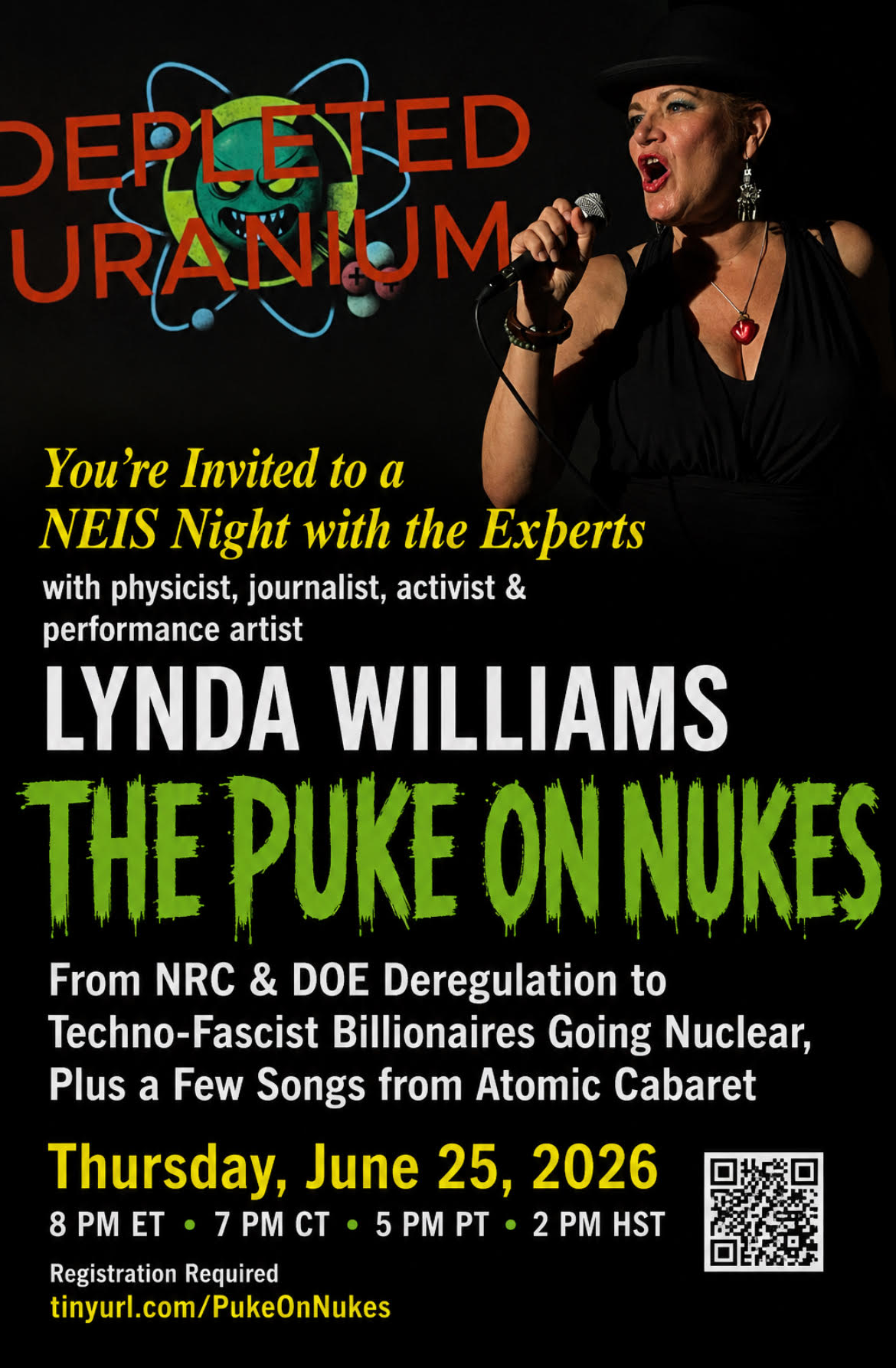
25 June- THE PUKE ON NUKES
Thursday, June 25, 2026
7pm Central Time (8pm ET, 6pm MT, 5pm PT) UTC – 5
From NRC & DOE Deregulation to Techno-Fascist Billionaires Going Nuclear, Plus a Few Songs from Atomic Cabaret REGISTER
26 June – Radiation Trainwreck at the NRC / Join the Protect Better Campaign – https://us02web.zoom.us/meeting/register/4ZlZ5_qLSHGiLSCg8FF6Bg#/registration


Cuba Is Not a Failed State – It Is a Besieged State
PETITION: “Global Appeal to Endorse Palestinian Right of Return of Refugees”
To see nuclear-related stories in greater depth and intensity – go to https://nuclearinformation.wordpress.com
-
Archives
- June 2026 (142)
- May 2026 (306)
- April 2026 (356)
- March 2026 (251)
- February 2026 (268)
- January 2026 (308)
- December 2025 (358)
- November 2025 (359)
- October 2025 (376)
- September 2025 (257)
- August 2025 (319)
- July 2025 (230)
-
Categories
- 1
- 1 NUCLEAR ISSUES
- business and costs
- climate change
- culture and arts
- ENERGY
- environment
- health
- history
- indigenous issues
- Legal
- marketing of nuclear
- media
- opposition to nuclear
- PERSONAL STORIES
- politics
- politics international
- Religion and ethics
- safety
- secrets,lies and civil liberties
- spinbuster
- technology
- Uranium
- wastes
- weapons and war
- Women
- 2 WORLD
- ACTION
- AFRICA
- Atrocities
- AUSTRALIA
- Christina's notes
- Christina's themes
- culture and arts
- Events
- Fuk 2022
- Fuk 2023
- Fukushima 2017
- Fukushima 2018
- fukushima 2019
- Fukushima 2020
- Fukushima 2021
- general
- global warming
- Humour (God we need it)
- Nuclear
- RARE EARTHS
- Reference
- resources – print
- Resources -audiovicual
- Weekly Newsletter
- World
- World Nuclear
- YouTube
-
RSS
Entries RSS
Comments RSS
 nuclear-news
China has called for calm and restraint after North Korea claimed to have test-launched its first intercontinental ballistic missile that is capable of hitting anywhere in the world.