North Korea will not be accepted as a nuclear power by US or Russia, say Rex Tillerson and Sergei Lavrov Both sides agree to pursue a ‘diplomatic solution’ to the crisis, The Independent, Mythili Sampathkumar New York @MythiliSk 28 Dec 17 The US and Russia have insisted they will not accept North Koreaas a “nuclear state”, amid a series of missile tests by the East Asian nation and increased rhetoric from both Kim Jong-un and Donald Trump.
US Secretary of State Rex Tillerson and Russian Foreign Minister Sergei Lavrov spoke by phone on a myriad of issues, but both agreed on their stance regarding Pyongyang’s continued development of nuclear weapons despite United Nations sanctions.
State Department Heather Nauert said in a statement that “both sides agreed that they will continue to work towards a diplomatic solution to achieve a denuclearised Korean peninsula”. However, on the same call on Tuesday, Mr Lavrov criticised President Donald Trump’s “aggressive rhetoric” towards North Korea……..
Late last week, the UN Security Council also unanimously passed – including votes from Russia and China who have closer ties to Pyongyang – more sanctions on North Korea, further limiting its oil supplies and slave labour market. …..
according to Chinese customs data, China exported no oil products to North Korea in November – something that was above and beyond UN sanctions requirements. Beijing also imported no North Korean iron ore, coal or lead in last months, the second full month of those trade sanctions, the data showed….. http://www.independent.co.uk/news/world/asia/north-korea-us-russia-nuclear-power-recognise-rex-tillerson-sergei-lavrov-a8130316.html
December 29, 2017
Posted by Christina Macpherson |
North Korea, politics international, Russia, USA, weapons and war |
Leave a comment
 ‘Dotard’ vs. ‘Rocketman’: The Nuclear Standoff That Rattled 2017 http://www.huffingtonpost.com.au/entry/dotard-vs-rocketman-the-nuclear-standoff-that-rattled-2017_us_5a3e8bdce4b0b0e5a7a27be6 Days after Donald Trump was elected president of the United States, he received a stark warning from America’s outgoing leader.
In their first and only meeting,
Barack Obama told his successor that North Korea ― a volatile nation hellbent on nuclear proliferation ― would pose the biggest foreign challenge his administration would face.
Trump, who has dedicated much of his presidency to
erasing Obama’s legacy, seemed to heed this advice, briefly. After rarely mentioning North Korea during his election campaign, he swiftly elevated the issue to his primary foreign policy concern (and later
declared an end to Obama’s “era of strategic patience” with the rogue state).
But under Trump’s leadership, the past year has seen brewing tensions between Washington and Pyongyang soar to
unprecedented levels with a specter of nuclear war. Economic sanctions in response to a series of North Korean missile launches escalated into a direct exchange of heated insults and threats between Trump and Kim Jong Un, the hermit kingdom’s hostile dictator.
Clashes between Donald Trump and Kim Jong Un dominated headlines this year.
North Korea’s Nuclear Strides
The Pentagon’s efforts to stave off conflict with North Korea have been marred by a string of “decisive failures” this year, according to new analysis published this month from the Brookings Institution, a Washington-based think tank.
“The United States and [North Korea] have engaged in bellicose rhetorical brinksmanship, making war between the two states seem increasingly likely,” wrote Katy Collin, a post-doctoral fellow at the Brookings Foreign Policy program. “Public acceptance of the possibility of conflict within the United States has ballooned. Mechanisms to head off escalation caused by misunderstandings do not exist.”
North Korea made remarkable technological advances to its internationally condemned nuclear program throughout 2017. It conducted its sixth and most powerful nuclear teston Sept. 3, which the regime claimed was a hydrogen bomb loaded onto an intercontinental ballistic missile (ICBM). Subsequent analysis of seismic data revealed the test was approximately 17 times stronger than the blast that decimated the Japanese city of Hiroshima during World War II.
Pyongyang has also expanded the reach of its missiles this year: The entire continental U.S. is now believed to be within ICBM striking range. Experts have expressed concern at North Korea’s alarming progress, and worry that it is on track to outpace America’s abilities to defend itself and its allies in the region.
The regime’s most recent missile launch in late November exceeded 8,100 miles in range. As tested, such a rocket would be able to travel more than enough distance to reach Washington, D.C., or New York City, although it is unclear if it could transport a warhead that far.
“North Korea knows what they’re doing,” David Wright, a physicist and the co-director of the global security program at the Union of Concerned Scientists, told HuffPost at the time. “It’s hard to say if it’s six months or two years before they can deliver a nuclear warhead, but it’s heading in that direction.”
Donald Trump’s Fire And Fury
Yet Trump, undermining diplomatic efforts by his own Secretary of State Rex Tillerson, has repeatedly confronted North Korea’s provocations with aggravations of his own. He infamously vowed in August to meet the defiant country with “fire and fury,” prompting Pyongyang’s threat to launch a missile at the U.S. island territory of Guam.
Months later, Trump said the U.S. would “totally destroy” North Korea, which is home to an estimated 25 million people, if provoked. “Rocketman is on a suicide mission for himself and for his regime,” Trump said in his first speech before the United Nations General Assembly, referring to Kim.
In an extremely rare personal address, Kim responded by pledging to “tame the mentally deranged U.S. dotard with fire.” Soon after, North Korean Foreign Minister Ri Yong-ho said the regime might detonate an H-bomb in the Pacific Ocean.
As hostilities boiled over, experts urged the “America First” leader to “stick to the script” and avoid making incendiary comments about North Korea during his 12-day trip through Asia last month. But Trump couldn’t help himself:
The president’s taunts “create an incentive for the North Koreans to stage provocations to show him up,” Jeffrey Lewis, a nuclear weapons expert at the Middlebury Institute of International Studies, told HuffPost in November.
If the situation deteriorates into an acute crisis, such remarks from Trump could give North Korea the impression a military strike is imminent, Lewis added. “If that happens, my belief is the North Koreans would use their nuclear weapons first, in order to try to repel an invasion.”
A turbulent 2017 has stirred fears and uncertainty for the year ahead.
“Trump has been impatient with multilateral, diplomatic containment of nuclear proliferation,” Collin said. “While diplomacy, sanctions, and targeted engagement have been successful in preventing conflict on the Korean peninsula for decades, 2017 marks decisive failures in terms of North Korea’s nuclear capacities.”
December 27, 2017
Posted by Christina Macpherson |
North Korea, politics international, USA |
Leave a comment
North Korea plans ‘satellite’ launch for space program, amid UN sanctions News Corp Australia Network, DECEMBER 27, 2017 AS North Korea plans a “satellite” space launch, observers have warned, amid UN sanctions, the rogue nation could be using it as a cover for more weapons tests.Fox News NORTH Korea’s regime is planning to launch a satellite that observers warn could be a Trojan horse for more weapons tests, a South Korean newspaper reports.
North Korea is being sanctioned by the United Nations over its nuclear and missile launches and is currently not allowed to carry out any launches using ballistic missile technology, which includes satellites, reports Fox News.
“Through various channels, we’ve recently learned that the North has completed a new satellite and named it Kwangmyongsong-5,” the Joongang Ilbo daily reported, quoting a South Korean government source.
The isolated North Korean regime has called the sanctions an “act of war” that’s been “rigged up the US.”
The South Korean newspaper reports that the communist regime’s plan is to put a satellite with cameras and telecommunication devices into orbit.
Pyongyang launched its Kwangmyongsong-4 satellite in February 2016, which much of the international community viewed as a disguised ballistic missile test.
A spokesman for the South Korean military reportedly said there was “nothing out of ordinary at this moment,” but added that Seoul was watching out for any provocative acts, “including the test of a long-range missile disguised as a satellite launch…….. http://www.news.com.au/world/asia/north-korea-plans-satellite-launch-for-space-program-amid-un-sanctions/news-story/e935e5ce25fe0c025d7ab43481e08759
December 27, 2017
Posted by Christina Macpherson |
North Korea, technology |
Leave a comment
North Korea nuclear weapons up for grabs if regime falls, THE United States has revealed what would happen if it entered North Korea and what its first objective would be after entering. Debra Killalea and AFP news.com.auDECEMBER 19, 2017 WASHINGTON has told China how it plans to secure North Korea’s nuclear arsenal in the event of a Kim regime collapse.
The plan, which aims to avoid a clash between the rival powers, was revealed by US Secretary of State Rex Tillerson last week and would see America enter North Korea searching for weapons.
During a talk to the Atlantic Council last week, Mr Tillerson said the Trump administration has provided assurances to Beijing that if US troops landed in North Korea they would do their job, but would not stay.
The comment aimed to reassure China that the United States would not occupy North Korea if the Kim regime fell.
Beijing views North Korea as a buffer state preventing the 28,500 US troops in South Korea from camping on its doorstep.
Mr Tillerson said the US and China “have had conversations about in the event that something happened — it could happen internal to North Korea; it might be nothing that we from the outside initiate — that if that unleashed some kind of instability, the most important thing to us would be securing those nuclear weapons they’ve already developed and ensuring that they — that nothing falls into the hands of people we would not want to have it.”
He said the US was not seeking regime collapse or that the country planned to send forces north of the demilitarized zone. …….
Beijing had refused US calls to discuss the possible collapse of its neighbour for years, but according to Mr Tillerson top US and Chinese military officials have finally met to discuss the once-taboo topic.
New York-based Political analyst and Asian specialist Sean King told news.com.au he wasn’t sure what to make out of Mr Tillerson’s remarks.
Mr King, a senior vice-president of Park Strategies, said Mr Tillerson’s thinking appears out of sync with that of US President Donald Trump……. http://www.news.com.au/world/asia/north-korea-nuclear-weapons-up-for-grabs-if-regime-falls/news-story/9fc2e4d7df97e4fdfe35d593484e88a3
December 20, 2017
Posted by Christina Macpherson |
North Korea, USA, weapons and war |
Leave a comment
‘North Korea is a time bomb’: government advisers urge China to prepare for war, http://www.scmp.com/news/china/diplomacy-defence/article/2124613/north-korea-time-bomb-government-advisers-urge-chinaThe risk of conflict on the Korean peninsula is the highest its been in decades and Beijing must mobilise resources for fallout, observers say, SCMP, Wendy Wu, China must be ready for a war on the Korean peninsula, with the risk of conflict higher than ever before, Chinese government advisers and a retired senior military officer warned on Saturday.
Beijing, once seen as Pyongyang’s key ally with sway over its neighbour, was losing control of the situation, they warned.
“Conditions on the peninsula now make for the biggest risk of a war in decades,” said Renmin University international relations professor Shi Yinhong, who also advises the State Council, China’s cabinet.
Shi said US President Donald Trump and North Korean leader Kim Jong-un were locked in a vicious cycle of threats and it was already too late for China to avert it. At best, Beijing could stall a full-blown conflict.
“North Korea is a time bomb. We can only delay the explosion, hoping that by delaying it, a time will come to remove the detonator,” Shi said on the sidelines of a Beijing conference on the crisis.
Addressing the conference, Wang Hongguang, former deputy commander of the Nanjing Military Region, warned that war could break out on the Korean peninsula at any time from now on until March when South Korea and the United States held annual military drills.
“It is a highly dangerous period,” Wang said. “Northeast China should mobilise defences for war.”
Yang Xiyu, a senior fellow at the China Institute of International Studies affiliated with China’s foreign ministry, said conditions on the peninsula were at their most perilous in half a century.
“No matter whether there is war or peace, regretfully, China has no control, dominance or even a voice on the issue,” he said.
China might already be preparing for the worst.
Last week, Jilin Daily, the official newspaper of the province bordering North Korea, published a full page of advice for residents on how to respond to a nuclear attack.
A document purportedly from telecom operator China Mobile about plans to set up five refugee camps in Jilin’s Changbai county also surfaced online last week.
Wang said the Jilin Daily article was a “signal to the country to be prepared for a coming war”.
He said China was also worried about the threat North Korea’s frequent nuclear tests were posing to unstable geological structures in the region.
Nanjing University professor Zhu Feng said that no matter how minor the possibility, China should be prepared psychologically and practically for “a catastrophic nuclear conflict, nuclear fallout or a nuclear explosion”.
“Why do we always act like ostriches? Why do we always believe a war won’t occur?” Zhu said.
“What China needs is a sense of urgency about its declining influence in strategy related to the peninsula and the way it brings down China’s status and role in East Asian security issues.”
He also said Kim’s failure to meet Chinese envoy Song Tao during his trip to Pyongyang last month was a “humiliation” for China.
Meanwhile at the United Nations in New York, US Secretary of State Rex Tillerson called on China and Russia to increase their efforts to halt Pyongyang’s nuclear programme.
Tillerson also backtracked on his previous unconditional offer for talks by saying that Washington would not negotiate with Pyongyang until it stopped “threatening behaviours”.
North Korean ambassador to the UN Ja Song-nam accused the United States, Japan and the United Nations Security Council of waging a hostile campaign to stop Pyongyang from gaining nuclear weapons that it saw as necessary to defend itself.
Renmin University professor Shi said hopes for peace could not rest on Kim and Trump, and China and Russia should work together to argue against war.
In a meeting with South Korean President Moon Jae-in in Beijing, Chinese President Xi Jinping said war on the peninsula was not acceptable.
December 20, 2017
Posted by Christina Macpherson |
China, North Korea, politics international, weapons and war |
Leave a comment
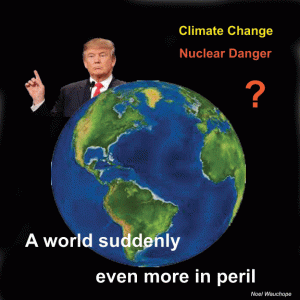 DONALD Trump has vowed to take “all necessary steps” to stop North Korea’s nuclear arms race as tyrant Kim Jong-un bids for recognition as a nuclear power. Express UK, By REBECCA PINNINGTON, 20 Dec 17 Vowing America would stand up for itself like never before, the US president vowed to tackle Kim’s hurried arms testing “head on”.
Mr Trump said the US had made an “unprecedented effort” to isolate dictator Kim’s regime in a bid to put a stop to the frenzied nuclear developments.
However, he said: “There is much more work to do. America and its allies will take all necessary steps to ensure denuclearisation and ensure that this regime cannot threaten the world.”
Mr Trump said: “This situation should have been taken care of long before I got into office, when it was much easier to handle. But it will be taken care of. We have no choice.”…….“In addition, many actors have become skilled at operating below the threshold of military conflict—challenging the United States, our allies, and our partners with hostile actions cloaked in deniability.”
Mr Trump also labelled China and Russia “rival powers” in the landmark speech, outlining his administration’s national security strategy……
December 20, 2017
Posted by Christina Macpherson |
North Korea, politics international, weapons and war |
Leave a comment
 North Korean official in charge of nuclear facilities reportedly executed https://www.upi.com/North-Korean-official-in-charge-of-nuclear-facilities-reportedly-executed/2561513650935/, By Jennie Oh Dec. 18, 2017 SEOUL, South Korea, (UPI) — A senior North Korean official in charge of construction works on nuclear facilities is believed to have been executed, Asahi Shimbun reported Tuesday.
A former North Korean soldier told the Japanese daily there have been unconfirmed reports that a director of Bureau 131 was recently removed from his position then executed for allegedly disclosing military secrets.
Bureau 131, or the General Bureau of Atomic Energy, is a subsidiary of the ruling Worker’s party, responsible for construction works on the North’s major nuclear and missile facilities, including the main nuclear test site of Punggye-ri and the Tongchang-ri missile launch pad.
The director is believed to have worked as a specialist at the bureau since its establishment. The Asahi report suggests his sentence may have been delivered due to the delayed timing of the regime’s sixth nuclear test, and the collapse of tunnels following the massive underground blast.
A source told the paper, “It seems he took the blame as the prolonged mining of the nuclear facility pushed back the test date to September when it was initially set for spring.”
North Korea conducted its sixth and largest nuclear test at the Pyunggye-ri nuclear facility on September 3, claiming to have tested a powerful hydrogen bomb.
The artificial explosion reportedly caused buildings and grounds in the vicinity to collapse, and has since triggered a series of landslides and aftershocks.
December 20, 2017
Posted by Christina Macpherson |
North Korea, politics |
Leave a comment
 The other North Korea nuclear threat we should be worried about CNBC, 20 Dec17
- North Korea’s questionable nuclear safety standards and its isolation from the global scientific community increase the risk of a nuclear accident, according to 38North
- The country’s leader Kim Jong Un was caught on tape smoking a cigarette next to an intercontinental ballistic missile earlier this year
- If a nuclear disaster does occur, it would likely cause regional panic
Nyshka Chandran | The risk of a
North Korean nuclear meltdown can’t be ignored, according to a recent note published on 38North, a project of the US-Korea Institute at Johns Hopkins School of Advanced International Studies.
Longstanding doubts over the hermit kingdom’s nuclear safety resurfaced in July, when a video emerged of leader Kim Jong Unsmoking a cigarette next to a Hwasong-14 intercontinental ballistic missile.
“Kim’s recklessness is certainly notable, and it hints at an under-emphasized and potentially devastating possibility: the threat of a nuclear accident in North Korea,” said the 38North note, released late last week.
Adding to the concern, Chinese researchers said in September that North Korea’s
Punggye-ri nuclear test site was at risk of imploding. That was followed by TV Asahi’s October report of a tunnel collapse at the same nuclear site, an incident believed to have killed more than 200 people. Pyongyang, in response, called the report false and dismissed it as misinformation.
The Yongbyon Nuclear Scientific Research Center, the North’s major nuclear facility, is so densely concentrated that one fire could lead to a disaster potentially worse than Chernobyl, former South KoreanPresident Park Geun-hye claimed in 2014……..https://www.cnbc.com/2017/12/19/kim-jong-un-north-korea-nuclear-accident-risks-rising.html
December 20, 2017
Posted by Christina Macpherson |
North Korea, safety |
Leave a comment
 North Korea is in ‘final stages of nuclear weaponisation’, says South Korea, The Independent 16 Dec 2017, South Korea’s vice foreign minister issued an urgent plea about the threat from Pyongyang, warning the United Nations Security Council that North Korea was “in the final stages of nuclear weaponization”.
“It will fundamentally alter the security landscape in the region and beyond” if the North is able to equip a missile with a nuclear warhead, Cho Hyun warned.
In the past few months, North Korea has rattled the world with a series of weapons tests. It detonated a hydrogen bomb and has launched multiple ballistic missiles, saying after the latest firing that it now has the capability to attack the US mainland and had devised a missile capable of carrying “super-large heavy nuclear warhead”.
The late-November launch soared higher than any previous test, US Secretary of Defence James Mattis said, and illustrated North Korea’s determination to build missiles that can “threaten everywhere in the world”.
Continuing to defy international warnings, a top North Korean official said escalating pressure from the global community shows America is “terrified” by North Korea‘s nuclear capabilities.
The nation’s ambassador to the United Nations, Ja Song Nam, called a meeting of the UN Security Council a “desperate measure plotted by the US” in response to North Korea’s displays of military might.
The Trump administration has sent mixed signals this week about its approach to North Korea’s belligerence………http://www.independent.co.uk/news/world/north-korea-latest-news-updates-us-trump-terrified-nuclear-weapons-attack-a8113606.html
December 18, 2017
Posted by Christina Macpherson |
North Korea, South Korea, weapons and war |
Leave a comment
 North Korea May Soon Test Another Nuclear Weapon (The Only Question Is Where), National Interest, http://nationalinterest.org/blog/the-buzz/north-korea-may-soon-test-another-nuclear-weapon-the-only-23694 Dave Majumdar, 17 Dec 17,North Korea continues to work on tunnels it used for nuclear test, despite recent tremors according to imagery analysis by the 38 North project at Johns Hopkins School of Advanced International Studies. That might mean that North Korea might test and another nuclear weapon at some point in the not so distant future.
“Recent commercial satellite imagery indicates that despite the continuation of small tremors near Mt. Mantap since North Korea’s last nuclear test, tunnel work at the Punggye-ri Nuclear Test Site is still underway,” reads new analysis by 38 North’s Frank V. Pabian, Joseph S. Bermudez Jr. and Jack Liu. “These efforts continue to be concentrated at the West Portal, leaving the North Portal—where the last five tests were conducted—mostly dormant and likely abandoned, at least for the time being.”
December 18, 2017
Posted by Christina Macpherson |
North Korea, weapons and war |
Leave a comment
 Tillerson backtracks on offer of unconditional North Korea talks https://www.dailytelegraph.com.au/news/world/tillerson-backtracks-on-offer-of-unconditional-north-korea-talks/news-story/2236599a83ed87f95c79af52af2a9279 16 Dec 17,
AP, News Corp Australia Network AMERICA’S top diplomat stepped back from his offer of unconditional talks with North Korea, telling world powers the nuclear-armed nation must earn the right to negotiate with the United States.
Secretary of State Rex Tillerson’s declaration before the UN Security Council marked a stunning reversal after he proposed discussions with Pyongyang without preconditions earlier this week. That overture was almost immediately rebutted by White House officials.
Still, Mr Tillerson had planned to reiterate his call at a special UN ministerial meeting on North Korea at the council.
His prepared remarks suggested only that North Korea would have to undertake a sustained halt in its threatening behaviour before talks could begin. But Mr Tillerson changed the script. “North Korea must earn its way back to the table,” Mr Tillerson told the foreign ministers.
“The pressure campaign must and will continue until denuclearisation is achieved. We will in the meantime keep our channels of communication open.”
The debate over offering North Korea unconditional talks reflects the differences within the Trump administration as it runs out of time to prevent North Korea from perfecting a nuclear-tipped missile that can strike the US mainland. President Donald Trump has vowed to prevent such capability, with military action if necessary.
So far, US-led sanctions on North Korea and diplomatic isolation haven’t compelled Kim Jong Un’s government to stop its nuclear and missile tests, or to seek negotiations.
Asked overnight if he supported unconditional talks, Mr Trump did not answer directly. “Well, we’re going to see what happens with North Korea. We have a lot of support. There are a lot of nations that agree with us — almost everybody,” Mr Trump told reporters. He credited China — which accounts for about 90 per cent of North Korea’s external trade — with helping on pressuring North Korea, while Russia was not.
“We’d like to have Russia’s help — very important,” said Mr Trump. He raised it in a Thursday phone call with Russian President Vladimir Putin.
At the UN Mr Tillerson called on China and Russia to go beyond UN-mandated economic sanctions. He said North Korean labourers were toiling in “slave-like conditions” in Russia for wages used to fund nuclear weapons, while China was still allowing crude oil to flow into North Korean refineries.
North Korea has conducted more than 20 ballistic missile tests during 2017 and its most powerful nuclear explosion to date. Its more recent missile test in late November fired a projectile that experts say could carry a nuclear warhead to the US Eastern Seaboard.
December 16, 2017
Posted by Christina Macpherson |
North Korea, politics international, USA, weapons and war |
Leave a comment
 North Korean Nuclear Reactor Safety: The Threat No One is Talking About, 38 North, BY: MATT KORDA, DECEMBER 14, 2017 The ability of North Korea to safely operate its nuclear reactors, according to many experts, is increasingly being called into question given the North’s isolation and lack of safety culture. Pyongyang’s ability to respond to a nuclear accident in a timely fashion will make the difference between a small-scale event and a catastrophic disaster. And while the actual contamination would be localized, the lack of transparency from North Korea in dealing with the situation is likely to cause political panic in the region in excess of the actual radiological exposure and environmental impact. The opening of nuclear safety talks with the North to help prevent such an accident from occurring would provide a rare opportunity for regional dialogue and could pry open the door for realistic and productive discussions of North Korea’s nuclear program.
A Disaster Waiting to Happen?
A video of Kim Jong Un smoking next to an untested liquid-fueled missile tells you everything you need to know about North Korea’s nuclear safety culture. The remarkable 14-second clip shows the Supreme Leader taking a puff while a Hwasong-14 intercontinental ballistic missile is erected on the launch pad mere feet away—prompting a torrent of snarky Twitter commentary expressing regret that Kim’s lit cigarette had not “solved the problem for us.” Kim’s recklessness is certainly notable, and it hints at an underemphasized and potentially devastating possibility: the threat of a nuclear accident in North Korea.
At the March 2014 Nuclear Security Summit in The Hague, then-South Korean President Park Geun-hye claimed that Yongbyon, North Korea’s primary nuclear research center, “is home to such a dense concentration of nuclear facilities that a fire in a single building could lead to a disaster potentially worse than Chernobyl.” While her damage assessment is likely an exaggeration—researchers from 38 North assess Chernobyl’s power output to have been 3,000 percent greater than Yongbyon—the potential for a nuclear accident is not.
Niko Milonopoulos and Edward D. Blandford noted previously that a sudden fault in North Korea’s outdated power grid could prevent the Yongbyon reactors from being adequately cooled and could potentially trigger a meltdown. Such an event could also be prompted by a natural disaster or abnormal weather patterns. Complementary analysis by Nick Hansen indicates that North Korea’s 5 MWe plutonium production reactor had to be briefly shut down following a flood in July 2013 which destroyed parts of the cooling systems. He noted with concern that “if a major flood cuts off the cooling water supply to the reactors before they can be shut down, a major safety problem could occur.” This is exactly what prompted the series of nuclear meltdowns at Fukushima……….http://www.38north.org/2017/12/mkorda121417/
December 16, 2017
Posted by Christina Macpherson |
North Korea, safety |
Leave a comment
China building network of refugee camps along border with North Korea https://www.theguardian.com/world/2017/dec/12/china-refugee-camps-border-north-korea Document suggests at least five camps are being set up as Beijing prepares for possible influx of refugees should Kim Jong-un’s regime collapse, Guardian, Tom Phillips , 12 Dec 17, China is quietly building a network of refugee camps along its 880-mile (1,416km) border with North Korea as it braces for the human exodus that a conflict or the potentially messy collapse of Kim Jong-un’s regime might unleash.
The existence of plans for the camps, first reported in English by the Financial Times last week, emerged in an apparently leaked internal document from a state-run telecoms giant that appears to have been tasked with providing them with internet services.
The China Mobile document, which has circulated on social media and overseas Chinese websites since last week, reveals plans for at least five refugee camps in Jilin province.
The document, which the Guardian could not independently verify, says: “Due to cross-border tensions … the [Communist] party committee and government of Changbai county has proposed setting up five refugee camps in the county.”
It gives the names and locations of three such facilities: Changbai riverside, Changbai Shibalidaogou and Changbai Jiguanlizi. The New York Times reportedthat centres for refugees were also planned in the cities of Tumen and Hunchun.
A spokesman for China’s foreign ministry declined to confirm the camps’ existence at a regular press briefing on Monday but did not deny they were being built. “I haven’t seen such reports,” Lu Kang told reporters.
The question was purged from the foreign ministry’s official transcript of the briefing, as regularly happens with topics raised by foreign journalists that are considered politically sensitive or inconvenient.
North Korea fortifies part of border where defector escaped
The leaked document contains the name and telephone number of a China Mobile employee who drafted it but calls to that number went unanswered on Tuesday. The construction of the camps appears to reflect growing concern in Beijing about the potential for political instability – or even regime collapse – in North Korea.
Cheng Xiaohe, a North Korea specialist from Renmin University in Beijing, said while he could not confirm whether the document was genuine, it would be irresponsible for China not to make such preparations.
“Tensions are high on the Korean peninsula … it is on the brink of war. As a major power and a neighbouring country, China should make plans for all eventualities.”
Jiro Ishimaru, a Japanese documentary maker who runs a network of citizen journalists inside North Korea and on the Chinese side of the border, said a contact in Changbai county had recently told him that while they had not seen signs of camps being built there, they “had heard there are plans to build a facility”.
Tensions on the Korean peninsula have soared this year as the US president, Donald Trump, has stepped up pressure on his North Korean counterpart and Pyongyang has accelerated its nuclear and ballistic missile programmes.
Trump has baited Kim with the nickname “Little Rocket Man” and threats of military action, while Kim has responded with insults of his own, and a succession of nuclear and missile tests that have brought two new rounds of UN sanctions.
Following its latest intercontinental ballistic missile test on 29 November, Pyongyang claimed the ability to strike anywhere on US soil.
‘Quite backwards’: Chinese tourists gawk at impoverished North Koreans
In an interview with the Guardian in Beijing on Monday, Dennis Rodman, the NBA star turned would-be peacemaker, played down fearsof a catastrophic nuclear conflict and denied Kim, whom he calls his friend, was “going to try and bomb or kill anyone in America”.
“We ain’t gonna die, man, come on, no … It’s not like that,” Rodman insisted, urging Trump to use him as an intermediary to engage with Kim. He described the verbal war between Trump and Kim as “a chess game” that should not be taken too seriously.
Beijing seems less certain. Last week one official newspaper in Jilin, the Chinese province closest to North Korea’s nuclear test site, hinted at that nervousness with a full-page article offering tips on how to react to a nuclear incident.
Iodine tablets, masks and soap were useful allies in the event of such a catastrophe, readers of the Jilin Daily learned.
Additional reporting by Wang Zhen and Justin McCurry in Tokyo.
December 12, 2017
Posted by Christina Macpherson |
China, North Korea, politics international |
Leave a comment
Why North Korea’s nuclear test is still producing aftershocks, BBC, 11 December 2017 “…….
Why are aftershocks still happening?
According to the USGS, last weekend’s tremors were “relaxation events”. They measured a magnitude of 2.9 and 2.4.
“When you have a large nuclear test, it moves the earth’s crust around the area, and it takes a while for it to fully subside. We’ve had a few of them since the sixth nuclear test,” an official told Reuters.
The “movement of the earth’s crust” is akin to the very definition of an earthquake and scientists say it is only to be expected in the weeks and months after an explosion of that magnitude.
“These aftershocks for a 6.3 magnitude nuclear test are not very surprising,” Dr Jascha Polet, seismologist and professor of geophysics at California State Polytechnic University, told the BBC.
After any tremor of that size, aftershocks with declining magnitude are common, as the rock moves around and releases stress.
The area around the quake site “experiences deformation, and this creates areas of increased and decreased stress, which affects the distribution of aftershocks,” Ms Polet said.
“The fact that the source of the earthquake is an explosion doesn’t change how we expect the energy to redistribute,” geophysicist and disaster researcher Mika McKinnon, told the BBC.
But research on explosions of a similar magnitude as the North Korea nuclear test at the Nevada Test Site in the US where over decades nuclear tests were carried out, has found that the aftershocks of these events were fewer in number and lower in magnitude.
So each location is unique.
Can tremors destroy the test site?
One of the speculations after the September test was that it would damage the tunnel system North Korea has dug into the mountains at its test site.
“The more energy you put into an area, the more unstable it’s going to get,” Mika McKinnon explained.
“The more tests are happening, the more energy there is, the more redistribution of stress and the more rocks will be breaking.”
There have been some indications of individual tunnel collapses, she explained. “Seismic signals that look more like rock fall than anything else. That will happen more and more.”
But, she adds, there is no way of really knowing whether the entire tunnel system will collapse as this is an engineering problem far more than a scientific one.
It is unclear whether this process already has rendered the current test site unusable but North Korea has hinted its next nuclear test could be above ground…….http://www.bbc.com/news/world-asia-42305161
December 12, 2017
Posted by Christina Macpherson |
environment, North Korea |
Leave a comment
Aftershocks detected 14 weeks after North Korea nuclear test ‘moves Earth’s crust’ http://www.independent.co.uk/news/world/asia/aftershocks-north-korea-nuclear-test-tremors-punggye-ri-usgs-hydrogen-bomb-mountain-a8101966.html
‘It takes a while for the crust movement to fully subside’, says USGS Jon Sharman 10 Dec 17 Geologists have detected two tectonic tremors that they say are probably aftershocks from North Korean nuclear tests conducted over three months ago.
The artificial explosion created near a known nuclear testing site in North Korea had “moved the Earth’s crust” and subsequent seismic activity showed the region’s underlying geology settling back down, experts said.
The aftershocks, of magnitude 2.9 and 2.4, were detected at 6.13am and 6.40am GMT on Saturday respectively, said the US Geological Survey (USGS).
Lassina Zerbo, executive secreta
ry of the Vienna-based Comprehensive Nuclear-Test-Ban Treaty Organisation, said analysts had confirmed that the activity was “tectonic” in origin.
A USGS official said the tremors had occurred near the Punggye-ri nuclear test site, where North Korea conducted its sixth and largest underground nuclear test on 3 September.
“They’re probably relaxation events from the sixth nuclear test,” the official said. “When you have a large nuclear test, it moves the earth’s crust around the area, and it takes a while for it to fully subside. We’ve had a few of them since the sixth nuclear test.”
Pyongyang claimed the September test was of a thermonuclear hydrogen bomb, and experts have estimated it was 10 times more powerful than the US atomic bomb dropped on Hiroshima in 1945.
A series of quakes since then has prompted experts and observers to suspect the test might have damaged the mountainous location of its site in the northwest tip of North Korea, where all of the country’s nuclear tests have been conducted.
South Korea’s spy agency told the country’s lawmakers in October that North Korea might be readying two more tunnels at the site.
North Korea hinted its next nuclear test could be above ground after US President Donald Trump warned in September that the United States would “totally destroy” North Korea if it threatened America.
Another possible obstacle to North Korea’s use of Punggye-ri for tests is the nearby active volcano of Mount Paektu, which North Koreans consider a sacred site. Its last eruption was in 1903, and experts have debated whether nuclear testing could trigger another.
North Korea’s official media reported on Saturday that national leader Kim Jong-un had scaled Mount Paektu with senior military officials to “emphasise his military vision” after completion of the country’s nuclear force.
But pictures released by the official KCNA news agency showed him wearing smart black leather shoes and carrying no specialised equipment.
Mr Kim declared the nuclear force complete after the test of North Korea’s largest ever intercontinental ballistic missile last month, which experts said puts all of America within range.
South Korea said Pyongyang still needed to prove it has mastered critical missile technology, such as re-entry, terminal stage guidance and warhead activation, however.
December 11, 2017
Posted by Christina Macpherson |
environment, North Korea, weapons and war |
Leave a comment







 nuclear-news