Why the United States Needs North Korea to Stay Nuclear, A nuclear North Korea is not a threat, but an ideal stabilizer. National Interest Hongyu Zhang, Kevin Wang,
Many are hopeful that the June 12 summit in Singapore between President Trump and North Korean leader Kim Jong-un will lead to denuclearization and peace on the Korean Peninsula. Others believe the historical record makes clear that such a hope is overly optimistic. But what if allowing North Korea to retain its nuclear arsenal could both lead to peace and benefit America’s long-term security interests in the region?
There are two reasons for this. First, possessing nuclear weapons is the best way to pacify North Korea and constrain its aggression. Second, a secure and independent North Korea (without the presence of Chinese or U.S. forces) would also provide a buffer against great power tensions. The long-term primary objective of U.S. strategy in East Asia should be to contain a rising China. To achieve this, the United States must minimize Chinese influence on its neighboring states—whether they are U.S. allies or not. A limited North Korean nuclear arsenal is the most effective way to make this happen.
The United States should, therefore, continue reaching out diplomatically to North Korea and even end some sanctions to seek long-term stability. Contrary to the conventional wisdom, a nuclear North Korea and a balanced peninsula are the best possible outcome for the region and the world.
The View From Pyongyang: A Need for Balance
During the Cold War, the Soviet Union’s backing of North Korea and U.S. backing of South Korea were roughly equal, resulting in a stable power balance on the Korean Peninsula. However, since the Soviet collapse, the balance of power has rapidly shifted against North Korea. The United States continues to lead the Republic of Korea (ROK)-U.S. Combined Forces Command and regularly renews its security commitments in the region. In contrast, Russia abolished its alliance treaty with North Korea in 1994. China also refused to replace the Soviet Union as North Korea’s patron when the matter was discussed between Deng Xiaoping and Kim Il-sung in 1991.
Without this balance, the peninsula has been in prolonged instability and frequently came close to military confrontation. As a sovereign state ruled by a totalitarian regime, North Korea has shown its willingness to guarantee its security at any cost. Intensifying military and economic pressure against the North has only made it more defiant and unpredictable. Therefore, any solution to the present crisis must take into account the security of this sovereign nation. Clearly, massive militarization and isolation are not a long-term solution for North Korea.
……… not only do nuclear weapons offer a level of security that Chinese assurances do not, but they also are the most cost-effective way for a resource-poor North Korea to achieve sustainable security. A nuclear North Korea is not a threat, but an ideal stabilizer. The balance of power on the Korean peninsula and that between the United States and China are interrelated. China’s rise has the potential to shift the regional balance, making confrontation more likely in the future. If a limited nuclear capability guarantees North Korea’s existence and independence, it can provide a buffer space to keep Chinese forces in China and U.S. troops stationed in South Korea separate. ……….
North Korea’s fear of Chinese control is one area where North Korean and American interests of containing China actually align. Moreover, North Korea would prefer to have the ability to hedge between two superpowers to get the best deal, which is only possible by reducing China’s monopoly on economic leverage over North Korea. In the same way that a nuclear China was useful in containing the USSR in the 1970s, North Korea may be helpful in containing China today.
A tacit agreement to allow the DPRK to retain a minimal but credible nuclear deterrent is advantageous to U.S. interests in that it maintains a source of friction in Sino-North Korean relations. By possessing nukes, North Korea will be more independent from Chinese influence and can turn away from China. Thus, a nuclear North Korea would be a viable solution to the imbalance of power on the Korean peninsula after the end of the Cold War. Finally, North Korea would also benefit the long-term U.S. strategy of containing Chinese expansionism. This China containment policy can only be successful if the United States is willing to politically and economically engage with North Korea.
In a 1967 article in Foreign Affairs, Richard Nixon stated that “Taking the long view, we simply cannot afford to leave China forever outside the family of nations, there to nurture its fantasies, cherish its hates and threaten its neighbors.” If Nixon, along with Henry Kissinger’s support, could understand the strategic value of engaging a former adversary with newly acquired nuclear weapons, perhaps policymakers can see the strategic value of doing so with North Korea today.
Hongyu Zhang is a Visiting Assistant Professor of Government at the College of William & Mary, and can be reached at hzhang17@wm.edu. His research focuses on nuclear proliferation, East Asian security, and Chinese foreign policy.
U.S. identifies North Korea missile test site it says Kim committed to destroy , Matt Spetalnick,
WASHINGTON (Reuters) 21June 18- The missile engine test site that President Donald Trump said North Korean leader Kim Jong Un had committed to destroy is a major facility in the western part of the country that has been used for testing engines for long-range missiles, according to a U.S. official.
Trump told reporters after their June 12 summit that Kim had pledged to dismantle one of his missile installations, which would be North Korea’s most concrete concession at the landmark meeting in Singapore.
However, the president at the time did not name the site.
A U.S. official identified it on Wednesday as the Sohae Satellite Launching Ground, saying North Korea “has used this site to test liquid-propellant engines for its long-range ballistic missiles.”
Pyongyang has said its missiles can reach the United States.
“Chairman Kim promised that North Korea would destroy a missile engine test stand soon,” the official told Reuters, speaking on condition of anonymity.
There was no immediate word on the exact timetable, and North Korea has not publicly confirmed that Kim made such a commitment.
CBS News was the first to identify the site, which is the newest of North Korea’s known major missile testing facilities.
Although Trump has hailed the Singapore summit as a success, skeptics have questioned whether he achieved anything, given that Pyongyang, which has rejected unilateral nuclear disarmament, appeared to make no new tangible commitments in a joint written declaration.
The U.S.-based North Korea monitoring group 38 North said in an analysis at the end of last week there had been no sign of any activity toward dismantling Sohae or any other missile test site.
Here’s a look at North Korea’s nuclear power and what it would take to dismantle it, Business Insider, Eleanor Albert, Council on Foreign Relations, Jun. 16, 2018 North Korea has one of the world’s largest conventional military forces — combined with its missile and nuclear tests, the nation is a worldwide concern.
Some experts believe Pyongyang has between 15 and 20 nuclear weapons, while US intelligence believes the number to be between 30 and 60 bombs.
Analysts estimate the Hwasong-15 missile has a potential range of 8,100 miles and could reach anywhere on the US mainland.
North Korea has received nuclear assistance from Russia, China and Pakistan and has sold missiles and technology to countries like Iran, Libya, Syria, Egypt, Vietnam, Yemen, United Arab Emirates, and Myanmar.
The United States and its Asian allies regard North Korea as a grave security threat. It has one of the world’s largest conventional military forces, which, combined with its missile and nuclear tests and aggressive rhetoric, has aroused concern worldwide. But world powers have been ineffective in slowing its path to acquire nuclear weapons. While it remains among the poorest countries in the world, North Korea spends nearly a quarter of its gross domestic product (GDP) on its military, according to US State Department estimates. Its brinkmanship will continue to test regional and international partnerships aimed at preserving stability and security. The planning of a historic US-North Korea summit in June 2018 has opened the door for direct diplomacy, but many experts say the dismantling of North Korea’s arsenal would be a lengthy, challenging process. ……..http://www.businessinsider.com/north-korea-nuclear-power-what-it-would-take-to-dismantle-2018-6/?r=AU&IR=T
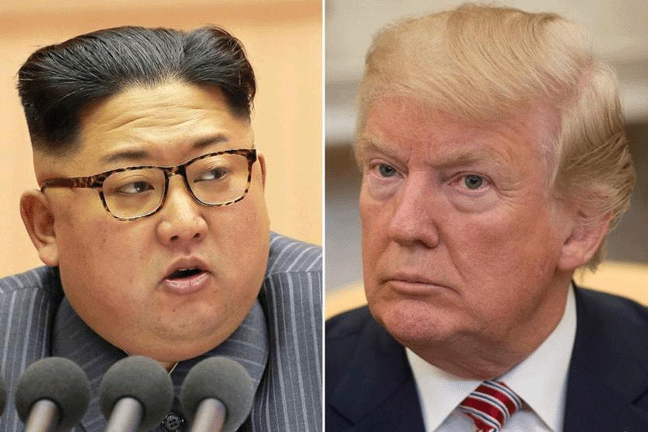
In the first summit meeting between the leaders of the United States and North Korea, Donald Trump met with Kim Jong-un, on June 12, 2018, in Singapore. The two leaders smiled warmly, posed for cameras as friends, shook hands, and Trump spoke in glowing terms of admiration about Kim at the news conference.
The summit came after a year and a half of both men terrorizing the world with open threats of thermonuclear annihilation and childish public insults. Trump derisively nicknamed the North Korean dictator “Rocket Man” and called him “fat and short,” while Kim Jong-un called Trump “a mentally deranged U.S. dotard.” This week’s historic meeting was nearly scrapped by Trump in a threatening, yet passive-aggressive letter to Jong-un that tried to make the cancellation look like it was North Korea’s idea.
On behalf of the United States, Trump conceded to Kim the discontinuation of joint military exercises with South Korea and to withdraw troops stationed there; he also gave Jong-un international standing and lavished him with compliments. He echoed North Korean rhetoric, which characterizes the military exercises as “very provocative.”
In response to accusations about giving away the farm for a handful of rocks and rusty Nuka Cola bottle caps, USA Today reported that other than agreeing to a meeting, Trump said “I gave up nothing.”
In return, we got a crazy-vague joint statement wrapped in a PR stunt. All North Korea gave us was a meeting. The signed agreement had no specificsabout denuclearization. The 1 1/2 page document ignored North Korea’s existing stockpile of nuclear weapons, had no verification provisions whatsoever, and failed to address ongoing issues of its attacks, kidnappings, and physical threats on Japan and South Korea.
North Korea has historically avoided true nuclear disarmament, preferring to qualify any agreements instead as denuclearization of the peninsula. “That has always been interpreted as a call for the United States to remove its “nuclear umbrella” protecting South Korea and Japan,” wrote Reuters. The country has promised denuclearization since the 1990s and has repeatedly ignored that promise as a rule.
Emerging from the summit as a victorious bringer of peace on Earth, Trump tweeted that “everybody can now feel much safer than the day I took office. There is no longer a Nuclear Threat from North Korea.”
It was a stunning concession when Trump announced, “We will stop the war games which will save us a tremendous amount of money.” It shocked and baffled South Korea and other allies, the Pentagon, US military officials, and members of the Republican Party. This came hot on the heels of Trump saying it would be better if South Korea and Japan protect themselves.
South Korea and Japan are not feeling the same love in the air as Trump and Jong-un. “His announcement was a surprise even to President Moon Jae-in’s government in Seoul,” wrote Reuters. “One South Korean official said he initially thought Trump had misspoken.” South Korea’s largest newspaper Chosun Ilbo openly worried that the North will keep its nuclear weapons program permanently as a result of Trump’s concessions, describing the summit as “dumbfounding and nonsensical.”
You see, we’ve allied ourselves to help protect South Korea for some pretty big reasons. If, like Trump, you’re encountering a North Korea-US summit with no prep whatsoever, here’s a quick bit of background.
North and South Korea have been divided since 1945; for a short period Russia occupied the North while the US occupied the south; during the war, China aided the north and the US aided the south (we lost 54,246 lives and 7,704 American soldiers are still unaccounted for). The Korean War ended with an armistice agreement but no peace settlement, so technically the war has never ended. American military remains in the South as part of a mutual defense treaty.
Fast forward to 1963 and the world finds out that the North has begun building a nuclear reactor. Then a nuclear weapons program in the 1980s. The first time North Korea committed to denuclearization was 1992’s Joint Declaration of the Denuclearization of the Korean Peninsula — though historically, nuclear inspectors have been barred from surveying North Korean facilities.
Earlier this year, a team of Stanford University experts — one who visited North Korean nuclear facilities multiple times — formulated a detailed planfor the dismantlement of the North Korean program with a 10- to 15-year estimate. In statements surrounding the summit, Trump — who has no science advisor — said “I think whoever wrote that [estimate] is wrong.”
Before going into the summit Trump bragged about his lack of preparation and said that he “will know, just [by] my touch, my feel” how to assess Kim Jong-un’s nuclear plan.
Trump, who coasted into the White House on his sole qualification as a dealmaker, came straight to the North Korean denuclearization summit after failing to make a deal about milk with Canada. That was at the G-7 summit in Quebec, to which he arrived late and left early and wholly tanked by withdrawing the US from the signed trade declaration, all while somehow managing to piss off the one country known as the world’s friendliest. He spent the weekend petulantly talking smack about the Canadian prime minister, Justin Trudeau, whom he called “very dishonest and weak.”
He ran from G-7 straight into the arms of Kim Jong-un, with whom he seemed genuinely pleased. As a token, Trump commissioned a gift for North Korea’s leader in the form of a fake Hollywood movie trailer about the two of them, starring together, bringing peace and happiness to the world. It included lines like “featuring President Donald Trump and Chairman Kim Jong Un … in a meeting to remake history.” He played it on an iPad for the dictator in their private meeting. Washington Post reported that when it aired in the press room, journalists assumed the video was North Korean propaganda.
Reuters explained that prior to Trump’s elevation of Kim, he “was an international pariah accused of ordering the killing of his uncle, a half-brother and hundreds of officials suspected of disloyalty.” They added, “The North Korean leader had been isolated, his country accused by rights groups of widespread human rights abuses and under U.N. sanctions for its nuclear and ballistic missile programs.”
The Washington Post noted the UN’s report “described the country as a ruthless police state where as many as 120,000 people are kept in political gulags under horrific conditions; other prisons, effectively labor camps, hold people for ordinary crimes. Telephone calls are monitored and citizens are punished for watching or listening to foreign broadcasts.”
Now put that in the context of nuclearization. According to U.S. military intelligence, defense experts and North “watchers” (cited in Newsweek), in 2017 it was estimated that North Korea has “enough plutonium stored up to create a minimum of six nuclear weapons, but other estimates were as high as 10 to 16 nuclear weapons.”
So if Kim is a dictator with nukes and very aggressivehackers, there’s no reason to doubt that both Kim and Trump are fine with holding the world hostage under threat of nuclear annihilation for whatever their real endgames really are. Last August Trump warned that any North Korean attack “will be met with fire, fury and frankly power, the likes of which the world has never seen before.”
For North Korea’s grand finale to its founder’s 105th birthday party in April 2017, it celebrated with a propaganda video showing missiles being launched.
“Eventually the nukes found their target, San Francisco, and exploded in massive fiery eruptions, engulfing the city in flames. The audience appeared to applaud San Francisco’s destruction,” wrote nervous Bay Area press. “The image of flickering flames overlaid shots of an American flag and a military cemetery.”
Pompeo says North Korea sanctions to remain until complete denuclearisation, Reuters, Christine Kim, Michael Martina– 14 June 18, SEOUL/BEIJING – Tough sanctions will remain on North Korea until its complete denuclearisation, the U.S. secretary of state said on Thursday, apparently contradicting the North’s view that the process agreed at this week’s summit would be phased and reciprocal.
U.S. President Donald Trump and North Korean leader Kim Jong Un issued a joint statement after their meeting in Singapore this week that reaffirmed the North’s commitment to “work toward complete denuclearisation of the Korean peninsula”, while Trump “committed to provide security guarantees”.
Trump later told a news conference he would end joint U.S.-South Korean military exercises.
“President Trump has been incredibly clear about the sequencing of denuclearisation and relief from the sanctions,” Secretary of State Mike Pompeo told reporters after meeting South Korea’s president and Japan’s foreign minister in Seoul.
“We are going to get complete denuclearisation; only then will there be relief from the sanctions,” he said.
North Korean state media reported on Wednesday that Kim and Trump had recognized the principle of “step-by-step and simultaneous action” to achieve peace and denuclearisation on the Korean peninsula.
The summit statement provided no details on when North Korea would give up its nuclear weapons program or how the dismantling might be verified.
Skeptics of how much the meeting achieved pointed to the North Korean leadership’s long-held view that nuclear weapons are a bulwark against what it fears are U.S. plans to overthrow it and unite the Korean peninsula.
……. Kim understood getting rid of his nuclear arsenal needed to be done quickly and there would only be relief from stringent U.N. sanctions on North Korea after its “complete denuclearisation”, Pompeo said.
Moon later said South Korea would be flexible when it comes to military pressure on North Korea if it is sincere about denuclearisation.
Also on Thursday, North and South Korea held their first military talks in more than a decade. The talks followed on from an inter-Korean summit in April at which Moon and Kim agreed to defuse tension and cease “hostile acts”.
Speaking later in the day in Beijing, Pompeo said China, Japan and South Korea all acknowledged a corner had been turned on the Korean peninsula issue, but that all three had also acknowledged sanctions remain in place until denuclearisation is complete.
Like most Korea observers, in the lead-up to the Trump–Kim summit I have been inundated with questions from journalists and friends alike. Does Kim Jong-un have any actual intention to denuclearise? Would Donald Trump settle for anything less than complete, verifiable, irreversible disarmament (CVID) of North Korea’s nuclear program? Will North Korea’s human rights abuses be on the agenda? And, in that vein, will Trump raise the issue of North Korean abductions of Japanese citizens?
There is, however, one question that no one is asking. And it is a crucial one.
What about the North Korean A-bomb victims, the only survivors of the US nuclear attacks on Japan, who have never had recourse to monetary redress? Will they be on the summit agenda?
The absence of this question in the summit discussions is unsurprising. North Koreans are the forgotten victims of the atomic bombs and represent a gap in global memory of nuclear issues. It is not commonly known that when the US dropped atomic bombs over Nagasaki and Hiroshima in August 1945, roughly 10% of the victims of these attacks were of Korean descent.
Koreans were residing in the A-bomb target cities in large numbers under colonial auspices: in many cases they had been brought there against their will, forced to perform labour in Japan’s military industrial factories.
And it is a virtually unknown fact that when Koreans were repatriated to their newly divided homeland in the years following Japan’s surrender, approximately 2000 of the A-bomb survivors wound up north of the 38th parallel, suffering from the unrelenting effects of the radiation blast. Many of them are still alive and ailing today. In a further twist of fate, owing to the lack of diplomatic relations between Pyongyang and Tokyo, North Korean victims were precluded from financial assistance provided by the Japanese government to overseas A-bomb survivors, including South Koreans, in later decades. This was premised on a belief that “the money would likely never reach them”.
The plight of the North Koreans would never have come to light at all were it not for an activist named Lee Sil-gun. I have sat with Lee in Hiroshima on a number of occasions to interview him about his advocacy efforts. He was born in Japan in 1929 to Korean parents, and became an atomic bomb victim by virtue of exposure to residual radiation in Hiroshima.
In the post-war years, as the plight of A-bomb victims became politicised in Japan and the redress movement launched by South Korean victims gradually gained traction, he was dismayed to find that the voiceless North Koreans had been left out of the discourse:
I knew that there were victims in the North because I farewelled them at the port when they were shipped off from Japan after the Second World War.
Lee began embarking on annual visits to Pyongyang in the 1990s in an attempt to reach out to the victims there. He was supported in this endeavour by a small group of dedicated Japanese anti-nuclear activists.
They found the North Koreans in a terrible predicament: without recourse to adequate medical care, the victims were resorting to various primitive methods to treat their radiation-related maladies. They were burning sulphur, for instance, and using the smoke to sterilise recurrent wounds.
On discovering this, Lee and his supporters arranged a dispatch of Japanese medical practitioners to the DPRK to train local doctors in the treatment of A-bomb illness; they then organised a converse delegation of victims and doctors from North Korea to Japan, to respectively undergo treatment and be familiarised with advanced medical equipment.
North Korean officials were appreciative of and inspired by Lee’s efforts, and in 1997 issued him with an astonishing request. They asked Lee if he would organise a photo exhibition in North Korea depicting the destructive impact of nuclear weapons. Lee happily obliged, and this exhibit came to fruition two years later: 77 photos were displayed in the Grand People’s Study House in central Pyongyang from 13–18 August 1999.
I found a newspaper article about this event in an archive in Seoul. When I asked Lee how he managed to pull it off, he became choked with emotion. Through tears, he said:
I went to the Hiroshima Peace Memorial Museum and asked if I could borrow some of their posters and photos. At first they were reluctant, but eventually they let them have them for a month. I was so happy.
Four reasons make plain why this issue should be part of the Trump–Kim summit and any ongoing US–DPRK talks.
First, for Trump to acknowledge North Korea’s long-ailing A-bomb victims would be the best way to set the scene for talks on denuclearisation. Consider Barack Obama’s playbook, for instance. When he made an historic visit to the Hiroshima Peace Memorial in 2016, paying homage to the nuclear victims, it did wonders for US–Japan relations. Paying tribute to the North Korean victims at the summit would serve to frame the negotiations in such a way that Pyongyang was not the only party with adverse nuclear potential at the table.
Second, the issue of North Korean A-bomb victims would be a reminder that the devastating potential of nuclear weapons is embedded in the memory of North Korea. This should factor into Trump’s strategic calculus of Kim’s intentions for his nuclear program.
To be sure, Kim is young and did not experience first-hand the turmoil in Northeast in the aftermath of the US atomic bombings. But his grandfather did. And his own father permitted the efforts of activists from Japan to advocate on behalf of North Korean A-bomb victims – the same victims that live among Kim Jong-un’s populace today. Thus, if Trump does not manage to achieve the grand CVID bargain that he hopes for at the summit, he shouldn’t jump to the conclusion that Kim intends to use his nukes in the near future.
Third, any settlement regarding the “denuclearisation” of the Korean Peninsula should reasonably entail the establishment of a specialist treatment facility for A-bomb victims in the North. Two years ago, I visited a nursing home that offers round-the-clock treatment to the South Korean victims in Hapcheon County; the patients reported to me that they were still having tiny shards of glass surgically removed from their faces all these decades down the track.
While I don’t wish to suggest that the South Koreans are better off – in fact, they are still suffering immensely – the North Koreans have been left without any such facility. If the 1945 chapter of nuclear history has still not been settled, how can we expect to settle the current one with North Korea?
Lastly, raising the North Korean A-bomb victims issue would serve as a stark reminder at the summit that there is still only one government that has deployed nuclear weapons in conflict, and it is not Pyongyang. To the contrary, (the now) North and South Koreans were the collateral damage of that historic conflict, and many are still awaiting redress.
* This piece is based on a forthcoming journal article.
North Korea’s view of negotiations with Trump: Kim was the tough one. SMH, By Kirsty Needham, 13 June 18, Singapore: A day after Donald Trump gave the world his version of the historic talks with Kim Jong-un, North Korean media has provided the view of the other person in the room.
Trump spoke casually at a press conference about ending US “war games” with South Korea, but the North Korean state news agency KCNA highlighted it as a win for Kim. The news agency said the halt to joint military exercises would continue while the US and North Korea undertook “goodwill dialogue”.
North Korea also highlighted Trump’s offer of security guarantees and a lifting of economic sanctions as negotiations advance and the mutual relationship improves.
Kim underlined Trump’s “bold decision on halting irritating and hostile military actions”, which, according to KCNA, came after Kim told Trump the two sides should stop antagonising one another.
An end to the “war games” was not in the letter signed by the two men after negotiations ended on Tuesday. The militaries of South Korea and the US also revealed they had not been informed of the move before Trump made his televised comments.
KCNA reported that Kim had won support from Trump for “the principle of step-by-step and simultaneous action in achieving peace”.
“Kim Jong-un clarified the stand that if the US side takes genuine measures for building trust in order to improve the DPRK-US relationship, the DPRK, too, can continue to take additional goodwill measures of the next stage commensurate with them,” said the KCNA report.
This means the US must offer concessions before it will see further steps from North Korea. The need for “simultaneous” action may be the reason nothing more concrete was signed at the summit, and why there was as yet no agreement for a peace treaty to end the Korean War, despite high expectations.
The version presented to the North Korean public in some ways presents a mirror image of US Secretary of State Mike Pompeo’s depiction of the US side as tough negotiators who were unwilling to budge on the demand for complete, verifiable and irreversible denuclearisation by North
Korea.
Through the lens of the North Korean media reports, it was Kim who held the North Korean line and was the tough negotiator.
The North Korean media nonetheless trumpeted the improved rapport between the two sides and friendly atmospherics of the meeting.
…….China also welcomed the end of war games, with foreign ministry spokesman Geng Shuang saying the halt to military exercises was an endorsement of China’s roadmap for peace on the Korean Peninsula.
North Korean leader Kim Jong Un provides guidance on a nuclear weapons program in this undated photo released by North Korea’s Korean Central News Agency (KCNA) in Pyongyang September 3, 2017. KCNA via REUTERS
The Guardian view on Trump in Singapore: a huge win – for North Korea https://www.theguardian.com/commentisfree/2018/jun/12/the-guardian-view-on-trump-in-singapore-a-huge-win-for-north-korea 13 June 18 Editorial A confident leader strode into the Singapore summit and won. Kim Jong-un went with a plan, gave little and left with plenty: bolstered status and diplomatic leverage, lavish praise from the US president, the promise of an end to US-South Korean military drills – and, surely, a growing confidence that North Korea is doing well at this game. A meeting supposed to effect a breakthrough on denuclearisation looked “more like a big welcome party to the nuclear-armed club”, in the acid but accurate words of one observer.
Better than war, for sure. But since it was Donald Trump who raised that spectre, giving him credit for dispelling it would be like calling a man a life-saver when second thoughts stay his hand from murder. The US president handed over gift after gift in exchange for the inflation of his ego. He does not know or does not care that his country went home poorer than it came. The language in the joint statement was weaker than in previous agreements– the very significant difference being that the North is now much further advanced in its nuclear programme. There was not even a pledge that either side “shall” take action; just the assertion that North Korea will “commit to working towards” denuclearisation, which it sees as a general, not unilateral, process.
In return Mr Trump axed the drills with, it seems, no warning to Seoul (or even US forces). Worse, he described them as “provocative” and “inappropriate”, not just giving the North what it wanted, but suggesting it was right to demand it. He added that he hoped to withdraw US troops from South Korea at some point – further undermining the long alliance.
Mr Trump’s recounting of the meeting would have been laughable were it not so shocking. He explained to the North Koreans that they could have “the best hotels in the world” on the beaches they use for artillery drills. He presented Mr Kim with a Hollywood-style movie trailer laying out the choice before him, complete with growling voiceover. He described the 100,000 or more North Koreans held in prison camps as “one of the big winners” of the meeting, though not even the vaguest assurance was extracted on their behalf. While finding time for another crack at Canada’s Justin Trudeau, he called Mr Kim “a very talented man” who wants to do the right thing and loves his country. He praised him for “running it tough” (quite the euphemism for a dictatorship with human rights atrocities which the UN calls unparalleled in the modern world). And the comprehensive, verifiable, irreversible denuclearisation on which the US was to insist? Ah: “There was no time!” to cover that. But he would be surprised if the North Koreans hadn’t begun already. Mr Trump thinks that the two sides probably have a rough transcript capturing all this, but does not need to verify anything because “I have one of the great memories of all time”. No satirist would dare to invent this.
Hope for the best but don’t expect much progress in lower-level talks next week; nor at meetings at the White House or in Pyongyang, mooted by the US president. China has already implied that it may be time to relax sanctions; South Korea and Russia have hinted that they are similarly minded. Even Mr Trump acknowledged that in six months’ time it may emerge that the North Koreans are not taking action (adding, in a startling moment of candour, that “I will find some sort of excuse” rather than admit that).
“He trusts me and I trust him,” Mr Trump boldly declared of Mr Kim. But if the US president is so naive, surely the North Korean leader cannot be. In so far as the US president has any enduring belief, it appears to be that disruption is a good in and of itself: that throwing everyone else off-balance must benefit the world’s only superpower, as one official has suggested (his colleague had a cruder characterisation). Withdrawal from the Iran deal proved that America’s enemies cannot rely upon its word. The G7 and Singapore summits demonstrated that allies cannot either. But Tuesday’s meeting also showed that Americans have reason to be wary. They too cannot count upon Mr Trump to live up to his promises.
The text from the document signed by Donald Trump and Kim Jong-un has been made available. Here it is in full:
President Donald J Trump of the United States of America and Chairman Kim Jong-un of the State Affairs Commission of the Democratic People’s Republic of Korea (DPRK) held a first, historic summit in Singapore on June 12, 2018.
President Trump and Chairman Kim Jong-un conducted a comprehensive, in-depth, and sincere exchange of opinions on the issues related to the establishment of new US-DPRK relations and the building of a lasting and robust peace regime on the Korean Peninsula.
President Trump committed to provide security guarantees to the DPRK, and Chairman Kim Jong-un reaffirmed his firm and unwavering commitment to complete denuclearisation of the Korean Peninsula.
Convinced that the establishment of new US-DPRK relations will contribute to the peace and prosperity of the Korean Peninsula and of the world, and recognising that mutual confidence-building can promote the denuclearisation of the Korean Peninsula, President Trump and Chairman Kim Jong-un state the following:
The United States and the DPRK commit to establish new US-DPRK relations in accordance with the desire of the peoples of the two countries for peace and prosperity.
The United States and the DPRK will join their efforts to build a lasting and stable peace regime on the Korean Peninsula.
Reaffirming the April 27, 2018 Panmunjom Declaration, the DPRK commits to work towards complete denuclearisation of the Korean Peninsula.
The United States and the DPRK commit to recovering POW/MIA remains, including the immediate repatriation of those already identified.
Having acknowledged that the US-DPRK summit — the first in history — was an epochal event of great significance and overcoming decades of tensions and hostilities between the two countries and for the opening of a new future, President Trump and Chairman Kim Jong-un commit to implement the stipulations in this joint statement fully and expeditiously.
The United States and the DPRK commit to hold follow-on negotiations led by the US Secretary of State, Mike Pompeo, and a relevant high-level DPRK official, at the earliest possible date, to implement the outcomes of the US-DPRK summit.
President Donald J Trump of the United States of America and Chairman Kim Jong-un of the State Affairs Commission of the Democratic People’s Republic of Korea have committed to cooperate for the development of new US-DPRK relations and for the promotion of peace, prosperity, and security of the Korean Peninsula and of the world.
North Korean leader Kim Jong Un provides guidance on a nuclear weapons program in this undated photo released by North Korea’s Korean Central News Agency (KCNA) in Pyongyang September 3, 2017. KCNA via REUTERS
Why Donald Trump should stay wary about North Korea’s nuclear plans – even if Kim Jong-un promises to allow inspections
Experts say that the level of know-how and stock of easily concealed materials would make it easy for Pyongyang to start making bombs again, SCMP, Liu Zhenzhen.liu@scmp.com, 08 June, 2018, Experts believe that North Korea has the capability and knowledge to hide hundreds of kilograms of nuclear material from inspectors and could quickly resume its bomb-making programme, even if it agrees to start the denuclearisation process at next week’s summit between Donald Trump and Kim Jong-un.
A recent report by a team led by Siegfried Hecker, a former director of the America’s Los Alamos weapons laboratory, calculated that at the end of last year North Korea’s inventory contained between 250 and 500kg (550-1,000lb) of highly enriched uranium-235 (HEU) and 20 to 40kg of plutonium-239 (Pu-239), the two most important materials for making a bomb.
A single atomic bomb needs about 4-10kg of weapons-grade plutonium, or about 15kg of HEU. With additional fusion materials that are much easier to produce, more powerful hydrogen bombs can be assembled.
“With the material, the knowledge, the experienced scientists, North Korea will be able to make the weapons again,” said an expert with Chinese Academy of Engineering Physics (CAEP), the country’s nuclear weapons research and manufacturing institution, speaking on condition of anonymity. “A system of knowledge is difficult to eliminate.”
Pyongyang’s nuclear programme will be a primary topic of discussion when the US president and the North Korean leader meet in Singapore on Tuesday. Although they may disagree on what “denuclearisation” actually means, from the US perspective, it would likely require the inspection and surrender of all the fissile materials.
However, no one knows exactly how much material North Korea holds, in particular how much HEU, and enrichment facilities are easy to conceal.
“Enrichment of uranium is one capability that can be most easily hidden and made almost impossible to inspect and verify,” said Zhao Tong, a Beijing-based fellow in the nuclear policy programme at the Carnegie Endowment for International Peace.
He said the credibility of North Korea’s “denuclearisation” could be built only on mutual trust and confidence because 100 per cent transparency was impossible.
“Centrifuges can be built underground and covered up in unknown corners of the country,” he said.
Kim, the economy and why UN sanctions did not bring North Korea to the summit table
Although UN sanctions have limited growth, North Korea’s financial health – and the physical health of its people – seem to be stabilising, SCMP, Lee Jeong-ho, 03 June, 2018 If top officials in Washington and Tokyo are to be believed, the application of “maximum pressure” through United Nations sanctions was decisive in bringing North Korean leader Kim Jong-un to the summit table.
Pyongyang has been the target of a string of UN bans from trade to travel for more than a decade, the toughest coming in September when they were expanded to cover crude oil.
Just six months later Kim sent a message offering to meet US President Donald Trump with no strings attached.
Senior US and Japanese officials credited the offer in large part to the international sanctions, which they maintained had battered the already beleaguered North Korean economy.
But there is evidence – anecdotal and data – that North Korea’s economy has stabilised over the past few years, and while UN sanctions are limiting its growth, the country is far from famine or total collapse.
Reliable data on North Korea is hard to get. But information from various sources suggests that it has been making noticeable improvement since Kim came to power in December 2011 – at least before a new round of United Nations sanctions began taking effect this year.
Park En-na, South Korea’s ambassador for public diplomacy, said the general picture was that North Korea’s economy was getting better.
“Kim has introduced many new elements to the economy. To some extent, they even allowed privatisation,” Park said.
Kim has rolled out various measures to accelerate his country’s economic development and loosen the government’s grip on business and industry. In 2012, he offered factories and companies incentives to improve productivity and a year later, he established 13 new economic development zones to try to attract foreign investment. More market-oriented reforms were adopted in 2014 to further liberalise the economy. On top of that, improving living standards is now a national priority.
TICKING OVER
Although the direct effect of these decisions is hard to measure, there are some economic indicators of progress.
The Bank of Korea, the central bank in Seoul, estimated the North Korean economy had grown 1.24 per cent on average since Kim took power, expanding by 4 per cent to US$28.5 billion in 2016, the fastest growth in 17 years.
Pyongyang’s trade figures also reveal signs of economic expansion since 1996.
North Korea’s main exports are minerals, metallurgical products and manufactured goods including armaments, according to the latest Central Intelligence Agency’s World Factbook. Its main imports are petroleum, coking coal and machinery.
………
ON THE GROUND
International observers also report that conditions in North Korea appear stable.
David Beasley, executive director of the World Food Programme (WFP), made an official trip to North Korea last month, visiting Pyongyang, Sinwon county in South Hwanghae province and Sinuiju city in North Pyongan province.
Beasley said signs of hunger and malnourishment in the country had diminished.
“What I did not see was starvation. In the 1990s, there was famine and starvation, but I saw none of them,” he said…….
NUCLEAR CONFIDENCE
North Korea’s economy-first focus emerged in April when Kim said he would start moving away from the “byungjin” policy, which calls for developing nuclear weapons and the economy simultaneously, to adopt a new strategy focusing on improving the economy.
That message was reinforced – albeit indirectly – during Kim’s talks with Chinese President Xi Jinping in the northeastern Chinese city of Dalian in May. In that meeting, Kim said he anticipated taking “phased and synchronous measures” to “achieve denuclearisation and lasting peace on the Korean peninsula”. That process would involve step-by-step eradication of nuclear weapons in return for economic sweeteners and a gradual lifting of sanctions.
Many analysts said Kim was simply using the weapons as a bargaining chip for aid to offset the effect of the sanctions and thereby realise his much-needed economic goals.
But Chung Jae-heung, a researcher at the Sejong Institute in Seoul, said North Korea was emboldened by its nuclear strength rather than bowed by a sanctions-hit economy.
“It’s Pyongyang’s confidence as a nuclear state that brought Kim to the negotiating table, not solely UN sanctions, as its economy is not as bad as many of us think,” Chung said.
“The North Korean regime is not likely to collapse due to UN sanctions, as Beijing is unlikely to cut down its oil supply to the extent that may threaten the survival of the Kim regime.”
Park, the South Korean ambassador, said that having acquired nuclear technology, Kim could next turn his focus to economic development.
“It is difficult to assess how much impact UN sanctions have on North Korea,” she said. “But it is obvious that under the sanctions, they can’t make meaningful economic development as there is no investment from the outside.”
Lim Eul-chul, a North Korea expert at the Institute for Far Eastern Studies in Seoul, said that while the recent UN sanctions may have caused the North Korean economy harm, their implications were limited, and they paled in the context of recent history.
The measures taken by the UN “will never be as bad as the great North Korean famine of the 1990s”, he said.
How Kim Jong Un and Trump Differ on Denuclearization. Bloomberg , By David Tweed and Kanga Kong
Donald Trump and Kim Jong Un are preparing to meet face-to-face in Singapore on June 12, a prospect that seemed unthinkable just a year ago when the leaders of the U.S. and North Korea were exchanging insults and threats. The main topic will be denuclearization, but they appear to have different ideas of what that means and how long it might take. Overcoming those differences will be key to reaching a historic outcome.
1. What is the U.S. stance on denuclearization?
The U.S. wants to see “complete, verifiable and irreversible denuclearization” of the Korean Peninsula. Known in the arms-control world as “CVID,” this would involve dismantling North Korea’s nuclear program and stripping Kim of the ability to make nuclear bombs in the future.
2. What does denuclearization mean for North Korea?
North Korea in April committed to work toward “complete denuclearization,” without elaborating on what that meant. In 2016, a government spokesman called for “the denuclearization of the whole Korean peninsula and this includes the dismantlement of nukes in South Korea and its vicinity.” More recently, North Korea has framed its willingness to get rid of nuclear weapons in more of a global context, implying that it will do so in concert with established nuclear powers like the U.S., China and Russia.
3. Does the U.S. have nuclear weapons on the peninsula?
The U.S. hasn’t stationed them in South Korea since 1992, but it does provide a so-called nuclear umbrella that guarantees the safety of allies South Korea and Japan. Kim may ask the U.S. to remove the nuclear bombers it has stationed in Guam and cease patrols by its nuclear-armed submarines. The U.S. would be unlikely to agree to any measures that would leave its allies vulnerable.
4. What about the time frame for removing nuclear weapons?
Speed is crucial for the U.S. to avoid a lengthy process that provides sanctions relief for North Korea as well as time to advance its nuclear program even further. Even so, North Korea has made it clear it will not accept the so-called Libya model proposed by U.S. National Security Adviser John Bolton under which the regime ships its nuclear arsenal out of the country in return for security guarantees and sanctions relief. ……….https://www.bloomberg.com/news/articles/2018-06-04/how-kim-jong-un-and-trump-differ-on-denuclearization-quicktake
Clapper says Kim’s regime doesn’t feel like a ‘supplicant’ now
Ex-DNI chief says he backs Trump’s decision to attend summit
North Korean leader Kim Jong Un’s decision to sit down with the U.S. was fueled by his regime’s view that it made significant achievements in its nuclear weapons program and would no longer be a “supplicant” in talks, former Director of National Intelligence James Clapper said.
Clapper said it may not matter whether North Korea actually has the technology to launch an intercontinental ballistic missile with a nuclear warhead that can successfully hit a U.S. target. That’s less important to the regime than the psychological boost it received from demonstrating its prowess in testing ICBMs and more powerful nuclear bombs.
Rather than pushing for a swift disarmament, the report suggests small, achievable steps, including a continued freeze on nuclear and ballistic missile tests and a shut-down of the enrichment facility at Yongbyon. It might take six to 10 years of phased concessions on both sides before the nuclear risk is substantially eliminated
A nuclear deal with North Korea would require unprecedented access to secret weapons sites, LA Times, By DAVID S. CLOUD, JUN 03, 2018
So are there any models of “rogue” regimes with nuclear programs that might appeal to North Korea? The answer is yes. But, unfortunately, it’s a state that kept its nuclear deterrent intact: Pakistan. If Pyongyang is weighing up two possible futures—Libya vs. Pakistan—it’s not much of a choice.
Pakistan began to seriously pursue nuclear weapons in the 1970s, motivated by a desire to deter its more powerful rival India, as well as match India’s nuclear capability. The Pakistani politician Zulfikar Ali Bhutto, who later became prime minister, claimed, “If India builds the bomb, we will eat grass or leaves—even go hungry—but we will get one of our own.” In 1998, on a clear and bright day in the Chagai district, Pakistan carried out a series of nuclear tests. Pakistan’s chief scientific officer said “All praise be to Allah” and pushed the button, causing the mountain to shake in a vast explosion.
In 2016, the Bulletin of the Atomic Scientistsestimated that Pakistan had 130 to 140 warheads and predicted that it would nearly double its arsenal by 2025. Islamabad could deliver nuclear weapons by medium-range ballistic missiles, cruise missiles, F-16 fighters, and tactical systems for short-range use on the battlefield.
We can be confident that North Korea is paying close attention to Islamabad’s experience. After all, the two countries share important similarities. They both face an enduring rivalry with a far more powerful democratic state that used to be part of the same country (India and South Korea). Furthermore, both North Korea and Pakistan have, at times, flouted international norms. In 2003, North Korea withdrew from the Non-Proliferation Treaty. Pakistan never signed the treaty. For decades, North Korea and Pakistan have been informal allies, trading conventional weapons and supporting Iran in the Iran-Iraq War.
In addition, Pakistan’s nuclear capability led the West to handle the country with kid gloves. The United States provided millions of dollars of material assistance to guard Pakistan’s nuclear stockpile, including helicopters and nuclear detection equipment. Pakistan’s nuclear capability is also one reason why Washington continued to provide billions of dollars in military and economic aid, even though Islamabad supported the Taliban insurgency that battled U.S. troops in Afghanistan.
Meanwhile, Pakistan gained prestige as the only Muslim-majority country with nuclear weapons. The Pakistani Ministry of Foreign Affairs described the nuclear program as “Pakistan’s finest hour.” The nuclear program is also domestically popular. The nuclear tests in 1998 that shook mountains led to jubilant street celebrations.
Of course, all of this came at a cost. The money poured into Pakistan’s nuclear program could have been spent on health or education. The nuclear tests in 1998 were condemned around the world. After refusing to sign the Non-Proliferation Treaty, Pakistan faces restrictions on importing civili
civilian nuclear technology. Nuclear weapons may deter India, but they also risk accidents and even escalation to nuclear war.
But for North Korea, the balance sheet still favors the Pakistan model: a poor country that ate grass to build a nuclear deterrent, seeks to be accepted as a recognized nuclear power, supports denuclearization in principle but only as part of a broader international disarmament effort (that will likely never happen), successfully deters a more powerful rival, and gains domestic prestige and international status.
Saddam and Qaddafi made their choices, and they’re both dead. North Korea wants to follow a different path. Why not become the Pakistan of East Asia?







 nuclear-news