Donald Trump has directed the secretary of state, Mike Pompeo, to delay a planned trip to North Korea
 Trump orders Pompeo to delay nuclear North Korea talks due to lack of progress https://www.theguardian.com/us-news/2018/aug/24/trump-pompeo-delay-nuclear-north-korea-talks-lack-of-progress
‘I do not feel we are making sufficient progress’
Trump suggests US-China trade dispute may be to blame, Guardian, Martin Pengelly, 24 Aug 18, Donald Trump has directed the secretary of state, Mike Pompeo, to delay a planned trip to North Korea, the president tweeted on Friday, “because I feel we are not making sufficient progress with respect to the denuclearisation of the Korean Peninsula”.
Trump met Kim Jong-un in Singapore in June, after months of abuse and threats between the two leaders and the US-led imposition of tough sanctions against Pyongyang.
Trump claimed the Singapore summit was a success, after he signed a joint statement which said in part: “President Trump committed to provide security guarantees to the DPRK, and Chairman Kim Jong-un reaffirmed his firm and unwavering commitment to complete denuclearization of the Korean peninsula.”
North Korea has returned to the US remains of soldiers killed in the Korean war, which was fought between 1950 and 1953 and has never formally ended. But critics have said the Singapore statement achieved nothing concrete and progress has been slow.
On Friday, at the end of a week in which the International Atomic Energy Agency said North Korea was still developing nuclear weapons, Trump made a striking U-turn.
Some of the blame rested with China, he said, “because of our much tougher Trading stance”.
Trump’s imposition of tariffs on steel and other imports has touched off an intensifying trade war with Beijing.
Trump added: “I do not believe they are helping with the process of denuclearization as they once were (despite the UN Sanctions which are in place).
“Secretary Pompeo looks forward to going to North Korea in the near future, most likely after our Trading relationship with China is resolved.”
Pompeo, formerly CIA director, has played a leading role in talks with North Korea, meeting Kim twice on three visits to Pyongyang. On Thursday, he appointed a senior Ford executive, Steven Biegun, to be his special envoy. The two men would visit the country next week, Pompeo said.
A senior White House official told Reuters Trump asked Pompeo not to go to North Korea during a meeting at the White House on Friday afternoon.
Trump tweeted: “I would like to send my warmest regards and respect to Chairman Kim. I look forward to seeing him soon!”
In response, Kelly Magsamen, vice-president for national security and international policy at the Center for American Progress and a former Pentagon and White House adviser on Asia, tweeted that Trump was “undermining his own leverage again. Not to mention his [secretary of state] and new envoy”.
“It’s fine to not send the secretary due to lack of progress,” she wrote, “but don’t then also talk about how you are eager to meet with [Kim] and how China is thwarting you.”
Trump left the White House on Friday for Ohio, where he was due to visit a hospital and speak at a Republican dinner. He did not respond to shouted questions about North Korea.
Trump declared the North Korea nuclear threat over. The United Nations isn’t so sure,
LA Times,By TRACY WILKINSON Two months after President Trump boasted that North Korea is “no longer a nuclear threat,” growing evidence suggests that leader Kim Jong Un has not shut down the country’s illicit production of bomb-making material and other nuclear activities, raising concerns that the proposed denuclearization deal has stalled at the starting gate………http://www.latimes.com/nation/la-na-pol-us-norkor-nuclear-20180823-story.html
A new Summit between South and North Korea
 Koreas prepare for summit as North asks US to ease sanctions, https://apnews.com/89398fce8c9a42fc9e3fc1f3fde1dd5e/Koreas-prepare-for-summit-as-North-asks-US-to-ease-sanction,By YOUKYUNG LEE Aug. 10, 2018 SEOUL, South Korea (AP) — The rival Koreas plan to hold high-level talks on Monday to prepare for a third summit between their leaders, as Pyongyang called on the United States to reciprocate its “goodwill measures” by easing sanctions and stopping demands that the North denuclearize first.
The plans by the Korean leaders to meet come as Washington and Pyongyang try to follow through on nuclear disarmament vows made at a U.S.-North Korea summit in June between President Donald Trump and North Korean leader Kim Jong Un.
In the most recent sign of growing frustration between Washington and Pyongyang, North Korea criticized senior American officials for insisting that North Korea give up its nuclear weapons first before easing sanctions. Notably, the statement didn’t directly criticize Trump.
North Korea said in a statement Thursday that “some high-level officials within the U.S. administration” were making “desperate attempts at intensifying the international sanctions and pressure.”
“We hoped that these goodwill measures would contribute to breaking down the high barrier of mistrust” between Pyongyang and Washington, the North’s Foreign Ministry spokesperson said. “However, the U.S. responded to our expectation by inciting international sanctions and pressure.”
Those American officials are “going against the intention of President Trump to advance the DPRK-U.S. relations, who is expressing gratitude to our goodwill measures for implementing the DPRK-U.S. joint statement,” it said referring to the North by its official name, the Democratic People’s Republic of Korea.
Washington has said that sanctions will not be lifted until Pyongyang fully and finally dismantles its nuclear weapons. Some experts say that North Korea does not want to denuclearize first or maybe denuclearize at all because it wants a long, drawn-out process that sees external aid shipped in in return for abandoning nuclear weapons.
Pyongyang has also stepped up its calls for a formal end to the Korean War, which some analysts believe is meant to be the first step in the North’s effort to eventually see all 28,500 U.S. troops leave the Korean Peninsula.
A South Korean official at the Unification Ministry, who spoke on condition of anonymity because of office rules, said the two Koreas will also discuss on Monday ways to push through tension-reducing agreements made during an earlier summit between Kim and South Korean President Moon Jae-in. Among the agreements was holding another inter-Korean summit in the fall in Pyongyang.
The rival Koreas may try to seek a breakthrough amid what experts see as little progress on nuclear disarmaments between Pyongyang and Washington despite the Singapore summit in June and U.S. Secretary of State Mike Pompeo’s several visits to North Korea.
Pyongyang insisted that the U.S. should reciprocate to the North’s suspension of missile launches and nuclear tests and other goodwill gestures such as the return of remains of American troops killed in the Korean War. The United States cancelled a joint war exercise with South Korea that was due to take place this month while dismissing calls to ease sanctions until the North delivers on its commitments to fully denuclearize.
The inter-Korean meeting on Monday will be held at Tongilgak, a North Korean-controlled building in the border village of Panmunjom. South Korea’s unification minister will lead the delegation from Seoul but North Korea, which proposed the Monday meeting first, did not confirm the makeup of its delegation.
It wasn’t clear when another inter-Korean summit might happen, but if the April 27 summit agreements between Moon and Kim are followed through on, the leaders will likely meet in Pyongyang in the next couple of months.
In the meantime, both Koreas are seeking an end of the Korean War. South Korea’s presidential spokesman said last month that Seoul wants a declaration of the end of the 1950-53 war sooner than later. The Korean Peninsula is still technically in a state of war because the fighting ended with a cease-fire, not a peace treaty.
Earlier Thursday, North Korea’s Rodong Sinmun said in a commentary that ending the Korean War is “the first process for ensuring peace and security not only in the Korean peninsula but also in the region and the world.”
Kim and Moon met in April at a highly publicized summit that saw the leaders hold hands and walk together across the border, and then again in a more informal summit in May, just weeks before Kim met Trump in Singapore.
North Korea Now in Standoff With U.S.A. on nuclear negotiations
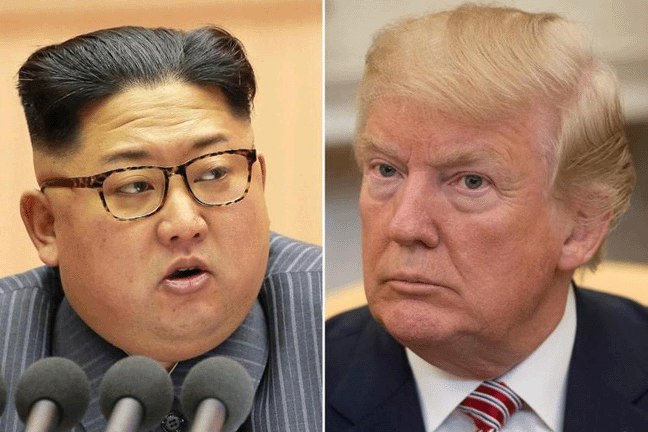 Once ‘No Longer a Nuclear Threat,’ North Korea Now in Standoff With U.S. NYT, By David E. Sanger and William J. Broad, Aug. 10, 2018 WASHINGTON — North Korea is insisting that the United States declare that the Korean War is over before providing a detailed, written disclosure of all its atomic weapons stockpiles, its nuclear production facilities and its missiles as a first major step toward denuclearization.
Two months after President Trump declared his summit meeting in Singapore with Kim Jong-un a complete success, North Korea has not yet even agreed to provide that list during private exchanges with Secretary of State Mike Pompeo, according to American and South Korean officials familiar with the talks.
Mr. Pompeo maintains progress is being made, although he has provided no details. But John R. Bolton, Mr. Trump’s national security adviser, this week said, “North Korea that has not taken the steps we feel are necessary to denuclearize.”
On Thursday, North Korea’s state-run newspaper, Rodong Sinmun, called the declaration of the end of the war “the demand of our time” and that would be the “first process” in moving toward a fulfillment of the June 12 deal struck between Mr. Trump and Mr. Kim. Pyonygang also wants peace treaty talks to begin before detailing its arsenal.
If the standoff over the parallel declarations remains, it is hard to see how the two countries can move forward with an agreement.
“The North Koreans have lied to us consistently for nearly 30 years,” Joseph Nye, who wrote one of the National Intelligence Council’s first assessments of the North’s weapons programs in 1993, said at the Aspen Institute on Tuesday.
“Trump is in a long tradition of American presidents who have been taken to the cleaners,” Mr. Nye said.
Neither Mr. Trump nor Mr. Pompeo has acknowledged the impasse. But officials said South Korea has quietly backed the North Korean position, betting that once Mr. Trump has issued a “peace declaration” it would be harder for him to later threaten military action if the North fails to disarm or discard its nuclear arsenal.
Against North Korea’s continuing nuclear buildup — and its threats to strike the United States — Washington has long refused to formally declare the end of the war, which was halted with a 1953 armistice but never officially brought to a close.
And fears remain that making concessions to Pyongyang — especially after Mr. Trump shelved annual American military exercises with South Korea that he called “war games,’’ the phrase used by the North — would outrage Republicans in Congress and open Mr. Trump to charges that he has been outmaneuvered by the North Korean leader.
The White House has never reconciled Mr. Trump’s post on Twitter after meeting Mr. Kim that “there is no longer a Nuclear Threat from North Korea” with Mr. Bolton’s assessment that the Singapore agreement has so far yielded almost no progress in the nuclear arena. That view is shared by many in Congress and the American intelligence agencies.
For Mr. Trump and Mr. Pompeo, much rides on how this standoff is resolved — or whether it results in the collapse of what the president called his determination to “solve” the nuclear crisis.
Mr. Pompeo has told associates that he believes his tenure as secretary of state will be judged largely on how he handles the negotiations. In recent weeks he has softened some of his statements toward North Korea, saying the United States is open to a step-by-step approach that most officials had previously rejected.
“The ultimate timeline for denuclearization will be set by Chairman Kim,”Mr. Pompeo said last week — a stark contrast to Mr. Trump’s statements last year that North Korea should give up its weapons rapidly, or face tremendous, if unspecified, consequences.
Challenged about the lack of progress so far, officials at the White House and State Department pointed to three developments as signs that the strategy with North Korea is advancing.
They noted that North Korea has not conducted a missile or nuclear test since November. Since the Singapore summit, Pyongyang has returned the remains of about 55 Americans killed in the Korean War, which appear genuine, a good-will gesture though one unrelated to the nuclear program. And satellite evidence suggests North Korea has begun dismantling a test site where it has developed missile technologies and launched space satellite missions. Experts cautioned, however, that all the steps taken so far are easily reversible……..https://www.nytimes.com/2018/08/10/us/politics/north-korea-denuclearize-peace-treaty.html
North Korea finding fault with USA’s diplomat Mike Pompeo
North Korea’s Pompeo Problem Exposes Widening Rift Over Talks, Bloomberg By Bill Faries, August 7, 2018,
- Top U.S. diplomat rebuked after two latest trips to Asia
- U.S. told it will ‘get nothing’ from its pressure campaign
North Korea appears to have a Pompeo problem.
The widening gulf between Secretary of State Michael Pompeo’s description of nuclear talks with North Korea and Pyongyang’s criticism of his efforts is adding further confusion to the status of negotiations intended to lead to the denuclearization of the Korean peninsula.
Twice in recent weeks North Korean officials and state media have rebutted the top U.S. diplomat’s characterization of events and suggested the administration has a myopic focus on denuclearization while ignoring issues such as bringing about a final resolution of the Korean War. Even as President Donald Trump and North Korean leader Kim Jong Un exchange optimistic messages about their push for peace, Pompeo has increasingly become a target of public disparagement from Pyongyang.
Public opinion being influenced by biased and inaccurate reporting on North Korea
They have thus obscured the reality that the fate of the negotiations depends not only North Korean policy but on the willingness of the United States to make changes in its policy toward the DPRK and the Korean Peninsula that past administrations have all been reluctant to make.
These stories also underscore a broader problem with media coverage of the US-North Korean negotiations: a strong underlying bias toward the view that it is futile to negotiate with North Korea. The latest stories have constructed a dark narrative of North Korean deception that is not based on verified facts. If this narrative is not rebutted or corrected, it could shift public opinion—which has been overwhelmingly favorable to negotiations with North Korea—against such a policy.
How the Media Wove a Narrative of North Korean Nuclear Deception 38 North, BY: GARETH PORTER, JULY 26, 2018
Since the June 12 Singapore Summit between US President Trump and North Korean leader Kim Jong Un, the US media has woven a misleading narrative that both past and post-summit North Korean actions indicate an intent to deceive the US about its willingness to denuclearize. The so-called intelligence that formed the basis of these stories was fed to reporters by individuals within the administration pushing their own agenda.
The Case of the Secret Uranium Enrichment Sites
In late June and early July, a series of press stories portrayed a North Korean policy of deceiving the United States by keeping what were said to be undeclared uranium enrichment sites secret from the United States. The stories were published just as Secretary of State Mike Pompeo was preparing for the first meetings with North Korean officials to begin implementing the Singapore Summit Declaration.
The first such story appeared on NBC News on June 29, which reported: Continue reading
U.S. Secretary of State Pompeo accused North Korea of hiding nuclear facilities, enriching uranium
Pompeo accused North Korea of hiding nuclear facilities, enriching uranium: Report , Straits Times, 17 July 18 TOKYO (THE YOMIURI SHIMBUN/ASIA NEWS NETWORK) – US Secretary of State Mike Pompeo accused North Korea of operating secret facilities for the enrichment of uranium when he met senior North Korean official Kim Yong Chol during his July 6-7 visit to the country, the Yomiuri Shimbun has learned.
The US top diplomat’s move appears to underscore Washington’s increasing suspicion that Pyongyang is covertly proceeding with activities that are contrary to denuclearisation, despite its declared commitment to the goal.
It also raises the possibility that even if North Korea starts the process of denuclearisation, the alleged existence of secret facilities will become an issue during the declaration and verification phases.
According to sources knowledgeable about Japan-US-South Korea trilateral talks, Pompeo said at his meeting Kim Yong Chol that Pyongyang was enhancing the production of enriched uranium and also concealing nuclear-related facilities and nuclear warheads.
Citing information that construction activities are under way at a missile plant at Hamhung in the north-eastern province of South Hamgyong to expand the facility, Pompeo stressed that this was not beneficial to US-North Korean relations.
Kim Yong Chol, a top North Korean party official and former spy agency chief with whom Pompeo played a key role in arranging an unprecedented summit between US President Donald Trump and North Korean leader Kim Jong Un in Singapore on June 12, flatly denied Pompeo’s claim, according to the sources.
Pyongyang has never hidden or operated a secret uranium enrichment site, the North Korean official was quoted as saying.
Kim also reportedly argued that activities at the Hamhung missile plant were part of construction work in preparation for the rainy season, not expansion work.
On July 7, a North Korean foreign ministry spokesman released a statement accusing Washington of showing a “regrettable” attitude at the meeting between Pompeo and the North Korean official……..https://www.straitstimes.com/asia/east-asia/pompeo-accused-north-korea-of-hiding-nuclear-facilities-enriching-uranium-report
Mike Pompeo holds nuclear talks with North Korean officials in Pyongyang
Secretary of state predicts ‘productive’ meeting on his third visit, joking: ‘If I come one more time, I will have to pay taxes here’, Guardian, Julian Borger in Washington and Justin McCurry in Tokyo 7 Jul 2018
Mike Pompeo and a US delegation held talks in Pyongyang with North Korean officials on Friday, in an effort to make progress towards disarmament and improved bilateral relations three weeks after Donald Trump’s Singapore summit with Kim Jong-un.
The US secretary of state is seeking to persuade the North Korean leadership to take concrete steps that Trump said he was promised in Singapore, including the destruction of a missile engine testing site and the repatriation of remains of US soldiers killed in the Korean war.
Pompeo is also asking for more substantial steps towards disarmament, reportedly including an inventory of the North Korean arsenal of warheads and missiles.
Mike Pompeo and a US delegation held talks in Pyongyang with North Korean officials on Friday, in an effort to make progress towards disarmament and improved bilateral relations three weeks after Donald Trump’s Singapore summit with Kim Jong-un.
The US secretary of state is seeking to persuade the North Korean leadership to take concrete steps that Trump said he was promised in Singapore, including the destruction of a missile engine testing site and the repatriation of remains of US soldiers killed in the Korean war.
Pompeo is also asking for more substantial steps towards disarmament, reportedly including an inventory of the North Korean arsenal of warheads and missiles.
…….. He is under time pressure to produce results by August, when the US and South Korea were due to hold joint military exercises. Those exercises were cancelled on Trump’s orders in Singapore as an up-front concession. Adding to the pressure, the president has repeatedly claimed that the testing site has already been destroyed, and that the soldiers’ remains have been sent back, neither of which has happened.
Trump has also made extravagant claims about what was agreed in Singapore. At a rally in Montana on Thursday, he claimed: “We signed a wonderful paper saying they’re going to denuclearise their whole thing. It’s going to all happen.”
In a joint statement with Trump, Kim agreed to move towards “complete denuclearisation” but that has been a stock phrase in North Korean rhetoric since 1992 and signifies a vague and long-term process of multilateral disarmament on the Korean peninsula. Since the Singapore meeting, satellite images and intelligence leaks have suggested that North Korea is upgrading critical parts of its nuclear programme
……….. The meeting lasted two hours and 45 minutes and Pompeo then had dinner with his senior aides. The next session is due to start at 9am. It is unclear whether Pompeo will meet Kim Jong-un on this trip.
There were reports before Pompeo began his visit, that he might relax the US demand for complete, verifiable, irreversible disarmament (CVID), and settle for mutual confidence-building measures that defused tensions without dismantling the North Korean arsenal.
His spokeswoman, Heather Nauert, denied those reports on Thursday, saying: “Nothing could be further from the truth. Our policy toward North Korea has not changed.
“We are committed to a denuclearised North Korea and Secretary Pompeo looks forward to continuing his consultations with North Korean leaders to follow up on the commitments made at the Singapore summit,” Nauert added……….. https://www.theguardian.com/us-news/2018/jul/05/mike-pompeo-north-kroea-visit-pressure-nuclear-progress
U.S. Secretary of State Mike Pompeo faces delicate task of negotiating with North Korea on reducing nuclear weapons
Mike Pompeo under pressure to secure nuclear progress in North Korea visit , Guardian Justin McCurry in Tokyo and agencies 5 Jul 2018 Secretary of state faces pressure to establish timeline for denuclearisation as well as duty to reassure regional allies Weeks after Donald Trump declared the world a safer place following his historic summit with Kim Jong-un, Mike Pompeo is due to arrive in Pyongyang on Friday amid growing doubts over the regime’s willingness to abandon its nuclear weapons.
Unnamed US intelligence officials also concluded that North Korea does not intend to completely give up its nuclear stockpile.
Pompeo will also use his visit to consult and reassure Washington’s allies in the region, with meetings planned with Japanese and South Korean officials in Tokyo on Sunday. Japan has voiced support for the leaders’ Singapore declaration, but reacted cautiously to Trump’s decision to cancel a joint US-South Korea military exercise scheduled for August.
Pompeo must establish how far North Korea’s nuclear and missile programmes have advanced before US officials can even attempt to draw up a potential timeline for America’s central demand – their complete, irreversible and verifiable dismantlement [CVID].
At present, the US has no reliable information on where all of North Korea’s production and testing facilities are located or the size of its ballistic inventory.
In a tweet this week, Trump said Washington and Pyongyang had been having “many good conversations” with North Korea over denuclearisation. “In the meantime, no Rocket Launches or Nuclear Testing in 8 months, he said. “All of Asia is thrilled. Only the Opposition Party, which includes the Fake News, is complaining. If not for me, we would now be at War with North Korea!”
Sceptics have pointed out that Kim no longer believes such tests are necessary now that the North has successful developed an intercontinental ballistic missile, and that dismantling North Korea’s missile and nuclear infrastructure represents a much tougher diplomatic challenge that could take years and cost billions of dollars, if it happens at all.
“Denuclearisation is no simple task,” Daryl Kimball, executive director of the Arms Control Association, wrote in a commentary. “There is no precedent for a country that has openly tested nuclear weapons and developed a nuclear arsenal and infrastructure as substantial as the one in North Korea to give up its nuclear weapons.”
Experts have played down Trump’s upbeat appraisal of his 12 June meeting with Kim in Singapore, where the leaders made a loose commitment to work towards the denuclearisation of the Korean peninsula and agreed goodwill measures such as the possible return of the remains of US soldiers from the 1950-53 Korean war.
There are signs Pompeo might abandon all-or-nothing demands for CVID and replace them with incremental steps that South Korea has reportedly suggested would be more likely to secure Kim’s cooperation…….https://www.theguardian.com/us-news/2018/jul/05/mike-pompeo-north-kroea-visit-pressure-nuclear-progress
Despite Donald Trump’s brash confidence, serious and delicate negotiations will be needed with North Korea

 Donald Trump is typically bullish about North Korea nuclear talks – but the hard work begins this week
Analysis: However confident Mr Trump is about nuclear talks with Pyongyang, the hard work is just beginning, The Independent, Chris Stevenson International Editor, 5 July 28, “……….In the lead-up to the unprecedented summit between Donald Trump and the North Korean leader in Singapore on 12 June – and in the weeks afterwards – the US president has sought to paint a picture of a problem solved. Indeed this week Mr Trump tweeted that talks were “going well,” and “All Asia is thrilled”.
After the Trump-Kim summit, North Korea is probaably making more nuclear bomb fuel
North Korea agreed at the summit to “work toward denuclearization of the Korean Peninsula,” but the joint statement signed by Mr Kim and Mr Trump gave no details on how or when Pyongyang might surrender its nuclear weapons.
Ahead of the summit, North Korea rejected unilaterally abandoning an arsenal it has called an essential deterrent against US aggression.
North Korea likely making more nuclear bomb fuel despite Trump-Kim talks, report says http://www.abc.net.au/news/2018-06-30/believes-n-korea-making-more-nuclear-bomb-fuel-us-intelligence/9927908
US intelligence agencies believe North Korea has increased production of fuel for nuclear weapons at multiple secret sites in recent months and may try to hide these while seeking concessions in nuclear talks with the United States, NBC News has quoted US officials as saying.
Key points:
- Unidentified US officials told NBC North Korea had stepped up production of enriched uranium
- North Korea may have three or more secret nuclear sites
- Mr Trump said last week North Korea was blowing up four of its big test sites
North Korea has little incentive to “denuclearize”. Trump’s incoherent strategy leaves the world in danger
 North Korea’s nuclear facilities cannot be closed with a handshake http://www.kbzk.com/story/38534251/north-koreas-nuclear-facilities-cannot-be-closed-with-a-handshake: Jun 29, 2018 By Jonathan Cristol , Research Fellow in the Levermore Global Scholars Program at Adelphi University and Senior Fellow at the Center for Civic Engagement at Bard College. @jonathancristol.
(CNN) — On Wednesday, the North Korea watchers at 38 North released satellite imagery that shows North Korea making improvements to the Yongbyon Nuclear Scientific Research Center. While this report is unsettling, it is not at all surprising.
More unsettling than the report is the possibility that President Donald Trump believed that the North Korean nuclear threat could be solved by a handshake. In the immediate aftermath of the Singapore Summit, Trump said that, “There is no longer a Nuclear Threat from North Korea.” That statement was false, and the North Korean activity at Yongbyon proves it.
But North Korean nuclear activity is not in violation of the terms of the summit, since Trump and Kim Jong Un did not sign paperwork regarding immediate and complete denuclearization. Instead, they signed an agreement that includes a vague statement that North Korea will “work toward” denuclearization of the Korean Peninsula.
So far, the Trump administration is the only side moving in that direction — by agreeing to suspend joint military exercises with South Korea in exchange for vague promises. The improvements at Yongbyon, however, do not even violate Kim’s vague promise, which was only to stop nuclear and ballistic missile testing.
But, more importantly, Kim has little incentive to cease nuclear activity, and for that he can thank the incoherent strategy of Trump. The “maximum pressure” campaign of ever-tightening, crippling sanctions against North Korea is all but forgotten by Washington, and even Secretary of State Mike Pompeo says, “I am not going to put a timeline on [denuclearization].”
Additionally, Trump’s statements that the problem is solved gives China little incentive to apply pressure on its southern ally and gives America little leverage over China. Historically, China has been reluctant to apply too much pressure on Pyongyang for fear of a North Korean collapse that would both inundate China with refugees and potentially bring US troops to the Chinese border. It was Kim’s nuclear program that brought China into the sanctions regime. If, as the President said, the nuclear program is solved, then Washington has little recourse if China chooses to resume trading with North Korea.
CNN reports that the upgrades at Yongbyon were long-planned. These upgrades and further actions to strengthen Pyongyang’s nuclear deterrent will continue overtly in absence of an explicit agreement to stop them. And if such an agreement is reached, upgrades to the nuclear program and further research and development will likely continue in underground facilities. North Korea is not likely to give up its nuclear weapons for any reason or for any price.
Trump may think that a warm handshake and a few shared laughs will solve the North Korean problem, but Kim is not so naive. One of the world’s most brutal and repressive dictators, according to Human Rights Watch, is not going to be won over by Trump’s public remarks that he “got along great with Kim Jong Un, who wants to see wonderful things for his country” or that the two leaders share a “special bond.” Kim is going to take advantage of Trump’s pathological desire for praise and promise him the world, while continuing to develop his weapons programs.
The new developments at Yongbyon are not, on their face, cause for concern. But there are reasons to worry about the 38 North report. If Trump thinks that Kim agreed not to continue with his program, then this report (if discussed on his preferred news network) might cause Trump to return to his previous belligerent rhetoric vis-a-vis North Korea. If Trump thinks that this report makes him look weak, then he may be susceptible to John Bolton’s argument that there is a “legal case” to mount a preventive strike against North Korea.
Trump may think that the summit in Singapore prevented a war, but that is only true in the sense that it stopped him from starting one. That said, the summit does not need to be futile — it could also be the start of a genuine and serious set of arms control and limitation negotiations. These negotiations would require patience and skill without an obvious or immediate photo-op or half-clever tweet.
But since Trump is neither known for his patience nor his restraint on social media, we can expect North Korean nuclear research and facilities upgrades to continue apace.
Previously angry and aggressive, John Bolton, Trump’s national security adviser, now chummy with Putin and Kim Jong Un
The new John Bolton: Trump ally swaps fire and brimstone for a spoonful of sugar
Trump’s national security adviser seems to have abandoned his firebrand persona – and in Moscow the change of tone was striking, Guardian, Julian Borger, 28 June 18,
The trademark walrus moustache was still there, and the penetrating gaze was just the same, but in almost every other way the new John Bolton and the old John Bolton seemed very different.
The old Bolton was a firebrand pundit, raining derision from television talkshows and editorials on US diplomats promoting compromise with America’s enemies. Almost a year ago he wrote a commentary describing Vladimir Putin as a serial liar responsible for an “act of war” in the form of his interference in the US election and warned: “We negotiate with Russia at our peril.”
He described the nuclear deal with Iran, by which Tehran reduced its uranium stockpile by 98%, as an “American Munich” comparable to Neville Chamberlain’s short-lived agreement with Hitler, and he derided US diplomats as “appeasers” for pursuing contacts with adversaries for their own sake.
That was then, but this is now. And Bolton is now national security adviser to Donald Trump, whose defining diplomatic style is chumminess with dictators. In the past month, Bolton has shaken hands with Kim Jong-un and Vladimir Putin, with smiles all round. Face to face with Putin on Wednesday, Bolton replaced fire and brimstone with a large dose of honey………
The change in tone is even more evident in relation to North Korea. In January this year, Bolton said: “Talking to the North Koreans is a waste of time.” He repeatedly insisted that the only subject of discussion at a summit should be the details of how North Korean nuclear weapons would be dismantled and removed.
“I think it’s important if the president sees that they’re just looking for a way to waste time, that he make the point that he’s not there to waste time and that we expect real denuclearisation, not talks about talks about denuclearisation,” he wrote.
It is clear that Trump’s Singapore meeting with Kim Jong-un stopped very much short of that. The US failed in its effort to have its language insisting on “complete verifiable irreversible disarmament” and setting out a timetable.
Instead, Trump unilaterally suspended joint military exercises with South Korea, to the surprise of the government in Seoul and to the US military. In return, he claimed to have won a pledge from Kim to destroy a missile engine testing site. In terms of the overall North Korean weapons programme, the site was a small element, and there is no evidence so far that it has been dismantled.
…….Back in Moscow at a post-Putin press conference, the new Bolton had a one-line answer to a flurry of questions about what had become of the old Bolton.
“I don’t address what I have said before,” he said. https://www.theguardian.com/us-news/2018/jun/28/john-bolton-trump-adviser-new-style-putin
North Korea carrying out improvements at Yongbyon Nuclear Research Facility
North Korea improving nuclear facility despite Kim Jong-un’s pledge, satellite images show, ABC News , By Mary Lloyd , 28 June 18 Satellite images show improvements have continued at a North Korean nuclear facility, even though leader Kim Jong-un recently made commitments to dismantle the country’s nuclear program.
U.S. Secretary of State Mike Pompeo confident that North Korea understands what is expected in complete denuclearization
 North Korea understands U.S. on ‘complete denuclearization’: Pompeo, Patricia Zengerle, WASHINGTON (Reuters) – U.S. Secretary of State Mike Pompeo said on Wednesday he was confident that North Korea understood the scope of the U.S. desire for complete denuclearization as the two countries negotiate after President Donald Trump’s summit with North Korean leader Kim Jong Un.
“We’ve been pretty unambiguous in our conversations about what we mean when we say complete denuclearization,” Pompeo told a Senate Appropriations subcommittee hearing on funding for the State Department.
Trump has drawn some criticism from national security analysts for an agreement that emerged from his June 12 summit with Kim that had few details on how Pyongyang would surrender its nuclear weapons and ballistic missiles…… https://www.reuters.com/article/us-usa-pompeo-senate-northkorea/n-korea-understands-u-s-on-complete-denuclearization-pompeo-idUSKBN1JN2W3
1 This Month

Protect Sazan Island from the Trump family! https://secure.avaaz.org/campaign/en/protect_sazan_island_from_the_trump_family_loc/?bqFCVab&v=174511&cl=22707147157&_checksum=5e9dde668860e8231c33699735e16a1fbf22ab2cb01da50c999fe8732b9775ef&utm_source=email&utm_medium=blast_email&utm_campaign=174511


Cuba Is Not a Failed State – It Is a Besieged State
PETITION: “Global Appeal to Endorse Palestinian Right of Return of Refugees”
To see nuclear-related stories in greater depth and intensity – go to https://nuclearinformation.wordpress.com
-
Archives
- June 2026 (129)
- May 2026 (306)
- April 2026 (356)
- March 2026 (251)
- February 2026 (268)
- January 2026 (308)
- December 2025 (358)
- November 2025 (359)
- October 2025 (376)
- September 2025 (257)
- August 2025 (319)
- July 2025 (230)
-
Categories
- 1
- 1 NUCLEAR ISSUES
- business and costs
- climate change
- culture and arts
- ENERGY
- environment
- health
- history
- indigenous issues
- Legal
- marketing of nuclear
- media
- opposition to nuclear
- PERSONAL STORIES
- politics
- politics international
- Religion and ethics
- safety
- secrets,lies and civil liberties
- spinbuster
- technology
- Uranium
- wastes
- weapons and war
- Women
- 2 WORLD
- ACTION
- AFRICA
- Atrocities
- AUSTRALIA
- Christina's notes
- Christina's themes
- culture and arts
- Events
- Fuk 2022
- Fuk 2023
- Fukushima 2017
- Fukushima 2018
- fukushima 2019
- Fukushima 2020
- Fukushima 2021
- general
- global warming
- Humour (God we need it)
- Nuclear
- RARE EARTHS
- Reference
- resources – print
- Resources -audiovicual
- Weekly Newsletter
- World
- World Nuclear
- YouTube
-
RSS
Entries RSS
Comments RSS
 nuclear-news