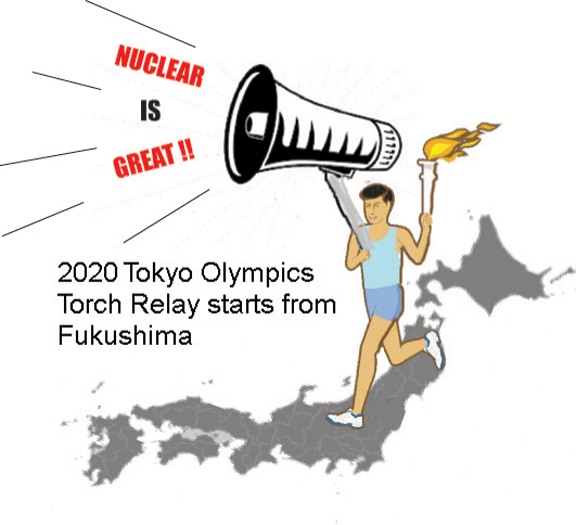
Olympics propaganda revs up to make Fukushima and nuclear power look good
IOC chief ‘impressed’ at Fukushima recovery progress https://www.channelnewsasia.com/news/sport/ioc-chief–impressed–at-fukushima-recovery-progress-10965390, 25 Nov 18
Olympics chief Thomas Bach said Saturday he was impressed at the “great progress” made in the reconstruction of Fukushima, in a visit to the region devastated by the 2011 tsunami and nuclear disaster
TOKYO: Olympics chief Thomas Bach said Saturday (Nov 24) he was impressed at the “great progress” made in the reconstruction of Fukushima, in a visit to the region devastated by the 2011 tsunami and nuclear disaster.
Amid hopes that hosting events will help revive the region, International Olympic Committee President Bach visited a stadium set to hold baseball and softball matches during the Tokyo 2020 Olympics.
During his visit, he told Japanese Prime Minister Shinzo Abe that he was “very much impressed” by the “great progress”.
“The Fukushima region is the suitable place to show the power of the Olympics, the power of sports,” Abe said, reiterating his hopes of showing the world the recovery of Fukushima and other disaster-hit areas during the sporting event, for which Tokyo is the designated host city.
Fukushima has also been chosen as the starting point for the Olympics torch relay.
The passing of the flame is scheduled to start on March 26, 2020, and the torch will head south to the subtropical island of Okinawa – the starting point for the 1964 Tokyo Games relay – before returning north and arriving in the Japanese capital on Jul 10.
The March 2011 tsunami, triggered by a massive undersea quake, killed around 18,000 people and swamped the Fukushima nuclear plant, sending its reactors into meltdown and leading to the world’s worst nuclear disaster since Chernobyl.
Tens of thousands of people evacuated their homes. Authorities have been working to rebuild the region, about 240 kilometres north of Tokyo, although areas near the crippled plant remain uninhabitable because of radiation dangers.
Japan’s Nuclear Regulation Authority concerned about risks of radioactive leaks from facility near Tokyo
November 23, 2018
The Japan Atomic Energy Agency said Wednesday that some of the low-level radioactive waste stored underground at a facility near Tokyo may leak from its containers due to inadequate disposal procedures.
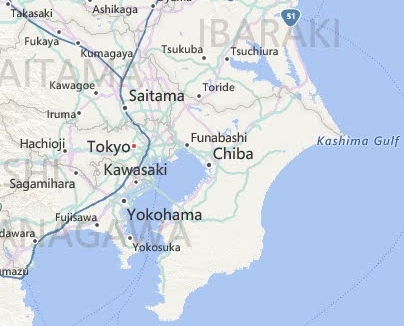
The government-backed agency keeps 53,000 drums of low-level radioactive waste, or about 10,600 kiloliters, in a concrete pit in the basement of a building of the Nuclear Research and Science Institute in the village of Tokai, Ibaraki Prefecture.
Some of the waste did not undergo the proper water removal process when placed in the pit, and leakage and corroded containers in the pit were found during inspections between 1987 and 1991, according to the agency.
The nuclear research body planned to inspect the drums over the next 50 years to check for leakage. But the Nuclear Regulation Authority said at a meeting Wednesday that the agency needs to check them more quickly.
The agency should inspect all the drums within five years, Shinsuke Yamanaka, an NRA commissioner, said at the meeting.
The agency currently inspects the drums visually once a year but will now begin to lift and check them individually.
According to the agency and the NRA, the low-level radioactive waste is placed at the facility, built sometime from around 1964 to 1976, for disposal.
The agency said it did not properly conduct the process of removing water and other materials in some cases during the 1960s.
https://www.japantimes.co.jp/news/2018/11/22/national/low-level-radioactive-waste-stored-tokai-research-facility-near-tokyo-may-leak-agency-says/#.W_mJgvZFzIV
Japan’s nuclear watchdog weighs giving children priority in distribution of iodine tablets
As a reminder, Iodine tablets only protect you from Iodine 131, not from all the other radionuclides.
Plus it has to be taken at least 4 hours before an exposure to radiation, and as usually you will be informed always late of the nuclear accident by the government authorities it will be too late for you to take those tablets….
Just another prop from the nuclear industry and of government, a make believe that you will be safe because they generously distribute you iodine tablets.
 The Nuclear Regulation Authority decided Wednesday to review the nation’s distribution system for iodine tablets against radiation exposure.
November 21, 2018
The Nuclear Regulation Authority decided Wednesday to review the nation’s distribution system for iodine tablets against radiation exposure.
Japan’s nuclear regulation body decided Wednesday to review the nation’s distribution system for iodine tablets against radiation exposure, with an eye on giving priority to children.
Current rules say iodine tablets should be in principle distributed in advance to all residents living within a 5-kilometer radius of 16 nuclear plants in 13 prefectures, where doing so is deemed difficult in emergency situations.
But some municipal governments have yet to hand out the tablets to all residents, including children who are more vulnerable to radiation exposure.
An expert panel set up by the Nuclear Regulation Authority will hold its first meeting next month to review the distribution system with the aim of compiling a report by April. The NRA will decide on a new policy based on the report.
Radioactive iodine released in nuclear accidents could be accumulated in the thyroid gland, increasing the risk of thyroid cancer, particularly among children.
If the tablets are taken beforehand, potassium iodine can saturate the thyroid gland and block radioactive iodine from being stored there.
When Japan was hit by a nuclear crisis at the Fukushima No. 1 plant following the March 2011 earthquake and tsunami, iodine tablets stored at municipal governments were not effectively used.
According to the NRA, the plan to review the pre-distribution of iodine tablets is based on a guideline compiled by the World Health Organization in 2017. WHO says the protection of children and adolescents must be considered a priority as their risk of developing thyroid cancer is higher than adults. Individuals older than 40 are less likely to benefit from iodine tablets.
WHO says the timely administration of the tablets is the key for blocking radioactive exposure, and the most effective protection is offered if they are taken before or immediately at the time of radioactive exposure.
Experts are expected to discuss whether it is reasonable to reflect the WHO recommendations in the NRA’s manual on the pre-distribution of iodine tablets.
Among other topics, the panel will study how doctors will be involved in tablet distributions. It will also hear the views of municipal governments on the matter.
Japan’s Nuclear Regulation Authority concerned about risks of radioactive leaks from facility near Tokyo
 Low-level radioactive waste stored at Tokai research facility near Tokyo may leak, agency says, Japan Times,
KYODO, 23 Nov 18 The Japan Atomic Energy Agency said Wednesday that some of the low-level radioactive waste stored underground at a facility near Tokyo may leak from its containers due to inadequate disposal procedures.
The government-backed agency keeps 53,000 drums of low-level radioactive waste, or about 10,600 kiloliters, in a concrete pit in the basement of a building of the Nuclear Research and Science Institute in the village of Tokai, Ibaraki Prefecture.
Some of the waste did not undergo the proper water removal process when placed in the pit, and leakage and corroded containers in the pit were found during inspections between 1987 and 1991, according to the agency.
The nuclear research body planned to inspect the drums over the next 50 years to check for leakage. But the Nuclear Regulation Authority said at a meeting Wednesday that the agency needs to check them more quickly……..https://www.japantimes.co.jp/news/2018/11/22/national/low-level-radioactive-waste-stored-tokai-research-facility-near-tokyo-may-leak-agency-says/#.W_hm2IczbGg
Residents of the town of Namie, Fukushima Prefecture to sue govt and TEPCO over compensation for nuclear disaster damage

 Residents of nuclear crisis hit Namie to sue TEPCO, gov’t after settlement talks failNovember 19, 2018 (Mainichi Japan) KORIYAMA, Fukushima — Residents of the town of Namie, Fukushima Prefecture, are set to sue the government and the operator of nearby Fukushima Daiichi Nuclear Power Station for more compensation over damages caused by the plant’s March 2011 triple core meltdown, lawyers for the residents said on Nov. 18.
The lawyers told a press conference here that the residents decided to take the case to the Fukushima District Court on Nov. 27 after the operator, Tokyo Electric Power Co. (TEPCO), repeatedly rejected settlement proposals offered in an alternative dispute resolution (ADR) process.
The lawyers said roughly 100 people from the town in northeastern Japan are expected to launch the suit, but the number will likely reach about 2,000. Participating residents held a meeting on Nov. 18 to establish a group of plaintiffs in the prefectural city of Koriyama.
This will be the first time that a group of residents has filed a class action lawsuit after an ADR effort over the nuclear disaster was discontinued, according to the attorneys…….
In the suit, the residents will demand compensation for being forced to evacuate from their neighborhoods, having their communities destroyed by the disaster and having their expectations for a settlement betrayed by the utility.
Evacuation instructions have been lifted in Namie except in areas designated as zones where it will be difficult for residents to return in the foreseeable future. However, the residents will demand a uniform amount of damages in the suit they will launch. They will also sue the government in order to clarify the state’s responsibility for the nuclear accident in March 2011……….
(Japanese original by Toshiki Miyazaki, Fukushima Bureau) https://mainichi.jp/english/articles/20181119/p2a/00m/0na/015000c
 |
ReplyForward
|
OLympics chief part of the propaganda to minimise the seriousness of the nuclear catastrophe at Fukushima

International Olympic Committee President Bach will on Saturday visit a stadium set to host 2020 Olympics baseball and softball games, and meet 60 students who play the sports, organisers said in a statement.
Bach will also speak with local high school students and meet Fukushima Governor Masao Uchibori. Japanese Prime Minister Shinzo Abe has expressed hopes of showing the world the recovery of Fukushima and other disaster-hit areas during the sporting event, for which Tokyo is the designated host city.
Fukushima was also chosen as the starting point for the Olympics torch relay.
The passing of the flame is scheduled to start on March 26, 2020, and the torch will head south to the subtropical island of Okinawa — the starting point for the 1964 Tokyo Games relay — before returning north and arriving in the Japanese capital on July 10.
The March 2011 tsunami, triggered by a massive undersea quake, killed around 18,000 people and swamped the Fukushima nuclear plant, sending its reactors into meltdown and leading to the world’s worst nuclear disaster since Chernobyl.
Tens of thousands of people evacuated their homes. Authorities have been working to rebuild the region, about 240 kilometres (150 miles) north of Tokyo, although areas near the crippled plant remain uninhabitable because of radiation dangers.
In a Japan court, with no jury, U.S. sailors exposed to Fukushima radiation, would not get a fair trial
U.S. sailors filed a class action in the Southern District of California in 2012 claiming radiation they were exposed to following the meltdown of a nuclear power plant in Fukushima, Japan while aboard U.S. vessels on a humanitarian mission has caused cancer, brain tumors, birth defects in their children and other rare health problems. Some have even died, according to their attorneys.
If U.S. courts dismiss the two related cases – Cooper et al. v. TEPCO et al. and Bartel et al. v. Tokyo Electric Power Company Inc. et al. – the sailors could bring their claims in Japan under its Compensation for Nuclear Damage Act.
Sammartino did clarify throughout the hearing that she would not waste her or the attorneys’ time by holding a court hearing if she wasn’t going to consider their arguments.
Class attorney Charles Bonner of Sausalito, California implored the judge not to dismiss the litigation, noting that attorneys have not been able to conduct discovery in the case, and that the defendants’ motions to dismiss were “based on legal arguments,” not facts.
Bonner suggested class counsel needed to obtain contracts between GE, which designed and helped to maintain the nuclear reactors for 40 years in Fukushima, and TEPCO, which operated the plant. Bonner said the contracts likely contain a choice-of-law provision that would indicate whether the parties would agree to litigate in the U.S. or Japan.
“Our sailors have already been here five years. They need some resolution in this court,” Bonner said……..
Edwards suggested if the Southern District of California dismissed the cases, the sailors wouldn’t “go to Japan and hire Japanese lawyers.”
Bonner buoyed Edwards’ point, noting a declaration from Japanese lawyers who said the class would not get a fair trial in Japan, where no jury would decide the case’s merits……..
Sammartino took the matter under submission and indicated that she will issue a written ruling.https://www.courthousenews.com/attorneys-implore-judge-to-keep-sailors-fukushima-case-in-u-s/
High court rejects bid to shut down Shikoku Electric reactor
A high court in western Japan on Thursday rejected a lawsuit to shut down Shikoku Electric Power Co’s only operable nuclear reactor.
The Takamatsu High Court denied a legal bid by residents of Ehime prefecture to shut down the No. 3 reactor at the Ikata nuclear plant, the company said in a statement.
The 890-megawatt reactor was restarted on Oct 27 and is currently running at full capacity.
The restart followed a Hiroshima High Court in late September that lifted a 2017 injunction blocking operations at the reactor.
International Atomic Energy Agency (IAEA) says Japan must urgently tackle Fukushima’s radioactive water buildup
 Reuters 13th Oct 2018 , Japan must urgently tackle a buildup of contaminated water at its Fukushima
nuclear plant, destroyed by an earthquake and tsunami more than seven years
ago, the International Atomic Energy Agency (IAEA) said on Tuesday. The
call after a site visit by IAEA experts follows last month’s admission by
plant owner Tokyo Electric Power (Tepco), that water treated there still
contained radioactive material, despite having said for years it had been
removed.
https://uk.reuters.com/article/us-japan-disaster-nuclear-water/iaea-pushes-japan-for-urgent-disposal-of-contaminated-fukushima-water-idUKKCN1NI14X?rpc=401&
Tepco to temporarily stop injecting water at Fukushima reactor
TEPCO to stop injecting water at Fukushima reactor https://www3.nhk.or.jp/nhkworld/en/news/20181109_10/ The operator of the Fukushima Daiichi nuclear power plant plans to temporarily stop injecting water into one of its damaged reactors to test the cooling of fuel debris.
Tokyo Electric Power Company announced it will conduct the 7-hour test at the No.2 reactor as early as March next year.
The unit is one of 3 in the 6-reactor facility that suffered a meltdown after the March 2011 earthquake and tsunami. The damaged reactors contain a mixture of molten nuclear fuel and structural parts.
TEPCO officials say water injections keep temperatures stable in the 3 reactors at around 30 degrees Celsius.
The planned experiment is aimed at checking how the debris is being cooled. It will be the first time to halt water injections into the reactor since they were stabilized after the accident.
TEPCO’s assessment says the reactor temperature would rise by around 5 degrees per hour if injections were halted by accident. But it says the rise will be limited to about 0.2 degrees per hour when natural heat radiation is taken into account.
TEPCO officials say they will begin cutting back on water injections by around half to 1.5 tons per hour for about a week as early as in January, before halting them completely in March after checking the results.
TEPCO estimates the 7-hour stoppage may raise the reactor temperature by about 1.4 degrees but says water injections will resume if the temperature rises more than 15 degrees.
Company officials say they want to assess changes in the temperature so they can use the data in future emergency cases, including earthquakes and tsunamis.
Fukushima nuclear disaster – whiteboard reveals the chaos in March 2011
“Stop monitoring, evacuate now,” an order said.
The next line follows, “1F3 (No. 3 reactor of Fukushima No. 1 plant) hydrogen explosion.”
“Don’t return here, head west,” another directive said.
Media representatives were invited on Nov. 8 for the first time to the emergency headquarters that was set up at the prefecture-run Environmental Radioactivity Monitoring Center of Fukushima here to monitor the radiation levels around the Fukushima No. 1 nuclear plant when a massive tsunami crippled the power supply on March 11, 2011.
The center was originally constructed as a facility to monitor radiation levels in the area as well as serve as an education center for nuclear power generation.
The headquarters were abandoned on the night of March 14, 2011, after the evacuation order was issued following the explosion at the No. 3 reactor building. No one since then has returned to use or tidy up the site………http://www.asahi.com/ajw/articles/AJ201811090033.html
Local opposition to restart of Tokai nuclear station, but it is cleared to start by Japan’s nuclear watchdog
|
Aging Tokai nuclear plant outside Tokyo cleared to restart, THE ASAHI SHIMBUN, November 7, 2018 The nation’s nuclear watchdog on Nov. 7 formally approved a 20-year extension of the only nuclear reactor in the Tokyo metropolitan area, although local communities will have the final say on the restart.Operator Japan Atomic Power Co. will need the consent of the Ibaraki prefectural government, as well as six local municipalities, including the village of Tokai, where its aging Tokai No. 2 nuclear plant is located.
The company faced having to prepare to decommission the plant’s 40-year-old reactor if it failed to meet a Nov. 27 deadline on revised and more stringent safety standards implemented by the Nuclear Regulation Authority in the aftermath of the 2011 nuclear disaster in Fukushima Prefecture. After the triple meltdown at the Fukushima No. 1 nuclear plant, the operational life of nuclear reactors was set at up to 40 years in principle. But power companies can continue to operate their facilities for an additional 20 years if their reactors pass the NRA screening. So far, all requests to the NRA to extend the operating life of old reactors have been approved. The reactor at the Tokai No. 2 plant is the fourth to clear the NRA for extended operations since the Fukushima disaster. It is located about 120 kilometers from the heart of Tokyo. The 1.1-gigawatt boiling water reactor is the only unit at the Tokai No. 2 plant and is of the same design as the crippled reactors at the Fukushima No. 1 nuclear plant. The Tokai No. 2 plant was also affected by the tsunami generated by the magnitude-9.0 Great East Japan Earthquake on March 11, 2011. It is the first time for a reactor affected by the tsunami to be approved for an operational extension. It is also the first boiling water reactor to gain such approval. The NRA examined the reactor’s pressure vessel and other equipment, and concluded that the unit could operate safely until November 2038. But it remains unclear if Japan Atomic Power can restart the plant under its earliest time frame of 2021, due to local opposition. In October, Mayor Toru Umino of Naka, one of the six municipalities around the plant, announced his opposition to the extension. The city assembly of Mito, another municipality, adopted a resolution against the extension in June. About 960,000 people live within a 30-km radius of the plant, making it the most densely populated site among the nation’s nuclear facilities. After the Fukushima disaster, municipalities in close proximity to a nuclear plant were required to craft an evacuation plan to respond to a nuclear emergency. But only three of the 14 municipalities around the Tokai No. 2 nuclear plant within that range have done so due to the difficulty of arranging transportation for such a large number of people. Bringing the reactor back online is expected to cost Japan Atomic Power at least 174 billion yen ($1.54 billion), a sum that includes construction of a seawall and other safeguard measures. The company hopes to have those measures in place by the end of March 2021. It may well also have to spend tens of billions of yen in the future to meet a new requirement that nuclear facilities are able to contain damage from a terrorist attack. TIMELINE OF KEY EVENTS …….http://www.asahi.com/ajw/articles/AJ201811070061.html |
|
2020 Olympics as PR for the global nuclear industry? Fukushima to start the events

Disaster-stricken prefecture will host first event of the 2020 games https://asia.nikkei.com/Politics/Abe-and-IOC-chief-to-visit-Fukushima-Olympics-venue
Bach will visit Japan to attend a two-day general assembly meeting of the Association of National Olympic Committees starting Nov. 28, followed by an IOC Executive Board session, both to be held in Tokyo.
The Olympic torch relay will start in Fukushima Prefecture on March 26, 2020, with the flame scheduled to be lit in the ancient Greek city of Olympia on March 12 the same year, a day after the ninth anniversary of the 2011 disaster.
The city of Fukushima will host six softball games including a match played by the Japan team on July 22 as the first event of the Olympic Games.
Fukushima’s fishing industry threatened by plans to dump radioactive water
 Radioactive water threatens Fukushima fishery’s fragile gains, Plant operator plans to dump contaminated water into the ocean, Nikkei Asian Review, TAKUMI SASAKI, Nikkei staff writer November 04, 2018, TOKYO — Since a catastrophic nuclear accident seven years ago, Fukushima fishermen have made painstaking efforts to rebuild their livelihood, assiduously testing the radioactivity levels of their catches to ensure safety. Now, rapidly accumulating wastewater from the crippled power plant is again threatening this hard-won business recovery. Radioactive water threatens Fukushima fishery’s fragile gains, Plant operator plans to dump contaminated water into the ocean, Nikkei Asian Review, TAKUMI SASAKI, Nikkei staff writer November 04, 2018, TOKYO — Since a catastrophic nuclear accident seven years ago, Fukushima fishermen have made painstaking efforts to rebuild their livelihood, assiduously testing the radioactivity levels of their catches to ensure safety. Now, rapidly accumulating wastewater from the crippled power plant is again threatening this hard-won business recovery.
Faced with the prospect that there will be no more space to store tanks containing radioactive water leaking from the Fukushima Daiichi nuclear power plant, operator Tokyo Electric Power Co. Holdings and the Japanese government are considering diluting the water and dumping it into the ocean. Even though Fukushima’s fishery has been recovering, the haul throughout the entire prefecture amounted to about 3,300 tons last year, just 10% of the average prior to the 2011 disaster. And even reaching there has not been easy. Fish markets in the prefecture now house testing rooms filled with equipment. Staff members mince seafood caught every morning to screen for radioactivity. Such painstaking efforts gradually enabled fishermen to return to the sea, with all fishing and farming operations resuming in February this year. But the trend could reverse if the government goes through with plans to release nuclear wastewater into the sea. Tepco has been cooling down the molten fuel cores by pumping water into the ruined reactors. The tainted water is later taken out and treated, but the system in place does not filter out tritium, a radioactive hydrogen isotope. The tritium-laced water is currently stored in tanks within the premises of Fukushima Daiichi, but space is due to run out within five years……..https://asia.nikkei.com/Economy/Radioactive-water-threatens-Fukushima-fishery-s-fragile-gains
|
Eastern Japan cities sign nuclear accident evacuation accord

1 This Month

of the week – THE ONENESS of HUMANITY
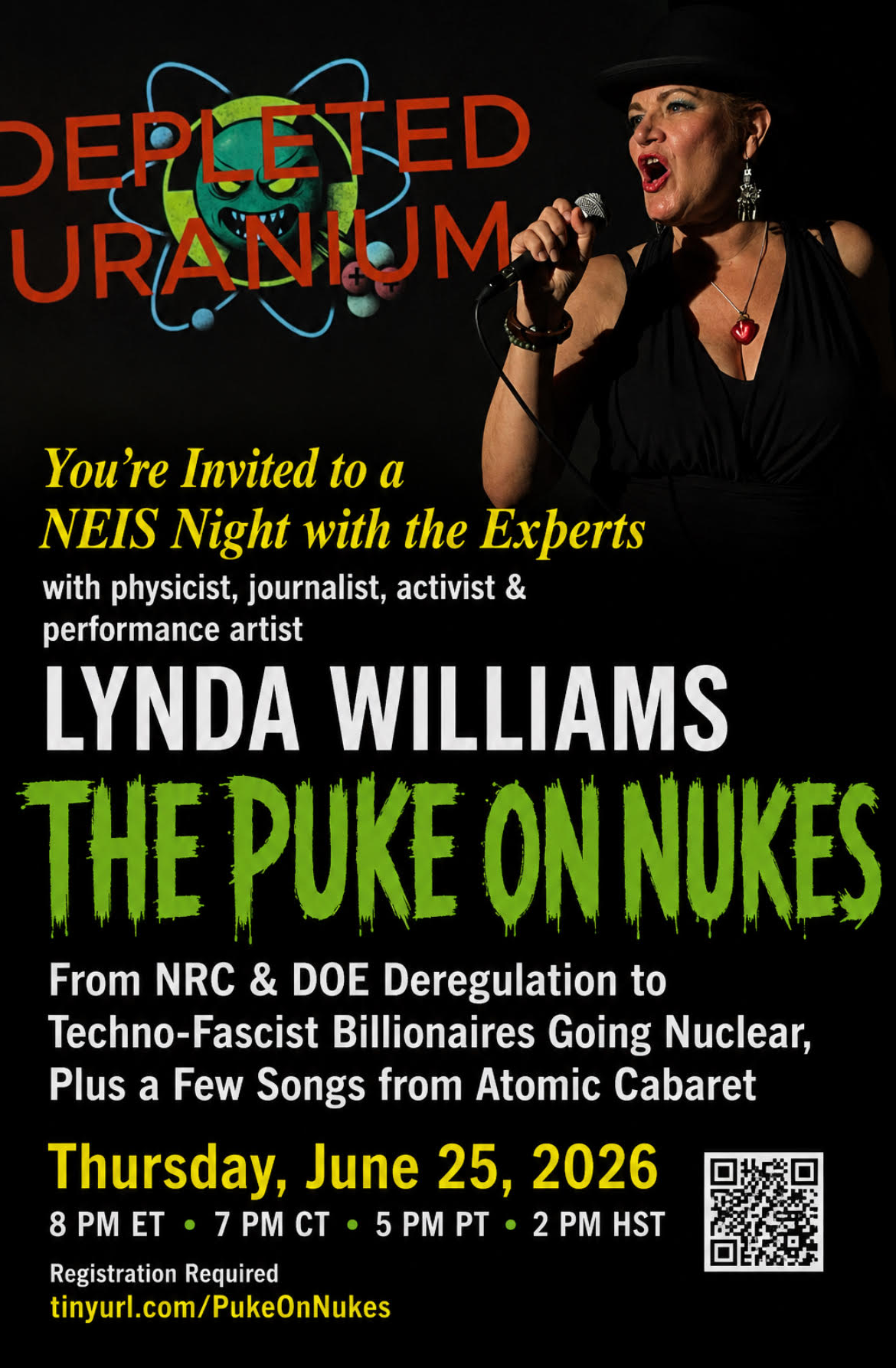
25 June- THE PUKE ON NUKES
Thursday, June 25, 2026
7pm Central Time (8pm ET, 6pm MT, 5pm PT) UTC – 5
From NRC & DOE Deregulation to Techno-Fascist Billionaires Going Nuclear, Plus a Few Songs from Atomic Cabaret REGISTER
26 June – Radiation Trainwreck at the NRC / Join the Protect Better Campaign – https://us02web.zoom.us/meeting/register/4ZlZ5_qLSHGiLSCg8FF6Bg#/registration

1st July – Webinar Waste of Space: The Environmental Harm of Military and Civil Space Activity st July, 7 pm

Report Launch Online: We are seeing an increasing exploitation of space for military and commercial purposes. This must change.

Protect Sazan Island from the Trump family! https://secure.avaaz.org/campaign/en/protect_sazan_island_from_the_trump_family_loc/?bqFCVab&v=174511&cl=22707147157&_checksum=5e9dde668860e8231c33699735e16a1fbf22ab2cb01da50c999fe8732b9775ef&utm_source=email&utm_medium=blast_email&utm_campaign=174511


Cuba Is Not a Failed State – It Is a Besieged State
PETITION: “Global Appeal to Endorse Palestinian Right of Return of Refugees”
To see nuclear-related stories in greater depth and intensity – go to https://nuclearinformation.wordpress.com
-
Archives
- June 2026 (251)
- May 2026 (306)
- April 2026 (356)
- March 2026 (251)
- February 2026 (268)
- January 2026 (308)
- December 2025 (358)
- November 2025 (359)
- October 2025 (376)
- September 2025 (257)
- August 2025 (319)
- July 2025 (230)
-
Categories
- 1
- 1 NUCLEAR ISSUES
- business and costs
- climate change
- culture and arts
- ENERGY
- environment
- health
- history
- indigenous issues
- Legal
- marketing of nuclear
- media
- opposition to nuclear
- PERSONAL STORIES
- politics
- politics international
- Religion and ethics
- safety
- secrets,lies and civil liberties
- spinbuster
- technology
- Uranium
- wastes
- weapons and war
- Women
- 2 WORLD
- ACTION
- AFRICA
- Atrocities
- AUSTRALIA
- Christina's notes
- Christina's themes
- culture and arts
- Events
- Fuk 2022
- Fuk 2023
- Fukushima 2017
- Fukushima 2018
- fukushima 2019
- Fukushima 2020
- Fukushima 2021
- general
- global warming
- Humour (God we need it)
- Nuclear
- RARE EARTHS
- Reference
- resources – print
- Resources -audiovicual
- Weekly Newsletter
- World
- World Nuclear
- YouTube
-
RSS
Entries RSS
Comments RSS
 nuclear-news