Jiji Press FUKUSHIMA (Jiji Press) — The economy, trade and industry ministry will steadily promote decommissioning work at the stricken Fukushima No. 1 nuclear power plant, new minister Isshu Sugawara said Friday.
“Decommissioning work and disposal of tainted water at the plant are the ministry’s highest priorities,” Sugawara said in a meeting with Fukushima Gov. Masao Uchibori.
The nuclear plant, owned by Tokyo Electric Power Company Holdings Inc., is the site of a triple reactor meltdown in March 2011.
Sugawara, who took office on Wednesday as part of Prime Minister Shinzo Abe’s Cabinet reshuffle, said the ministry will also step up support to businesses in areas hit by the nuclear disaster.
Uchibori sought to move nuclear fuel stored at TEPCO’s Fukushima No. 2 nuclear plant, which will also be decommissioned, out of his prefecture.
Speaking to reporters after the meeting, Sugawara said the ministry will work responsively on tackling treated water at the Fukushima No. 1 plant that contains tritium, a radioactive substance.
Japan’s Economy, Trade and Industry Minister Isshu Sugawara attends a news conference at Prime Minister Shinzo Abe’s official residence in Tokyo, Japan September 11, 2019
September 12, 2019
TOKYO: Exiting nuclear power in Japan is unrealistic, the country’s new industry minister said on Thursday (Sep 12), in comments that reiterated the government’s line but are at odds with those made a day earlier by another newly installed cabinet member.
The conflicting comments by cabinet members appointed by Prime Minister Shinzo Abe on Wednesday highlight the abiding sensitivities of nuclear power in Japan, more than eight years after the Fukushima catastrophe caused mass evacuations and Japan’s worst energy crisis in the modern era.
“There are risks and fears about nuclear power,” industry minister, Isshu Sugawara, told reporters a day after his appointment in a cabinet reshuffle.
“But ‘zero-nukes’ is, at the moment and in the future, not realistic,” he added.
The comments by Sugawara, himself once an anti-nuclear advocate, were at odds with those made by new environment minister, Shinjiro Koizumi, who said earlier that Japan should look at ways to exit nuclear power to avoid repeating the March 2011 Fukushima disaster.
“I would like to study how we will scrap them, not how to retain them,” Koizumi said at his first news conference late on Wednesday.
Japan’s nuclear regulator is overseen by Koizumi’s ministry, while energy policy is set by Sugawara’s ministry.
The comments by Koizumi, the son of former prime minister Junichiro Koizumi, were out of step with government policy, which designates atomic power as an important element of the energy mix. The senior Koizumi became an anti-nuclear campaigner after Fukushima.
“The reality is that restarts have been not only delayed, but are increasingly difficult and many will be scrapped” said Martin Schulz, senior research fellow at Fujitsu Research Institute.
Shinjiro Koizumi’s comments were “a bit at odds with the government position – but not totally out of line,” Schultz said.
Three reactors at the Fukushima Daiichi station run by Tokyo Electric Power melted down after being hit by a massive earthquake and tsunami in March 2011, spewing radiation.
Most of Japan’s nuclear reactors, which before Fukushima supplied about 30 per cent of the country’s electricity, are going through a re-licensing process under new safety standards imposed after the disaster highlighted regulatory and operational failings.
Japan has six reactors operating at present, a fraction of the 54 units before Fukushima. About 40 per cent of the pre-Fukushima fleet is set to be decommissioned after operators decided it would be too expensive to refit them to meet the new safety requirements.
The nuclear sector’s shutdown forced Japan to import record amounts of thermal coal and liquefied natural gas to replace the lost capacity, sending electricity bills for consumers and businesses higher.
Fukushima trial ends in not guilty verdict, but nuclear disaster will haunt Japan for decades to come, By James Griffiths, CNN, September 19, 2019 The only criminal prosecution stemming from the 2011 Fukushima nuclear disaster has ended in not guilty verdicts, in a blow to families displaced by the meltdown, as the fallout promises to haunt northern Japan for decades to come.
A court in Tokyo acquitted the former chairman and two former vice presidents of Tokyo Electric Power Company (Tepco), the firm which operated the Fukushima Daiichi plant, according to public broadcaster NHK. The trio were accused negligence for failing to implement safety measures, all three pleaded not guilty. Tsunehisa Katsumata, Sakae Muto and Ichiro Takekuro argued they could not have reasonably foreseen the disaster and thus were not responsible for its effects, including the premature deaths of 44 hospital patients linked to the emergency evacuation.
Japanese prosecutors had previously refused to charge the men, and only took up the case after a concerted legal effort by the families of the dead and those who were evacuated from the area around Fukushima.
The cleanup from the disaster — caused when an earthquake-triggered tsunami struck the plant — is expected to take decades, and cost billions of dollars. Tens of thousands of people still remain displaced, eight years after the original meltdown.
This month, officials said that water pumped into the stricken plant to cool its nuclear cores might have to be dumped into the ocean, due to a lack of storage space for the thousands of tons of contaminated liquid. Around 300 to 400 tons of highly radioactive water is generated every day; it’s currently stored in hundreds of tanks at the site, from which there have been multiple leaks in the years since decommissioning started.
“There are no other options,” environment minister Yoshiaki Harada said of dumping the water into the sea, though other officials claimed a final decision has not yet been made.
The suggestion of dumping even diluted radioactive runoff raised alarm in neighboring South Korea, and could effect the Japanese fishing industry over fears of contamination, regardless of whether these are valid. The original disaster sparked panics in China and on the United States West Coast, where radioactive isotopes have been detected in the California wine crop.
Tepco has previously estimated the Fukushima cleanup could take up to 40 years, at a cost of some $50 billion……….
Tepco’s liability has been a key point of contention since the meltdown.
The firm has firmly maintained that the disaster was just that, a catastrophic event that could not have been planned for. The Tohoku earthquake was the fourth largest in world history, the largest ever to strike Japan, and Tepco’s position is that it simply could not have been expected to guard against such a disaster.
Certainly, Tepco’s response in aftermath the disaster has provided plenty of ammunition for critics, such as the delay in announcing a meltdown was taking place, Tepco’s own admitted downplaying of safety concerns, and multiple leaks of contaminated water during the cleanup process.
In 2012, a Japanese government report found that measures taken by Tepco and the Japanese nuclear regulator to prepare for disasters were “insufficient” and response to the crisis “inadequate.” That came in the wake of a study presented in parliament which said the disaster, far from being an act of nature, was a “man-made” catastrophe which should have been predicted and prepared for.
In fact, of all the studies of the disaster, only Tepco’s own internal report found that no one could have predicted the scale of the earthquake and tsunami and prepared for them. A parliamentary panel said that “the direct causes of the accident were all foreseeable prior to March 11, 2011.”
Despite these damning findings, however, Japanese authorities have shown little desire to hold Tepco officials accountable. Prosecutors twice refused to bring charges, and this week’s court case only occurred after residents appealed.
Thursday’s decision now closes the legal chapter on Fukushima. But as tons and tons of contaminated water continue to build up at the site of the former plant, and fuel rods remain to be cleared, the ghosts of the disaster will be with Japan for decades to come.
Japan Just Let the Executives Who Oversaw the Fukushima Nuclear Disaster off the HookYears after the disaster, there are ghost towns in the areas surrounding the plant.
By Alex Lubben VICE.com Sep 20 2019 “………..Three executives at the utility were accused of criminal negligence for failing to take adequate precautions to protect the plant from a tsunami. Despite knowing their plant might not withstand big waves, they left it as it was.
Now, years after the fact, all three of them are off the hook.
A Japanese court found the head of the Tokyo Electric Power Co., Tsunehisa Katsumata, along with two other former executives not guilty of criminal professional negligence.
The verdict means it’s unlikely anyone will be convicted on charges surrounding one of the worst nuclear disasters ever, one that prompted an international reckoning with the dangers of nuclear power plants……
the company’s own scientists, in the lead-up to the disaster, had warned that the plant was in a tsunami-prone area, and that the plant might not be adequately prepared to weather one, Reuters reported. …….
“The ashes of half a dozen unidentified laborers ended up at a Buddhist temple in a town just north of the crippled Fukushima nuclear plant. Some of the dead men had no papers; others left no emergency contacts. Their names could not be confirmed and no family members had been tracked down to claim their remains. They were simply labeled “decontamination troops”
Fukushima’s Radioactive Water Crisis, https://www.counterpunch.org/2019/09/16/fukushimas-radioactive-water-crisis/ byROBERT HUNZIKERSEPTEMBER 16, 2019Tokyo Electric Power’s Fukushima Daiichi Nuclear Power Station, which experienced three massive meltdowns in 2011, is running out of room to store radioactive water. No surprise! But now, what to do about phosphorescent water?
Addressing the issue, Japan’s environmental minister Yoshiaki Harada held a news conference (September 2019). Unfortunately, he proffered the following advice: “The only option will be to drain it into the sea and dilute it.” (Source: Justin McCurry in Tokyo, Fukushima: Japan Will Have to Dump Radioactive Water Into Pacific, Minister Says, The Guardian, Sept. 10, 2019)
“The only option”… Really?
Over the past 8 years, Tokyo Electric Power (TEPCO) has scrambled like a Mad Hatter to construct emergency storage tanks (1,000) to contain upwards of one million tonnes of contaminated radioactive water, you know, the kind of stuff that, over time, destroys human cells, alters DNA, causes cancer, or produces something like the horrific disfigured creature in John Carpenter’s The Thing! That’s the upshot of a triple nuclear meltdown that necessitates constant flow of water to prevent further melting of reactor cores that have been decimated and transfigured into corium or melted blobs. It’s the closest to a full-blown “china syndrome” in all of human history. Whew! Although, the truth is it’ll be a dicey situation for decades to come.
Ever since March 11, 2011, TEPCO has scrambled to build storage tanks to prevent massive amounts of radioactive water from pouring into the ocean (still, some lesser amounts pour into the ocean every day by day). Now the government is floating a trial balloon in public that, once the tanks are full, it’ll be okay to dump the radioactive water into the ocean. Their logic is bizarre, meaning, on the one hand, the meltdown happens, and they build storage tanks to contain the radioactive water, but on the other hand, once the storage tanks run out of space, it’s okay to dump radioactive water into the ocean. Seriously?
Meantime, the Fukushima meltdown brings the world community face to face with TEPCO and the government of Japan in an unprecedented grand experiment that, so far, has failed miserably. Of course, dumping radiation into the Pacific is like dumping radiation into everybody’s back yard. But, for starters, isn’t that a non-starter?
Along the way, deceit breeds duplicity, as the aforementioned Guardian article says the Japanese government claims only one (1) death has been associated with the Fukushima meltdown but keep that number in mind. Reliable sources in Japan claim otherwise, as explained in previous articles on the subject, for example, “Fukushima Darkness, Part Two” d/d November 24, 2017, and as highlighted further on in this article.
When it comes to nuclear accidents, cover-ups reign supreme; you can count on it.
As such, it is believed the Japanese government is lying and should be held accountable for hoodwinking the world about the ravages of Fukushima, especially with the Olympics scheduled for next year.
For example, the following explains how death by radiation is shamefully hidden from the public via newspeak: Fukushima Daiichi Nuclear Power Station worker deaths “that expire at home” are not officially counted. Accordingly, how many workers on a deathbed with radiation sickness leave home to go to work (where deaths are counted) just before they die? Oh, please!
Meanwhile, the last thing the world community needs in the face of an uncontrollable nuclear meltdown, like Fukushima, is deceptiveness and irresponsibility by the host government. Too much is at stake for that kind of childish nonsense. And just to think, the 2020 Olympics are scheduled with events held in Fukushima. Scandalously, the International Olympic Committee (IOC) is A-Okay with that.
In contrast, a Greenpeace International March 8th 2019 article entitled: Japanese Government Misleading UN on Impact of Fukushima Fallout on Children, Decontamination Workers: “The Japanese government is deliberately misleading United Nations human rights bodies and experts over the ongoing nuclear crisis in areas of Fukushima… In areas where some of these decontamination workers are operating, the radiation levels would be considered an emergency if they were inside a nuclear facility.” Enough said!
“In its reporting to the United Nations, the Japanese government deliberately misrepresents the scale, complexity, and radiation risks in areas of Fukushima, the working practice and conditions for workers, and its disregard for children’s health and wellbeing. This reality should shame the government to radically change its failing policies,” said Kazue Suzuki, Energy Campaigner of Greenpeace Japan.
As such, either Greenpeace or the IOC is “dead wrong” about the conditions at Fukushima. Take your pick.
After all, the trend of misrepresentation of nuclear accidents has been established for decades. Not only Fukushima, Chernobyl (1986) is a nuclear disaster zone where the “official death count from radiation exposure” has been considerably discounted by various governmental agencies and NGOs. For inexplicable reasons (actually explicable but a long story), nuclear accidents are given Get Out Jail Free cards by the world’s press and associated governmental orgs and NGOs.
Yet, over time, the truth comes out, and when it does it’s dreadfully atrocious: A BBC special report, The True Toll of the Chernobyl Disaster d/d July 26, 2019 says: “The official, internationally recognized death toll, just 31 people died as an immediate result of Chernobyl while the UN estimates that only 50 deaths can be directly attributed to the disaster.”
That’s the official tally. Ugh! It’s so far off the mark that, if it were a baseball pitch, it’d be in the dirt, and a prime example of the public not getting the truth about the ravages of nuclear power accidents.
Of course, it is important to take note of how “wordsmiths” describe the death numbers, i.e., “died as an immediate result of Chernobyl” can only include someone standing at the site when it happened, leaving out all cases of radiation exposure that kills and cripples over subsequent days, months, and years. Or, in the case of the UN statement, “only 50 deaths can be directly attributed.” Only those standing there when it happened… ahem!
According to the BBC article, the Russian Academy of Sciences said as many as 112,000-125,000 died by 2005. That’s 2,500xs more deaths than the official reports, which also never increase in number over time as radiation takes its merry ole time blasting, destroying, and/or altering human cell structure. Ukrainian authorities claim death rates of Chernobyl cleanup workers rose from 3.5 to 17.5 deaths per 1,000 between 1988 and 2012 on a database of 651,453 cleanup workers, which equates to 11,392 deaths. Additionally, Belarus had 99,693 cleanup workers, equating to 1,732 deaths. Not only that, disability among workers shows that approximately 5% are still healthy in 2012 (only 5%, meaning 95% unhealthy) with commonality of cardiovascular and circulatory diseases and nervous system problems.
By 2008 in Belarus alone 40,049 liquidators or cleanup workers of Chernobyl were registered with cancer.
Viktor Sushko, deputy director general of the National Research Centre for Radiation Medicine (NRCRM) based in Kiev, Ukraine, describes the Chernobyl disaster as: “The largest anthropogenic disaster in the history of humankind,” Ibid.
Thus begging the most obvious of questions re Fukushima victims in the years ahead; how many cases of cancer, and how many will die? Unfortunately, radioactive isotopes don’t stop once they’re activated in a nuclear meltdown. They’re pernicious over time destroying and/or grotesquely altering human cell structure. For proof, visit second-generation Chernobyl children locked up in orphanages in Belarus.
“As of January 2018, 1.8 million people in Ukraine, including 377,589 children, carried status of victims of the disaster, according to Sushko and his colleagues. Not only that, there has been a rapid increase in the number of people with disabilities, rising from 40,106 in 1995 to 107,115 in 2018,” Ibid.
According to a USA Today article – Chernobyl’s Legacy: Kids With Bodies Ravaged by Disaster, April 17, 2016: “There are 2,397,863 people registered with Ukraine’s health ministry to receive ongoing Chernobyl-related health care. Of these, 453,391 are children — none born at the time of the accident. Their parents were children in 1986. These children have a range of illnesses: respiratory, digestive, musculoskeletal, eye diseases, blood diseases, cancer, congenital malformations, genetic abnormalities, trauma.” Many of the children are hidden away deep in the forested countryside in orphanages in Belarus.
Back to Fukushima, there are numerous instances of governmental meddling to hide the truth, starting with passage of the 2013 government secrecy act, The State Secrecy Law, aka: Act on the Protection of Specially Designated Secrets (SDS), Act No. 108, which says that civil servants or others who “leak secrets” will face up to 10 years in prison, and those who “instigate leaks,” especially journalists, will be subject to a prison term of up to 5 years. Subsequently, Japan fell below Serbia and Botswana in the Reporters Without Borders 2014 World Press Freedom Index.
Horrifically, at the end of the day, when nuclear goes bad, it takes everyone along on a daunting trip for years and years and more years, outliving life spans but continuing generation after generation, like the 453,391 Chernobyl-radiated-influence children born after the nuclear blowout in 1986. Chernobyl altered their genes before they were born…. Imagine that!
Cliodhna Russell visited children’s orphanages in Belarus in 2014: “Children rocking back and forth for hours on end, hitting their heads against walls, grinding their teeth, scraping their faces and putting their hands down their throats.” (Source: How My Trip to a Children’s Mental Asylum in Belarus Made Me Proud to be Irish, the journal.ie, March 18, 2014.)
Postscript: “It’s a real shame that the authorities hide the truth from the whole world, from the UN. We need to admit that actually many people are dying. We are not allowed to say that, but TEPCO employees also are dying. But they keep mum about it,” Katsutaka Idogawa, former mayor of Futaba (Fukushima Prefecture) Fukushima Disaster: Tokyo Hides Truth as Children Die, Become Ill from Radiation – Ex-Mayor, RT News, April 21, 2014)
Post-Postscript: “The ashes of half a dozen unidentified laborers ended up at a Buddhist temple in a town just north of the crippled Fukushima nuclear plant. Some of the dead men had no papers; others left no emergency contacts. Their names could not be confirmed and no family members had been tracked down to claim their remains. They were simply labeled “decontamination troops” — unknown soldiers in Japan’s massive cleanup campaign to make Fukushima livable again five years after radiation poisoned the fertile countryside,” (Source: Mari Yamaguchi, Fukushima ‘Decontamination Troops’ Often Exploited, Shunned, AP & ABC News, Minamisona, Japan, March 10, 2016)
Dumping Fukushima’s Radioactive Water Into Pacific Ocean Is ‘Only Option’, Japan Sayshttps://www.sciencealert.com/fukushima-is-running-out-of-space-to-store-contaminated-waterARIA BENDIX, BUSINESS INSIDER 12 SEP 2019 On March 11, 2011, Japan was struck by the most powerful earthquake in the nation’s history – a magnitude 9 temblor that triggered a tsunami with waves up to 133 feet (40 meters) high. The disaster set off three nuclear meltdowns and three hydrogen explosions at the Fukushima Daiichi Nuclear Power Plant.
Eight years later, Fukushima holds more than 1 million tons of contaminated water.
The water comes from two main sources. First, the tsunami caused the reactor cores to overheat and melt, so cleanup workers injected water into the cores to cool them. In the wake of the accident, groundwater also seeped in beneath the reactors and mixed with radioactive material.
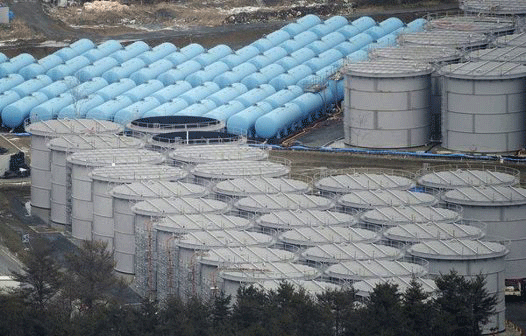
To store this contaminated water, the plant currently has 1,000 sealed tanks. But the water is still accumulating. There’s enough room to keep the liquid contained through summer 2022, but after that, there will be no space left.
At a news briefing in Tokyo, Japan’s environment minister, Yoshiaki Harada, said that come 2022, “the only option will be to drain it into the sea and dilute” the contaminated water.
The Japanese government, however, is waiting on a verdict from a panel of experts before making a final decision about what to do with the water.
Meanwhile, the environmental group Greenpeace said in a statement that the “only environmentally acceptable option” would be to continue to store the water and filter it for contaminants.
But that would require more tanks and an expensive filtration process.
Dumping the water could reduce cleanup costs
Only two events have ever been designated “level 7” nuclear accidents by the International Atomic Energy Agency (IAEA): Fukushima and Chernobyl.
The majority of radiation released during the Fukushima disaster wound up in the Pacific Ocean, but the meltdown also forced the evacuation of more than 200,000 people from nearby areas – about 43,000 of whom still haven’t returned.
Shortly after the tsunami, Fukushima plant workers constructed storage tanks to house the contaminated water used to cool the reactor cores. But they also had to contend with the radioactive groundwater, since cracks in the downed reactors’ foundations allowed liquid to seep in from below.
This left cleanup crews with more dirty water to store and treat than they’d anticipated.
To purify all this water, plant workers at first used zeolites – volcanic materials that cling to a radioactive isotope called cesium. Then in 2013, they filtered the water for strontium, another toxic radioactive substance. But they had trouble filtering out an isotope called tritium, since it binds easily to water.
Greenpeace later said the government had been deterred by the price tag of all the viable methods; one system from a company called Kurion would have cost around US$1 billion to set up, plus several hundred million dollars to operate each year.
‘The sea is not a garbage dump’
Water containing tritium isn’t very dangerous for humans – dumping tritium-laced water into the ocean is common practice for coastal nuclear plants. But it could endanger the local marine species, including fish, which provide a source of income for people living near the power plant.
In 2018, Fukushima’s operator, the Tokyo Electric Power Company (Tepco), also revealed that isotopes like strontium lingered in the water, which meant that about 80 percent of the plant’s treated water still had radiation levels above the government’s standard for ocean dumping.
Some tanks had radiation levels that were 20,000 times greater than the government’s safety standards.
Sending that contaminated water into the ocean could allow it to travel to nearby shores in South Korea, where it could contaminate that local seafood supply, too.
“The sea is not a garbage dump,” Jan Hakervamp, a nuclear-energy expert at Greenpeace, told Business Insider.
“The sea is a common home for all people and creatures and must be protected.” his article was originally published by Business Insider.
Koizumi hopes son will push for abandonment of nuclear power http://www.asahi.com/ajw/articles/AJ201909160016.html, THE ASAHI SHIMBUN, September 16, 2019 HITACHI, Ibaraki Prefecture–Former Prime Minister Junichiro Koizumi said he hopes his son in his new position in the Cabinet will wean Japan from nuclear power and expand the use of natural energy.In a speech here on Sept. 15, Koizumi said he was happy that his son, Shinjiro, 38, was appointed environment minister, his first Cabinet post, last week.
“He has studied things more than I did,” Koizumi said. “The environment is the most pressing issue. I want him to abandon nuclear power and turn Japan into a nation that can develop on natural energy.”
Koizumi also reiterated that he made a mistake when he promoted nuclear power when he was prime minister from 2001 to 2006.
Pro-nuclear advocates had said that nuclear power was safe, low-cost and clean, but Koizumi said the accident at the Fukushima No. 1 nuclear power plant in 2011 “proved all three ‘virtues’ false.”
He said Japan has abundant natural energy and should seek a path that does not rely on nuclear power.
“We will be doomed if we allow another nuclear accident to occur.”
Japan’s newly appointed environment minister, Shinjiro Koizumi, held a news conference on Wednesday at his ministry in Tokyo.
September 12, 2019
Japan’s new environmental minister, Shinjiro Koizumi, called Wednesday for permanently shutting down the nation’s nuclear reactors to prevent a repeat of the 2011 Fukushima disaster, comments that came just a day after Koizumi’s predecessor recommended dumping more than one million tons of radioactive wastewater from the power plant into the Pacific Ocean.
Koizumi was appointed to his position Wednesday as part of a broader shake-up of Japanese Prime Minister Shinzo Abe’s cabinet. He is the 38-year-old son of former Japanese Prime Minister Junichiro Koizumi, a vocal critic of nuclear energy.
“I would like to study how we will scrap them, not how to retain them,” the younger Koizumi, whose ministry oversees Japan’s nuclear regulator, said during his first news conference late Wednesday. “We will be doomed if we allow another nuclear accident to occur. We never know when we’ll have an earthquake.”
In March of 2011, a powerful earthquake triggered a tsunami that caused the meltdown of three nuclear reactors at the Fukushima Daiichi power plant on Japan’s northeastern coast, forcing tens of thousands of people to flee radiation around the plant. It was the world’s second-worst nuclear disaster, after Chernobyl.
After the disaster, all 54 of Japan’s nuclear reactors were shut down. Reuters reported Wednesday that “about 40 percent of the pre-Fukushima fleet is being decommissioned” and only six reactors are currently operating. Amid drawn out legal battles over the impacts of the meltdown, campaigners have ramped up opposition to nuclear power generation in the country.
However, some Japanese politicians, including the current prime minister, have argued that nuclear energy is necessary to meet national climate goals. Japan’s new trade and industry minister, Isshu Sugawara, criticized Koizumi’s call to shutter the country’s reactors. “There are risks and fears about nuclear power,” Sugawara said. “But ‘zero-nukes’ is, at the moment and in the future, not realistic.”
According to The Guardian:
Japan’s government wants nuclear power to comprise 20 percent to 22 percent of the overall energy mix by 2030, drawing criticism from campaigners who say nuclear plants will always pose a danger given the country’s vulnerability to large earthquakes and tsunamis.
Abe, however, has called for reactors to be restarted, arguing that nuclear energy will help Japan achieve its carbon dioxide emissions targets and reduce its dependence on imported gas and oil.
Despite Abe and Sugawara’s stances, “the government is unlikely to meet its target of 30 reactor restarts by 2030,” due to local opposition and legal challenges, noted The Guardian.
The Telegraph reported Thursday that Koizumi “was a surprise addition” to Abe’s cabinet, considering that the new minister “has expressed sharp differences with senior members of the ruling Liberal Democratic Party since he was first elected in 2009 and supported a rival in the most recent election for party president.”
Polls often indicate that Koizumi is considered a popular contender to serve as the next prime minister—and Abe’s choice to appoint him to the cabinet, according to The Telegraph, is “seen as an effort to give a new generation of politicians an opportunity to learn the ropes of government.”
Koizumi replaced Yoshiaki Harada, who made headlines around the world earlier this week. Responding to a projection from Tokyo Electric Power (TEPCO) that the utility will run out of storage space for contaminated groundwater around the Fukushima plant around the summer of 2022, Harada suggested during a news conference Tuesday that “the only option will be to drain it into the sea and dilute it.”
As Common Dreams reported Tuesday, Harada’s comments were swiftly condemned by critics of nuclear energy both in Japan and around the world as well as the neighboring government of South Korea.
New environment minister says Japan should stop using nuclear power
September 12, 2019
TOKYO (Reuters) – Japan’s newly installed environment minister, Shinjiro Koizumi, wants the country to close down nuclear reactors to avoid a repeat of the Fukushima catastrophe in 2011.
The comments by the son of former prime minister Junichiro Koizumi, himself an anti-nuclear advocate, are likely to prove controversial in the ruling Liberal Democratic Party, which supports a return to nuclear power under new safety rules imposed after Fukushima.
“I would like to study how we will scrap them, not how to retain them,” Shinjiro Koizumi said at his first news conference late on Wednesday after he was appointed by Prime Minister Shinzo Abe.
Japan’s nuclear regulator is overseen by Koizumi’s ministry.
Three reactors at the Fukushima Daiichi station run by Tokyo Electric Power melted down after being hit by a massive earthquake and tsunami in March 2011, spewing radiation that forced 160,000 people to flee, many never to return..
Most of Japan’s nuclear reactors, which before Fukushima supplied about 30 percent of the country’s electricity, are going through a re-licensing process under new safety standards imposed after the disaster highlighted regulatory and operational failings.
Japan has six reactors operating at present, a fraction of the 54 units before Fukushima. About 40 percent of the pre-Fukushima fleet is being decommissioned.
Shinjiro Koizumi’s father, a popular prime minister now retired from parliament, became a harsh critic of atomic energy after the Fukushima nuclear crisis.
Japan should scrap nuclear reactors after Fukushima, says new environment minister
Shinjiro Koizumi says: ‘We will be doomed if we allow another accident to occur’
September 12, 2019
Japan’s new environment minister has called for the country’s nuclear reactors to be scrapped to prevent a repeat of the Fukushima nuclear disaster.
Shinjiro Koizumi’s comments, made hours after he became Japan’s third-youngest cabinet minister since the war, could set him on a collision course with Japan’s pro-nuclear prime minister, Shinzo Abe.
“I would like to study how we will scrap them, not how to retain them,” Koizumi, 38, said. “We will be doomed if we allow another nuclear accident to occur. We never know when we’ll have an earthquake.”
Koizumi faced an immediate challenge from the new trade and industry minister, who said that ridding Japan of nuclear power was “unrealistic”.
“There are risks and fears about nuclear power,” Isshu Sugawara told reporters. “But ‘zero-nukes’ is, at the moment and in the future, not realistic.”
Japan’s government wants nuclear power to comprise 20% to 22% of the overall energy mix by 2030, drawing criticism from campaigners who say nuclear plants will always pose a danger given the country’s vulnerability to large earthquakes and tsunamis.
Abe, however, has called for reactors to be restarted, arguing that nuclear energy will help Japan achieve its carbon dioxide emissions targets and reduce its dependence on imported gas and oil.
All of Japan’s 54 reactors were shut down after a giant tsunami caused a triple meltdown at the Fukushima Daiichi nuclear power plant in March 2011.
Nuclear power accounted for about 30% of Japan’s energy production before the disaster. Today, just nine reactors are back in operation, having passed stringent safety checks introduced after the Fukushima meltdown.
But the government is unlikely to meet its target of 30 reactor restarts by 2030 amid strong local opposition and legal challenges.
Although he faces potential opposition from inside the cabinet, Koizumi should at least receive the backing of his father, Junichiro Koizumi, a former prime minister who has emerged as a vocal opponent of nuclear power.
While Japan debates the future of nuclear energy, the younger Koizumi, who has been tipped as a future prime minister, is now at the centre of a controversy over the future of more than a million tonnes of contaminated water stored at Fukushima Daiichi.
On Tuesday, his predecessor as environment minister said the plant’s operator, Tokyo Electric Power, had no choice but to dilute the water and release it into the Pacific ocean rather than store it indefinitely.
The prospect of dumping the water into the sea has angered local fishermen and drawn protests from neighbouring South Korea.
10 Sept 2019 | Japan’s environment minister announced Tuesday that the country will have to dump radioactive water from the Fukushima power plant into the ocean because it is running out of space, Reuters reported. According to Reuters, Tokyo Electric, or Tepco, has collected more than 1 million tonnes of contaminated water from the cooling pipes used to keep fuel cores from melting since the plant was crippled by an earthquake and tsunami in 2011. “The only option will be to drain it into the sea and dilute it,” the minister, Yoshiaki Harada, told a news briefing in Tokyo…The government is awaiting a report from an expert panel before making a final decision on how to dispose of the radioactive water. (The Hill, Reuters)
After Fukushima, Japan’s nuclear power fleet went offline with plans to restart only when safety concerns could be addressed. On his first day at the office, the new environment minister has said he has no intention of ever restarting the reactors. The move could put Shinjiro Koizumi at loggerheads with PM Shinzo Abe, a vocal proponent of nuclear.
SEPTEMBER 12, 2019 MARIAN WILLUHNOn his final day in office, Japanese environment minister Yoshiaki Harada stunned environmentalists by announcing more than a million tons of contaminated water from the Fukushima-Daiichi nuclear power station will have to be dumped in the Pacific.
A day later Japan inaugurated a new environment minister who, at his very first press conference, flew in the face of prime minister Shinzo Abe’s plans to restart the nation’s nuclear power plants.
Shinjiro Koizumi took office yesterday and within hours revealed his intentions regarding the nuclear fleet, which comes under his ministerial purview.
“I would like to study how we will scrap them, not how to retain them,” said Koizumi of the reactors. “We will be doomed if we allow another nuclear accident to occur.”
Disaster
After an earthquake and subsequent tsunami battered the Fukushima-Daiichi nuclear power station in early 2011 – causing a triple meltdown at the plant – Japan shuttered its 54 reactors. Plans have been in place to restart most of them, encouraged by Prime Minister Abe. The PM says the country’s reliance on 30% of its energy from nuclear ensures it can hit its carbon emission reduction targets. Any permanent closure of nuclear assets could mean a big push on solar and other renewables.
Many Japanese heavily oppose nuclear. Tuesday’s announcement wastewater may be dumped into the ocean immediately had fisheries voicing protest, for example. The decision to dump the waste is not final and will be reviewed by a panel of experts appointed by the government.
At 38, Koizumi is Japan’s youngest post-war minister and has been dubbed “a rising star” by Japanese media. He is the son of former PM Junichiro Koizumi and does not appear content to remain in the old man’s shadow, with political analysts predicting the new environment minister is on the path to becoming PM himself.
Shinjiro Koizumi says: ‘We will be doomed if we allow another accident to occur’, Justin McCurry in Tokyo
Thu 12 Sep 2019 Japan’s new environment minister has called for the country’s nuclear reactors to be scrapped to prevent a repeat of the Fukushima nuclear disaster.
“I would like to study how we will scrap them, not how to retain them,” Koizumi, 38, said. “We will be doomed if we allow another nuclear accident to occur.”
Japan’s government wants nuclear power to comprise 20% to 22% of the overall energy mix by 2030, drawing criticism from campaigners who say nuclear plants will always pose a danger given the country’s vulnerability to large earthquakes and tsunamis.
Abe, however, has called for reactors to be restarted, arguing that nuclear energy will help Japan achieve its carbon dioxide emissions targets and reduce its dependence on imported gas and oil.
All of Japans 54 reactors were shut down after a giant tsunami caused a triple meltdown at the Fukushima Daiichi nuclear power plant in March 2011.
Nuclear power accounted for about 30% of Japan’s energy production before the disaster. Today, just nine reactors are back in operation, having passed stringent safety checks introduced after the Fukushima meltdown.
But the government is unlikely to meet its target of 30 reactor restarts by 2030 amid strong local opposition and legal challenges.
Although he faces potential opposition from inside the cabinet, Koizumi should at least receive the backing of his father, Junichiro Koizumi, a former prime minister who has emerged as a vocal opponent of nuclear power.
While Japan debates the future of nuclear energy, the younger Koizumi, who has been tipped as a future prime minister, is now at the centre of a controversy over the future of more than a million tonnes of contaminated water stored at Fukushima Daiichi.
On Tuesday, his predecessor as environment minister said the plant’s operator, Tokyo Electric Power, had no choice but to dilute the water and release it into the Pacific ocean rather than store it indefinitely.
The prospect of dumping the water into the sea has angered local fishermen and drawn protests from neighbouring South Korea.15.23 AESTLast modified on Thu 12 Sep 2019 15.59
Tokyo Electric Power Co.’s Fukushima No. 2 nuclear power plant
September 2, 2019
Japan’s nuclear policy-setting body adopted a report Monday saying the country is entering an era of massive nuclear plant decommissioning, urging plant operators to plan ahead to lower safety risks and costs requiring decades and billions of dollars.
Twenty-four commercial reactors–or 40 percent of Japan’s total–are designated for or are being decommissioned. Among them are four reactors at the Fukushima No. 1 nuclear power plant that were severely damaged by the massive 2011 earthquake and tsunami that struck northeastern Japan.
The annual nuclear white paper, adopted by the Japan Atomic Energy Commission, urges utilities to learn from U.S. and European examples, especially those of Germany, France and Britain. Japan hasn’t yet completed the decommissioning of any reactors and doesn’t have concrete plans for the final disposal of radioactive waste.
“Taking into consideration further increase of nuclear facilities that will be decommissioned, new technology and systems need to be developed in order to carry out the tasks efficiently and smoothly,” the report said. “It’s a whole new stage that we have to proceed to and tackle.”
Japanese utilities have opted to scrap aged reactors instead of investing in safety requirements under post-Fukushima standards. The decommissioning of a typical reactor costs nearly 60 billion yen ($560 million) and takes several decades.
Before the Fukushima disaster, Japan had 60 commercial reactors that provided about 25 percent of the country’s energy needs.
Despite the government’s renewed ambitions for nuclear power, reactor restarts are proceeding slowly as nuclear regulators spend more time on inspections. Meanwhile, anti-nuclear sentiment persists among the public and makes it more difficult for plant operators to obtain local consent in making revisions to their facilities. Any plan related to nuclear waste storage tends to get strong resistance.
Since the Fukushima accident, only nine reactors in Japan have restarted, accounting for about 3 percent of the country’s energy supply, compared to the government’s ambitious 20-22 percent target.
In July, Tokyo Electric Power Holdings Co., or TEPCO, announced plans to decommission all four reactors at its second Fukushima plant, Fukushima No. 2, which narrowly avoided meltdowns in 2011. The move followed eight years of demands by the local government and residents for the reactors’ closure.
TEPCO said the decommissioning of Fukushima No. 2 alone would cost 410 billion yen and would take four decades, but experts have raised concerns about whether those estimates are realistic for a company already struggling with the ongoing cleanup of the wrecked Fukushima plant, estimated to cost about 8 trillion yen.
Japan Atomic Power Co., which has been decommissioning its Tokai nuclear plant since 2001, announced in March that it was pushing back the planned completion of the project by five years, to 2030, because the company still has been unable to remove and store highly radioactive materials from the core. The decommissioning of the government’s Tokai fuel reprocessing facility is expected to take 70 years and cost 770 billion yen.
The white paper stated that Japan is pursuing its divisive spent-fuel reprocessing ambitions and a plan to develop a fast-breeder reactor despite international concerns over the country’s plutonium stockpile of 47 tons, though the commission calls for more efforts in reducing the stockpile and increasing transparency.
France’s recently reported move to abandon ASTRID, its next-generation fast reactor that would theoretically produce more plutonium while burning it as fuel, could be a setback for Japan, which was hoping to jointly develop the technology.
Vietnamese trainees sue Fukushima firm over decontamination work, September 5, 2019 (Mainichi Japan, TOKYO (Kyodo) — Three Vietnamese men on a foreign trainee program in Japan have sued a construction company for making them conduct radioactive decontamination work related to the March 2011 nuclear disaster in Fukushima Prefecture without prior explanation, supporters of the plaintiffs said Wednesday.
The lawsuit, dated Tuesday and filed with a branch of the Fukushima District Court, demanded that Hiwada Co., based in Koriyama in the northeastern Japan prefecture, pay a total of about 12.3 million yen in damages, according to the supporters.
The case is the latest in a string of inappropriate practices under the Japanese government’s Technical Intern Training Program which has been often criticized as a cover for cheap labor.
According to Zentouitsu Workers Union, a Tokyo-based labor union that supports foreign trainees, Hiwada made the plaintiffs conduct decontamination work in the cities of Koriyama and Motomiya in Fukushima Prefecture between 2016 and 2018……. https://mainichi.jp/english/articles/20190905/p2g/00m/0na/014000c
Diplomats from 22 countries and regions attended a briefing at the Foreign Ministry, where Japanese officials stressed the importance of combating rumors about safety at the plant, which was decimated by a 2011 earthquake and tsunami, while pledging transparency.
The plant’s operator, Tokyo Electric Power Co., or TEPCO, said last month that it would run out of storage space for the water in 2022, prompting South Korea to raise safety questions amid tensions with Japan that have intensified over trade and history. South Korea was among those represented at Wednesday’s briefing.
Water must be continuously pumped into the four melted reactors at the plant so the fuel inside can be kept cool, and radioactive water has leaked from the reactors and mixed with groundwater and rainwater since the disaster.
The plant has accumulated more than 1 million tons of water in nearly 1,000 tanks. The water has been treated but still contains some radioactive elements. One, tritium — a relative of radiation-emitting hydrogen — cannot be separated.
Tritium is not unique to Fukushima’s melted reactors and is not harmful in low doses, and water containing it is routinely released from nuclear power plants around the world, including in South Korea, officials say.
The water has been a source of concern, sparking rumors about safety, especially as Japan tries to get countries to lift restrictions on food imports from the Fukushima area ahead of the 2020 Tokyo Olympics. Import restrictions are still in place in 22 countries and regions, including South Korea and China.
“In order to prevent harmful rumors about the Fukushima Dai-ichi plant from being circulated, we believe it is extremely important to provide scientific and accurate information,” Yumiko Hata, a Ministry of Economy, Trade and Industry official in charge of the Fukushima accident response, said at the briefing. “We appreciate your understanding of the situation and continuing support for the decommissioning work at the Fukushima Dai-ichi plant.”
Officials said there were no complaints from the diplomats Wednesday about Japan’s handling of the water.
More than eight years after the accident, Japan has yet to decide what to do with the radioactive water. A government-commissioned panel has picked five options, including the controlled release of the water into the Pacific Ocean.
As disputes between Japan and neighboring South Korea escalated over export controls and colonial-era labor used by Japanese companies, Seoul last month announced plans to step up radiation tests of Japanese food products, and asked about the contaminated water and the possibility of its release into the sea.
Experts say the tanks pose flooding and radiation risks and hamper decontamination efforts at the plant. Nuclear scientists, including members the International Atomic Energy Agency and Japanese Nuclear Regulation Authority, have recommended the water’s controlled release into the sea as the only realistic option scientifically and financially. Local residents oppose this, saying the release would trigger rumors of contamination, which would spell doom for Fukushima’s fishing and agriculture industries.
The panel recently added a sixth option of long-term storage.
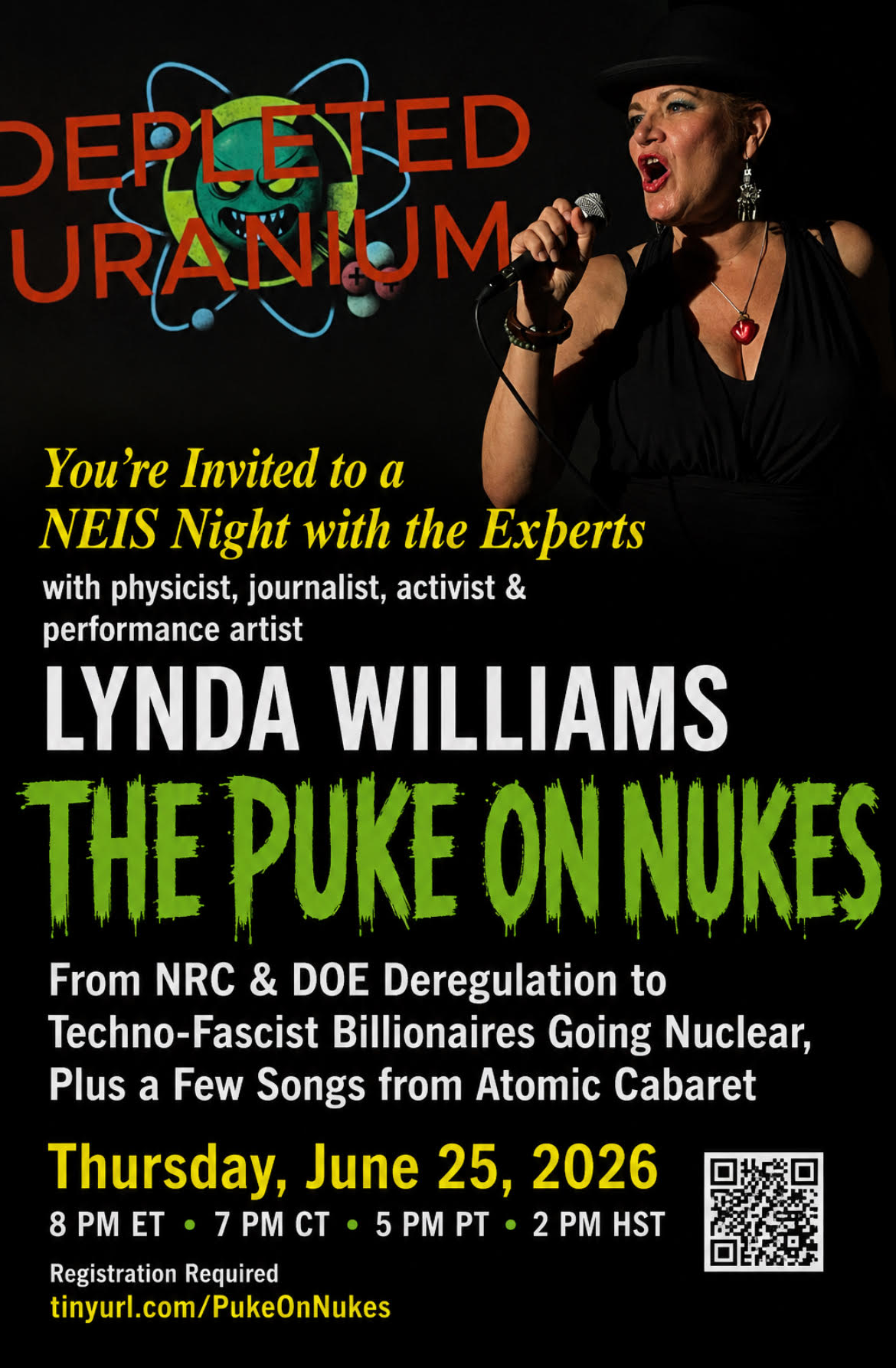
7pm Central Time (8pm ET, 6pm MT, 5pm PT) UTC – 5 From NRC & DOE Deregulation to Techno-Fascist Billionaires Going Nuclear, Plus a Few Songs from Atomic Cabaret REGISTER












 nuclear-news
