The 10 year anniversary of the Fukushima Daiichi nuclear accident occurs in March. Work just published in the Journal ‘Science of the Total Environment’ documents new, large (> 300 micrometers), highly radioactive particles that were released from one of the damaged Fukushima reactors.
Particles containing radioactive cesium (134+137Cs) were released from the damaged reactors at the Fukushima Daiichi Nuclear Power Plant (FDNPP) during the 2011 nuclear disaster. Small (micrometer-sized) particles (known as CsMPs) were widely distributed, reaching as far as Tokyo. CsMPs have been the subject of many studies in recent years. However, it recently became apparent that larger (>300 micrometers) Cs-containing particles, with much higher levels of activity (~ 105 Bq), were also released from reactor unit 1 that suffered a hydrogen explosion. These particles were deposited within a narrow zone that stretches ~8 km north-northwest of the reactor site. To date, little is known about the composition of these larger particles and their potential environmental and human health impacts.
Now, work just published in the journal Science of the Total Environment characterizes these larger particles at the atomic-scale and reports high levels of activity that exceed 105 Bq.
The particles, reported in the study, were found during a survey of surface soils 3.9 km north-northwest of reactor unit 1
From 31 Cs-particles collected during the sampling campaign, two have given the highest ever particle-associated 134+137Cs activities for materials emitted from the FDNPP (specifically: 6.1 × 10⁵ and 2.5 × 10⁶ Bq, respectively, for the particles, after decay-correction to the date of the FDNPP accident).
The study involved scientists from Japan, Finland, France, the UK, and USA, and was led by Dr. Satoshi Utsunomiya and graduate student Kazuya Morooka (Department of Chemistry, Kyushu University). The team used a combination of advanced analytical techniques (synchrotron-based nano-focus X-ray analysis, secondary ion mass spectrometry, and high-resolution transmission electron microscopy) to fully characterize the particles. The particle with a 134+137Cs activity of 6.1 × 10⁵ Bq was found to be an aggregate of smaller, flakey silicate nanoparticles, which had a glass like structure. This particle likely came from reactor building materials, which were damaged during the Unit 1 hydrogen explosion; then, as the particle formed, it likely adsorbed Cs that had had been volatized from the reactor fuel. The 134+137Cs activity of the other particle exceeded 106 Bq. This particle had a glassy carbon core and a surface that was embedded with other micro-particles, which included a Pb-Sn alloy, fibrous Al-silicate, Ca-carbonate / hydroxide, and quartz (Fig. 2).
The composition of the surface embedded micro-particles likely reflect the composition of airborne particles within the reactor building at the moment of the hydrogen explosion, thus providing a forensic window into the events of March 11th 2011 (Fig. 3). Utsunomiya added, “The new particles from regions close to the damaged reactor provide valuable forensic clues. They give snap-shots of the atmospheric conditions in the reactor building at the time of the hydrogen explosion, and of the physio-chemical phenomena that occurred during reactor meltdown.” He continued, “whilst nearly ten years have passed since the accident, the importance of scientific insights has never been more critical. Clean-up and repatriation of residents continues and a thorough understanding of the contamination forms and their distribution is important for risk assessment and public trust.
Professor Gareth Law (co-author, University of Helsinki) added, “clean-up and decommissioning efforts at the site face difficult challenges, particularly the removal and safe management of accident debris that has very high levels of radioactivity. Therein, prior knowledge of debris composition can help inform safe management approaches”.
Given the high radioactivity associated with the new particles, the project team were also interested in understanding their potential health / dose impacts.
Dr Utsunomiya stated, “Owing to their large size, the health effects of the new particles are likely limited to external radiation hazards during static contact with skin. As such, despite the very high level of activity, we expect that the particles would have negligible health impacts for humans as they would not easily adhere to the skin. However, we do need to consider possible effects on the other living creatures such as filter feeders in habitats surrounding Fukushima Daiichi. Even though ten years have nearly passed, the half-life of 137Cs is ~30 years. So, the activity in the newly found highly radioactive particles has not yet decayed significantly. As such, they will remain in the environment for many decades to come, and this type of particle could occasionally still be found in radiation hot spots.”
Professor Rod Ewing (co-author from Stanford University) stated “this paper is part of a series of publications that provide a detailed picture of the material emitted during the Fukushima Daiichi reactor meltdowns. This is exactly the type of work required for remediation and an understanding of long-term health effects”.
Professor Bernd Grambow (co-author from IMT Atlantique) added “the present work, using cutting-edge analytical tools, gives only a very small insight in the very large diversity of particles released during the nuclear accident, much more work is necessary to get a realistic picture of the highly heterogeneous environmental and health impact”.
The chief of an antinuclear group has urged Japan to attend the first meeting of parties to a U.N. treaty banning nuclear weapons, saying the only country to have suffered the atomic bombings has a “moral responsibility” to do so.
In a recent online interview with Kyodo News, Beatrice Fihn, executive director of the International Campaign to Abolish Nuclear Weapons, said as an observer, Japan should “discuss issues relevant to survivors of nuclear weapons use” at the meeting as it has “the knowledge and expertise.”
The first meeting on the pact outlawing the development, testing, possession and use of nuclear weapons is expected to be held in Austria within a year of the treaty going into force on Jan. 22.
Japan has decided not to sign the Treaty on the Prohibition of Nuclear Weapons in consideration of its security ties with the United States, which provides a nuclear umbrella to Tokyo against security threats from North Korea and others. Other nuclear-armed states are also not signatories of the pact.
The head of ICAN, which won the 2017 Nobel Peace Prize for its efforts that led to the adoption of the nuclear ban treaty, said her group expects the first meeting of the treaty’s parties to discuss issues such as support for atomic bomb victims and environmental remediation following the use of nuclear weapons.
Japan “should engage in these conversations about the rights and the needs of survivors,” Fihn said. “If they don’t do that, you know, it will be to abandon the hibakusha,” or survivors of the 1945 U.S. atomic bombings of Hiroshima and Nagasaki.
The Swedish executive director said there has been “a growing voice” from the hibakusha and the Japanese public calling for Tokyo to join the treaty.
It’s really an issue of democracy here and the government at some point has to listen,” she said. “I would encourage Japanese people to speak out louder and stronger.”
Although Fihn does not believe the administration of U.S. President Joe Biden will join the nuclear ban treaty and begin disarming in the near future, she welcomed the new government that is “serious about multilateralism and diplomacy.”
Fihn expressed hope that Washington will “let other countries decide for themselves” on whether or not to join the nuclear ban treaty.
Noting “a lot of support” for the pact from citizens of North Atlantic Treaty Organization member countries, she said, “I hope that the U.S. will keep an open mind” when it comes to NATO states joining this treaty.
The 10 year anniversary of the Fukushima Daiichi nuclear accident occurs in March. Recent work documents new, large (> 300 micrometers), highly radioactive particles that were released from one of the damaged Fukushima reactors.
The 10 year anniversary of the Fukushima Daiichi nuclear accident occurs in March. Work just published in the Journal ‘Science of the Total Environment’ documents new, large (> 300 micrometers), highly radioactive particles that were released from one of the damaged Fukushima reactors.
Particles containing radioactive cesium (134+137Cs) were released from the damaged reactors at the Fukushima Daiichi Nuclear Power Plant (FDNPP) during the 2011 nuclear disaster. Small (micrometer-sized) particles (known as CsMPs) were widely distributed, reaching as far as Tokyo. CsMPs have been the subject of many studies in recent years. However, it recently became apparent that larger (>300 micrometers) Cs-containing particles, with much higher levels of activity (~ 105 Bq), were also released from reactor unit 1 that suffered a hydrogen explosion. These particles were deposited within a narrow zone that stretches ~8 km north-northwest of the reactor site. To date, little is known about the composition of these larger particles and their potential environmental and human health impacts.
Now, work just published in the journal Science of the Total Environment characterizes these larger particles at the atomic-scale and reports high levels of activity that exceed 105 Bq.
The particles, reported in the study, were found during a survey of surface soils 3.9 km north-northwest of reactor unit 1.
From 31 Cs-particles collected during the sampling campaign, two have given the highest ever particle-associated 134+137Cs activities for materials emitted from the FDNPP (specifically: 6.1 × 10⁵ and 2.5 × 10⁶ Bq, respectively, for the particles, after decay-correction to the date of the FDNPP accident).
The study involved scientists from Japan, Finland, France, the UK, and USA, and was led by Dr. Satoshi Utsunomiya and graduate student Kazuya Morooka (Department of Chemistry, Kyushu University). The team used a combination of advanced analytical techniques (synchrotron-based nano-focus X-ray analysis, secondary ion mass spectrometry, and high-resolution transmission electron microscopy) to fully characterize the particles. The particle with a 134+137Cs activity of 6.1 × 10⁵ Bq was found to be an aggregate of smaller, flakey silicate nanoparticles, which had a glass like structure. This particle likely came from reactor building materials, which were damaged during the Unit 1 hydrogen explosion; then, as the particle formed, it likely adsorbed Cs that had had been volatized from the reactor fuel. The 134+137Cs activity of the other particle exceeded 106 Bq. This particle had a glassy carbon core and a surface that was embedded with other micro-particles, which included a Pb-Sn alloy, fibrous Al-silicate, Ca-carbonate / hydroxide, and quartz.
The composition of the surface embedded micro-particles likely reflect the composition of airborne particles within the reactor building at the moment of the hydrogen explosion, thus providing a forensic window into the events of March 11th 2011. Utsunomiya added, “The new particles from regions close to the damaged reactor provide valuable forensic clues. They give snap-shots of the atmospheric conditions in the reactor building at the time of the hydrogen explosion, and of the physio-chemical phenomena that occurred during reactor meltdown.” He continued, “whilst nearly ten years have passed since the accident, the importance of scientific insights has never been more critical. Clean-up and repatriation of residents continues and a thorough understanding of the contamination forms and their distribution is important for risk assessment and public trust.
Professor Gareth Law (co-author, University of Helsinki) added, “clean-up and decommissioning efforts at the site face difficult challenges, particularly the removal and safe management of accident debris that has very high levels of radioactivity. Therein, prior knowledge of debris composition can help inform safe management approaches.”
Given the high radioactivity associated with the new particles, the project team were also interested in understanding their potential health / dose impacts.
Dr Utsunomiya stated, “Owing to their large size, the health effects of the new particles are likely limited to external radiation hazards during static contact with skin. As such, despite the very high level of activity, we expect that the particles would have negligible health impacts for humans as they would not easily adhere to the skin. However, we do need to consider possible effects on the other living creatures such as filter feeders in habitats surrounding Fukushima Daiichi. Even though ten years have nearly passed, the half-life of 137Cs is ~30 years. So, the activity in the newly found highly radioactive particles has not yet decayed significantly. As such, they will remain in the environment for many decades to come, and this type of particle could occasionally still be found in radiation hot spots.”
Professor Rod Ewing (co-author from Stanford University) stated “this paper is part of a series of publications that provide a detailed picture of the material emitted during the Fukushima Daiichi reactor meltdowns. This is exactly the type of work required for remediation and an understanding of long-term health effects.”
Professor Bernd Grambow (co-author from IMT Atlantique) added “the present work, using cutting-edge analytical tools, gives only a very small insight in the very large diversity of particles released during the nuclear accident, much more work is necessary to get a realistic picture of the highly heterogeneous environmental and health impact.”
Japan town mayor OKs restarting nuclear reactor over 40 years old
February 16, 2021 (Mainichi Japan) TSURUGA, Fukui— The mayor of a central Japan town hosting a nuclear power plant operated by Kansai Electric Power Co. informed the speaker of the municipal assembly on Feb. 15 that he would approve the restart of a reactor at the plant that is more than 40 years old.
Mayor Hideki Toshima of the Fukui Prefecture town of Mihama told Mihama Municipal Assembly Speaker Yoshihiro Takenaka that he would approve the restart of the No. 3 reactor at Mihama Nuclear Power Station, which began operating in the 1970s. The assembly had already approved the reactivation of the aging reactor.
Meanwhile, Mayor Yutaka Nose of the prefectural town of Takahama, home to Kansai Electric’s Takahama Nuclear Power Station, whose No. 1 and 2 reactors are also over 40 years old, has given the green light for resuming the operations of the two rectors, while the Takahama Municipal Assembly has also approved of the move.
Now that local consent has been secured, the focus has shifted to the decisions expected from Gov. Tatsuji Sugimoto and the prefectural assembly……….
As a general rule, a nuclear power plant operator is expected to obtain consent for restarting a rector from the local governments around the plant as well as local assemblies. As a condition for approving the restart, the Fukui Prefectural Government said Kansai Electric would need to present candidate sites outside the prefecture for interim spent nuclear fuel storage facilities. The prefectural government maintained that until that condition was achieved, the parties were “not even at the starting line of discussion.”
However, after Kansai Electric proposed on Feb. 12 that it would finalize a planned site for the storage facilities by the end of 2023, the prefectural government demonstrated a positive attitude toward reactivation. Discussion on restarting the aging reactor may develop further at the prefectural assembly session convening on Feb. 16.
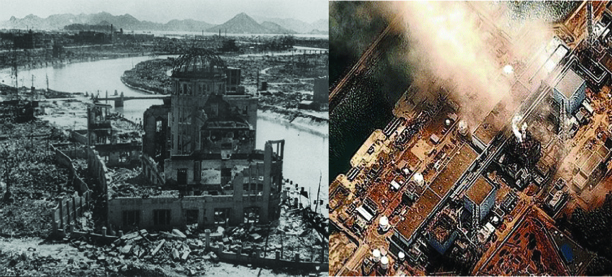
As World War 2 neared its end, with 20 million Russian soldiers killed, fighting with the Allies against Hitler, America’s government was already planning its military superiority over Russia.
What they needed was to demonstrate a weapon of huge mass destruction, that would frighten the Russians. Germany surrendered on 7 May 1945. Too late to try one out on Germany , but Japan was still in the war, (though near to giving up). So they had to hurry. Japan would be the test case – selecting the city of Hiroshima , both to test the effects of atomic bombing, and to show the Russians, on August 6th. To emphasise the USA’s military superiority, they plutonium bombed Nagasaki 3 days later.
After the war, how to get Japan ”on side” against Russia , and equally important, to show the Japanese that nuclear is really quite good.? USA helped Japan to now get an ‘economic miracle’, and better still, give Japan the benefit of ‘good nukes’.
To these crowded, seismically dangerous Japanese islands, USA promoted clusters of nuclear power stations. The nuclear industry’s image was miraculously enhanced – to Japan, and to the world.
BUT, 66 years later, Japan suffered another disastous nuclear blow, with the meltdown at the Fukushima nuclear power station. With the 10 year anniversary of this disaster, on March 11, the real cleanup is nowhere in sight, vast amounts of contaminated water are still accumulating, areas are uninahitable, and most evacuees don’t want to return. Radioactive pollution in forests is still a problem.
Sad to reflect that this one country, Japan, has suffered two great nuclear horrors – 75 years apart, with the tragic effects of both continuing. The world needs, not a celebratory, cosmetic, Olympic Games, but real international help for the people of Fukushima, and for the environmental remediation. Japan needs help to shut down the toxic nuclear industry and move to clean energy
Strong Earthquake in Japan 10 years after the devastating tsunami in 2011
7.3 strong, the earthquake reports little damage
A leak in a nuclear plant and widespread power outage are initial concerns
The 7.3 magnitude quake which hit near Fukushima on Saturday night 11.04 pm local time hit off of Fukushima just weeks before the 10th anniversary of a quake on March 11, 2011 that devastated northeast Japan…………
, most concerning are reports of a leak at Fukushima Daini Nuclear Power plant, according to public broadcaster NHK – though this has been denied by the facility owners.
Pool water used for storing spent nuclear fuel may have leaked and contaminated the surrounding area, the outlet said.
An earthquake of 7.1 degrees on the Ritcher scale shook eastern Japan that Saturday (02/13/2021) and was strongly felt in Tokyo, without the Japanese authorities activating the tsunami warning for the moment.
Highest seismic activity before an earthquake occurs, are zero. The radioactivity contained in the pools of water that accumulate is a minor problem within this frame. We also remember that Japan’s nuclear program is a consequence of the unconditional surrender imposed by the U.S. after the Second War, to have control in the fissile material zone and lay its largest base on the island of Okinawa.
It was not an accident.
It’s not an earthquake fault.
It was the deliberate action of a conquest strategy, which made Japan a time bomb for all humanity.
Powerful magnitude 7.3 earthquake jolts Fukushima area, Japan Times 14 Feb 21, A powerful magnitude 7.3 earthquake struck late Saturday off the coast of Tohoku, leaving at least 50 people injured and knocking multiple power plants offline.
The quake, which measured a strong 6 on the Japanese seismic intensity scale — the second-highest level — jolted Miyagi and Fukushima prefectures in the Tohoku region. No tsunami warning was issued.
The injuries were reported in Miyagi and Fukushima prefectures, but it was not immediately clear if anyone was seriously hurt.
Nationwide, at least 950,000 homes were without power as of midnight, top government spokesman Katsunobu Kato said at a news conference. Kato later said that multiple power plants in the nation were offline.
A government source said the power outage situation was expected to improve through the early hours of Sunday but that more time would be needed in the Tohoku region.
The quake, which was also felt in Tokyo, where it registered a 4 on the Japanese scale, struck at around 11:07 p.m., according to the Meteorological Agency. The epicenter was off the coast of Fukushima, about 220 kilometers (135 miles) north of Tokyo. Its focus was estimated to be at a depth of about 55 kilometers.
At a news conference early Sunday morning, a Meteorological Agency official said aftershocks of up to a strong 6 on the Japanese scale could occur for at least a week. The official said Saturday’s quake was believed to be an aftershock of the Great East Japan Earthquake that struck the same region on March 11, 2011.
“Because (the 2011 quake) was an enormous one with a magnitude of 9.0, it’s not surprising to have an aftershock of this scale 10 years later,” said Kenji Satake, a professor at the University of Tokyo’s Earthquake Research Institute.
The quake registered a strong 6 in the southern part of Miyagi, and in the Nakadori central and Hamadori coastal regions of Fukushima, the agency said…….
No abnormalities have been found at the Fukushima Nos. 1 and 2 nuclear power plants, according to Tokyo Electric Power. The same was true for Japan Atomic Power Co.’s inactive Tokai No. 2 nuclear power plant in the village of Tokai in Ibaraki Prefecture and Tohoku Electric Power Co.’s Onagawa nuclear plant in Miyagi Prefecture, according to their operators……….
Prime Minister Yoshihide Suga immediately directed government agencies to assess damage, rescue any potential victims, work with municipalities and provide necessary information about any evacuation plans and damage as soon as possible. The government was setting up a task force to examine the quake.
Defense Minister Nobuo Kishi directed the Self-Defense Forces to gather information on the scope of the damage and be prepared to respond immediately.
The quake, which comes less than a month before the 10th anniversary of the Great East Japan Earthquake, registered a 4 on the Japanese scale as far north as Aomori Prefecture and as far west as Shizuoka Prefecture. It was the strongest quake in the region since April 7 that year, the meteorology agency said.
Japan Times 10th Feb 2021, A court has ordered Tokyo Electric Power Company Holdings Inc. to pay a total of some ¥600 million to 271 plaintiffs over an evacuation caused by
the 2011 nuclear disaster. The Iwaki branch of Fukushima District Court
reached its conclusion Tuesday in a lawsuit filed by 297 plaintiffs —
which included residents of the heavily affected Yamakiya district in the
town of Kawamata who were ordered to evacuate — seeking ¥14.7 billion in
damages from Tepco.
The plaintiff side expressed its intention to appeal to
a higher court. The suit is the second in a series filed by evacuees who
left their homes due to the triple meltdown at Tepco’s Fukushima No. 1
nuclear power plant triggered by the March 2011 earthquake and tsunami. The
plaintiffs excluded the state from the suit as it hoped to achieve an early
resolution.
Fukushima to Triple Wind Power Generation https://www.nippon.com/en/news/yjj2021020801101/ Feb 8, 2021 Tokyo, (Jiji Press)–Japan’s industry ministry announced a plan on Monday to triple wind power generation in Fukushima Prefecture to 360 megawatts in fiscal 2024 from four years before.The plan highlighted the use of renewable energy as a pillar of efforts to accelerate the recovery of the northeastern prefecture from the March 2011 nuclear accident.
Under the plan, the Fukushima and national governments aim to construct an industrial complex running solely on renewable energy sourced within the prefecture, by fiscal 2030.
The national government will provide financing to build some 30 kilometers out of the over 80 kilometers of a grid that will supply electricity in the prefecture from renewable sources.
All 10 nuclear reactors in the prefecture are set to be decommissioned, following the triple meltdown at Tokyo Electric Power Company Holdings Inc.’s <9501> disaster-hit Fukushima No. 1 nuclear plant.
No matter how you feel about nuclear energy, nuclear waste is generally something you want to stay as far away from as possible—unless you’re two villages on the Hokkaido, Japan’s second-largest island. The two small fishing towns, Suttsu and Kamoenai, are competing to become the site for a high-level radioactive waste storage site as a means to stay afloat economically. But not everyone is so thrilled about the prospect.
According to national data, Japan has generated more than 19,000 tons of highly toxic atomic waste since it began using nuclear power in 1966. To keep it away from people, back in 2000, the country passed the Designated Radioactive Waste Final Disposal Act to open a call for an underground waste repository for some of it.
At the time, unsurprisingly, no municipalities to sign up to host the toxic stuff. The trepidation only grew when in 2011, an earthquake and tsunami triggered an explosion at Japan’s Fukushima Daiichi Nuclear Power Plant, releasing an unprecedented amount of radioactive contamination into the ocean. It was the most severe nuclear accident since Chernobyl.
But now, times are desperate in Japan’s small villages. Fishing, once a booming industry, is in decline. Many young people are moving into cities where economic prospects are better. As a result, populations are shrinking. Suttsu currently has a population of 2,885, down from nearly 5,000 in 1980, and Kamoenai is home to just more than 800. As Bloomberg noted, both towns were also hit hard by the economic downturn of the covid-19 pandemic last year.
Agreeing to host the nuclear storage facility would be a major boost for either town. By agreeing to preliminary research into hosting the nuclear storage facility, municipalities can rake in up to $19 million in government subsidies over two years. If that first stage goes well, another $66 million becomes available in exchange for a four-year field survey and preliminary drilling. If that goes smoothly, the town would go through a 14-year evaluation period, unlocking even more funding. In total, the potential prize for agreeing to host the facility could be up to $37 billion in investments. So in October, both towns’ officials came forward as potential candidates.
But of course, the prospect of living near an atomic waste dump has sparked opposition from concerned residents of both towns. Nuclear waste can contain toxic elements like uranium and plutonium. Anti-nuclear advocates in Suttsu even pushed for a referendum on the village’s application, but the municipal assembly voted it down. Japanese government officials said their review process is airtight and would protect locals, but in an interview with the magazine Aera, Yugo Ono, a geology professor at Hokkaido University, said the earthquake risk is high and could lead to the stored waste leaking.
It’s sad that small Japanese towns are being forced to these lengths to protect their economic stability. But at some point, Japan will need to put its nuclear waste somewhere. Let’s just hope when it does, it does so safely.
Dynamics of radiocesium in forests after the Fukushima disaster: Concerns and some hope
Scientists compile available data and analyses on the flow of radionuclides to gain a more holistic understanding, FORESTRY AND FOREST PRODUCTS RESEARCH INSTITUTE, 5 Feb 21, HTTPS://WWW.EUREKALERT.ORG/PUB_RELEASES/2021-02/FAFP-DOR020221.PHP
Research News After the Chernobyl disaster of 1986, the 2011 Fukushima Daiichi nuclear power plant (FDNPP) disaster was the second worst nuclear incident in history. Its consequences were tremendous for the Japanese people and now, almost a decade later, they can still be felt both there and in the rest of the world. One of the main consequences of the event is the release of large amounts of cesium-137 (137Cs)–a radioactive “isotope” of cesium–into the atmosphere, which spread farther away from the power plant through wind and rainfall.
Considering the massive threat posed by 137Cs to the health of both humans and ecosystems, it is essential to understand how it has distributed and how much of it still lingers. This is why the International Atomic Energy Agency (IAEA) has recently published a technical document on this specific issue. The fifth chapter of this “Technical Document (TECDOC),” titled “Forest ecosystems,” contains an extensive review and analysis of existing data on 137Cs levels in Fukushima prefecture’s forests following the FDNPP disaster.
The chapter is based on an extensive study led by Assoc. Prof. Shoji Hashimoto from the Forestry and Forestry Products Research Institute, Japan, alongside Dr. Hiroaki Kato from the University of Tsukuba, Japan, Kazuya Nishina from the National Institute of Environmental Studies, Japan, Keiko Tagami from the National Institutes for Quantum and Radiological Science and Technology, Japan, George Shaw from the University of Nottingham, UK, and Yves Thiry from the National Agency for Radioactive Waste Management (ANDRA), France, and several other experts in Japan and Europe.
The main objective of the researchers was to gain a better understanding of the dynamics of 137Cs flow in forests. The process is far from straightforward, as there are multiple elements and variables to consider. First, a portion of 137Cs-containing rainfall is intercepted by trees, some of which is absorbed, and the rest eventually washes down onto the forest floor. There, a fraction of the radiocesium absorbs into forest litter and the remainder flows into the various soil and mineral layers below. Finally, trees, other plants, and mushrooms incorporate 137Cs through their roots and mycelia, respectively, ultimately making it both into edible products harvested from Fukushima and wild animals.
Considering the complexity of 137Cs flux dynamics, a huge number of field surveys and gatherings of varied data had to be conducted, as well as subsequent theoretical and statistical analyses. Fortunately, the response from the government and academia was considerably faster and more thorough after the FDNPP disaster than in the Chernobyl disaster, as Hashimoto explains: “After the Chernobyl accidents, studies were very limited due to the scarce information provided by the Soviet Union. In contrast, the timely studies in Fukushima have allowed us to capture the early phases of 137Cs flow dynamics; this allowed us to provide the first wholistic understanding of this process in forests in Fukushima.”
Understanding how long radionuclides like 137Cs can remain in ecosystems and how far they can spread is essential to implement policies to protect people from radiation in Fukushima-sourced food and wood. In addition, the article also explores the effectiveness of using potassium-containing fertilizers to prevent the uptake of 137Cs in plants. “The compilation of data, parameters, and analyses we present in our chapter will be helpful for forest remediation both in Japan and the rest of the world,” remarks Hashimoto.
When preventive measures fail, the only remaining option is trying to fix the damage done–in the case of radiation control, this is only possible with a comprehensive understanding of the interplay of factors involved.
In this manner, this new chapter will hopefully lead to both timely research and more effective solutions should a nuclear disaster happen again.
Japan Times 3rd Feb 2021,Two fishing villages in Hokkaido are vying to host the final storage
facility for half a century of Japanese nuclear waste, splitting
communities between those seeking investment to stop the towns from dying,
and those haunted by the 2011 Fukushima disaster, who are determined to
stop the project.
In the middle is a government that bet heavily on nuclear
energy to power its industrial ascent and now faces a massive and growing
pile of radioactive waste with nowhere to dispose of it. Since it first
began generating atomic energy in 1966, Japan has produced more than 19,000
tons of high-level nuclear waste that is sitting in temporary storage
around the country.
After searching fruitlessly for two decades for a
permanent site, the approaches from Suttsu, population 2,885, and Kamoenai,
population 810, may be signs of progress. The towns have focused a debate
that has bedeviled an industry some regard as a vital emissions-free energy
source and others revile as a dangerous liability. The accidents at
Chernobyl in 1986 and Fukushima in 2011 reinforced public skepticism about
both the safety of reactors and our ability to safely store their residue
for centuries. While new generations of fail-safe reactor designs may
eventually help assuage the first concern, the problem of the waste
remains.
Mayor gives Japan’s first approval for restart of reactors over 40 years old, Japan Times, BY ERIC JOHNSTON, STAFF WRITER, Feb 1, 2021
OSAKA – The mayor of the town of Takahama in Fukui Prefecture granted permission Monday for the restart of the Nos. 1 and 2 reactors at Kansai Electric Power Co.’s Takahama Nuclear Power Plant, becoming the first local leader in the nation to approve use of nuclear reactors more than 40 years old. The Takahama No. 1 reactor is 46 years old and the No. 2 reactor is 45.
Kepco will now seek restart approval from the prefectural government. But with questions still unanswered about where spent fuel generated by the reactors will be stored, it is unclear whether the utility’s plans to have both reactors online this spring can be realized.
Monday’s formal approval came after Takahama Mayor Yutaka Nose called on the central government, in an online meeting Friday with industry minister Hiroshi Kajiyama, to provide assistance to the town and received assurance that it would. Kajiyama said the government wanted to provide the maximum amount of support possible, and was aligned with what Takahama was seeking in terms of a local revitalization policy.
In exchange for granting restart permission, Nose asked the central government to raise the amount of funding it provides the town for hosting the Takahama plant, which has four reactors in total, as well as for various local projects.
While not legally required, local approval for reactor restarts by utilities is established policy, and local government heads often negotiate on financial assistance measures before giving their decision. The Takahama Municipal Assembly approved the restart of the reactors in November.
Kepco wants to restart the No. 1 reactor in March and the No. 2 reactor in May at the earliest. With Nose giving the green light, the utility will next seek approval from the Fukui Prefectural Assembly and Fukui Gov. Tatsuji Sugimoto — but that could prove more problematic.
Sugimoto has said that in order for him to give his approval, Kepco will need to indicate where, outside Fukui Prefecture, it plans to build a midterm storage facility for spent nuclear fuel. But with no other localities willing to host such a facility, Kepco has yet to do that.
In December, the Federation of Electric Power Companies, which consists of 10 major utilities including Kepco, proposed that a storage facility in the city of Mutsu, Aomori Prefecture, scheduled to go into operation during fiscal 2021 be used jointly for midterm spent fuel storage. However, Mutsu Mayor Soichiro Miyashita said he would never allow Kepco’s spent fuel to be stored there.
The interim facility, Recyclable-Fuel Storage Co., was established by Tokyo Electric Power Co. and Japan Atomic Power Co. to store spent fuel from their reactors only. The fuel is scheduled to remain there for up to 50 years before it must be transferred to a final disposal facility.
In addition to the Takahama reactors, Kepco hopes to restart its Mihama No. 3 reactor in the town of Mihama, Fukui Prefecture, which is 44 years old. But the Fukui governor also wants to know where spent fuel from that reactor will be contained — again, outside the prefecture. Kepco apologized to Sugimoto in December for not being able to offer a report on where such spent fuel would be sent https://www.japantimes.co.jp/news/2021/02/01/national/takahama-nuclear-reactor-restart-approval/
Fukushima businesses struggling to stay afloat despite government help, Japan Times, 29 Jan 21 Commercial complexes built as part of revitalization projects in areas affected by the triple meltdown at the Fukushima No. 1 nuclear power plant in March 2011 are struggling to stay afloat.Faced with difficulties due to swelling costs, business operators often turn to local municipalities for financial aid to help them overcome crises. But the financial struggles will not end soon, given that only a portion of the residents who evacuated from the disaster-stricken areas have returned or are expected to.
Those outlets are now facing a testing moment that will determine whether they can continue with their businesses.
A small village in Fukushima Prefecture located northwest of the power plant, Iitate, which was issued evacuation orders after the nuclear disaster, built the commercial complex Michi no Eki Madeikan for ¥1.4 billion. However, business at the commercial building, which has a convenience store and a vegetable stand, has always been touch and go.
Madei Garden Village Iitate runs the business using a ¥33 million payment from the local government. But even with those funds, the operator saw a deficit of ¥9 million in fiscal 2017 and ¥8 million the following year.
Faced with a severe financial crisis, the company was forced to seek financial aid worth ¥35 million from Iitate in 2018.
After revising its business strategy, the company managed to reduce running costs and decrease the deficit to ¥300,000 in fiscal 2019.
“We are expecting a profit in fiscal 2020. I’ll be dealing with the accumulating debt as a priority,” says Rokutaro Kurihara, the company’s managing director.
Kurihara’s company is among those operating at 12 commercial facilities in 10 towns in areas that used to be designated as no-go zones, including the town of Namie and Tamura city.
Since most of the stores and shops shut down when residents evacuated from the region, local governments have built them for returning residents.
7pm Central Time (8pm ET, 6pm MT, 5pm PT) UTC – 5 From NRC & DOE Deregulation to Techno-Fascist Billionaires Going Nuclear, Plus a Few Songs from Atomic Cabaret REGISTER









 nuclear-news