Two Niigata nuclear reactors run by Tepco clear new safety standards, a first for the company since the Fukushima crisis

2 residents file request for temporary injunction against Oi nuke plant restart

The Constitutional Democratic Party of Japan clarifies goal of eliminating nuclear power in policy draft

Japan’s $122 billion nuclear fuel reprocessing plant Rokkasho delayed yet again
 Japanese nuclear fuel reprocessing plant delayed yet again Nikkei Asian Review
https://asia.nikkei.com/Politics-Economy/Policy-Politics/Japanese-nuclear-fuel-reprocessing-plant-delayed-yet-again
TOKYO — The Japanese company building a reprocessing plant for spent nuclear fuel pushed back the planned completion date by another three years Friday, further clouding prospects for realizing the nuclear fuel cycle sought by the energy-poor country.
Executive President Kenji Kudo apologized Friday to Aomori Vice Gov. Ikuo Sasaki and said his company would work as one to follow the new timetable at all costs.
Sasaki warned that the series of problems at the plant, stemming from age-related deterioration and insufficient inspections, “could cause residents to lose trust in the facility’s safety.”
The reprocessing plant is meant to extract uranium and plutonium from spent nuclear fuel for reuse in reactors, making it a key link in the envisioned nuclear fuel cycle. Work on the Rokkasho facility began in 1993, but it has sat idle for more than two decades, and many parts are deteriorating with age. Rainwater leaked into a building housing an emergency power supply, and corrosion ate holes in exhaust pipes at a uranium enrichment facility.
The cost of the Rokkasho plant, including operating expenses, has climbed to 13.9 trillion yen ($122 billion), and repair costs may push the total even higher. The necessary funds are provided by the big power companies that are Japan Nuclear Fuel’s main shareholders, feeding growing criticism that the burden falls indirectly on consumers.
The government decided last year to scrap the Monju experimental fast-breeder nuclear reactor, another part of the fuel-cycle plan.
Kudo acknowledged the excessive number of delays and said he would accept the criticism levied at his company. “We want to complete [the facility] at the earliest possible date,” he said.
But it remains unclear whether three additional years will be enough to bring the plant in line with tough new standards imposed after the Fukushi
96% of Fukushima town of Futaba is still uninhabitable
Kyodo News 25th Dec 2017, Radiation cleanup work began Monday in Futaba to make the town that
co-hosts the crisis-hit Fukushima Daiichi nuclear power plant inhabitable again by around spring 2022 under a government-led reconstruction project.
Cleanup work has been carried out in areas contaminated with radioactive substances released from the nuclear plant in the aftermath of the March 2011 huge earthquake and tsunami, with the plant operator Tokyo Electric
Power Company Holdings Inc. being responsible for the cost.
But the latest work in Futaba is the first of the government-led project to make areas designated as special reconstruction zones livable again. The government plans to carry out cleanup work and promote infrastructure development
intensively at national expense in those areas.
About 96 percent of Futaba town is designated as a difficult-to-return zone and an evacuation advisory is still in place for the entire town, which along with Okuma town hosts the Fukushima Daiichi complex.
https://english.kyodonews.net/news/2017/12/3cee32941963-radiation-cleanup-work-begins-in-fukushima-nuclear-plant-town.html
Serious economic and safety risks in Japan’s plans to export nuclear technology
 Japan’s Nuclear Exports: Risky Business A burgeoning nuclear export portfolio carries with it significant risks and responsibilities.The Diplomat By Tom Corben December 22, 2017 While Japanese Prime Minister Shinzo Abe’s electoral victory in October has generated plenty of debate regarding prospective constitutional change, another highly controversial issue — nuclear power — has largely escaped attention despite being touted as a significant electoral issue. Although initially returning to power in 2012 at the height of post-Fukushima anti-nuclear sentiment, Abe has promoted nuclear energy as a pillar of his economic agenda at home and abroad. Indeed, despite the industry’s diminishing domestic prospects, his return to office signals the continuation of policies promoting Japanese nuclear technology abroad as a means of addressing the nation’s trade deficit, ironically a product of the suspension of most of Japan’s own reactors. While I have discussed the domestic security dimensions to Japan’s nuclear power program elsewhere, it is worth unpacking some of the political, financial, and strategic risks of a continuation of Tokyo’s nuclear export agenda.
Japan’s Kansai Electric used possibly falsified Mitsubishi Materials products at reactors

Japan downplayed Chernobyl concerns at G-7 for energy policy’s sake: declassified documents

International concern over Japan’s super expensive nuclear reprocessing project
 Japan’s MOX program faces tough questions as recycling costs balloon for spent atomic fuel, https://www.japantimes.co.jp/news/2017/12/17/national/japans-mox-program-faces-tough-questions-recycling-costs-balloon-spent-atomic-fuel/ DEC 17, 2017, Kyodo
Japan is the only non-nuclear weapons state in the world that still engaged in a commercial spent-fuel reprocessing program. While it struggles to keep its nuclear power program sustainable by burning the recycled hybrid fuel called mixed oxide, or MOX, this has resulted in a stockpile of nearly 50 tons of plutonium.This stockpile, which can be used to make nuclear weapons, has caused international concern.
The MOX fuel is produced by reprocessing spent nuclear fuel and reusing the extracted plutonium and uranium as fresh fuel. Japan’s utilities send their spent nuclear fuel to France for reprocessing. The problem is that only a few reactors in Japan are currently using MOX.
According to data from the Finance Ministry and other sources, the price of one MOX fuel unit imported in 1999 by Tokyo Electric (now Tokyo Electric Power Company Holdings Inc.) was ¥230 million ($2 million).
The price of the recycled fuel that Kansai Electric Power Co. bought in September 2016, however, exceeded ¥1 billion.
While power firms do not disclose MOX costs, sources familiar with the fuel recycling business said the price includes the cost of transport, private security and insurance.
With many nuclear plants shut due to the safety concerns raised by the 2011 Fukushima disaster, only three plants — two Kansai Electric reactors and one Shikoku Electric Power Co. reactor — now use MOX in the so-called pluthermal power generation program.
Since the pluthermal project is the only way for the nation to consume its plutonium stockpile, it has declined only slightly since the three reactors were started.
Government and utilities shaken by high court challenge to public trust in Japan’s nuclear authority

NRA has nuke plant volcano checklist, but experts point to eruptions’ unpredictability

For 1st time, a high court rules against nuclear plant operations


Failure of Monju fast-breeder nuclear reactor leaves Japan with a huge spent fuel problem
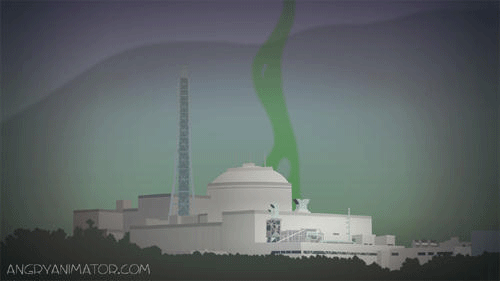 Japan Times 6th Dec 2017, The operator of the Monju prototype fast-breeder nuclear reactor submitted
a plan Wednesday to decommission the trouble-plagued facility located in
Fukui Prefecture. The most recent plan presented to the Nuclear Regulation
Authority lays out a 30-year time frame to complete the project despite a
number of problems that remain unresolved, including where to store the
spent nuclear fuel.
The government had originally hoped the Monju reactor
would serve as a linchpin for its nuclear-fuel-recycling efforts as it was
designed to produce more plutonium than it consumed. But it experienced a
series of problems, including a leakage of sodium coolant in 1995 and
equipment failures in 2012. The plant has only operated intermittently over
the past two decades.
https://www.japantimes.co.jp/news/2017/12/06/national/nuclear-reactor-operator-submits-30-year-plan-scrap-trouble-prone-monju-facility/
Proposal for Japan to ‘rent’ nuclear weapons from USA
‘Dual key’ nuclear weapons-sharing with Washington would save Tokyo trouble of developing own arsenal, protect alliance, Asia Times, DOUG TSURUOKA DECEMBER 6, 2017 , “……the unthinkable has become publicly thinkable. There’s widespread debate in Japan about whether the country should go nuclear – either by developing its own arsenal, or sharing such weapons with the US under a “dual key” arrangement, popularly known as “rent-a-nukes,” to counter the growing threat from North Korea……. http://www.atimes.com/article/will-japan-rent-nukes-us-counter-north-korean-threat/
Greenpeace: Takahama & Sendai reactors must be shut down immediately following Kobe Steel scandal

1 This Month

of the week- – THE ONENESS of HUMANITY
We the Nuclear Free North

1st July – Webinar Waste of Space: The Environmental Harm of Military and Civil Space Activity st July, 7 pm

Report Launch Online: We are seeing an increasing exploitation of space for military and commercial purposes. This must change.

Protect Sazan Island from the Trump family! https://secure.avaaz.org/campaign/en/protect_sazan_island_from_the_trump_family_loc/?bqFCVab&v=174511&cl=22707147157&_checksum=5e9dde668860e8231c33699735e16a1fbf22ab2cb01da50c999fe8732b9775ef&utm_source=email&utm_medium=blast_email&utm_campaign=174511


Cuba Is Not a Failed State – It Is a Besieged State
PETITION: “Global Appeal to Endorse Palestinian Right of Return of Refugees”
To see nuclear-related stories in greater depth and intensity – go to https://nuclearinformation.wordpress.com
-
Archives
- June 2026 (258)
- May 2026 (306)
- April 2026 (356)
- March 2026 (251)
- February 2026 (268)
- January 2026 (308)
- December 2025 (358)
- November 2025 (359)
- October 2025 (376)
- September 2025 (257)
- August 2025 (319)
- July 2025 (230)
-
Categories
- 1
- 1 NUCLEAR ISSUES
- business and costs
- climate change
- culture and arts
- ENERGY
- environment
- health
- history
- indigenous issues
- Legal
- marketing of nuclear
- media
- opposition to nuclear
- PERSONAL STORIES
- politics
- politics international
- Religion and ethics
- safety
- secrets,lies and civil liberties
- spinbuster
- technology
- Uranium
- wastes
- weapons and war
- Women
- 2 WORLD
- ACTION
- AFRICA
- Atrocities
- AUSTRALIA
- Christina's notes
- Christina's themes
- culture and arts
- Events
- Fuk 2022
- Fuk 2023
- Fukushima 2017
- Fukushima 2018
- fukushima 2019
- Fukushima 2020
- Fukushima 2021
- general
- global warming
- Humour (God we need it)
- Nuclear
- RARE EARTHS
- Reference
- resources – print
- Resources -audiovicual
- Weekly Newsletter
- World
- World Nuclear
- YouTube
-
RSS
Entries RSS
Comments RSS
 nuclear-news