UK government’s dilemma as China demands more control of UK’s new nuclear plants


 Chinese seek greater say in UK nuclear plants By Guy Chazan Dt.com Sept 1 13, The state-owned Chinese nuclear group that is in talks to invest in Britain’s new nuclear programme wants greater operational control of any new plants it finances, potentially creating a national security headache for the government.
China General Nuclear Power Group (CGN), is in talks with EDF of France on sharing the cost of building a new plant at Hinkley Point, Somerset, which has an estimated price tag of £14bn.
But CGN has made it clear to EDF that it will only proceed if it is given more of a say in running other plants the two companies build together in the UK, according to people familiar with the talks.
As well as Hinkley, EDF also has plans to construct two new reactors at Sizewell in Suffolk. One of the people said CGN could seek to become joint operator of the new Sizewell plant – although EDF is likely to retain overall control. The Chinese could also push for greater involvement in the plant’s construction, and might even seek to provide the design for its reactors. “CGN is using Hinkley as a stepping stone,” he said. “In the next project, they’ll want greater control.”
However, given the sensitivities surrounding nuclear power, the idea of allowing a Chinese state-backed company to take an operational role in a nuclear power station could raise a welter of national security concerns……..
Mark Pritchard, a Conservative MP and member of the national security strategy committee, said Chinese companies should only be able to take a “minor” role in sensitive sectors of the economy such as energy………http://www.ft.com/intl/cms/s/0/3dfb8eb0-10b5-11e3-b5e4-00144feabdc0.html#axzz2dnO4ZmCk
China to replace coal by wind and solar energy, by 2030
China has already demonstrated what’s in store by reducing the cost of solar PV modules so much that they are now commonplace on roofs across the mortgage belt suburbs of Australia. Between one-in-10 and even as much as one-in-three households now have solar PV systems installed in the outer metropolitan suburbs of Sydney, Brisbane, Perth, Adelaide and Melbourne as well as several regional cities. Such an outcome wasn’t even dreamt about by the most wildly optimistic greenie just four years ago.
What Japan did for home entertainment equipment, China will do for clean energy
 Wind & solar outpace coal in China by 2030 – Bloomberg Tristan Edis 28 Aug 13, Bloomberg New Energy Finance (BNEF) has released analysis which finds renewables will make up more than half of new power capacity growth in China to 2030, across a variety of plausible scenarios. By 2030 total installed capacity of renewable energy power plants will equal that of coal.
This study sought to examine how technological and economic changes might realistically alter the make-up and growth of China’s power sector. They found that coal’s dominance will be challenged by:
– faster technological improvement and cost reductions achieved by renewable energy technologies;
– increased social concern and, consequently, government regulation over environmental pollution;
– the prospects of shale gas, and;
– a potential price on carbon emissions. Continue reading
China calls Fukushima radiation a serious international environmental issue
Official Chinese Press: Fukushima contamination is “serious international environmental issue” — Crisis concerns the core interests of people who share the planet http://enenews.com/commentary-fukushima-contamination-is-international-environmental-issue-govt-must-address-global-anxiety-crisis-concerns-the-core-interests-of-people-who-share-planet
Source: Xinhua (China’s official press agency)
Authors: Liu Tian, Zhang Cheng
Date: Aug 23, 2013
[…] it is the time for the Japanese government to shoulder more responsibilities to address the global concerns. […]
Studies showed that radioactive substances have spread into high sea from the crippled nuclear plant, proving that the tragedy has no longer a national problem, but a serious international environmental issue that needs stronger efforts to deal with. […]
A priority for the Japanese government to relieve the global anxiety is to make the accident relevant information more transparent to the international community so as to precisely assess the graveness of the entire accident and its aftermath.
It is hoped that the Japanese government would not keep the information for its own political interests as the issue concerns not only the core interests of the Japanese people, but also people who share the planet. […]
China’s $323 billion renewable energy program
China outlines renewable energy splurge July 30, 2013 http://www.smh.com.au/business/carbon-economy/china-outlines-renewable-energy-splurge-20130730-2qx92.html#ixzz2amhMZ8XK
China may invest another 2.3 trillion yuan in key energy- aving and emission-reducing projects, Xie Zhenhua, vice chairman of the National Development and Reform Commission, said Tuesday at a conference in Beijing. China stands by its pledge to cut carbon emissions per unit of economic output by as much as 45 per cent before 2020 from 2005 levels, he said.
The increased reliance on renewable sources of energy fits with efforts by China, the world’s biggest carbon emitter, to help mitigate the effects of pollution blanketing its major cities. Along with renewables investments, the environment ministry is considering stricter controls on vehicle and industry pollution.
The government aims to have 100 gigawatts of wind-power installed capacity and more than 35 gigawatts of solar power by 2015, Xie reiterated today. China’s targets have encouraged companies including China Petrochemical Corp., also known as Sinopec Group, to strengthen their commitment to protect the environment.
Sinopec Monday said it will invest 22.9 billion yuan on an environmental protection plan.
China asked seven cities and provinces last year to put in place regional caps and pilot programs for trading emission rights.
The country will gradually expand the regions falling under its carbon trading pilot program starting from 2015 in order to explore the potential for a national system, Xie said.
China’s government fears that anti-nuclear activism may become a national movement
 The government in Beijing would be happy if anti-nuclear protests were to stay at the level of bickering between counties or even the occasional outburst of nimbyism, as in Jiangmen. But there is a risk that the success of Jiangmen residents in securing a change of heart could encourage others. “We can expect similar protests wherever a nuclear project is planned,” says Eva Sternfeld of Berlin’s Technical University, who has studied such activism.
Nuclear activism Limiting the fallout, The Economist A rare protest prompts the government to scrap plans to build a uranium-processing plant. Is anti-nuclear activism on the rise? Jul 20th 2013 | PENGZE, JIANGXI PROVINCE |OPPOSE nuclear pollution”; “Give us back our green homeland”. So declared banners raised by some of the hundreds of protesters who took to the streets of Jiangmen city in the southern province of Guangdong on July 12th. In a remarkable concession, the local government announced that it would heed their demands and abandon plans to build a uranium-processing facility. For officials in Beijing, keen to develop nuclear power and keep activism in check, the demonstration was an unsettling sign of potential
trouble.
The protest was the first known major public rally against a project involving the nuclear-power industry since China began building nuclear plants in the mid-1980s. Continue reading
People power winning against the nuclear industry – even in China!
 China Protest Forcing Nuclear Retreat Shows People Power By Bloomberg News – Jul 14, 2013 Protests in a southern Chinese city last week that forced local authorities to abandon plans for a uranium-processing facility highlight the growing willingness of ordinary people to challenge the state on environmental issues.
The proposed Longwan Industrial Park project won’t be approved “in order to fully respect the opinion of the masses,” the government of Heshan, Guangdong province, said in a statement on its website on July 13. A “social-stability risk assessment” of the proposal that was released for public awareness generated “much opposition,” it said.
Heshan is the latest local authority to back down in the face of pressure from a public increasingly empowered by its ability to sway officials who fear social unrest. Governments in cities across the country have canceled or delayed plans for industrial projects over the past year after confrontations with residents concerned about safety and pollution.
“Chinese civil society is getting stronger,” said Willy Wo-Lap Lam, an adjunct professor of history at the Chinese Universityof Hong Kong. “People now realize if their numbers are big enough, if they are united and stand their ground, the government will back down,” he said.
Opposition to the uranium facility underscores growing concern among China’s expanding middle class that industrial plants damage the environment and people’s health. Pollution has replaced land grabs as the primary cause of social unrest with many of the protests erupting in more prosperous coastal cities such as Shanghai and Ningbo where residents have deployed smartphones and used social media to organize their campaigns…….
“In future, especially in coastal developed regions, these kinds of public demonstrations may be the norm as we’ve seen in the West, where such projects face growing ‘not in my backyard’ sort of opposition,” said Ma. “In the future, large projects in China will need a longer and longer time to get approved like they do in the West.” http://www.bloomberg.com/news/2013-07-14/china-protest-forcing-nuclear-retreat-shows-people-power.html
Success for Chinese anti nuclear protestors, as government scraps plans for uranium processing plant
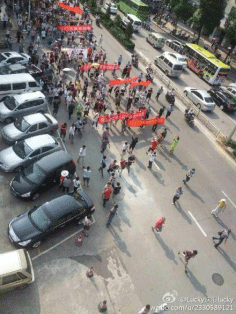 China cancels $6 billion uranium plant after protest SATURDAY JUL 13, 2013 | CHEN AIZHU, QI DING FOR REUTERS BEIJING (Reuters) – China has abruptly canceled plans to build its largest uranium processing plant in a southern Chinese city, a day after hundreds of protesters took to the streets demanding the project be scrapped, a local government website said on Saturday.
The proposed 230-hectare complex in the heart of China’s Pearl River delta industrial heartland in Guangdong province had also sparked unease in neighboring Hong Kong and Macau.
Authorities in the gambling enclave had formally raised the issue with their Guangdong counterparts, the South China Morning Post reported.
A one-line statement published on the Heshan city government’s website said that “to respect people’s desire, the Heshan government will not propose the CNNC project”.
State-run China National Nuclear Corporation and China Guangdong Nuclear Power Corp (CGNPC) had planned to build the 37 billion yuan ($6 billion) project.
Officials from both companies could not be reached for comment……..
The surprisingly swift decision to cancel the project came after hundreds marched to city offices on Friday that forced officials to pledge an extension of public consultation by 10 days. Locals had planned more protests on Sunday.
Chinese authorities are becoming increasingly sensitive to local protests over environmental issues, having canceled, postponed or relocated several major petrochemical and metals plants…….http://www.newsdaily.com/article/dea9628fb2b26f48d30394204db3e45a/china-cancels-6-billion-uranium-plant-after-protest
Anti nuclear march in Jiangmen – a rare protest movement in China
Jiangmen rises against uranium plant http://www.thestandard.com.hk/breaking_news_detail.asp?id=38672&icid=2&d_str= (07-12 12:57) More than 1,000 people have marched to the municipal government office in Jiangmen to protest against a plan to build a uranium processing plant in Guangdong City.
The protesters say they’re concerned about radiation and possible nuclear pollution. They’re also unhappy with the government’s 10-day consultation process, which ends tomorrow, RTHK reports.
Jiangmen authorities have already signed an agreement with the China National Nuclear Corporation to house the 40-billion-yuan project. Construction is expected to begin at the end of this year.
Guangdong protests against uranium processing plant
 Jiangmen residents protest against uranium processing plant http://www.scmp.com/news/china/article/1280894/jiangmen-residents-protest-against-uranium-processing-plant Several hundred people gathered in Jiangmen’s city centre on Friday morning to protest against a planned uranium processing plant in the Guangdong city.
“Jiangmen doesn’t want radiation”, one banner carried by demonstrators said. “We want children, not atoms,” said another. Police appear to have been anticipating the protest with Jiangmen city government building being cordoned-off.
One group of protesters gathered in front of the building, another group meet at the Donghu Lake park.
Two protesters, who declined to be identified, said that the protest had been organized via QQ and WeChat, two social messaging services, at least two days ahead of the protest.
One local said that the local government had held an emergency meeting last night to prepare for the protest. According to one demonstrator, the public protest lasted from 8am to 11:30am and is planned resume in the afternoon.
Some protesters were holding banners calling for another protest on Sunday.
Thee 30-hectare plant would carry out uranium conversion, enrichment and fuel fabrication, the Jiangmen City Development and Reform Bureau said in an earlier statement.
The plant’s construction some 100km from Hong Kong and Macau has sparked health concerns in both cities as well. The Heshan government under the administration of Jiangmen held a press conference earlier on Friday morning defending the project. Heshan mayor Wu Yuxiong said that the local government has decided to extend the period in which the risk assessment report is publicly accessible by a further ten days.
Microblogs about the protests have been quickly censored, indicating increased sensitivity about a backlash. Earlier this year, two demonstrations against a gas refinery in Kunming have caused a public backlash. A similar protest in Chengdu had been repressed.
Confusion and secrecy surround China’s proposed uranium processing plant in Jiangmen,
 Experts call for more details on Guangdong uranium plant, South China Morning Post, Olga Wong and Minnie Chan Concern over sketchy nature of details and possible radiation risks from proposed nuclear development in Guangdong.
Nuclear experts and green activists have called for more information from the Guangdong government after limited details were released about its proposal for a uranium processing plant in Jiangmen, about 100 kilometres from Hong Kong.
An announcement by the Jiangmen City Development and Reform Bureau said the 230-hectare plant would carry out uranium conversion, enrichment and fuel fabrication.
But the three-page statement, issued last Thursday, did not make it clear whether the plant, in the Longwan industrial district of Zhishanzhen, would perform spent fuel reprocessing – recycling of old fuel rods that could emit high doses of radiation – or what measures would be used to avoid radiation leaks…… Continue reading
Macau worried about proposed uranium processing plant
Macau asks questions about proposed uranium processing plant, South China Morning Post, Thursday, 11 July, 2013 Phila Siu Macau has made an official inquiry to the Guangdong government about a proposal to build a uranium processing plant near Jiangmen , but the Hong Kong government would not say yesterday whether it had also done so.
The approach by Macau follows an announcement that the 230-hectare plant was planned for an industrial zone in an area governed by Jiangmen, which is about 100 kilometres from Hong Kong.
Macau’s chief executive, Fernando Chui Sai-on, said in a statement yesterday: “The SAR government has officially enquired about this through the communication mechanism between Guangdong and Macau.”….. Worries have been expressed that contamination from the plant could find its way into Hong Kong’s food supply…..http://www.scmp.com/news/china/article/1279838/macau-asks-questions-about-proposed-uranium-processing-plant
China moves fast towards renewable energy, slows down nuclear program
 Solar, wind power gain over nuclear power in China, says German official South China Morning Post, Joyce Man in Berlin 8 July 13, German official says solar and wind generation is reaching the market faster than nuclear power under Beijing’s latest five-year plan China’s thinking has shifted increasingly towards renewable energy, which is reaching the market faster than nuclear power, a German environment official has said.
“If you analyse the last 10 years, the thinking in China has shifted more and more towards renewables. I see that renewables are getting to the markets quicker than expected and nuclear energy is getting to the markets slower than expected,” said Karsten Sach, deputy director general for European and international environment policy at the German Ministry for the Environment, Nature Conservation and Nuclear Safety. He was speaking to the South China Morning Post in Berlin.
Sach emphasised the importance of wind and solar energy: “If you read Chinese projections a decade ago on how nuclear and renewables would develop over the next decade, you would have seen nuclear far ahead of renewables. If you look at what happened and the projections of what will happen in the most recent five-year plan, you see renewables in front of nuclear.
“That’s just the facts and those are sometimes ignored. I don’t comment on Chinese policy. I just see [China is] doing much more on renewables than on nuclear. It’s a very welcome decision, but China has to make its own decision,” the German official said.
Sach said China recognised renewables would form a world market in the future. He said the country understood it could deliver energy in a socially beneficial way, without air pollution, and create jobs in remote areas………. http://www.scmp.com/news/china/article/1277560/solar-wind-power-gain-over-nuclear-power-china-says-german-official
China pledges no pre-emptive nuclear strike
Shangri-La Dialogue: China reiterates ‘no-first-use’ nuclear pledge Straits Times News Jun 02, 2013 CHINA is maintaining its pledge not to be the first to use nuclear weapons in a conflict, a top Chinese general said on Sunday.
Omission of the “no-first-use” pledge in a recently released defence
white paper had created ripples in military circles and sparked
speculation that China may have dropped the policy.
“I want to make a solemn statement that the Chinese government will
never discard our pledge of no first-use of nuclear arms,”
Lieutenant-General Qi Jianguo told the Shangri-La Dialogue security
forum in Singapore.
“We have been sticking to this policy for half a century, and its
facts have proven that it is not only in the interest of the Chinese
people but also of the people of all the world.” ….. subscribers
only http://www.straitstimes.com/breaking-news/asia/story/shangri-la-dialogue-china-reiterates-no-first-use-nuclear-pledge-20130602
Chna’s nuclear weapons secrets
China’s nuclear program still shrouded in secrecy JAPAN TIMES, BY MICHAEL RICHARDSON MAY 23, 2013 SINGAPORE – China’s program to expand and modernize its conventional armed forces is well-documented and closely watched by nearby Asia-Pacific states, as well as the United States and other more distant countries with interests in the region. However, China’s arsenal of nuclear weapons and delivery systems (missiles and aircraft) is shrouded in secrecy — and controversy……
Most U.S. arms control officials and analysts continue to say that China has between 240 to 400 nuclear warheads, nearly all of them on ballistic missiles in underground silos or on mobile launchers that are hard to find and destroy. These include long-range missiles capable of reaching the U.S. mainland.
Such a force is less than a third of the arsenals kept by the U.S. and Russia, which between them still have far more long-range nuclear weapons than any other states with nuclear arms, despite big negotiated cuts in their inventories.
Still, the Chinese force would be enough to ensure strategic deterrence, meaning that if China was attacked by a nuclear power, it could still retaliate and inflict unacceptable damage…..
China has not publicly declared how many nuclear weapons it has and there is no way for outsiders to verify their estimates. China officially proclaims a “no first use” policy, stating that it would use nuclear forces only in response to a nuclear strike against China.
The pledge has two parts: first, that Beijing will never use nuclear weapons first against any nuclear-weapon state; and second, that it will never use or threaten to use nuclear weapons against any nonnuclear-weapons state or nuclear-weapon-free zone of the kind that exists in Southeast Asia and the South Pacific……
Unraveling China’s nuclear secrets without its cooperation will be nearly impossible. The best hope may be for the U.S. and Russia to make any future nuclear arms reduction negotiations contingent on participation by China, India and Pakistan. http://www.japantimes.co.jp/opinion/2013/05/23/commentary/chinas-nuclear-program-still-shrouded-in-secrecy/#.UZ58j6JwpLs
Greenhouse gas emissions to be capped by China
China emissions cap proposal hailed as climate breakthrough REneweconomy, By Giles Parkinson on 22 May 2013 China, the world’s biggest polluter, is proposing to set a cap on greenhouse gas emissions as early as 2016 in a move that is being hailed as a potentially transformative step in the fight against climate change.
According to news reports from China, the powerful National Development and Reform Commission (NDRC) has proposed setting absolute caps that would divorce the growth on emissions from growth in the economy, and will also set a peak in its overall emissions in 2025, five years earlier than planned.
China has already pledged to cut its emissions intensity – the amount of Co2 it emits per economic unit – by up to 45 per cent by 2020. The significance of an absolute cap is that it promises to reign in emissions even if the economy grows faster than expected.
Furthermore, Point Carbon reports, at a recent NDRC meeting, its vice director Xie Zhenhua said China should set long-term emission targets for 2030 and 2050 in a bid to decarbonise its economy. China, like Australia is heavily dependent on carbon-intensive coal to generate electricity – just over 82 per cent. But it has also proposed a cap on coal consumption of 4 billion tonnes.
Lord Nicholas Stern, the chair of the Grantham Research Institute on Climate Change at the London School of Economics, described it as “exciting news”, and said it should encourage all countries, the US in particular, to take stronger action.
“And it improves the prospects for a strong international treaty being agreed at the United Nations climate change summit in 2015,” he told The Independent in the UK…….. http://reneweconomy.com.au/2013/china-emissions-cap-proposal-seen-as-climate-breakthrough-40529
1 This Month

22 June – Virtual Event –Climate Change: New Data, New Debate

Monday, June 22, 2026 2:30 p.m. – 3:15 p.m. CT
YouTube. Register here

Protect Sazan Island from the Trump family! https://secure.avaaz.org/campaign/en/protect_sazan_island_from_the_trump_family_loc/?bqFCVab&v=174511&cl=22707147157&_checksum=5e9dde668860e8231c33699735e16a1fbf22ab2cb01da50c999fe8732b9775ef&utm_source=email&utm_medium=blast_email&utm_campaign=174511

25 June- THE PUKE ON NUKES
Thursday, June 25, 2026
7pm Central Time (8pm ET, 6pm MT, 5pm PT) UTC – 5
From NRC & DOE Deregulation to Techno-Fascist Billionaires Going Nuclear, Plus a Few Songs from Atomic Cabaret REGISTER
26 June – Radiation Trainwreck at the NRC / Join the Protect Better Campaign – https://us02web.zoom.us/meeting/register/4ZlZ5_qLSHGiLSCg8FF6Bg#/registration


Cuba Is Not a Failed State – It Is a Besieged State
PETITION: “Global Appeal to Endorse Palestinian Right of Return of Refugees”
To see nuclear-related stories in greater depth and intensity – go to https://nuclearinformation.wordpress.com
-
Archives
- June 2026 (211)
- May 2026 (306)
- April 2026 (356)
- March 2026 (251)
- February 2026 (268)
- January 2026 (308)
- December 2025 (358)
- November 2025 (359)
- October 2025 (376)
- September 2025 (257)
- August 2025 (319)
- July 2025 (230)
-
Categories
- 1
- 1 NUCLEAR ISSUES
- business and costs
- climate change
- culture and arts
- ENERGY
- environment
- health
- history
- indigenous issues
- Legal
- marketing of nuclear
- media
- opposition to nuclear
- PERSONAL STORIES
- politics
- politics international
- Religion and ethics
- safety
- secrets,lies and civil liberties
- spinbuster
- technology
- Uranium
- wastes
- weapons and war
- Women
- 2 WORLD
- ACTION
- AFRICA
- Atrocities
- AUSTRALIA
- Christina's notes
- Christina's themes
- culture and arts
- Events
- Fuk 2022
- Fuk 2023
- Fukushima 2017
- Fukushima 2018
- fukushima 2019
- Fukushima 2020
- Fukushima 2021
- general
- global warming
- Humour (God we need it)
- Nuclear
- RARE EARTHS
- Reference
- resources – print
- Resources -audiovicual
- Weekly Newsletter
- World
- World Nuclear
- YouTube
-
RSS
Entries RSS
Comments RSS
 nuclear-news