China’s plan to use artificial intelligence to boost the thinking skills of nuclear submarine commanders
Equipping nuclear submarines with AI would give China an upper hand in undersea battles while pushing applications of the technology to a new level, SCMP, Stephen Chen, 05 February, 2018, China is working to update the rugged old computer systems on nuclear submarines with artificial intelligence to enhance the potential thinking skills of commanding officers, a senior scientist involved with the programme told the South China Morning Post.
A submarine with AI-augmented brainpower not only would give China’s large navy an upper hand in battle under the world’s oceans but would push applications of AI technology to a new level, according to the researcher, who spoke on condition of anonymity because of the project’s sensitivity.
“Though a submarine has enormous power of destruction, its brain is actually quite small,” the researcher said.
While a nuclear submarine depends on the skill, experience and efficiency of its crew to operate effectively, the demands of modern warfare could introduce variables that would cause even the smoothest-run operation to come unglued.
For instance, if the 100 to 300 people in the sub’s crew were forced to remain together in their canister in deep, dark water for months, the rising stress level could affect the commanding officers’ decision-making powers, even leading to bad judgment.
An AI decision-support system with “its own thoughts” would reduce the commanding officers’ workload and mental burden, according to the researcher……….
Up till now, the “thinking” function on a nuclear sub, including interpreting and answering signals picked up by sonar, a system for detecting objects under water by emitting sound pulses, has been handled almost exclusively by human naval personnel, not by machines.
Now, through AI technology, a convolutional neural network undergirds so-called machine learning. This structure underpins a decision support system that can acquire knowledge, improve skills and develop new strategy without human intervention.
By mimicking the workings of the human brain, the system can process a large amount of data. On a nuclear submarine, data could come from the Chinese navy’s rapidly increasing observation networks, the submarine’s own sensors or daily interactions with the crew…….. http://www.scmp.com/news/china/society/article/2131127/chinas-plan-use-artificial-intelligence-boost-thinking-skills
February 5, 2018
Posted by Christina Macpherson |
China, technology, weapons and war |
Leave a comment
China accuses US of ‘Cold War mentality’ over nuclear policy BBC News 4 Feb 18 China has urged the US to drop its “Cold War mentality” after Washington said it planned to diversify its nuclear armoury with smaller bombs.”The country that owns the world’s largest nuclear arsenal, should take the initiative to follow the trend instead of going against it,” China’s defence ministry said on Sunday.
The US military believes its nuclear weapons are seen as too big to be used and wants to develop low-yield bombs.
Russia has already condemned the plan.
Iran’s foreign minister claimed it brought the world “closer to annihilation”……….
China said on Sunday it “firmly” opposed the Pentagon’s review of US nuclear policy.
The defence ministry in Beijing said Washington had played up the threat of China’s nuclear threat, adding that its own policy was defensive in nature.
“We hope that the United States will abandon its Cold War mentality, earnestly assume its special disarmament responsibilities, correctly understand China’s strategic intentions and objectively view China’s national defence and military build-up,” its statement said. …..http://www.bbc.com/news/world-asia-42935758
February 5, 2018
Posted by Christina Macpherson |
China, politics international, USA |
Leave a comment
 China goes nuclear with latest state-brokered power deal, Josephine Mason, David Stanway
BEIJING (Reuters) 2 Feb 18, – China National Nuclear Corp (CNNC), China’s No. 2 nuclear power producer, will take over the country’s top nuclear power plant builder to create a company worth almost $100 billion, the latest state-orchestrated marriage in the nation’s vast power sector.
Approval for the tie-up between CNNC and China Nuclear Engineering & Construction (CNEC) was announced by the State-Owned Assets Supervision and Administration Commission (SASAC) on Wednesday in a one-line statement posted on its website…….
Beijing wants to overhaul its nuclear sector in order to create globally competitive firms and reduce overcapacity across its broader power market. The nuclear industry is struggling with project delays and a slowdown in approvals for new domestic projects.
By creating a unified home-brand series of reactors, and combining firms, China will be better positioned to bid for and finance overseas projects, experts say.
Both companies have built nuclear plants overseas, including in Pakistan, and developing Chinese nuclear technology abroad is a key goal of China’s Belt and Road initiative…… https://www.reuters.com/article/us-china-power-nuclear/china-goes-nuclear-with-latest-state-brokered-power-deal-idUSKBN1FK0S4
February 3, 2018
Posted by Christina Macpherson |
business and costs, China, marketing |
Leave a comment
Xinhuanet 1st Feb 2018, China General Nuclear Power Corporation (CGN), a major Chinese nuclear
power operator, said Wednesday that nuclear projects in Britain were
proceeding well. He Yu, chairman of the board of CGN, said since the deals
were inked in 2016 with French energy company EDF and the British
government, CGN has invested 1.7 billion British pounds in order to advance
the projects. CGN signed agreements in 2016 for Hinkley Point C (HPC), a
nuclear project in Somerset, and a suite of agreements relating to the
Sizewell C (SZC) in eastern England and Bradwell B projects (BRB) in Essex.
“A total of 15 Chinese suppliers and contractors have passed a preliminary
qualification assessment for the HPC project,” He said. “HPC, which is
Britain’s first new nuclear power station in a generation, is the largest
construction in Europe.”
http://www.xinhuanet.com/english/2018-02/01/c_136940068.htm
Reuters 31st Jan 2018, Notable Chinese investments in Britain include the Hinkley C nuclear power
station which is being built by China General Nuclear Power Corp and the
British arm of France’s EDF (EDF.PA), while British firms, such as Rolls
Royce (RR.L), have won large deals from Chinese firms to supply items like
plane engines. Both May and senior Chinese officials have restated their
commitment to the “golden era” in ties but a row over May’s decision
to delay approval for the Chinese-funded Hinkley nuclear plant in late 2016
chilled relations. However, Britain was the first Western country to sign
up to the China-backed Asian Infrastructure Investment Bank and it sent
Finance Minister Philip Hammond to a Beijing summit last year about
President Xi Jinping’s flagship ‘Belt and Road Initiative’ – a
trillion-dollar infrastructure-led push to build a modern Silk Road.
https://www.reuters.com/article/us-china-britain/chinas-li-says-ties-with-britain-to-stay-unchanged-through-brexit-idUSKBN1FK023
February 3, 2018
Posted by Christina Macpherson |
business and costs, China, marketing, politics international, UK |
Leave a comment
 China needs more nuclear warheads to deter US threat, military says, Commentary says the existing stockpile is big enough to prevent ‘bullying’ but should be expanded as Washington changes strategy, SCMP, Minnie Chan, 30 January, 2018 China must expand its nuclear stockpile so it can better deter and hit back at an enemy strike as geopolitical uncertainties mount and the US appears bent on a nuclear build-up, according to the Chinese military’s mouthpiece.
In the PLA Daily on Tuesday, a commentary said China had enough nuclear weapons to prevent “bullying” by other nuclear powers but still needed to respond to changes in US strategy.
“To enhance China’s strategic counterbalance in the region and maintain China’s status as a great power, and protect national security, China has to beef up and develop a reliable nuclear deterrence capability,” it said.
It also said China would still stick to the “no first use” doctrine, meaning there were no circumstances in which it would be the first to use nuclear weapons.
The commentary comes as the administration of US President Donald Trump is expected to unveil its new military weapons policy later this week.
A leaked draft of the document says Washington will ramp up new nuclear projects and deploy more “low yield” nuclear bombs, according to the Huffington Post.
Military analysts said China was poised to increase its own arsenal of nuclear warheads but there were no plans to rival the United States.
Beijing-based military analyst Zhou Chenming said China only needed to add about 100 warheads to its stockpile to counter threats from the US and India.
“Nuclear weapons are hugely expensive to maintain and China is very pragmatic. Beijing will not spend too much money on an arms race,” Zhou said.
China has never declared the scale of its nuclear stockpile but the Washington-based Arms Control Association puts the country’s total at 270 warheads, the fourth-biggest of the five main nuclear states. Russia has 7,000, the US 6,800, France 300 and Britain 215, the association estimates. ……http://www.scmp.com/news/china/diplomacy-defence/article/2131261/china-needs-more-nuclear-warheads-deter-us-threat
January 31, 2018
Posted by Christina Macpherson |
China, weapons and war |
Leave a comment
IPFM 12th Jan 2018, IPFM’s new research report “China’s Fissile Material Production and
Stockpile” (PDF copy) by Hui Zhang uses information from newly available
Chinese public sources to provide a more detailed and documented
reconstruction of China’s production of highly enriched uranium (HEU) and
plutonium for nuclear weapons.
The report provides new evidence to constrain the operating histories for China’s Lanzhou and Heping gaseous
diffusion enrichment plants. Lanzhou stopped HEU production for weapons in 1980 and shifted to making low enriched uranium (LEU) for civilian power reactors and possibly for naval reactors. It was shut down on 31 December
2000 and in 2017 was demolished.
The Heping plant may still be operating but not producing HEU for weapons. China also has centrifuge enrichment
plants but they are believed not to produce HEU for weapons. The new report also offers new details on the operational experience of the Jiuquan and Guangyuan weapon plutonium production reactors. China also used these
reactors to produce tritium for weapons. The reactors were closed in the 1980s and have been undergoing decommissioning.
http://fissilematerials.org/blog/2018/01/chinas_fissile_material_p.html
January 16, 2018
Posted by Christina Macpherson |
China, weapons and war |
Leave a comment
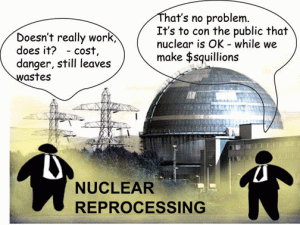 Reuters 11th Jan 2018, So close yet so far: China deal elusive for France’s Areva. A deal long
sought by French company Areva to build a $12-billion nuclear waste
reprocessing plant in China looks increasingly unlikely to go ahead despite
a visit to Beijing by President Emmanuel Macron meant to drum up business.
During Macron’s state visit this week, Areva and China National Nuclear
Corp (CNNC) signed a new “protocol agreement” to build the plant but,
not for the first time, no definitive contract was signed.
Since talks began more than a decade ago – when uranium prices UXXc1 were near record
highs – a series of non-committal French-Chinese memorandums of
understanding have been signed for building a reprocessing plant in China
modeled on state-owned Areva’s plant in La Hague, northern France.
The reprocessing of nuclear fuel waste involves separating plutonium from the
spent uranium and reusing it in “Mixed Oxide” (MOX) fuel at nuclear
power stations.
But the 2011 Fukushima nuclear disaster and competition
from renewable energy are weighing on the nuclear sector, and uranium
prices are down 80 percent from a decade ago, making the expensive and
dangerous recycling process less attractive. Chinese nuclear scientist Li
Ning, dean of Xiamen University’s College of Energy and a member of State
Nuclear Power Technology Corporation’s (SNPTC) expert committee, sees
“a fairly low probability” that China will sign a formal contract for
the project.
https://www.reuters.com/article/us-areva-china-nuclearpower-analysis/so-close-yet-so-far-china-deal-elusive-for-frances-areva-idUSKBN1F01RJ
January 13, 2018
Posted by Christina Macpherson |
China, France, marketing, politics international, reprocessing |
Leave a comment
Guardian 10th Jan 2018, China is moving towards becoming a global leader in renewable technology as
the US pulls away, a new report has said.
China is the world’s biggest emitter of greenhouse gases and still invests in coal but in recent years
it has become the largest investor in domestic renewable energy. The
country is now on track to lead international investment in the sector,
according to the report by the Institute for Energy Economics and Financial
Analysis (IEEFA).
“As the global transition toward renewables gains pace
and as battery storage and electric vehicles technologies pick up momentum,
China is setting itself up to dominate these sectors globally over the next
several dec ades of this century,” said IEEFA. IEEFA identified a record
high spend of more than US$44bn by China on international takeovers and
projects worth more than $1bn – a 38% year-on-year growth.
https://www.theguardian.com/environment/2018/jan/10/china-on-track-to-lead-in-renewables-as-us-retreats-report-says
January 12, 2018
Posted by Christina Macpherson |
China, renewable |
Leave a comment
 Areva to sign 10 bln euros China nuclear re-processing MoU -sourcehttps://www.reuters.com/article/china-france-areva/areva-to-sign-10-bln-euros-china-nuclear-re-processing-mou-source-idUSP6N1NF02R, Reuters Staff,
PARIS, Jan 9 (Reuters) – French power group Areva is set to sign a memorandum of understanding (MoU) for a Chinese nuclear re-processing deal worth about 10 billion euros ($11.9 billion), a source with knowledge of the matter said.
The deal with the China National Nuclear Corp (CNNC) was expected to be signed on Tuesday, during a state visit to China by French President Emmanuel Macron.
$1 = 0.8375 euros Reporting by Benjamin Mallet; Writing by Sudip Kar-Gupta; Editing by Leigh Thomas and Jean-Michel Belot
January 11, 2018
Posted by Christina Macpherson |
China, France, marketing |
Leave a comment
 China, France sign deal to enhance cooperation on nuclear energy Xinhua | 2018-01-10 07:17 GUANGZHOU
 — A Chinese nuclear power operator signed an agreement Tuesday with a French energy organization to deepen cooperation on nuclear power technology.
The deal, between China General Nuclear Power Corporation (CGN) and the French Alternative Energy and Atomic Energy Commission (CEA), focuses on areas such as nuclear reactor technology, advanced fuels and materials, and nuclear fuel cycles.
Under the agreement, CGN and CEA will deepen cooperation in the upstream and downstream nuclear power industry chain, including reactor life management and the concept design of the fourth-generation nuclear energy technology.
He Yu, chairman of CGN, said the new agreement will enhance bilateral exchanges in nuclear power technology and open new space for Sino-French nuclear power cooperation.
Founded in 1994, CGN is the largest nuclear power operator in China, with 39,000 employees worldwide. It focuses on the development of clean energies such as nuclear power, nuclear fuel, wind power and solar power.
The CEA is a key organization in research, development and innovation in France. Its main areas include defense and security, nuclear and renewable energy, and physical and life sciences.
http://www.chinadaily.com.cn/a/201801/10/WS5a554d97a3102e5b17371b35.html
January 9, 2018
Posted by arclight2011part2 |
China, France, marketing |
Leave a comment
Where China’s top leaders will hide to survive nuclear fallout, Scientists shed light on Beijing’s nuclear bunker located in ‘world’s most deeply buried karst caves’ SCMP, Stephen Chen 07 January, 2018, A nuclear bunker for China’s top leadership, their subordinates, troops and staff is built within the world’s most deeply buried limestone karst caves that extend more than 2km underground, beneath an unusually thick, hard layer of rock, a geological survey has found.
Located under a national park about 20km northwest of the central government’s headquarters in downtown Beijing, the fallout shelter is situated amid a network of caves that has space for a small city and a stable supply of drinking water for a million people, according to the government-funded study.
The bunker is part of the Central Military Commission’s Joint Battle Command Centre, which was revealed to the world in 2016 when state media reported that President Xi Jinping, dressed in fatigues, had visited the facility.
It is not known when either the command centre or the bunker was built but according to state media reports, work began on them decades ago and they have had major upgrades in recent years.
The command centre is referred to as the “brain” of the People’s Liberation Army because it is where all military decisions are made. Its daily operations include analysing military intelligence, monitoring activities across China’s five “battle zones” and issuing orders to military operations at home and abroad, according to state media reports.
The main entrance to the facility is located in the Western Hills National Forest Park – so in the event of a serious threat such as a nuclear strike, China’s top leaders would not have far to go from their Zhongnanhai headquarters near the Forbidden City, and the government could continue functioning from the bunker……..http://www.scmp.com/news/china/society/article/2127059/beijings-nuclear-bunker-located-worlds-most-deeply-buried-karst
January 8, 2018
Posted by Christina Macpherson |
China, weapons and war |
Leave a comment
 CGN Power’s latest project delay deals another blow to China’s nuclear energy ambition http://www.scmp.com/business/companies/article/2126529/cgn-powers-latest-project-delay-deals-another-blow-chinas-nuclear, China’s largest nuclear reactor and builder delays commissioning of the first unit to later this year, Eric Ng, eric.mpng@scmp.com – Tuesday, 02 January, 2018, The latest commissioning delay at CGN Power’s nuclear project in Taishan, in Guangdong province – the third in two years – will lead to a further deferral of 5 billion yuan (US$770 million) in annual revenues and potentially more cost overruns, according to ratings agency Moody’s.
The delay is another setback for China’s ambitious development programme, which aims to raise its installed nuclear power capacity to 58 gigawatts by the end of 2020 from 34.73GW last year, and the world’s hopes for a successful launch of third-generation nuclear reactors.
They are touted by their designers to be safer and more efficient than second-generation ones, a key selling point after the global nuclear industry was dealt a blow by Japan’s Fukushima disaster in 2011.
“The delays reflect our concerns over the high execution risk for CGN in rolling out its aggressive expansion target and its adoption of a new generation of nuclear technology,” Ada Li, senior analyst at Moody’s, wrote in a note on Tuesday.
“The delays also imply the deferral of cash flows from the two nuclear units and potential additional capital expenditure, which would further pressure CGN’s financial metrics.”
She estimated the two reactors to initially make 5 billion yuan in annual revenues, amounting to 7 per cent of the firm’s 2016 revenues, adding its repeated delays are “credit negative”.
CGN said on Friday the first two generating reactors of the plant in Taishan – 136 kilometres west of Hong Kong – has been delayed to 2018 and 2019, from the second half of 2017 and the first half of 2018 respectively.
“As no nuclear power generating unit with the EPR [Evolutionary Power Reactor] technology has been put into commercial operation across the world … Taishan Nuclear has to conduct more experimental verifications in respect of design and equipment,” it added.
The firm in early 2015 cited a “comprehensive evaluation” of the construction plan and risks for its first delay. In the second delay early last year, it said it the needed to conduct “more experimental verifications in respect of its design and equipment”.
The project was originally expected to come on line in 2015.
Moody’s said the latest postponement will not affect its A3 issuer credit rating on CGN, which has already incorporated a six to 12-month delay.
Dennis Ip, head of Hong Kong and China utilities equities research at Daiwa Capital Markets, believes CGN will have difficulty meeting the revised target, saying in a note that he expects the first unit to start up in the first half of 2019.
Ip a year ago projected the Taishan plant’s investment cost to rise to between 22 and 23 yuan per watt from his previous forecast of 21 yuan. The company, meanwhile, had budgeted it at 14 yuan. Each unit has 1.75 billion watt of capacity.
January 3, 2018
Posted by Christina Macpherson |
business and costs, China, politics |
Leave a comment
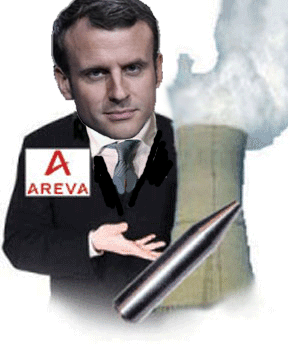 Final negotiations for Areva reprocessing plant in China, Les Echos, Frédéric Schaeffer, Correspondant à Pékin, 26 Dec 17, Areva’s president was in Beijing on Thursday. Paris hopes to sign an agreement during Emmanuel Macron’s visit to China in early January. The contract would be around ten billion euros for Areva……
“There have been comprehensive discussions with many Chinese officials in France and French in Planned over 10 years. This project could be agreed upon during the visit of Emmanuel Macron early January in the Middle Kingdom. “We are accelerating the final negotiations in view of the President’s visit” ….”the visit of Emmanuel Macron will mark a key stage” – French nuclear officials
…. The stakes are crucial for New Areva, the agency resulting from the restructuring of the French nuclear industry and now refocused on the fuel cycle. This could be the key – with a contract of ten billion euros. …. CNNC originally chose the coastal city of Lianyungang to locate the plant. But that announcement had sparked violent protests last year, forcing a halt to preliminary work. Since then, CNNC and the government have examined several coastal sites but have been careful not to make their choice known.https://www.lesechos.fr/industrie-services/energie-environnement/0301060536871-ultimes-negociations-pour-lusine-de-retraitement-dareva-en-chine-2141002.php
December 27, 2017
Posted by Christina Macpherson |
business and costs, China, France, politics |
2 Comments
China’s plans to expand in the South China Sea with a floating nuclear power plant continue, news.com.au, News Corp Australia Network DECEMBER 26, 2017 CHINA’S expansion in the South China Sea continues with plans for a floating nuclear plant. But that’s not all. They’re also using ‘magical machines’.AFP CHINA’S large-scale land reclamation around disputed reefs and shoals in the South China Sea is “moving ahead steadily”, state media has reported, and is on track to use giant “island-builders” to transform even more of the region.
Beijing claims nearly all of the sea and has been turning reefs in the Spratly and Paracel chains into islands, installing military facilities and equipment in the area where it has conflicting claims with neighbours……….The report noted that with last month’s introduction of the new super-dredger Tianjing, a “magical island building machine”, and other “magical machines” soon to come, “the area of the South China Sea’s islands and reefs will expand a step further”.
China is also building a floating nuclear power plant, the report said, to provide power for those living in the Sansha city area……. http://www.news.com.au/technology/innovation/chinas-plans-to-expand-in-the-south-china-sea-with-a-floating-nuclear-power-plant-continue/news-story/bdc1bf6f6b556daf097b3199b5690182
December 27, 2017
Posted by Christina Macpherson |
China, technology |
Leave a comment
‘North Korea is a time bomb’: government advisers urge China to prepare for war, http://www.scmp.com/news/china/diplomacy-defence/article/2124613/north-korea-time-bomb-government-advisers-urge-chinaThe risk of conflict on the Korean peninsula is the highest its been in decades and Beijing must mobilise resources for fallout, observers say, SCMP, Wendy Wu, China must be ready for a war on the Korean peninsula, with the risk of conflict higher than ever before, Chinese government advisers and a retired senior military officer warned on Saturday.
Beijing, once seen as Pyongyang’s key ally with sway over its neighbour, was losing control of the situation, they warned.
“Conditions on the peninsula now make for the biggest risk of a war in decades,” said Renmin University international relations professor Shi Yinhong, who also advises the State Council, China’s cabinet.
Shi said US President Donald Trump and North Korean leader Kim Jong-un were locked in a vicious cycle of threats and it was already too late for China to avert it. At best, Beijing could stall a full-blown conflict.
“North Korea is a time bomb. We can only delay the explosion, hoping that by delaying it, a time will come to remove the detonator,” Shi said on the sidelines of a Beijing conference on the crisis.
Addressing the conference, Wang Hongguang, former deputy commander of the Nanjing Military Region, warned that war could break out on the Korean peninsula at any time from now on until March when South Korea and the United States held annual military drills.
“It is a highly dangerous period,” Wang said. “Northeast China should mobilise defences for war.”
Yang Xiyu, a senior fellow at the China Institute of International Studies affiliated with China’s foreign ministry, said conditions on the peninsula were at their most perilous in half a century.
“No matter whether there is war or peace, regretfully, China has no control, dominance or even a voice on the issue,” he said.
China might already be preparing for the worst.
Last week, Jilin Daily, the official newspaper of the province bordering North Korea, published a full page of advice for residents on how to respond to a nuclear attack.
A document purportedly from telecom operator China Mobile about plans to set up five refugee camps in Jilin’s Changbai county also surfaced online last week.
Wang said the Jilin Daily article was a “signal to the country to be prepared for a coming war”.
He said China was also worried about the threat North Korea’s frequent nuclear tests were posing to unstable geological structures in the region.
Nanjing University professor Zhu Feng said that no matter how minor the possibility, China should be prepared psychologically and practically for “a catastrophic nuclear conflict, nuclear fallout or a nuclear explosion”.
“Why do we always act like ostriches? Why do we always believe a war won’t occur?” Zhu said.
“What China needs is a sense of urgency about its declining influence in strategy related to the peninsula and the way it brings down China’s status and role in East Asian security issues.”
He also said Kim’s failure to meet Chinese envoy Song Tao during his trip to Pyongyang last month was a “humiliation” for China.
Meanwhile at the United Nations in New York, US Secretary of State Rex Tillerson called on China and Russia to increase their efforts to halt Pyongyang’s nuclear programme.
Tillerson also backtracked on his previous unconditional offer for talks by saying that Washington would not negotiate with Pyongyang until it stopped “threatening behaviours”.
North Korean ambassador to the UN Ja Song-nam accused the United States, Japan and the United Nations Security Council of waging a hostile campaign to stop Pyongyang from gaining nuclear weapons that it saw as necessary to defend itself.
Renmin University professor Shi said hopes for peace could not rest on Kim and Trump, and China and Russia should work together to argue against war.
In a meeting with South Korean President Moon Jae-in in Beijing, Chinese President Xi Jinping said war on the peninsula was not acceptable.
December 20, 2017
Posted by Christina Macpherson |
China, North Korea, politics international, weapons and war |
Leave a comment






 nuclear-news