Pentagon report on China’s nuclear weapons program, still “significantly below” the U.S.
The Pentagon Believes China Is Likely Developing A Long-Range Nuclear Bomber, Task and Purpose, Tony Capaccio, Bloomberg News, January 17, 2019 WASHINGTON — China is likely developing a long-range bomber capable of delivering nuclear weapons and a space-based early warning system it could use to more quickly respond to an attack, according to a new report from the U.S. Defense Intelligence Agency.
The development of the bomber, when combined with China’s land-based nuclear weapons program and a deployed submarine with intercontinental ballistic missile technology, would give Beijing a “triad” of nuclear delivery systems similar to the U.S. and Russia, according to the report published Tuesday.
“China is building a robust, lethal force with capabilities spanning the air, maritime, space and information domains which will enable China to impose its will in the region,” the report’s author, Lt. Gen. Robert Ashley, said in the introduction.
The report comes as President Donald Trump’s administration focuses on the potential for “great power” conflict with countries like China and Russia as part of its national defense strategy. It also comes amid heightened trade tensions between Washington and Beijing, and continuing disputes about China’s posture in the South China Sea.
……… The DIA assessment released Tuesday underscores that China maintains a “no first-use” nuclear policy but adds that there is “some ambiguity, however, over the conditions under which China’s NFU policy would apply.”
Despite a slew of disputes over Taiwan, the South China Sea and global trade, the review also says there is no indication in Chinese military strategic documents that Beijing views war with the U.S. as looming.
Moreover, while China’s defense spending climbed an average of 10 percent per year from 2000 to 2016, total spending remains “significantly below” the U.S., the report said. Spending was about 1.3 percent of gross domestic product from 2014-2018, compared to more than 3 percent of GDP for the U.S. over the same period.
China is trying to strike a balance between expanding its capabilities and reach without “alarming the international community about China’s rise or provoking the United States, its allies and partners, or others in the Asia-Pacific region into military conflict or an anti-China coalition,” the report adds.
Underlying China’s concerns are its view that the U.S.-led security architecture in Asia seeks to constrain its rise and interfere with its sovereignty, particularly in a Taiwan conflict scenario and in the East and South China Seas, said DIA.
The DIA’s observations will likely be used by proponents of the Pentagon’s drive to modernize the U.S. aging nuclear weapons infrastructure over 30 years, an effort that, when operations and support costs are included, could total about $1 trillion………. https://taskandpurpose.com/the-pentagon-believes-china-is-likely-developing-a-long-range-nuclear-bomber
Concerns about safety of China’s planned 46 nuclear reactors within a radius of about 100 km from Hong Kong and Macau.

 China’s Guangdong to have 26 nuclear reactors, Indigenous Hualong reactors to be built at new megaplant in Huizhou, JANUARY 17, 2019 China’s southern Guangdong province is on a spree constructing nuclear power plants, with the latest addition to the province’s nuclear plant cluster in the city of Huizhou, 90 kilometers northeast of Hong Kong…..
The 120 billion yuan (US$17.74 billion) megaproject, to be run by the state-owned China General Nuclear Power Corp (CGN), will bring the total number of nuclear reactors in Guangdong, a manufacturing powerhouse and China’s largest provincial economy, to 26.
CGN’s ultimate plan is to boost that number to 46, spanning 11 plants, to power Guangdong’s booming economy, whose gross domestic product in 2018 is tipped to hit the 10-trillion-yuan mark and surpass South Korea and Canada.
The new reactors in Huizhou, already given the go-ahead by China’s environmental watchdog, will be built around China’s indigenous, third generation Hualong (China Dragon) pressurized water nuclear reactor ……..
The first Hualong reactor went live in Fujian province in 2017.
Still, concerns are being raised about the safety of so many nuclear plants, including Daya Bay, Ling’ao, Taishan, Lufeng, Yangjiang and Huizhou, within a radius of about 100 km from Hong Kong and Macau.
Guangdong’s aggressive plans to harness nuclear energy have long stoked fears about safe operations and the disposal of spent fuel rods.
CGN has sought to allay misgivings by promising more transparent consultation, reactor management and notification of incidents, but the company has given scant information about the Huizhou plant, the built-in safety infrastructure and contingency plans.
The company told Xinhua that the National Nuclear Safety Administration would conduct a further assessment of the plant’s design and safety facilities and decide the start of its construction. http://www.atimes.com/article/chinas-guangdong-to-have-26-nuclear-reactors/
USA-China co-operation in removing nuclear material from Nigeria
How the US and China collaborated to get nuclear material out of Nigeria — and away from terrorist groups, Defense News, By: Aaron Mehta, 14 Jan 19, “……… Moving the nuclear material out of Nigeria has been a long-sought goal for the United States and nonproliferation advocates. But the goal has taken on increased importance in recent years with the rise of militant groups in the region, particularly Boko Haram, a group the Pentagon calls a major terrorist concern in the region.
It was the mid-1990s when Nigeria, with technical support and backing from China, began work on what would become Nigerian Research Reactor 1, located at Ahmadu Bello University in Kaduna. The location opened in 2004, and is home to roughly 170 Nigerian workers.
The design, however, used highly enriched uranium, or HEU, a type of nuclear substance often referred to by the general public as weapons-grade uranium. This kind of uranium forms the core of any nuclear weapons material, and the Nigerian material was more than 90 percent enriched, making it particularly attractive for anyone looking to use it.
Since NIRR-1 went online, however, improvements in technology meant that experiments involving highly enriched uranium could now be run with a lesser substance. Across the globe, the IAEA and its partners have worked to swap out weapons-grade material with lightly enriched uranium, or LEU, which is enriched at less than 20 percent, and hence unusable for weapons. In all, 33 countries have now become free of HEU, including 11 countries in Africa.
With just over 1 kilogram of HEU, the Nigerian material, if stolen, would not be nearly enough to create a full nuclear warhead. However, a terrorist group would be able to create a dirty bombwith the substance or add the material into a stockpile gathered elsewhere to get close to the amount needed for a large explosion.
They’re small reactors, they’re not power reactors where the fuel is so radioactive it kills you,” he said. “This is very attractive to a proliferation point of view, and they are research reactors, so they are often at universities without high security.”
Replacing HEU with LEU in research reactors naturally requires caution, as anything nuclear-related comes with risks. But the Nigerian mission was particularly difficult because of security concerns, Hanlon said. He noted that Boko Haram, while not in the Kaduna region, has been operating in Nigeria for quite some time.
“All of our partners understood that operational security was paramount,” Schwartz said. “The world is a safer place today as a result of the determined work to remove this weapons useable Uranium from Nigeria.”
China’s role
The removal operation cost roughly $5.5 million, with the United States contributing $4.3 million. The United Kingdom ($900,000) and Norway ($290,000) also chipped in. But while it didn’t contribute money, China’s role in the operation was outsized — and occurred as the war of words from the Trump administration toward Beijing was reaching a fever pitch, one that did not die down in the weeks to come.
As the October operation was just hours from starting, U.S. President Donald Trump took to the press to discuss nuclear material and China.
“Until people come to their senses, we will build [the nuclear arsenal] up,” Trump told reporters just hours before the Nigeria operation was to begin. “It’s a threat to whoever you want. And it includes China, and it includes Russia, and it includes anybody else that wants to play that game. You can’t do that. You can’t play that game on me.”
By the time the Antonov plane — carrying the HEU, along with American inspectors and security — arrived at Shijiazhuang airport in China on Dec. 6, the arrest of a Chinese technology executive in Canada had inflamed fears of a trade conflict between the two countries.
“Even though the national level conversation is really poor because of trade and other issues, the technical collaboration between laboratories, between nuclear engineers, that’s generally gone pretty well,” he said. He added that China has invested heavily in LEU over the last decade, and therefore also has an interest in encouraging others to switch to that technology.
Whether that cooperation continues if relations between the two nations continue to deteriorate will be a true test going forward……… https://www.defensenews.com/news/pentagon-congress/2019/01/14/how-the-us-and-china-collaborated-to-get-nuclear-material-out-of-nigeria-and-away-from-terrorist-groups/
China reportedly tests powerful non-nuclear weapon
China has tested one of the most powerful non-nuclear weapons in existence, according to state media. Video released by the Xinhua news agency shows the testing of the massive bomb, dubbed the Chinese ‘Mother of All Bombs’.
Chinese state media boasts nuclear weapons escalation, in response to Trump
Trump’s done one good thing – stopped the Bill Gates- China “new nuclear power” push

Bill Gates shelves nuclear reactor in China, citing U.S. policy, Axios, Amy Harder, Dec 30
TerraPower, a nuclear-energy company founded by Bill Gates, is unlikely to follow through on building a demonstration reactor in China, due largely to the Trump administration’s crackdown on the country.
Why it matters: This is a blow to America’s attempts to commercialize advanced, smaller scale nuclear technology and, separately, further evidence of soured relations between the U.S. and China under President Trump.
Driving the news: In a year-end blog post covering various topics published Saturday night, Gates said of TerraPower: “We had hoped to build a pilot project in China, but recent policy changes here in the U.S. have made that unlikely.”
Details: The Trump administration, led by the Energy Department, announced in October that it was implementing measures to “prevent China’s illegal diversion of U.S. civil nuclear technology for military or other unauthorized purposes.”
- Those measures have made it nearly impossible for TerraPower’s project to go forward, according to multiple people familiar with the development.
- TerraPower had pursued plans to build a pilot reactor in China because that country has two things America doesn’t — growing electricity demand and a long-term strategic energy plan — a top TerraPower executive told me last year.
- Morning Consult and, separately, an analyst for the think tank International Institute for Strategic Studies, covered the impacts of the October policy change shortly after it occurred, with brief mentions of the likely negative impact on TerraPower………
What’s next: “We may be able to build it [the reactor] in the United States if the funding and regulatory changes that I mentioned earlier happen,” Gates said in his post, although he didn’t specify which funding or regulations.
Meanwhile, the Energy Department just announced it plans to buy some of the power from new advanced reactors being pursued by NuScale, another advanced nuclear company, for here in the United States. https://www.axios.com/bill-gates-nuclear-reactor-china-terrapower-be4c792c-6f76-4723-bf63-d8f9fb527dc1.html
Chinese city residents protest over plans for nuclear research plant
 Local suspicions over Changsha plant heightened by failure to officially announce the plans until one day before public consultation process was due to end, SCMP, Mandy Zuo, 28 Dec 18, Dozens of residents in a city in central China have staged a protest over plans to build a nuclear research institute near their homes.
The protesters fear that radioactive materials used at the planned facility in Changsha, the capital of Hunan province, will pose a health risk.
The institute behind the project did not officially release their plans on Tuesday – after work had began on the site and one day before the public consultation period was supposed to end.
An environmental impact assessment into the project said No 230 Research Institute, a branch of the China National Nuclear Corporation, had acquired a space of over 20,000 square metres near a densely populated area to expand its offices and laboratories at the site, which will be dedicated to the geological exploration of uranium.
Although the facility is not intended to handle refined uranium, and scientists say that unprocessed material does not emit harmful levels of radiation, residents have expressed concerns about the possible health risks and have called for building work to be halted.
Their concerns were heightened by the failure to carry out an assessment of the radiological hazards and the decision to announce the plans a day before the consultation period was due to end.
Wu Xiaosha, one of the protesters, said people were also angry that the project is already being built without approval.
“The environmental impact assessment report lied about the population in the area – it said there are only 40,000 people in the area, but actually it’s nearly 250,000,” said Wu.
Yang Wenqiang, an official from the Changsha Urban Rural Planning Bureau, refused to comment on the matter, saying the government was holding an emergency meeting and would release a statement later……
Environmental concerns have fuelled a growing number of protests in China in recent years as public awareness of the possible health risks increases.
The Chinese Academy of Social Sciences reported that half of protests with more than 10,000 participants between 2001 and 2013 were sparked by concerns about pollution. https://www.scmp.com/news/china/society/article/2179905/chinese-city-residents-protest-over-plans-nuclear-research-plant
Nuclear power is losing its glow in China
Why Is China Losing Interest In Nuclear Power? Oil Price,
The real change here regards discussions of the future. Pre-Fukushima, China’s power planners were considering adding 400 GWs of nuclear power by the year 2050. It appears plans of this magnitude are no longer under consideration.
Whatever the underlying cause, China has de-emphasized its massive nuclear new build strategy. We suspect the reason is a combination of slowing demand for electricity and deteriorating cost competitiveness of the nuclear plants compared to the alternatives.
After years of controversy, China’s massive Taishan NuclearPower Plant , goes online (all too close to Hong Kong)
Controversial nuclear reactor goes live in southern China
Reactor at Taishan Plant goes online, after five years of delays, debate and controversies about safety and other issues
The plant is in China’s southern Guangdong province, an economic dynamo whose annual gross domestic product is now on par with that of Russia and South Korea. The province has been intent on harnessing nuclear power to feed more electricity into its grid for its sprawling cities and manufacturing clusters.
Four nuclear plants along Guangdong’s coastline are already up and running and now a colossal new reactor at the Taishan Power Plant quietly went online last week. The plant has been plagued by bickering between technicians and Chinese officials as well as their French counterparts concerning safety and contingency measures, controversies that resulted in a five-year delay.
A joint venture by the state-owned China General Nuclear Power Corp (CGN) and Électricité de France, the Taishan plant is a mere 130 kilometers west of Hong Kong. It is home to the world’s first operational reactor of the novel third-generation European Pressurized Reactor (EPR) configuration, arguably the world’s largest electrical generator as measured by nameplate capacity……
Meanwhile, France’s Flamanville EPR project is still years behind its original commission target, the same as another plant in Finland.
Xinhua notes that the generator stator – the stationary part of a rotary system – at the Taishan reactor weighs almost 500 tonnes, and its double layer concrete dome is said to be strong enough to withstand a direct hit by a plane and can contain the fallout in a Chernobyl-like scenario, with improvements also made in light of the 2011 Fukushima incident.
CGN admitted that the Taishan reactor was “challenging to construct.” Environmentalists were also fuming at the elusive nature of the plant’s planning and project supervision, amid widespread skepticism about its safety and system redundancy.
Many opposed to the new EPR design demanded that the new reactor remain off the grid before every part could be checked by a third party, to which CGN and China’s National Energy Administration never acceded.
In 2015, France’s Nuclear Safety Authority admitted there were safety concerns about an EPR being built in Flamanville. The watchdog also warned that Taishan, which shared the same design and whose pressure vessels were procured from the same supplier, could also suffer from the same safety issues.
There were also reports alleging that the Taishan rector “did not receive the latest safety tests before installation,” as the French manufacturer said its tests detected faults that could lead to cracks in the reactor shell.
In December 2017, Hong Kong media blew the lid on a cover-up involving a cracked boiler found during test runs.
But CGN insisted that all design and quality issues had been ironed out throughout the years of delays and the pair of reactors in Taishan were indeed safer than the old units at the Daya Bay Plant built in Shenzhen in the late 1980s.
The Daya Bay project once triggered a massive outcry in Hong Kong when many rallied and petitioned against having a nuclear plant on the city’s doorstep. http://www.atimes.com/article/controversial-nuclear-reactor-goes-live-in-southern-china/
Cost of Chinese-designed and largely Chinese-owned nuclear reactor for Bradwell UK will probably blow out hugely

 Dave Toke’s Blog 16th Dec 2018 The UK’s Office for Nuclear Regulation (ONR) has requested a long series of safety improvements to the proposed design of the Chinese HPR1000 (‘Hualong’) reactor proposed to be built at Bradwell in Essex. Previous experience suggests this could presage a big increase in costs for the plant which is likely to cost a lot more than similar plant built in China. The HPR100 design Bradwell, UKis based on one being built in China at by China General Nuclear Power Group (CGN). CGN will own around two-thirds of the project, with EDF owning the remaining share.
‘follow up’ point materials must severely question any financial estimates of the plant’s costs that have been based on the plant being built in
China.
https://realfeed-intariffs.blogspot.com/2018/12/office-for-nuclear-reactor-demands.html
Global nuclear industry’s confidence is wobbling, as China loses enthusiasm for nuclear power
 China’s losing its taste for nuclear power. MIT Technology Review, Once nuclear’s strongest booster, China is growing wary about its cost and safety. by Peter Fairley,December 12, 2018
Most beautiful wedding photos taken at a nuclear power plant” might just be the strangest competition ever. But by inviting couples to celebrate their nuptials at the Daya Bay plant in Shenzhen and post the pictures online, China General Nuclear Power (CGN), the country’s largest nuclear power operator, got lots of favorable publicity.
A year later, the honeymoon is over.
For years, as other countries have shied away from nuclear power, China has been its strongest advocate. Of the four reactors that started up worldwide in 2017, three were in China and the fourth was built by Beijing-based China National Nuclear Corp. (CNNC) in Pakistan. China’s domestic nuclear generation capacity grew by 24% in the first 10 months of 2018.
The country has the capacity to build 10 to 12 nuclear reactors a year. But though reactors begun several years ago are still coming online, the industry has not broken ground on a new plant in China since late 2016, according to a recent World Nuclear Industry Status Report.
Officially China still sees nuclear power as a must-have. But unofficially, the technology is on a death watch. Experts, including some with links to the government, see China’s nuclear sector succumbing to the same problems affecting the West: the technology is too expensive, and the public doesn’t want it.
The 2011 meltdown at Japan’s Fukushima Daiichi plant shocked Chinese officials and made a strong impression on many Chinese citizens. A government survey in August 2017 found that only 40% of the public supported nuclear power development.
The bigger problem is financial. Reactors built with extra safety features and more robust cooling systems to avoid a Fukushima-like disaster are expensive, while the costs of wind and solar power continue to plummet: they are now 20% cheaper than electricity from new nuclear plants in China, according to Bloomberg New Energy Finance. Moreover, high construction costs make nuclear a risky investment.
And gone are the days when nuclear power was desperately needed to meet China’s soaring demand for electricity. In the early 2000s, power consumption was growing at more than 10% annually as the economy boomed and manufacturing, a heavy user of electricity, expanded rapidly. Over the past few years, as growth has slowed and the economy has diversified, power demand has been growing, on average, at less than 4%.
China’s disenchantment with nuclear power corresponds with an overall decline in nuclear generation elsewhere in the world. Utilities are retiring existing plants and have stopped building new ones. If China, too, gives up on nuclear, it could sound the death knell………
Within days of Fukushima, nuclear reactor construction in China was frozen. When building resumed months later, after a wave of inspections, Beijing insisted that future nuclear power projects adopt more advanced designs with extra safety features.
The damage to public confidence, however, had already been done. In 2013 over a thousand people assembled in Jiangmen, east of Hong Kong, to decry a planned uranium fuel plant. Within days the state-run project was scrapped. In 2016 local officials suspended preliminary work on a site in Lianyungang, in northeastern Jiangsu province, after an uproar caused by revelations that it might host a recycling plant for spent nuclear fuel. In the wake of that protest, China’s State Council amended its draft regulations on nuclear power management, requiring developers to hold public hearings before siting projects…………
Dwindling options
The government has lately said little about nuclear policy. Its official target, last updated in 2016, calls for 58 gigawatts of nuclear generating capacity to be installed by 2020 and for another 30 GW to be under construction. All experts agree China won’t reach its 2020 goal until 2022 or later, and pre-Fukushima projections of 400 GW or more by midcentury now look fanciful. Han says he is betting that after the country builds the 88 GW in its 2020 plan, it will move on to other energy sources. …….
If the Hualong One proves too expensive, China’s lingering nuclear hopes will be pinned to its advanced-reactor program—an effort to develop a new generation of technologies that include high-temperature gas-cooled reactors, designs cooled with sodium metal or salt, and smaller versions of pressurized-water reactors. These various designs are meant to be cheaper to build and operate—and much safer—than conventional reactors.
But so far there is little evidence that any of them will solve nuclear’s problems. A sodium-cooled reactor completed near Beijing in 2011 has had familiar technical glitches such as problems in its coolant systems. And the rising cost of a pair of high-temperature gas-cooled reactors nearing completion at Shandong Province’s Shidao Bay ended plans for a further 18 such reactors at the site.
There’s always the possibility of a breakthrough that would make nuclear safe and cheap enough to compete with renewables and coal. But even China’s nuclear giants are hedging their bets. Both CGN and the state-owned firm funding China’s AP1000 investments rank among the world’s top 10 renewable-power operators……..
Chinese military is building a test facility to simulate thermonuclear explosions
|
Operation Z machine: China’s next big weapon in the nuclear ‘arms race’ could create clean fuel – or deadly bombs
The Chinese military is building a test facility to simulate thermonuclear explosions on a much greater scale than comparable US centres It’s been described as a Chinese version of America’s “Z machine” – formally known as the Z Pulsed Power Facility – a giant wheel-like device developed by the United States to see how particles react under extreme radiation and magnetic pressure. Z machines have been used in the development of nuclear weapons, from conventional warheads to the pure fusion bomb – a hydrogen bomb that can in theory be made in any size, cost a fraction of today’s nuclear stockpile and burn “cleanly” without producing radioactive fallout. And for decades, the Z machine at Sandia National Laboratories in Albuquerque, New Mexico, has led the way in the field. But now Chinese researchers are trying to build a machine that will produce much more electricity to create much more extreme environments for testing weapons, allowing scientists to delve deeper into the nuclear unknown……….. Lei Yuan, a nuclear physicist at Peking University’s school of physics, said the project team should prepare for massive challenges. Lei said there had been costly failures in developing the technology in the US and Chinese scientists faced equal if not greater uncertainties because of their much more ambitious goals. For instance, fusion could produce a large number of fast flying neutrons that will weaken or damage critical components. While the equipment was durable, researchers had not yet been able to solve the neutron problem, Lei said. He warned the development of a pure fusion bomb would meant international nuclear weapons treaties would have to be rewritten. “But I don’t think we need to worry about this, not until we see a real new bomb. The technology is so difficult, it remains more fantasy than real threat.” https://www.scmp.com/news/china/science/article/2177652/operation-z-machine-chinas-next-big-weapon-nuclear-arms-race |
|
China’s push to take over the abandoned Moorside nuclear project
 Chinese nuclear giant flags interest in NuGen’s abandoned Cumbria plant, Building, 7 December 2018 China General Nuclear also reveals plans to speed up delivery of nuclear power plant in Essex.China General Nuclear has flagged interest in building on the Moorside site recently vacated by Toshiba subsidiary NuGen as it reveals plans to speed up development of a nuclear power plant in Essex.
China General Nuclear (CGN), who is already developing Hinkley Point C (pictured) with EDF Energy, is carrying out technical assessments with a view to building another plant with the French energy giant in Bradwell, Essex.
Speaking at the Nuclear 2018 conference in London Rob Davies, the UK chief operating officer of CGN, said: “With the demise of NuGen there is a gap in the UK’s nuclear programme; the expected sequence of reactors coming down the line has been interrupted.
“We are confident we can close that gap by bringing Bradwell into operation much sooner.”…….https://www.building.co.uk/news/chinese-nuclear-giant-flags-interest-in-nugens-abandoned-cumbria-plant/5096959.article
China and USA competing to market technology to Argentina
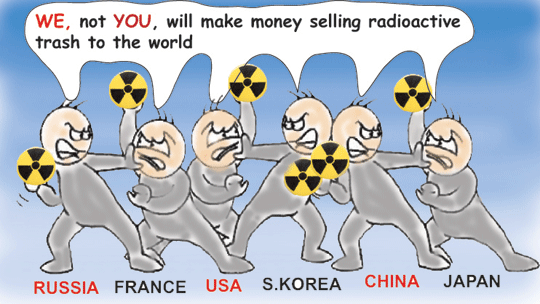
China, vying with U.S. in Latin America, eyes Argentina nuclear deal, Cassandra Garrison, Matt Spetalnick, BUENOS AIRES/WASHINGTON (Reuters) 29 Nov 18 – Argentina and China are aiming to close a deal within days for the construction of the South American nation’s fourth nuclear power plant, a multi-billion dollar project that would cement Beijing’s deepening influence in a key regional U.S. ally.
Argentina hopes to announce an agreement on the Chinese-financed construction of the Atucha III nuclear power plant during Chinese President Xi Jinping’s state visit on Sunday following the summit of leaders of G20 industrialized nations in Buenos Aires, Juan Pablo Tripodi, head of Argentina’s national investment agency, told Reuters in an interview.
The potential deal, reportedly worth up to $8 billion, is emblematic of China’s strengthening of economic, diplomatic and cultural ties with Argentina. It is part of a wider push by Beijing into Latin America that has alarmed the United States, which views the region as its backyard and is suspicious of China’s motives.
………. The negotiations on Chinese financing of the Atucha III nuclear power plant are a key cause for concern for the U.S. government, a senior Trump administration official told Reuters.
Atucha III would be one of the biggest projects financed by China in Argentina, according to the Reuters review of Chinese state funding data…….. https://www.reuters.com/article/us-argentina-china-insight/china-vying-with-u-s-in-latin-america-eyes-argentina-nuclear-deal-idUSKCN1NX0FE
USA issues stark warning against UK partnering with China on nuclear power stations
 US warns Britain against Chinese alliances on nuclear plants, Security official claims evidence of civilian nuclear technology being put to military use, Ft.com, David Sheppard in London , 25 Oct 18
The US has issued a stark warning to the UK about partnering with China’s largest state-backed nuclear company on a host of new power plants, saying it has evidence that it is engaged in taking civilian nuclear technology and transferring it to military uses. Christopher Ashley Ford, the US assistant secretary for international security and non-proliferation, said that China General Nuclear (CGN), which is a partner on the £18bn Hinkley Point C nuclear project, among others, was at the forefront of Chinese efforts to militarise civilian nuclear technology.
“It’s quite clear now that essentially the entirety of the Chinese nuclear industry is lashed up with military-civil fusion,” Mr Ford said in a briefing with the Financial Times. “There is a growing pattern of information of which we have become aware over time related to technological theft issues.” Mr Ford said the US had shared evidence, both “open source” and from intelligence gathering, with the UK, showing CGN was involved in the transfer of technology that could be used for a range of military applications. That could include powering China’s new breed of nuclear powered submarines, aircraft carriers and “floating nuclear reactors for the ongoing militarisation of the South China Sea”, Mr Ford
“If CGN is engaged in helping the Chinese navy . . . with missiles that could presumably be pointed at western capitals, including London . . . It’s worth thinking about whether that’s a particularly good idea,” Mr Ford said. The bluntly delivered warning comes as UK prime minister Theresa May has tried to increase scrutiny of Chinese investment in key UK infrastructure compared to her predecessor David Cameron, including over involvement in nuclear power plants.
But the US intervention, given their status as the UK’s key military ally, is likely to increase pressure on Downing Street. The Trump administration is locked in a trade war with China, with tensions ramping up over tariffs and the balance of payments between the two countries. But the US this month also updated its own policies on civilian nuclear co-operation with China to say that there would be a “presumption of denial” for any US company seeking to transfer technology to CGN or its subsidiaries. …..
A contract between China and Westinghouse Electric Company, the US nuclear engineering group sold by Toshiba to Canadian asset manager Brookfield last year, is not, however, broadly affected by the US policy shift, although future deals could be. The second Westinghouse plant in China started up on Wednesday, 11 years after the deal to build four AP1000 reactors was first signed. …..
Last month, CGN told the Financial Times that political sensitivities could prompt it to give up the chance to operate a new atomic power plant at Bradwell in Essex, as the group also outlined ambitious plans for an industrial partnership with Britain. …..
CGN has invested more than £2bn in its British nuclear projects in the past two years, and has committed to spend £9.5bn in this area in total. https://www.ft.com/content/84ab26f6-d7a5-11e8-a854-33d6f82e62f
1 This Month

Protect Sazan Island from the Trump family! https://secure.avaaz.org/campaign/en/protect_sazan_island_from_the_trump_family_loc/?bqFCVab&v=174511&cl=22707147157&_checksum=5e9dde668860e8231c33699735e16a1fbf22ab2cb01da50c999fe8732b9775ef&utm_source=email&utm_medium=blast_email&utm_campaign=174511


Cuba Is Not a Failed State – It Is a Besieged State
PETITION: “Global Appeal to Endorse Palestinian Right of Return of Refugees”
To see nuclear-related stories in greater depth and intensity – go to https://nuclearinformation.wordpress.com
-
Archives
- June 2026 (129)
- May 2026 (306)
- April 2026 (356)
- March 2026 (251)
- February 2026 (268)
- January 2026 (308)
- December 2025 (358)
- November 2025 (359)
- October 2025 (376)
- September 2025 (257)
- August 2025 (319)
- July 2025 (230)
-
Categories
- 1
- 1 NUCLEAR ISSUES
- business and costs
- climate change
- culture and arts
- ENERGY
- environment
- health
- history
- indigenous issues
- Legal
- marketing of nuclear
- media
- opposition to nuclear
- PERSONAL STORIES
- politics
- politics international
- Religion and ethics
- safety
- secrets,lies and civil liberties
- spinbuster
- technology
- Uranium
- wastes
- weapons and war
- Women
- 2 WORLD
- ACTION
- AFRICA
- Atrocities
- AUSTRALIA
- Christina's notes
- Christina's themes
- culture and arts
- Events
- Fuk 2022
- Fuk 2023
- Fukushima 2017
- Fukushima 2018
- fukushima 2019
- Fukushima 2020
- Fukushima 2021
- general
- global warming
- Humour (God we need it)
- Nuclear
- RARE EARTHS
- Reference
- resources – print
- Resources -audiovicual
- Weekly Newsletter
- World
- World Nuclear
- YouTube
-
RSS
Entries RSS
Comments RSS
 nuclear-news