But the deal failed to emerge then, and in January Argentina’s nuclear energy undersecretary, Julian Gadano, and the ambassador to China, Diego Guelar, met officials in Beijing for talks about the project, the government source said.
China keen to sell nuclear reactor to Bangladesh – an inflated and costly project
Chinese companies lobby for 2nd nuclear power plant in Bangladesh, New Age, Shakhawat Hossain | Apr 21,2019 Chinese companies are showing interest in constructing the planned second nuclear power plant in Bangladesh’s south although the site is yet to be selected.
Two Chinese companies — Dongfang Electric Corporation and China State Construction Engineering Corporation — have already lobbied the Bangladesh Atomic Energy Commission to win the deal, officials said. …….The officials said that some other Chinese companies, including Guangdong Nuclear Power Group, were making queries about the second nuclear power plant, site of which was likely to be selected in June 2019.
Two Chinese companies — Dongfang Electric Corporation and China State Construction Engineering Corporation — have already lobbied the Bangladesh Atomic Energy Commission to win the deal, officials said. …….The officials said that some other Chinese companies, including Guangdong Nuclear Power Group, were making queries about the second nuclear power plant, site of which was likely to be selected in June 2019.
Science and technology secretary Anwar Hossain said that they were considering extending the duration of the site selection programme by six months.
………..Officials said that the Chinese corporation assured the commission of ‘timely commencement and completion’ of the project against the backdrop of criticism that many projects, including Padma Multipurpose Bridge, implemented by Chinese companies in Bangladesh caused cost overrun due to delay in construction.
National committee to protect oil, gas, mineral resources, power and ports member secretary Anu Muhammad said that he was not surprised to find the over enthusiasm of the Chinese companies for the planed second nuclear power plant.
Since the government hardly maintains transparency in the energy related projects, many Chinese companies are active to win projects through the ‘backdoor’, he noted.
Since the government hardly maintains transparency in the energy related projects, many Chinese companies are active to win projects through the ‘backdoor’, he noted.
He alleged that a ‘nexus between locals and foreigners’ was influencing the government to undertake inflated and costly projects, many of which had no national interest. …….http://www.newagebd.net/article/70470/chinese-companies-lobby-for-2nd-nuclear-power-plant-in-bangladesh
China gambles on untested “Hualong One” nuclear reactor, and plans for international sales
 China goes all-in on home grown tech in push for nuclear dominance, David Stanway, SHANGHAI (Reuters)17 Apr 19 – China plans to gamble on the bulk deployment of its untested “Hualong One” nuclear reactor, squeezing out foreign designs, as it resumes a long-delayed nuclear program aimed at meeting its clean energy goals, government and industry officials said. China goes all-in on home grown tech in push for nuclear dominance, David Stanway, SHANGHAI (Reuters)17 Apr 19 – China plans to gamble on the bulk deployment of its untested “Hualong One” nuclear reactor, squeezing out foreign designs, as it resumes a long-delayed nuclear program aimed at meeting its clean energy goals, government and industry officials said.
China, the world’s biggest energy consumer, was once seen as a “shop window” for big nuclear developers to show off new technologies, with Beijing embarking on a program to build plants based on designs from France, the United States, Russia and Canada. But after years of construction delays, overseas models such as Westinghouse’s AP1000 and France’s “Evolutionary Pressurised Reactor” (EPR) are now set to lose out in favor of new localized technologies, industry experts and officials said. ……….Though China has yet to complete its first Hualong One, officials are confident it will not encounter the delays suffered by rivals, and say it can compete on safety and cost. Beijing has already decided to use the Hualong One for its first newly commissioned nuclear project in three years, set to begin construction later this year at Zhangzhou, a site originally earmarked for the AP1000. [nL3N2152KM] ……… EDF, France’s state-run utility, which helped build the EPR project at Taishan in Guangdong province, declined to comment. Westinghouse, now owned by Brookfield after entering bankruptcy restructuring, also did not respond to a request for comment. INTERNATIONAL AMBITIONSChina’s ambitions for the Hualong One extend overseas as well. The first foreign project using the reactor is under construction in Pakistan and the model is in the running for projects in Argentina and Britain……..https://www.reuters.com/article/us-china-nuclearpower-hualong/china-goes-all-in-on-home-grown-tech-in-push-for-nuclear-dominance-idUSKCN1RT0C0 |
China opens fourth border crossing with North Korea, complete with radiation detectors
Japan Times AFP-JIJI, APR 10, 2019
BEIJING – A Chinese city has opened a new border crossing with North Korea — fitted with radiation detectors — even as talks between Washington and Pyongyang have languished over disagreements for nuclear sanctions relief………
The crossing also has a nuclear radiation detection gate, the city said. China has long been worried about any fallout from North Korea’s nuclear activities and Jilin was rocked by an earthquake after a massive bomb test across the border in September 2017. ….. https://www.japantimes.co.jp/news/2019/04/10/asia-pacific/china-opens-fourth-border-crossing-north-korea-complete-radiation-detectors/#.XK6MiFUzbGg
China will fall short of its nuclear power generation capacity target for2020
Reuters 2nd April 2019 China will fall short of its nuclear power generation capacity target for
2020, according to a forecast from the China Electricity Council on
Tuesday. Total nuclear capacity is expected to reach 53 gigawatts (GW) next
year, below a target of 58 GW, council vice chairman Wei Shaofeng told the
China Nuclear Energy Sustainable Development Forum in Beijing.
China is the world’s third-biggest nuclear power producer by capacity, with 45.9 GW
installed by end-2018 and 11 units still under construction, but its
reactor building program has stalled since the 2011 Fukushima nuclear
disaster in Japan.
No new approvals have been granted for the past three
years, amid spiraling costs, delays for key projects and safety concerns
about new technologies. Environmental impact assessments for two new
projects in southeast China were submitted to regulators last month,
however, paving the way for a resumption of its atomic energy program.
China to Resume Approving Nuclear Power Plants
SIXTH TONE, Li YouApr 02, 2019 Energy official’s announcement comes after the Fukushima disaster in Japan led to new nuclear power projects in China being halted.
China will begin construction on several new nuclear power projects this year, according to Liu Hua, deputy minister of the Ministry of Ecology and Environment and head of the National Nuclear Safety Administration.
Liu’s announcement — made Monday during the China Nuclear Energy Sustainable Development Forum in Beijing and later reported by Economic Information Daily — marks an end to the country’s three-year halt to approving new nuclear projects. Since the 2011 Fukushima nuclear disaster in Japan, China has been circumspect in approving new projects. From 2016 to 2018, the country did not greenlight a single one…….
treating spent nuclear fuel and disposing of nuclear waste raise concerns for both the environment and public safety. In August 2016, thousands of residents protestedagainst a planned nuclear waste facility in Lianyungang, Jiangsu province, that led to the project being halted. ….https://www.sixthtone.com/news/1003796/china-to-resume-approving-nuclear-power-plants
Orano (makeover of bankrupt AREVA ) not getting anywhere in selling nuclear reprocessing plant to China
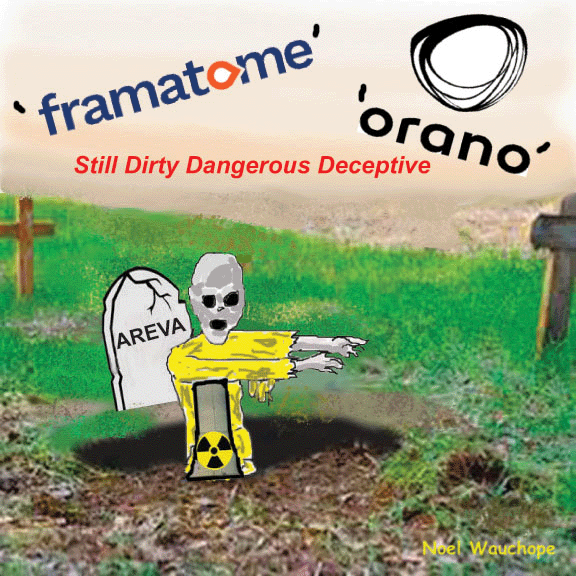 Les Echos 23rd March 2019 Another place, another atmosphere. Xi Jinping’s
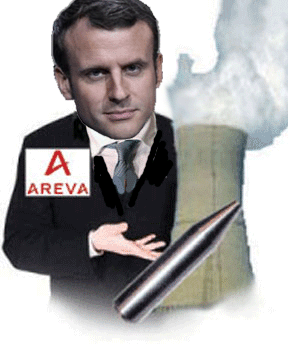 visit to France is not expected to lead to any major breakthrough on Orano’s long-awaited contract to build a used nuclear fuel processing and recycling plant in China.
Fifteen months after Emmanuel Macron’s visit to Beijing during which the French industrialist and his partner CNNC had concluded a new memorandum of understanding , Orano (the former Areva refocused on the fuel cycle) is still far from to have won the bet. At the time, Orano and CNNC had given themselves until the end of 2018 to formally agree on this mega contract of more than 10 billion dollars.
China trying to market nuclear technology to Argentina
Chinese delegation set to revive stalled Argentina nuclear power plant talks
Technical team expected to go to Latin American country to discuss project reportedly worth up to US$8 billion, SCMP, 16 Mar, 2019 A delegation from China will visit Argentina this month to discuss the construction of a nuclear power plant, signalling possible progress in a deal that could increase Beijing’s deepening influence in the South American nation.
“Never Recognised India, Pakistan As Nuclear Countries,” Says China
https://www.ndtv.com/india-news/china-never-recognised-india-pakistan-as-nuclear-countries-2001316
“China has never recognised India and Pakistan as nuclear countries. Our position on this has never changed,” Chinese Foreign Ministry spokesman Lu Kang told a media briefing in Beijing.
All India | Press Trust of IndiaMarch 01, 2019 BEIJING: China Friday said it has never recognised India and Pakistan as nuclear powers and ruled out extending such a status to North Korea following the unsuccessful second summit between US President Donald Trump and North Korean leader Kim Jong-un in Vietnam.
“China has never recognised India and Pakistan as nuclear countries. Our position on this has never changed,” Chinese Foreign Ministry spokesman Lu Kang told a media briefing in Beijing.
He was replying to a question whether China would recognise North Korea as a nuclear state like India and Pakistan as talks between Trump and Kim at the second summit in Hanoi broke down over Pyongyang’s refusal to give up two nuclear processing plants.
China has been blocking India’s entry into the 48-member Nuclear Suppliers Group (NSG) on the ground that New Delhi has not signed the Nuclear Non-Proliferation Treaty (NPT).
After India applied for NSG membership, Pakistan too applied for the same following that China has called for a two-step approach which states that NSG members first need to arrive at a set of principles for the admission of non-NPT states into the NSG and then move forward discussions of specific cases.
Wind and solar power in China – fast outstripping nuclear power
Wind & Solar In China Generating 2× Nuclear Today, Will Be 4× By 2030, Clean Technica, February 21st, 2019 by Michael Barnard, Close to five years ago I published an assessment of nuclear scaling vs wind and solar scaling using China as the proving ground in the CleanTechnica article “Wind Energy Beats Nuclear & Carbon Capture For Global Warming Mitigation.” Today, the China example is more clear proof that wind and solar are the better choice for global warming mitigation than nuclear generation.China’s example is meaningful because it disproves several arguments of those in favor of increased nuclear generation. It’s not suffering under regulatory burden. It’s mostly been using the same nuclear technologies over and over again, not innovating with every new plant. It doesn’t have the same issues with social license due to the nature of the governmental system. The government has a lot of money. The inhibitors to widespread deployment are much lower.
Yet China has significantly slowed its nuclear generation rollout while accelerating its wind and solar rollout. Even strong industry insiders accept this, ones such as former World Nuclear Association executive Steve Kidd, writing in Nuclear Engineering International in 2017.
Kidd estimates that China’s nuclear capacity will be around 100 gigawatts (GW) by 2030, well below previous expectations. Forecasts of 200 GW by 2030 were “not unusual only a few years ago,” he writes, but now seem “very wide of the mark.” And even the 100 GW estimate is stretching credulity ‒ nuclear capacity will be around 50 GW in 2020 and a doubling of that capacity by 2030 won’t happen if the current slow-down sets in.
Why is China slowing its nuclear rollout so drastically? Because nuclear is turning out to be more expensive than expected, new nuclear designs are proving to be uneconomical, and new wind and solar are dirt cheap and much easier to build.
Recently I published an assessment of the potential for wind and solar to massively exceed US CO2 reductions from nuclear in the CleanTechnica article US Could Achieve 3× As Much CO2 Savings With Renewables Instead Of Nuclear For Less Money. As usual, many of the comments from nuclear advocates related to the relative success of China, its speed of deployment compared to other jurisdictions and similar things.
In the discussion threads, I attempted to find apples-to-apples comparisons of China’s nuclear, solar, and wind generation compared, but none seemed to exist. As a result, I developed a model spanning 2010 to 2030, core years for all three programs. The charts are generated from the model

As I noted in 2014, the wind generation program had started much later than the nuclear program yet had been able to build much more capacity much more quickly, roughly six times more real wind energy capacity than nuclear per year over the years of 2010 through 2014. At the time, I used best of breed capacity factors for both wind and nuclear. One of the arguments against this at the time and on an ongoing basis is that China is curtailing wind and solar generation and achieving lower capacity factors. However, China is also experiencing less than best of breed capacity factors with its nuclear fleet, averaging 80% instead of 90%. This would have put the real world generation in the range of 3–4 times better for wind than for nuclear.
It doesn’t really matter as even with the diminished capacity factors for wind and solar currently experienced, they generated more than double the electricity generated by nuclear in 2018. Wind and solar each generated more electricity last year than nuclear did. By 2030, the ratio is very likely to be 4:1 in favor of wind and solar. And as Lazard has shown, wind and solar are much, much cheaper than nuclear, so China will be getting a lot more electricity at a lower cost point.
The chart above uses the capacity factors being experienced for wind, solar and nuclear to date in China and projects that all three will improve over the coming decade as operational efficiencies and grid connections improve………….

The quote from Kidd above suggests China might achieve only 100 GW of nuclear capacity by 2030. That’s an overestimation according to the actual data. Nuclear reactors in construction today only bring Chinese nuclear capacity to 55 GW by 2023. Reactors scheduled to start construction in the next three years only bring that number to 66 GW. Reactors planned but not scheduled at all are only likely to see 88 GW by 2030. There is no planned capacity that achieves even 100 GW, never mind the heady days when 200 GW was thought to be possible.
And to be clear, even if 200 GW of nuclear had been realized, it still would have been less actual generation than wind and solar.
As I indicated in the recent article on US ability to decrease carbon load, nuclear is much lower carbon per MWh than either coal or gas generation, as well as being free of chemical and particulate pollution. However, wind is still quite a bit lower than nuclear in CO2e per MWh and solar is around the same. Given the speed of deployment per GW of capacity and the much lower price per MWh of wind and solar, nuclear as part of the mix doesn’t make a lot of sense in most places…………https://cleantechnica.com/2019/02/21/wind-solar-in-china-generating-2x-nuclear-today-will-be-4x-by-2030/
|
|
A headache for Britain – its reliance on China for nuclear technology
 UK’s reliance on China’s nuclear tech poses test for policymakers, Britain risks alienating Beijing if it scraps power deals over security concerns, Ft.com, 15 Feb 19,
The UK has no easy way to block China’s ambitions to export nuclear reactor technology to Britain on security grounds, despite growing public anxiety about Chinese involvement in sensitive infrastructure, according to people familiar with the situation. The government’s willingness to permit the state-owned utility, CGN, to participate in the UK’s nuclear power generation programme has raised eyebrows in recent months as Chinese investment has come under hostile scrutiny, both in Europe and the US.
In October, an assistant US secretary of state, Christopher Ashley Ford, even warned the UK explicitly against partnering with CGN, saying that Washington had evidence that the business was engaged in taking civilian technology and converting it to military uses. More recently, concerns about the Chinese telecoms company Huawei and cyber security have also prompted calls for the government to back away from closer energy ties. But government policies requiring nuclear projects to be “developer-led”, and interlocking commitments given to Chinese investors by David Cameron’s government in 2014, make it awkward for the government to reverse course………..
Is Chinese involvement really a problem? Opposition to the deal ranges from the strategic to the practical. Economist Dieter Helm said he finds it astonishing that an independent nuclear military power should be “complacent about allowing potential enemies into the core of its nuclear technologies”. Some critics also worry about the availability of fuel and spares in what will be a 60-year plant should Britain and China fall out………..
The bigger risk to CGN’s ambitions may be the UK’s waning appetite for more nuclear reactors, and the lack of competitive tension among developers in seeking new deals. A report last summer from the National Infrastructure Commission warned against “rushing” to support more nuclear stations and suggesting only one more be agreed before 2025, preferring to place bigger bets on renewable energy.
The government has been lobbied by EDF to consider a new form of financing for nuclear, known as the regulated asset base model, which would impose a charge on consumers during the construction phase, helping to reduce the project’s cost of capital, and potentially unlocking private sector investment. This could make the highly geared French group less dependent on Chinese capital to proceed with Sizewell C. According to one civil servant, the business department, BEIS, is considering these proposals “very seriously”.
In the meantime, CGN, which declined to comment on its UK operations, continues to invest heavily in the UK. The total is £2.7bn and counting on Hinkley, the design assessment for the Bradwell reactor and 340 megawatts of renewables plant. According to a source close to CGN: “This is an important year and it is important to remember that the company is a utility, not a bank.” “The Chinese see this UK deal as a strategic imperative and seem intent to do what it takes to make it happen,” said the consultant. “If the UK has changed its mind, it is going to be hard to let them down gently.” https://www.ft.com/content/7734e3be-2f6f-11e9-8744-e7016697f225
India’s submarine rivalry with China in the second nuclear age
The Strategist , 15 Feb 2019|Ramesh Thakur There are substantially fewer nuclear weapons today than at the height of the Cold War. Yet the overall risks of nuclear war—by design, accident, rogue launch or system error—have grown in the second nuclear age. That’s because more countries with fragile command-and-control systems possess these deadly weapons. Terrorists want them, and they are vulnerable to human error, system malfunction and cyberattack.
The site of great-power rivalry has shifted from Europe to Asia with crisscrossing threat perceptions between three or more nuclear-armed states simultaneously. With North Korea now possessing a weaponised ICBM capability, the US must posture for and contend with three potential nuclear adversaries—China, Russia and North Korea.
The only continent to have experienced the wartime use of atomic weapons, Asia is also the only continent on which nuclear stockpiles are growing. The total stockpiles in Asia make up only 3% of global nuclear arsenals, but warhead numbers are increasing in all four Asian nuclear-armed states (China, India, North Korea and Pakistan). None of them has yet ratified the Comprehensive Nuclear-Test-Ban Treaty, although China is a signatory. Asia stands alone in nuclear testing in this century.
The Cold War nuclear dyads have morphed into interlinked nuclear chains, with a resulting greater complexity of deterrence relations between the nuclear-armed states. Thus, as I’ve previously argued, the tit-for-tat suspensions of the Intermediate-Range Nuclear Forces Treaty by the US and Russia has a significant China dimension. The nuclear relationship between India and Pakistan is historically, conceptually, politically, strategically and operationally deeply intertwined with China. While Pakistan’s nuclear policy is India-specific, the primary external driver of India’s policy has always been China.
……….the race to attain a continuous at-sea deterrence capability through nuclear-armed submarines is potentially destabilising in Asia because the regional powers lack well-developed operational concepts, robust and redundant command-and-control systems, and secure communications over submarines at sea……… https://www.aspistrategist.org.au/indias-submarine-rivalry-with-china-in-the-second-nuclear-age/
Is nuclear power REALLY a clean-power fix for Africa – as Russia and China push it
 Russia, China back nuclear as a clean-power fix for Africa
Money Web , Sebastien Malo, Thomson Reuters Foundation / 10 February 2019 “…….For now, South Africa is the only country on the continent operating a nuclear power plant.
But in recent years, at least seven other sub-Saharan African states have signed agreements to deploy nuclear power with backing from Russia, according to public announcements and the World Nuclear Association (WNA), an industry body………
Like Ethiopia, emerging nuclear states Sudan, Kenya, Uganda, Nigeria, Rwanda, Zambia and Ghana have signed agreements with Russia’s state nuclear corporation, ROSATOM – most since 2016.
Their content ranges from language on the construction of nuclear reactors to assistance with feasibility studies and personnel training, press statements show.
ROSATOM’s solutions for managing spent fuel and radioactive waste vary from country to country, but are normally worked out at the later stages of a nuclear new-build programme “in the strictest compliance with international law”, a spokeswoman told the Thomson Reuters Foundation.
Chinese state-owned nuclear firms have also taken the lead in the region, sealing deals with Kenya, Sudan and Uganda, WNA data shows.
South African student Masamaki Masanja, 23, won a ROSATOM competition for young people to make videos about Africa’s nuclear potential, and got to visit the Novovoronezh nuclear power plant in western Russia in 2017.
“It was mind-blowing,” said the second-year mechanical engineering student, via Skype.
The experience left him with a strong sense that nuclear power should be adapted quickly for Africa’s needs………
Rebel risk
Some political observers, however, are concerned about the prospect of nuclear reactors backed by Russia in some countries with rebel groups and weak government institutions.
An Africa-based Western diplomat, who asked to remain anonymous, doubted Russia’s assurances it would collect nuclear waste from projects it helped establish.
“You could end up with very unfortunate situations in parts of Africa … if you have a decaying nuclear power plant overrun by rebels, with waste that’s not going away,” he said.
Multiple requests for an interview with Russia’s ambassador in Ethiopia were declined.
So-called dirty bombs can combine conventional explosives like dynamite with radioactive material such as nuclear waste. ………
It could take 20 years for Ethiopia to build a nuclear power plant, estimated Hong-Jun Ahn, a Korean electrical engineer who advises the Ethiopian government on its nuclear plans.
Yonas Gebru, director of Addis Ababa-based advocacy group Forum for Environment, said green activists could prove another hurdle amid debate over whether nuclear power is “clean” energy.
“It would be good, and it would be wise also … to better capitalise on already started initiatives such as hydropower, wind energy (and) solar energy,” said Gebru. https://www.moneyweb.co.za/news/africa/russia-china-back-nuclear-as-a-clean-power-fix-for-africa/
Despite the severe disadvantages to Uganda, of nuclear power, Uganda’s govt succumbs to China’s nuclear marketing
Uganda to generate nuclear energy amidst safety, environmental concerns, By February 9, 2019 KAMPALA – Uganda is in the final stages of efforts to start generating some 2000 megawatts of electricity from five nuclear plants it plans to build in five districts scattered in the country’s four geographical regions……..
Already memoranda of understanding have been signed with Russia and the China National Nuclear Corporation [CNNC), Beijing on cooperation in the peaceful uses of nuclear energy on May 10, 2018.
In both of these documents Uganda is to secure technical expertise and financing to lift the plan off the ground.
According to Ms Sarah Nafuna, the head of Nuclear Energy Unit in the ministry, the MoU with Beijing details areas of technical and engineering cooperation as well as financial support to develop reactors for the nuclear plant……….
Energy ministry’s Nafuna declined to disclose the cost of developing the nuclear plants, but a high-level source that asked not to be named because they were not authorised to speak on the matter, estimated the capital and operating costs upward of Shs145 trillion.
This working figure is higher than Uganda’s Shs29 trillion annual budget, raising questions about the country’s ability to mobilise such resources when it is already saddled with a total external debt exposure, including committed but undisbursed debt of USS$12.2 billion debt, [about Shs 45.4 trillion]……….
sceptics also argue that a sunshine-rich country such as Uganda should never think of going the risky route of nuclear energy. ………
while government officials strongly defend the nuclear project, questions abound about how a country – that has failed to handle minor fire disasters and basic household waste will effectively deal with toxic wastes, which are the by-product of nuclear power generation.
In Kampala for instance, garbage is littered all over, with roads becoming impassable when it rains. Moreover, some hospitals and clinics carelessly dispose their medical waste in landfills, yet the government insists it can handle nuclear waste.
Mr Nandala Mafabi, the secretary general of the FDC, a critic of nuclear power generation says the government should explore safer sources of energy such as solar and wind energy, and only consider nuclear as an energy source later……….
Opponents of the nuclear energy are also worried about health hazards, safety and radioactive waste management, with questions about the country’s preparedness to deal with radioactive waste and accidental leaks which advanced economies like Japan have grappled with.
Mr Frank Muramuzi, the executive director of National Association of Professional Environmentalists (NAPE), also opposed building of nuclear plants and instead pointed the government to harness electricity from other renewable energy sources such as solar.
“Nuclear plants are expensive, have long construction periods of about 10 years and expensive to de-commission the plants at the end of their lifespan, especially disposing of hazardous radioactive waste,” he said………http://www.pmldaily.com/features/2019/02/uganda-to-generate-nuclear-energy-amidst-safety-environmental-concerns.html
China urges dialogue, as Russia and USA ramp up nuclear weaponry, pull out of weapons treaty
Russia withdraws from Cold War-era nuclear weapons treaty with US https://www.abc.net.au/news/2019-02-02/russia-withdraws-from-cold-war-era-nuclear-weapons-treaty/10774536 Russia has suspended a Cold War-era nuclear weapons treaty, President Vladimir Putin said, after the United States accused Moscow of violations and said it would withdraw from the arms control pact.
 Key points:
- Russia will start work on new missiles, including hypersonic ones

- US and Russia both allege the other has violated the INF treaty
- China urges dialogue amid fears of nuclear arms race
The Intermediate-range Nuclear Forces (INF) Treaty prevents the two superpowers from possessing, producing or test-flying ground-launched nuclear cruise missiles with a range of 500 to 5,500 kilometres.
The United States announced it will withdraw from the INF treaty in six months unless Moscow ends what it says are violations of the pact, but Russia denied violating the treaty.
“The American partners have declared that they suspend their participation in the deal, we suspend it as well,” Mr Putin said during a televised meeting with foreign and defence ministers.
Mr Putin said Russia will start work on creating new missiles, including hypersonic ones, and told ministers not to initiate disarmament talks with Washington, accusing the United States of being slow to respond to such moves.
“We have repeatedly, during a number of years, and constantly raised a question about substantiative talks on the disarmament issue,” Mr Putin said.
“We see that in the past few years the partners have not supported our initiatives.”
The US alleges a new Russian cruise missile violates the important pact, signed by former leaders Ronald Reagan and Mikhail Gorbachev in 1987.
The missile, the Novator 9M729, is known as the SSC-8 by the North Atlantic Treaty Organisation (NATO).
Russia said the missile’s range put it outside the treaty, and accused the US of inventing a false pretext to exit a treaty it wants to leave anyway so it can develop new missiles.
Russia also rejected the demand to destroy the new missile.
During the meeting with Mr Putin, Russian Foreign Minister Sergey Lavrov accused the US of violating the INF and other arms deals, including the non-proliferation treaty.
Mr Putin said Russia would not deploy its weapons in Europe and other regions unless the US did so.
Fears of new arms race
The row over the INF treaty is yet another twist in Russia’s worsening relations with the United States and the West, with tensions over Russia’s annexation of Crimea from Ukraine as well as allegations of it meddling with the presidential election in the US and being behind a nerve agent attack in Britain.
The treaty’s suspension has drawn a strong reaction from Europe and China.
European nations fear the treaty’s collapse could lead to a new arms race with possibly a new generation of US nuclear missiles stationed on the continent.
In a statement, China’s Ministry of Foreign Affairs said the bilateral treaty was important to maintain “global strategic balance and stability”.
“China is opposed to US withdrawal action and urges the United States and Russia to handle their differences properly through constructive dialogue,” the statement said, warning that unilateral withdrawal could trigger “negative consequences”.
How US and China’s African nuclear mission could provide model for disarming North KoreaSC
- The recent joint operation to remove uranium from Nigeria could provide a template for denuclearisation on the Korean peninsula
- Although the two countries have proved they can still work together, the challenges posed by North Korea are likely to prove far more challenging
China and America’s recent joint nuclear non-proliferation mission in West Africa could provide a precedent for dismantling North Korea’s nuclear arsenal, analysts have said, but warned that the scale and political complexity of the task will be far greater.
This week it emerged that Chinese and American nuclear experts had cooperated on a project to remove highly enriched uranium (HEU) from a reactor in Nigeria to prevent the material falling into the hands of terrorists.
The mission last year, which also involved British and Norwegian experts along with contractors from Russia and the Czech Republic, was completed within a day despite violent clashes in Kaduna province where the reactor was located, according to Defensenews.com.
The logistics and security arrangements needed to fly the material to China were completed within six weeks, showing the capacity of both the US and China to set aside their differences and cooperate when their mutual interests are at stake.
US and China team up to keep nuclear material from terrorists
The Nigerian operation was not the first time the two countries had worked together to prevent nuclear proliferation in West Africa; a similar operation to remove HEU to China was carried out in Ghana in 2017.
Because neither China nor America’s interests are served by a nuclear-armed North Korea, similar work could be carried out in the future should talks on denuclearisation come to fruition.
Miles Pomper, a senior fellow at the James Martin centre for non-proliferation studies at the Middlebury Institute of International Studies at Monterey, said: “It is conceivable in the case of denuclearisation that North Korea’s nuclear weapons or material could be taken to China.
“Given the fact that China already has nuclear weapons, the US could likely accept that although the US would likely then push for their disassembly.”
Bruce Bennett, a senior defence researcher at the Rand Corporation, said the two countries would continue to cooperate on dismantling nuclear weapons.
“If instability developed in North Korea, China may well be at greater risk from terrorists or Chinese dissident groups seizing North Korean nuclear weapons and using them against China,” he said……… https://www.scmp.com/news/china/diplomacy/article/2182564/how-us-and-chinas-african-nuclear-mission-could-provide-model
1 This Month

Protect Sazan Island from the Trump family! https://secure.avaaz.org/campaign/en/protect_sazan_island_from_the_trump_family_loc/?bqFCVab&v=174511&cl=22707147157&_checksum=5e9dde668860e8231c33699735e16a1fbf22ab2cb01da50c999fe8732b9775ef&utm_source=email&utm_medium=blast_email&utm_campaign=174511


Cuba Is Not a Failed State – It Is a Besieged State
PETITION: “Global Appeal to Endorse Palestinian Right of Return of Refugees”
To see nuclear-related stories in greater depth and intensity – go to https://nuclearinformation.wordpress.com
-
Archives
- June 2026 (129)
- May 2026 (306)
- April 2026 (356)
- March 2026 (251)
- February 2026 (268)
- January 2026 (308)
- December 2025 (358)
- November 2025 (359)
- October 2025 (376)
- September 2025 (257)
- August 2025 (319)
- July 2025 (230)
-
Categories
- 1
- 1 NUCLEAR ISSUES
- business and costs
- climate change
- culture and arts
- ENERGY
- environment
- health
- history
- indigenous issues
- Legal
- marketing of nuclear
- media
- opposition to nuclear
- PERSONAL STORIES
- politics
- politics international
- Religion and ethics
- safety
- secrets,lies and civil liberties
- spinbuster
- technology
- Uranium
- wastes
- weapons and war
- Women
- 2 WORLD
- ACTION
- AFRICA
- Atrocities
- AUSTRALIA
- Christina's notes
- Christina's themes
- culture and arts
- Events
- Fuk 2022
- Fuk 2023
- Fukushima 2017
- Fukushima 2018
- fukushima 2019
- Fukushima 2020
- Fukushima 2021
- general
- global warming
- Humour (God we need it)
- Nuclear
- RARE EARTHS
- Reference
- resources – print
- Resources -audiovicual
- Weekly Newsletter
- World
- World Nuclear
- YouTube
-
RSS
Entries RSS
Comments RSS
 nuclear-news