Putin orders tactical nuclear weapons drills
SOTT, Mon, 06 May 2024
An exercise to check the military’s ability to use smaller-range systems was announced by the Defense Ministry on Monday
Russia will test its ability to deploy tactical nuclear weapons, the Defense Ministry announced on Monday. The drill will be conducted “in the near future” and was ordered by President Vladimir Putin, the statement said.
Missile forces of the Southern Military District will be directly involved in the exercise. It will also require the participation of military aircraft and the Russian Navy, the ministry said.
The goal of the exercise is to iron out “the practical aspects of the preparation and deployment of non-strategic nuclear weapons,” it added.
The military cited “provocative statements and threats against Russia by certain Western officials” as the reason for the drill. The troops will confirm that they can “ensure unconditional territorial integrity and sovereignty” of the nation, it added.
Moscow has a wide range of nuclear-capable weapons, from long-range intercontinental ballistic missiles to smaller-range tactical nukes. Amid the Ukraine conflict, senior Russian officials, including Putin, have stated that the country’s nuclear doctrine allows the use of these weapons when the existence of the nation is at stake.
The US and its allies have accused Moscow of nuclear saber-rattling. Putin said in March that at no point in the conflict has the situation required such a radical move as a nuclear strike.
Comment: From the same source:
28 Apr, 2024
Macron calls for EU nuclear force
more https://www.sott.net/article/491187-Putin-orders-tactical-nuclear-weapons-drills
Ending the Logic of War
Why Western societies need to find new responses to violence and crises
FABIAN SCHEIDLER, MAY 06, 2024 https://fabianscheidler.substack.com/p/ending-the-logic-of-war
Over more than two decades, the Western world has moved further and further into a permanent state of crisis and emergency, which, according to the rhetoric of some of our leading politicians, has now escalated into an outright state of war. It began with the “war on terror” after September 11 and the subsequent attacks in Europe, followed by the responses to Russia’s invasion of Ukraine and finally the Gaza war, which especially the US and Germany are supporting with massive arms supplies. A state of war was also declared by many Western heads of state in response to the pandemic, with Emmanuel Macron famously proclaiming: “We are at war. And that requires our general mobilization.”
In the name of fighting the respective enemies, a massive rearmament of the military, police and surveillance technologies was set in motion, basic civil rights were restricted. Urgent concerns such as social justice and climate protection have been and continue to be marginalized with reference to ever new states of emergency and the overpowering threat posed by the current enemy. In Germany, we are hearing increasingly militaristic tones from top politicians that are reminiscent of the late days of the German Empire, with the Minister of Defense, Boris Pistorius, calling on the country to become “ready for war”.
While the capitalist world-system is in a permanent structural crisis and the legitimacy of Western political elites is dwindling, governments tend to resort to states of war and emergency, as this allows them to silence domestic conflicts and to justify massive crackdowns on dissidents. In the logic of war, the view is narrowed to the external enemy, societies are called upon to close ranks. Anyone who disagrees runs the risk of being declared an ally of the enemy.
It is obvious that these developments are extremely dangerous for a democracy. In view of the global challenges that are likely to increase in the coming decades due to geopolitical shifts, growing environmental crises and scarcity of resources, it is high time question the logic of war and to highlight different responses to current and future crises.
First of all, when we look back, it should be noted that neither the US nor any EU country has been attacked militarily since the Second World War (apart from the conflict over the British colony of the Falkland Islands in 1982). The attack on September 11, 2001 was a serious crime, but – as the term terrorist attack implies – by definition not a military attack. Since then, despite all internal conflicts, peace has prevailed in these countries. The situation, however, is different when we look the other way around: The US alone has been involved in around 200 military interventions around the globe since 1950. In addition, it has engaged in more than 70 covert regime change operations – often against democratically elected governments – plunging the affected nations into decades of chaos or authoritarian rule. The UK, France, Germany and other Western countries were also involved in numerous military operations abroad, most of which were sold to the public as noble missions in defense of human rights. But the real balance sheet looks different.
The war in Afghanistan alone, the centerpiece of the “war on terror”, has cost 176,000 lives, 98 percent of them Afghans. The September 11 attacks, to which this war was the response, claimed 2996 lives – one sixtieth of the victims of the subsequent war. While 80 percent of Afghans lived in poverty before the war, 97 percent did so after the withdrawal of the USA and its allies. Terrorism has exploded worldwide as a result of these “wars on terror”. Whether in Afghanistan, Iraq or Libya: wherever Western missions have been active, they have left behind failed states and a trail of devastation.
As a result of these interventions, terror finally arrived in Europe. Western societies did not respond to the attacks in Madrid, London, Paris and elsewhere with self-reflection and a change in their policy towards Arab states, but with more military operations abroad, while boosting mass surveillance, militarization of the police, and restrictions on civil liberties domestically. This is despite the fact that even in the years of the most bloody attacks in Europe, more than 100 times as many people died from multi-resistant hospital germs as from terror. If the money had been invested in the healthcare system, ruined by decades of austerity, instead of the military, tens of thousands of lives could have been saved instead of sparking new wars.
We encounter here two essential characteristics of Western responses to crises and violence: firstly, the extreme disproportionality between event and reaction. The threat posed by the enemy is magnified out of all proportion, the responses are completely out of scale in relation to the original act and can even cause orders of magnitude more damage and casualties. Secondly, the inability to grasp the cycle of cause and effect. Acts of violence such as terrorist attacks are interpreted as manifestations of a primordial evil without a history; the world disintegrates into a Manichean duality of good and evil that no longer allows for any complexity or shades. There is no analysis of the causes and prehistory, especially not when it comes to one’s own mistakes or even complicity. On the contrary: anyone who addresses the genesis of the violence and the role of their own governments in it is accused of relativizing and trivializing the enemy.
After the Hamas attacks on Israel, which claimed the lives of 1140 people, one might have expected that lessons would have been learned from the disastrous outcome of the war on terror. But instead, Western governments supported the Israeli government in repeating the mistakes of that time. Once again we are witnessing an almost obscene disproportionality in the military response, which has now claimed the lives of 34,000 people, 14,000 of them children. This is 30 times as many deaths as on October 7. The causes of the violence are not only being ignored, but are even being exacerbated by the permanent traumatization and humiliation of the enemy. An analysis of the roots of the escalation, such as Israel’s 16-year blockade of the Gaza Strip in violation of international law, is denounced as a legitimization of Hamas’ deeds and a betrayal of Israel. Hence, the Israeli government and the Western states supporting it have embarked on a maelstrom of blind destruction without any realistic political goal.
The inability or reluctance to understand the connection between cause and effect, the excessiveness of reactions, the pompous and narcissistic self-adulation as representatives of the good, the denunciation and suppression of criticism, the lack of empathy towards the victims and the inability to comprehend even a minimum of complexity are signs of an alarming mental regression among the political elites of the Western world. Indeed, this regression is disturbingly reminiscent of the “sleepwalkers” on the eve of the First World War.
And that brings us to the war in Ukraine, which, like the Gaza war, carries the risk of global escalation. Russia’s invasion of Ukraine on February 24, 2022 was undoubtedly a serious violation of international law and a crime against the Ukrainian people. And yet these findings do not exempt us from analyzing the causes and the question of whether and how this war could have been avoided, what role the West played in it – and how it can be ended. It should be a matter of course in political analysis that investigating causes has nothing to do with legitimizing crimes, that there can be more than one culprit in a conflict and that the misdeeds of the one in no way justify those of the other.
But even these minimal requirements for rational thinking seem to go beyond the grasp of Western foreign policymakers and media pundits. Instead of seeing the war in Ukraine as an expression of geopolitical and regional conflicts of interest that have a history and could possibly even be resolved diplomatically, it is portrayed as a Manichean struggle between the ever virtuous, God-sent West against the diabolical dragon from the East, which is driven by an insatiable greed for power, blood and land. A typical indication of this relapse into mythical thinking and propagandistic demonization is the inflation of comparisons between Putin and Hitler, which both the press and top politicians on both sides of the Atlantic routinely indulge in. This tendency culminates in the fully-fledged regressive fantasy that the satanic beast in Moscow wants to devour us all – in other words, the whole of Europe and eventually the rest of the world. In Germany, defense minister Pistorius has already prophesied that the time for a Russian attack on NATO will come in “five to eight years”. Apparently he either disposes of a crystal ball or he sees, like John of Patmos, the approach of the apocalypse in nightly visions. Yet there is not the slightest indication that the Russian leadership would ever be so suicidal as to attack a NATO country and thus send itself to nuclear nirvana.
No, we are not dealing here with an incarnation of primeval evil, not with Voldemort or Sauron, nor with a new Hitler, but with a thoroughly rational, albeit often unscrupulous, actor who in this respect is hardly any different from the major Western powers – just think of the Iraq war. The Russian leadership is pursuing very clearly defined and regionally limited goals with this war. This includes, in particular, the neutrality of Ukraine. According to a recently leaked document on the negotiations between Russia and Ukraine, this was also at the heart of a possible ceasefire agreement in spring 2022 – with Ukraine’s express consent. At the time, Russia had held out the prospect of withdrawing to the lines of February 23, 2022 in return.
Today, this option is practically off the table and Ukraine is in a much worse negotiating position. The suppression of sober analysis by mythical thinking has prevented the West from engaging in de-escalation and peacemaking. Instead of participating in the numerous negotiating missions of the Turkish government, of Israeli Prime Minister Naftali Bennet and later of the South African, Brazilian and Chinese governments, Western politicians, led by the US, have rejected or even sabotaged all diplomacy and opted for the pipe dream of a complete reconquest of the occupied territories, which even according to the Pentagon and the long-time commander-in-chief of the Ukrainian armed forces, Valerii Zaluzhnyi, has long been completely unrealistic. Once again, the West is lurching towards a permanent escalation with pompous rhetoric, but without a political goal, while a new Verdun is looming in Ukraine. The only answer our political leadership has given to the geopolitical changes associated with the rise of China and the decline of the US hegemony is: more weapons. Almost all other pressing tasks, from social justice to a serious protection of the biosphere, are sacrificed on the altar of rearmament, which supposedly has no alternative. Cults of sacrifice are always part of the logic of war.
But the logic of war is not destiny. The answer to the acts of violence of the recent past lies in our hands. Neither the Russian invasion of Ukraine nor the Hamas attack are forcing us into a spiral of militarization, armament and war. On the contrary, this spiral only makes our lives and the survival of our species on the battered planet Earth even more precarious. We can only achieve security by tackling the causes of violence and creating a new peace order that takes equal account of the security interests of all parties involved: Israelis and Palestinians, Ukrainians and Russians, Americans and Chinese. To achieve this, we must learn to see the world through the eyes of others. The West is not God’s chosen force for good in the world; on the contrary, it has left a 500-year trail of violence on Earth. Its dominance will inevitably come to an end in the 21st century. May we find the wisdom to accept this transition and perhaps even see it as an opportunity for a more peaceful world.
This article was first punished in German by the Berliner Zeitung.
Token gesture: Biden puts hold on approved shipments of ammo to Israel
SOTT, Hayden Cunningham, The Post Millennial, Mon, 06 May 2024
The Biden administration has halted a shipment of ammunition previously approved to aid Israel in its war efforts with Hamas.
This suspension of munition delivery is the first of its kind since the beginning of the recent conflict between Israel and Hamas last October, when Hamas attacked Israel, murdering 1,200, and Israel launched a full-scale retaliation. According to two Israeli officials who spoke to Axios, the ammunition shipment was stopped last week.
The White House has yet to officially comment on the decision.
In April, Nancy Pelosi and other Democratic representatives issued a signed letter that called on Biden to halt the sale of weapons to Israel, even as they encourage munitions to be sent to Ukraine. The lawmakers called it “unjustifiable” to approve weapons transfers to Israel after an Israeli airstrike that inadvertently killed several humanitarian workers
This recent move comes amidst growing criticism within President Biden’s own base regarding US support for Israel. As left-wing activists across the country have continually called for the US to withdraw its support from Israel, the Biden administration has appeared to soften its initial support for the Jewish state.

The timing of this decision also follows US Secretary of State Antony Blinken’s visit to Israel last Wednesday. During his visit, Blinken held discussions with Israeli Prime Minister Benjamin Netanyahu about potential military operations in Gaza.
Netanyahu has recently signaled Israel’s intention to launch an invasion of Rafah, a city in southern Gaza where there is a checkpoint between Gaza and Egypt that Egypt keep strictly controlled to prevent the flow of Palestinians into their nation. There have been ongoing efforts to negotiate a ceasefire with Hamas and secure the release of hostages, though Hamas has refused many of these attempts.
Comment: Actually it’s Israel who’s turned down most of the proposals. Any deal requiring them to withdraw from Gaza will interfere with their ongoing ethnic cleansing/genocide project.
…………………………………………… Last February, the Biden administration requested assurances from Israel that any US-made weapons would be used in compliance with international law. Israel responded by providing a signed letter in March affirming its commitment to this standard.
Comment: Biden’s floundering campaign is uppermost in the minds of his handlers. Given the unrest across US. campuses over the Palestinian genocide, it seems that he’s been advised to throw them a bone.
The End of the World as We Know It
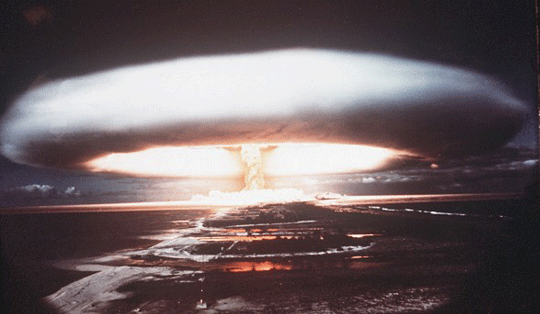
and Democratic presidents, in particular, are often worried about appearing soft on defence—they are easily swayed by their military advisors.
Most of the US public thinks that America has renounced the optional first use of nuclear weapons. But while many presidential candidates have promised to do so, no one in office has ever made it an official policy.
Far from enhancing American national security, or the security of the world, nuclear weapons will lead us to the edge of destruction.
Lawrence M. Krauss 6 May 24, https://quillette.com/2024/05/06/the-end-of-the-world-nuclear-war-weapons-apocalypse

A review of Nuclear War: A Scenario by Annie Jacobsen; 400 pages; New York: Dutton (March 2024)
As Chair of the Board of Sponsors of the Bulletin of the Atomic Scientists from 2008–2018, I helped unveil the Doomsday Clock every year for a decade. That meant that each year, I sat down with my colleagues for several days and seriously contemplated how close we might be to the end of civilisation. But even that sombre preparation could not prepare me for the grim realities unveiled in the recent book, Nuclear War: A Scenario, by veteran national security journalist Annie Jacobsen
Jacobsen details the events that would take place, minute by minute, in the 72 minutes from the launch of a rogue intercontinental ballistic missile (ICBM) by North Korea to the destruction of modern civilization and the death of up to five billion people.
Jacobsen imagines the following scenario:
0 min) A lone ICBM is launched from North Korea.
(19 min) The US launches 50 ballistic missiles at targets in North Korea and instructs submarines to launch 32 additional missiles.
(21 min) Most of Southern California becomes uninhabitable due to a North Korean submarine-launched ballistic missile (SLBM) attack on the Diablo Canyon nuclear reactor.
(33 min) Washington DC, together with almost all its 6 million inhabitants, is vaporized by the impact and explosion of the North Korean ICBM.
(49 min) Fearing they are under attack from the US missiles heading toward North Korea, Russia launches 1,000 missiles at US targets. On detection of these, the US launches an ICBM and SLBM attack on 975 Russian targets.
(51 min) NATO pilots launch an aerial nuclear attack on the Russian targets.
(52 min) North Korea is effectively wiped off the map, following the impact of 32 SLBM and 50 ICBM missiles.
(57 min) All land-based US military bases are destroyed by Russian SLBMs.
(58 min) Much of Europe is destroyed by a Russian SLBM attack on NATO bases. (59 min) The US launches the remainder of its stock of SLBMs at Russia.
(72 min) 1,000 locations in the United States are hit by Soviet ICBMs. A large fraction of the US population is killed immediately and most of the rest have little or no means of survival. A similar fate befalls Russia several minutes later.
Meanwhile, 52 minutes into this apocalyptic exchange, a nuclear device explodes in space high above the US, producing an electromagnetic pulse that renders almost all communication systems in the continental US inoperative, destroying much of the country’s infrastructure and causing widespread floods and fires, thus further complicating life for the few remaining survivors.
Whether or not one finds the specific scenario Jacobsen outlines plausible, it is clear that any major nuclear confrontation would have apocalyptic consequences. As Soviet Chairman Nikita Khrushchev said shortly after the Cuban Missile Crisis, in such a situation, “the survivors would envy the dead.”
Military planners have been preparing for scenarios like this since at least 1960, when the first comprehensive nuclear war planning exercise was carried out in the US.
As Jacobsen describes, in 1949, experts estimated that as few as 200 fission-type weapons of the kind that destroyed Hiroshima and Nagasaki would have been sufficient to essentially wipe out the Soviet Union. But despite this, both the US and the Soviets continued to amass weapons. By 1967, the US and USSR had around 30,000 nuclear and thermonuclear warheads each. While their arsenal has since been reduced, the US still has over 1,700 warheads on hair-trigger, launch-on-warning alert. Russia has only slightly fewer. Both countries have over 3,000 additional nuclear weapons stockpiled and available for use.
For the past 79 years, we have been living under the Damoclean sword of mutually assured destruction (MAD), the basis of modern nuclear deterrence. It is argued that since any act of nuclear aggression would lead to the annihilation of most of the world, no rational leader would launch a first strike. What is less frequently stressed, however, is that for this to work, deterrence must never, ever fail. Because once it does, the world as we know it will end.
The madness of having almost 2,000 nuclear weapons on hair-trigger alert, capable of being irretrievably launched on their missions of destruction at the mere warning of an incoming nuclear attack—before a single nuclear explosion has even occurred—has not been lost on US presidential candidates from both parties. Both George W. Bush, and Barack Obama vowed to take us back from the razor’s edge while running for president, but neither made good on this promise while in the White House. I was on Obama’s science policy team during his first run for the presidency. I was gratified when he won because I thought he would fix this lunacy. I was profoundly disappointed when he didn’t.
Most of the US public thinks that America has renounced the optional first use of nuclear weapons. But while many presidential candidates have promised to do so, no one in office has ever made it an official policy.
I have often wondered why successful presidential candidates change their tune once they get into the Oval Office. I suspect that the generals who advise the President and the Secretary of Defence have lived with the idea of launch-on-warning throughout their whole careers and cannot even imagine that a US president might allow a nuclear weapon to explode on American soil without having already launched a response. Since most presidents have no experience with war game planning—and Democratic presidents, in particular, are often worried about appearing soft on defence—they are easily swayed by their military advisors.
The maddening ramping-up of nuclear arsenals is a real-world example of the well-known game theory scenario called The Prisoner’s Dilemma, in which two prisoners, who cannot communicate with either other, are motivated by mistrust to make choices that are in neither party’s best interests. Likewise, each of the superpowers assumes that its adversary will stockpile ever more nuclear weapons, so it seems logical to stockpile more themselves.
There is a simple way out of this dilemma. Unlike in the game theory example, the prisoners here can talk to each other and, through diplomacy, can jointly arrive at a win-win strategy. The problem is that there are currently almost no front-door communications between either Russia and the US or China and the US on strategic nuclear issues. The resulting perils are clear—especially at this time, with the continuing war in Ukraine, tensions between China and Taiwan, and the brewing catastrophe in the Middle East.
The American public has been misinformed about the gravity of this threat because of a false narrative regarding anti-ballistic missile (ABM) defence. Having witnessed Israel’s recent success in defending itself against conventional missiles launched from Iran, many people assume that the US has a working ABM system (a false claim first touted by George W. Bush in around 2004). We don’t—despite having spent almost 176 billion dollars trying to create such a system. As Jacobsen emphasizes in her book, we have only 44 ABM interceptors in place. Moreover, in carefully controlled tests that did not realistically reproduce the many uncertainties inherent in an actual nuclear exchange—including the possible use of decoys—the prototypes of those interceptors have failed more than 50 percent of the time. We have essentially no defences against nuclear weapons. All we can do is try to ensure that they are never used.
For the arms industry, however, nuclear weapons—as horrifying as they are—are the gift that keeps on giving. The Biden administration’s $850 billion defence budget for 2025 allocates $69 billion to nuclear weapons operations and modernisation. Plans for 400 new ICBMs, new nuclear submarines and bombers, and upgrades to existing warheads are currently in the works, at a projected cost of three quarters of a trillion dollars over the next decade. MAD isn’t mad enough, it seems. Defence contractors, lobbyists, and right wing think tanks are concerned that 1,700 nuclear weapons are not enough and that “America’s enemies will become even more emboldened… while facing a hobbled and undersized American nuclear deterrent.”
Almost all the nuclear war games that military strategists have engaged in have invariably escalated to the point of Armageddon. Spending further billions to produce weapons whose sole purpose is to lead to nuclear annihilation will not make us safer. Far from enhancing American national security, or the security of the world, nuclear weapons will lead us to the edge of destruction.
I was proud to take the helm of the group established in 1947 by Albert Einstein and Robert Oppenheimer to warn the world of the dangers of nuclear weapons, in part through the annual setting of the Doomsday Clock. But, sadly, that effort has been an abject failure. Perhaps Jacobsen’s new book, reportedly soon to be adapted for the big screen, may bring people to their senses. For the past 79 years, we have been lucky, but our luck may not hold forever. Even a single ICBM launch could lead to a war that abruptly ends over 400,000 years of modern hominid evolution, leaving little or no trace of human existence and of our other technological achievements—all in less time than it took me to write these words.
Lawrence M. Krauss
Lawrence M. Krauss, a theoretical physicist, is President of the Origins Project Foundation. His most recent book is “The Edge of Knowledge: Unsolved Mysteries of the Cosmos.”
Military interests are pushing new nuclear power

in this supposedly “civil” strategy—are multiple statements about addressing “civil and military nuclear ambitions” together to “identify opportunities to align the two across government.”
A 2007 report by an executive from submarine-makers BAE Systems called for these military costs to be “masked” behind civil programs.
Rolls Royce even issued a dedicated report, marshaling the case for expensive “small modular reactors” to “relieve the Ministry of Defense of the burden of developing and retaining skills and capability.”
The UK government has finally admitted it
By Andy Stirling and Philip Johnstone, 6 May 24, https://beyondnuclearinternational.org/2024/05/06/military-interests-are-pushing-new-nuclear-power/
The UK government has announced the “biggest expansion of the [nuclear] sector in 70 years.” This follows years of extraordinarily expensive support.
Why is this? Official assessments acknowledge nuclear performs poorly compared to alternatives. With renewables and storage significantly cheaper, climate goals are achieved faster, more affordably and reliably by diverse other means. The only new power station under construction is still not finished, running ten years late and many times over budget.
So again: why does this ailing technology enjoy such intense and persistent generosity?
The UK government has for a long time failed even to try to justify support for nuclear power in the kinds of detailed substantive energy terms that were once routine. The last properly rigorous energy white paper was in 2003.
Even before wind and solar costs plummeted, this recognized nuclear as “unattractive.” The delayed 2020 white paper didn’t detail any comparative nuclear and renewable costs, let alone justify why this more expensive option receives such disproportionate funding.
A document published with the latest announcement, Civil Nuclear: Roadmap to 2050, is also more about affirming official support than substantively justifying it. More significant—in this supposedly “civil” strategy—are multiple statements about addressing “civil and military nuclear ambitions” together to “identify opportunities to align the two across government.”
These pressures are acknowledged by other states with nuclear weapons, but were until now treated like a secret in the UK: civil nuclear energy maintains the skills and supply chains needed for military nuclear programs.
The military has consistently called for civil nuclear
Official UK energy policy documents fail substantively to justify nuclear power, but on the military side the picture is clear.
For instance, in 2006 then prime minister Tony Blair performed a U-turn to ignore his own white paper and pledge nuclear power would be “back with a vengeance.” Widely criticized for resting on a “secret” process, this followed a major three volume study by the military-linked RAND Corporation for the Ministry of Defense (MoD) effectively warning that the UK “industrial base” for design, manufacture and maintenance of nuclear submarines would become unaffordable if the country phased out civil nuclear power.
A 2007 report by an executive from submarine-makers BAE Systems called for these military costs to be “masked” behind civil programs. A secret MoD report in 2014 (later released by freedom of information) showed starkly how declining nuclear power erodes military nuclear skills.
In repeated parliamentary hearings, academics, engineering organizations, research centers, industry bodies and trade unions urged continuing civil nuclear as a means to support military capabilities.
In 2017, submarine reactor manufacturer Rolls Royce even issued a dedicated report, marshaling the case for expensive “small modular reactors” to “relieve the Ministry of Defense of the burden of developing and retaining skills and capability.”
The government itself has remained coy about acknowledging this pressure to “mask” military costs behind civilian programs. Yet the logic is clear in repeated emphasis on the supposedly self-evident imperative to “keep the nuclear option open”—as if this were an end in itself, no matter what the cost. Energy ministers are occasionally more candid, with one calling civil-military distinctions “artifical” and quietly saying: “I want to include the MoD more in everything we do”.
In 2017, we submitted evidence to a parliamentary public accounts committee investigation of the deal to build Hinkley Point C power plant. On the basis of our evidence, the committee asked the then MoD head (who—notably—previously oversaw civil nuclear contract negotiations) about the military nuclear links. His response:
We are completing the build of the nuclear submarines which carry conventional weaponry. We have at some point to renew the warheads, so there is very definitely an opportunity here for the nation to grasp in terms of building up its nuclear skills. I do not think that that is going to happen by accident; it is going to require concerted government action to make it happen.
This is even more evident in actions than words. For instance hundreds of millions of pounds have been prioritized for a nuclear innovation program and a nuclear sector deal which is “committed to increasing the opportunities for transferability between civil and defense industries.”
An open secret
Despite all this, military pressures for nuclear power are not widely recognized in the UK. On the few occasions when it receives media attention, the link has been officially denied.
Other nuclear-armed states are also striving to maintain expensive military infrastructures (especially around submarine reactors) just when the civilian industry is obsolescing. This is true in the US, France, Russia and China.
Other countries tend to be more open about it, with the interdependence acknowledged at presidential level in the US for instance. French president Emmanuel Macron summarizes: “without civil nuclear power, no military nuclear power, without military nuclear, no civil nuclear.”
This is largely why nuclear-armed France is pressing the European Union to support nuclear power. This is why non-nuclear-armed Germany has phased out the nuclear technologies it once lead the world in. This is why other nuclear-armed states are so disproportionately fixated by nuclear power.
These military pressures help explain why the UK is in denial about poor nuclear performance, yet so supportive of general nuclear skills. Powerful military interests—with characteristic secrecy and active PR—are driving this persistence.
Neglect of this picture makes it all the more disturbing. Outside defense budgets, off the public books and away from due scrutiny, expensive support is being lavished on a joint civil-military nuclear industrial base largely to help fund military needs. These concealed subsidies make nuclear submarines look affordable, but electricity and climate action more costly.
The conclusions are not self-evident. Some might argue military rationales justify excessive nuclear costs. But history teaches that policies are more likely to go awry if reasons are concealed. In the UK—where nuclear realities have been strongly officially denied—the issues are not just about energy, or climate, but democracy.
Andy Stirling is Professor of Science & Technology Policy in the Science Policy Research Unit, University of Sussex. Philip Johnstone is Research Fellow, SPRU, University of Sussex.
Hamas will not be defeated for another two to three years: Israeli military sources
Hamas is reasserting civilian control of Khan Yunis following the withdrawal of the Israeli army and the return of some residents to the largely destroyed city
The Cradle, News Desk, MAY 5, 2024
Israeli military sources estimate that Hamas will not be decisively defeated in Gaza until 2026 or 2027, even as Hamas reasserts civilian control of the largely destroyed city of Khan Yunis following the army’s withdrawal, Israeli media reported on 4 May.
Sources speaking with Israeli newspaper Yedioth Ahronoth said, “We will not be in Gaza permanently. We’ll return for extensive raids deep into the territory to defeat a terror army built over 15 years.”
The sources add that “Meanwhile, the achievements of the forces that fought in Gaza are eroding, and there’s no conclusive political solution.”
The comments came amid reports that Hamas is reasserting security control over Khan Yunis following the withdrawal of the Israeli army and the slow return of Palestinians to their homes, or what is left of them, in the southern Gaza City since last month.
Yedioth Ahronoth reported that for Israel, it is becoming “increasingly difficult to achieve even the more modest goals of the war: reducing Hamas’ civilian, not just military, control, especially after the IDF’s main military operation ended this week, to continue with limited raids.”
The paper added that “The Air Force will not target every municipal worker currently clearing debris from the streets with a tractor, nor will it strike every Gazan head of sanitation or regional education department manager still receiving their salary from Hamas.”
Previous reporting from +972 Magazine indicated that the Air Force was using artificial intelligence to develop target lists to assassinate thousands of low-level Hamas members by bombing their homes at night while they slept with their wives and children.
Yedioth Ahronoth says the Israeli army now struggles to identify and target the intact internal security mechanisms of Hamas.
It noted a successful case last month in which the air force identified members of Hamas’ internal security services in Shujaiyah’s Kuwait Square last month and immediately launched airstrikes, killing most of them.
The paper also noted the Israeli military assassinated the mayor of the Maghazi refugee camp, Hatem al-Ghamri, for serving as the head of the local emergency committee for Hamas. The committee was responsible for distributing humanitarian aid to the camp’s residents.
“Since the first day of the war, the mayor has been working to provide relief services to tens of thousands of displaced people who sought refuge in the camp,” Mohammad al-Ayedi told the Palestine Chronicle.
“He directly supervised the central emergency committee of the camp and continued to work diligently until the day of his martyrdom. Indeed, he was killed while fulfilling his mission of providing relief to the displaced,” he added.
However, Yedioth Ahronoth notes, “the challenge of locating and targeting the dispersed workforce of thousands of Hamas operatives is akin to finding a needle in a haystack.”
Instead, video footage and eyewitness reports have emerged of many instances of Israeli drones opening fire and killing unarmed civilians, including children and healthcare workers, as well.
The paper added that in the markets of Jabaliya in northern Gaza, Hamas operatives are currently maintaining order and preventing price gouging on food amid shortages………………………………………more https://thecradle.co/articles-id/24727—
Is There Life Beyond Nuclear Armageddon?

Bruce Dorminey, Senior Contributor, Forbes, 30 Apr 24
Earth is a very rare jewel of a planet. A completely serendipitous chance encounter with a Mars-sized impactor some 4.5 billion years ago created our anomalously large moon which to this day gives our planet its stable axial tilt. All of which enabled our planet to evolve its current life-rich biosphere.
Yet only in the last 300,000 years or so have we been around long enough to watch Earth’s civilizations come and go. And only within the last hundred years have we created weapons of mass destruction so powerful that if used in anger, they could wipe out billions of years of biological evolution.
Given recent geopolitics, however, in fifty years’ time I wouldn’t bet on there being anybody here to ponder such philosophical musings.
Thus, could life survive a full-scale nuclear war?
A nuclear Armageddon might be broadly similar to the K/Pg impact (the “dinosaur killer”) some 66 million years ago, Ariel Anbar, a geochemist and President’s Professor at Arizona State University in Tempe, told me via email. But in terms of the energy released the impact was thousands of times larger than even an all-out nuclear war would release, he says. Nuclear war also brings with it radiation that can drive mutations, which is a special kind of “nasty” but both scenarios are more than enough to bring down human civilization, says Anbar.
Most if not all of humanity would simply disappear.
My suspicion is that something like 99.9% of all humans would die, and our civilization would never rebound, Bruce Lieberman, a paleontologist and evolutionary biologist at the University of Kansas in Lawrence, told me via email. Either we wouldn’t survive, or it would be so bad for those few that lived that they would be better off if they didn’t survive, says Lieberman.
But Would Our Biosphere Survive?
Earth’s biosphere would survive even though it would take a big hit, says Anbar. Leaving aside the consequences of radioactive fallout, a nuclear war would be less severe than the K/Pg impact some 66 million years ago, he says. The consequences of nuclear fallout from a global exchange are hard to gauge since there’s a lot we do not know, says Anbar. But plenty of animals would likely survive so evolution is not likely to be “reset” back to microbes, he says.
How would nuclear Armageddon compare to natural planet killers that have befallen planet Earth, such as giant asteroids, comets as well as nearby gamma ray bursts or supernova explosions?
Life eventually rebounded after each of these mass extinctions, though it took at least 10-20 million years for diversity to reach former levels and for ecosystems to return to their pre-extinction levels of complexity, says Lieberman.
Even so, Lieberman says a global nuclear holocaust would cause a tremendous initial loss in biodiversity, perhaps on the order of 70% to 95% of all animal and plant species on land and 25% to 50% in the oceans.
The lesson here is that our planet’s fate can turn on a dime…………………………………………………………………………. more https://www.forbes.com/sites/brucedorminey/2024/04/30/is-there-life-beyond-nuclear-armageddon/?sh=30cdf0a04eb0
Nukes in space: Why a very very stupid idea just became more likely

Fears of a Cold War nightmare are resurfacing.
Tom Howarth, May 4, 2024, https://www.sciencefocus.com/space/nukes-in-space
Could a nuke be used in space? Last month, Russia seemingly took a step toward making the idea a reality. In defiance of a US and Japan-sponsored UN resolution, the country vetoed plans to prevent the development and deployment of off-world nuclear weapons.
Fortunately, the country didn’t actually threaten to launch such a device into space, an act that would violate the 1967 Outer Space Treaty. However, the UN representative for Russia did call the new resolution a “cynical ploy” and claimed “we are being tricked”.
But what would actually happen if Russia – or any other country – detonated a nuke above Earth? The worrying answer: such an explosion could be as devastating as one on ground level.
What happens if you detonate a nuclear warhead in space?
There are some pretty stark differences between setting off a nuke at ground level and up in orbit.
“When nuclear weapons go off on the ground, a lot of energy is initially released as X-rays,” Dr Michael Mulvihill, vice chancellor research fellow at Teesside University, tells BBC Science Focus.
“Those X-rays superheat the atmosphere, causing it to explode into a fireball – that’s what produces the shockwave and characteristic mushroom cloud that sucks up dirt and produces fallout.”
But in space there is no atmosphere. So no mushroom clouds or shockwaves are formed when you set off a nuke in space. That doesn’t mean the effects are any less terrifying, however.
“In space, a nuclear explosion releases a huge amount of energy as X-rays, gamma rays, intense flows of neutrons and subatomic charged particles. It also produces what’s known as an electromagnetic pulse, or EMP,” Mulvihill says.
An EMP is effectively a burst of electromagnetic energy; when one interacts with the upper atmosphere, it strips electrons from it, blinding radar systems, knocking out communications and wiping out power systems.
After the initial explosion, a belt of radiation wraps around the Earth that persists for months, possibly even years – no one knows for sure. The radiation can damage satellites and, as Mulvihill points out, would pose a serious risk to anyone in space at the time – such as astronauts on the ISS.
“The EMP would knock out power systems on the ISS, effectively destroying the life support systems and everything that circulates the atmosphere within the space station. And I imagine the astronauts would be exposed to high levels of radiation too,” Mulvihill explains.
“It would be highly hostile to life in orbit.”
Space is becoming more and more crowded with satellites – approximately 10,000 satellites are in low earth orbit right now, and tens of thousands more are planned for launch in the coming years. This significantly raises the stakes of unleashing nuclear energy in space, as we become more reliant on the systems we put into orbit.
From ground level, however, other than blowing power grids and disrupting communications, the effects could also be somewhat beautiful.
As charged particles from the explosion interact with the Earth’s magnetic field and the atmosphere, they would cause brilliant auroras, stretching across huge distances that could last for days. So there’s that, at least.
Have nuclear explosions reached space before?
Unsurprisingly, during the Cold War, global superpowers (namely, the US and Russia) tested nukes in just about every scenario imaginable. On land, underwater, in a mountain – you name it, they tried blowing it up.
It comes as no surprise then, that detonating nuclear weapons in space has been done before. In total, the US conducted five space nuclear tests in space; the most famous of which, according to Mulvihill, occurred on 9 July 1962 near(ish) to the Pacific island paradise of Hawaii.
Starfish Prime was launched 400km (250 miles) above Johnston Island and had an explosive power of 1.4 megatons – about 100 times more powerful than the Hiroshima bomb.
The EMP was much larger than expected, compromising the classified nature of the test as streetlights and phone lines were knocked out in Hawaii 1,450 km (900 miles) away from the detonation point.
The ensuing red auroras stretched across the Pacific Ocean and lasted for hours.
“At the time there were around 22 satellites in space, of which around a third were knocked out,” Mulvihill says. The casualties included the world’s first TV communication satellite, Telstar 1, which had been a beacon of US technological development until Starfish Prime caused it to prematurely fail after just seven months in orbit.
In the following years, everyone came to their senses a bit and decided that testing nuclear warheads in space constituted a bad idea. Thus, the Outer Space Treaty (OST) was born.
Signed in 1967 by the US, UK and Soviet Union, the OST now has over 100 signatories and designates space as free for all to use for peaceful purposes only. The world breathed a sigh of relief and got on with using space for nice things like astronomy, space stations and WiFi for the next 60 years. So, what’s changed?
How worried should we be?
Rumours of a change in the orbital security situation began swirling when earlier this year the US House Intelligence Committee chairman Mike Turner issued a vague warning about a “serious national security threat” posed by Russia.
Following this, news outlets began reporting that the threat pertained to a possible “nuclear weapon in space”.
“It’s certainly concerning, but don’t lose sleep over it,” Mulvihill says. “Russia is still a signatory of the OST, so any sort of weapon in space would be absolutely illegal.”
He also points out that as Starfish Prime demonstrated, nuclear weapons in space are indiscriminate, meaning any detonation would do just as much damage to Russia and its allies as anyone else.
“It wouldn’t just knock out Starlink [the SpaceX system of satellites that provides internet to 75 countries]. It would knock out Chinese satellites and everyone else’s too.”
Another possibility, Mulvihill thinks, is that countries could develop nuclear-powered ‘jammers’. In other words, not a bomb (phew), but something that uses nuclear power to generate a signal that could disrupt, rather than destroy, other satellites.
Ultimately, though, this could all be little more than geopolitical posturing. “Deterrence is all about messaging and trying to persuade somebody that you would do it without ever actually getting there. I think that’s probably the psychology that’s going on with this,” Mulvihill concludes.
Inside story: Will Iran’s supreme leader revise his ‘nuclear fatwa’?
https://amwaj.media/article/inside-story-will-iran-s-supreme-leader-revise-his-nuclear-fatwa 5 May 24
The direct confrontation between Iran and Israel has sparked speculation about a potential shift in the Islamic Republic’s nuclear policies under the leadership of Ayatollah Ali Khamenei.
Following Iran’s Apr. 14 military action against Israel in response to the Apr. 1 bombing of the Iranian consulate in Damascus, a senior commander of the Islamic Revolutionary Guard Corps (IRGC) explicitly suggested the possibility of a revision to Tehran’s objection to atomic weapons. The suggestion may only be a part of the war of words between Iran and Israel. However, the fact that such discourse is rapidly becoming mainstream in Iran raises questions of what may lie ahead—including whether a shift may take place under Khamenei, who has long opposed atomic weapons on a religious basis.
Rapidly changing discourse
Amid media speculations of a major Israeli attack in response to Iran’s Apr. 14 drone and missile strike on sites inside Israel, Gen. Ahmad Haqtalab—the commander of the Protection and Security Corps of Nuclear Centers—on Apr. 18 stated, “If the Zionist regime wants to use the threat of attacking our country’s nuclear centers as a tool to pressure Iran, it is possible to review the nuclear doctrine and policies of the Islamic Republic of Iran and deviate from the previous considerations.”
The warning was rare, and even as tensions eased between Tehran and Tel Aviv, Iranian officials continued to underscore the significance of the matter. Four days after Haqtalab’s intervention, former IRGC commander and current MP Javad Karimi Qoddousi tweeted, “If permission is issued, there will be [only a] week before the first [nuclear] test.” Qoddousi separately posited that the same amount of time was needed to test missiles with an increased range of 12,000 km (7,456 miles).
However, Iranian Foreign Ministry spokesman Nasser Kanani promptly interjected, dismissing the notion of any alteration to the country’s nuclear doctrine. Meanwhile, government-run Iran daily slammed Qoddousi, characterizing his statements as “untrue” and possibly being exploited by “enemies” to pursue further sanctions and fear mongering against Iran. Several other outlets, including conservative-run media, notably echoed such criticisms.
Yet, despite the blowback, Qoddousi went ahead and posted a video on Apr. 25 in which he said that Iran needs only half a day to produce the 90%-enriched uranium necessary to build nuclear bombs.
Khamenei and the ‘nuclear fatwa’
In Shiite Islam, a fatwa is a religious edict issued by a high-ranking Islamic jurist on the basis of interpretation of Islamic law. To followers of the jurist in question, fatwas are binding and the primary point of reference for everything from major life decisions to day-to-day matters. Fatwas can also be a part of state policies.
Ayatollah Khamenei has on multiple occasions over the past two decades reiterated his objection to the development, stockpiling, and usage of nuclear weapons as haram or religiously impermissible. Among believers, violating what is deemed haram would have serious consequences both in this life and the hereafter. In 2010, the supreme leader reiterated his objection to weapons of mass destruction in a message to an international conference on nuclear disarmament, stating they “pose a serious threat to humanity” and that “everyone must make efforts to secure humanity against this great calamity.”
Critics of what became known as the nuclear fatwa have over the years raised a variety of objections, from the modality of Khamenei’s religious edict to the manner in which it has been presented. Some even question whether the ruling really exists. What is indisputable, however, is that the religious edict has previously averted conflict by aiding diplomacy.
For instance, in connection with the 2013-15 nuclear negotiations that led to the signing of the Joint Comprehensive Plan of Action (JCPOA) between Iran and world powers—which saw Tehran agree to restrictions on its atomic program in exchange for sanctions relief—there were suggestions that the Islamic Republic should codify the fatwa.
Amid the nuclear negotiations with Iran, then-US secretary of state John Kerry in 2014 stated, “We take [Khamenei’s fatwa] very seriously….a fatwa issued by a cleric is an extremely powerful statement about intent. Our need is to codify it.” In another interview the same year, Kerry asserted that “the requirement here is to translate the fatwa into a legally binding, globally recognized, international understanding…that goes beyond an article of faith within a religious belief.”
Only days after the signing of the JCPOA in 2015, Khamenei said, “The Americans say they stopped Iran from acquiring a nuclear weapon. They know it is not true. We had a fatwa, declaring nuclear weapons to be religiously forbidden under Islamic law. It had nothing to do with the nuclear talks.”
Will Khamenei change his fatwa?
Khamenei is not the first Iranian Islamic jurist to issue a fateful religious edict on a highly politicized matter. Back in 1891, Mirza Mohammad Shirazi (1815-95), a leading Shiite religious authority at the time, issued a hokm or verdict against the usage of tobacco in what became known as the Tobacco Protest. The move came in protest against a concession granted by the Qajar monarch Naser Al-Din (1848-98) to the British Empire, granting control over the growth, sale, and export of tobacco to an Englishman. The hokm issued by Shirazi ultimately led to the repeal of the concession.
Neither a fatwa nor a hokm is set in stone and can be revised. The main distinction between the two types of rulings is that a hokm tends to have more conditions and requirements attached to it. Moreover, while a fatwa must be followed by the followers of the Islamic jurist who issued it, a hokm must be followed by all believers—including Shiites who are not followers of the jurist in question.
Explaining the intricacies of a hokm, a cleric and professor of Islamic law (fiqh) at the Qom Seminary told Amwaj.media, “There are primary hokm and secondary hokm. The former is like the necessity of the daily prayer that is mentioned in the Quran and the hadiths [traditions], or the prohibition on consuming alcohol. The secondary hokm is based on expediency and necessity that leads to the first ruling being changed. For example, if alcohol helps someone stay alive, then it is not haram [religiously impermissible] for him or her [to make use of it].” He added, “A fatwa can be changed too.”
NATO using war games to ‘prepare for conflict’ – Moscow
https://www.rt.com/russia/596996-nato-conflict-prepares-russia/ 5 May 24
The US-led bloc is holding its largest exercises in decades near the Russian border, the Foreign Ministry has pointed out
NATO’s largest exercise since the Cold War are being held near Russia’s border, indicating that the US-led bloc is “seriously preparing” for a potential conflict with Moscow, Foreign Ministry spokeswoman Maria Zakharova has said.
The Steadfast Defender drills, featuring some 90,000 troops from all 32 NATO member states and 1,100 combat vehicles, started in late January and will end in May.
According to the wargame scenario, “the coalition’s actions against Russia are being practiced using all the instruments, including hybrid and conventional weapons,” Zakharova said in a statement on Saturday.
”We have to admit that NATO is seriously preparing for a ‘potential conflict’ with us,” Zakharova said.
The diplomat was commenting on accusations made by NATO earlier this week that Russia was allegedly carrying out “hybrid activities” on the member countries’ soil, which they insist constitute a threat to their security. These actions include “sabotage, acts of violence, cyber and electronic interference, disinformation campaigns, and other hybrid operations,” the bloc claimed in a statement on Thursday.
Zakharova dismissed the allegations as “disinformation” and an attempt to shift public attention from NATO’s own activities.
The bloc and the leadership of individual member states are “increasing the degree of anti-Russian hysteria in order to justify the unprecedented scale of militarization in Europe,” the official stated.
According to the diplomat, it was NATO that launched “a hybrid war against Russia in all operational environments and in all geographic directions.” In addition, the bloc members are actively involved in the Ukraine conflict. They are providing Kiev not only with financial support, but also with weapons and intelligence data – which are then used “to strike civilians and civilian infrastructure in Russia,” Zakharova added
Back in March, Russian Security Council Secretary Nikolay Patrushev said that NATO’s Steadfast Defender 2024 exercises were “increasing tensions and destabilizing the situation in the world” by simulating a military confrontation with Moscow. The official described the bloc as an “important tool” employed by the US to exert pressure and influence on other nations. NATO has come directly to Russia’s western border and is preparing for future conflicts, he stressed.
In recent months, multiple senior officials from NATO member states claimed that Moscow was planning to launch an attack against the military bloc in the coming years.
Russia has repeatedly denied those claims, with President Vladimir Putin saying the country “has no interest … geopolitically, economically or militarily … in waging war against NATO.”
Tell President Biden: WE WANT COOPERATION, NOT CONFLICT!

Biden is still asking for billions of dollars to spend on militarizing the Asia-Pacific region and encircling China. While the China-US summit in November was a good start, we’re a long way to building a sustainable and human-centered bilateral relationship where war is unlikely. Tell Biden we can’t afford one more penny on global aggression.
Dear President Joseph R. Biden,
You made an Oval Office address, during which you said, “American leadership is what holds the world together. American alliances are what keep us, America, safe.” In your more than fifty years of public service, however, the US has been involved in multiple wars. Currently, the US is occupying Syria, Iraq, Somalia in addition to supporting Israel’s siege and ethnic cleansing campaign in Gaza. Meanwhile, the Russia-Ukraine conflict has dragged on with no effort dedicated to peace talks.
As your administration seeks $105 billion in military spending, it seeks to allocate $7.4 billion of that money for militarizing the Asia-Pacific region, including more weapons to Taiwan. That doesn’t even include the $10 billion for weaponizing Taiwan authorized by the US Senate last year. About $3.4 billion of your request is for building a base to host attack submarines targeting China. This is all on top of the $9.1 billion for the Pacific Deterrence Initiative proposed by the Pentagon earlier this year.
Civil society organizations and environmentalists in the Philippines, Papua New Guinea, Japan, South Korea, and Guam have protested our military exercises and bases, which many say will make them the first casualties in a potential war. Military alliances don’t make them feel safe, and it is also taking away funds from targeting real threats like the climate crisis.
As we spend money on militarizing the region, it’s only made China more wary of cooperation. Yet, China is a natural ally in our fight against climate change. From Brooklyn to Beijing, extreme weather events are getting deadlier; 83 million more could die from climate-related disasters this century if we don’t limit global warming to 1.5° C by 2030. We implore you to strike a global climate finance deal.
Instead of tens of billions going to genocide in Gaza, war in Ukraine, and weapons systems in the Pacific, we must allocate resources to ensure a livable ecosystem. That kind of leadership is exactly what two-thirds of Americans surveyed by the Pew Research Center in 2020 would like to see – leadership focused on the climate crisis. President Xi has pledged to peak carbon emissions by 2030. You have expressed support for $11 billion in climate finance by 2024. If we don’t fund war, we could spend what you proposed on protecting our planet and much more.
US Air Force pays $13 billion for new ‘doomsday’ planes that protect president during a nuclear attack – sparking fears America’s preparing for WWIII

- The contract is to replace the four doomsday planes in use due to them ageing
- The fleet is used to protect the president in the event of a nuclear attack
- READ MORE: America’s ‘doomsday’ plane was sent on a four-hour training
By STACY LIBERATORE FOR DAILYMAIL.COM, 30 April 2024
American is set to get a new fleet of ‘doomsday planes’ that some have said signal the nation could be preparing for World Ward III.
The US Air Forced announced a $13 billion contract to develop craft to replace the aging Boeing planes that are used to protect the president during a nuclear attack.
The funds were awarded to Sierra Nevada Corp, which will design a successor to the E-4B ‘Nightwatch’ that features a mobile command post capable of withstanding nuclear blasts and electromagnetic effects.
The project, called Survival Airborne Operations Center, is expected to be completed by 2036…………………..
The Air Force has a fleet of four E-4Bs, with at least one on alert at all times, but the Boeings are aging and many parts have become obsolete.
Sierra Nevada Corporation (SNC), an American aerospace company, said: ‘SNC is building the airborne command center of the future!………………………………..
Boeing was let go as the sole provider of the doomsday planes in December 2023 after the company and US military could not agree on pricing for the next-generation fleet.
Details of SNC’s design have not been shared, but the craft will likely resemble the current E-4B ‘Nightwatch.
The current doomsday plane includes an advanced satellite communications system, nuclear and thermal effects shielding, acoustic control and an advanced air-conditioning system for cooling electrical components.
The planes can also be refueled in the air and have remained airborne and operational for as long as 35.4 hours in one stint.
The engine can produce 52,500 pounds of thrust and the plane can carry up to 800,000 pounds.
Each E-4B ‘Nightwatch’ is 231 feet long with a 195-foot wingspan – and cost $223 million to make.
The Air Force said in the FY2024 budget request that SAOC will provide ‘a worldwide, survivable, and enduring node of the National Military Command System (NMCS) to fulfill national security requirements throughout all stages of conflict,’ according to SWNS.
As a command, control and communications center directing US forces, executing emergency war orders and coordinating the activities of civil authorities including national contingency plans, this capability ensures continuity of operations and continuity of government as required in a national emergency or after negation/destruction of ground command and control centers,’ the military branch added.
‘SAOC will fulfill the requirements of the AF Nuclear Mission by providing Nuclear Command, Control and Communications (NC3) capabilities to enable the exercise of authority and direction by the President to command and control US military nuclear weapons operations.’
SNC has not revealed what airframe they will use for their doomsday planes.
The E-4Bs are operated by the First Airborne Command and Control Squadron of the 595th Command and Control Group, are coordinated by the United States Strategic Command and are stationed near Omaha, Nebraska, at the Offutt Air Force Base.
One of the doomsday planes was sent on a four-hour training flight in 2022 after Vladimir Putin placed Russia’s nuclear forces on high alert.
Military flight tracking sites showed the modified Boeing 747 had departed from the US Air Force base in Lincoln, Nebraska and carried out a training flight with other specialist military aircraft. https://www.dailymail.co.uk/sciencetech/article-13363035/US-Air-Force-pays-13-billion-new-doomsday-planes-protect-president-nuclear-attack-sparking-fears-Americas-preparing-WWWIII.html
Israel’s Finance Minister Smotrich calls for ‘total annihilation’ of Gaza
Julia Conley. Common Dreams, Wed, 01 May 2024, https://www.sott.net/article/491110-Israels-Finance-Minister-Smotrich-calls-for-total-annihilation-of-Gaza
In just the latest example of a top Israeli official openly calling for the elimination of Gaza and the 2.3 million Palestinians who live there, Finance Minister Bezalel Smotrich on Tuesday demanded the destruction of cities and refugee camps in the blockaded enclave.
“There are no half measures,” said Smotrich at a government meeting. “Rafah, Deir al-Balah, Nuseirat — total annihilation.”
“‘You will blot out the remembrance of Amalek from under heaven,'” he added, quoting the biblical story of the nation of Amalek, whose people God commanded the Israelites to exterminate and which right-wing Israeli leaders have long invoked to justify the killing of Palestinians.
Prime Minister Benjamin Netanyahu also referenced Amalek in the first weeks of Israel’s current escalation against Gaza; Smotrich’s comments came as he and other government officials pushed Netanyahu to forge ahead with a planned attack on the southern city of Rafah, where more than 1.5 million people have been displaced as other cities across Gaza have been decimated by Israeli forces.
Ibrahim Hooper, national communications director for the Council on American-Islamic Relations (CAIR), called on President Joe Biden to stop condemning thousands of U.S. college students who have demanded a cease-fire and an end to military aid for Israel and direct his ire toward the Israeli government, which he has repeatedly insisted is targeting Hamas despite its genocidal statements and indiscriminate attacks.
“In case the Israeli government’s genocidal intent in Gaza was unclear to anyone despite its daily war crimes against the Palestinian people, Israeli Finance Minister Bezalel Smotrich’s words should serve as another wake-up call,” said Hooper. “The intent of the Netanyahu government has always been Palestinian land without Palestinians, and violence has always been the route to achieve that heinous goal. Instead of condemning college students, President Biden must condemn Israeli leaders for making and acting on their genocidal threats.”
In recent months, Israeli officials have stated that the “migration” of Gaza residents is their ultimate goal in relentlessly attacking the enclave, that all Palestinians in Gaza are “responsible” for a Hamas-led attack on southern Israel in October and are legitimate targets, that the enclave should be “flattened,” and that the Israel Defense Forces is fighting “human animals.”
Comment: And total annihilation seems to be Israel’s final solution.
Journalist Mehdi Hasan sardonically suggested that Smotrich’s comments will be deemed acceptable by the Biden administration, members of Congress, and the U.S. corporate media because he didn’t “say it on a college campus.”
“Finance Minister Bezalel Smotrich, a member of the security cabinet, ought to be fired immediately over his latest remarks,” read an editorial in Haaretz Tuesday night that was published as police in New York were storming Columbia University to arrest students.
Comment: It’s notable that Haaretz published that editorial, however the majority of Israelis still support their government’s genocide, and a significant minority claim it is not being aggressive enough.
“That’s how any properly run country would act, and all the more so a country against which the International Court of Justice in The Hague has issued provisional measures requiring it to refrain from genocide, including one requiring it to deal properly with incitement to genocide.”
Smotrich and others have objected to what National Security Minister Itamar Ben Gvir on Tuesday called a “reckless” deal that would allow for the release of scores of Israeli hostages being held by Hamas in exchange for Palestinian prisoners who have long been detained in Israeli jails. The deal would include a 40-day halt in fighting.
CAIR also pointed out Tuesday that five units of Israel’s security forces have been accused of committing a “gross violation of human rights,” according to a U.S. State Department analysis.
“Our nation’s repeated claim that it supports international law and human rights,” said national executive director Nihad Awad, “is a cruel illusion.”
The Fight Over THAAD in Korea

An anti-ballistic missile system can easily be overwhelmed by a full-scale enemy attack. The system’s primary purpose is to support a first-strike capability, in which the United States takes out as many of the enemy’s missiles as possible, leaving the anti-ballistic missile system to counter the few surviving missiles.
In essence, that makes the radar in the THAAD system a first-strike weapon
The effect is to enlist South Korea, willingly or not, in U.S. war plans against China. When residents in Seongju argue that THAAD makes them a target, they are not mistaken.
CounterPunch, BY GREGORY ELICH, 1 May 24
Since the U.S. military brought its Terminal High Altitude Area Defense (THAAD) system to South Korea in 2017, it has met with sustained local resistance. THAAD is the centerpiece of the numerous actions the United States has undertaken to enmesh South Korea in its hostile anti-China campaign, a course that Korean peace activists are fighting to reverse.
In a unanimous decision at the end of March, South Korea’s Constitutional Court dismissed two challenges lodged by residents of Seongju County against the deployment of THAAD. [1] Since its arrival, the THAAD system has met with recurring demonstrations in the nearby village of Soseong-ri. The hope in the Yoon and Biden administrations is that the court’s decision will dishearten opponents of THAAD. In this expectation, they are already disappointed, as anti-THAAD activists responded to the court’s decision by vowing to “fight to the end.” [2]
Although protestors have regularly held rallies on the road leading to the THAAD site, swarms of Korean police cleared them away to allow free passage for U.S. military supply trucks. Opposition to THAAD has angered U.S. officials, leading the Biden administration to dispatch Secretary of Defense Lloyd Austin to Seoul to deliver the message that it deemed the situation “unacceptable” and progress on establishing the base needed to accelerate. Austin also raised objections to protests by residents in Pohang over noise from U.S. Apache attack helicopters conducting live-fire exercises. [3] Predictably, the Yoon administration responded by prioritizing U.S. demands over the welfare of the Korean people and promised “close cooperation for normalizing routine and unfettered access to the THAAD site” and “improvement of the combined training conditions.” [4]
THAAD is billed as an anti-missile defense system consisting of an interceptor missile battery, a fire control and communications unit, and an AN/TPY-2 X-band radar. The ostensible purpose of THAAD in Seongju is to counter incoming North Korean missiles, but serious doubts exist about its efficacy in that role. In terms of coverage, THAAD’s position in Seongju puts it in range to cover the main U.S. military base in South Korea, Camp Humphreys in Pyeongtaek, but out of range to protect Seoul, which at any rate is indefensible due to its proximity to the border. Even so, it is questionable how much utility the system offers even for Pyeongtaek.
THAAD’s missiles are designed to intercept incoming ballistic missiles at an altitude of 40 to 150 kilometers. The THAAD battery would have less than three and a half minutes to detect and counter-launch against a high-altitude ballistic missile fired from the farthestpoint in North Korea. By then, the incoming missile would have fallen below the lower-end altitude range of 40 kilometers, leaving it invulnerable to interception. [5] That would be the best-case scenario, as in the event of a war, the North Koreans are not likely to be so accommodating as to launch ballistic missiles from as far away as possible.
Furthermore, the THAAD battery in Seongju is equipped with six launchers and 48 interceptor missiles. With a thirty-minute THAAD battery launcher reload time, incoming missiles would not take long to deplete THAAD’s ability to respond, even under the most accommodating circumstances.
An upgrade was recently made to integrate THAAD with Patriot PAC-3 defense to intercept ballistic missiles at a lower altitude. This enhancement is of doubtful utility, as the radar’s response would still be constrained by the short flight time of an incoming missile. For all the hype about the successful interception of Iranian missiles fired at Israel, the Patriot’s showing in a more suitable scenario was less than stellar. It had an advantage there, as Iranian and Yemeni launch sites were situated much farther away from their target than in the Korean case. Yet, out of 120 Iranian ballistic missiles, the Patriot system shot down only one. The others were intercepted primarily by U.S. warplanes. [6]
North Korea’s development of a solid-fuel hypersonic intermediate-range missile has added another unmeetable challenge for THAAD. Because of its proximity, it is doubtful that North Korea would target US forces with high-altitude ballistic missiles in case of war. Instead, it would likely rely on its long-range artillery, cruise missiles, and short-range ballistic missiles, flying well below the lower limit of THAAD’s altitude coverage.
Despite its doubtful defensive effectiveness on the Korean Peninsula, the United States attaches enormous importance to THAAD’s deployment in South Korea, which suggests an unstated motivation. A clue is provided by the stationing in Japan of two stand-alone AN/TPY-2 radars without an accompanying THAAD system. [7] In other words, it is the radar that matters to the U.S. military, and the linkage to THAAD interceptors is primarily a pretense made necessary by popular feeling in Korea.
What makes the AN/TPY-2 special is its ability to operate in two modes. In terminal mode, it feeds tracking data to the THAAD missile battery, allowing it to target an incoming ballistic missile as it descends toward its target. In forward-based mode, the THAAD missile battery is not involved, and the role of the radar is to detect a ballistic missile as it ascends from its launching pad, even from deep into China. In this mode, the radar is integrated into the U.S. missile defense system and sends tracking data to interceptor missiles stationed on U.S. territory and Pacific bases. [8] As a U.S. Army publication points out, when in forward-based mode, a field commander may use the radar system “to concurrently support both regional and strategic missile defense operations.” [9]
There are hints that preparations may already be underway to establish the conditions necessary for THAAD to operate in forward-based mode. Last year, South Korea and Japan agreed to link their radars to the U.S. Indo-Pacific Command in Hawaii. [10] The ostensible purpose is to enhance the tracking accuracy of missiles fired from North Korea, but the concept applies equally well to Chinese missiles. It is not a stretch to imagine that if South Korean and Japanese radars have been linked to the United States, the same may be true with the THAAD’s AN/TPY-2. Certainly, if the U.S. Army switches the mode, it will not be informing South Korean authorities, so sure are the Americans that they can freely treat Korean sovereignty with contempt. Switching an AN/TPY-2 radar from one mode to the other takes only eight hours, a quick process that is opaque to outsiders. [11]
An anti-ballistic missile system can easily be overwhelmed by a full-scale enemy attack. The system’s primary purpose is to support a first-strike capability, in which the United States takes out as many of the enemy’s missiles as possible, leaving the anti-ballistic missile system to counter the few surviving missiles. In essence, that makes the radar in the THAAD system a first-strike weapon.
The closer the radar is stationed to an adversary’s ballistic missile launch, the more precise the tracking provided to the U.S.-based anti-missile system. South Korea is ideally located for the AN/TPY-2, where its radar can cover much of eastern China. [12] The effect is to enlist South Korea, willingly or not, in U.S. war plans against China. When residents in Seongju argue that THAAD makes them a target, they are not mistaken.
The Yoon administration is taking integration with the U.S. missile defense system one step further in planning to spend an estimated $584 million to procure American SM-3 interceptor missiles, suitable for protecting the United States and its bases in the Pacific.[13] The SM-3 interceptors are to be deployed on South Korean Aegis destroyers, which will need to be upgraded at additional cost to handle them. [14]
Residents in Seongju are also concerned about potential health risks associated with living adjacent to the THAAD installation.
Continue readingNATO state rejects €100 billion Ukraine war chest ‘madness’
https://www.rt.com/news/596896-hungary-nato-ukraine-madness/ 02 May 2024
Budapest is opposing a potential €100-billion ($107 billion), five-year NATO plan to fund Ukraine in its conflict with Russia,Hungarian Foreign Minister Peter Szijjarto has said. The draft plan on the military aid fund was presented to member states of the US-led bloc by Secretary General Jens Stoltenberg earlier this week, Szijjarto revealed.
The minister made the remarks on Thursday to Hungarian broadcaster M1 before heading for a ministerial meeting of the Organization for Economic Co-operation and Development (OECD) countries in Paris. Szijjarto said:
“On Tuesday, the NATO member states received the secretary-general’s proposal to raise 100 billion that NATO plans to spend on the war. Since the money is to be collected over five years, this means NATO expects the hostilities to continue for this period.”
Budapest will oppose the initiative and is not planning to participate in arming Kiev or training its soldiers, Szijjarto stressed. The draft plan was presented to the bloc’s member states in its “first reading” and is still a subject to negotiations, the senior diplomat noted.
“In the coming weeks during negotiations we will fight for Hungary’s right to stay away from this madness, from collecting these 100 billion and siphoning them out of Europe.”
Budapest prioritizes the security of its own people before anything else and will do its best to “stay out of war,” Szijjarto explained, adding Hungary’s opinion remains that the conflict can only be resolved through negotiations. Nonetheless, Budapest acknowledges mounting global security issues and wants to be ready to face them, he said.
Szijjarto urged:
“We cannot ignore the threat of a new world war and the preparations for a nuclear war. This madness here in Europe must be stopped.”
Hungary has consistently expressed its opposition to the ever-growing involvement of the US-led NATO bloc – and of the EU – in the Ukrainian conflict, refusing to send arms to prop up Kiev or to train its troops, and forbidding use of its territory to funnel such shipments from third countries.
Budapest has also publicly spoken out against the potential accession of Ukraine into NATO, which has long been one of the key goals of Ukrainian leadership.
1 This Month

of the week – Shut Down Drone Warfare!


Tell the Ukrainian Government to Drop Prosecution of Peace Activist Yurii Sheliazhenko

Petition to revoke the licensing of the Near Surface Nuclear Disposal Facility (NSDF) at Chalk River. https://www.ourcommons.ca/petitions/en/Petition/Details?Petition=e-7247
To see nuclear-related stories in greater depth and intensity – go to https://nuclearinformation.wordpress.com
-
Archives
- April 2026 (114)
- March 2026 (251)
- February 2026 (268)
- January 2026 (308)
- December 2025 (358)
- November 2025 (359)
- October 2025 (376)
- September 2025 (257)
- August 2025 (319)
- July 2025 (230)
- June 2025 (348)
- May 2025 (261)
-
Categories
- 1
- 1 NUCLEAR ISSUES
- business and costs
- climate change
- culture and arts
- ENERGY
- environment
- health
- history
- indigenous issues
- Legal
- marketing of nuclear
- media
- opposition to nuclear
- PERSONAL STORIES
- politics
- politics international
- Religion and ethics
- safety
- secrets,lies and civil liberties
- spinbuster
- technology
- Uranium
- wastes
- weapons and war
- Women
- 2 WORLD
- ACTION
- AFRICA
- Atrocities
- AUSTRALIA
- Christina's notes
- Christina's themes
- culture and arts
- Events
- Fuk 2022
- Fuk 2023
- Fukushima 2017
- Fukushima 2018
- fukushima 2019
- Fukushima 2020
- Fukushima 2021
- general
- global warming
- Humour (God we need it)
- Nuclear
- RARE EARTHS
- Reference
- resources – print
- Resources -audiovicual
- Weekly Newsletter
- World
- World Nuclear
- YouTube
-
RSS
Entries RSS
Comments RSS
 nuclear-news