The Gazafication of Lebanon: Israel Blows up Nabatieh City Hall, kills Mayor and Aid Workers

Juan Cole, 10/17/2024
Ann Arbor (Informed Comment) – The Israeli military has begun giving southern Lebanon the Gaza treatment. Some 25% of Lebanese are under “evacuation orders,” which is to say that Israel is expelling them from their homes in preparation for further military operations against the Hezbollah Party-Militia.
The U.N. Humanitarian Coordinator for Lebanon, Imran Riza, said Wednesday, “Health care facilities, mosques, historical markets, residential complexes, and now government buildings are being reduced to rubble. Displaced families continue to feel at risk, even after fleeing to safe areas.”
Lebanon is a small country of perhaps 4 million citizens and nearly 2 million refugees. The UN says that some 1.2 million people have been displaced, with 275,000 people leaving for Syria. This latter number includes both Lebanese leaving their own country and Syrian refugees in Lebanon returning to the Baathist dictatorship of Bashar al-Assad. The equivalent of such a vast displacement of residents in the United States would be 51 million internal refugees. It is unimaginable.
We saw this movie in Gaza. It is total war.
Even the humanitarian aid workers attempting to help people get through the violence and displacement are being targeted by the Israeli military. Humanitarian Coordinator Riza added, “This morning a devastating attack claimed the lives of yet more civilians and local authorities working to provide relief, with the strike occurring just as a crisis meeting was convening at the municipality of Nabatieh in South Lebanon. I deplore and mourn the deaths of Ahmad, Sadeq, Mohammed, Qassem – members of a relief team with whom the UN and humanitarian partners have been working for more than a year – and all other victims of this conflict that must stop, urgently.”
The attack referenced by the UN official was an Israeli airstrike on the City Hall of the Lebanese city of Nabatieh, which is a civilian object, not a military one. The Israelis killed the mayor, Ahmed Kaheel, council member Sadeq Ismail, photographer Mohammad Baytar, and employees Qasem Hijazi and Mohammad Zohri. Sadeq Ismail and Qasem Hijazi, along with Mayor Kaheel, were the humanitarian relief team to which the UN official referred to above. The Lebanese Ministry of Health (and no, it isn’t “Hezbollah controlled”) said that the strike killed 16 persons in total and wounded 52.
Lebanese Prime Minister Najib Miqati condemned the bombing, noting that the city council had been meeting about humanitarian aid issues before they were blasted to smithereens……………………………….
Nabatieh is majority Shiite Muslim, and Israel’s targeting of its municipal building may be a manifestation of the increasing hatred of Shiites visible in Israeli social media, which sometimes sound like Sunni extremists such as ISIL. The city, however, also has substantial Maronite Christian and Eastern Orthodox Christian communities and many churches and mosques………………….https://www.juancole.com/2024/10/gazafication-lebanon-nabatieh.html
SCOTT RITTER: Iran’s Bomb is Real — and It’s Here
20 Oct 24, By Scott Ritter, Consortium News, https://consortiumnews.com/2024/10/20/scott-ritter-irans-bomb-is-real-and-its-here/
For months now, the world has focused on the danger of nuclear war between the United States and Russia. But Iran and Israel could beat them to it.
The outbreak of conflict between Iran and Israel appears to have changed Iran’s stance against possessing a nuclear weapon as Israel is poised to strike after Teheran’s retaliation with two major attacks of drones and ballistic and cruise missiles.
Iran has issued at least three statements through official channels since April that has opened the door to the possibility of religious edicts against Iran acquiring nuclear weapons being rescinded.
The circumstances which Iran has said must exist to justify this reversal appear to have now been met.
No mere threats, these statements issued by Teheran should be viewed as declaratory policy indicating Iran has already made the decision to obtain a nuclear weapon; that the means to do so are already in place and that this decision can be implemented in a matter of days once the final political order is given.
The religious fatwa against possessing nuclear weapons was issued in October 2003 by Iran’s Supreme Leader Ayatollah Ali Khamenei. It reads:
“We believe that adding to nuclear weapons and other types of weapons of mass destruction, such as chemical weapons and biological weapons, are a serious threat to humanity…[w]e consider the use of these weapons to be haram (forbidden), and the effort to protect mankind from this great disaster is everyone’s duty.”
However, the Shia faith holds that fatwas are not inherently permanent, and Islamic jurists can reinterpret the scripture in accord with the needs of time.
Shortly after Iran launched Operation True Promise against Israel in April, Ahmad Haghtalab, an Islamic Revolutionary Guard Corps (IRGC) commander responsible for the security for Iran’s nuclear sites, declared:
“If [Israel] wants to exploit the threat of attacking our country’s nuclear centers as a tool to put pressure on Iran, it is possible and conceivable to revise the Islamic Republic of Iran’s nuclear doctrine and policies to deviate from previously declared considerations.”
In May, Kamal Kharrazi, a former foreign minister who advises the Supreme Leader, declared: “We [Iran] have no decision to build a nuclear bomb, but should Iran’s existence be threatened, there will be no choice but to change our military doctrine.”
And earlier this month Iranian lawmakers called for a review of Iran’s defense doctrine to consider adopting nuclear weapons as the risk of escalation with Israel continues to grow. The legislators noted that the Supreme Leader can reconsider the fatwa against nuclear weapons on the grounds that the circumstances have changed.
These statements, seen together, constitute a form of declaratory policy which, given the sources involved, imply that a political decision has already been made to build a nuclear bomb once the national security criterion has been met.
Has the Capability
Iran has for some time now possessed the ability to manufacture and weaponize nuclear explosive devices. Using highly enriched uranium, Iran could construct in a matter of days a simple gun-type weapon that could be used in a ballistic missile warhead.
In June Iran informed the IAEA that it was installing some 1,400 advanced centrifuges at its Fordow facility. Based upon calculations derived from Iran’s on-hand stockpile of 60 percent enriched uranium hexaflouride (the feedstock used in centrifuge-based enrichment), Iran could produce enough highly enriched uranium (i.e., above 90 percent) to manufacture 3-5 uranium-baed weapons in days.
All that is needed is the political will to do so. It appears that Iran has crossed this threshold, meaning that the calculus behind any Israeli and/or U.S. attack on Iran has been forever changed.
Iran has made no bones about this new reality. In February, the former chief of the Atomic Energy Organization, Ali-Akbar Salehi, stated that Iran has crossed “all the scientific and technological nuclear thresholds” to build a nuclear bomb, noting that Iran had accumulated all the necessary components for a nuclear weapon, minus the highly enriched uranium.
Two weeks later, Javad Karimi Ghodousi, a member of the Iranian parliament’s National Security Commission, declared that if the supreme leader “issues permission, we would be a week away from testing the first [nuclear bomb]“, later adding that Iran “needs half a day or maximum a week to build a nuclear warhead.”
A simple gun-type nuclear weapon would not need to be tested — the “Little Boy“ device dropped on Hiroshima by the U.S. on Aug. 6, 1945 was a gun-type device that was deemed so reliable that it could be used operationally without any prior testing.
Iran would need between 75 and 120 pounds of highly enriched uranium per gun-type device (the more sophisticated the design, the less material would be needed). Regardless, the payload of the Fatah-1 solid-fueled hypersonic missile, which was used in the Oct. 1 attack on Israel, is some 900 pounds—more than enough capacity to carry a gun-type uranium weapon.
Given the fact that the ballistic missile shield covering Israel was unable to intercept the Fatah-1 missile, if Iran were to build, deploy, and employ a nuclear-armed Fatah-1 missile against Israel, there is a near 100 percent certainty that it would hit its target.
Iran would need 3-5 nuclear weapons of this type to completely destroy Israel’s ability to function as a modern industrial nation.,
Consequences of Pulling Out of Iran Nuclear Deal
This situation came about after President Donald Trump in 2017 withdrew the U.S. from the Joint Comprehensive Plan of Action — the JCPOA, better known as the Iran nuclear deal. The driving factor behind the negotiation of the JCPOA, which took place under President Barack Obama, was to shut down Iran’s pathway to a nuclear weapon. As Obama said,
“Put simply, under this deal, there is a permanent prohibition on Iran ever having a nuclear weapons program and a permanent inspections regime that goes beyond any previous inspection regime in Iran. This deal provides the IAEA the means to make sure Iran isn’t doing so, both through JCPOA-specific verification tools, some of which last up to 25 years, and through the Additional Protocol that lasts indefinitely. In addition, Iran made commitments in this deal that include prohibitions on key research and development activities that it would need to design and construct a nuclear weapon. Those commitments have no end date.”
Early on in his administration, in June 2021, after Trump had already pulled the U.S. out of the deal, President Joe Biden declared that Iran would “never get a nuclear weapon on my watch.”
The director of U.S. National Intelligence said in a statement released Oct. 11 that, “We assess that the Supreme Leader has not made a decision to resume the nuclear weapons program that Iran suspended in 2003.”
In the aftermath of Trump’s precipitous decision to withdraw from the JCPOA, Iran took actions which underscored that it no longer felt constrained by any JCPOA limits.
Iran has expanded its nuclear program by installing advanced centrifuge cascades used to enrich uranium and scaled back International Atomic Energy Agency (IAEA) monitoring of its nuclear program. In short, Iran has positioned itself to produce a nuclear weapon on short order.
While the ODNI currently believes that the Supreme Leader has not made the political decision to do so, an assessment published in July contains a telling omission from past assessments of Iran’s nuclear capabilities.
The February 2024 ODNI assessment noted that, “Iran is not currently undertaking the key nuclear weapons-development activities necessary to produce a testable nuclear device.”
However, this statement went missing from the July 2024 assessment, a clear indication that the U.S. intelligence community, due in large part to the reduction in IAEA inspection activity, lacks the insight into critical technical aspects of Iran’s nuclear-related industries.
Senator Lindsey Graham, after reading the classified version of the July 2024 ODNI report on Iran, said he was “very worried” that “Iran will in the coming weeks or months possess a nuclear weapon.”
What Confronts the US & Israel
This is the situation confronting Israel and the United States as they decide on an Israeli retaliation against Iran for the Oct. 1 missile attack.
Iran has indicated that any attack against its nuclear or oil and gas production capabilities would be viewed as existential in nature. That could trigger the reversal of the fatwa and the deployment of nuclear weapons within days of such a decision being made.
President Joe Biden told reporters on Friday that he knows when and where Israel will strike but refused to say. Leaked U.S. intelligence documents in recent days showed the limits of U.S. knowledge of exactly what Israel plans to do.
The United States and nuclear-power Israel have long said that a nuclear-armed Iran was a red line which could not be crossed without severe consequences, namely massive military intervention designed to destroy Iran’s nuclear infrastructure.
That line has been crossed — Iran is a de facto nuclear power, even if it hasn’t taken the final steps to complete the construction of a nuclear bomb.
The consequences of attacking Iran could prove fatal to the attackers and possibly the whole region.
Leaked US Intelligence Documents Outline Israeli Preparations to Strike Iran
Reportedly, the leak comes courtesy of a US intelligence source
by Connor Freeman October 19, 2024 https://news.antiwar.com/2024/10/19/leaked-us-intelligence-documents-outline-israeli-preparations-to-strike-iran/#gsc.tab=0
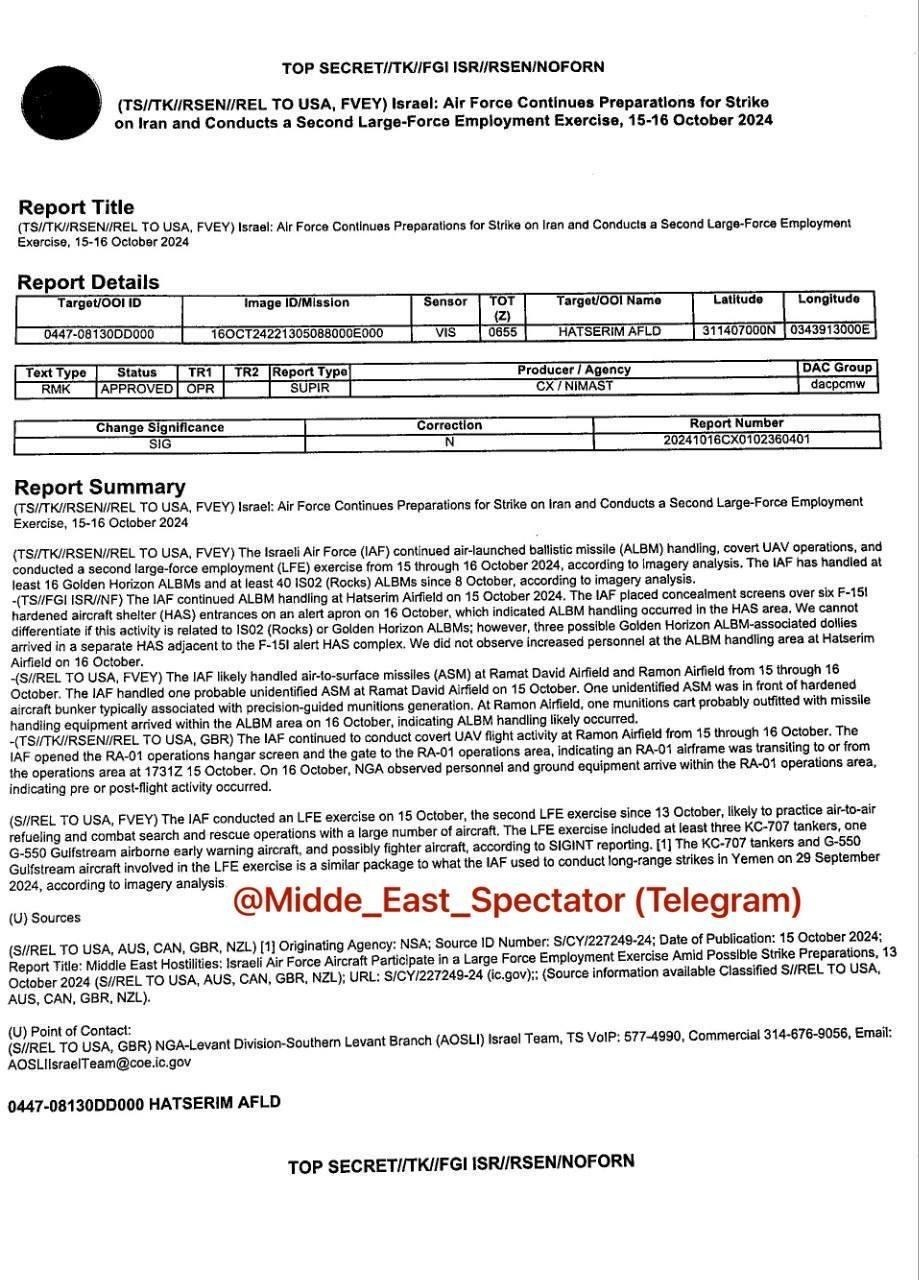
Leaked top secret documents from the Pentagon and the National Security Agency (NSA) outline Israeli preparations for a major attack against Iran, CNN reported on Saturday. The documents were published Friday on a Telegram channel, said to be affiliated with Iran, named “Middle East Spectator” that claims it received the information from a source within a US intelligence agency.
Besides the US, these documents, dated October 15 and 16, were only meant to be viewed by officials in Canada, the UK, Australia, and New Zealand, Washington’s “Five Eyes” allies. CNN cites “three people familiar with the matter,” including one that confirmed the documents’ authenticity. The documents can be viewed here and here.
The documents, including a visual intelligence report from the Pentagon’s National Geospatial-Intelligence Agency, details ongoing activities being carried out in anticipation of the attack in Iran at Israeli Air Force (IAF) bases.
The US has observed, “IAF exercises using air-launched ballistic missiles (ALBMs), air-to-surface ballistic missiles, fighter jets, UAVs, and refueling tankers previously used during Israeli strikes on Houthi sites in Yemen… The IAF has handled at least 16 Golden Horizon ALBMs and 40 IS02 (Rocks) ALBMs since October 8,” reports Times of Israel.
According to CNN, one of the documents reveals that Israel maintains a nuclear weapons arsenal which, for decades, has been an open secret. This is highly controversial, as amendments made to US foreign assistance laws by US Senators Stuart Symington and John Glenn in 1976 make Washington’s huge military aid to Israel illegal because Tel Aviv is not a signatory of the Non-Proliferation Treaty. But successive US presidents since Richard Nixon, including Joe Biden most recently, have agreed with their Israeli counterparts to never acknowledge Israel’s approximately 90–300 nukes.
US officials are telling the media that the leak is “extremely serious.” At the same time, officials emphasize that it will probably not affect Israel’s plans. Without commenting further, the Pentagon as well as the Office of the Director of National Intelligence have not disputed the documents’ authenticity. The US has apologized to Tel Aviv for the leak, an Israeli source told Haaretz.
Washington is expected to be involved with the Iran assault either by providing intelligence support to Israel, or less likely by pursuing direct military action. Earlier this week, the US bombed Houthi targets in Yemen using B-2 long-range stealth bombers, which haven’t seen combat since 2017, in a message to the Islamic Republic.
Israel’s attack is being framed as retaliation against Tehran for Iran’s October 1 barrage of roughly 200 ballistic missiles which targeted Israeli military sites. That missile attack came in response to a litany of Israeli provocations, amidst its genocidal war against the Palestinians, including the assassination of Hamas political chief Ismail Haniyeh while he was visiting the Iranian capital this summer.
Earlier on Saturday, reports surfaced of a drone attack on a home belonging to Prime Minister Benjamin Netanyahu. According to Israel’s Channel 12, an official said this will imply “greater legitimacy for a wider range of targets” concerning the upcoming Iran strike. Netanyahu has fingered Hezbollah for the drone attack, although the group has not claimed responsibility.
Zelensky aide reveals secret clauses of ‘victory plan’
RT, Wed, 16 Oct 2024, https://www.rt.com/russia/605823-ukrainian-plan-secret-clauses/
The classified component details attack plans on Russia and a weaponry wish list, according to Mikhail Podoliak.
The secret component of the “victory plan” unveiled by Vladimir Zelensky on Wednesday includes Kiev’s targets for long-range attacks on Russian soil, Mikhail Podoliak, a top aide to the Ukrainian leader, has revealed.
The parts of the plan that were not disclosed to the public consist of a list of targets, a plan of action, and a detailing of the weapons needed to carry out such attacks against Russia, Podoliak told RBC Ukraine in an interview on Wednesday.
“There, in the appendices, it is precisely said what kind of weapons should be used to destroy logistics very far from the front line… what targets will be hit and how many weapons are needed for this.”
Zelensky revealed the so-called “victory plan” earlier in the day in an address to the country’s parliament. The Ukrainian leader toured Western capitals in recent weeks to show the plan to his backers in private and try to generate support for it.
The public part of the plan largely consists of a number of demands made of Ukraine’s Western supporters. Kiev requested an immediate invitation to join NATO, a lifting of restrictions on the use of Western-supplied long-range weapons for strikes on Russia, as well as the deployment of “a comprehensive non-nuclear strategic deterrence package” on Ukrainian soil.
The plan, particularly its cornerstone NATO accession demand, appears to have elicited a mixed reaction in the West. Washington’s envoy to NATO, Julianne Smith, for instance, said that while the bloc remains committed to Kiev’s “irreversible path of membership,” actual accession was not a “short-term” matter.
Moscow dismissed the plan as a set of “incoherent slogans,” with Foreign Ministry spokeswoman Maria Zakharova condemning it as “bloody foam on the lips of a neo-Nazi killer.”
She also dismissed the NATO aspirations long-touted by Kiev, suggesting the only place the West actually deems fit for Ukraine in its “security architecture” is “in a coffin and Ukrainian citizens in graves.”
China not part of nuclear arms race, says envoy

US, with largest arsenal, called on to stop misrepresenting nation’s policy
By MINLU ZHANG at United Nations and SHAO XINYING in Beijing | CHINA DAILY 2024-10-21 https://www.chinadaily.com.cn/a/202410/21/WS671596c9a310f1265a1c88ef.html
A Chinese arms control official called on the United States on Friday to “stop misrepresenting China’s nuclear policy” and said that China “has not, and will not, engage in a nuclear arms race”.
A representative of the US told the First Committee of the United Nations General Assembly on Friday that Russia is violating the New START Treaty and employing “irresponsible nuclear rhetoric” amid the Ukraine crisis. The representative also claimed that China has not fully disclosed the extent of its nuclear weapons modernization.
Shen Jian, China’s ambassador for disarmament affairs, told the committee that China’s no-first-use policy “requires maintaining a certain level of ambiguity regarding its nuclear arsenal to ensure the survivability of its limited nuclear forces”.
“As long as no country uses nuclear weapons against China, it will not face a nuclear threat from China. This is the most meaningful form of transparency,” Shen said.
He said the US possesses the largest and most advanced nuclear arsenal, adding that it adheres to “the policy of preemptive nuclear strikes, and even tailors nuclear deterrence strategies for other countries”.
“The transparency of the US display of nuclear power is nothing more than a ‘muscle show’ that will not make other countries feel safe,” he said.
“China has consistently maintained its nuclear forces at the minimum level required for national security and has not, and will not, engage in a nuclear arms race,” the Chinese envoy said.
He said China must “appropriately” modernize its nuclear forces to “ensure the safety, reliability and survivability of its minimum nuclear deterrent”, as “China’s external security environment continues to deteriorate”, noting that certain countries are developing global missile defense systems and other weapons that “impact strategic stability”.
He urged the US to “stop misrepresenting China’s nuclear policy”. For 60 years, China has adhered to a no-first-use policy with a high degree of stability, consistency and predictability, he said. Recently, China again formally proposed that nuclear-armed states negotiate a “No First Use Treaty” or issue a joint political statement on the matter as soon as possible.
China has engaged in arms control and nonproliferation dialogues with many countries around the world, including the US, Shen said. As the current coordinator of the P5 mechanism, China is also actively promoting dialogue and cooperation among the five nuclear-weapon states.
The P5 mechanism is a dialogue process among the five permanent members of the UN Security Council: China, France, Russia, the United Kingdom and the US.
Shen said that the US should stop projecting its logic that “power inevitably seeks dominance “onto China.
China not part of nuclear arms race, says envoy
US, with largest arsenal, called on to stop misrepresenting nation’s policy
By MINLU ZHANG at United Nations and SHAO XINYING in Beijing | CHINA DAILY | Updated: 2024-10-21 07:48
A Chinese arms control official called on the United States on Friday to “stop misrepresenting China’s nuclear policy” and said that China “has not, and will not, engage in a nuclear arms race”.
A representative of the US told the First Committee of the United Nations General Assembly on Friday that Russia is violating the New START Treaty and employing “irresponsible nuclear rhetoric” amid the Ukraine crisis. The representative also claimed that China has not fully disclosed the extent of its nuclear weapons modernization.
Shen Jian, China’s ambassador for disarmament affairs, told the committee that China’s no-first-use policy “requires maintaining a certain level of ambiguity regarding its nuclear arsenal to ensure the survivability of its limited nuclear forces”.
“As long as no country uses nuclear weapons against China, it will not face a nuclear threat from China. This is the most meaningful form of transparency,” Shen said.
He said the US possesses the largest and most advanced nuclear arsenal, adding that it adheres to “the policy of preemptive nuclear strikes, and even tailors nuclear deterrence strategies for other countries”.
“The transparency of the US display of nuclear power is nothing more than a ‘muscle show’ that will not make other countries feel safe,” he said.
“China has consistently maintained its nuclear forces at the minimum level required for national security and has not, and will not, engage in a nuclear arms race,” the Chinese envoy said.
He said China must “appropriately” modernize its nuclear forces to “ensure the safety, reliability and survivability of its minimum nuclear deterrent”, as “China’s external security environment continues to deteriorate”, noting that certain countries are developing global missile defense systems and other weapons that “impact strategic stability”.
He urged the US to “stop misrepresenting China’s nuclear policy”. For 60 years, China has adhered to a no-first-use policy with a high degree of stability, consistency and predictability, he said. Recently, China again formally proposed that nuclear-armed states negotiate a “No First Use Treaty” or issue a joint political statement on the matter as soon as possible.
China has engaged in arms control and nonproliferation dialogues with many countries around the world, including the US, Shen said. As the current coordinator of the P5 mechanism, China is also actively promoting dialogue and cooperation among the five nuclear-weapon states.
The P5 mechanism is a dialogue process among the five permanent members of the UN Security Council: China, France, Russia, the United Kingdom and the US.
Shen said that the US should stop projecting its logic that “power inevitably seeks dominance “onto China.
Shen said that over the past 20 years, the US has withdrawn from the Anti-Ballistic Missile Treaty, the Intermediate-Range Nuclear Forces Treaty and the Iran nuclear deal, and these moves undermine the international arms control regime.
According to The New York Times, amid ongoing global conflicts, the US plans to allocate an estimated $1.7 trillion over the next 30 years to modernize its arsenal.
Shen noted that while some countries have criticized China and Russia with regard to their nuclear arsenals, they made “no mention of other nuclear-weapon states upgrading their arsenals”. He called this a “double standard “and emphasized that such actions, which “draw lines based on ideology and stir up bloc confrontation”, will not advance nuclear disarmament.
Wang Zhen, a researcher of international politics at the Shanghai Academy of Social Sciences’ Institute of International Relations, told China Daily that “the US’ misrepresenting of China’s nuclear development serves mainly to justify its upgrading of its nuclear arsenal, and the so-called ‘China nuclear threat’ is used as an excuse to adjust its nuclear strategy”.
He said that the US, despite its huge nuclear arsenal, clings to a first-use nuclear deterrence policy, which “underscores its pursuit of nuclear hegemony”.
Gabor Mate: ‘It’s like we’re watching Auschwitz on TikTok’
October 20, 2024 https://scheerpost.com/2024/10/20/gabor-mate-its-like-were-watching-auschwitz-on-tiktok/
Had there been YouTube and Instagram and TikTok around Auschwitz, this is what we would have seen, people burning alive. And it’s beyond horrendous, it’s beyond comprehension.”
In an online meeting with French activist and film producer Frank Barat on Monday, Canadian physician Gabor Mate explored the psychological complexities of witnessing atrocities in Gaza and Palestine, saying: “It’s like we’re watching Auschwitz on TikTok.”
They delve into the emotional and historical roots of violence and oppression, highlighting the trauma, guilt, and helplessness experienced by observers. Mate stresses the need to acknowledge these emotions and examines the normalisation of violence, while contemplating the future implications for Gaza and global society.
Ukraine must have nukes or NATO – Zelensky

https://www.rt.com/russia/605856-zelensky-nuclear-nato-trump/ 16 Oct 24
The leader has described his conversation with former US President Donald Trump as he promotes his ‘victory plan’ to Western backers.
Ukraine can protect itself either by becoming a nuclear state or a member of NATO, Vladimir Zelensky said on Thursday, claiming that he had offered the same line of reasoning to former US President Donald Trump.
Speaking at a press conference after promoting his ‘victory plan’ for the conflict with Russia to European officials, Zelensky suggested that Ukraine would need nuclear weapons, should it not be granted NATO membership.
“Which of the big nations, the nuclear nations, suffered? Everyone? No, just Ukraine,” he stated, referring to the signatories of the 1994 Budapest Memorandum. The document involved the US, UK, and Russia extending security assurances to Kiev in return for the removal of Soviet nuclear weapons from Ukraine.
“Speaking to Donald Trump, I told him: ‘What is the way out for us?’ Either Ukraine will have nuclear weapons, and they will serve as protection, or we need to be in some kind of an alliance. We don’t know any effective alliances except NATO,” Zelensky added.
Ukraine’s choice is to become a NATO member, Zelensky said, claiming that Trump had found his reasoning justified.
Ukraine has never controlled nuclear weapons, but claims it was formerly among the major atomic powers before agreeing to relinquish them. In February 2022, weeks before the escalation of the Ukraine conflict, Zelensky expressed regret at the decision in a speech at the International Security Conference in Munich, suggesting that his country had “every right” to reverse it.
Zelensky confirmed this week that an immediate invitation for Ukraine to join NATO was on his list of requests to Western donors. The secretary general of the US-led bloc, Mark Rutte, said on Thursday that Ukraine may not even be the next nation to become a member.
Widening the War: The US Sends Troops to Israel
October 20, 2024, Dr Binoy Kampmark, https://theaimn.com/widening-the-war-the-us-sends-troops-to-israel/
The dangers should be plastered on every wall in every office occupied by a military and political advisor. Israel’s attempt to reshape the Middle East, far from giving it enduring security, will merely serve to make it more vulnerable and unstable than ever. In that mix and mess will be its greatest sponsor and guardian, the United States, a giant of almost blind antiquity in all matters concerning the Jewish state.
In a measure that should have garnered bold headlines, the Biden administration has announced the deployment of some 100 US soldiers to Israel who will be responsible for operating the Terminal High Altitude Area Defense (THAAD) system. They are being sent to a conflict that resembles a train travelling at high speed, with no risk of stopping. As Israeli Defence Minister Yoav Gallant promised in the aftermath of Iran’s October 1 missile assault on his country, “Our strike will be powerful, precise, and above all – surprising.” It would be of such a nature that “They will not understand what happened and how it happened.”
In an October 16 meeting between the Secretary of Defense Lloyd J. Austin III and Gallant, the deployment of a mobile THAAD battery was seen “as an operational example of the United States’ ironclad support to the defense of Israel.” Largely meaningless bits of advice were offered to Gallant: that Israel “continue taking steps to address the dire humanitarian situation” and take “all necessary measures to ensure the safety and security” of UN peacekeepers operating in Lebanon’s south.
The charade continued the next day in a conversation between Austin and Gallant discussing the killing of Hamas leader Yahya Sinwar. THAAD was again mentioned as essential for Israel’s “right to defence itself” while representing the “United States’ unwavering, enduring, and ironclad commitment to Israel’s security.” (“Ironclad” would seem to be the word of the moment, neatly accompanying Israel’s own Iron Dome defence system.)
A statement from the Pentagon press secretary, Maj. Gen. Patrick Ryder, was a fatuous effort in minimising the dangers of the deployment. The battery would merely “augment Israel’s integrated air defense system,” affirm the ongoing commitment to Israel’s defence and “defend Americans in Israel, from any further ballistic missile attacks from Iran.”
The very public presence of US troops, working alongside their Israeli counterparts in anticipation of broadening conflict, does not merely suggest Washington’s failure to contain their ally. It entails a promise of ceaseless supply, bolstering and emboldening. Furthermore, it will involve placing US troops in harm’s way, a quixotic invitation if ever there was one.
As things stand, the US is already imperilling its troops by deploying them in a series of bases in Jordan, Syria and Iraq. Iran’s armed affiliates have been making their presence felt, harrying the stationed troops with increasing regularity since the Israel-Hamas war broke out on October 7 last year. A gradual, attritive toll is registering, featuring such attacks as those on the Tower 22 base in northern Jordan in January that left three US soldiers dead.
Writing in August for The Guardian, former US army major Harrison Mann eventually realised an awful truth about the mounting assaults on these sandy outposts of the US imperium: “there was no real plan to protect US troops beyond leaving them in their small, isolated bases while local militants, emboldened and agitated by US support for Israel’s brutal war in Gaza, used them for target practice.” To send more aircraft and warships to the Middle East also served to encourage “reckless escalation towards a wider war,” providing insurance to Israeli Prime Minister Benjamin Netanyahu that he could be protected “from the consequences of his actions.”
Daniel Davis, a military expert at Defense Priorities, is firmly logical on the point of enlisting US personnel in the Israeli cause. “Naturally, if Americans are killed in the execution of their duties, there will be howls from the pro-war hawks in the West ‘demanding’ the president ‘protect our troops’ by firing back on Iran.” It was “exactly the sort of thing that gets nations sucked into war they have no interest in fighting.”
Polling, insofar as that measure counts, suggests that enthusiasm for enrolling US troops in Israel’s defence is far from warm. In results from a survey published by the Chicago Council on Foreign Relations in August, some four in ten polled would favour sending US troops to defend Israel if it was attacked by Iran. Of the sample, 53% of Republicans would favour defending Israel in that context, along with four in 10 independents (42%), and a third of Democrats (34%).
There have also been some mutterings from the Pentagon itself about Israel’s burgeoning military effort, in particular against the Lebanese Iran-backed militia, Hezbollah. In a report from The New York Times, the chairman of the Joint Chiefs of Staff, Gen. Charles Q. Brown Jr., is said to be worried about the widening US presence in the region, a fact that would hamper overall “readiness” of the US in other conflicts. Being worried is just the start of it.
US wants Ukraine to send teenagers into the chopper mill of lost proxy war against Russia.

Walt Zlotow, West Suburban Peace Coalition, Glen Ellyn IL, 18 Oct 24
After 32 months of failure, one might conclude the US is ready to toss in the towel in its proxy war against Russia in Ukraine.
Over $150 billion in war material has done nothing to achieve stalemate, much less victory. Russia is advancing steadily to cut off Ukraine’s ability to remain in the fight both provoked and extended for over 2 years by the Biden administration.
Ukraine’s young men ore fleeing conscription in droves. To keep the conveyor belt of cannon fodder flowing, President Zelensky lowered the draft age from 27 to 25 last April. He was responding to criticism from supreme US war promoter Sen. Lindsay Graham, who visited Zelensky to offer “I would hope that those eligible to serve in the Ukrainian military would join. I can’t believe it’s at 27. You’re in a fight for your life, so you should be serving — not at 25 or 27. We need more people in the line.” At the beginning of this lost war Graham gloated that “Ukraine should fight to the last person”…as long as billions in US weapons keep flowing.
The Biden administration is now suggesting Ukraine should toss teenagers into the war by lowering the draft age to 18 to fill the ranks of near empty brigades. If asked again about Ukraine’s dire situation, Graham would likely amend his earlier comment to state that ‘Ukraine should fight to the last teenager.’
Nuclear Fever: War Mongering on Iran

In Foreign Policy, Matthew Kroenig, generously self-described as a national security strategist, blusters for war. “Indeed, now is an ideal opportunity to destroy Iran’s nuclear program,” he asserts with childish longing.
In a report authored by both Democrats and Republicans for the Council, a warning of chilling absurdity is offered: “The United States needs to maintain a declaratory policy, explicitly enunciated by the president, that it will not tolerate Iran getting a nuclear weapon and will use military force to prevent this development if all other measures fail.”
Iran can never have nuclear weapons, because the United States and Israel say so
October 18, 2024, by: Dr Binoy Kampmark, https://theaimn.com/nuclear-fever-war-mongering-on-iran/
The recent string of exaggerated military successes – or at least as they are understood to be – places Israel in a situation it has been previously used to: prowess in war. Such prowess promises much: redrawing boundaries; overthrowing governments; destroying the capabilities of adversaries and enemies. Nothing, in this equation, contemplates peace, let alone diplomatic resolution. It’s playground pugilism that rarely gets out of the sandpit.
In Washington, a fever has struck regarding Israel’s advances. The outbreak has stirred much enthusiasm in a doctrine that has been shown, time and again, to be wretchedly uncertain and grossly dangerous. With no concrete evidence of imminent harm to US interests, it featured in the highest policy planning circles that oiled an invasion of Iraq in 2003. While the stated objective was the disarming of Saddam Hussein’s regime for having Weapons of Mass Destruction it turned out not to have, the logic was one of pre-emptive strike: we attack the madman in Baghdad before he goes nuclear and loses it.
The establishment wonk on empire and espionage at The Washington Post, David Ignatius, offers a fairly meaningless assessment in terms of claimed Israeli dominance over Iran and its proxies. After a year of conflict, Israel had “gained what military strategists call ‘escalation dominance’.” The implication: a decisive attack on Iran is imminent.
The point here (at this juncture, the mind lost seeks sanctuary in a mental asylum of lunatic reassurances), is that attacking Iran in toto will not result in much by way of retaliatory detriment. Some bruising, surely, but hardly lingering flesh wounds. Israel has, it would seem, been working some magic, spreading its own view that Iran has a gruesome plan in its military vault: eliminating Israel by 2040.
In Foreign Policy, Matthew Kroenig, generously self-described as a national security strategist, blusters for war. “Indeed, now is an ideal opportunity to destroy Iran’s nuclear program,” he asserts with childish longing. The reason for such an attack lies in a presumption. Yet again, the doctrine of pre-emption, one hostile to international law and the UN Charter, plays out its feeble rationale. Evidence, in such cases, is almost always scanty. Kroenig, however, is certain. Iran will secure one bomb’s worth of weapon-grade material within a matter of weeks. The rest is obvious. No evidence is offered, nor does it even matter, given Kroenig’s longstanding zeal in wishing to rid Iran of its nuclear facilities.
The Atlantic Council has also suggested a policy that what is good for the goose of Christian-Jewish freedom is not good for the gander of Persian Shia ambition. It is exactly this full-fledged hypocrisy that the despots of the secular tyranny in North Korea realised in dealing with Washington. Beware the nostrums against nuclear armament.
In a report authored by both Democrats and Republicans for the Council, a warning of chilling absurdity is offered: “The United States needs to maintain a declaratory policy, explicitly enunciated by the president, that it will not tolerate Iran getting a nuclear weapon and will use military force to prevent this development if all other measures fail.”
Instead of resisting belligerent chatter, the authors suggest that the US threaten Iran through announcing “yearly joint exercises with Israel, such as Juniper Oak and seek additional funding in the next budget cycle to speed research and development of next-generation military hardware capable of destroying Iran’s nuclear program
Kroenig shows his usual stuffing. Iran can never have nuclear weapons, because the United States and Israel say so. (The Sunni powers, for their own reasons, agree.) This form of perennial idiocy could apply to all the powers that have nuclear weapons, including Israel itself. At one point, no state should have had that relic of sadism’s folly. Then they came in succession after the United States: the Soviet bomb, the Britannic bomb, the Gallic bomb. Throw in China, India, Pakistan, Israel. Plucky, deranged North Korea, was wise to note the trend, showing lunacy to be eternally divisible.
It is precisely that sort of logic that has drawn such comments as this from the Supreme Leader Ayatollah Ali Khamenei in a May interview: “Iran’s level of deterrence will be different if the existence of Iran is threatened. We have no decision to produce a nuclear bomb, but we will have to change our nuclear doctrine if such threats occur.” This month, almost 40 legislators penned a letter to the Supreme National Security Council calling for a reconsideration of current nuclear doctrine. The greater the fanatic’s desire to remove a perceived threat, the more likely an opponent will give basis to that threat.
For all the faux restraint being officially aired in Washington regarding Israel’s next round of military assaults, there is enormous sympathy, even affection, for the view that wrongs shall be righted, and the mullahs punished. Bedding for a more hostile response to Iran also features in the inane airings of the presidential election. Vice President Kamala Harris, in an interview with 60 minutes, remarked that, “Iran has American blood on its hands, okay?” In making that claim, she suggested that Tehran was somehow Washington’s greatest adversary.
In response to this fatuous remark, Justin Logan of the Cato Institute offers an ice-cold bath of reason: “This is not the Wehrmacht in 1940.” The path to dominating the Middle East hardly involves such tools as propaganda, proxy operations and psychological warfare “much less becoming the greatest threat to the United States.”
The nuclear option is now available to governments that should never have had them. But acquiring the dangerously untenable followed. To assume that brutal, amputation loving theocrats in Tehran should not have them defies the trajectory of a certain moronic consistency. The Persian bomb is probably imminent, and it is incumbent on the murderous fantasists in Israel and the United States to chew over that fact. Unfortunately for the rest of us, the fetish against acquisition risks expanding a conventional conflict through testing the will and means of a power that, while wounded, hardly counts as defeated.
First ex-Royal Navy nuclear submarine to be disposed of enters final dismantling phase.
Navy Lookout 15th Oct 2024 https://www.navylookout.com/first-ex-royal-navy-nuclear-submarine-to-be-disposed-of-enters-final-dismantling-phase/
Work has started on the third and final phase of the project to dismantle ex-HMS Swiftsure. As the demonstrator project for the dismantling programme, she will be the first former RN SSN to be fully disposed of.
The glacial project to safely scrap the growing fleet of decommissioned boats has finally begun to make some progress at Rosyth in the last few years. Each submarine will undergo a three-step process which involves Low Level Radioactive Waste (LLW) being removed first. The second and most demanding stage involves the removal of the Reactor Pressure Vessel that holds the reactor core and is classed as Intermediate Level Radioactive Waste (ILW).
Work has started on the third and final phase of the project to dismantle ex-HMS Swiftsure. As the demonstrator project for the dismantling programme, she will be the first former RN SSN to be fully disposed of.
The glacial project to safely scrap the growing fleet of decommissioned boats has finally begun to make some progress at Rosyth in the last few years. Each submarine will undergo a three-step process which involves Low Level Radioactive Waste (LLW) being removed first. The second and most demanding stage involves the removal of the Reactor Pressure Vessel that holds the reactor core and is classed as Intermediate Level Radioactive Waste (ILW).
Swiftsure’s disposal is a notable achievement as the first Pressurised Water Reactor (PWR) anywhere in the world to be dismantled. Other nations use a much simpler process and cut the entire reactor compartment out of the submarine and transport it structurally complete for burial in land storage facilities. The US has successfully disposed of over 130 nuclear ships and submarines since the 1980s. The Russians have disposed of over 190 Soviet-era boats (with some international assistance) since the 1990s while France has already disposed of 3 boats from their much smaller numbers.
Besides the progress with Swifsure, LLW has been safely removed from ex-HMS Resolution, Revenge and Repulse. As experience has been gained working on successive boats techniques have been refined and more waste has been managed to final disposal at reduced cost. The optimisation of the process allowed 50% greater tonnage of waste to be removed in 75% of the time it took for Swiftsure. So far the work has been completed safely on budget and on time. Work has yet to begin on ex-HMS Dreadnought, Churchill and Renown still afloat in the basin at Rosyth.
While there is positive progress at Rosyth, 14 Dock at Devonport is still not ready to accept the first boat to begin defuelling and dismantling. There are now 15 decommissioned submarines filling up the basins in Plymouth (soon to be 16 when HMS Triumph goes in 2025). Work to get rid of this legacy cannot start soon enough. At least the lessons learned in Rosyth should give the teams at Devonport an advantage although the majority of these boats still have their nuclear fuel on board and will have to undergo a 4-stage process.
Volodomyr’s World: A Delusional ‘Victory Plan’
RUSSIAN and UERASIAN POLITICS, by Gordonhahn, October 17, 2024,
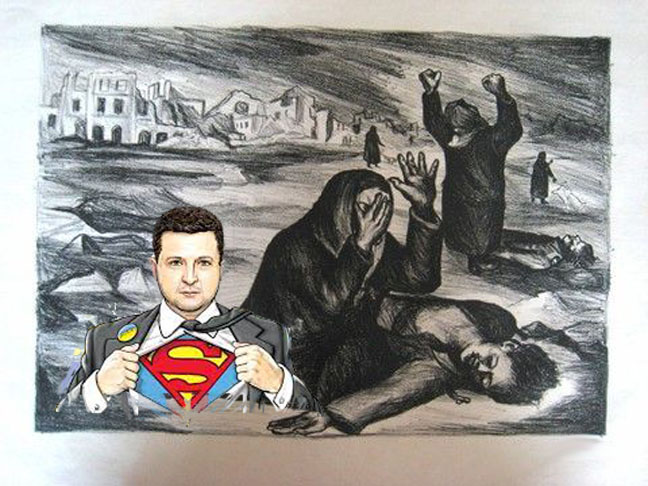
Ukraine’s Volodomyr Zelenskiy lives in a world of productions, PR, simulacra and, therefore, delusion. Hence, the bizarre content of his so-called Victory Plan as presented to Ukraine’s parliament, the Verkhovna Rada, on October 16th. It contained five points, each out of touch with the real world in its own way……
The first point is Ukraine’s immediate admittance to NATO. This is none other than an extension to the level of the absurdity of his policy of trying to bring the alliance into the NATO-Russia Ukrainian War as an open and direct combatant party. Despite repeated escalations, the reluctance or hesitation to grant Ukraine the right to use Western-supplied long-range missiles against targets deep inside Russia demonstrates the limits of Western commitment.
So does the reduction of Western weapons and financial assistance to Ukraine, and repeated claims by Western leaders that their countries weapons reserves are depleted, and the lack of a war time production plan demonstrate that the West will not fight Russia directly any time soon, no less immediately, as granting Ukraine NATO membership would soon lead to.
Moreover, Western leaders have repeatedly rejected this idea. Saying that Ukraine’s membership in NATO was only “in the future” and that even another country might be admitted prior to Ukraine, new NATO Gen Sec Rutte Mark Rutte poured cold water on any “immediate” NATO membership for Ukraine the day after Zelenskiy outlined his Victory Plan to the Rada…..
The second point includes many of the faults of the first in that it calls for the West to build up Ukraine’s defensive and, crucially, offensive military capacity as a deterrent to Russian aggression and, more importantly, to allow Kiev to turn the war back onto Russian territory. This point includes Western approval so that Kiev can use long-range missiles provided by the West to attack targets deep inside Russia…. To this point is attached a secret protocol, the contents of which are known to the leaders of the US, UK, and Italy
Thus, Zelenskiy is proposing that NATO engage in attacks on Russia directly as an alliance or by one of its members, Ukraine. In short he is proposing that NATO with Ukraine as a member wage war against Russia.
To be sure, building up Ukraine’s defense to such a level that it could spearhead a NATO attack on Russia with any hope of success would take at least several years, by which time Ukraine is unlikely to exist. Pushing the war onto Russian territory has just been tried in Kursk to disastrous effect, with Ukrainian troops on the verge of encirclement and destruction.
Assuming an existing Ukraine, such a plan would require the West virtually to transition to a war economy if to have any prospect of success, with all the catastrophic effects for the parties which adopted such a decision and likely for domestic stability that would have as well.
Most dangerous is Zelenskiy’s reiteration of his plea to be allowed to hit deep inside Russia with long-range missiles, which can only be undertaken by using Western targeting and other technical means data and Western military officer-operators. Putin has said this would establish the countries in the armed forces of which these operators serve as combatants in the war and legal targets for Russian retaliation.
The third point is the ‘containment’ of Russia by way of the deployment of non-nuclear, long-range ballistic missiles in Ukraine. This point has the look of a post-war military strategic initiative and also has a secret protocol attached. The prospect of such a move by the West was one of the causes of Putin’s decision to begin the present ‘special military operation.’ Thus, as with the first three points the ‘Victory Plan’ is a road map to escalation and a direct NATO-Russian war; again, a long-standing goal of Zelenskiy since February 2022.
The fourth point is for the West to help rebuild Ukraine’s military-industrial base, as another means of protecting Ukraine and containing Russia. This point also has a secret protocol and likely pertains more to any post-war period, since Russia will have no trouble destroying any new military-industrial plants during the war.
The fifth point is also post-war oriented, stipulating that the forces of what should become Europe’s leading military power – Ukraine – as a surrogate for American power on the continent. It is proposed that Ukrainian forces would replace American forces across Europe. Thus, NATO would become Ukrainian-oriented and Ukraine a veritable European superpower. This point has the scent of many ultranationalist and neofascist visions of a Great Ukraine, master of an eastern European “Intermarium” stretching from the Baltic Sea to the Black Sea. This smacks of a certain megalomania in Zelenskiy’s thinking that supplements his Victory Plan’s delusions. This may be fine for a sitcom or even a film manuscript — a geopolitical feel-good’ story — but not the real world of cut throat self-interest and lessons learned and hardened by the crooked, cruel path of human history.
The absurdities and extravagant demands and expectations in Zelenskiy’s Victory Plan may explain in part – along with the domestic political needs of the impending U.S. presidential election — the delaying tactics being used by Washington to put off strategic decisions such as whether or not to pressure Zelenskiy to negotiate with Russia, to negotiate behind Ukraine’s back, or to change the political configuration (remove Zelenskiy) in Kiev.
The U.S. Biden administration has been doing everything in order to delay until after the elections any decisions or announcements of decisions already made in relation to the future of its support for the NATO-Russia Ukrainian War and the Zelenskiy Maidan regime’s strategies.
First, in September the administration began postponing and still is any decision on whether or not to grant permission to Kiev to use Western-supplied long-range missiles in order to target deep inside Russia…………………………………………………………………………………….
The administration can now put off any strategic decisions, including rejection of Zelenskiy’s absurd ‚Victory Plan‘ until next month—that is until November at the earliest. One can be sure they will not be announced before the results of the U.S. presidential election are known and perhaps significantly later. …………………………………………………………………………………….
In the meantime, Ramstein will approve a new package of assistance, military and financial, to Ukraine to ensure there is no full collapse of the front and/or regime until after Biden’s departure from office.
Nevetheless, difficult strategic decisions await decisionmakers in the West in order to soften the appearance of defeat at Russia’s hands. Otherwise, they confront a perhaps decade-long war supporting a Ukrainian underground, terrorist attacks, and a disappearing indigenous Ukrainian economy and society reduced to a shrinking western Ukraine as Russian forces cross the Dneiper River and grind through the land to Ukraine’s western, southwestern and northwestern borders, to Odessa in the south, Lvov and Uzhgorod in the west, and Lutsk and Kovel in the north.
And all along the threat of direct war with Russia and nuclear escalation will hang over their heads and those of their electorates. To a significant degree, Zelenskiy and his delusions stand in the way of the West’s only reasonable exit path: de-escalation and peace, sans defeat and loss of face for NATO. Indeed, difficult decisions and bad options are the path ahead. https://gordonhahn.com/2024/10/17/volodomyrs-world-a-delusional-victory-plan/—
Israel Is Routinely Shooting Children in the Head in Gaza: US Surgeon & Palestinian Nurse
SCHEERPOST, October 17, 2024
As the official death toll in Gaza passes more than 42,400, the true number may be impossible to know until Israel’s war is over. But medical workers who witnessed the carnage in Gaza’s hospitals are speaking out. We speak with Dr. Feroze Sidhwa about his op-ed in The New York Times that features harrowing stories from dozens of healthcare workers and CT scans of children shot in the head or the left side of the chest. The Times called the corresponding images of the patients too graphic to publish. “I personally wish that Americans could see more of what it looks like when a child is shot in the head, when a child is flayed open by bombs,” says Sidhwa. “I think it would make us think a little bit more about what we do in the world.” We also speak with Palestinian nurse Rajaa Musleh, who worked at Al-Shifa Hospital in Gaza City. “I will never forget the dogs were eating the dead body inside Shifa Hospital at the front of the emergency department. This will be stuck on my mind for my whole life,” says Musleh. “My message for the whole world: We are human beings. We are not numbers. We have the right to receive healthcare inside Gaza.”
Transcript
This is a rush transcript. Copy may not be in its final form.
AMY GOODMAN: As the official death toll in Gaza passes more than 42,400, the true number may be impossible to know until Israel’s war is over. But medical workers who witnessed the carnage in Gaza’s hospitals are speaking out.
We begin today’s show with a surgeon who volunteered at the European Hospital in Khan Younis and wrote a devastating opinion piece in The New York Times headlined “65 Doctors, Nurses and Paramedics: What We Saw in Gaza.”
In a minute, we’ll be joined by Dr. Feroze Sidhwa, who begins the piece writing, quote, “I worked as a trauma surgeon in Gaza from March 25 to April 8. I’ve volunteered in Ukraine and Haiti, and I grew up in Flint, Mich. I’ve seen violence and worked in conflict zones. But of the many things that stood out about working in a hospital in Gaza, one got to me: Nearly every day I was there, I saw a new young child who had been shot in the head or the chest, virtually all of whom went on to die. Thirteen in total.
“At the time, I assumed this had to be the work of a particularly sadistic soldier located nearby. But after returning home, I met an emergency medicine physician who had worked in a different hospital in Gaza two months before me. ‘I couldn’t believe the number of kids I saw shot in the head,’ I told him. To my surprise, he responded: ‘Yeah, me, too. Every single day,’” he said.
The piece quotes dozens of healthcare workers and includes three X-rays or CT scans of pediatric patients who were shot in the head or the left side of the chest. The person who provided the scans was Dr. Mimi Syed, who worked in Khan Younis from August 8th to September 5th and said the children usually arrived at the hospital either dead or in critical condition after suffering a single shot.
On Tuesday, The New York Times opinion section editor issued a statement refuting claims circulating online that the images were altered, saying the editors had, quote, “photographs to corroborate the CT scan images,” but, quote, “because of their graphic nature, we decided these photos — of children with gunshot wounds to the head or neck — were too horrific for publication.”
For more, we’re joined by Dr. Feroze Sidhwa, the trauma and general surgeon who wrote this piece. He also spearheaded an open letter to President Biden and Vice President Harris signed by 99 U.S. medical professionals who served in Gaza, testifying to the unprecedented scale of the healthcare catastrophe and calling for an immediate ceasefire and the end to all U.S. support for Israel.
We are also joined in Chicago by Rajaa Musleh, the country representative in Gaza of MedGlobal, a medical humanitarian aid group. She previously worked as a nurse at Al-Shifa Hospital in Gaza City…………………………………………………………………………………………………………………………………………………………………………………………………………………………………… more https://scheerpost.com/2024/10/17/israel-is-routinely-shooting-children-in-the-head-in-gaza-us-surgeon-palestinian-nurse/
China’s openness about its latest nuclear missile test shows growing confidence vis-à-vis the United States

The rare public ICBM test seems to have been specifically aimed at dissuading Washington from using nuclear weapons in a potential conflict across the Taiwan Strait
Bulletin, By Hui Zhang | October 16, 2024
China’s Ministry of National Defense announced last month that the People’s Liberation Army Rocket Force (PLARF) had successfully launched an intercontinental ballistic missile (ICBM) carrying a simulated warhead into the Pacific Ocean and that the missile accurately fell into the designated area. This was the first time since 1980 that China had test-fired an ICBM into international waters.
But the test launch was part of routine annual training, the ministry added, in line with international law and international practice, and not directed against any country or target.
Just as observers were vigorously speculating about the type of missile used in the test, China Junhao (China’s military media wing) cut short the discussions, releasing pictures of the launch site—a very rare step given that the Chinese army has not made public a photo of the launch of a new ICBM for decades.
China’s Ministry of National Defense announced last month that the People’s Liberation Army Rocket Force (PLARF) had successfully launched an intercontinental ballistic missile (ICBM) carrying a simulated warhead into the Pacific Ocean and that the missile accurately fell into the designated area. This was the first time since 1980 that China had test-fired an ICBM into international waters.
But the test launch was part of routine annual training, the ministry added, in line with international law and international practice, and not directed against any country or target.
Just as observers were vigorously speculating about the type of missile used in the test, China Junhao (China’s military media wing) cut short the discussions, releasing pictures of the launch site—a very rare step given that the Chinese army has not made public a photo of the launch of a new ICBM for decades…………………
With this new launch test, China certainly wants to show a forceful response to suspicion about its nuclear deterrence capabilities in the wake of recent corruption scandals and command instability in its rocket force. The test shows that the rocket force has an operational and credible nuclear force that can help ensure China’s ability to maintain a strong nuclear deterrent—a key element of President Xi Jinping’s long-held military objectives and emphasis on strengthening China’s nuclear forces, an emphasis initiated in 2015.
The rare public ICBM test seems to have been specifically aimed at dissuading Washington from using nuclear weapons in a potential conflict across the Taiwan Strait. The unusual transparency surrounding the test shows how China is becoming increasingly confident vis-à-vis the United States. It also could offer a rare opportunity for engaging in risk reduction talks.
A new missile type. Unlike the United States, which usually tests its ICBMs in international waters, China has usually fired its ICBMs over its homeland, using a lofted or depressed trajectory to keep the missile inside Chinese territory. China’s last full-trajectory flight test of an ICBM (the DF-5) was conducted in May 1980………………………………….
Where the 1980 test was meant to be a trump card for deterring Moscow, today’s DF-31AG test is aimed at deterring Washington………………………………………………………………………………………………………………….
Changing target. China now perceives the United States as being its main threat, and the question of whether China has a credible and reliable deterrent against a US first nuclear strike has become more important in Chinese government circles. At least, this appears to be the strategic calculation that Xi currently pursues………………………………………….
Since 2012 and Xi’s presidential tenure, however, China has been substantially modernizing, expanding, and diversifying its nuclear forces to address perceived threats from the United States. …………………………..
China has expanded its nuclear arsenal at unprecedented speed and scale. It has increased its total warhead count from about 260 in 2016 to about 500 in 2024. Most of the increase has come in the shape of ICBMs capable of reaching the continental United States—from about 65 in 2016 to about 240 in 2024. The US Defense Department projected that China would possess over 1,000 warheads by 2030.
The observable transformation of China’s nuclear posture and the projections for its expansion over the next decade raise the question of whether China has changed its nuclear strategy.[8] Until recently, Chinese officials and government documents reaffirmed China’s commitment to a no-first-use policy and a self-defense nuclear strategy.[9] Under this nuclear policy and strategy, China has always confirmed that it “keeps its nuclear capabilities at the minimum level required for national security.” The major question is how to interpret the “minimum” needs of a nuclear force for a secured second-strike capability.
Searching for a minimum and “effective” deterrent. China’s officials have never declared a specific number of weapons required for its minimum level. Such a level is never static. It depends on several factors, including estimates of survivability during a nuclear attack and a projected enemy’s missile defense systems. …………………….
………….. since 2000, the US missile defense plan has been a major driver of China’s nuclear modernization and buildup…………………………….
At this stage, it is not clear whether Xi Jinping has decided to empower the country’s nuclear force beyond assuring such a reliable second-strike capability. However, while there is little evidence to show that China has changed its long-standing nuclear strategy and no-first-use policy, recent qualitative and quantitative improvements in the nuclear forces demonstrate that Chinese leaders may now pursue a more ambitious nuclear strategy.
A more confident China—and the need to reduce risk. Without a clear understanding of China’s goals and motivations, a new arms race could be triggered with the United States, which would reverse China’s long-standing policy against such engagements. It is now the time for both countries to conduct dialogues to avoid a nuclear arms race and reduce the risk of nuclear conflict. Both sides should undertake risk-reduction and military confidence-building measures to address security concerns, clarify strategic intentions, and increase transparency. They should also engage in “strategic stability” talks.
As a first step, China and the United States could negotiate a bilateral agreement on mutual notification for ballistic missile and space launches, which would significantly reduce the risk of misperception and miscalculation……………………..https://thebulletin.org/2024/10/chinas-openness-about-its-latest-nuclear-missile-test-shows-growing-confidence-vis-a-vis-the-united-states/?utm_source=Newsletter&utm_medium=Email&utm_campaign=ThursdayNewsletter10172024&utm_content=NuclearRisk_ChinaNuclearMissileTest_10162024
.
The Energy Department just made one plutonium pit. Making more is uncertain

Bulletin, By Dylan Spaulding | October 10, 2024
Two conflicting developments arose this month in US efforts to produce new plutonium pits for its nuclear weapons: The National Nuclear Security Administration (NNSA) announced it had produced a warhead-ready pit—the explosive core of a nuclear weapon—for the first time in decades, and a federal court ruled that NNSA will be required to consider the cumulative environmental and health impacts of its pit production program.
Overshadowing these events is a vigorous debate over the necessity for new pits at all. Previous analyses have found that plutonium pits have viable lifespans well beyond the expected service life of the current stockpile, whereas production of pits for new weapons is part of a sweeping US nuclear modernization that raises concern over the future of arms control and any possibility for stockpile reductions at a time of deteriorating international relations.
The two most recent developments illustrate a critical tension in the US nuclear weapons program: New pit production demonstrates a doubling down of US reliance on nuclear weapons for the 21st century. The failure to adhere to environmental policy in doing so highlights the unwitting cost that US citizens may bear for this policy choice—as they have repeatedly in the past………………………………………………………………………………………………………………………………………………………………….
…….Production challenges. Despite any fanfare, demonstrating the ability to certify one plutonium pit doesn’t guarantee smooth sailing toward Los Alamos’s mandated production goals.
The Los Alamos’ Plutonium Facility at Technical Area 55 (PF-4) is conducting the dangerous and difficult work of pit production while also undergoing construction and modernization, with work happening round-the-clock—several other plutonium-related missions are pursued under the same roof. The facility has been criticized for deficiencies in personal safety and safety-related engineering, including recent glovebox fires, floods, worker exposure to plutonium and beryllium, and violations of criticality safety rules. The likelihood of such incidents increases as a result of fast-paced work in close-quarters with a mostly new workforce. In 2013, the PF-4 facility was shut down for three years following a severe criticality safety violation; a repeat could prove fatal, literally and figuratively.
…………………………………………… Regardless of Los Alamos’ success, the congressionally mandated quota of 80 pits per year remains impossible to meet by NNSA’s own admission. This number relies on completion and commissioning of a second production facility at the Savannah River Site in South Carolina, which won’t be operational until the mid-2030s at the earliest.
Just as the future rate of plutonium pit production is uncertain, the missile these pits are intended for—the new Sentinel intercontinental ballistic missile—is also not likely to be completed on schedule. The troubled Sentinel project remains vastly over budget and behind schedule, putting its future at risk and making coordination of the warhead and missile difficult to foresee. Problems or changes in scope for either program will affect the other.
A federal court ruling. Coinciding with NNSA’s announcement of the first diamond-stamped pit, a US District Court ruled that the Energy Department and the NNSA violated the National Environmental Policy Act (NEPA) by failing to properly consider alternatives before proceeding with pit production, requiring the agency to conduct a programmatic environmental impact assessment.
This was a victory for transparency and the community groups—among them, Savannah River Site Watch, Nuclear Watch New Mexico, Tri-Valley Communities Against a Radioactive Environment (CAREs), and the Gullah/Geechee Sea Island Coalition—who, for years, have been asking for such an assessment.
Reestablishing pit production on the scale now contemplated is potentially the biggest investment in the nuclear weapons complex since the Manhattan Project. With it comes hiring and training of thousands of new employees, increased transportation between sites, new construction, safely handing radioactive material, and the generation of new nuclear waste. The cumulative nature of these activities, occurring across many Energy Department’s sites, demands that the impacts of pit production be considered holistically in the form of a programmatic environmental impact assessment.
The environmental impact statements issued by the national laboratories offer perhaps the best public-facing analyses of whether their plans comply with standards for protection of public safety and the environment, including the likelihood of specific scenarios and associated risk of public exposure to hazards such as chemicals or radiation. Still, the NNSA has—until now—resisted issuing such a programmatic statement.
The agency clearly recognizes that pit production involves much of the US nuclear weapons complex. The press release announcing the first diamond-stamped pit thanked workers in Kansas City, Lawrence Livermore National Labs, Los Alamos, and the Pantex plant in Texas. But the NNSA has so far relied on a series of addenda and supplements to a 2008 environmental impact statement for work at Los Alamos and considers Savannah River separately. These assessments largely ignore the cross-complex collaboration required and the subsequent risks, including impacts on the potentially overburdened Waste Isolation Pilot Plant in New Mexico that must absorb the prolific—and complex—waste stream from the pit production process.
The court ruling—which holds that the Energy Department and the NNSA did not follow environmental requirements in pursuing two production sites—will require the NNSA to conduct a new review, bringing renewed public scrutiny and allowing a new opportunity for input from concerned opponents.
An unclear horizon. A programmatic environmental impact statement can take years before it’s finalized. The judge in the case declined to halt construction at NNSA’s second pit production site at Savannah River while the new assessment is being carried out, and the two parties have until October 21st to seek an agreement. It’s likely that the NNSA will argue that stopping pit-production work would be too expensive, too disruptive, and too damaging to national security to consider. It remains unclear what the potential consequences could be if the NNSA decides to challenge the ruling.
While work at Los Alamos is likely to continue amid a programmatic assessment, design choices are still underway at the Savannah River Site, where the NNSA is attempting to retrofit the troubled former mixed oxide (MOX) fuel fabrication plant which never reached productivity despite more than $7 billion of investment. This site is years away from being active and will require extensive transformation that may cost as much as $25 billion. Given this enormous investment, a programmatic environmental impact statement can ensure that this transformation better addresses the actual hazards and better protects communities, workers, and the environment.
Reestablishing pit production in the United States is a massive undertaking. It involves resurrecting a lost capacity that requires complicated engineering, construction, and extremely hazardous work processes that will be carried out by a largely new work force with little to no prior experience. NNSA and its contractors must manage safety risks across multiple sites where new hazardous waste will be generated in communities that don’t want it and where the Energy Department has a poor historic track record of environmental stewardship.
Congress and the Biden administration should eliminate the mandated 80 pit per year requirement while the NNSA conducts a new, thorough environmental assessment that would go a long way toward promoting increased safety and public protection—a challenge that the NNSA and the labs should take seriously. https://thebulletin.org/2024/10/the-energy-department-just-made-one-plutonium-pit-making-more-is-uncertain/
1 This Month



26 September – International Day for the Total Elimination of Nuclear Weapons


PLEASE OPPOSE HR 8255 AND S.3639 – bills would accelerate satellite deployment, with no environmental review or safeguards – https://ncstd5li.quorum.us/campaign/169331/
To see nuclear-related stories in greater depth and intensity – go to https://nuclearinformation.wordpress.com
-
Archives
- September 2026 (269)
- August 2026 (330)
- July 2026 (355)
- June 2026 (287)
- May 2026 (306)
- April 2026 (356)
- March 2026 (251)
- February 2026 (267)
- January 2026 (308)
- December 2025 (358)
- November 2025 (359)
- October 2025 (375)
-
Categories
- 1
- 1 NUCLEAR ISSUES
- business and costs
- climate change
- culture and arts
- ENERGY
- environment
- health
- history
- indigenous issues
- Legal
- marketing of nuclear
- media
- opposition to nuclear
- PERSONAL STORIES
- politics
- politics international
- Religion and ethics
- safety
- secrets,lies and civil liberties
- spinbuster
- technology
- Uranium
- wastes
- weapons and war
- Women
- 2 WORLD
- ACTION
- AFRICA
- Atrocities
- AUSTRALIA
- Christina's notes
- Christina's themes
- culture and arts
- Events
- Fuk 2022
- Fuk 2023
- Fukushima 2017
- Fukushima 2018
- fukushima 2019
- Fukushima 2020
- Fukushima 2021
- general
- global warming
- Humour (God we need it)
- Nuclear
- RARE EARTHS
- Reference
- resources – print
- Resources -audiovicual
- Weekly Newsletter
- World
- World Nuclear
- YouTube
-
RSS
Entries RSS
Comments RSS