Julian Assange Is Finally Free, But Let’s Not Forget the War Crimes He Exposed

Contrary to US government claims, WikiLeaks’s revelations actually saved lives — and drove demand for US accountability.
| By Editor on June 29, 2024 https://truthout.org/articles/julian-assange-is-finally-free-but-lets-not-forget-the-war-crimes-he-exposed/ |
After a 14-year struggle, including five years spent in Belmarsh, a maximum-security prison in London, WikiLeaks publisher Julian Assange is finally free. Under the terms of a plea deal with the U.S. Department of Justice, Assange pled guilty to one count of conspiracy to obtain documents, writings and notes connected with the national defense under the Espionage Act. Assange was facing 175 years in prison for 18 charges in the indictment filed by the Trump administration and pursued by the Biden administration.
The plea agreement requires that before entering his plea, Assange must have done everything he could to either return or destroy “any such unpublished information in his possession, custody, or control, or that of WikiLeaks or any affiliate of WikiLeaks.”
As stipulated in the plea deal, Ramona Manglona, U.S. Chief Judge of the District Court for the Northern Mariana Islands, sentenced Assange to 62 months with credit for the time he served in Belmarsh Prison. The U.S. sentencing guidelines say the range for this “offense” is 41-51 months, so Assange served 11 to 21 months longer than this type of case would typically garner.
Assange was prosecuted because WikiLeaks exposed U.S. war crimes in Iraq, Afghanistan and Guantánamo Bay. In 2010, U.S. Army intelligence analyst Chelsea Manning, who had a “TOP SECRET” U.S. security clearance, furnished WikiLeaks with 700,000 documents and reports, many of which were classified “SECRET.”
These documents included the “Iraq War Logs,” 400,000 field reports documenting 15,000 unreported deaths of Iraqi civilians, as well as systematic rape, torture and murder after U.S. forces transferred detainees to a notorious Iraqi torture squad.
They also contained the “Afghan War Diary,” comprising 90,000 reports that documented more civilian casualties by coalition forces than the U.S. military had reported. And they included the “Guantánamo Files” — 779 secret reports containing evidence that 150 innocent people had been held at Guantánamo Bay for years. The reports explain how the nearly 800 men and boys there had been tortured and abused, which violated the Geneva Conventions and the Convention Against Torture and Other Cruel, Inhuman or Degrading Treatment or Punishment.
Manning also provided WikiLeaks with the infamous 2007 “Collateral Murder” video, which depicts a U.S. Army Apache attack helicopter crew targeting and killing 12 unarmed civilians in Baghdad, including two Reuters journalists, as well as a man who came to rescue the wounded. Two children were injured in the attack. A U.S. Army tank drove over one of the bodies, severing it in two. In a conversation after the attack, one pilot said, “Look at those dead bastards,” and the other responded, “Nice.” The video reveals evidence of three violations of the Geneva Conventions and the U.S. Army Field Manual.
WikiLeaks provided material for news outlets around the world to report on U.S.-led atrocities. Informing the public about the illegality of George W. Bush’s “war on terror” resulted in calls for accountability.
“10 years on, the War Logs remain the only source of information regarding many thousands of violent civilian deaths in Iraq between 2004 and 2009,” John Sloboda, co-founder of Iraq Body Count (IBC), wrote in his submitted testimony for Assange’s extradition hearing in October 2020. IBC is an independent NGO that has done the only comprehensive monitoring of credibly reported casualties in Iraq since Bush’s 2003 invasion.
“WikiLeaks cables have contributed to court findings that US drone strikes are criminal offences and that criminal proceedings should be initiated against senior US officials involved in such strikes,” Clive Stafford Smith, co-founder of Reprieve and attorney for seven Guantánamo detainees, wrote in his submitted testimony.
“They took a hero [Assange] and turned him into a criminal,” Vahid Razavi, founder of Ethics in Tech, told Common Dreams. “Meanwhile, all of the war criminals in the files exposed by WikiLeaks via Chelsea Manning are free and never faced any punishment or even their day in court.”
The Iraq War Logs
The Iraq War Logs contained extensive evidence of U.S. war crimes. Several reports of detainee abuse were supported by medical evidence. Prisoners were blindfolded, shackled and hung by their ankles or wrists. They were subjected to punching, whipping, kicking, electrocution, electric drills, and cutting off fingers or burning with acid. Six reports document the apparent deaths of detainees.
Secret U.S. Army field reports revealed that U.S. authorities refused to investigate hundreds of reports of murder, torture, rape and abuse by Iraqi soldiers and police. The coalition had a formal policy of ignoring these allegations, marking them “no investigation is necessary.”
Although U.S. and U.K. officials maintained that no official records of civilian casualties existed, the logs document 66,081 noncombatant deaths out of 109,000 fatalities from 2004-2009.
The log describes video footage of Iraqi army officers executing a prisoner in Tal Afar. It says, “The footage shows approximately 12 Iraqi army [IA] soldiers. Ten IA soldiers were talking to one another while two soldiers held the detainee. The detainee had his hands bound … The footage shows the IA soldiers moving the detainee into the street, pushing him to the ground, punching him and shooting him.”
The Afghan War Diary
The Afghan War Diary also revealed evidence of U.S. war crimes from 2004-2009. The reports describe how a secret “black” unit composed of special operations forces hunted down accused Taliban leaders for “kill or capture” without trial. Secret commando units — classified groups of Navy and Army special operatives — used a “capture/kill list,” which resulted in the killing of civilians, angering the Afghan people.
Moreover, the CIA expanded paramilitary operations in Afghanistan, carrying out ambushes, ordering airstrikes and conducting night raids. The CIA financed the Afghan spy agency, operating it like a subsidiary.
A 2007 meeting between Afghan district officials and U.S. civil affairs officers was documented in the reports. Afghan officials are quoted as saying, “The people of Afghanistan keep loosing [sic] their trust in the government because of the high amount of corrupted government officials. The general view of the Afghans is that the current government is worst [sic] than the Taliban.”
The logs recorded numerous civilian casualties from airstrikes, shootings on the road, in villages and at checkpoints; many were caught in the cross fire. The victims weren’t suicide bombers or insurgents. Several deaths were not reported to the public.
The Guantánamo Files
The Guantánamo Files say that only 220 of the 780 people held at the prison camp since 2002 were classified as “dangerous international terrorists.” Of the rest of the detainees, 380 were classified as low-level foot soldiers and 150 were considered innocent Afghan or Pakistani civilians or farmers.
Many detainees were held at Guantánamo for years based on paltry evidence or confessions extracted by torture and abuse. Among the detainees, for example, were an 89-year-old Afghan villager with senile dementia and a 14-year-old boy who was the innocent victim of a kidnapping.
The files document a system aimed more at extracting intelligence than detaining dangerous terrorists. One man was transferred to Guantánamo because he was a mullah with special knowledge of the Taliban. A taxi driver was sent to the prison camp because he had general knowledge of certain areas in Afghanistan. An Al Jazeera journalist was held at Guantánamo for six years to be interrogated about the news network.
Nearly 100 detainees were classified with depressive or psychotic disorders. Several joined hunger strikes to protest their indefinite detention or attempted suicide, the files revealed.
No One Was Harmed by WikiLeaks’s Revelations
Although the U.S. government alleged that WikiLeaks’s publication of information had caused “great harm,” they “admitted there was not a single person anywhere that they could produce that was harmed by these publications,” Assange’s attorney Barry Pollack said at a June 26 press conference in Australia.
The plea agreement says, “Some of these raw classified documents were publicly disclosed without removing or redacting all of the personally identifiable information relating to certain individuals who shared sensitive information about their own governments and activities in their countries with the U.S. government in confidence.”
The U.S. government claims that Assange endangered U.S. informants who were named in the published documents. But John Goetz, an investigative reporter who worked for Germany’s Der Spiegel, testified at the 2020 extradition hearing that Assange went to great lengths to ensure that the names of informants in Iraq and Afghanistan were redacted. Goetz said that WikiLeaks underwent a “very rigorous redaction process” and Assange repeatedly reminded his media partners to use encryption. Indeed, Goetz said, Assange tried to stop Der Freitag from publishing material that could result in the release of unredacted information.
Moreover, WikiLeaks’s revelations actually saved lives. After WikiLeaks published evidence of Iraqi torture centers established by the U.S., the Iraqi government refused then-President Barack Obama’s request to grant immunity to U.S. soldiers who committed criminal and civil offenses there. As a result, Obama had to withdraw U.S. troops from Iraq.
Obama took credit for ending U.S. military involvement in Iraq. But he had tried for months to extend it beyond the December 31, 2011, deadline his predecessor negotiated with the Iraqi government. Negotiations broke down when Iraq refused to grant criminal and civil immunity to U.S. troops.
What Assange’s Plea Bargain Means for Free Speech
Before she accepted Assange’s guilty plea, Judge Manglona asked him what he did to violate the law. “Working as a journalist, I encouraged my source to provide information that was said to be classified,” Assange said. “I believed the First Amendment protected that activity, but I accept that it was a violation of the espionage statute.” Assange then added, “The First Amendment was in contradiction with the Espionage Act, but I accept that it would be difficult to win such a case given all these circumstances.”
Even though Assange will go free, his plea deal raises concerns for First Amendment advocates in the U.S.
“The United States has now, for the first time in the more than 100-year history of the Espionage Act, obtained an Espionage Act conviction for basic journalistic acts,” David Greene, head of civil liberties at the Electronic Frontier Foundation, told The New York Times. “These charges should never have been brought.”
Charlie Savage, who has covered the Assange case extensively for years, warned that Assange’s plea sets a “new precedent” that “will send a threatening message to national security journalists, who may be chilled in how aggressively they do their jobs because they will see a greater risk of prosecution.” But, Savage noted, since Assange pled guilty and didn’t mount a constitutional challenge to the Espionage Act, that eliminated the risk that the U.S. Supreme Court would ultimately sanction a narrow interpretation of First Amendment press freedoms.
“WikiLeaks published groundbreaking stories of government corruption and human rights abuses, holding the powerful accountable for their actions,” WikiLeaks said in a statement announcing the plea agreement. “As editor-in-chief, Julian paid severely for these principles, and for the people’s right to know. As he returns to Australia, we thank all who stood by us, fought for us, and remained utterly committed in the fight for his freedom.”
There is no doubt that but for the sustained activism of people around the world and the work of his superb legal team, Julian Assange would still be languishing behind bars for revealing evidence of U.S. war crimes.
The $91 billion wasted on nuclear weapons last year could transform ecosystem restoration (commentary)
by Melissa Parke on 28 June 2024, https://news.mongabay.com/2024/06/the-91-billion-wasted-on-nuclear-weapons-last-year-could-transform-ecosystem-restoration-commentary/
- Nuclear weapons have caused much damage to the environment and are the only devices ever created that have the capacity to destroy all complex life forms on Earth.
- Yet every year, the nine nuclear armed-nations divert vast sums of taxpayers’ money into producing, maintaining and modernizing weapons of mass destruction, approximately $91.4 billion in 2023 alone.
- “One year of nuclear weapons spending could pay for wind power for more than 12 million homes to help combat climate change, plant one million trees a minute, or clean up the Great Pacific Garbage Patch for 187 years in a row,” argues the director of the Nobel Peace Prize-winning organization, ICAN.
- This post is a commentary. The views expressed are those of the author, not necessarily of Mongabay.
The overwhelming sums of money being wasted on nuclear weapons every year should be spent on conserving our planet instead, argues a new report from my organization, the International Campaign to Abolish Nuclear Weapons (ICAN). We should take the money wasted on these bombs and missiles every single year and instead of setting ourselves up to cause more, possibly irrevocable and irreconcilable damage, clean up the legacy of harm already done and invest in restoring ecosystems and halting biodiversity loss.
Nuclear weapons have already caused so much damage to our environment and they are the only devices ever created that have the capacity to destroy all complex life forms on Earth. Nuclear war would mean climate disruption with devastating consequences. The world would fall under a nuclear winter, be subject to a deadly global famine and exacerbated effects of global warming.
But contrary to what some would like you to believe, their devastating impact is not just limited to a hypothetical post-apocalyptic hell, many of them are already being felt today.
Throughout their entire cycle, nuclear weapons have left a devastating environmental legacy around the world: from uranium mining through fuel production at nuclear processing plants to the impacts of the thousands of nuclear tests over the decades. Nuclear weapons facilities have contaminated land and water with radioactive waste that can last many thousands of years. Efforts to clean up the sites have been haphazard or half-hearted, cost billions of dollars over decades – and are still largely unfinished.
For a terrible and terrifying example of how poorly restoration efforts were carried out, we need to talk about the Runit Dome in the Marshall Islands. After exploding 43 nuclear bombs on the Enewetak Atoll between 1948 and 1958, and removing the people who lived there from their homes, the U.S. government did not initiate clean up until the 1970s. This consisted of – as the LA Times put it in a scathing exposé – “burying 33 Olympic-sized swimming pools’ worth of irradiated soil and two Olympic swimming pools’ worth of contaminated debris from islands across the atoll” and dumping it into the crater they created with the detonation, capping it off with a concrete dome.
That dome is showing signs of structural weakness and could crack under the pressure from rising sea levels. The U.S. Government now contends that the crater was built to store the debris, not protect the rest of the nearby environment from its contents.
Of course, it is not only the U.S. that has failed to deal with the environmental effects of its nuclear weapons production, testing, and use. The same can be said for the British in Australia and Kiribati, the French in Algeria and the Pacific, and the USSR/Russia in Kazakhstan.
It is also important to remember that radiation cannot be contained geographically; it respects no country’s border. Fallout patterns are complex and the full consequences of the fallout of years of particular atmospheric nuclear testing is not known- neither on humans, nor on other animals. Recent scientific studies found that the high radiation levels in wild boars in Ukraine are likely not directly due to the Chernobyl disaster but rather the result of nuclear weapons testing before the disaster occurred, resulting in residual radiation in the surrounding areas for decades.
Yet their destructive capacity does not end there. Nuclear weapons also carry a hefty opportunity cost that prevents us from addressing some of the urgent crises facing our planet.
Every year, the nine nuclear armed-states divert vast sums of taxpayers’ money into producing, maintaining and modernizing weapons of mass destruction. ICAN puts out the only report tracking this global nuclear weapons spending on an annual basis, our latest edition found that they wasted $91.4 billion on their arsenals in 2023.
Think of what this money could have gone to instead. One year of nuclear weapons spending could pay for wind power for more than 12 million homes to help combat climate change, plant one million trees a minute, or clean up the Great Pacific Garbage Patch for 187 years in a row.
It could also cover the entire annual funding gap ($79 billion) for global efforts to restore ecosystems and halt biodiversity loss. As biodiversity loss continues at unprecedented speeds under the onslaught of environmental degradation and climate change, new studies reveal that conservation efforts to improve or slow the decline of biodiversity are working in two-thirds of the cases. Imagine what could be achieved if these efforts were fully funded.
Anyone concerned about the climate crisis, about environmental degradation and biodiversity loss, should also support the cause of nuclear disarmament with equal passion, as these are interconnected issues.
Every species will be harmed in a nuclear war. Only one species can stop it.
Melissa Parke is Executive Director of the International Campaign to Abolish Nuclear Weapons (ICAN), winner of the 2017 Nobel Peace Prize. She formerly worked for the United Nations in Gaza, Kosovo, New York and Lebanon and served as Australia’s Minister for International Development.
WAR OR PEACE: Towards a Ukrainian Peace or a Direct NATO-Russian War
Russian and Eurasian Politicsby GORDONHAHN. June 28, 2024
Introduction
The following is an overview of the recent events and present state of the NATO-Russia Ukrainian War. We observe movement towards the end of the conflict in its present configuration and in two new directions simultaneously—a race to the final resolution of the NATO-Russia question. One direction consists of movement towards peace negotiations. The other is toward escalation into a open, direct NATO-Russia war likely to expand beyond the borders of Ukraine and far western regions of Russia. The race to resolution is on and it remains anyone’s guess whether peace or greater war will win the day.
Russia Proposes Diplomacy…Again
On June 14 Russian President Vladimir Putin proposed a roadmap for ending the NATO-Russia Ukrainian War during a speech at Russia’s Ministry of Foreign Affairs………………………………………………………………..
. In particular, he has now offered “simple” conditions for the “beginning of discussions.” They include: the full withdrawal of all Ukrainian troops from Donetsk, Luhansk, Kherson, and Zaporozhia oblasts as they existed as of 1991—that is, Russia would receive all the oblasts’ territories not just those now controlled by Russian troops. Immediately upon agreeing to this condition and a second requiring Kiev’s rejection of any NATO membership (Ukraine’s “neutral, non-bloc, non-nuclear status”), from the Russian side “immediately, literally the same minute there will follow an order to cease fire and begin negotiations” and Moscow “will guarantee the unhindered and safe withdrawal” of Ukrainian units. ……………………………….
To be sure, Putin’s offer was not made under the illusion that it would be taken up within the next few months and was certainly another effort to lay blame for the conflict at Washington’s, Brussels and, less so perhaps, Kiev’s doors. Nevertheless, Putin’s public offering before Russia’s Foreign Ministry personnel is a most authoritative and official statement of a specific proposal from Russia; one that included paths to both a ceasefire and permanent peace, if Washington and/or Kiev choose to take them as Ukraine continues to crumble at the front, in the political sphere, and economically throughout this year.
………………………………………………………Continued refusal to talk with Moscow and any further Russian gains give Putin flexibility in enticing or threatening Washington, Brussels, and/or Kiev to the negotiating table. Refuse talks and lose non-Novorossiyan lands; accept talks and Kiev gets them back.
Also, both subjectively (with Putin’s intent) and objectively (without Putyin’s intent) the proposal undermined Ukrainian President Volodomyr Zelenskiy’s ‘disnamed’ ‘peace summit’ in Switzerland which was nothing other than an exercise in rallying support among supporters for the beleaguered Maidan regime. ………………………..
……………………………………………………my sense that the Ukrainian war will end one way or the other this year unless NATO intervenes directly with troops on the ground.
Moscow’s Military Plans: Reject Talks and War You Shall Have
Moscow’s military plans for the remainder of the year can be summed up as continuity in Ukraine and preparations for war beyond Ukraine against the West. Thus, in Ukraine Russia will continue its more offensive strategy of ‘attrit and advance’ upgraded from, an intensification of what Alexander Mercouris calls ‘aggressive attrition’ (https://gordonhahn.com/2024/02/02/russian-strategic-transformation-in-ukraine-from-aggressive-attrition-to-attrit-and-advance/). . Under attrit and advance, Russian forces still emphasize destruction of Ukraine’s armed forces over the taking and holding of new territory. The attrition of massive, combined air, artillery, missile, and drone war supersedes the advances on the ground by armor and infantry in this strategy. Thus, territorial advance is slow, but personnel losses are fewer.
………………………………………………………………….Despite the calls of some Russian hawks, Putin will never acquiesce to bomb Ukraine, no less Kiev ‘into a parking lot’ or ‘the stone age.’ For Russians, Ukrainians are a fraternal eastern Slavic people, with long-standing ties to Russia. Most Russian families have relatives or friends from or in Ukraine. Kiev is ‘the mother of all Russian cities’, and despite Russia’s possession of precise smart weapons, the risk of destroying Orthodox holy sites and other historical monuments in Kiev is too high. Russia’s overwhelming strength in weapons and manpower, despite Western inputs into Ukraine’s armed forces, could allow Russian attrit and advance to persist for many years—more than will be necessary to force negotiations or seize much of Ukraine.
Boiling the Russian Frog – Escalation by Any Other Name
There has been much talk about the US repeartedly stepping over Russian red lines. The most recent is Washington’s and Brussels’ (NATO’s) grant of permission to Kiev to target the territory of Russia proper (1991 territory) with Western-made weapons. The West itself has drawn many red lines that it said could spark direct war with Russia and, therefore, should not be crossed: offensive weapons, artillery, tanks, aircraft, various types of missiles, cluster munitions, etc., etc. Most recently, Washington crossed two red lines in rapid succession by approving Kiev use of U.S missiles, such as ATACMs to target Russian territory across the border in Kharkov and, presumably Sumy……………………………………………………………………
It then expanded approval of the use of such missiles against any Russian territories from which attacks in Ukraine are being supported (www.politico.com/news/2024/06/20/us-says-ukraine-can-hit-inside-russia-anywhere-00164261). Days later Ukraine fired 5 ATACMs (4 were intercepted) at Sevastopol which hit beach-goers far from any military target, wounding 46 and killing 3, including 2 children. The potential escalation of the overall war resulting from this Ukrainian target was compounded ……………………………………………………………………….
Western NATO leaders seem intent on expanding the war beyond Ukraine’s borders and that will require Western public support and thus a vaccum of public discussion of NATO actions and national interests. Even if the constant escalation is ‘simply’ a game of chicken, upping the ante to see if Putin blinks or if the war can be dragged out past the November U.S. elections, there are many in U.S. intelligence and other departments, who are itching for a war against Russia who may escalate or enable Kiev to do so, intentionally or not, such that one is provoked. Unintentionality comes in, as Kiev has been anxious to force NATO or at least NATO member-states into direct involvement in the war. Ukraine has achieved some success in this, but so far such Western involvement has been limited, intially, to secret injections of Western troops and mercenaries, and then to open advisory roles. The summer and fall of 2024 will be a dangerous window in which a spark can detonate the larger war that such mad men and women are playing with.
To the extent that the West remains intent on continuing the escalation of the NATO-Russia Ukrainian War, Moscow will engage in asymmetrical escalation targeting Western forces outside of Europe and prepare for possible full-scale war with NATO or NATO members in and beyond Ukraine……………………………………………………………….
Towards a Eurasian Security Pact: Getting Ready for Direct War with NATO
With war with NATO now firmly in the cards, a distinct possibility, the Kremlin is intensely set on military and military-political preparations. The rejection of Putin’s next peace proposal was likely the last straw that will set in motion the next phase in Russia’s diplomatic offensive in tendem with China aimed at rallying the Rest against the West. …………….
For years, particularly after the Maidan coup, Putin has been conducting Russian diplomacy with the goal of creating a Great Eurasian and global alternative to the West’s ‘rules-based world order’, seeking to base a new, alternative international system of political, economic, financial, and monetary institutions on different rules written by all the great powers – the ‘Rest’ – rather than just the West…………………………………………………………………………
………………………………………………………. This Greater Eurasia security pact is thus also a mechanism for splitting NATO, particularly Europe from the U.S. This is to be achieved by networking and lobbying all the international organizations in Eurasia that Russia has been building for decades now: ………………………………….
……………………………………………… the train of the Rest’s rejection of the Western worldview has left the station, and, with the danger of escalation in Ukraine, Israel, and elsewhere afoot, it seems more likely that the new Eurasian-South bloc will be an alternative to, possibly a foe of the West’s ‘rules-based world order’ rather than a partner (http://kremlin.ru/events/president/transcripts/74285).
Conclusion
Again, the NATO-Russia Ukrainian War – the current war with militay combat confined largely to Ukrainian and far western Russian territory — will end this year or very early next year. However, a new broader war can take its place, if the peace fails or is never agreed upon. ………………………………………………………
…………….. The hope is that cooler heads will prevail, but the U.S. is in the midst of a deep and potentially explosive political crisis in which bureaucratic politics can become highly cryptic, conspiratorial, chaotic, and irrational, provoking new more dangerous conflict. Similarly, in Kiev a meltdown of the Maidan regime could be imminent and will likely come as a shot in the dark, unexpected by all……………………………………………………..
That Zelenskiy is now broaching peace talks with Putin is a reflection of the opportunity and dangers that are in the offing. https://gordonhahn.com/2024/06/28/war-or-peace-towards-a-ukrainian-peace-or-a-direct-nato-russian-war/
Israeli Defense Minister Vows to Return Lebanon to ‘Stone Age’
President Joe Biden has significant leverage he could use to reign in Prime Minister Benjamin Netanyahu, but has largely refused to do so. While US officials claim their diplomatic efforts are not stalled, an increasing number of countries worry war will break out and are asking their citizens to leave Lebanon.
The White House reversed course and now says a ceasefire in Lebanon cannot be contingent on a deal in Gaza
by Kyle Anzalone June 27, 2024 , https://news.antiwar.com/2024/06/27/israeli-defense-minister-vows-to-return-lebanon-to-stone-age/
Defense Minister Yoav Gallant said Israel was prepared to send Lebanon back to the “Stone Age” with a massive bombing campaign. The White House desperately tries to avert a major war in the Middle East but is not making progress.
After three days of meetings with top officials in Washington, Gallant told reporters that Israel preferred diplomacy but was also willing to utterly destroy Lebanon. “We do not want war, but we are preparing for every scenario. Hezbollah understands very well that we can inflict massive damage in Lebanon if a war is launched,” he said. Israel could bomb “Lebanon back to the Stone Age, but we don’t want to do it.”
Gallant’s remarks come as daily tit-for-tat exchanges between Hezbollah and Israel risk escalating into a major war that could see the US, Iran, and other militias across the Middle East enter the fray. After announcing it had “operational plans” ready for an attack, Israel has started to move some military assets from near Gaza to its northern border.
The White House has invested considerable effort into bringing the conflicts in Lebanon and Gaza to a close. However, rather than applying pressure on Tel Aviv to deescalate, Washington has tried to force Hezbollah and Hamas to accept Israeli demands. Last week, American officials told Beirut that Washington was unable to constrain Tel Aviv, in hopes the warning would convince Hezbollah to back down.
President Joe Biden has significant leverage he could use to reign in Prime Minister Benjamin Netanyahu, but has largely refused to do so. While US officials claim their diplomatic efforts are not stalled, an increasing number of countries worry war will break out and are asking their citizens to leave Lebanon.
Last week, Biden’s envoy Amos Hochstein visited Tel Aviv and Beirut, hoping to work on a deal to end the fighting. At the time, Hochstein pushed for a deal to end the war in Gaza, with the belief that it would lead to deeslcation on Israel’s northern border as well.
Hezbollah maintains that it will end operations against Israel once the onslaught in Gaza comes to a close. Israel says it will not stop attacks on Lebanon until Hezbollah withdraws several miles from the border. Tel Aviv has decimated southern Lebanon, turning much of the area within three miles of the border into a “dead zone.”
Now, the Biden administration’s tactics have flipped, with officials telling reporters that the deal to end the fighting across the Israel-Lebanon border must be separate from any Gaza ceasefire. “The logic of [Hezbollah leader Hassan] Nasrallah…is that it is all tied to Gaza, and until there is a cease-fire in Gaza the firing at Israel won’t stop,” the Wall Street Journal reported, citing a senior Biden official. “We frankly, completely reject this logic.”
Kyle Anzalone is the opinion editor of Antiwar.com, news editor of the Libertarian Institute, and co-host of Conflicts of Interest.
Do thorium reactors prevent nuclear weapons proliferation risks?

Gordon Edwards, 30 June 24.
Many people have been assured, incorrectly, that the use of thorium as a “nuclear fuel” eliminates the danger of nuclear weapons proliferation. That is simply untrue.
The fact is, thorium is NOT a nuclear fuel.
However, a thorium-232 atom can be transmuted into a uranium-233 atom by capturing a stray neutron, and uranium-233 (not generally found in nature) is an excellent nuclear fuel and can also be used to make excellent nuclear weapons. So a “thorium reactor” is really a uranium-233 reactor.
Natural thorium — thorium-232 — is not fissile (i.e. it is not a chain-reacting material). So thorium requires a concentrated fissile material to be added to it, in order to get a chain reaction going and produce the neutrons that are needed to transmute thorium-232 atoms into chain-reacting uranium-233 atoms.
That concentrated fissile material additive does not have to be enriched uranium, it can equally well be plutonium. It has to be either one or the other, there is no other choice. So, in any event, to get a “thorium reactor” going, you need to use either uranium (enriched to a rather high degree) or plutonium (extracted from used nuclear fuel) as an additive. In either case, you will need to use proliferation-sensitive technologies (uranium enrichment or plutonium extraction) before even embarking upon a thorium reactor program.
Thorium use is therefore not a proliferation-resistant plan of action, not even to begin with.
It gets worse, because subsequently, if the “thorium-impregnated-with-fissile material” is irradiated in a reactor, the thorium atoms will FIRST be transmuted into protactinium atoms (protactinium-233) which will then spontaneously “decay” into uranium-233 atoms. In addition, further neutron captures inside the reactor will also produce a small amount of uranium-232, an undesired pollutant that is a strong gamma emitter.
Thorium enthusiasts often say that the powerful gamma rays from U-232 will make the U-233 unusable for nuclear weapons, which is somewhat of an exaggeration to begin with.
However, if the protactinium-233 is chemically separated out from the irradiated “thorium fuel” outside the reactor, those protactinium-233 atoms will spontaneously decay into pure uranium-233 atoms without any admixture of uranium-232 (because there are no neutrons outside the reactor to create uranium-232 as a result of additional neutron captures),
Since pure U-233 can be produced spontaneously outside the reactor, as outlined above by separating out protactinium-233 first, this procedure can completely avoid the problem of U-232 contaminating the U-233 — which, admittedly, would make nuclear weapons construction more difficult (although not impossible).
So the complicating factor of U-232 can be circumvented entirely by a would-be proliferator. There is no doubt that U-233 is an extremely powerful nuclear explosive material and, uncontaminated, can be used to make arsenals of nuclear weapons with relative ease.
Thus thorium reactors do not “eliminate” or even significantly reduce the problem of nuclear weapons proliferation.
The Suspect Body Count: The Death Toll in Gaza is Much Higher Than We’re Being Told
Seymour Hersh Substack Thu, 27 Jun 2024 https://www.sott.net/article/492600-The-Suspect-Body-Count-The-Death-Toll-in-Gaza-is-Much-Higher-Than-We-re-Being-Told
The number of slain Palestinians in Gaza, including those believed to be Hamas cadres, has gone through a series of public recalibrations in recent weeks, as Israel’s reshuffled war cabinet has struggled to minimize international rage at the slaughter there. The reduced body count was little more than a sideshow because the Israeli offensive is continuing in Gaza with no signs of the ceasefire that the Biden administration has been desperately seeking.
Hamas triggered the war last October 7 with a surprise attack — there is so far no official explanation for Israel’s security failure that day — that killed 1,139 Israelis and injured 3,400 more. Some 250 soldiers and civilians were taken hostage.
Comment: There is plenty of evidence to strongly suggest that Israel allowed the incursion on Oct. 7th to happen and that parties unknown carried out most of the killing. This strategy fits with Israel’s decades-long goal of creating the right ‘conditions’ to justify implementing a final solution to their ‘Palestinian problem’.
The expected Israeli response began within days, with the bombing of the Gaza Strip. Some Israeli ground operations inside Gaza began on October 13, and two weeks later the expected full-scale offensive began. The war still rages, with one estimate concluding that by the beginning of April 70,000 tons of explosives had been dropped on targets throughout the 25-mile long Gaza, more tonnage than was dropped by Germany on London and by America and the United Kingdom on Dresden and Hamburg in World War II, combined.
The Gaza Health Ministry, which is under Hamas control, estimated as of Tuesday that the death toll from the Israeli attacks stood at 37,718, with more than 86,000 Gazans wounded. Last month the Israeli government issued a much lower estimate of the casualties, stating that its planes and troops had killed 14,000 “terrorists” — Hamas fighters — and no more than 16,000 civilians.
The Biden administration, on the eve of the first presidential debate, has said nothing about the new numbers, but there are many senior analysts in the international human rights and social science community who consider these numbers to be hokum: a vast underestimate of the damage that has been done to a terrorized civilian population living in makeshift tents and shelters amid disease and malnutrition, with a lack of sanitation, medical care, and medicines as well as increasing desperation and fatigue.
In days of telephone and email exchanges with public health and statistical experts in America I found a general belief that the civilian death toll in Gaza, both from the bombings and their aftermath, had to be significantly higher than reported, but none of the scientists and statisticians — appropriately — was willing to say so in print because of a lack of access to accurate data. I also asked one well-informed American official what he thought the actual civilian death count in Gaza might be and he answered, without pause: “We just don’t know.”
One public health expert acknowledged: “No clear and definite body count is possible, given the continuing Israeli bombing.” He added, caustically, “How many bombs does it take to kill a human being?”
Gaza was an ideal target for an air attack, he said. “No functioning fire department. No fire trucks. No water. No place to escape. No hospitals. No electricity. People living in tents and bodies stacked up all over . . . being eaten by stray dogs.
“What the fuck is wrong with the international medical community?” he asked. “Who are we kidding? Without a ceasefire, a million people are going to starve. This is not a debating point. How can you count something when the system is biting its own tail.” He was referring to the fact that the health system in Gaza — its hospitals and service agencies — “is being targeted and shattered” by Israeli aircraft and those responsible for the counting of the dead and injured “are themselves dead.”
The expert added that the lack of better casualty statistics is not only the fault of Israel. “Hamas has a vested interest in consistently minimizing the number of civilians killed “because of a lack of planning over the years when it was in charge of Gaza.” He was referring to ordinary Gazan citizens’ lack of access to Hamas’s vast underground tunnel complex that could have served as a bomb shelter for all. In Gaza during the Israeli bombing raids, “Is Hamas going to say that Israel” was able to kill all in Gaza “because we started a war without being able to fully protect our people?” His point was that Hamas has every reason, as does Israel, to minimize the extent of innocent civilians who have become collateral damage in the ongoing war.
Comment: Hamas did not start this most recent round of mass slaughter by Israel on Oct 7th. Hamas has never provided Israel with the justification it always sought to massacre Gazans wholesale. On Oct. 7th, Israel provided itself with that justification.
A prominent American public health official who spoke to me acknowledged that he was also concerned about the numbers of unreported dead in Gaza. In a crisis, he said, “we can start with a name-by-name count, but pretty soon the numbers of killed and missing exceed the capacity of any such approach, especially when the counters are being killed and the records [are] at risk.” He said that various postwar academic studies of mortality during the siege of Mosul — when a US-led coalition fought a door-to-door fight in 2017 against the Islamic State in Iraq, killing as many 11,000 civilians — “showed the large loss of life from the use of high-velocity weapons in urban areas. So we should expect similar in Gaza.”
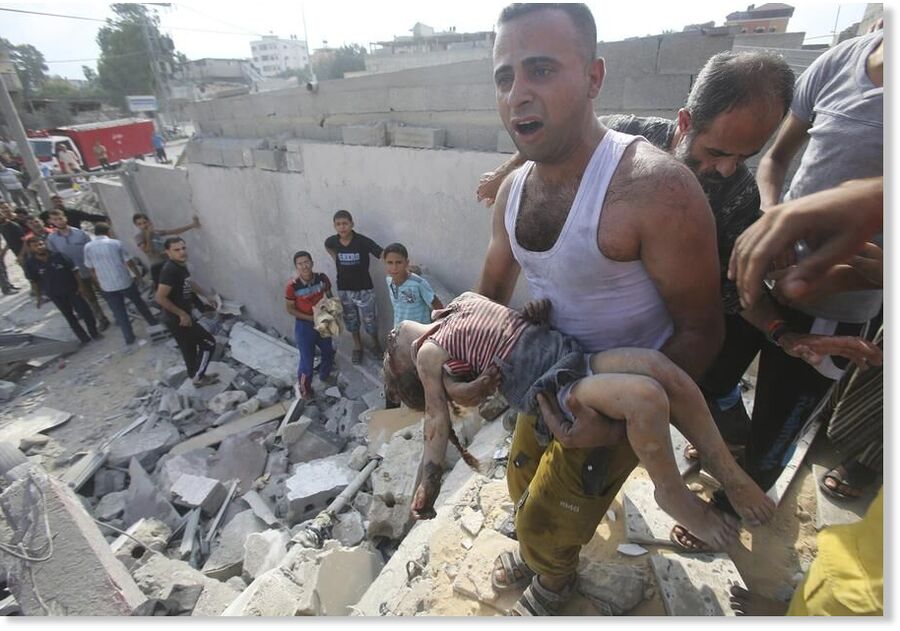
Other data suggest that the published death figures are seriously misleading. Save the Children, an international child protection agency, issued a report this month estimating that as many as 21,000 children in Gaza are “trapped beneath rubble, detained, buried in unmarked graves, or lost from their families.” Other children, the agency said, “have been forcibly disappeared, including an unknown number detained and forcibly transferred out of Gaza” with their whereabouts unknown to the families “amidst reports of ill-treatment and torture.”
Comment: As if the mass slaughter and starvation of Palestinians in Gaza is not enough, it is highly likely that a large number of Palestinian children have been abducted by Zionist state forces, likely to be tortured and killed or otherwise used for the depraved pleasures of some of the people that inhabit that “shitty little country”.
Jeremy Stoner, the charity’s regional director for the Middle East, said: “Gaza has become a graveyard for children, with thousands of others missing, their fates unknown. . . . We desperately need a ceasefire to find and support the missing children who have survived, and to prevent more families from being destroyed.”
Warnings about the inevitability of far more deaths among the ordinary citizens of Gaza have been around since last winter. In December, Devi Sridhar, the chair of global public health at the University of Edinburgh, wrote in the Guardian that the Gaza war was “the deadliest conflict for children in recent years” with as many as 160 children being killed daily. The surviving children do not have “the basic needs that any human, especially babies and children, need to stay healthy and alive. . . . Unless something changes, the world faces the prospect of almost a quarter of Gaza’s 2 million population — close to half a million human beings — dying within a year.
“It’s a crude estimate,” Sridhar wrote, “but one that is data-driven, using the terrifying real numbers of death in previous and comparable conflicts.”
The New York Times and the Washington Post reported Wednesday that a new study endorsed by the United Nations found that as many as half a million Gaza residents are facing imminent starvation because of “a lack of food.” The study also said that more than one half of the surviving residents of Gaza “had to exchange their clothes for money and one-third resorted to picking up trash to sell.”)
One of the most avid early critics of the official statistics published by the Gaza Health Ministry and accepted by most in the American media, has been Ralph Nader. On March 5, he wrote a column in the Capitol Hill Citizen, a monthly newspaper he founded, about what he called “the undercount” of Palestinian casualties in Gaza. He quoted Martin Griffiths, the United Nations under-secretary-general for humanitarian affairs: “Life is draining out of Gaza at terrifying speed.”
In my years as a journalist, I have often found an oddball story that says more with each retelling. Something like that happened in February when Al Jazeera ran an interview with a 64-year-old Gazan undertaker named Saadi Hassan Sulieman Baraka, whose nickname is Abu Jawad. He complained of working almost constantly since the Israeli invasion of Gaza began.
“I’ve buried about ten times more people during this war than I did across my entire 27 years as an undertaker,” he said. “The least was 30 people and the most was 800. Since October 7, I’ve buried more than 17,000 people.” He especially remembered the day he buried the 800 dead. “We collected them in pieces; their bodies so riddled with holes it was like Israeli snipers used them for target practice; Others were crushed like . . . like a boiled potato, and many had huge facial burns.
“We couldn’t really tell one person’s body from the other, but we did our best. We made one big deep grave, probably 10 meters (30 feet) deep and buried them together.”
It could be propaganda — of course, it could. But Abu Jawad made no mention of anyone from the Gaza Health Ministry coming to collect the names of the dead. He made no mention of any government official being involved in the process at all.
Israel’s main goal is the extermination of Palestinians – retired NATO colonel
https://www.rt.com/news/599901-israel-strategy-extermination-palestinians/26 June 24
The IDF’s “brute force” strategy makes no sense from a counterinsurgency perspective, Col. Jacques Baud has claimed.
Israel’s tactics in Gaza go against all the rules of counterinsurgency and can only be explained as a deliberate effort to “eliminate the Palestinians,” former NATO analyst and Swiss intelligence officer Col. Jacques Baud has said.
Speaking to ‘Going Underground’ host Afshin Rattansi on Monday, Baud said that Israel is “not trying to solve the problem [of Hamas violence] on the political side, as we normally should for a counterinsurgency.”
“They are doing it by brute force, meaning that they destroy people and that’s the name of the game,” he added.
In nearly nine months of warfare against Hamas, the Israel Defense Forces (IDF) has killed almost 38,000 people in Gaza, the majority of them women and children, according to the latest figures from the territory’s health ministry.
Israeli Prime Minister Benjamin Netanyahu has repeatedly stated that Israel will continue its campaign until it achieves “total victory” over the Palestinian militants, but has been more evasive when asked about his post-war plans for Gaza. He has said that Israel will maintain “full security control” over Gaza, but has refused to back his more moderate allies’ calls for a multinational government in the enclave.
“The only explanation” for Israel’s refusal to entertain a political solution is not that “the Israelis are stupid and don’t know how to wage war,” Baud continued. “[It’s that] they’re doing this on purpose to eliminate the Palestinians.”
“Palestine will be exclusively Jewish, and that has always been the consistent policy,” he told Rattansi. “They don’t dare do it in one shot. They are doing it in brutal sequences. The ultimate goal is to empty Palestine of Palestinians.”
While Netanyahu has never called for the wholesale depopulation of Gaza, several prominent figures within his government have. Finance Minister Bezalel Smotrich and National Security Minister Itamar Ben Gvir have both called for a tenfold reduction in Gaza’s population, while a policy document compiled by Israel’s Ministry of Intelligence last year recommended that the enclave’s 2.3 million residents be driven into Egypt or sent to the West as refugees.
“They already have projects to rebuild,” Baud said, adding that “the idea is to completely empty Gaza and then to rebuild the kind of colony [Israel] had until 2005,” when Israeli forces withdrew from the territory.
Regardless of who oversees the reconstruction of Gaza, the UN Development Program has estimated that the cost of restoring the enclave to its pre-war condition will cost at least $40 billion and take 16 years.
Watch Baud’s full interview with Rattansi to hear his opinion on the parallels between Israel’s war effort and NATO’s strategy in Ukraine, and his view on the West’s involvement in both crises.
US can’t trace $62 million of military aid sent to Ukraine – watchdog.
Rt.com 28 June 24
The Pentagon does not know whether defense items were “lost or destroyed,” an investigation has found.
The US Defense Department is unable to locate $62 million worth of weapons given to Ukraine, according to a report released on Wednesday.
The conclusions were presented by the Pentagon inspector general after an assessment on whether the DoD is effectively monitoring defense items provided to the Ukrainian Armed Forces.
The watchdog found that as of late November last year, a total $62.2 million in hardware designated for enhanced end-use monitoring (EEUM) was reported as missing. Among them are night vision devices, Javelin anti-tank missiles, and missile launch units.
According to the report, the US Office of Defense Cooperation (ODC) in Ukraine “cannot tell which of these items were lost and which were destroyed.” The Ukrainian army has not yet provided clarification, it adds…………………………………………more https://www.rt.com/news/600100-us-military-aid-millions-missing-ukraine/
Israel’s leaked plan for annexing the West Bank, explained
Israeli Finance Minister Bezalel Smotrich’s plan to annex the West Bank would see over 60% of the territory becoming a part of Israel. But Palestinian experts say it is “already happening.”
BY QASSAM MUADDI Mondoweiss
The issue of Israel’s creeping annexation of the West Bank has resurfaced in recent days after a leaked recording of Israel’s finance minister Bezalel Smotrich revealed a “dramatic” plan to impose permanent Israeli control over the West Bank “without the government being accused of annexing it,” as Smotrich was recorded saying.
Smotrich’s statements, recorded by the Peace Now Israeli NGO and published by CNN and the New York Times, were made during a speech he gave to settler leaders earlier in June. Smotrich was recorded saying that he had elaborated a plan in the past year and a half and exposed it to Israel’s Prime Minister Netanyahu, who was “fully onboard.”
The plan centers around transferring administrative authorities in the West Bank from the Israeli army to the civil authorities of the Israeli government. Smotrich said that he oversaw the creation of an entire administrative body directly linked to the government and that members of this body were already embedded in the Israeli army’s Civil Administration.
In 1967, Israel began administering the West Bank and Gaza under a military administrative body, the Military Government, and in 1981, the Civil Administration was established in its place. Following Netanyahu’s formation of the most right-wing government in Israel’s history in 2022, Smotrich was put in charge of the Civil Administration. Since October 7, Smotrich’s hardline policies pushing for settlement expansion have reached new heights, with the recently leaked annexation plan raising fears about the intentions of the self-described fascist toward the Palestinians living in the West Bank.
According to Smotrich, the administrative changes he wishes to implement represent a “dramatic change” equivalent to “changing the DNA of the system.”
Smotrich said that large budgets were allocated to infrastructure projects for settlement expansion and for “security measures” for the settlements, adding that the aim of such a plan is “to avoid the West Bank from becoming part of a Palestinian state.”
Smotrich plan ‘already happening’………………………………..more https://mondoweiss.net/2024/06/israels-leaked-plan-for-annexing-the-west-bank-explained/
Israeli Officials Hiding Data About Forced Starvation of Gaza Prisoners: Report
Former detainees say the Israel Prison Service “has significantly reduced their food rations, to the point of starvation, causing them to shed dozens of kilograms.”
BRETT WILKINS, Jun 27, 2024, Common Dreams,
Israeli prison officials are concealing information about reductions in food rations for Palestinians held in the Gaza Strip, where detainees—who have also reported horrific abuse including alleged rape and deadly torture—have been deliberately driven “to the point of starvation,” according to a report published Thursday.
Security sources told the Israeli newspaper Haaretz that the Israel Prison Service (IPS) is intentionally cutting Palestinian prisoners’ caloric intake, a move confirmed by Israeli National Security Minister Itamar Ben-Gvir, who called the policy a “deterrent.”
“The Palestinian detainees will receive the minimum rights and the minimum food, and I will ensure that this policy is implemented,” Ben-Gvir, who leads the far-right Otzma Yehudit (Jewish Power) party, said Thursday in response to a query from Israel’s Supreme Court…………………………………………………………………………………………….. https://www.commondreams.org/news/israel-starving-prisoners
Test site activity sparks fears of more nuclear blasts
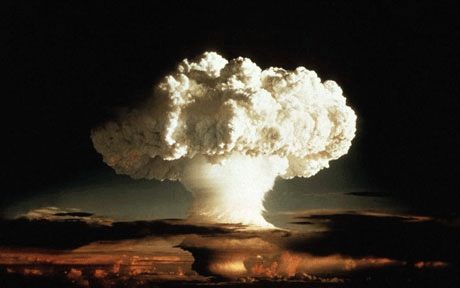
Satellite imagery shows that Russia, China and the US are building roads
and other infrastructure in historic nuclear test sites, raising fears that
they could soon not be historic any more, and back in use.
A powerful piece of multimedia storytelling in the NYT offers a reminder of what that could
mean: raised levels of radioactive strontium-90 in teeth and bones,
off-the-charts levels of cancer, diabetes, stillbirth and miscarriage in
“downwind” populations near nuclear test sites, and a resumption of the
mad race to build ever bigger bombs that was supposed to end with the cold
war.
The US poisoned the lives and destroyed the homelands of the Marshall
islanders. The UK did similar in the Australian outback, and France in
French Polynesia. Some of those affected have received compensation. None
has ever had an official apology.
Tortoise 24th June 2024
https://www.tortoisemedia.com/2024/06/24/test-site-activity-sparks-fears-of-more-nuclear-blasts/
How Israel Became a Nuclear Power
The United States actively works to shield the Israeli nuclear weapons program from criticism as well as public knowledge.
In effect, unwillingness to commit to nuclear nonproliferation has led to nuclear proliferation.
https://antinuclear.net/2024/06/24/keep-up-to-date-on-australias-media-quagmire-on-nuclear-power/
Israel’s nuclear weapons program has been an open secret for over fifty years. Declassified documents and the wider availability of satellite imagery have largely been responsible for revealing the extent of the nation’s nuclear program. So too has the courage of whistleblowers such as Mordechai Vanunu, an Israeli nuclear technician who exposed his country’s covert program and was subsequently drugged and kidnapped by Mossad agents in Italy before being secretly tried and sentenced to eighteen years in prison in 1986.
Yet the United States and other nuclear-armed states, as well as a broad range of bodies responsible for monitoring arms proliferation, continue to maintain a policy of not publicly acknowledging the existence of Israel’s nuclear weapons.
These norms of institutional secrecy are surprisingly powerful and far-reaching. US government employees have been fired for referring to Israeli nuclear weapons. Even Wikipedia’s page on the subject uses circuitous language to refer to their existence. (The page is locked to edits from almost all contributors.) This approach is effective: a 2021 poll suggested that more Americans believed that Iran has nuclear weapons than that Israel does, when the reality is the opposite.
This wall of silence has proven remarkably porous. During the early days of Israel’s war on Gaza, government officials openly entertained the possibility of using nuclear weapons on the battlefield, and figures within the US military think tank circuit have wondered whether Israel’s secrecy is doing it more harm than good.
Conventional wisdom about the strategic importance of possessing nuclear weapons is that there’s no reason to have one if you don’t tell anyone. Intimidation is as much a part of deterrence as use. If no one suspects you can respond to an attack with the overwhelming force of a nuclear counterattack, what’s to make them think twice?
But Hezbollah’s continued assault on northern Israel, which has thus far led to the evacuation of over ninety thousand people, gives lie to the notion that possession of nuclear weapons offers complete protection. In a recent speech, Hassan Nasrallah, Hezbollah’s secretary general, made it clear that if Israel were to cross what it considers to be red lines, there would be no target within the country safe from a retaliatory response. It is therefore not clear that Israel’s nuclear weapons are on their own preventing it from being attacked in a way that threatens its existence. Israel’s relationship with the United States has, however, afforded it a range of impressive offensive and defensive nonnuclear capabilities, backed up by the even larger looming threat of US military involvement, which it is actively using.
Were the US to enforce its own policies consistently, Israel’s status as a state in possession of nuclear weapons would directly threaten its access to aid. The Glenn Amendment to the US Arms Export Control Act explicitly prohibits arms assistance to and mandates sanctions on countries that have, as Israel did in 1979, tested a nuclear weapon after 1977. But the fact that its nuclear weapons program continues to command this kind of bizarre deference illuminates the forces driving nuclear proliferation around the world.
The Forces Behind Proliferation
Scrupulous nonacknowledgment of Israeli nuclear weapons in the present day is part of the United States’ general position of aiding Israeli military endeavors, regardless of the financial or strategic cost. But the reason Israel has nuclear weapons in the first place has less to do with its relationship with the United States and more to do with the geopolitical forces that have driven proliferation since America first dropped the bomb on Japan.
The program that produced Israel’s nuclear weapons is as old as the state itself. As Avner Cohen details in Israel and the Bomb, a nuclear program was discussed by Israel’s leaders practically from the establishment of the Israeli state in 1948. David Ben-Gurion, the country’s first prime minister, took an intense personal interest in nuclear technologies in particular and science and technology as foundations of modern state power in general.Hezbollah’s continued assault on northern Israel gives lie to the notion that possession of nuclear weapons offers complete protection.
Already in 1949, Israel was conducting exploratory research for potential uranium deposits in the Negev, a desert region in the country’s south. When these proved inadequate, it developed techniques for producing usable nuclear material from the relatively poor resources at its disposal, before turning to the United States as the potential source of the raw materials necessary to jump-start a nuclear program.
But in the immediate postwar years, the United States was unwilling to provide the necessary material without guarantees from Israel that the country’s leaders saw as undesirably inhibiting. Israel instead turned to other small countries with nuclear programs at different stages of development: France and Norway, two of only three European countries in the early 1950s operating nuclear reactors.
Israel and France shared a set of geopolitical interests. Both opposed the government of Egyptian president Gamal Abdel Nasser. The French, motivated by neocolonial idealism, took issue with Nasser for nationalizing the Suez Canal, and Israel of course felt threatened by Nasser’s Arab nationalism.
Skepticism about the possibility that the US nuclear umbrella could actually offer security guarantees also motivated nations like France to advance a Gaullist policy of strategic autonomy. This meant encouraging nuclear proliferation where doing so would secure the broader geopolitical interests of declining powers.
Nonproliferation Amid Great-Power Rivalry
In the present, the United States actively works to shield the Israeli nuclear weapons program from criticism as well as public knowledge. As with France’s hostility to a Nasser-led anti-Western order, the Israeli-US alliance is strongly motivated by fear of Iran, or any other anti-American state, developing its own nuclear program. Yet Israel’s nuclear weapons, along with the substantial, long-term support among a certain segment of the US political class for war with Iran, are two very powerful factors driving Iran to develop its own nuclear weapon.
At present, Iran does not have nuclear weapons, though experts believe that it currently maintains the capability to quickly develop them. President Barack Obama’s 2015 Iran nuclear deal limited Iran’s ability to develop a nuclear weapon and imposed a regime of inspections and oversight which provided assurance to other countries that it was not developing nuclear weapons. But Israel opposed the deal on the grounds that it did not go far enough to preclude the possibility that Iran might one day develop a nuclear weapon — a similar kind of all-or-nothing approach to the one that informed the Donald Trump administration’s decision to exit the agreement in 2018.
As Israel’s war on Gaza continues and expands outward into the broader region, it seems it may only be a matter of time before Iran finally does develop a nuclear weapon. After its recent large-scale rocket attacks against Israel, Iran announced that it might reverse its current voluntary commitment to not developing nuclear weapons should Israel retaliate by hitting its nuclear facilities. It goes without saying that this would make the ongoing conflict between Israel and Iran much more dangerous, giving even low-level incidents the potential to escalate to dramatic and destructive new heights.
The United States actively works to shield the Israeli nuclear weapons program from criticism as well as public knowledge.
In effect, unwillingness to commit to nuclear nonproliferation has led to nuclear proliferation. This explains why Saudi Arabia has in recent years betrayed nuclear ambitions. Crown Prince Mohammed bin Salman has stated in US press outlets that Saudi Arabia would develop a nuclear weapon if Iran did so. Yet rather than treating this open disregard for stated US policy as a serious limit on US-Saudi relations, the United States has been pushing for a so-called “normalization” deal between Saudi Arabia and Israel — including a stipulation of a “credible path to a Palestinian state.” Saudi Arabia, in turn, wants the United States to provide it with nuclear technology — ostensibly, of course, for a power program.
The dilemma for America is that whatever interest it does have in nuclear nonproliferation must be balanced against its broader commitment to global hegemony. The latter would be undermined if China, which it now sees as its key competitor, stepped in to provide technical support to fledgling nuclear programs, as it has done with Saudi Arabia. Last year, China sent one of its engineering companies to conduct surveys of the Gulf monarchy’s uranium deposits, although it seems unlikely that these deposits could support a nuclear program of any size.
Nuclear weapons experts have called for safeguards that could prevent the development of a Saudi nuclear weapons program. Yet unlike in the case of Israel’s search for nuclear material, the threat of safeguards doesn’t seem to be a deterrent to the kingdom’s openly stated nuclear ambitions. It sometimes seems that U.S. nuclear weapons policy in 2024 is based on a tacit acceptance of its powerlessness over global nuclear weapons politics. Rather than trying to prevent proliferation, America has been forced to settle for the role of being the primary nuclear patron where it can.
Existential Threats
Israel’s possession of nuclear weapons has been largely irrelevant to the ongoing war in Gaza. The country’s overwhelming conventional capabilities have granted it superiority on the battlefield, at the cost of the lives of tens of thousands of civilians. But possession of nuclear weapons reinforces the worldview that underlies Israel’s political calculations (and to some extent, those of every nuclear-armed country): that its existence is constantly threatened, and it is only rational for it to possess the means of responding to such threats with unlimited force.
It is the states with the most nuclear weapons, Russia and the United States, that most assiduously cling to the logic that weapons of mass destruction are the only safeguard against existential threats. Both have consistently bypassed opportunities to deescalate the very real, immediate risks to human safety and civilization that the continued existence of nuclear weapons poses. In doing so, they’ve set a powerful precedent for every other country in the world to uphold nuclear weapons as the only real guarantor of security.
Without a real commitment to reducing the role of nuclear weapons in global politics by the states that can certainly afford it, this de facto policy encourages nuclear proliferation. Israel’s well-defended status as a nuclear power that need not even announce itself is not an exception, but an example to other states thinking of going nuclear.
Emma Claire Foley is a writer and filmmaker based in New York. Her writing and commentary has appeared in Newsweek, NBC, the Guardian, and elsewhere.
Unable to back down, Israel and Hezbollah move closer to all-out war
BBC, 22 June 24, By Lucy Williamson, Reporting from the Israel-Lebanon border
Full-scale war between Israel and Hezbollah would be “a catastrophe”, the UN Secretary-General says. But to David Kamari, who lives under near-daily fire on the Israeli side of the border, it would be a solution.
Last month, a Hezbollah rocket fired from Lebanon landed in his front garden in the border town of Kiryat Shmona, cracking his house in several places and filling it with rubble.
He points out the gaping holes where shrapnel sliced through the walls, missing him by inches. And then to the hills above us, where Hezbollah-controlled territory begins.
“Every day, every night: bombs. [It’s a] problem,” he said. “And I was born here. If you live here one night, you go crazy.”
David is still living in his rubble-filled house, pieces of shrapnel entangled with the remains of his television set. Outside is the blackened relic of his car, burned by the fire that swept through his front yard after the rocket hit.
Most of the population of Kiryat Shmona was evacuated after the 7 October Hamas attacks, as Hezbollah rockets began raining down in support of their Palestinian ally.
David is one of the few who stayed. “I’ve lived here 71 years,” he said. “I won’t go. I was in the army, I’m not afraid.”
His solution? “War with Hezbollah; kill Hezbollah,” he says.
Israel has been striking back hard against Hezbollah, killing senior commanders and hitting targets further inside Lebanon.
Hezbollah has sent larger volleys of drones and missiles across the border this month, and threats on both sides have increased. Earlier this week, the group published drone footage of military installations and civilian infrastructure in the Israeli city of Haifa.
Tough talk has long been part of a mutual strategy of deterrence, with both sides seen as wary of all-out war.
But as the tit-for-tat conflict grinds on, and more than 60,000 Israelis remain evacuated from their homes in the north, there are signs that both Israel’s leaders and its citizens are prepared to support military options to push Hezbollah back from the border by force……………………………………………………………………………………..
As difficult as this border conflict is for people on both sides, a full-scale war would lift the crisis onto a different scale.
Some residents of Beirut are keeping suitcases packed and passports ready, in case of all-out conflict, and the Hezbollah leader, Hassan Nasrallah, said this week that nowhere in Israel would be spared.
Hezbollah is a well-armed, well-trained army, backed by Iran; Israel, a sophisticated military power with the US as an ally.
Full-scale war is likely to be devastating for both sides.
The UN Secretary-General, Antonio Guterres, said it would be a “catastrophe that goes […] beyond imagination”.
The problem for Israel is how to stop the rockets and get its people back to the abandoned northern areas of the country.
The problem for Hezbollah is how to stop the rockets when its ally, Hamas, is being pounded by Israeli forces in Gaza.
The longer that situation grinds on, the more the risks of a miscalculation increase, and the more Israel’s government is under pressure to resolve the situation.
The Hamas attacks on 7 October changed security calculations in Israel. Many of those with homes near the border – and some of those in positions of power – say the kind of agreement made with Hezbollah in the past is no longer enough.
Tom Perry lives in kibbutz Malkiya, right up against the Lebanese border fence. He was out drinking with friends when a Hezbollah rocket slammed through the front of his house earlier this month.
“I think the Secretary-General’s warning is right – [war] will be a catastrophe to the area,” he said.
“But unfortunately it looks like we have no other option. No agreement lasts forever, because they want death for us. We are doomed to wars forever, unless Israel can eliminate Hezbollah.”
Israel’s leaders lost all credibility after the 7 October attacks, he says, and don’t have a strategy to deliver peace.
“They need to quit – all of them. The biggest failure of our army and our country was 7 October, and they were our leaders. We don’t need these leaders.”
Demands for political change are likely to increase when Israel’s conflicts end.
Many believe Israel’s prime minister is playing for time: caught between growing demands for a ceasefire in Gaza, and growing support for a war in the north. https://www.bbc.com/news/articles/c4nn145p20qo
Ukraine hit Russia’s space communications and early warning center
COMMENT. This is really serious. The US is really trying to start a war with Russia. Russia will definitely respond to these attacks. And the vast majority of Americans will know nothing about the US provocation because of our censorship. So, they will be outraged at the Russian attacks and support US counterattacks. They’ve hit a few other early warning facilities in Russia in the last few weeks that Scott Ritter has talked about, and that Putin has given very grave and serious warnings about because it blinds Russia to knowing if they are about to be attacked by intercontinental ballistic missiles, making their loss an existential threat for Russia.
After the strikes in Sevastopol and the loss of Russian civilians in Crimea and Dagestan, Ukraine also hit the valuable NIP-16 space monitoring and communication center near the city of Yevpatoria on the Black Sea coast.
This is a Soviet facility that was placed under the command of the Russian Aerospace Defense Forces for Nuclear Early Warning and Command Operations after Russia’s unification with Crimea.
As can be seen, Kiev is now systematically hitting Russian targets of strategic importance. Moscow can no longer afford not to take action.
The NIP-16 installation includes two sites located 10 km apart: the receiving station at site 1, near the village of Vitino, and a transmitting station at site 2, near the village of Uyutnoe.………………………………………………………. https://seemorerocks.substack.com/p/ukraine-hit-russias-space-communications?utm_source=substack&utm_medium=email#media-2d576da4-cd74-4647-81eb-57e26fc5d6a8
1 This Month

of the week – Shut Down Drone Warfare!


Tell the Ukrainian Government to Drop Prosecution of Peace Activist Yurii Sheliazhenko

Petition to revoke the licensing of the Near Surface Nuclear Disposal Facility (NSDF) at Chalk River. https://www.ourcommons.ca/petitions/en/Petition/Details?Petition=e-7247
To see nuclear-related stories in greater depth and intensity – go to https://nuclearinformation.wordpress.com
-
Archives
- April 2026 (114)
- March 2026 (251)
- February 2026 (268)
- January 2026 (308)
- December 2025 (358)
- November 2025 (359)
- October 2025 (376)
- September 2025 (257)
- August 2025 (319)
- July 2025 (230)
- June 2025 (348)
- May 2025 (261)
-
Categories
- 1
- 1 NUCLEAR ISSUES
- business and costs
- climate change
- culture and arts
- ENERGY
- environment
- health
- history
- indigenous issues
- Legal
- marketing of nuclear
- media
- opposition to nuclear
- PERSONAL STORIES
- politics
- politics international
- Religion and ethics
- safety
- secrets,lies and civil liberties
- spinbuster
- technology
- Uranium
- wastes
- weapons and war
- Women
- 2 WORLD
- ACTION
- AFRICA
- Atrocities
- AUSTRALIA
- Christina's notes
- Christina's themes
- culture and arts
- Events
- Fuk 2022
- Fuk 2023
- Fukushima 2017
- Fukushima 2018
- fukushima 2019
- Fukushima 2020
- Fukushima 2021
- general
- global warming
- Humour (God we need it)
- Nuclear
- RARE EARTHS
- Reference
- resources – print
- Resources -audiovicual
- Weekly Newsletter
- World
- World Nuclear
- YouTube
-
RSS
Entries RSS
Comments RSS
 nuclear-news