Israel’s War on Iran: The Overkill No One Calls War
| urbanwronski on February 3, 2026, https://urbanwronski.com/2026/02/03/israels-war-on-iran-the-overkill-no-one-calls-war/ |
Tehran, June 13, 2025, 4:17 a.m. The first explosions light up the sky over Natanz. Israeli F-35s, invisible to radar, drop JDAMs on Iran’s largest uranium enrichment plant. Within minutes, no fewer than five car bombs detonate across Tehran, next to government buildings and the homes of nuclear scientists. The IDF, ever the courteous occupier, issues a warning to Iranian civilians: evacuate the areas around weapons factories and military bases in Shiraz. Or else.
By dawn, Israel has struck over 100 targets. Not just nuclear sites, but missile depots, air defences, and the homes of Iran’s top military brass. General Hossein Salami, commander of the Revolutionary Guards, is dead. So is Chief of Staff Mohammad Bagheri. So are nuclear scientists Fereydoon Abbasi and Mohammad Mehdi Tehranchi.
The Mossad, meanwhile, has spent years smuggling precision weapons into Iran, setting up covert drone bases near Tehran, and recruiting Iranian dissidents to sabotage air defences from within. This is not a flare-up. This is not a crisis. This is war, waged by Israel, enabled by the US, and dressed up as something else entirely.
The US Joins the Party On June 22, the Americans arrive. Twelve B-2 stealth bombers, escorted by 125 aircraft, drop 30,000 pound “bunker buster” bombs on Fordow, Natanz, and Isfahan. The GBU-57s, each capable of burrowing 200 feet underground before detonating, are the only weapons on Earth that can destroy Iran’s fortified nuclear sites. Trump calls it “Operation Midnight Hammer.” The Pentagon calls it “degrading Iran’s nuclear capabilities.” The rest of the world calls it what it is: the US and Israel bombing a country that, by all independent accounts, is not building a nuclear weapon. Nor intends to.
The Body Count By June 28, the numbers are in. Iranian health officials report 1,190 dead, including 435 military personnel and 436 civilians. Another 4,000 are wounded. Israel loses 28. The US? Zero. Iran fires back with missiles at Tel Aviv, drones at Haifa, a barrage at a US base in Qatar, but the Iron Dome and Patriot batteries swat most of them away. The Iranian air force, such as it is, never gets off the ground. Its fleet of MiG-29s and F-14s, some half a century old, are no match for Israel’s F-35s and the US’s B-2s. Iran has no air force to speak of. It has missiles, proxies, and little else.
The Mossad’s Shadow War This is not just a war of bombs. It’s a war of knives in the dark. The Mossad doesn’t just strike from the air, it strikes from within. In the months leading up to June 2025, Mossad operatives and recruited Iranian dissidents disable air defences, plant explosives, and assassinate scientists. They infiltrate government databases, steal passport data, and turn Iranian software against itself. When the war “ends,” the Mossad stays.
“We will be there,” Mossad Director David Barnea promises, “like we have always been there.”
The Next Round And there will be a next round. The US and Israel have already authorised fresh strikes. The CIA and Mossad are busy preparing the ground with cyberattacks, sabotage, the occasional hanging of an accused spy in Tehran’s Evin Prison. Iran, for its part, threatens to close the Strait of Hormuz, block oil shipments, and unleash its proxies across the region. But the pattern is set: Israel strikes, the US backs it up, and the world calls it anything but war.
The Language of Impunity Why does this matter? Because language is the first casualty. When Israel and the US bomb Iran, it’s a “campaign.” When Iran fires back, it’s “escalation.” When 1,190 Iranians die, it’s “collateral damage.” When the Mossad assassinates a scientist, it’s “targeted killing.” When the US drops bunker busters, it’s “degrading capabilities.” This is not neutral phrasing. It’s a lie by omission, a way to wage war without consequence, to turn atrocity into policy.
The Spectacle of Overkill Israel has 345 combat aircraft. Iran has 312, most of them museum pieces. Israel spends 5.6% of its GDP on defence. Iran spends 2.6%. Israel has the Iron Dome, David’s Sling, and the full backing of the US military. Iran has the S-300, a system so outdated that Israeli drones fly right through it. This is not a war. It’s a slaughter, dressed up as self defence.
What Comes Next The ceasefire is a pause, not an end. The Mossad is still in Tehran. The CIA is still running ops. The US with Donald Trump’s “beautiful Armada” is still offshore, waiting for the next excuse. And Iran? Iran is still standing, still defiant, still a target. Because for Israel and its American backer, the war never ends. It just gets rebadged.
Name it now. Or live with it forever.
Why Trump’s Denunciations of the Iranian Killings Ring Fatally Hollow
How the Ghost of Renee Nicole Good Haunts His Response to Iran’s Protests
By Juan Cole, TomDispatch, 3 Feb 26
The pro-democracy protesters in Iran deserved so much better. They deserved the support of a democratic United States that could sincerely urge the rule of law and habeas corpus (allowing people to legally challenge their detentions) be respected, not to speak of freedom of speech, the press, and assembly in accordance with the Constitution. Unfortunately, President Donald J. Trump has forfeited any claim to respect for such rights or a principled foreign policy and so has proved strikingly ineffective in aiding those protesters.
The arbitrary arrests and killings committed by agents of Trump’s authoritarian-style rule differ only in number, not in kind, from the detainments and killings of protesters carried out by the basij (or pro-regime street militias) in Iran. In fact, they rendered his protests and bluster about Iran the height of hypocrisy. Above all, the killing of Renee Nicole Good in her car in Minneapolis by a Trumpian ICE agent haunted his response, providing the all-too-grim Iranian regime with an easy rebuttal to American claims of moral superiority.
Rioters and Terrorists
Trump’s threats of intervention in Iran came after the latest round of demonstrations and strikes there this winter. In late December, bazaar merchants in Iran decried the collapse of the nation’s currency, the rial. For many years, it had been under severe pressure thanks to Trump’s “maximum pressure” sanctions, renewed European sanctions over Iran’s nuclear enrichment program, and incompetent government financial policies. In December, the rial fell to 1.4 million to the dollar — and no, that is not a misprint — having lost 40% of its value over the course of the previous year. Inflation was already running at 42%, harming those on fixed incomes, while the rial’s decline particularly hurt the ability of Iranians to afford imported goods. ……………….
A turning point came on January 8th, when security force thugs began shooting down demonstrators en masse and stacking up bodies. Until then, the demonstrations had been largely peaceful……………………………………………………………………………………………………
By mid-January, human rights organizations were estimating that thousands of demonstrators had been mown down by the Iranian police and military. Even Iran’s clerical leader, Ali Khamenei, confirmed that thousands were dead, though ludicrously enough, he blamed Donald Trump for instigating their acts. On January 9th, perhaps as a cover for its police and military sniping into crowds, the government cut the country’s internet off, while denouncing all protesters as “rioters” and “terrorists.”
Antifa-Led Hellfire
And here’s the truly sad thing: while such unhinged rhetorical excesses were once the province of dictatorships and other authoritarian regimes like those in Iran and North Korea, the White House is now competing with Tehran and Pyongyang on a remarkably even playing field. The Trump White House, for instance, excused the dispatch of the National Guard to Portland, Oregon, last year on the grounds of a “Radical left reign of terror,” “antifa-led hellfire,” and “lunatics” committing widespread mayhem in that city, even deploying “explosives.” Of course, Trump’s image of Portland as an apocalyptic, anarchist free-fire zone bore no relation to reality, but it did bear an eerie relation to the language of the authoritarian regimes in Iran and North Korea.
That means Trump’s America now stands on increasingly shaky ground when it accuses other regimes of atrocities. ……………………………………………………………………………………………………………………………………………………………………………………………………………………………..https://tomdispatch.com/why-trumps-denunciations-of-the-iranian-killings-ring-fatally-hollow/
It is 85 seconds to midnight
By Sarah Starkey | January 27, 2026, https://thebulletin.org/2026/01/press-release-it-is-85-seconds-to-midnight/#post-heading
“Failure of Leadership:” Doomsday Clock Moves Closer to Midnight as Global Existential Threats Worsen. Experts Cite New START Expiration, Record-Breaking Climate Trends, AI, Various Biosecurity Concerns Among Other Factors.
WASHINGTON, DC – January 27, 2026 – The Doomsday Clock was set at 85 seconds to midnight, the closest the Clock has ever been to midnight in its history. The Bulletin of the Atomic Scientists’ Science and Security Board (SASB), which sets the Clock, called for urgent action to limit nuclear arsenals, create international guidelines on the use of AI, and form multilateral agreements to address global biological threats.
Alexandra Bell, president and CEO, Bulletin of the Atomic Scientists, said: “The Doomsday Clock’s message cannot be clearer. Catastrophic risks are on the rise, cooperation is on the decline, and we are running out of time. Change is both necessary and possible, but the global community must demand swift action from their leaders.”
The Doomsday Clock time is annually determined by the Bulletin of the Atomic Scientists’ Science and Security Board (SASB) in consultation with its Board of Sponsors, which includes eight Nobel Laureates. Major factors in 2026 included growing nuclear weapons threats, disruptive technologies like artificial intelligence (AI), multiple biological security concerns, and the continuing climate crisis. The Clock’s time changed most recently in January 2025, when the Doomsday Clock was set at 89 seconds to midnight.
Daniel Holz, PhD, professor at the University of Chicago in the departments of Physics, Astronomy and Astrophysics, the Enrico Fermi Institute, and the Kavli Institute for Cosmological Physics, and SASB chair, Bulletin of the Atomic Scientists, said: “The dangerous trends in nuclear risk, climate change, disruptive technologies like AI, and biosecurity are accompanied by another frightening development: the rise of nationalistic autocracies in countries around the world. Our greatest challenges require international trust and cooperation, and a world splintering into ‘us versus them’ will leave all of humanity more vulnerable.”
Maria Ressa, co-founder and CEO of Rappler, professor of Professional Practice at Columbia University’s School of International and Public Affairs (SIPA), and 2021 Nobel Peace Prize Laureate, said: “Without facts, there is no truth. Without truth, there is no trust. And without these, the radical collaboration this moment demands is impossible. We are living through an information Armageddon—the crisis beneath all crises—driven by extractive and predatory technology that spreads lies faster than facts and profits from our division. We cannot solve problems we cannot agree exist. We cannot cooperate across borders when we cannot even share the same facts. Nuclear threats, climate collapse, AI risks: none can be addressed without first rebuilding our shared reality. The clock is ticking.”
The 2026 Doomsday Clock statement says:
A year ago, we warned that the world was perilously close to global disaster and that any delay in reversing course increased the probability of catastrophe. Rather than heed this warning, Russia, China, the United States, and other major countries have instead become increasingly aggressive, adversarial, and nationalistic. Hard-won global understandings are collapsing, accelerating a winner-takes-all great power competition and undermining the international cooperation critical to reducing the risks of nuclear war, climate change, the misuse of biotechnology, the potential threat of artificial intelligence, and other apocalyptic dangers. Far too many leaders have grown complacent and indifferent, in many cases adopting rhetoric and policies that accelerate rather than mitigate these existential risks. Because of this failure of leadership, the Bulletin of the Atomic Scientists Science and Security Board today sets the Doomsday Clock at 85 seconds to midnight, the closest it has ever been to catastrophe …
Even as the hands of the Doomsday Clock move closer to midnight, there are many actions that could pull humanity back from the brink:
The United States and Russia can resume dialogue about limiting their nuclear arsenals. All nuclear-armed states can avoid destabilizing investments in missile defense and observe the existing moratorium on explosive nuclear testing.- Through both multilateral agreements and national regulations, the international community can take all feasible steps to prevent the creation of mirror life and cooperate on meaningful measures to reduce the prospect that AI be used to create biological threats.
- The United States Congress can repudiate President Trump’s war on renewable energy, instead providing incentives and investments that will enable rapid reduction in fossil fuel use.
- The United States, Russia, and China can engage in bilateral and multilateral dialogue on meaningful guidelines regarding the incorporation of artificial intelligence in their militaries, particularly in nuclear command and control systems.
Nuclear Weapons: Sliding further down a slippery nuclear slope
Jon B. Wolfsthal, director of global risk at the Federation of American Scientists (FAS) and SASB member, Bulletin of the Atomic Scientists, said: “In 2025, it was almost impossible to identify a nuclear issue that got better. More states are relying more intently on nuclear weapons, multiple states are openly talking about using nuclear weapons for not only deterrence but for coercion. Hundreds of billions are being spent to modernize and expand nuclear arsenals all over the world, and more and more non-nuclear states are considering whether they should acquire their own nuclear weapons or are hedging their nuclear bets. Instead of stoking the fires of the nuclear arms competition, nuclear states are reducing their own security and putting the entire planet at risk. Leaders of all states must relearn the lessons of the Cold War – no one wins a nuclear arms race, and the only way to reduce nuclear dangers is through binding agreement to limit the size and shape of their nuclear arsenals. Nuclear states and their partners need to invest now in proven crisis communication and risk reduction tools, recommit to preventing the spread of nuclear weapons, refrain from nuclear threats, and pursue a more predictable and stable global security system.”
Disruptive Technologies: Competition crowds out cooperation
Steve Fetter, PhD, professor of public policy and former dean, University of Maryland, fellow, American Physical Society (APS), member, National Academy of Sciences’ (NAS) Committee on International Security and Arms Control (CISAC), and SASB member, Bulletin of the Atomic Scientists, said: “As uses of AI expand and concerns grow about potential risks, Trump revoked Biden’s AI safety initiative and banned states from crafting their own AI regulation, reflecting a ‘damn the torpedoes’ approach to AI development. The emphasis on technological competition is making it increasingly difficult to foster the cooperation that will be needed to identify and mitigate risks, and attacks against universities and cuts in federal funding are eroding our ability to come up with effective solutions.”
Climate Change: A troubling outlook
Inez Fung, ScD, professor emerita of Atmospheric Science in the Department of Earth and Planetary Science and the Department of Environmental Science, Policy and Management at the University of California, Berkeley, and SASB member, Bulletin of the Atomic Scientists, said: “Reducing the threat of climate catastrophe requires actions both to address the cause and to deal with the damage of climate change. First and foremost come reductions in emissions of greenhouse gases from the burning of fossil fuels to produce energy. Many technologies for renewable energy are now mature and cost effective, and governments should ramp up the wide deployment of these clean energy technologies by providing incentives to produce them on a large scale and to create markets for them. Equally important in the fight against climate change is renewed reliance on science that tracks and guides emission reduction and mitigation efforts. This return to science-based climate policy includes the collection, validation, and sharing of climate and greenhouse gas information around the world, as well as the enhancement of model projections of climate impacts on the wellbeing of all inhabitants of the planet.”
Biological Threats: Degraded capacity and major concerns
Asha M. George, DrPH, executive director, Bipartisan Commission on Biodefense at the Atlantic Council, and SASB member, Bulletin of the Atomic Scientists, said: “This year featured degraded capacity to respond to biological events, further development and pursuit of biological weapons, poorly restrained synthetic biology activities, increasingly convergent AI and biology, and the specter of life-ending mirror biology. Partnerships–between countries, between industry and government, and between the public health and national security communities–will be key to managing these risks. With the right tools and determination, we need not fall prey to the diseases that threaten us.”
The Bulletin of the Atomic Scientists was founded in 1945 by Albert Einstein, J. Robert Oppenheimer, and University of Chicago scientists who helped develop the first atomic weapons in the Manhattan Project. The Bulletin created the Doomsday Clock two years later to convey man-made threats to human existence and the planet. The Clock is a reminder of the world’s vulnerability to catastrophe and a symbol that there is still time left to act.
MEDIA CONTACTS: Alex Frank, (703) 276-3264 and afrank@hastingsgroupmedia.com, or Max Karlin, (703) 276-3255 and mkarlin@hastingsgroupmedia.com.
US military action in Iran risks igniting a regional and global nuclear cascade.
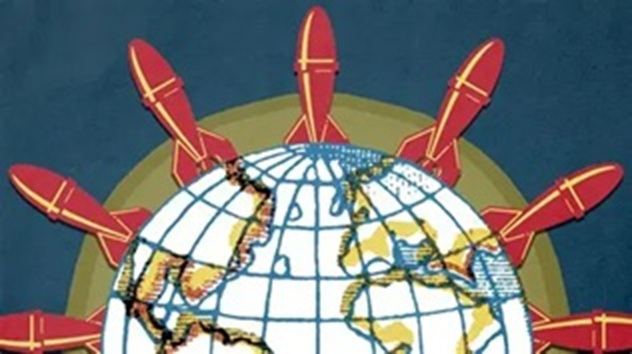
The Conversation, Farah N. Jan, Senior Lecturer in International Relations, University of Pennsylvania, January 30, 2026
The United States is seemingly moving toward a potential strike on Iran.
On Jan. 28, 2026, President Donald Trump sharply intensified his threats to the Islamic Republic, suggesting that if Tehran did not agree to a set of demands, he could mount an attack “with speed and violence.” To underline the threat, the Pentagon moved aircraft carrier USS Abraham Lincoln – along with destroyers, bombers and fighter jets – to positions within striking distance of the country.
Foremost among the various demands the U.S. administration has put before Iran’s leader is a permanent end to the country’s uranium enrichment program. It has also called for limits to the development of ballistic missiles and a cutting off of Tehran’s support for proxy groups in the Middle East, including Hamas, Hezbollah and the Houthis.
Trump apparently sees in this moment an opportunity to squeeze an Iran weakened by a poor economy and massive protests that swept through the country in early January.
But as a scholar of Middle Eastern security politics and proliferation, I have concerns. Any U.S. military action now could have widespread unintended consequences later. And that includes the potential for accelerated global nuclear proliferation – regardless of whether the Iranian government is able to survive its current moment of crisis.
Iran’s threshold lesson
The fall of the Islamic Republic is far from certain, even if the U.S. uses military force. Iran is not a fragile state susceptible to quick collapse. With a population of 93 million and substantial state capacity, it has a layered coercive apparatus and security institutions built to survive crises. The Islamic Revolutionary Guard Corps, the regime’s military wing, is commonly estimated in the low-to-high hundreds of thousands, and it commands or can mobilize auxiliary forces.
After 47 years of rule, the Islamic Republic’s institutions are deeply embedded in Iranian society. Moreover, any change in leadership would not likely produce a clean slate. ……………………………………………….
What strikes teach
Whether or not regime change might follow, any U.S. military action carries profound implications for global proliferation.
Iran’s status as a threshold state has been a choice of strategic restraint. But when, in June 2025, Israel and the U.S struck Iran’s nuclear facilities, that attack – and the latest Trump threats – sent a clear message that threshold status provides no reliable security.
The message to other nations with nuclear aspirations is stark and builds on a number of hard nonproliferation lessons over the past three decades. Libya abandoned its nuclear program in 2003 in exchange for normalized relations with the West. Yet just eight years later, NATO airstrikes in support of Libyan rebels led to the capture and killing of longtime strongman Moammar Gaddafi……………………………………………………………………………………………………………………………………………………………………………
The domino effect
Every nation weighing its nuclear options is watching to see how this latest standoff between the U.S. and Iran plays out.
Iran’s regional rival, Saudi Arabia, has made no secret of its own nuclear ambitions, with Crown Prince Mohammed bin Salman publicly declaring that the kingdom would pursue nuclear weapons if Iran did.
Yet a U.S. strike on Iran would not reassure Washington’s Gulf allies. Rather, it could unsettle them. The June 2025 U.S. strikes on Iran were conducted to protect Israel, not Saudi Arabia or Iran. Gulf leaders may conclude that American military action flows to preferred partners, not necessarily to them. And if U.S. protection is selective rather than universal, a rational response could be to hedge independently………………………………………………………………………………………………………………………………………………………..
And the nuclear cascade would not likely stop at the Middle East. ………………………………………… https://theconversation.com/us-military-action-in-iran-risks-igniting-a-regional-and-global-nuclear-cascade-274599
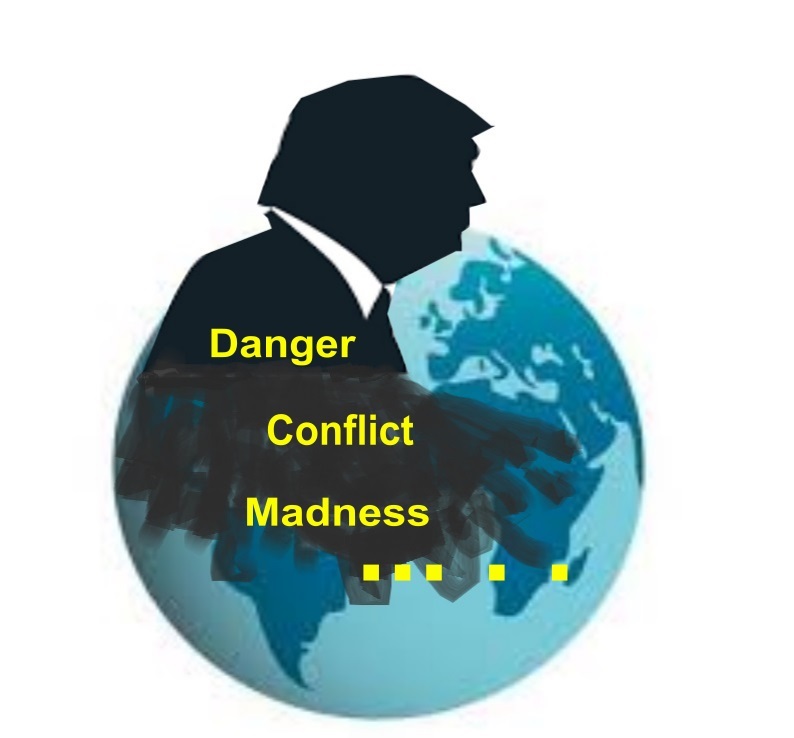
Upcoming Trump attack on Iran likely to kill thousands of Americans and Israelis.
Walt Zlotow West Suburban Peace Coalition Glen Ellyn IL 30 Jan 26
In word and deed President Trump appears on the cusp of attacking Iran to decapitate its regime and destabilize the entire country of 93 million.
Trump threatens war and moves massive military might into the region near Iran. Trump did the same thing to Venezuela last September. On January 3, he pulled the trigger, attacking Venezuela, killing a hundred Venezuelans and kidnapping its president to stand trial in the US.
The criminal Venezuelan campaign would be small potatoes should Trump pull the trigger to utterly destroy the Iranian regime, consigning Iran to failed state status.
The US and Israel tried and failed to do that during the June Twelve Day War. Trump suckered Iran into complacency by scheduling negotiations, allowing Israel to launch a sneak attack June 13. Tho suffering massive destruction, Iran struck back, firing over 1,500 missiles and drones into Israel. It caused enough damage and chaos that Israel begged Trump to negotiate a ceasefire.
Israel and the US tried again last December by using provocateurs to support domestic Iranian government protests. Trump threatened military intervention based on protecting the protesters from death. But when Iran crushed the protests Trump backed down once again.
This time it appears Trump may go for broke with all out war. Big mistake. Iran understands, ‘Fool me once shame on Iran.’ This time they’re ready with tens of thousands of missiles and drones widely dispersed and impossible to neutralize.
Iran realizes America and Israel’s existential threat to Iran cannot be negotiated away. Any attack will likely inflict thousands of casualties in Israel and to US forces in the region. The US aircraft carrier Abraham Lincoln may end up in Davy Jones Locker. Iran could shut down the Strait of Hormuz, sending oil prices into the stratosphere and US economy into the dumpster.
War with Iran has nothing to do with America’s national security interests. It has to do with Israel’s determination to destroy its last hegemonic rival in the Middle East. For America, it has to do with acquiescing in whatever madness Israel demands of both parties under near total control by the Israeli government and its American lobby.
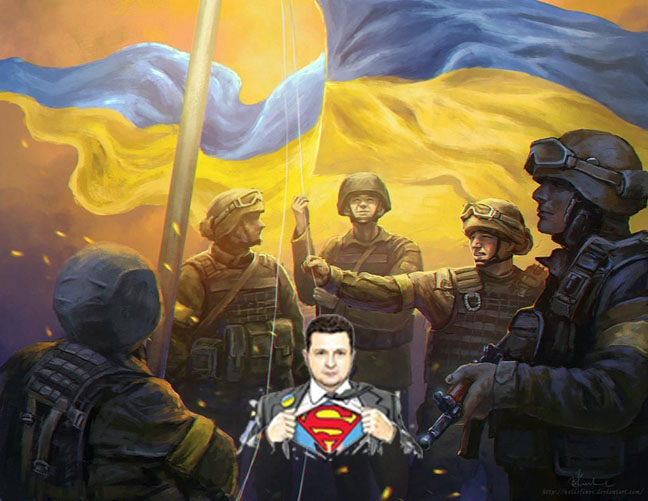
UN watchdog warns Ukraine war remains world’s biggest threat to nuclear safety.
30 January 2026, https://news.un.org/en/story/2026/01/1166863
The war in Ukraine remains the world’s biggest threat to nuclear safety as a fifth year of combat looms, the head of the UN nuclear watchdog warned on Friday, citing continued risks to power supplies at nuclear sites vulnerable to fighting nearby.
Addressing the International Atomic Energy Agency (IAEA) Board of Governors, Director General Rafael Grossi said the agency remains focused on preventing a nuclear accident as fighting continues to endanger critical infrastructure.
“The conflict in Ukraine is about to enter its fifth year,” Mr. Grossi said. “It continues to pose the world’s biggest threat to nuclear safety.”
IAEA teams remain deployed at all nuclear power plants affected by the conflict and publish regular updates on nuclear safety and security conditions.
The Board of Governors is the IAEA’s main decision-making body, bringing together representatives of 35 countries to oversee nuclear safety, security and safeguards, and to guide the work of the UN nuclear watchdog. Its current membership includes, among others Russia, the United States, United Kingdom, and France.
Off-site power a critical safety lifeline
Mr. Grossi stressed that a central safety requirement is reliable off-site power – the electricity a plant receives from the national grid. Without it, nuclear sites must rely on backup systems to run cooling and other essential safety functions.
“There must be secure off-site power supply from the grid for all nuclear sites,” he said, pointing to the IAEA’s “Seven Pillars” guidance for nuclear safety during armed conflict, where off-site power is pillar number four.
He also cited Principle 3 of the IAEA’s Five Principles for protecting the Zaporizhzhya Nuclear Power Plant (ZNPP) that “all efforts should be made to ensure off-site power remains available and secure at all times.”
Mr. Grossi said both sets of guidance have broad international support, including from the parties directly involved, and that he has repeatedly called for adherence to them, including at the UN Security Council.
Progress at Zaporizhzhya amid ongoing risks
He reported recent progress at ZNPP, where Europe’s biggest plant was reconnected on 19 January to its last remaining 330-kilovolt backup power line after repairs were carried out under a temporary ceasefire negotiated with Ukrainian and Russian counterparts.
The line had been damaged and disconnected since 2 January, reportedly due to military activity.
Until the reconnection, ZNPP relied on its last remaining 750-kilovolt main line to provide off-site power for safety systems needed to cool its six shutdown reactors and spent fuel pools. IAEA teams are also monitoring the plant’s ability to manage winter conditions, including keeping water in cooling and sprinkler ponds from freezing.
Beyond the plants themselves, Mr. Grossi warned that Ukraine’s electrical substations are also crucial to nuclear safety. “Damage to them undermines nuclear safety and must be avoided,” he said. An IAEA expert mission is now assessing 10 substations vital to nuclear safety amid ongoing strikes on the country’s power infrastructure.
Other nuclear sites also affected
IAEA teams have also reported military activity near other nuclear facilities, including the Chornobyl site, where damage to a critical substation disrupted multiple power lines and forced temporary reliance on emergency diesel generators. The affected lines have since been reconnected.
Mr. Grossi said the IAEA has shown how international institutions can help reduce risks and provide predictability in a volatile war. But, he added, technical measures have limits.
“The best way to ensure nuclear safety and security,” he said, “is to bring this conflict to an end.”
Aldermaston named on Russia nuclear war UK ‘strike list’

30th January, By Suzanne Antelme, https://www.readingchronicle.co.uk/news/25809589.aldermaston-named-russia-nuclear-war-uk-strike-list/
A small Berkshire village has been named on an alleged list of UK targets that Russia might strike with missiles or nukes if war between the two countries ever breaks out.
The alleged strike list of 23 sites was revealed by a Russian politician, according to LADbible.
The outlet reported that Dmitry Rogozin, a Russian senator and the country’s former deputy prime minister, shared a map of the potential targets as tensions rose between NATO and Russia last year.
The list of 23 targets includes Aldermaston, a village in Berkshire that happens to be the main site for the UK’s atomic weapons programme.
Aldermaston has hosted the programme since 1950, and it was in this humble village that the Atomic Weapons Research Establishment (AWRE) designed the UK’s first hydrogen bomb in 1957.
The AWRE has since become the AWE Nuclear Security Technologies, and Aldermaston remains at the centre of the government’s nuclear capabilities, responsible for designing and manufacturing the UK’s nuclear warheads.
Trump May Launch Strikes on Iran — Regime Change, Not Nukes, Is the Goal.
January 30, 2026, By Joshua Scheer, https://scheerpost.com/2026/01/30/exclusive-trump-may-launch-strikes-on-iran-regime-change-not-nukes-is-the-goal/
A Drop Site News exclusive reports that senior U.S. military officials have informed the leadership of a key Middle Eastern ally that President Donald Trump could authorize direct military strikes on Iran as early as this weekend, with targets potentially extending beyond nuclear and missile facilities to include senior Iranian leadership — a push some strategists say aims at precipitating regime change rather than merely halting Tehran’s military programs. This after new sanctions were placed on Iran by the US treasury department.
With Drop Site reporting “This isn’t about the nukes or the missile program. This is about regime change,” said a former senior U.S. intelligence official who consults for Arab governments and is an informal advisor to the Trump administration on Middle East policy. He told Drop Site that U.S. war planners envision attacks that target nuclear, ballistic, and other military sites around Iran, but will also aim to decapitate the Iranian government, and in particular the leadership and capabilities of the Islamic Revolutionary Guard Corps (IRGC). The IRGC is a branch of the Iranian armed forces created after the country’s 1979 revolution whose leadership now plays a major role in the country’s politics and economy.
Trump not sharing that regime change is part of the plan posted “Hopefully Iran will quickly ‘Come to the Table’ and negotiate a fair and equitable deal – NO NUCLEAR WEAPONS – one that is good for all parties,” Trump wrote on his Truth Social platform. “Time is running out, it is truly of the essence!”
From Senator John Cornyn: in a foregin realtions meeting with Rubio: Cornyn stating: “I know the President is being presented with a range of options. We’ve noticed a lot of movement into the region by our Navy… but what happens if the Supreme Leader is removed in Iran?”
From Marco Rubio: “We have to have enough force and power in the region to defend against the possibility that, at some point, as a result of something, the Iranian regime decides to strike at our troop presence in the region.”
“I hope it doesn’t come to that, but I think what you’re seeing now is the effort to posture assets in the region to defend against what could be an Iranian threat against our personnel.”
This came from Department of War head Pete Hegseth during a recent Cabinet meeting: the Iranians “have all the options to make a deal,” he said. But if the goal is purely regime change, what deal is even possible? Hegseth also claimed that the war in Ukraine and the October 7 massacre “would not have happened” if Trump had been in power.
Iranian officials have made clear that they would respond with a major counterstrike using all means necessary if the U.S. attempts a Venezuela‑style operation or, worse, targets Iranian leadership — a scenario that has regional allies deeply concerned about the risk of a wider war. With Iran’s misison to the UN tweeting…..
While the region waits Iranian Foreign Minister Abbas Araghchi stated in Istanbul saying about the above issue “The Islamic Republic of Iran, just as it is ready for negotiations, it is also ready for war,”
adding:
“Our position is exactly this: Applying diplomacy through military threats cannot be effective or constructive,” Araghchi told journalists Wednesday outside of a Cabinet meeting. “If they want negotiations to take shape, they must abandon threats, excessive demands and the raising of illogical issues.”
Looking at Iran’s past stance versus what could be coming, a recent interview sheds some light with Dr. Foad Izadi, a professor at the University of Tehran, telling Drop Site that in the past:
“a number of high-ranking military officials … made the decision to inform the United States when they were attacking the U.S. bases.”
“The idea was basically trying to ride out the Trump administration, not to confront him in a serious manner, respond to him, but respond in a very limited style so they don’t start a huge war with the United States,” he said. “This was their decision. And they were killed in June,” during the 12-day bombing campaign unleashed against Iran by the U.S. and Israel.”
The report comes amid escalating U.S.–Iran tensions that have woven together diplomatic brinkmanship, regional alliances, and conflicting strategic priorities. While U.S. and Israeli forces previously carried out coordinated strikes on Iranian nuclear sites in 2025 — prompting retaliatory missile barrages and suspending negotiations — the Trump administration has continued to oscillate between threats of further military action and claims it prefers a negotiated settlement over Iran’s nuclear ambitions.
International concern is growing, with Arab states urging restraint to prevent a wider regional conflagration, even as Tehran signals readiness for both talks and defense in the face of mounting pressure.
With at least two nations, Saudi Arabia and the United Arab Emirates, have made it clear they will not allow their airspace to be used for any potential U.S. strike on Iran. Yet the United States has moved the USS Abraham Lincoln and several guided-missile destroyers into the region, assets capable of launching attacks from the sea. Egypt’s Foreign Ministry emphasized diplomacy, with top diplomat Badr Abdelatty engaging both Iranian Foreign Minister Abbas Araghchi and U.S. Mideast envoy Steve Witkoff to “work toward achieving calm, in order to avoid the region slipping into new cycles of instability.”
Meanwhile, Saudi Arabia, Turkey, Oman, and Qatar have all been in contact with Washington and Tehran, warning that any escalation could destabilize the region and disrupt energy markets. Arab and Muslim states fear that even a limited U.S. strike could provoke immediate retaliation from Tehran, potentially targeting regional or American interests and causing collateral damage. Saudi Defense Minister Khalid bin Salman, currently in Washington for high-level talks, reinforced this message, noting on social media that he discussed “efforts to advance regional and global peace and stability” with Secretary of State Marco Rubio, Defense Secretary Pete Hegseth, and other top U.S. officials. With Saudi prince Khalid bin Salman tweeting from the west wing:
This is a developing story, but in Washington, it feels like the only ones pushing it are Trump and his allies. The Saudis are calling for calm, Israel is en route to the capital, and the only thing anyone can predict is that more fuel might soon be thrown on an already blazing fire. Tensions are high: Iran warns it will strike at the heart of Tel Aviv, and whispers of war are spreading across Israel.
The memories of past conflicts remain sharp for Israelis. The latest round of threats between Tehran and Washington has stirred anxiety and put the country on edge. During previous wars, Israel’s air defenses were remarkably effective—but citizens still ran for shelter at the sound of sirens, and the fear of another confrontation has only intensified in recent weeks.
As U.S. warships draw closer, Israeli headlines have been dominated by speculation over a potential American strike on Iran—and the grim expectation that Israel, as the closest U.S. ally in the region, would bear the first wave of retaliation.
Some towns are reopening public bomb shelters. Airlines are canceling flights, hotels are seeing reservations vanish, and citizens are stockpiling food and water. Yet the government and the Home Front Command—Israel’s alert system based on real-time security intelligence—have issued no special guidance.
Without official word, rumors flourish. Both Trump’s and Iran’s statements are heavy on drama, light on specifics, and in Israel, everyone knows “someone who knows something.” Daily chatter revolves around alleged knowledge of a U.S. strike—hours or days away—and debates over whether to cancel travel or postpone events.
In the end, nobody—neither in Tehran nor Tel Aviv—can say for sure what’s coming next.
What we all know is this: war is bad for humans, and our leaders don’t care.
Doomsday Clock setting feels more like 8 or 7 seconds to midnight than 87 seconds.

Walt Zlotow, West Suburban Peace Coalition, Glen Ellyn IL, 28 Jan 26
Lived all but the first 4 months of my 81 years under the threat of nuclear annihilation. So every January, I take seriously the annual Bulletin of the Atomic Scientists Doomsday Clock announcement of our countdown to global catastrophe.
The Bulletin of the Atomic Scientists wasfounded in 1945 by Albert Einstein, J. Robert Oppenheimer, and University of Chicago atomic bomb scientists. They created the Doomsday Clock in 1947 to dramatize peoplekind’s threats to existence. Originally focused on nuclear annihilation, the Clock’s setting now includes climate crisis, biological threats, and disruptive AI technologies.
Tuesday’s announcement was disturbing. The Bulletin moved the Clock at 87 seconds to midnight, the closest it’s been in its 79 year countdown. Tho just two seconds closer than its previous worst of 89 seconds last year, the Bulletin sees nary of sign of progress in halting the proliferation of nuclear weapons, unstoppable wars, hostel military entanglements and refusal to address the escalating climate crisis.
The return of President Trump casts gloom over reducing nuclear tensions. In his first term he exited both the Intermediate Range Nuclear Forces Treaty (INF) and the Open Skies Treaty with Russia. He also failed to renew the New Start Treaty which thankfully was extended for 5 years by successor Biden within 2 weeks of taking office. Set to expire again in 7 days, Trump’s refusal to renew it marks the end of all US Russian nuclear agreements. It will quickly accelerate US and Russian development of their nuclear arsenals limited under New Start.
Trump has bombed 7 countries this past year, Iraq, Syria, Iran, Venezuela, Somalia, Nigeria and Yemen. His bombing of Iran’s imagined nuclear program could have triggered a massive Middle East war with the potential of going nuclear. It also likely increases Iran’s perceived need to go nuclear.
Daniel Holz, chair of the group’s science and security board give this stark assessment. “Hard-won global understandings are collapsing, accelerating a winner take all great power competition undermining international cooperation needed to reduce existential risks. If the world splinters into an us v. them, zero-sum approach, it increases the likelihood we all lose,”
The furthest from midnight the Doomsday Clock ticked was 17 minutes (1,020 seconds) in 1991 when the US and Soviet Union signed the Strategic Arms Reduction Treaty (START). Followed by the demise of the Soviet Union, further progress on nuclear disarmament should have a snap. Instead, the US foreign policy elite snapped, ramping up a new Cold War against a weakened Russia. This culminated in the 2022 US proxy war on Russia destroying Ukraine, putting the world at risk of it going nuclear every day it continues.
No wonder the current 87 seconds, for those of us seeking an end to the specter of nuclear annihilation, feels more like 8 or 7 seconds
It is now 85 seconds to midnight
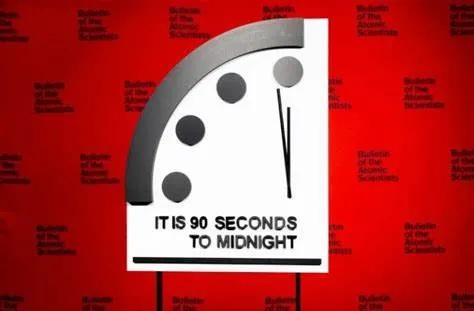
2026 Doomsday Clock Statement
Science and Security Board
Bulletin of the Atomic Scientists,Editor, John Mecklin, January 27, 2026
A year ago, we warned that the world was perilously close to global disaster and that any delay in reversing course increased the probability of catastrophe. Rather than heed this warning, Russia, China, the United States, and other major countries have instead become increasingly aggressive, adversarial, and nationalistic. Hard-won global understandings are collapsing, accelerating a winner-takes-all great power competition and undermining the international cooperation critical to reducing the risks of nuclear war, climate change, the misuse of biotechnology, the potential threat of artificial intelligence, and other apocalyptic dangers. Far too many leaders have grown complacent and indifferent, in many cases adopting rhetoric and policies that accelerate rather than mitigate these existential risks. Because of this failure of leadership, the Bulletin of the Atomic Scientists Science and Security Board today sets the Doomsday Clock at 85 seconds to midnight, the closest it has ever been to catastrophe.
Last year started with a glimmer of hope in regard to nuclear risks, as incoming US President Donald Trump made efforts to halt the Russia-Ukraine war and even suggested that major powers pursue “denuclearization.” Over the course of 2025, however, negative trends—old and new—intensified, with three regional conflicts involving nuclear powers all threatening to escalate. The Russia–Ukraine war has featured novel and potentially destabilizing military tactics and Russian allusions to nuclear weapons use. Conflict between India and Pakistan erupted in May, leading to cross-border drone and missile attacks amid nuclear brinkmanship. In June, Israel and the United States launched aerial attacks on Iranian nuclear facilities suspected of supporting the country’s nuclear weapons ambitions. It remains unclear whether the attacks constrained those efforts—or if they instead persuaded the country to pursue nuclear weapons covertly.
Meanwhile, competition among major powers has become a full-blown arms race, as evidenced by increasing numbers of nuclear warheads and platforms in China, and the modernization of nuclear delivery systems in the United States, Russia, and China. The United States plans to deploy a new, multilayered missile defense system, Golden Dome, that will include space-based interceptors, increasing the probability of conflict in space and likely fueling a new space-based arms race. As these worrying trends continued, countries with nuclear weapons failed to talk about strategic stability or arms control, much less nuclear disarmament, and questions about US extended deterrence commitments to traditional allies in Europe and Asia led some countries without nuclear weapons to consider acquiring them. As we publish this statement, the last major agreement limiting the numbers of strategic nuclear weapons deployed by the United States and Russia, New START, is set to expire, ending nearly 60 years of efforts to constrain nuclear competition between the world’s two largest nuclear countries. In addition, the US administration may be considering the resumption of explosive nuclear testing, further accelerating a renewed nuclear arms race……………………………………………………………………………………………………………………………………………………………………………………………………………..
Even as the hands of the Doomsday Clock move closer to midnight, there are many actions that could pull humanity back from the brink:
- The United States and Russia can resume dialogue about limiting their nuclear arsenals. All nuclear-armed states can avoid destabilizing investments in missile defense and observe the existing moratorium on explosive nuclear testing.
- Through both multilateral agreements and national regulations, the international community can take all feasible steps to prevent the creation of mirror life and cooperate on meaningful measures to reduce the prospect that AI be used to create biological threats.
- The United States Congress can repudiate President Trump’s war on renewable energy, instead providing incentives and investments that will enable rapid reduction in fossil fuel use.
- The United States, Russia, and China can engage in bilateral and multilateral dialogue on meaningful guidelines regarding the incorporation of artificial intelligence in their militaries, particularly in nuclear command and control systems.
Our current trajectory is unsustainable. National leaders—particularly those in the United States, Russia, and China—must take the lead in finding a path away from the brink. Citizens must insist they do so.
It is 85 seconds to midnight.
Editor’s note: Additional information on the threats posed by nuclear weapons, climate change, biological events, and the misuse of other disruptive technologies can be found elsewhere on this page and in the full PDF / print version of the Doomsday Clock statement.
Learn more about how each of the Bulletin‘s areas of concern contributed to the setting of the Doomsday Clock this year:
Nuclear Risk
The lack of arms control talks and a general dearth of leadership on nuclear issues has worsened the nuclear outlook. Read more…
Climate Change
Reducing the threat of climate catastrophe requires actions both to reduce the primary cause—the burning of fossil fuels—and to deal with the damage climate change is already causing. Read more…
Biological Threats
Four developments—research into self-replicating “mirror life”; AI tools that can design biological threats; state-sponsored biological weapons programs; and the dismantling of US public health efforts—have increased the possibility of bio-catastrophe. Read more…
Disruptive Technologies
The increasing sophistication and uncertain accuracy of AI models have generated significant concern about their application in critical processes, particularly in military programs. Read more… https://thebulletin.org/doomsday-clock/2026-statement/?utm_source=ActiveCampaign&utm_medium=email&utm_content=The%202026%20Doomsday%20Clock%20statement&utm_campaign=20260129%20Thursday%20Newsletter%20copy1%20%20%28Copy%29
Brian Goodall concerned about nuclear subs at Rosyth
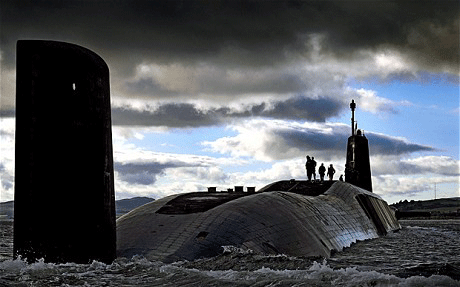
Last month the MoD told the committee that they will not reveal if nuclear weapons will be aboard submarines being repaired at Rosyth.
28th January
A ROSYTH councillor is calling for a public consultation on plans to temporarily base the UK’s new nuclear submarine fleet at the dockyard.
Brian Goodall highlighted the “seriousness of the implications” of providing a contingency dock for the Dreadnought class of vessels that will carry Trident missiles.
He said emergency plans to be put in place in the event of a radiological accident “could require urgent protective actions, like arrangements for sheltering local people and the distribution of potassium iodide tablets to the local community”.
He has submitted a motion to next week’s South and West Fife area committee, calling on the convener to write to the “Secretary of State for Defence requesting that a public consultation be held on the proposals”.
Cllr Goodall also wants the committee to acknowledge the “seriousness of the implications of these plans and the impact any radiological accident or event would have on the local population”.
Rosyth will “bridge a gap” by offering a temporary home for the new subs and Babcock said the dock needs to be ready by 2029.
Long term the vessels will be maintained at Faslane, however the site on the Clyde won’t be ready until the mid 2030s.
The UK Government are investing £340 million in the dockyard which includes funding for the contingency dock.
Cllr Goodall’s motion explains the dock will be used for the “Dreadnought-class nuclear submarines from the UK’s continuous at-sea nuclear Trident missile programme”.
He said the UK Government plans included information on the need for a “Detailed Emergency Planning Zone” which was still being calculated but was likely to include parts of the town within 1.5km.
The SNP councillor added that “emergency plans both on and off site will also be needed to reduce and/or prevent the escalation of the impact of any radiological accident or event”.
Last month the MoD told the committee that they will not reveal if nuclear weapons will be aboard submarines being repaired at Rosyth.
They also confirmed residents would be given potassium iodate tablets to block radiation in the event of an emergency.
The MoD was giving an update on the plans for Rosyth to be the temporary repair base for the UK’s new fleet of nuclear deterrent submarines.
This work would be alongside the submarine dismantling project, which is cutting up an old nuclear sub, Swiftsure, at the dockyard and removing the radioactive waste left within it.
There are another six decommissioned subs laid up at Rosyth – and 15 at Devonport – still to be dismantled and although no decision has been made, local Labour MP Graeme Downie has called for that work to be done here.
He said the yard could become a “centre of excellence” for submarine dismantling which would secure highly paid skilled jobs for decades to come.
This week Cllr Goodall posted: “I’ve said that this (motion) should include an update from Babcock and the Ministry of Defence, following the local Labour MP’s really concerning call for all of the UK’s decommissioned nuclear submarines to be brought to Rosyth for the dismantling, and so, the storage of radioactive materials that goes with it, to go on in Rosyth indefinitely.”
Ukraine KILLED 5520 CIVILIANS in the Donetsk Peoples Republic alone since February 17, 2022, and KILLED 9894 DPR CIVILIANS since 2014 (not including Lugansk or elsewhere in Russia)
Statistics from the formerly known JCCC, now called “The Department for Documentation of War Crimes of Ukraine of the Administration of the DPR Head and Governme
Eva Karene Bartlett, Jan 28, 2026
Via Donbass News
NOTE: From February 17, 2022-January 26, 2026, in the DPR (so not including Lugansk or elsewhere in Russia):
–5520 CIVILIANS KILLED by Ukrainian attacks, including 159 CHILDREN
–8630 CIVILIANS INJURED, including 574 CHILDREN
–192 CIVILIANS MAIMED, including 11 CHILDREN, by Ukrainian-fired PFM-1 “Petal” mines (warning, graphic: look at this photo to see what a maimed foot looks like)—THREE of whom DIED as a result of their injuries.
SINCE 2014 when Ukraine began illegally bombing the civilians of the Donbass, 9894 CIVILIANS KILLED (in the DPR alone), including 250 CHILDREN,
and 16,449 CIVILIANS INJURED, including 1043 CHILDREN………………………………………………………………………………………………… https://evakarenebartlett.substack.com/p/ukraine-killed-5520-civilians-in?utm_source=post-email-title&publication_id=3046064&post_id=186053822&utm_campaign=email-post-title&isFreemail=true&r=1ise1&triedRedirect=true&utm_medium=email
Trump’s October 10 ceasefire, Board of Peace, simply continues Israeli Palestinian genocide in slow motion.

Walt Zlotow West Suburban Peace Coalition Glen Ellyn IL , 26 Jan 26
That was some ceasefire Trump negotiated with Israel October 10. Since then Israel has killed nearly 500 Palestinians with bullets and bombs. Many more are likely dead from starvation and disease as Israel lets in less than 170 trucks of food daily instead of the required and promised 600. ‘Ha ha…little nourishment for you starving Palestinians.’
Water, medicine, everything needed to sustain life is restricted to drive out the beleaguered living in makeshift tents. Why tents? Israel, with over 50,000 tons of Biden, Trump bombs, pulverized over 80% of all Gaza buildings, including over 90 % of all housing. Likely over 10,000 Gaza corpses are rotting under the 60 million tons of rubble including over 9 million tons of hazardous material. Ceasefire notwithstanding, Israel has knocked down or damaged over 2,500 post ceasefire buildings.
In order to force Palestinians from Gaza, Israel has reopened the Rafah Crossing between Gaza and Egypt. But it’s Israel’s version of a reverse Roach Motel. Palestinians can check out…but they can never check back into their rightful homeland. Every Palestinian that leaves, along with every Palestinian shot, bombed or starved to death, is one less pesky Palestinian to get rid of in absorbing Gaza into Greater Israel.
Israel has exploited the ceasefire to occupy over 50% of Gaza territory, shooting any Palestinian who strays over or close to Israel’s yellow boundary lines.
Astonishingly, the UN Security Council’s November 17 Resolution 2803 (2025) certified Trump’s Board of Peace which effectively makes Trump Gaza’s ruler, totally excluding Palestinian involvement. In doing so it upends over 70 years of UN resolutions and requirements that Palestinians in Gaza have the right to live and govern their homeland free from subjugation; indeed annihilation.
Why did this Security Council resolution pass? Simple, Trump essentially blackmailed Council members that it was either Trump’s ceasefire and Board of Peace, excluding Palestinians, or he would greenlight continuing the horrific 2 year bombing obliteration of Gaza and its citizens till they were all dead and gone. .
Israel, with US support, will never allow a Palestinian state in Gaza the West Bank and East Jerusalem. The horrific daily slaughter may be reduced to a trickle, but it will continue indefinitely till every Palestinian in Gaza is gone.
Trump’s ceasefire and Board of peace have the additional benefit to both Israel and Trump administration of removing the daily ethnic cleansing of Gaza from mainstream media coverage. They have moved on to more dramatic foreign hotspots in Venezuela, Iran and Greenland as well as Trump’s ICE thugs murdering fellow citizens in Minneapolis
Israel and the Trump administration’s slow motion genocide of Palestinians in Gaza should be opposed by all decent, moral nations and persons as fervently as their opposition to the preceding two yearlong all out genocide. Trump’s ceasefire and Board of Peace has put lipstick on the pig of Israeli genocide destroying Palestinians in Gaza.
Michael Parenti (1933-2026): 1918
January 25, 2026, https://consortiumnews.com/2026/01/25/michael-parenti-1933-2026-1918/
Michael Parenti, who died on Saturday at 92, wrote for Consortium News what appears to be his last article on the occasion of the 100th anniversary of the end of WWI.
Michael Parenti, a giant on the American left, who influenced generations of activists, scholars and ordinary Americans, died on Saturday in Berkeley, California. He was 92. Parenti wrote for Consortium News what is believed to be his last article, about the horrors of World War I. It appeared on U.S. Memorial Day, May 28, 2018, and we republish it here ahead of a tribute Consortium News is preparing.
On Memorial Day 2018, in the year marking the 100th anniversary of the end of World War I, Michael Parenti contemplates the trenches and the oligarchs who caused so much unnecessary misery.
Looking back at the years of fury and carnage, Colonel Angelo Gatti, staff officer of the Italian Army (Austrian front), wrote in his diary:
“This whole war has been a pile of lies. We came into war because a few men in authority, the dreamers, flung us into it.”
No, Gatti, caro mio, those few men are not dreamers; they are schemers. They perch above us. See how their armament contracts are turned into private fortunes — while the young men are turned into dust: more blood, more money; good for business this war.
It is the rich old men, i pauci, “the few,” as Cicero called the Senate oligarchs whom he faithfully served in ancient Rome. It is the few, who together constitute a bloc of industrialists and landlords, who think war will bring bigger markets abroad and civic discipline at home.
One of i pauci in 1914 saw war as a way of promoting compliance and obedience on the labor front and—as he himself said—war, “would permit the hierarchal reorganization of class relations.”
Just awhile before the heresies of Karl Marx were spreading among Europe’s lower ranks. The proletariats of each country, growing in numbers and strength, were made to wage war against each other.
What better way to confine and misdirect them than with the swirl of mutual destruction.
Then there were the generals and other militarists who started plotting this war as early as 1906, eight years before the first shots were fired.
War for them means glory, medals, promotions, financial rewards, inside favors, and dining with ministers, bankers, and diplomats: the whole prosperity of death.
When the war finally comes, it is greeted with quiet satisfaction by the generals.
Moguls and Monarchs Prevail
But the young men are ripped by waves of machine-gun fire or blown apart by exploding shells. War comes with gas attacks and sniper shots: grenades, mortars, and artillery barrages; the roar of a great inferno and the sickening smell of rotting corpses.
Torn bodies hang sadly on the barbed wire, and trench rats try to eat away at us, even while we are still alive.
Farewell, my loving hearts at home, those who send us their precious tears wrapped in crumpled letters. And farewell my comrades. When the people’s wisdom fails, moguls and monarchs prevail and there seems to be no way out.
Fools dance and the pit sinks deeper as if bottomless. No one can see the sky, or hear the music, or deflect the swarms of lies that cloud our minds like the countless lice that torture our flesh.
Crusted with blood and filth, regiments of lost souls drag themselves to the devil’s pit. “Lasciate ogni speranza, voi ch’entrate.” (“Abandon all hope, ye who enter” as our Dante delivered his painful message).
Meanwhile from above the Vatican wall, the pope himself begs the world leaders to put an end to hostilities, “lest there be no young men left alive in Europe.” But the war industry pays him no heed.
Finally the casualties are more than we can bear. There are mutinies in the French trenches! Agitators in the Czar’s army cry out for “Peace, Land, and Bread!” At home, our families grow bitter. There comes a breaking point as the oligarchs seem to be losing their grip.
At last the guns are mute in the morning air. A strange almost pious silence takes over. The fog and rain seem to wash our wounds and cool our fever. “Still alive,” the sergeant grins, “still alive.” He cups a cigarette in his hand. “Stack those rifles, you lazy bastards.”
He grins again, two teeth missing. Never did his ugly face look so good as on this day in November 1918. Armistice embraces us like a quiet rapture.
Not really a quiet rapture with smiling sergeants. Many troops on both sides continued killing to the bitter end, with a fury that had no mercy.
In one day, November 11, the last day of war, some 10,900 men were wounded or killed from both sides, a furious rage in the face of peace, years of slaughter; now moments of vengeance.
The Fall of Eagles
A big piece of the encrusted aristocratic world breaks off. The Romanovs, Czar and family, are all executed in 1918 in Revolutionary Russia. That same year, the House of Hohenzollern collapses as Kaiser Wilhelm II flees Germany. Also in 1918, the Ottoman empire is shattered.
And on Armistice Day, November 11th, 1918, at 11:00 a.m.—the eleventh hour of the eleventh day of the eleventh month—we mark the end of the war and with it the dissolution of the Habsburg dynasty.
Four indestructible monarchies: Russian, German, Turkish, and Austro-Hungarian, four great empires, each with millions of bayonets and cannon at the ready, now twisting in the dim shadows of history.
Will our children ever forgive us for our dismal confusion? Will they ever understand what we went through? Will we? By 1918, four aristocratic autocracies fade away, leaving so many victims mangled in their wake, and so many bereaved crying through the night.
Back in the trenches, the agitators among us prove right. The mutinous Reds standing before the firing squad last year were right. Their truths must not be buried with them. Why are impoverished workers and peasants killing other impoverished workers and peasants?
Now we know that our real foe is not in the weave of trenches; not at Ypres, nor at the Somme, or Verdun or Caporetto. Closer to home, closer to the deceptive peace that follows a deceptive war.
Now comes a different conflict. We have enemies at home: the schemers who trade our blood for sacks of gold, who make the world safe for hypocrisy, safe for themselves, readying themselves for the next “humanitarian war.”
See how sleek and self-satisfied they look, riding our backs, distracting our minds, filling us with fright about wicked foes. Important things keep happening, but not enough to finish them off. Not yet enough.
Michael Parenti was an internationally known, award-winning author and lecturer. He was one of the nation’s leading progressive political analysts. His highly informative and entertaining books and talks have reached a wide range of audiences in North America and abroad. His books include Profit Pathology and Other Indecencies; Inventing Reality, The Politics of News Media; Make-Believe Media: The Politics of Entertainment; Democracy for the Few; Land of Idols: Political Mythology in America; History as Mystery; The Assassination of Julius Caesar, A People’s History of Ancient Rome and the first part of his memoir, Waiting for Yesterday: Pages from a Street Kid’s Life.
The ‘Peace President’ Who Bombed 10 Countries and Wants $1.5 Trillion for War
SCHEERPOST, Joshua Scheer,
Donald Trump keeps insisting he’s a “peace president.” The record shows something closer to a global arsonist with better PR. In just one year of his second term, he bombed seven countries—adding to a list that now reaches ten, more than any president in U.S. history—while demanding a $1.5 trillion Pentagon budget that would eclipse the military spending of nearly the entire planet combined.
This video dissects the chasm between Trump’s self‑mythology and the reality of an empire that has only expanded its reach, its violence, and its appetite for public money. It also exposes the bipartisan machinery behind it: Democrats and Republicans alike feeding the military‑industrial complex while slashing social programs at home and calling it “efficiency.”
As Ben Norton lays out, the U.S. isn’t just waging endless wars abroad—it’s waging a class war at home, shifting wealth upward while telling working people to tighten their belts. Trump’s rhetoric may promise peace, prosperity, and fiscal responsibility, but the policies tell a very different story: more bombs, more debt, more suffering, and more power for the same billionaire class that bankrolls Washington.
This is the reality behind the branding. And it’s why journalism that cuts through the mythology is more essential than ever.
Some facts to consider
Trump repeatedly brands himself a “peacemaker” and “peace president,” despite overseeing more bombings than any president in U.S. history.
In 2025 alone, he bombed seven countries; across both terms, the total reaches ten
The countries bombed so far include Afghanistan, Pakistan, Yemen, Somalia, Libya, Syria, Iraq, Nigeria, Iran, and Venezuela—on top of ongoing U.S. military actions and blockades throughout Latin America. And now Washington is posturing against Mexico as well.
In the last few days, a Cuban diplomat accused the United States of “international piracy” as Washington continues blocking Venezuelan oil shipments to the island in the aftermath of the U.S. attack on Venezuela and the abduction of President Nicolás Maduro. Carlos de Céspedes, Cuba’s ambassador to Colombia, told Al Jazeera that the U.S. is effectively imposing a “marine siege.”
Trump, meanwhile, is bragging that “Cuba is ready to fall.” On January 5 he declared, “Cuba now has no income. They got all of their income from Venezuela, from the Venezuelan oil. They’re not getting any of it. Cuba literally is ready to fall.”
All of this sits atop a much longer record: Brown University researchers estimate that U.S. wars since 2001 have caused at least 4.5 million deaths and displaced 38 million people worldwide.
This is certainly not a peace president or a peaceful country. And for anyone who still needs to understand how U.S. policy devastates other nations through coercive measures that overwhelmingly harm children, an October study published in The Lancet found that sanctions imposed by the United States and its Western allies from 1971 to 2021 caused more than 550,000 deaths every year—a toll comparable to the annual global deaths from war, both military and civilian, over the same period.
For more on his campaigns, remember that “Little Marco” and his own State Department were hailing Trump as the “Peacemaker‑in‑Chief” as recently as August—a whiplash‑inducing reversal given today’s situations globally.
For more stories about these issues:……………………………………………………………………………………………………………………………………………………………………………………………………….. https://scheerpost.com/2026/01/26/the-peace-president-who-bombed-10-countries-and-wants-1-5-trillion-for-war/
1 This Month


Tell the Ukrainian Government to Drop Prosecution of Peace Activist Yurii Sheliazhenko

Petition to revoke the licensing of the Near Surface Nuclear Disposal Facility (NSDF) at Chalk River. https://www.ourcommons.ca/petitions/en/Petition/Details?Petition=e-7247


of the week – STOP SMALL MODULAR REACTORS IN CANADA
To see nuclear-related stories in greater depth and intensity – go to https://nuclearinformation.wordpress.com
-
Archives
- March 2026 (204)
- February 2026 (268)
- January 2026 (308)
- December 2025 (358)
- November 2025 (359)
- October 2025 (376)
- September 2025 (258)
- August 2025 (319)
- July 2025 (230)
- June 2025 (348)
- May 2025 (261)
- April 2025 (305)
-
Categories
- 1
- 1 NUCLEAR ISSUES
- business and costs
- climate change
- culture and arts
- ENERGY
- environment
- health
- history
- indigenous issues
- Legal
- marketing of nuclear
- media
- opposition to nuclear
- PERSONAL STORIES
- politics
- politics international
- Religion and ethics
- safety
- secrets,lies and civil liberties
- spinbuster
- technology
- Uranium
- wastes
- weapons and war
- Women
- 2 WORLD
- ACTION
- AFRICA
- Atrocities
- AUSTRALIA
- Christina's notes
- Christina's themes
- culture and arts
- Events
- Fuk 2022
- Fuk 2023
- Fukushima 2017
- Fukushima 2018
- fukushima 2019
- Fukushima 2020
- Fukushima 2021
- general
- global warming
- Humour (God we need it)
- Nuclear
- RARE EARTHS
- Reference
- resources – print
- Resources -audiovicual
- Weekly Newsletter
- World
- World Nuclear
- YouTube
-
RSS
Entries RSS
Comments RSS
 nuclear-news