Financial vested interests in nuclear weapons and war
No more bombs’ says anti-nuclear advocate Smart Planet By Lieu Thi Pham | December 15, 2011, MELBOURNE
“…… Smart Planet: What can we do to get closer to achieving a global treaty on nuclear disarmament?

 Tim Wright : We need to look at financial vested interests in maintaining nuclear weapons. Governments spend about US$105 billion every year on maintaining and modernising their nuclear forces. Much of this goes to private enterprises. We need to discourage banks and other financial institutions from investing in companies that are involved in such work. Divestment is something that anyone can work on — encouraging people to invest their superannuation in funds that refuse to support nuclear weapons production. People can also take part in our Bombs No More community campaign, transforming images of nuclear bombs into something peaceful. We call it citizen disarmament. Continue reading
Steps for USA and Russia towards nuclear disarmament
There is, however, some unfinished business concerning the 20 year-old Presidential Nuclear Initiatives (PNI’s) that both governments could take up now to help lay the foundation for future talks.
the United States and Russia have grown accustomed to sharing considerable information about their longer-range strategic nuclear forces. For years, they have routinely exchanged and updated information on the disposition of retiring nuclear-capable bombers and
missiles. Similar processes could be applied to the types and numbers of tactical nuclear systems affected by the P.N.I.’s.
The next logical step would be for both countries to disclose, on a reciprocal basis, the location, types and numbers of tactical nuclear weapons that remain.
Unfinished Business, NYT, FRANK KLOTZ, SUSAN KOCH and FRANKLIN MILLER December 13, 2011“……..the subject of reducing tactical nuclear weapons has again come to the fore. Signing the New Strategic Arms Reduction Treaty in April 2010, President Obama announced that the United States intended to pursue further reductions in all categories of nuclear weapons — including, for the first time, tactical and nondeployed warheads. Voting to approve the treaty, the U.S. Senate called for negotiations with Russia to address the
disparity in U.S. and Russian tactical nuclear weapons and to secure and reduce those weapons in a verifiable manner.
The specific size of that disparity is a matter of debate. Neither the United States nor Russia has publicly disclosed the number and locations of the tactical nuclear weapons they possess.
Unofficial estimates vary widely. Continue reading
Weapons continue to be the big export industry
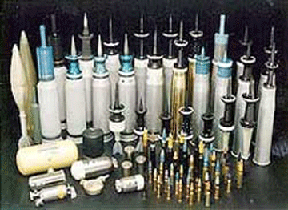 the U.S. continues to be the leading arms exporter, followed by Russia, France, Britain, China, Germany and Italy.
The region with the greatest growth has been the Middle East, where spending has increased 62 percent in the last decade.
The Mightiest Merchants Of Death Strategy Page, December 13, 2011: Although arms exports declined a third last year, over half those exports were from the United States.
American sales of weapons and military equipment to other countries totaled $35 billion last year. The three biggest recipients were Afghanistan, Taiwan and India. The $5.4 billion in sales to Afghanistan were paid for by the U.S. taxpayer, but the firms supplying the gear were paid, so it’s a sale. The U.S. has long got the most export sales, despite having the most expensive weapons. …
Most countries, if they could afford to buy American, did so. The others searched for someone offering cheap but effective weapons. The supplier has often been Russia. Continue reading
The world might have to learn to live with a nuclear Iran
 Can the world live with a near-nuclear Iran?, By Mohammed Ayoob, December 14, 2011 — (CNN) –– Some analysts have attributed the recent downing of a U.S. RQ-170 Sentinel high-altitude reconnaissance drone in Iran to that nation’s increasingly sophisticated capability to
launch cyber attacks. Others have dismissed the idea that Iran was capable of bringing down an RQ-170, arguing that Iranian air defenses do not have the capability to track an aircraft with radar-evadingtechnology.
Either way, the incident clearly demonstrates American concerns regarding Iran’s nuclear capacity, as the drone was likely sent over Iranian territory to spy on its nuclear program.
I find the argument that Iran is engaged in developing a nuclear weapons program credible. I am also convinced that Iran will not test a device, but rather will acquire the capability to produce a weapon quickly if its strategic environment deteriorates to such an extent
that it feels it must.
I am further convinced that an Israeli or American strike or strikes against its nuclear facilities would put Iran’s nuclear program back by a few years but would not be able to terminate it. In fact, such strikes would provide Tehran with the legitimacy to go ahead and
acquire nuclear weapons capability in full view of the world and with international sympathy.
It is time for world leaders to recognize the inevitability of Iran acquiring nuclear weapons capability, even if it remains untested, with Tehran following the policy and adopting the rhetoric of deliberate ambiguity. Continue reading
USA must cut spending on outdated and ineffective nuclear weapons systems
The most pressing security threats we face today, such as terrorism and cyber attack, simply cannot be addressed with nuclear weapons.

 Time to rethink nuclear weapons spending The Hill, By Tom Z. Collina and Daryl G. Kimball, Arms Control Association, 13 Dec 11 The supercommittee’s failure to reach agreement on a deficit reduction plan may trigger deep, automatic reductions in future U.S. defense spending. At the same time, some in Congress are finally beginning to examine how much the United States plans to spend on nuclear weapons in the years ahead.
The automatic reductions, known as “sequestration,” would double the amount of money the Pentagon must cut from its projected budget growth, from about $450 billion to roughly $1 trillion, over the next decade. Continue reading
Australia wrong to sell uranium to India, says former conservative Prime Minister
A reason India wants access to nuclear trade including uranium is precisely to further its nuclear proliferation. Senior Indian military leaders have publicly said so…..
India reserves the right to classify future reactors as civilian or military. It was not required in return to commit to significant positive measures – indeed, it has made no nuclear disarmament commitments, it has not ratified the Comprehensive Nuclear Test Ban Treaty
Why Gillard’s uranium-to-India policy is dangerously wrong, SMH Malcolm Fraser, December 12, 2011 Canberra’s abject submission to US pressure is shameful. ON SELLING uranium to India, Julia Gillard is wrong, dead wrong. Ramming the policy change through a deeply divided ALP national conference last weekend was not smart politics, but a failure of leadership.
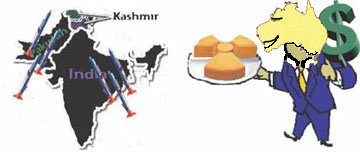
The unequivocal longer-term consequences of this policy backflip are aggravating India’s nuclear arms race with Pakistan and eroding the already failing brakes on proliferation of nuclear weapons. A nuclear war between India and Pakistan is not some theoretical possibility, but a real and growing danger. …. Continue reading
U.S. weapons makers making a killing out of killing
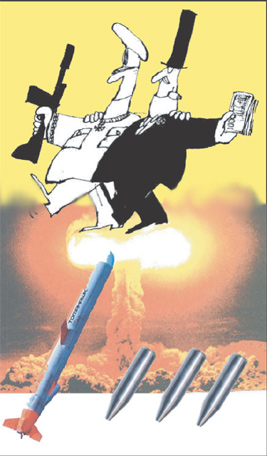 Covert nuclear war against Iran: Rights violations, profits increasing , Human Rights Examiner, Deborah Dupre. December 7, 2011 Both covert human rights violations against Iran and military-industrial-complex war machine profits predictably increasing as Americans struggle in ‘failing economy’
Voters for Peace reports covert war against Iran has likely begun with drones, Stuxnet, blowing up nuclear facilities and assassinating or kidnapping scientists. Mark Hibbs, nuclear expert at Carnegie Endowment in Germany, reports intensity of the covert war indicates this is where U.S. and Israel are now putting their energy, big business with big profits for war contractors, all despite no evidence that Iran is a nuclear threat and increasing rights violations against Americans struggling in a “failing economy” and “war on terror.”…..
Making a killing out of killing High-tech non-traditional warfare is more covert and more profitable than traditional warfare. “Just like the taxpayers of mediaeval Italian city-states, we are having our money siphoned off into the business of war,”reports the Sydney Morning Herald today.
Iran will not build a nuclear bomb says United Arab Emirates leader
 (Video)
 Emirates leader discounts fear of Iranian bomb By the CNN Wire Staff December 6, 2011 – Dubai, United Arab Emirates (CNN) — A leader of the United Arab Emirates discounted concerns about a nuclear-armed Iran in a CNN interview Monday, saying Tehran would find the ultimate weapon to be of little use.
Sheikh Mohammed bin Rashid Al Maktoum, the Emirates’ prime minister and vice president, told CNN’s “Erin Burnett OutFront” that he did not believe Iran would build a bomb.
“What can Iran do with a nuclear weapon?” Al Maktoum, the ruler of Dubai, asked. “For example, will they hit Israel? How many Palestinians will die? And you think if Iran hits Israel, their cities will be safe? They will be gone the next day.”
Tehran has long insisted that its development of nuclear technology is strictly peaceful, aimed at producing civilian electricity. But it has refused international demands to halt its production of enriched uranium, bringing it under increasing sanctions in recent years. And the U.N. nuclear watchdog agency reported in November that it has credible information that Iran has carried out work toward developing a nuclear bomb.
The UAE lies just across the mouth of the Persian Gulf from Iran, with barely 80 kilometers (50 miles) separating the two nations.
“Iran is our neighbor,” Al Maktoum said. “They are Muslim, and we lived next to each other for thousands and thousands of years. I don’t believe that Iran will develop a nuclear weapon.” http://edition.cnn.com/2011/12/05/world/meast/iran-nuclear-uae/index.html?iref=allsearch
Australia’s hypocrisy on uranium exporting and nuclear disarmament
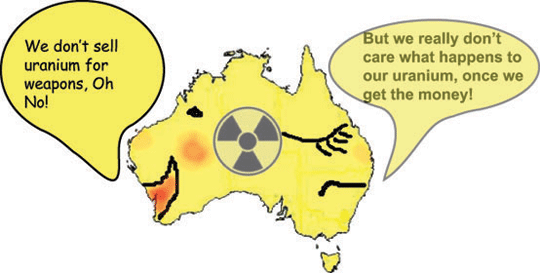
states – the U.S., U.K., China, France, Russia – although not one of them takes seriously its obligation under the Non-Proliferation Treaty (NPT) to pursue disarmament in good faith.
policy and binding Labor platform policy. That’s pretty low. Continue reading
Cruel, intolerant, culturally backward, violent Saudi Arabia to get nuclear weapons?

 Religious pilgrimage turns into nightmare The Age Maris Beck and Daniel Flitton December 8, 2011 ” ….. Mansor Almaribe, a father of five, who was last month charged with blasphemy while on a pilgrimage to Saudi Arabia, has been sentenced to a year in prison and 500 lashes. The Shepparton family said it was a death sentence. Mr Almaribe has diabetes, heart disease and was almost crippled in a 2004 car accident that broke his back in five places. “He won’t make 50 lashes,” son Mohammad, 16, told The Age….
..Mr Almaribe, a Shiite Muslim who was travelling in the majority Sunni kingdom, was found guilty of cursing two companions of the prophet Mohammed aloud in a public place…. a radical had reported Mr Almaribe to police after recognising him as Shiite from the green turban he wore. “He was just praying and reading the Koran to himself in an area known to be frequented by Shiites.”… http://www.theage.com.au/victoria/religious-pilgrimage-turns-into-nightmare-20111207-1ojbc.html#ixzz1g0DiYVsM
 Prince Hints Saudi Arabia May Join Nuclear Arms Race, NYT, December 6, 2011 DUBAI, United Arab Emirates (AP) — A Saudi prince, in a remark designed to send chills through the Obama administration and its allies, suggested that the kingdom might consider producing nuclear weapons if it found itself between atomic arsenals in Iran and Israel. The prince, Turki al-Faisal, who has served as the Saudi intelligence chief and as ambassador to the United States, made the comment on Monday at a Persian Gulf security forum in Riyadh, Saudi Arabia. The remark confirmed Western fears about the potential for an arms race in the Middle East if Iran moves to produce a nuclear weapon…..
Prince Turki said at the forum on Monday that an Iranian quest for nuclear weapons and Israel’s presumed nuclear arsenal might force Saudi Arabia to follow suit. Most defense analysts believe that Israel has nuclear weapons, but it has refused to confirm or deny their existence.
“It is our duty toward our nation and people to consider all possible options, including the possession of these weapons,” Prince Turki was quoted as saying…http://www.nytimes.com/2011/12/07/world/middleeast/saudi-arabia-may-seek-nuclear-weapons-prince-says.html
Red Cross and Red Crescent lead the non government movement for a Nuclear Weapons Convention
At last year’s review conference of the four-decade-old NPT, in New York, a record number of states called for work to begin on a Nuclear Weapons Convention –
 The movement for a nuclear weapons ban received a further boost last week when national Red Cross and Red Crescent societies from around the globe adopted a historic resolution appealing to all states to “pursue in good faith and conclude with urgency and determination negotiations to prohibit the use of and completely eliminate nuclear weapons through a legally binding international agreement”.
Other major international organisations would do well to follow the Red Cross’ lead
Aren’t nuclear weapons harmful, too?, Crikey, by Tom Wright, 5 Dec 11, The global treaty prohibiting cluster munitions, which entered into force last August, was pursued on the basis that such weapons cause “unacceptable harm”. Similarly, the treaty outlawing anti-personnel landmines, negotiated a decade earlier, was borne from widespread public concern for the overwhelmingly civilian victims of those conventional arms.
The two treaties were achieved as a result of civil society and “likeminded nations” working in partnership to resolve an obvious and urgent humanitarian problem. Now many of the same governments and campaigners involved in those initiatives are turning their attention to an equally pressing task: banning nuclear arms.
In recent years, a growing number of nations have expressed dissatisfaction at the slow rate of progress towards disarmament. The arms control approach, which focuses on “managing” the threat rather than eliminating it, is floundering. With some nations pursuing nuclear arms in defiance of the Non-Proliferation Treaty (NPT), and the already-armed investing billions in the modernisation of their arsenals, a new approach is needed.
At last year’s review conference of the four-decade-old NPT, in New York, a record number of states called for work to begin on a Nuclear Weapons Convention – a treaty which, if successful, would make the aspiration of abolition a reality. By consensus, the conference acknowledged, first the first time, the “catastrophic humanitarian consequences” of any use of nuclear weapons, and the need to comply, at all times, with applicable international law. Continue reading
Australian Labor Party trashes Nuclear Non Proliferation in rush to make uranium money out of India
 Indeed, proponents of the platform change [to sell uranium to India] generally made no acknowledgment that India was the first and only state in the world to acquire nuclear weapons as a result of international cooperation on the basis of it being for peaceful purposes – nor her belligerent testing in the mid-1990s; her rather public nuclear arms race with Pakistan; her failure to fully comply with international safeguards and monitoring initiatives; her problems with the US despite a comparable bilateral agreement in place concerning technology and expertise. Nor the rather significant point that none of the cited measures are enforceable under international law – they are considerably difficult to monitor, verify and enforce.
Australian Labor Party downplay arms control considerations, Crikey.com, December 5, 2011 , by NAJ Taylor On Sunday, the Australian Labor Party voted 206 to 185 in favour of changing one part of the party’s longstanding and non-negotiable platform on uranium exports: that recipient states must be members of the Nuclear Nonproliferation Treaty (NPT).
The express intention of the change in policy platform is to lift the ban on uranium sales to India, who are among those three states globally that remain outside – and have no intention of joining – the NPT. With the opposition Coalition having been in support of such a move for some time, the vote is expected to have immediate policy ramifications.
Of little consequence now, the Greens do have a well-known policy position on uranium that clearly states: “The Australian Greens will […] prohibit the exploration for, and mining and export of, uranium”.
Misrepresenting India’s record – it is a grave error to cite India’s nuclear weapons record – which is sub-optimal, not “exemplary”, as is often recycled – as evidence in support of a policy change that is predominately driven by political, commercial and diplomatic pressures. Continue reading
USA drone downed by Iran?
Iranians claim to down US drone, BBC News, 4 Dec 11 Iran’s armed forces have shot down an unmanned US spy plane that violated its eastern borders, military sources say.
Iranian media reports said the drone – identified as a type RQ170 – suffered minimal damage and was now in the hands of the armed forces.
The Nato-led Isaf force in neighbouring Afghanistan says the US drone could be one that was lost over western Afghanistan last week…. http://www.bbc.co.uk/news/world-middle-east-16024605
The “China Killer” – India developing new long range nuclear missile

 India to test new missile dubbed ‘the China killer’, The Age 3 Dec 11, Given the incendiary moniker ”the China killer” by the more sensationalist press, India’s newest nuclear-capable missile will be its most powerful yet, and an unmistakable signal to its neighbours.
Agni V – formally named after the Hindu god of fire and acceptor of sacrifices – is set to be tested within three months. It will be capable of carrying a nuclear warhead 5000 kilometres, meaning it can reach not only Beijing and Shanghai, but all of northern China. India’s existing arsenal can already reach every corner of Pakistan…. Continue reading
American public has no way to know the cost of USA nu clear weapons
Taxpayers Left in the Dark When it Comes to Nuclear Weapons Spending, Project on Governmnet Oversight (POGO) Dec 01, 2011, By MIA STEINLE and DANIELLE BRIAN The U.S. government has never been fully open about the cost of its nuclear weapons programs. This fact has sparked a debate over how to best calculate the financial burden nuclear weapons place on taxpayers. The Washington Post’s Glenn Kessler wrote yesterday that the estimate of $700 billion over ten years put forth by the Ploughshares Fund (a nuclear policy foundation that is one of POGO’s funders) has gained a lot of traction, has been disputed by the Obama administration as being too high.
In response, Ploughshares defended its number but pointed out that “There is no official number that tells American citizens how much our government is spending on nuclear weapons. In fact, we are not even precisely sure how many nuclear weapons we have.”
But what wasn’t fully acknowledged in WaPo’s analysis is that the Obama administration’s $200 billion estimate—a rough number the Department of Defense (DoD) gave to Congress earlier this month—is far too low.
The nuclear weapons budget is divided between the DoD and the Department of Energy (DOE), accounting for about 7 percent and 67 percent, respectively, of each department’s budget. But it’s unclear if the administration is counting everything it should be counting when it comes to nuclear programs. As Stephen I. Schwartz, co-author of a 2009 Carnegie Endowment for International Peace report on nuclear spending, told WaPo, the administration’s current estimate is likely leaving out some important costs:
“It’s a little like saying it costs me $1,000 a year to operate my car, except that I am not counting the cost of insurance, repairs, registration, taxes, etc.,” Schwartz said. “The actual cost is higher, maybe even much higher. But unless the folks at DOD can provide us with a breakout of the costs for each system, it’s impossible to say what’s included and what’s not.”
The administration’s estimate does not appear to include the lifecycle costs of projects, which are often far greater than initial construction costs. And the DoD is known for projects with high maintenance costs. For example, the DoD’s F-35 Joint Strike Fighters will cost $382 billion to acquire, but operating costs for the life of the program will total a staggering$1 trillion.…..
So, how much does the U.S. spend on nuclear weapons? The only way to know for sure—and the only way for Congress to make informed decisions about funding—is for the administration to be more transparent about its nuclear spending, and to make a complete, detailed budget available to the public that includes operations, tactical nukes and other costs borne by the taxpayer. We also need a GAO audit of that budget, because right now, the one thing we do know is that we do not know enough. http://pogoblog.typepad.com/pogo/2011/12/taxpayers-left-in-the-dark-when-it-comes-to-nuclear-weapons-spending.html
1 This Month
23-25 October – on Zoom – World BEYOND War’s annual global conferenc


Shut down the radiation-damaged Heysham nuclear reactors now
To see nuclear-related stories in greater depth and intensity – go to https://nuclearinformation.wordpress.com

Say No to NASA’s Reckless Nuclear Reactor on the Moon
Say No to NASA’s Reckless Nuclear Reactor on the Moon

-
Archives
- October 2026 (209)
- September 2026 (339)
- August 2026 (330)
- July 2026 (355)
- June 2026 (287)
- May 2026 (306)
- April 2026 (356)
- March 2026 (251)
- February 2026 (267)
- January 2026 (308)
- December 2025 (358)
- November 2025 (359)
-
Categories
- 1
- 1 NUCLEAR ISSUES
- business and costs
- climate change
- culture and arts
- ENERGY
- environment
- health
- history
- indigenous issues
- Legal
- marketing of nuclear
- media
- opposition to nuclear
- PERSONAL STORIES
- politics
- politics international
- Religion and ethics
- safety
- secrets,lies and civil liberties
- spinbuster
- technology
- Uranium
- wastes
- weapons and war
- Women
- 2 WORLD
- ACTION
- AFRICA
- Atrocities
- AUSTRALIA
- Christina's notes
- Christina's themes
- culture and arts
- Events
- Fuk 2022
- Fuk 2023
- Fukushima 2017
- Fukushima 2018
- fukushima 2019
- Fukushima 2020
- Fukushima 2021
- general
- global warming
- Humour (God we need it)
- Nuclear
- RARE EARTHS
- Reference
- resources – print
- Resources -audiovicual
- Weekly Newsletter
- World
- World Nuclear
- YouTube
-
RSS
Entries RSS
Comments RSS

