The anti-Russia, pre-SMO, Timeline of Which Legacy Media Won’t Speak

timeline of events leading up to the commencement in February 2022 of Russia’s Special Military Operation
Eva Karene Bartlett, Oct 28, 2025, https://evakarenebartlett.substack.com/p/the-anti-russia-pre-smo-timeline?utm_source=post-email-title&publication_id=3046064&post_id=177345476&utm_campaign=email-post-title&isFreemail=true&r=1ise1&triedRedirect=true&utm_medium=email
Very useful written timeline of events leading up to the commencement in February 2022 of Russia’s Special Military Operation.
Jacques Baud discussed much of this (see bottom of this post), but this written account is worth bookmarking.
Alan Watson:
“Vladimir Putin did not wake up on 24 February 2022 and decide, “I think I’ll invade eastern Ukraine today,” nor was the US campaign to expand NATO into Ukraine a last-minute maneuver. (US State Department documents show Ukraine’s future membership was discussed as early as 1994.)
9 Feb 1990: In a deal approved by Mikhail Gorbachev, the last leader of the Soviet Union, as a quid pro quo for accepting German reunification within NATO, Secretary of State James Baker pledged that NATO would not expand “one inch to the east.”
US, European and German leaders made explicit assurances to Gorbachev against any future eastward NATO expansion. Gorbachev understood the assurances as a “binding agreement.” Subsequently, Soviet leaders made decisions on that basis and acted on them – withdrawing the Red Army from Germany and dissolving the Warsaw Pact.
12 March 1999: Clinton is president. The Czech Republic, Hungary and Poland became members of NATO. A weakened post-Soviet Russia, led by Boris Yeltsin, controlled by a cabal of Oligarchs, could do nothing to prevent it. Powerless, Yeltsin was said to be “infuriated” with “his friend Bill Clinton…”
29 March 2004: George W. Bush is president. Seven more Eastern European countries join NATO: Bulgaria, Estonia, Latvia, Lithuania, Romania, Slovakia and Slovenia – largest wave of NATO enlargement ever.
April 2008: At the Bucharest NATO summit, George W. Bush announced that Ukraine and Georgia are on an “immediate path to NATO.” Bill Burns, ambassador to Russia, sent a memo to Secretary of State Condoleezza Rice. “Across the board,” he wrote, the Russian political class told him, “Ukraine is the reddest of red lines” – “Nyet means nyet.”
22 Feb 2014: Just as the Sochi Winter Olympics were underway, Kiev erupted in violence. State Department official Virginia Nuland boasted that since the 2004-2005 “Orange Revolution,” the US had spent $5 billion on regime change in Ukraine. NATO rooftop snipers killed both protestors and police, forcing Ukraine’s democratically elected president Viktor Yanukovych to flee the country.
2 May 2014: Bussed to Odessa from Kiev, Right Sector thugs carrying baseball bats confront ethnic Russians protesting the coup. When protestors fled into the city’s Trade Unions House, the building was set on fire. Forty-eight people were burned or bludgeoned to death – the Donbass civil war point of no return.
11 Feb 2015: Putin and Ukrainian President Poroshenko meet with French President Francois Hollande and German Chancellor Angela Merkel in Belarus to negotiate the Minsk ceasefire accords. The leaders agreed to a deal that would have ended the fighting – granting autonomy to the Russian-speaking Donbass, but successive Ukrainian governments refused to implement the accord.
German Chancellor Merkel later admitted that Minsk was a stall tactic to allow the West to build Ukraine’s army up to NATO standards. [Ed. note – Zelensky also admitted that he lied in his campaign for President, in pledging to uphold the Minsk agreement]
17 Dec 2021: Team Biden rejects Putin’s proposed mutual security accords that would have left a “neutral” Ukraine intact. For years, Russia had tried to convince US administrations that Ukraine was off-limits to NATO membership, but Russian concerns were brushed aside. December 2021, Team Biden insisted, “Russia doesn’t say who can join NATO.”
18 Feb 2022: During the Winter Olympics in China, the Organization for Security and Co-operation in Europe (OSCE) documented that Ukraine had ramped up artillery attacks along the Line of Contact.
(Since the 2014 coup in Kiev, the Armed forces of Ukraine, including the Neo-Nazi Banderites, had killed thousands of ethnic Russians in the Donbass.
19 Feb 2022: Invited to speak at the Munich Security Conference, Ukrainian President Zelensky said, “Ukraine will get and deploy nuclear missiles.”
20 Feb 2022: On CBS 60 Minutes, Ukraine’s Minister of Foreign Affairs Dmytro Kuleba said, “Ukraine will never honor the Minsk cease fire.”
21 Feb 2022: Russia captured a Ukrainian soldier, killed five others as they crossed over the border into Rostov. Russia learned the invasion of Donetsk city was imminent and recognized the breakaway Donbass and Luhansk oblasts as independent republics.
24 Feb 2022: With about 90,000 troops, Russia launched its “Special Military Operation” – not a “full scale invasion.” Citing the UN principle, “Responsibility to Protect,” Russia intervened in the eight-year Donbass civil war after all prospects for diplomacy had failed.
April 2022, week six of the war, Russian and Ukrainian negotiators convened peace talks in Istanbul. Later, Ukrainian diplomat Oleksandr Chalyi recalled, “Putin tried to do everything possible to conclude an agreement…” [The tentative accord would have left a “neutral” #Ukraine intact.]
On 1 April, USAID revealed photographic evidence of a “massacre” in Bucha and financed a press tour featuring US public figures. Problem: Four days earlier at a press conference, the mayor had announced that the Russians had retreated from the city [and he did not report there had been a massacre].
After the Russians voluntarily retreated, the regime scattered bodies in the streets that included both actors in body bags and recently killed “Russian collaborators” from around Bucha – giving an “outraged” Joe Biden and Boris Johnson, who flew unannounced to Kiev, the justification to order Zelensky to “keep fighting.”
If the US, UK and EU continue rejecting Russian proposals for a long term, European wide peace accord – as Putin proposed in December 2021 – the Russian army will continue advancing toward Kharkiv in the north and Odessa on the Black Sea. As Putin and Foreign Minister Sergei Lavrov emphasized: There will be no Minsk III.”
From a September 2024 interview I did with Jacques Baud (former Swiss intelligence & author). In this clip, Jacques lays out the history of events related to Ukraine prior to 2022, prior even to the 2014 coup which brought fascism to power in Ukraine, & how it was the NATO-Ukraine alliance which brought war, not Russia.
Full interview: https://rumble.com/v5fjhrh-jacques-baud-nato-threatened-russia-decades-before-2022.html https://odysee.com/@EvaKareneBartlett:9/JacquesBaudNATOThreatenedRussia:5
The UK is at risk of a nuclear attack as the US is set to house nuclear weapons in Suffolk, England, which would make the country a target in a US and Russia war
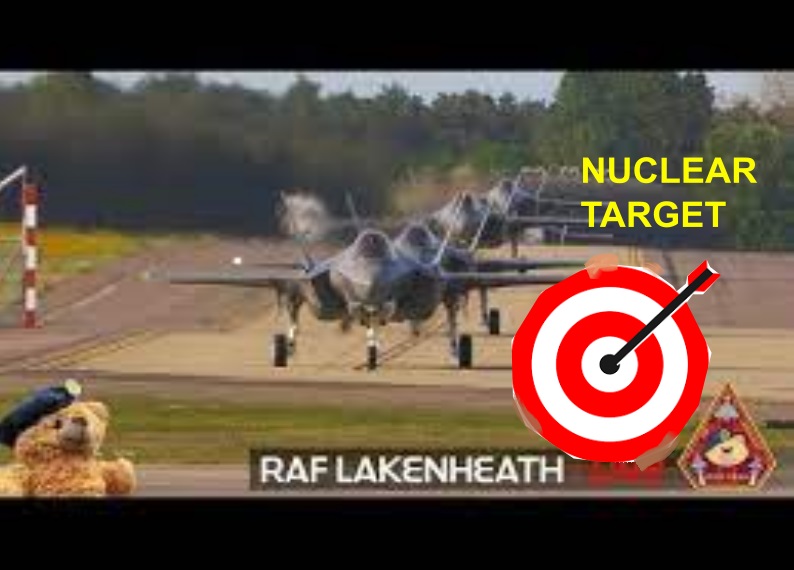
Emily Malia Mirror UK, GAU Writer, 27 Oct 2025
RAF Lakenheath in Suffolk, operated by the United States, is expected to house US/ NATO nuclear weapons in the near future. This development places the UK on the frontline of potential conflict between America and Russia.
The presence of American nuclear weapons on British soil significantly increases the nation’s risk of becoming a target. Military analysts suggest that in the event of war, Lakenheath would likely face strikes before attacks spread to other parts of the country.
Whilst experts acknowledge that nuclear conflict between the US, NATO and Russia would prove devastating globally, it’s crucial to grasp the direct consequences for British towns and cities. The Campaign for Nuclear Disarmament warns: “A single nuclear strike on any town or city would be catastrophic for the local community and environment, and the radioactive impact would spread much further.
“But a nuclear war would be catastrophic for all humanity, forms of life, and the entire planet. Yet the possibility of nuclear war is the greatest for many decades.”
Casualties
Their report reveals if a Russian warhead, such as an SS-25 or SS-27, were to strike the heart of London, nearly a million people would die. Similarly, a hit on Glasgow could result in 326,000 casualties, while in Cardiff, 196,000 lives would be lost.
The epicentre of the nuclear explosion is believed to reach a staggering temperature of several million degrees centigrade. Consequently, a heat flash would obliterate all human tissue within a 1.5 square mile radius.
Back in 1945, when the United States unleashed two atomic bombs over Hiroshima in Japan, all that was left within a half-mile radius were shadows seared into stone. The aerial bombings claimed up to 200,000 lives, most of whom were civilians………………………………………..
Further afield from the zone of instant devastation, there would be a gradual rise in fatalities among those who endured the initial explosion. Approximately seven miles from the blast site, individuals would sustain lethal burns or even require amputations, while others would be blinded or suffer internal injuries.
Unlike a typical disaster, the mortality rate would be shockingly high as most emergency services would be unable to respond due to their own personnel being killed and equipment destroyed. The sheer number of casualties would simply swamp the UK’s medical resources, with people as far as 11 miles away potentially suffering injuries from shattered windows or structural damage.
The long-term impact
In the ensuing days, even those fortunate enough to survive would now be impacted by the radioactive fallout, with the majority succumbing within a week. This would manifest in various ways, from hair loss to bleeding gums, fever, vomiting, delirium and even internal bleeding.
Those with lower levels of exposure would still face complications, including pregnant women who are at a high risk of miscarriage and birth complications. In addition, long-term effects could include radiation-induced cancers affecting many civilians, up to two decades after the event.
It’s believed that children of those exposed to radiation are statistically more likely to be born with abnormalities and suffer from leukaemia. Aside from public health, nuclear weapons are known to cause severe damage to the environment and climate on an unprecedented scale.
Predictions suggest that in the aftermath of a nuclear war, two billion people could face starvation due to climate disruption and its impact on food production. https://www.mirror.co.uk/news/world-news/horrifying-number-people-who-could-36139768
A Torturous Sanitation Disaster Is Unfolding in Gaza’s Displacement Camps
Every morning we wake to disease, dust, and the unbearable stench of open sewage.
By Sara Awad , Truthout, October 25, 2025
Ceasefire is a relief. After two years of surviving war, we can finally breathe — but that doesn’t mean our suffering is over. For many of us, it’s only just begun. The tents, and the people still living in them, stand as a heavy reminder that our struggles are far from over. After two years of immense destruction by the Israeli military, most families in Gaza are now living in tents — nylons and fabric that don’t protect them either from summer or winter.
In tent life, there is an unlivable war — a war that doesn’t begin with bombs, but with the absence of everything that makes life human. It is a war whose weapons are the denial of clean water, the lack of hygiene, the absence of toilets, dignity, and safety. I am not writing this as a distant witness. No — I am writing this from within it. From the ground. From inside the tent. These are not stories I’ve heard; these are the sensations I experience.
One month living in a tent was enough for me to understand the immense sanitation disaster and horrific conditions that make displaced people feel suffocated by everything around them. This kind of news doesn’t make headlines, and you might not have heard about it. But it is a silent kind of violence — one that kills us every day.
I am here to tell you how my people — including my family — are facing the devastating consequences of the sanitation crisis in these tents.
Thousands of makeshift tents at displacement camps all across Gaza are full of families seeking refuge.
A lack of sufficient toilets, access to clean water, and the presence of open sewage are catastrophic consequences faced by displaced Palestinians — conditions that have persisted since the early months of Gaza’s displacement crisis.
After spending over a month in Gaza City under Israeli occupation, 39-year-old Asma Mohammad and her family fled to the central Gaza Strip, seeking refuge in Al-Nuseirat Camp to escape the ongoing Israeli offensive. Speaking to me via WhatsApp, she described the daily struggle to access basic sanitation. “I have to walk nearly half an hour just to reach the bathroom,” Asma said. “I stopped drinking coffee or tea so I wouldn’t have to walk so far to use a filthy toilet that’s shared by hundreds of people.”
This is something that touches our dignity. I know what she meant because I am experiencing the same thing. Here where I am in az-Zawayda, in central Gaza, men spend a whole week building a bathroom — a toilet. It takes so long because there is no sewage system anywhere anymore. Israel has destroyed the vast majority of sewage facilities in every part of Gaza……………………………………………………………………………………………………………………………………………………………………………. https://truthout.org/articles/a-torturous-sanitation-disaster-is-unfolding-in-gazas-displacement-camps/?utm_source=Truthout&utm_campaign=ec58022e30-EMAIL_CAMPAIGN_2025_10_25_06_42&utm_medium=email&utm_term=0_bbb541a1db-ec58022e30-650192793
Are Our Priorities Wrong? Defence Spending vs Real Needs

the greatest threat to Australia’s security is subservience to U.S. militarism.
Politics for the people, 30 Oct 25
Introduction: A Nation Out of Balance
The latest Ipsos Issues Monitor shows that cost of living, housing, crime, and healthcare matter most to Australians. Yet fewer than 8 per cent name defence as a concern. Despite this, defence spending in Australia now stands at about A$59 billion for 2025-26, a record amount.
While households struggle with rent hikes, soaring groceries, and lengthy hospital waits, government priorities tell a different story. If our leaders can mobilise billions for submarines and foreign military bases, why not for homes, hospitals, and community safety?
The government’s growing defence spending shows how far priorities have shifted from citizens’ needs.
The Problem: Spending That Ignores Public Needs
1. Australians Struggle While Defence Budgets Soar
According to SBS’s “If the Budget Were $100”, defence receives $6.60, health $15.90, and welfare $37.00. The government insists on “fiscal responsibility” when it comes to families, but not when signing billion-dollar arms contracts.
This surge in defence spending contrasts sharply with the lack of targeted cost-of-living support.
The mismatch is stark: Australians cite the cost of living in Australia as their top issue, yet policies focus on militarisation. A nation cannot claim security when its citizens cannot afford food, rent, or electricity.
Internal link: Inflation in Australia: How It’s Reshaping Everyday Life
2. Housing and Healthcare Left Behind
The 2025-26 Budget allocates A$9.3 billion to social housing and homelessness, barely a sixth of defence spending. Hospitals receive about A$33.9 billion in Commonwealth funding, far short of what’s needed to end long emergency queues and staff shortages.
Using public money productively, Australia could expand housing supply and modernise hospitals without “finding” tax revenue. As a sovereign currency issuer, the Commonwealth can fund whatever domestic resources are available.
Internal link: Social Justice in Australia: Its Meaning and Path to Equality
The Impact: What Australians Are Experiencing
3. Everyday Australians Feel Forgotten
Workers juggle multiple jobs. Families spend over 30 per cent of their income on rent. Hospitals cancel surgeries due to staff burnout. Meanwhile, record military budgets create jobs, but not the kind that house or heal people.
This deepens inequality and fuels public frustration. Cost of living in Australia headlines dominate the news, yet solutions are still tokenistic while weapons programs thrive.
Internal link: Why It Feels So Hard to Get Ahead in Australia Today
4. Who Benefits from the Defence Boom – and Who Are We Really Defending Against?
Arms corporations and political donors benefit most. AUKUS contracts flow to foreign firms. U.S. forces rotate through Darwin, and Pine Gap stays a key U.S. intelligence hub.
So, who is Australia defending against? Officially, the government cites a “deteriorating Indo-Pacific environment.” Australia faces no imminent invasion. The real risk lies in our alliance obligations. Much of this defence spending directly supports U.S. strategic goals, not Australian security.
When Washington pursues containment of China, Australia follows, even if it damages trade and peace. This dependence undermines sovereignty and raises the uncomfortable truth: the greatest threat to Australia’s security is subservience to U.S. militarism.
Economic insecurity, environmental decline, and eroded independence are the dangers we should fear. As a nation with dollar sovereignty, Australia can defend its people through prosperity, not through weapons for U.S. wars.
The Solution: What Must Be Done
5. Use Dollar Sovereignty for People, Not War
Australia issues its own currency. It cannot “run out” of money but can run out of political will. By embracing Modern Monetary Theory principles, the government could fund full employment, universal healthcare, and green infrastructure before military expansion.
Internal link: Investing in Peace: Rethinking Australia’s Defence Strategy
6. Re-prioritise the Budget for National Wellbeing
Australia can realign its priorities by:
- Expanding public housing nationwide.
- Investing heavily in healthcare staffing and preventive care.
- Addressing crime through community programs, not incarceration.
- Keeping defence strictly for territorial protection, not for U.S. wars.
Redirecting even 10 per cent of Australia’s defence spending toward housing and health would transform lives and strengthen genuine security.
Frequently Asked Questions
- Why does Australia spend so much on defence?
Defence growth is politically tied to the U.S. alliance and AUKUS, not citizen demand. - Who are we really defending against?
Australia’s rising defence spending is driven more by alliance politics than genuine threats. No nation threatens Australia. The real danger is being drawn into conflicts created by foreign powers. - Can public money fund housing and health without cuts elsewhere?
Yes, as the currency issuer, Australia can fund both. The constraint is resources, not revenue. - What would happen if 10 per cent of defence spending were redirected?
Billions would build thousands of homes, hire nurses and teachers, and ease cost-of-living pressure.
Final Thoughts: Time to Fund What Matters…………………………………………………… https://socialjusticeaustralia.com.au/defence-spending-vs-real-needs/
Report: Israel Launched Airstrike in Gaza on Saturday After Getting US Approval.

The IDF has killed at least 93 Palestinians in Gaza since the ceasefire went into effect
by Dave DeCamp | October 26, 2025, https://news.antiwar.com/2025/10/26/report-israel-launched-airstrike-in-gaza-on-saturday-after-getting-us-approval/
Israel launched an airstrike in Gaza on Saturday after notifying the US and getting approval to launch the attack, the Israeli news site Ynet has reported.
The Israeli military launched the strike in the Nuseirat Refugee Camp in central Gaza, claiming it targeted a member of Palestinian Islamic Jihad (PIJ) who was planning an attack on the IDF, a claim PIJ strongly denied.
PIJ said in a statement that the claim that its military wing, the al-Quds Brigades, was preparing an attack was “a pure false claim and fabrication through which the occupation seeks to justify its aggression and violation of the ceasefire.” PIJ, which supported the ceasefire deal, called on mediating countries to “compel” Israel to stop its attacks on Gaza.
The strike wounded four Palestinians, according to the al-Awda Hospital. “The hospital has received four injured people following the Israeli occupation’s targeting of a civilian car in the al-Ahli Club area in Nuseirat Camp in central Gaza,” the hospital said.
The Ynet report said the alleged PIJ operative who was targeted was wounded, not killed. According to Israeli sources, the strike came after Israel passed intelligence to the US, and the attack was only launched after coordination with US Central Command (CENTCOM), which included notifying CENTCOM Commander Adm Brad Cooper. CENTCOM has established a military post in southern Gaza where it is overseeing the Gaza ceasefire.
US Middle East envoy Steve Witkoff was also briefed on the strike right after it was launched. The attack marked the first time that Israel and the US used a new mechanism to coordinate on military action in Gaza under the ceasefire deal. Hamas, a signatory to the ceasefire deal, called the Israeli strike a “clear violation” of the agreement.
In response to the report and criticism of the US-Israel relationship, Israeli officials said they were coordinating with the US but insisted Israel doesn’t need “approval” to bomb Gaza.
According to the Palestinian news agency WAFA, Israel also launched a drone strike on Friday that killed two Palestinians, and there’s no sign that Israel coordinated with the US on the attack. Gaza’s Health Ministry said on Sunday that Israeli forces have killed at least 93 Palestinians in Gaza since the ceasefire went into effect, including four who were killed over the previous 48 hours.
US Deploying Aircraft Carrier Strike Group Near Venezuela as Regime Change Push Heats Up
by Dave DeCamp | October 26, 2025 , https://news.antiwar.com/2025/10/26/us-deploying-aircraft-carrier-strike-group-near-venezuela-as-regime-change-push-heats-up/
The US military is deploying an aircraft carrier to the waters near South America as the Trump administration continues its military buildup in the Caribbean and its push toward war with Venezuela.
Sean Parnell, a US War Department spokesman, wrote on X on Friday that the USS Gerald Ford and its strike group, which includes five destroyers, will be heading to US Southern Command’s area of responsibility to “bolster US capacity to detect, monitor, and disrupt illicit actors and activities that compromise the safety and prosperity of the United States homeland and our security in the Western Hemisphere.”
The Gerald Ford has been deployed in the Mediterranean Sea, and according to a ship tracker, it is currently off the coast of Croatia in the Adriatic Sea. According to USNI News, it would take the aircraft carrier at least a week to reach SOUTHCOM’s area of responsibility from Croatia.
The deployment of the aircraft carrier and accompanying warships will mark a significant escalation of US military power in the region amid reports that the US is soon planning to bomb Venezuela with the goal of ousting President Nicolas Maduro.
The US has been stepping up the military pressure on Venezuela by flying bombers near its coast and continuing its bombing campaign against alleged drug boats in the region. A US Navy destroyer, the USS Gravely, has also arrived in Trinidad and Tobago for joint exercises near the coast of Venezuela.
Also on Friday, War Secretary Pete Hegseth announced the 10th US airstrike against a boat that he claimed was carrying drugs. The Pentagon has provided no evidence to back up its claims about what the boats it has been bombing are carrying, and has also not provided any information about the identities of the people it has been killing, who are labelled as “narco-terrorists” to justify their extrajudicial execution.
Hegseth said the latest boat strike targeted a vessel in the Caribbean and killed six “narco-terrorists,” bringing the total number of people extrajudicially executed by the US military in the region since September 2 to 43, according to numbers released by the Trump administration. “If you are a narco-terrorist smuggling drugs in our hemisphere, we will treat you like we treat Al-Qaeda. Day or NIGHT, we will map your networks, track your people, hunt you down, and kill you,” the US war chief said.
President Trump and his top officials have framed the bombing campaign and push toward war with Venezuela as a response to the large number of overdose deaths in the US, but the deaths are primarily caused by Fentanyl and other opioids, which do not come from Venezuela. A US official has told Drop Site News that US intelligence has assessed that little to no of the fentanyl trafficked to the United States is being produced in Venezuela.
Trump officials have also been claiming that the boats they are targeting are attempting to carry drugs to the US, but the official speaking to Drop Site said many of the boats targeted for strikes do not even have the requisite gasoline or motor capacity to reach US waters.
ATOMIC BLACKMAIL? The Weaponisation of Nuclear Facilities During the Russia-Ukraine War.
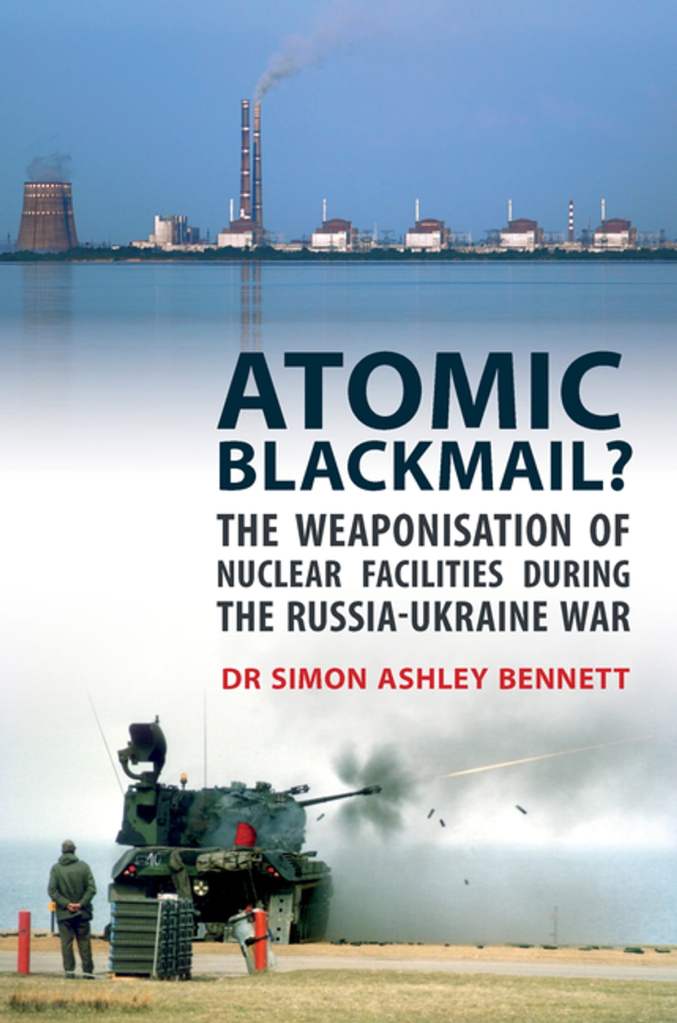
a protagonist could use long-range munitions to turn a NPP into a dirty bomb that would spread radioactive contamination over a wide area, dispersing or diverting army formations, rendering civilian infrastructure and farmland unusable, contaminating groundwater and creating a radioactive cloud that would – if the wind was blowing in a convenient direction – cause transborder harms.
Simon Ashley Bennett, https://www.libripublishing.co.uk/Products/CatID/16/ProdID=292
In Atomic Blackmail? Simon Bennett examines the very real possibility of the ‘weaponisation’ of nuclear facilities during the Russia-Ukraine War. The Russia-Ukraine War has several unique aspects, the most striking of which is that it is being fought in proximity to nuclear facilities and working nuclear power stations, including the six-reactor Zaporizhzhia Nuclear Power Plant (NPP), Europe’s largest, and the decommissioned four-reactor Chernobyl NPP that, in 1986, suffered a catastrophic failure that released radioactive contamination across much of Europe. Some experts claim the contamination caused several thousand excess cancer deaths.
In 1985, foreign affairs and nuclear expert Bennett Ramberg published Nuclear Power Plants: An Unrecognised Military Peril, with a second edition of the book published in 1992. In his visionary discourse, Ramberg posited that in future wars, regional or global, nuclear facilities and powerplants might be weaponised, to gain political traction over an opponent and/or neutralise opposing forces’ capacity for battlefield manoeuvre.
In one scenario, Ramberg described how a protagonist could use long-range munitions to turn a NPP into a dirty bomb that would spread radioactive contamination over a wide area, dispersing or diverting army formations, rendering civilian infrastructure and farmland unusable, contaminating groundwater and creating a radioactive cloud that would – if the wind was blowing in a convenient direction – cause transborder harms. As demonstrated by the Chernobyl disaster, a reactor malfunction can generate serious and long-lasting environmental impacts. Radioactive particles released from Chernobyl’s devastated Reactor Number Four were deposited as far afield as the Cumbrian hills in north-west England.
While, at the time of writing, none of Ukraine’s fifteen reactors had been damaged in an exchange of fire, the possibility remains that this could happen during Ukraine’s 2023, and subsequent, offensives to expel Russian forces from sovereign Ukrainian territory. Much to the consternation of the International Atomic Energy Agency (IAEA), there have been several near-misses, with weapons fired in and around both the decommissioned Chernobyl NPP and working Zaporizhzhia NPP. Further, Russian long-range precision munitions (cruise missiles) have been tracked flying either close to, or over Ukraine’s NPPs. The Pivdennoukrainsk (South Ukraine) NPP has been overflown. On 20 September, 2022, a missile landed some 300 metres from the NPP.
While Ramberg’s nightmare vision of destroyed NPPs rendering a country uninhabitable has not, yet, been realised in the Russia-Ukraine War, the longer and more intense the conflict, the greater the likelihood that one or more of Ukraine’s NPPs will be damaged or, via a credible sabotage threat, used to leverage tactical or strategic advantage. Atomic blackmail finally exampled.
Trump’s ‘peace plan’ traps Gaza in limbo
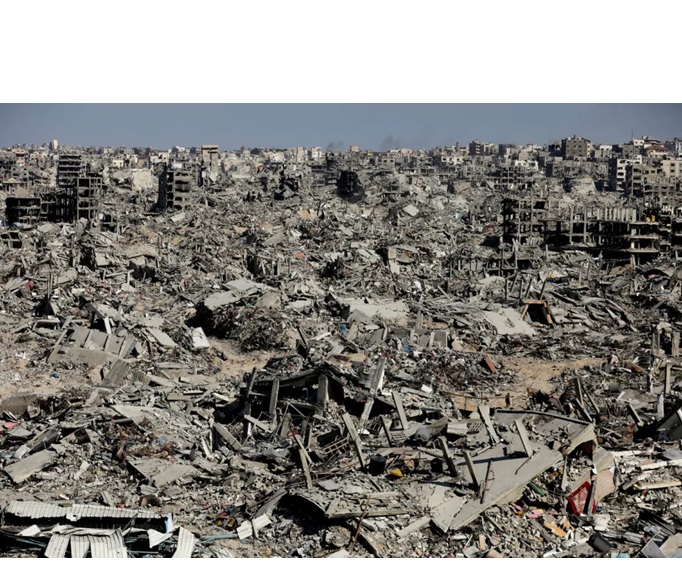
Gaza is now trapped in the limbo of the uncertainty surrounding the Trump plan. The U.S. might prevent Netanyahu from resuming Israel’s genocide, but unless Palestinians gain full control over Gaza’s future, it’s just a slower form of killing.
Mondoweiss, By Mitchell Plitnick October 25, 2025
On Tuesday, Israeli military sources announced that, in their estimation, Hamas still has some 20-25,000 fighters, although many of them are new recruits who are not well trained. They also said Hamas still has “hundreds” of rockets, although the majority of Hamas’ arsenal is said to have been destroyed.
Retired General Giora Eiland, who still has a significant position in Israel’s military hierarchy, added that the tunnel network in Gaza is still some 80% intact.
If these estimates are true, and that is far from clear, it’s either an admission of grave failure by Israel or an admission that destroying Hamas was never the point of the genocide that Israel has committed over the past two years. Or, possibly, both.
These statements are meant to arouse a feeling in Washington and in Israel that the “job” is not yet finished and Israel must be allowed to resume its genocide.
Israeli Prime Minister Benjamin Netanyahu has been squirming under the weight of President Donald Trump’s imposed ceasefire since it began, even while he has been forced to present a smiling public face about it.
Netanyahu’s immediate strategy is to require Trump to keep full pressure on Israel to maintain the “ceasefire.” He is doing this with a steady stream of provocative and deadly actions. He is allowing some aid into Gaza, but not nearly enough. Israel continues to work at provoking Palestinian responses with targeted attacks and provocative actions.
On Sunday, Israel suffered losses in the Rafah area under disputed circumstances. The United States allowed some response, but sharply limited it, preventing Israel from using the incident as an excuse for abandoning the ceasefire deal.
Lest anyone mistake the Trump administration’s actions for beneficence, there was complete silence from Washington the previous day, when Israeli forces fired on a Palestinian civilian vehicle near Gaza City, wiping out a family of eleven, including seven children.
Trump has continued to accuse Hamas of breaching the ceasefire, while ignoring Israel’s actions, which have thus far led to over 100 Palestinian deaths in Gaza since the ceasefire began.
But even while Trump has continued to issue empty threats against Hamas, his administration’s actions have been aimed at restraining Israel. The dispatch of Jared Kushner and Steve Witkoff, followed by Vice President JD Vance, and now Secretary of State Marco Rubio has had the effect of making sure that Israel is aware that the U.S. is watching and is not prepared to see this ceasefire collapse.
In a very telling episode, the Knesset voted to annex major chunks of the West Bank while Vance was in the country. This drew a sharp rebuke from the Vice President and a panicked response from Netanyahu. It is a stark contrast to Joe Biden’s meek response more than a decade ago when he visited Israel and the government announced a major new settlement while he was there. President Barack Obama was quite upset by the incident, but Biden wanted to ignore it.
Trump on Thursday warned Israel that the U.S. would no longer support Israel if it annexed the West Bank. But for Gaza, this isn’t a sustainable position. Trump is not going to maintain this kind of pressure indefinitely. He has put the annexation question to bed for some time (which just means that Israel will simply go on with its gradual annexation of the West Bank rather than the dramatic move of a formal annexation), but Gaza will require much longer-term engagement. More importantly, Trump’s “20-Point Plan” faces serious obstacles, and they are of a type that is very likely to result in the U.S. administration becoming frustrated with Hamas more than with Israel.
The danger of Hamas’ “Yes, but…”
Hamas made it clear when it agreed to the ceasefire that it was not agreeing to all of Trump’s plan. All parties understood that. ………………………………………………………………………………………………………………………………
Trump has a vested interest in seeing the ceasefire endure, but what does that mean in practice?
Neither Trump nor Netanyahu is going to be willing to allow Palestinians to govern themselves, even as technocrats. Without that, there will continue to be resistance. It’s that simple
Some limited rebuilding might be contemplated, but right now, that is being used as a tool to force Hamas to comply with Trump’s demands for their disarmament and disbandment. Jared Kushner made that clear, explicitly stating that any reconstruction efforts would be concentrated in the area of Gaza that remains under Israeli control.
Yet as much as Netanyahu would like to return to the all-out slaughter, he is not going to risk Trump’s wrath to do it. But in the meantime Gaza is likely to be trapped in a nightmarish middle ground between genocide and a functioning future.
Israel will not tolerate any security role in Gaza for Türkiye, as Trump has floated. They’d much prefer that both security and governing forces in Gaza be led by the U.S. or, short of that, more pliant Muslim countries such as Indonesia and Azerbaijan. Azerbaijan is perhaps Israel’s closest, if one of its quietest, allies in the Muslim world. Trump has already secured the participation of Indonesia and is working on Azerbaijan. ………………………………….
Gaza is now caught in the netherworld of the uncertainty of the Trump plan. While Vice President Vance says the ceasefire is “going better than expected,” it is not going anywhere for the people of Gaza.
Vance was remarking on how Israel is “complying” with Trump’s directives. That is, they are not killing so many Palestinians or doing so much shooting that the ostensible ceasefire would collapse.
But autumn is soon going to turn to winter in Gaza. There are insufficient shelters for most of the people, inadequate supplies of food and water, few heat sources, and limited means to address these issues in the short time allotted…………………………………………
The International Court of Justice’s advisory opinion, issued on Wednesday, provoked an hysterical response from Washington, as it ordered Israel to cooperate with all UN agencies, including the UN Relief and Works Agency (UNRWA), which Israel has falsely accused of supporting Hamas and encouraging attacks on Israel……………………….
All of this leaves the people of Gaza facing a different kind of hardship. There doesn’t seem to be any immediate rush to deploy an international force that would lead to a further Israeli withdrawal and enhanced efforts to clear the massive amounts of rubble. Without that necessary first step, reconstruction cannot truly begin in a sustainable way.
The population is cold, hungry, and facing unprecedented health crises that will go on for many years, according to the World Health Organization. While diplomats bicker, those conditions worsen……………………
Trump might prevent Netanyahu from returning to the full force of Israel’s two-year genocide, and that is still a real positive. But what the people of Gaza are facing now, with so many unanswered questions about how the Strip is to be managed, fed, supplied, and secured, carries with it its own set of threats.
It’s better than the genocide that was, but unless Palestinians are given full access to their own decisions and the tools they need to rebuild and survive until Gaza is rebuilt, it’s just a slower kind of killing. https://mondoweiss.net/2025/10/trumps-peace-plan-traps-gaza-in-limbo/
The threat of nuclear Armageddon.
The risk of nuclear conflict is higher today than ever before. The time is now to revive stalled efforts towards disarmament and arms control
IPS Journal, 27 Oct 25
Rolf Mützenich, Berlin, Rolf Mützenich has been a member of the German Bundestag since 2002. He was the Chairman of the SPD parliamentary group in the Bundestag from 2019 to 2025.

EN
Foreign and security policy 27.10.2025 | Rolf Mützenich
The threat of nuclear ArmageddonThe risk of nuclear conflict is higher today than ever before. The time is now to revive stalled efforts towards disarmament and arms control
The recently released thriller ‘A House of Dynamite’, now showing in cinemas and on Netflix, takes a powerful look at a topic that had long been considered a thing of the past following the end of the Cold War: the threat of nuclear Armageddon. In Kathryn Bigelow’s film, the US military suddenly discovers an intercontinental ballistic missile over the Pacific Ocean that could reach the US mainland within minutes. From different perspectives, the film tells how political and military decision-makers attempt to respond to the crisis. It becomes clear how vulnerable we are despite sophisticated defence systems and strategic war games, and how quickly a single attack using a nuclear weapon could escalate into a global catastrophe within minutes.The film is not a distant fantasy, but reflects an increasingly realistic scenario of our present. The days when former US President Barack Obama promoted the vision of a nuclear-free world in Prague back in 2009 now seem like a thing of the distant past. In their place, we are witnessing the return of open threats of nuclear war, tactical nuclear strikes being discussed as a serious military option in the strategic considerations of the major powers, disarmament and arms control treaties expiring or being terminated, nuclear arsenals being modernised and new delivery systems being developed. The bitter truth is that the risk of nuclear conflict is probably higher today than ever before. We are on the threshold of a new nuclear age that is even more complex, unpredictable and uncertain than the so-called ‘balance of terror’ during the Cold War…………………………………………………….
A broader global trend
The world is currently moving towards a new tri- or even multipolar nuclear age. At present, nine countries possess nuclear weapons, including the five permanent members of the UN Security Council as well as Israel, India, Pakistan and North Korea. However, in view of growing global uncertainties and geopolitical tensions, more and more countries are considering developing their own nuclear capabilities. ……………………………………………………………………..
The existing system of disarmament and arms control is already on the brink of collapse. In recent years, both Russia and the United States have terminated the Intermediate-Range Nuclear Forces Treaty (INF) and the Open Skies Treaty. With the expiry of the New START Treaty in February 2026, there is a threat that the last remaining arms control agreement between the two largest nuclear powers will be lost………………………………………………….
Counting on others and working together
It is therefore high time to breathe new life into the stalled efforts towards disarmament and arms control. The focus should be on limiting strategic nuclear arsenals and preserving the existing treaties…………………………………………………………. https://www.ips-journal.eu/topics/foreign-and-security-policy/the-threat-of-nuclear-armageddon-8642/
Israel and US Scorn ICJ Ruling Against Starving Civilians as Method of Warfare

The World Court says Israel has a duty as the occupying power to cooperate with UN relief efforts, not impede them.
By Marjorie Cohn , Truthout. October 24, 2025
World Court) told Israel what seems obvious to any reasonable person — that it cannot starve civilians as a method of warfare. But Israel does not act in accordance with international law, as evidenced by its two-year campaign of genocide against the Palestinian people in Gaza, during which it has killed over 68,000 Gazans (more likely 680,000, UN Special Rapporteur Francesca Albanese said on September 15).
In its 71-page advisory opinion, issued on October 22, the ICJ reiterated that Israel is illegally occupying the Gaza Strip. The court unanimously held that as the occupying power, Israel has obligations under international humanitarian law to ensure that the population of the Occupied Palestinian Territory, including Gaza, has essential supplies of everyday life, including water, food, shelter, clothing, bedding, and fuel, as well as medical equipment and services. The court also held that Israel must respect and protect all medical and relief personnel and facilities.
The ICJ ruled 10-1 in its advisory opinion that Israel has an obligation to facilitate humanitarian relief by the United Nations Relief and Works Agency for Palestine Refugees in the Near East (UNRWA) and other international organizations and third states, and must refrain from impeding that relief.
And the court unanimously held that Israel must respect the prohibition on deportation and forcible transfer in the Occupied Palestinian Territory, and the right of the Palestinian prisoners held in Israel to be visited by the International Committee of the Red Cross. The court noted that transfer is forcible not just when it is achieved by physical force, but also when people have no choice but to leave because the occupying power has inflicted conditions of life that are intolerable.
The ICJ rejected Israel’s bogus defense that its national security trumped its obligations under international humanitarian law, saying that the protection of security interests is not a “free-standing exception” allowing a state to violate its international humanitarian law obligations………………………………………………………………………….
Impacts of ICJ Advisory Opinions
Although advisory opinions of the ICJ are nonbinding, they carry great moral, political, and diplomatic weight with third states. On July 19, 2024, the ICJ held that Israel’s occupation of Palestinian territory is illegal and all states have an obligation not to recognize as legal the situation arising from the unlawful presence of Israel in the Occupied Palestinian Territory, and not to render aid or assistance in maintaining that situation. As a result of that ruling (and domestic pressure), several states have now recognized Palestine as an independent state…………………………………………………………………………………………………………….
The Israeli Foreign Ministry said that it “categorically rejects” the ICJ’s October 22 advisory opinion, stating that the court ignored the “extensive evidence” Israel provided of what it claimed was UNRWA’s “infiltration” by Hamas and UNRWA’s complicity in terrorist activities. “This is yet another political attempt to impose political measures against Israel under the guise of ‘International Law,’” the ministry alleged.
Likewise, the U.S. State Department called the advisory opinion “corrupt,” claiming that it “unfairly bashes Israel and gives UNRWA a free pass for its deep entanglement with and material support for Hamas terrorism.”………………………………………………………………………………………………………………………………………………………………………………………………….
The Current Situation
Before the October 10 ceasefire deal between Israel and Hamas took effect, UN-supported global experts warned that over 640,000 Palestinians were facing catastrophic levels of food insecurity and that there was an “entirely man-made” famine in Gaza City.
Since the ceasefire began, Israel has started allowing some aid into Gaza, but nowhere near enough to meet its legal obligations and assist the starving Gazans. The UN World Food Program is getting about 750 tons of food aid into Gaza daily, still far below its target of 2,000 tons per day. Although the ceasefire agreement requires 600 trucks per day of food and other humanitarian supplies, only 263 trucks entered Gaza on October 20, and 281 trucks entered Gaza on October 22, less than half of the agreed-upon number.
The Gaza Humanitarian Foundation has suspended operations, as it runs out of money and faces leadership problems and logistical obstacles to a resumption of its work.
Meanwhile, the ICJ is considering the merits of South Africa’s case against Israel that alleges Israel breached the Genocide Convention. Arrest warrants for Israeli Prime Minister Benjamin Netanyahu and former Defense Minister Yoav Gallant for war crimes and crimes against humanity — for intentionally and knowingly depriving the civilian population in Gaza of objects indispensable to their survival and intentionally directing an attack against a civilian population — are pending in the International Criminal Court.
During the past two years, millions of people globally have demonstrated in solidarity with the Palestinian people, and the Boycott, Divestment, Sanctions movement has achieved widespread popular support.
The new advisory opinion issued by the ICJ will continue to shame Israel in the eyes of the world. https://truthout.org/articles/israel-and-us-scorn-icj-ruling-against-starving-civilians-as-method-of-warfare/
Israel’s AI use in Gaza potentially normalizes civilian killings, obscures blame, exposes Big Tech complicity: Expert

Israel is using AI systems with known inaccuracy risks at ‘almost every stage’ of its military operations, says Heidy Khlaaf, chief AI scientist at AI Now Institute
Mevlut Ozkan 07.04.2025, https://www.aa.com.tr/en/artificial-intelligence/israel-s-ai-use-in-gaza-potentially-normalizes-civilian-killings-obscures-blame-exposes-big-tech-complicity-expert/3526518
– The sheer scale and complexity of AI models makes it ‘impossible to trace their decisions that can hold any individual or military accountable,’ warns Khlaaf, a former systems safety engineer at OpenAI
– ‘Amazon, Google and Microsoft are explicitly working with the IDF to develop or allow them to use their technologies … despite being aware of the risks of AI’s low accuracy rates … and how the IDF intends to use their systems for targeting,’ says expert
ISTANBUL
Israel’s use of artificial intelligence (AI) in its ongoing assault on the Gaza Strip – aided by tech giants such as Google, Microsoft, and Amazon – is fueling concerns over the normalization of mass civilian casualties and raising serious questions about the complicity of these firms in potential war crimes, according to a leading AI expert.
Multiple reports have confirmed that Israel has deployed AI models such as Lavender, Gospel, and Where’s Daddy? to conduct mass surveillance, identify targets, and direct strikes against tens of thousands of individuals in Gaza – often in their own homes – all with minimal human oversight.
Rights groups and experts say these systems have played a critical role in Israel’s incessant and apparently indiscriminate attacks, which have laid to waste massive swaths of the besieged enclave and killed more than 50,000 Palestinians, mostly women and children.
“With the explicit use of AI models that we know lack precision accuracy, we are only going to see the normalization of mass civilian casualties, as we have kind of seen with Gaza,” Heidy Khlaaf, a former systems safety engineer at OpenAI, told Anadolu.
Khlaaf, who is currently a chief AI scientist at AI Now Institute, warned that this trend could establish a dangerous precedent in warfare where military forces deflect responsibility for potential war crimes onto AI systems, while benefiting from the lack of a robust international mechanism to intervene or hold actors accountable.
“This is really a dangerous combination that can lead to military entities not being held accountable for potential war crimes, where they can simply point to an AI system and say, ‘Hey, it’s this algorithm that decided this. It wasn’t me,’” she said.
She stressed that Israel is using AI systems at “almost every stage” of its military operations – from intelligence collection and planning to final target selection.
The AI models, she explained, are trained on a variety of data sources, including satellite imagery, intercepted communications, drone surveillance, and the tracking of individuals or groups.
“They develop multiple AI algorithms that use a statistical or probabilistic calculation from this historical data that they’ve been trained on to predict where future targets may be,” she elaborated.
However, she emphasized that these predictions “do not necessarily reflect reality.”
Khlaaf pointed to recent revelations that commercial large language models (LLMs) like Google’s Gemini and OpenAI’s GPT-4 were used by the Israeli military to translate and transcribe intercepted Palestinian communications, automatically adding individuals to target lists “purely based on keywords.”
She noted that various investigations have confirmed that one of the Israeli military’s operational strategies involves generating large numbers of targets through AI without verifying their accuracy.
The expert underlined that AI models are fundamentally unreliable for tasks requiring high precision, such as targeting in military operations, because they rely on statistical probabilities rather than verified intelligence.
“Unfortunately, assessments have shown that AI models used for targeting can have an accuracy rate as low as 25%,” Khlaaf said.
“So, given this track record of AI’s high error rates, with a force like the IDF (Israel Defense Forces), who is willing to accept a large amount of civilian casualties to take one target out … then this sort of inaccurate automation of target selection is really not far from indiscriminate bombing at scale.”
Automation without accountability
Khlaaf further emphasized that the increasing use of AI in war is setting a dangerous precedent, where accountability is obscured.
“AI is setting this precedent that normalizes inaccurate targeting practices, and because of the sheer scale and complexity of these models, it then becomes impossible to trace their decisions that can hold any individual or military accountable,” she asserted.
Even the so-called “human in the loop” safeguard, often promoted as a fail-safe against AI errors, appears insufficient in the case of the IDF, she added.
Investigations revealed that the humans overseeing Israel’s AI-generated targets operated under “very loose guidance,” casting doubt on whether efforts were even made to minimize civilian casualties, according to Khlaaf.
She warned that the current trajectory could enable militaries to shield themselves from war crime allegations by blaming AI for erroneous targeting.
“If it’s hard to trace … why an AI may have contributed to civilian casualties, then you can very well imagine a case where it’s used heavily exactly to avoid accountability for killing a large amount of civilians,” she said.
‘Amazon, Google and Microsoft explicitly working with IDF’
Khlaaf confirmed that major US-based tech firms are directly involved in supplying AI and cloud computing capabilities to the Israeli military.
“This is not a new trend,” she noted, recalling that Google has been providing AI and cloud services to the Israeli military since 2021 through its $1.2 billion Project Nimbus, alongside Amazon.
Microsoft’s involvement also deepened after October 2023, as Israel relied more on its cloud computing services, AI models, and technical support, she said.
Other companies, including Palantir, have also been linked to Israeli military operations, although details of their roles remain sparse, she added.
Crucially, Khlaaf argued that these partnerships went beyond the sale of general-purpose AI tools.
“It’s important to point out that the IDF isn’t just using off-the-shelf cloud or AI services and taking them and just putting them in military applications,” she explained.
“Amazon, Google and Microsoft are explicitly working with the IDF to develop or allow them to use their technologies for intelligence and targeting, despite being aware of the risks of AI’s low accuracy rates, their failure modes, and how the IDF intends to use their systems for targeting.”
The implications suggest that tech companies were “complicit and directly enabling” Israeli actions, including those that “would be categorized or ruled as unlawful or that amount to war crimes,” Khlaaf said.
“If it has been determined that the IDF is committing specific war crimes, and the tech companies have guided them in committing those war crimes, then yes, that makes them very much complicit,” she added.
‘An enormous gap’
Khlaaf warned that the world is witnessing “the full embrace of automated targeting without due process or accountability,” a phenomenon backed by increasing investments from Israel, the US Department of Defense, and the EU.
“Our legal and technical frameworks are not prepared for this type of AI-based warfare,” she said.
Although existing international law, such as Article 36 of the 1949 Geneva Convention, mandates legal reviews for new weapons, there are currently no binding international regulations specific to AI-driven military technologies.
Additionally, while the US maintains export controls on specific AI-enabling technologies such as GPUs and certain datasets, there is no “wholesale ban on AI military technology specifically,” she noted.
“There’s an enormous gap there that hasn’t really been addressed as of yet,” Khlaaf said.
Pentagon orders USS Gerald R. Ford into Caribbean, first carrier sent to region
Yahoo News, Nicholas Slayton, Sat, October 25, 2025
The Pentagon ordered the Gerald R. Ford Carrier Strike Group to sail to the Caribbean, adding one of the Navy’s largest and most potent formations to the major U.S. build-up in the region. The new deployment will add the aircraft carrier’s more than 70 aircraft and multiple destroyers to the array of firepower already sent to the region for a mission the White House insists is aimed at drug traffickers.
Pentagon spokesperson Sean Parnell confirmed the deployment in a statement, saying the strike group would be “in support of the President’s directive to dismantle Transnational Criminal Organizations (TCOs) and counter narco-terrorism.”
Carrier Strike Group 12 includes the USS Gerald R. Ford, the destroyers USS Bainbridge and USS Mahan and Carrier Air Wing 8. Their arrival makes this fall’s buildup one of the largest deployments of naval power since the start of the Red Sea conflict in late 2023. The strike group’s air contingent includes four squadrons of F/A-18 fighters and one squadron of E/A-18G strike fighters.
Word of the deployment came shortly after Defense Secretary Pete Hegseth announced another airstrike on a civilian vessel in the Caribbean. Hegseth said the strike killed six on board, a tally which would bring the death toll in U.S. strikes on boats in the region to 43 since September, according to White House figures.
Hegseth accused the crew of being members of the gang Tren de Aragua, a group the administration has often linked to the boats with little public evidence. It was the 10th strike in total, and the third one in as many days.
Governments and media in the region have reported that those killed or wounded in U.S. strikes have included citizens from Colombia, Ecuador, and Trinidad and Tobago. At least two sailors have been rescued by U.S. forces after surviving strikes on their boats, including an Ecuadorian man who was released days later when authorities in his country said there was no evidence of a crime to charge him with.
Earlier this year, the Trump administration designated several gangs and drug cartels as “foreign terrorist organizations,” and accused the Venezuelan government of collaborating with them. The White House has advised Congress that the U.S. is in an “armed conflict” with these gangs, but no Congressional authorization for the use of force has been given……………………………………………………. https://www.yahoo.com/news/articles/pentagon-orders-uss-gerald-r-183731366.html?guccounter=1&guce_referrer=aHR0cHM6Ly93d3cuc290dC5uZXQv&guce_referrer_sig=AQAAAC-xq4OFcery8IiSv68w1zrTr-PmRrn6IBwmoiNxApl6bQszSfDGY6O51M4yAGAU1O90WYXwK-DRaUu0nfau6ncVUnxrYVkwer67gcsHqDulCR8Y2h3pG0HD-S1OJ9NpV1QqBFkaKO0mADBLxw3mgTmEliwGClbGebBO1lPCO-bZ
Tomahawks, Raytheon, and Zelensky’s $90 billion shopping list at the White House

Reflecting Volodymyr Zelensky’s confidence that the Trumpster would oblige him, he, Zelensky, actually visited Raytheon, the Tomahawk’s maker, before his session at the White House.
Patrick Lawrence: Desperation Row
By Patrick Lawrence, Consortium News, 20 Oct 25
What a big game Volodymyr Zelensky talked before his latest little while in the Oval Office last Friday.
The Ukrainian president (who is no longer legitimately the Ukrainian president) arrived for another summit with President Trump with a shopping list of air defense and weapons systems worth $90 billion.
Yes, $90 billion. This compares with $128 billion the United States has already given Ukraine since the Russian intervention began in February 2022, according to a Council on Foreign Relations report dated July 15, 2025.
Playing to Trump’s penchant for keeping everything business, Zelensky said Ukraine would purchase all the new hardware in what he called “a mega deal.” What nonsense. Kiev is flat broke. How could the regime possibly pay for new weapons and matériel?
Would Kiev write Washington a check out of funds Washington has previously sent? Or does Zelensky mean NATO, which is supposed to buy American weaponry to pass on to Ukraine, will finance his shopping list? Zelensky now speaks for the European end of the Atlantic alliance, is it?
The only other thought I have is that the Zelensky regime intends to pay for the new gear with the billions of euros the Europeans promise to send Kiev — the billions, that is, the Europeans now plan to steal from Russia’s frozen assets. But that money is supposed to keep Kiev in pencils and paper clips for a short while longer.
Oh, what tangled webs these people weave. Or propose to weave.
But the hopelessly corrupt Zelensky had more than a 70 percent raise on his mind when he arrived in Washington. The master importunist also wanted an unstated number — let’s just say a lot — of Tomahawk missiles atop this.
Tomahawks, long-range missiles capable of a nuclear payload, go for $2 million to $2.5 million apiece, and by the reporting I have seen the idea was Trump would send these gratis. Reflecting Zelensky’s confidence that the Trumpster would oblige him, he, Zelensky, actually visited Raytheon, the Tomahawk’s maker, before his session at the White House.
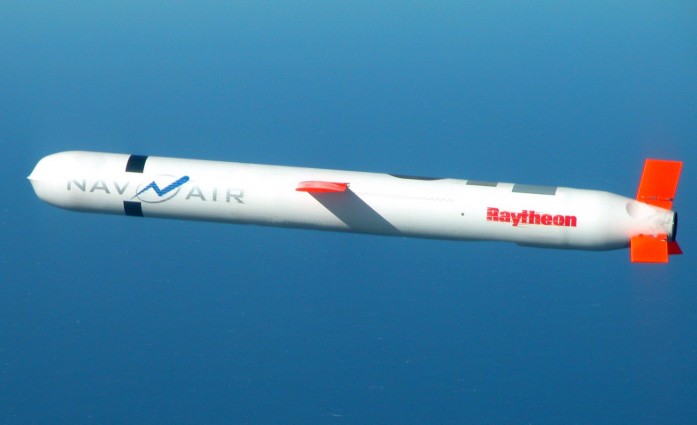
This is a crook with nerve: You have to give Volodymyr this much.
More weapons, fewer talks: This was the Kiev regime’s clever-sounding but very stupid formula as Zelensky prepared to shake the bowl once again. Time to start hitting Russian targets relentlessly. It is the only way to get Moscow seriously to negotiate an end to the war. This is the latest line.
In the event, Zelensky’s time in the Oval Office was not as awkward as that mess he made when he first met Trump last February. But it was in that direction. The protocol people seated Vlod so his back was to the journalists covering the event — a subtle but unmistakable dis, this. And when Zelensky briefed media afterward, they made him do so outside the White House.
Trump Axes the Tomahawks
No Tomahawks for Volod, then, at least none now. Trump made this clear before, during and after his time with the Ukrainian mooch. The fate of the rest on Zelensky’s list is unclear, but my guess is Kiev will get what the Europeans buy from U.S. weapons makers and send south across the Polish border.
The decisive moment in this — the decisive two hours, this is to say — came a day before Zelensky’s White House visit, when Trump took a call from Vladimir Putin and spent as many hours talking to the Russian president. By all accounts Trump’s then-pending decision on the Tomahawks question took up a considerable part of the exchange.
Trump’s comments afterward testify to this. “Tomahawk is a vicious, offensive, incredibly destructive weapon,” he said immediately following the call. “Nobody wants Tomahawks shot at them.”
Speaking just as he began talks with Zelensky, Trump remarked, “Hopefully we will be able to get the war over without thinking about Tomahawks.”
The argument is commonly made that Donald Trump thinks and believes what the last person he has spoken to tells him is so. And fair enough: Trump is plainly a man of shallow intellect and has no sound judgment in matters of state.
The easy out for this kind of person is to repeat with faux-conviction the views of anyone whose judgments, whatever they may be, are respected. But to suggest that Putin has an easy time “playing” Trump in this fashion, as do mainstream media and those whose views these media faithfully reflect, is a cynical dodge.
You get cast into the darkness for saying this, but never mind that: Vladimir Putin is a demonstrably accomplished statesman, and he is the only principal in the Ukraine crisis who makes a credible case for an enduring settlement — this not only between Moscow and Kiev but between Russia and the West.
The security of one nation cannot be established at the expense of the security of any other nation: This is basic to sound diplomacy and is the core of Moscow’s case. This is what Putin and those in his national security circle mean when they insist on addressing root causes.
As the late Stephen F. Cohen taught me years ago, Russia’s position vis-à-vis the West is not about spheres of influence, which we can count a 19th century anachronism: It is about spheres of security, and you cannot name a nation that does not shape its foreign policies with this as an objective.
Tomahawks & Perilous Escalation
As to the Tomahawks, Putin, as well-reported, advised Trump that shipping Tomahawks to a regime as irresponsible as Kiev would fundamentally damage any prospect of a restoration in U.S.–Russian relations and force an escalation of the war.
This is so, not least but not only because the Russians would not be able to tell if an incoming missile bore a nuclear warhead. It would take Americans, equally, to operate them as the Ukrainians cannot do so on their own.
Tell me, was it sensible of Putin to urge Trump not to send the Ukrainians Tomahawks, or are we supposed to think of this some other way?
It is very tiresome at this point to read the mainstream press describe the Russian position. “Monotonous” may be my better word.
The Washington Post: Russia manipulates Trump “by continually dangling hopes of peace deal while it ramps up attacks.” And: “Russia rules out a ceasefire so that fighting can continue.” And: “Putin has refused to offer concessions.”
The New York Times: “Russia rebuffs President Trump’s diplomatic push.” And: “… Moscow’s decision to spurn negotiations while ramping up deadly attacks.”
None of this is true, of course — not an f–ing word of it. All this repetitive language is deployed merely to avoid stating Moscow’s true position. It is too sound for that — too much in the cause of a peace to the benefit of all sides.
I do not like the sound of that $90 billion number Zelensky and his people put about before the Oval Office encounter last week. The extravagance of it suggests that the Zelensky regime and the Europeans — and the Euros serve as his North Star now, given they are mutually delusional — intend the war with Russia to go on indefinitely, never mind Ukraine and its Western sponsors lost it a long time back.
Life on Desperation Row, let’s call this.
Trump is now scheduled to meet Putin for another summit in two weeks’ time, this one in Budapest. I see little coming of it.
In my read, the Trumpster may have grasped the validity of the Russian view of the war and its resolution as far back as the Alaska summit in mid–August. There is no knowing this, of course.
The grim reality is that it is unlikely to matter either way: There are too many constituencies with an interest in keeping the Ukraine conflict going.
It is one of those cases wherein it would be a very good thing to be wrong.
Biden hands off Ukraine war to Trump…who now owns it.
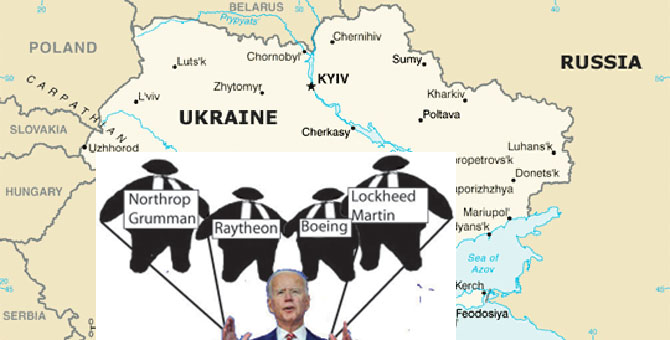
Walt Zlotow, West Suburban Peace Coalition, Glen Ellyn IL, 25 Oct 25
President Biden provoked the Russian invasion of Ukraine for 13 months with reckless NATO expansion before Russia said ‘enough’ and pushed back violently. Biden then spent his last 37 months pouring over $150 billion in military aid which proved worthless in achieving Ukrainian victory. All it did was prolong Ukraine’s suffering with hundreds of thousands dead and wounded in a shattered country.
2024 candidate Trump called out this senseless stupidity for what is was, Biden’s war that Trump wouldn’t have provoked had he won in 2020. He further boasted he’d end it on first day of second term.
Tho Trump largely stopped the direct funding that Biden kept squandering till his last sorrowful day, he’s still selling weapons to the European dead-enders UK, France, Germany and others to gift Ukraine. One day Trump says Ukraine should quit without return of a single lost square mile; next day he claims Ukraine can retrieve it all. One day he ponders sending Ukraine Tomahawk missiles likely to provoke nuclear war; next day he tells Ukraine President Zelensky, who flew 4,867 miles to beg for them…’Faggedaboudit.’
Trump’s got bigger war fish to fry than the lost cause of Ukraine. He’s still supporting Israel’s genocidal ethnic cleansing of Gaza, his fake ceasefire notwithstanding. He’s getting ready to bomb Venezuela, not content with just blasting small, unarmed Venezuelan boats to smithereens. He may be planning another round of air strikes on Iran in his quest at regime change and destabilization there.
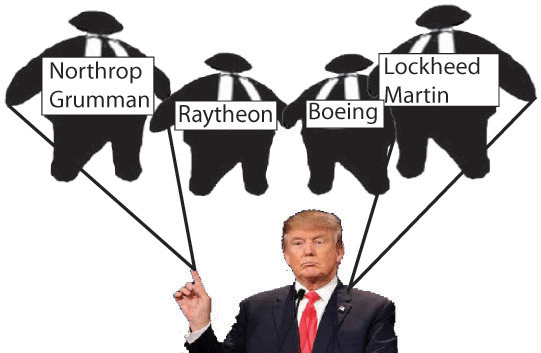
Ukraine will collapse on Trump’ watch. Biden never wavered in support of a war impossible to win. Trump, however, wavered in his boast he would end Biden’s war, allowing it to continue incurring hundreds of thousands more casualties and more lost Ukrainian territory. By so doing, history will record Trump’s ownership of America’s failed proxy war to weaken Russia at the end, as surely as it records Biden’s ownership at the beginning.
Trump says he will inform Congress of plans to strike land-based cartel targets in Venezuela

CLG News, Oct 24, 2025. https://legitgov.substack.com/p/trump-says-he-will-inform-congress?utm_source=post-email-title&publication_id=3203936&post_id=176990365&utm_campaign=email-post-title&isFreemail=true&r=1ise1&triedRedirect=true&utm_medium=email
Trump says he will inform Congress of plans to strike land-based cartel targets in Venezuela | 23 Oct 2023 | President Trump said Thursday he will inform Congress of his plans to attack land-based cartel targets in Venezuela as he looks to expand his thus-far seaborne military campaign.
“We’re going to go [to Congress]. I don’t see any loss in going — no reason not to,” Trump told reporters at a White House event touting a federal crackdown that’s arrested roughly 3,200 alleged drug cartel members over the past month. “You know they will always complain, ‘Oh, we should have gone.’ So we’re going to definitely,”
Trump said. Trump has threatened land-based strikes for weeks after the administration on Sept. 2 began targeting vessels smuggling drugs off the Caribbean coast of Venezuela. “I don’t think we’re going to necessarily ask for a declaration of war. I think we’re just going to kill people that are bringing drugs into our country. Okay? We’re going to kill them, you know, they’re going to be like dead, okay?” Trump said.
Trump announces military strike kills narcoterrorists, destroys drug submarine | 18 Oct 2025 | President Donald Trump said Saturday that a U.S. military strike destroyed a “very large drug-carrying submarine” in the Caribbean this week, killing two suspected narcoterrorists and capturing two others alive, while releasing video of the strike.
In a statement posted to Truth Social, Trump said the vessel was carrying mostly “fentanyl and other narcotics” toward the U.S. on a “well known narcotrafficking transit route.” He claimed the interdiction prevented as many as 25,000 American overdose deaths.
“It was my great honor to destroy a very large DRUG-CARRYING SUBMARINE,” Trump wrote. “U.S. Intelligence confirmed this vessel was loaded up with mostly Fentanyl… There were four known narcoterrorists on board. Two of the terrorists were killed. The two surviving terrorists are being returned to their Countries of origin, Ecuador and Colombia, for detention and prosecution.”
1 This Month



26 September – International Day for the Total Elimination of Nuclear Weapons


PLEASE OPPOSE HR 8255 AND S.3639 – bills would accelerate satellite deployment, with no environmental review or safeguards – https://ncstd5li.quorum.us/campaign/169331/
To see nuclear-related stories in greater depth and intensity – go to https://nuclearinformation.wordpress.com
-
Archives
- September 2026 (245)
- August 2026 (330)
- July 2026 (355)
- June 2026 (287)
- May 2026 (306)
- April 2026 (356)
- March 2026 (251)
- February 2026 (267)
- January 2026 (308)
- December 2025 (358)
- November 2025 (359)
- October 2025 (375)
-
Categories
- 1
- 1 NUCLEAR ISSUES
- business and costs
- climate change
- culture and arts
- ENERGY
- environment
- health
- history
- indigenous issues
- Legal
- marketing of nuclear
- media
- opposition to nuclear
- PERSONAL STORIES
- politics
- politics international
- Religion and ethics
- safety
- secrets,lies and civil liberties
- spinbuster
- technology
- Uranium
- wastes
- weapons and war
- Women
- 2 WORLD
- ACTION
- AFRICA
- Atrocities
- AUSTRALIA
- Christina's notes
- Christina's themes
- culture and arts
- Events
- Fuk 2022
- Fuk 2023
- Fukushima 2017
- Fukushima 2018
- fukushima 2019
- Fukushima 2020
- Fukushima 2021
- general
- global warming
- Humour (God we need it)
- Nuclear
- RARE EARTHS
- Reference
- resources – print
- Resources -audiovicual
- Weekly Newsletter
- World
- World Nuclear
- YouTube
-
RSS
Entries RSS
Comments RSS
 nuclear-news