Russia building an underwater drone that can carry nuclear warheads
Russia building underwater nuclear drone that could cause TSUNAMIS as big as 2011 disaster
MOSCOW is in the process of constructing an underwater drone that can carry nuclear warheads, destroy naval bases and cause tsunamis, according to a Russian state news agency. Express UK, By CAITLIN DOHERTY18 May 18, A source told TASS news agency the Poseidon drone will be able to carry nuclear weapons of up to two megatonnes.
The drone will operate at under-sea depths of more than 1 kilometre, and will have a speed of between 60 and 70 knots.
The source said: “It will be possible to mount various nuclear shares on the ‘torpedo’ of the Poseidon multipurpose seaborne system, with the thermonuclear single warhead. They added it will “have the maximum capacity of up to two megatonnes in TNT equivalent”….
The Russian President said the machine would have “hardly any vulnerabilities” and would carry “massive nuclear ordinance”.
“There is simply nothing in the world capable of withstanding them.”
The name Poseidon was chosen after open voting on the Russia’s Defence Ministry website.
TASS news agency has not been able to confirm the information provided by the source.
One physicist has said a machine of this magnitude could cause as much damage as the tsunami that hit Japan in 2011.
Rex Richardson told Business Insider: “A well-placed nuclear weapon of yield in the range 20 MT to 50 MT near a sea coast could certainly couple enough energy to equal the 2011 tsunami, and perhaps much more.
“Taking advantage of the rising-sea-floor amplification effect, tsunami waves reaching 100 meters [330 feet] in height are possible.”…https://www.express.co.uk/news/world/961500/Russia-building-underwater-nuclear-drone-that-could-cause-tsunami-japan-2011
Serbia to set up commission to examine health effects of NATO’s use of depleted uranium
Serbia to Probe Health Impact of NATO Depleted Uranium Balkan Insight 18 May 18 The Serbian parliament will establish a commission to examine the alleged effects on public health of NATO’s use of depleted uranium ammunition during the 1999 bombing of Yugoslavia. Serbian MPs are expected to vote on Friday to establish a parliamentary commission to determine whether NATO’s use of depleted uranium ammunition in 1999 has increased the number of cancer sufferers – despite scepticism from medical experts……..
But Kyle Scott, the US ambassador to Belgrade, said that the World Health Organisation and the UN determined that depleted uranium does not pose a serious health risk……..http://www.balkaninsight.com/en/article/serbia-to-examine-depleted-uranium-effects-from-nato-bombing-05-18-2018
US could use canceled MOX plutonium fuel plant to make new nuclear weapons
MOX got nixed. Now it could be the pits https://beyondnuclearinternational.org/2018/05/16/mox-got-nixed-now-it-could-be-the-pits/
What got canceled was a long-overdue, vastly over-budget and totally unneeded MOX fuel fabrication plant (pictured above the headline in a photo by High Flyer © 2018.) The now abandoned MOX plant would have combined surplus US weapons plutonium left over from the Cold War with uranium extracted from irradiated commercial reactor fuel, into mixed-oxide or MOX fuel. The fuel was slated to be used in commercial reactors. (Technically, the MOX plant will only be officially canceled 30 days after the May 10 submission of the waiver letter to Congress. But there is little doubt there will be any change in the decision.)
The new proposal would turn one boondoggle — that at least had an albeit flawed non-proliferation agenda — into an overtly dangerous, and some argue unnecessary, proliferation operation. The South Carolina site would be converted into a plutonium pit production facility. Pits are the plutonium cores that trigger nuclear weapons.
“Siting of new factories at SRS or elsewhere to produce the plutonium components of nuclear weapons is a provocative move that will further stimulate a nuclear arms race and result in a host of nuclear waste and toxic waste streams,” said Tom Clements, director of the public interest organization Savannah River Site Watch, in a press statement he released on May 10. Clements however, welcomed the cancelation of the MOX plant.
The MOX scheme was originally established as a joint project with Russia because Russia refused to vitrify or “immobilize” its surplus plutonium — the method preferred by the US at the time. A joint US-Russia agreement signed by the two countries in 2000, with several amended protocols signed in subsequent years, allowed the US to immobilize only part of its surplus plutonium inventory, while converting the rest to MOX. Immobilization would have led to burial rather than the re-use of plutonium in the civilian sector. Re-use crosses an arms control line and increases proliferation risks. In 2002, US immobilization plans were canceled in favor of all-MOX. By 2016, as US-Russian relations worsened, Russia suspended implementation of the agreement.
This helped pave the way for the less than graceful exit from the MOX plan which has now occurred. The looming prospect of another $50 billion in expenditures to complete the plant was another major disincentive.
Instead, the NNSA now says it will dilute 34 tons of plutonium with an inert substance and dispose of it at the deep underground Waste Isolation Pilot Plant in New Mexico. This exercise is estimated to cost just under $20 billion. This alternative “dilute and dispose” approach, says physicist Dr. Edwin Lyman of the Union of Concerned Scientists, “will be far safer and more secure than MOX.”
(It should be noted here that the WIPP dump suffered a serious explosion and release of radioactive materials in February 2014 that exposed workers and forced a prolonged closure. The price-tag for damage from the blast could top $2 billion, making it one of the costliest nuclear accidents in US history, according to the LA Times.)
The squandering of $7.6 billion on the MOX plant is made even more disgraceful by the fact that there was never a guarantee there would be any US customers for the fuel. Reactors that use MOX fuel must run hotter and the waste they produce is more highly radioactive. No US reactors are specifically designed to use MOX, a problem which raised both safety as well as economic questions. As with all commercial nuclear power reactors, there was no plan in place for irradiated MOX fuel management, storage or disposal.
In France, about 20 reactors can use MOX, but the percentage of MOX in the entire fuel inventory is only about 30%, and the percentage of plutonium in the MOX portion of the fuel is just 8%. After fissioning, MOX reactors still produce plutonium in their waste fuel, which cannot be reprocessed and repurposed into more MOX. So there is no net reduction of the plutonium inventory.
In other words, the whole MOX idea is an expensive exercise in futility. And maybe worse. In a new book by Gregory S. Jones, “Reactor Grade Plutonium and Nuclear Weapons: Exploding the Myths,” the author provides a technical analysis as to how reactor grade plutonium can be used quite easily and effectively for the production of nuclear weapons. In fact, he said, the US itself used precisely that in its 1962 nuclear weapons test.
This blows out of the water the standard mantra that only weapons grade plutonium can be used to make a nuclear weapon. It is harder, yes, but by no means impossible.
The production of new plutonium pits is also highly controversial. The US has set itself a course to produce 30 pits a year by 2026, ramping up to 80 a year by 2030. So far, the Los Alamos National Laboratory (LANL) is the only facility designated to produce new pits and its output to date has been zero. Non-proliferation groups say there is no need to produce more pits — some argue that the pits will last long enough while others want to see a reduction in the US nuclear weapons arsenal.
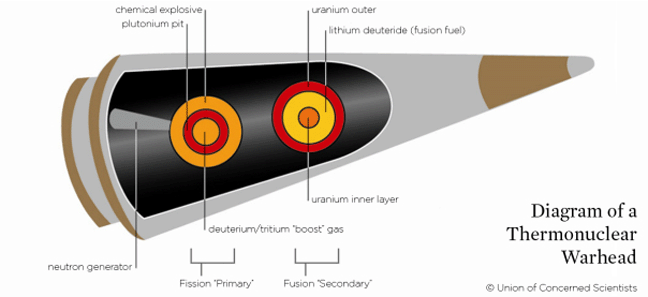
At the Nuclear Deterrence Summit in Virginia in February 2018, LANL director, Dr. Terry Wallace, said that “while plutonium does not age, the pits will only last 85 years.” His argument was all about what is called in nuclear weapons parlance, confidence in the nuclear deterrent. “And you can’t project confidence if you don’t have a facility for production,” Wallace said.
What “confidence” actually means, said Dr. Robert Soofer of the Department of Defense at the same Summit, is “do we have sufficient nuclear weapons to deter China and Russia? Do we have enough to assure our allies? If you don’t have enough to deter, you invite aggression and make our allies nervous.”
(In an earlier essay we took issue with the whole notion of deterrence. You can read it here.)
Pit production has been craftily absorbed into what is known as stockpile stewardship, which sounds like some sort of benign care-taking operation. But…
“Stewardship means we have to modernize,” said Wallace.
And modernize, my friends, means make new nuclear weapons.
Facing the increasing threat of nuclear war
 World Gets a Two-Minute Warning on the Risk of Nuclear War http://progressive.org/dispatches/world-gets-a-two-minute-warning-on-the-risk-of-nuclear-war-180514/#.Wvyq7ZC4Omg.twitter, by Roger Kimmel Smith May 14, 2018 Leaders of the international peace movement met in New York City over the weekend to grapple with an increasing threat of nuclear war. Taking a cue from the Bulletin of the Atomic Scientists and its famous Doomsday Clock, a day-long conference, held Saturday, May 12, at Judson Memorial Church, was titled “Two Minutes to Midnight.”
After closing test site, North Korea could later still resume nuclear bomb tests
 Why Closing Kim’s Test Site Won’t Hinder His Nuclear Plans, Bloomberg By David Tweed and Kanga Kong May 15, 2018,
A decade ago, the last time North Korea took talks with the U.S. so far, then-leader Kim Jong Il blew up a cooling tower at the Yongbyon nuclear plant as part of a deal to limit its weapons program. Within months, he was reassembling the reactor — a key source of weapons-grade plutonium. That’s one reason why arms-control experts are watching with caution as his son, Kim Jong Un, now moves to publicly dismantle the remote subterranean testing site used by the regime to detonate six nuclear bombs.
…….Does North Korea need more tests?
Possibly not. Both India and Pakistan established themselves as nuclear powers after a similar number of tests — and neither has detonated a bomb since 1998. In his April 20 statement announcing the Punggye-ri closing, Kim said the country’s efforts to build a warhead small enough to fit on a ballistic missile had progressed to the point where tests were no longer necessary. Still, it’s unclear whether North Korea has figured out how to prevent a warhead from burning up during re-entry from space.
Would the site’s closing be permanent?
No. A 38 North analysis of satellite images taken May 7 showed that several support buildings outside the northern, western and southern portals had been razed while some mining cart rails had been removed. Such facilities can be replaced as easily as the Yongbyon cooling tower. Lewis, of the Middlebury Institute, argues that the tunnel’s horizontal layout would also make it relatively easy to “pop” open the sealed entrances and regain access after their closing.
What about building a new tunnel?
A new test site could be constructed in three to six months, depending on how much labor was thrown at the job, according to Suh Kune Y., a nuclear engineering professor at Seoul National University. Future detonations — most likely to test warhead miniaturization — might only require a simple straight tunnel with one right angle at the end, he said.
What about other sites?
North Korea, which is believed to manage a vast subterranean network in part to frustrate U.S. and South Korean spies and military planners, probably has other locations that could house tests. Suh pointed out that North Korea refers to the Punggye-ri facility as its “northern test site,” possibly implying there are others. And, of course, tests don’t need to be underground. In September, North Korea Foreign Minister Ri Yong Ho suggested that his country could detonate a hydrogen bomb over the Pacific Ocean. https://www.bloomberg.com/news/articles/2018-05-15/closing-kim-s-test-site-won-t-hinder-his-nuke-plans-quicktake
U.S. Manhattan Project national park to include exhibits noting inhumane nature of atomic weapons
Japan Times, KYODO , 12 May 18 HIROSHIMA – A U.S. national park commemorating facilities related to the Manhattan Project, the secret U.S. wartime atomic bomb program, will include exhibits showing the inhumane nature of nuclear weapons, a park official said.
The plan to display the damage caused by the U.S. atomic bombings on Japan during World War II is welcome news for atomic bomb survivors who have worked to convey the horror of the weapons.
“We intend to address this issue thoroughly and respectfully,” said Kris Kirby, superintendent of the Manhattan Project National Historical Park, referring to the catastrophic humanitarian consequences of the use of nuclear weapons.
In November 2015, the U.S. government officially designated as a national park the facilities related to the Manhattan Project located in Oak Ridge, Tennessee; Los Alamos, New Mexico; and Hanford in Washington State.
The work to craft the exhibition plan for the facilities may start in 2019, and officials hope to complete it within two years.
It is not yet decided where the exhibits to highlight the inhumane aspects of the weapons will be placed, but Kirby said they would be “incredibly important elements” of the story surrounding the Manhattan Project.
…… An official of the Hiroshima Municipal Government welcomed the latest development and said, “We hope the exhibition … will be based on objective facts, and does not glorify the atomic bomb development.”
….. many people died in the bomb blasts and flames and even those who survived continued to suffer due to the increased risks of cancer and leukemia throughout their lives as well as the loss of family members……https://www.japantimes.co.jp/news/2018/05/13/national/u-s-manhattan-project-national-park-include-exhibits-noting-inhumane-nature-atomic-weapons/#.Wvi08O-FPGg
USA National Nuclear Security Administration (NNSA) plan for unnecessary production of plutonium pits
 What’s Not in NNSA’s Plutonium Pit Production Decision, Santa Fe, NM –May 10, 2018 Contact Jay Coghlan, Nuclear Watch NM, 505.989.7342, c. 505.470.3154, jay@nukewatch.org Scott Kovac, Nuclear Watch NM, 505.989.7342, scott@nukewatch.org
Jay Coghlan, Nuclear Watch Director, commented, “NNSA has already tried four times to expand plutonium pit production, only to be defeated by citizen opposition and its own cost overruns and incompetence. But we realize that this fifth attempt is the most serious. However, we remain confident it too will fall apart, because of its enormous financial and environmental costs and the fact that expanded plutonium pit production is simply not needed for the existing nuclear weapons stockpile. We think the American public will reject new-design nuclear weapons, which is what this expanded pit production decision is really all about.
1 See 2012 Navy memo demonstrating its lack of support for the Interoperable Warhead athttps://www.nukewatch.org/importantdocs/resources/Navy-Memo-W87W88. 2 For example, see Safety concerns plague key sites proposed for nuclear bomb production, Patrick Malone, Center for Public Integrity, May 2, 2108,https://www.usatoday.com/story/news/nation/2018/05/02/safety-concerns-nuclear-bomb-manufacturesites/572697002/
Los Alamos National Laboratory will share production of plutonium pits with the Savannah River Site in South Carolina
NNSA announces decision on pit production, L A Monitor, May 11, 2018, Los Alamos National Laboratory will share production of plutonium pits with the Savannah River Site in South Carolina, the Nuclear Weapons Council and National Nuclear Security Administration announced Thursday.
LANL will maintain production of 30 plutonium pits per year, while the Savannah River Site will produce 50 pits per year.
“To achieve DoD’s 80 pits per year requirement by 2030, NNSA’s recommended alternative repurposes the Mixed Oxide Fuel Fabrication Facility at the Savannah River Site in South Carolina to produce plutonium pits while also maximizing pit production activities at Los Alamos National Laboratory in New Mexico,” according to Thursday’s release.
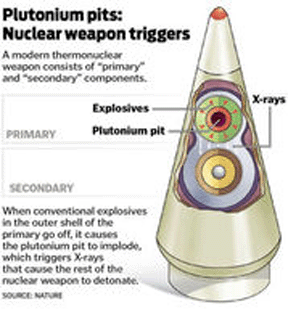
……. Plutonium pits are the size of a softball and are used as trigger mechanisms for nuclear weapons…..
“First, in Nuclear Watch’s view, this decision is in large part a political decision, designed to keep the congressional delegations of both New Mexico and South Carolina happy,” said Nuclear Watch Executive Director Jay Coghlan. “New Mexico Senators Tom Udall and Martin Heinrich are adamantly against relocating plutonium pit production to South Carolina. On the other hand, South Carolina Senator Lindsay Graham was keeping the boondoggle Mixed Oxide (MOX) program on life support, and this pit production decision may help to mollify him.
Coghlan said he believes the split plan will ultimately fail.
“NNSA has already tried four times to expand plutonium pit production, only to be defeated by citizen opposition and its own cost overruns and incompetence,” Coghlan said. “But we realize that this fifth attempt is the most serious.
“However, we remain confident it too will fall apart, because of its enormous financial and environmental costs and the fact that expanded plutonium pit production is simply not needed for the existing nuclear weapons stockpile. We think the American public will reject new-design nuclear weapons, which is what this expanded pit production decision is really all about.”
Greg Mello, executive director of the Los Alamos Study Group, took a more pragmatic view. ……
“Pit production isn’t needed for decades, even for a large arsenal, but Congress has demanded it, so the bulk of the work will leave LANL. The R and D (research and development) work will stay behind. This transition is many years down the road. Pit production will always be difficult, expensive and dangerous wherever it’s done.”
A fact sheet about the decision can be found here. http://www.lamonitor.com/content/nnsa-announces-decision-pit-production
Nuclear weapons for Saudi Arabia – theme for May 18

Saudi Arabia and Israel have been itching for an attack on Iran. That would be a dangerous move by either of those States. But hey! What if you get get America to do this on their behalf? With Trump now surrounding himself with belligerent advisors, like Mike Pompeo and John Bolton, and with Trump’s son-in-law Jared Kushner cosying up to Israel and Saudi Arabia – there’s every chance that USA will move closer to the military brink. After all, Trump recently warned Iran that if it started enriching uranium “there will be very severe consequences,” and “something will happen”
Of course, it’s a different story for the Trump and the USA, when it comes to letting the Saudi Arabians enrich uranium. Westinghouse is keen to sell U.S,. nuclear technology to Saudi Arabia, and the Trump administration is writhing about trying to bypass the “123 rule” which prohibits uranium enrichment.
Saudi Arabia has been quick to militarily attack in the past – Bahrain 1994 and 2011 – Yemen recently.
The regime’s brutality towards its own citizens should surely give the world pause to think about how it might behave towards other people, when it’s in possession of nuclear bombs. Cruelty and beheadings are “normal” for crimes -not only for murders, but also for apostasy, blasphemy, atheism.
Of course, super salesman Donald Trump would find this irrelevant, indeed encouraging. After all, 12 months ago, Trump visited Riyadh , returning with a $350 Billion arms contract for America.
Nuclear power for Saudi Arabia becomes an absurd idea, when you consider that Saudi Arabia is not only the “Saudi Arabia” of oil, but also of sunshine. Their motivation for nuclear weapons is clear.
Growing risk of Middle East war, as USA exits Iran nuclear deal, – Iran Israel strikes
Iran-Israel strikes show risk of Middle East war is growing after US exit from nuclear deal, CNBC, 11 May 18
- The U.S. exit from the Iran nuclear deal threatens to inflame tensions in the Middle East and heighten the risk of open conflict among regional powers, analysts say.
- Israel launched an attack on Iran’s positions in Syria on Thursday, following an earlier strike by Iranian forces on the Golan Heights in retaliation for earlier Israeli strikes.
- A long-standing fear is that open military conflict among the Middle East’s dominant players will devolve into a regionwide conflict that drags global powers into war.
A series of rocket exchanges between Iran and Israel along the Syrian border on Thursday may confirm what many feared: The U.S. exit from the Iran nuclear deal will inflame regional rivalries and heighten the risk of open conflict in the Middle East.
Israel launched a deadly attack on Iranian positions in Syria on Thursday, responding to an earlier rocket attack by Iran’s forces on the Golan Heights, a border area Israel captured from Syria in 1967. Iran’s attack itself followed several strikes by Israel on its bases in Syria, where the Iranians are supporting President Bashar Assad in the nation’s long-burning civil war.
The earlier Israeli strikes came both before and after President Donald Trump announced he is withdrawing the United States from the 2015 Iran nuclear deal and restoring wide-ranging sanctions aimed at crippling the Iranian economy. Thursday’s rocket exchange came just two days after Trump’s announcement.
Middle East watchers warn that Trump’s decision to abandon the nuclear deal emboldens Israel and Saudi Arabia to take a more aggressive stance against Iranian forces and proxies in the region. They say it also marginalizes Iran’s political moderates like President Hassan Rouhani and emboldens the nation’s hard-line conservatives and the Iranian Revolutionary Guard Corps, an elite military organization loyal to the supreme leader, Ayatollah Ali Khamenei.
“US withdrawal from the JCPOA could shift the balance of power among the Iranian leadership from those who want to keep the deal operational to hardline elements more willing to risk escalation by strengthening support for regional proxies, and who favour economic self-sufficiency and opposed President Rouhani’s push for greater engagement with the West,” ratings agency Fitch said Thursday, referring to the deal by its official name, the Joint Comprehensive Plan of Action.
The long-standing fear is that open military conflict among the Middle East’s dominant players will devolve into a regionwide conflict that drags global powers like the United States and Russia into war. It could also choke off oil supplies from the world’s largest energy export hub. ……. https://www.cnbc.com/2018/05/10/risk-of-war-in-the-middle-east-grows-after-us-exit-from-nuclear-deal.html
Current activity at North Korea’s nuclear test site
Something’s going on at North Korea’s nuclear test site https://www.smh.com.au/world/asia/something-s-going-on-at-north-korea-s-nuclear-test-site-20180511-p4zemh.html, By Anna Fifield and Adam Taylor, 11 May 2018 — Tokyo: North Korea could be taking preliminary steps to close its nuclear test site, according to new satellite images that suggest Kim Jong-un might be making good on one of the surprising pledges he’s made over the last month.
Or, he’s making the rest of the world think he is by arranging a performance for the satellites that pass overhead.
Satellite images taken since last month’s inter-Korean summit show a steady reduction in the number of buildings around North Korea’s known nuclear test site, built under Mount Mantap in the Punggye-ri area in the north of the country.
“At the very least, this a welcome PR move,” said Jeffrey Lewis, head of the East Asia program at the James Martin Centre for Nonproliferation Studies in Monterey, California.
“Over the past two weeks, five or six buildings have inexplicably come down,” Lewis said, citing commercial satellite images from the San Francisco-based firm Planet Labs that have a resolution comparable to Google maps. “Something is clearly happening there.”
As part of the extraordinary rapprochement now going on, North Korea has vowed to dismantle the test site, where all six of its nuclear detonations have taken place, this month. But as with so many things about North Korea, it’s difficult to tell how much of this is wheat and how much is chaff.
Kim made the pledge during a historic summit with South Korean President Moon Jae-in, which laid the groundwork for a meeting between Kim and President Donald Trump that will likely take place in the next month or so.
Kim said he would invite security experts and journalists to the North to observe the closure of the site, the South’s presidential Blue House said.
All six of North Korea’s nuclear tests have taken place deep under the mountain at Punggye-ri, with five of them occurring in the tunnel complex accessed through an entrance known as the north portal. There are two other entrances to the site, the west and south portals.
The last test, in September last year, was so huge that some experts wondered if Mount Mantap was suffering from “tired mountain syndrome” and had become unusable. But numerous nuclear experts have cast doubt on that theory, noting that even if the tunnels leading to the north portal were unusable, the other two entrances could still be operational.
Tunnelling and activity at the west portal had been visible as recently as April 20, a week before the inter-Korean summit, according to an analysis for 38 North, a website devoted to North Korea.
There are clusters of buildings at the portals, including administration buildings and a command center, as well as smaller buildings.
The big, main buildings are still there but the smaller, more peripheral ones at the north and south portals, the entrances to the main tunnels, have come down, Lewis said.
This could be part of the preparations for inviting journalists and experts to watch the closure of the site, which, Lewis said, could be as simple – and as reversible – as blocking the portals.
“Shutting down the test site is something they can easily do. It’s just tunnels so they can seal the entrances – but they can also unseal them,” he said.
“And the tunnels are always going to be there,” he added, unless North Korea blows up the whole site.
Still, analysts wanting to be optimistic about the diplomatic process say that declaring the site finished and taking some steps towards closing it would support their theory that Kim is making an effort, just like this week’s release of three Americans who had been held in North Korea.
But sceptics say that closing a test site that might well be spent is just cosmetic.
A group of Chinese scientists last month said they believe the test site had collapsed after September’s huge test, which caused an earthquake so big that satellites caught images of the mountain above the site actually moving.
North Korea claimed to have detonated a hydrogen bomb, which would be exponentially more powerful than the atomic devices previously tested, and experts said the size of the earthquake suggested that it had indeed been a hydrogen, or thermonuclear, explosion.
Adding to theory that the site has outlived its utility is new research from scientists from the Earth Observatory of Singapore at Nanyang Technical University, who claim to have found evidence that the damage at Mount Mantap was more substantial than other research shows.
In their study, which will be published in the journal Science on Thursday, they argued that by using satellite radar imagery to supplement ground-based seismological readings they were able to gain a more accurate picture of the September 3 test.
Sylvain Barbot, a researcher with the Earth Observatory of Singapore, wrote in an e-mail that the nuclear test last year was so large that “we could ‘feel’ it from space.”
The amount of shaking that accompanied the explosion was so severe that traditional radar measurements were inaccurate, Barbot said, and his team had to use unusual techniques to compensate for significant changes in the landscape.
By using these techniques, the researchers were able to estimate a depth for the nuclear detonation: Around 450 metres, beneath the summit of Mount Mantap. Researchers then combined this information with seismological readings to come up with an estimated yield for the weapon of between 120 kilotons to 304 kilotons.
Much of this range would be far higher than officials from the United States and South Korea estimate.
The researchers also found evidence that a significant part of Mount Mantap had collapsed after the explosion, supporting the Chinese study. A “very large” part of the facility had collapsed, Barbot said, “not merely a tunnel or two.”
Washington Post
Geophysicists say North Korea’s huge underground nuclear test DID move the mountain
 North Korean nuclear test had energy of 10 Nagasaki bombs and moved mountain, geophysicists say http://www.abc.net.au/news/science/2018-05-11/north-korea-nuclear-test-satellites-seismic-monitoring/9746676 By science reporter Belinda Smith, 11 May 18,
An underground North Korean nuclear test in September last year exploded with 10 times the energy of the atomic bomb that exploded over Nagasaki in 1945.
It also caused the overlying mountain peak to sink by half a metre and shift about 3.5 metres south.
These are conclusions drawn by geophysicists, who used satellite radar and instruments that pick up waves travelling through the earth, to calculate the explosion’s depth and strength.
In the journal Science today, they also report signs that a subterranean tunnel system at the test site collapsed 8.5 minutes after the bomb detonated.
In the past, satellite technology — called synthetic radar aperture imagery — has mapped how the ground stretches and warps after earthquakes.
But this is the first time it has been used to examine a nuclear bomb test site, according to Teng Wang, study co-author and a geophysicist at Singapore’s Nanyang Technological University.
Since the United Nations General Assembly adopted the Comprehensive Nuclear-Test-Ban Treaty in 1996, nine nuclear tests have taken place.
Six of these were by North Korea, five of which were at its Mt Mantap facility in the country’s north.
The bombs were detonated in chambers tunnelled into the mountain itself — a granite peak that extends upwards just over 2,200 metres.
But this means the details of the tests, such as the energy produced by the bombs, have been largely unknown outside North Korea — until now.
Eye in the sky, ear to the ground
Dr Wang and his colleagues suspected they could deduce the strength and precise location of the bomb test on September 3 last year, which triggered a magnitude-6.3 earthquake.
Clandestine nuclear activities are tracked by a global monitoring system of sensors that pick up the faint shivers and shudders generated by distant underground blasts and earthquakes.
But while these instruments are capable of picking up the wave signature of a bomb blast thousands of kilometres away, more information is needed to pinpoint exactly where an explosion has taken place.
So in the weeks after the September North Korean bomb test, Dr Wang and his colleagues received images of the Mt Mantap terrain before and after the test, snapped by the German TerraSAR-X satellite.
To map the bumps and dips on the Earth’s entire surface, TerraSAR-X pings radar towards the ground and measures how long it before the signal is bounced back up again.
“As long as the ground is deformed, we can measure it from space using synthetic radar aperture,” Dr Wang said.
Combined with a bit of nifty mathematical modelling — the first time anyone’s modelled an underground nuclear test with radar data — he and his colleagues got a fix on the exact location of the detonation site.
This is a highlight of the work, said Hrvoje Tkalcic, a geophysicist at the Australian National University, who was not involved in the study.
“What’s always difficult is pinpointing an exact location [of a bomb test],” Professor Tkalcic said.
Dr Wang and his team calculated that the top of the mountain subsided about half a metre after the September test, and parts of it shuffled south.
To manage this deformation, the bomb released the energy equivalent to between 109,000 and 276,000 tonnes of TNT in a chamber 450 metres below Mt Mantap’s peak.
The “Fat Man” bomb that exploded over Nagasaki yielded an energy level equivalent to 20,000 tonnes.
Among the data, they found the seismic shivers of a second, smaller event — an aftershock that appeared 700 metres south of, and 8.5 minutes after, the explosion.
The waves produced by the aftershock weren’t consistent with an explosion; rather, it looked like the ground had imploded.
This, the geophysicists suggest, “likely indicates the collapse of the tunnel system of the test site”.
While Dr Wang and his team used data from seismic monitoring systems in China and the surrounding area, Australia has one of the best in the world, Professor Tkalcic said: the Warramunga monitoring station in the Northern Territory, near Tennant Creek.
It’s almost smack bang in the centre of the continent, in an incredibly quiet part of the world, seismically speaking; far from tectonic plate edges, cities and the shoreline, where waves crashing on the coast create seismic noise.
It uses an array of buried instruments to pick up waves that travel through the ground, acting as a giant antenna to amplify weak signals.
“They’re used in the same way as astronomers use arrays of antennas to look at deep space. It’s just that our antennas are pointed to the centre of the earth,” Professor Tkalcic said.
There is also an infrasound detection system at Warramunga station, which detects waves that travel through the atmosphere produced by bomb blasts.
The data is transmitted by satellite to the Comprehensive Nuclear-Test-Ban Treaty Organisation in Vienna, where it is monitored round the clock.
So how do geophysicists know if seismic waves are caused by bomb blasts and not, say, an earthquake or landslide?
In a subterranean explosion, the ground is pushed outwards and compressed, sending a particular type of wave through the ground, Professor Tkalcic said.
An earthquake’s seismic signature is different. If two plates collide, rub against each other or slip, they send out another type of wave.
“We can tell if the first motion was predominantly a compression or if it was a shear type of motion,” Professor Tkalcic said.
Iran might now resume cyber attacks on USA institutions
 THE IRAN NUCLEAR DEAL’S UNRAVELING RAISES FEARS OF CYBERATTACKS Wired Andy Greenberg, 18 May 18
WHEN THE US last tightened its sanctions against Iran in 2012, then-president Barack Obama boasted that they were “virtually grinding the Iranian economy to a halt.” Iran fired back with one of the broadest series of cyberattacks ever to target the US, bombarding practically every major American bank with months of intermittent distributed denial of service attacks that pummeled their websites with junk traffic, knocking them offline. Three years later, the Obama administration lifted many of those sanctions in exchange for Iran’s promise to halt its nuclear development; Tehran has since mostly restrained its state-sponsored online attacks against Western targets.
Now, with little more than a word from President Trump, that détente appears to have ended. And with it, the lull in Iranian cyberattacks on the West may be coming to an end, too.
Cutting Swords
President Trump announced Tuesday that he would unilaterally withdraw the US from the Iran nuclear deal negotiated by the Obama administration in 2015, and impose new sanctions against the country within 90 days. Since then, foreign policy watchers have warned that the move would isolate the US, risk further destabilizing the Middle East, and invite another nuclear rogue nation into the world. But for those who have followed the last decade of digital conflicts around the globe, the unraveling of the Iran deal reignites not only the country’s nuclear threat, but also the threat of its highly aggressive hackers—now with years more development and training that have only honed their offensive tactics.
“They’ve developed this ability over the last years and there’s no reason for them not to use it now,” says Levi Gundert, an Iran-focused analyst at private intelligence firm Recorded Future. “They want to try to induce other countries to think about repercussions before levying sanctions, and they have a real capability in the cyber domain.”
……… since the 2015 nuclear deal, Iran has largely restricted its hacking to its own neighborhood, repeatedly hitting its longtime rival Saudi Arabia and other Gulf nations with cyberattacks but limiting its attacks on Western targets to mere cyberespionage, not actual disruptive operations.
Iran may have quietly grown into a serious threat to any enemy nation that it can reach via the internet. And now that the last three years of tense peace appears to be ending, its list of fair-game targets may once again include the United States, too.
Iran Attacks
- While Iran has perpetrated some hacking against the US recently, its focus was espionage rather than destruction
- One thing that has helped Iran’s offensive capabilities? Learning from US attacks against it
- The country is still smarting from Stuxnet, the first attack of its kind https://www.wired.com/story/iran-nuclear-deal-cyberattacks/
An impossible task? – “permanent, verifiable, irreversible dismantlement” of North Korea’s nuclear program
 Nuclear Inspectors Would Face Monumental Task in N.Korea http://english.chosun.com/site/data/html_dir/2018/05/08/2018050801221.html By Cho Yi-jun May 08, 2018
The U.S.’ call for a “permanent, verifiable, irreversible dismantlement” of North Korea’s nuclear and ballistic missile programs would pose a monumental task for international inspectors.
U.S. officials project “the most extensive inspection campaign in the history of nuclear disarmament, one that would have to delve into a program that stretches back more than half a century and now covers square miles of industrial sites and hidden tunnels across the mountainous North,” according to the New York Times on Sunday.
The success of any verification hinges on accurately assessing North Korea’s nuclear weapons and missile stockpiles, most of which are hidden away. Already U.S. intelligence agents are going all out to gather data about the North’s nuclear and ballistic missile facilities.
The U.S. National Geospatial-Intelligence Agency recently launched a project that tracks the movements of all vehicles in and out of North Korean military installations, CNN reported. Washington has also monitored North Korean responses to American fighter planes flying overhead to arrive at an overall assessment of the North’s hidden military bases.
One diplomatic source in Washington said the U.S. “may have assessed North Korea’s secret military installations much more accurately than the North thinks.”
The New York Times cited the RAND Corporation as arriving at no better assessment than that North Korea has 20 to 60 nuclear warheads and around 40 to 100 nuclear facilities, while one nuclear facility has more than 400 buildings.
“While there is no question Iran hid much of its weapons-designing past, North Korea has concealed programs on a far larger scale,” the daily said.
The RAND Corporation predicts that it would take 273,000 U.S. troops just to locate and secure North Korea’s weapons of mass destruction, which is more than the number of American soldiers deployed in Iraq at the peak of the U.S. invasion.
It warned that the International Atomic Energy Agency has only 300 inspectors, and 80 of them are already assigned to monitoring activities in Iran. If the North agrees in principle to denuclearize, the IAEA will have a huge task simply finding the personnel.
North Korea could easily conceal highly enriched uranium which could be used to produce a nuclear bomb, and it would be virtually impossible to find if the North fails to cooperate.
Justice Party lawmaker Kim Jong-dae, who recently visited Washington, told reporters that North Korea has “tens of thousands of facilities related to nuclear and missile development, while there are around 10,000 underground tunnels and storage facilities in the Mt. Baekdu area.”
“Realistically, the U.S.-North Korea summit should discuss nuclear arms reduction rather than complete dismantlement,” he added.
Mac Thornberry, head of the U.S. House Armed Services Committee, told Fox New that he is “very skeptical” that North Korea will completely dismantle its weapons of mass destruction and advised the U.S. to “prepare for the worst.”
But others warned that North Korea could face a grim future if it attempts to fool the U.S.
Hardline U.S. lawmaker Lindsey Graham said in a radio interview that North Korea played “every president before -– Clinton, Bush, all of them” but warned that Pyongyang would regret it if it tries to dupe the Trump administration since this would mean the “end of the North Korean regime.”
Ending Iran nuclear deal could have grave consequences: Jordan fears new arms race
 JORDAN’S FOREIGN MINISTER SEES ARMS RACE IF IRAN NUCLEAR DEAL ENDS
Jordanian Foreign Minister Ayman al-Safadi says an end of the Iran deal could have grave consequences across the Middle East, BY REUTERS JERUSALEM POST MAY 8, 2018 MURNAU – Jordanian Foreign Minister Ayman al-Safadi on Tuesday warned of “dangerous repercussions” and a possible arms race in the Middle East unless a political solution was found to free the region of nuclear weapons and other weapons of mass destruction.
Al-Safadi spoke in Germany before an expected announcement by US President Donald Trump on whether he will pull out of the Iran nuclear deal or work with European allies who say it has successfully halted Iran’s nuclear ambitions.
“We all need to work together in making sure that we solve the conflicts of the region … and strive for a Middle East that is free of all weapons of mass destruction,” he told reporters after a meeting with leaders of Chancellor Angela Merkel’s right-left “grand coalition” government.
“If we do not look at the political picture and … find a way to ensure that the whole region is free of (these weapons), we’ll be looking at a lot of dangerous repercussions that will affect the region in terms of an arms race,” he said.
In March, Saudi Arabian Crown Prince Mohammed bin Salman told CBS news that his kingdom would “without a doubt” develop nuclear weapons if Iran, Riyadh’s arch foe, did so.
Israel is widely believed to be the only nuclear-armed state in the Middle East, although it neither confirms nor denies possessing atomic weapons. …….https://www.jpost.com/Middle-East/Jordans-foreign-minister-sees-arms-race-if-Iran-nuclear-deal-ends-554777
1 This Month
15 October. Joint Appeal for Nuclear Abolition Day -presentation to the UN on October 15 will be live on UNWebTV
Endorse the Nuclear Abolition Day Appeal
23-25 October – on Zoom – World BEYOND War’s annual global conference

To see nuclear-related stories in greater depth and intensity – go to https://nuclearinformation.wordpress.com
-
Archives
- October 2026 (149)
- September 2026 (339)
- August 2026 (330)
- July 2026 (355)
- June 2026 (287)
- May 2026 (306)
- April 2026 (356)
- March 2026 (251)
- February 2026 (267)
- January 2026 (308)
- December 2025 (358)
- November 2025 (359)
-
Categories
- 1
- 1 NUCLEAR ISSUES
- business and costs
- climate change
- culture and arts
- ENERGY
- environment
- health
- history
- indigenous issues
- Legal
- marketing of nuclear
- media
- opposition to nuclear
- PERSONAL STORIES
- politics
- politics international
- Religion and ethics
- safety
- secrets,lies and civil liberties
- spinbuster
- technology
- Uranium
- wastes
- weapons and war
- Women
- 2 WORLD
- ACTION
- AFRICA
- Atrocities
- AUSTRALIA
- Christina's notes
- Christina's themes
- culture and arts
- Events
- Fuk 2022
- Fuk 2023
- Fukushima 2017
- Fukushima 2018
- fukushima 2019
- Fukushima 2020
- Fukushima 2021
- general
- global warming
- Humour (God we need it)
- Nuclear
- RARE EARTHS
- Reference
- resources – print
- Resources -audiovicual
- Weekly Newsletter
- World
- World Nuclear
- YouTube
-
RSS
Entries RSS
Comments RSS

