End the silence on nuclear weapons, and the targeted plans for nuclear megadeaths in the Middles East
Netanyahu, How Many People Will Die in a Nuclear War in the Middle East? https://www.haaretz.com/opinion/.premium-bibi-how-many-people-will-die-in-a-nuclear-war-in-the-middle-east-1.6118136 Ehud Ein-Gil
In the early 60s, the U.S. estimated that the number of victims in a nuclear war against the Soviet Union and China would total some 600 million. Twenty years ago, ‘Doomsday Machine’ author Daniel Ellsberg posed a similar question about the Mideast,
The double standard over Israel’s nuclear weapons

 ISRAEL AND DENUCLEARIZATION: NECESSARY PARADOX OR HYPOCRISY IN ACTION? Jerusalem Post, While Israel maintains nuclear ambiguity, the Jewish state is believed to possess up to 200 atomic weapons.
BY BENJI FLACKS/THE MEDIA LINE MAY 26, 2018
Although Israel maintains a policy of ambiguity regarding its possession of nuclear weapons, the Jewish state is known to have a sizeable atomic arsenal. David Ben Gurion, Israel’s first prime minister, established with the help of France a covert nuclear program in the 1950s to combat against what was widely viewed as an existential military threat posed by Arab neighbors. Ever since, information has from time-to-time been leaked regarding the size and potency of Israel’s atomic capabilities, although no independent body has confirmed specific figures.Against this backdrop, the United States—which has the world’s second-largest nuclear stockpile after Russia—is actively promoting global non-proliferation. To this end, President Donald Trump is slated to hold a summit with North Korean ruler Kim Jong-Un to discuss the Peninsula’s denuclearization; and the US leader recently withdrew Washington from the Joint Comprehensive Plan of Action (commonly referred to as the Iran nuclear accord), which, in his estimation, would not have prevented Tehran’s acquisition of the bomb over the long-term.
For many, a clear dichotomy—if not double-standard—emerges when these policies are juxtaposed against the world’s hush-hush approach to—if not tacit approval of—Israel’s nuclear arms program.
According to Shannon Kile, head of the Nuclear Weapons Project at the Stockholm International Peace Research Institute (SIPRI), Israel exists in a sort of legal limbo given that it is not a party to the 1968 Treaty on the Non-Proliferation of Nuclear Weapons (NPT), which codified into international law regulations governing nuclear development. By contrast, he explained to The Media Line, “the United States has the moral and legal right to pressure North Korea and Iran [in ways that are] set out in the binding treaty.
“The NPT legally recognized legitimate nuclear nations and in the treaty, North Korea and Iran were barred from making nuclear weapons,” Kile elaborated, while qualifying that Pyongyang did pull-out of the NPT in 2003, blaming its decision on “U.S. aggression.”
Nevertheless, Kile noted, there is “a long-running international dispute over [Israel’s] nuclear program. NPT countries, particularly Egypt, have argued for a nuclear-free zone in the Middle East that would include Israel. This notion,” he continued, “was a key pillar in the extension of the treaty in 1995. But not all countries seem willing to force Israel to sign up.”
More broadly, Kile believes that there “needs to be a commitment for all nuclear states to fulfill their obligation to denuclearize, as this would bolster the norm against atomic weapons. All NTP signatories have committed to abolishing their nuclear arms yet we see no real progress on that, even in the United States.” …….
https://www.jpost.com/Israel-News/Israel-and-denuclearization-Necessary-paradox-or-hypocrisy-in-action-558401
UN chief launches new disarmament agenda ‘to secure our world and our future’

 https://news.un.org/en/story/2018/05/1010551 The United Nations chief announced a bold new vision for global disarmament on Thursday, to help eliminate nuclear arsenals and other deadly weapons from a world that is just “one mechanical, electronic and human error away” from destruction.
“The United Nations was created with the goal of eliminating war as an instrument of foreign policy,” Secretary-General António Guterres said, unveiling his new agenda, entitled, Securing Our Common Future, at the University of Geneva, in Switzerland.
“But seven decades on, our world is as dangerous as it has ever been,” he warned.
“Disarmament prevents and ends violence. Disarmament supports sustainable development. And disarmament is true to our values and principles,” he explained.
The launch comes at a time when “arms control has been in the news every day, sometimes in relation to Iran and Syria, sometimes the Korean Peninsula,” said the UN chief.
The new Agenda focuses on three priorities – weapons of mass destruction, conventional weapons, and new battlefield technologies.
First, he stressed that disarmament of nuclear, chemical and biological weapons could “save humanity,” noting that some 15,000 nuclear weapons remain stockpiled around the world and hundreds are ready to be launched within minutes.
“We are one mechanical, electronic or human error away from a catastrophe that could eradicate entire cities from the map,” he warned.
Mr. Guterres said the States that possess nuclear weapons have the primary responsibility for avoiding catastrophe. In that regard, he appealed to Russia and the US to resolve their dispute over the Intermediate-Range Nuclear Forces Treaty; to extend the New START treaty on strategic offensive arms, which is due to expire in just three years; and to take new steps towards reducing nuclear stockpiles.
Disarmament prevents and ends violence. Disarmament supports sustainable development. And disarmament is true to our values and principles – UN chief Guterres
Second, he said disarmament of conventional weapons, which include small arms, light weapons and landmines, could “save lives,” in particular those of civilians who continue to bear the brunt of armed conflict.
The UN chief said that beyond the appalling numbers of civilians killed and injured, conflicts are driving record numbers of people from their homes, often depriving them of food, healthcare, education and any means of making a living.
At the end of 2016, more than 65 million people were uprooted by war, violence and persecution, he said.
“My initiative will have a strong basis in the 2030 Agenda for Sustainable Development, the world’s blueprint for peace and prosperity on a healthy planet,” he said, noting that excessive spending on weapons drains resources for sustainable development.
In fact, more than $1.7 trillion dollars was spent last year on arms and armies – the highest level since the fall of the Berlin Wall. That is around 80 times the amount needed to meet the humanitarian aid needs of the whole world, he said.
Third, he said that new technologies, when used maliciously, could help start a new arms race, endangering future generations.
“The combined risks of new weapon technologies could have a game-changing impact on our future security,” he said.
Disarmament – including arms control, non-proliferation, prohibitions, restrictions, confidence-building and, where needed, elimination – is “an essential tool to secure our world and our future,” said the UN chief.
“The paradox is that,” he added, “when each country pursues its own security without regard for others, we create global insecurity that threatens us all.”
New impetus needed to achieve a safer and more secure world
The cover of the Agenda, a 73-page document, depicts Orizuru, an origami paper crane. Its significance is that Japanese legend has it that anyone who folds a thousand paper cranes, will have their wish granted by the gods.
In her hospital bed, Sadako Sasaki – a survivor of the atomic bomb explosion at Hiroshima in 1945 – folded more than a thousand paper cranes, praying that she would recover from the deadly leukaemia caused by the blast.
She died at the age of 12, but her story spread around the world and origami cranes have since become symbols of peace.
In the final paragraph of the Agenda, Mr. Guterres quotes the late Secretary-General, Dag Hammarskjöld, saying “in this field, as we well know, a standstill does not exist; if you do not go forward, you do go backward”.
The Agenda concludes with an appeal to all “to use every opportunity to carry forward momentum for disarmament where it exists, and to generate new impetus where it is needed, in order to achieve a safer and more secure world for all.”
North Korea destroys its nuclear weapons site

North Korea claims it has demolished its nuclear testing site North Korea has carried out what it said is the demolition of its nuclear test site, setting off a series of explosions over several hours in the presence of foreign journalists. ABC News, 25 May 18
- Closing of North Korea’s nuclear test site was announced by Kim Jong-un before planned summit with US President Donald Trump
- North Korea brought in a small group of foreign journalists to witness the event
- Demolition comes after North Korea labelled US Vice President Mike Pence a “political dummy”
The explosions at the nuclear test site deep in the mountains of the North’s sparsely populated north-east were centred on three tunnels at the underground site and a number of buildings in the surrounding area.
North Korea had completely dismantled its Punggye-ri nuclear test ground “to ensure the transparency of discontinuance of nuclear test,” state news agency KCNA said.
The dismantling of the nuclear test ground “completely closed the tunnel entrances,” it said, adding that two tunnels there had been ready for use in “powerful underground nuclear tests”.
There was no leakage of radioactive material or adverse impact on the surrounding environment from the dismantling, the agency added.
“The discontinuance of the nuclear test is an important process moving towards global nuclear disarmament,” KCNA said……. http://www.abc.net.au/news/2018-05-24/north-korea-says-its-has-demolished-its-nuclear-test-site/9797594
USA Pentagon speeds up weapons sales to Saudi Arabia
 US speeding up arms exports to Saudi Arabia http://english.alarabiya.net/en/business/economy/2018/05/24/US-speeding-up-arms-exports-to-Saudi-Arabia-Reports.html Al Arabiya English, Dubai , 24 May 2018
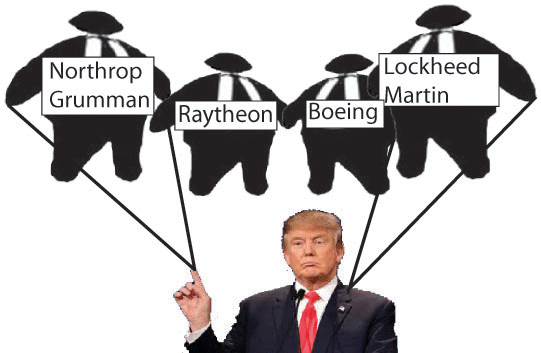
The Pentagon is speeding up US weapons deliveries to allied militaries such as Saudi Arabia, Romania, Japan, and South Korea through new “pilot authorities that change how it can design and execute contracts” according to news reports.
Nuclear war now becoming closer than ever
the chance of accidents, miscalculations, and blunders with tactical weapons—as well as the pressure to “use them or lose them” in battle—greatly increase the risk of an all-out nuclear war.
The Fourth Geneva Convention extends legal protection to civilians during wartime. The rules against deliberately harming noncombatants were expanded by two additional protocols, in 1977. “The civilian population . . . shall not be the object of attack,” Protocol II states. “Acts or threats of violence the primary purpose of which is to spread terror among the civilian population are prohibited.” Despite that admonition, today’s nuclear-targeting policies in many ways resemble medieval hostage-taking. The innocent are threatened with murder in order to preserve the peace.
 The Growing Dangers of the New Nuclear-Arms Race, The Trump Administration’s push for more nuclear weapons is part of a perilous global drive to miniaturize and modernize devices that already promise annihilation. New Yorker, By Eric Schlosser, 24 May 18, Less than a decade after President Barack Obama called for the abolition of nuclear weapons, the nine countries that possess them are engaged in a new nuclear-arms race. North Korea has most likely developed a hydrogen bomb, and its Hwasong-15 missiles may be large enough to transport not only a warhead but also decoys, chaff, and other countermeasures that would thwart America’s Ground-Based Midcourse Defense anti-ballistic-missile system. India recently commissioned its second ballistic-missile submarine, launched an Agni-5 ballistic missile that can strike targets throughout Pakistan and China, and tested nuclear-capable BrahMos and Nirbhay cruise missiles. Pakistan now has the world’s fastest-growing nuclear stockpile, including low-yield warheads on Hatf-9 missiles for use against Indian troops and armored vehicles. Israel is expanding the range of its Jericho III ballistic missiles and deploying cruise missiles with nuclear weapons on submarines. France and the United Kingdom are developing replacements for their Vanguard and Triomphant ballistic-missile submarines. China is about to introduce Dongfeng-41 ballistic missiles that will be mounted on trucks, loaded with up to ten nuclear warheads, and capable of reaching anywhere in the United States. Russia is building a wide range of new missiles, bombers, and submarines that will carry nuclear weapons. The R-28 Sarmat missile, nicknamed Satan-2, will carry up to sixteen nuclear warheads—more than enough for a single missile to destroy every American city with a population larger than a million people. Russia plans to build forty to fifty of the Satan-2s. Three other countries—Iran, Japan, and South Korea may soon try to obtain their own nuclear arsenals. Continue reading
USA Department of Veterans Affairs conveniently lost hundreds of claims for children, grandchildren of contaminated veterans
 VA lost or misplaced hundreds of claims for children, grandchildren of contaminated veterans http://www.wfla.com/8-on-your-side/investigations/va-lost-or-misplaced-hundreds-of-claims-for-children-grandchildren-of-contaminated-veterans/1194448265, Steve Andrews May 23, 2018
UK short of funds for its £51bn nuclear defence programme
 Nuclear defence programme to cost £51bn over next decade National Audit Office predicts total spending and warns of £2.9bn shortfall, Ft.com Peggy Hollinger, Industry Editor
The cost of building and maintaining the UK’s nuclear defence programme will add up to £50.8bn over the next 10 years, the UK’s public spending watchdog has said. The National Audit Office predicted a £2.9bn shortfall on the programme in that period, assuming the Ministry of Defence delivers the cost-cutting it has promised. The assessment is the first time the NAO has looked at the cost of the entire network of programmes, equipment and people needed for the UK’s nuclear deterrent between 2018 and 2028. As well as itemising completion of the current Astute submarines, the report looks at the costs of building the new Dreadnought class that will eventually replace the four Vanguard nuclear-armed boats from the early 2030s. The report showed that the top four suppliers — Rolls-Royce, BAE Systems, Babcock International and AWE Management — have won 97 per cent of contracts for nuclear defence………..https://www.ft.com/content/08d19194-5d0e-11e8-ad91-e01af256df68
USA Congress rejects move to limit new low-yield nuclear weapon.
House rejects limit on new nuclear warhead, Defense News , , 24 May 18, WASHINGTON — The U.S. House on Wednesday shot down a proposed limit on the Trump administration’s pursuit of a low-yield nuclear weapon.
F-35 bombers to get B61 Mod 12 nuclear weapon
 Terrifying new nuclear threat is here, Fox news By Kris Osborn | Warrior Maven 24 May 18
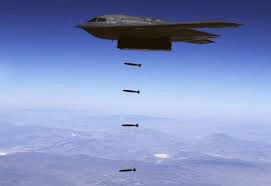
The Air Force is integrating the B61 Mod 12 nuclear weapon into the F-35 this year as part of a long-range plan to deploy a nuclear-armed, dual-capable F-35 able to give commanders a wider envelope of precision nuclear attack options.
“Detailed risk reduction activities have been completed ensuring the F-35A is fully compatible with the B61-12 weapon. Planning for Block 4 nuclear certification efforts have begun in anticipation of initial B61-12 integration on the F-35A this year,” Maj. Emily Grabowski, Air Force Spokeswoman, told Warrior Maven.
The Block 4 F-35, to fully emerge in the next decade, contains more than 50 technical adjustments to the aircraft designed as software and hardware builds — to be added in six-month increments between April 2019 to October 2024, she added.
The latest version of the B61 thermonuclear gravity bomb, which has origins as far back as the 1960s, is engineered as a low-to-medium yield strategic and tactical nuclear weapon, according to nuclearweaponsarchive.org, which also states the weapon has a “two-stage” radiation implosion design.
The most current Mod 12 version has demonstrated a bunker-buster earth-penetrating capability, according to the Federation of American Scientists (FAS).
“B61-12 is designed to have four selectable explosive yields: 0.3 kilotons (kt), 1.5 kt, 10 kt and 50 kt,” FAS writes.
Utilizing speed, maneuverability and lower-altitude flight when compared to how a bomber such as a B-2 would operate, a nuclear-capable F-35 presents new threats to a potential adversary. In a tactical sense, it seems that a high-speed F-35, fortified by long-range sensors and targeting technologies, might be well positioned to identify and destroy mobile weapons launchers or other vital, yet slightly smaller on-the-move targets. ………..
Also, without providing any detail, Grabowski did add that the Air Force is working closely with industry weapons developers to actively build new weapons specifically for the F-35.
“As we gain increasing experience with the aircraft and these new weapons mature, the program will follow the requirements for incorporating future weapons,” she told Warrior. http://www.foxnews.com/tech/2018/05/24/terrifying-new-nuclear-threat-is-here.html
USA’s history of accidental dropping of nuclear bombs
Remembering A Near Disaster: U.S. Accidently Drops Nuclear Bombs On Itself And Its Allies WUNC91.5, By JAY PRICE 24 May 18
In 1968, the Pentagon halted a program that kept military bombers in the air, loaded with nuclear weapons to deter a Soviet attack.
The problem was the jets kept having near-catastrophic accidents.
“If you go through some of the archival evidence publicly available, it seems like once a week or so, there was some kind of significant noteworthy accident that was being reported to the Department of Defense or the Atomic Energy Commission or members of Congress,” said Stephen Schwartz, a long-time nuclear weapons analyst.
Schwartz singled out 1958 as a particularly notorious year.
“We’re actually celebrating − celebrating is probably the wrong word − but we’re marking the 60th anniversary of no fewer than eight nuclear weapons accidents this year,” Schwartz said.
Every couple of weeks, Maurice Sanders gets a reminder of one of those 1958 accidents when a car with out-of-state tags parks in front of his house just outside Florence, South Carolina. Strangers pile out and tromp around to the scrub oak forest just behind his back yard to gaze down at an odd tourist attraction.
“It’s the hole from where the bomb had dropped, years ago,” Sanders said. “I think it’s on some kind of map or something.”
The circular pit is as big around as a small house, with a pond of tea-colored water at the bottom. A fading plywood cutout that someone put up − apparently to lure more tourists − is the size and shape of the Mark 6 nuclear bomb that was dropped there by accident.
The core containing the nuclear material was stored separately on the B-47 bomber it fell from, but the high explosives that were used to trigger the nuclear reaction exploded on impact, digging the crater estimated at 35 feet deep. The blast injured six members of a nearby family and damaged their home beyond repair.
Earlier that same year, just one state farther south, a jet fighter collided with a bomber during a training exercise, and the crew jettisoned a bomb into coastal waters near Savannah, Georgia.
Two years later, in 1961, a B-52 bomber flying out of Seymour Johnson Air Force Base near Goldsboro came apart in the sky, and the two armed nuclear bombs it was carrying fell into a farming community northeast of the base. One buried itself so deeply into a tobacco field that some of its parts were never found. The other floated down on a parachute, planting its nose in the ground beside a tree.
The parachute bomb came startlingly close to detonating. A secret government document said three of its four safety mechanisms failed, and only a simple electrical switch prevented catastrophe. It was 260 times more powerful than the bomb dropped on Hiroshima and could have instantly killed thousands of people. The radioactive fallout could have endangered millions more as far north as New York City.
Safety takes back seat to readiness
The military’s name for serious nuclear weapons mishaps is “broken arrow.” The Pentagon has only officially acknowledged 32 broken arrows, but evidence compiled by the government shows there were thousands more accidents involving nuclear weapons, Schwartz said.
“Most of which were not that as serious as the 32 we know about, but some of them were quite bad,” he said.
Schwartz said a wave of serious accidents in the late 1950s through 1968 was partly due to programs that kept the U.S. on a war footing. A few planes were kept aloft 24 hours a day, ready to drop bombs on Russia.
And then there was the sheer number of weapons being made, which created more opportunities for things to go wrong.
Schwartz said by the year after the bomb fell on South Carolina, the U.S. was making almost 20 nuclear weapons a day……..
“Everything associated with nuclear weapons the nuclear weapons delivery system, the command-and-control systems that make sure they go off when they’re supposed to and most importantly that they don’t go off when they’re not supposed to − all of these things are designed, built, operated, and maintained by human beings,” Schwartz said. “And human beings are fallible.”
Overseas accidents bring program’s end
It wasn’t the bombs the U.S. dropped on itself that finally ended the program. Rather, it was two accidents over friendly nations.
In 1966, a B-52 bomber – also flying out of Seymour Johnson – broke apart in the sky near the coast of Spain. One of its bombs dropped into the sea, and three fell on land where conventional explosives scattered radioactive material.
Then, in 1968, the burning-seat-cushion crash spread plutonium and uranium onto sea ice and into the sea off the coast of Greenland……..http://wunc.org/post/remembering-near-disaster-us-accidently-drops-nuclear-bombs-itself-and-its-allies#stream/0
USA nuclear agency up to its old tricks – secretive over-spending on nuclear weapons
New Documents Raise Questions About Increased Nuclear Spending, A nuke agency is up to its old tricks War is Boring, WIB POLITICS May 22, 2018 Lydia Dennett
There are many reasons to keep certain parts of the U.S. nuclear weapons complex a secret. But fraud, waste, and abuse run rampant when the mystique and awe of nuclear bombs gets in the way of effective oversight. And it is the taxpayer who ends up suffering.
The secrets to creating a nuclear explosion and the materials to do so are kept by the National Nuclear Security Administration, a semi-autonomous agency within the Department of Energy, and it has a $1.2 trillion plan to build new nuclear warheads and facilities over the next 30 years.
But new documents obtained by the Project on Government Oversight discussing the life expectancy of nuclear weapons components show that the uranium cores may have a longer life span than originally thought. This may undermine some justifications for an expansive—and expensive—nuclear modernization plan.
Although much of the documents are redacted, likely to keep safe the most sensitive details of the U.S. nuclear enterprise, the remaining details seem to suggest that initial life-span estimates were too conservative. These initial estimates were partially used as justification for plans to build an expensive new facility and revising plans based on these findings could result in billions of savings for taxpayers.
In light of NNSA’s rhetoric about the aging nuclear arsenal and the desperate need for more money to modernize, POGO endeavored to determine exactly what upgrades were truly needed to support a credible nuclear deterrent. In 2013, we released a report that called for a study into the lifetime of uranium secondaries in order to determine what capacity would be required of a proposed new facility.
Initially, the NNSA had claimed publicly that it needed a “big box” design, a large facility that would replace several different buildings in the complex and that had the capacity to remanufacture 160-200 secondaries per year. But just a few years later the department’s own Stockpile Stewardship and Management Plan stated the need was really only 80.
Given this shift within the department, as well as a litany of design missteps, cost overruns, and poor project oversight, POGO recommended a lifetime study for uranium secondaries and a scaled-down design utilizing existing facilities.
Shortly after POGO released our UPF report, the NNSA formed a “Red Team” to review the design. That review echoed many of POGO’s findings and recommendations including the need for “significant and sustained oversight” as well as immediately scrapping the big box design.
“Design efforts on the current ‘big box,’ single structure UPF concept should be stopped while a comprehensive reevalution of program requirements and applicable design standards is undertaken,” the report stated.
The new documents from the time suggest that a study into the lifetimes of secondaries supported this decision. One of the newly obtained documents is a 2010 peer review analysis conducted by the Los Alamos National Laboratory of the life expectancy study for one nuclear warhead type, the W78. The review committee examined work and analysis done by the “life expectancy team” charged with concluding how long these secondaries will remain effective…………
NNSA’s pattern of exaggerating spending needs
A remarkably similar situation occurred with the agency’s planned plutonium operations replacement facility. The NNSA claimed the proposed Chemistry and Metallurgy Research Replacement – Nuclear Facility needed to be able to manufacture 450 plutonium cores per year. But after a lifetime study found they can last for over 150 years without significantly degrading the number plummeted to less than 80 per year, dramatically decreasing what would be required of the new building.
Congress ultimately canceled the facility when cost overruns and delays made it impossible to continue, and the NNSA is now pursuing a scaled down approach. But there’s no getting around the fact that twice now the NNSA has either obscured facts that would suggest a more limited capacity is all that’s required or has pursued an expensive plan without knowing all the facts beforehand. Either explanation is an unacceptable exploitation of taxpayer dollars.
……… Despite these nearly constant warnings and recommendations for improvement from all the four corners of the nuclear complex world, the NNSA plans to move full steam ahead with their incredibly expensive upgrade plan. A plan that is partially justified by rhetoric suggesting that age has significantly deteriorated parts of the complex.Without an independent study it’s impossible to know if these claims are true. And with NNSA’s track record, Congress would be more than justified in asking questions. Before pouring billions of dollars into this effort, Congress should commission an independent, scientist-led study by the JASON advisory group to ensure NNSA’s future spending plans match up with the overall U.S. national security needs.
This story first appeared at the Project on Government Oversight. https://warisboring.com/new-documents-raise-questions-about-increased-nuclear-spending/
Walter Pincus warns U.S. Congress to be sceptical of Pentagon’s call to fund a new nuclear weapon
 The Pentagon is seeking money for a new nuclear weapon. Congress should be skeptical. https://www.washingtonpost.com/opinions/the-pentagon-is-seeking-money-for-a-new-nuclear-weapon-congress-should-be-skeptical/2018/05/18/d13fe766-59e4-11e8-8836-a4a123c359ab_story.html?utm_term=.e44ec44d91b4 By Walter Pincus May 18 Walter Pincus is a former Washington Post reporter and columnist covering national security issues.
Top Pentagon officials are telling some pretty tall tales in seeking congressional support for a new, low-yield, nuclear warhead to put on a long-range, submarine-launched ballistic missile.
Gen. John E. Hyten, commander of U.S. Strategic Command, gave the most unusual rationale when he testified on March 20 before the Senate Armed Services Committee.
The stated purpose of this new weapon is to deter the Russians from using any of their low-yield nuclear weapons — something Russian President Vladimir Putin has often threatened to do if he ever found himself being overwhelmed by NATO conventional forces, presumably in Western Europe.
The United States and its NATO allies already have about 200 low-yield nuclear bombs deployed in Europe. But Hyten and Pentagon officials say an additional weapon is needed to deter Putin’s first use of his tactical nukes, because the aircraft that would deliver our bombs, stealthy as they may be, might not be able to get through Russian defenses.
That’s where the new submarine-launched weapon would come in.
In Hyten’s presentation, should the Russians initiate the use of tactical nukes on the battlefield, the United States would launch one or two low-yield weapons from submarines, not toward the battlefield, where allies might be threatened, but toward targets in Russia.
Here’s the most interesting part: How are the Russians going to know the warheads on those incoming missiles are low-yield, and not — like most nuclear warheads delivered by our submarine-launched ballistic missiles — 10 times more powerful than the bombs used to strike Hiroshima and Nagasaki?
Hyten’s initial response to that question was to tell the senators that from launch to detonation some 30 minutes would elapse.
He then explained: “If somebody does detect that launch, they would see a single missile or maybe two missiles coming. They will realize it is not an existential threat to their country and, therefore, they do not have to respond with an existential threat.” By “existential threat” Hyten essentially meant a full-scale first strike by hundreds of U.S. warheads, designed to knock out Russia’s ability to respond and perhaps survive as a nation.
In short, Hyten suggested that Putin — or his successor — would wait 30 minutes for the incoming one or two U.S. missiles to hit Russian targets before deciding whether to launch a major nuclear response back at the United States.
Why does Hyten suggest that?
His answer was surprising: “That is what I would recommend if I saw that coming against the United States.”
Has any prior STRATCOM commander, or any other U.S. senior government official, announced publicly the United States would ride out any nuclear attack before responding?
Hyten went on to explain, “If we do have to respond, we want to respond in kind and not further escalate the conflict out of control.”
He described the new warhead as a “deterrence weapon first, and then a response weapon . . . to keep the conflict from escalating worse. It actually makes it harder for an adversary to use [a nuclear] weapon in the first place and if it does use it, it allows you to respond appropriately.”
Hyten added, “The key is a rational actor. A rational actor is the basis of all deterrent policy.”
Defense Secretary Jim Mattis made a simpler claim for developing the new warhead in testimony on May 9 before the Senate Appropriations defense subcommittee. He described the scenario Hyten used: Russia, facing defeat in a conventional battle, “would escalate to a low-yield nuclear weapon knowing that our choice would be . . . to either respond with a high-yield [nuclear weapon] or surrender — in other words, frankly suicide or surrender, because a nuclear exchange between Russia and the United States would be a disaster for this planet.”
Suicide or surrender are hardly the only choices, and Mattis should know better.
That same day, May 9, Rep. Adam Smith (Wash.), ranking Democrat on the Armed Services Committee, offered the more traditional understanding of how to deter the Russian low-yield nuclear weapon threat. It came during markup of the fiscal 2019 defense authorization bill.
Smith said, “We don’t create this notion that we can just exchange nuclear weapons and as long as they are small it will be okay. It won’t be okay.” Instead, he suggested, the response to the Russians should be, “We have over 4,000 nuclear weapons, and if you launch one, we will launch ours back at you. And we are not going to sit there and be concerned to make sure that ours isn’t bigger than yours when you started this.”
The Washington state congressman added, “If we send that message, that is a very sufficient deterrent.”
The full House Armed Services Committee ended up authorizing $65 million for development of the new low-yield, sub-launched missile and sent the measure on for an eventual vote by the full House. Meanwhile, the Senate Armed Services Committee has scheduled taking up the measure the week of May 21 where it may face more opposition than it did in the House committee. It should.
China lands nuclear strike bombers on South China Sea islands
Prepared for battle: China lands nuclear strike bombers on South China Sea islands CHINA raised global fears after sending nuclear bombs and warplanes above the South China Sea as part of a simulated training exercise with air force officials declaring the country is “preparing for battle”. Express UK, By LATIFA YEDROUDJ May 20, 2018 Air force personnel confirmed it had ”organised multiple bombers” to conduct “take-off and landing training” along islands and reefs in the South China Sea, as practise in light of a full-scale war.
1 This Month
15 October. Joint Appeal for Nuclear Abolition Day -presentation to the UN on October 15 will be live on UNWebTV
Endorse the Nuclear Abolition Day Appeal
23-25 October – on Zoom – World BEYOND War’s annual global conference

To see nuclear-related stories in greater depth and intensity – go to https://nuclearinformation.wordpress.com
-
Archives
- October 2026 (149)
- September 2026 (339)
- August 2026 (330)
- July 2026 (355)
- June 2026 (287)
- May 2026 (306)
- April 2026 (356)
- March 2026 (251)
- February 2026 (267)
- January 2026 (308)
- December 2025 (358)
- November 2025 (359)
-
Categories
- 1
- 1 NUCLEAR ISSUES
- business and costs
- climate change
- culture and arts
- ENERGY
- environment
- health
- history
- indigenous issues
- Legal
- marketing of nuclear
- media
- opposition to nuclear
- PERSONAL STORIES
- politics
- politics international
- Religion and ethics
- safety
- secrets,lies and civil liberties
- spinbuster
- technology
- Uranium
- wastes
- weapons and war
- Women
- 2 WORLD
- ACTION
- AFRICA
- Atrocities
- AUSTRALIA
- Christina's notes
- Christina's themes
- culture and arts
- Events
- Fuk 2022
- Fuk 2023
- Fukushima 2017
- Fukushima 2018
- fukushima 2019
- Fukushima 2020
- Fukushima 2021
- general
- global warming
- Humour (God we need it)
- Nuclear
- RARE EARTHS
- Reference
- resources – print
- Resources -audiovicual
- Weekly Newsletter
- World
- World Nuclear
- YouTube
-
RSS
Entries RSS
Comments RSS

