New reports cast doubt on impact of US strikes on Iran’s nuclear sites
Citing intelligence assessments, NBC News and Washington Post report that only Fordow site was destroyed in US attack.
US Secretary of Defense attacks media for questioning Iran strikes
By Al Jazeera Staff, 18 Jul 202518 Jul 2025, https://www.aljazeera.com/news/2025/7/18/new-reports-cast-doubt-on-impact-of-us-strikes-on-irans-nuclear-sites
Washington, DC – New media reports in the United States, citing intelligence assessments, have cast doubt over President Donald Trump’s assertion that Washington’s military strikes last month “obliterated” Iran’s nuclear programme.
The Washington Post and NBC News reported that US officials were saying that only one of the three Iranian nuclear sites – the Fordow facility – targeted by the US has been destroyed.
The Post’s report, released on Friday, also raised questions on whether the centrifuges used to enrich uranium at the deepest level of Fordow were destroyed or moved before the attack.
“We definitely can’t say it was obliterated,” an unidentified official told the newspaper, referring to Iran’s nuclear programme.
Trump has insisted that the US strikes were a “spectacular” success, lashing out at any reports questioning the level of damage they inflicted on Iran’s nuclear programme.
An initial US intelligence assessment, leaked to several media outlets after the attack last month, said the strikes failed to destroy key components of Iran’s nuclear programme and only delayed its work by months.
But the Pentagon said earlier in July that the attacks degraded the Iranian programme by one to two years.
While the strikes on Fordow – initially thought to be the most guarded facility, buried inside a mountain – initially took centre stage, the NBC News and Washington Post reports suggested that the facilities in Natanz and Isfahan also had deep tunnels.
‘Impenetrable’
The US military did not use enormous bunker-busting bombs against the Isfahan site and targeted surface infrastructure instead.
A congressional aide familiar with intelligence briefings told the Post that the Pentagon had assessed that the underground facilities at Isfahan were “pretty much impenetrable”.
The Pentagon responded to both reports by reiterating that all three sites were “completely and totally obliterated”.
Israel, which started the war by attacking Iran without direct provocation last month, has backed the US administration’s assessment, while threatening further strikes against Tehran if it resumes its nuclear programme.
For its part, Tehran has not provided details about the state of its nuclear sites.
Some Iranian officials have said that the facilities sustained significant damage from US and Israeli attacks. But Supreme Leader Ali Khamenei said after the war that Trump had “exaggerated” the impact of the strikes.
The location and state of Iran’s highly enriched uranium also remain unknown.
Iran’s nuclear agency and regulators in neighbouring states have said they did not detect a spike in radioactivity after the bombings, suggesting the strikes did not result in uranium contamination.
But Rafael Grossi, the head of the United Nations nuclear watchdog, the IAEA, did not rule out that the uranium containers may have been damaged in the attacks.
“We don’t know where this material could be or if part of it could have been under the attack during those 12 days,” Grossi told CBS News last month.
According to Grossi, Iran could resume uranium enrichment in a “matter of months”.
The war
Israel launched a massive attack against Iran on June 13, killing several top military officials, as well as nuclear scientists.
The bombing campaign targeted military sites, civilian infrastructure and residential buildings across the country, killing hundreds of civilians.
Iran responded with barrages of missiles against Israel that left widespread destruction and claimed the lives of at least 29 people.
The US joined the Israeli campaign on June 22, striking the three nuclear sites. Iran retaliated with a missile attack against an air base housing US troops in Qatar.
Initially, Trump said the Iranian attack was thwarted, but after satellite images showed damage at the base, the Pentagon acknowledged that one of the missiles was not intercepted.
“One Iranian ballistic missile impacted Al Udeid Air Base June 23 while the remainder of the missiles were intercepted by US and Qatari air defence systems,” Pentagon spokesperson Sean Parnell told Al Jazeera in an email last week.
Advertisement
“The impact did minimal damage to equipment and structures on the base. There were no injuries.”
After a ceasefire was reached to end the 12-day war, both the US and Iran expressed willingness to engage in diplomacy to resolve the nuclear file. But talks have not materialised.
Iran and the US were periodically holding nuclear talks before Israel launched its war in June.
During his first term in 2018, Trump withdrew the US from the 2015 multilateral nuclear agreement, known as the Joint Comprehensive Plan of Action (JCPOA).
The agreement saw Iran scale back its nuclear programme in exchange for lifting international sanctions against its economy.
In recent days, European officials have suggested that they could impose “snap-back” sanctions against Iran as part of the deal that has long been violated by the US.
Tehran, which started enriching uranium beyond the limits set by the JCPOA after the US withdrawal, insists that Washington was the party that nixed the agreement, stressing that the deal acknowledges Iran’s enrichment rights.
On Friday, Iranian Foreign Minister Abbas Araghchi said he held talks with the top diplomats of France, the United Kingdom and Germany – known as the E3 – as well as the European Union’s high representative.
Araghchi said Europeans should put aside “worn-out policies of threat and pressure”.
“It was the US that withdrew from a two-year negotiated deal – coordinated by EU in 2015 – not Iran; and it was US that left the negotiation table in June this year and chose a military option instead, not Iran,” the Iranian foreign minister said in a social media post.
“Any new round of talks is only possible when the other side is ready for a fair, balanced, and mutually beneficial nuclear deal.”
Tehran denies seeking a nuclear bomb. Israel, meanwhile, is widely believed to have an undeclared nuclear arsenal.
Trump Asked Zelensky If He Could Strike Moscow If the US Provided Longer-Range Weapons.

Trump later denied that he was considering sending long-range weapons to Ukraine and said that Ukraine shouldn’t target Moscow
by Dave DeCamp | Jul 15, 2025, https://news.antiwar.com/2025/07/15/trump-asked-zelensky-if-he-could-strike-moscow-if-the-us-provided-longer-range-weapons/
President Trump has encouraged Ukraine to step up strikes deep inside Russia and even asked Ukrainian President Volodymyr Zelensky if his forces were capable of striking Moscow if the US provided longer-range weapons, the Financial Times reported on Tuesday.
Sources told the FT that the conversation occurred during a July 4 phone call. “Volodymyr, can you hit Moscow? . . . Can you hit St Petersburg too?” Trump asked. Zelensky replied that his forces could “absolutely” strike the Russian cities if the US provided the necessary weapons.
The report said that Trump signaled backing for the idea of providing long-range weapons in order to “make them [Russians] feel the pain” to pressure Moscow at the negotiating table. In comments to reporters, Trump later denied that he was considering providing Ukraine with long-range weapons and said that Zelensky “shouldn’t target Moscow.”
The White House confirmed that the conversation about striking Moscow took place, but insisted Trump wasn’t encouraging Ukrainian attacks inside Russia. A White House official told the BBC that Trump was “merely asking a question, not encouraging further killing. He’s working tirelessly to stop the killing and end this war.”
The FT report said that US officials have also provided Zelensky with a list of potential long-range weapons the US could supply. The Ukrainians have been asking for Tomahawk missiles, which have a range of over 1,000 miles, making them capable of hitting Moscow from Ukrainian territory.
Last year, the Biden administration gave Ukraine the green light to use ATACMS missiles in strikes on Russian territory. The ATACMS have a range of about 190 miles, which is not far enough to hit Moscow. Russia has made clear that attacks on its territory risk nuclear escalation since it lowered the threshold for its use of nuclear weapons in response to the US backing the ATACMS attacks.
The revelation about the Trump-Zelensky call came after the US president announced a new plan to provide Ukraine with “billions of dollars” worth of weapons by selling arms to NATO countries that will then transfer them to the war-torn nation. He also threatened major tariffs on Russia and its trading partners if a peace deal isn’t reached in 50 days, an ultimatum Moscow has rejected.
U.S. Military Launches MASSIVE Drills to Prepare for WAR with China | KJ Noh
https://www.youtube.com/watch?v=UfHiRlHD3ZY
The U.S. launched massive military drills focused on war with China in the Pacific theater this week, involving 12,000 personnel from the Air Force and Space Force, and more than 350 aircraft, with the Secretary of the Air Force noting that this exercise is “the first of its kind since the Cold War.”
- US conducts Department-level War drills not seen in a generation aimed at China
- How Trump’s Tariff Tantrum and Rubio in ASEA are part of this escalation; Beijing’s countermove: ASEAN-China FTA
- History: Tariffs as economic warfare & as continuation of the TPP: Hybrid warfare and continuity of war agenda
- 4 phases of Taiwan’s history/4 phases of US-China relation: Taiwan’s proxy role
- Weaponization and provocation: does China have to respond?
- Russia-China two-front-war accusations; strategic sequencing, division of labor, separation anxiety
“If we make no effort to change direction, we will end up where we are heading.”
Hungary Refuses To Finance US Weapons for Ukraine

Donald Trump has shifted the financial burden of new US weapons to the EU, raising tensions among member states
News Desk, JUL 14, 2025, https://thecradle.co/articles/hungary-refuses-to-finance-us-weapons-for-ukraine
Hungarian Foreign Minister Péter Szijjártó said on 14 July that Hungary will not participate in financing US weapons for Ukraine, even if Washington formally proposes the initiative to the EU.
“I would like to emphasize that Hungarian money, Hungarian weapons, and Hungarian soldiers will not be sent to Ukraine.
Nothing will be sent there,” Szijjártó stated during a press conference in Budapest following a meeting with Moroccan Minister of Industry and Trade Ryad Mezzour.
Despite this, he expressed support for US President Donald Trump’s so-called peace efforts, stating: “No one has done as much for peace in Ukraine as Trump.”
He added that these efforts “could have been much more successful in recent months if they hadn’t been obstructed by European and Ukrainian leaders.”
Szijjártó’s remarks came shortly after Trump announced on 14 July that the US would deliver Patriot air defense missiles to Ukraine, saying the EU would cover the full cost.
“We will send them Patriots, which they desperately need … The EU is going to pay us 100 percent for that, and that’s the way we want it,” Trump told reporters at Joint Base Andrews.
Trump framed the weapons transfer as part of a broader strategy to pressure Moscow into negotiations, but did not specify how many systems would be delivered.
“Putin really surprised a lot of people. He talks nice and then bombs everybody in the evening. But there’s a little bit of a problem there. I don’t like it,” he said.
The announcement coincided with the arrival of Trump’s special envoy, retired Lt. Gen. Keith Kellogg, in Kiev. Ukrainian officials confirmed that discussions would center on weapons, sanctions on Russia, and deepening ties with Washington.
Ukrainian President Volodymyr Zelensky earlier confirmed Kiev’s readiness to purchase Patriot systems and long-range missiles from the US.
A significant announcement on further arms support is expected from Trump later this week, according to Axios.
U.S. and Israeli strikes on Iran could fuel a new wave of nuclear proliferation
In the wake of recent strikes by Israel and the United States on Iranian
cities, military sites and nuclear facilities, a troubling paradox has
emerged: actions intended to prevent Iran from acquiring nuclear weapons
may actually be accelerating its pursuit of them and encouraging other
countries to follow suit.
The Conversation 14th July 2025, https://theconversation.com/u-s-and-israeli-strikes-on-iran-could-fuel-a-new-wave-of-nuclear-proliferation-260897
80 Years Ago: The First Atomic Explosion, 16 July 1945.

James B. Conant’s Eyewitness Account:
“The Whole Sky Suddenly Full of White Light Like the End of the World”
1,100 Square Miles in New Mexico Exposed to Radioactive Contamination
UCLA Report Suspected “Many Potential Long-Term Insidious Hazards” From Trinity Test Radiation
Washington, D.C., July 16, 2025 – Early in the morning of 16 July 1945, 80 years ago today, the U.S. Manhattan Project staged the first test of a nuclear weapon in the New Mexican desert. It was the first trial of a plutonium implosion weapon—the same weapon type that devastated Nagasaki a few weeks later. The explosion on the ground produced radioactive fallout contaminating over 1,100 square miles of the state, with some debris spreading as far north as Canada. Six weeks after the test, a “swath of fairly high radioactivity on the ground cover[ed] an area of about 100 miles long by 30 miles wide,” according to a Los Alamos Laboratory report published today for first time by the National Security Archive, while “gamma radiation was found in measurable but very low intensities in Santa Fe, Las Vegas, Raton and even in Trinidad, Colorado,” 260 miles from the point of detonation.
To mark the anniversary of this world-historic event, the National Security Archive today published a collection of essential declassified documents on the first atomic bomb test and the radioactive contamination that preoccupied government officials and medical experts during the years that followed. The new posting builds upon an Electronic Briefing Book of documents, photos, and period films published last year by the Archive, fortifying it with a number of significant new records, including:
- memoranda sent to Manhattan Project director Gen. Leslie R. Groves by his Scientific Advisor Richard C. Tolman on the so-called “100-ton test”—the Trinity “dress rehearsal”—and the reasons for holding a test of the implosion device at the Trinity site,
- Manhattan Project Director General Leslie Groves’ phoned-in message on the test minutes after it occurred, reporting that results were “probably … above expectations,”
- reports by Chief of British Mission Sir James Chadwick on the Test, who wrote, “Even now, a week later, I am filled with awe when I look back at this moment. It was a vision from the Book of Revelation,”
- and Harvard University President James B. Conant’s dramatic firsthand account of the test, observing that “the enormity of the light and its length quite stunned me.”
The Trinity Test planners prepared for possible adverse public health effects but did not know how far radioactive debris would spread, and the biological and public health impact of low-level radiation is still a contested issue. But during the years after Trinity, researchers with the Atomic Energy Project at the Medical School of the University of California, Los Angeles (UCLA) collected evidence to help determine whether the fallout produced a health hazard. While the studies drew no firm conclusions, a 1951 report by the Project found that there were “many potential long-term insidious hazards from the present low-level contamination which is the focal point of these studies.” The possibility that such hazards could eventually inspire legal action was concerning to medical experts who also wanted to learn more about the military implications of low levels of radiation contaminating “large land areas,” leading the Atomic Energy Commission to fund a research program at UCLA to determine the scope and impact of the contamination.
The Trinity test took place 80 years ago, but it is not entirely in the past. Researchers at the National Cancer Institute have determined that the test’s fallout contributed to excess numbers of thyroid cancers. To this his day, “down winders” in New Mexico seek federal compensation under the Radiation Exposure and Compensation Act (RECA), which so far has excluded that state, even though 33 of its counties, including tribal areas, experienced levels of radiation exposure that were higher than other U.S. counties covered by the Act.
Trump Announces Weapons Plan for Ukraine, Gives Russia 50-Day Deadline for Tariffs
Under the plan, the US will sell more weapons to NATO countries that will be transferred to Ukraine
by Dave DeCamp | Jul 14, 2025, https://news.antiwar.com/2025/07/14/trump-announces-weapons-plan-for-ukraine-gives-russia-50-day-deadline-for-tariffs/
President Trump on Monday met with NATO Secretary-General Mark Rutte at the White House and announced a plan to provide Ukraine with “billions of dollars” worth of US military equipment by selling US weapons to NATO countries that will be then transferred to the war-torn nation. The president also said that if a peace deal isn’t reached within 50 days, he will impose tariffs on Russia.
A source told Axios that the US is expected to sell $10 billion worth of military equipment to NATO countries in the first wave. Explaining the weapons plan to reporters, Rutte said the idea was to ensure that the US, which he described as the “police agent” of the world, is able to maintain its military stockpiles while also providing a “massive” amount of weapons to Ukraine.
“The US needs to make sure it can keep its hands on what the US needs to keep the whole world safe, because, in the end, you are the police agent of the whole world … but given that, the US has decided to indeed to massively supply Ukraine with what is necessary through NATO. Europeans [will be] 100% paying for that,” Rutte said.
Trump and Rutte said that they’d gotten commitments from European countries to purchase US weapons for Ukraine. “I will say that I spoke with Germany, spoke with most of the larger countries, and they are really enthusiastic about this, and they’re willing to go really far,” Trump said.
Trump and Rutte didn’t elaborate on the type of arms that would be sent, except to mention that more US-made Patriot air defense systems would be supplied to Ukraine. Sources told Axios that the weapons will also include long-range weapons that can strike deep inside Russia.
Regarding tariffs, Trump threatened to impose 100% tariffs on Russia and “secondary tariffs” that would target Moscow’s trading partners, which include China and India. “We’re going to be doing very severe tariffs if we don’t have a deal in 50 days,” he said.
While announcing measures to continue the proxy war, Trump is still trying to distance himself from the conflict, calling it a “Biden war” and a “Democrat war.” The president insisted that he still wants to bring the conflict to an end and that he hopes the new military aid and tariff threat will do that. “This is not Trump’s war. We’re here to get it finished and stopped,” he said.
Trump also expressed frustration with Putin, saying that he has nice conversations with the leader, but that missiles keep targeting Ukrainian cities. “My conversations with him are very pleasant, and then the missiles go off at night,” he said.
Russia has made clear that it won’t back down on its core demands for a peace deal: Ukrainian neutrality and the recognition of the four oblasts Moscow annexed in 2022 as Russian territory, which would require a Ukrainian withdrawal from the territory it still controls in those areas.
Ukrainian President Volodymyr Zelensky has refused to give up the territory and is unlikely to make concessions as long as the US and NATO continue to support his war effort. In the meantime, Russia continues to make gains on the battlefield and launch heavy missile and drone attacks across Ukraine.
The New York Times Finally Stops Avoiding The G-Word

Caitlin Johnstone, Jul 16, 2025, https://www.caitlinjohnst.one/p/the-new-york-times-finally-stops?utm_source=post-email-title&publication_id=82124&post_id=168435877&utm_campaign=email-post-title&isFreemail=true&r=1ise1&triedRedirect=true&utm_medium=email
The New York Times has published an op-ed by a genocide scholar who says that he resisted acknowledging the truth of what Israel is doing in Gaza for as long as he could, but can no longer deny the obvious.
It’s an admission that may as well have come from The New York Times itself.
In an article titled “I’m a Genocide Scholar. I Know It When I See It.”, a Brown University professor of Holocaust and genocide studies named Omer Bartov argues that “Israel is literally trying to wipe out Palestinian existence in Gaza,” and denounces his fellow Holocaust scholars for failing to acknowledge reality.
“My inescapable conclusion has become that Israel is committing genocide against the Palestinian people,” Bartov writes. “Having grown up in a Zionist home, lived the first half of my life in Israel, served in the I.D.F. as a soldier and officer and spent most of my career researching and writing on war crimes and the Holocaust, this was a painful conclusion to reach, and one that I resisted as long as I could. But I have been teaching classes on genocide for a quarter of a century. I can recognize one when I see one.”
And resist he did. In November 2023, Bartov wrote another op-ed for The New York Times saying “As a historian of genocide, I believe that there is no proof that genocide is currently taking place in Gaza, although it is very likely that war crimes, and even crimes against humanity, are happening.”
Apparently he is seeing the proof now and has stopped resisting what’s been clear from the very beginning. And it would seem the editors of the Gray Lady have ceased resisting as well.
The New York Times, which has an extensively documented pro-Israel bias, has frenetically avoided the use of the g-word on its pages from the very beginning of the Gaza onslaught. Even in its opinion and analysis pieces the NYT Overton window has cut off at framing the issue as a complex matter of rigorous debate, with headlines like “Accused of Genocide, Israelis See Reversal of Reality. Palestinians See Justice.” and “The Bitter Fight Over the Meaning of ‘Genocide’” representing the closest thing to the pro-Palestinian side of the debate you’d see. During the same time we’ve seen headlines like “From the Embers of an Old Genocide, a New One May Be Emerging” used in reference to Sudan.
In an internal memo obtained by The Intercept last year, New York Times reporters were explicitly told to avoid the use of the word “genocide”, as well as terms like “ethnic cleansing” and “occupied territory”.
“‘Genocide’ has a specific definition in international law,” the memo reads. “In our own voice, we should generally use it only in the context of those legal parameters. We should also set a high bar for allowing others to use it as an accusation, whether in quotations or not, unless they are making a substantive argument based on the legal definition.”
Earlier this year the American Friends Service Committee cancelled its paid advertisement in The New York Times calling for an end to the genocide in Gaza, saying the outlet had wanted them to change the word “genocide” to “war” in order for their ad to be published.
So there has been a significant change.
To be clear, this analysis by Omer Bartov is not significant in and of itself. He is only joining the chorus of what has already been said by human rights organizations like Amnesty International, Human Rights Watch, United Nations human rights experts, and the overwhelming majority of leading authorities on the subject of genocide.
What is significant is that even experts who’ve been resisting acknowledging the reality of the genocide in Gaza because of their bias toward Israel have stopped doing so, and that even the imperial media outlets most fiendishly devoted to running propaganda cover for that genocide have run out of room to hide.
The Israel apologists have lost the argument. They might not know it yet, but they have. Public sentiment has turned irreversibly against them as people’s eyes are opened to the truth of what’s happening in Gaza, and more and more propagandists are choosing to rescue what’s left of their tattered credibility instead of going down with the sinking ship.
Truth is slowly beginning to get a word in edgewise.
Keep pushing. Keep fighting. Keep resisting.
It’s working.
Ex-UN Special Rapporteur Says Francesca Albanese Deserves Nobel Prize, Not US Sanctions
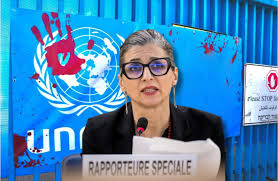
The US is punishing UN Special Rapporteur Francesca Albanese for her scathing reports on Israel’s genocide in Gaza.
By Marjorie Cohn , Truthout, July 14, 2025
The day after Donald Trump welcomed indicted war criminal Israeli Prime Minister Benjamin Netanyahu to the United States for the third time in less than six months, U.S. Secretary of State Marco Rubio imposed sanctions against UN Special Rapporteur on Occupied Palestine Francesca Albanese for her clear-eyed critiques of Israel’s genocide.
In a July 9 press statement, Rubio charged that Albanese “has directly engaged with the International Criminal Court (ICC) in efforts to investigate, arrest, detain, or prosecute nationals of the United States or Israel, without the consent of those two countries.” He alleged that Albanese “has spewed unabashed antisemitism, expressed support for terrorism, and open contempt for the United States, Israel, and the West … including recommending that the ICC, without a legitimate basis, issue arrest warrants” for Netanyahu and former Defense Minister Yoav Gallant.
“No comment on mafia style intimidation techniques,” Albanese responded to the sanctions in a text message to Al Jazeera. “Busy reminding member states of their obligations to stop and punish genocide. And those who profit from it.” She queried why she had been sanctioned: “for having exposed a genocide? For having denounced the system? They never challenged me on the facts.”
In the height of irony, war criminal Netanyahu nominated serial lawbreaker Trump for the Nobel Peace Prize. But it is Albanese who deserves that prize.
“The UN Special Rapporteur on Occupied Palestine deserves the Nobel Peace Prize, not the U.S. punitive pushback by way of targeted sanctions denying her entry into the country and freezing any American assets she may have,” Richard Falk, who served as UN Special Rapporteur on Occupied Palestine from 2008 to 2014, told Truthout.
“This was an intimidating attack on Albanese, an unpaid civil servant, for her brave truth-telling and expert knowledge fully in accord with expectations of the job to report periodically to the UN Human Rights Council and the General Assembly,” Falk added. “Her well-documented reports have broken the mainstream silence in the West on Israel’s genocidal assault, carried out before the eyes and ears of the world, shocking many by its transparency and sadism over a period of more than 20 months. She has also exposed shameful patterns of U.S. complicity with Israeli criminality.”
As they dined together in Washington, Netanyahu told Trump he had nominated him for the Nobel Peace Prize. The nomination, which Netanyahu sent to the Nobel Committee 10 days after the U.S. bombed nuclear facilities in Iran, rewarded Trump for his unwavering support for the crimes of the Zionist regime in both Palestine and Iran. Trump has continued and increased Joe Biden’s financial, political, and diplomatic assistance to Israel’s (now) 21-month-long genocide in the Occupied Palestinian Territory, which has killed more than 58,000 Palestinians. Trump also dutifully complied with Netanyahu’s plea to bomb Iranian nuclear sites, dropping several 30,000-pound bunker buster bombs on Iran. U.S. participation in Israel’s international crimes is patently illegal.
“Anatomy of a Genocide”
On July 1, 2024, Albanese filed her report “Anatomy of a Genocide” with the UN Human Rights Council. The summary begins, “After five months of military operations, Israel has destroyed Gaza.” That was one year ago. Not content with destroying Gaza, Israel continues to slaughter, starve, and displace the Palestinian people.
In this report, Albanese thoroughly documents Israel’s commission of genocide which is prohibited by the Genocide Convention. She cites the International Court of Justice’s (ICJ’s) order that Israel prevent and punish genocide and ensure humanitarian aid, which Israel has ignored. Albanese finds that “Israel has strategically invoked the international humanitarian law framework as ‘humanitarian camouflage’ to legitimize its genocidal violence in Gaza.” Israel, she charges, “appears to represent itself as conducting a ‘proportionate genocide.’” The crime of genocide, Albanese notes, entails “both individual and State responsibility.”
Israel’s actions “have been driven by a genocidal logic integral to its settler-colonial project in Palestine, signalling a tragedy foretold,” Albanese continues. “[D]isplacing and erasing the Indigenous Arab presence,” she writes, “has been an inevitable part of the forming of Israel as a ‘Jewish State.’”
Since illegally acquiring Palestinian territory by force in 1967, “Israel has advanced its settler-colonial project through military occupation, stripping the Palestinian people of their right to self-determination,” the report reads. “Genocide cannot be justified under any circumstances, including purported self-defence.” The ICJ has repeatedly held that Israel, as occupier, does not have a right to self-defense against the occupied Palestinians.
Albanese recommends that UN member states immediately implement an arms embargo on Israel, and investigate and prosecute war crimes, crimes against humanity, and genocide under principles of universal jurisdiction.
“Genocide as Colonial Erasure”
On October 1, 2024, Albanese filed her report “Genocide as Colonial Erasure.” In it, she expands her analysis of Israel’s genocide beyond the July 1 report. She cites the ICJ’s Advisory Opinion of July 2024, finding Israel’s occupation of Palestinian territory illegal, and reaffirming that the unlawfulness of the occupation “vitiates [Israel’s] claims of purported self-defence.” Albanese writes that “the only lawful recourse available to Israel is its unconditional withdrawal from the whole of that territory.”
When this report was filed, at least 90 percent of Palestinians in Gaza had been forcibly displaced, “many more than 10 times,” Albanese writes. Israeli officials and religious leaders “continue to encourage erasure and dispossession of Palestinians, setting new thresholds for acceptable violence against civilians. The Nakba, which has been ongoing since 1948, has been deliberately accelerated.”
“As Israeli leaders promised,” Albanese writes, “Gaza has been made unfit for human life.” She found “an intent to destroy [the] population [of Gaza] through starvation … Hungry crowds waiting for food have been massacred.”……………………………………………………………………………………………………………………………………………………………………………………………………… https://truthout.org/articles/ex-un-special-rapporteur-francesca-albanese-deserves-nobel-prize-not-sanctions/
Israeli Minister: ‘Gaza must be in Ruins for Decades,’ as Airstrike Kills Children seeking Water
Juan Cole07/14/2025. https://www.juancole.com/2025/07/minister-airstrike-children.html
Ann Arbor (Informed Comment) – In an interview with Israel’s Channel 14, Minister of Energy Eli Cohen said that “Gaza must remain in ruins for decades to come” and that Israel will not help rebuild its civilian infrastructure. The Israeli army has damaged or destroyed some 90% of the Gaza Strip’s housing stock, as well as destroying most hospitals and all schools and universities, as well as water purification plants and other essential infrastructure, leaving over 2 million people to try to live in rubble.
Note that Cohen is a member of the ruling right wing Likud Party headed by Prime Minister Benjamin Netanyahu rather than being from the extremist Religious Zionism bloc that is in coalition with the Likud. A former accountant and teacher of business at Tel Aviv University, Cohen has been listed among the top 100 most influential Israelis.
Keeping millions of Palestinians in Gaza, half of them children, living in ruins for decades is not the sort of goal announced by sane, civilized, ordinary European politicians. At least, not since the 1930s. If a Likud Party stalwart like Cohen openly speaks like this, imagine what the Religious Zionism and Jewish Power cabinet members and members of parliament sound like.
Also on Sunday, the Associated Press reports from an eyewitness, Ramadan Nassar, that some 14 adults brought 20 children to collect water from a distribution point in Nuseirat in central Gaza. As though out of nowhere, an Israeli missile struck them, killing six children and four adults. AP says that the Israeli military alleged that the strike was a technical error. There seem to be a lot of those, since over half of the 58,000 Palestinians Israel has killed since October 2023 have been women and children, and many of the rest were noncombatant men.
Most water in Gaza is not potable, since Israel has deliberately destroyed water purification plants, and ground water is full of bacteria. Watery diarrhea, which can lead to dehydration and even death, is common in the Palestinian population of Gaza, including among vulnerable infants and children.
Just as civilized politicians don’t talk about making millions of people live in rubble for decades, civilized militaries don’t have rules of engagement that allow for 20, or 50, or even 100 civilian deaths for every militant targeted.
NATO is refusing to do joint military operations with Israel because of these unacceptable rules of engagement, which would get any NATO officer court-martialed who tried to implement them.
In addition, Palestinian media sources reported that Israeli airstrikes and attacks left 95 people dead on Sunday, 52 of them in Gaza City.
On Monday, UNICEF announced that it recorded 5,800 cases of malnutrition among children in the Gaza Strip during the month of June, as IMEMC reports:
Severe acute malnutrition involves muscle wastage and pencil-like arms, and produces permanent brain damage.
About the Author
Juan Cole is the founder and chief editor of Informed Comment. He is Richard P. Mitchell Professor of History at the University of Michigan He is author of, among many other books, Muhammad: Prophet of Peace amid the Clash of Empires and The Rubaiyat of Omar Khayyam. Follow him on Twitter at @jricole or the Informed Comment Facebook Page
The phases of Ukraine – continued.
By Gordon Hahn – March 1 , 2025 – Source
Russian and Eurasian Politics, Translated by Wayan, proofread by Hervé, for Saker Francophone.
– – ……………………..……………………………………………………..The collapse of the Ukrainian army
The collapse of the front is expected to occur simultaneously or shortly after the collapse of the Ukrainian army. The state of the Ukrainian army is indeed dire. It suffers not only from a growing shortage of weapons, but also from a shortage of personnel, discipline, morale, and capabilities, all crippled by corruption. The 2024 military mobilization failed. Desertion and refusal to obey orders are endemic, and corruption not only hinders recruitment but also promotes high levels of absence without leave, reducing the number of Ukrainian soldiers actually fighting at the front.
The military mobilizations of the past and present year are having a debilitating effect on the economy, and society is failing to replace current losses at the front with completely inexperienced recruits with low or zero morale. There are no more volunteers, and by spring, some Ukrainian officials report, the situation will be irremediable. Moreover, almost all of the new recruits are elderly or demotivated, reports The Economist .
Frontline commanders, such as the commander of the drone battalion of Ukraine’s 30th Mechanized Brigade, confirm that the 2024 mobilization was an absolute failure and that there are now too few men to replace combat losses. Mobilization is carried out through harsh, often violent, measures. Verkhovna Rada deputy Alexander Bakumov of Zelenskiy’s
Servants of the People party said in a session that the mobilization in the Kharkiv region is forced, resembling a filtration of the Ukrainian population (referring to the practice of detaining, beating, and torturing citizens of the occupied areas in an ostensible search for fighters and collaborators), with exits from the city blocked by “recruitment “ gangs and lawyers for the mobilized men beaten. Small businesses are facing mass closures due to the lack of workers willing to leave for fear of being drafted into the army. Others have reported data falsification at recruiting offices to justify recruitment . There are numerous reports and videos of the violence used by recruiting gangs. Ultimately, what can be said of an army whose military system must force citizens to fight, even by forcibly seizing priests leading a religious procession and sending them to the front?
Moreover, many men are fleeing the country in greater numbers to avoid Ukraine’s desperate and draconian forced mobilization measures, sometimes risking their lives and sociopolitical stability. More recently, Western governments have pressured Kyiv to extend mobilization to the 18-25 age cohort, which would lead to a near-catastrophic demographic collapse of a population already reduced by some 30 percent due to war deaths and emigration. Even the recruitment centers themselves are trying to avoid the draft. When Rada deputies proposed filling the personnel shortage by creating a brigade from among the mobilization gangs, the chairman of the mobilization centers claimed that there were not enough of them to form a full brigade. The low number of volunteers and the failure of mobilization are creating distortions in the force structure. ” Zombie brigades ” or ” paper brigades ” are partially manned units simply called brigades to impress Western donors and facilitate the corruption of commanders who garnish salaries allocated to non-existent personnel.
The large number of desertions from the Ukrainian army, a phenomenon completely ignored by the Western media for three years, was finally revealed in November to have exceeded 100,000 since the start of the war. This would perhaps represent more than 10% of the Ukrainian army at its current size, given that Zelenskiy recently claimed that it has 800,000 recruits. Moreover, more than half of these desertions took place in the first ten months of 2024 alone. This is already large-scale desertion and includes mass desertions .
Military blogger Yurii Butusov, Servant of the People MP Maryana Bezuglaya, and others reported late last year the desertion of an entire 1,000-man brigade trained in France upon their arrival at the front. This may have been a case of the commander’s failed attempt to form so-called ” zombie brigades .” Indeed, military personnel have questioned the recent practice of creating new brigades when existing ones are woefully underequipped, apparently suspecting the corruption scheme behind the practice. One Ukrainian commander told a Polish newspaper that sometimes in combat there are more deserters than killed and wounded.
Desertions are one of the symptoms of lax discipline and, above all, low morale, increasingly plaguing the Ukrainian army. Commanders report that 90 percent of their frontline troops are newly mobilized men forcibly. Sources in the Ukrainian General Staff report the same . Thus, desertions are accompanied by unauthorized retreats, which are becoming increasingly frequent. For example, hundreds of people fled the battle at one point last fall in Vugledar (Ugledar) before the town fell. Vugledar was once a stronghold that, in 2023, Russian forces stormed dozens of times without success.
Ukrainian soldiers refuse to carry out operational orders because they amount to suicide operations and are beginning to surrender in entire units, in one case almost an entire battalion (for example, the 92nd Combat Squadron). Indeed, refusals to follow orders or undertake counteroffensive measures are increasing. In one recent case, the Azov Brigade’s chief of staff, Bogdan Koretich, accused a Ukrainian general of such poor command that he was described as responsible for more Ukrainian war deaths than Russians, forcing his dismissal. At lower levels, commanders are being dismissed in large numbers. At the same time, field commanders publicly criticize senior commanders and staff for their strategic incompetence and negligence.
One reason for the disintegration of discipline and morale is that there is no relief for the troops, as there is no long-term demobilization or time away from the front other than that resulting from brief episodic troop rotations; a consequence of insufficient troop numbers. Soldiers and their families have been lobbying for over a year for a demobilization law that would allow long rotations for troops to return home, but no such law is in sight. This would likely lead to a deadly shortage of troops and the complete rout of the Ukrainian army on the battlefield.
However, perhaps the main problem in the Ukrainian military, as in the rest of the Ukrainian state and society, is corruption. It is endemic and pervasive in the production and procurement of weapons, mobilization (evasion of conscription through bribes), the purchase of leave and absences from the front, and the staffing of brigades. One Ukrainian defense minister told a journalist that the problem was ” catastrophic .” Anna Skorokhod, an independent Rada MP, claims that only 15% (!) of rank-and-file soldiers serve at the front, with a large number either nonexistent (dead souls) in service or having bribed their way into hiding somewhere in the rear.
This is how Ukrainian officers describe the widespread corruption in the army. According to a Ukrainian army captain:
” Due to false information about the presence of personnel, the commanders of the branches receive false information. And they operate with ‘dead souls’, developing combat plans. For example, at a point where the Russians have broken through a section of the front, the commander orders a certain brigade to send a battalion with an attached group as reinforcements. In fact, the battalion has long since left, its number is now only one company, some have bought their way to the rear or deserted. As a result, there is nothing to close the breakthrough, because of the threat, the flanks of neighboring brigades begin to collapse. “
According to a source in the General Staff of the Ukrainian Armed Forces: ”
If we take the number of Russian soldiers we have at the front on paper, then if the Russians have a numerical advantage, it is less than double. But that’s on paper. In practice, the situation is different. Let’s imagine a section separated from the front. According to the newspapers, there are 100 people on our side and 150 on the Russian side. In other words, the enemy’s advantage is insignificant. With such numbers, it is quite possible to maintain the defense. But in a real battle, the situation is radically different. At most 40 of our 100 people participate. And often even fewer. The rest are deserters, who simply refuse to fight, etc. And the Russians have 140 to 145 people out of 150 fighting. In total, the advantage has already more than tripled. Why does this situation exist?” Our army was initially based on a core of volunteers, ATO veterans, and highly motivated soldiers who went into battle without coercion and seized the initiative. The Russians had a major motivation problem from the very beginning. But they worked on this issue and gradually created their own system of military-repressive coercion. And it works by sending soldiers into battle and stopping cases of insubordination and desertion. We haven’t created anything like that. And I doubt we’re even capable of creating such a system. Our state system is too weak and corrupt for that. And now that the volunteers are dead, either from wounds or simply exhausted, and the army is replenished with fake conscripts who have close to zero motivation, there’s no way to force them to fight. A separate problem is the quality of the command staff and the combat management system. There are also some very big failures here, as many experienced commanders have died and worthy replacements do not always come after them .”
Moreover, corruption reaches the top of the Ukrainian military establishment (as well as the civilian establishment). The suspension of US aid to Ukraine until April and the investigation into US arms supplies to Kyiv announced by the new administration of President Donald Trump resonated in the Ukrainian capital, leading to the opening of an investigation into the procurement practices of the Defense Ministry and Defense Minister Rustem Umerov, whose predecessor, Aleksey Reznikov, had also been ousted on suspicion of massive corruption. Umerov immediately moved to fire the head of the procurement organization, but
she refused to leave her office. There have been rumors for months that Zelenskiy was seeking to oust Umerov, and following the announcement of the investigation, calls for his resignation are growing . This adds crisis to crisis, dealing another blow to the military establishment at a pivotal moment in a catastrophic war.
Ukraine’s endemic and universal corruption has seen the artificial or outright absence of construction of fortifications at the front, bringing us back to the previous section on the collapsing front lines.
It is a state of corruption, low morale and incapacity reminiscent of Bashar al-Assad’s recently collapsed Syrian army.
This kind of Ukrainian army, or its collapse, poses a threat to both the Maidan regime and the Ukrainian state. The troops of a collapsed Ukrainian army will become a force that can be mobilized by a military or civilian leader to carry out a coup d’état and possibly a neo-fascist revolution, or by peripheral and local figures to establish separate fiefdoms. Recall that during the Maidan protests, leaders in Lvov and elsewhere first broached the idea of seceding from Ukraine, then controlled by Yanukovych. After the Maidan uprising and Yanukovych’s overthrow, it was Crimea and Donbass that moved toward separatism.
Ukrainian regime splits, then falls
With the army in collapse or even on the verge of collapse, political instability can be expected to intensify, with internal infighting intensifying as what remains resembles a front line moves closer to Kyiv. Russian forces will reach the Dnieper River by this summer and may capture territory along much or all of its length this year. With the fall of industrial giants, such as the cities of Dnipro and Zaporozhe, rump Ukraine will be reduced to a country of Western Ukrainian traders in a decimated economy, society, and political regime, assuming the Russians decide to stop at the Dnieper. Already, HUR leader Kyryll Budanov and the head of the Office of the President (OP), Andriy Yermak, are at odds, with rumors circulating for months that Zelenskiy is preparing to fire Budanov. In late January, Ukrainskaya Pravda , a pro-Maidan newspaper, reported that Budanov shocked Rada deputies at a closed-door meeting by declaring that if peace talks did not begin soon, processes would begin that would lead to the destruction of Ukraine . There has been some cooperation in the opposition between Zelenskiy’s dismissed armed forces commander, General Valeriy Zaluzhniy, and former Ukrainian President Petro Poroshenko. Both have been investigated for alleged treason by Zelenskiy’s prosecutors and the secret police, the SBU, and have been the subject of political attacks by the PO. The leader of the parliamentary faction of Zelenskiy’s ” Servants of the People ” party in the Ukrainian Verkhovna Rada, David Arakhamiya, is reportedly on the way out and will soon be replaced as party faction chairman. Arakhmiya is one of the few Ukrainian figures to acknowledge that Ukraine almost reached a peace deal with Russia in March 2022 that would have brought a swift end to the war, but that the West scuttled the agreement by withholding security guarantees and urging Kyiv to fight. Recently, as the new Trump administration put peace talks back on the agenda, Arakhmiya appeared to encourage the process by noting that he was in contact with Kremlin-linked Russian oligarch Roman Abramovich and had good ties to Republicans in the United States, likely increasing Zelenskiy’s suspicions about his loyalty. https://lesakerfrancophone.fr/les-quatre-prochaines-phases-deffondrements-de-lukraine
These internal struggles are compounded by the unfulfilled revolutionary aspirations of its ultranationalist and neofascist wing, which led the Maidan takeover in the first place ten years ago in February 2024. More recently, the founder and former leader of the neofascist Right Sector group and advisor to former Ukrainian Army Commander-in-Chief Zaluzhniy, Dmitro Yarosh,
repeated his call for the completion of the neofascist revolution on his Facebook page: “
It turned out that during the Revolution of Dignity and the Russo-Ukrainian War, Ukrainian nationalists became the main factor in the Ukrainian national liberation struggle in the 21st century. I am a Ukrainian nationalist—this sounds proud both in Ukraine and around the world. The next power after the War of Independence should be nationalist.” Otherwise, we will once again be drawn into an unbreakable cycle of national humiliation, corruption, degeneration, moral degradation, economic decline, inferiority, and defeat. Therefore, after the War of Independence, the wise, courageous, and noble must reign in Ukraine. Glory to the Nation! ” The leader and commander of the neo-fascist Azov Brigade, Andrey Biletskiy,
sounded the alarm about the army in December and called for far-reaching reforms, perhaps with the aim of taking over the leadership of the army and even the state. In short, the Zelenskiy government has opponents , even enemies, in all political camps, from the military to moderate nationalists to neo-fascists, even in his own largely discredited and corrupt Servant of the People party.
These developments within the elite are compounded by the collapse of Zelenskiy’s popularity and public trust. General Zaluzhniy is favored over Zelenskiy in the most recent opinion polls in Ukraine. Ukrainians’ trust in Zelensky
has plummeted from 80% in May 2023 to 45% a year later, according to the US National Democratic Institute. A recent Ukrainian opinion poll conducted by the Kyiv-based Center for Social Monitoring shows that only 16% of Ukrainians are willing to vote for Zelenskiy in any future presidential election, and 60% would prefer him not to run. Meanwhile, Zaluzhniy, ousted by Zelenskiy, would lead in such an election and would have 27% support, the poll found. According to previous internal opinion polls by the Presidential Office, Zelenskiy would lose a presidential election to Zaluzhniy today. The dismissed general ranks as the
most popular political and military figure in Ukraine, according to other recent polls (). In approval ratings, Zelenskiy has fallen to third place, after Zaluzhniy and the head of military intelligence (HRU) Budanov, whom the President’s Office is trying to fire . The stumbling block may be Budanov’s long-standing ties to US and Western intelligence services . In a more recent survey, Zaluzhniy (71.6%) and Budanov (46.7%) retained higher approval ratings than Zelenskiy (40.8%).
All of the above strongly suggests that the regime is fracturing behind the scenes and that Zelenskiy will be unable to maintain the situation as crises at the front and in the army intensify. The Maidan regime is threatened by a regime divided into competing factions, each putting forward its own claim to the sovereignty of the Ukrainian state or parts of it. Zaluzhniy’s reported contacts with opposition figure Poroshenko would mark the defection of a key actor from the Maidan regime to the political opposition to Zelenskiy. Such defections play a decisive role in regime transformations, whether transitional or revolutionary. It is sufficient to recall the effect that Eltsion’s defection from Mikhail Gorbachev’s reformist Soviet CPSU regime had on Soviet politics, exacerbating the polarization to both the ” left ” and ” right ” of Gorbachev’s perestroishchiki and leading to the sweeping August coup against both and ultimately the collapse of the USSR.
On top of all this, the regime’s stability is being undermined by the Trump administration’s push for peace talks with Moscow and, most recently, its implicit decision to remove Zelensky from the presidency to facilitate those negotiations. The February 2 call by Trump’s Ukraine peace envoy, Keith Kellogg, for presidential elections to be called by the end of the year appears to spell doom for Zelenskiy, given General Zaluzhniy’s far greater popularity. For Zelenskiy, an electoral defeat or a decision not to run would be a saving grace compared to other means by which he could be removed from power. But Kellogg’s mere suggestion, let alone an actual presidential campaign waged as the front and the army collapse, will intensify the power struggle, perhaps to the breaking point.
Then there is the very real potential for a popular uprising as the economy deteriorates and corruption becomes more publicized, especially as it is linked to the military’s difficulties. Ukrainians already view this as a greater threat than the Russian military, according to a recent poll conducted by the Kyiv-based sociological research group Reinting . The poll showed that more Ukrainians cited price increases and the general state of the economy (32% and 33%, respectively) as more worrisome than the expansion of Ukrainian territory occupied by the Russian military (25%). Social discontent with the regime’s shortcomings, highlighted by the extravagant lifestyles visible online by Zelenskiy’s family, his inner circle, and the Ukrainian elite in general, is a time bomb waiting to explode.
This crisis of the Maidan regime is likely to trigger a state crisis, perhaps state failure and territorial collapse. Domestic infighting and instability could very well lead to military and/or palace coups, and even to internecine wars and the division of parts of the country by mutually antagonistic Ukrainian factions of one kind or another.
The Failure and Collapse of the Ukrainian State
The collapse of the regime could lead to the organizational and administrative collapse of the state, leaving no functioning central government. This would facilitate territorial dissolution through warlord-led secessions, regions dominated by ethnic minorities, and/or vengeful takeovers by foreign powers: Poland, Romania, not to mention Russia. All of this could be compounded by economic dislocation and social chaos, leaving both Europe and Russia with a major security problem on their borders. One need only recall the Ukrainian national separatism that arose in Lvov and other regions of western Ukraine during the Maidan protests. These initial separatist measures preceded those taken in Crimea and Donbass, but came months after the collapse of the Yanukovych regime and the victory of the Maidan uprising. Below, I review various aspects or phases of Ukraine’s potential collapse as a state: state disorganization and functional failure; territorial collapse on a Ukrainian nationalist and/or quasi-criminal basis; minority ethnonational separatism; and foreign national revanchism.
The Ukrainian state is vulnerable to organizational incapacity and administrative failure due to an increasingly dysfunctional economy and the almost total dependence of its economy and state budget on foreign aid, loans, and grants. I and others have noted the destruction of Ukraine’s energy grid and other infrastructure and the further debilitating effect of military mobilization on businesses.
Against the backdrop of such grave difficulties and what can only be greater economic dislocation caused by the buildup and advance of the Russian military, Ukraine’s largest donor, the United States, has frozen all foreign aid, excluding only Israel and Egypt from the decree, as announced by the Trump administration. This will soon leave the Ukrainian government without the necessary funding to govern, provide public goods, and so on. Ukrainians already view prices as a greater threat than the Russian military, as noted above.
Thus, Ukraine’s loss of sovereignty to the West, primarily Washington, means a complete collapse with the withdrawal of funding. This is already evident in the most transparent of USAID corruption revelations, which revealed that 85% of Ukrainian media outlets will have to close without USAID funds. One can imagine the destructive impact on other sectors of Ukraine’s lifeline of Western aid: the economy, healthcare, social benefits, and so on. One can then expect regional governments, supported by ambitious oligarchs opposed to the Zelenskiy government or even the entire Maidan regime itself, to become separate fiefdoms for said oligarchs, paving the way for regional hoarding of key assets and possibly even separatism.
Furthermore, Ukraine suffers from an ethnically based “state problem,” driven by regions populated by ethnic minorities and foreign legacies encompassing most of western Ukraine. These regions became part of Ukraine following the Soviet defeat of Nazism in the Great Patriotic War and the occupation of these regions by the Red Army, which were subsequently incorporated into the Ukrainian SSR of the Soviet Union. As I wrote in my book ”
Ukraine on the Brink : Russia, the West, and the ‘New Cold War’ ” (McFarland, 2016), today’s Ukrainian state was built by Lenin, Stalin, and later Khrushchev (Crimea). Thus, in the Transcarpathian region of western Ukraine, there are subregions with large Romanian and Hungarian populations whose lands previously belonged to Romania and Hungary, respectively, then allies of the Nazis. These populations were already subjected to linguistic and other forms of discrimination at the hands of the state and its Ukrainian ultranationalist and neofascist allies before Russia’s invasion in 2022. Now, they are being brutalized by Zelenskiy’s military mobilization gangs, perhaps disproportionately compared to ethnic Ukrainian areas. This may fuel a desire to return to their national homelands by enlisting their aid by incorporating them into Romania and Hungary, respectively. Territorially speaking, this is a far lesser danger than the potential for Polish revanchism, which would mean the dissolution of the Ukrainian state. Fortunately for Kyiv, such developments are for the time being a remote possibility. But if the Ukrainian state begins to disintegrate, let alone experience internecine warfare or an incipient civil war, the potential for external revanchism will become more kinetic.
Conclusion
There is nothing inevitable about the cascade of collapses proceeding at full speed. Regime collapse can still be avoided, but regime collapse will quickly follow that of the front and the army. The only ways to fully prevent this cascade of collapses are a ceasefire, a full-fledged peace agreement, a full-scale NATO military intervention, or the conquest of all of Ukraine by Russia. Of these, only a ceasefire agreement is theoretically possible this year, and as early as April, a ceasefire could come too late or prove ineffective in stopping several of these collapses, holding the front line but unable to prevent the collapse of the army, the regime, and the state. Roving bands of idle soldiers on little or no pay will remain a combustible force, and a ceasefire could force the equally combustible crucible of presidential and parliamentary elections. In this, one can agree with HUR leader Budanov, who stated that if Ukraine does not begin peace talks by the summer, processes could begin to destroy the country. And Budanov’s assertion may be an understatement of the urgency. Trump must place Ukraine at the top of his agenda and pursue a settlement with maximum effort, using all the levers of persuasion Washington still possesses. Otherwise, Ukraine could explode. The fact that Kellogg’s call for elections produced a statement the very next day from Zelenskiy finally supporting negotiations with Moscow and thus seeking to break off direct US-Russian talks ” on Ukraine without Ukraine ” and without Europe is a demonstration of how pressure on the increasingly politically weak and emotionally damaged Zelensky could produce rapid results. But time is running out, and Ukraine’s four collapses are approaching.
China backs Southeast Asia nuclear ban; Rubio, Lavrov at ASEAN meeting
US President Trump’s tariffs loom over gathering in Malaysia’s Kuala Lumpur which will also feature US-Russia talks.
Aljazeera, 10 Jul 2025
China has agreed to sign a Southeast Asian treaty banning nuclear weapons, Malaysia’s and China’s foreign ministers confirmed, in a move that seeks to shield the area from rising global security tensions amid the threat of imminent United States tariffs.
The pledge from Beijing was welcomed as diplomats on Thursday gathered for the Association of Southeast Asian Nations (ASEAN) foreign ministers’ meeting, where US Secretary of State Marco Rubio is also due to meet regional counterparts and Russian counterpart Sergey Lavrov.
Malaysia’s Minister of Foreign Affairs Mohamad Hasan told reporters China had confirmed its willingness to sign the Southeast Asian Nuclear Weapon-Free Zone (SEANWFZ) treaty – an agreement in force since 1997 that restricts nuclear activity in the region to peaceful purposes such as energy generation.
“China made a commitment to ensure that they will sign the treaty without reservation,” Hasan said, adding that the formal signing will take place once all relevant documentation is completed.
ASEAN has long pushed for the world’s five recognised nuclear powers – China, the United States, Russia, France and the United Kingdom – to sign the pact and respect the region’s non-nuclear status, including within its exclusive economic zones and continental shelves.
Last week, Beijing signalled its readiness to support the treaty and lead by example among nuclear-armed states.
Rubio, who is on his first visit to Asia as secretary of state, arrived in Kuala Lumpur on Thursday amid a cloud of uncertainty caused by President Donald Trump’s aggressive tariff strategy, which includes new levies on six ASEAN nations as well as key traditional allies Japan and South Korea……………………………………………………………….
………………………..Reporting from Kuala Lumpur, Al Jazeera’s Rob McBride says Southeast Asian nations are finding themselves at the centre of intensifying diplomatic competition, as global powers look to strengthen their influence in the region.
“The ASEAN countries are facing some of the highest tariffs from the Trump administration,” McBride said. “They were also among the first to receive new letters announcing yet another delay in the imposition of these tariffs, now pushed to 1 August.”
The uncertainty has pushed ASEAN states to seek alternative trade partners, most notably China. “These tariffs have provided an impetus for all of these ASEAN nations to seek out closer trade links with other parts of the world,” McBride added.
China’s Foreign Minister Wang Yi has been in Kuala Lumpur for meetings with ASEAN counterparts, underscoring Beijing’s growing engagement.
Meanwhile, Russia’s top diplomat, Sergey Lavrov, has also been holding talks in Malaysia, advancing Moscow’s vision of a “multipolar world order” – a concept backed by China that challenges what they see as a Western-led global system dominated by the US………………………………………………………………………………………………………………………. https://www.aljazeera.com/news/2025/7/10/china-backs-southeast-asia-nuclear-ban-rubio-lavrov-at-asean-meeting
A new nuclear arms race

With this in mind, the official representatives of most of the world’s nations, gathering in 2017 under UN auspices, met and crafted the Treaty on the Prohibition of Nuclear Weapons. Endorsed by a vote of 122 to 1 (with 1 abstention), it banned the use, threatened use, development, manufacture, acquisition, possession, stockpiling, stationing, and installation of nuclear weapons. The treaty entered into force in January 2021, and has been signed, thus far, by 94 nations. Opinion polls and declarations by hundreds of cities in a variety of nations indicate that it has substantial public support.
by beyondnuclearinternational. https://beyondnuclearinternational.org/2025/07/13/a-new-nuclear-arms-race/
Are we headed towards one, or already in it, asks Lawrence Wittner
Amid growing international chaos, it should come as no surprise that nuclear dangers are increasing.
The latest indication is a rising interest among U.S. allies in enhancing their nuclear weapons capability. For many decades, remarkably few of them had been willing to build nuclear weapons―a result of popular opposition to nuclear weapons and nuclear war, progress on nuclear arms control and disarmament, and a belief that they remained secure under the U.S. nuclear umbrella. But, as revealed by a recent article in London’s Financial Times, Donald Trump’s public scorn for NATO allies and embrace of Vladimir Putin have raised fears of U.S. unreliability, thereby tipping the balance toward developing an expanded nuclear weapons capability.
This growing interest in nuclear weapons is especially noticeable in Europe, where Trump’s berating of NATO and Putin’s threats of nuclear attack are particularly unsettling. Although Friedrich Merz, Germany’s chancellor, dismissed any notion of Germany developing its own nuclear weapons, he has stated that it must explore “whether nuclear sharing, or at least nuclear security from the UK and France, could also apply to us.” Furthermore, several German think tank experts have floated the idea of building the infrastructure that, if necessary, could produce German nuclear weapons.
In Poland, too, a nuclear weapons capacity has become increasingly appealing. Prime Minister Donald Tusk recently raised the idea of pursuing nuclear weapons or, at least, seeking an agreement for sharing France’s nuclear arsenal. A board director of PGZ, Poland’s state-controlled military manufacturer, remarked: “There are suddenly a lot of words and different opinions about what to do, but they all show Poland believes in stronger nuclear deterrence against Russia.”
In South Korea, North Korea’s nuclear weapons program and its growing military relationship with Russia, combined with Trump’s unreliability, have contributed to growing support for the nation’s acquiring its own nuclear weapons. Although neither of the two major parties has announced this policy, Cho Tae-yul, the foreign minister, informed parliament that acquiring nuclear weapons was “not off the table,” for “we must prepare for all scenarios.”
Similarly, the idea of developing nuclear weapons is drawing increasing scrutiny in Japan. Sharing South Korea’s fear of a North Korean attack and Trump’s unreliability, Japanese leaders also worry about China’s growing assertiveness. If a North Korean or Chinese nuclear strike occurred, Japan would have only 5 minutes of warning time. Moreover, thanks to its nuclear power plants, Japan already holds enough plutonium to build several thousand nuclear bombs.
In addition, of course, a nuclear arms race is well underway among the nuclear weapons-producing nations: the United States, Russia, China, Britain, France, Israel, India, Pakistan, and North Korea. All of them are either expanding their nuclear arsenals, building a new generation of nuclear weapons, or both. Most of the nuclear arms control and disarmament agreements of the past have been abandoned, while the remaining agreements are on life support. The New Start Treaty between Russia and the United States, the two nations possessing almost 90 percent of the world’s 12,331 nuclear weapons, is scheduled to expire in February 2026, and there are no negotiations underway to replace it. Meanwhile, in recent years, the top officials of three nuclear-armed nations―Vladimir Putin, Donald Trump, and Kim Jong Un―have issued numerous statements threatening nuclear war.
Against this backdrop, this January the editors of the Bulletin of the Atomic Scientists reset their “Doomsday Clock,” established in 1946, at 89 seconds to midnight, the closest ever to human extinction. The following month, UN Secretary-General António Guterres, deploring the unraveling of international security arrangements, warned that nuclear weapons provided a “one-way road to annihilation.”
These escalating nuclear dangers suggest that, if nuclear weapons, whether possessed by an alliance or by individual nations, are unable to safeguard humanity from total destruction, then a different approach to survival in the nuclear age is needed: one grounded in international security.
With this in mind, the official representatives of most of the world’s nations, gathering in 2017 under UN auspices, met and crafted the Treaty on the Prohibition of Nuclear Weapons. Endorsed by a vote of 122 to 1 (with 1 abstention), it banned the use, threatened use, development, manufacture, acquisition, possession, stockpiling, stationing, and installation of nuclear weapons. The treaty entered into force in January 2021, and has been signed, thus far, by 94 nations. Opinion polls and declarations by hundreds of cities in a variety of nations indicate that it has substantial public support.
Although the Treaty on the Prohibition of Nuclear Weapons provides a useful framework for creating a nuclear weapons-free world, it has not, as yet, rolled back the nuclear menace. The reason is that its provisions are only binding on the nations that have signed it. And the nine nuclear weapons-producing nations, joined by the nations under their nuclear umbrella, refuse to do so―at least so far. Convinced that, in a world of independent and often hostile nations, their security rests upon possession of nuclear weapons, they remain unwilling to abolish them.
Even so, their resistance to the treaty might be overcome by a further step toward international security: the strengthening of international organizations. At present, the United Nations lacks the power to effectively enforce its primary mission of maintaining international peace and security. But that power could be expanded by providing the global organization with an independent source of income, restricting the role of the veto in the Security Council, and expanding the role of the General Assembly. International security would also be enhanced by increasing the jurisdiction of the International Court of Justice and of the International Criminal Court.
Strengthening international security might seem impractical at this time of overheated nationalist claims and the global chaos they produce. Even so, times of crisis sometimes produce historic breakthroughs, and the prospect of nuclear annihilation might have that effect.
Lawrence S. Wittner is Professor of History Emeritus at SUNY/Albany and the author of Confronting the Bomb (Stanford University Press).
Trump to Ukraine: ‘Squander another half million casualties to prevent defeat on my watch’

Walt Zlotow, West Suburban Peace Coalition, Glen Ellyn IL. 13 July25
Most esteemed observers put Ukraine’s dead and wounded at north of a half million in their lost war with Russia. Several million young Ukrainian men have fled conscription while stragglers are rounded up like stray dogs to be thrown into the meat grinder of warfare they’re totally unprepared to fight.
But the war is much more than Ukraine defending itself from a Russian invasion. It’s America’s proxy war to weaken, Russia from Western European political economy. Its origins go back 17 years when the US pitched NATO membership to Ukraine to achieve that senseless goal. It virtually guaranteed war after the US engineered the 2014 coup against Russian friendly Ukrainian President Victor Yanukovych. It ignited a civil war between the Kyiv government and the Russian cultured Ukrainians in the Donbas on Russia’s border. Russia tried diplomacy for 8 years to no avail before invading both to keep Ukraine out of NATO and end protect the beleaguered Donbas Ukrainians. Just before the invasion the US stupidly told Russia that NATO membership for Ukraine and Russia’s security concerns were not subject to diplomacy.
America’s best laid plans to prevail failed spectacularly. Now Ukraine will never join NATO but Donbas Ukrainians are largely safe and thrilled to be under Russian protection from the terrors imposed by Kyiv. Ukraine’s fate was sealed once Biden announced he’d only waste US treasure for weapons but not one drop of US blood for Ukraine’s defense. Three and a half years and over $200 billion in US/NATO weapons have simply put Ukraine on US/NATO life support.
Biden was able to keep Ukraine in the fight for nearly 3 years, squandering a half million of its finest, so he could pass the war on to successor Trump. After being eviscerated by the US national security class for his admitting defeat and withdrawing from the 20 year Afghan war, Biden was loathe to incur another defeat on his watch. So he loaded up Ukraine with tons of weapons in his last months to ensure Ukraine would not collapse before his leaving.
Even before retaking office, clueless Trump bragged he’d end the war in one day. He tried to browbeat Ukraine President Zelensky to negotiate war’s end, even humiliating him before the world in the Oval Office. One hundred seventy-five days in Trump is facing his own Afghanistan style defeat as Ukraine nears collapse.
To stave off impending defeat he reversed the Pentagon’s withdrawal of new weapons based on US stockpiles running low. But all he could sputter was that he’s releasing “defensive weapons” only which will do no good with Ukraine running out of cannon fodder to fire them.
For Trump that’s A-OK. ‘Fight on Ukraine…I’ve only got three and a half years to keep this going till I can pull a Biden and pass it on the next clueless idiot trying to defeat an undefeatable Russia.’ The real issue is not whether Trump will succeed. He can’t. The ominous issue facing the US, indeed peoplekind, is whether Trump’s plan to avert defeat will lead to nuclear war that has been a possibility every day in Ukraine for the past three and a half years.
Aid as ambush: The horrifying new face of Israel’s Gaza war.
The IDF has shut out the UN, installing its own group to hand out food to the starving Palestinians… except it distributes death instead
By Eva Bartlett, a Canadian independent journalist. She has spent years on the ground covering conflict zones in the Middle East, especially in Syria and Palestine (where she lived for nearly four years). 30 Jun, 2025 , https://www.rt.com/news/620793-israel-palestine-aid-trap/
For nearly 630 days, the world has watched the Israeli slaughter of Palestinians in Gaza, primarily by bombing, sniping, and starvation. Off-camera, we’ve read about the rape and torture of Palestinian hostages, including the torturing to death of three doctors from the enclave.
For the last 100 days, Israel has reinforced a full blockade on Gaza, depriving starving Palestinians of food, drinking water, medicines, and fuel – meaning ambulances cannot function. . This is following prior blockades last year, and the overall blockade of the strip, which has lasted over 17 years.
Since late May, we’ve been seeing horrific video footage of skeletal Palestinians lined up hoping for food aid being gunned down by US mercenaries and Israeli soldiers.
Israel has endlessly bombed Palestinians, destroyed hospitals and abducted doctors and patients. It has bombed churches, schools, UN centres and tents housing displaced Palestinians – in supposed “safe zones” where they were ordered by the Israeli army to flee to. It has killed over 200 journalists and deliberately targeted medics. To those only paying attention recently, these crimes go back decades, and extend to the Israeli army and illegal colonists’ crimes against Palestinian civilians, including children, in the West Bank. Add to this the Israeli bombardment of civilian areas of Lebanon and Syria over the years, and now Israel’s recent unprovoked bombings of Iran.
Suffice it to say that when Israel came under the barrage of Iranian retaliatory missiles, reports of some 30 Israeli civilians suffering panic attacks garnered little sympathy.
Again, those who have been paying attention for longer than two years would also recall previous Israeli wars on Gaza, like in 2014, when Israelis gathered with drinks and snacks on hillsides to rejoice in the bombing of the enclave, or the 2009 t-shirts celebrating snipers killing pregnant women with the phrase “one shot, two kills”.
In 2010, when writing about a traumatized 10 year old I’d met who could no longer walk normally nor speak after the terror of having Israeli tanks shelling his home, I cited a study by the Gaza Community Mental Health Programme which stated that “91.4 percent of children in Gaza displayed symptoms of moderate to very severe PTSD.”That was fifteen years and numerous Israeli wars on Gaza ago.
The US-Israeli “humanitarian” death traps
The killing of Palestinians in Gaza didn’t stop when Israel attacked Iran. The most insidious new invention is the recently-created US-Israeli “aid” group, the Gaza Humanitarian Foundation (GHF). The Israeli authorities accuse Hamas of stealing aid, and based on this unproven accusation, have deemed that long-established UN aid agencies could no longer operate in Gaza, insisting instead that a group staffed with armed combat veterans (mercenaries is a better word) is better equipped to ensure that food reaches famished Palestinians.
It is outrageous that in spite of some media coverage, Israel has been allowed to for months (over a year, really) block the entrance of thousands of aid trucks amassed outside of Gaza, only to then dictate that hired gunmen would be in charge of “distributing aid.”
The massive irony and duplicity is that even Israeli and Western media have reported on the actual thieves of aid in Gaza: not Hamas, but an ISIS-linked group under the protection of the Israeli army.
As the independent media outlet The Cradle reported, the group’s leader, Yasser Abu Shabab, “is a known leader of armed gangs linked to ISIS and involved in looting aid under Israeli protection… Multiple reports, including from Haaretz and The Washington Post, confirm that these gangs have been seen looting in full view of Israeli forces, who neither intervene nor prevent the theft.”
In a subsequent post, The Cradle cited the Israeli Army Radio as reporting: “Israel has transferred weapons to members of the militia…The militia operates mainly in the Rafah area, which the Israeli army has occupied and cleared. The militia’s tasks include preventing humanitarian aid from entering Gaza and fighting Hamas.”
What is apparently happening is that starved Palestinians, after walking many kilometres to the distribution sites, are then corralled into tight enclosures and fired upon by the “aid” mercenaries.
Jonathan Whittall, the Head of the UN Office for the Coordination of Humanitarian Affairs in the Occupied Palestinian Territory (OCHA) described the situation as “conditions created to kill, carnage, weaponized hunger, a death sentence for people just trying to survive.”
In a clip posted on June 23, Whittall said, “Israeli authorities are preventing us from distributing through these systems that we’ve established and that we know work. We could reach every family in Gaza, as we have in the past, but we’re prevented from doing so at every turn.”
More recently, UN Secretary-General Antonio Guterres echoed Whittall, saying: “Any operation that channels desperate civilians into militarized zones is inherently unsafe. It is killing people.. People are being killed simply trying to feed themselves and their families. The search for food must never be a death sentence.” The UN’s own humanitarian efforts are being “strangled” by Israel, he said, and even the aid workers themselves are starving.
The aid-seeking civilians are reportedly being shot in the head and chest, in what looks more like execution than “warning shots” or “crowd control”.
The victims include an 18-month old girl whose X-ray shows a bullet lodged in her chest. According to Ramy Abdu, Chairman of the non-profit Euro-Med Human Rights Monitor, the girl was shot while in her mother’s arms on the way to a GHF aid point.
As far back as last July, an article in The Lancet warning that the total number of Palestinian civilian deaths caused directly and indirectly by Israeli attacks since October 2023 could reach “up to 186,000 or even more.”Other estimates were even more grim, include that of Norwegian Dr. Mads Gilbert, who has worked extensively from Gaza over the years, who said the number of those dead or soon to die could be over 500,000.
Fast forward to a recent report by Yaakov Garb of Ben-Gurion University, published via the Harvard Dataverse. It describes the false aid distribution design as, “all adjacent to Israeli military installations… manned by armed combat veterans backed by Israeli soldiers. The design creates a ‘chokepoint’ or ‘fatal funnel’ – a predictable movement path from a single entry to a single exit with no cover or concealment.”
It is the graphic on page five which caught people’s attention. From a population of 2.2 million before the genocide, the graph only accounts for 1.85 million, leaving many asking, where are the remaining 350,000 people? This makes the concerns voiced a year ago more valid.
In his report, Yaakov Garb wrote, “The Israeli military has an obligation, as the occupying power in Gaza, to supply the population with humanitarian relief… If an attacker cannot adequately and neutrally feed a starving population in the wake of a disaster it is ongoingly creating, it is obligated to allow other humanitarian agencies to do so.”
But instead, every day we see new horrors of emaciated Palestinian civilians desperately braving death in hopes of securing food for their families… and being gunned down by the Israeli army and the mercenaries it backs.
It seems, at least, that these actions are finally catching up with Israel, meaning a lack of support for or trust in the state or its representatives, and a global demand for justice for Palestinians.
To cite Craig Mokhiber, a human rights lawyer and former senior UN Human Rights official, who posted recently on X:
“The (Israeli) regime is on trial for genocide. Its leaders are indicted for crimes against humanity. Israel is isolated. The regime is now almost universally despised, just as the Nazi and apartheid regimes were despised. People across the world stand overwhelmingly with Palestine. You don’t come back from apartheid & genocide.”
1 This Month

of the week – Shut Down Drone Warfare!


Tell the Ukrainian Government to Drop Prosecution of Peace Activist Yurii Sheliazhenko

Petition to revoke the licensing of the Near Surface Nuclear Disposal Facility (NSDF) at Chalk River. https://www.ourcommons.ca/petitions/en/Petition/Details?Petition=e-7247
To see nuclear-related stories in greater depth and intensity – go to https://nuclearinformation.wordpress.com
-
Archives
- March 2026 (244)
- February 2026 (268)
- January 2026 (308)
- December 2025 (358)
- November 2025 (359)
- October 2025 (376)
- September 2025 (257)
- August 2025 (319)
- July 2025 (230)
- June 2025 (348)
- May 2025 (261)
- April 2025 (305)
-
Categories
- 1
- 1 NUCLEAR ISSUES
- business and costs
- climate change
- culture and arts
- ENERGY
- environment
- health
- history
- indigenous issues
- Legal
- marketing of nuclear
- media
- opposition to nuclear
- PERSONAL STORIES
- politics
- politics international
- Religion and ethics
- safety
- secrets,lies and civil liberties
- spinbuster
- technology
- Uranium
- wastes
- weapons and war
- Women
- 2 WORLD
- ACTION
- AFRICA
- Atrocities
- AUSTRALIA
- Christina's notes
- Christina's themes
- culture and arts
- Events
- Fuk 2022
- Fuk 2023
- Fukushima 2017
- Fukushima 2018
- fukushima 2019
- Fukushima 2020
- Fukushima 2021
- general
- global warming
- Humour (God we need it)
- Nuclear
- RARE EARTHS
- Reference
- resources – print
- Resources -audiovicual
- Weekly Newsletter
- World
- World Nuclear
- YouTube
-
RSS
Entries RSS
Comments RSS
 nuclear-news