Punjab Chief Minister Amarinder Singh warns on Pakistan’s readiness to use nuclear weapons
|
Pakistan will not hesitate to go nuclear in war with India: Amarinder Singh, “Whether it was one killed or 100, the message has gone out loud and clear that India will not let the killing of its soldiers and citizens go unpunished,” Singh said. Economic Times , 4 Mar 19, AMRITSAR: Punjab Chief Minister Amarinder Singh on Monday warned that Pakistan would not hesitate to use its nuclear arsenal if it felt it was losing out against India in a conventional war. Pointing out that both India and Pakistan were nuclear powers, he said it was not in either country’s interest to use the weapons of mass destruction but Islamabad could indulge in such a misadventure, if faced with defeat in other battles. ….. https://economictimes.indiatimes.com/news/politics-and-nation/pakistan-will-not-hesitate-to-go-nuclear-in-war-with-india-amarinder-singh/ |
|
|
North Korea’s frighteningly strong non-nuclear artillery
|
Forget About Nuclear Weapons: North Korea’s Artillery Could Kill Thousands And impact millions within 24 hours. National Interest
North Korea on Nov. 16, 2018 claimed it tested a new “ultramodern” weapon, ending a voluntary freeze on major weapons testing that began in April 2018. State-run Korean Central News Agency said Kim visited the Academy of Defense Science, a center of weapons-development in North Korea, and “supervised a newly-developed ultramodern tactical weapon test.” Pak Jong Chon, who apparently is head of the Korean People’s Army Artillery Command, reportedly attended the test alongside North Korean leader Kim Jong Un, hinting that the weapon in the test was a non-nuclear artillery system, perhaps firing rockets. ……. Much of Pyongyang’s artillery is in range of the Seoul Greater Metropolitan Area, which begins just 25 miles south of the DMZ. Some 10 million people live in the Greater Seoul Metropolitan Area and another 15 million reside just outside of the metropolitan area. South Korea has prepared underground shelters for Seoul’s entire population. “Though the expanding range of North Korea’s ballistic missiles is concerning, a serious, credible threat to 25 million [Republic of Korea] citizens and approximately 150,000 U.S. citizens living in the [Greater Seoul Metropolitan Area] is also posed from its long-range artillery.” U.S. Army general Vincent Brooks, head of U.S. Forces Korea, told a U.S. Senate committee in March 2018. …….. https://nationalinterest.org/blog/buzz/forget-about-nuclear-weapons-north-korea%E2%80%99s-artillery-could-kill-thousands-46077 |
|
USA and South Korea cancel big war games – in a conciliatory gesture to North Korea
 US, S. Korea officially call off annual military exercises amid nuclear talks with N. Korea, By KIM GAMEL | STARS AND STRIPES March 2, 2019
SEOUL, South Korea — The United States and South Korea canceled key war games in favor of low-profile drills, the allies said Sunday, in a major concession to North Korea days after its nuclear summit with President Donald Trump collapsed without agreement.
The springtime exercises known as Key Resolve and Foal Eagle, along with their autumn counterpart Ulchi Freedom Guardian, have long been the lynchpin of the alliance between Seoul and Washington.
The drills, which include computer simulations and live-fire bombing runs, also have been a touchstone for tensions as the North considers them a rehearsal for an invasion.
The decision to cancel Key Resolve and Foal Eagle had been widely expected after Trump reiterated his own antipathy for the drills, which he has called “very expensive” and “provocative.”
Rebranding exercises
A rebranded “combined command post exercise” will be held from Monday to March 12, according to a separate statement issued Sunday by the top U.S. and South Korean commanders on the divided peninsula.
Commanders and other military officials insisted they can maintain a strong defensive posture with scaled-back training…… https://www.stripes.com/news/pacific/us-s-korea-officially-call-off-annual-military-exercises-amid-nuclear-talks-with-n-korea-1.571119
Cold War-like arms race is likely to follow the collapse of a historic nuclear treaty
Key points:
- The landmark INF treaty was integral to ending the Cold War
- Short and intermediate range missiles were banned because of the short flight time
- Analyst say it’s unlikely to be renegotiated within the six-month notice period
Last week, Russian President Vladimir Putin said Russia was ready for a Cuban Missile-style crisis if the US wanted one, referring to the 1962 standoff that brought the world to the edge of nuclear war.
Decades later, tensions between the two nations are heating up again.
Mr Putin warned that Moscow would retaliate if the US placed new missiles closer to Russia, telling local media that Moscow could deploy hypersonic missiles on ships and submarines outside US territorial waters.
The comments were made after the Trump administration announced it would officially abandon a historic nuclear pact that had kept nuclear missiles out of Europe for three decades.
Here’s a look at what the treaty is, what may come next, and why analysts believe its demise could lead to a 21st-century arms race.
The Intermediate-Range Nuclear Forces Treaty (INF) bans the US and the Russian Federation, previously the Soviet Union, from developing, testing and possessing short- and intermediate-range missiles that could be launched from the ground, as opposed to the sea or sky.
The treaty — signed by former US president Ronald Reagan and Soviet leader Mikhail Gorbachev in December 1987 — declared that “nuclear war cannot be won and must never be fought” and took seven years to negotiate.
Both sides agreed to destroy a total of 2,692 short-, medium- and intermediate-range missiles with a range between 500 and 5,500 kilometres that were stationed in, or aimed at Europe.
The treaty is credited with helping to ending the Cold War.
Maria Rublee, a former US intelligence officer and nuclear politics expert at Monash University, told the ABC these missiles were seen as a “hair trigger for nuclear war” due to how quickly they could strike a target.
“You don’t have time to talk, to pick up the phone, the red hotline, to say what’s going on and ask if this is a mistake.”
Washington and its North Atlantic Treaty Organisation (NATO) allies claim Moscow has been violating the terms of the treaty by developing missiles within the range for years, but Russia has repeatedly denied the allegations.
Earlier this month the Trump administration declared it would suspend US obligations under the treaty, with the intention of withdrawing because of Russia’s alleged non-compliance.
The day after the announcement, Russia also said it would withdraw from the treaty, and accused the US of fabricating the allegations so it could develop new missiles.
The treaty is not dead just yet — both parties must give six months notice before they can officially withdraw — but Dr Rublee said the chances of the treaty being revived were low, although there was some hope.
“[The first step] is not going to come from the Trump administration and it’s not going to come from Russia,” she said.
“It would need to come from NATO because the countries most at risk are European countries.”…….. https://www.abc.net.au/news/2019-03-03/collapse-of-treaty-could-lead-to-new-arms-race/10845950
U.S. army wants risky small modular nuclear reactors
The Army wants mobile nuclear reactors for FOBs, but some scientists say that’s ‘naive’, Army Times The Army wants to bring back mobile nuclear reactors to power forward bases and is asking industry how to make that happen.
A collection of scientists that closely monitor nuclear issues thinks that the concept is “naive,” dangerous and describes the chances for the current technology to accomplish what the Pentagon wants as “vanishingly small.”
In January, the Pentagon’s Strategic Capabilities Office posted a request for information on the government website fbo.gov asking for information from industry on how companies might provide a less than 40-ton small mobile nuclear reactor design, capable of operating for three years or more and putting out 1 to 10 megawatts of power.
Dubbed “Project Dilithium,” a nod to the fictional dilithium crystal, a fuel source that powered warp drives in the Star Trek films and television series…….
But Edwin Lyman, acting director of the Nuclear Safety Project at the Union of Concerned Scientists, noted that the Army’s own study showed the devices would “not be expected to survive a direct kinetic attack.”
Lyman acknowledges the Army’s need to save fuel, reduce convoys and transports and minimize attacks on those elements of the force. But, he also argues that adding reactors to the battlefield could create more problems than it solves.
In a lengthy response to the program posted on the Bulletin of Atomic Scientists website, Lyman outlines the scientific, safety and policy problems with developing and deploying a small mobile nuclear reactor.
 But he closes with his analysis that the nuclear ambitions of the ground forces are part of a “patient, decade-long effort by nuclear lobbyists” aimed at gaining the interest of both the Pentagon and Congress to be “the savior small nuclear reactor vendors need: deep-pocketed and unbeholden to return-seeking investors.”
He implores defense officials to “pull the plug on this misguided effort.” ……….
The Army Nuclear Power Program, which ran from 1954 to 1977, developed eight small nuclear reactors. Those reactors ranged in power production from 1 to 10 megawatts.
How five of the eight reactors were used:
- The PM-1 reactor was used in Sundance, Wyoming, from 1962 to 1968.
- The PM-2A was used at Camp Century, Greenland, from 1961 to 1964.
- The PM-3A was used at McMurdo Base, Antarctica, from 1962 to 1972.
- The ML-1 was used in developmental testing from 1962 to 1966.
- The MH-1A Panama Canal Zone from 1965 to 1977.
Lyman notes a major failure with one of the original eight designs in 1961 when a core meltdown and explosion of the ML-1 reactor in Idaho killed three operators.
The three deployed to Antarctica, Greenland and Alaska proved “unreliable and expensive to operate,” Lyman wrote.
The idea was resurrected by the National Defense Authorization Act for FY 2014, in which Congress asked for a report on a “small modular reactor” to power forward or remote operating bases.
A Defense Science Board task force then published a detailed report in 2016 outlining the power requirements that could be met with such hardware. Last year, the Army’s deputy chief of staff, G-4, published a 148-page study on the use of mobile nuclear power plants for ground operations, adopting the recommendations of the 2016 Defense Science Board and further advocating, as the board did, that the Army manage ground nuclear reactor programs and pursue existing or near-to-maturity technologies.
Last year’s Army G-4 report outlined a dozen existing locations that officials think could have power provided by the type of mobile reactor they’re seeking:
- Thule, Greenland
- Kwajalein Atoll
- Guantanamo Bay, Cuba
- Diego Garcia
- Guam (for both a naval and Air Force facility on the island)
- Ascension Island
- Fort Buchanan, Puerto Rico
- Bagram Air Base, Afghanistan
- Camp Buehring, Kuwait
- Fort Greely, Alaska
- Lajes Field, Azores……… https://www.armytimes.com/news/your-army/2019/03/01/the-army-wants-mobile-nuclear-reactors-for-fobs-but-some-scientists-say-thats-naive/
Destructive power of nuclear explosions documented as never before
 Nuclear explosions: Preserving images of terrifying, swift power, CBS News 3333 Mar 19, The force of nuclear weapons has to be seen to be believed. Now, thanks to a project headed by Gregg Spriggs at Lawrence Livermore National Laboratory in California, the public can see the destructive power of atomic blasts as never before.Starting in 1945 the United States conducted 210 above-ground nuclear tests, all of them documented on film, from as many angles as possible. Nuclear explosions: Preserving images of terrifying, swift power, CBS News 3333 Mar 19, The force of nuclear weapons has to be seen to be believed. Now, thanks to a project headed by Gregg Spriggs at Lawrence Livermore National Laboratory in California, the public can see the destructive power of atomic blasts as never before.Starting in 1945 the United States conducted 210 above-ground nuclear tests, all of them documented on film, from as many angles as possible.
That ended in 1963 when, for the good of the planet, the U.S. and the Soviet Union agreed to stop testing in the atmosphere. Unlike most of us, Spriggs understands the physics that produces these spectacular images – fireballs that can spread two miles across, and reach temperatures of 10 to 15 million degrees kelvin. At the outer edge of the fireball is a shockwave; what the fireball doesn’t vaporize, the shockwave crushes. “When it starts off, it’s moving at Mach 100, a hundred times the speed of sound,” Spriggs said, showing correspondent David Martin footage of one test’s shockwave. And then there is the mushroom-shaped cloud, which climbs into the sky, spewing radiation. “That’s directly tied to the nuclear fallout which is very, very sensitive to the cloud height,” he said. Using a computer to measure the cloud from one blast, Spriggs discovered the original calculations made 50 years ago were off by a full mile. “Instead of 35,000 feet, it was something like 40,000 feet, and it was because of the way they measured it,” Spriggs said. That made him wonder if calculations from all the other blasts were wrong as well. It was more than just academic curiosity; those calculations are used to predict the performance (what Spriggs called the yield) of today’s nuclear weapons. “If you measure the shockwave radius and you’re off by one percent, you will be off by five percent in the yield,” he said. So, Spriggs set out to re-analyze and then release to the public the estimated 9,000 rolls of unclassified film that had been shot. He found most of them in the archives at Los Alamos National Laboratory in New Mexico, birthplace of the atom bomb. ……… What do you hope the public gets out of watching this?” “I hope they appreciate just how horrific these weapons are,” Spriggs replied. “This is something that can kill millions of people in the blink of an eye.” Spriggs is one of the few nuclear weapons designers old enough to have actually witnessed a nuclear explosion – a high-altitude nighttime blast over the Pacific……..https://www.cbsnews.com/news/nuclear-explosions-lawrence-livermore-national-laboratory-film-preservation/ |
|
The possibility of nuclear war between India and Pakistan
COULD THE CONFLICT BETWEEN PAKISTAN AND INDIA LEAD TO NUCLEAR WAR? Experts say it’s unlikely, but Pakistan’s lack of a “No First Use” doctrine for nuclear weapons means it’s not impossible. Pacific Standard, JACK HERRERA, FEB 27, 2019
In 1999, Pakistan’s foreign minister explained why the country refused to adopt a No First Use policy, declaring that Islamabad would use “any weapon” in its arsenal to defend the country. Today, experts believe that, unlike India, Pakistan could plausibly deploy a nuclear weapon in response to a conventional attack. Pakistan maintains a smaller army and less weaponry than India, and would likely be overwhelmed if the Indian military invaded Pakistani territory with its full force. Facing loss of territory and national collapse, Islamabad could decide to launch a nuclear weapon against India in an attempt to even the playing field………
Missiles That Could Kill Millions: India’s Nuclear Weapons Program, Explained,
Over 100 nukes and counting.
India has 130 to 140 nuclear warheads—and more are coming, according to a new report. “India is estimated to have produced enough military plutonium for 150 to 200 nuclear warheads, but has likely produced only 130 to 140,” according to Hans Kristensen and Matt Korda of the Nuclear Information Project at the Federation of American Scientists. “Nonetheless, additional plutonium will be required to produce warheads for missiles now under development, and India is reportedly building several new plutonium production facilities.”
In addition, “India continues to modernize its nuclear arsenal, with at least five new weapon systems now under development to complement or replace existing nuclear-capable aircraft, land-based delivery systems, and sea-based systems.”…….
It’s an ambitious program. “The government appears to be planning to field a diverse missile force that will be expensive to maintain and operate,” the report points out.
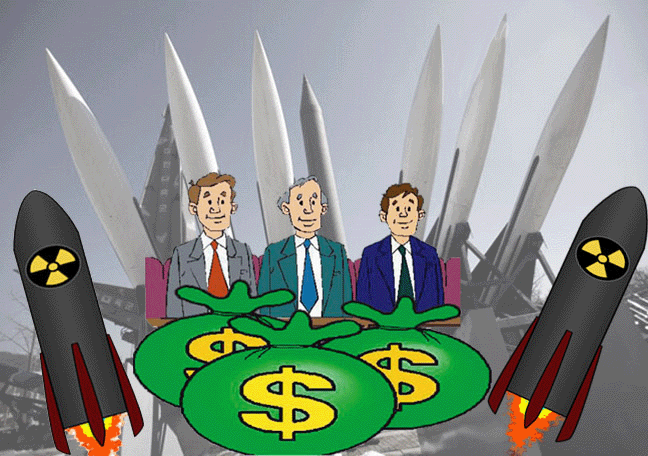
Current status of nuclear weapons around the world
|
The Status Of Nuclear Weapons Around The World, NPR (transcript) , February 28, 2019, Heard on All Things Considered
NPR’s Ari Shapiro speaks with Joan Rohlfing, president and COO of the Nuclear Threat Initiative about the current status of nuclear weapons globally. ARI SHAPIRO, HOST:Were surrounded by reminders that North Korea is not the only nuclear threat. In Russia, Moscow says it’s developing a hypersonic missile that will someday be able to get past American defenses. India and Pakistan, both nuclear powers, claim to have shot down each other’s fighter jets. It’s their most serious confrontation in years. To assess how dangerous this moment is, we’re joined now by Joan Rohlfing. She worked on nonproliferation in the Clinton administration, and she’s now president of the Nuclear Threat Initiative…….. ROHLFING: So there are currently nine nuclear weapon states that have the capacity to use nuclear weapons today. There’s the so-called permanent five of the U.N. Security Council – U.S., Russia, China, France, U.K. And then in the category of newer, more recent nuclear weapon states, we have India, Pakistan, Israel, North Korea. ………
ROHLFING: So there are several brightest danger spots. I wish I could say there was only one danger spot. And as we’ve seen so much media focus on North Korea, I would say we’re missing the broader picture. And two danger spots are the U.S.-Russia relationship as well as India and Pakistan. ……….
ROHLFING: So the U.S. and Russia have significant arsenals on high alert, ready to go at a moment’s notice against a backdrop of a lot of friction and deteriorating relationship across a range of fronts – over Ukraine, over Crimea, over Syria. There are many ways in which you could imagine an accident or a miscalculation happening. There are dangerous military incidents that are happening with some regularity, planes coming in close contact with each other. And for decades, we were engaged in ongoing negotiations to manage the nuclear threat. Five years ago, that effectively fell apart. And for the first time in 50 years, we have not been talking about how we manage this relationship and are potentially allowing the guardrails, the treaties that restrain nuclear weapons, to crater. So it’s a very troubling moment. ……… One of the complications is there are new technologies that make the nuclear threat more complex. So think about the emergence of cyberattacks, cyber vulnerabilities. The Defense Department in 2013 issued a report that essentially said – and I’m paraphrasing – there are no military systems that are immune from the threats of cyberattack and cyber vulnerabilities.
SHAPIRO: And so a hacker could conceivably make it look as though a nuclear attack was imminent or actually stage one.
ROHLFING: Indeed. Imagine if our command and control system were compromised so it looked like there was a significant incoming attack and it prompted us to react by retaliating with nuclear missiles or vice versa.SHAPIRO: So when you put the danger of this moment in the context of the last 50 years, how worried are you right now? ROHLFING: I’m very worried. I would say this is the most dangerous period since the Cuban Missile Crisis, the current period. The risk is that high. And it’s interesting. As we see so much focus on North Korea, this is a much broader threat. It’s an urgent threat. And it’s the biggest existential threat that most people have never heard of. SHAPIRO: What needs to change to move things in a more positive direction? ROHLFING: I would say number one, we’ve got to get back to the negotiating table in particular with Russia. Other states on a regional basis need to do this as well, notably India and Pakistan. We have to talk to each other to figure out how we manage to prevent nuclear crises……… https://www.npr.org/2019/02/28/699118990/the-status-of-nuclear-weapons-around-the-world |
|
South Korea offers hope that the Trump-Kim nuclear summit could bring an end to the Korean War
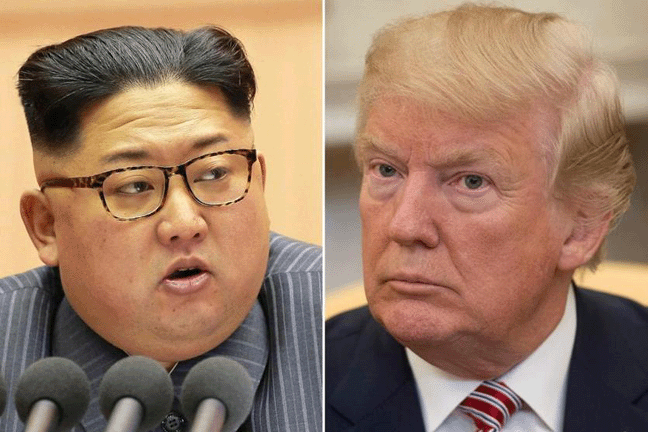 Korean War could be declared over at Trump-Kim summit, says South Korea There’s an upbeat tone that a formal declaration ending the Korean War could be made at the Hanoi summit this week. SBS News 25 Feb 19, Hopes that US President Donald Trump and North Korean leader Kim Jong-un will formally declare an end to the 1950-53 Korean War at the Hanoi summit rose Monday, after South Korea said the two leaders could reach an agreement.
The devastating conflict between communist North Korea, backed by China, and the capitalist South, aided by the United States, ended with an armistice rather than a peace treaty, leaving Pyongyang and Washington still technically at war.
“I believe that the possibility is there,” the South’s presidential Blue House spokesman Kim Eui-kyeom told reporters about a formal declaration.
“There is no way of knowing what kind of declaration it might be, but I believe the US and North Korea may reach an agreement.”
President Moon Jae-in said in October “it was only a matter of time” before Washington and Pyongyang declared an end to the war.
The US has also struck an upbeat tone. Stephen Biegun, the US special envoy for North Korea, said earlier this month that Trump was “ready to end this war”, fuelling speculation that the formal end of the conflict may be near.
Kim, the leader of North Korea, is due to meet the US president in the Vietnamese capital on Wednesday and Thursday, where it is hoped the pair will make progress in talks on denuclearisation, and a possible peace treaty……..
President Trump says he would be happy as long as North Korea maintains its pause on weapons testing, and he is in no rush to strike a nuclear deal with Kim Jong-un. …..https://www.sbs.com.au/news/korean-war-could-be-declared-over-at-trump-kim-summit-says-south-korea
Tensions in Kashmir: Pakistan readies for war
 Pakistan readies military, hospitals for war with its nuclear rival India after Pulwama terror attack, Business Insider
U.N. Secretary-General Antonio Guterres urges the United States and Russia to save nuclear arms safeguards
 U.N. chief wants INF nuclear treaty saved, concrete steps in Hanoi https://www.euronews.com/2019/02/25/un-chief-wants-inf-nuclear-treaty-saved-concrete-steps-in-hanoi
Russia flexes nuclear muscles , warns on its ability to strike nuclear targets in USA
 After Putin’s warning, Russian TV lists nuclear targets in U.S. Andrew Osborn, MOSCOW (Reuters) 25 Feb 19, – Russian state television has listed U.S. military facilities that Moscow would target in the event of a nuclear strike, and said that a hypersonic missile Russia is developing would be able to hit them in less than five minutes.
The targets included the Pentagon and the presidential retreat in Camp David, Maryland.
The report, unusual even by the sometimes bellicose standards of Russian state TV, was broadcast on Sunday evening, days after President Vladimir Putin said Moscow was militarily ready for a “Cuban Missile”-style crisis if the United States wanted one.
With tensions rising over Russian fears that the United States might deploy intermediate-range nuclear missiles in Europe as a Cold War-era arms-control treaty unravels, Putin has said Russia would be forced to respond by placing hypersonic nuclear missiles on submarines near U.S. waters.
……..The targets, which Kiselyov described as U.S. presidential or military command centers, also included Fort Ritchie, a military training center in Maryland closed in 1998, McClellan, a U.S. Air Force base in California closed in 2001, and Jim Creek, a naval communications base in Washington state.
Kiselyov, who is close to the Kremlin, said the “Tsirkon” (‘Zircon’) hypersonic missile that Russia is developing could hit the targets in less than five minutes if launched from Russian submarines.
Hypersonic flight is generally taken to mean traveling through the atmosphere at more than five times the speed of sound……. https://www.reuters.com/article/us-usa-nuclear-russia/after-putins-warning-russian-tv-lists-nuclear-targets-in-us-idUSKCN1QE1DM
We are closer to a nuclear war than we would like to believe – new smaller bombs make this more likely
Those missiles, Putin estimates, could reach Moscow in 10 minutes and he considers this “a very serious threat.” He declared in his response in English, “In this case, we will be forced – I repeat – forced to take tit-for-tat steps.”
Now, read this warning with another piece of news from the Truthout.org website. According to the Truthout report, the National Nuclear Security Administration (NNSA), the U.S. federal agency responsible for the military application of nuclear science, announced that the first of a new generation of strategic nuclear weapons had rolled off the assembly line. It is smaller in size and power; it will yield “only” about one-third of the power of the bomb the U.S. had dropped on Hiroshima on Aug. 6, 1945. In one day, 145,000 people were killed in Hiroshima. So, this “small” bomb, that is officially designated as the W76-2, could kill approximately 50,000 people.
A smaller missile and a smaller bomb, according to the group known as the Union of Concerned Scientists, are actually more dangerous than those monster nuclear weapons, for they kill fewer people. No, there is no contradiction in this evaluation. What precluded the use of the big bombs by both sides was the fear that mutual destruction from both sides’ large atomic weapons would mean the annihilation of civilization. That mutual assured destruction (MAD) theory made a thermonuclear disaster “unthinkable.” ……
This small bomb, according to the Union of Concerned Scientists, is not a deterrent against another country; it is going to be used. It is designed to be used. Its power is not the equivalent of the roughly 100 kilotons of TNT as the ones that had devastated Hiroshima and Nagasaki, but five kilotons. A practical guy like Trump would like to teach a lesson or two to those who are on his national strategy document as “the enemies of the U.S.” using this rather economic weapon. It would not end capitalism and the financial network as the “big one” would have.
Policy analysts think that the Pentagon would definitely deploy short-range nuclear-capable missiles in Eastern Europe and on islands off the Chinese coast. Watch for the deployment of those small bombs on nuclear submarines around Iran, too.
We are closer to a nuclear war than we would like to believe. https://www.dailysabah.com/columns/hakki-ocal/2019/02/25/tit-for-tat-steps-toward-a-nuclear-war
North Korea blasts Japan, claiming that Japan in “nuclear weaponizing”
In a commentary published Saturday in the Rodong Sinmun, the official newspaper of the North’s ruling party criticized what it claimed were “voices for the revision of the constitution and increased military spending and nuclear weaponization” from within the administration of Prime Minister Shinzo Abe.
The commentary said that under Abe, Japan “can go nuclear anytime after giving up ‘three non-nuclear principles.’ ” Consequently, it claimed, “peace in the Asia-Pacific region will be exposed to a great danger.”
Japan, the only country to have endured a nuclear attack, has long maintained that it adheres to its three nonnuclear principles of not possessing, not producing and not permitting the introduction of nuclear weapons. However, the government admitted in 2010 that previous administrations had lied to the public for decades about atomic weapons, after a government-appointed panel confirmed the existence of secret Cold War-era agreements allowing the U.S. to bring them into the country.
The Rodong Sinmun commentary said that if Japan ditches its three nonnuclear principles, there would be “unimaginable” and “catastrophic consequences.”
“All the countries that truly want global peace and security should keep close watch over Japan’s nuclear weaponization.”
Japan has ramped up military spending and the acquisition of sophisticated weapons in recent years, spending around 1 percent of its gross domestic product on the Self-Defense Forces — which, given the size of its economy, makes it one of the world’s biggest military spenders……. https://www.japantimes.co.jp/news/2019/02/25/national/politics-diplomacy/north-korea-alleges-nuclear-weaponization-japan-trump-kim-summit-draws-near/#.XHRA0YkzbGg
-
Archives
- October 2026 (120)
- September 2026 (339)
- August 2026 (330)
- July 2026 (355)
- June 2026 (287)
- May 2026 (306)
- April 2026 (356)
- March 2026 (251)
- February 2026 (267)
- January 2026 (308)
- December 2025 (358)
- November 2025 (359)
-
Categories
- 1
- 1 NUCLEAR ISSUES
- business and costs
- climate change
- culture and arts
- ENERGY
- environment
- health
- history
- indigenous issues
- Legal
- marketing of nuclear
- media
- opposition to nuclear
- PERSONAL STORIES
- politics
- politics international
- Religion and ethics
- safety
- secrets,lies and civil liberties
- spinbuster
- technology
- Uranium
- wastes
- weapons and war
- Women
- 2 WORLD
- ACTION
- AFRICA
- Atrocities
- AUSTRALIA
- Christina's notes
- Christina's themes
- culture and arts
- Events
- Fuk 2022
- Fuk 2023
- Fukushima 2017
- Fukushima 2018
- fukushima 2019
- Fukushima 2020
- Fukushima 2021
- general
- global warming
- Humour (God we need it)
- Nuclear
- RARE EARTHS
- Reference
- resources – print
- Resources -audiovicual
- Weekly Newsletter
- World
- World Nuclear
- YouTube
-
RSS
Entries RSS
Comments RSS

