A new citizens group is raising alarms about the nuclear capacity of the F-35 fighter jet.
F-35 opponents shift focus to nuclear risks, Vt Digger , By Mar 12 2019 A new citizens group is raising alarms about the nuclear capacity of the F-35 fighter jet.
There are no “Local” nuclear wars. Urgent need for nuclear powers to disarm.
The Treaty’s purpose was not simply to prevent the spread of nuclear weapons, but to serve as a temporary measure until Article VI could take effect: the “cessation of the nuclear arms race at an early date and to nuclear disarmament, and on a Treaty on general and complete disarmament under strict and effective international control.”
The 191 countries that signed the NPT — the most widely subscribed nuclear treaty on the planet — did so with the understanding that the major powers would de-nuclearize. But in the 50 years since the Treaty was negotiated, the nuclear powers have yet to seriously address eliminating weapons of mass destruction.
While over the years the Americans and the Russians have reduced the number of warheads in their arsenals, they — along with China — are currently in the midst of a major modernization of their weapon systems. Instead of a world without nuclear weapons, it is a world of nuclear apartheid, with the great powers making no move to downsize their conventional forces.
For non-nuclear armed countries, this is the worst of all worlds.
There Are No “Local” Nuclear Wars
The folly of this approach was all too clear in the recent India and Pakistan dustup. While both sides appear to be keeping the crisis under control, for the first time in a very long time, two nuclear powers that border one another exchanged air and artillery attacks.
While so far things have not gotten out of hand, both countries recently introduced military policies that make the possibility of a serious escalation very real.
On the New Delhi side is a doctrine called “Cold Start” that permits the Indian military to penetrate up to 30 kilometers deep into Pakistan if it locates, or is in pursuit of, “terrorists.” On the Islamabad side is a policy that gives front-line Pakistani commanders the authority to use tactical nuclear weapons………
If that [ a nuclear weapons attack exchange] happens, its effects will not be just regional. According to a study by the University of Colorado, Rutgers University, and UCLA, if Pakistan and India exchanged 100 Hiroshima-sized nuclear warheads (15 kilotons), they would not only kill or injure 45 million people, but also generate enough smoke to plunge the world into a 25-year long nuclear winter.
Temperatures would drop to Ice Age levels and worldwide rainfall would decline by 6 percent, triggering major droughts. The Asian Monsoon could be reduced by between 20 and 80 percent, causing widespread regional starvation.
Between the cold and the drought, global grain production could fall by 20 percent in the first half decade, and by 10 to 15 percent over the following half decade.
Besides cold and drought, the ozone loss would be between 20 and 50 percent, which would not only further damage crops, but harm sea life, in particular plankton. The reduction of the ozone layer would also increase the rate of skin cancers.
The study estimates that “two billion people who are now only marginally fed might die from starvation and disease in the aftermath of a nuclear conflict between Pakistan and India.”
In short, there is no such thing as a “local” nuclear war……… https://www.counterpunch.org/2019/03/13/nuclear-powers-need-to-disarm-before-its-too-late/
A nuclear nightmare is brewing between India and Pakistan
|
Japan Times BY JAMES STAVRIDIS, BLOOMBERG, MAR 11, 2019 NEW YORK – While India and Pakistan seem to have stopped bombing one another, the causes behind the cross-border tensions aren’t going away any time soon. The two nations are nuclear-armed; have large conventional armed forces; have had four serious wars since they became independent in 1947; and have enormous cultural and religious antipathy. This is a prescription for a disaster, and yet the confrontation is flying below the international radar — well below North Korea, Brexit, China-U.S. trade confrontations, Iran and even the “yellow vests” of France. A full-blown war in Kashmir is a very real possibility………. The most recent crisis was set off in mid-February when a Pakistani terrorist group, Jaish-e-Mohammad, detonated a suicide bomb in Indian-controlled Kashmir, killing 40 Indian soldiers. ……… The fragile cease-fire in place for two decades is fraying. Partly this is the result of domestic politics in India:…….. Most worrisome, of course, are the significant nuclear arsenals of the combatants. Each has roughly 150 missiles, although only India has a submarine-based ballistic missile capability and thus a true nuclear triad (land, air and sea). Pakistan is developing sea-launched cruise missiles to counter that Indian threat. India has adopted a “no first use” doctrine, although Pakistan — which has smaller conventional forces and thus potentially the need for a more ambiguous doctrine — has not made an equivalent pledge. ………. With Pakistan’s economic plight and the upcoming elections in India, South Asia is in a situation in which a military miscalculation, perhaps even a nuclear one, is real possibility. https://www.japantimes.co.jp/opinion/2019/03/11/commentary/world-commentary/nuclear-nightmare-brewing-india-pakistan/#.XIbKfskzbGg |
Where climate threat and nuclear threat meet: Top Secret US Cold War Nuclear Base in Greenland
Melting Ice Sheets Could Reveal Top Secret US Cold War Nuclear Base https://www.iflscience.com/environment/melting-ice-sheets-could-reveal-top-secret-us-cold-war-nuclear-base/ 11 Mar 19, Among the many Bond villain–esque plans dreamed up during the Cold War, few come stranger than “Project Iceworm,” the shady US program to build a network of top secret nuclear missile launch sites beneath the Danish territory of Greenland. The largest and most impressive of the US bases was Camp Century, a warren of tunnels and labs under northwest Greenland’s ice sheet that was powered by its own portable nuclear reactor.
After just eight years of operation, Camp Century was decommissioned in 1967 due to engineering woes and a political scandal centered on whether Denmark had actually given the US full permission to house nuclear materials in their territory.
As the Cold War ended, the base was largely forgotten, not least because it was hoped to remain “preserved for eternity” under a blanket of snow and ice. However, with climate change knocking at the door, it looks like a different kind of thaw could reveal all.
A study published in 2016 used simulations to show that the ice above and around Camp Century could thaw by 2090 under a “business-as-usual” climate change scenario. Not only would this unearth the once-secret abandoned military base, but it also holds the potential to let loose the huge amounts of chemical and nuclear waste left at the site. These pollutants could leech into the surrounding surface water and spark a plethora of problems for the island’s human population and ecosystem.
Another study, published last year in the journal Global Environmental Politics, took a further look at the situation at Camp Century, arguing it has the potential to fire up some long-frozen geopolitical tensions. It’s not very clear how much Denmark knew about the US’ plans in Greenland. While they agreed the US could have the Thule Air Base in northwest Greenland, the issue of nuclear weapons in Danish territory was a big no-no. To make matters even thornier, Greenland has since transitioned to a self-governing overseas administrative division of Denmark.
If the climatic scenario predicted does hit, as anticipated, who will be responsible for the clean-up of toxic chemicals and radioactive materials?
As the study argues, Camp Century is not the only problem. This scenario serves as just one example of how climate change could trigger a huge number of unforeseen consequences in international politics, especially when it comes to overseas military bases.
“The case could be the proverbial canary in the coal mine for future politics surrounding overseas military bases,” according to study author Jeff Colgan.
“Climate change can create knock-on environmental problems associated with a military base’s infrastructure or waste that disrupt the international politics that govern the base,” he wrote in the study. “Any cleanup costs or compensation related to the knock-on environmental problems create an unfunded liability for the host country, the country operating the base, or both.”
This is just another unexpected fallout of the climate issue we’re facing that needs to be dealt with sooner rather than later.
Hanoi nuclear summit: Where were the women?
This is a far cry from previous administrations that had women running or helping to run nuclear negotiations—Madeleine Albright, Condoleezza Rice, Wendy Sherman, and Rose Gottemoeller, to name a few.
No doubt, there were women present at the margins in Hanoi. White House Press Secretary Sarah Huckabee Sanders was in the room with Vietnamese officials when the Trump administration pitched arms exports from the United States to their hosts. Kim Yo-jong—Kim Jong-un’s younger sister—was spotted holding an ashtray for the North Korean leader and mostly stayed not more than a few feet from her brother throughout the summit. Other women were serving in support roles back in Washington, but that’s not the same as being at the table.
So who are the women that have been most involved in the Trump-Kim summit process so far?……..
By excluding women from active negotiating roles, Washington and Pyongyang reduced their possible chances for success. There is no excuse for this, as there are scores of women experts on North Korea nuclear policy, and more who focus on the peace process. For example, Women Cross DMZ—a group of female activists working to achieve a peaceful end to the Korean conflict—places a special emphasis on the role that women should play in peace negotiations. Their philosophy is not baseless. According to research, peace agreements that are signed by women feature higher-quality content and higher rates of implementation than those not signed by women, and therefore lead to longer-lasting agreements. On the whole, women are also more likely to insist that parties stay at the table until an agreement is made. There were a lot of factors that played into the outcome (or lack thereof) of the summit in Hanoi, but to ensure future success, leaders in Washington and Pyongyang should think about bringing more women to the next negotiations. …… https://thebulletin.org/2019/03/hanoi-summit-where-were-the-women/?utm_source=Bulletin%20Newsletter&utm_medium=iContact%20email&utm_campaign=WomenatSummit_030720
Trump budget increases funding for nuclear weapons agency amid new production
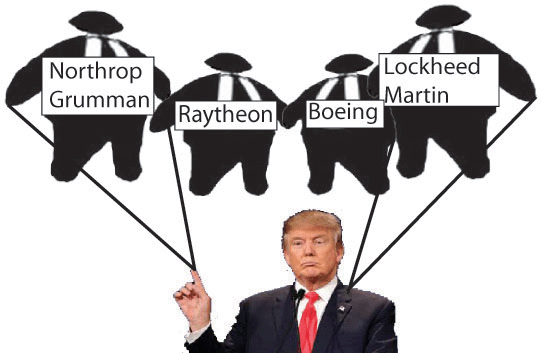 Defense News, 11 Mar 19, WASHINGTON — The National Nuclear Security Administration will receive an 8.3 percent increase over its current budget, with an eye on completing production of a new low-yield nuclear missile this upcoming fiscal year.
Need for a prcactical treaty to cap and eliminate nuclear cruise missiles
These cruise missiles also can be armed with conventional explosives, and there is no way to distinguish nuclear from non-nuclear ones when they are in flight. Such ambiguity erases the line between conventional and nuclear weapons, and increases the likelihood of accidental Armageddon. This is precisely why, in 1987, Ronald Reagan and Mikhail Gorbachev urgently made progress in eliminating them.
We can, and must, seek to repeat their historic achievement today. We need to remember that arms control is not a pollyannaish exercise, but rather a potent tool of hard national security……….
Recently, Russia’s top arms control diplomat said Russia stands ready for talks on a possible successor to the INF Treaty. “We are ready for dialogue,” said Deputy Foreign Minister Sergei Ryabkov. “If the U.S. is interested, it should spell out its proposal.”
Since it appears nobody has done so, let’s spell it out. Our next agreement should focus less on overall numbers and, instead, seek to cap and eliminate the single most dangerous and destabilizing class of nuclear weapons: all nuclear-tipped cruise missiles of any range. We should start “cruise control” negotiations bilaterally between the United States and Russia, and leave room for other countries that have not yet deployed such systems — including China, India and Pakistan — to join now or later.
For three years, my colleagues and I have been laying the groundwork for such an ambitious global effort to cap and eliminate nuclear cruise missiles. In private talks with current and former senior officials from the United Kingdom, Russia, China, Germany, Japan and other key countries, we have found broad support and enthusiasm for this approach. ……… https://thehill.com/opinion/national-security/433075-nuclear-cruise-control-can-stop-a-spiraling-new-arms-race
Bay of Biscay graveyard of nuclear-armed Russian submarine
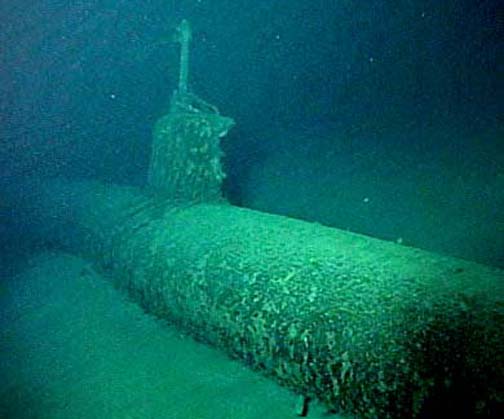
CTY Pisces – Photos of a Japanese midget submarine that was sunk off Pearl Harbor on the day of the attack. There’s a hole at the base of the conning tower where an artillery shell penetrated the hull, sinking the sub and killing the crew. Photos courtesy of Terry Kerby, Hawaii Undersea Research Laboratory. August 2003.
n April 8, K-8 suffered two fires, resulting in a shutdown of both nuclear reactors. The boat surfaced, and Captain Vsevolod Borisovich Bessonov ordered the crew to abandon ship. Eight crew members, trapped in compartments that were either flooded or burned out, died in the initial incident. Fortunately, a Soviet repair vessel arrived, and took K-8 under tow. However, bad weather made the recover operation a difficult prospect. Much of K-8’s crew reboarded the submarine, and for three days fought a life-and-death struggle to save the boat. Although details remain scarce, there apparently was no opportunity to safely remove the four nuclear torpedoes from K-8, and transfer them to the repair ship.
The Bay of Biscay is one of the world’s great submarine graveyards. In late World War II, British and American aircraft sank nearly seventy German U-boats in the Bay, which joined a handful of Allied and German subs sunk in the region during World War I. On April 12, 1970, a Soviet submarine found the same resting place. Unlike the others, however, K-8 was propelled by two nuclear reactors, and carried four torpedoes tipped by nuclear warheads……… https://nationalinterest.org/blog/buzz/15000-feet-below-waves-lurks-trouble-dead-russian-submarine-nuclear-armed-46652
People of Kashmir – stuck in a dangerous, potentially nuclear, conflict
In Kashmir, we’re stuck in the middle of a potentially nuclear conflict but the world looks away, ABC News, By Umar Lateef Misgar 9 Mar 19, When Adil Dar rammed a car stuffed with explosives into a paramilitary convoy in Indian-administered Kashmir last month, I didn’t make much of the news.
I was travelling across northern India at the time. Having been born and brought up amid a conflict that has defined the life of every young Kashmiri for the past three decades it just seemed more of the same: military cordons, gunfights, curfews, blown-up houses, maiming and the death of our friends and acquaintances.
But the magnitude of this attack by Dar, a 22-year-old Kashmiri, crept up on me through numbers and images. It was the worst attack against Indian forces since the armed insurgency erupted in Kashmir in the late 1980s.
At least 40 Indian paramilitary personnel had been killed, setting off a chain of events that almost brought South Asia to the brink of an all-out nuclear war.
I felt heartbroken by the loss of life that had occurred.
The Indian media instantly began to whip up a frenzy against the Kashmiris, doubling down on efforts to demonise an entire people.
The Indian population’s anger was focused against Kashmiri civilians, students and migrant businessmen, who were attacked by mobs. As many as 2000 of them were forced to flee from different Indian cities…….
I have lived in India as a student and travelled across the country throughout my life, but I have never felt as threatened as during this recent visit.
Constantly dehumanised in the Indian media as well as politics, Kashmiris have been undermined and permanently relegated as dispensable other in the Indian consciousness. Even the India’s parliamentary opposition, led by the Indian National Congress party that finds its roots in the anti-colonial struggles of the subcontinent, didn’t even dare to speak a word against this wave of anti-Kashmiri hate-crimes………
Amid rising tensions, both the countries mobilised their armed forces, leading to the worst tension in 20 years. Diplomats succeeded in persuading the two nuclear-armed nations to back-off. For now.
It is local Kashmiris whose lives were disrupted by this military posturing and brinkmanship. Civilians across the de-facto border that divides Indian and Pakistani-administered Kashmir, suffered the stress of warplanes hovering above and the impending threat of war………
Deadliest decade
The confrontation between India and Pakistan has slowly de-escalated but people continue to be killed, and while last year was the deadliest in a decade the coming year looks catastrophically bleak.
In the past week 15 people including eight Kashmiri civilians died in shelling and gunfights on the border.
As world attention shifts elsewhere the plight of Kashmiri people remains constant. Our land, our air and our bodies will remain the sites of violent confrontation and electoral bargaining.
Will anyone bat an eye before the next nuclear showdown? https://www.abc.net.au/news/2019-03-09/kashmir-is-stuck-in-the-middle-of-nuclear-tension/10878950
International Atomic Agency would require Saudi Arabia to have the same nuclear safeguards as Iran has
Before Saudi Arabia Goes Nuclear, It May Have to Follow Iran’s Lead, Bloomberg, By Jonathan Tirone March 7, 2019,
- Kingdom has yet to clinch enhanced atomic monitoring deal
- World powers are meeting with Iran on Wednesday in Vienna.
“………Focus on Saudi Arabia’s nuclear program has risen in the last month after the U.S. Congress opened an investigation into the potentially illegal transfer of sensitive technologies to the kingdom. This week the International Atomic Energy Agency, responsible for verifying that countries don’t divert material for weapons, weighed in on what its inspectors need before the kingdom can start generating nuclear power.
Focus on Saudi Arabia’s nuclear program has risen in the last month after the U.S. Congress opened an investigation into the potentially illegal transfer of sensitive technologies to the kingdom. This week the International Atomic Energy Agency, responsible for verifying that countries don’t divert material for weapons, weighed in on what its inspectors need before the kingdom can start generating nuclear power.
Riyadh’s nuclear program is developing “based on an old text” of safeguard rules, even as it expects to complete its first research reactor this year and plans to tap uraniumreserves, according to IAEA Director General Yukiya Amano, who told journalists this week in Vienna that he’s “appealing to all countries to rescind” those old ways of doing business.
“We’re encouraging all countries to conclude and implement an additional protocol and that includes Saudi Arabia,” said Amano, who’s also in charge of enforcing the 2015 nuclear deal struck between Iran and world powers. The Japanese career diplomat has called the set of rules established by that accord, which U.S. President Donald Trump withdrew from in May, as “the most rigorous monitoring mechanism ever negotiated.”……
the IAEA comments could strike a precautionary note among vendors lining up to service the kingdom’s nuclear ambitions. Receiving the imprimatur of IAEA inspectors, who account for gram-level quantities of nuclear material worldwide, is a precondition for receiving technologies and fuel. Without reaching a new understanding with monitors, Saudi plans for 3.2 gigawatts of atomic power by the end next decade could flounder. …….
Maintaining that level of IAEA access to Iran’s nuclear program is the reason that China, France, Germany, Russia and the U.K. continue to defy U.S. calls to abandon the 2015 deal and reimpose sanctions. Diplomats from those countries convened Wednesday in Vienna in their first meeting since the European Union established a trade channel to skirt U.S. threats.
Snap Inspections in Iran
IAEA complementary access to sites rose under agreement with world powers……https://www.bloomberg.com/news/articles/2019-03-06/before-saudi-goes-nuclear-it-may-have-to-follow-iran-s-lead
Nuclear insanity – education is desperately needed to alert the world to the nuclear weapons danger

|
Nuclear age: Humanity is flirting with extinction, https://thehill.com/opinion/national-security/432694-nuclear-age-humanity-is-flirting-with-extinction
BY DAVID KRIEGER, 03/05/19 The most stunning and frightening truth about the nuclear age is this: Nuclear weapons are capable of destroying civilization and most complex life on the planet, yet next to nothing is being done about it. Humanity is flirting with extinction and is experiencing the “frog’s malaise.” It is as though the human species has been placed into a pot of tepid water — metaphorically with regard to nuclear dangers and literally with regard to climate change — and appears to be calmly treading water while the temperature rises toward the boiling point. In this piece, I focus on the metaphorical pot of heating water, heading toward a boil, representing the increasing nuclear dangers confronting all humanity.
Disconcertingly, there is virtually no political will on the part of nations in possession of nuclear arsenals to alter this dangerous situation; and, despite legal obligations to negotiate in good faith for an end to the nuclear arms race and for nuclear disarmament, there is no major effort among the nuclear-armed and umbrella countries to achieve nuclear zero. While the non-nuclear-armed countries have negotiated a Treaty on the Prohibition of Nuclear Weapons (TPNW) and are working to bring this treaty into force, those countries that possess the weapons and those sheltering under their nuclear umbrella have not supported the new treaty. All nine nuclear-armed countries boycotted international negotiations on banning and eliminating nuclear weapons. In addition, each of these countries is in the process of modernizing its nuclear arsenal, thereby wasting valuable resources on weapons that must never be used, and doing so while basic human needs for billions of people globally go unmet and unattended. Despite this unjust and deplorable situation, most of the 7 billion people on the planet are complacent about nuclear weapons. This only adds fuel to the fire under the frogs. In the nuclear age, humanity is challenged as never before. Our technology, and particularly our nuclear weapons, can destroy us and all that we hold dear. But before we can respond to the profound dangers, we must first awaken to these dangers. Complacency is rooted in apathy, conformity, ignorance and denial — a recipe for disaster. If we want to prevail over our technologies, we must move from apathy to empathy; from conformity to critical thinking; from ignorance to wisdom; and from denial to recognition of the danger. But how are we to do this? The key is education — education that promotes engagement; education that forces individuals and nations to face the truth about the dangers of the nuclear age. We need education that leads to action that will allow humanity to get out of the metaphorical pot of heating water before it is too late. Education can take many forms, but it must begin with solid analysis of current dangers and critiques of the lack of progress in stemming the dangers of the nuclear age. We need education that is rooted in the common good. We need education that provides a platform for the voices of the survivors of Hiroshima and Nagasaki. We need education that makes clear the instability and dangerous nature of nuclear deterrence. We need education that challenges the extreme hubris of leaders who believe the global nuclear status quo can survive indefinitely in the face of human fallibility and malevolence. We need education that can break through the bonds of nuclear insanity and move the world to action. We need the public to speak out and demand far more of their leaders if we are to leap from the pot of heating water, avert disaster and reach the safe haven of nuclear zero. David Krieger is a founder of the Nuclear Age Peace Foundation, and has served as its president since 1982. He is the author and editor of many books on nuclear dangers, including “ZERO: The Case for Nuclear Weapons Abolition.” |
|
U.S, Navy accelerates production of attack submarines
Meet America’s Secret Weapon To Kill China’s ‘Underwater’ Nuclear Weapons
The Navy just ordered 19 more sub-hunting Poseidon Aircraft – Could they stop Chinese SSBNs?
(Washington, D.C. ) 6 Mar 19 “…….The increasing global reach of Chinese nuclear-armed ballistic missile submarines, armed with JL-2 weapons reportedly able to hit parts of the US, continues to inspire an ongoing Navy effort to accelerate production of attack submarines, prepare long-dwell drones for deployment to the Pacific and continue acquisition of torpedo-armed sub-hunting planes such as the P-8/A Poseidon.
Seeking to overcome the Pacific’s “tyranny of distance” dispersed geography, and track China’s expanding fleet of submarines, the Navy is working with Congress to produce as many as three Virginia-class submarines per year, moving beyond the current plan to build two. In the air, the Navy has been moving to place its new Triton sea drones in Guam and has recently awarded Boeing a $2.4 billion deal to produce 19 more P-8A Poseidon surveillance and attack planes………. https://nationalinterest.org/blog/buzz/meet-americas-secret-weapon-kill-chinas-underwater-nuclear-weapons-46247
North Korea’s major nuclear reactor has been shut down for months
Key North Korean nuclear reactor has been shut down for months: IAEA, Channel News Asia, 4 Mar 19, VIENNA: The nuclear reactor that is believed to have supplied much of the plutonium for North Korea’s nuclear weapons appears to have been shut down for the past three months, the UN atomic watchdog said on Monday (Mar 4), without suggesting why.The 5-megawatt reactor is part of North Korea’s Yongbyon nuclear complex, the possible dismantling of which was a central issue in talks between US President Donald Trump and North Korean leader Kim Jong Un in Vietnam last week.
The Vienna-based International Atomic Energy Agency has not had access to North Korea since Pyongyang expelled its inspectors in 2009, and it now monitors the country’s nuclear activities mainly through satellite imagery.
Some independent analysts, who are also using satellite imagery, believe the ageing reactor is having technical problems.
“The agency has not observed any indications of the operation of the 5MW(e) reactor since early December 2018,” IAEA Director-General Yukiya Amano said in a closed-door speech to his agency’s Board of Governors, which is meeting this week.
At the radiochemical laboratory that separates plutonium from the reactor’s spent fuel, there were no indications of such reprocessing activities, Amano added.
But a facility widely believed to be used for uranium enrichment, a process that can also produce weapons-grade material for nuclear bombs, appeared to be running, he said. And building work continued on an experimental light-water reactor.
The IAEA has repeatedly said it is ready to play a verification role in North Korea once a political agreement is reached on the country’s nuclear activities.
The United States says it wants a full “denuclearisation” of North Korea, but the Trump-Kim summit’s abrupt ending without agreement left the future of their talks uncertain ………. https://www.channelnewsasia.com/news/asia/key-north-korean-nuclear-reactor-has-been-shut-down-for-months–iaea-11310906
Vladimir Putin signs decree suspending Russia’s membership of Intermediate-Range Nuclear Forces Treaty (INF)
Russia officially suspends INF Treaty with US, https://www.aljazeera.com/news/2019/03/russia-officially-suspends-inf-treaty-190304143410145.html
Vladimir Putin signs decree suspending Russia’s obligations under key nuclear arms pact with US. Russia’s President Vladimir Putin has signed a decree suspending Moscow’s participation in a key Cold War-era nuclear arms control treaty, following a similar move by the United States.
In a statement on Monday, the Kremlin said the suspension would last until the US “ends its violations of the treaty or until it terminates”.
In February, Washington gave notice of its intention to withdraw from the landmark 1987 Intermediate-Range Nuclear Forces Treaty (INF), which was established as a major safeguard against nuclear war.
The move by US President Donald Trump set the stage for the bilateral pact’s termination in six months.
Washington accuses Moscow of developing and deploying a cruise missile that violates provisions of the treaty that ban the production, testing and deployment of land-based cruise and ballistic missiles that have a range between 500km and 5,500km.
US officials have also expressed concerns that China, which is not party to the pact, was gaining a significant military advantage in Asia by deploying large numbers of missiles with ranges beyond the treaty’s limit.
Russia has denied any breaches, instead, charging that it was the US that had flouted the pact by deploying missile defence facilities in Eastern Europe that could fire cruise missiles instead of interceptors.
Washington rejects the claim.
The collapse of the treaty has stoked fears of a replay of a Cold War-era European missile crisis during the 1980s, when the US and the Soviet Union both deployed intermediate-range missiles on the continent.
Putin has previously said Russia would seek to develop medium-range missiles, but would not deploy them in the European part of the country or elsewhere unless the US does so.
NATO has supported the US’s decision to withdraw from the pact, but many European leaders have voiced fears over the consequences of its demise.
China has also urged Russia and the US to preserve the treaty.
Russia to lease nuclear-powered attack submarine to India for a cool $3 billion
|
India, Russia To Sign $3 Billion Nuclear Sub Deal This Week
India and Russia are set to sign a $3 billion lease agreement for a nuclear-powered attack sub on March 7, according to local media reports. The Diplomat, By Franz-Stefan Gady, March 05, 2019 India and Russia are expected to conclude an intergovernmental agreement for a 10-year lease of a Russian nuclear-powered attack submarine (SSN) this week. The deal, estimated to be worth around $3 billion, will likely be inked on March 7, according to sources cited by The Economic Times. Neither the Indian nor Russian defense ministries, however, have officially confirmed that a signing ceremony will be held in the coming days. |
|
-
Archives
- October 2026 (120)
- September 2026 (339)
- August 2026 (330)
- July 2026 (355)
- June 2026 (287)
- May 2026 (306)
- April 2026 (356)
- March 2026 (251)
- February 2026 (267)
- January 2026 (308)
- December 2025 (358)
- November 2025 (359)
-
Categories
- 1
- 1 NUCLEAR ISSUES
- business and costs
- climate change
- culture and arts
- ENERGY
- environment
- health
- history
- indigenous issues
- Legal
- marketing of nuclear
- media
- opposition to nuclear
- PERSONAL STORIES
- politics
- politics international
- Religion and ethics
- safety
- secrets,lies and civil liberties
- spinbuster
- technology
- Uranium
- wastes
- weapons and war
- Women
- 2 WORLD
- ACTION
- AFRICA
- Atrocities
- AUSTRALIA
- Christina's notes
- Christina's themes
- culture and arts
- Events
- Fuk 2022
- Fuk 2023
- Fukushima 2017
- Fukushima 2018
- fukushima 2019
- Fukushima 2020
- Fukushima 2021
- general
- global warming
- Humour (God we need it)
- Nuclear
- RARE EARTHS
- Reference
- resources – print
- Resources -audiovicual
- Weekly Newsletter
- World
- World Nuclear
- YouTube
-
RSS
Entries RSS
Comments RSS

