
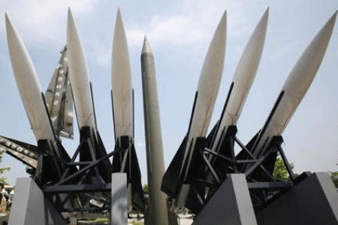
picture is from Financial Times https://www.ft.com/content/d35f0566-787b-11e9-be7d-6d846537acab
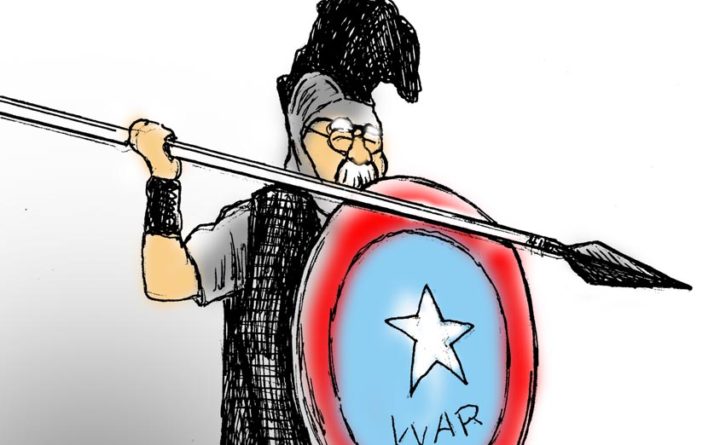
John Bolton Has Wanted War With Iran Since Before You Were Born
“I actually temper John,” Trump said, “which is pretty amazing.” Mother Jones, DAN SPINELLI, 18 May 19, Fourteen months into his tenure as national security adviser, John Bolton has become a central figure in the run-up to what could be the most extensive American military offensive since the invasion of Iraq. Tensions between Iran and the United States have been high for weeks, beginning with a menacing video Bolton released in February targeting the Iranian supreme leader and reached a boil last week when, according the New York Times, he ordered the Pentagon to prepare to send as many as 120,000 troops to the Middle East to counter Iran. ……
May 18, 2019
Posted by Christina Macpherson |
politics international, USA, weapons and war |
Leave a comment
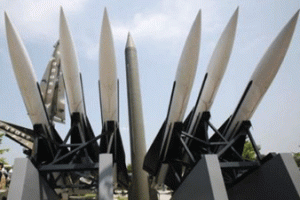 Nuclear Weapons Are Getting Less Predictable, and More Dangerous Defense One, BY PATRICK TUCKER, TECHNOLOGY EDITOR MAY 16, 2019 Facing steerable ICBMs and smaller warheads, the Pentagon seeks better tracking as the White House pursues an unlikely arms-control treaty.
On Tuesday, U.S. Secretary of State Mike Pompeo met his counterpart, Russian Foreign Minister Sergey Lavrov, to discuss, among many things, the prospect of a new, comprehensive nuclear-weapons treaty with Russia and China. At the same time, the Pentagon is developing a new generation of nuclear weapons to keep up with cutting-edge missiles and warheads coming out of Moscow. If the administration fails in its ambitious renegotiation, the world is headed toward a new era of heightened nuclear tension not seen in decades.
That’s because these new weapons are eroding the idea of nuclear predictability.
Since the dawn of the nuclear era, the concept of the nuclear triad — bombers, submarines, and intercontinental ballistic missiles — created a shared set of expectations around what the start of a nuclear war would look like. If you were in NORAD’s Cheyenne Mountain Complex in Colorado and you saw ICBMs headed toward the United States, you knew that a nuclear first strike was underway. The Soviets had a similar set of expectations, and this shared understanding created the delicate balance of deterrence — a balance that is becoming unsettled.
Start with Russia’s plans for new, more-maneuverable ICBMs. Such weapons have loosely been dubbed “hypersonic weapons” — something of a misnomer because all intercontinental ballistic missiles travel at hypersonic speeds of five or more times the speed of sound — and they create new problems for America’s defenders. …….
The United States is starting to build a new generation of smaller nukes of its own. The reasoning was laid out in the 2018 Nuclear Posture Review, and the weapons have been rolling off the assembly line since January……
But Selva also noted that low-yield weapons present the same sort of ambiguity as hypersonic weapons.
“We don’t know what they launched at us until it explodes,” he said.
The U.S. military has responded to Russian weapons development with several other key moves: building a next-generation air-launched cruise missile, hiring Northrop Grumman to build a new penetrating bomber, lowering the nuclear yield on some sub-launched ballistic missiles, and exploring bringing back a sea-launched cruise missile, or SLCM, that could have a nuclear tip……
Lynn Rusten, vice president of the Global Nuclear Policy Program at the Nuclear Threat Initiative, said that the ambiguity problem would apply to the SLCMs effort as well. “We use conventional SLCMs a lot in our normal warfare. If you start having nuclear SLCMs deployed as well, there will be a real discrimination in terms of when one of those things is launched, what is that thing coming at you? Where is it going?”……..
Many arms control experts say the first and most important step that the U.S. could take in navigating this far more unpredictable future is to extend New START. Even Selva, who declined to offer a public recommendation about such an extension, said that the United States benefits in multiple ways from the treaty’s mechanisms for keeping track of the parties’ strategic arsenals. ……
A collapse of New START might also cause China to embrace a more aggressive nuclear stance to hedge against rising unpredictability…….
As uncertainty increases, misperceptions become more dangerous. And there is reason to believe the United States is already looking at the situation through various imperfect lenses. One is the belief that China has any interest in trilateral arms control. Another is “escalate to de-escalate.” Some Russia experts, such as Olga Oliker, the Europe and Central Asia director at the International Crisis Group, call it a fiction dreamed up in the West after a misreading of a Russia’s 2017 Naval Doctrine.
“Moscow continues to believe, and Russian generals in private conversations emphasize, that any conventional conflict with NATO risks rapid escalation without ‘de-escalation’ — into all-destroying nuclear war. It must therefore be avoided at all costs,” she wrote in February.
“If anything, U.S. emphasis on new lower-yield capabilities — effectively an ‘escalate to de-escalate’ strategy of the sort many attribute to Russia — would undermine the deterrent balance, potentially triggering the very sorts of crises low-yield proponents hope to avert.”
Michael Kofman, a senior research scientist at CNA, says the “escalate to de-escalate” debate obscures a more fundamental truth about Russian strategic doctrine. “Russia has never accepted the proposition that a war with the United States could be conventional only. Hence, Russian nuclear strategy has a firm place for scalable employment of nuclear weapons, for demonstration, escalation management, warfighting, and war termination if need be,” he told Defense One. “The gist of the problem is that the Pentagon believes that nuclear weapons are some kind of gimmick that can be deterred in conventional war, but actually the prospect for conventional-only war with Russia is somewhat limited from the outset.”
Bottom line: the U.S., Russia, and China, may be entering into a high-stakes discussion on nuclear arms with each suffering from severe misconceptions about the others’ intent. The price of failure of the new negotiation effort, if New START is not re-affirmed, would be a new period of heightened nuclear tensions and less predictability.
Rusten believes the arms race has already begun.
“We don’t want to be where that trajectory will take us five years from now,” she said. https://www.defenseone.com/technology/2019/05/everyones-nuclear-weapons-are-getting-less-predictable-and-more-dangerous/157052/
May 18, 2019
Posted by Christina Macpherson |
politics international, Russia, USA, weapons and war |
Leave a comment
 With Bolton whispering in Trump’s ear, war with Iran is no longer unthinkable, Guardian, Owen Jones 16 May 19, Antiwar activists must do everything they can to prevent it, and that includes pressuring US allies
It was a deception that would lead to millions of civilian deaths, and the deaths of nearly 60,000 US soldiers. In August 1964 President Lyndon B Johnson solemnly declared that, after two apparent North Vietnamese attacks on US navy destroyers in the Gulf of Tonkin, military action would take place.
Four years later, Senator Albert Gore – father of Bill Clinton’s future vice-president – warned in a closed Foreign Relations Committee session that, “If this country has been misled … the consequences are very great.” His suspicions were correct. The second Gulf of Tonkin attack might never have happened – and perhaps neither did. Communications to make it look like the attack occurred had been falsified. But US policy was already set on a dramatic escalation of the Vietnam war: and here was the perfect pretext.
This week it emerged that the US government is discussing sending up to 120,000 troops to the Middle East for possible military action against Iran. “We’ll see what happens with Iran,” declared President Trump. “If they do anything, it will be a bad mistake.” The principal driving force behind this is Trump’s national security adviser, John Bolton, a man who thinks there is no problem to which the answer isn’t war: in the Bush era, his militarism was too much for the commander-in-chief who laid waste to Iraq. You can see them scrabbling for excuses already: the Trump administration says Iran-backed proxy groups are preparing attacks on US forces in Iraq and Syria, a claim forcefully denied this week by British major-general Christopher Ghika, the deputy commander of counter-terror operations in both countries. The US has blamed Iran, without evidence, for damage to Saudi oil tankers in the Gulf of Oman. Could an Iranian Gulf of Tonkin be looming?
It is easy to dismiss these fears as alarmist. Is Trump not the man who confounded his critics by seeking peace on the Korean peninsula? Trump boasts that he “actually tempers” Bolton; Iran’s supreme leader, Ayatollah Ali Khamenei, states: “There won’t be any war.” As Sanam Vakil, a research fellow at Chatham House, tells me: “Both sides are posturing, sending [threats] back and forth, and I don’t think heading for any direct military interventions.” Bolton, she reassures me, is just one of many voices in the room, and US secretary of state Mike Pompeo himself says that the US is not seeking war……..
A senior Senate aide tells me that the triumph of Bolton’s plans is all too conceivable: Bolton could exploit Trump’s ignorance of policy, an area in which he excels. While any war would not be popular with Trump’s base he could be convinced by Bolton that it is possible to escalate up to a point, then pull back at the brink: but by then it may be impossible to do so. Rightwing thinktanks and broadcasters are already hyping up links between Iran and al-Qaida.
The consequences of an Iranian conflagration should horrify us. Dan Plesch – a specialist at Soas University of London’s Centre for International Studies and Diplomacy – details the US air and naval power potentially ranged against Iran: it’s what one of his colleagues describes as “a tsunami of precision-guided molten metal”. The “lethality of US force”, says Plesch, “to very rapidly destroy military, civil, political and economic infrastructure is hugely underestimated” – and is far greater than in 2003. The US would seek to impose a government-in-exile with no roots in the country; a bloody balkanisation could follow. Iran would mobilise its regional influence – dramatically increased by the Iraq catastrophe – raising the prospect of wider regional conflict.
The risk is already too real for us to wait and see before acting. Pressure must be exerted by the public on US allies to declare their total opposition to any war with Iran, including not permitting their military bases to be used. The mass protests that will greet Trump’s visit in three weeks’ time must include demands that no British support for such a bloody adventure be offered. Feeling blasé about the danger? Well, consider this: all that stands between Bolton’s violent fantasy being executed is Donald Trump himself. https://www.theguardian.com/commentisfree/2019/may/15/war-with-iran-john-bolton-donald-trump-usa?CMP=share_btn_tw
May 18, 2019
Posted by Christina Macpherson |
politics, politics international, USA, weapons and war |
Leave a comment

Unusual secrecy around 1950s nuclear testing , The Saturday Paper, Martin McKenzie-Murray 18 May 19 Between 1952 and 1957, Britain tested 12 nuclear weapons in Australia – on the Montebello Islands off the Pilbara coast, and at Maralinga and Emu Fields in the South Australian outback. The tests were hurried, incautious and showed extraordinary disregard for Australian assistance and the local Indigenous people who had been forcibly but imperfectly evacuated from their land.
It was a clusterfuck,” says Elizabeth Tynan, an Australian historian, and the award-winning author of Atomic Thunder: The Maralinga Story. “The disregard was partly driven by the fact they were in a rush. They cut corners. They did it on the cheap – and it showed. They had very little regard for safety. Cavalier. They knew about the risks. There were international protocols. Many were disregarded. I met one man, he was a technician with the British effort in Australia, and he said of Indigenous Australians that they were ‘nothing to do with us – it was the Australian government’s responsibility’.”
For Susanne Roff growing up in Melbourne in the 1950s was uneventful. But later, living in Scotland with her husband, William Roff, an eminent historian, she developed a dogged, almost obsessive interest in this chapter of British history that remains cloaked in secrecy.
Once a month, Roff takes the train south from her home in a Scottish fishing village – to archives in London, Birmingham and Cambridge. She’s still looking for answers. “Why was the purportedly Australia-controlled Atomic Weapons Tests Safety Committee so ineffective?” she asks. “Why was the UK able to continue testing at Maralinga until barely six weeks before opening of the 1956 Olympics despite the known hazards to east coast populations? Why didn’t [Sir Mark] Oliphant ever speak out against the tests and contamination, including when he was governor of South Australia?”
Late last year, Roff had another question: Why, more than 60 years after the last nuclear test in Australia, had the British government suddenly vanished previously declassified documents about the tests from its national archives? Roff wasn’t alone in her surprise. The Campaign for Freedom of Information, a British not-for-profit organisation, described it as worrying.
All that was certain was that the files had been removed on the order of the Nuclear Decommissioning Authority.
“WE CAN BUT WONDER WHY THE WORLD’S THIRD ATOMIC AND THERMONUCLEAR POWER HAS SUDDENLY BECOME SO NERVOUS ABOUT EVENTS THAT HAPPENED DECADES AGO.”“The secrecy is arguably even worse today,” Tynan tells me. She is working on a second book about the British tests. “British service personnel have run into brick walls at every turn [in seeking compensation and acknowledgement]. One of the clues to the attitude of the British government is that it has not really ever properly acknowledged what they did. They were nuclear colonialists and they buggered up a part of our country. One former British personnel I met burst into tears when he thought about how Britain had never said sorry. The secrecy … seems incomprehensible. They continue to be secretive.”
But not all documents are closeted. Susanne Roff has some, which she shared with me – British intelligence files on Dr Eric Burhop, an Australian physicist who had worked on the Manhattan Project, which ran from 1939 to 1946. …….
Robert Menzies agreed to the testing immediately, without bothering to consult cabinet. For a time, only three people in the country knew of the agreement: the prime minister, treasurer and defence minister. He asked few questions of the British. “But it wasn’t pure patriotic sycophancy,” Tynan says of Menzies’ decision. “The pragmatic response was: vast reserves of uranium in Australia. It’s central to weaponry and power. It was completely valueless until the Manhattan Project. Then it became a valuable commodity. Australia had a lot of it. That was a very significant part of his reasoning. The other thing that would’ve informed Menzies’ thinking was that he was anxious to ensure Britain and America would protect Australia.”
They were also without the counsel of the Australians who had worked on the American tests – notably, Mark Oliphant and Eric Burhop. Both Susanne Roff and Elizabeth Tynan agree Oliphant would have been a strong head of the safety authority, which was otherwise feckless.
Both men were long suspected of being Communist spies, and may have been excluded to mollify US doubts about British security. The files on Burhop that I’ve seen are voluminous. The FBI, MI5 and ASIO all had records on him. In England and America, he was aggressively surveilled. His phone was tapped. Even Joseph Rotblat had his doubts about his former colleague. The British intelligence historian Andrew Brown has written: “Rotblat remained convinced that Burhop and other left-wing scientists … opposed the [proposed nuclear] moratorium not for their stated reasons but because it would perpetuate the USA’s monopoly and place the USSR at a dangerous disadvantage.”……
In 1984, Australia held a royal commission into the British tests. It found a litany of negligence and cover-ups. “Britain had to be dragged, kicking and screaming, to it,” Elizabeth Tynan says. Today, their attitude is much the same. In 2015, Fiji – frustrated by Britain’s refusal to compensate its people who suffered radiation poisoning during the Pacific tests – declared it would compensate citizens itself. “We are bringing justice to a brave and proud group of Fijians to whom a great injustice was done,” Fiji’s prime minister said. “Fiji is not prepared to wait for Britain to do the right thing.”
Meanwhile, in Britain’s national archives, the nuclear files are still gone. “The UK government has always [downplayed] risks to the servicemen who took part in the tests, the Aboriginal community in the immediate vicinity of them, and the general population downwind … as well as possible genetic effects on subsequent generations,” Susanne Roff says. “We see similar responses in relation to Fukushima in Japan. All the operational and scientific documents relating to the Australian tests that have been on open access in the National Archives have suddenly gone walkabout. We can but wonder why the world’s third atomic and thermonuclear power has suddenly become so nervous about events that happened decades ago.” https://www.thesaturdaypaper.com.au/news/law-crime/2019/05/18/unusual-secrecy-around-1950s-nuclear-testing/15581016008158
|
|
May 18, 2019
Posted by Christina Macpherson |
AUSTRALIA, history, OCEANIA, politics international, secrets,lies and civil liberties, UK, weapons and war |
Leave a comment
“Get Your Endangered Species Off My Bombing Range!” Counter Punch by JOAN  ROELOFS MAY 17, 2019,
 “The Department of Defense’s ability to conduct realistic live-fire training, weapons system testing, and essential operations is vital to preparing a more lethal and resilient force for combat. . . . Starting in the late 1990s, the Department became increasingly concerned about “encroachment” pressures adversely affecting the military’s use of training and testing lands. Specifically, military installations saw
two main threats to their ability to test, train, and operate: nearby incompatible land uses and environmental restrictions to protect imperiled species and their habitats.”
Such problems are to be resolved by the DoD Readiness and Environmental Protection Integration
(REPI) Program.
The program employs “buffer partnerships” that include the DoD, private conservation groups, universities, and state and local governments. Also involved, often as additional funders, are other federal departments: Homeland Security, Energy, Interior, Agriculture, Commerce; and agencies, for example, the Agency for International Development (USAID) and the National Oceanic and Atmospheric Administration (NOAA). REPI regards these as “win-win partnerships,” as they share the cost of land or acquire easements to preserve compatible uses and natural habitats, without interfering with bombing or other essential training exercises. In addition to the helpful funding, the military can muster impressive influence over local development authorities, town councils, and adjacent landowners…….
At Fort Benning, Georgia, home of the “Maneuver School of Excellence,” (as well as the notorious School of the Americas, now renamed the Western Hemisphere Institute for Security Cooperation), live-fire and other training was threatened by threatened species and their habitats. Now the base and its partners are restoring habitat and offering contiguous land for buyers who would use the land for recreation. Among the partners are the Georgia Land Trust, The Conservation Fund, the Alabama Land Trust, and the Nature Conservancy (TNC).
Nationwide, TNC is likely the conservation organization with the greatest amount of funding from the DoD. The TNC grants for Fort Benning alone included (but were not limited to) one for $11,115,000, and another for $55,517,470. Both were described as: “Assist State and local governments to mitigate or prevent incompatible civilian land use/activity that is likely to impair the continued operational utility of a Department of Defense (DoD) military installation.”
Washington State, very receptive to military activities, despite the Hanford nuclear disaster area, has several REPI projects. One of them, at Joint Base Lewis-McChord, on Puget Sound, is to eliminate the “threat” to live-fire exercises and other missions coming from imperiled species and incompatible development. The extensive area beyond its 91,000 acres became a designated “Sentinel Landscape,” a partnership headed by Departments of Agriculture, Defense, and Interior to “align resources” to protect military testing “while benefiting ALL partners and landowners.” ……
The Defense Department has several other programs designed to prevent interference with live ammunition, bombing ranges, and other military activities. One is the Legacy Resource Management Program, which seeks civilian partners to help protect endangered species and “to promote stewardship of our nation’s. . . cultural heritage.” Already “The Department of Defense manages thousands of National Register of Historic Places-listed properties. . .” Also working with REPI is the DoD’s Office of Economic Adjustment; its Joint Land Use Studies Program helps local communities to avoid interfering with military operations by their civilian activities.
The military has a poor reputation as regards the environment—we think about the Marshall Islands, the Hanford Nuclear Reservation, poisoned aquifers, toxic waste burns, underwater sonar, and much more. It has paid attention to the criticisms. It still engages in its former ways, including the world record of oil consumption and extensive toxic emissions, but now there is a soft cop.
The DoD now emphasizes its need for natural landscapes for realistic training, its wish to avoid displacing or accidently bombing locals, and its help in protecting endangered species. However it does not want any environmental restrictions to poke into its activities. The military wants more land, airspace, and ocean clearance, and will make concessions. It uses the carrot, and the commanding influence of military power. The REPI Program supplies funds and also leverages contributions from state and local governments and conservation organizations, which are henceforth partners…..
there are serious concerns about the REPI project, and similar ones that partner with civilian governments and nongovernmental environmental organizations. First of all, by publicizing its protection of red-cockaded woodpeckers, gopher tortoises and others, their habitats, working farmlands, forests, and wetlands, the DoD emits a dust cloud over the intense environmental destruction of land, sea, and air resulting from military operations and their preparations. Militarization is worldwide and beyond, into space. In addition to the contribution of the US, other nations’ militaries are increasing in size, activities, and lethality. Many have been armed by us, or against the threat of us; some in response to other perceived threats. ……
Toxic wastes are produced (and not sequestered) at many US domestic bases; our military has granted us the bulk of superfund sites. As Joshua Frankhas stated:
US military sites, which total more than 50 million acres, are among the most insidious and dangerous Pentagon legacies. They are strewn with toxic bomb fragments, unexploded munitions, buried hazardous waste, fuel dumps, open pits filled with debris, burn piles and yes, rocket fuel…….
Another major concern about REPI and other military “partnerships” with civilian institutions and terrain is that it erodes the boundaries, however weak these days, between civil and military. Might the US be turning into a banana republic or a military dictatorship? Penetration is not new; the US Army Corps of Engineers have been developing and maintaining recreational lakes and flood control projects for a long time. However, the military is slowly expanding into every nook and cranny of civilian life. …..
https://www.counterpunch.org/2019/05/17/get-your-endangered-species-off-my-bombing-range/
May 18, 2019
Posted by Christina Macpherson |
environment, Reference, USA, weapons and war |
Leave a comment
Overall, an all-out U.S. attack on the Soviet Union, China and satellite countries in 1962 would have killed 335 million people within the first seventy-two hours.
As devastating as these projections are, all readily admit they don’t tell the entire story. While these three studies model the immediate effects of a nuclear attack, long-term problems might kill more people than the attack itself. The destruction of cities would deny the millions of injured, even those who might otherwise easily survive, even basic health care. What remains of government—in any country—would be hard pressed to maintain order in the face of dwindling food and energy supplies, a contaminated landscape, the spread of disease and masses of refugees.
While the threat of nuclear war between the United States and Soviet Union has ended, the United States now faces the prospect of a similar war with Russia or China. The effects of a nuclear war in the twenty-first century would be no less severe. The steps to avoiding nuclear war, however, are the same as they were during the Cold War: arms control, confidence-building measures undertaken by both sides and a de-escalation of tensions.
 335 Million Dead: If America Launched an All-Out Nuclear War https://nationalinterest.org/blog/buzz/335-million-dead-if-america-launched-all-out-nuclear-war-57262 “Under SIOP, “about 1,000” installations that were related to “nuclear delivery capability” would be struck.” by Kyle Mizokami 13 May 19, A major draw of U.S. nuclear weapons to Soviet cities would have also been the presence of local airports, which would have functioned as dispersal airfields for nuclear-armed bombers. On the other hand, the Soviet attack would largely hit ICBM fields and bomber bases in low-population-density regions of the Midwest, plus a handful of submarine bases on both coasts.
It is no exaggeration to say that for those who grew up during the Cold War, all-out nuclear war was “the ultimate nightmare.” The prospect of an ordinary day interrupted by air-raid sirens, klaxons and the searing heat of a thermonuclear explosion was a very real, albeit remote, possibility. Television shows such as The Day After and Threadsrealistically portrayed both a nuclear attack and the gradual disintegration of society in the aftermath. In an all-out nuclear attack, most of the industrialized world would have been bombed back to the Stone Age, with hundreds of millions killed outright and perhaps as many as a billion or more dying of radiation, disease and famine in the postwar period.
During much of the Cold War, the United States’ nuclear warfighting plan was known as the SIOP, or the Single Integrated Operating Plan. The first SIOP, introduced in 1962, was known as SIOP-62, and its effects on the Soviet Union, Warsaw Pact and China were documented in a briefing paper created for the Joint Chiefs of Staff and brought to light in 2011 by the National Security Archive. The paper presupposed a new Berlin crisis, similar to the one that took place in 1961, but escalating to full-scale war in western Europe.
Although the war scenario was fictional, the post-attack estimates were very real. According to the paper, the outlook for Communist bloc countries subjected to the full weight of American atomic firepower was grim. The paper divided attack scenarios into two categories: one in which the U.S. nuclear Alert Force, a percentage of overall nuclear forces kept on constant alert, struck the Soviet Union and its allies; and a second scenario where the full weight of the nuclear force, known as the Full Force, was used. Continue reading →
May 14, 2019
Posted by Christina Macpherson |
USA, weapons and war |
Leave a comment
 Beyond the spectacle of summits, Trump isn’t
  truly dedicated to nuclear arms control https://www.aspistrategist.org.au/beyond-the-spectacle-of-summits-trump-isnt-truly-dedicated-to-nuclear-arms-control/
After three decades of intermittent negotiations with North Korea, direct engagement between heads of state was a fresh approach, for which Trump should be commended. But his administration’s indigestion when contemplating anything less than an all-encompassing, landmark accord should have been tempered with a seasoned helping of negotiating flexibility. And looking beyond Hanoi, it’s evident that Trump and his team are hardly committed to nuclear arms control writ large.
Only weeks after the US declared its intention to withdraw from the Intermediate-Range Nuclear Forces (INF) Treaty, which forbids both nuclear and conventional missiles with ranges of 500 to 5,000 kilometres, the Pentagon announced its plans to test a ground-mobile version of the sea-launched Tomahawk cruise missile in August, followed by a 4,000-kilometre-range ballistic missile in November.
Russia and the US have each critiqued the other for treaty noncompliance. Washington has continued to cite the operating range of Russia’s 9M729 missile and Moscow’s failure to course-correct since 2014, whereas Moscow has countered that the US Aegis Ashore missile defence site in Romania could perhaps be repurposed to launch offensive cruise missiles instead of only defensive interceptors.
At a January meeting in Geneva, Russia purportedly offered an inspection of the 9M729 system in exchange for a demonstration that the Aegis launchers couldn’t be converted to accommodate offensive missiles. American diplomats rejected this proposal, and, with the US Defense Department wasting no time to prepare for tests of INF Treaty–violating weapons soon after the agreement becomes void on 2 August, the Trump administration appears all too willing to dispense with existing arms limitations.
US officials have also yet to communicate their stance on prolonging the New Strategic Arms Reduction Treaty (New START). In a phone call with Russian President Vladimir Putin in January 2017, Trump reportedly disparaged the treaty as a ‘bad deal’ after Putin mentioned possible extension beyond 2021. Top US Air Force generals have testified before Congress and spoken publicly in unequivocal support of New START, calling bilateral and verifiable arms-control treaties ‘essential’, ‘of huge value’, ‘unbelievably important’ and ‘good for us’.
Regrettably, Bolton was a strident critic of New START before his appointment to lead Trump’s National Security Council, and the US State Department’s top diplomat for arms control remains noncommittal, explaining that the administration’s consolidated position towards treaty extension is still meandering through bureaucratic interagency review. ‘It gives reason to suspect our American counterparts of setting ground’ to let the treaty expire quietly, said Russia’s deputy foreign minister. Without the INF Treaty and the binding, verifiable limits contained in New START, American and Russian nuclear weaponry could soon be unconstrained for the first time since 1972.
And signatories to the Nuclear Non-Proliferation Treaty have just concluded their final preparatory meeting in advance of the treaty’s review conference next year. Non-nuclear states have expressed irritation that the US and Russia have further created ‘doubt about their intention ever to fulfil their disarmament obligations’. Instead of faithfully pursuing another stepwise reduction in its numbers of launchers and warheads, the US proposed multilateral working groups to discuss specific disarmament challenges. Among the 122 countries that voted in July 2017 for a nuclear-weapons ban, this American initiative, called ‘Creating an Environment for Nuclear Disarmament’, smells like much high-minded talk without any meaningful effort towards US arms reductions.
If Trump desires credibility, dialogue with Russia promises fertile ground. At the outset, his political opponents may deride such overtures as cosying up to Putin. But as highlightedby former admiral Mike Mullen, the top American military officer from 2007 to 2011, ‘even in the darkest days of the Cold War’ the US had regular interchanges with the Soviet Union, but ‘we don’t have them now—it’s not even close’.
And responsibly trimming American and Russian arsenals would make any future pressure on North Korea all the more compelling.
Commitment to arms-control talks could help Washington and Moscow further comprehend areas of shared concern, such as China’s economic clout in central Asia and its adventurism in the Arctic, short of a thaw in relations. If mutually beneficial agreements with Moscow stimulate Trump’s appetite for open-minded negotiations and incremental processes, and achieve appreciation and esteem from the international community, perhaps step-by-step progress with Kim would then become palatable.
Evan Karlik is a lieutenant commander in the US Navy. He spent his early childhood in Western Samoa and the Philippines, and was stationed in Hawaii from 2011 to 2014. He served last year as a Defense Fellow in the US House of Representatives.
May 14, 2019
Posted by Christina Macpherson |
politics international, USA, weapons and war |
Leave a comment
|
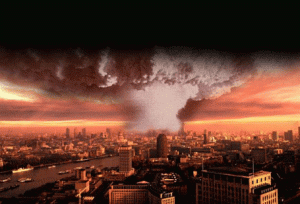 This Old U.S. Navy Nuclear Submarine Could Nuke 24 Cities (In One Shot) This Old U.S. Navy Nuclear Submarine Could Nuke 24 Cities (In One Shot)
If you do the math, the Ohio-class boats may be the most destructive weapon system created by humankind. National Interest,by Sebastien Roblin 13 May 19, In short, a full salvo from an Ohio-class submarine—which can be launched in less than one minute—could unleash up to 192 nuclear warheads to wipe twenty-four cities off the map. This is a nightmarish weapon of the apocalypse.
|
|
May 14, 2019
Posted by Christina Macpherson |
USA, weapons and war |
Leave a comment
Tass, May 13 2019 Both Project 22350 new frigates and Project 20380 corvettes under construction and Project 11442 cruisers undergoing upgrade will be furnished with the Paket-NK system. MOSCOW, May 13. /TASS/. The advanced Paket-NK torpedo defense system developed by the Research and Production Enterprise ‘Region’ (part of Tactical Missiles Corporation) will be mounted on Project 11442 cruisers during their upgrade, Enterprise CEO Igor Krylov told TASS on Monday……..
As a result of their upgrade, the Project 11442 cruisers will get new Oniks and Kalibr missiles and Tsirkon hypersonic weapons (instead of Granit missiles currently in service). Advanced surface-to-air missile systems, communications, navigation, life support and other systems are due to be mounted on these warships.
The Project 11442 heavy missile cruisers are among the Russian Navy’s largest warships: they are 250 meters long and displace over 26,000 tonnes. The warships have 20 launchers of Granit anti-ship supersonic missiles as their basic armament. The warships have an unlimited operating range due to their nuclear propulsion unit. Russia and the United States are the sole countries that operate warships of this class.
http://tass.com/defense/1057894
May 14, 2019
Posted by Christina Macpherson |
Russia, weapons and war |
Leave a comment
|
US: Next Nuclear Treaty Review Likely to Be ‘Incredibly Difficult’ VOA News, UNITED NATIONS — 13May19The final preparatory meeting for next year’s review of the Nuclear Nonproliferation Treaty ended Friday with deep divisions, and U.S. Ambassador Robert Wood said reaching agreement at the 2020 conference “will be an incredibly difficult task.”
But he told the closing session of the two-week preparatory conference that “it is a task we cannot abandon.”
The NPT is the world’s single most important pact on nuclear arms, credited with preventing their spread to dozens of nations since entering into force in 1970.
It has succeeded in doing this via a grand global bargain: Nations without nuclear weapons committed not to acquire them; those with them committed to move toward their elimination; and all endorsed everyone’s right to develop peaceful nuclear energy.
‘Significant challenges’
Treaty members — every nation but India, Pakistan and North Korea, who possess nuclear weapons, and Israel, which is believed to be a nuclear power but has never acknowledged it — gather every five years to review how it’s working. They try to agree on new approaches to problems, not by updating the treaty, which is difficult, but by trying to adopt a consensus final document calling for steps outside the treaty to advance its goals.
Malaysia’s U.N. Ambassador Syed Mohd Hasrin Tengku Hussin, chair of the third preparatory conference, told a news conference Friday that delegates “do not agree on everything but remain committed to full implementation” of the NPT, and talked about “how to accelerate measures to a nuclear-free world.”
Citing “significant challenges,” he noted that the meeting took place “at a time of increasing international tension and deteriorating relationships between those countries that possess nuclear weapons” — the U.S., Russia, China, Britain and France.
Hussin also singled out differences between nuclear weapon and non-nuclear weapon states on disarmament.
Iran ‘completely frustrated’
Iranian delegate Bahram Shahaboddin said in a closing statement that non-nuclear weapon states “are completely frustrated by the 50-year lack of progress on nuclear disarmament,” and continuing delaying tactics by the nuclear powers.
“We must not allow this to happen again. In 2020, we must say loud and clear enough is enough,” he said, singling out the United States for spending $1.2 trillion on its nuclear arsenal and “brazenly” threatening non-nuclear weapon states with nuclear weapons.
Hussin said delegates did agree on the agenda, procedures and president of the review conference — Argentina’s Ambassador to Austria Rafael Grossi — so in 2020 they can concentrate on substance……..
Rebecca Johnson, a security analyst and founding president of the International Campaign to Abolish Nuclear Weapons which won the 2017 Nobel Peace Prize, said: “The real questions for 2020 are going to be about the nuclear risks and treaties under threat from a few narcissistic leaders who are pulling out of them in order to keep proliferating and deploying nuclear weapons.”
“Their dangerous actions undermine not only the NPT … which we need to protect humanity from nuclear war, but climate catastrophes that threaten security for all of us,” she told AP. https://www.voanews.com/a/us-next-nuclear-treaty-review-likely-to-be-incredibly-difficult/4913234.html
|
|
May 13, 2019
Posted by Christina Macpherson |
2 WORLD, politics international, weapons and war |
Leave a comment
North Korea won’t give up all its nuclear weapons, former Defense Secretary Gates says. Politico, By PATRICK TEMPLE-WEST, 05/12/2019
Former Defense Secretary Robert Gates said North Korea is unlikely to ever give up all its nuclear weapons, and that President Donald Trump was right to walk away from deal with leader Kim Jong-un in February.In an interview with CBS that taped on May 10, Gates said North Koreans have come to see some modest nuclear capabilities as “essential to their national survival.”
“I believe that North Koreans will never completely denuclearize,” Gates said, adding that the Trump administration is “unrealistic in believing that they can get complete denuclearization.” ……. https://www.politico.com/story/2019/05/12/robert-gates-north-korea-1317623
May 13, 2019
Posted by Christina Macpherson |
North Korea, politics international, weapons and war |
Leave a comment

|
Apocalypse now? Cyber threats and nuclear weapons systems, European Leadership Network Julia Berghofer |Policy Fellow and Project Manager for the YGLN, 10 May 19, It is accepted that all states are vulnerable to cyber threats. Yet, a majority of states have yet to develop coherent cyber strategies or implement sufficient preventive measures. Despite the increase in severe cyber incidents directed at national power plants, companies and nuclear-related military equipment, the threat of cyber interference in national nuclear weapons systems is not being properly tackled. With multinational nuclear supply chains and nuclear command and control systems at risk of being compromised, this must be urgently addressed.
The more complex, the more vulnerable
Governments and legislators are struggling to keep pace with the rapid development of cyber capabilities. As military systems become more technically complex it would be easy to assume that they are more secure. The opposite is true. Increased automation and connectivity increases vulnerabilities to cyber attacks. Measures such as air-gapping a system (ie. de-connecting it from the internet) can fall short. A recent US Government Accountability Office (GAO) report assessed the cyber security of US weapons systems and found “mission critical cyber vulnerabilities in nearly all weapons systems […] under development.“ While the report does not make reference to any specific system type, one can reasonably assume that nuclear weapons systems are vulnerable to cyber attacks.
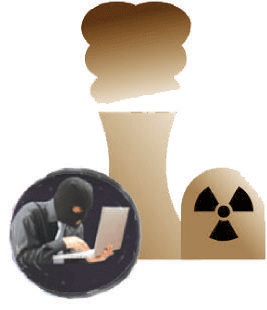 Possible kinds of cyber attacks Possible kinds of cyber attacks
Cyber attacks can take many forms. Activities range from cyber espionage, data theft, infiltration of nuclear command, control and communications (NC3), denial of service/distributed denial of service (DoS/DDoS) attacks, false alarms (jamming and spoofing), sabotage and physical damage. When directed against nuclear weapons systems, in the worst possible case this may escalate to a deliberate or inadvertent exchange of nuclear weapons.
Another area of concern is the supply chain, comprised of any hardware and software components belonging to the nuclear weapons system, including NC3, platforms, delivery systems and warheads. The supply chain usually includes a string of companies and providers located in different countries with varying cyber security standards, which means there is room for manipulation and sabotage. Take, for instance, a computer chip produced in country A. If a vulnerability were inserted at the production stage it could then be remotely activated at a later point when the chip is integrated into the military system of country B. If the attacker happened to be an “insider“ with unlimited access to a military site, compromising military equipment could be easier. This could be done for instance through an infected USB drive when security standards in a military facility happen to be low, leaving the victim of the attack unaware of the manipulation up until it is too late.
Limited awareness of cyber risks to nuclear systems
There is a lack of awareness within the expert community and among decision-makers and a reluctance by states to implement measures such as common cyber security standards and the sharing of information on vulnerabilities. Among the nuclear weapons states, only in the United States have high-ranking officials, such as Gen. Robert Kehler (ret.) and Air Force Gen. John Hyten (STRATCOM), in two Senate Armed Service Committee hearings in 2013 and 2017 expressed their concerns about a potential cyber attack affecting the U.S. nuclear deterrent. One reason why decision-makers and governments are unwilling to take these steps could be that it seems too unrealistic or improbable a threat, merely belonging to the worlds of science fiction and doomsday scenarios. But there is no reason to assume that the warnings of the GAO, the U.S. 2017 Task Force on Cyber Deterrence or the Nuclear Threat Initiative (NTI) are exaggerated.
Certainly, there has not yet been a major cyber attack on a state-run nuclear weapons programme – at least none we have publicly heard of. But there are a string of examples of cyber interference in nuclear installations or parts of the  supply chain related to them. These include: the Stuxnet attack in 2010 affecting over 15 Iranian nuclear facilities which slowed down the development of Iran’s alleged nuclear weapons programme; a massive cyber attack on Lockheed Martin in 2009 during which thousands of confidential files on the U.S. F35 Lightning II fighter aircraft were compromised by hackers (they were also able to see information such as the location of military aircraft in flight); the 2017 hacking of the THAAD missile defence system in South Korea; the 2009 Conficker Worm attack on the French Marine Nationale; a 2011 cyber espionage campaign on the French nuclear company Areva; and deep worries over the WannaCry virus possibly targeting parts of the UK Trident system in 2017. supply chain related to them. These include: the Stuxnet attack in 2010 affecting over 15 Iranian nuclear facilities which slowed down the development of Iran’s alleged nuclear weapons programme; a massive cyber attack on Lockheed Martin in 2009 during which thousands of confidential files on the U.S. F35 Lightning II fighter aircraft were compromised by hackers (they were also able to see information such as the location of military aircraft in flight); the 2017 hacking of the THAAD missile defence system in South Korea; the 2009 Conficker Worm attack on the French Marine Nationale; a 2011 cyber espionage campaign on the French nuclear company Areva; and deep worries over the WannaCry virus possibly targeting parts of the UK Trident system in 2017.
What should decision-makers and policy-makers do?
|
|
May 11, 2019
Posted by Christina Macpherson |
2 WORLD, safety, secrets,lies and civil liberties, technology, weapons and war |
Leave a comment

From the A bomb to the AI bomb, nuclear weapons’ problematic evolution, more https://www.france24.com/en/20190510-nuclear-weapons-artificial-intelligence-ai-missiles-bombs-technology-military, France 24 LIVE, Sébastian SEIBTm 10 May 19
From autonomous nuclear submarines to algorithms detecting a threat, to robot-guided high-speed missiles, artificial intelligence could revolutionise nuclear weapons – risking some profound ethical conundrums – a recent report reveals.
At 2:26 A.M. on June 3, 1980, Zbigniew Brezezinski, US President Jimmy Carter’s famously hawkish national security adviser, received a terrifying phone call: 220 Soviet nuclear missiles were heading for the US. A few minutes later, another phone call offered new information: in reality, 2,220 missiles were flying towards the US.
Eventually, as Brezezinski was about to warn Carter of the impending doom, military officials realised that it was a gargantuan false alarm caused by a malfunctioning automated warning system. Thus, the Cold War nearly became an apocalypse because of a computer component not working properly.
This was long before artificial intelligence (AI) rose to prominence. But the Americans and Soviets had already begun to introduce algorithms into their control rooms in order to make their nuclear deterrence more effective. However, several incidents – most notably that of June 3, 1980 – show the disadvantages of using AI.
Novelty implies new vulnerabilities’
Almost forty years on from that near debacle, AI seems to have disappeared from the nuclear debate, even though such algorithms have become ubiquitous at every level of society. But a report by the Stockholm International Peace Research Institute (SIPRI) published on May 6 underlines the importance of this aspect.
The nuclear arms race still poses a considerable threat, seeing as Donald Trump’s America has promised to modernise its arsenal, North Korea seems uninterested in abandoning its nuclear programme, and relations are tense between neighbouring nuclear powers and historical antagonists India and Pakistan.
However, technological breakthroughs in AI show “enormous potential in nuclear power, as in the areas of conventional and cyber weapons”, said Vincent Boulanin, the researcher at SIPRI responsible for the report, in an interview with FRANCE 24. In particular, machine learning is “excellent for data analysis”, Boulanin continued. Such work could play an essential role in intelligence gathering and the detection of cyber attacks.
Russia resurrects Soviet AI system
“In truth, we know very little about the use of AI in nuclear weapons systems at present,” Boulanin admitted. Russia is the only world power to have brought up the issue recently, with President Vladimir Putin announcing in March 2018 the construction of a fully automated nuclear submarine called Poseidon. Furthermore, in 2011 Moscow resurrected and updated the Perimetr system, which uses artificial intelligence to be able (under certain conditions) to detect an atomic bomb by another state. But experts consider these announcements to be lacking in concrete details.
In part, such scepticism stems from the fact that “the adoption of new technologies in the nuclear field tends to be rather slow because novelty implies the possibility of new vulnerabilities”, Boulanin pointed out. Those in control of nuclear weapons programmes prefer to work on outdated computers instead of state-of-the-art technologies that are at risk of being hacked.
Nevertheless, Bounanin continued, it’s only a matter of time before the nuclear powers adopt AI in their weapons systems, considering the enticing prospects of such technology. Its main advantage is that algorithms are an awful lot faster than humans at processing information.
AI could also make guidance systems for missiles more accurate and more flexible, according to Boulanin. “This would be especially useful for high velocity systems that human can’t manoeuvre,” he said. Indeed, several countries are working on prototypes of hypersonic aircraft and missiles able to fly five times faster than the speed of sound. It would be impossible for humans to intervene on the trajectory of such missiles, while AI could correct the aim if necessary.
The dark side of AI in nuclear weapons
There is, however, a very dark side to AI. By nature, it implies the delegation of decision-making from humans to machines – which would carry serious “moral and ethical” implications, noted Page Stoutland, vice-president of the American NGO Nuclear Threat Initiative, which collaborated in the SIPRI report.
On this basis, “the guiding principle of respect for human dignity dictates that machines should generally not be making life-or-death decisions”, argued Frank Sauer, a nuclear weapons specialist at the University of Munich, in the SIRI study. “Countries need to take a clear stance on this” so that they don’t have robotic hands on the red button.
That’s while algorithms are created by humans and, as such, can reinforce the prejudices of their creators. In the US, AI used by the police to prevent reoffending has been shown to be “racist” by several studies. “It is therefore impossible to exclude a risk of inadvertent escalation or at least of instability if the algorithm misinterprets and misrepresents the reality of the situation,” pointed out Jean-Marc Rickli, a researcher at the Geneva Centre for Security Policy, in the SIRI report.
Risk of accidental use
Artificial intelligence also risks upsetting the delicate balance between the nuclear powers, warned Michael Horowitz, a defence specialist at the University of Pennsylvania, in the SIRI study: “An insecure nuclear-armed state would therefore be more likely to automate nuclear early-warning systems, use unmanned nuclear delivery platforms or, due to fear of rapidly losing a conventional war, adopt nuclear launch postures that are more likely to lead to accidental nuclear use or deliberate escalation.” That means that the US – which boasts the world’s largest nuclear stockpile – will be more cautious in adopting AI than a minor nuclear power such as Pakistan.
In short, artificial intelligence is a double-edged sword when applied to nuclear weapons. In certain respects, it could help to make the world safer. But it needs to be adopted “in a responsible way, and people needs to take time to identify the risks associated with AI, as well as pre-emptively solving its problems”, Boulanin concluded.
One sobering comparison might be with the financial services industry. Bankers used the same arguments – the promises of speed and reliability – to introduce AI to the sector as those used by its advocates in the nuclear weapons field. Yet the use of AI in trading rooms has led to some very unpleasant stock market crashes. And of course, nuclear weapons will give AI much more to play with than mere money.
May 11, 2019
Posted by Christina Macpherson |
2 WORLD, technology, weapons and war |
Leave a comment
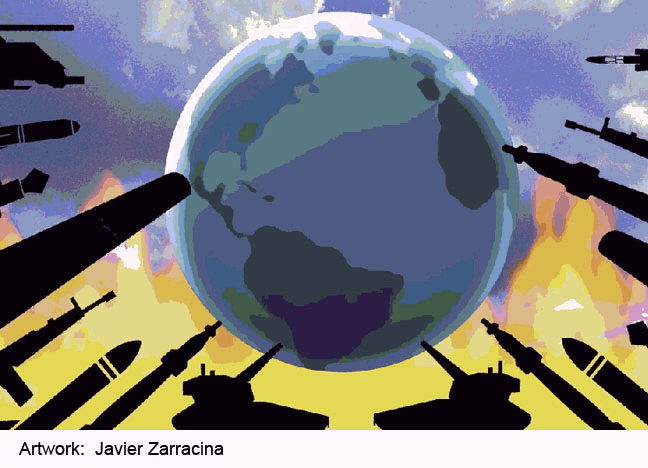 Nuclear paralysis and nuclear risk, Japan Times, BY DAVID HOWELL, MAY 10, 2019, LONDON – We are dangerously close to a world without arms control agreements. That is what some of the most experienced U.S. defense and disarmament experts are now warning, and a recent detailed report from a U.K. House of Lords Committee fully shares their alarm. The implications for the increasing risk of nuclear weapons use, tactical or strategic, are direct, immense and horrific. The disarmament process, on which the previous generation put so much hope, has come to a halt and what is termed “policy paralysis” has set in.
Whether these warnings are going to attract the urgent attention, and the action, they deserve is an open question. Of course in the Pacific Rim region the nuclear threat seems obvious and omnipresent, with unpredictable North Korean leader Kim Jong Un’s ongoing missile-launching activity still looming over nearby states, notably Japan.
But in the West it is quite different. A thick layer of complacency surrounds Western opinion about arms control and nuclear risk, built up from assumptions that the basic architecture of global arms stability of the last 70 years still works and stays firm. Preoccupation with other issues, such as Brexit, immigration and global warming, blots out most media coverage of nuclear matters, even though one nuclear slipup could kill millions in minutes.
Comfort is drawn from the belief that the balance of mutual deterrence between nuclear powers still holds firm, that Russia and the United States — which possess 90 percent of the world’s stock of nuclear weapons — still have some sort of dialogue despite their antagonism (as in the Cold War), that the proliferation of nuclear weapons has been reasonably contained and will continue to be so, and that the full range of arms control and limitation treaties, agreed on 20 or 30 years ago, are still valid or can be renewed.
Unfortunately none of these conditions still hold true. It is just dawning on Western policymakers that the whole arms stability structure, far from maintain the balance of the decades since World War II, could soon become highly unstable.
First, there has been a vast deterioration in both Russian-U.S. and Russian-European relations……..
Second, the “game,” if that is not a misnomer, is no longer a binary affair between two superpowers but, with the ascendancy of China, between at least three …….
Third, while the global spread of nuclear weapons, much feared half a century ago, has up to now been limited, as far as is known, to four new countries — namely India, Pakistan, Israel and North Korea……
Fourth, in August America is withdrawing from the Intermediate Range Nuclear Forces Treaty, signed in 1987 and requiring the progressive destruction of short- and medium-range missiles that could deliver nuclear warheads…….
Fifth, new cybertechnologies are now of such power that they can disrupt anti-missile warning systems, send fake alarms, attack command and control systems and provoke “accidents.”…….
Next year will come a major review of the 50-year-old Nuclear Non-Proliferation Treaty, which somehow holds the whole precarious pattern in place. The treaty accepts the legal right of the original five nuclear powers — the U.S., United Kingdom, Russia, China and France — to have nuclear weapons as long as they make progress to disarm and eventually get rid of them…….
a new arms race is beginning and the nuclear risk is increasing when the world has enough troubles already and can ill afford any more.
David Howell is a Conservative politician, journalist and economic consultant. He is chairman of the House of Lords International Relations. https://www.japantimes.co.jp/opinion/2019/05/10/commentary/world-commentary/nuclear-paralysis-nuclear-risk/#.XNXwyhQzbGg
May 11, 2019
Posted by Christina Macpherson |
politics international, weapons and war |
Leave a comment
Tehran, May 10 (Prensa Latina) Iran supports the Nuclear Non-Proliferation Treaty (NPT) to the full extent, Iran’s Representative to the UN, Mohammad Ali Robatjazi, said in a statement quoted in Tehran on Friday.
During a meeting held in New York, Robajatjazi described the atomic weapon as greatest threat to humanity.
The best way to stop the development of these lethal tools is the total application of the NPT, to which all countries must subscribe, he said.
The Iranian delegate criticized the U.S. nuclear aid to Israel, which reflects its double standards for the possession and development of atomic technology.
Israel must be forced to join the Non-Proliferation Treaty, and submit to inspections of the International Atomic Energy Agency (IAEA), he stressed…… https://www.plenglish.com/index.php?o=rn&id=41815&SEO=iran-supports-nuclear-non-proliferation-treaty
May 11, 2019
Posted by Christina Macpherson |
Iran, politics international, weapons and war |
Leave a comment









 nuclear-news