Nuclear bomb testing – the cruellest legacy of environmental injustice and racism
|
Nuclear testing legacy is ‘cruellest’ environmental injustice, warns rights expert,
https://news.un.org/en/story/2020/07/1068481 16 July 2020
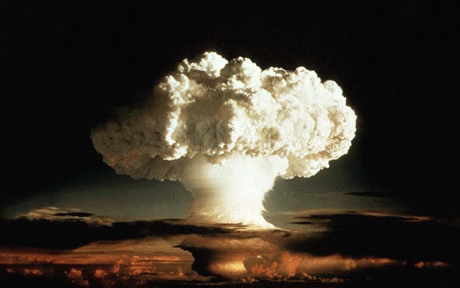
Human RightsThe dangerous legacy of nuclear weapons testing continues to affect many communities, a leading rights expert said on Thursday, on the 75th anniversary of testing in the United States, that heralded the nuclear age.
In an appeal to governments worldwide to get rid of weapons of mass destruction, UN Special Rapporteur on toxics, Baskut Tuncak, said that the Trinity tests in New Mexico on 16 July 1945, were the prelude to “two horrific explosions suffered by (the) innocent people of Japan”, during the Second World War.
They were also followed by the detonation of hundreds of nuclear bombs over vulnerable communities in the Pacific, and the disposal of radioactive waste on lands and territories of indigenous peoples. Paradise lostThis had created a legacy of nuclear testing that “is one of the cruellest examples of environmental injustice witnessed” in “what should be a peaceful island paradise”, said Mr Tuncak, who reports to the Human Rights Council in Geneva. From 1946-58, 67 nuclear bombs were detonated on the Marshall Islands, he said, the equivalent of more than 1.5 “Hiroshima-sized explosions every day for 12 years”. Communities “have suffered unimaginably” from radioactive contamination and this continues today “with a legacy of contamination, illness and anguish”, the expert insisted.
Twin environmental disasters made matters worse, he added, referring to climate change-induced sea level rise and nuclear waste concentrated in a radioactive “tomb”. 200 tests in 30 yearsSimilarly, in French Polynesia, over 200 nuclear tests were conducted over a 30-year period from 1966 to 1996, subjecting inhabitants to associated health and environmental damage, the Special Rapporteur said. From Greenland to the indigenous territories of the United States, he warned that people continued to suffer from the nuclear testing era. Waste not“In recent decades, numerous Native American tribes received funding to store unwanted nuclear waste on their lands,” he said. “Those of Point Hope, Alaska, became recipients of radioactive soil and higher cancer rates that are believed to have been the foreseeable result. And the people of Greenland discovered radioactive waste left by the US military, unbeknownst to them as the ice continues to melt in the Arctic.” This discriminatory approach should be addressed by all States as part of the discussion on “systemic racism” and nuclear disarmament, Mr. Tuncak insisted. “Unaddressed, the dangers of radioactive contamination will persist for centuries, and so too will the harmful legacy of racism that surrounds this tragic chapter of humanity,” he added. |
|
Peace cranes flyimg in Vermont , in support of U.N. Treaty on the Prohibition of Nuclear Weapons
 Peace cranes on Church Street aim to abolish nukes, https://www.wcax.com/2020/07/17/peace-cranes-hanging-on-church-street-to-abolish-nuclear-weapons/ WCAX News Team Jul. 17, 2020 BURLINGTON, Vt. (WCAX) – Cranes are a symbol of peace in many cultures, and 1,000 origami peace cranes from Japan are now displayed in front of Burlington City Hall in observance of next month’s 75th anniversary of the atomic bombings of Hiroshima and Nagasaki in World War II.The story behind the peace cranes is of a little girl, Sadako Sasaki, who developed cancer from atomic radiation because of the Hiroshima bombing. Sasaki started getting sick around age 11.
Robin Lloyd, an activist for abolishing nuclear weapons, believes Sasaki’s story will not only reach the hearts of Vermonters but also teaches an important lesson.
“The cranes date from a little girl who got leukemia from the Hiroshima bombing,” Lloyd said. “Then her health started to fail and her friends said, ‘If you can fold 1,000 cranes, then your wish will come true.‘”
Sasaki died before she reached 1,000 cranes, but her story lives on. Organizers at Thursday’s event in Burlington say they want to use the peace cranes to gain support for the abolition of nuclear weapons.
Joseph Gainza, a longtime Vermont peace activist, says that Vermont has supported nuclear weapons abolition in the past.
”The House of Representatives overwhelmingly — and the Vermont Senate unanimously — voted on a resolution calling on the United States to enter into the nuclear weapons abolition treaty,” Gainza said.
Today, the Treaty on the Prohibition of Nuclear Weapons continues to gain support, according to Maho Takahashi, an activist in Burlington. ”With that treaty, once 50 countries ratify it, it will enter into force,” Gainza said.
The peace cranes will be flying for the next week. Each crane has a lesson that visitors are encouraged to take and learn from.
Thanks to Botswana, the Treaty on the Prohibition of Nuclear Weapons has now reached 40 states ratifying it

Thanks to Botswana, the Treaty on the Prohibition of Nuclear Weapons has now reached 40 states parties. After just 10 more ratifications, it will enter into force. Botswana deposited its instrument of ratification with the UN Secretary-General, António Guterres, on 15 July, the anniversary of the entry into force of the Treaty of Pelindaba, which established the whole of Africa as a nuclear-weapon-free zone.
In case you missed it, Fiji also ratified the ban treaty last week. You can read about the significance of this step and Fiji’s long history of activism against the bomb in the Guardian, thanks to Dr Vanessa Griffen and Talei Luscia Mangioni.
The 40th ratification is a significant milestone, dispelling any doubts over the treaty’s inevitable entry-into-force. The Australian Government simply cannot ignore the ban forever.
In more good news, on Tuesday night the City of Port Adelaide Enfield became the first South Australian council to endorse the ICAN Cities Appeal. There are now 28 Australian councils that call for the federal government to sign and ratify the Treaty on the Prohibition of Nuclear Weapons.
Today is the 75th anniversary of the first nuclear explosion, code-named “Trinity”. This event has significance for all people impacted by nuclear weaponry worldwide, including in Australia. Nuclear explosions don’t stay in the past, the effects of radiation continue through the decades and generations. In just a couple of hours we’ll begin our special Trinity video panel with three incredible women who are fighting against the bomb. Check the details and get the Zoom link here, or watch it later from the ICAN Australia Facebook page.
The effects of radiation on the “downwinders” – guinea pigs for nuclear bomb research

Now I Am Become Death’: The Legacy of the First Nuclear Bomb Test, NYT, By Maria Cramer July 15, 2020
“………The effects of radiation were not well understood by most scientists on the project at the time, according to historians, and the preparations that were made to keep civilians safe reflected that ignorance.
They placed crude monitors around the small towns within 40 miles of the testing site. A scientist who was seven months pregnant and her husband, who was also a scientist, were sent to a motel in one of the towns with a Geiger counter, a device used to detect radioactive emissions, to measure the radiation. If the needle hit a certain mark, she was instructed to alert officials so that they could evacuate the town, Professor Wellerstein said.
Officials did not warn any of the residents — many of them ranchers, Navajos, Mexican settlers and their descendants who raised cattle and drank water from cisterns — about the test. Should anyone ask about the blast, officials had proposed several cover stories, including telling the public that a remote ammunitions depot had exploded, Professor Wellerstein said.
“It produced more light and heat than the sun,” said Tina Cordova, a founder of the Tularosa Basin Downwinders Consortium, which has urged the government to conduct more research about the aftermath of the blast and to compensate the affected communities.
Ash fell for days afterward in the landscape and in every direction and in amazing quantities,” she said.
Warnings went unseen and ignored.
“Thus a nation which sets the precedent of using these newly liberated forces of nature for purposes of destruction may have to bear the responsibility of opening the door to an era of devastation on an unimaginable scale,” the petition cautioned.
The bombs in Nagasaki and Hiroshima are believed to have killed up to about 200,000 people, with many of those victims succumbing to radiation poisoning in the weeks that followed.
The government never conducted a full investigation into the effects of the radiation, even after the communities downwind of the blast saw an unusual spike in infant deaths in the months after the explosion, said Joseph J. Shonka, a scientist and one of the authors of a 2010 study about the effects of nuclear testing for the Centers for Disease Control and Prevention.
“The Trinity downwinders have not been treated in either a fair or a just manner,” he said.
Ms. Cordova, who grew up in Tularosa, N.M., said cancer had been pervasive in the towns near the Trinity test site, where everyone can name someone who died of the disease.
“We know that the government basically walked away and has taken no responsibility for the suffering and the dying,” said Ms. Cordova, who has survived thyroid cancer and has several relatives who died of various forms of cancer.
Members of Congress from New Mexico have introduced legislation that would expand the Radiation Exposure Compensation Act, which compensates uranium miners and people who lived downwind from nuclear testing sites, to include the residents who lived around Trinity.
In 2014, the National Cancer Institute began interviewing people who lived in the towns near the testing site to try and document the effects of the blast. The institute said it anticipated publishing the results “within the next few months.” https://www.nytimes.com/2020/07/15/us/trinity-test-anniversary.html
A USA resumption of nuclear testing ? -a green light for all other nations to start their own testing
if the U.S. were to resume nuclear testing, it would be a green light for all other nations to start their own testing.
 A restart of nuclear testing offers little scientific value to the US and would benefit other countries The Conversation, Ferenc Dalnoki-Veress, Scientist-in-Residence and Adjunct Professor, Middlebury, Miles A. Pomper, Senior Fellow, James Martin Center for Nonproliferation Studies, Middlebury 14 July 20,
“…….The U.S. tested nuclear bombs for decades. But at the end of the Cold War in 1992, the U.S. government imposed a moratorium on U.S. testing. This was strengthened by the Clinton administration’s decision to sign the Comprehensive Nuclear Test Ban Treaty. Although the Senate never ratified the treaty and it never entered into force, all 184 countries that signed the test ban, including the U.S., have followed its rules.
But in recent weeks, the Trump administration and Congress have begun debating whether to restart active testing of nuclear weapons on U.S. soil…….
We are two nuclear weapons researchers – a physicist and an arms control expert – and we believe that there is no value, from either the scientific nor diplomatic perspective, to be gained from resuming testing. In fact, all the evidence suggests that such a move would threaten U.S. national security. Continue reading
Nuclear bomb testing – a form of racism and colonialism
Danielle Endres: Nuclear testing as a form of colonization, https://www.sltrib.com/opinion/commentary/2020/07/15/danielle-endres-nuclear/ By Danielle Endres ·16 July 20
At 5:29 a.m. on July 16, 1945, scientists in the Manhattan Project detonated the world’s first nuclear weapon in the desert homelands of the Mescalero Apache, a place now known as Alamogordo, New Mexico. As the detonation cloud mushroomed into the sky, the Trinity test ushered in a new era, the atomic age.
July 16 1945 – the first nuclear bomb test – the start of many more
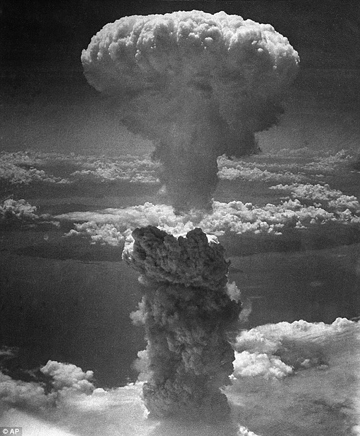 Now I Am Become Death’: The Legacy of the First Nuclear Bomb Test
The 75th anniversary of what’s known as the Trinity explosion, the world’s first nuclear weapon test, comes as tensions over nuclear devices intensify. NYT, By Maria Cramer July 15, 2020 It was 1 a.m. on July 16, 1945, when J. Robert Oppenheimer met with an Army lieutenant general, Leslie Groves, in the parched landscape of Jornada del Muerto — Dead Man’s Journey — a remote desert in New Mexico.
A group of engineers and physicists was about to detonate an atomic device packed with 13 pounds of plutonium, a nuclear weapon that the government hoped would bring an end to World War II……..At 5:29 a.m. local time, the device exploded with a power equivalent to 21,000 tons of TNT and set off a flash of light that would have been visible from Mars, researchers said.
It was the first nuclear test in history.
Less than a month later, the United States would drop a nearly identical weapon on the city of Nagasaki in Japan. The bomb, named Fat Man, fell three days after Americans dropped a uranium bomb, called Little Boy, on Hiroshima. Both weapons immediately killed tens of thousands of Japanese people and forced Japan’s surrender on Aug. 14, bringing an abrupt end to the war.
Mr. Oppenheimer said a Hindu scripture ran through his mind at the sight of the explosion: “Now I am become Death, the destroyer of worlds.”
The top secret test was heard and seen for miles.
The goal of the test was to see if the military could harness plutonium into a weapon that would destroy whole cities, said Alex Wellerstein, a science historian at the Stevens Institute of Technology in Hoboken, N.J., who studies the history of nuclear weapons…… https://www.nytimes.com/2020/07/15/us/trinity-test-anniversary.html
USA National coalition against nuclear weapons
 Nuclear Threat Still Looms https://progressive.org/op-eds/nuclear-threat-still-looms-adams-200713/United by these tragedies, now most impacted communities have the same ultimate goals: ensuring these weapons are never used again, and that they are one day eliminated. by Lilly Adams, July 13, 2020 Nuclear Threat Still Looms https://progressive.org/op-eds/nuclear-threat-still-looms-adams-200713/United by these tragedies, now most impacted communities have the same ultimate goals: ensuring these weapons are never used again, and that they are one day eliminated. by Lilly Adams, July 13, 2020 In July 16, 1945, at around 5:30 in the morning, 11-year-old Henry Herrera was outside his home in Tularosa, New Mexico, helping his father work on the radiator of their truck, when he saw a blinding flash of light. He thought he was witnessing the end of the world. In fact, he was witnessing the first ever use of a nuclear weapon — the Trinity nuclear test.
A few weeks later, on Aug. 6 and 9, the newly tested weapons were used on Japan, in Hiroshima and Nagasaki, killing between 150,000 to 246,000 innocent people. In 1946, nuclear testing began in the Marshall Islands; it would continue there until 1958 , and in the United Statesuntil 1992
. The production of these weapons, with its own harmful consequences, continues today. Even worse, Congress recently voted to fund expansion of the nation’s nuclear weapons program. In a cruel twist of fate, July 16 is a double nuclear anniversary for New Mexico. On that day in 1979, a dam holding back radioactive waste at the Church Rock uranium mill broke, releasing 1,100 tons of uranium waste and 94 million gallons of radioactive water into the Rio Puerco, across three Navajo Nation chapters, and into Arizona. After both July 16 events, no health studies or medical resources were provided for residents, leaving those affected to battle the resulting illnesses and deaths alone.Last summer, after marking these anniversaries, my colleagues and I felt a sense of anti-climax. Something was missing. Perhaps after so long, we had become numb in the face of this history of death. As we approached the 75th anniversary of the fateful bombings of Japan, we decided we needed to do more. To begin, we reached out to our partners in Japan, and learned an important lesson. The survivors of the bombings, known as hibakusha, generally focus on messages of hope and resiliency, in pursuit of opportunities to build a peaceful world. They share their haunting memories of the bombings, but then they look forward and demand progress. We also looked to the survivors of nuclear weapons activities here at home. Estimates range from tens of thousands to hundreds of thousands of people in the United States and in the Marshall Islands that have been sickened and killed due to nuclear weapons testing, uranium mining and nuclear-weapons production. Despite the distances between them — in time, place and culture — the stories of many of these survivors are the same. A flash of blinding light, the feeling the world was ending. Falling dust and powder — like snow — that sickened people and would lead, eventually, to cancers. Secrecy and neglect shrouded their experiences for decades. United by these tragedies, now most impacted communities have the same ultimate goals: ensuring these weapons are never used again, and that they are one day eliminated. With these goals in mind, our national coalition is gathering virtually on Aug. 6 and 9, the anniversaries of the bombings in Hiroshima and Nagasaki. The event will feature presentations from many of the 150 groups that have joined the effort so far. We hope readers will join us to learn more and hear from the people who have been impacted and are fighting for change. Seventy-five years after these bombings, nuclear weapons are still here, continuing to threaten every person on earth. But the survivors are still here, too. And in a time of separation and mourning, this is a chance to stand in solidarity with communities around the world that are calling for peace. This column was produced for the Progressive Media Project, which is run by The Progressive magazine, and distributed by Tribune News Service. |
|
The connections between nuclear weapons and nuclear power in the UK
 How much do you know about the connections between nuclear weapons and nuclear power? https://mariannewildart.wordpress.com/2020/07/13/how-much-do-you-know-about-the-connections-between-nuclear-weapons-and-nuclear-power/ JULY 13, 2020 BY MARIANNEWILDART Why is the UK government so addicted to nuclear? How much do you know about the connections between nuclear weapons and nuclear power? https://mariannewildart.wordpress.com/2020/07/13/how-much-do-you-know-about-the-connections-between-nuclear-weapons-and-nuclear-power/ JULY 13, 2020 BY MARIANNEWILDART Why is the UK government so addicted to nuclear?Nuclear weapons and nuclear power share several common features. In fact, the UK’s first nuclear power stations were built primarily to provide fissile material for nuclear weapons during the Cold War. The development of both the nuclear weapons and nuclear power industries is mutually beneficial. And now it appears that the government is using the Hinkley Point C nuclear power station to subsidise Trident, Britain’s nuclear weapons system. As part of a Parliamentary investigation into the Hinkley project, it emerged that without the billions of pounds earmarked for building this new power station in Somerset, Trident would be ‘unsupportable’. Professor Andy Stirling and Dr Phil Johnstone argued that the nuclear power station will ‘maintain a large-scale national base of nuclear-specific skills’ essential for maintaining Britain’s military nuclear capability. Join CND for an online discussion with Professor Stirling and Dr Johnstone about these connections.
|
|
75 years after the first nuclear bomb explosion, why aren’t we all worried about nuclear war?
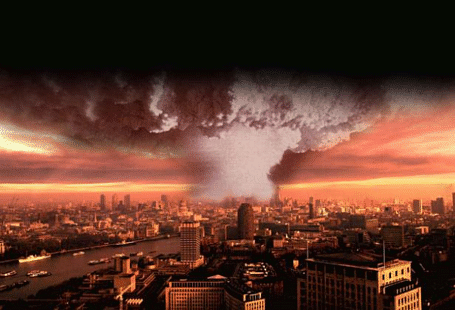
Renewed nuclear danger https://independenttribune.com/news/local/column-renewed-nuclear-danger/article_d71499e9-187c-53c0-8b37-6b9b8f06e2f0.html, By Gerry Dionne, 12 July 20
- July 16 of this year marks the 75th anniversary of the first nuclear bomb detonation. I don’t foresee any dancing in the street to mark the occasion. In fact, I imagine your nightly newscast will ignore it entirely. Oh, we’ll probably hear something about Hiroshima three weeks later. That first use of the weapon in malice has more historic significance. The two bombs dropped on Japan resulted in 214,000 deaths by the end of 1945.
Frankly, I’m mystified that we hear so little about the threat of nuclear war today considering how consequential such an event would be. It’s a danger far more clear and present than an errant asteroid, or an eruption of the Yellowstone Caldera. Currently, we’re all agog about the novel coronavirus. We’ve lived with a nuclear Sword of Damocles hanging over our collective head for 75 years now, and we tend to think we experienced real danger of thermonuclear war for a period of only 13 days back in 1962. We survived that physically unscathed; that’s probably it for one lifetime, right?
The post-World War II arms race has seen 2,056 nuclear test detonations by at least eight nations; more than half of that total (1,030) were American. The United States has not conducted a nuclear test since 1992, when a bipartisan congressional majority mandated a nine-month testing moratorium. In 1996, the United States was the first to sign the Comprehensive Test Ban Treaty, which verifiably prohibits all nuclear test explosions of any yield. Today, the CTBT has 184 signatories and almost universal support. But it hasn’t formally entered into force due to the failure of the United States, China, Egypt, Iran and Israel to ratify the agreement; and by India, Pakistan and North Korea, which have neither signed nor ratified the measure.
This leaves the door to renewed testing open. According to a May 22 article in The Washington Post, senior national security officials discussed the option of a demonstration of nuclear air detonation at a May 15 interagency meeting. A senior official told the Post that a “rapid test” by the United States could prove useful from a negotiating standpoint as the Trump administration tries to pressure Russia and China to engage in talks on a new arms-control agreement.
The push to restart nuclear weapons testing is happening at a time when tensions between the United States and Russia have stepped up provocative moves in airborne “show of force” demonstrations that can turn hazardous when combat aircraft come nail-bitingly close to each other. The danger expands exponentially when the aircraft involved are nuclear-capable, and when the operations are staged in militarily sensitive areas, such as a first-time U.S. B-1B bomber flight May 21 over the Sea of Okhotsk; or a May 29 flight by two B-1B bombers across Ukrainian-controlled airspace for the first time, coming close to Russian-controlled airspace over Crimea.
Not wanting to be left out of the merriment, Russia conducted a March 12 flight of two nuclear-capable Tu-160 “Blackjack” bombers over Atlantic waters near Scotland, Ireland and France from its base on the Kola Peninsula in Russia’s far north, prompting France and the United Kingdom to scramble interceptor aircraft. In conducting these operations, U.S. and Russian military leaders appear to be delivering two messages to their counterparts. First, despite any perceived reductions in military readiness caused by the coronavirus pandemic, they are fully prepared to conduct all-out combat operations against the other. Second, any such engagements could include a nuclear component at an early stage of the fighting.
Although receiving precious little media attention in the U.S. and international press, these maneuvers represent a dangerous escalation of U.S.-Russian military interactions and could set the stage for a dangerous incident involving armed combat between aircraft of the opposing sides. This by itself could precipitate a major crisis and possible escalation. Just as worrisome are the strategic implications of these operations, suggesting a commitment to the early use of nuclear weapons in future major-power engagements.
The U.S. Air Force Global Strike Command has long since supplanted the Strategic Air Command in its function as our nuclear war delivery system. Its commander, Gen. Timothy Ray, has said, “We have the capability and capacity to provide long-range fires anywhere, anytime, and can bring overwhelming firepower, even during the pandemic.” It really doesn’t matter whether those words reassure or horrify you; the eventual outcome of merely holding weapons of nearly limitless lethality is written in stone.
Sources: Arms Control Association Newsletter, July/August 2020; The Washington Post, May 22, 2020; and JanesDefenseWeekly.com, July 5, 2020.
American-Israeli strategy developing for clandestine not-quite-war strikes on Iran?
 Long-Planned and Bigger Than Thought: Strike on Iran’s Nuclear Program Long-Planned and Bigger Than Thought: Strike on Iran’s Nuclear Program
Some officials say that a joint American-Israeli strategy is evolving — some might argue regressing — to a series of short-of-war clandestine strikes. NYT, By David E. Sanger, Eric Schmitt and Ronen Bergman, 12 July 20 As Iran’s center for advanced nuclear centrifuges lies in charred ruins after an explosion, apparently engineered by Israel, the long-simmering conflict between the United States and Tehran appears to be escalating into a potentially dangerous phase likely to play out during the American presidential election campaign.
New satellite photographs over the stricken facility at Natanz show far more extensive damage than was clear last week. Two intelligence officials, updated with the damage assessment for the Natanz site recently compiled by the United States and Israel, said it could take the Iranians up to two years to return their nuclear program to the place it was just before the explosion. An authoritative public study estimates it will be a year or more until Iran’s centrifuge production capacity recovers.
Another major explosion hit the country early Friday morning, lighting up the sky in a wealthy area of Tehran. It was still unexplained — but appeared to come from the direction of a missile base. If it proves to have been another attack, it will further shake the Iranians by demonstrating, yet again, that even their best-guarded nuclear and missile facilities have been infiltrated.
Although Iran has said little of substance about the explosions, Western officials anticipate some type of retaliation, perhaps against American or allied forces in Iraq, perhaps a renewal of cyberattacks. In the past, those have been directed against American financial institutions, a major Las Vegas casino and a dam in the New York suburbs or, more recently, the water supply system in Israel, which its government considers “critical infrastructure.”
Officials familiar with the explosion at Natanz compared its complexity to the sophisticated Stuxnet cyberattack on Iranian nuclear facilities a decade ago, which had been planned for more than a year. In the case of last week’s episode, the primary theory is that an explosive device was planted in the heavily-guarded facility, perhaps near a gas line. But some experts have also floated the possibility that a cyberattack was used to trigger the gas supply.
Some officials said that a joint American-Israeli strategy was evolving — some might argue regressing — to a series of short-of-war clandestine strikes, aimed at taking out the most prominent generals of the Islamic Revolutionary Guards Corps and setting back Iran’s nuclear facilities…….. https://www.nytimes.com/2020/07/10/world/middleeast/iran-nuclear-trump.html
|
|
|
Evacuation of a tiny Russian village, – in preparation for a nuclear missile test?
 Russian Village in ‘Danger Zone’ of Possible Nuclear Missile Test, Nenoksa is once again the crosshairs after a radioactive accident last year. AT TOP https://www.popularmechanics.com/military/research/a33219749/nenoksa-nuclear-missile/ BY KYLE MIZOKAMIJUL 6, 2020
- The tiny Russian village of Nenoksa will face voluntary evacuations due to an “unspecified test.”
- The test could well be of the Burevestnik nuclear-powered cruise missile.
- A nearby incident in 2019 involving Burevestnik killed five and triggered radiation warnings throughout the region.
The missile test comes just days after Scandinavian countries bordering Russia detected a mysterious release of radiation. An investigation pointed to northern Russia as a source, but Moscow insisted that nearby nuclear plants were running normally. An alternate theory was that there had been a second accident involving the new nuclear cruise missile, but with what looks like a Burevestnik test coming up that too now seems unlikely.
Mega-rich Americans prepare fpr nuclear war, with luxury bunkers

Inside the luxury nuclear bunker protecting the mega-rich from the apocalypse
A volcanic-ash scrubber, a decontamination room, a waterslide — when it comes to surviving a nuclear apocalypse, the Survival Condo has everything you could need, at a price. CNet.com, Claire Reilly, July 6, 2020 ……. after visiting my first real nuclear bunker, my apocalypse plan has been upgraded. Now my list of needs includes “underground swimming pool” and “postapocalyptic rock-climbing wall.” I’ve become fussy about how I’ll spend time during the planet’s dying breaths. My bug-out bag has gotten bougie. I’ve seen the world’s most high-tech bunker, and I want in.
Welcome to the Survival Condo. This former Atlas Missile silo turned luxury condominium complex offers the world’s rich and powerful a chance to buy into the ultimate life insurance: an apocalypse bunker that promises the perfect combination of shelter and style.
……. The starting cost for a unit in this complex is $1 million, plus an extra $2,500 per month in dues to cover your living expenses: electricity, water, internet, all the tinned eggs you could dream of.
For the ultra-rich and paranoid, though, you can’t put a price on safety…
The end of the world as we know it
Nuclear winter isn’t like spending Christmas upstate. It’s a global nightmare realm, where Ice Age-like temperatures last for years, populations perish and life as we know it becomes the stuff of sci-fi nightmares.
At least that’s according to Brian Toon, professor of atmospheric and oceanic sciences at the University of Colorado and world-renowned expert on the global effects of nuclear war. ……
Toon says a nuclear explosion is like “bringing a piece of the sun down to the Earth,” and the aftermath of that kind of explosion causes huge fires — think citywide infernos. Those fires push huge amounts of smoke up into the stratosphere. And because it never rains in the stratosphere, sunlight can’t reach Earth. Welcome to nuclear winter.
“The temperatures become colder than the last Ice Age,” says Toon. “So we have sub-Ice Age temperatures over the whole planet for about 10 years.”
That’s exactly why the Survival Condo exists — to protect the mega-rich from the devastation of global nuclear war, and to make sure the world’s most powerful people can survive in comfort, rather than shivering in the wasteland, waiting to have their billionaire brains eaten by hungry hordes. ……..
I’m at the very top of a bunker that descends 15 floors and 200 feet underground. On this upper level, a wide dome set into the hill houses the main entry and communal recreation facilities. That’s where you’ll find the pet park, climbing wall and swimming pool (complete with a water slide).
Beneath the dome, the cylindrical silo houses a further 14 floors — the top three floors are where you’ll find the mechanical rooms, medical facilities and a food store (complete with a full hydroponics and aquaculture setup), followed beneath by seven levels of residential condos. At the bottom, the final four floors house the classroom and library, a cinema and bar, and a workout room (with a sauna). ……..
what if there’s radiation because of a dirty bomb? You would have to go in this room, which is a decontamination scrub room. The chemicals in here can take care of everything. We have iodine pills to treat you for radiation, we have Geiger counters that detect radiation, and we have special chemicals to scrub both biological and radioactive contaminants from you. But you would lose your clothes. You’d be naked and afraid.”
As we wind our way through the Survival Condo, it’s like I’m in an episode of Cribz, set in a dark, alternate reality. This is where we keep the camo gear! This is the gun range! Here’s how we scrub the volcanic ash out of the air in the event of a supervolcano! …….
As a bonus, if the world is really ending, these windows display a real-time view of the carnage outside, thanks to the Survival Condo’s external surveillance cameras. Everyone come to the kitchen! The surface-dwellers are hunting in packs now!….
I guess there’s a grim irony in the idea that even when the nukes drop and the very fabric of society has disintegrated beyond recognition, the rich and powerful will still have it better off than the rest of us.
We’ll still be a society of haves and have-nots. Except in this case, the haves will be watching Armageddon from the comfort of their air-conditioned, underground cinema. And the have-nots will be out in the wilderness, freezing through nuclear winter and picking over the bones of our loved ones, trying to survive the real thing. https://www.cnet.com/features/inside-the-survival-condo-nuclear-bunker-protecting-the-ultrarich-hacking-the-apocalypse/
Following fire at nuclear site, Iran warns it will retaliate if it suffers cyber attacks
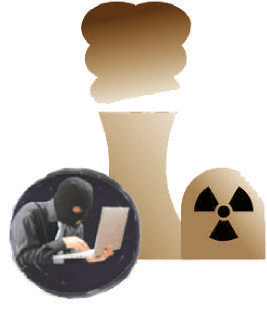 Nuclear site cyber attack possible: Iran, Canberra Times, 4 July 20, Iran will retaliate against any country that carries out cyber attacks on its nuclear sites, the head of civilian defence says, after a fire at its Natanz plant which some Iranian officials say may have been caused by cyber sabotage. Nuclear site cyber attack possible: Iran, Canberra Times, 4 July 20, Iran will retaliate against any country that carries out cyber attacks on its nuclear sites, the head of civilian defence says, after a fire at its Natanz plant which some Iranian officials say may have been caused by cyber sabotage.
The underground Natanz Fuel Enrichment Plant (FEP) is one of several Iranian facilities monitored by inspectors of the International Atomic Energy Agency, the UN nuclear watchdog. Iran’s top security body said on Friday that the cause of the “incident” at the nuclear site had been determined but “due to security considerations” it would be announced at a convenient time……
Three Iranian officials who spoke to Reuters on condition of anonymity said they believed the fire was the result of a cyber attack, but did not cite any evidence. One of the officials said the attack had targeted the centrifuge assembly building, referring to the delicate cylindrical machines that enrich uranium, and said Iran’s enemies had carried out similar acts in the past. Two of the officials said Israel could have been behind the Natanz incident but offered no evidence. Asked on Thursday evening about recent incidents reported at strategic Iranian sites, Israeli Prime Minister Benjamin Netanyahu told reporters: “Clearly we can’t get into that.” In 2010, the Stuxnet computer virus, which is widely believed to have been developed by the United States and Israel, was discovered after it was used to attack the Natanz facility. to have been developed by the United States and Israel, was discovered after it was used to attack the Natanz facility. Australian Associated Press https://www.canberratimes.com.au/story/6818945/nuclear-site-cyber-attack-possible-iran/?cs=14264#gsc.tab=0 |
|
-
Archives
- October 2026 (112)
- September 2026 (339)
- August 2026 (330)
- July 2026 (355)
- June 2026 (287)
- May 2026 (306)
- April 2026 (356)
- March 2026 (251)
- February 2026 (267)
- January 2026 (308)
- December 2025 (358)
- November 2025 (359)
-
Categories
- 1
- 1 NUCLEAR ISSUES
- business and costs
- climate change
- culture and arts
- ENERGY
- environment
- health
- history
- indigenous issues
- Legal
- marketing of nuclear
- media
- opposition to nuclear
- PERSONAL STORIES
- politics
- politics international
- Religion and ethics
- safety
- secrets,lies and civil liberties
- spinbuster
- technology
- Uranium
- wastes
- weapons and war
- Women
- 2 WORLD
- ACTION
- AFRICA
- Atrocities
- AUSTRALIA
- Christina's notes
- Christina's themes
- culture and arts
- Events
- Fuk 2022
- Fuk 2023
- Fukushima 2017
- Fukushima 2018
- fukushima 2019
- Fukushima 2020
- Fukushima 2021
- general
- global warming
- Humour (God we need it)
- Nuclear
- RARE EARTHS
- Reference
- resources – print
- Resources -audiovicual
- Weekly Newsletter
- World
- World Nuclear
- YouTube
-
RSS
Entries RSS
Comments RSS

