Walt Zlotow West Suburban Peace Coalition Glen Ellyn IL, 5 Mar 26
President Trump bet his entire criminal attack on Iran as a quick 3 day operation which would force Iran’s capitulation. Kill its leader Ayatollah Ali Khamenei and the 90 million Iranians would rise up against their government and make peace with new master America.
It has backfired spectacularly. The vast majority of Iranians have rallied around the Islamic government. When Trump demanded Iran surrender, the remaining government publicly told Trump, ‘Go to hell.’ Instead, they have launched thousands of missiles and drone explosives on US instillations thruout the region. American deaths and injuries are occurring. They are successfully bombing America’s criminal war partner Israel, the real mastermind of this self-destructive war. Iran has closed the Strait of Hormuz which will quickly destabilize the world economy over oil pricing. Iran’s attacks on US resources in the Gulf States will possibly destabilize the entire region.
Trump, realizing he’s both failed and trapped, is becoming increasingly more detached from reality. The US is already running low munitions to fight a long war, but Trump claims we have enough to fight multiple wars “forever”. But he quickly contradicted himself by claiming any shortages are due to negligence of his predecessor he only refers to as “Sleepy Joe”. This from a debilitated president falling asleep at public events. He’s cut off all trade with Spain because they refuse to help Trump wage his criminal war. Trump hints at boots on the ground in Iran, setting congressional critics’ hair on fire.
Why doesn’t Iran fold against the largest military in the world and its criminal war partner Israel? Simple. After trying to negotiate peace with these two brutal, vicious countries for decades, Iran realizes both represent an existential threat to their existence. Facing obliteration, proud Iran has decided to go down fighting, taking America and Israel with them.
Knowing it was coming, Iran has been preparing years for all out war. It has tens of thousands of missiles and drones scattered and well-hidden to prevent US, Israeli destruction. The US, Israeli hunters are now becoming the hunted. US embassies in the region, some already under attack, are telling their staffers they cannot help evacuate them.
Trump has nearly 3 years left in office. His failed 3 day quickie war to destroy Iran as an Israeli hegemonic rival may turn his last 3 years into an unrelenting personal catastrophe. Alas, it may also be a catastrophe for Israel, America, the Middle East, possibly the entire world.
It’s only Day Five of the war, but surely the epic stupidity of Australia so cravenly backing the US-Israeli invasion of Iran is evident by now. Michael West reports.
We are led by fools and sycophants. The illegal, unprovoked invasion of Iran is not just garden-variety stupidity. This is stupidity on a grandiose, stratospheric scale.
The Israeli propaganda narrative that Iranians would sprinkle rose petals at the feet of their invaders has not come to pass. It has already been demolished in fact.
Instead of bringing freedom and democracy – ‘regime change’ – we have brought chaos, possibly a world war, and definitely the destruction of the Middle East. The world economy is being hit hard as we write; oil prices spiralling, energy prices about to soar, and the inexorable spectre of inflation and recession.
“And it didn’t have to happen.“
This was a war of choice. Even without the “Epstein Coalition” – as the Iranian media so aptly dubs their invaders – murdering 168 Iranian school girls on day one, ‘peace through strength’ was never going to happen.
Quite the contrary. The illegal and unprovoked invasion of Iran has hardened the resolve of Iranians, who are massing in their hundreds of thousands across the country to mourn their dead and chant Death to America, to back their regime.
Where was the advice?
The Epstein Coalition killed the Ayatollah, who was actually against nuclear power; he was a moderate. Did Albo and Penny Wong not seek advice from Foreign Affairs that attacking Iran was folly, that the anti-regime protestors were a minority, that the pre-invasion protests were a Mossad and CIA psyop, that Iran might attack US proxy states in the region, that invasion would be a Brobigdadgian mistake?
Or did they ignore the advice in favour of a Washington regime compromised by the Epstein pedophile scandal?
And now, we see the feeble, hypocritical whining by Israel and its supporters about Iran attacking the Gulf states. Is that our only moral defence? Decades of supporting these regimes: Bahrain, Qatar, Kuwait, Saudi Arabia, and the United Arab Emirates – US proxy states all – regimes now unravelling, the oil price is soaring, inflation and recession are beckoning globally.
Images are emerging from Bahrain of locals cheering on the Iranian missiles. Were DFAT and our politicians unaware of popular angst in the Gulf states against American imperialism?
And what did they expect Iran to do in the face of this existential threat? Not blow up American bases and infrastructure while the US attacked them; after the US betrayed them at the very negotiating table when they were offering significant concessions on nuclear enrichment, all to avoid war? This war.
Australia, the US flunkies
Yet here was Australia, Saturday night, first out of the blocks worldwide to throw its support behind Donald Trump and his preposterous “Operation Epic Fury”, a probable pedophile being blackmailed and led around by the genocidal Benjamin Netanyahu like a pony at the fairground show.
“Operation Epstein Fury”, it was fast labelled. The soaring, craven stupidity is hard to grasp. Both major parties backing it. Albo first, then Angus Taylor rushing to tow the Donald’s line. Then, Pauline Hanson, too, who even congratulated and praised Netanyahu. We are led by fools and sycophants.
The flawed defence of atrocity
To address the empty rhetoric of the pro-war lobby, criticism of this war does not equate to support for the regime in Iran. Defenders of the US-Israel atrocity are busy with their swarms of social media bots peddling the argument that “you are an Islamist terror supporter” if you criticise the invasion.
This is the 2026 version of “You are a Hamas supporter” if you argue against genocide in Gaza.
The cold facts of this debacle are that regime change does not work, that Iran did not want this war, that Iran appears to be exceptionally well prepared – even winning the war – that the Epstein Coalition, which Australia supports, is daily backing war crimes: blowing up hospitals, schools and civilian infrastructure.
“This is a war which has already been lost.“
The obvious reality is that regime change wars are a demonstrable failure. Vietnam. Iraq. Afghanistan. Iraq – a million dead, irretrievable regional stability. In Afghanistan, 20 years, trillions of dollars spent, four US presidents, six Australian PMs – all to replace the Taliban with the Taliban.
And here we are, the world’s busybodies, doing it again.
Who would ever negotiate with the US in good faith again, or Israel for that matter? Iran did not want this war. Iran has not attacked another country in 300 years.
The US lured them to the negotiating table, then, without warning, murdered their leadership. This echoes last year’s 12-day war, where Israel and the US lured them in on the premise of good faith talks, then murdered them and now play the victim.
What did they expect Iran to do in the face of this existential threat?
The record speaks for itself. The US is the biggest invader of other countries in history. Israel has, last year alone, attacked Iran, Iraq, Lebanon, Yemen, Jordan, Palestine, Qatar, Tunisia, Malta, and Greece.
Six illegal attacks of sovereign nations, as well as three illegal attacks in international waters equals 9 all up. In one year. And now they are invading Lebanon again, seizing more territory as their puppets, America, fight their campaign against Iran.
Albo, what are you doing?
We know who the war mongers are. We are the war mongers. Yet, in his bizarre statement of support, Prime Minister Anthony Albanese was the fastest out of the blocks of all the allies on the weekend, issuing a false statement.
The claim, echoed by the usual warmongers of the Lib-Lab establishment, is that Iran is guilty of attacks on Australian soil, referencing alleged attacks on a deli in Bondi.
We know who the war mongers are. We are the war mongers. Yet, in his bizarre statement of support, Prime Minister Anthony Albanese was the fastest out of the blocks of all the allies on the weekend, issuing a false statement.
The claim, echoed by the usual warmongers of the Lib-Lab establishment, is that Iran is guilty of attacks on Australian soil, referencing alleged attacks on a deli in Bondi.
Then there is the age-old claim that Iran is about to produce nuclear weapons. The US and Israel’s nuclear risk claims have been so roundly discredited it’s a joke.
Benjamin Netanyahu has been trying to instigate a war against Iran for 30 years – claiming Iran is days away, weeks away, months away from nuclear missiles.
And they were at the negotiating table again when the Epstein forces murdered them.
The propaganda
We are now seeing mainstream media decry the ‘illegal attacks’ on Israel and the Gulf states. Yet the ‘victim card’ is tapped out. Around the world, outside the legacy media propaganda, there is little sympathy for Israel having razed Gaza and slaughtered between 72,000 and 700,000 Palestinians while stealing more land in the West Bank daily.
It will continue. The media and political classes have failed so majestically that they can only try to salvage their authority with more propaganda.
The deplorable coverage of the murdered schoolgirls in Iran is a case in point. The “40 beheaded babies” and the “mass rapes” of Hamas filled the headlines in the West on October 8, 2023. Yet real murders – 170 murdered schoolgirls – have hardly rated a mention. Yes, a mention perhaps, but a side story, buried, no headlines of outrage.
Can’t handle the truth?
Is the truth too hard to handle? Is it not evident to everybody except the most brainwashed advocate of the Epstein lobby that Israel – the government, the state – is the problem here?
Netanyahu has won his ambition to drag America into a war against Iran, and if you follow the money, while world stock markets teeter, the stock market in Tel Aviv is surging, replete with weapons companies as it is.
Meanwhile, the ASX is tanking, ergo our savings. Oil prices are surging, ergo higher energy prices and inflation. The Houthis, Iran’s allies, are shooting again in the Red Sea while, on the other side of the Arabian peninsula, Iran has blocked the Straits of Hormuz, choking off a large chunk of the world’s oil supply.
Higher prices in India and China will mean higher prices for imports and inflation around the world.
The lessons of history have not been learnt; in fact, they have been discarded in spectacular fashion.
“While they kick 17 million Americans off their healthcare, Republicans want to spend billions on Trump’s reckless war of choice,” said the chair of the Congressional Progressive Caucus. “Hell no.”
The Pentagon is reportedly planning to ask Congress to approve a supplemental funding package of around $50 billion to help finance the Trump administration’s unauthorized war on Iran, which has already cost billions of dollars and many lives.
Progressives were quick to reject the idea of providing the bloated, fraud-ridden Pentagon with additional funds to sustain a war that lawmakers did not approve and that is broadly unpopular with the American public.
“While they kick 17 million Americans off their healthcare, Republicans want to spend billions on Trump’s reckless war of choice,” said Rep. Greg Casar (D-Texas), chair of the Congressional Progressive Caucus. “Hell no.”
Reutersreported Tuesday that “Deputy Defense Secretary Steve Feinberg has been leading Pentagon work in recent days on a supplemental budget request of around $50 billion that could be released as soon as Friday.”
“The new money would pay for replacing the weapons used in recent conflicts including those in the Middle East,” the outlet added. “The figure is preliminary and could change.”
Sen. Lindsey Graham (R-SC), the most vocal cheerleader of the war in Congress, told reporters Tuesday that he believes “there will be a supplemental” funding request from the Pentagon.
“We’ll have to approve that,” said Graham.
“If this war continues at the same pace, Americans could see their government burn through tens of billions of dollars, funds that would amount to the cost of Medicaid for millions in the United States.”
The push for a supplemental funding package is the latest indication that the assault on Iran—launched with no clear justification, objective, or timeline and in violation of domestic and international law—could drag on indefinitely, even as Trump administration officials deny that the president who ran on avoiding wars has embroiled the nation in another disastrous quagmire in the Middle East.
Dylan Williams, vice president for government affairs at the Center for International Policy, wrote Tuesday that Congress should approve “not one damn penny” for Trump’s war on Iran.
The Center for American Progress (CAP) estimated Tuesday that the Iran war has likely already cost US taxpayers more than $5 billion.
“At more than $5 billion and counting, the costs of Operation Epic Fury—in only its first few days of operations—could cover Supplemental Nutrition Assistance Program (SNAP) benefits for more than 2 million Americans for a year,” noted CAP’s Allison McManus. “If this war continues at the same pace, Americans could see their government burn through tens of billions of dollars, funds that would amount to the cost of Medicaid for millions in the United States.”
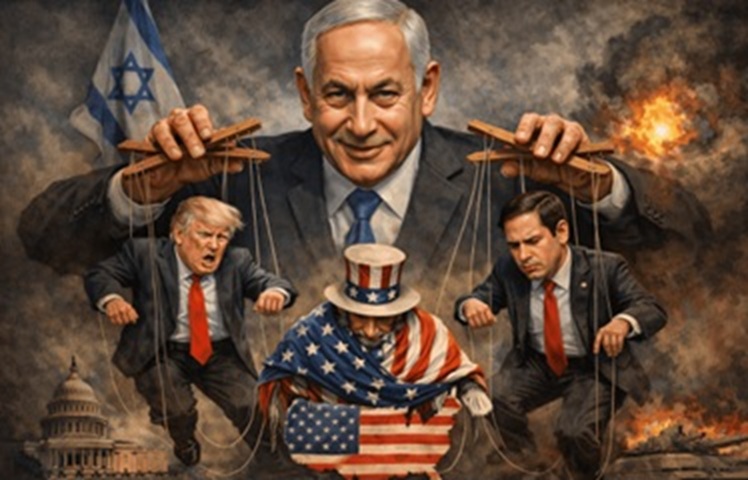
Israel is dictating foreign policy, with Trump’s throat-clearing, unwavering support for Israel attacking the country despite the American population not supporting this misadventure.
Secretary of State Marco Rubio acknowledged this week that the United States anticipated Israeli military action against Iran and believed it would trigger retaliatory strikes on American forces — a scenario that ultimately led Washington to join the offensive.
Speaking to reporters at the Capitol, Rubio said U.S. officials “knew that there was going to be an Israeli action” and expected it would “precipitate an attack against American forces.” He added that failing to strike first would have meant “higher casualties.”
This shows how Israel is dictating foreign policy, with Trump’s throat-clearing, unwavering support for Israel attacking the country despite the American population not supporting this misadventure.
Couldn’t Trump have been more like Biden and Harris, who scolded Bibi and yet allowed the genocide to take place in the first place?
Remember Biden’s delusion in claiming he had “done more for the Palestinian community than anybody.”
That assertion stands in sharp contrast to accounts from within his own administration. Maryam Hassanein, a former Interior Department political appointee who resigned, directly rejected that narrative.
“I think his legacy is the opposite,” Hassanein said. “He’s the president who’s done the most harm to Palestinians.”
To go off on a long tangent about the great foreign policy and immigration failures of the Biden White House would be too much to recount here. However, they were only revealing what is now clear as day: the Democratic Party is complicit in the empire. The question now is not whether that is true, but how to confront and change it.
What this demonstrates is something that has long been known: Israel is the United States’ ride-or-die friend. But at this point, it has become a Thelma & Louise moment — driving off a cliff and taking the whole world with them.
The remarks suggest the Trump administration viewed participation in the war as a preemptive necessity rather than an independent strategic choice. Critics argue the statement instead underscores Washington’s unwillingness to restrain Israel — even when U.S. forces would be drawn into direct conflict.
Netanyahu’s Long-Pursued Campaign
Israeli Prime Minister Benjamin Netanyahu openly described the operation as the culmination of decades of advocacy for confronting Iran militarily. He said the strikes were carried out with “the assistance of the United States” and framed the campaign as something he had sought to achieve for 40 years.
The comments reinforced concerns among some analysts that Israel’s strategy effectively shaped U.S. decision-making.
Could Washington Have Prevented the Escalation?
Brian Finucane, a former State Department lawyer now with the International Crisis Group, argued that the U.S. maintains substantial leverage over Israel due to its military and financial support. According to data from Brown University’s Costs of War Project, the U.S. has provided over $21 billion in military aid to Israel since October 2023 and more than $300 billion in total assistance since Israel’s founding.
Finucane suggested that if Washington had strongly opposed Israeli strikes, it may have been able to delay or deter them. Whether Iran would have refrained from retaliatory action is a separate question, he noted.
Mounting Casualties and Political Fallout
The joint U.S.–Israeli campaign has resulted in significant casualties. Iranian authorities report hundreds killed, including civilians. U.S. Central Command confirmed American service members have also died in the fighting.
Meanwhile, members of Congress — including senior Democrats on foreign affairs and armed services committees — have requested clarification from the administration regarding the legal justification for the operation, its objectives, and what would constitute mission success.
The war marks the second major U.S.–Israeli confrontation with Iran in less than a year, deepening instability across the region and intensifying debate in Washington over executive war powers.
A Question of Agency
Rubio’s framing raises a deeper question: was the United States genuinely compelled by strategic necessity — or simply unwilling to restrain an ally intent on escalating the conflict? The truth is that Washington’s worldview has become increasingly unmoored from any sense of proportionality or restraint. This same person in Rubio has defended coilionelism.
The U.S. provides Israel with extensive military assistance and diplomatic cover, making it difficult to claim neutrality in moments of crisis. There was no imminent threat of an attack, and Iran did not possess a nuclear weapon — a point underscored by Tulsi Gabbard, but whats she know, shes just the Director of National Intelligence. The fact remains that a far smaller nation is effectively pulling the last global superpower into a widening regional confrontation — one that carries risks far beyond the immediate battlefield.
How this ends is anyones guess most likely not well but don’t worry you can still gamble on and profit from it.
The narrative that Israel was ready to act alone has holes in it, considering Israel has relied on US air defenses to intercept Iranian missiles in previous conflicts, and POLITICO reported a few days before the war started that Trump officials thought it might be better for the “politics” if Israel attacked on its own at first, provoking Iranian attacks on US assets to justify US intervention.
The president made the comments in response to a question about Rubio saying the US launched the war because Israel planned to attack
Adding to the mixed messaging coming from the Trump administration regarding the war with Iran, President Trump suggested on Tuesday that he may have “forced Israel’s hand” when the conflict started.
The president was responding to a question about Secretary of State Marco Rubio, who said on Monday that one reason why the US launched the war on Saturday was that Israel was planning to attack and that the US assessed Iran could respond with attacks. on US bases.
Senior Trump officials said the same thing during classified briefings with members of Congress on Monday, which was confirmed by House Speaker Mike Johnson (R-LA) and other lawmakers. “Because Israel was determined to act with or without the US, our commander in chief and the administration and the officials [in the Cabinet] had a very difficult decision to make. They had to evaluate the threats to the US, to our troops, to our installations, to our assets in the region in beyond,” Johnson said.
In what can only be called a worst case scenario, the burgeoning nuclear arms race has officially broken its bounds and will now include the world’s fourth largest nuclear superpower, France. (Counting only nuclear weapons actively deployed, France ranks third, behind the US and Russia, as less than 5% of China’s nuclear stockpile is actually deployed.)
Without offering precise numbers, French President Emmanuel Macron announced on Monday that France would increase its nuclear stockpile, currently estimated to include 290 nuclear warheads.
Macron also announced plans to build a second nuclear-powered aircraft carrier that would, like the currently deployed Charles de Gaulle, be capable of launching nuclear armed Rafale fighter jets.
In addition, Macron announced that some nuclear-capable Rafale jets might be temporarily deployed to allied European countries, naming Britain, Germany, Poland, the Netherlands, Belgium, Greece, Sweden, and Denmark. This move expands France’s “nuclear umbrella” and places intermediate range missiles closer to Russia; it also positions France to replace US nuclear-armed aircraft currently deployed in three of those countries (Germany, Belgium, and The Netherlands) in the case of US withdrawal from NATO.
France, like the US, Russia, China, and Great Britain, is a signatory to the Treaty on the Nonproliferation of Nuclear Weapons. That Treaty requires nuclear-armed states to pursue “in good faith” a cessation of the arms race and complete nuclear disarmament “at an early date.” Since the signing of that Treaty more than fifty years ago, the US and Russia have intermittently engaged in negotiations leading to reductions in stockpile size, but both have also maintained nuclear arsenals with more than 3,500 warheads and show no signs of attempting a full disarmament campaign.
That reality, along with the consistent refusal of the nuclear powers to provide required reports to the United Nations about efforts to comply with NPT obligations, led non-nuclear nations to adopt the Treaty on the Prohibition of Nuclear Weapons in 2017. The TPNW entered into force in January 2021 and now has the support of a majority of global states.
The United States government has been dismissive of the TPNW, denouncing it when it was being negotiated in 2017 and ignoring it since then. The government’s attempt to pretend the Treaty does not exist has been abetted by US mainstream media that resolutely refuses to mention the TPNW even in articles exploring the current status of the nuclear threat that include hand-wringing about the failure of arms control efforts.
That same mainstream media has, in recent months, begun to speak of the new global nuclear arms race—something OREPA has been warning about for more than a decade. Fifteen years ago, we pointed out that US investment in “modernization” of its nuclear capabilities, including building new bomb plants like the Uranium Processing Factility in Oak Ridge, was pushing the world toward a new nuclear arms race.
Unfortunately, our prescience has since been validated. Today, as mainstream media used words like “verge” and “brink” to talk about the nuclear arms race, some media with deeper knowledge describe the situation more accurately. The Bulletin of Atomic Scientists, for instance, has stated that we are in a full-blown global nuclear arms race.
Until Macron’s announcement, that global nuclear arms race was considered to be between the US, Russia, and China. But as the illusion of the old “rules-based” world order collapses, nuclear weapons are once again being deployed as viable threats and, potentially, the beginning of the end for planet Earth.
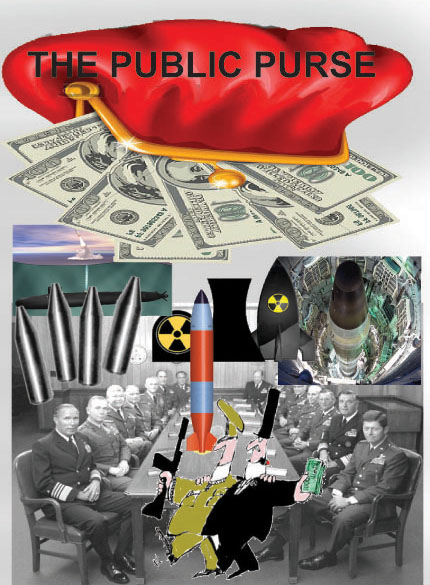
Macron’s Monday speech did follow one long-standing rule of the nuclear establishment—never mention the human cost of nuclear weapons. Any conversation that includes the damage done to human beings, men, women, children, families, by nuclear weapons production, testing, use, and threat of use; or that mentions the trillions of dollars being spend on these weapons of mass destruction while hundreds of millions of people go hungry and lack health care and shelter; or that accounts for massive environmental damage at mines, processing, production, and testing sites around the world; or that warns of the effects of nuclear winter in the event of a nuclear exchange—would undermine if not erase arguments that nuclear weapons have a role in providing security in any rational, human sense.
As victims of nuclear weapons, the hibakusha, survivors of Hiroshima and Nagasaki, winners of the 2024 Nobel Peace Prize, courageously share their witness, telling the story of the worst day of their lives, the unimaginable horror of the devastation, death, and destruction wrought by bombs that, by today’s standards, are tiny. Their conclusion is the only one that makes sense—nuclear weapons must never be used again, and the only way to guarantee that is to abolish them altogether.
There exists today a path to nuclear disarmament, and it is not the path laid out by Emmanual Macron. It is the Treaty on the Prohibition of Nuclear Weapons, the only hope we have of avoiding a nuclear holocaust. As then-director of the International Campaign to Abolish Nuclear Weapons, Beatrice Fihn, said in accepting the 2017 Nobel Peace Prize: “There are only two possible outcomes to the story of nuclear weapons. Either we do away with them, or they will do away with us.”
Iran’s sprawling nuclear facility at Natanz was struck during U.S. and Israeli military operations against the Islamic Republic, Iran’s ambassador to the U.N. nuclear watchdog said on Monday.
Again they attacked Iran’s peaceful, safeguarded nuclear facilities yesterday,” Reza Najafi told reporters at a meeting of the International Atomic Energy Agency’s 35-nation board of governors. Asked by Reuters which facilities were hit, he replied: “Natanz.”
Beyond Nuclear strongly condemns the attacks against Iran by two nuclear-armed countries, the United States and Israel, when a diplomatic solution to Iran’s nuclear program was already within reach.
“These renewed attacks on Iran come at a time when negotiations were already underway to secure a new nuclear verification agreement with Iran,” said Linda Pentz Gunter, the international specialist at Beyond Nuclear. “This illegal attack by the US and Israel is dangerous and provocative and risks leading to a wider war, potentially involving the use of nuclear weapons. Such an outcome would be catastrophic not only for the region but for the world.”
Iran is a signatory to the nuclear Non-Proliferation Treaty (NPT) that allows for the development of a civil but not military nuclear program and has consistently denied it has any plans to develop nuclear weapons.
Prior to the attacks by the US and Israel against Iran’s nuclear facilities last June (pictured), the International Atomic Energy had said there was no evidence to suggest Iran was making nuclear weapons.
The premise for the attacks appears to be President Trump’s personal dissatisfaction with current negotiations over Iran’s nuclear program. But in 2018, President Trump destroyed a perfectly workable nuclear agreement with Iran known as the Joint Comprehensive Plan of Action, that subjected Iran to verification and inspections to be sure it did not develop nuclear weapons.
Uranium enriched to 5% U-235 is considered for civil use. Above 90% is viewed as weapons grade. Currently, Iran is believed to be enriching uranium to 60% or possibly 80%, considered “weapons usable” but not suitable for the production of nuclear missiles.
“Instead of continuing with the diplomatic efforts already underway to negotiate a new nuclear agreement with Iran, the Trump administration has chosen the reckless and unnecessary path of military aggression, a decision that will cost countless innocent lives and billions of US tax dollars,” Pentz Gunter said.
Although also a signatory to the NPT, the US has failed to abide by Article VI of the treaty, which calls for nuclear armed nations to reduce and eventually eliminate their arsenals. The US is instead “modernizing” its nuclear weapons — code for expansion and enhancement — at a cost of $946 billion over the next ten years.
Israel has refused to admit that it has nuclear weapons, but is estimated to possess at least 80 warheads and potentially as many as 200.
French nuclear-armed jets could be stationed in Britain and other allied European countries after Emmanuel Macron unveiled a dramatic expansion of France’s deterrence doctrine…
The French president also used the symbolic setting of Île Longue, the country’s Atlantic nuclear fortress in Brittany, to announce the first increase in its nuclear warhead stockpile since the 1990s.
French president Emmanuel Macron has said France would increase the number of nuclear warheads and allow for temporary deployment of its nuclear-armed aircraft to allied countries for exercises as part of its new nuclear strategy seeking to “Europeanise” its deterrence programme (15:29, 15:50).
In a major speech at the nuclear submarines Navy base of Île Longue, Macron said Belgium, Denmark, Germany, Greece, Sweden, the Netherlands, Poland, and the United Kingdom are expected to be involved in the programme, with London and Berlin playing particularly important roles (15:47, 16:00).
Several EU leaders confirmed their plans to engage with France on the details of the programme (16:44, 16:51, 17:04).
The president repeated his warnings that Europe needed to urgently step up its defence posture to respond to new, emerging threats and disintegration of rules on the use of nuclear weapons
And so it begins. This time it isn’t ‘kayfabe’ and ‘negotiated strikes and counter-strikes’. The ‘peace president’, when announcing joint US-Israeli strikes against Iran on 28 February, said it would just take a few days, and gloated that he ‘took out the regime’ by targeting top Iranian leadership, including Ayatollah Khamenei. But Iran’s swift and massive response – bombing 11 countries housing US and Israeli military bases and installations, including a British base in Cyprus, EU territory – now has Trump saying the war will ‘last for weeks’…
What did they think was going to happen, that Iranians would ‘rise up and take power from their oppressors’? The Americans appear to have truly believed their own propaganda. In reality, Iranians are defiantly rallying in support of their country, and government, while Muslims across the region are preparing to potentially join the fray and do as Iran has always sought: remove all American military forces from the Persian Gulf, if not the Middle East as a whole.
It’s too early for predicting such an end-game, but in the meantime, it appears that, in the absence of Iranian popular support for US and Israeli ‘regime intervention’, the strategy could switch to attacking the people of Iran and the country’s infrastructure, ‘punishment’ for not ‘capitulating’.
As Henry Kissinger famously said, “It may be dangerous to be America’s enemy, but to be its friend is fatal.” We can add that to host US military bases and CIA operations is to turn your country into a vassal state.
The international order that Franklin and Eleanor Roosevelt helped to build after the catastrophe of WWII was founded on a simple and profound idea – that law and respect, not force, should govern relations among states. That idea is now being destroyed by the very nation that did most to promote it in founding the UN. The irony is bitter beyond measure.
Let us be clear about what the United States and Israel are pursuing. The US objective is not the security of the American people. The objective is global hegemony. The attempt is to destroy the UN and the international rule of law—an attempt that will fail.
On February 16, 2026, one of us (Jeffrey Sachs) sent a letter to the UN Security Council warning that the United States was on the verge of tearing up the United Nations Charter. That warning has now come to pass. The United States and Israel have launched an unprovoked war against Iran in flagrant violation of Article 2(4) of the Charter, without authorization from the Security Council, and without any legitimate claim of self-defense under Article 51. They are trying to kill the UN Charter and the international rule of law, but they will fail.
At the Security Council on February 28, 2026, the US and its allies directed their condemnation not at the American and Israeli aggression, but at Iran. One US ally after the next condemned Iran for its retaliatory attacks yet absurdly failed to condemn the illegal and unprovoked US-Israeli attack on Iran. This performance by these countries was disgraceful and turned reality completely upside down.
The truth is that the devastation of the war will not directly affect the so-called West: their children will not suffer traumas or death, and their countries will not be set ablaze. The victims of this attack are the people of the Middle East. They are the expendable ones who suffer from Western arrogance, abuse of power, and addiction to war.
We close with two observations. First, the United States will not achieve global hegemony or kill the UN. The world is too large, too diverse, and too determined to resist domination by any single power, much less one with 4 percent of the world’s population. The world outside of the US and the countries it occupies want the UN to live and thrive. The US attempt will surely fail, but it may cause immense suffering before it does.
Second, if Israel continues its addiction to war and occupation, it too will not survive. That addiction represents a mix of theocracy and post-traumatic stress. Part of Israel believes that it is the biblical kingdom of the 5th century BC. The other part lives in the traumatic memory of the Holocaust, and so is determined to kill any perceived adversary rather than learn to live together with it in peace. The Israeli Ambassador’s twisted defense of Israel’s brazen attack on Iran, as usual, cited the Bible and Auschwitz as the two justifications. These are Israel’s two perennial references, but not the real world of today.
The joint US-Israeli attacks were described by Trump as necessary because Iran “rejected every opportunity to renounce their nuclear ambitions, and we can’t take it anymore.” This is of course a flat lie. As the letter of February 16 recounted, Iran agreed a decade ago to a nuclear deal, the Joint Comprehensive Plan of Action (JCPOA) that was adopted by the UN Security Council in Resolution 2231. It was Trump who ripped up the agreement in 2018. In June 2025, Israel bombed Iran in the midst of US-Iran negotiations. This time too, the Israel-US war plans were set weeks ago when Netanyahu met with Trump, and the negotiations underway between the US and Iran were a charade. This seems to be the new modus operandi of the US: start negotiations and then aim to murder the counterparts.
It is easy to understand why the US allies behave in the embarrassing and self-abasing way they did at the UN Security Council. In addition to the United States, eight of the other fourteen Council members host US military bases or grant the US military access to local bases: Bahrain, Colombia, Denmark, France, Greece, Latvia, Panama, and the United Kingdom. These countries are not fully sovereign. They are partially governed by the US. The US military bases house CIA operations, and the host countries constantly look over their shoulder to try to avoid US subversion in their own countries.
As Henry Kissinger famously said, “It may be dangerous to be America’s enemy, but to be its friend is fatal.” We can add that to host US military bases and CIA operations is to turn your country into a vassal state.
As an absurd but telling example, the Danish ambassador parroted every US talking point, pointing her finger at Iran for its aggression as if Iran had not been attacked by the US and Israel. She completely forgot that such humiliating vassalage to the US will not play well for Denmark if the US occupies Greenland.
The truthful voices at the Security Council came from the countries not occupied by the United States. Russia explained correctly that the so-called West (that is, the countries occupied by the US) is engaged in victim-blaming when it points its finger at Iran. China reminded the Council that the crisis began with the US and Israeli attacks on Iran, not with Iran’s retaliation. Somalia’s ambassador, speaking on behalf of several African member states, truthfully portrayed the source of this recent escalation. The UN Representative of the League of Arab States spoke brilliantly about the root cause of Israel’s mad aggression: the denial of rights to Palestinian people, and Israel’s use of mass murder and regional war to prevent the emergence of a State of Palestine.
When Iran retaliates against US military bases in the Gulf, it is exercising its inherent right of self-defense under Article 51 of the Charter. We must remember that the US and Israel are openly and repeatedly assassinating Iran’s leaders, with the aim of overthrowing its government. When states murder a foreign head of state and attempt to destroy the government, the target of those threats is entitled under international law to defend itself.
The US-Israeli bombing murdered not only Iran’s Supreme Leader and several top government officials, but also more than 140 young girls in their school in Minab. These young children are the victims of a horrific war crime. The countries today that gave a pass to the United States and Israel for these killings—notably Denmark, France, Latvia, the United Kingdom, and of course the US —are also complicit in this war crime.
This UN Security Council emergency meeting will likely be remembered as the day the United Nations ceased to function from its headquarters on American soil. An international organization dedicated to the peaceful settlement of disputes cannot credibly operate from a country that wages illegal wars, threatens member states with annihilation, and treats UN Security Council resolutions as disposable instruments of convenience. For the UN to survive, and we need it to survive, it will need several homes around the world—in Brazil, China, India, South Africa, and others—honoring the true multipolarity of our world.
Let us be clear about what the United States and Israel are pursuing. The US objective is not the security of the American people. The objective is global hegemony. The attempt is to destroy the UN and the international rule of law—an attempt that will fail. Israel’s objective is to establish a Greater Israel, destroy the Palestinian people, and assert its hegemony over hundreds of millions of Arabs across the Middle East (from the Nile to the Euphrates, as US Ambassador Mike Huckabee recently asserted).
The United States’ delusional efforts at global hegemony are proceeding region by region. The US has recently claimed, in a wholly twisted supposed revival of the Monroe Doctrine, that it controls the Western Hemisphere and can dictate how Latin American countries conduct their economic and political affairs. The US kidnapped the sitting Venezuelan president to prove the point, and it now threatens to overthrow the Cuban government as well.
Today’s war against Iran aims to prove that the US similarly owns the Middle East. The war is part of a 30-year campaign, initiated by the Clean Break doctrine, to overthrow all governments that oppose US and Israeli hegemony in the region. Those joint Israel-US wars have included the genocide in Gaza, the occupation of the West Bank and the decades of wars and regime-change operations in Iran, Iraq, Lebanon, Libya, Somalia, Sudan, Syria, and Yemen.
One part of the US global plan is to commandeer the world’s oil exports and to weaken China and Russia in the process. The US seizure of Venezuela was designed to ensure American control of that country’s oil exports, especially to control the flow of oil to China. US sanctions on Russia aim to prevent Russian oil from reaching India and China. Now the US aims to stop the flow of Iran’s oil to China. More broadly, the US aims to control the entire Gulf region plus Iran to maintain its imperial dominance.
The international order that Franklin and Eleanor Roosevelt helped to build after the catastrophe of WWII was founded on a simple and profound idea – that law and respect, not force, should govern relations among states. That idea is now being destroyed by the very nation that did most to promote it in founding the UN. The irony is bitter beyond measure..
A state that depends on permanent war, permanent occupation and slaughter of the Palestinians, and the indefinite subjugation of millions of people has no viable future, and the policies that the United States is now pursuing on Israel’s behalf will accelerate rather than prevent that outcome.
The two-state solution, which the Council has endorsed repeatedly, offers Israel a path to peace. Tragically Israel rejects that. The result, eventually, will be the end of Israel itself in its current form, especially as the US population is rapidly turning against Israel’s violent theocracy and towards the cause of Palestine. Perhaps there will be one democratic state for both Arabs and Jews living in peace, together, with an end of apartheid rule.
These are harsh truths, but emergencies demand honesty. The UN is being murdered by Israel and the United States. The Security Council must rouse itself from their military occupation by the US, and remember that they are the stewards of the UN Charter’s promise to maintain international peace and security.
Trump published a video on social media early on the morning of February 28, announcing, “The United States military began major combat operations in Iran”.
As the US and Israel brutally bombed Tehran, Donald Trump admitted that they want regime change.
Trump ordered members of Iran’s military to “lay down your weapons”, or “face certain death”.
The US president then called on Iranian opposition supporters to “take over your government”, claiming, “It will be yours to take. This will be probably your only chance for generations”.
Iran immediately retaliated, launching strikes in self-defense against multiple US military bases in Qatar, Bahran, Kuwait, and the UAE. The Pentagon’s largest base in the region, Al-Udeid in Qatar, was hit.
The absurd narrative that Washington and Tel Aviv are promoting is that they had to carry out “preemptive” attacks (which are illegal under international law), because Tehran supposedly seeks nuclear weapons.
This is nonsense. Iran signed the nuclear deal, the Joint Comprehensive Plan of Action (JCPOA), in 2015, in which it agreed not to pursue nuclear weapons in return for the US and European countries lifting their illegal unilateral sanctions.
The International Atomic Energy Agency (IAEA) admitted that Iran was abiding by the nuclear deal. Nevertheless, Trump unilaterally tore it up in 2018, during his first term as US president, in flagrant violation of international law (given that the JCPOA had been endorsed by UN Security Council Resolution 2231, which even the US had voted for, under Obama).
Iran’s current president, Masoud Pezeshkian, is ironically a reformist who sought to negotiate another deal with the same US aggressors who sabotaged the previous one just a few years before.
When Trump entered office for his second term, in 2025, he oversaw several rounds of bad-faith “negotiations” with Iran. Then, during those talks, the US and Israel suddenly bombed Iran in June 2025. The Wall Street Journal admitted: “In Twist, U.S. Diplomacy Served as Cover for Israeli Surprise Attack”.
The same thing happened in February 2026. The Trump administration participated in fake “negotiations” with Iran.
On February 27, Oman’s Foreign Minister Badr Albusaidi, who moderated the talks, said they had made “substantial progress”, and a “peace deal is within our reach”.
Mere hours later, Trump and Netanyahu launched a massive bombing campaign in Iran.
The reality is that the US and Israel do not want peace.
The goal of this war of aggression is clear: Washington seeks to topple Iran’s independent government and finally overturn the Iranian Revolution of 1979, which removed one of the pillars of the US empire’s “twin pillars” strategy in West Asia.
The US empire, and more specifically the large US corporations that it represents, want to control the plentiful resources not only in Iran, but in the entire region, which is home to the world’s top producers of oil and natural gas, as well as critical minerals and other important commodities.
Wesley Clark, a former top US general and NATO commander, revealed more than two decades ago that, following the attacks of September 11, 2001, imperial strategists at the Pentagon made plans to overthrow the governments of seven countries in West Asia and North Africa.
On the US empire’s target list was Iraq, Syria, Lebanon, Libya, Somalia, Sudan, and Iran.
Washington succeeded in destabilizing governments in six of those seven. Iran is the last one standing.
With its war, the United States hopes to install in Tehran a puppet, like the son of the former shah, the murderous monarch who came to power following a CIA-orchestrated coup in 1953 against Iran’s democratically elected Prime Minister Mohammad Mosaddegh.
A Fox News correspondent reported that the CIA-linked US state media outlet VOA Persian is broadcasting propaganda in Iran in support of the so-called “exiled crown prince”, Reza Pahlavi, who has spent much of his life living in the US, and whose dictatorial father terrorized Iran, with staunch US backing, until the 1979 revolution.
Top US officials have been secretly meeting with the so-called “exiled crown prince”, the former Israeli intelligence officer Barak Ravid reported in January. On Twitter, Reza Pahlavi heaped praise on Trump, claimed “the Islamic Republic is collapsing”, and called for the Iranian people to help put him in power.
US imperial strategists believe the Iranian government is weak at this moment, and they are going for the jugular.
In doing so, the billionaire supposed “populist” Trump is fulfilling the dreams of the most ardent neoconservative hawks — even as he calls himself a “peace president”.
Devonport doesn’t just work on operational nuclear submarines, it is also a ‘graveyard’ for retired ones. Twelve out of the 16 decommissioned submarines at Devonport are still carrying their fuel – effectively a stockpile of nuclear waste.
New Internationalist 1st Jan 2026
Could the threat of nuclear war be closer than ever? Amy Hall explores how we got here and the pathways out of the crisis.
If you want to get a nuclear-powered submarine refitted, repaired or refuelled in Britain, there is only one place to go – Devonport dockyard in Plymouth, the biggest naval base in Western Europe.
Running across more than six kilometres of waterfront, the dockyard has been part of the landscape for generations. It dominates the western edge of the South West England city, encased by high fenced walls, security cameras and warning signs about police dogs and potential arrest for ‘unauthorized activity’.
But Plymouth itself has not seen the same boost. ‘Most of the money generated goes out of the city,’ says local campaigner Tony Staunton, who is also the vice chair of the Campaign For Nuclear Disarmament (CND). Authorities say that Devonport generates around 10 per cent of Plymouth’s income, but neighbourhoods next to the dockyard remain among the poorest five per cent in the country.
Devonport doesn’t just work on operational nuclear submarines, it is also a ‘graveyard’ for retired ones. Twelve out of the 16 decommissioned submarines at Devonport are still carrying their fuel – effectively a stockpile of nuclear waste.
Over the last 30 years, at least 10 serious radioactive leaks have been documented at Devonport, and chemicals like plutonium, americium and tritium have been found on the Plymouth coastline, including at a wildlife reserve close to the dockyard. Staunton says he has met former dockworkers with cancer who are convinced that their illnesses date back to the time they worked at Devonport, but a ‘culture of secrecy’ about any negative impact of the docks pervades over this military city.
Local authorities have taken steps to prepare for a serious radiation leak at the dockyard, which is within a residential area. An investigation by Declassified UK found that in 2018 the Ministry of Defence distributed 60,900 iodine tablets to schools, emergency services and healthcare settings in local areas.
Nuclear-powered submarines are not only able to carry warheads; they are an essential part of the nuclear warfare infrastructure. And, as the British government jumps with both feet into the nuclear arms race, Devonport is key. The facility is set to receive £4.4 billion (just over $5 billion) in government investment over the next 10 years.
As the world becomes more insecure, nuclear-armed states are reaffirming commitments to the most destructive weapons humans have developed. During the first six months of 2025, five nuclear-armed countries were engaged in military hostilities or outright war. And, after decades of decline, the trend of more retired nuclear warheads being dismantled than new ones being deployed looks set to be reversed.
Nearly all of the nine nuclear-armed states (US, Russia, Britain, France, China, Israel, India, Pakistan, North Korea) have been busy modernizing and growing their arsenal. Over the past five years global spending on nuclear weapons increased by just over 32 per cent, with the US and UK’s spending rising by 45 and 43 per cent respectively between 2019 and 2023. One year of global nuclear weapons spending could feed 45 million people in danger of famine for 13 years…………………………………………………………………………………………………………………………………………………..
The bombs dropped on Hiroshima and Nagasaki are considered ‘low-yield’ by modern standards. International Campaign to Abolish Nuclear Weapons (ICAN) estimates that casualties from a major nuclear war between the US and Russia would reach hundreds of millions. The use of less than one per cent of the world’s nuclear arsenal could disrupt the climate and threaten two billion people with starvation.
Escalations in global conflict continue despite the existence of nuclear weapons. ‘This concept of nuclear deterrence is really a faith belief system – that having nuclear weapons is necessary to make sure they’re not used,’ says Alicia Sanders-Zakre, policy and research coordinator at ICAN. ‘As long as this theory continues to hold value within the political establishment of nuclear armed states, it’s not possible to get rid of nuclear weapons.’……………………………………………………………………………………………………………………………………………………………
Today, as the British government itself admits, ‘the future of strategic arms control … does not look promising’. But civil society has got behind the Treaty on the Prohibition of Nuclear Weapons (TPNW) which makes acquiring, proliferating, deploying, testing, transferring, using and threatening to use nukes illegal.
Fresh from their “snuff-movie” hit incinerating Venezuelan fishermen, Team Trump moves yet another carrier strike group into the Persian Gulf. Suddenly, our infotainment airwaves are full of experts spruiking “clean, surgical strikes,” while our media eagerly repeats the Pentagon’s propaganda. An old fat sea-cow, the USS Abraham Lincoln, and her tattooed bouncers are framed as instruments of precision and humane restraint, hovering just over the horizon of Iran’s ruggedly spectacular coast.
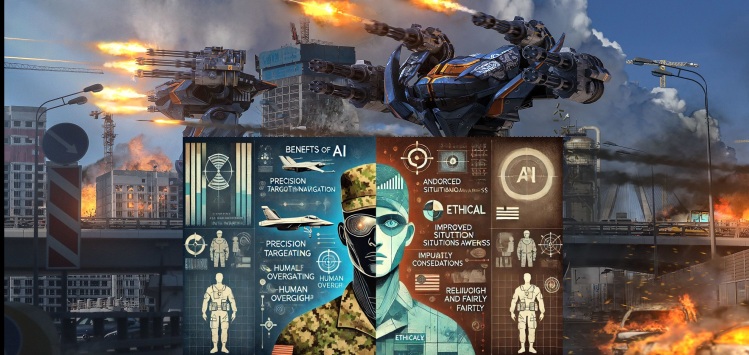
“Surgical strikes?” Pentagon experts now propose to kill and maim Iranians in an illegal blitzkrieg or perhaps three months of “boots on the ground” – the messages are as garbled as a Trump rally speech. But what is clearly being sold is the old lie that war is glorious, noble, and heroic. The US is supposedly ready to “send a message” without another Iraq-style quagmire because, this time, war will be data-driven, algorithmically optimised, and somehow morally minimised.
Modern warfare has never been more complex, nor more bloodthirsty. Today, to hold a principled anti-war stance is often derided as “un-Australian” or weaponised through accusations of anti-Semitism, all while a new cycle of state-sanctioned Islamophobia plays out under the guise of national security. We are witnessing the return of “One Nation” rhetoric: a toxic mix of division and rabid ignorance. From the White House, the lies arrive with such velocity that they overwhelm the public’s ability to process them. Above all, we are sold an antiseptic fantasy: that the next war will be a clean victory won by Artificial Intelligence, where autonomous drones and “algorithmic warfare” replace the messy reality of human slaughter.
We are rarely told who taught the machines to kill. And at what human cost.
The reality of 2026 is that the “intelligence” in AI remains deeply, painfully, and inexorably human. AI-enabled targeting, surveillance, and logistics systems require billions of data points to be labelled, sorted, and refined before a single model can be deployed. Every box drawn around a body in a blurry image, every classification of rubble, every tag of “weapon” versus “non-combatant” has been performed by a human being. Not by Silicon Valley engineers, but by a vast, hidden army of pieceworkers scattered across the Global South.
In refugee camps in East Africa, in cramped internet cafés in South Asia, and in crowded apartments in Latin America, workers are paid the equivalent of a few dollars an hour to sit at flickering screens and trace rectangles around human silhouettes. Behold the invisible pedagogues of the war machine, providing the labelled examples that allow military AI to distinguish “target” from “background,” “combatant” from “crowd.”
The irony is dark and palpable. Many of these workers live in regions already wrecked by Western interventions. Some fled earlier conflicts in Iraq, Syria, or Afghanistan; others live under permanent austerity. Men and women now find themselves training systems that may one day patrol their own skies. It is a grim circularity: the global poor – the “wretched of the earth,” as Frantz Fanon termed them – are pressed into teaching the next generation of weapons how to see.
This is the new “Digital Taylorism.” Just as 20th-century manufacturers broke down manual labour into minute, repetitive tasks, 21st-century AI firms have fragmented intellectual labour into atomised micro-gestures. For those training military models, the work is often traumatic. Investigations into data-labelling hubs in Kenya, India, and Colombia document the harm: workers are forced to view thousands of hours of violent, graphic content—war footage, torture, and the aftermath of bombings—to “fine-tune” the algorithm’s recognition.
Unlike the soldiers who will eventually operate these systems, these digital labourers have no veteran status, no medals, and no guaranteed access to mental health care. When their performance drops due to the trauma, the solution is simple: deactivate their account and hire another worker from the endless queue.
Australia is not a bystander. Firms like Palantir and Anduril have successfully blurred the lines between civilian and military data. In February 2026, the Labor government quietly awarded Palantir a fresh $7.6 million contract for Defence’s Cyber Warfare Division. Meanwhile, Canberra has committed $1.7 billion to Anduril’s “Ghost Shark” program—autonomous undersea vehicles designed for strike operations.
When these systems are woven into civilian infrastructure, the war machine becomes an everyday reality. The same optimisation logic used to squeeze more deliveries out of a warehouse worker is repurposed to accelerate the “sensor-to-shooter” loop. In Australia, we saw a prototype of this in Robodebt: the weaponisation of data against the poorest, treating them as problems to be hunted by algorithms long before any human looks at the facts.
This is not a glitch. It is how capital has integrated AI into the security state. A data labeller in Nairobi might make less in a day than a single second of flight time for a carrier-based fighter jet. The system depends on the invisibility of the connection between the micro-task on a screen and the missile in the sky.
We must refuse the comforting illusion that the coming war will be “clean” because it is “smart.” If our automated future is built on a foundation of traumatised, underpaid labour, then it is not a technological triumph. It is a moral failure disguised as innovation. The cost of the next war will not only be counted in missiles fired and lives lost in Tehran or the Strait of Hormuz. It is already being paid, quietly, in the human dignity we have sacrificed to train the machines that will fight it.
Coda: The Sycophant’s Algorithm
And so, we find ourselves back in the familiar, fawning posture of the Australian security establishment – a collection of strategic wallflowers so desperate for an invitation to the dance that they have handed the keys to the kingdom to a band of Silicon Valley carpetbaggers. We are told that by tethering our national interest to the likes of Palantir and Anduril, we are buying “security.”
In reality, we are buying a front-row seat to our own irrelevance.
We have become the regional branch managers for a war machine we neither control nor understand. To watch a Labor government – the party that once spoke of “national sovereignty” – quietly outsource our military intelligence to foreign algorithms trained by the global dispossessed is more than a policy failure; it is a spiritual surrender. It is the triumph of the technocrat over the citizen, the dashboard over the diplomat. We are being marched into a conflict in the Middle East not by the force of reason, but by the relentless, unthinking click of a mouse in a Nairobi sweatshop. It is a spectacle of profound hollowness, orchestrated by people who wouldn’t know a national interest if it bit them on the leg in the middle of a Canberra cocktail party.









 nuclear-news