USA Government Accountabilty Office calls for assessment of costs for planned new nuclear warheads
 NUCLEAR WEAPONS: NNSA Should Further Develop Cost, Schedule, and Risk Information for the W87-1 Warhead Program, https://www.gao.gov/products/GAO-20-703 NUCLEAR WEAPONS: NNSA Should Further Develop Cost, Schedule, and Risk Information for the W87-1 Warhead Program, https://www.gao.gov/products/GAO-20-703
GAO-20-703: Sep 23, 2020. The National Nuclear Security Administration plans to replace the W78—an older type of nuclear warhead used in intercontinental ballistic missiles—with the W87-1, starting in 2030. But it’s unclear if NNSA can produce enough of the W87-1’s fissile cores in time to meet its planned production schedule.NNSA estimated that the new warhead could cost up to $14.8 billion, which could make it the most expensive program of this type to date. Upcoming design decisions for the weapon could affect cost. But the agency didn’t have formal plans to assess the costs and benefits of these decisions. Our recommendations address these and other concerns. |
|
|
It’s important to dispel three persistent myths about China’s nuclear weapons
 THE DANGEROUS MYTHS ABOUT CHINA’S NUCLEAR WEAPONS, War on the Rocks, DAVID LOGAN, SEPTEMBER 18, 2020
……….While the Cold War superpowers engaged in arms racing, China committed to building a “lean and effective” force. Since obtaining a nuclear weapons capability, China has publicly claimed a categorical no-first-use policy and has asserted that “China does not engage in any nuclear arms race with any other country and keeps its nuclear capabilities at the minimum level required for national security.”
Misplaced Attention: The Real Risks of Beijing’s Nukes
Misplaced Attention: The Real Risks of Beijing’s Nukes………..
Addressing the Risks
These myths can exacerbate dangerous nuclear dynamics between China and the United States. The belief that China’s no-first-use policy is a sham increases the risk of Washington misidentifying a Chinese signal of resolve as preparations for a nuclear strike………
The myths can also hobble efforts to address more legitimate risks. Many of these risks, particularly those rooted in different perceptions, could be mitigated through formal dialogue. Beijing and Washington can share and refine understandings about escalation dynamics or their aims in a crisis or conflict. But misperception and miscommunication, sometimes rooted in the very myths discussed above, can make it difficult carry out such dialogues…………
Perhaps most significantly, a misguided focus on the myths could, perversely, make those myths realities. ……….
fixating on poorly sourced or unfounded claims makes any dialogue both less likely to occur and less effective if it does happen. There are enough real concerns about China’s nuclear modernization that need to be addressed without being distracted by myths. https://warontherocks.com/2020/09/the-dangerous-myths-about-chinas-nuclear-weapons/

45 nations have now ratified the U.N. Treaty on the Prohibition of Nuclear Weapons

 KYODO NEWS –21 Sept 20 Malta, a Mediterranean island country, completed the ratification process for a U.N.-adopted nuclear ban treaty Monday, bringing the number of such countries and regions to 45 with a total of 50 required for the pact to enter into force, a nonprofit antinuclear organization said.The latest ratification comes on the same day the U.N. General Assembly held a ceremony marking the 75th anniversary of the world body’s founding.
 With the addition of one more signatory to the Treaty on the Prohibition of Nuclear Weapons, the International Campaign to Abolish Nuclear Weapons, or ICAN, hopes for an early enforcement of the pact, possibly by the end of this year.
However, the treaty’s potential effectiveness remains uncertain as all five permanent members of the U.N. Security Council, all of which are nuclear powers, have declined to ratify it.
Japan, the only country in the world to have experienced nuclear bombings, has not ratified the pact either, in light of its security alliance with the United States providing nuclear deterrence against adversaries.
The nuclear ban treaty, adopted in 2017, will enter into force 90 days after it has been ratified by at least 50 countries and regions. According to the United Nations, 84 countries and regions have signed the nuclear ban treaty.
In a related move, a group of 56 former leaders or ministers from countries that depend on U.S. nuclear deterrence on Monday released a letter urging the leaders of their respective countries to participate in the U.N. nuclear ban treaty.
From Japan, former Prime Minister Yukio Hatoyama, former Foreign Minister Makiko Tanaka and former Defense Minister Naoki Tanaka joined the petition.
Iran a most transparent country for IAEA inspections
Tehran’s Nuclear Program Most Transparent Among IAEA Members, https://financialtribune.com/articles/national/105333/tehran-s-nuclear-program-most-transparent-among-iaea-members , 18 Sept 20, Iran’s permanent representative to Vienna-based international organizations said the Islamic Republic has the most transparent nuclear program among member states of the International Atomic Energy Agency, as proven through numerous inspections of the country’s nuclear sites by the UN agency.
“The fact that 22% of all global inspections done by the IAEA have been carried out in Iran proves that Iran enjoys the most transparent peaceful nuclear program among the member states of the agency,” Kazem Gharibabadi said in an address to the IAEA Board of Governors on Thursday, IRNA reported.
The envoy reminded that the high level of cooperation between Tehran and the agency had not come by easily to be “easily weakened as a result of a few parties’ myopic political interests”.
He was referring to the United States and the Israeli regime’s immense pressure on the agency to try and find fault with Tehran’s nuclear work.
Under pressure from Israel, the US’ most prominent regional ally, Washington quit a historic 2015 nuclear accord with Tehran and world powers two years ago. The US then returned sanctions that the deal, formally known as the Joint Comprehensive Plan of Action, had lifted, not even bothering to exempt food items and medicines from the illegal bans.
Still under Israeli pressure, the agency cited “concerns” earlier this year about two Iran-based sites. Iran first refused access to the sites, arguing that the alleged information provided to the IAEA had been cooked up by Israel’s spy agencies.
Tehran, however, later allowed access to the sites on a purely voluntary basis and only to honor its cooperation with the IAEA.
“In order for the agency’s integrity to be preserved, its members should seriously avoid exerting any pressure on it,” Gharibabadi said.
JCPOA’s “handful of enemies” came up with “baseless and unfounded” allegations about the Iranian sites after falling short of all pretexts to destroy the international agreement, he said, urging the agency and its board to avoid falling for their plots.
Double StandardsThe Iranian official also criticized the double standards applied by the agency’s members toward the Israeli regime and its nuclear activities. He pointed out two instances of singularity concerning Israel, the regime’s being the only Middle Eastern party that has refused to sign up to the nuclear Non-Proliferation Treaty and is the exclusive owner of nuclear weapons in the region. “Still thanks to the double-standard approaches adopted by some IAEA members, the regime has snubbed the entire international community and IAEA’s requests to fall in line with the agency’s safeguards and allow inspections by its experts,” the Iranian diplomat said. “Israel remains the biggest source of concern for regional security,” Iran’s ambassador stressed, noting that the regime possesses various types of weapons of mass destruction, evaded similar treaties addressing these weapons and has recurrently threatened and attacked neighboring countries. |
|
U.S. general says that North Korea has a ”small” number of nuclear weapons (over 70?)
|
N. Korea has ‘small number’ of nuclear weapons: US general, Korea Herald, By Yonhap, Sept 18, 2020 WASHINGTON — North Korea has a “small number” of nuclear weapons, the vice chairman of the US Joint Chiefs of Staff said Thursday, although that number was not defined. Air Force Gen. John Hyten told a virtual forum that the specific numbers were “classified” and in many ways hard to understand. “But a small number is a confident characterization of nuclear capabilities that can threaten their neighbors or the United States,” he said in a symposium hosted by the National Defense University’s Center for the Study of Weapons of Mass Destruction. Hyten offered no further explanation of what he meant by “a small number.” The US has never officially discussed its assessment of North Korea’s nuclear capabilities, but the communist state is widely estimated to possess more than 70 nuclear warheads. In its latest annual report,” North Korean Tactics,” published in July, the US Army said the North is “estimated” to possess 2,500 to 5,000 tons of chemical weapons. With regard to its nuclear arsenal, however, the report simply states “estimates for North Korean nuclear weapons range from 20 to 60 bombs, with the capability to produce six new devices each year.” North Korea has conducted six nuclear tests, between October 2006 and September 2017. Hyten’s remark follows a recently renewed controversy, at least in Seoul, over Pyongyang’s nuclear capabilities. In his latest book, “Rage,” Washington Post journalist Bob Woodward discusses a US response to a North Korean attack that he says could include the use of up to 80 nuclear weapons……….. http://www.koreaherald.com/view.php?ud=20200918000129 |
|
USA DID have a plan to drop 80 nuclear weapons on Nortrh Korea
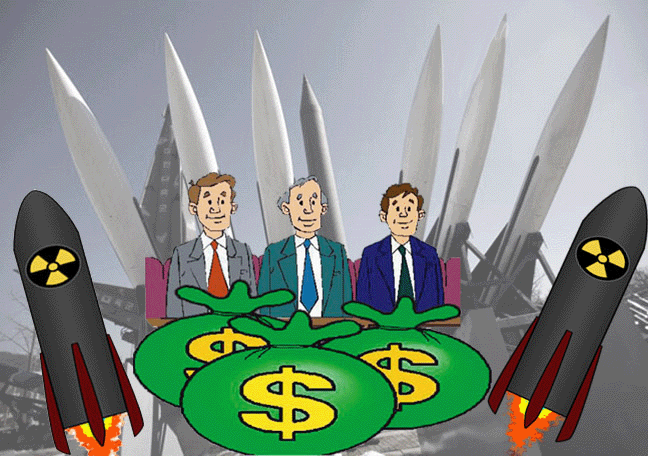 Yes, The United States DidDraw Up A Plan To Drop 80 Nuclear Weapons On North Korea, In 2017, a war between North Korea and the United States was “much closer than anyone would know,” President Trump claims. The Drive BY THOMAS NEWDICK, SEPTEMBER 18, 2020.
Current nuclear war plans are among any nuclear-armed military’s most closely guarded secrets. Details of one such attack plan recently became available, however, revealing that the United States envisaged using 80 nuclear weapons in case of war with North Korea. The way this particular detail emerged is also pretty unusual — the associated passage appeared in U.S. journalist Bob Woodward’s book Rage, detailing President Trump’s administration, which was published this week.
In an interview with NPR, Woodward cleared up any confusion, noting that the 80 nuclear weapons were part of a U.S. attack plan — OPLAN 5027, which would include ‘decapitating’ the North Korean regime of dictator Kim Jong-un.
Woodward said that Mattis confided in him that he was not worried that Trump might launch a preemptive strike against North Korea. Instead, the source of his angst was the North Korean leader in Pyongyang.
In fact, such was Mattis’s level of concern that he would sleep in his gym clothes, Woodward claims. “There was a light in his bathroom… if he was in the shower and they detected a North Korean launch.”
There were alarm bells set up in Mattis’s bedroom and kitchen too, and on more than one occasion during the summer of 2017 they sounded the alert, and he entered the communications room in his Washington DC residency. Woodward explains that Mattis’s car was also constantly followed by an SUV with a team equipped to plot the flight path of any incoming missile, whether it was threatening Japan, South Korea, or the United States. If Mattis considered the missile hostile, he had a mobile communications link to issue launch orders to shoot it down. …………
Clearly, the status of a nuclear-armed North Korea provided much pause for thought within the U.S. administration during Mattis’ tenure as Secretary of Defense. That a strike plan against North Korea involving 80 nuclear weapons was discussed between the president and his defense secretary isn’t all that hard to imagine………..
One of the options under consideration in Washington was OPLAN 5015, a nuclear strike to take out the North Korean leadership, which Woodward also refers to, drawing again from his extensive interviews with Trump. Specifically, Woodward mentions “updating” such a plan — after all, Kim Jong-un and his predecessors will have always been priority targets in the case of an all-out war. ……………… https://www.thedrive.com/the-war-zone/36519/yes-the-united-states-did-draw-up-a-plan-to-drop-80-nuclear-weapons-on-north-korea
Russia developing a nuclear-powered missile that can ”attack from unexpected directions”
Russia’s nuclear missile with global reach is capable of attacking from ‘unexpected directions’ https://www.wionews.com/world/russias-nuclear-missile-with-global-reach-is-capable-of-attacking-from-unexpected-directions-327492
|
WION Web Team New Delhi, India Sep 14, 2020 Russia is developing a nuclear-powered missile that can fly around the atmosphere for years on end ready to strike at any moment.
This does mark the first time this missile has made the headlines. Last year, this so-called missile was involved with a mysterious explosion in Russia, which reportedly left at least 5 scientists dead. This explosion had also led to a major spike in the radiation levels in the area. Now British intelligence claims that Russia is “pushing the boundaries of science, and international treaties” in developing novel weapons. So what do we know about this cruise missile? Russia calls the missile “Burevestnik” or “Storm Petrel”, while the NATO calls it “Skyfall” Putin first unveiled the Burevestnik on March 1, 2018, claiming that it was invincible. Essentially, it is a cruise missile that features a small nuclear-powered engine. This is the first of its kind, for it can fly long distances for hours or even days. The missile can also exploit loopholes in enemy defence networks. Russian president Vladimir Putin had earlier said that the testing of Burevestnik was going on successfully. The British chief of defence said the missile had global reach and could “attack from unexpected directions”. The mention of this missile came up during the Five Eyes intelligence hub including experts from the UK, US, Australia, New Zealand and Canada. |
|
South Korea says no use of nuclear weapons in joint operational plans with U.S
 South Korea says no use of nuclear weapons in joint operational plans with U.S. The Chronicle Herald, South Korea says no use of nuclear weapons in joint operational plans with U.S. The Chronicle Herald,
Hyonhee Shin, 16 Sep 20, SEOUL (Reuters) – South Korea said on Tuesday none of its joint military action plans with the United States include any use of nuclear weapons, after a book by a U.S. journalist sparked debate over whether scenarios of a full-blown war with North Korea would entail a nuclear attack from either side.
In his new book, titled “Rage,” Washington Post associate editor Bob Woodward wrote that the United States had devised plans for a possible armed clash with North Korea, such as “the U.S. response to an attack that could include the use of 80 nuclear weapons.” The book was based on multiple interviews with U.S. President Donald Trump. The passage fueled debate in South Korea over whether it meant Washington or Pyongyang would detonate 80 bombs against each other. Seoul’s defense ministry said on Tuesday its joint operational plans (OPLAN) with the United States did not include any use of nuclear weapons, reiterating the view of the presidential office. A presidential official said on Monday there must not be another war on the peninsula and any use of force cannot be implemented without South Korea’s consent. “I can say clearly that the use of a nuclear weapon does not exist in our OPLANs, and it is impossible to use military force without our agreement,” the official told reporters…………. https://www.thechronicleherald.ca/news/world/south-korea-says-no-use-of-nuclear-weapons-in-joint-operational-plans-with-us-497135/ |
|
Long nuclear convoy near Glascow

|
Nuclear convoy passes near Glasgow ‘laden with six warheads’ A 26-vehicle convoy passed through Balloch and by Loch Lomond this morning, a Nukewatch UK campaigner told Glasgow Live
https://www.glasgowlive.co.uk/news/glasgow-news/nuclear-convoy-passes-near-glasgow-18940177 ByCraig Williams 15 SEP 2020 A nuclear weapons convoy passed near Glasgow this morning carrying what is believed to have been six Trident nuclear warheads. Nukewatch UK claims the convoy left RNAD Coulport this morning on its way to Atomic Weapons Establishment Burghfield near Reading – taking a route which saw it travel over Haul Road to the A82 near Cameron House, before passing through Balloch on the A811 to Stirling. Including an estimated 26 vehicles, the unmarked convoy is then said to have travelled along the M9 towards Edinburgh, taking the Edinburgh Bypass and then the A68 towards Jedburgh. Nukewatch UK Campaigner Jane Tallents followed the convoy from the Edinburgh Bypass onto the A68. She told Glasgow Live: “The convoy took the Haul Road and travelled onto the A82 before passing through Alexandria and Balloch. It was then spotted in Drymen as it made its way along the A811 towards Stirling.” Having studied convoys like it for the last 30 years, Jane believes it was travelling with approximately six nuclear warheads to AWE Burghfield for the weapons to undergo repair works prior to being returned to RNAD Coulport and put back on the Royal Navy’s nuclear submarines. “The convoy, which numbered around 26 vehicles, included huge lead-lined lorries carrying the nuclear warheads, along with a fire engine in case of a fire, a moving workshop, a decontamination unit, tow truck and loads of MOD police. “The journey is usually made six times per year when they take the warheads down to refurbish them and then transport them back up again.” Nukewatch UK tracks and monitors the convoys that transport the UK’s Trident nuclear warheads by road from Burghfield to Coulport. Campaigner Jane believes that more people show know of the convoys that travel from Scotland to England via motorways and on small country roads. She added: “We campaign for an end of nuclear weapons. The fact there is such a risk taken with these convoys is reason enough to get rid of them. The convoys travel on small roads at various points of the journey and pass peoples’ houses – today it went through the village of Buchlyvie (around 18 miles north of Glasgow). “Residents in the village could stand on their doorsteps and the nuclear convoy travels about four feet by their doors.” |
The hidden stumbling block to progress on nuclear weapons
The hidden stumbling block to progress on nuclear weapons, Bulletin of the Atomic SCientists,By Ward Wilson, September 16, 2020 ”……………………Eliminating nuclear weapons is an especially important subject these days because there’s a confrontation brewing. The United States and the other nuclear-armed states are upgrading their weapons (and some are even increasing the size of their arsenals). But many non-nuclear-armed states seem to be taking the opposite position. In 2017, the United Nations passed the Treaty on the Prohibition of Nuclear Weapons, and more than 60 percent of the world’s countries voted for it—122 nations in all. The treaty will go into effect when 50 nations sign and ratify it. Today, there are 84 countries that have signed and 44 that have ratified. With only six more countries to go, entry into force will likely come in 2021 or, at the latest, 2022.
Once the treaty is in effect, elimination will become the center of a contentious worldwide debate. The majority of the world will have a new legal argument for pushing toward global zero, but the nine nuclear-armed states are sure to resist. So it makes sense to think a little about whether eliminating nuclear weapons is even possible.
Nuclear weapons are both weapons and symbols…….
Weapons are essentially tools to achieve a particular task. The effectiveness of a tool is objective and quantifiable—how well does it get the job done?
Symbols, on the other hand, are psychological. They can inspire and change beliefs. ……
Nuclear weapons are, in some ways, like these ceremonial swords. Their symbolic value is more important than their military utility. For example, one of the roles of nuclear weapons is as a symbol of prestige. ………
The people who make nuclear weapons policy seem to believe that they have enormous power, conflating their symbolic meaning with their practical usefulness.
But in reality, nuclear weapons are not terribly valuable as weapons. They have not been used in war for more than 75 years. And although numerous occasions have arisen since 1945 when their use was considered, each time, decision makers declined………
Once the symbolic layer has been peeled away, the remaining task will be to evaluate the military utility of nuclear weapons objectively. If it becomes clear that nuclear weapons are dangerous and have almost no military uses, it may be much easier to take [them] off. https://thebulletin.org/2020/09/the-hidden-stumbling-block-to-progress-on-nuclear-weapons/
In 2017, USA considered plans to attack North Korea using nuclear weapons
|
US reviewed plans to use nuclear weapons on North Korea, strike leadership https://www.nknews.org/2020/09/us-reviewed-plans-to-use-nuclear-weapons-on-north-korea-strike-leadership/
Amid growing tensions in 2017, U.S. brushed up on plans to attack North Korea using nuclear weapons
Chad O’Carroll September 14, 2020 The United States reviewed plans to strike North Korea with as many as 80 nuclear weapons and updated leadership strike plans during the first year of Trump’s presidency, according to veteran journalist Bob Woodward’s new book, “Rage.”Woodward’s book reveals that, as tensions between North Korea and the U.S. sharpened in 2017 over Pyongyang’s testing of advanced missile technologies, then-Secretary of Defense Jim Mattis grew anxious about the possibility of nuclear war. Woodward cited direct interview material and informed sources to make these claims.Mattis did not think Trump would launch a preemptive strike on North Korea, but when tensions were
|
|
Duterte asks nations to reject war, eliminate nuclear weapons
Duterte asks nations to reject war, eliminate nuclear weapons, Darryl John Esguerra – Reporter / @DJEsguerraINQ
No goals, however lofty, can justify weapons that destroy with such unforgiving brutality,” Duterte said.
The video, which also featured messages by other world leaders, was originally posted on YouTube by the City of Hiroshima to commemorate the 75th anniversary of the atomic bombing last Aug. 6, which was followed by the bombing of Nagasaki on Aug. 9.
“We must not forget: Nuclear weapons will not make us freer, stronger, or more secure. We must not waver. All nations should reject war and do everything to pave the path for peace. We must be firm. All nations must work together to eliminate nuclear weapons,” Duterte said……….Other world leaders in the video were World Health Organization Director-General Tedros Ghebreyesus, Belgium Foreign Affairs and Defense Minister Philippe Goffin, and Lithuanian President Gitanas Nauseda. https://globalnation.inquirer.net/190853/on-75th-anniv-of-hiroshima-bombing-duterte-asks-nations-to-reject-war-eliminate-nuclear-weapons
France’s secrecy over its deplorable history of nuclear bomb testing in Algeria

|
Algeria: France urged to reveal truth about past nuclear tests, https://www.theafricareport.com/41067/algeria-france-urged-to-reveal-truth-about-past-nuclear-tests/, By Farid Alilat, Thursday, 10 September 2020, A study released shows the presence of waste tied to French nuclear tests in Algeria done during the 1960s. Jeune Afrique/The Africa Report had a chance to consult the report.
On 13 February 1960 at 7:04 a.m., France tested its first nuclear bomb, named Gerboise bleue, over Reggane. At the time, the French authorities explained that the tests were being conducted in uninhabited and deserted areas. However, at least 20,000 people were living at the sites, which still to this day have yet to be fully decontaminated. What waste remains of the 17 nuclear tests France carried out in Algeria between 1960 and 1967? What kind of condition is it in, and what repercussions does it have on the health of residents and the environment? Is France ready to assist Algerians in locating this waste and decontaminating sites, at a time when both countries show a willingness to work together on a memorial initiative regarding the colonial past? More than 60 years after Gerboise bleue, was conducted, a report from the International Campaign to Abolish Nuclear Weapons (ICAN) recommends that France answer these questions and provide Algeria with assistance in cleaning up the relevant sites. ‘Radioactivity Under the Sand’, a study led by Patrice Bouveret, director of the French Centre for Documentation and Research on Peace and Conflicts (Observatoire des armements), and Jean-Marie Collin, co-spokesperson for ICAN France, provides a comprehensive review of the presence of French nuclear waste in Algeria. Between February 1960 and February 1967, France carried out 17 atmospheric and underground nuclear tests in the Reggane and Hoggar regions, not far from a natural museum housing cave paintings which date back to the Neolithic period. Nine of these tests were conducted after Algeria gained independence in July 1962.
In accordance with a clause contained in the Evian Agreements of March 1962, France was permitted to continue its testing programme until 1967. On paper, the testing came to an end that year. However, the Algerian government under Chadli Bendjedid’s presidency secretly granted the French permission to continue carrying out tests at the B2-Namous site in Reggane until 1986. Radioactive materials left out in the openAlthough some of the facilities used for the tests were dismantled prior to and after the programme’s shutdown, waste is still present both above and below ground. At the end of the Algerian War, the two parties failed to negotiate a clause which would have forced France to decontaminate the sites or provide Algerians with archives and documentation related to the nuclear tests. “After seven years [from 1960 to 1967] of conducting a range of tests, the two sites at Reggane and In Ekker were handed over to Algeria without providing for any procedures to control and monitor radioactivity,” reads a December 1997 report from the French Senate. The institution acknowledged that the French authorities displayed “a certain lack of concern”, noting that local residents “could have been treated with at least a little consideration”. According to the authors of the ICAN report: “From the beginning of nuclear tests, France set up a policy of burying all waste in the sand. Everything that may have been contaminated by radioactivity had to be buried.” This included planes, tanks and other equipment. Worse still, radioactive materials (vitrified sand and contaminated rocks and lava) were left out in the open, thereby exposing the population and the environment to assured danger.
The report also mentions that since France is not subject to any obligation under agreements it has established with Algeria, it has never revealed the location or quantity of the buried waste. The authors add: “The nuclear past should no longer remain buried deep in the sand.” Lack of transparencyIn a 1996 ‘classified defence’-level report held in the archives of the French Ministry of Defence and which remains classified, the French authorities indicate that the tests had been halted without taking any initiative to provide documentation to their Algerian counterparts. “No memorandum and no report have been found that provide information about the radiological condition of the launch bases when they were returned to the Algerian authorities [in 1967],” the report reads. Not only does waste remain under the sand, but “the sites are not subject to checks for radioactivity and are even less the subject of campaigns to raise awareness among local residents about the health risks”. Although the Morin Law of 2010 (of which France recognised victims through its nuclear testing ) opened the doors to granting compensation to nuclear test victims in French Polynesia and Algeria, it failed to take environmental consequences into account. The Treaty on the Prohibition of Nuclear Weapons (TPNW), adopted in July 2017 and signed by Algeria, requires State Parties to take measures to assist the residents and areas contaminated by the tests. In addition, the treaty stipulates that “a State Party that has used or tested nuclear weapons or any other nuclear explosive devices shall have a responsibility to provide adequate assistance to affected States Parties, for the purpose of victim assistance and environmental remediation”. The issue is that, thus far, France has declined to sign the TPNW. What’s more, a lack of transparency still dominates. For example, ICAN’s report cites a secret agreement between France and Algeria regarding nuclear decontamination which was reportedly signed during former French President François Hollande’s visit with his Algerian counterpart, Abdelaziz Bouteflika, in Algiers in December 2012. The agreement concerned the notorious B2-Namous site in Reggane. A set of recommendationsWill the memorial initiatives recently undertaken by both countries – with the appointment of two experts, Benjamin Stora for France and Abdelmadjid Chikhi for Algeria – be a game changer for this chapter of history which continues to put a strain on relations between France and Algeria? According to Algeria’s veterans affairs minister, the memorial initiatives integrate the nuclear waste question. In keeping with these efforts, ICAN’s report recommends that the two parties hold discussions and that France improve Algerian citizens’ access to French medical archives, as well as that French legislation from 2010 “delineating the affected areas in the Sahara” be amended “so that they can be expanded, as was done for French Polynesia”. Other recommendations concern nuclear waste, with the report suggesting that “France should provide the Algerian authorities with a full list of sites where contaminated waste was buried, in addition to the precise location of each of these sites (latitude and longitude), a description of this material, as well as the type and thickness of the materials used to cover them”. The report also proposes that France “provide Algeria with the plans of the French Alternative Energies and Atomic Energy Commission’s [CEA] underground installations under the Reggane plateau military base, as well as the plans of the various galleries excavated in the Tan Afella mountain”. On 13 February 1960 at 7:04 a.m., France tested its first nuclear bomb, named Gerboise bleue, over Reggane. At the time, the French authorities explained that the tests were being conducted in uninhabited and deserted areas. However, at least 20,000 people were living at the sites, which still to this day have yet to be fully decontaminated. |
|
|
Russian nuclear submarines ‘hunted’ by NATO forces in the Barents sea
NATO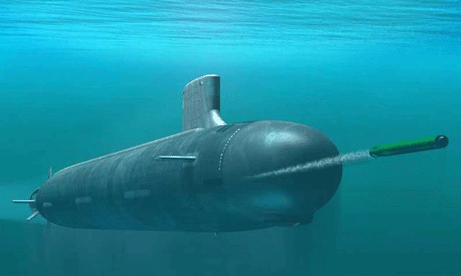 forces organized ‘a hunt’ of a nuclear Russian submarine in the Barents , Military, By Boyko Nikolov On Sep 13, 2020 MOSCOW, (BM) – NATO ships made an attempt to “take the pincers” of the Russian submarine in the waters of the Barents Sea, according to the Nation-news resource on September 12, learned BulgarianMilitary.com.
It is noted that the Russian submarine, which was “hunted” by NATO forces, is equipped with nuclear warheads and means of delivering them with Poseidon torpedoes. The American submarine, in turn, has Harpoon torpedoes and Tomahawk cruise missiles in its arsenal.
A similar incident is also reported in May 2020 in waters belonging to the Northern Sea Route. And also about the flight of a group of NATO bombers over the waters of the East Siberian Sea.
Such actions are assessed by the National Center for Defense Management of the Russian Federation as provocative.
US and British Navy maneuvers into Barents Sea are a signal to Moscow
For the first time since the mid-80s, under the supervision of the Russian fleet, four American and one British ship entered the Barents Sea, which indicates a growing intensity of the confrontation between the great powers in the Arctic, writes The Washington Times.
According to the newspaper, the purpose of this operation was to send a signal to Moscow, as well as to check the readiness of the Navy for action in any weather conditions.
Meanwhile, Norwegian officials refused to participate in this British-American operation – which speaks of its “provocative essence.”
According to officials of the US Navy, these exercises are necessary in order for the US armed forces to be ready to operate in various climatic conditions, including in the Arctic. However, the Trump administration does not particularly hide its intentions to repulse other states – mainly Russia, but also assertive China – that are trying to establish control over strategically important Arctic territories.
As expected, Moscow was not happy about the joint British-American operation. Russian media reported that the Northern Fleet is actively monitoring American and British ships in the Barents Sea.
So far, there have been no reports of close contact between Russian and American ships – as well as news of high-profile statements by senior Russian officials. However, as The Washington Times notes, recalling that it carefully monitors what is happening, Moscow sent a clear signal that it considers this Arctic territory to be its own.
According to American officials, on May 1, they notified Russia of an impending operation in order to avoid an “unintentional exacerbation.”According to officials of the US Navy, these exercises are necessary in order for the US armed forces to be ready to operate in various climatic conditions, including in the Arctic. However, the Trump administration does not particularly hide its intentions to repulse other states – mainly Russia, but also assertive China – that are trying to establish control over strategically important Arctic territories.
As expected, Moscow was not happy about the joint British-American operation. Russian media reported that the Northern Fleet is actively monitoring American and British ships in the Barents Sea.
So far, there have been no reports of close contact between Russian and American ships – as well as news of high-profile statements by senior Russian officials. However, as The Washington Times notes, recalling that it carefully monitors what is happening, Moscow sent a clear signal that it considers this Arctic territory to be its own.
According to American officials, on May 1, they notified Russia of an impending operation in order to avoid an “unintentional exacerbation.”………….. https://bulgarianmilitary.com/2020/09/13/nato-forces-organized-a-hunt-of-a-nuclear-russian-submarine-in-the-barents-sea/
-
Archives
- October 2026 (104)
- September 2026 (339)
- August 2026 (330)
- July 2026 (355)
- June 2026 (287)
- May 2026 (306)
- April 2026 (356)
- March 2026 (251)
- February 2026 (267)
- January 2026 (308)
- December 2025 (358)
- November 2025 (359)
-
Categories
- 1
- 1 NUCLEAR ISSUES
- business and costs
- climate change
- culture and arts
- ENERGY
- environment
- health
- history
- indigenous issues
- Legal
- marketing of nuclear
- media
- opposition to nuclear
- PERSONAL STORIES
- politics
- politics international
- Religion and ethics
- safety
- secrets,lies and civil liberties
- spinbuster
- technology
- Uranium
- wastes
- weapons and war
- Women
- 2 WORLD
- ACTION
- AFRICA
- Atrocities
- AUSTRALIA
- Christina's notes
- Christina's themes
- culture and arts
- Events
- Fuk 2022
- Fuk 2023
- Fukushima 2017
- Fukushima 2018
- fukushima 2019
- Fukushima 2020
- Fukushima 2021
- general
- global warming
- Humour (God we need it)
- Nuclear
- RARE EARTHS
- Reference
- resources – print
- Resources -audiovicual
- Weekly Newsletter
- World
- World Nuclear
- YouTube
-
RSS
Entries RSS
Comments RSS

