No need for nuclear arsenal once Kashmir issue is resolved: Pakistan PM
, Business Standard, 20 June 21
Pakistan’s nuclear arsenal is “simply a deterrent” to protect the country and there will no longer be any need for it once the Kashmir issue is resolved, Prime Minister Imran Khan has said
Pakistan’s nuclear arsenal is “simply a deterrent” to protect the country and there will no longer be any need for it once the Kashmir issue is resolved, Prime Minister Imran Khan has said as he asserted that if the Americans have the resolve and the will, the issue can be sorted out.
Pakistan has 165 nuclear warheads as of January this year and it appears to be expanding its nuclear arsenals, a study by Stockholm International Peace Research Institute (SIPRI) said last week. Pakistan had 160 nuclear warheads as of January last year, it said.”I don’t know where they’ve come up with this. Pakistan’s nuclear arsenal is simply a deterrent, to protect ourselves,” Prime Minister Khan said during an interview with the news programme Axios on HBO, which was reported by Dawn online.
Khan said that he was “not sure” whether it was growing. “As far as I know, it’s not an offensive thing. Any country which has a neighbour seven times its size would be worried.
He was responding to a question by the interviewer who asked, “Intelligence analysts say Pakistan has the fastest growing nuclear arsenal anywhere in the world. Why?”
Khan went on to say that he was “completely against nuclear arms”.
“I always have been. We’ve had three wars against India and ever since we have had a nuclear deterrent, there has been no war between the two countries. We’ve had border skirmishes but we’ve never faced war.
“The moment there is a settlement on Kashmir, the two neighbours would live as civilised people. We will not need to have nuclear deterrents,” the cricketer-turned-politician said.
To another question, Khan said that the US had a big responsibility when it came to Kashmir.
“If the Americans have the resolve and the will, [the Kashmir issue] can be sorted out,” he said.,,,,,,,, https://www.business-standard.com/article/current-affairs/no-need-for-nuclear-arsenal-once-kashmir-issue-is-resolved-pakistan-pm-121062101422_1.html
U.S. Space Force wants to use directed-energy weapons for space superiority,
 |
The Space Force wants to use directed-energy weapons for space superiority,
|
Nathan Strout, 17 June 21, WASHINGTON — The head of the Space Force acknowledged that the U.S. is developing the “appropriate” directed-energy systems to maintain American space superiority, although he declined to provide details in the unclassified setting of a June 16 congressional hearing.
Noting that directed-energy systems could be a possible defensive tool for American satellites, Rep. Jim Langevin, D-R.I., asked Chief of Space Operations Gen. Jay Raymond whether the United States was adequately developing a directed energy portfolio “to be an effective capability for space dominance.”
“Yes sir, we are,” Raymond responded, suggesting that they discuss the issue in more detail in a classified setting. “We have to be able to protect these capabilities that we rely so heavily on.”
n a statement to C4ISRNET, a Space Force spokesperson said, “General Raymond has stated many times that China and Russia have directed energy capabilities that are designed to damage or destroy our satellites. His response to Congressman James Langevin’s question was confirming that our architecture developments in the face of these threats are appropriate.”
The Missile Defense Agency has explored using space-based lasers to intercept ballistic missiles in the past, and other nations have fielded ground-based laser dazzling weapons that can blind on orbit sensors. However, the Space Force has been effectively mum on what weapon systems — conventional or directed energy — it is developing to protect its satellites or defeat enemy satellites. Raymond’s acknowledgement at the hearing might be the first time he’s publicly confirmed the directed energy systems are under development.
The government cited the development of anti-satellite (ASAT) weapons by China and Russia as a justification for the creation of Space Command and the Space Force, and since their establishment military space leaders have been quick to criticize ASAT development and testing. U.S. Space Command’s Gen. James Dickinson has heavily criticized direct-ascent missile tests by Russia, which demonstrated the ability to take out satellites in low Earth orbit and the potential to cause dangerous space debris. Perhaps more concerning is a mysterious Russian satellite that has shown the ability to fire a projectile in space. Raymond refers to the spacecraft as an on-orbit weapon system.
Russia has made space a war-fighting domain by testing space-based and ground-based weapons intended to target and destroy satellites. This fact is inconsistent with Moscow’s public claims that Russia seeks to prevent conflict in space,” said Dickinson after a Russian ASAT test in December. “Space is critical to all nations. It is a shared interest to create the conditions for a safe, stable and operationally sustainable space environment.”
However, the Space Force — and the Air Force before it — have always been secretive about what ASAT weapons the U.S. military has or is developing. The one with the most public details is the Counter Communications System, a transportable system that can jam enemy satellites. And while the Air Force is developing laser weapons, it’s not clear what plans — if any — there are to attach them to space systems or direct them at enemy satellites. The U.S. also has missiles that can reach satellites in low Earth orbit.
Reports from the intelligence community and observers have highlighted the development of kinetic weapons — such as those mentioned above — as well as non-kinetic weapons — such as ground-based jammers or laser systems that can effectively blind satellite sensors — by nations deemed American adversaries.
In a report earlier this year, the Center for Strategic and International Studies suggested that the Space Force develop orbital laser weapons to defend American satellites. Titled “Defense Against the Dark Arts in Space,” the report lays out the various types of ASAT weapons and describes several ways the Space Force could defend against them. That includes passive defenses, like building a redundant space architecture that could survive the loss of one or even multiple satellites, and active defenses, such as satellite-mounted lasers that could blind incoming threats.
The U.S. has invested heavily in building passive defenses, such as a distributed architecture like the one described in the report, but it’s less forthcoming on its active defenses. Other nations are less secretive. Most notably, France has stated that it could equip its satellites with weapons — possibly lasers — to defend themselves from adversaries.
While Raymond’s brief comments didn’t give any insight into what the U.S. is developing in regards to directed energy systems for space, they didn’t rule out the types of weapons laid out in the CSIS report.
“It was a limited exchange, but the context of the statements and the statements themselves certainly leave the door open to nonkinetic defensive space capabilities of some kind,” said Todd Harrison, director of the CSIS Aerospace Security Project. “As we noted in our report, on-board electronic countermeasures, such as laser dazzlers and radar jammers, can be an effective way to defend satellites against certain types of kinetic attacks. And it has the advantage of protecting satellites without producing space debris, which is important to the long-term viability of the space domain for all users, not just the U.S. military.”
For the first time, drones autonomously attacked humans
For the First Time, Drones Autonomously Attacked Humans. This Is a Turning Point. Drone experts have long dreaded this moment.
Popular Mechanics, BY KYLE MIZOKAMIJUN 1, 2021
- Libyan forces reportedly used Kargu-2 drones to autonomously seek out and attack human targets.
- This is the first recorded case of using a self-hunting drone against people.
- Drone experts say this extremely dangerous development could be dangerous to people far beyond the traditional battlefield.
The world’s first recorded case of an autonomous drone attacking humans took place in March 2020, according to a United Nations (UN) security report detailing the ongoing Second Libyan Civil War. Libyan forces used the Turkish-made drones to “hunt down” and jam retreating enemy forces, preventing them from using their own drones.
The field report (via New Scientist) describes how the Haftar Affiliated Forces (HAF), loyal to Libyan Field Marshal Khalifa Haftar, came under attack by drones from the rival Government of National Accord (GNA) forces. After a successful drive against HAF forces, the GNA launched drone attacks to press its advantage. From the report:
Logistics convoys and retreating HAF were subsequently hunted down and remotely engaged by the unmanned combat aerial vehicles or the lethal autonomous weapons systems such as the STM Kargu-2 (above) and other loitering munitions. The lethal autonomous weapons systems were programmed to attack targets without requiring data connectivity between the operator and the munition: in effect, a true “fire, forget and find” capability.
The report says Turkey supplied the drones to Libyan forces, which is a violation of a UN arms embargo slapped on combatants in the conflict.
…….. Drone experts have been dreading this moment while advocating for a ban on autonomous attack drones. https://www.popularmechanics.com/military/weapons/a36559508/drones-autonomously-attacked-humans-libya-united-nations-report/
The real welfare cheats are weapons makers.
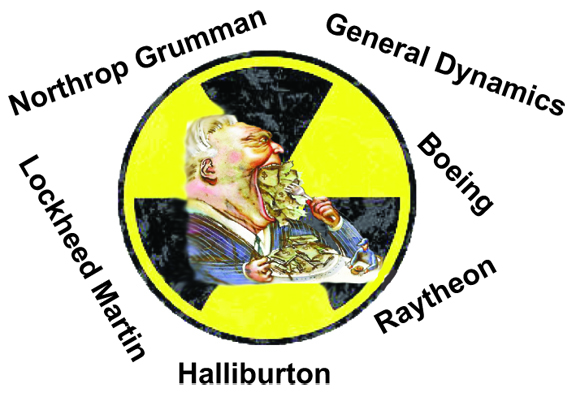
We’re squabbling over Social Security, while the government lavishes infinitely more money on the arms industry. The Nation, By Rebecca Gordon 16 June 21, ”……………………………..President Joe Biden remains super-glued to the same old post–World War II agreement between the two major parties: They can differ vastly on domestic policies, but they remain united when it comes to projecting US military power around the world and to the government spending that sustains it. In other words, the US “national security” budget is still the third rail of politics in this country…………………………….

WELFARE FOR WEAPONS MAKERS
Of course, there’s a second high-voltage, untouchable rail in American politics and that’s funding for the military and weapons manufacturers. It takes a brave politician indeed to suggest even the most minor of reductions in Pentagon spending, which has for years been the single largest item of discretionary spending in the federal budget.
It’s notoriously difficult to identify how much money the government actually spends annually on the military. President Trump’s last Pentagon budget, for the fiscal year ending on September 30, offered about $740 billion to the armed services (not including outlays for veteran services and pensions). Or maybe it was only $705.4 billion. Or perhaps, including Department of Energy outlays involving nuclear weapons, $753.5 billion. (And none of those figures even faintly reflected full national security spending, which is certainly well over a trillion dollars annually.)
Most estimates put President Biden’s 2022 military budget at $753 billion—about the same as Trump’s for the previous year. As former Senator Everett Dirksen is once supposed to have said, “A billion here, a billion there, and pretty soon you’re talking real money.”
Indeed, we’re talking real money and real entitlements here that can’t be touched in Washington without risking political electrocution. Unlike actual citizens, US arms manufacturers seem entitled to ever-increasing government subsidies—welfare for weapons, if you like. Beyond the billions spent to directly fund the development and purchase of various weapons systems, every time the government permits arms sales to other countries, it’s expanding the coffers of companies like Lockheed-Martin, Northrup-Grumman, Boeing, and Raytheon Technologies. The real beneficiaries of Donald Trump’s so-called Abraham Accords between Israel and the majority Muslim states of Morocco, the United Arab Emirates, Bahrain, and Sudan were the US companies that sell the weaponry that sweetened those deals for Israel’s new friends.
When Americans talk about undeserved entitlements, they’re usually thinking about welfare for families, not welfare for arms manufacturers. But military entitlements make the annual federal appropriation of $16.5 billion for Temporary Aid to Needy Families (TANF) look puny by comparison. In fact, during Republican and Democratic administrations alike, the yearly federal outlay for TANF hasn’t changed since it was established through the 1996 Personal Responsibility and Work Opportunity Reconciliation Act, known in the Clinton era as “welfare reform.” Inflation has, however, eroded its value by about 40 percent in the intervening years.
And what do Americans get for those billions no one dares to question? National security, right?
But how is it that the country that spends more on “defense” than the next seven, or possibly 10, countries combined is so insecure that every year’s Pentagon budget must exceed the last one? Why is it that, despite those billions for military entitlements, our critical infrastructure, including hospitals, gas pipelines, and subways (not to mention Cape Cod steamships), lies exposed to hackers?
And if, thanks to that “defense” budget, we’re so secure, why is it that, in my wealthy home city of San Francisco, residents now stand patiently in lines many blocks long to receive boxes of groceries? Why is “national security” more important than food security, or health security, or housing security? Or, to put it another way, which would you rather be entitled to: food, housing, education, and health care, or your personal share of a shiny new hypersonic missile?
But wait! Maybe defense spending contributes to our economic security by creating, as Donald Trump boasted in promoting his arms deals with Saudi Arabia, “jobs, jobs, jobs.” It’s true that spending on weaponry does, in fact, create jobs, just not nearly as many as investing taxpayer dollars in a variety of far less lethal endeavors would. As Brown University’s Costs of War project reports:
And if, thanks to that “defense” budget, we’re so secure, why is it that, in my wealthy home city of San Francisco, residents now stand patiently in lines many blocks long to receive boxes of groceries? Why is “national security” more important than food security, or health security, or housing security? Or, to put it another way, which would you rather be entitled to: food, housing, education, and health care, or your personal share of a shiny new hypersonic missile?
Rebecca GordonRebecca Gordon, a TomDispatch regular, teaches in the philosophy department at the University of San Francisco. She is the author of American Nuremberg: The U.S. Officials Who Should Stand Trial for Post-9/11 War Crimes (Hot Books, April 2016). Her previous books include Mainstreaming Torture: Ethical Approaches in the Post-9/11 United States and Letters from Nicaragua.
https://www.thenation.com/article/economy/the-real-welfare-cheats-are-war-profiteers/
The Pentagon’s Project, Pele Military micro-reactors – creates more problems than it solves.

Military micro-reactors: Waging yesterday’s wars while losing the future’s https://www.defensenews.com/opinion/commentary/2021/06/15/military-micro-reactors-waging-yesterdays-wars-while-losing-the-futures/By: Bryan Clarkand Henry Sokolski With its withdrawal from Afghanistan and decision to end programs that typified America’s conflicts of past two decades, the Biden administration’s Pentagon is planning for long-term competitions against China and Russia. But for the Pentagon’s mobile micro-reactor effort, Project Pele, it’s still 2007.
Designed to supply energy to remote troops, Pele is geared for fighting the last war, which lacked high-end threats and during which vulnerable fuel convoys were a significant source of American casualties.
The Pentagon is asking Congress to spend $60 million next year on Pele. Congress should hit the brakes. Not only is Pele rooted in anachronistic military scenarios, but against Chinese, Russian, North Korean or Iranian militaries, it would be a prime target for precise missiles and drones as well as a source of friction with nuclear-skeptic U.S. allies expected to host the reactors.
With its withdrawal from Afghanistan and decision to end programs that typified America’s conflicts of past two decades, the Biden administration’s Pentagon is planning for long-term competitions against China and Russia. But for the Pentagon’s mobile micro-reactor effort, Project Pele, it’s still 2007.
Designed to supply energy to remote troops, Pele is geared for fighting the last war, which lacked high-end threats and during which vulnerable fuel convoys were a significant source of American casualties.
The Pentagon is asking Congress to spend $60 million next year on Pele. Congress should hit the brakes. Not only is Pele rooted in anachronistic military scenarios, but against Chinese, Russian, North Korean or Iranian militaries, it would be a prime target for precise missiles and drones as well as a source of friction with nuclear-skeptic U.S. allies expected to host the reactors.
To address the threat of attack, Pele’s fuel is intended to be inherently stable and resistant to meltdown.
Perhaps, but a large attack could bury the fuel in debris, preventing it from dissipating heat and causing it to exceed its design temperature. And even if the fuel remains intact, it is radioactive and would create a contamination risk once released from the reactor by an attack.
Count on our allies being unwilling to host Pele reactors that opponents are sure to strike. Unlike Iraq and Afghanistan, where the governments were beholden to the United States and guided-weapons threats were nonexistent, U.S. troops facing China would have to operate on Japanese, Australian or Philippine soil — nations that harbor strong anti-nuclear sentiments. U.S. governments in Guam or the Northern Mariana islands may have less choice in the matter, but residents there will hardly welcome new radioactive targets for Chinese missiles.
U.S. forces could reduce the threat to mobile reactors by taking them off the front lines. However, this reduces their value in solving logistical problems. More important, moving Pele away from the front will place it closer to civilian populations worried about Pele’s everyday radiological footprint. Consider instead of platoons of diesel mechanics and convoys of fuel, the Army needs squads of nuclear power plant operators and pallets of testing supplies and water treatment equipment. The return trip will also be full. Every glove, paper towel and sample bottle would likely be considered low-level waste and require specialized disposal, possibly back in the United States.
Bottom line: Pele creates more military challenges than it solves.
Mobile reactors might make sense for powering remote settlements and polar or moon stations, which is why NASA and the Energy Department are backing the project. But Pele is the wrong answer for tomorrow’s power-hungry military sensors, electric combat vehicles and directed-energy weapons. To supply these systems, the Pentagon should take a broader approach. Instead of advancing a comfortable solution from the past, the Defense Department should drive energy innovation through competition, such as the prize challenges that the Defense Advanced Research Projects Agency successfully used to advance new robotics and semiconductor designs.
New energy technologies are available. Solar and wind generation are being advanced and fielded today by commercial industry. Developments in batteries, capacitors and flywheels are already revolutionizing energy storage. A combination of these and other as-yet unidentified technologies could address the U.S. military’s expeditionary energy needs and be more feasible to deploy than Pele. Congress should reallocate Pele’s proposed budget to fund competitions to surface and exploit these new approaches rather than picking a winner today that is likely to lose tomorrow.
Bryan Clark, a retired U.S. Navy nuclear submarine officer, is currently a senior fellow at the Hudson Institute and the director of its Center for Defense Concepts and Technology. Henry Sokolski is the executive director at the Nonproliferation Policy Education Center. He served in the U.S. Defense Department’s Office of Net Assessment and as the department’s deputy for nonproliferation policy under then-Defense Secretary Dick Cheney
NATO readies for a collective response to attacks in space
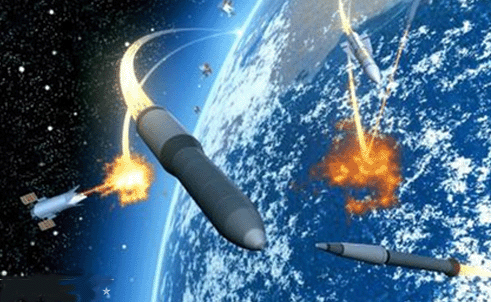
NATO says attack in space could trigger mutual defense clause Defense News By: Lorne Cook, The Associated Press 16 June 21BRUSSELS — NATO leaders on Monday expanded the use of their all for one, one for all, mutual defense clause to include a collective response to attacks in space.
Article 5 of NATO’s founding treaty states that an attack on any one of the 30 allies will be considered an attack on them all. Until now, it’s only applied to more traditional military attacks on land, sea, or in the air, and more recently in cyberspace.
In a summit statement, the leaders said they “consider that attacks to, from, or within space” could be a challenge to NATO that threatens “national and Euro-Atlantic prosperity, security, and stability, and could be as harmful to modern societies as a conventional attack.”
“Such attacks could lead to the invocation of Article 5. A decision as to when such attacks would lead to the invocation of Article 5 would be taken by the North Atlantic Council on a case-by-case basis,” they said.
Around 2,000 satellites orbit the earth, over half operated by NATO countries, ensuring everything from mobile phone and banking services to weather forecasts. Military commanders rely on some of them to navigate, communicate, share intelligence and detect missile launches.
In December 2019, NATO leaders declared space to be the alliance’s “fifth domain” of operations, after land, sea, air and cyberspace. Many member countries are concerned about what they say is increasingly aggressive behavior in space by China and Russia.
Around 80 countries have satellites, and private companies are moving in, too. In the 1980s, just a fraction of NATO’s communications was via satellite. Today, it’s at least 40%. During the Cold War, NATO had more than 20 stations, but new technologies mean the world’s biggest security organization can double its coverage with a fifth of that number.
NATO’s collective defense clause has only been activated once, when the members rallied behind the United States following the Sept. 11, 2001, attacks…………..
Biden said Monday that Article 5 is “a sacred obligation” among allies. “I just want all of Europe to know that the United States is there,” he said. “The United States is there.” https://www.defensenews.com/smr/nato-priorities/2021/06/14/nato-says-attack-in-space-could-trigger-mutual-defense-clause/
NATO’s hostility to the Nuclear Weapons Ban Treaty is in conflict with its true goal – to become a non-nuclear alliance .
NATO’s Nuclear Two-Step, An alliance that avows nuclear disarmament should not cling so dangerously to its weapons. https://www.defenseone.com/ideas/2021/06/natos-nuclear-two-step/174703/ BY RICHARD LENNAN, EFORMER UN DISARMAMENT OFFICIAL, JUNE 14, 2021
NATO wants to become a non-nuclear alliance. That sentence might surprise many, but it’s true: when the organization achieves its long-standing goal of full implementation of the Nuclear Non-proliferation Treaty, its members will no longer possess nuclear weapons.
Given the growing risks, it would be natural for NATO to be reinvigorating and accelerating its efforts on nuclear disarmament. Perversely, however, the alliance has been moving in the opposite direction.
Despite NPT commitments to work to reduce stockpiles and diminish the role of nuclear weapons in security doctrines, the three nuclear-armed NATO members are all improving their nuclear arsenals. NATO rhetoric in favor of nuclear weapons is hardening, and the alliance is “circling the wagons” around nuclear deterrence. Although the North Atlantic Treaty makes no mention of nuclear weapons, NATO was officially dubbed a “nuclear alliance” in the 2010 Strategic Concept and this deliberate embedding of nuclear weapons in the alliance’s identity has steadily continued.
Political support by individual NATO members for retaining NATO’s nuclear weapons capability is increasingly seen as a test of loyalty and unity; discussion of alternatives is discouraged, even punished. Bizarrely, the NATO 2030 Reflection Group report recommended that “NATO should better communicate on the key role of its nuclear deterrence policy… so as to effectively counter hostile efforts to undermine this vital policy.” An uninitiated observer could be forgiven for thinking that NATO’s raison d’être is not “to safeguard the freedom, common heritage and civilization” of its members, but rather to defend and protect their right to use weapons of mass destruction.
When much of the world is strengthening the norm against nuclear weapons by joining the 2017 Treaty on the Prohibition of Nuclear Weapons, or TPNW, NATO is undermining its own security by encouraging proliferation of nuclear weapons, by provoking arms races with nuclear-armed rivals, and by constraining the ability of alliance members to pursue effective steps towards nuclear disarmament.
Nowhere is the harmful effect of this trend clearer than in NATO’s counterproductive hostility to the TPNW. The treaty’s objective is also one professed by NATO: ending the nuclear weapons threat by eliminating nuclear weapons. Any differences therefore come down to the means by which this objective is to be achieved. Yet NATO has reacted to the TPNW as if it were some kind of dangerous assault on its core values, if not a threat to its very existence.
The reasons given for NATO’s opposition have been described by Hans Blix as “strained” and by former Canadian foreign minister Lloyd Axworthy as “phoney baloney”. There is no legal reason that NATO allies cannot join the TPNW, and NATO’s obsessive focus on the treaty has prevented any consideration of what it can offer the alliance.
By supporting and joining the the treaty, individual NATO states can help to build a robust new global norm against nuclear weapons, strengthening barriers against proliferation, diminishing pressure for nuclear arms races, and reducing the overall reliance of NATO on nuclear weapons, opening up pathways for progress on disarmament. They will also demonstrate their commitment to fully discharging their disarmament obligations under the earlier Non-Proliferation Treaty, easing tensions among its signatories.
Conversely, the approach of blanket dismissal of and hostile non-engagement with the TPNW will only constrain NATO’s options, alienate potential partners, and push the alliance’s nuclear disarmament goal further out of reach.
Outside the alliance’s current leadership, there is growing support within a number of member states for joining the TPNW. A range of former leaders, including NATO secretaries general and defense and foreign ministers, have called on NATO states to join. Parliaments in NATO states have passed motions in support of the treaty; cities across the alliance have called on their governments to join it. Opinion polls in many NATO states consistently support, by a clear margin, accession to the treaty.
NATO as a non-nuclear alliance would be something to celebrate. Yet rather than openly aspiring to such status, and discussing how it might look and function, the alliance seems to be actively avoiding – even suppressing – any consideration of the possibility. This is a dangerously counterproductive and shortsighted approach.
It is time for NATO members to shake off the restrictions of reactive, short-term thinking about nuclear weapons, and instead to re-embrace the vision of nuclear disarmament as a preventative tool for shaping NATO’s security environment. While total elimination of nuclear weapons may remain a distant goal, envisioning and planning for NATO as a non-nuclear alliance should begin now. Positive and constructive engagement with the TPNW, including joining the treaty for those NATO members willing and ready to do so, would be a logical place to start.
Richard Lennane is a former Australian diplomat and UN disarmament official. He is a principal co-author of A Non-Nuclear Alliance: Why NATO Members Should Join the UN Ban on Nuclear Weapons, published on 10 June 2021 by the International Campaign to Abolish Nuclear Weapons (ICAN).
The military-industrial-media complex renders the American populus ill-informed in matters regarding war .

[and – it’s the same i Australia C.M.]
“How real is all this influence? Does the military-industrial-media complex (MIMC) actually affect the information we receive and our perception of war?”
The military-industrial-media complex renders the American populus ill-informed in matters regarding war — Rise Up Times
“The media has been a major player in ‘hyping up’ the sense of danger and need for military action in many situations.” https://wordpress.com/read/feeds/34005311/posts/3390423975
By HELEN JOHNSON The Miscellany News, Vassar College May 20, 2021
This is the fifth article in a five-part series about the military-industrial-media complex. The fourth article,“The (im)proper meshing of the corporate media and the military-industrial complex,” can be found here.
I have now examined the military-industrial complex (MIC) and the corporate media each individually; explained how the MIC has expanded to include not only the arms makers, Congress and the military, but also oil companies, service and equipment providers, surveillance and technology companies and think tanks; examined how the consolidation of corporate power within the media industry has resulted in a handful of companies controlling 90 percent of our media, and how these huge corporations hold incredible political power, not just to influence politicians and legislation directly, but to subtly shape entire ideologies. In this installment, I illustrated how the corporate media is linked in many ways to the MIC, including through outright ownership, interlocking directorates, revolving doors and overreliance on the government and the military for information and access to the battlefield during war.
But how real is all this influence? Does the military-industrial-media complex (MIMC) actually affect the information we receive and our perception of war? In this article I’ll explain that yes, because of its enormous reach, the extreme consolidation of its power and its entanglement with the gigantic machine that is the MIC, the media today has failed to properly inform the American citizenry on matters concerning war. The MIMC manufactures pro-military opinion among the public; suppresses information relevant to military activities; provides a sanitized coverage of war; fails to investigate, criticize, or thoroughly debate issues of military involvement; too easily bends to pressure from government and military officials and sometimes even spreads outright lies and false information.
This has resulted in an American populus that, in general terms, is ill-informed, uneducated and misled in matters regarding military involvement, as well as overly militaristic and pro-war. Americans are thus unable to hold their government accountable for unnecessary or inappropriate use of military force, and are complicit in the perpetuation of American imperialism, colossal defense budgets that strip the country of severely lacking social programs and never-ending wars that kill and destroy while a handful of corporations reap immense profits.
The media has been a major player in ‘hyping up’ the sense of danger and need for military action in many situations. Douglas Kellner—American academic and sociologist—explains in his book, Media Spectacle and the Crisis of Democracy: Terrorism, War and Election Battles, how Sept. 11 was a prime example of the media spreading hysteria and fear among an already panicked and traumatized nation. He notes how the media obsessively focused on terrorism, possible threats and retaliation in the weeks and months after Sept. 11. It also handed a megaphone to extremism and did little to weed out the potentially dangerous or incorrect information being spread on its platforms.
Spreading hysteria and panic throughout the population had two effects: First, it made Americans feel heavily reliant on the government for protection and, according to Kellner, made any disagreement with or questioning of the Bush administration seem “unpatriotic and even treasonous.” Second, it was extremely profitable for the media companies themselves; with millions of eyes glued to TVs, newspapers and other media platforms, media consumption spiked and profits went up. Thus, the corporate media and the military-industrial complex both benefited from this collaboration……………
An important note here is that this type of behavior is by no means limited to right-wing or conservative news outlets. In its analysis, FAIR cited The New York Times, The Hill, the Associated Press, and The Washington Post—in addition to Fox News—as all contributing to this culture of hysteria. A separate FAIR article’s headline directs a pointed accusation at CNN: “CNN’s Iran Fearmongering Would Make More Sense Coming Directly From Pentagon.” No mainstream media outlet is innocent of pro-war fear mongering.
The media has also suppressed or downplayed information relevant to military activity on multiple occasions. For example, although the media did everything in their power to vilify Iraq and Saddam Hussein in the lead-up to and during the Iraq war, they completely ignored how the United States backed Hussein in the past. The United States played an integral role in Hussein’s rise to power and actively supported Iraq during the Iran-Iraq War—including going along with Hussein’s use of chemical weapons. However, this seemed to be irrelevant once Bush Jr. had made up his mind to invade Iraq.
Another instance of the U.S. media suppressing or failing to report information came during the middle of the Iraq War in 2004. On Jun. 28, 2004, the United States transferred sovereignty of Iraq in a secret ceremony, immediately after which Paul Bremer—who had been seen by Iraqis as a dictator—left the country. Bremer had heavily controlled Iraqi politics and privatized a huge portion of the economy, including handing out contracts to American firms like Halliburton. However, Bremer’s replacement wasn’t much better. The U.S. chose Ayad Allawi, who had ties to the CIA, to serve as interim prime minister until elections could be held, and the U.S. handpicked the rest of the Iraqi council as well. The two months following the transfer of power saw escalated violence and a continuation of the chaos that had been produced by Bremer.
But watching the news in the United States, you would think “we had turned a corner,” as President Bush repeated over and over again. If the media had thoroughly reported on the situation in Iraq, it could have led to a nationwide understanding that the war was doing more harm than good and serving the interests of huge corporations at the expense of American and Iraqi lives. A truly informed citizenry could have put public pressure on the Bush administration to end the war, or an electorate dissatisfied with the situation could have voted him out of office. Instead, it would be seven more years before the withdrawal of American troops from Iraq.
Suppressing or downplaying information isn’t the only way the mainstream media—in complicity with the MIC—has warped our understanding of war. The media also produces an extremely sanitized coverage of war: it avoids printing and broadcasting images of death and destruction; sidesteps discussions of American casualties and almost entirely refuses to mention casualties on the other side (which are usually much higher); and uses euphemisms like “collateral damage” and “air campaign” that hold very different connotations from what these phrases actually mean—i.e., innocent civilian death and continuous bombing.
Kellner notes that during the Iraq war, “Entire networks like Fox and the NBC cable networks provided little but propaganda and jingoism, as did for the most part CNN. All of the cable networks, as well as the big three U.S. broadcasting networks, tended to provide highly sanitized views of the war, rarely showing Iraqi casualties, thus producing a view of the war significantly different than that shown in other parts of the world.”……………….
Not only do reporters and news anchors oftentimes receive direct instructions from higher-ups on what to and what not to say, but there is also careful screening of experts and guests brought onto the TV networks during wartime. And, as noted in my previous article, many of these “experts” are former generals and Pentagon officials, whose talking points have been carefully scripted and who have been trained on how to speak about matters of war in order to paint the U.S. military and government in the best possible light.
The U.S. corporate media has also chronically failed to properly investigate, criticize and debate issues of war and military involvement. It tends to take the current administration’s account of the situation as fact, and during times of war or military tension, it is branded unpatriotic to criticize the government. Although there are many examples of the media’s failure to investigate and report the truth when it comes to war, the most egregious case was in the lead-up to the invasion of Iraq.
George W. Bush and Dick Cheney had planned from day one of their administration to invade Iraq. As explained in this article, Bush and Cheney—as well as Paul Wolfowitz, Donald Rumsfeld and others in and around the Bush administration—were either directly a part of or tangentially related to the neoconservative think tank PNAC, which was advocating for a regime change in Iraq as early as 1998. The fact that Bush planned to invade Iraq from the get-go has been confirmed by multiple officials close to the administration.
From the immediate aftermath of Sept. 11 up until the 2003 invasion of Iraq, the Bush administration waged a propaganda war to convince the nation that Saddam Hussein was linked to Al Qaeda and that he possessed weapons of mass destruction (WMD). These claims turned out to be false. Not only did Saddam Hussein have nothing to do with the Sept. 11 attacks, but Iraq was not in possession of WMD nor were they in the process of making any.
Even so, these allegations were widely circulated in the mainstream media. The nonpartisan Center for Public Integrity documented a total of 935 false statements made by top administration officials regarding the threat from Iraq before the war, and the majority of these assertions “were broadcast widely by U.S. media with little or no investigation of their credibility, and few rebuttals from war skeptics or dissenters.”
Not only did the media outlets completely fail to properly investigate these claims before broadcasting them to the nation—even The Washington Post and The New York Times admitted that they had uncritically published information fed to them by the Bush administration—but they continued to circulate the misinformation long after it had been disproven. Even after ABC, NBC and The Washington Post reported that the claims were false, Fox Television and other U.S. cable networks continued to play the stories about Iraq’s alleged connection with Al Qaeda and supposedly threatening weapons program.
The Bush administration had accomplished its goal: to convince enough of the American population, still reeling and traumatized from Sept. 11, that Saddam Hussein was dangerous—so that they could have their war. The failure on the part of the corporate media to investigate and criticize the Bush administration’s claims, and the continued circulation of these claims even after they were proven false, would lead to a disastrous eight-year long conflict resulting in hundreds of thousands of deaths.
There are many, many more instances of skewed reporting when it comes to war and military involvement. Not all of these instances involve outright lying to the American public or regurgitating government pro-war propaganda; many of the ways in which the corporate media influences our perception of war are small and relatively unnoticeable……….. more https://riseuptimes.org/2021/06/12/the-military-industrial-media-complex-renders-the-american-populus-ill-informed-in-matters-regarding-war/
Shattered remains — the fallout from the Trinity nuclear bomb test

Tularosa Basin Downwinders continue their fight for recognition
Shattered remains — Beyond Nuclear International The fight to right the injustices of Trinity https://wordpress.com/read/feeds/72759838/posts/3391600721 By Tina Cordova, 14 June 21, In a world searching for sustainable energy infrastructures, the US has still not rectified the injustices that came about with the earliest moments of the nuclear era. On July 16, 1945, when the US government detonated the first atomic bomb at the Trinity Site in South Central New Mexico, officials had little to no concern for the people who lived in the adjacent area.
Most of them were people of color, Native Americans and also Hispanos who had emigrated north from Mexico (or their ancestors had likely done so). These people were warned neither before nor after the so-called “test” as to the dangers they were facing as a result of the bomb.
As we know, this “test” would be the first of many from both Western and Eastern superpowers. Within the US context, other communities considered marginal to the US would be devastated; the atomic explosions on the Marshall Islands and their impacts on Indigenous communities are one of the best-known of these horrific accounts. Debates around nuclear power continue to have great international resonance today.
As documented in written and oral histories recorded by the Tularosa Basin Downwinders Consortium (TBDC), ash fell from the sky for days after the bomb was detonated and settled on everything—the people, the land, and the animals. The TBDC was originally organized to bring attention to the negative health effects suffered by the people of New Mexico as a result of their overexposure to radiation as a result of the “test.” Ultimately, the TBDC’S goals include raising awareness and attaining justice for impacted local communities and families.
Fallout
The bomb detonated at Trinity produced massive fallout that blanketed the earth and became part of the water and food supply that the people of the area rely on for sustenance. The bomb was incredibly inefficient, inasmuch as it was overpacked with plutonium: it incorporated 13 pounds of plutonium when only three pounds were necessary for the fission process. The remaining 10 lbs. of plutonium—with a half-life of 24,000 years—was dispersed in the radioactive cloud that rose over eight miles above the atmosphere, penetrating the stratosphere.
The bomb was detonated on a platform at a height of 100 feet off the ground, the only time a device was ever detonated so close to the ground. At this height the blast did not produce massive destruction—but it did produce massive fallout. In fact, Trinity produced more fallout than any of the atomic bombs detonated at the Nevada Site. In Japan, the bombs were detonated at heights of 1600 (Nagasaki) and 1800 (Hiroshima) feet respectively, which produced massive destruction and the horrific images which we know too well. In contrast, the accounts of communities in southern New Mexico are best characterized by what Rob Nixon calls “slow violence.” Through this concept, Nixon wants us to focus on how environmental degradation that occurs at the hands of human actors can slowly accumulate and impact communities for years after an initial event.
To understand the exposure received by New Mexicans in the area, it is important to understand the lifestyles of the people living there in the 1940s and ’50s. In rural parts of New Mexico in 1945 there was no running water, so people collected rainwater for the purpose of drinking, cooking, and the like. There was no refrigeration, so there were no grocery stores to buy produce, meat, or dairy products. Mercantile stores sold things like sugar, flour, coffee, rice, cereal, and other nonperishables, but all the meat, dairy, and produce that was consumed was grown, raised, hunted locally. Most if not all the food sources were negatively affected by the radioactive fallout that became part of almost everything that was consumed.
The regional water infrastructures included cisterns, sometimes dug into the ground, to collect water directed off of rooftops. Once inside a cistern, radioactive debris would remain effectively forever (having no place else to go) so that water dipped out of a cistern for drinking or cooking would be replete with radioactive isotopes that were then consumed. Even one particle of plutonium inhaled or ingested would remain in the body giving off radiation and destroying cells, tissue, and organs.
Denial
People who have shared with the TBDC their stories of the blast that day have said that they thought it was the end of the world. Imagine: the bomb produced more heat and more light than the sun. It was detonated at about 5:30 a.m. and many reported that the explosion “knocked them out of bed.” They said first the sky lit up brighter than day, and then the blast followed. Many said that they were gathered up by their mothers and made to pray. The light is reported to have been seen all the way to California and the blast was felt as far north as Albuquerque. It was an unprecedented event that no one received warning about, and within days a lie was delivered and perpetuated by the US government: a munition dump at the Alamogordo Bombing Range had accidently exploded but no one was hurt, it claimed.
People who have shared with the TBDC their stories of the blast that day have said that they thought it was the end of the world. Imagine: the bomb produced more heat and more light than the sun. It was detonated at about 5:30 a.m. and many reported that the explosion “knocked them out of bed.” They said first the sky lit up brighter than day, and then the blast followed. Many said that they were gathered up by their mothers and made to pray. The light is reported to have been seen all the way to California and the blast was felt as far north as Albuquerque. It was an unprecedented event that no one received warning about, and within days a lie was delivered and perpetuated by the US government: a munition dump at the Alamogordo Bombing Range had accidently exploded but no one was hurt, it claimed.
The US government has never returned to conduct a full epidemiological study on the impacts of this exposure on the people of New Mexico. Yet in 1990, a bill was passed called the Radiation Exposure Compensation Act (RECA), which provided recognition, an apology, and reparations to the people living downwind of the Nevada Test Site and elsewhere in the Southwest not counting the region around the Trinity site. So while the people of New Mexico were the first to be exposed to this horrific form radiation anyplace in the world, while they lived much closer to the Trinity test site and were therefore exposed to much more higher doses of radiation, and while they were also documented as being downwind of the Nevada Test site, they have never been included in the RECA fund.
Documentation
There has been a recent challenge by the National Cancer Institute to what we know to be true about the people’s use of cisterns in rural parts of New Mexico. To dispel the idea that people in the 1940s and ’50s didn’t use cisterns, the TBDC is now undertaking a process for collecting notarized affidavits in which people recount what they remember about how they acquired water for drinking and cooking purposes. Many of the statements are clear about how rainwater was collected mainly in cisterns and that this water was considered a precious commodity.
This archival work provides the TBDC with the opportunity to document, for the first time, the memories of local and elderly community members about the region’s water infrastructures and support their efforts for environmental justice. This ongoing archival work was even useful for TBDC’s March, 2021, presentation to the US Congress on the importance of expanding RECA.
The collection of affidavits is made public so that there is a record of what has been shared with the TBDC through this process. People who wrote the statements in these affidavits are from varying communities across New Mexico, and it is interesting to note that most of them were typically not familiar with each other, yet their statements have many common themes.
The TBDC believes that there is an imperative to document the truth as told by those who experienced the Trinity bomb and know of their living conditions. It is hoped that the affidavits will inform the public as to the inaccuracies that are often told by the government and agencies that represent the government. All of this is especially crucial today as nuclear energy has continued to be of great importance globally. Numerous administrations have sought to expand US nuclear power abroad, yet as both the US and other governments around the world continue to look towards nuclear, its origins and those present during its origins must no longer be overlooked.
Tina Cordova is a seventh generation native New Mexican born and raised in the small town of Tularosa in south central New Mexico, and is past Vice President of the New Mexico Highlands University Foundation, her Alma Mater. A thyroid cancer survivor, in 2005 Tina co-founded the Tularosa Basin Downwinders Consortium.
The world’s narrow escape from nuclear war
The world’s narrow escape from nuclear war https://www.bigissue.com/culture/books/the-worlds-narrow-escape-from-nuclear-war/
Author Serhii Plokhy reflects on the world’s closest shave with nuclear war in 1962, and that fact that all that really saved us was ‘plain dumb luck.’ In October 1962 the world experienced the most dangerous crisis in its history. As the Soviet leader Nikita Khrushchev ordered Soviet nuclear armed missiles to be placed in Cuba to protect the island from possible American invasion, and redress the imbalance in the missile power between the United States and his country, US President John F Kennedy declared the naval blockade of Cuba. In the tense days and weeks that followed that decision, Kennedy and Khrushchev managed to avoid nuclear confrontation thanks to the one feature they shared – the fear of nuclear war.
Numerous books have been written on the history of the crisis since its resolution. Almost all of them are focused on the decision-making process in Kennedy’s White House. What is often lost in that analysis is the understanding that Kennedy and Khrushchev had limited control over the actions of their military and more than once lost control over the situation on the ground, on the seas and in the sky.
On a number of occasions, the key decision on whether to start a shooting war that could eventually lead to the nuclear exchange lay not with them, but with their commanders in the theatre. It is not for nothing that a former US secretary of state, Dean Acheson, suggested that John Kennedy avoided war by “plain dumb luck”.
Few events in the history of the Cuban Missile Crisis demonstrate the degree of the danger caused by the actions of the individual commanders, and the importance of the “dumb luck,” in the avoidance of the nuclear war than the drama which played out in the late hours of October 27 and early morning of October 28 1962 when, in the Sargasso Sea, four Soviet nuclear-armed submarines approached the US quarantine line.1962, and that fact that all that really saved us was ‘plain dumb luck.’
Nuclear weapons numbers building up again.
Nuclear arms decline stalls as nations modernise arsenals, Johannes LEDELYahoo News, 14 June 2021, ·As nuclear nations commit to renewing and sometimes expanding their arsenals, a decline seen since the early 1990s seems to have stalled, with some signs of a numerical increase, researchers said Monday
“The reduction of nuclear arsenals that we have gotten used to since the end of the Cold War appears to be levelling out,” Hans Kristensen, associate senior fellow at SIPRI’s Nuclear Disarmament, Arms Control and Non-proliferation Programme, told AFP.
The amount of nukes among the nine nuclear-armed states — the US, Russia, the UK, France, China, India, Pakistan, Israel and North Korea — totalled 13,080 at the start of 2021, a slight decrease from 13,400 a year earlier, the Stockholm International Peace Research Institute (SIPRI) estimated.
However, this includes retired warheads waiting to be dismantled, and without them the combined military stockpile of nuclear arms rose from 9,380 to 9,620.
Meanwhile, the number of nuclear weapons deployed with operational forces increased from 3,720 to 3,825, the report said.
Of these, some 2,000 were kept in a “kept in a state of high operational alert,” meaning for launch in a matter of minutes.
“We’re seeing very significant nuclear modernisation programmes all around the world and in all the nuclear weapons states,” Kristensen said.
He added that nuclear states also seem to be raising “the importance they attribute to the nuclear weapons in their military strategies.”
This change can be observed in both Russia and the United States, which together possess over 90 percent of the world’s nuclear weapons, Kristensen said, stressing it was too early to say if the new US administration under President Joe Biden would deviate from the strategy under his predecessor Donald Trump.
I think that the Biden administration is signalling quite clearly that it is going to continue the overwhelming main thrust of the nuclear modernisation programme that was underway during the Trump years,” the researcher said, noting the programme was started under Barack Obama………..
The International Campaign to Abolish Nuclear Weapons (ICAN) this month reported that nuclear nations increased spending on their arsenals by $1.4 billion (1.2 billon euros) to $72 billion in 2020, even as the pandemic raged………..https://au.news.yahoo.com/nuclear-arms-decline-stalls-nations-183906780.html
Nuclear energy – Nuclear weapons – the inseparable link
Nuclear energy – Nuclear weapons – the inseparable link, Jonathon Porritt, 4 June 21

whether we’re talking big reactors or small reactors, fission or fusion. The simple truth is this: we should see nuclear as another 20th century technology, with an ever-diminishing role through into the 21st century, incapable of overcoming its inherent problems of cost, construction delay, nuclear waste, decommissioning, security (both physical and cyber), let alone the small but still highly material risk of catastrophic accidents like Chernobyl and Fukushima. My ‘Net Zero Without Nuclear’ report goes into all these inherent problems in some detail.
So why are the UK’s politicians (in all three major parties) still in thrall to this superannuated technology? It’s here we have to go back to Amchitka! Some environmentalists may still be taken aback to discover that the Government’s principal case for nuclear power in the UK today is driven by the need to maintain the UK’s nuclear weapons capability – to ensure a ‘talent pool’ of nuclear engineers and to support a supply chain of engineering companies capable of providing component parts for the nuclear industry, both civilian and military. The indefatigable work of Andy Stirling and Phil Johnston at Sussex University’s Science Policy Research Unit has established the depth and intensity of these interdependencies, demonstrating how the UK’s military industrial base would become unaffordable in the absence of a nuclear energy programme.
”……….nuclear power plays no part in Greenpeace’s modelling of a rapid transition to a Net Zero carbon world. It’s been very supportive of my new report, ‘Net Zero Without Nuclear’.
I wrote this report partly because the nuclear industry itself is in full-on propaganda mode, and partly because that small caucus of pro-nuclear greens (that’s existed for as long as I can remember) seems to be winning new supporters.
And I can see why. The Net Zero journey we’re now starting out on for real (at long last!) is by far the most daunting challenge that humankind has ever faced. Writing in the Los Angeles Review of Books in June 2019, author and Army veteran Roy Scranton put it like this:
‘Climate change is bigger than the New Deal, bigger than the Marshall Plan, bigger than World War II, bigger than racism, sexism, inequality, slavery, the Holocaust, the end of nature, the Sixth Extinction, famine, war, and plague all put together, because the chaos it’s bringing is going to supercharge every other problem. Successfully meeting this crisis would require an abrupt, traumatic revolution in global human society; failing to meet it will be even worse.’
Not many people see it like that – as yet. But more and more will, as signals of that kind of chaos start to multiply. And we already know that the kind of radical decarbonisation on which our future depends is going to be incredibly hard. So why should we reject a potentially powerful contribution to that decarbonisation challenge?
………….. there is no longer any doubt about the viability of that [renewables] alternative. In 2020, Stanford University issued a collection of 56 peer-reviewed journal articles, from 18 independent research groups, supporting the idea that all the energy required for electricity, transport, heating and cooling, and all industrial purposes, can be supplied reliably with 100% (or near 100%) renewable energy.[i] The solutions involve transitioning ASAP to 100% renewable wind – water – solar (WWS), efficiency and storage.
The transition is already happening. To date, 11 countries have reached or exceeded 100% renewable electricity. And a further 12 countries are intent on reaching that threshold by 2030. In the UK, the Association for Renewable Energy and Clean Technology says we can reach 100% renewable electricity by 2032. Last year, we crossed the 40% threshold.
Continue readingPro nuclear politicians angry at suggestion of canceling sea-launched cruise missile.
Lawmakers Fume Over Acting Navy Secretary’s Call to Cancel Nuclear Sea-Launched Cruise Missile, Military.com 11 Jun 2021Stars and Stripes | By Sarah Cammarata
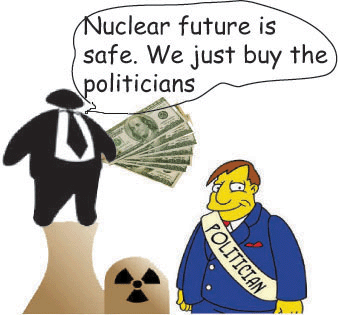
I think we’re all shocked to have heard the news of the acting secretary of the Navy appearing to take action to zero out the sea-launched cruise missile. This is something that is incredibly important,” said Rep. Mike Turner of Ohio, the ranking Republican on the House Armed Services Committee subpanel on strategic forces.
WASHINGTON — House and Senate lawmakers voiced concern Thursday over the acting Navy secretary’s move to cancel the service’s nuclear sea-launched cruise missile in fiscal 2023 as top defense leaders said they had not been briefed on the decision.
“I think we’re all shocked to have heard the news of the acting secretary of the Navy appearing to take action to zero out the sea-launched cruise missile. This is something that is incredibly important,” said Rep. Mike Turner of Ohio, the ranking Republican on the House Armed Services Committee subpanel on strategic forces.
“We know that the Nuclear Posture Review isn’t underway, and yet we have the first steps toward actions that would be unilateral disarmament,” Turner said during the committee’s hearing to review the fiscal 2022 budget proposal for nuclear forces.
Multiple media outlets reported this week that acting Navy Secretary Thomas Harker directed the service in a June 4 memo to “defund [the] sea-launched cruise missile.”
The 2018 Nuclear Posture Review — an examination of U.S. nuclear policy that occurs when a new administration takes office — supported pursuing this type of missile. The strategy under former President Donald Trump’s administration called for expanding the role and capability of the U.S. nuclear arsenal.
The Defense Department’s Melissa Dalton testified Thursday that the review by President Joe Biden’s administration is “on the cusp” of commencing. Biden has said he wants to reduce reliance on nuclear weapons.
“The sole purpose of the U.S. nuclear arsenal should be deterring — and if necessary, retaliating against — a nuclear attack,” Biden’s campaign said in an online statement before the president’s election. …….. https://www.military.com/daily-news/2021/06/11/lawmakers-fume-over-acting-navy-secretarys-call-cancel-nuclear-sea-launched-cruise-missile.html
Growing support for the nuclear ban treaty in public opinion polls , voters and lawmakers in NATO’s 30 countries
As President Biden and his NATO counterparts focus on nuclear-armed Russia
at their summit meeting on Monday, they may also face a different sort of
challenge: growing support, or at least openness, within their own
constituencies for the global treaty that bans nuclear weapons.
The International Campaign to Abolish Nuclear Weapons, the Geneva-based group
that was awarded the 2017 Nobel Peace Prize for its work to achieve the
treaty, said in a report released on Thursday that it had seen increased
backing for the accord among voters and lawmakers in NATO’s 30 countries,
as reflected in public opinion polls, parliamentary resolutions, political
party declarations and statements from past leaders.
New York Times 10th June 2021
1 This Month





PLEASE OPPOSE HR 8255 AND S.3639 – bills would accelerate satellite deployment, with no environmental review or safeguards – https://ncstd5li.quorum.us/campaign/169331/
To see nuclear-related stories in greater depth and intensity – go to https://nuclearinformation.wordpress.com
-
Archives
- October 2026 (67)
- September 2026 (339)
- August 2026 (330)
- July 2026 (355)
- June 2026 (287)
- May 2026 (306)
- April 2026 (356)
- March 2026 (251)
- February 2026 (267)
- January 2026 (308)
- December 2025 (358)
- November 2025 (359)
-
Categories
- 1
- 1 NUCLEAR ISSUES
- business and costs
- climate change
- culture and arts
- ENERGY
- environment
- health
- history
- indigenous issues
- Legal
- marketing of nuclear
- media
- opposition to nuclear
- PERSONAL STORIES
- politics
- politics international
- Religion and ethics
- safety
- secrets,lies and civil liberties
- spinbuster
- technology
- Uranium
- wastes
- weapons and war
- Women
- 2 WORLD
- ACTION
- AFRICA
- Atrocities
- AUSTRALIA
- Christina's notes
- Christina's themes
- culture and arts
- Events
- Fuk 2022
- Fuk 2023
- Fukushima 2017
- Fukushima 2018
- fukushima 2019
- Fukushima 2020
- Fukushima 2021
- general
- global warming
- Humour (God we need it)
- Nuclear
- RARE EARTHS
- Reference
- resources – print
- Resources -audiovicual
- Weekly Newsletter
- World
- World Nuclear
- YouTube
-
RSS
Entries RSS
Comments RSS

