US and Allies’ military machine – out of Afghanistan (where it’s needed) and into the Pacific – against its new enemy – The Great Barrier Reef

War games on despite pandemic, threat to Great Barrier Reef https://www.greenleft.org.au/content/war-games-despite-pandemic-threat-great-barrier-reef, Kerry SmithJuly 16, 2021 Lurking off the coast of China’s eastern seaboard now are three United States aircraft carrier battle groups (each with about 30 support vessels).
They will be joined by a British aircraft carrier group and Australian and Canadian warships as part of biennial military exercises, which start on July 18 and last until the end of the month.
Talisman Sabre 2021 (TS21) will involve a US expeditionary strike group from the USS America, the amphibious assault ship based at Sasebo Naval Base in Japan, and 17,000 Australian, US and foreign troops in combined land, sea and air war exercises.
According to Stars and Stripes, for the first time, there will be live-fire training: the US Army will fire a Patriot missile defense system from Shoalwater Bay in Queensland at a pair of drone targets on July 16.
This is within the Great Barrier Reef Marine Park and other environmentally and culturally significant areas.
The war games will also take place in Darwin in the Northern Territory and Evans Head, New South Wales.
All are thousands of kilometres away from their home base, and provocatively close to the new declared enemy — China.
Forces from Canada, Japan, New Zealand and the Republic of Korea will take part and Australia-based personnel from India, Indonesia, France and Germany will observe.
Meanwhile, the ABC’s “defence correspondent” hyperventilated on July 14 that a solitary Chinese military ship, outside Australian territorial waters, poses a threat to national security.
The Independent and Peaceful Australia Network (IPAN) is concerned about both the war games and its impact on environmentally and culturally significant sites.
“TS21 will involve amphibious assaults, movement of heavy vehicles, use of live ammunition as well as the use of U.S. nuclear-powered and nuclear-weapon capable vessels,” IPAN spokesperson Annette Brownlie said.
“These activities are incompatible with the protection of the environment and, in particular, the Great Barrier Reef.
“During Talisman Sabre 2013, the US jettisoned four unarmed bombs on the Great Barrier Reef when they had difficulty dropping them on their intended target, Townshend Island,” Brownlie said.
The objective of Talisman Sabre is to further integrate the Australian military with the US — now ranked among the world’s worst polluters.
IPAN said the ADF did not engage in a Public Environment Report process for TS21 and has yet to release an environmental assessment for the areas in which TS21 will take place.
However, the Department of Defence did produce an environmental awareness video for visiting troops that promotes the military use of the Great Barrier Reef. The video reminds troops to consider the reef and not to litter.
“Talisman Sabre is a threat to the reef and to the environment. Putting out a video is a completely inadequate response,” Brownlie said.
This comes as federal environment minister Sussan Ley is lobbying to keep the Great Barrier Reef off the United Nations Educational, Scientific and Cultural Organization World Heritage Committee’s “in danger” list.
Despite a global pandemic, about 1800 foreign military personnel have arrived in Darwin to participate.
Australia’s weapons lobby drumming up fear of nuclear attack by China, against all logic

Those in Australia beating the “drums of war” point to Taiwan as the flashpoint for the next major global conflict. To what end does a first strike on Australia achieve China’s goals in relation to Taiwan?
War with China: zero logic yet the weapons lobby has 42% of Australians believing it Michael West Media, by Marcus Reubenstein | Jul 16, 2021 Incredibly, a survey finds 42% of Australians believe China will attack Australia, this despite exports to China surging 36% over in the last six months, and despite there being no logical rationale for war with China, or an attack by China. Marcus Reubenstein analyses the ludicrous position of Australia’s China hawks and the mainstream media pushing their agendas.
“Cry ‘Havoc!’ and let slip the dogs of war.”
William Shakespeare, Julius Caesar Act 3, Scene 1
China is a rapidly growing economic power, seeking to exert considerable influence in its region and beyond. And like every great power it is a bully which tries to entice, cajole or intimidate other nations into adopting its view of the world.
How is this such a difficult concept for Australians to embrace?
Since Federation we’ve tied our fortunes to two great powers, the declining British Empire then the rising, and rising even more, US global hegemony……….
Who is threatening whom?
A new report from the Australia Institute begins with the following words:

“In April this year, Australians were warned by no less an expert than the former Minister for Defence, Christopher Pyne, that they may need to engage in a ‘kinetic’ war with China in the next five to ten years.”
Perhaps, in the realm of China policy, ‘no lesser expert’ better describes his authority on the subject.

The same Pyne, famously discussed his role as a defence industry consultant with EY whilst he was a sitting member of the Federal Cabinet, a matter which prompted a Senate investigation.
He still works for EY, sits on the board of defence contractor XTEC, is Chair of the Advisory Board of another defence contractor NIOA, and in June last year Arawa Capital announced him as Chair of its Advisory Board and Investment Committee for a fund investing in weapons systems.
In heralding that appointment Arawa specifically referred to the, still unsubstantiated, Scott Morrison announcement of a malicious cyber attack by an unnamed “state-based” actor. Arawa trumpeted Pyne has “unrivalled knowledge of the cyber, intelligence and national security landscape.”
With Pyne on board, Arawa said it “anticipates closing out the initial $50mil capital raising swiftly.” It transpired there was a swift “closing out”, ASIC records show six months later Arawa Capital Pty Ltd was deregistered as a company.
According to research from Michael West Media’s “Revolving Doors” series, Pyne’s numerous board memberships and consultancies put him in direct, or indirect, contact with more than a dozen weapons makers and contractors.
Clearly, talking up a war with China is of no financial benefit to these companies.
Why would China attack Australia?
Should Australia go to war with China in defence of Taiwan? is the title of the Australia Institute report and 42% of its six hundred respondents think China is poised to attack Australia.
How and why?
Those in Australia beating the “drums of war” point to Taiwan as the flashpoint for the next major global conflict. To what end does a first strike on Australia achieve China’s goals in relation to Taiwan?
If Australia has something China wants, it is many times cheaper and easier to buy it than to send your army half way around the world to steal it.
China’s current leadership is presiding over a great deal more diplomatic disasters than triumphs but, if nothing else, the Chinese are pragmatic.
Australia’s rabid China hawks will no doubt dismiss such assessments, saying China doesn’t need to deploy military assets it would simply launch a nuclear strike on a target—which they ignore is home to 1.2 million ethnically Chinese people.
My counter argument?
The policy wonks in Washington, who made you their lapdogs, didn’t throw you a bone because they thought you were smart, they threw you the bone because they knew you were dumb enough to catch it!
This survey’s inconvenient truth
The same number of respondents were polled in Taiwan and only a few more (49 percent) expressed fears of an attack from the mainland. Bear in mind the Taiwanese are of the same Han ethnicity as the majority of Chinese, who moved over from the mainland in the 1680s; the PRC has never given up its claim to what was once part of China; and the island sits just 161 kilometres off the coast of China.
That four in ten Australians should think Beijing—a mere 9,000 kilometres from Canberra—is gearing up for invasion is staggering.
Report author Allan Behm noted, “Given Australia and Taiwan’s historical and geographical differences, it is astounding that Australians could be more fearful than Taiwan in anticipating an attack from China.”
This anticipation is undoubtedly fuelled by Australia’s China hawks, all with close ties to US-funded research groups and patronage from US weapons makers.
However, they should not be too smug in thinking their “drums of war” are resonating.
73 percent of Australians regard the United States as an aggressive nation, while only six in ten Australians believe the US would come to our aid in the event of war with China.
Given Australia has followed the United States into 100 percent of its wars, that Australians would only rate America a 60 percent chance of leaping to our defence is a sobering statistic.
Totally at odds with Prime Minister Morrison and Foreign Minister Maris Payne’s unquestioned support of the US antagonism towards China, 75 percent of Australians think it is in our interests that China and the US “work together towards world peace”. Of concern to the spin merchants inside the government an even higher number of coalition supporters, 79 percent, think peace with China is a good idea.
Despite the US, and Morrison’s, rhetoric of Taiwan being a like-minded democracy of shared values, 76 percent of Taiwanese rate America as an aggressor. Should the US come to Taiwan’s aid in a war with China, only 18 percent of Taiwanese people think they would win.
How reliable are drummers?
By any sensible strategic logic, the dogs of war should remain in their box. Let the drums of war continue to drum up business for the China threat industry and their death-merchant patrons. …..
Israel determined to“maintain military superiority”, in preparation for a nuclear Iran
Gantz: We must ‘adapt our plans’ to prepare for a nuclear Iran
Prime minister says Israel carefully monitoring situation in Lebanon and that IDF currently in better place than it was in 2006 war against Hezbollah, Tims of Israel, By JUDAH ARI GROSS15 July 2021, Defense Minister Benny Gantz on Wednesday called for Israel to step up its preparations for the possibility of Iran obtaining a nuclear weapon……… Israel has maintained that as it is not part of the nuclear deal, it is free to act as it sees fit to prevent Iran from obtaining an atomic bomb.
In his speech, Gantz called for the government to allow the country’s security services to “maintain military superiority, which ensures our secure existence and advances peace.”
The remark appeared to refer to a report by the Kan broadcaster earlier in the evening that the IDF was asking the government for a major budget increase, in large part to prepare itself to conduct strikes aimed at thwarting Iran’s nuclear pursuit………https://www.timesofisrael.com/gantz-we-must-adapt-our-plans-to-prepare-for-a-nuclear-iran/
If you thought that space research had nothing to do with weapons – think again!

With all three Gunsmoke-J satellites on orbit, the Army is ready to test space-based targeting C4ISR NETBy Nathan StroutTue Jul 13 2021, The Army is keen to use the vantage of space to find and target beyond-line-of-sight (BLOS) threats. While satellite imagery has traditionally been a product of the intelligence community, the development of relatively affordable yet highly capable small satellites that can operate in low Earth orbit has convinced military leaders that it can play a tactical role on the battlefield.
In a demonstration last fall, the Army was able to show that it could take images from satellites on orbit down to Earth, process them with artificial intelligence to find threats, and deliver targeting data to weapon systems in about 20 seconds. That speed is opening a whole slew of possibilities to commanders, enabling them to “see” further down the battlefield in near real time than ever before.
That demonstration used images from commercial satellite constellations, but now the Army has its own trio of imagery satellites to further develop this capability. The Army’s Gunsmoke-J program has launched three cubesats to use “emerging advanced electronics to allow the use of dedicated intelligence assets to provide tactically actionable targeting data to war fighters on a responsive and persistent timeline,” according to an annual budget proposal. Gunsmoke-J is a Joint Capability Technology Demonstration conducted by the Army Space and Missile Defense Command and Assured Position Navigation and Timing/Space Cross Functional Team………..
“This deployment and same day launch of two separate Gunsmoke-J satellites is a major step toward demonstrating what we believe will be enabling tactical warfighter capability,” ……..
If the Gunsmoke experiments are successful, then this work could lead to future systems, which would enhance long-range precision fires in support of the war fighter.” https://www.c4isrnet.com/battlefield-tech/space/2021/07/12/with-all-three-gunsmoke-j-satellites-on-orbit-the-army-is-ready-to-test-space-based-targeting/
Nuclear arms control hasn’t worked. We need a new approach.
Why nuclear arms control is dead, The Hill, BY WARD WILSON, — 07/09/21 : This year the MacArthur Foundation said it will cease funding anti-nuclear weapons efforts by 2023. That means the largest foundation working in the nuclear weapons field is throwing in the towel. Ten million dollars a year of scholarly research, diplomatic conferences, track II meetings, and other work to limit nuclear weapons will disappear within two years.
Why would MacArthur do such a thing? They aren’t doing it because nuclear weapons have been eliminated. Perhaps it is because of a loss of faith in the cautious, step-by-step effort to slowly limit the number of nuclear weapons and, over time, work down to zero.
If MacArthur’s board decided that the step-by-step approach isn’t working, they wouldn’t be the first to come to that conclusion. The John Merck Fund, the Rockefeller Foundation, the Ford Foundation, the W. Alton Jones Foundation, the Compton Foundation, the William and Flora Hewlett Foundation, the Skoll Foundation — all these funders evidently have concluded the same. And a report in the Washington Post last week seems to confirm that they are right.
………………… we are entering a new and dangerous era of international competition and tension. The Cold War may have ended 20 years ago, but arms races often signal impending hot wars — and a nuclear arms race is the gravest of signs. Time is short. The cautious, step-by-step approach of arms control, with the minimalist goal of “limiting” nuclear weapons, indeed has failed.
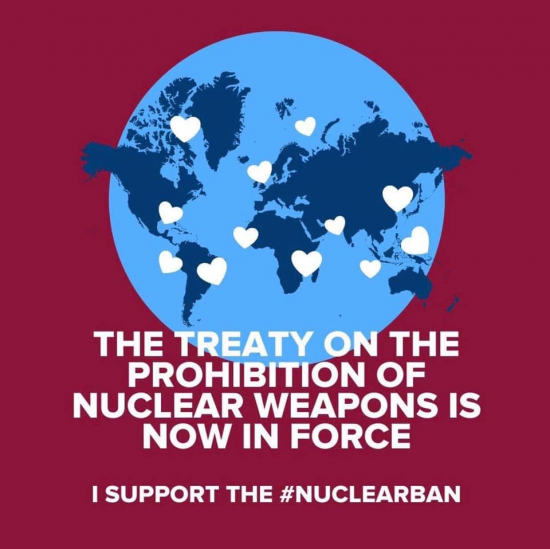
The need for a more aggressive approach ought to have been obvious, if for no other reason than the rest of the world already has given up hope for arms control. In 2017, more than 60 percent of the world’s nations — 122 countries — voted for a United Nations treaty not to limit, not to “one day” eliminate, but to abolish nuclear weapons now. If the apparent loss of faith in arms control by funders isn’t enough, the loss of faith by much of the world ought to be unmistakable proof.
Clearly, a more muscular approach is needed. Continuing to try long-term, careful approaches to the problem guarantees that efforts to oppose nuclear weapons eventually will wither and die. It is time for a stronger, more aggressive strategy — and past time to directly challenge the fundamental beliefs of nuclear weapons advocates. The arms control approach clearly has failed.
It has failed because it took the claims and assumptions of nuclear weapons advocates at face value. Nuclear weapons experts said that nuclear weapons were the “ultimate guarantee” of safety, and arms control nongovernmental organizations and scholars then tried to work within that assumption………..
Nuclear weapons advocates say that nuclear weapons are the “ultimate weapon.” Arms control advocates asked themselves, “How can we persuade people that a ban on the ultimate weapon would ever work?” They should have asked: “Isn’t utility the measuring stick of a weapon? How can a weapon be the ultimate weapon if it’s never used? Isn’t it possible that nuclear weapons are too clumsy, too poisonous, too dangerous to be useful? Isn’t it possible that they aren’t used because they aren’t militarily useful? And isn’t that why nearly 75 years have passed with them sitting idly in silos?”
Arms control is dead. The second nuclear arms race is on. The hour is late — but it is, perhaps, not too late to aggressively challenge the Cold War assumptions and the blinkered mindset that have kept us from seeing the reality of nuclear weapons. https://thehill.com/opinion/national-security/561786-why-nuclear-arms-control-is-dead
North Korea Needs the Bomb to Protect Itself From America
North Korea Needs the Bomb to Protect Itself From America
Pyongyang isn’t crazy, just focused on a credible threat.
Foreign Policy,By Doug Bandow, a senior fellow at the Cato Institute. 9 July 21, ”’………….. North Korea’s quest for nukes has helped make it an economic disaster, turning it into a global pariah and diverting resources from economic investment. That’s one reason the country, as Kim admitted in public recently, is facing another critical food crisis. However, it now is an unofficial member of the world’s exclusive nuclear club.
Nevertheless, the mere possession of nuclear weapons does not mean it threatens America with them. North Korea makes no pretense of having global concerns, other than using diplomatic relations for profit when possible. In the abstract, the Kim dynasty has no interest in the United States or even the Western Hemisphere. Pyongyang’s priority is regional, especially avoiding domination by another power.China exerted substantial influence (Russia less so) over the ancient Korean kingdom, long known as a shrimp among whales. Japan was a colonial oppressor during the first half of the 20th century. Most important today is North Korea’s relations with South Korea, as the two states remain engaged in a de facto civil war, short-circuited by outside intervention in 1953. One reason China’s importunities against North Korea’s nuclear program fall flat is because such weapons help Pyongyang preserve its independence from Beijing.
However, the United States has intruded in Northeast Asia. America intervened in the Korean War, maintains forces in and around the Korean Peninsula, is prepared to intervene in a future conflict, and regularly threatens to wage preventive war.
Indeed, Washington’s willingness to routinely oust governments on Uncle Sam’s naughty list makes the United States particularly dangerous. Washington can’t even be trusted to live up to a denuclearization accord, as Libya’s Muammar al-Qaddafi discovered a decade ago. The Iranians learned that one president’s word does not bind their successor.The North desires a deterrent. At the party congress earlier this year, Kim explained, according to a summary report by state media, that “Korea was divided by the U.S., the world’s first user of nukes and war chieftain, and the DPRK has been in direct confrontation with its aggressor forces for decades, and the peculiarities of the Korean revolution and the geopolitical features of our state required pressing ahead uninterruptedly with the already-started building of nuclear force for the welfare of the people, the destiny of the revolution and the existence and independent development of the state.”
That is a prolix way of saying Pyongyang needs the bomb to protect itself from Washington………… https://foreignpolicy.com/2021/07/07/north-korea-nuclear-weapons-united-states-deterrence/
Nuclear weapons testing has never really stopped. We just call underground testing ”subcritical”

10 July 21, We never ended nuclear detonations. The US has performed and continues to perform over 100 nuclear tests explosions 1000 feet below the desert floor on Western Shoshone holy land in Nevada where we have blown up plutonium with high explosive chemicals,
But because it doesn’t cause a chain reaction, Clinton characterized them in 1992, as “ subcritical” tests which he asserted don’t violate the not so comprehensive Comprehensive Test Ban Treaty!! Of course Russia immediately followed our lead and does these nuclear test explosions at Novaya Zemlya in the fragile arctic area. .
Dialogue between Russia and USA must include subject of offensive weapons in outer space – says Russian Foreign Minister
US plans to deploy arms in space should be taken into account in bilateral dialogue-LavrovAmericans are working on a program for the deployment of offensive weapons in outer space in the context of the global missile defense system, Russian Foreign Minister said https://tass.com/politics/1311759
VLADIVOSTOK, July 8. /TASS/. The Russian-US dialogue on strategic stability should reckon with the US program for the deployment of offensive weapons in outer space, Russian Foreign Minister Sergey Lavrov said on Thursday.
“Naturally, when we speak about the necessity to discuss strategic stability in all of its dimensions, we mean all the factors influencing this strategic stability. They include nuclear weapons, non-nuclear strategic weapons, offensive and defensive strategic systems, and, of course, we cannot ignore the fact that the Americans are working on a program for the deployment of offensive weapons in outer space in the context of the global missile defense system,” he said in a lecture he delivered at the Far Eastern Federal University..
The much-awaited Russian-American summit took place in the Swiss capital city of Geneva on June 16. Presidents Vladimir Putin of Russia and Joe Biden of the United States discussed the current state of and prospects for further development of bilateral relations, issues of strategic stability and international matters. The leaders said in a joint statement that the sides planned to launch a comprehensive bilateral dialogue on strategic stability.
U.S. Space Force opens new centre to facilitate war in space
Space Force opens facility to improve war-fighting capabilities CWISRNET, By Nathan Strout 9 July, 21WASHINGTON — The U.S. Space Force opened a new satellite operations center July 7 at Kirtland Air Force Base in New Mexico designed to advance the still nascent service’s space war-fighting capabilities.
The Rendezvous and Proximity (REPR) Satellite Operations Center was established by the Space and Missile Systems Center’s Innovation and Prototyping Directorate as a new workspace to drive on-orbit experimentation and demonstrations with prototype satellites and payloads………….
The center is just the latest space-related facility established at Kirtland Air Force Base, which serves as a home to SMC’s Innovation and Prototyping Directorate, the Air Force Research Laboratory’s Space Vehicles Directorate, and the Space Rapid Capabilities Office. In November, AFRL opened the Deployable Structures Laboratory, a $4 million building dedicated to developing deployable space structures. A few months later, AFRL began construction on the $3.5 million Skywave Technology Laboratory, which will house its space environment research. Most recently, AFRL announced the opening of a $12.8 million Space Warfighting Operations Research and Development, or SWORD, lab to track objects on orbit,
advance satellite cybersecurity, and develop autonomous capabilities. https://www.c4isrnet.com/battlefield-tech/space/2021/07/08/space-force-opens-up-new-operations-center-to-improve-war-fighting-capabilities/
William Perry and Jerry Brown address the unwisdom of spending $2 trillion on new nuclear weapons
Spending $2 trillion on new nuclear weapons is a risk to more than just your wallet, Business Insider, BILL PERRY, JERRY BROWN, JOHN GARAMENDIJUL 7, 2021,
- The US is pursuing the modernization of all three legs of the nuclear triad, at an estimated cost of $1.7 trillion over 30 years.
- Simultaneous modernization exceeds what’s needed for an effective nuclear deterrent and is an unnecessarily costly and risky way to achieve our deterrence requirements.
- Bill Perry is a former US secretary of defense. Jerry Brown is a former governor. John Garamendi is the US Representative for California’s 3rd Congressional District.
The world is witnessing a new, dangerous nuclear arms race. Tensions are rising between the Great Powers. As the US, Russia, and China rush to modernize their nuclear arsenals, the trip wire is becoming more taut by the day.
Observation and communication satellites and systems are increasingly vulnerable to attacks. All three countries are fielding stealth and hypersonic nuclear delivery systems designed to evade detection. The risks of a false alarm or a political miscalculation has always haunted the nuclear landscape, and they do even more today.
Last week, legislation was introduced in the US House of Representatives to address the misguided nuclear modernization strategy the US is currently employing and chart a safer, more cost-effective course for our modernization efforts – one that is predicated on deterrence rather than dominance.
As long as nuclear weapons exist, we must have a safe, secure, and effective nuclear deterrent. However, simultaneous modernization efforts across all three legs of the nuclear triad exceed that scope and are an unnecessarily costly and risky way to achieve our deterrence requirements.
The current US nuclear modernization strategy includes the Ground Based Strategic Deterrent (GBSD), the B-21 bomber, the Columbia-class submarine, the Long-Range Standoff (LRSO) air-launched cruise missile, the sea launched nuclear cruise missile, and new nuclear warheads.
The costs of these projects are extraordinary: a 2017 Congressional Budget Office (CBO) report estimated that the 30-year cost of nuclear weapons spending would be $1.2 trillion ($1.7 trillion adjusted for inflation).
As the Government Accountability Office recently noted, the current plan to modernize every part of the US nuclear arsenal simultaneously is a recipe for schedule delays and cost overruns.
The ICBM leg of the triad deserves special attention. The total price tag to procure the GBSD is projected to be at least $95 billion, and up to $264 billion when accounting for total life-cycle costs. A pause in the GBSD will help defray short-term costs for the Air Force and will also defer a long-term expenditure.
Additionally, the W87-1, the warhead that is being designed for the GBSD, will cost at least $12 billion to build – and is not part of the estimated GBSD procurement cost of $95 billion. To build new warhead cores for the W87-1, the National Nuclear Security Agency (NNSA) is expanding plutonium pit production, which will cost at least another $9 billion through the late 2020s according to the Congressional Budget Office…………..
Maintaining and upgrading the current Minuteman III missile is not only technically possible – it is also cost-effective. According to a 2017 CBO report, it would cost $37 billion less to maintain the MMIII than developing and deploying the GBSD through 2036.
It’s clear that replacing the Minuteman III for the GBSD is a wasteful and costly undertaking that is not in our national security interest. That’s why we are supporting the “Investing in Commonsense Ballistic Missiles (ICBM) Act of 2021,” which was introduced in the US House of Representatives last week by Congressman Garamendi.
This bill will simply pause the development of the GBSD, and the associated W87-1 nuclear warhead, and life extend the Minuteman III until 2040 – something that is both technically feasible and more cost-efficient. This extension provides time for arms control negotiations and additional debate on the utility of a ground-based system, which may make this program unnecessary.
This legislation will help deescalate the modern nuclear arms race and prevent the unnecessary spending of billions of taxpayer dollars. That’s why nine members of Congress joined Garamendi’s “ICBM Act” as original cosponsors, and it’s why 12 policy experts and arms control associations have joined us in endorsing the legislation.
The “ICBM Act” will strengthen our national security and save billions of tax-payer dollars by:
- Prohibiting the use of funds for the GBSD program and W87-1 warhead modification program for fiscal years 2022 through 2031;
- Extending the service life of the Minuteman III missiles until at least 2040, and requiring use of nondestructive testing methods and technologies similar to those used by the Navy for Trident II D5 SLBMs; and
- Transferring back to the Air Force all unobligated funds for the GBSD program, and transferring unobligated funds for the W87-1 warhead modification program from the National Nuclear Security Administration to the Treasury.
As a former US secretary of defense, governor of California, and current chair of the Armed Services Subcommittee on Readiness, we have an intimate understanding of this issue and the urgency with which we must address it.
We have visited the launch sites. We have met the young Air Force captains who sit in the buried bunker ready to turn the launch keys for atomic bombs capable of destroying a city three times the size of Hiroshima. It sobers the mind and underscores the need to chart a new course for our modernization strategy before we cross a line from which we cannot return.
Bill Perry is the former US secretary of defense who served under President Bill Clinton. Jerry Brown is the former governor of California and is currently the executive chair of the Bulletin of the Atomic Scientists. John Garamendi is the US Representative for California’s 3rd Congressional District and chair of the Armed Services Subcommittee on Readiness.https://www.businessinsider.com.au/nuclear-modernization-plans-are-unnecessarily-costly-and-risky-2021-7?r=US&IR=T
The UK and Ireland Nuclear Free Local Authorities (NFLA) deplore the new secrecy on defence nuclear safety reports
The UK and Ireland Nuclear Free Local Authorities (NFLA) is very disappointed with the decision of a tribunal appeal related to the Information Commissioner that has decided to not allow certain defence nuclear safety reports to be published, citing ‘national security’ grounds.
As ‘The Ferret’ investigative journalism site has uncovered, annual reports by the Ministry of Defence’s (MOD) internal watchdog, the Defence Nuclear Safety Regulator (DNSR), were published for 10 years under the Freedom of Information Act, but ceased in 2017, when the MOD deemed these reports now as ‘too sensitive’ to go into the public realm.
The Ferret has noted previously that the reports for 2005 to 2015 highlighted “regulatory risks” 86 times, including 13 rated as ‘high priority’. One issue repeatedly seen as a high risk was a growing shortage of suitably qualified and experienced nuclear engineers, which is of real concern to
the NFLA.
NFLA 5th July 2021
The all-American story of the twin horrors climate change and nuclear weapons

An All-American Horror Story
SCHEERPOST, BY MODERATOR July 5, 2021, An All-American Horror StoryThree-quarters of a century of nuclear follies — and that’s just for starters. By Tom Engelhardt / TomDispatch. Yes, once upon a time I regularly absorbed science fiction and imagined futures of wonder, but mainly of horror. What else could you think, if you read H.G. Wells’s War of the Worlds under the covers by flashlight while your parents thought you were asleep? Of course, that novel was a futuristic fantasy, involving as it did Martians arriving in London to take out humanity. Sixty-odd years after secretly reading that book and wondering about the future that would someday be mine, I’m living, it seems, in that very future, however Martian-less it might be. Still, just in case you hadn’t noticed, our present moment could easily be imagined as straight out of a science-fiction novel that, even at my age, I’d prefer not to read by flashlight in the dark of night.
I mean, I was barely one when Hiroshima was obliterated by a single atomic bomb. In the splintering of a moment and the mushroom cloud that followed, a genuinely apocalyptic power that had once rested only in the hands of the gods (and perhaps science-fiction authors) became an everyday part of our all-too-human world. From that day on, it was possible to imagine that we — not the Martians or the gods — could end it all. It became possible to imagine that we ourselves were the apocalypse. And give us credit. If we haven’t actually done so yet, neither have we done a bad job when it comes to preparing the way for just such a conclusion to human history.
Let’s put this in perspective. In the pandemic year 2020, 76 years after two American atomic bombs left the cities of Hiroshima and Nagasaki in ashes, the world’s nuclear powers actually increased spending on nuclear weapons by $1.4 billion more than they had put out the previous year. And that increase was only a small percentage of the ongoing investment of those nine — yes, nine — countries in their growing nuclear arsenals. Worse yet, if you happen to be an American, more than half of the total 2020 “investment” in weaponry appropriate for world-ending scenarios, $37.4 billion to be exact, was plunked down by our own country. (A staggering $13.3 billion was given to weapons maker Northrop Grumman alone to begin the development of a new intercontinental ballistic missile, or ICBM, the one thing our thoroughly troubled world obviously needs.) In all, those nine nuclear powers spent an estimated $137,000 a minute in 2020 to “improve” their arsenals — the ones that, if ever used, could end history as we know it.
In the Dust of the History of Death
Imagine for a second if all that money had instead been devoted to creating and disseminating vaccines for most of the world’s population, which has yet to receive such shots and so be rescued from the ravages of Covid-19, itself a death-dealing, sci-fi-style nightmare of the first order. But how could I even think such a thing when, in the decades since this country dropped that first atomic bomb on Hiroshima, it’s learned its atomic lessons all too well? Otherwise, why would its leaders now be planning to devote at least $1.7 trillion over the next three decades to “modernizing” what’s already the most modern nuclear arsenal on the planet?…………
Consider it an irony of the first order, then, that U.S. leaders have spent years focused on trying to keep the Iranians from making a single nuclear weapon, but not for a day, not for an hour, not for a second on keeping this country from producing ever more of them and the delivery systems that would distribute them anywhere on this planet. In that light, just consider, for instance, that, in 2021, the U.S. is preparing to invest more than $100 billion in producing a totally new ICBM, whose total cost over its “lifespan” (though perhaps the correct word would be “deathspan”) is already projected at $264 billion — and that’s before the cost overruns even begin. All of this for a future that… well, your guess is as good as mine.
Or consider that, only recently, the American and Russian heads of state, the two countries with by far the biggest nuclear arsenals, met in Geneva, Switzerland, and talked for hours, especially about cyberwar, while spending little appreciable time considering how to rein in their most devastating weaponry and head the planet toward a denuclearized future.
And keep in mind that all of this is happening on a planet where it’s now commonplace scientific knowledge that even a nuclear war between two regional powers, India and Pakistan, could throw so many particulates into the atmosphere as to create a nuclear winter on this planet, one likely to starve to death billions of us. In other words, just one regional nuclear conflict could leave the chaos and horror of the Covid-19 pandemic in the unimpressive dust of the history of death………….
While it’s seldom thought of that way, climate change should really be reimagined as the equivalent of a slow-motion nuclear holocaust……….
there was no mushroom cloud, but rather a “cloud” of greenhouse gases forming over endless years beyond human vision. Still, let’s face it, on this planet of ours, not in 2031 or 2051 or 2101 but right at this very moment, we’re beginning to experience the equivalent of a slow-motion nuclear war.
In a sense, we’re already living through a modern slo-mo version of Hiroshima, no matter where we are or where we’ve traveled. At this moment, with an increasingly fierce megadrought gripping the West and Southwest, the likes of which hasn’t been experienced in at least 1,200 years, among the top candidates for an American Hiroshima would be Phoenix (118 degrees), Las Vegas (114 degrees), the aptly named Death Valley (128 degrees), Palm Springs (123 degrees), and Salt Lake City (107), all record temperatures for this season. A recent report suggests that temperatures in famed Yellowstone National Park are now as high or higher than at any time in the past 20,000 years (and possibly in the last 800,000 years). And temperatures in Oregon and Washington are already soaring in record fashion with more to come, even as the fire season across the West arrives earlier and more fiercely each year. As I write this, for instance, California’s Big Sur region is ablaze in a striking fashion, among growing numbers of western fires. Under the circumstances, ironically enough, one of the only reasons some temperature records might not be set is that sun-blocking smoke from those fires might suppress the heat somewhat. ………
In this desperately elongated version of nuclear war, everything being experienced in this country (and in a similar fashion around the world, from Australia’s brutally historic wildfires to a recent heat wave in the Persian Gulf, where temperatures topped 125 degrees) will only grow ever more extreme, even if, by some miracle, those nuclear weapons are kept under wraps. After all, according to a new NASA study, the planet has been trapping far more heat than imagined in this century so far. In addition, a recently revealed draft of an Intergovernmental Panel on Climate Change report suggests that our over-heating future will only grow worse in ways that hadn’t previously been imagined. Tipping points may be reached — from the melting of polar ice sheets and Arctic permafrost (releasing vast amounts of methane into the atmosphere) to the possible transformation of much of the Amazon rain forest into savannah — that could affect the lives of our children and grandchildren disastrously for decades to come. And that would be the case even if greenhouse-gas releases are brought under control relatively quickly.
Once upon a time, who could have imagined that humanity would inherit the kinds of apocalyptic powers previously left to the gods or that, when we finally noticed them, we would prove eerily unable to respond? Even if another nuclear weapon is never used, we stand capable, in slow-motion fashion, of making significant parts of our world uninhabitable — or, for that matter, if we were to act soon, keeping it at least reasonably habitable into the distant future.
Imagine, just as a modest start, a planet on which every dollar earmarked for nuclear weapons would be invested in a green set of solutions to a world growing by the year ever warmer, ever redder, ever less inhabitable. https://scheerpost.com/2021/07/05/an-all-american-horror-story/
Short time left to make a comment on this very dangerous costly USA Hypersonic plan
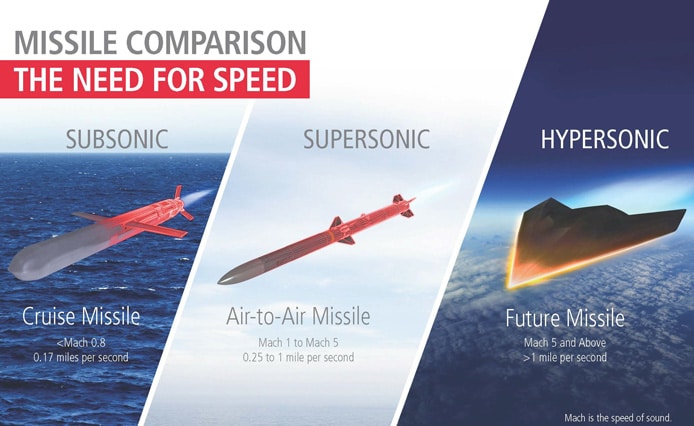
Hypersonic flight is defined as flight through the atmosphere at altitudes below 100 kilometres (km) and at speeds above Mach 5 (~3,800 miles per hour, or roughly 5 times the speed of sound).
MILITARY HYPERSONIC VEHICLE DESIGNS
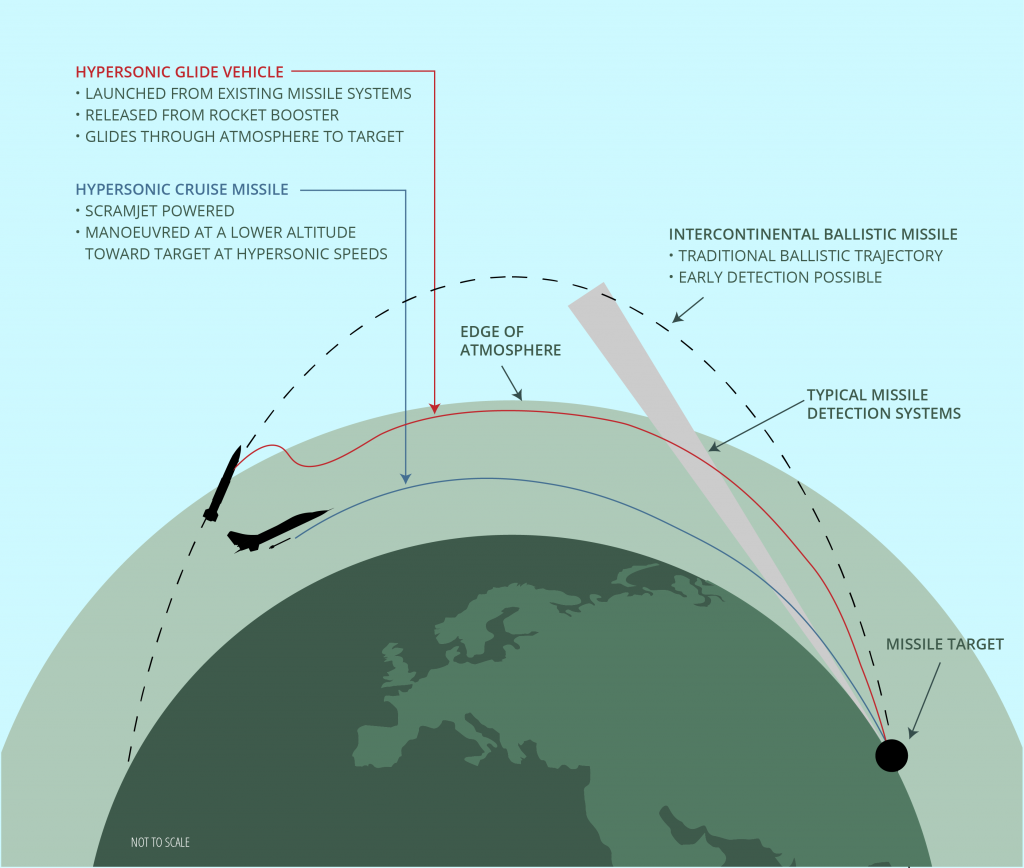
Two types of hypersonic vehicle (see below) are being developed to serve military functions. Both can deliver conventional or nuclear payloads at speeds between Mach 5 and Mach 20, offering virtually unlimited global strike range when coordinated with existing weapons delivery systems.
WHAT IS THE MILITARY VALUE OF HYPERSONIC WEAPONS?
In theory, the key advantages of hypersonic vehicles are speed, evasiveness, and manoeuvrability. Hypersonic missiles and glide vehicles are designed to combine the manoeuvrability of a cruise missile with the speed of a ballistic missile. Unlike ICBMs, which travel in predictable paths at high altitudes in a parabolic arc toward their target, hypersonic weapons take unpredictable paths at low altitudes with higher speeds. As a result, these weapons have the potential to render modern ballistic missile defence systems obsolete. Able to deliver conventional, nuclear, or biological payloads at high velocities over long ranges, hypersonic weapons, if operational, could strike with little notice, enabling unprecedented global first-strike capabilities.
Please make a comment – you don’t have to be an expert.
1) Testing of Hypersonics will dramatically escalate the nuclear arms race/new Cold War2) Our nation can’t afford another arms race – especially one in space3) We need to be spending our national treasury on dealing with our real enemy – climate crisis and growing economic inequality
4) Toxic rocket fuel exacerbates an already grave climate crisis5) It’s time the warmongers listened to the taxpayers
Notice of Availability for the Joint Flight Campaign (JFC) Draft Programmatic Environmental Assessment/Overseas Environmental Assessment (PEA/OEA). The Proposed Action, Joint Flight Campaign (JFC), is sponsored by the Office of the Under Secretary of Defense for Research and Engineering and by the United States Department of the Army (U.S. Army). These agencies have designated the United States Department of the Navy (U.S. Navy) Strategic Systems Programs (SSP) and the U.S. Army Rapid Capabilities and Critical Technologies Office (RCCTO) as the lead agencies for the Proposed Action. The U.S. Army RCCTO, the U.S. Navy SSP, and the United States Army Space and Missile Defense Command (USASMDC), as Participating Agencies, along with the Department of Energy, the National Aeronautics and Space Administration (NASA), the U.S. Air Force 30th Space Wing, and the U.S. Air Force 45th Space Wing as Cooperating Agencies, have prepared this PEA/OEA in accordance with the National Environmental Policy Act (NEPA; 42 United States Code 4321, as amended), the Council on Environmental Quality (CEQ) Regulations for Implementing the Procedural Provisions of NEPA (Title 40 Code of Federal Regulations [CFR] Parts 1500-1508, 1978, July 1, 1986), the Department of the Army Procedures for Implementing NEPA (32 CFR Part 651), the Department of the Air Force Procedures for Implementing NEPA (32 CFR Part 989), Chief of Naval Operations Instruction 5090.1E, and Executive Order 12114, Environmental Effects Abroad of Major Federal Actions.
The Proposed Action entails up to six flight test launches at up to four different launch locations per year, over the next 10 years. Test objectives are expected to dictate range selection from Atlantic and Pacific test ranges. Due consideration will be given to existing launch ranges to avoid any unnecessary changes to the environment. The launch range for each test will be determined based on the test objectives, and the availability and technical suitability of the test range. Test scenarios are planned to include broad ocean area (BOA) impacts of the spent stages and the hypersonic payload, and do not include any land-based impacts. This PEA/OEA is being prepared as a Programmatic EA to provide an analysis of multiple launch locations that will be available to the test directorates over the next 10 years. The launch selection process will utilize this PEA/OEA and will include a check of the relevancy of this document to support specific launch scenarios. It is anticipated that this PEA/OEA will support most future decisions; however, tiered NEPA documents could occur if there are significant changes to the proposed missile or facilities at a proposed launch location.
The U.S. Army RCCTO and U.S. Navy SSP determined that four launch locations meet the screening criteria/evaluation factors and the test requirements for vehicle performance and data collection. They also considered the No Action Alternative, as required by the CEQ regulations. There is one launch location on the west coast and one in Hawai`i, both with impact sites in the Pacific Ocean, and two launch locations on the east coast, with impact sites in the Atlantic Ocean. The Pacific locations analyzed are the Pacific Missile Range Facility, Barking Sands, Kauai, Hawai`i; Vandenberg Space Force Base, California; and BOA impact sites in the Pacific Ocean. The east coast locations include the NASA Wallops Flight Facility, Virginia; Cape Canaveral Space Force Station, Florida; and Atlantic BOA impact sites.
The Draft JFC PEA/OEA and Draft Finding of No Significant Impact (FONSI) are available at http://jfceaoea.govsupport.us. Public comments on the Draft JFC PEA/OEA and Draft FONSI will be accepted from June 11, 2021 to July 10, 2021 and can be provided in either of the following ways: (1) E mail comments by July 10, 2021 to jfceaoea@govsupport.us; (2) Mail comments, postmarked no later than July 10, 2021, to: USASMDC, ATTN: SMDC-EN (D. Fuller), P.O. Box 1500, Huntsville, AL 35807.
(TGI1329762 6/11/21)
Please make a comment – you don’t have to be an expert.
Need for a USA”no first use” of nuclear weapons policy – the concern of regional U.S. allies

In our lead article this week, Van Jackson makes a compelling case for the United States to establish a no-first use policy on nuclear weapons. This would entail a pledge from Washington that its nuclear arsenal would not be used as a means of warfare except in the event that it was first subject to a nuclear attack by an adversary. While there is already some momentum behind such a policy amongst Democrats, Biden has taken no concrete steps towards implementing it and it has yet to be legislated by Congress.
No-first use nuclear policy. https://www.eastasiaforum.org/2021/07/05/no-first-use-nuclear-policy/ Author: Editorial Board, ANU, 5 July 21,
Since the election of Joe Biden in 2020, much of the world has breathed a collective sigh of relief as we have witnessed what appears to be a return to ‘pre-Trump normalcy’ in the United States. One of the greatest foreign policy challenges that faces the Biden administration, however, is recovering US credibility in Asia, which was severely undermined by his predecessor Donald Trump.
From the standpoint of US allies in the region, a concerning aspect of Trump’s rise to the presidency was his loose talk about nuclear weapons and apparent openness to utilising them against adversaries. While most allies have long emphasised the immense benefits of the US security guarantee and its attendant nuclear umbrella, Trump’s rise to power rendered alliance relationships potential liabilities.
These concerns among allies in the region were significantly elevated in 2017, when Trump began to entertain the prospect of launching a pre-emptive — albeit non-nuclear — strike against North Korea. He supposedly even went so far as to order an evacuation of US servicemen and their families from Seoul — an injunction that was ultimately not carried out by US officials in South Korea. His apparent willingness to engage in conflict with a nuclear-armed North Korea was reinforced rhetorically as he threatened ‘fire and fury’ against Kim Jong-un’s regime.
These developments had US allies (and non-allies alike) in the region beleaguered by the prospect of nuclear war in the region. Their concerns were reinforced by Trump’s predilection to appoint family members — with little to no foreign policy expertise — as official advisors. The notion that a US-initiated conflict with North Korea, entailing probable commitment by American allies, might be informed in part by the likes of Ivanka Trump and Jared Kushner was a severe indictment of alliance management.
The election of Joe Biden allayed some of the concerns of US allies. But the fact that Trump received over 70 million votes in the election and may run again for president in 2024 means that his tenure cannot be easily viewed as an unfortunate aberration.
What can Biden do during his presidency to restore confidence among American allies in the region, and restore US credibility in the aftermath of the Trump administration?
In our lead article this week, Van Jackson makes a compelling case for the United States to establish a no-first use policy on nuclear weapons. This would entail a pledge from Washington that its nuclear arsenal would not be used as a means of warfare except in the event that it was first subject to a nuclear attack by an adversary. While there is already some momentum behind such a policy amongst Democrats, Biden has taken no concrete steps towards implementing it and it has yet to be legislated by Congress.
Jackson outlines three common arguments that are cited against a non-first use nuclear policy: China, Russia and North Korea would never believe in the veracity of no-first use declarations; it would encourage uncertainty among adversaries as to whether the United States could use nuclear weapons against them; and there would also be concerns among American allies about the implications of a no-first use policy for US extended nuclear deterrence and Washington’s ability to deter threats on their behalf.
Yet Jackson argues that, ‘ … the world is no longer unipolar. The old bargain — Washington does arms-racing so allies don’t — makes no sense in a world where US politics is depressingly awry. Allied nuclear proliferation poses its own risks, but it may be a better alternative to US nuclear preponderance and presidential first-use launch authority’.
As the region becomes increasingly volatile, a policy of US restraint on the use of nuclear weapons has acquired new urgency. The advent of the Biden administration has done little to alleviate US–China tensions; Biden’s China policy so far appears to be a continuation of that of the Trump administration. Meanwhile, prospects of a cross-Strait crisis continue to rise and progress on the denuclearisation of North Korea remains elusive. These political tensions have been aggravated by economic destabilisation in the region that has been fuelled by the COVID-19 crisis.
These developments have spawned new concerns about conflict and the role of US alliances in the region. Some analysts believe that such conflict would have potential to evolve into nuclear war. Given that the US-led alliance network is premised on the maintenance of regional peace and security, it behoves Washington to clarify that it will not employ first use of nuclear weapons.
This is important for the Biden government. It is also important for the future US administrations that could see the likes of Trump with a finger back on the nuclear button.
The EAF Editorial Board is located in the Crawford School of Public Policy, College of Asia and the Pacific, The Australian National University.
Germany joins 15 other nations to call for an end to nuclear testing ‘once and for all’
Germany, Spain and Sweden: ‘End nuclear weapons testing’ https://www.dw.com/en/germany-spain-and-sweden-end-nuclear-weapons-testing/a-58158956
Germany is joining 15 other countries for a nuclear disarmament conference aiming to build momentum after a US-Russia summit renewed hopes for more arms control between the two nuclear powers.
German Foreign Minister Heiko Maas said ahead of a nuclear arms control conference on Monday that the threat of a nuclear arms race grows “where tension and mistrust predominate.”
“More than ever, we need steps that encourage trust through verifiable agreements created between nuclear-weapons states,” Maas said before departing to Madrid for a meeting of the Stockholm Initiative, which brings together 16 countries advocating global nuclear arms reduction.
The conference follows last month’s summit in Geneva between US President Joe Biden and Russian President Vladimir Putin pledged to start talks on arms control.
A statement after the summit said the US and Russia “seek to lay the groundwork for future arms control and risk reduction measures.”
“We need to build on this with clear steps by nuclear weapons states to fulfill their responsibility and obligations on disarmament,” Maas said, adding that the Geneva summit shows how progress is possible.
An end to nuclear testing ‘once and for all’
A joint editorial written by Maas, Spanish Foreign Minister Arancha Gonzalez Laya, and Swedish Foreign Minister Ann Linde listed several steps nuclear-weapons countries could take toward disarmament.
“This could include downgrading the role of nuclear weapons in strategies and doctrines, reducing the risk of conflict and an accidental nuclear weapon deployment, further reducing nuclear stockpiles and laying the foundations for a new generation of arms control agreements,” the foreign ministers wrote Monday in the Rheinische Post newspaper.
“We must end nuclear weapons testing once and for all by finally bringing the Comprehensive Nuclear-Test-Ban Treaty into force, restarting negotiations on a treaty banning the production of fissile material for military use, and building robust and credible capabilities to verify nuclear disarmament steps,” the editorial added.
What is the status of global nuclear arms control?
In February, the US and Russia agreed to extend the New START disarmament treaty. It limits the nuclear arsenals of both countries to 800 launchers and 1,550 ready-to-use nuclear warheads each.
The New START treaty is the only major arms control treaty in place between the US and Russia after the US withdrew from the Open Skies Treaty in May citing Russian non-compliance.
At the beginning of 2021, the US, Russia, the UK, France, China, India, Pakistan, Israel and North Korea possessed a total of 13,080 nuclear warheads, a decrease of 320 from the previous year, according to the Stockholm Peace Research Institute SIPRI annual report published in June.
1 This Month





PLEASE OPPOSE HR 8255 AND S.3639 – bills would accelerate satellite deployment, with no environmental review or safeguards – https://ncstd5li.quorum.us/campaign/169331/
To see nuclear-related stories in greater depth and intensity – go to https://nuclearinformation.wordpress.com
-
Archives
- October 2026 (67)
- September 2026 (339)
- August 2026 (330)
- July 2026 (355)
- June 2026 (287)
- May 2026 (306)
- April 2026 (356)
- March 2026 (251)
- February 2026 (267)
- January 2026 (308)
- December 2025 (358)
- November 2025 (359)
-
Categories
- 1
- 1 NUCLEAR ISSUES
- business and costs
- climate change
- culture and arts
- ENERGY
- environment
- health
- history
- indigenous issues
- Legal
- marketing of nuclear
- media
- opposition to nuclear
- PERSONAL STORIES
- politics
- politics international
- Religion and ethics
- safety
- secrets,lies and civil liberties
- spinbuster
- technology
- Uranium
- wastes
- weapons and war
- Women
- 2 WORLD
- ACTION
- AFRICA
- Atrocities
- AUSTRALIA
- Christina's notes
- Christina's themes
- culture and arts
- Events
- Fuk 2022
- Fuk 2023
- Fukushima 2017
- Fukushima 2018
- fukushima 2019
- Fukushima 2020
- Fukushima 2021
- general
- global warming
- Humour (God we need it)
- Nuclear
- RARE EARTHS
- Reference
- resources – print
- Resources -audiovicual
- Weekly Newsletter
- World
- World Nuclear
- YouTube
-
RSS
Entries RSS
Comments RSS

