Tokyo’s Games Are Harming the Nuclear Weapons Ban

a two-week Olympic media blitz that normalizes nuclear disasters and shrugs at rising nuclear dangers, which illustrates why –
we need a new drive for mass nuclear literacy. With arms control in retreat, an informed citizenry could be our last, best line of defense.
Tokyo’s Games Are Harming the Nuclear Weapons Ban Movement https://www.thenation.com/article/society/tokyo-olympics-nuclear-weapons/
By paying lip service to the Fukushima disaster and the nuclear bombs dropped on Japan, these games are downplaying the growing danger of nuclear catastrophe.
By Alyn Ware
The Olympics are supposed to be a tangible symbol of global cooperation and peaceful competition. But the games carry a lot of baggage—not only from the pandemic but also from the Fukushima disaster and Japan’s nuclear politics.
As Covid cases spread in the Olympic Village and in Tokyo, protesters continue to demand the Olympics be canceled, and they continue to be ignored. But the tone-deafness of these Olympics goes back further—to the Fukushima nuclear disaster. In 2019, then–Prime Minister Shinzo Abe dubbed the Tokyo Olympics the “Recovery Games,” meant “to showcase the affected regions of the tsunami” and the nuclear meltdown of 2011, which continues to pose threats today.
That’s why some Olympic events are being held in Fukushima’s Azuma Stadium, and why Olympic torch runners have been routed through Fukushima prefecture, hitting what the official Olympic website calls “places of interest” near the Fukushima Daiichi nuclear plant. It started at J-Village, a former logistics hub for crews working to remediate the stricken reactors, now a sports complex, where Greenpeace detected a radiation hot spot in late 2019. It passed through Ōkuma and Futaba, where the plant is located, and other nearby towns long abandoned after the disaster.
This is intended to project an image of recovery and normalcy to the world. But it’s government propaganda, deaf to citizens’ concerns, and blind to ongoing threats. Fukushima Daiichi continues to leak radioactivity. New radiation hot spots and other impacts are being discovered all the time.
This sort of Olympic spin tactic has been used before. In the 1964 Tokyo Olympics, the government sought to portray Japan as a modern industrial nation with its own nuclear research program. Yoshinori Sakai, born in Hiroshima on the day the atomic bomb was dropped, lit the Olympic flame. A scant year and half after the Cuban missile crisis, this gesture soft-pedaled the dangers of nuclear technology, nuclear weapons, and the burgeoning arms race.
Today, the tone-deafness continues. This month, on the anniversary of the Trinity nuclear tests that enabled the atomic bombings of Japan, IOC President Thomas Bach went to Hiroshima to lay a wreath at a memorial, prompting an angry response. “President Bach using the image of ‘a peaceful world without nuclear weapons’ only to justify holding of the Olympics by force under the pandemic is a blasphemy to atomic bombing survivors,” a coalition of civic groups wrote. “An act like this does nothing but do harm to the global nuclear weapons ban movement.”
Billions watching the games are imbibing the idea that, protests notwithstanding, Covid, Fukushima, the atomic bombings, and rising nuclear dangers today pose no impediment to normalcy. This should be countered with factual context and truth-telling.
Nuclear Games, a new documentary available online, attempts this by contrasting the Olympic ideals of peace and humanity with our history of nuclear violence and inhumanity (full disclosure: My organization Basel Peace Office is one of several NGOs helping with the project). It uses manga and interactive content to counter Olympic spin and teach mass audiences, including young people, Nuclear History 101: the Cuban missile crisis, Chernobyl, the victims of uranium mining and nuclear testing, the North Korean nuclear program.
We urgently need remedial education on nuclear issues. Most millennials believe nuclear war will occur within the next decade, yet they also rank nuclear weapons as the least important of 12 global issues. They’re both justifiably anxious and badly misinformed.
Achieving basic nuclear literacy is indispensable now. Nuclear dangers are more acute than in 1964, the risk of nuclear war is growing, and the arms control regime is failing. This year, the Bulletin of the Atomic Scientists moved its Doomsday Clock ahead to 100 seconds before midnight—closer to the zero hour than during the Cuban missile crisis.
Nuclear weapons states are turning away from arms control and embarking on a second Cold War–style arms race. As China builds missile silos and Russia builds new types of nuclear weapons, the United Kingdom and Pakistan are expanding their nuclear arsenals, the United States is spending billions to “modernize” its arsenal, and other nuclear powers are following suit.
To be sure, there is pushback. Some 1,200 policy-makers, celebrities, academics, and civil society leaders issued a joint letter to presidents Biden and Putin flagging growing nuclear dangers and urging them to adopt a no-first-use policy to defuse nuclear tensions and facilitate disarmament. US Senators Ed Markey and Jeff Merkley and their colleagues on the Nuclear Arms Control Working group recently called on Biden to guide the Nuclear Posture Review towards a pledge of no first use and the elimination of new types of nuclear weapons.
But such things can hardly compete with a two-week Olympic media blitz that normalizes nuclear disasters and shrugs at rising nuclear dangers, which illustrates why we need a new drive for mass nuclear literacy. With arms control in retreat, an informed citizenry could be our last, best line of defense.
Algeria: deep resentment of French colonialism and the effects of nuclear bombing -still very real today.

In Algeria, France’s 1960s nuclear tests still taint ties, https://www.france24.com/en/africa/20210729-in-algeria-france-s-1960s-nuclear-tests-still-taint-ties More than 60 years since France started its nuclear tests in Algeria, their legacy continues to poison relations between the North African nation and its former colonial ruler.The issue has come to the fore again after President Emmanuel Macron said in French Polynesia on Tuesday that Paris owed “a debt” to the South Pacific territory over atomic tests there between 1966 and 1996.
The damage the mega-blasts did to people and nature in the former colonies remains a source of deep resentment, seen as proof of discriminatory colonial attitudes and disregard for local lives.
Diseases related to radioactivity are passed on as an inheritance, generation after generation,” said Abderahmane Toumi, head of the Algerian victims’ support group El Gheith El Kadem.
“As long as the region is polluted, the danger will persist,” he said, citing severe health impacts from birth defects and cancers to miscarriages and sterility.
France carried out its first successful atomic bomb test deep in the Algerian Sahara in 1960, making it the world’s fourth nuclear power after the United States, the Soviet Union and Britain.
Today, as Algeria and France struggle to deal with their painful shared history, the identification and decontamination of radioactive sites remains one of the main disputes.
In his landmark report on French colonial rule and the 1954-62 Algerian War, historian Benjamin Stora recommended continued joint work that looks into “the locations of nuclear tests in Algeria and their consequences”.
France in the 1960s had a policy of burying all radioactive waste from the Algerian bomb tests in the desert sands, and for decades declined to reveal their locations.
‘Radioactive fallout’
Algeria’s former veterans affairs minister Tayeb Zitouni recently accused France of refusing to release topographical maps that would identify “burial sites of polluting, radioactive or chemical waste not discovered to date”.”The French side has not technically conducted any initiative to clean up the sites, and France has not undertaken any humanitarian act to compensate the victims,” said Zitouni. According to the Ministry of the Armed Forces in Paris, Algeria and France now “deal with the whole subject at the highest level of state”.
“France has provided the Algerian authorities with the maps it has,” said the ministry.
Between 1960 and 1966, France conducted 17 atmospheric or underground nuclear tests near the town of Reggane, 1,200 kilometres (750 miles) from the capital Algiers, and in mountain tunnels at a site then called In Ekker.
Eleven of them were conducted after the 1962 Evian Accords, which granted Algeria independence but included an article allowing France to use the sites until 1967.
A radioactive cloud from a 1962 test sickened at least 30,000 Algerians, the country’s official APS news agency estimated in 2012.
French documents declassified in 2013 revealed significant radioactive fallout from West Africa to southern Europe. Algeria last month set up a national agency for the rehabilitation of former French nuclear test sites.
In April, Algeria’s army chief of staff, General Said Chengriha, asked his then French counterpart, General Francois Lecointre, for his support, including access to all the maps.
We respect our dead’Receiving the maps is “a right that the Algerian state strongly demands, without forgetting the question of compensation for the Algerian victims of the tests,” stressed a senior army officer, General Bouzid Boufrioua, writing in the defence ministry magazine El Djeich.”France must assume its historical responsibilities,” he argued.President Abdelmadjid Tebboune, however, ruled out any demands for compensation, telling Le Point weekly that “we respect our dead so much that financial compensation would be a belittlement. We are not a begging people.”France passed a law in 2010 which provided for a compensation procedure for “people suffering from illnesses resulting from exposure to radiation from nuclear tests carried out in the Algerian Sahara and in Polynesia between 1960 and 1998”.
But out of 50 Algerians who have since launched claims, only one, a soldier from Algiers who was stationed at one of the sites, “has been able to obtain compensation”, says the International Campaign to Abolish Nuclear Weapons (ICAN).
No resident of the remote desert region has been compensated, it said.
In a study released a year ago, “Radioactivity Under the Sand”, ICAN France urged Paris to hand Algeria a complete list of the burial sites and to facilitate their clean-up.
The 2017 Treaty on the Prohibition of Nuclear Weapons obliges states to provide adequate assistance to individuals affected by the use or testing of nuclear weapons.
It was signed by 122 UN member states, but by none of the nuclear powers. France argued the treaty was”incompatible with a realistic and progressive approach to nuclear disarmament”.
ICAN France in its study argued that “people have been waiting for more than 50 years. There is a need to go faster.
“We are still facing an important health and environmental problem that must be addressed as soon as possible.”
A-bomb survivor activist, 89, calls Japan’s failure to back nuclear ban ‘disgraceful’
A-bomb survivor activist, 89, calls Japan’s failure to back nuclear ban ‘disgraceful’ https://mainichi.jp/english/articles/20210729/p2a/00m/0na/034000c
July 30, 2021 (Mainichi Japan) TOKYO — The world took a major step toward a nuclear-free world when the Treaty on the Prohibition of Nuclear Weapons completely banning the use and storage of atomic arms went into effect in January.
Nuclear powers and countries like Japan which are under the U.S. nuclear umbrella have not signed the treaty, only going as far as joining the Treaty on the Non-Proliferation of Nuclear Weapons (NPT), but the influence of the ban treaty on the NPT is enormous.
However, the COVID-19 pandemic has meant that top-level meetings concerning both treaties have not been held as planned, grinding international discussion of them to a halt. The pandemic has also thrown cold water on citizens’ anti-atomic weapons activism, forcing events to be minimized or canceled outright.
With the 76th anniversaries of America’s atomic bombings of Hiroshima and Nagasaki fast approaching, what do hibakusha — people exposed to the effects of the bomb — still alive today think of these dilemmas?
“This is the only country in the world to have been attacked with nuclear bombs in wartime, and yet it can’t ratify the Treaty on the Prohibition of Nuclear Weapons. I think it’s so pitiful, so disgraceful,” said Terumi Tanaka, the 89-year-old co-chair of the Japan Confederation of A- and H-Bomb Sufferers Organizations. Anger laced his calm tones, obvious even over the online video conference.
In response to the nuclear arms ban treaty going into effect, Tanaka began a petition drive to urge the Japanese government to join the treaty. But half a year has passed now with him unable to go out in the streets due to the pandemic………..
Countries with nuclear weapons won’t attend the conference of the signatories, and only countries without the arms will need to seek ways to ban them. “How do we get nuclear-armed countries involved? I think a time is coming where a great effort will have to be put in (to activism),” he said.
Getting nuclear powers and those under the nuclear umbrella like Japan to take part is no simple task. But while the coronavirus has prevented certain forms of activism, and spread with apparent ease across borders, Tanaka sees a silver lining in the situation, saying, “It’s presented the opportunity to realize that the conflicts countries have between each other are meaningless.”
With this year marking the 65th anniversary of the Japan Confederation of A- and H-Bomb Sufferers Organizations’ founding, Tanaka had in mind that it would mark a sense of closure. Its general meeting is held every June, but due to the state of emergency declared in Tokyo, it has been turned into an on-paper event this year.
“It was very disappointing. We’d needed to do a full review of our activism so far,” Tanaka said regretfully. The average age of hibakusha now is over 83. The generation of people with clear, unshakeable memories of that time like Tanaka, who was 13 when the bomb was dropped on Nagasaki, are gradually but steadily leaving this world.
“We experienced that sound with our bodies. The people who will make up the core of the activism going forward were very young children when they were exposed to the bomb, so they have few memories of the time involving their five senses. But, they might at some point remember what was for them a strange experience. In that sense, those people can be said to have experienced it first hand, too,” he said.
In March, Tanaka ended the international campaign he has pursued for five years to see an earlier implementation of the ban treaty. At the end of May, he resigned as chair of the Saitama Prefecture hibakusha association. After days spent passionately involved in anti-nuclear activism, Tanaka is thinking of using the time he has now to write about the life he spent giving himself to his work.
“Nuclear weapons are so cruel it seems they don’t even qualify for the name ‘weapon’. This testimony must, even when all the hibakusha are gone, be passed down for as long as the human race exists,” Tanaka said.
(Japanese original by Kayo Mukuda, Tokyo City News Department)
China is building a 2nd base for nuclear missiles, still way behind USA and Russia
China is building a 2nd base for nuclear missiles, say analysts Al Jazeera, 28 July 21,
Researchers in the US say China is building 250 silos for nuclear missiles in ‘the most significant expansion of the Chinese nuclear arsenal ever’. Analysts at the Federation of American Scientists say China is building a second field of silos for launching nuclear missiles in a development that could constitute “the most significant expansion of the Chinese nuclear arsenal ever”.
The United States-based researchers made the discovery after analysing commercial satellite images, and said on Monday that the field – located near the city of Hami in Xinjiang province – may eventually include about 110 silos.
The new field is about 380km (236 miles) from a base near the city of Yumen in neighbouring Gansu province, where a separate group of researchers earlier this month found construction under way on 120 missile silos.
Altogether, the People’s Liberation Army Rocket Force now appears to have 250 silos under construction at Hami, Yumen, as well as at a training ground near the city of Jilantai in Inner Mongolia, wrote the FAS’s Matt Korda and Hans Kristensen.
The number marks a significant increase, they said, given that China has for decades operated only 20 silos for its liquid fuel Df-5 Intercontinental Ballistic Missiles (ICBM)………
Korda and Kristensen noted, however, that even if China were to double or triple its nuclear stockpile it would still be a long way from near-parity with the stockpiles of Russia and the US, each of which have nuclear warhead stockpiles of close to 4,000.
Regardless of how many silos China ultimately intends to fill with ICBMs, this new missile complex represents a logical reaction to a dynamic arms competition in which multiple nuclear-armed players – including Russia, India, and the United States – are improving both their nuclear and conventional forces as well as missile defense capabilities,” they said…………
The US has repeatedly called on China to join it and Russia on a new arms control treaty.
Beijing has rejected the call, but said it would be happy to hold arms control talks if the US was willing to reduce the size of its nuclear arsenal to China’s level. https://www.aljazeera.com/news/2021/7/28/china-is-building-a-second-missile-silo-field-say-us-researchers
Moltex Energy’s nuclear pyroprocessing project with plutonium would produce weapons grade material and encourage weapons proliferation
Will Canada remain a credible nonproliferation partner? https://thebulletin.org/2021/07/will-canada-remain-a-credible-nonproliferation-partner/
By Susan O’Donnell, Gordon Edwards | July 26, 2021
Susan O’Donnell Susan O’Donnell is a researcher specializing in technology adoption and environmental issues at the University of New Brunswick.
Gordon Edwards Gordon Edwards is a mathematician, physicist, nuclear consultant, and president of the Canadian Coalition for Nuclear Responsibility,
The recent effort to persuade Canada to sign the Treaty on the Prohibition of Nuclear Weapons has stimulated a lively debate in the public sphere. At the same time, out of the spotlight, the start-up company Moltex Energy received a federal grant to develop a nuclear project in New Brunswick that experts say will undermine Canada’s credibility as a nonproliferation partner.
Moltex wants to extract plutonium from the thousands of used nuclear fuel bundles currently stored as “high-level radioactive waste” at the Point Lepreau reactor site on the Bay of Fundy. The idea is to use the plutonium as fuel for a new nuclear reactor, still in the design stage. If the project is successful, the entire package could be replicated and sold to other countries if the Government of Canada approves the sale.
The recent effort to persuade Canada to sign the Treaty on the Prohibition of Nuclear Weapons has stimulated a lively debate in the public sphere. At the same time, out of the spotlight, the start-up company Moltex Energy received a federal grant to develop a nuclear project in New Brunswick that experts say will undermine Canada’s credibility as a nonproliferation partner.
Moltex wants to extract plutonium from the thousands of used nuclear fuel bundles currently stored as “high-level radioactive waste” at the Point Lepreau reactor site on the Bay of Fundy. The idea is to use the plutonium as fuel for a new nuclear reactor, still in the design stage. If the project is successful, the entire package could be replicated and sold to other countries if the Government of Canada approves the sale.
On May 25, nine US nonproliferation experts sent an open letter to Prime Minister Justin Trudeau expressing concern that by “backing spent-fuel reprocessing and plutonium extraction, the Government of Canada will undermine the global nuclear weapons non-proliferation regime that Canada has done so much to strengthen.”
The nine signatories to the letter include senior White House appointees and other US government advisers who worked under six US presidents: John F. Kennedy, Lyndon B. Johnson, Richard Nixon, George H.W. Bush, Bill Clinton, and Barack Obama; and who hold professorships at the Harvard Kennedy School, University of Maryland, Georgetown University, University of Texas at Austin, George Washington University, and Princeton University.
Plutonium is a human-made element created as a byproduct in every nuclear reactor. It’s a “Jekyll and Hyde” kind of material: on the one hand, it is the stuff that nuclear weapons are made from. On the other hand, it can be used as a nuclear fuel. The crucial question is, can you have one without the other?
India exploded its first nuclear weapon in 1974 using plutonium extracted from a “peaceful” Canadian nuclear reactor given as a gift many years earlier. In the months afterwards, it was discovered that South Korea, Pakistan, Taiwan, and Argentina—all of them customers of Canadian nuclear technology—were well on the way to replicating India’s achievement. Swift action by the US and its allies prevented these countries from acquiring the necessary plutonium extraction facilities (called “reprocessing plants”). To this day, South Korea is not allowed to extract plutonium from used nuclear fuel on its own territory—a long-lasting political legacy of the 1974 Indian explosion and its aftermath—due to proliferation concerns.
Several years after the Indian explosion, the US Carter administration ended federal support for civil reprocessing of spent nuclear fuel in the US out of concern that it would contribute to the proliferation of nuclear weapons by making plutonium more available. At that time, Canada’s policy on reprocessing also changed to accord with the US policy—although no similar high-level announcement was made by the Canadian government.
Moltex is proposing to use a type of plutonium extraction technology called “pyroprocessing,” in which the solid used reactor fuel is converted to a liquid form, dissolved in a very hot bath of molten salt. What happens next is described by Moltex chairman and chief scientist Ian Scott in a recent article in Energy Intelligence. “We then—in a very, very simple process—extract the plutonium selectively from that molten metal. It’s literally a pot. You put the metal in, put salt in the top, mix them up, and the plutonium moves into the salt, and the salt’s our fuel. That’s it. … You tip the crucible and out pours the fuel for our reactor.”
The federal government recently supported the Moltex project with a $50.5-million grant, announced on March 18 by Intergovernmental Affairs Minister Dominic LeBlanc in Saint John.
At the event, LeBlanc and New Brunswick Premier Blaine Higgs described the Moltex project as “recycling” nuclear waste, although in fact barely one-half of one per cent of the used nuclear fuel is potentially available for use as new reactor fuel. That leaves a lot of radioactive waste left over.
From an international perspective, the government grant to Moltex can be seen as Canada sending a signal—giving a green light to plutonium extraction and the reprocessing of used nuclear fuel.
The US experts’ primary concern is that other countries could point to Canada’s support of the Moltex program to help justify its own plutonium acquisition programs. That could undo years of efforts to keep nuclear weapons out of the hands of countries that might want to join the ranks of unofficial nuclear weapons states such as Israel, India, Pakistan, and North Korea. The Moltex project is especially irksome since its proposed pyroprocessing technology is very similar to the one that South Korea has been trying to deploy for almost 10 years.
In their letter, the American experts point out that Japan is currently the only nonnuclear-armed state that reprocesses spent nuclear fuel, a fact that is provoking both domestic and international controversy.
In a follow-up exchange, signatory Frank von Hippel of Princeton University explained that the international controversy is threefold: (1) The United States sees both a nuclear weapons proliferation danger from Japan’s plutonium stockpile and also a nuclear terrorism threat from the possible theft of separated plutonium; (2) China and South Korea see Japan’s plutonium stocks as a basis for a rapid nuclear weaponization; and (3) South Korea’s nuclear-energy R&D community is demanding that the US grant them the same right to separate plutonium as Japan enjoys.
Despite the alarm raised by the nine authors in their letter to Trudeau, they have received no reply from the government. The only response has come from the Moltex CEO Rory O’Sullivan. His reply to a Globe and Mail reporter is similar to his earlier rebuttal in The Hill Times published in his letter to the editor on April 5: the plutonium extracted in the Moltex facility would be “completely unsuitable for use in weapons.”
But the International Atomic Energy Agency (IAEA) has stated that “Nuclear weapons can be fabricated using plutonium containing virtually any combination of plutonium isotopes.” All plutonium is of equal “sensitivity” for purposes of IAEA safeguards in nonnuclear weapon states.
Similarly, a 2009 report by nonproliferation experts from six US national laboratories concluded that pyroprocessing is about as susceptible to misuse for nuclear weapons as the original reprocessing technology used by the military, called PUREX.
In 2011, a US State Department official responsible for US nuclear cooperation agreements with other countries went further by stating that pyroprocessing is just as dangerous from a proliferation point of view as any other kind of plutonium extraction technology, saying: “frankly and positively that pyro-processing is reprocessing. Period. Full stop.”
And, despite years of effort, the IAEA has not yet developed an approach to effectively safeguard pyroprocessing to prevent diversion of plutonium for illicit uses.
Given that history has shown the dangers of promoting the greater availability of plutonium, why is the federal government supporting pyroprocessing?
It is clear the nuclear lobby wants it. In the industry’s report, “Feasibility of Small Modular Reactor Development and Deployment in Canada,” released in March, the reprocessing (which they call “recycling”) of spent nuclear fuel is presented as a key element of the industry’s future plans.
Important national and international issues are at stake, and conscientious Canadians should sit up and take notice. Parliamentarians of all parties owe it to their constituents to demand more accountability. To date however, there has been no democratic open debate or public consultation over the path Canada is charting with nuclear energy.
Countless Canadians have urged Canada to sign the UN Treaty on the Prohibition of Nuclear Weapons that came into force at the end of January this year. Ironically, the government has rebuffed these efforts, claiming that it does not want to “undermine” Canada’s long-standing effort to achieve a Fissile Materials Cut-off Treaty. Such a treaty would, if it ever saw the light of day (which seems increasingly unlikely), stop the production of weapons usable materials such as highly enriched uranium and (you guessed it) plutonium.
So, the Emperor not only has no clothes, but his right hand doesn’t know what his left hand is doing.
Biden administration approves $25 Billion Pentagon budget increase, despite calls from House Democrats opposing this.

Because of its role in setting defense policy—which determines subsidies and other rewards to private industry—the Senate Armed Services Committee is awash in cash from military contractors. According to OpenSecrets, Reed’s top contributors during the 2020 campaign cycle included Lockheed Martin and General Dynamics, two of the leading beneficiaries of federal contracts.
A Huge Outrage’: Senate Panel Approves $25 Billion Pentagon Budget Increase https://www.commondreams.org/news/2021/07/23/huge-outrage-senate-panel-approves-25-billion-pentagon-budget-increase
“Not so incidentally, the $25 billion spending increase approved by the Senate Armed Services Committee exactly matches the cost to scale up Covid-19 vaccine production to meet global demand.”
The Senate Armed Services Committee agreed Thursday to add $25 billion to President Joe Biden’s already massive $715 billion Pentagon spending request, a move that prompted immediate outrage from progressive activists who have been demanding cuts to the bloated U.S. military budget.
“Just the proposed $25 billion increase to the Pentagon budget alone could end homelessness in the United States, making clear that senators are more interested in increasing the profits of military contractors than meeting the needs of everyday working people,” said Carley Towne, co-director of the anti-war group CodePink.
Because of its role in setting defense policy—which determines subsidies and other rewards to private industry—the Senate Armed Services Committee is awash in cash from military contractors. According to OpenSecrets, Reed’s top contributors during the 2020 campaign cycle included Lockheed Martin and General Dynamics, two of the leading beneficiaries of federal contracts.
Robert Weissman, president of the watchdog group Public Citizen, said in a statement Thursday that “anyone who cares about our national security should oppose this increase in Pentagon spending and demand… that the funds that would have gone to the Pentagon instead be allocated to global Covid-19 vaccine production or other human needs priorities.”
“When the coronavirus has demonstrated that all the guns in the world can’t protect our national security; when the U.S. spends more on its military than the next eleven nations combined; when we are withdrawing from Afghanistan and therefore reducing required military expenditures; when the Pentagon can’t pass an audit; when the Pentagon continues to lavish funds on the F-35 which is ten years behind schedule, double the original price tag and plagued by performance issues (like engines that don’t work); what possible justification is there for increasing the Pentagon budget over and above the increase already requested by the Biden administration?” Weissman asked.
“Not so incidentally,” he added, “the $25 billion spending increase approved by the Senate Armed Services Committee exactly matches the cost to scale up Covid-19 vaccine production to meet global demand.”
In addition to money for the Pentagon, the Senate panel’s proposed NDAA includes nearly $30 billion in funding for the Department of Energy, which manages the nation’s nuclear stockpile. Just a day after more than 20 Democratic lawmakers demanded reductions in the United States’ nuclear arsenal, the Senate Armed Services Committee called for “recapitalizing and modernizing the U.S. nuclear triad.”
The House and Senate must ultimately agree to identical legislation for the NDAA to become law. Given the narrow margins in both chambers, progressive members of Congress could credibly threaten to tank any bill that includes what they consider to be excessive funding for the Pentagon.
In March, 50 House Democrats led by Reps. Barbara Lee (D-Calif.), Mark Pocan (D-Wis.), and Jake Auchincloss (D-Mass.) demanded cuts to Defense Department budget, arguing the money would be better spent on “diplomacy, humanitarian aid, global public health, sustainability initiatives, and basic research.”
But Biden ignored the Democrats’ call, requesting $715 billion for the Pentagon—an increase from the current $704 billion spending level approved under former President Donald Trump.
Democrat lawmakers call on President Biden to reduce the role of nuclear weapons in the upcoming Nuclear Posture Review.
SENATORS MARKEY, MERKLEY AND REPS. BEYER, GARAMENDI LEAD COLLEAGUES IN URGING PRESIDENT BIDEN TO REDUCE MILITARY ROLE OF U.S NUCLEAR WEAPONS IN UPCOMING NUCLEAR POSTURE REVIEW https://www.markey.senate.gov/news/press-releases/senators-markey-merkley-and-reps-beyer-garamendi-lead-colleagues-in-urging-president-biden-to-reduce-military-role-of-us-nuclear-weapons-in-upcoming-nuclear-posture-review Washington (July 22, 2021)–
Today, Senators Edward J. Markey (D-Mass.), Jeffrey A. Merkley (D-Ore.) and Representatives Don Beyer (VA-08) and John Garamendi (CA-03), co-chairs of the Nuclear Weapons and Arms Control Working Group, led 18 of their colleagues in calling on President Joseph R. Biden to actively guide the formation of the Department of Defense-led Nuclear Posture Review. The Nuclear Posture Review (NPR) will be part of an integrated National Defense Strategy that the Department of Defense says will be completed by early next year. The lawmakers urged the Administration to consider a series of bold actions that would fulfill the President’s pledge to reduce the role of “nuclear weapons in our national security strategy.”
“Mr. President, as a United States Senator and then as Vice President, you were a party to every major nuclear weapons debate of the past five-decades. From bolstering the Anti-Ballistic Missile Treaty, to building European support for the Intermediate-Nuclear Forces Treaty, to securing votes for ratification of the New START Treaty, you have consistently been on the right side of history. Your Administration’s NPR is a watershed moment where you can reject a 21st century arms race and make bold decisions to lead us towards a future where nuclear weapons no longer threaten all humanity,” the lawmakers wrote in their letter to President Biden.
Specifically, the lawmakers called for President Biden’s Nuclear Posture Review to:
- Adjust U.S. declaratory policy to assign a reduced role for U.S. nuclear weapons, consistent with the President’s past stated view that: “Given our non-nuclear capabilities and the nature of today’s threats — it’s hard to envision a plausible scenario in which the first use of nuclear weapons by the United States would be necessary. Or make sense.”
- Direct the Department of Defense to include in its proposed target list a breakdown of the damage expectancy, civilian casualties, and climatic and humanitarian consequences stemming from nuclear weapons use.
- Examine the number and types of new weapons needed to deter nuclear attack, taking into account recommendations from the Government Accountability Office to consider deferring or cancelling certain nuclear weapons modernization programs.
- Complete independent review of the proposed intercontinental ballistic missile (ICBM) – the Ground Based Strategic Deterrent – that looks into the technical feasibility and comparative cost savings of life-extending the current Minuteman III ICBM.
- Eliminate two of President Trump’s new types of nuclear weapons: the nuclear sea-launched cruise missile (SLCM) under development and the low-yield W-76(2) warhead already deployed on U.S. ballistic missile submarines.
- Commit to pursuing robust diplomacy with Russia and China on arms control through U.S.-Russia bilateral strategic stability talks, which build upon an extended New START Treaty, and starting a new bilateral U.S.-China strategic stability dialogue that builds towards the eventual conclusion of arms control measures that reduce the risk of miscalculation.
A copy of the letter can be found HERE.
China threatens Japan with nuclear war over intervention in Taiwan
China threatens Japan with nuclear war over intervention in Taiwan, Business Standard, 23 July 21,
Deputy PM Aso urged dialogue to resolve any issue The Chinese Communist Party aired a video in which it warned Japan of a nuclear response and “full-scale war” if the island nation interferes in China’s handling of Taiwan, Fox News reported.
The video, which appeared on a channel approved by the CCP, singles out Japan as the one exception to China’s policy to not use nuclear weapons against non-nuclear powers.
“We will use nuclear bombs first,” the video said. “We will use nuclear bombs continuously. We will do this until Japan declares unconditional surrender for the second time.” The video was deleted from Chinese platform Xigua after gaining 2 million views, but copies were uploaded to YouTube and Twitter, Taiwan News reported. Accoding to Fox News,the threats follow comments made two weeks ago by Japanese officials about Taiwan’s sovereignty, with Deputy Prime Minister Taro Aso saying that Japan must “defend Taiwan,” The Japan Times reported……. https://www.business-standard.com/article/international/china-threatens-japan-with-nuclear-war-over-intervention-in-taiwan-121072300030_1.html
Maohi Lives Matter’: Tahiti protesters condemn French nuclear testing legacy

Maohi Lives Matter’: Tahiti protesters condemn French nuclear testing legacy https://globalvoices.org/2021/07/23/maohi-lives-matter-tahiti-protesters-condemn-french-nuclear-testing-legacy/
France conducted 193 nuclear tests in the South Pacific by Mong Palatino 23 July 20217
More than 1,000 people gathered in the Tahiti capital of Papeete to condemn the failure of the French government to take full accountability for its nuclear testing program in the South Pacific.
France conducted 193 nuclear tests from 1966–1996 in Mā’ohi Nui (French Polynesia). France’s 41st nuclear experiment in the Pacific led to catastrophe on July 17, 1974, when France tested a nuclear bomb codenamed “Centaure.” Because of weather conditions that day, the test caused an atmospheric radioactive fallout which affected all of French Polynesia. Inhabitants of Tahiti and the surrounding islands of the Windward group were reportedly subjected to significant amounts of ionizing radiation 42 hours after the test, which can cause significant long-term health problems.
The July 17, 2021 protest was organized under the banner of #MaohiLivesMatter to highlight the continuing fight for nuclear justice. Campaigners said that despite the statement of former French President François Hollande in 2016 recognizing the negative environmental and health impact of the nuclear tests, the French government has done little to provide compensation or rehabilitation to French Polynesia.
After analyzing 2,000 pages of declassified French military documents about the nuclear tests, in March 2021 a group of researchers and investigative journalists from INTERPRT and Disclose released their findings on the health implications of the experiments.
According to our calculations, based on a scientific reassessment of the doses received, approximately 110,000 people were infected, almost the entire Polynesian population at the time.
The report has revived public awareness in France about the impact of their nuclear testing program. The French government held a roundtable discussion about the issue in Paris in early July. Though some criticized the French government for their alleged lack of transparency around the clean-up efforts in French Polynesia, officials denied these claims.
Protesters in Tahiti insisted that the French government should do more to address the demands of French Polynesian residents. Some noted that if French President Emmanuel Macron was able to seek forgiveness for the role of France in enabling the Rwanda genocide in 1994, he should at least make a similar apology for the harmful legacy of the nuclear tests in the Pacific.
The #MaohiLivesMatter protest has inspired solidarity in the Pacific.
The International Campaign to Abolish Nuclear weapons (ICAN) Australia issued this statement of support:
As you gather in Maohi Nui on the 17th July we offer our deep respects to your leaders and community members who have long spoken out against the harms imposed by these weapons. We have heard your calls for nuclear justice. We continue to listen closely when you speak of the lived experience of the testing years and the on–going harms.
French President Emmanuel Macron is expected to tackle the legacy of nuclear testing during his visit to Tahiti this month.
Moral Intelligence or Nuclear War, by Robert C. Koehler
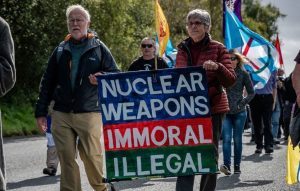
“To declare that nuclear weapons can only “legally” be used in retaliation for a nuclear strike hardly leaves me feeling safe. Are we left with a world continually at war with itself, with our best hope being that all future wars will be waged legally and politely?”
Moral Intelligence or Nuclear War, by Robert C. Koehler — Rise Up Times
Moral Intelligence or Nuclear War, by Robert C. Koehler,
We can no longer create a wasteland and call it peace.
By ROBERT C. KOEHLER Common Dreams Rise UpTimes July 15, 2021
Let’s dance at the border! One of these days, something will give—the rich, the powerful will suddenly look around cluelessly. What’s happening? Awareness will sweep across the planet: We are one, and life is sacred. This consciousness will even invade political life and what I call moral intelligence will find political traction.
This won’t mean that life suddenly becomes simple—anything but! The politics of today, nationally and internationally, is simple: somebody wins, somebody loses; war is inevitable, there are always several on the horizon, and the primary consequence of every war that is waged is that it spurs more wars, a fact that remains officially unnoticed; only some lives matter, those that don’t are collateral damage, illegal aliens or simply the enemy; nuclear weapons (ours, only ours) are justified, necessary and must be continually upgraded; national borders, however arbitrary, are sacred (the only thing that’s sacred); if these norms are challenged, the best response is mockery and cynicism.
The game of war has been going on sufficiently long—a dozen millennia or whatever—and is at its stopping point.
Transcending this mindset requires facing life in all its complexity, which is a necessary part of our personal lives. But could it be that facing the endless complexity of life is also politically possible? This seems to be the question I’ve been given to ponder—and cherish—as I step into my elder years. Come on! Politics requires simplistic public herding, does it not? You can’t steer a country without an enemy.
As a peace journalist, I usually begin by focusing on the media. Consider this recent Washington Post piece regarding the use of nuclear weapons. Even though the article is critical of the Trump administration, which in 2018 “expanded the role of nuclear weapons by declaring for the first time that the United States would consider nuclear retaliation in the case of ‘significant non-nuclear strategic attacks,” the article remains trapped, I fear, in linear, conventional thinking………..
the assumption that “the public” (whatever that is) would be focused on vengeance after a horrific cyberattack is simplistic, to say the least. The public—you, me, and perhaps everyone on the planet—would be in shock, wounded and grieving, and would be primarily focused on healing, help and the heroism of the many who gave their lives in rescue efforts. When I recall the days right after 9/11, what I think about are people lined up to donate blood, not shaking their fists in cartoonlike demands for vengeance against whomever.
But to slide such an assumption—the public is impulsive and stupid—into an article about nuclear weapons removes the possibility of bringing a larger awareness to the discussion, a public awareness that nuclear weapons should never be used and, indeed, should not exist, in our hands or anyone else’s. The Post appears not to want to go that far,….
I fear there are far deeper realities loose in the world: a military-industrial complex that will do whatever it can to prevent the world from transcending war; the possibility of a president in political trouble, seeing war (even the nuclear button) as a solution; and the hidden forces of the deep state, exerting pressures on political leaders the public will never know about.
To declare that nuclear weapons can only “legally” be used in retaliation for a nuclear strike hardly leaves me feeling safe. Are we left with a world continually at war with itself, with our best hope being that all future wars will be waged legally and politely?
Regarding nukes, the Post notes, the Obama administration’s guidance document declares that “the United States “will not intentionally target civilian populations or civilian objects.” And a former head of the U.S. Strategic Command under Obama told the Post the command had developed nuclear delivery “tactics and techniques to minimize collateral effects.”
“Minimized collateral damage” is a phrase you’d use only in regard to people whose lives didn’t matter. And if the weapons involved are nuclear, it sounds like a grotesque lie. All of which intensifies my outrage: We are one, and life is sacred. The game of war has been going on sufficiently long—a dozen millennia or whatever—and is at its stopping point. We can no longer create a wasteland and call it peace. The wasteland it is in our power to create is Planet Earth.
I know the human species has what it takes to reach beyond its artificial borders and refuse to let this happen. The time for the best of us to emerge is now. https://wordpress.com/read/feeds/34005311/posts/3456649903
The tally of North Korea’s nuclear weapons
Nuclear Notebook: How many nuclear weapons does North Korea have in 2021? Bulletin of the Atomic Scientists
By Hans M. Kristensen, Matt Korda, July 21, 2021 orth Korea has made significant advances over the past two decades in developing a nuclear weapons arsenal. It has detonated six nuclear devices––one with a yield of well over 100 kilotons––and test-flown a variety of new ballistic missiles, several of which may be capable of delivering a nuclear warhead to targets in Northeast Asia and potentially in the United States and Europe. However, there is considerable uncertainty about which of North Korea’s missiles have been fielded with an active operational nuclear capability.
It is widely assumed that North Korea has operational nuclear warheads for medium-range missiles. However, it is unclear whether it has managed to develop fully functioning nuclear warheads that can be delivered by long-range ballistic missiles and, following violent atmospheric reentry, detonate as planned. That said, just because North Korea has not yet publicly demonstrated a capability to deliver a functioning nuclear reentry vehicle on a long-range ballistic missile does not necessarily indicate that it is not working on developing one or could not field one in the future. It is clear from its development efforts and public statements that North Korea ultimately intends to field an operational nuclear arsenal capable of holding regional and US targets at risk.
Due to the lack of clarity surrounding North Korea’s nuclear program, agencies and officials of the US intelligence community, as well as military commanders and nongovernmental experts, struggle to assess the program’s characteristics and capabilities. Based on publicly available information about North Korea’s fissile material production and missile posture, we cautiously estimate that North Korea might have produced sufficient fissile material to build 40 to 50 nuclear weapons and that it might possibly have assembled 10 to 20 warheads for delivery by medium-range ballistic missiles.
North Korea’s nuclear policy
North Korea declared a no-first-use policy following its fourth nuclear test in 2016; however, it diluted its statement with the caveat that it would not “be the first to use nuclear weapons […] as long as the hostile forces for aggression do not encroach upon its sovereignty”………………
Nuclear testing and warhead capabilities
After six nuclear tests––including two with moderate yields and one with a high yield––there is no longer any doubt that North Korea can build powerful nuclear explosive devices designed for different yields. ………………………..
Medium-range ballistic missiles
North Korea has developed three medium-range ballistic missiles (MRBMs), all three of which are likely to be operational. This is the category of missile that is most likely to have an operational nuclear capability…………
Intercontinental ballistic missiles
The most dramatic development has been North Korea’s display and test-launching of large ballistic missiles that appear to have intercontinental range. North Korea has publicly shown five types of missiles in this category: the Taepo Dong-2, the Hwasong-13, the Hwasong-14, the Hwasong-15, and the Hwasong-16. These systems are in various stages of development, and some may simply be mockups or technology demonstrators……………………. https://thebulletin.org/premium/2021-07/nuclear-notebook-how-many-nuclear-weapons-does-north-korea-have-in-2021/
Pentagon review: What happens if ‘nuclear football’ is lost?
Pentagon review: What happens if ‘nuclear football’ is lost? Questions about security procedures arose after Jan. 6, when Vice President Mike Pence was escorted to safety along with a military aide carrying the backup communications system.. 6, when Vice President Mike Pence was escorted to safety along with a military aide carrying the backup communications system.
By The Associated Press NBC News, 21 July 21, WASHINGTON — The Pentagon is taking a rare look at whether it is prepared to deal with the theft or compromise of the portable communications system nicknamed the “nuclear football,” which enables the president or a stand-in to order a nuclear attack.
In announcing the probe Tuesday, the Pentagon inspector general’s office did not disclose what precipitated it, but questions about security procedures arose in the aftermath of the Jan. 6 insurrection at the Capitol.
Vice President Mike Pence was seen on security camera video being escorted to safety, along with a military aide carrying the backup “nuclear football,” as rioters entered the Capitol.
A backup system always accompanies the vice president so that he is able to communicate in the event the president cannot. The “football,” officially called the Presidential Emergency Satchel, enables communication with the office inside the Pentagon that transmits nuclear attack orders.
The inspector general’s office said its review began this month. It gave no timeline for completing it.
“The objective of this evaluation is to determine the extent that DoD processes and procedures are in place and adequate to alert DoD officials in the event that the Presidential Emergency Satchel is lost, stolen, or compromised,” Randolph R. Stone, an assistant inspector general, wrote in a July 19 letter to the director of the White House military office and the director of the Joint Staff at the Pentagon. “This evaluation will also determine the adequacy of the procedures the DoD has developed to respond to such an event.”
Two Democrats who had asked the Pentagon inspector general to review the matter, Reps. Stephen Lynch of Massachusetts and Jim Cooper of Tennessee, said in a joint statement that the Jan. 6 riot raised questions about whether the Pentagon was even aware that Pence’s “nuclear football” was potentially in danger of falling into the hand of insurrectionists………..
“U.S. Strategic Command, which is responsible for U.S. strategic deterrence and nuclear operations, was reportedly unaware that Vice President Pence, his military aide, and the nuclear football were all potentially in danger and only came to understand the gravity of the incident several weeks later when security camera footage was played as a video exhibit during the Senate impeachment trial,” they wrote. https://www.nbcnews.com/politics/national-security/pentagon-review-what-happens-if-nuclear-football-lost-n1274582
With all its wisdom, the human race is killing itself

HELEN CALDICOTT: With all its wisdom, the human race is killing itself, Independent Australia, By Helen Caldicott | 17 July 2021 From a historical perspective, Homo sapiens are an evolutionary aberrant.
Unlike other forms of life, armed with an opposing thumb and a highly developed and advanced neocortex, we have, over time, developed the capacity to destroy most organisms on planet Earth.
This has been accomplished either with the energy of heat, light and power that exist inside the sun or, conversely, by slowly cooking the planet as we release fossil gases — carbon dioxide and methane………..
Little did people know when they developed steam engines, motor cars and factories that were powered by these fossil fuels that within several centuries, such wonderful inventions which made life incredibly easy would, in the long run, threaten the biosphere with eventual extinction.
And ever since humans evolved, the male species has seen fit to harness the overwhelming power of testosterone to kill invading species, but more to the point, slaughter his fellow constituents for territorial gains, power plays and control dynamics. Yes, it is true that other male species will fight to the kill over mating imperatives, food or territorial control, but they have no access to reason, scientific knowledge and moral imperatives.
Congruent with this history, it is obvious that as we became more obsessed with gaining scientific knowledge, such wisdom would be put to better methods of killing.
So where does the human race stand now? Nine countries now own nuclear weapons, with the USA and Russia greatly predominating, owning 94 per cent of all the approximately 14,000 in the world……….
The U.S. now spends over one trillion dollars a year on potential murder, all dressed up in the name of “national defence” which is pure rubbish. Because let’s face it, America has no enemies, Russia has joined the capitalist sphere, China is, at the moment, a little belligerent but the U.S. more so with 800 military bases in 80 foreign countries.
For the human race to survive, it is imperative that we encourage and foster friendship with all nations on Earth, that we reign in the killing testosterone instinct, that women with their nurturing hormones rapidly take control of national governments and pursuant to the teachings of the great moral profits – Jesus, Buddha, Muhammad, and all others – that we rapidly learn to live in peace with each other. Or let’s face it, we are doomed and will take the wonders of billions of years of creation with us. https://independentaustralia.net/article-display/helen-caldicott-with-all-its-wisdom-the-human-race-is-killing-itself,15300
Automation in nuclear weapon systems: lessons from the man who saved the world

, Medium.com. NinaMiller, 16 July, 21, In 1983, the world came within a phone call of nuclear annihilation. When an alert of incoming ballistic missiles registered at an early warning command centre outside of Moscow, Lieutenant Colonel Stanislav Petrov had to decide whether or not to confirm the signal to his superior, an action which could have sparked a catastrophic nuclear exchange. Rather than escalate the report up to Soviet leadership, Petrov — who felt he ‘was sitting on a hot frying pan’ — decided the missile alert was a system malfunction.
Later called ‘the man who saved the world’, Petrov demonstrated an astute understanding of the limits of machine analysis. What can modern policymakers learn from Petrov’s experience about the impact of automation on accidents in nuclear weapon systems?Available information indicates that US officials are integrating greater amounts of automation and potentially machine learning in nuclear command, control, and communications (NC3). Indeed, the fields in which increased automation is being considered vary from predictive maintenance and data analytics to cybersecurity, tracking of adversary submarines, and early warning systems. Human operators often ‘overtrust’ automated systems in other high-consequence environments like civil aviation and medicine, yet it remains unclear exactly how automation misuse could increase the risk of nuclear accidents or escalation………..
an inherent paradox when it comes to human — machine interaction: the more reliable and useful an automated system is, the less likely human operators are to critically assess and pay attention to its function. In other words, the probability of a catastrophic mistake caused by automation bias or complacency in NC3 will be highest for consistent, highly reliable systems with a high level of automation
Will the next Petrov make the right decision? To decrease the risk of automation misuse and instability, next generation command and control will need to reward vigilance, give operators the time and ability to consult additional information, and ensure that nuclear postures in the United States and elsewhere do not encourage over-reliance on machines in a crisis.
Decision-support systems that develop recommendations for human operators about the use of nuclear weapons are likely to involve the highest risk of automation misuse. Machine advice could be misinterpreted or uncritically trusted when the systems perform well in peacetime and wargames, leading users to develop a ‘learned carelessness’ when using the system. The lumberjack effect is perhaps the most counterintuitive and dangerous paradox — if the Soviet early warning system had been highly reliable and vetted, Petrov might not have hesitated.
As US officials contemplate the proper role of machine learning in a modernized NC3 infrastructure, they should be careful not to take the wrong lessons from Petrov’s experience. Human supervision is not enough. Healthy human-machine teams need opportunities to train together and learn from mistakes, which is difficult or impossible for certain NC3 functions like early warning or force planning. Proposed solutions like explainable AI and enhancing trust in AI could actually be counterproductive if they create false expectations of machine reliability or inadvertently encourage complacency. Nuclear modernization in the United States and elsewhere should take as a starting point that the paradoxes of automation cannot be solved, only mitigated and managed.
Nina Miller is a PhD student in MIT’s Department of Political Science and currently a Research Associate with Lawrence Livermore National Laboratory’s Center for Global Security Research (CGSR). Her research focuses on the intersection of international security, political psychology, and technology. https://medium.com/international-affairs-blog/automation-in-nuclear-weapon-systems-lessons-from-the-man-who-saved-the-world-d39aa2f4da5a
New book ”I Alone Can Fix It” -raises question that Trump could have been ready to launch a nuclear war.
Pelosi feared Trump would launch nuclear weapons in final days, book claims, https://thehill.com/blogs/blog-briefing-room/news/563125-pelosi-feared-trump-would-launch-nuclear-weapons-in-final-daysBY LEXI LONAS – 07/15/21 Speaker Nancy Pelosi (D-Calif.) was fearful former President Trump would launch nuclear weapons in his final days in the White House, according to a new book.
Washington Post journalists Carol Leonnig and Philip Rucker write in “I Alone Can Fix It” that Pelosi called Gen. Mark Milley, the chairman of the Joint Chiefs of Staff, after the Capitol riot to express her concerns about Trump’s behavior, the newspaper reported.
According to the book, she wanted to ensure Trump could not start a war and launch nuclear weapons as one of his final acts in power
“This guy’s crazy,” Pelosi reportedly told Milley. “He’s dangerous. He’s a maniac.”
“Ma’am, I guarantee you that we have checks and balances in the system,” Milley responded, Leonnig and Rucker write.
Trump responded to the excerpts from the book by saying that Pelosi is a “nut job.”
“Nancy Pelosi is a known nut job. Her enraged quotes that she was afraid that I would use nuclear weapons is just more of the same. In fact, I was the one who got us out of wars, not into wars,” Trump said.
They also state that Milley and other military officials feared Trump would attempt a coup to stay in power and considered resigning.
“They may try, but they’re not going to f—— succeed,” Milley reportedly told his deputies when discussing the potential of a coup. “You can’t do this without the military. You can’t do this without the CIA and the FBI. We’re the guys with the guns.”
Milley thought Trump was “the classic authoritarian leader with nothing to lose,” the authors write.
Trump in a statement on Thursday dismissed the allegations in the new book, saying he “never threatened, or spoke about, to anyone, a coup of our Government.”
“So ridiculous!” he said while repeating unfounded allegations of massive election fraud and saying he lost respect for Milley last summer.
The authors interviewed more than 140 people for the book, due out on Tuesday, including Trump himself for more than two hours.
1 This Month





PLEASE OPPOSE HR 8255 AND S.3639 – bills would accelerate satellite deployment, with no environmental review or safeguards – https://ncstd5li.quorum.us/campaign/169331/
To see nuclear-related stories in greater depth and intensity – go to https://nuclearinformation.wordpress.com
-
Archives
- October 2026 (67)
- September 2026 (339)
- August 2026 (330)
- July 2026 (355)
- June 2026 (287)
- May 2026 (306)
- April 2026 (356)
- March 2026 (251)
- February 2026 (267)
- January 2026 (308)
- December 2025 (358)
- November 2025 (359)
-
Categories
- 1
- 1 NUCLEAR ISSUES
- business and costs
- climate change
- culture and arts
- ENERGY
- environment
- health
- history
- indigenous issues
- Legal
- marketing of nuclear
- media
- opposition to nuclear
- PERSONAL STORIES
- politics
- politics international
- Religion and ethics
- safety
- secrets,lies and civil liberties
- spinbuster
- technology
- Uranium
- wastes
- weapons and war
- Women
- 2 WORLD
- ACTION
- AFRICA
- Atrocities
- AUSTRALIA
- Christina's notes
- Christina's themes
- culture and arts
- Events
- Fuk 2022
- Fuk 2023
- Fukushima 2017
- Fukushima 2018
- fukushima 2019
- Fukushima 2020
- Fukushima 2021
- general
- global warming
- Humour (God we need it)
- Nuclear
- RARE EARTHS
- Reference
- resources – print
- Resources -audiovicual
- Weekly Newsletter
- World
- World Nuclear
- YouTube
-
RSS
Entries RSS
Comments RSS

