Australian-UK-US nuclear submarine deal makes the connection clear between civilian and military nuclear activities.

In failing fully to investigate this link between military nuclear and civil energy policy, the UK media have also missed more intimate connections. The senior Energy Ministry figure who negotiated the extraordinarily costly electricity contracts with France from the sole UK nuclear power plant currently under development went on to become the leading official in the Defence Ministry.
This same individual confirmed under questioning by Parliament that the nuclear submarine program is connected to civil nuclear policy. And it is this same person who is reported to have played a lead role in brokering the AUKUS deal.
In the United Kingdom, France, the United States, and Australia, policies in non-military, non-nuclear areas are often shaped by military nuclear interests. The AUKUS alliance is driven, in part, by a longstanding crisis in the nuclear submarine industry’s efforts to realize economies of scale.
In these countries, energy policy is steered towards risky, costly, delay-prone nuclear options rather than alternatives. In the process, policymakers impede progress on vital climate targets. Throughout, the public remains unaware. So, the gravest damage inflicted by hidden nuclear military interests is not their warping effects on non-military policy but on the health of democracy.
Australian-UK-US nuclear submarine deal exposes civilian-military links, https://thebulletin.org/2021/11/australian-uk-us-nuclear-submarine-deal-exposes-civilian-military-links/ Bulletin, By, Phil Johnstone | November 9, 2021 Andy Stirling Andy Stirling is Professor of Science and Technology Policy in the Science Policy Research Unit at Sussex University where he co-directs the ESRC. Phil Johnstone is a Senior Research Fellow at the Science Policy Research Unit at Sussex University. Phil has researched and published widely .
Under the AUKUS agreement, the United States and the United Kingdom plan to transfer nuclear submarine technologies to Australia. One international security scholar characterized the deal as “a terrible decision for the nonproliferation regime,” noting grave concerns for peace and security worldwide. Others have expressed concerns about “loopholes” surrounding nuclear submarine fissile materials, increased nuclear risks in the Pacific, and a potential acceleration of an arms race in the region. Still others doubt the purported efficacy of nuclear-propelled submarine designs.
Within national borders, nuclear activities often depend on expensive access to specific skills, supply chains, regulatory and design capabilities, educational and research institutions, and waste management and security infrastructures. These dependencies are especially strong in national struggles to build, maintain, and operate nuclear-propelled submarines. The AUKUS announcement overturned normally sacrosanct nuclear secrecy on these matters. It also raised bigger questions about energy policy, climate strategies, and democracy itself.
In democratic nuclear weapons states such as the United States, the United Kingdom, and France, shared civil-military nuclear industrial bases are largely—albeit indirectly—funded by electricity consumers. Colossal investments in new nuclear power are underwritten by anticipated revenues from future electricity sales. These investments flow through nuclear construction supply chains and outward to support military nuclear activities. In this way, crucial support is given to military infrastructures, outside of defense budgets and off the public books. But as civil nuclear power declines, this massive hidden funding flow may diminish, which presents problems for nuclear submarines whose costs are not only often prohibitive but escalating.
The AUKUS deal makes more sense when viewed in light of this crisis in the US, UK, and French national nuclear submarine industries. Spiralling civil nuclear construction delays, technological failures, bankruptcies, and fraud exercise little effect on government commitments to civil nuclear power, given pressure to underpin military capability. This is why these governments are failing to recognize the radical technology and market changes that render baseload power, according to industry, “outdated.” This is why policymakers so often neglect renewables and storage options that are outcompeting nuclear power. This is why some argue that nuclear power must persist as a “necessary part of the mix” in nuclear weapons states, despite diverse alternatives offering sufficient volumes of zero carbon power more quickly and cheaply than can nuclear.
Although well documented in the defense policy documents of existing and aspiring nuclear weapons states, these military drivers have been seriously neglected in discussions of energy and climate strategies. Recently however, some countries have begun to acknowledge the strong connections between civil and military nuclear capabilities.
In the United States, for instance, a report led by former energy secretary Ernest Moniz said in 2017 that “a strong domestic supply chain is needed to provide for nuclear Navy requirements. This supply chain has an inherent and very strong overlap with … commercial nuclear energy.” Since then, multiple high level reports have acknowledged that US military nuclear programs depend on a vibrant civil nuclear sector. “The connectivity of the civilian and military nuclear value chain—including shared equipment, services, and human capital—has created a mutually reinforcing feedback loop, wherein a robust civilian nuclear industry supports the nuclear elements of the national security establishment,” according to one study. Civil nuclear activities transfer an effective value of $26.1 billion dollars to the US military nuclear enterprise, according to this study.
In recent years, French press reports have hinted that dwindling civil nuclear power threatens national military nuclear capabilities. President Macron confirmed this when he said that “without civil nuclear power, there can be no military nuclear power.” Military drivers of civil nuclear activities are also acknowledged in more authoritarian nuclear states like Russia and China.
Australia possesses some of the most abundant and competitive renewable energy resources in the world. Yet the Australian nuclear lobby argues that acquiring military nuclear technology will benefit the claimed imperative to establish a civil nuclear industry. Prime Minister Scott Morrison asserted that he is not pushing for a civil nuclear power program, but other prominent voices disagree. Referring to submarine-derived small modular reactors, Australian politician and UK trade advisor Tony Abbott said that “if nuclear power is ok at sea, pretty soon it will be ok on land, too.” The Minerals Council for Australia claims that acquiring military nuclear technology is an “incredible opportunity” because it “connect[s] [Australia]… to the growing global nuclear power industry and its supply chains.”
Australian civil nuclear proponents welcome the aspirations of military nuclear proponents—and the reverse is also true. Australia’s military is concerned that a lack of a civil nuclear industry may pose difficulties for sustaining nuclear submarine competencies. Australian Navy Admiral Chris Barry pointed out that the absence of a civil nuclear industry left a “big gap” in the country’s ability to manage nuclear submarines. Some argue that a civil nuclear sector in Australia could provide the skills and expertise to enable military nuclear capability. Others are concerned that Australia will be the only country with nuclear submarines but no civilian nuclear industry. Military nuclear ambitions drive otherwise-inexplicable civil nuclear attachments.
In the United Kingdom, some worry about a post-imperial loss of a coveted “seat at the top table” of world affairs. Here again, nuclear submarine capabilities take center stage. Former prime minister Tony Blair worried that relinquishing nuclear capabilities would be “too big a downgrading of our status as a nation.” Meanwhile, detailed official energy policy analyses urged the government to set nuclear plans aside, given trends in renewables and related options. But shortly after a Defence Ministry report on submarine capabilities, Tony Blair swapped the open energy policy consultation for a quicker, covert process, after which the government proclaimed a “nuclear renaissance.”
The Royal Courts of Justice found reasoning for this policy insufficient, but Blair doubled down. “Nuclear power is back with a vengeance,” he said, invoking the name of the recently launched ballistic missile submarine, HMS Vengeance. He did not mention the military rationale. Since then, UK government white papers have failed to justify the country’s civil nuclear commitments—for instance by comparing nuclear costs with those of renewable alternatives. The commitment is taken for granted.
In the United Kingdom, the submarine industry’s openness about military pressures for civil nuclear power contrasts with energy policymakers’ silence. Now-declassified defense reports express grave worries that faltering civil nuclear programs undermine provision for essential military skills. Submarine-builder BAE Systems admits that funding for civil programs “masks” military costs. Naval reactor manufacturer Rolls Royce states that their expensive, government-funded efforts on ostensibly civilian small modular reactors can “relieve the burden” on Defence Ministry efforts to retain skills and capabilities for military programs. Numerous other government documents highlight synergies between civil and military nuclear skills. Yet when challenged, the UK Government denies that civil nuclear commitments influence military activities.
Boris Johnson emphasized that the AUKUS deal offers the United Kingdom “a new opportunity to strengthen Britain’s position as a science and technology superpower, and … could reduce the cost of the next generation of nuclear submarines for the Royal Navy.” Indeed, as discussed in this publication, the deal is “…likely to have particular significance for the UK’s nuclear program” because “the UK is struggling through a number of issues related to the revamping of its nuclear enterprise.” Despite government denials, Johnson’s statement confirms that the AUKUS deal is influenced by the same cost pressures and economies of scale associated with dogged maintenance of a shared civil-military industrial base.
In failing fully to investigate this link between military nuclear and civil energy policy, the UK media have also missed more intimate connections. The senior Energy Ministry figure who negotiated the extraordinarily costly electricity contracts with France from the sole UK nuclear power plant currently under development went on to become the leading official in the Defence Ministry. This same individual confirmed under questioning by Parliament that the nuclear submarine program is connected to civil nuclear policy. And it is this same person who is reported to have played a lead role in brokering the AUKUS deal.
In the United Kingdom, France, the United States, and Australia, policies in non-military, non-nuclear areas are often shaped by military nuclear interests. The AUKUS alliance is driven, in part, by a longstanding crisis in the nuclear submarine industry’s efforts to realize economies of scale. In these countries, energy policy is steered towards risky, costly, delay-prone nuclear options rather than alternatives. In the process, policymakers impede progress on vital climate targets. Throughout, the public remains unaware. So, the gravest damage inflicted by hidden nuclear military interests is not their warping effects on non-military policy but on the health of democracy.
Biden and Congress agree: Build Back Bombs Better

Biden and Congress agree: Build Back Bombs Better, $1.75 trillion for the social welfare/climate bill; $1.75 trillion for ‘modernizing’ nukes. Asia Times, By JOHN WALSH, NOVEMBER 8, 2021 Last Friday, the US Congress passed the “Infrastructure” Bill, which will be signed into law post haste, says the White House. The bill, designed to upgrade roads, bridges, transport and broadband, is a bricks-and-mortar affair and will benefit industry and commerce. It is the first of two bills that have been the center of attention in the US for months now
The second bill is the Build Back Better bill. This bill has provisions for childcare and preschool, elder care, health care, prescription-drug pricing, immigration and curbing greenhouse-gas emissions. This might be described as a bill for people, not for bricks and mortar. It has been the darling of progressives in Congress. The White House has now promised it will come up for a vote by November 15.
Whatever one may think of the Build Back Better bill, there is no doubt it is a shadow of its original self. The total for the Build Back Better plan was to be in the neighborhood of $6 trillion, as originally envisaged by congressional progressives, and then it slipped to about $3 trillion, and now it has shrunk again to $1.75 trillion – the incredible shrinking Build Back Better bill.
It is woefully inadequate. On health care, greenhouse gases, family leave, education and other matters, it is little more than a stingy beginning.
Now look at the cost of “upgrading” and “modernizing” the US nuclear arsenal, a program that was originated by Barack Obama, after he got his Nobel Peace Prize, and has now ballooned beyond its original $1 trillion price tag to a stunning $1.75 trillion. No shrinkage there. For both main US political parties, no cost is too high to keep us Americans poised every instant on the razor edge of Accidental Armageddon.
Nuclear weapon “modernization,” however, is only one small corner of the total picture. Let’s look at the entire military budget. ………..
The situation is even more barbaric when we look at the entire “national security” budget, which includes the yearly budget of the 17 “intel” agencies and comes to $1.3 trillion. No expenditure is too great, it seems, to ensure that the feds track all our phone conversations and e-mails and harass every unsuspecting Chinese student and academic they can get their mitts on. It would take only 13% of that $1.3 trillion to fund Build Back Better. …………
From all of the above, a compelling proposal emerges. A 23% cut in the military budget (or if you wish to cast your net wider, a 13% cut in the “national security” budget) would fund the entire Build Back Better Bill – with no more cuts.
With a 23% cut for fiscal 2022, the military budget drops from $750 billion to $580 billion. That is still well in excess of the combined military expenditures of $314 billion for China ($252 billion) and Russia ($62 billion). In fact a cut of 50% in the military outlay would still leave it at $375 billion, still higher than the combined expenditure of Russia and China.
If an elected official cannot agree to that, he or she is either paranoid or a hegemonist up to no good. In either event. they should be barred from public office………..
Bomb Back Better,” if we might call it that, will sail through Congress and the White House as effortlessly as a vulture on the wing.
Common sense suggests we Americans transfer our hard-earned dollars from guns to butter, but no such prospect is in sight. Only one act is required to get to that promised land. We must not vote for anyone who cannot see his or her way to an ironclad commitment to a 50% cut in the National “Security” Budget – for starters. It’s as easy as that. https://asiatimes.com/2021/11/biden-and-congress-agree-build-back-bombs-better/
Escalation of nuclear tensions between USA and China as a result of the AUKUS deal
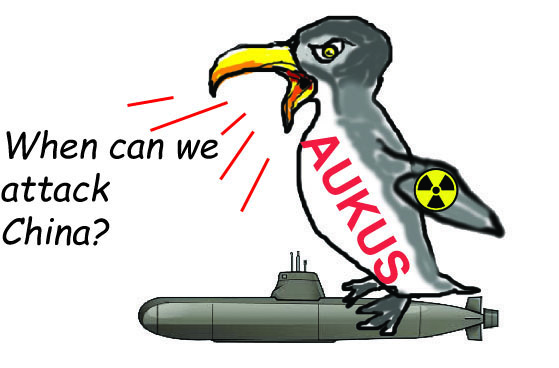
AUKUS, WEAPON PLANS SIGNAL NUCLEAR ESCALATION IN US-CHINA TENSIONS https://ctnewsjunkie.com/2021/11/10/op-ed-aukus/
by Jamil RaglandNovember 10, 2021, What do Groton, Connecticut, and Adelaide, Australia, have in common? Soon, both will be home to one of the United States’ most guarded secrets: nuclear submarine technology.
In mid-September, the United States, United Kingdom, and Australia announced the AUKUS trilateral security partnership (the acronym AUKUS is the combination of the abbreviation for each nation). The key feature of this new security partnership is that the United States will share its knowledge and capabilities in building nuclear-powered submarines with the Australian government. This is a major move, as the US has only shared this technology with Great Britain, the other member of AUKUS.
Australian Prime Minister Scott Morrison stressed that these would only be nuclear-powered submarines, not nuclear armed. Yet as the leaders of the AUKUS nations described their intent to “preserve security and stability in the Indo-Pacific,” all eyes turned to China, the nation which went unmentioned in the remarks, yet who was clearly the focus of the new partnership.
Chinese Foreign Ministry Spokesman Zhao Lijian responded by saying that the security partnership was “extremely irresponsible.” He went on to say that the nuclear submarine cooperation among AUKUS “has seriously undermined regional peace and stability, intensified the arms race, and undermined international non-proliferation efforts.”
Yet China itself tested a new kind of missile in August which ups the ante in terms of weaponry. Known as a hypersonic missile, this weapon is designed to evade US missile defense systems that were built to shoot down old-style ballistic missiles that follow a predictable trajectory after launch. The new Chinese missile enters the atmosphere from a lower point and is maneuverable, which makes intercepting them much more difficult. And the missile is capable of carrying a nuclear payload.
It seems that 50 years of living with “mutually assured destruction” as an actual policy during the US-Soviet Cold War has taught the leaders of the largest nations in the world nothing about the dangers of nuclear posturing. After near accidents and close calls such as the Cuban Missile Crisis, which brought both nations to the brink of war, it appeared that maybe a lesson had been learned. Real progress was made between the Soviet Union (now Russia) and the United States in reducing nuclear stockpiles. At the global peak, there were more than 70,000 nuclear weapons around the world; that number is now down to about 13,000.
But this progress is threatened by the foolhardy arms race the Chinese Foreign Ministry spokesperson warned about, even as his nation was participating in it. We now have US military personnel bragging about the “exquisite timing” with which they can now detonate nuclear weapons to maximize their horrifying destructive capabilities. This is almost certainly a response to China’s new hypersonic missile. And up the ladder of escalation we go.
I’m too young to have experienced bomb drills during the height of the Cold War, but I had teachers who did. My eighth-grade history teacher was obsessed with impressing upon us the power of nuclear weapons; he described in detail the blast radius of a 50-megaton thermonuclear bomb. He showed us the movie The Day After, which showed the after-effects of a nuclear war between the United States and Russia.
He told us that even though we didn’t live near the nuclear silos like the families in the movies, we still weren’t safe. Pratt & Whitney in East Hartford, and of course the naval base at Groton, would put Connecticut on the front lines of a nuclear conflict. I had nightmares for weeks about my impending vaporization.
But ultimately, I realized I was worried about nothing. The Soviet Union had collapsed, and Russia and the United States, while not exactly friends, weren’t exactly enemies either. We were living in what policymakers and writers called the “unipolar moment,” where the United States stood unchallenged in the world. The potential for nuclear war was confined to the movies, no matter how real they seemed.
Now though, what seemed like fantasy is creeping back into the realm of the possible. New weapons, partnerships, and acronyms can’t mask the feeling of historical déjà vu that we’re experiencing now. We even have an island nation to serve as a potential flashpoint for Armageddon – Taiwan in this case, not Cuba. Unless our leaders head off potential conflict and find a peaceful way to coexist, we may have to live with a day after that none of us want.
Jamil Ragland writes and lives in East Hartford. You can read more of his writing at www.nutmeggerdaily.com.
The Children Who Suffered When a U.S. Nuclear Test Went Wrong

The Children Who SufferedWhen a U.S. Nuclear Test Went Wrong https://www.thedailybeast.com/the-children-who-suffered-when-a-us-nuclear-test-went-wrong
YEARS OF SUFFERING
In 1954 the U.S. executed its largest nuclear detonation. The people of the Marshall Islands would endure the effects of fallout for years.Walter Pincus Nov. 07, 2021. During the 1954 Castle Bravo test over Bikini Atoll in the Marshall Islands, America executed its largest nuclear detonation, a thousand times more powerful than the bomb dropped on Hiroshima. Nuclear fallout rained down on inhabitants of atolls more than 100 miles away, including Rongelap.
What follows is an excerpt of Blown to Hell: America’s Deadly Betrayal of the Marshall Islanders, where Dr. Robert A. Conard, a former Navy doctor who was among those who first examined the Marshall Island natives after Bravo, discovers a new impact of the radioactive fallout on children. Beginning in 1956, as an employee of the Atomic Energy Commission’s Brookhaven National Laboratory, Conard led annual medical examinations of the Rongelapese.
Over the years, Dr. Robert A. Conard and pediatricians he brought with him to Rongelap carefully watched the slow development of several children who had been exposed to the 1954 fallout. In the survey done in March 1963, the doctors’ attention was initially focused on two boys who had been one-year-olds at the time of the fallout.
Both showed early signs of cretinism, a condition of stunted physical and mental growth owing to a deficiency of a thyroid hormone often related to iodine deficiency.
Also of particular interest was the development of a palpable nodule in the thyroid gland of 13-year-old Disi Tima, a fisherman’s daughter, who had been exposed to the Bravo fallout when she was four years old.
Ethical Investors press Serco to drop bid for contract with the Atomic Weapons Establishment
Best known for its involvement with NHS test and trace during the
coronavirus pandemic Serco is believed to have had plans to compete for
contracts with the Atomic Weapons Establishment, which makes and maintains
warheads. Serco abandoned its bid after investors warned that if the
FTSE250 company began working on nuclear weapons they may have to dump
shares to meet Environmental, Social and Governance (ESG) standards, the
Telegraph first reported. A spokesperson for Serco declined to comment on
the news.
City AM 7th Nov 2021
Winning and losing the nuclear peace

HOW TO AVOID NUCLEAR WAR, War on the Rocks, MICHAEL KREPON 8 Nov 21, Arms control has become passé. Russian and U.S. leaders have cast aside treaties as inconvenient to their pursuit of freedom of action. Republican presidents produced great arms control achievements. At present, most Republican senators and aspirants for higher office denigrate arms control and treaty-making as a failed, unnecessary, and unwise pursuit. Arms control provided necessary guardrails in the past. Now, dangerous military practices are on the rise, especially in Ukraine and across the Taiwan Strait. U.S.-Chinese relations are trending toward crisis. Four nuclear-armed states in Asia — China, Pakistan, India, and North Korea — are increasing their nuclear arsenals. Every nuclear-armed competitor is relying increasingly on deterrence as the diplomacy of arms control is in the doldrums. If unaltered, these trend lines point toward tragedy.
Many have forgotten what is crucial to remember: Deterrence is dangerous by design and has a track record of failure in lesser cases. ……………………………………..
Those who denigrate arms control forget that, by the end of the Cold War, conditions for lasting nuclear peace were in hand — not because of strengthened deterrence, but because champions of deterrence adopted the practices of arms control. The United States and Russia were no longer enemies. Crucial norms were in place alongside the Anti-Ballistic Missile Treaty, which codified national vulnerability, thereby removing one incentive for increased nuclear force levels. Strategic forces were no longer threatening: Indeed, Boris Yeltsin agreed in the second Strategic Arms Reduction Treaty to the prohibition of land-based missiles carrying multiple warheads. Conditions for strategic, crisis, and arms race stability were therefore at hand. Deep cuts were envisioned. Dangerous military practices were absent. Major powers respected the territorial integrity and national sovereignty of others.
This was the inheritance that Vladimir Putin, George W. Bush, and Donald Trump found unnecessary and inconvenient. ……………………..
In my book, Winning and Losing the Nuclear Peace: The Rise, Demise, and Revival of Arms Control, I propose that we embrace an ambitious goal of extending the three norms of no use, no testing, and no new proliferation to the 100th anniversary of Hiroshima and Nagasaki…………………………………………..
Michael Krepon is the co-founder of the Stimson Center and the author of Winning and Losing the Nuclear Peace: The Rise, Demise, and Revival of Arms Control, from which this essay is drawn. https://warontherocks.com/2021/11/how-to-avoid-nuclear-war/
Time for American lawmakers to press for USA to sign up to the UN Nuclear Weapons Prohibition Treaty
Local Opinion: U.S. should limit nuclear weapons, Raymond Graap, Special to the Arizona Daily Star, 8 Nov 21,
ED. The writer first outlines the near misses – almost nuclear war, that have occurred from the 1960sc onward
”……………This story is told to show how close we came, and how one individual prevented nuclear catastrophe. There have been at least seven other instances when we came very close. Nearly all were terminated by the action of one person, utilizing human judgement instead of reliance on computer warning systems. Humans have made errors, too. The last was a false alarm in Hawaii on Jan. 13, 2018, when a technician sent out the following: “EMERGENCY ALERT. BALLISTIC MISSILE THREAT INBOUND TO HAWAII. SEEK IMMEDIATE SHELTER. THIS IS NOT A DRILL”. Chaotic activity throughout the state followed until a second message 38 minutes later went out advising that the first was an error.
- So, what have we learned about controlling these global terminating weapons? That we must have a different approach. Instead of restraint, the U.S. is on a frantic race to modernize and replace all our bombers, land-based missiles and submarines. So, what are other nuclear-armed countries doing? The same. All are spending huge amounts of money on weapons that no one can use without committing national and global suicide.
- However, for the first time in our history, a treaty on the prohibition of nuclear weapons was passed by the United Nations in 2017 and entered into force in January of this year after the 50th nation ratified it. This represents our only hope as it outlaws the use, possession, manufacture, threat of use, and transfer of nuclear weapons. The goal is the global elimination of these sordid inventions of the human mind.
How many of the nuclear weapons-armed nations have signed on? None, the U.S. included. Our senators and representatives need to vigorously support this effort.
Graap is a retired physician and board member of Physicians for Social Responsibility, , Arizona Chapter. Information about current efforts to abolish nuclear weapons is available at www.preventnuclearwar.org. https://tucson.com/opinion/local/local-opinion-u-s-should-limit-nuclear-weapons/article_1b44011e-3e50-11ec-b9b4-c3cf4a446a5d.html
Much pressure on President Biden to drop plans to limit nuclear weapons

Pentagon bearing down on Biden to shelve nuclear reforms
The president has pledged to narrow the role of atomic weapons. But others cite China to argue for the status quo. Politico, By BRYAN BENDER, ALEXANDER WARD and PAUL MCLEARY 11/05/2021,
President Joe Biden’s pledge to limit the role of nuclear weapons is facing growing resistance from Pentagon officials and their hawkish allies, who are arguing to keep the status quo in the face of Chinese and Russian arms buildups.
Biden’s top national security advisers will soon review the conditions under which the United States might resort to using nuclear weapons. Among the options are adopting a “no first use” policy, or declaring that the “sole purpose” of the arsenal is to deter a nuclear conflict and not use them in response to a conventional war or other strategic assault like a cyber attack.
Both would mark major departures from the current posture, which has been purposely ambiguous throughout the nuclear age about whether the United States might strike first, and holds that atomic weapons are for “deterrence of nuclear and non-nuclear attack.”
Biden’s National Security Council plans to convene a high-level meeting on nuclear declaratory policy this month, according to a White House official who spoke to POLITICO on the condition of anonymity because of the issue’s sensitivity.
But China’s surprising nuclear expansion in recent months alongside Russia’s modernization of its arsenal has strengthened the hand of military leaders who oppose any policy changes or significant cuts to a new generation of missiles, bombers and other atomic weapons, according to a half a dozen current and former government officials privy to the discussions.
Lack of answers’
Biden’s allies in Congress are also beginning to complain about the lack of details from the administration on the nuclear review process, who is advising it, and what it might mean for the president’s goals.
“The Nuclear Posture Review must reflect the President’s guidance to ‘reduce the role of nuclear weapons in our national strategy,’” Sen. Ed Markey (D-Mass.), a member of the Foreign Relations Committee and co-chair of the Nuclear Weapons Working Group, told POLITICO.
Markey penned a letter to Biden in September seeking further explanation on why the Pentagon removed Leonor Tomero from her position running the nuclear review. Tomero, a longtime nuclear policy official, previously worked for Rep. Adam Smith (D-Wash.), chair of the House Armed Services Committee, who has promised legislation to adopt a no first use policy………………..
The “Pentagon’s lack of answers to date about the Nuclear Posture Review leave me concerned the policy review will prioritize the old assumptions of the military industrial complex at the expense of diverse voices seeking to reduce nuclear risks,” Markey told POLITICO in a statement.
………………….. leading arms control advocates don’t sound hopeful that Biden will get the full menu to choose from. “We want to make sure that the president is presented with a full range of options even those that particular agencies — NSC, the Pentagon — may not prefer or recommend,” said Daryl Kimball, executive director of the Arms Control Association. “And it would be a disservice to the president’s Nuclear Posture Review if the nuclear weapons blob at the Pentagon were to give him a limited range of options.” https://www.politico.com/news/2021/11/05/pentagon-biden-nuclear-weapons-519738
Serco pulls out of bidding for work on UK’s nuclear arsenal, because of ethical investing concerns

The rise of ethical investing has forced the outsourcer Serco to
pull out of bidding to help manage Britain’s nuclear weapons arsenal,
leaving the Ministry of Defence reliant on fewer potential partners for the
critical work. The FTSE 250 company has abandoned plans to compete for
contracts with the Atomic Weapons Establishment, which designs, makes and
maintains warheads, City sources revealed. The decision follows warnings
from fund managers that working with nuclear weapons might force them to
dump Serco shares due to non-compliance with Environmental, Social and
Governance (ESG) standards.
Telegraph 6th Nov 2021
UN ”Code of Conduct” towards preventing arms race in space, but no treaty banning weapons in space
Alice Slater, 7 Nov 21, The arms controllers have advanced their proposal for a Code of Conduct in space instead of a treaty to ban weapons in space. The country’s who have repeatedly been denied an opportunity to negotiate a space ban treaty in the consensus bound Disarmament Committee in Geneva, like Russia and China, have opposed this proposal, because it won’t create binding law and is an end run and distraction around negotiating a treaty to ban weapons in space. It will look like we’re doing something when we aren’t willing to be legally bound by it! The new American Empire way!!
Outer Space: UN Committee Advances Proposal on Rules Governing Behavior in Space
A United Nations panel overwhelmingly approved a resolution Nov. 1 to create a working group aimed at preventing an arms race in outer space, setting up the measure to pass in the General Assembly. The resolution, introduced by the United Kingdom with the support of more than 30 other nations, including the U.S., would establish an open-ended working group that would “ make recommendations on possible norms, rules and principles of responsible behaviors relating to threats by States to space systems.” The measure was approved by the U.N.’s First Committee, which deals with disarmament and international security threats, in a landslide 163-8 vote, with nine abstentions. Those opposed included Russia, China, North Korea, Iran, Cuba, Nicaragua, Venezuela, and Syria. (Air Force Magazine)
See also: UN Committee says yes to establishing space rules group (Space Watch)
See also: UN Committee Votes ‘Yes’ On UK-US-Backed Space Rules Group (Breaking Defense)
See also: The United Nations Could Finally Create New Rules for Space (Wired)
NATO chief advises UK to deal with climate change threat to its Trident nuclear weapons at Faslane

COP26: NATO chief says it is up to UK to address Trident climate change flooding threat. NATO’s secretary general has stressed that it is up to individual nation members of the alliance to take action to protect military resources from the impacts of climate change, amid warnings that Faslane, the home of the UK’s Trident nuclear deterrent, could be
impacted by flooding due to rising sea levels.
Scotsman 3rd Nov 2021
China’s strategy in its nuclear weapons buildup
China’s Nuclear Gambit
Don’t be distracted by the aerial incursions and naval build-ups – the real action is China’s nuclear build-up, in the hopes of deterring any U.S. intervention in a regional conflict. The Diplomat, By Valerie Niquet, November 06, 2021
”……………………………….. Anxious not to suffer the fate of the Soviet Union, China has always refused to be dragged into an unwinnable arms race with the United States. A guaranteed second-strike nuclear capability is enough to achieve China’s objectives. But that objective is threatened by U.S. conventional precision strike capabilities, superiority in next-generation ISR, and ballistic missile defense developments at the regional level. This last aspect threatens the deterrent effect of China’s nuclear-capable middle-range ballistic missiles, which can target U.S. bases in Asia as well as the United States’ closest allies in the region.
China’s nuclear doctrine and objectives have not changed fundamentally. Credible nuclear capabilities have always been part of China’s strategy of deterrence and anti-access/area denial (A2/AD) against the United States. By reinforcing the credibility and certainty of its second-strike capability, China expects to deter the United States from intervening in a regional conflict, for example, Taiwan’s “reunification” by force or grey zone tactics. China wants to assert its capacity in order to make use of a set of pressure tactics, using public opinion in the United States as well as among U.S. allies such as Japan. In the event of a conflict in the Taiwan Strait, Japan would be very nearly on the frontline. However, Japan is also extremely risk-averse and vulnerable to threats of missile strikes from China.
To win in a regional conflict, China must maintain pressure to dissuade the United States from intervention by using the threat of escalation, to make the idea of intervention impossible to fathom. China is playing on reticence among the U.S. public to engage in asymmetric wars, where one side projects a high level of will when the other seems to be less involved. China is betting on a “Munich moment,” relying on its nuclear capabilities to keep any future conflict local or even under the threshold of war, thereby winning without fighting.
The acceleration of silo construction and the testing of new “game-changing” arms are all part of a nuclear signaling game in times of peace that serve to demonstrate China’s determination and impress the adversary. By increasing these capacities, China is testing the sole guarantor of strategic stability in Asia, the United States, and the will of the U.S. to intervene….. https://thediplomat.com/2021/11/chinas-nuclear-gambit/
Why the Pentagon Is Equipping the F-35 With a Thermonuclear Bomb
Why the Pentagon Is Equipping the F-35 With a Thermonuclear Bomb, Popular Mechanics, A man with a bomb can do things a missile with a bomb can’t. BY KYLE MIZOKAMINOV 5, 2021
- The F-35 Joint Strike Fighter is nearly certified to carry a new thermonuclear weapon, the B61-12.
- Although the U.S. military has a variety of ways to deliver nuclear weapons, there are only a handful of ways to use them on the battlefield.
- Using a crewed delivery system ensures there is a person in the loop for the entire flight who can execute last minute instructions……………. https://www.popularmechanics.com/military/weapons/a38093134/pentagon-equipping-f-35-thermonuclear-bomb/
Moving to peace and security – by ratifying the Comprehensive Nuclear Test Ban Treaty
Ratifying the Comprehensive Nuclear-Test-Ban Treaty is the way to ensure peace The Hill BY IVANA NIKOLIĆ HUGHES AND HART RAPAPORT, — 11/04/21 The Comprehensive Nuclear-Test-Ban Treaty (CTBT) — the international agreement governing use of nuclear weapons — turned 25 in September. The anniversary, ordinarily a time to celebrate the careful diplomacy that led to such an achievement, was tempered by the continued refusal of the U.S. government to accede to a document that it negotiated. The resulting void created by this lack of leadership threatens to overturn a decades-long period of relative nuclear peace. There is only one option to hem in the dangerous proliferation of nuclear weapons that has led nations such as Iran and North Korea to the precipice of nuclear power: Ratify the CTBT and ensure it enters into force……………
ratification would allow the newly-empowered CTBT and its accompanying oversight organization to benefit from the consent of the world’s most powerful government in creating an international norm against nuclear testing. Currently, nations such as Russia — which is party to the CTBT — face little substantial backlash for their detonations. After all, they can easily point to the United States’s refusal to accede to the treaty as proof of the validity of their own actions. These excuses would lose their power after ratification, with future actions against those nations’ international commitments subject to pushback through the full power of the nearly 200 CTBT signatories marshaled by the United States.
To fully enter force, the CTBT also must be signed by seven nations — China, Egypt, India, Iran, Israel, North Korea and Pakistan — aside from the United States. Achieving this would be a difficult diplomatic effort, but it is possible. These nations’ refusals to sign are largely based on a geopolitical rival’s — India with Pakistan, and vice versa, for example — failure to sign and ratify the document. This presents an opportunity for American foreign policy to work at its best by bringing these pairs of nations to the bargaining table concurrently to hash out any testing-related difficulties. It may be unreasonable to assume that all of the states are willing to do so, but the reduction in geopolitical tensions and chance of nuclear mishaps from even a single additional state pledging not to test nuclear weapons would be substantial. Of course, this can only happen after the United States ratifies the document and commits to support its tenets in the international arena.
During a time of increased partisan polarization in Congress, a domestic and international priority such as the CTBT provides a gateway for politicians from both parties to focus on what matters to the American people: ensuring that nuclear threats do not dominate the 21st century like they did in the latter half of the 20th century. It would send a strong signal to the rest of the world that our political elite can still collaborate to ensure that America remains a defining member of the international community after years of disengagement. If nothing else, it would ensure that time and money can be spent on today’s true priorities — among them, cybersecurity, climate change and infrastructure development — rather than those of the past.
Ivana Nikolić Hughes is a senior lecturer in chemistry at Columbia University and the director of Columbia’s Center for Nuclear Studies.
Hart Rapaport is a research assistant at Columbia’s Center for Nuclear Studies. https://thehill.com/opinion/national-security/579506-ratifying-the-comprehensive-nuclear-test-ban-treaty-is-the-way-to
Biden faces Pentagon hawks in his effort to curb nuclear weapons spending
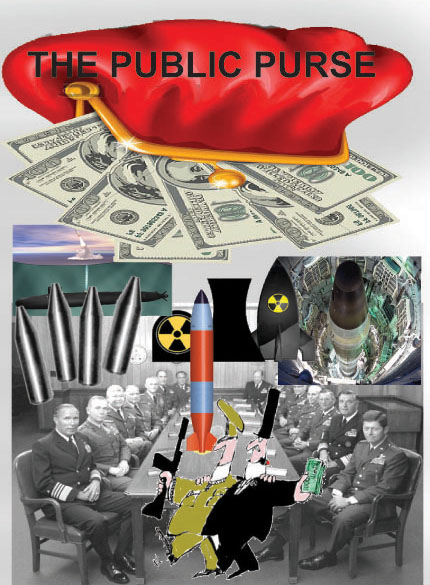
Nuclear arms hawks give bureaucratic mauling to Biden vow to curb arsenal, Guardian, Julian Borger in Washington, Wed 3 Nov 2021 Defence budget and nuclear posture review are battlegrounds as Republicans seek to block limits on US use of weapons,
A battle is being fought in Washington over the Biden administration’s nuclear weapons policy, amid fears by arms control advocates that the president will renege on campaign promises to rein in the US arsenal.
The battlegrounds are a nuclear posture review (NPR) due early next year and a defence budget expected about the same time. At stake is a chance to put the brakes on an arms race between the US, Russia and China – or the risk of that race accelerating.
Despite Biden’s pledge during the campaign – and in his interim national security guidance issued in March – that his administration would reduce “our reliance and excessive expenditure on nuclear weapons”, hawks at the Pentagon have won the early skirmishes.
Biden is also under pressure from some allies, nervous about Biden’s past support for limiting the use of nuclear weapons to the “sole purpose” of deterring, and retaliating against, a nuclear attack on the US or its allies.
The current US posture is broader, leaving open a nuclear response to “significant non-nuclear strategic attacks”. Britain and France also retain a certain amount of ambiguity about when they would use their weapons, and are concerned a US change to “sole purpose” would oblige them ultimately to narrow their options. Paris has taken the lead in conveying those anxieties, and Emmanuel Macron raised nuclear posture issues with Biden when the two met in Rome on Friday.
The big struggle, however, is on the home front, where arms control advocates are on the defensive.
The administration’s first defence budget in February included $43bn for an array of nuclear modernisation schemes, including controversial programmes introduced by Donald Trump, like a new sea-launched cruise missile. The total cost of modernisation could be over $1.5tn.
In September, one of Biden’s political appointees at the Pentagon, Leonor Tomero, who questioned the need for such a vast and growing nuclear weapons budget, was forced out in a bureaucratic power struggle after just nine months in the post. Her job had been to oversee the drafting of the NPR, which sets out what nuclear weapons the US should have and under what conditions they could be used…………..
Senator Edward Markey, a Democrat, has written to Biden demanding to know why Tomero had been removed in the midst of drafting the NPR, demanding to know if “ideology played any role”.
………..Nickolas Roth, the director of the nuclear security programme at the Stimson Center thinktank, said: “I am concerned that the removal of Leonor from her position will have a chilling effect throughout the Biden administration, on those who might be willing to propose anything other than the status quo for US nuclear weapons policy.”
…………. China’s nuclear weapons development, including the recent reported testing of a nuclear-capable hypersonic glider launched from orbit, has increased the political pressure on Biden to abandon his arms control pledges, although the Chinese arsenal is still dwarfed by the US total of 3,750 warheads.
Emma Belcher, the president of the Ploughshares Fund, an arms control advocacy organisation, argued that China’s rise as a nuclear weapons power only underlines the urgency of arms control.
“The best way to control the situation and head off an arms race with China is through diplomacy and restraint,” Belcher said. “We’ve seen this movie before. It’s expensive and dangerous. So what we’re hoping we’ll see from the NPR is for diplomacy to be put first, and an off ramp from a new kind of cold war.” https://www.theguardian.com/world/2021/nov/03/nuclear-arms-joe-biden-pentagon-hawks
1 This Month





PLEASE OPPOSE HR 8255 AND S.3639 – bills would accelerate satellite deployment, with no environmental review or safeguards – https://ncstd5li.quorum.us/campaign/169331/
To see nuclear-related stories in greater depth and intensity – go to https://nuclearinformation.wordpress.com
-
Archives
- October 2026 (58)
- September 2026 (339)
- August 2026 (330)
- July 2026 (355)
- June 2026 (287)
- May 2026 (306)
- April 2026 (356)
- March 2026 (251)
- February 2026 (267)
- January 2026 (308)
- December 2025 (358)
- November 2025 (359)
-
Categories
- 1
- 1 NUCLEAR ISSUES
- business and costs
- climate change
- culture and arts
- ENERGY
- environment
- health
- history
- indigenous issues
- Legal
- marketing of nuclear
- media
- opposition to nuclear
- PERSONAL STORIES
- politics
- politics international
- Religion and ethics
- safety
- secrets,lies and civil liberties
- spinbuster
- technology
- Uranium
- wastes
- weapons and war
- Women
- 2 WORLD
- ACTION
- AFRICA
- Atrocities
- AUSTRALIA
- Christina's notes
- Christina's themes
- culture and arts
- Events
- Fuk 2022
- Fuk 2023
- Fukushima 2017
- Fukushima 2018
- fukushima 2019
- Fukushima 2020
- Fukushima 2021
- general
- global warming
- Humour (God we need it)
- Nuclear
- RARE EARTHS
- Reference
- resources – print
- Resources -audiovicual
- Weekly Newsletter
- World
- World Nuclear
- YouTube
-
RSS
Entries RSS
Comments RSS

