U.N. nuclear watchdog to hold emergency meeting on Ukraine
U.N. nuclear watchdog to hold emergency meeting on Ukraine, Reuters, By Francois Murphy, Editing by Andrew Cawthorne and Ed Osmond
- Canada, Poland call meeting at Kyiv’s request – diplomats
- Russia has seized Chernobyl site, staff unable to leave
- IAEA calling on “all parties” to ensure nuclear safety
- Ukraine says missiles hit radioactive waste site in Kyiv
VIENNA, Feb 27 (Reuters) – The U.N. nuclear watchdog’s 35-nation Board of Governors will hold an emergency meeting on Wednesday about Ukraine, where war is raging in a country with four operational nuclear power plants and various waste facilities including Chernobyl………………………. https://www.reuters.com/world/europe/un-nuclear-watchdog-hold-emergency-meeting-ukraine-diplomats-2022-02-27/
Russian troops to take over Zaporizhzhia nuclear power plant

Russian troops are approaching a second nuclear power plant in Ukraine,
after capturing Chernobyl. Ukraine’s interior ministry has said the
invading troops are approaching Zaporizhzhia. Vadym Denysenko, an adviser
in the Ukraine government, said Russian troops have aimed their rockets at
the site. Kremlin troops stormed the site of the Chernobyl nuclear disaster
on the first day of the invasion. Since then excess gamma radiation levels
have been recorded but it is unclear why.
Mirror 26th Feb 2022
https://www.mirror.co.uk/news/world-news/russia-aims-rockets-second-nuclear-26339222
Ukraine’s reactors – largest nuclear complex in Europe – IN DANGER
 | |||

Author Viewsridge/Wikimedia Commons)
Ukraine’s reactors at risk
15 reactors plus Chernobyl in unprecedented warzone situation https://wordpress.com/read/feeds/72759838/posts/3854353677
A statement by Beyond Nuclear. 25 Feb 22,
Beyond Nuclear joins the chorus of voices calling for a peaceful resolution to the conflict in Ukraine, a situation that could become orders of magnitude worse should any of the country’s 15 nuclear reactors suffer major damage due to military exchanges.
We are in an unprecedented situation, with, for the first time, a war happening in a region where there are operating nuclear reactors. This presents an extreme risk to human life unlike any we have seen in previous wars, even when traditional infrastructure has been bombed and destroyed.
The humanitarian tragedy is already enormous, with people fleeing, abandoning homes and businesses, with their lives upended and their safety and survival in jeopardy. However, should a major release of radioactivity occur due to the damage or destruction of any one of the country’s 15 reactors, the scale of the disaster would escalate to unimaginable proportions, affecting populations well beyond the boundaries of Ukraine and Russia.
Military activity around the Chernobyl nuclear site and within the Exclusion Zone is also of great concern. Reports are coming in showing elevated rates of radiation stirred up by the presence of troops, tanks and heavy equipment moving through the highly radioactively contaminated region, which is closed to regular human habitation. In April 2020, when a major wildfire consumed the area, radiation levels rose by 16 times.
The occupation of the site by Russian military personnel, reportedly the result of a firefight at the plant site, is already a concern. This takeover has called a halt to all activities on the site, which houses a significant inventory of radioactive waste.
Any attack or accidental hit on the Chernobyl nuclear site is of even greater alarm. The new protective dome, euphemistically known as the New Safe Confinement building, that encases the exploded Unit 4’s crumbling sarcophagus, is by no means impervious to damage.
Within this dome lie unstable slurries of radioactive liquids, sludges and sands containing uranium, plutonium and other radioactive wastes. As recently as last May, workers detected an unusual rise in neutrons in the wastes lying in the basement of the destroyed Unit 4, raising fears of a chain reaction or even an explosion. War activities in and around the Chernobyl site, therefore, are a reason for high concern.
The six reactor Zaporizhzhia nuclear power plant in eastern Ukraine is of greatest concern, given its size — the largest power plant in Europe — and location. (Photo: Wikimapia)
The ISF2 (Interim Spent Fuel Storage #2 dry cask facility) at Chernobyl is also of serious concern. Its design, construction, management, and operation has been flawed from the start. Orano (formerly Areva) of France was effectively fired for the design and construction flaws. But serious problems have persisted even after Holtec International’s takeover of ISF2 management. An irradiated nuclear fuel fire at ISF2, whether due to intentional attack or unintended accident, could result in catastrophic releases of highly radioactive wastes into the environment over a large region.
The 15 operating reactors — located at Rivne (4), Khmelnitsky (2), South Ukraine (3) and Zaporizhzhia (6) — are all vulnerable to catastrophic meltdown, even if they are not directly attacked or accidentally hit.
As at Fukushima, a loss of offsite power followed by a loss of onsite power could cause the workforce to lose control of the reactor. If cooling is lost, the reactor will heat up, the water level within the reactor core drops and the fuel rods are exposed. Explosive gases are released, as happened at Fukushima-Daiichi in March 2011, where we saw three reactor explosions. Should these gases find a spark, similar explosions could occur at one or more of Ukraine’s reactors.
Of even greater concern are the fuel pools containing the irradiated fuel rods, and unprotected by the containment building. If a fuel pool is hit and either drains down or boils dry, exposing the fuel assemblies, fire is a real risk. Fuel pools contain far more radioactivity than the reactor itself and a fire would release even greater amounts of radiation.
A war zone could also create a dangerous environment for the nuclear workforce and their families, tempting some to evacuate. But a nuclear power plant, even under daily, routine operations, is not walkaway safe and cannot be abandoned. This presents a terrible, and sacrificial choice that should not have to be made.
The situation in Ukraine is unacceptable at a time when humanity should be coming together to take on our collective existential threat — the climate crisis. The situation in Ukraine brings home all too clearly that nuclear power plants are a dangerous liability and certainly not a solution to the climate crisis.
We are thinking of those suffering as a result of this pointless and cruel war, and offer a list of organizations to which humanitarian aid donations can be made to help the innocent victims caught up in this senseless violence.
Russian forces now control Chernobyl, inviting speculation and uncertainty

Russian forces now control Chernobyl, inviting speculation and uncertainty, Bulletin of the Atomic Scientists, By Susan D’Agostino | February 25, 2022 Yesterday, Russian forces seized control of the defunct Chernobyl Nuclear Power Plant, the still-radioactive site of the world’s worst nuclear disaster. The plant, along with the approximately 1,000-square mile radius around it known as the Chernobyl Exclusion Zone, supports ongoing work focused on nuclear waste management and storage…
Though the International Atomic Energy Agency, a United Nations watchdog, reported that there have been “no casualties nor destruction” at Chernobyl, experts and the public are now at work attempting to understand the potential risks posed by the takeover. While some offer measured responses concerning the potential for human and ecological disaster, others express alarm. Many posit theories for why Russia sought to seize control of Chernobyl, including using the site as a base, for a potential act of terrorism, or for the symbolic “win” it may represent.
Igor Konashenkov, a spokesperson for Russian Military of Defense, said in a statement that the Ukrainian staff “continues to service the facilities in a routine mode and monitor the radioactive situation.” Konashenkov did not indicate that Russian soldiers were holding the workers hostage, as Kateryna Pavlova, Chernobyl’s Head of the Department for International Cooperation and Public Relations, told the Bulletin yesterday.
“The most dangerous part is that we lost control,” Pavlova said. “Some part of the staff from Chernobyl Nuclear Power Plant and National Guard have been kidnapped. They can’t connect. They can’t report.”
White House Press Secretary, Jen Psaki, later expressed similar concern: “This unlawful and dangerous hostage-taking, which could upend the routine civil service efforts required to maintain and protect the nuclear waste facilities, is obviously incredibly alarming. We condemn it, and we request their release.”
Expert views of the potential risk have changed since the news broke. For example, yesterday the American Nuclear Society wrote in a tweet that the hostilities in the region “have not resulted in any additional radiological risk.” And Edwin Lyman, director of nuclear power safety at the Union of Concerned Scientists in Washington, said, “I can’t imagine how it would be in Russia’s interest to allow any facilities at Chernobyl to be damaged.”
Yet this morning, the State Nuclear Regulatory Inspectorate of Ukraine reported that radiation levels in the Chernobyl Exclusion Zone were “exceeded at a significant number of observation points” since Russian forces assumed control. The Ukrainian regulatory body attributed the excessive levels to the “disturbance of the top layer of soil from movement of a large number of radio heavy military” and an “increase of air pollution.”
“But now it is currently impossible to establish the reasons for the change in the radiation background in the exclusion zone because of the occupation and military fight in this territory,” the agency’s website said.
A Russian defense ministry official has disputed the claim of excessive radiation levels……..
Chernobyl sits along a short path from the Russia-Ukraine border to Ukraine’s capital. Pavlova, who described the takeover as a “psychological and humanitarian disaster,” notes that Chernobyl’s facilities and location might have been part of the allure. “We have houses where they can stay and leave. It could be their base,” Pavlova said. “It’s very close to Kyiv—only 140 kilometers. The airport is also nearby. It’s a very good location to bring their troops.”
The stricken reactor has been entombed in a sarcophagus—a steel and concrete coffin-like structure—since 1986. In 2016, another structure—known as New Safe Confinement, which is “strong enough to withstand a tornado” and designed to last 100 years, according to the European Bank for Reconstruction and Development—was placed over the sarcophagus. The New Safe Confinement was funded by more than 30 countries at a cost of $1.5 billion.
Still, the Ukrainian Ministry of Foreign Affairs warned that the Russian takeover “may cause another ecological disaster” and that if the war continues, Chernobyl “can happen again in 2022.”
Others were less concerned. “[T]he bigger risk comes from the potential for fighting around Ukraine’s four active nuclear power plants, which contain 15 separate reactors and generated over half the country’s electricity in 2020,” James M. Acton, co-director of the Nuclear Policy Program at the Carnegie Endowment for International Peace, wrote in a post………
Despite divergent early takes on the potential risks of this unfolding situation, Pavlova, who once served as Acting Head of the Chernobyl Exclusion Zone during a time when wildfires were rampant, is alarmed. “Not so many people understand how dangerous nuclear power plants are in the case of war,” Pavlova said. “I want the world to know that we are one little step—a few millimeters—from destroying our world.” https://thebulletin.org/2022/02/russian-forces-now-control-chernobyl-inviting-speculation-and-uncertainty/
The Most Immediate Nuclear Danger in Ukraine Isn’t Chernobyl
The Most Immediate Nuclear Danger in Ukraine Isn’t Chernobyl, Even though an accident is unlikely, Russia must take exceptional measures to avoid a nuclear catastrophe. Carnegie Endowment for International Peace, James M. Acton 24 Feb 22,

……………The most immediate nuclear danger, however, comes from Ukraine’s nuclear power plants. ………… the bigger risk comes from the potential for fighting around Ukraine’s four active nuclear power plants, which contain fifteen separate reactors and generated over half of the country’s electricity in 2020..
Chernobyl is inside a large exclusion zone, and the uninhabited space would mitigate the consequences of a second nuclear accident there. Ukraine’s other reactors are not similarly isolated. Moreover, much of the fuel in these other reactors is substantially more radioactive than the fuel at Chernobyl. To put it simply, nuclear power plants are not designed for war zones. It seems exceedingly unlikely that Moscow would authorize deliberate attacks on these facilities, but they could nonetheless become targets in a war that will, in any case, disrupt their operations.
For Ukrainian nuclear power plant staff, merely traveling to work may be a dangerous act—making it potentially challenging to ensure the reactor can be operated safely. In the event of an accident, backup personnel, such as firefighters, may not be able to reach the plant—not least because they could be involved in civilian relief efforts
Moreover, nuclear power plants might be targeted inadvertently. These facilities use power from the state’s electricity grid to help cool the reactor in the event it is forced to shut down. While backup power systems, such as diesel generators, are available, the power grid is one important line of defense. There is a very real risk of such power being lost in Ukraine if Russian forces attack the country’s electricity infrastructure—as NATO forces did against Serbia during the 1999 Kosovo War and Russia itself did against Ukraine in 2015 using cyber tools.
Even if Moscow doesn’t authorize direct attacks against nuclear power plants, such attacks might occur anyway. A weapon aimed at a nearby target could hit a nuclear power plant if its navigation system failed. If Russian forces believed that Ukrainian defense forces were inside a nuclear power plant, they could call in an airstrike, perhaps in contravention of an order not to attack nuclear power plants. This concern isn’t hypothetical: In 2017, U.S. special operation forces in Syria called in an attack against a dam that was on a “no strike” list. The resulting damage almost caused the dam to fail, which would likely have led to the drowning of tens of thousands of civilians.
The CEO of the company that operates Ukraine’s nuclear power plants has stressed that they are designed to withstand an aircraft crash. However, munitions are often designed to penetrate thick layers of protective concrete. One particularly serious risk is that a direct attack might drain the pools in which spent fuel is stored, often in large amounts. Without cooling, this fuel could melt, releasing very large quantities of radioactivity. This kind of accident was the “worst-case” outcome envisioned by officials as the Fukushima Nuclear Power Plant accident in Japan unfolded in 2011.I set out these scenarios with some hesitation. The likelihood of a serious nuclear accident is probably quite small……………..
Nonetheless, even if a nuclear accident is still quite unlikely, its effects could be severe and would add significantly to the long-term consequences of this invasion for Ukraine’s population. Moscow will be directly responsible for any nuclear accident that is caused, directly or indirectly, by its aggression. If it doesn’t want such an accident to be added to its growing list of crimes, it must take exceptional measures to avoid one. https://carnegieendowment.org/2022/02/24/most-immediate-nuclear-danger-in-ukraine-isn-t-chernobyl-pub-86521
UK government study shows that nuclear test veterans were more likely to have cancer and die
More than 20,000 men, many on National Service, were ordered to take part in 45 nuclear weapons tests and 593 radioactive ‘minor trials’ in America, Australia and the South Pacific between 1952 and 1991.They later reported cancer, blood disease, miscarriages for their wives and 10 times the usual rate of birth defects in their children, but the MoD spent millions denying war pensions and compensation, insisting there was no proof.
Nuclear test veterans were more likely to have cancer and die, government study finds, Mirror, By Susie Boniface 25 Feb 2022
A study found out that nuclear test veterans were more likely to die. There are now cross-party calls for a public inquiry and immediate compensation, as well as a medal, Men ordered to take part in Cold War radiation experiments WERE more likely to die, according to a government study which has blown apart 70 years of official denials.
- Nuclear test veterans told to watch atomic blasts then live, eat, and drink amid the fallout have raised rates of multiple cancers, the research has found.They are nearly four times more likely to die from a bone marrow cancer seen in survivors of Hiroshima and Nagasaki, and more likely than other servicemen to take their own lives.The shocking research proves:
- HALF the crew of HMS Diana, ordered twice to sail through fallout in 1956, died from tumours;
- Atomic scientists were SEVEN times more likely to kill themselves;
- RAF decontamination crews were FIVE times more likely to die from leukaemia;
- There were more cancers than deaths, meaning some veterans have fought multiple malignancies;
- And despite Ministry of Defence claims servicemen were well-protected, three-quarters were not checked for radiation, while clean-up workers were both unmonitored, and more likely to die from blood cancer.
- There are now cross-party calls for a public inquiry and immediate compensation, as well as a medal.Mayor of Greater Manchester Andy Burnham said: “This is all the evidence required to seek a formal inquiry into the issues and injustices that more than 20,000 veterans of nuclear testing have faced. It appears to be incontrovertible proof that their service led to serious health issues.“They need recognition and for the government to give them the respect owed to them by acknowledging what they have known for years: they paid a devastating price for their vital role in protecting our country. We are at a critical moment in this journey for justice and we need to see action now.”
- His call for speed was echoed by Tory grandee Sir John Hayes, patron of the British Nuclear Test Veteran Association, who said: “There can be no doubt and no more excuses. Based on these facts, we need to act with no delay to recognise these exceptional veterans’ extraordinary sacrifice.”
- More than 20,000 men, many on National Service, were ordered to take part in 45 nuclear weapons tests and 593 radioactive ‘minor trials’ in America, Australia and the South Pacific between 1952 and 1991.They later reported cancer, blood disease, miscarriages for their wives and 10 times the usual rate of birth defects in their children, but the MoD spent millions denying war pensions and compensation, insisting there was no proof.
The new research comes eight months before the 70th anniversary of Britain’s first nuclear test, Operation Hurricane, on October 3, 1952. It was published without warning on the morning that Russia invaded Ukraine.
It looked at causes of death among 21,357 veterans compared to a control group of servicemen who were not at the tests. It traced only 85 per cent, but found three per cent more veterans had died from cancer and two per cent more veterans died from other causes.
Test veterans were 20 per cent more likely than controls to die from stomach cancer or pleural cancer, 59 per cent more likely to die from skin cancer, and 26 per cent more likely to die from acute lymphatic leukaemia.
- There were 12 per cent more deaths from suicide, and 377 per cent more deaths from chronic myeloid leukaemia.
- CML is caused by genetic mutations in the bone marrow. By-products of nuclear weapons, including plutonium-239 and strontium-90 are considered “bone-seeking” when absorbed by man, and it is known that they can damage DNA.Stuart Ross, whose dad Archie was a RAF corporal at Christmas Island in 1958 and died in 2015 from aggressive leukaemia, said it was time to released the veterans’ military medical records.
- “My dad suffered for years with a layer of skin growing between his eyelid and eyeball, a daughter born with an outsized arm, and a grandson with Down’s syndrome. Then he died within six weeks of being diagnosed with blood cancer,” said Stuart, 57, of Hertford.“I’ve asked for the blood tests dad and many other veterans had taken when he was on the island, and officials tell me they don’t exist. They’re hidden somewhere. The Defence Secretary must order them to be released to the families. We deserve the truth.”The latest research studied an extra 19 years of data, and found higher rates for many types of death than were in three previous studies, first ordered by Margaret Thatcher in 1983.The report’s authors at the UK Health Security Agency warned that the MoD could no longer rely on dodgy dose records from the 1950s, saying that there should be no raised risk of death or cancer if the records “accurately reflect the broad levels of exposure”. They added that risks they found should be expected “if, in fact, doses… had been much larger than recorded”.
- The Mirror has campaigned for justice for the test veterans since the 1980s………….. https://www.mirror.co.uk/news/uk-news/nuclear-test-veterans-were-more-26331008
A rogue journalist ponders on Ukraine situation

Caitlin Johnstone: 12 Thoughts on Ukraine, https://consortiumnews.com/2022/02/24/caitlin-johnstone-12-thoughts-on-ukraine/ February 24, 2022 The U.S. power alliance has a choice between escalating aggressions against Russia to world-threatening levels or doing what anti-imperialists have been begging them to do for years and pursue detente. By Caitlin Johnstone
CaitlinJohnstone.com Russian President Vladimir Putin has launched a full-scale invasion of Ukraine, the goal of which he claims is not to occupy the country but to “demilitarize” and “de-Nazify” it. We’ve no reason to put blind faith in any of those claims. Only time will tell.
As of this writing dozens have reportedly been killed. All war is horrific. We can only hope that this one winds up being the least horrific a war can be.
Some thoughts:
- This whole thing could very easily have been avoided with a little bit of diplomacy. The only reason that didn’t happen was it would have meant the U.S. empire taking a teensy, weensy step back from its agenda of total planetary domination. I’ve seen people call it “sad” or “unfortunate” that Western powers didn’t make basic low-cost, high-yield concessions like guaranteeing no NATO membership for Ukraine and having Kiev honor the Minsk agreements, but it’s not sad, and it’s not unfortunate. It’s enraging. That they did this deserves nothing but pure, unadulterated, white hot rage.
- Narrative managers have been working furiously to quash all discussion of No. 1….the most influential Russia “experts” in the Western world decrying propaganda while demanding media outlets enact propaganda. Saying what your government wants said instead of objective reporting the truth is the thing that propaganda is.Please don’t report facts on your media platforms. Don’t let anyone talk about the known actions by NATO powers and Kiev, which experts have long warned would lead to this situation. You’re not allowed to talk about the known U.S./NATO/Ukraine actions which demonstrably led us to where we’re at. You’re only allowed to say Putin attacked Ukraine completely unprovoked, in a vacuum, solely because he is evil and hates freedom. Your loyalty is to the U.S. empire, not to truth. Whoever controls the narrative controls the world.
- It’s funny how everyone keeps referring to this as a “World War 2-style invasion” instead of a “U.S.-style invasion.” It’s not like examples of military invasions ended in the 1940s
- ………….These people actually believe it’s legitimate to call this “the largest invasion on our planet since WW2.” Just snip out all the pages from the history books between 1950 and 2003 to make Western imperialists feel good about themselves. Unbelievable.
- The primary risk of nuclear war is not that anyone will choose to start one, it’s that one could be triggered by miscommunication, malfunction or misunderstanding amid the chaos and confusion of escalating Cold War tensions. This nearly happened, repeatedly, in the last Cold War. Cold War brinkmanship has far too many small, unpredictable moving parts for anyone to feel confident that they can ramp up aggressions without triggering a nuclear exchange. Nobody who feels safe with these games of nuclear chicken understands what they really are. We survived the last Cold War by sheer, dumb luck. We were never once in control. We just got lucky. There’s no reason to trust that we’ll get lucky again. We need to abandon this madness and pursue detente immediately.
- After the bombs drop and I’m dying of radiation poisoning, with my final breath I’m going to thank U.S President Joe Biden for denying Putin the moral victory of an assurance that Ukraine won’t join NATO.
- Probably goes without saying but just in case: anyone who supports any kind of Western military confrontation with Russia is an enemy of our entire species.
- It would now seem the U.S. power alliance has a choice between either (A) escalating aggressions against Russia to world-threatening levels or (B) doing what anti-imperialists have been begging them to do for years and pursuing detente. This is exactly where anti-imperialists have been warning we could wind up if the U.S. didn’t work toward detente with Russia, while being called Kremlin agents and Putin lovers the entire time for years on end. All the people who’ve called us crazy over the years for warning that Cold War brinkmanship against Russia could lead to hot war are the same people calling to ramp up the brinkmanship now that our warnings proved true. Perhaps some serious re-evaluation is in order. The solution to a crisis that was created by Cold War brinkmanship is not more Cold War brinkmanship. The solution to a crisis that was created by cold war brinkmanship is detente.
- Assertions made by secretive government agencies based on classified intelligence should always be subjected to aggressively intense scrutiny, 100percent of the time, without exception and without apology, regardless of the fact that those assertions occasionally happen to prove true.
- It sure is a lucky coincidence that Westerners have spent the last few years being persuaded to hate Russia by their governments and media. Otherwise they might not be giving consent to the West’s dramatic response to this act of aggression.
- Remain intensely skeptical of all news coming out of Ukraine. Since 2016 the Western empire has been running an extremely aggressive narrative management campaign about Russia the likes of which we’ve never seen before. The news media have been fully complicit in this mass-scale psyop. Watch and wait for hard evidence of every claim made. Recall how snipers were usedduring the 2014 coup in Kiev to kill protesters and pin the blame on the ousted Yanukovych government.
PM Kishida rules out Japan’s possession of nuclear weapons
PM Kishida rules out Japan’s possession of nuclear weapons
February 25, 2022 (Mainichi Japan) TOKYO — Prime Minister Fumio Kishida has ruled out the possibility of Japan possessing nuclear weapons as part of the “capacity to strike enemy bases” that his government is seeking to acquire.
At a House of Councillors Budget Committee session on Feb. 24, Kishida said, “The three non-nuclear principles (of not possessing, not producing and not permitting the introduction of nuclear weapons) are our national policy. There are no options of using or possessing nuclear arms.”…………………….. https://mainichi.jp/english/articles/20220225/p2a/00m/0na/018000c
Why nuclear risk from war in Ukraine isn’t missiles, but accidental hits on reactors
“In case of the total destruction of the power plant, I think the consequences would be so much worse than at Fukushima and Chernobyl together,” Mr Gumenyuk said. “If speaking about consequences of this war situation, Europe will be totally contaminated.”
Why nuclear risk from war in Ukraine isn’t missiles but accidental hits on reactors, Kyiv safety expert warns, By Isabella Bengoechea i , 23 Feb 22
Kyiv nuclear safety expert Dmytro Gumenyuk told i while a direct attack is unlikely, military invasion raises the risk of possible accidental hits from missiles or artillery
Ukraine’s nuclear power plants would pose a risk of radioactive pollution in Europe if caught in the crossfire of a Russian invasion, a Kyiv safety expert has told i.
The chance of a direct military attack on such facilities would be highly unlikely but a lack of high-precision weapons in the occupied Donbas suggests there could be an increased chance of sensitive facilities being hit accidentally.
If this happens, radiation could contaminate air, soil and waterways, affecting not only Ukraine but also Russia and much of Europe, according to Dmytro Gumenyuk, head of safety analysis at the State Scientific and Technical Centre for Nuclear and Radiation Safety, a body within the state nuclear inspectorate.
Ukraine has 15 nuclear reactors in four power plants, which provide 52 per cent of the country’s electricity: Khelnitsky and Rivne in the northwest, and Zaporizhzhia and the South Ukrainian plants in the west and south respectively.
Some facilities including a nuclear waste storage site in the exclusion zone at Chernobyl – where in 1986 catastrophic failure at the power plant resulted in the worst nuclear disaster in history – lie close to the country’s borders, where Russia has amassed nearly 200,000 troops.
The plant at Zaporizhzhia is only about 150 miles from the front line in Donetsk, while the South Ukrainian plant is about another 160 miles further west.
While a direct attack is unlikely, military invasion raises the risk of possible accidental hits from missiles or artillery. On Tuesday the thermal power station at Shchastya, near the conflict line in Luhansk, caught fire amid shelling, leaving 40,000 residents without electricity.
Mr Gumenyuk said: “Our NPP [nuclear power plant] wasn’t designed for military protection. Of course it wasn’t designed against tanks, bombs, missiles and so on.
“In case of a military attack it is not a long time for getting from Dontesk to Zaporizhzhia NPP, and of course taking into account the small distances from the Russian Federation, we could suppose that our power plants are not fully protected from military attack from our neighbour.”
A direct attack by Russia is unlikely. Lada Roslycky, founder of the Ukraine-based Black Trident defence and security group, said: “From a military perspective and a defence perspective it would be an idiotic action.”
However, she pointed out the separatists’ lack of high-precision weapons in conflict in the occupied Donbas does raise the chance of sensitive facilities being hit accidentally.
She also suggested that this could be part of a Russian strategy of fomenting uncertainty through psychological warfare, by holding out the threat of attacking such facilities. “I really don’t think they would do it [attack nuclear facilities] but it’s possible … it’s such a wonderful, brilliant instrument,” she said.
The Conflict and Environment Observatory (CEOBS) said it is “right to be concerned about Ukraine’s 15 ageing Soviet-design nuclear reactors”.
“The three reactors at the South Ukraine Nuclear Power Plant and the six reactors at the Zaporizhzhia Nuclear Power Plant are the two sites most likely to be affected by a Russian invasion,” the observatory added.
The VVER 1000 pressurised water reactors at Zaporizhzhia each contain 163 assemblies – or structured groups of fuel rods. Each assembly contains about 500kg of uranium dioxide, making the total fuel inside one reactor about 80 tonnes.
After the 2011 nuclear disaster at Fukushima in Japan, Ukrainian nuclear authorities implemented extra safety measures to make their reactors safer, and protect against accidents such as fires and flooding.
However, Mr Gumenyuk warned that were the plant to be attacked, in the worst-case scenario, the consequences would be devastating.
“In case of the total destruction of the power plant, I think the consequences would be so much worse than at Fukushima and Chernobyl together,” Mr Gumenyuk said. “If speaking about consequences of this war situation, Europe will be totally contaminated.”
Soon after the disaster, radioactive rain began falling across northern Britain. In Cumbria detectors showed background radiation 200 times higher than normal. In Scotland two months later it was 4,000 times. Sheep in North Wales, Cumbria, and Scotland were found to have increased levels of caesium-137, prompting temporary restrictions on meat sales for 7,000 farms.
A nuclear disaster at Zaporizhzhia would contaminate the water, entering the Dneiper River and travelling down into the Sea of Azov, the Black Sea and then out into the Mediterranean.
In the event of a meltdown, radiation could contaminate the air where, depending on weather conditions, it could spread across Europe, as happened after the Chernobyl accident, when radiation spread as far as Sweden and the UK.
“But this is if all the units are totally destroyed,” said Mr Gumenyuk. “We do our best to prevent this situation. I hope in most cases our power units would survive even in single hits. Our nuclear reactors have containment to protect against the different impacts, including an air crash for example.”
Chernobyl’s nuclear waste
Ukraine’s nuclear waste storage facilities, including in the exclusion zone at Chernobyl, 70 miles south of the Belarussian border, also pose a radiation risk.

Last year Energoatom, the state nuclear operator, announced that Ukraine’s new Central Spent Fuel Storage Facility, in the exclusion zone at Chernobyl, was almost ready to begin operating. Spent fuel will be transferred to the new facility from where it is currently stored at power plants.
At present Russia has about 30,000 troops stationed in Belarus, apparently for joint military exercises, which are armed with short-range missiles, rocket launchers and Su-35 fighters. Leaders including Boris Johnson have suggested that Russia is planning at attack from Belarus, “coming down from the north, coming down from Belarus, and encircling Kyiv itself”. The route could take Russian troops through the exclusion zone.
According to CEOBS: “Decommissioning of the [Chernobyl] site and the packaging of waste is ongoing and will continue for decades. The site is under constant management and monitoring and the disruption caused by a conflict would impact the ongoing work to reduce the risks it poses. It seems likely that foreign companies would withdraw staff in the event of an invasion, impacting activities at the site.”
There are 22,000 assemblies of spent nuclear fuel at the storage site, kept in special casks to protect them.
However, Mr Gumenyuk pointed out that these were not protected against military firepower: “In case of the destruction of these casks, radioactive materials could be released and transferred to Ukraine and other European territories. This is a very dangerous situation.”
While some experts say any disruption to the site would be localised, Mr Gumenyuk said: “I disagree, the number of the fuel assemblies is very big and if all the casks were destroyed it would not only be the problem of Ukraine, maybe not all Europe, but many countries.”
Cyberattacks are another possibility. Last week Ukrainian government websites and banks were shut down by a wave of distributed denial of service attacks, thought to have been carried out by Russian hackers.
In 2015 the country’s energy sector was attacked by the BlackEnergy computer virus that caused a blackout of 800,000 households across 103 towns.
The next year, on the 30th anniversary of the Chernobyl disaster, Ukraine’s then-President Poroshenko said: “If the BlackEnergy virus was used for attacks on our power distributors, there is no guarantee that such technology will not threaten our nuclear plants”.
“Chernobyl is already volatile,” said Ms Roslycky. “Cyberattacks against Chernobyl call for attention… whether attacking kinetically or through cyber, when that happens this is something that would threaten global security.”
Accident, terrorism or sabotage
Direct attacks on the plants at Zaporizhzhia and South Ukraine are also unlikely, not least because Russia is not far from the power plants, and any radioactive contamination would affect Russia as well as Ukraine.
However, the possibility of an accident, terrorism or sabotage is somewhat higher. According to the Nuclear Security Index for 2020, Ukraine scores highly on global norms for nuclear materials security and implementing international commitments, with 94 and 78 out of 100 respectively.
However, under ‘risk environment’, which considers factors including political stability, effective governance, pervasiveness of corruption, and illicit activities by non-state actors, Ukraine scores 14.
A 2016 report by the EU Non-Proliferation Consortium drew attention to the illicit trafficking of radioactive materials in the DPR, LPR and unrecognised Transnistria in Moldova. “The armed conflict in eastern Ukraine and its related threats are dramatically influencing the nuclear security conditions in the country,” it said.
“Political and social instability amplifies the motivation of criminal or terrorist groups or organisations for illegal business related to the distribution of radioactive materials that are out of regulatory control.”
The danger of these armed insurgencies was highlighted most dramatically in 2014 when Malaysia Airlines Flight 17 was shot down over Donetsk in eastern Ukraine by pro-Russian separatists, killing all 298 on board. The Dutch-led investigation into the incident concluded that the plane was shot down with a Buk missile supplied by the 53rd Anti-Aircraft Missile Brigade of the Russian Federation. Those responsible may have believed they were shooting down a Ukrainian military aircraft…………………………………………. https://inews.co.uk/news/ukraine-war-nuclear-risk-russia-missiles-accidental-hits-reactors-1478269
Britain’s nuclear submarine base at risk from climate change
The United Kingdom’s nuclear military bases are being threatened by climate change, according to a recent report from the Nuclear Consulting Group. Paul Dorfman, the report’s author, said that the U.K.’s coastal nuclear infrastructure is vulnerable to flooding, due to rising sea levels and more frequent and severe storms.
“All of the models or predictions, all of the analysis, all of the data has really begun to run hot,” Dorfman told CNBC. “It’s good that people are taking notice, but it’s bad that this new data is showing us that we really do need to get our acttogether.”
The report also found that coastal flooding frequency is estimated to increase by between 10 and more than 100 in several European locations. In the United States, “the Pentagon has recently reported that
79 nuclear military bases will be affected by rising sea-levels and frequent flooding,” Dorfman added.
CNBC 21st Feb 2022
Russian President Vladimir Putin orders Russian forces to ‘maintain peace’ in eastern Ukraine’s two breakaway regions.
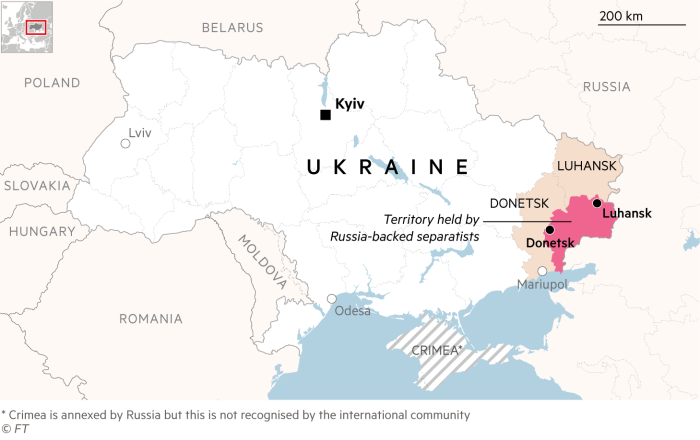
On Monday, local time, a Biden administration official said, however, the area was already controlled by Russian-backed separatists and Moscow, in practice, and that Mr Putin’s decision to send troops he called peacemakers into the breakaway regions of Ukraine did not as yet constitute a further invasion that would trigger a broader sanctions package.
“This isn’t a further invasion since it’s territory that they’ve already occupied,” the official said.
Russian President Vladimir Putin orders Russian forces to ‘maintain peace’ in eastern Ukraine’s two breakaway regions.
President Vladimir Putin has ordered his Defence Ministry to dispatch Russian forces to “maintain peace” in eastern Ukraine’s two breakaway regions, the Donetsk and Luhansk People’s Republics, after he said Moscow would recognise their independence.
Key points:
- Vladimir Putin, joined by Russia-backed separatist leaders, signed a decree recognising the independence of the breakaway regions
- In his address, Mr Putin delved into history as far back as the Ottoman empire and as recent as the tensions over NATO’s eastward expansion
- French President Emmanuel Macron earlier said the US and Russian leaders had agreed in principle to hold a summit
The Kremlin decree, spelled out in an order signed by Mr Putin, did not specify the size of the force to be dispatched, when they would cross the border into Ukraine nor exactly what their mission would be.
Hours later, a Reuters reporter witnessed unusually large columns of military vehicles and hardware, including tanks, moving through Donetsk, the largest city of the self-proclaimed republic.
Mr Putin earlier signed decrees to recognise the two breakaway regions as independent statelets………………………
On Monday, local time, a Biden administration official said, however, the area was already controlled by Russian-backed separatists and Moscow, in practice, and that Mr Putin’s decision to send troops he called peacemakers into the breakaway regions of Ukraine did not as yet constitute a further invasion that would trigger a broader sanctions package.
“This isn’t a further invasion since it’s territory that they’ve already occupied,” the official said.
But, the official added, that a full invasion could come at any time.
The United States will continue to pursue diplomacy with Russia until “tanks roll,” another official said.
“Russian troops moving into Donbas would not itself be a new step. Russia has had forces in the Donbas region for the past eight years … They are currently now making decisions to do this in a more overt and … open way,” the official said……………………
In his lengthy televised address, Mr Putin, looking visibly angry, described Ukraine as an integral part of Russia’s history and said that the regions in eastern Ukraine were ancient Russian lands and that he was confident the Russian people would support his decision.
Russian state television showed Mr Putin, joined by Russia-backed separatist leaders, signing a decree recognising the independence of the two Ukrainian breakaway regions, along with agreements on cooperation and friendship.
Under the two identical friendship treaties — submitted by Mr Putin for ratification by parliament — Russia has the right to build bases in the separatist regions and they, on paper, can do the same in Russia.
The parties committed to defend each other and signed separate agreements on military cooperation and on recognition of each other’s borders.
Their 31-point treaties also say Russia and the breakaway statelets will work to integrate their economies. Both regions are former industrial areas in need of massive support to rebuild after eight years of war with Ukrainian government forces.
The 10-year treaties are automatically renewable for further five-year periods unless one of the parties gives notice to withdraw.
Defying Western warnings against such a move, Mr Putin had announced his decision in phone calls to the leaders of Germany and France earlier, both of whom voiced disappointment, the Kremlin said.
The UN Security Council will meet publicly on Ukraine at 2am GMT (1pm AEDT) on Tuesday, a Russian diplomat said, following a request by the United States, the United Kingdom and France………………………..
EU will respond to ‘illegal act’ with sanctions against Moscow
According to another White House statement, Mr Biden had also discussed with France’s Emmanuel Macron and Germany’s Olaf Scholz “how they will continue to coordinate their response on next steps”. ………………..
The United Nations Secretary-General António Guterres called out Mr Putin’s decision to recognise the separatist regions as independent as “a violation of the territorial integrity and sovereignty of Ukraine” in a statement read by his spokesman, Stéphane Dujarric.
“The Secretary-General urges all relevant actors to focus their efforts on ensuring an immediate cessation of hostilities, protection of civilians and civilian infrastructure, preventing any action and statements that may further escalate the dangerous situation in and around Ukraine, and prioritising diplomacy to address all issues peacefully,” Mr Dujarric said.
…………….
With his decision to recognise the rebel regions, Mr Putin brushed off Western warnings that such a step would be illegal, would kill off peace negotiations and would trigger sanctions against Moscow.
“I deem it necessary to make a decision that should have been made a long time ago: to immediately recognise the independence and sovereignty of the Donetsk People’s Republic and the Luhansk People’s Republic,” Mr Putin said.https://www.abc.net.au/news/2022-02-22/putin-orders-russian-peacekeepers-ukraine/100849964
Damage limitation and US nuclear strategy

if America is able to target all of Russia’s missiles, this creates an incentive for the United States to try a damage‑limiting preventative attack that otherwise it would never have attempted.
It is within this situation that the Kremlin’s concern over even limited BM can be placed
the current situation demonstrates how damage limiting capabilities driven by the intent to save lives can lead to unwanted results – including not only Russia’s new weapons, but potentially also novel systems and more missile silos in China. As such, the recent recommitment of world leaders to the notion that nuclear war cannot be won and must never be fought provides a small but welcome step on the path to maintaining the uneasy peace.
Damage limitation and
US nuclear strategy https://www.lowyinstitute.org/the-interpreter/damage-limitation-and-us-nuclear-strategy VICTOR ABRAMOWICZ 20 Feb 22,
In an atomic world, the road to hell is paved with good intentions. Almost four years ago, I argued in The Interpreter that Vladimir Putin’s decision to pursue a range of weapons specifically designed to defeat America’s Ballistic Missile Defence (BMD) system was irrational behaviour, being an expensive solution to a problem which did not exist.
In particular, while the Kremlin worried that BMD might make Washington immune to Moscow’s existing missiles, in turn opening Russia to coercion or destruction, I observed that America’s 44 interceptor missiles could not hope to defeat Russia’s 1,700 warheads. And while the United States could potentially manufacture hundreds more, there was no indication that Washington planned to do so – and if this occurred, Russia’s existing countermeasures including chaff and jammers represented more cost-effective solutions.
Yet in the years since, having learned more about American nuclear warfighting policies, I’m forced to conclude that there may be more sense to Russia’s actions than first meets the eye – and they do not even require a view of Washington as a villain.
In particular, while the United States and Russia’s primary aim is to avoid a nuclear war, should this arise both of course still seek to minimise harm to themselves, including by saving the lives of millions of their citizens. In turn, both sought to achieve this imperative in many common ways – such as storing medicines or building civil bunkers.
Yet one key means, referred to as “damage limitation” appears to have only been pursued by America, perhaps because of its extraordinary expense. Damage limitation refers to the vastly complex task of seeking to be able to destroy (mainly by atomic attack) most and ideally all of Russia’s missiles before they are launched, including fixed silo-based and mobile land and sea-based weapons.
Washington’s interest in being able to pre-emptively ruin all these types of rockets is obvious and arguably even benign: they present a threat to millions of US lives. But by potentially successfully seeking such a capability it has also dramatically increased, from Moscow’s perspective, the risk of nuclear war.
This outcome reflects that both sides’ mobile assets in particular have been the crux of stability by enabling an “assured second strike”. That is, by being moveable and hence hard to destroy in an atomic first strike, such weapons helped ensure such an attack would never come as they promised obliteration in return.
Yet if America is able to target all of Russia’s missiles, this creates an incentive for the United States to try a damage‑limiting preventative attack that otherwise it would never have attempted.
It is within this situation that the Kremlin’s concern over even limited BMD can be placed, as any such defences further-increase the imperative to attack. So, while some Russian rockets would almost certainly survive a first strike, their reduced numbers are much more likely to be defeated by even a handful of interceptors. And should Washington manufacture more, even out of purely defensive intent, the appeal of a pre-emptive attack increases in turn.
In this light, Moscow’s novel weapons appear much more rational. They do not require unreasonable American malevolence, simply a recognition of Washington’s aim to save US lives.
After all, in a real nuclear crisis, what would a future president do if advised that America had a possibly fleeting fix on all of Russia’s weapons? What if, in such a scenario, Washington realised that Moscow had detected – and might at any moment fire upon – an American attack submarine that had been trailing a Russian missile‑sub, noting such vessels each hold enough warheads to wipe out the United States?
In such situations the incentives to strike first would be enormous. And to offset this grim calculus, even small numbers of BMD-immune weapons can disproportionately rebalance the scales and thus present a sensible investment.
Of course, Russia’s developments are only one means to address the evolving nuclear dilemma, and a variety of more peaceful measures have been suggested also. Yet the current situation demonstrates how damage limiting capabilities driven by the intent to save lives can lead to unwanted results – including not only Russia’s new weapons, but potentially also novel systems and more missile silos in China. As such, the recent recommitment of world leaders to the notion that nuclear war cannot be won and must never be fought provides a small but welcome step on the path to maintaining the uneasy peace.
The Ukraine Crisis Could Trigger a Nuclear Catastrophe – Tilman Ruff

The Ukraine Crisis Could Trigger a Nuclear Catastrophe, https://johnmenadue.com/the-ukraine-crisis-could-trigger-a-nuclear-catastrophe-nobody-wants/ By Tilman Ruff 21 Feb 22,
There are two potential nuclear dimensions to a war in Ukraine, which could create a massive humanitarian disaster and have profound global implications.
In the first week of February, US officials estimated that if war using conventional weapons broke out, 25,000 to 50,000 civilians could die in Ukraine, along with 5,000 to 25,000 Ukrainian and 3,000 to 10,000 Russian soldiers, and that between 1 and 5 million people would flee their homes and become refugees.
The toll could be much greater, especially if the conflict spread to neighbouring countries and NATO forces became embroiled. As Max Fisher wrote in the New York Times on 15 Feb: “threats and bluffs work best when they are backed up by action, increasing the risk of a war that neither side may truly want”, and “the more both sides try to make their threats credible, for example by relocating troops, the more they heighten the risk of a miscalculation that could careen out of control. He quotes Columbia University international relations scholar Dr. Keren Yarhi-Milo: “Every day that we’re not resolving it, we are increasing the percentage chance that something will go wrong”.
Conventional wars can be horrific enough. There must scarcely be a family in Russia or Ukraine without a relative among the close to 14 million Russians or 7 million Ukrainians who died during World War II, and Ukraine has been scarred by repeated invasions from both east and west. Modern weapons have greater destructiveness, range, accuracy while military spending has continued to increase to record levels even through the COVID-19 pandemic, to a staggering USD1981 billion in 2020. NATO members account for 56%, the US alone for 39%, and Russia for 3.1% of the global total.
Eruption of armed conflict in Ukraine risks involving not only Ukraine and Russia (and Crimea and parts of eastern Ukraine it has occupied), but neighbouring countries where Russian forces are stationed – Belarus and Modova, and many of NATO’s 30 members in Europe and across the Atlantic, notably the US, with forces stationed in many other NATO countries.
However a war in Ukraine could have two potentially devastating nuclear dimensions.
Nuclear power plants as potential ‘dirty’ bombs
Nuclear power plants are huge potential pre-positioned radiological weapons.
Ukraine, site of the world’s worst ever civilian nuclear disaster in Chernobyl, has 15 operating nuclear power reactors, in 4 nuclear plants in different parts of the country. The largest is Zaporozhye, in Enerhodar in the southeast of the country. It lies on the east (towards Russia) side of the Dniepr River, 330km west of the city of Donetsk and 200 km from the border of the Donetsk region, part of which has been taken over by Russian/Russian-backed forces. The site has 6 nuclear reactors of 950 Mw each, producing about a quarter of Ukraine’s electricity. It is the second largest nuclear power plant in Europe and one of the 10 largest in the world.
Like most nuclear power plants, highly radioactive and hot used reactor fuel is onsite in cooling ponds, as the fuel needs to be actively cooled for several years, before being put in dry assemblies, which are also on site. As reactor fuel becomes more radioactive the longer it is inside a reactor, cooling ponds often contain more radioactivity in the spent fuel than the reactors themselves do, but are housed in simple buildings without the multiple engineered layers of containment reactors typically have. As we saw in the Fukushima nuclear disaster, reactor meltdowns and explosions releasing vast amounts of radioactivity do not require a high level military assault breaching reactor cores. They can happen simply from disruption to the constant power and circulating water system required to keep reactors and spent fuels pools cool. At the Fukushima Daiichi site at the time of the disaster, 70% of all the radioactivity on site was in the spent fuel pools.
Nobel laureate physicist Prof Joseph Rotblat described in his landmark 1981 study “Nuclear radiation in warfare” that precision-guided bombardment or a commando raid with conventional weapons could rupture a reactor’s containment and pressure vessel, but that very serious radiological consequences could ensue even without rupture of the pressure vessel if the reactor cooling system were put out of action. He stated that: “In a pressurized water reactor [all Ukraine’s operating power reactors are of this type] the melt-down of the core could occur within less than one minute after the loss of coolant”.
War in Ukraine could turn nuclear if any of its nuclear power reactors and/or spent reactor fuel cooling ponds were damaged sufficiently to cause loss of coolant meltdown and/or explosion. The Russian-made Buk missile which brought down Malaysian Airlines flight MH17 in eastern Ukraine in 2014, killing all 298 people on board, appears to have been launched by Russian-backed separatists. A nuclear power plant may be an attractive high-impact target, including for proxy groups who may not be under direct military control but have access to high level weaponry.
Russia is one of the growing number of states actively engaged in cyberwarfare. Nuclear power plants and other nuclear facilities have repeatedly been targets of cyberattack, including infamously the Stuxnet computer virus targetted by Israel and the US to disrupt Iran’s uranium enrichment centrifuges in 2009.
Rotblat also described how the radioactive fallout from a damaged reactor, and even more so from an explosion in a spent fuel pool, could release more and longer-lived radioactivity than detonation of a nuclear bomb.
Thus nuclear power plants are effectively huge pre-positioned potential radiological weapons.
War turning nuclear
If fighting erupted in Ukraine, it would almost certainly begin with conventional weapons. Many of these have sufficient accuracy, range and destructiveness to put targets that are of high military value to Ukraine, Russia and NATO members at risk, even far from any frontline – like military and air bases; intelligence, command and logistical centres. Both Russian and NATO/US military doctrines allow first use of nuclear weapons in situations where the prospect of military defeat looms
Russia has 1600 deployed strategic nuclear weapons, and 1912 tactical nuclear weapons. Most of the delivery systems for the latter can carry either conventional or nuclear warheads, increasing the risk of worst-case thinking and precipitous and over reaction on the other side, and the danger of the threshold to nuclear escalation being crossed.
The US has 1650 deployed strategic nuclear weapons, and 100 B-61 nuclear bombs deployed to bases in Belgium, Germany, Italy, Netherlands and Turkey for delivery by aircraft of those nations.
in addition, France has 280 deployed nuclear weapons, and the UK 120 deployed nuclear weapons.
If the threshold of use of nuclear weapons is crossed, those who have managed nuclear weapons and nuclear war plans tell us the risks or rapid and large-scale escalation are very high. The current Ukraine crisis involves not only complicated history, politics and personalities, but hundreds of senior officials; many thousands of civilian and military officials and advisors; multiple enormous complex and dispersed command, control and communications systems; a web of often unconnected communications across many time zones and languages; and through Russia and NATO involves the 4 nations that possess all the world’s 3750 currently deployed nuclear weapons, including all the 2000 nuclear weapons on high alert, ready to be launched on short notice (counted in minutes).
There is a lot that can go wrong.
Diplomacy to remove the danger of nuclear escalation is desperately urgent and needs to progress to negotiations among all nuclear armed states to eliminate their nuclear arsenals under strict verification and timelines. Otherwise it will be a matter of time before our luck finally runs out.
Tilman Ruff Tilman Ruff AO is Co-President of International Physicians for the Prevention of Nuclear War (Nobel Peace Prize 1985); and co-founder and founding international and Australian Chair of the International Campaign to Abolish Nuclear Weapons (ICAN), awarded the 2017 Nobel Peace Prize, the first to an entity born in Australia.
Nuke Power at the Brink of Bankruptcy, War, Apocalypse
Nuke Power at the Brink of Bankruptcy, War, Apocalypse https://www.rsn.org/001/nuke-power-at-the-brink-of-bankruptcy-war-apocalypse.html?print=1 Harvey Wasserman/Reader Supported News 19 Feb 22,
Fifteen atomic reactors in Ukraine currently spew out massive quantities of radiation alongside the smoldering ruin of Chernobyl Unit 4.War could easily—-and soon!—-turn each into a nuke of mass destruction, blasting into the eco-sphere clouds of lethal fallout far in excess of actual A-Bombs, including Hiroshima and Nagasaki.
Like the rest of the global fleet, Ukraine’s reactors are sitting ducks, set to explode. They symbolize an monumental technological failure, left in the radioactive dust by the rise of renewables. But a devious, deceitful industry is desperate to kill green power, even if its dirty, decayed rump reactors could mushroom as you read this.
The essential unity between atomic power and weapons has been set since birth. France’s Macron now explicitly argues that “peaceful” reactors are needed to sustain the French atomic weapons program.
Cesium fallout from the four exploded Fukushima reactors exceeds that from Hiroshima and Nagasaki by a factor of more than 100. A compendium of studies at Chernobyl indicates a human death toll of more than a million. People and animals died in droves at Three Mile Island. After six decades of development, no US “Peaceful” atomic reactors can get private insurance against the liabilities of a catastrophic accident.
But the 400 nukes operating worldwide (93 in the US) threaten just that.
They burn at 571 degrees Fahrenheit, heating the planet. They spew carbon 14 and other greenhouse gases as they gouge their fuel, burn their innards and plague us all with unmanageable wastes.
Construction began on ALL US nukes at least thirty years ago. They’re embrittled, cracked, under-maintained, obsolete, ticking time bombs. Many are operating far beyond original design specs. Their workforces are aging and retiring. They sit in earthquake zones and flood plains, vulnerable to hurricanes, tornadoes, tsunamis, sabotage, war.
Attempts to build more of these old-style water-cooled clunkers have catastrophically failed at Olkiluoto in Finland, Flamanville in France, V.C. Summer in South Carolina (abandoned at a cost of $10 billion), Vogtle in Georgia…where two reactors that may never open have soared past $30 billion, potentially bankrupting the Peach State.
Powered with a mix of plutonium, the explosion at Fukushima Unit Three threw up a familiar mushroom cloud. Millions of gallons of radwaste there are poised to be poured into the Pacific.
Yet the nuke industry wants to paint itself green. It hides its massive carbon emissions…ignores the gargantuan quantities of heat and wastes each reactor pours into the eco-sphere….kills billions of land and sea creatures every day.
The reactor industry’s clearest present danger centers on its non-stop radiation releases and millions of tons of radioactive offal that can’t be managed.
But possible war in Ukraine (or elsewhere) could dwarf Chernobyl in a matter of moments. As both the Russians and the Ukrainians well know, these are pre-deployed Atomic Bombs, easily turned Apocalyptic by conventional weapons, advanced cyber-attack or simple incompetence.
The latest stab at reviving this zombie technology centers on “Small Modular Reactors.” Some models are meant to be cooled by liquid sodium, which has already caused an explosive 1959 radiation release at Santa Susana, north of Los Angeles, and a 1966 melt-down at Fermi I, south of Detroit.
All SMRs are years away from mass production. If built, they’ll emit huge quantities of heat and greenhouse gasses. They’ll divert enormous quantities of resources that could otherwise go for renewables that are cleaner, cheaper, safer, more reliable, more job-creating, more quickly deployed…and that that won’t explode, create radioactive waste or heat the planet.
SMRs today currently work primarily as scams grifting billions of public dollars into the pockets of the likes of Bill Gates. They’re virtually certain to fail. One or more are likely to explode.
They can never compete with the solar, wind, battery and LED/efficiency technologies revolutionizing global green energy. With an astonishing record of meteoric advances, these four pillars of Solartopia have pushed all fossil/nuclear technologies into history’s economic waste bin. As long as there are rooftops bare of solar panels, and offshore sites ready for wind turbines, the real market for any other form of new energy is marginal at best.
But the corporate nuke pushers don’t care. Their mainly theoretical new reactors can never compete. Their old ones are uninsured, falling apart, spewing heat, carbon, radiation and death while losing mega-tons of YOUR money.
AND they can blow up… as at Fukushima and Chernobyl.
With war coming right at them, ALL reactors need to be shut NOW…before they ignite the next Apocalypse…which YOU will pay for with your life, health, family, fortune and future.
Harvey Wasserman’s America at the Brink of Rebirth: The Organic Spiral of Us History can be had via www.solartopia.org. The Strip & Flip Selection of 2016: Five Jim Crows & Electronic Election Theft, co-written with Bob Fitrakis, is at www.freepress.org.
1 This Month





PLEASE OPPOSE HR 8255 AND S.3639 – bills would accelerate satellite deployment, with no environmental review or safeguards – https://ncstd5li.quorum.us/campaign/169331/
To see nuclear-related stories in greater depth and intensity – go to https://nuclearinformation.wordpress.com
-
Archives
- October 2026 (39)
- September 2026 (339)
- August 2026 (330)
- July 2026 (355)
- June 2026 (287)
- May 2026 (306)
- April 2026 (356)
- March 2026 (251)
- February 2026 (267)
- January 2026 (308)
- December 2025 (358)
- November 2025 (359)
-
Categories
- 1
- 1 NUCLEAR ISSUES
- business and costs
- climate change
- culture and arts
- ENERGY
- environment
- health
- history
- indigenous issues
- Legal
- marketing of nuclear
- media
- opposition to nuclear
- PERSONAL STORIES
- politics
- politics international
- Religion and ethics
- safety
- secrets,lies and civil liberties
- spinbuster
- technology
- Uranium
- wastes
- weapons and war
- Women
- 2 WORLD
- ACTION
- AFRICA
- Atrocities
- AUSTRALIA
- Christina's notes
- Christina's themes
- culture and arts
- Events
- Fuk 2022
- Fuk 2023
- Fukushima 2017
- Fukushima 2018
- fukushima 2019
- Fukushima 2020
- Fukushima 2021
- general
- global warming
- Humour (God we need it)
- Nuclear
- RARE EARTHS
- Reference
- resources – print
- Resources -audiovicual
- Weekly Newsletter
- World
- World Nuclear
- YouTube
-
RSS
Entries RSS
Comments RSS

