Recent history sheds light on the Ukraine situation . Part Three- Denazification
Retired Swiss Military-Intelligence Officer. Is it possible to actually know what has been and is going on in Ukraine?
Jacques Baud, The Unz Review 02 Apr 2022
”………………………………………………………………….. Denazification

In cities like Kharkov, Mariupol and Odessa, the Ukrainian defense is provided by the paramilitary militias. They know that the objective of “denazification” is aimed primarily at them. For an attacker in an urbanized area, civilians are a problem. This is why Russia is seeking to create humanitarian corridors to empty cities of civilians and leave only the militias, to fight them more easily.
Conversely, these militias seek to keep civilians in the cities from evacuating in order to dissuade the Russian army from fighting there. This is why they are reluctant to implement these corridors and do everything to ensure that Russian efforts are unsuccessful — they use the civilian population as “human shields.” Videos showing civilians trying to leave Mariupol and beaten up by fighters of the Azov regiment are of course carefully censored by the Western media.
On Facebook, the Azov group was considered in the same category as the Islamic State [ISIS] and subject to the platform’s “policy on dangerous individuals and organizations.” It was therefore forbidden to glorify its activities, and “posts” that were favorable to it were systematically banned. But on February 24, Facebook changed its policy and allowed posts favorable to the militia. In the same spirit, in March, the platform authorized, in the former Eastern countries, calls for the murder of Russian soldiers and leaders. So much for the values that inspire our leaders.
Our media propagate a romantic image of popular resistance by the Ukrainian people. It is this image that led the European Union to finance the distribution of arms to the civilian population. In my capacity as head of peacekeeping at the UN, I worked on the issue of civilian protection. We found that violence against civilians occurred in very specific contexts. In particular, when weapons are abundant and there are no command structures.
These command structures are the essence of armies: their function is to channel the use of force towards an objective. By arming citizens in a haphazard manner, as is currently the case, the EU is turning them into combatants, with the consequential effect of making them potential targets. Moreover, without command, without operational goals, the distribution of arms leads inevitably to settling of scores, banditry and actions that are more deadly than effective. War becomes a matter of emotions. Force becomes violence. This is what happened in Tawarga (Libya) from 11 to 13 August 2011, where 30,000 black Africans were massacred with weapons parachuted (illegally) by France. By the way, the British Royal Institute for Strategic Studies (RUSI) does not see any added value in these arms deliveries.
Moreover, by delivering arms to a country at war, one exposes oneself to being considered a belligerent. The Russian strikes of March 13, 2022, against the Mykolayev air base follow Russian warnings that arms shipments would be treated as hostile targets.
The EU is repeating the disastrous experience of the Third Reich in the final hours of the Battle of Berlin.War must be left to the military and when one side has lost, it must be admitted. And if there is to be resistance, it must be led and structured. But we are doing exactly the opposite — we are pushing citizens to go and fight, and at the same time, Facebook authorizes calls for the murder of Russian soldiers and leaders. So much for the values that inspire us.
Some intelligence services see this irresponsible decision as a way to use the Ukrainian population as cannon fodder to fight Vladimir Putin’s Russia. It would have been better to engage in negotiations and thus obtain guarantees for the civilian population than to add fuel to the fire. It is easy to be combative with the blood of others.
4. The Maternity Hospital At Mariupol
It is important to understand beforehand that it is not the Ukrainian army that is defending Mariupol, but the Azov militia, composed of foreign mercenaries.
In its March 7, 2022 summary of the situation, the Russian UN mission in New York stated that “Residents report that Ukrainian armed forces expelled staff from the Mariupol city birth hospital No. 1 and set up a firing post inside the facility.” On March 8, the independent Russian media Lenta.ru, publishedthe testimony of civilians from Mariupol who told that the maternity hospital was taken over by the militia of the Azov regiment, and who drove out the civilian occupants by threatening them with their weapons. They confirmed the statements of the Russian ambassador a few hours earlier.
The hospital in Mariupol occupies a dominant position, perfectly suited for the installation of anti-tank weapons and for observation. On 9 March, Russian forces struck the building. According to CNN, 17 people were wounded, but the images do not show any casualties in the building and there is no evidence that the victims mentioned are related to this strike. There is talk of children, but in reality, there is nothing. This does not prevent the leaders of the EU from seeing this as a war crime. And this allows Zelensky to call for a no-fly zone over Ukraine.
In reality, we do not know exactly what happened. But the sequence of events tends to confirm that Russian forces struck a position of the Azov regiment and that the maternity ward was then free of civilians.
The problem is that the paramilitary militias that defend the cities are encouraged by the international community not to respect the rules of war. It seems that the Ukrainians have replayed the scenario of the Kuwait City maternity hospital in 1990, which was totally staged by the firm Hill & Knowlton for $10.7 million in order to convince the United Nations Security Council to intervene in Iraq for Operation Desert Shield/Storm.
Western politicians have accepted civilian strikes in the Donbass for eight years without adopting any sanctions against the Ukrainian government. We have long since entered a dynamic where Western politicians have agreed to sacrifice international law towards their goal of weakening Russia………………. more https://www.sott.net/article/466340-Retired-Swiss-Military-Intelligence-Officer-Is-it-Possible-to-Actually-Know-What-Has-Been-And-is-Going-on-in-Ukraine
Recent history sheds light on the Ukraine situation . Part Two Outbreak of war.
Retired Swiss Military-Intelligence Officer. Is it possible to actually know what has been and is going on in Ukraine?
Jacques Baud, The Unz Review, 04 Apr 2022
Part Two: The War
As a former head of analysis of Warsaw Pact forces in the Swiss strategic intelligence service, I observe with sadness — but not astonishment — that our services are no longer able to understand the military situation in Ukraine. The self-proclaimed “experts” who parade on our TV screens tirelessly relay the same information modulated by the claim that Russia — and Vladimir Putin — is irrational. Let’s take a step back.
1. The Outbreak Of War
Since November 2021, the Americans have been constantly threatening a Russian invasion of Ukraine. However, the Ukrainians at first did not seem to agree. Why not?
We have to go back to March 24, 2021. On that day, Volodymyr Zelensky issued a decree for the recapture of the Crimea, and began to deploy his forces to the south of the country. At the same time, several NATO exercises were conducted between the Black Sea and the Baltic Sea, accompanied by a significant increase in reconnaissance flights along the Russian border. Russia then conducted several exercises to test the operational readiness of its troops and to show that it was following the evolution of the situation.
Things calmed down until October-November with the end of the ZAPAD 21 exercises, whose troop movements were interpreted as a reinforcement for an offensive against Ukraine. However, even the Ukrainian authorities refuted the idea of Russian preparations for a war, and Oleksiy Reznikov, Ukrainian Minister of Defense, states that there had been no change on its border since the spring.
In violation of the Minsk Agreements, Ukraine was conducting air operations in Donbass using drones, including at least one strike against a fuel depot in Donetsk in October 2021. The American press noted this, but not the Europeans; and no one condemned these violations.
In February 2022, events came to a head. On February 7, during his visit to Moscow, Emmanuel Macron reaffirmed to Vladimir Putin his commitment to the Minsk Agreements, a commitment he would repeat after his meeting with Volodymyr Zelensky the next day. But on February 11, in Berlin, after nine hours of work, the meeting of political advisors to the leaders of the “Normandy format” ended without any concrete result: the Ukrainians still refused to apply the Minsk Agreements, apparently under pressure from the United States. Vladimir Putin noted that Macron had made empty promises and that the West was not ready to enforce the agreements, the same opposition to a settlement it had exhibited for eight years.
Ukrainian preparations in the contact zone continued. The Russian Parliament became alarmed; and on February 15 it asked Vladimir Putin to recognize the independence of the Republics, which he initially refused to do.
On 17 February, President Joe Biden announced that Russia would attack Ukraine in the next few days. How did he know this? It is a mystery. But since the 16th, the artillery shelling of the population of Donbass had increased dramatically, as the daily reports of the OSCE observers show. Naturally, neither the media, nor the European Union, nor NATO, nor any Western government reacted or intervened. It would be said later that this was Russian disinformation. In fact, it seems that the European Union and some countries have deliberately kept silent about the massacre of the Donbass population, knowing that this would provoke a Russian intervention.
At the same time, there were reports of sabotage in the Donbass. On 18 January, Donbass fighters intercepted saboteurs, who spoke Polish and were equipped with Western equipment and who were seeking to create chemical incidents in Gorlivka. They could have been CIA mercenaries, led or “advised” by Americans and composed of Ukrainian or European fighters, to carry out sabotage actions in the Donbass Republics.
In fact, as early as February 16, Joe Biden knew that the Ukrainians had begun intense shelling the civilian population of Donbass, forcing Vladimir Putin to make a difficult choice: to help Donbass militarily and create an international problem, or to stand by and watch the Russian-speaking people of Donbass being crushed.
If he decided to intervene, Putin could invoke the international obligation of “Responsibility To Protect” (R2P). But he knew that whatever its nature or scale, the intervention would trigger a storm of sanctions. Therefore, whether Russian intervention were limited to the Donbass or went further to put pressure on the West over the status of the Ukraine, the price to pay would be the same. This is what he explained in his speech on February 21. On that day, he agreed to the request of the Duma and recognized the independence of the two Donbass Republics and, at the same time, he signed friendship and assistance treaties with them.
The Ukrainian artillery bombardment of the Donbass population continued, and, on 23 February, the two Republics asked for military assistance from Russia. On 24 February, Vladimir Putin invoked Article 51 of the United Nations Charter, which provides for mutual military assistance in the framework of a defensive alliance.
In order to make the Russian intervention seem totally illegal in the eyes of the public, Western powers deliberately hid the fact that the war actually started on February 16. The Ukrainian army was preparing to attack the Donbass as early as 2021, as some Russian and European intelligence services were well aware.
In his speech of February 24, Vladimir Putin stated the two objectives of his operation: “demilitarize” and “denazify” the Ukraine. So, it was not a question of taking over Ukraine, nor even, presumably, of occupying it; and certainly not of destroying it.
From then on, our knowledge of the course of the operation is limited: the Russians have excellent security for their operations (OPSEC) and the details of their planning are not known. But fairly quickly, the course of the operation allows us to understand how the strategic objectives were translated on the operational level.
Demilitarization:
- ground destruction of Ukrainian aviation, air defense systems and reconnaissance assets;
- neutralization of command and intelligence structures (C3I), as well as the main logistical routes in the depth of the territory;
- encirclement of the bulk of the Ukrainian army massed in the southeast of the country.
- destruction or neutralization of volunteer battalions operating in the cities of Odessa, Kharkov, and Mariupol, as well as in various facilities in the territory.
Denazification:
2. Demilitarization
The Russian offensive was carried out in a very “classic” manner. Initially — as the Israelis had done in 1967 — with the destruction on the ground of the air force in the very first hours. Then, we witnessed a simultaneous progression along several axes according to the principle of “flowing water”: advance everywhere where resistance was weak and leave the cities (very demanding in terms of troops) for later. In the north, the Chernobyl power plant was occupied immediately to prevent acts of sabotage. The images of Ukrainian and Russian soldiers guarding the plant togetherare of course not shown.
The idea that Russia is trying to take over Kiev, the capital, to eliminate Zelensky, comes typically from the West. But Vladimir Putin never intended to shoot or topple Zelensky. Instead, Russia seeks to keep him in power by pushing him to negotiate, by surrounding Kiev. The Russians want to obtain the neutrality of Ukraine.
Many Western commentators were surprised that the Russians continued to seek a negotiated solution while conducting military operations. The explanation lies in the Russian strategic outlook since the Soviet era. For the West, war begins when politics ends. However, the Russian approach follows a Clausewitzian inspiration: war is the continuity of politics and one can move fluidly from one to the other, even during combat. This allows one to create pressure on the adversary and push him to negotiate.
From an operational point of view, the Russian offensive was an example of previous military action and planning: in six days, the Russians seized a territory as large as the United Kingdom, with a speed of advance greater than what the Wehrmacht had achieved in 1940.
The bulk of the Ukrainian army was deployed in the south of the country in preparation for a major operation against the Donbass. This is why Russian forces were able to encircle it from the beginning of March in the “cauldron” between Slavyansk, Kramatorsk and Severodonetsk, with a thrust from the East through Kharkov and another from the South from Crimea. Troops from the Donetsk (DPR) and Lugansk (LPR) Republics are complementing the Russian forces with a push from the East.
At this stage, Russian forces are slowly tightening the noose, but are no longer under any time pressure or schedule. Their demilitarization goal is all but achieved and the remaining Ukrainian forces no longer have an operational and strategic command structure.
The “slowdown” that our “experts” attribute to poor logistics is only the consequence of having achieved their objectives. Russia does not want to engage in an occupation of the entire Ukrainian territory. In fact, it appears that Russia is trying to limit its advance to the linguistic border of the country…………………………… more https://www.sott.net/article/466340-Retired-Swiss-Military-Intelligence-Officer-Is-it-Possible-to-Actually-Know-What-Has-Been-And-is-Going-on-in-Ukraine
Fears sunken Russian warship Moskva was carrying nuclear weapons
There are fears that sunken Russian warship The Moskva was carrying nuclear weapons that could now cause a “broken arrow” incident. news.com.au
Megan Palin, April 16, 2022 There are fears that sunken Russian warship The Moskva that is now believed to be resting at the bottom of the Black Sea was carrying nuclear weapons.
Maksym Marchenko, the governor of the Odesa region, said Ukraine struck the ship with two Neptune missiles and caused “serious damage” on Thursday.
The Russian Defence Ministry denied there had been an attack by Ukraine on the ship, which would normally have about 500 sailors aboard, and said the heavily damaged Moskva sank in a storm under tow after being gutted by fire.
Speaking at the Pentagon on Friday, a senior US defense official said the Moskva warship was hit by two Ukrainian Neptune missiles, prompting its sinking.
In a chilling revelation, sources say it’s likely that several nuclear missiles are on the sunken vessel, and there is now real concern that could lead to a nuclear accident – otherwise known as a “broken arrow” incident in American military slang.
Mykhailo Samus, director of a Lviv-based military think-tank; Andriy Klymenko, editor of Black Sea News; and Ukrainian newspaper Defence Express all warned today that the Moskva was designed to carry warheads which could fit in the nose of its supersonic P-1000 “Vulkan” missiles – designed to take out American aircraft carriers.
“On board the Moskva could be nuclear warheads – two units,’ Samus said, while Klymenko called on other Black Sea nations – Turkey, Romania, Georgia, and Bulgaria – to insist on an explanation. Where are these warheads? Where were they when the ammunition exploded,” he asked.
This is HUGE. Russia’s defense ministry admits Moskva, their flagship in Black Sea fleet, slava class cruiser, has SUNK! It was key to intelligence & air defenses for the Russian ships. IMO this is on the level big as stopping Russians from taking Kyiv. https://t.co/3SifeskeHzpic.twitter.com/EmNR4L0Vgy— John Spencer (@SpencerGuard) April 14, 2022
BlackSeaNews editor-in-chief Andriy Klymenko called for an urgent international probe into whether the Moskva was carrying nuclear weapons.
“Friends and experts say that there are two nuclear warheads for cruise missiles on board the Moskva,” he said………….. https://www.news.com.au/world/europe/fears-sunken-russian-warship-moskva-was-carrying-nuclear-weapons/news-story/959170261e82bd43b5eb3c37fabf8dcd
 | |||
Ukraine crisis a risk to nuclear security
By Li Zhe | China Daily | 2022-04 The risks to nuclear security have increased with the continuation of the Russia-Ukraine conflict. The geopolitical game involving Russia and Ukraine but also the United States and some European countries poses a big threat to nuclear nonproliferation and nuclear deterrence.
Perhaps a bigger threat is that the nuclear risks will carry with them the hidden dangers to nuclear security in the post-conflict era.
Strategic stability is possible only if the arms race among major powers ends, and the nuclear powers pledge to non-first use of nuclear weapons. That’s why the US and the Soviet Union signed treaties to limit, rather reduce, their nuclear arsenals………….
Ukraine and Belarus respectively are allied with the US and Russia, and both want to repossess nuclear weapons. This shows the political wrestling between the US-led West and Russia has shaken countries caught in the middle and could prompt many of them to develop or get nuclear weapons.
Besides, Polish Deputy Prime Minister Jaroslaw Kaczynski said in a recent interview with German newspaper Die Welt that Poland was open to stationing US nuclear warheads on its soil.
Ukraine and Belarus do not possess nuclear weapons. Under the 1994 Budapest Memorandum on Security Guarantees, they transferred the nuclear weapons inherited from the Soviet Union to Russia for decommissioning in exchange for security assurances from the US and the United Kingdom and Russia. Also, despite not being in a position to acquire or develop nuclear weapons, they are caught in the vortex of large-scale political, economic and military confrontations and conflicts between the West and Russia.
With the Korean Peninsula and Iran nuclear issues yet to be resolved, the attempts of Ukraine and Belarus to acquire nuclear weapons could fuel a new round of nuclear proliferation.
Since Biden took office, the US administration’s stance on nuclear nonproliferation has been wavering and ambiguous. Early in his tenure, Biden talked about the necessity of nuclear arms control, including reducing the nuclear weapons arsenal, saving the cost of competition, preventing nuclear proliferation, and maintaining nuclear stability. But of late, he has been talking about great power competition, providing nuclear deterrence to US allies, and has not ruled out the use of nuclear weapons as deterrence.
The nuclear posture review of the Biden administration, too, is unclear, and it is likely to use the Russia-Ukraine conflict to accord higher priority to nuclear weapons in national security, and accordingly increase the defense budget to finance Washington’s geopolitical games. In fact, the administration has already proposed a huge budget including higher spending, of $813 billion, on defense………………
Global nuclear security has deteriorated over the past few years and the Ukraine crisis has made the future gloomier. So it is imperative that all parties make concerted efforts and restrain their respective military actions, and exhibit courage to hold talks on arms control and nuclear nonproliferation. http://global.chinadaily.com.cn/a/202204/15/WS6258ae63a310fd2b29e57111.html
Ukraine MoD Asserts No Evidence That Russia Will Deploy Nuclear Weapons Amid War
The spokesperson of the Ukrainian Defence Ministry, Oleksandr Motuzianyk stated that Ukraine perceives no indicators that Russia will deploy nuclear weapons.
Written By Rohit Ranjan Republic World, 15th April, 2022
Nonstop Corporate News on Ukraine Is Fueling Support for Unchecked US Militarism
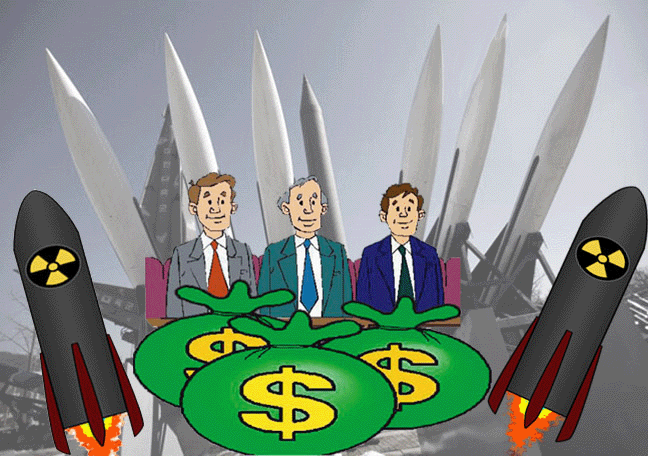
The U.S. public is being fed continuous nonstop images of technologically sophisticated weapons being used in Ukraine — in effect this appears to function as a sort of advertisement for the weapons industry, coupled with the sensational presentation of gratuitous violence
Talking heads in the dominant media landscape churn out cheap binarisms about good and evil, democracy versus authoritarianism. In doing so, they reinforce the mythic narrative that the U.S., a model of liberal innocence, is furthering the global fight for democracy, untainted in its false assertion that fascism is always elsewhere — in this case exclusively in Russia.
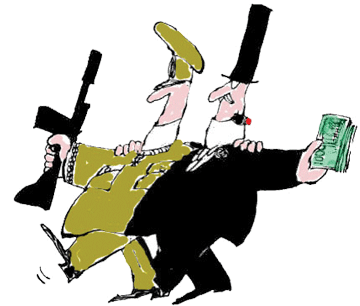
There is almost no talk about the role of the military-industrial complex, both in its push for war, and how it usually emerges as the only winner. Nor is there any talk about who profits from an embrace of war talk, the spectacularization of war and war itself.
Henry A. Giroux, Truthout, 13 Apr 22, The drums of fascism are beating louder. The catastrophe of war and outpouring of support for the millions of Ukrainians suffering under the brutal attacks by Russia has morphed into increased warmongering from the West. The shock of war has been transformed into a cinematic spectacle used to fan the flames of militarism. The sheer boldness, violence and ruthlessness of Russia’s attack on Ukraine has created a global political crisis accentuated by both a crisis of ideas and a crisis of historical reckoning, at least in the Western mainstream media.
The wider public’s inability to reflect on the underlying causes of the war is due at least in the United States to its long-standing dominant belief in its own exceptionalism, reinforced by a moral righteousness endlessly reproduced in the mainstream media.
Tragic pictures of the agonizing hardships faced by the Ukrainian people too often appear with little or no critical commentary in the corporate-controlled cultural apparatuses. Endless images of unfathomable agony by the Ukrainian people dominate the conventional news outlets and other monopolies of information governed by the spectacle of 24/7 coverage, matched almost entirely by a lack of historical analysis. While widespread moral repulsion to the tragedies of the war are understandable, what is not acceptable is the refusal of the mainstream media to reflect on the historical, political and economic conditions leading up to the war.
The U.S. public is being fed continuous nonstop images of technologically sophisticated weapons being used in Ukraine — in effect this appears to function as a sort of advertisement for the weapons industry, coupled with the sensational presentation of gratuitous violence.
Within this militarized aesthetic, operating in the service of permanent war, as cultural critic Rustom Bharucha writes, “there is an echo of the pornographic in maximizing the pleasure of violence.” The corporate media are thus rendering war as riveting, emotional and free from demanding intellectual complexities since it emerges out of an either/or view of good and evil.
Images of violence are replayed in the mainstream media over and over again, making violence not only more visible but also rootless. The sheer monopoly of such images gives them a fascist edge, all the while dissolving politics into a cinematic pathology. Writer and philosopher Susan Sontag’s observation about war coverage, made in a different historical context, is even more relevant today. According to Sontag, the endless images of war and suffering, removed from the context of rigorous historical analysis, represent a contempt for “all that is reflective, critical and pluralistic [and are] linked to forms of rabid masculinity [that] glamorizes death.”
Talking heads in the dominant media landscape churn out cheap binarisms about good and evil, democracy versus authoritarianism. In doing so, they reinforce the mythic narrative that the U.S., a model of liberal innocence, is furthering the global fight for democracy, untainted in its false assertion that fascism is always elsewhere — in this case exclusively in Russia. There is almost no talk about the role of the military-industrial complex, both in its push for war, and how it usually emerges as the only winner. Nor is there any talk about who profits from an embrace of war talk, the spectacularization of war and war itself.
When more critical explanations of the war appear, especially from those criticizing the eastward expansion of the North Atlantic Treaty Organization (NATO), which created one set of conditions for the conflict, they are often mocked, ignored, or at worst, accused of being treasonous. In this instance, a rampant militarism collapses the difference between a critical analysis and a justification for Russia’s actions………….
We have seen a similar shutting down of dissent before in the face of catastrophic events, especially in the aftermath of the 9/11 attacks and the ensuing “war on terror.” Yet, the frenetic opposition to dissent today seems more dangerous, especially given the multiple cultural platforms calling for “virtual war, for participating in it, and being manipulated by it, [including] crowd funding urban militias on Twitter, posting videos of captured tanks or ‘army cats’ to Instagram and TikTok.”
The need for community is too often now organized around a bristling war fever feeding on militaristic language in mainstream outlets such as The Atlantic, The New Republic, New Yorker, The Financial Times and The Wall Street Journal. In all cases, rightful moral outrage over the brutality of Russia’s unlawful invasion morphed quickly into a fog-of-war hysteria demanding more military aid, more punitive sanctions and bolstered by the discourse of unchecked jingoism. The call for peace or a diplomatic solution is barely mentioned.
With the war in Ukraine raging, more nuanced analyses along with dissent disappear in the suffocating discourses of hyper-nationalism and the growing bonfire of militarism fueled by what Indian essayist and novelist Pankaj Mishra, writing in the London Review of Books, calls “an infotainment media [that] works up citizens into a state of paranoid patriotism.” The military-industrial-intellectual-academic complex has reasserted itself in the face of Russia’s violation of international law, accelerating the prospect, if not welcoming, the potential of another looming Cold War, aided greatly by media apparatuses that bask in the comfort of moral certainty and patriotic inanity. In this atmosphere of hyper-war culture, military victories become synonymous with moral victories as language becomes weaponized and matters of ethics no longer inform the urgent call for peace.
In the face of the brutal Russian invasion, the concept of militarization is being amplified and put into service as a call for more upgraded weapons. Talk of war, not peace, dominates the mainstream media landscapes both at home and abroad. Such talk also fuels a global arms industry, oil and gas monopolies, and the weaponization of language itself. Militarism as a tool of unchecked nationalism and patriotism drives the mainstream and right-wing disimagination machines. Both fuel a global war fever through different degrees of misrepresentation and create what intellectual historian Jackson Lears writing in the London Review of Books calls “an atmosphere “poisoned by militarist rants.” He goes further in regarding his critique of the U.S. response to the war in Ukraine, writing in the New York Review of Books:
Yet the US has failed to put a cease-fire and a neutral Ukraine at the forefront of its policy agenda there. Quite the contrary: it has dramatically increased the flow of weapons to Ukraine, which had already been deployed for eight years to suppress the separatist uprising in the Donbas. US policy prolongs the war and creates the likelihood of a protracted insurgency after a Russian victory, which seems probable at this writing. Meanwhile, the Biden administration has refused to address Russia’s fear of NATO encirclement. Sometimes we must conduct diplomacy with nations whose actions we deplore. How does one negotiate with any potential diplomatic partner while ignoring its security concerns? The answer, of course, is that one does not. Without serious American diplomacy, the Ukraine war, too, may well become endless.
The horrific events in Ukraine have mobilized a global response against the brutal acts of violence inflicted on the Ukrainian people, but such massive acts of violence have also taken place in Syria, Afghanistan, Iraq and Yemen without eliciting comparable condemnations or humanitarian aid from the U.S. and Europe. Moreover, while public outrage in the U.S. is warranted in light of the “horrendous crimes by Russian troops against Ukrainian civilians—massacre, murder, and rape, among them,” memory fades, and the line between fantasy and historical consciousness disappears, “erasing the brutalizing crimes committed during America’s Global War on Terror.”……………………………………..
Historical amnesia and a prolonged military conflict combine making it easier to sell war rather than peace, which would demand not only condemnation of Russia but also an exercise in self-scrutiny with a particular focus on the military optic that has been driving U.S. foreign policy since President Dwight D. Eisenhower warned in the 1950s of the danger of the military-industrial complex.
The Ukrainian war is truly insidious and rouses the deepest sympathies and robust moral outrage, but the calls to punish Russia overlook the equally crucial need to call for peace. In doing so, such actions ignore a crucial history and mode of analysis that make clear that behind this war are long-standing anti-democratic ideologies that have given us massive inequality, disastrous climate change, poverty, racial apartheid and the increasing threat of nuclear war.
The horrific events in Ukraine have mobilized a global response against the brutal acts of violence inflicted on the Ukrainian people, but such massive acts of violence have also taken place in Syria, Afghanistan, Iraq and Yemen without eliciting comparable condemnations or humanitarian aid from the U.S. and Europe. Moreover, while public outrage in the U.S. is warranted in light of the “horrendous crimes by Russian troops against Ukrainian civilians—massacre, murder, and rape, among them,” memory fades, and the line between fantasy and historical consciousness disappears, “erasing the brutalizing crimes committed during America’s Global War on Terror.”……………………………………..
Historical amnesia and a prolonged military conflict combine making it easier to sell war rather than peace, which would demand not only condemnation of Russia but also an exercise in self-scrutiny with a particular focus on the military optic that has been driving U.S. foreign policy since President Dwight D. Eisenhower warned in the 1950s of the danger of the military-industrial complex.
The Ukrainian war is truly insidious and rouses the deepest sympathies and robust moral outrage, but the calls to punish Russia overlook the equally crucial need to call for peace. In doing so, such actions ignore a crucial history and mode of analysis that make clear that behind this war are long-standing anti-democratic ideologies that have given us massive inequality, disastrous climate change, poverty, racial apartheid and the increasing threat of nuclear war.
War never escapes the tragedies it produces and is almost always an outgrowth of the dreams of the powerful — which always guarantees a world draped in suffering and death. Peace is difficult in an age when culture is organized around the interrelated discourse of militarism and state violence. War has become the only mirror in which alleged democratic capitalist and authoritarian societies recognize themselves. Rather than defined as a crisis, war for authoritarian rulers and the soulless arms industries becomes an opportunity for power and profits, however ill-conceived.
Peace demands a different assertion of collective identity, a different ethical posture and value system that takes seriously Dr. Martin Luther King Jr.’s admonition that human beings must do everything not to “spiral down a militaristic stairway into the hell of thermonuclear annihilation.” This is not merely a matter of conscience or resistance but of survival itself.
UK to get ”special weapons”storage sites for USA nuclear weapons, – making a pre-emptive strike easier.

Daryl Kimball, the executive director of the Arms Control Association, said the upgrade of the UK storage facilities is “an early sign that the US and Nato are preparing to engage in a protracted and maybe heightened standoff with Putin’s Russia”.
UK military vaults upgraded to store new US nuclear weapons https://www.theguardian.com/world/2022/apr/12/uk-military-vaults-upgraded-to-store-new-us-nuclear-weapons
A US 2023 budget request shows the UK is one of several European countries where investment is under way at ‘special weapons’ storage sites Julian Borger in Washington and Dan Sabbagh, Wed 13 Apr 2022
Military bunkers in the UK are being upgraded so they can be used to store US nuclear weapons again after 14 years of standing empty, according to US defence budget documents.
In the Biden administration’s 2023 defence budget request, the UK was added to the list of countries where infrastructure investment is under way at “special weapons” storage sites, alongside Belgium, Germany, Italy, the Netherlands and Turkey – all countries where the US stores an estimated 100 B61 nuclear bombs.
Hans Kristensen, the director of the nuclear information project at the Federation of American Scientists (FAS), who first reported on the budget item, said he believed the British site being upgraded is the US airbase at RAF Lakenheath, 100 km north-east of London.
The US withdrew its B61 munitions from Lakenheath in 2008, marking the end of more than half a century of maintaining a US nuclear stockpile in the UK. At the time of the withdrawal, the gravity bombs were widely seen as militarily obsolete and hopes were higher for further disarmament by the nuclear weapons powers.
That optimism has since been dashed, against the backdrop of Vladimir Putin’s invasion of Ukraine, his regime’s nuclear threats against Nato, and extensive nuclear weapon modernisation programmes pursued by both the US and Russia. As part of the US plan, the B61 has been given a new lease of life with a guidance system, the B61-12 variant, due to go into full production in May.
The 2023 budget request says that Nato “is wrapping up a 13-year, $384m infrastructure investment program at storage sites in Belgium, Germany, Italy, the Netherlands, the UK, and Turkey to upgrade security measures, communication systems, and facilities”.
In the 1990s, RAF Lakenheath had 33 underground storage vaults, where 110 B61 bombs were stored, according to the FAS. Since their withdrawal the vaults have been mothballed. Kristensen said he believes the vaults are now being upgraded so the new B61-12 bombs can be stored there, if needed.
The Biden administration has been careful not to make any moves that might be seen as escalatory in the nuclear arena in response to Putin’s announcement he would put Russia’s nuclear forces on higher alert a few days after his invasion of Ukraine. The US has cancelled scheduled tests of its intercontinental ballistic missiles, for example.
For the same reason, Kristensen said he doubted the Biden administration is planning to increase the US nuclear stockpile in Europe. When the new B61-12 bombs are delivered, expected next year, they will replace older models already there. Instead, he thought the Lakenheath upgrade is intended to provided more flexibility to move the nuclear weapons around Europe.
“One of the things they have talked about is protecting the deterrent against Russia’s improved cruise missiles capabilities,” Kristensen said. “So they could be trying to beef up the readiness of more sites without them necessarily receiving nukes, so that they have the options to move things around in a contingency if they need to.”
Britain has become keen to take a more assertive role when it comes to its own nuclear deterrent, and last year announced it would increase its own stockpile of Trident nuclear warheads by 40% to 260, the first such increase since the end of the cold war. Whitehall sources say the UK has “a clearer appreciation” of its role as a nuclear weapons state in a renewed era of state competition with Russia and China.
The UK Ministry of Defence did not comment on the upgrade mentioned in the US budget. One British official said: “We won’t provide anything on this as it relates to the storage of nuclear weapons.” But the news comes just four months after the arrival in Lakenheath of the first of a new generation of nuclear-capable US combat aircraft, the F-35A Lightning II, the first such deployment in Europe.
Daryl Kimball, the executive director of the Arms Control Association, said the upgrade of the UK storage facilities is “an early sign that the US and Nato are preparing to engage in a protracted and maybe heightened standoff with Putin’s Russia”.
“The administration should provide some clarity about the military necessity and goals of possibly bringing nuclear weapons back to the UK,” Kimball added.
The developments in Europe are part of a broader retreat from arms control. The Biden administration’s nuclear posture review, which has been sent to Congress but not yet declassified, is reported not to contain the changes the president pledged during his campaign.
In 2020, he said he would formally declare the sole purpose of nuclear weapons to be deterrence of a nuclear attack against the United States or its allies. But the review leaves open the option of using nuclear arms to respond to non-nuclear threats as well.
The nuclear disarmament group CND said the “quiet announcement” by the US amounted to more militarisation at a time of growing risk and would add to the risks faced by the British public. Kate Hudson, the general secretary of CND, said she feared it could lead to US warheads being redeployed in the UK. “Nuclear weapons don’t make us safe – they make us a target,” she added.
Able Archer: The NATO exercise that almost went nuclear
Able Archer: The NATO exercise that almost went nuclear.
Able Archer was a 1983 NATO military exercise that nearly triggered war with the Soviet Union
Able Archer was an annual NATO military exercise that involved thousands of military personnel and equipment. The goal of the exercise was to simulate an escalation in a conflict between NATO countries and the USSR, culminating in a co-ordinated nuclear attack.
Live Science, By Callum McKelvie , 13 Apr 22,
In 1983, the annual exercise almost triggered the outbreak of war between NATO and the Soviet Union, when miscommunication led the Soviet government to believe the West was in fact mounting an invasion.
Able Archer, was an annual NATO exercise and the culmination the culmination of the Autumn Forger maneuvers that involved 100,000 personnel, some 16,000 of which were flown in from the United States according to The Atomic Heritage Foundation. The exercise was designed to end with a simulated nuclear strike following a theoretical Warsaw Pact invasion of Western Europe.
Although the Soviet Union was aware that the annual event was due to take place, in 1983 Able Archer differed in many ways from previous exercises.
First, there were large periods of radio silence, as well as encrypted messages among the NATO forces.
Second, the imaginary forces were moved to high alert and there were even reports of fake missiles being taxied out of hangers with dummy warheads.
Finally, senior officials were involved with even President Ronald Reagan himself scheduled to participate, although in reality he dropped out, according to the BBC. In the buildup to the 1983 Able Archer exercise the Warsaw Pact countries had become increasingly paranoid about the potential of a U.S. nuclear attack.
In 1981 Ronald Reagan became the 40th President of the United States and quickly proved himself aggressive in his approach towards the USSR. In March 1983, just a few short months before Able Archer, Reagan referred to the Soviet Union as an “evil empire”, according to Voices of Democracy and announced his intent to build the “Star Wars” space-based anti-missile program, according to the Atomic Heritage Foundation.
That same year, the U.S. deployed Pershing II Nuclear Missiles at their bases in West Germany, able to reach a Soviet target in less than 10 minutes, according to Missile Threat.
As a result of the this threat and the fear of a nuclear strike, the KGB created Project RYaN, which stood for “Raketno-Yadernoe Napadenie” — translated meaning “Nuclear Missile Attack” — according to the Wilson Center.
“The Soviet Intelligence community was still traumatized by its failure to anticipate the German attack in 1941 and was determined not to be taken by surprise again,” Colonel Robert E Hamilton wrote in his article “Able Archer At 35: Lessons from the 1983 War Scare“.
As well as using traditional intelligence methods, including human agents, RYaN also utilized computers in a bid to monitor indicators from both NATO and the United States that a nuclear attack was imminent.
On Sept. 26, the Soviet Early Warning Satellite System registered a warning that five American minuteman missiles were on their way to Russian soil, according to Stanford University. The warning was revealed to be a false alarm.
“1983 was a supremely dangerous year in which a series of events seriously raised the temperature between East and West,” historian Taylor Downing told All About History Magazine “Most obvious here was the shooting down of a Korean civilian airliner, flight KAL 007, by a Soviet fighter plane after it had strayed off course by about 350 miles and ended up crossing Soviet airspace above a sensitive military area.
“Reagan could not believe this was a case of mistaken identity, a tragic accident that caused the death of 269 innocent people, ” Downing continued. “He called the Soviet Union “a terrorist state” that showed no regard for human life. I argue that at this point the Cold War nearly went hot as some in Washington demanded a military retaliation against the Soviet Union.”
As tensions between the two sides began to rise, so did the danger of a possible nuclear conflict. According to the strategy of Mutually Assured Destruction, if this occurred then both sides would annihilate each other.
“When situations are this tense it is always possible that one side will misinterpret what the other side is doing,” Downing said. “In the end, the safety of all nuclear systems is reliant upon the human factor — it is a politician or military leader who finally has to respond to threats perceived or real and press the nuclear button. So, no matter how sophisticated the failsafe systems are, it is down to a person to make the final decision — and all humans are fallible.”
When the Able Archer exercise began on Nov. 7, 1983, the Soviet response was unprecedented………………………………………….
In 1990 the President’s Foreign Advisory Board crafted a top secret report entitled “The Soviet War Scare” which makes clear the threat posed by Able Archer, stating that the US “may have inadvertently placed our relations with the Soviet Union on a hair trigger.”……………. https://www.livescience.com/able-archer
Former U.S. Secretary of Defense Gates says it’s most unlikely that Russia would use chemical weapons in Ukraine
Gates says chances of Russia using chemical or nuclear weapons ‘pretty low’, The Hill, 13 Apr 22
………………………………….. Gates said there are also no military reasons for Putin to use targeted nuclear weapons in Ukraine.
“Again, what’s the military value of it? It’s really more of a terror weapon, at this point and the consequences of crossing that threshold are, I think, pretty consequential,” he said, also noting the geographical risk of such weapons.
“The winds there blow from the west. So radiation from the use of a tactical nuclear weapons in eastern Ukraine is going to end up in Russia,” Gates said……… https://thehill.com/policy/international/3266833-gates-says-chances-of-russia-using-chemical-or-nuclear-weapons-pretty-low/
The US-Australia-UK pact seems determined to pursue great power competition at the risk of real conflict.
APRIL 11, 2022
Written by
Sarang Shidore
The leaders of the United States, United Kingdom and Australia — the three nations that form the AUKUS security grouping— have issued a joint statement recently on deepening their cooperation to include new technologies. The statement spoke of “new trilateral cooperation on hypersonics and counter-hypersonics, and electronic warfare capabilities, as well as to expand information sharing and to deepen cooperation on defense innovation.”
AUKUS is an explicitly military pact announced in September 2021 aimed to counter China in the Asia-Pacific. It has been generally portrayed as an agreement to transfer highly sensitive nuclear submarine technology to Australia and equip Canberra with such craft. Since then, the submarine plans have made some progress, with the Exchange of Naval Nuclear Propulsion Information Agreement signed by the three countries, which allows sharing of sensitive data. Australian Prime Minister Scott Morrison has also announced the earmarking of an additional base for nuclear submarines on the country’s east coast.
But AUKUS is as much, or even more, about other defense technologies such as cyber, artificial intelligence, quantum physics, and others to which hypersonics is just the latest addition. The likely reason for adding the latter is China’s own progress in this technology, with a recent test that was seen in the United States as a breakthrough. The United States is widely considered to be behind China and Russia in hypersonic technology. However, Washington is very much implicated in Chinese advances. The United States probably sparked China’s drive for hypersonics when it withdrew from the bedrock Anti-Ballistic Missile (ABM) treaty in 2001.
Last year, I wrote about the dangers and risks AUKUS presents to the stability and security of Asia. These include setting a poor precedent for curbing nuclear proliferation, problematic weaponization of norms and values claims, the perception of an Anglo-Saxon club in Asia, and risks of sparking a new arms race. Deterrence has a place in any U.S. approach toward China, but the U.S. Indo-Pacific strategy is heavy on deterrence and light on reassurance. The inclusion of hypersonics in AUKUS is simply another sign that we have entered a world of decreasing safeguards against chances of great power conflict with all its potential to go nuclear. Nuclear war, more than the rise of China, is a core and existential threat to the United States.
Last year, I wrote about the dangers and risks AUKUS presents to the stability and security of Asia. These include setting a poor precedent for curbing nuclear proliferation, problematic weaponization of norms and values claims, the perception of an Anglo-Saxon club in Asia, and risks of sparking a new arms race. Deterrence has a place in any U.S. approach toward China, but the U.S. Indo-Pacific strategy is heavy on deterrence and light on reassurance. The inclusion of hypersonics in AUKUS is simply another sign that we have entered a world of decreasing safeguards against chances of great power conflict with all its potential to go nuclear. Nuclear war, more than the rise of China, is a core and existential threat to the United States.
World’s stockpile of usable nuclear weapons is increasing, warns Nuclear Weapons Ban Monitor
World’s stockpile of usable nuclear weapons is increasing, warns watchdog https://www.business-standard.com/article/international/world-s-stockpile-of-usable-nuclear-weapons-is-increasing-warns-watchdog-122041100517_1.html 11 Apr 22,
The Nuclear Weapons Ban Monitor has found no evidence, however, that any of the nuclear-armed states currently have the will to purposefully pursue nuclear disarmament Ajai Shukla
The number of nuclear warheads in usable stockpiles is rising, warns the Norwegian nuclear watchdog, Nuclear Weapons Ban Monitor.
According to the well-respected organisation, the world’s nine nuclear-armed states had a combined arsenal of 12,705 nuclear warheads at the beginning of 2022.
Of these, an estimated 9,440 warheads – with a collective yield equivalent to approximately 138,000 Hiroshima-bombs – constituted “usable stockpiles”, available for use by the nuclear armed states on their missiles, aircraft, submarines and ships.
In addition, an estimated 3,265 retired, older warheads were awaiting dismantlement in Russia, the United Kingdom, and the United States.
The United States’ usable stockpile increased slightly in 2019 but declined again in 2020 and 2021, while France’s and Israel’s stockpiles have remained constant.
The total number of nuclear warheads in the world continued to decrease slightly in 2021, but only because the US and Russia dismantle a small number of their retired, older nuclear warheads every year. However, there been no parallel and continued gradual reduction of the number of nuclear warheads that are available for use.
“Around 2007 the pace of reductions in global usable stockpiles slowed to a trickle. In fact, the number of nuclear warheads in global usable stockpiles has even started to increase again since its lowest point in 2017, when it was at 9,227 warheads,” said Matt Korda of the Federation of American Scientists, one of the contributors to the Nuclear Weapons Ban Monitor.
Dismantlement of retired, Cold-War-era nuclear weapons will soon cease to be a course of action to reduce the global nuclear inventory. No further progress in nuclear disarmament will then be in sight, unless nuclear-armed states can agree that their current usable stockpiles are not indispensable.
The Nuclear Weapons Ban Monitor has found no evidence, however, that any of the nuclear-armed states currently have the will to purposefully pursue nuclear disarmament, or to develop plans for its realisation.
The states with conduct that is not compatible with the TPNW are first and foremost the nine nuclear-armed states and the 32 so-called umbrella states (most of which are European). All of the umbrella states engaged in conduct in 2021 that was not compatible with the TPNW’s prohibition on assistance and encouragement of prohibited activities.
These 32 states aid and abet nuclear-armed states’ retention of nuclear weapons in several ways, including by participating in nuclear strike exercises and nuclear planning; provision of logistical and technical support; endorsement of nuclear-weapons doctrines, policies and statements; and with development, production, and maintenance of key components for nuclear weapons.
The Nuclear Weapons Ban Monitor also concludes that there was increasing engagement in 2021 with the Treaty on the Prohibition of Nuclear Weapons (TPNW), which entered into force in 2021 and which is seen as a vehicle for resistance to the permanence of nuclear weapons in world politics.
The Nuclear Weapons Ban Monitor tracks progress towards a world without nuclear weapons, highlights activities that hamper such progress, and analyses the key challenges to nuclear disarmament.
The Nuclear Weapons Ban Monitor also evaluates the extent to which all states — regardless of whether they have consented to be bound by the TPNW — act in accordance with the Treaty or not. It found that the conduct in 2021 of a total of 153 states (equating to almost 78% of the global total) was fully compatible with the Treaty.
The Nuclear Weapons Ban Monitor also continues to list Iran and Saudi Arabia as states of concern, in relation to the TPNW’s prohibition on developing and producing nuclear weapons. They do not possess nuclear weapons, but both have latent nuclear breakout capabilities.
A $50 billion (bottomless?) pit? Four public interest groups demand review of production of nuclear weapons ”pits”

DOE’s and NNSA’s pit production plan would involve extensive processing, handling, and transportation of extremely hazardous and radioactive materials, and presents a real and imminent harm to the plaintiffs and to the frontline communities around the production sites.
The government estimates that the cleanup will take until about 2060, Kelley said. “And at Site 300, some contamination will remain there in perpetuity—parts of Site 300 are essentially a sacrifice.” Such contamination is present at all U.S. nuclear weapons sites, “and at some of the big production sites, the contamination is even worse.”
Nuclear weapons monitors demand environmental review of new bomb production plans https://wordpress.com/read/feeds/72759838/posts/3943195911 By Marilyn Bechtel. 10 Apr 22,
Four public interest groups monitoring the nation’s nuclear weapons development sites are demanding the Department of Energy and the National Nuclear Security Agency conduct a thorough environmental review of their plans to produce large quantities of a new type of nuclear bomb core, or plutonium pit, at sites in New Mexico and South Carolina.
The organizations, Tri-Valley Communities Against a Radioactive Environment, Savannah River Site Watch, Nuclear Watch New Mexico, and Gullah/Geechee Sea Island Coalition, filed suit in late June 2021 to compel the agencies to conduct the review as required under the National Environmental Policy Act. They are now fighting an effort by DOE and NNSA to dismiss the suit over the plaintiffs’ alleged lack of standing. The groups are represented by the nonprofit South Carolina Environmental Law Project.
In 2018, during the Trump administration, the federal government called for producing at least 80 of the newly designed pits per year by 2030.
The public interest groups launched their suit after repeated efforts starting in 2019 to assure that DOE and NNSA would carry out their obligations to issue a thorough nationwide programmatic environmental impact statement, or PEIS, to produce the new plutonium pits at the Los Alamos National Laboratory in New Mexico and the Savannah River Site in South Carolina.
The organizations said that in correspondence with NNSA in March, the agency stated that it did not plan to review pit production, relying instead on a decade-old PEIS and a separate review limited to the Savannah River Site.
Although more will be known when the Biden administration completes the Nuclear Posture Review now underway, the administration’s request for $43.2 billion in fiscal 2022 to maintain and modernize the U.S. nuclear arsenal, and individual items to expand U.S. capabilities including pit production, very much follows the Trump administration’s spending patterns. The proposed nuclear weapons spending comes to nearly 6 percent of the $753 billion the current administration is asking for national defense, itself a total marginally higher than under Trump.
Continue readingIs the USA , while not directly involved in the war, giving direct instructions to Ukrainian forces?
US giving intel to Ukraine for operations in Donbas, Defense Secretary says
By Oren Liebermann, Barbara Starr, Jeremy Herb and Katie Bo Lillis, CNN, April 7, 2022
(CNN) Defense Secretary Lloyd Austin said publicly for the first time Thursday that the US is providing intelligence to Ukrainian forces to conduct operations in the Donbas region.
Testifying before the Senate Armed Services Committee, Austin was asked whether the US was providing intelligence to help Ukraine carry out attacks against Russian forces in the separatist-controlled Donbas region or Crimea.
“We are providing them intelligence to conduct operations in the Donbas, that’s correct,” Austin said in response to the question from Republican Sen. Tom Cotton of Arkansas.
Austin did not mention Crimea in his response. He also stated the US is not discouraging Ukraine from launching attacks against Russian forces in these areas.
Austin’s comments were the first time a US official has publicly acknowledged the US role in Ukraine’s operations in the contested region as the fighting shifts away from the capital of Kyiv and toward southeast Ukraine.
A senior defense official told CNN that some of the intelligence provided to Ukraine is “near real time.”……………. more https://edition.cnn.com/2022/04/07/politics/us-intel-ukraine-donbas-operations/index.html
China Is Accelerating Its Nuclear Buildup Over Rising Fears of U.S. Conflict
China Is Accelerating Its Nuclear Buildup Over Rising Fears of U.S. Conflict
Beijing believes U.S. could turn to nuclear weapons in a war; Ukraine invasion underscores the value of a robust arsenal
By Alastair Gale, April 9, 2022 China has accelerated an expansion of its nuclear arsenal because of a change in its assessment of the threat posed by the U.S., people with knowledge of the Chinese leadership’s thinking say, shedding new light on a buildup that is raising tension between the two countries.
The Chinese nuclear effort long predates Russia’s invasion of Ukraine, but the U.S.’s wariness about getting directly involved in the war there has likely reinforced Beijing’s decision to put greater emphasis on developing nuclear weapons as a deterrent,…(subscribers only) https://www.wsj.com/amp/articles/china-is-accelerating-its-nuclear-buildup-over-rising-fears-of-u-s-conflict-11649509201
India’s Inadvertent Missile Launch Underscores the Risk of Accidental Nuclear Warfare
Complex weapon systems are inherently prone to accidents, and this latest launch is one of a long history of military accidents in India, Scientific American By Zia Mian, M. V. Ramana on April 8, 2022
Last month, while most of the world focused on the war in Ukraine and worried that a beleaguered Russian leadership might resort to nuclear weapons, thus escalating the conflict into a direct war with the U.S.-led NATO nuclear-armed alliance, a nearly tragic accident involving India and Pakistan pointed to another path to nuclear war. The accident highlighted how complex technological systems, including those involving nuclear weapons, can generate unexpected routes to potential disaster—especially when managed by overconfident organizations.
India and Pakistan possess more than 300 nuclear weapons between them, and have fought multiple wars and faced many military crises. On March 9, two years after their dispute over Kashmir escalated into attacks by jet fighters, the Pakistan Air Force detected “a high speed flying object” inside Indian territory change course and veer suddenly toward Pakistan. It flew deep into Pakistan and crashed. The object was a BrahMos cruise missile, a weapon system developed jointly by India and Russia. India soon stated the launch was an accident.
The firing of the BrahMos missile falls within a long history of accidents involving military systems in India. Military aircraft have strayed across the borders during peacetime. India’s first nuclear submarine was reportedly “crippled” by an accident in 2018, but the government refused to divulge any details. Secrecy has prevented the investigation of an apparent failure of India’s ballistic missile defence system in 2016. Engagements between India and Pakistan can arise from such accidents, as in 1999 when a Pakistani military plane was shot down along the border by India, killing 16 people. Pakistan has had its share of accidents, including a Pakistani fighter jet crashing into the capital city in 2020.
All these weapons systems are inherently accident-prone because of two characteristics identified by organizational sociologist Charles Perrow decades ago—interactive complexity and tight coupling—that combine to make accidents a “normal” feature of the operation of some hazardous technologies. The first characteristic refers to the possibility that different parts of the system can affect each other in unexpected ways, thus producing unanticipated outcomes. The second makes it hard to stop the resulting sequence of events. For Perrow, “the dangerous accidents lie in the system, not in the components,” and are inevitable.
Perhaps the best and most troubling proof of this proposition is in the realm of nuclear weapons—which embody all the properties of high-risk technological systems. Despite decades of efforts to ensure safety, these systems have suffered many failures, accidents and close calls. During 1979–1980, for example, there were several false warnings of Soviet missile attacks, some of which resulted in U.S. nuclear forces being put on alert.
……………………………………The mistake that is of greatest concern is a false alarm of an incoming nuclear attack, possibly directed against nuclear forces. Indian or Pakistani—or Russian or NATO—policy makers may find themselves under immense pressure to launch a preemptive attack, thereby compounding the crisis. The terrible dilemma confronting them would be whether to use their nuclear weapons first or wait for the bombs from the other side to land. Nuclear war, even of a limited nature, between India and Pakistan could lead to millions of deaths in the short term and even graver consequences in the longer term for the region and beyond.
…………… As the legendary analyst of nuclear command and control Bruce Blair warned, among nuclear weapon system managers and operators there is an “illusion of safety” that masks “the systematic potential for tragedy on a monumental scale.” Whether it is India and Pakistan preparing for a fifth war, or the forces of a nuclear-armed Russia struggling ever more violently to subdue Ukraine and stem the flow of lethal NATO weapons, such illusions threaten the destruction of cities and may lead to the killing of nations. https://www.scientificamerican.com/article/indias-inadvertent-missile-launch-underscores-the-risk-of-accidental-nuclear-warfare/
1 This Month





PLEASE OPPOSE HR 8255 AND S.3639 – bills would accelerate satellite deployment, with no environmental review or safeguards – https://ncstd5li.quorum.us/campaign/169331/
To see nuclear-related stories in greater depth and intensity – go to https://nuclearinformation.wordpress.com
-
Archives
- October 2026 (29)
- September 2026 (339)
- August 2026 (330)
- July 2026 (355)
- June 2026 (287)
- May 2026 (306)
- April 2026 (356)
- March 2026 (251)
- February 2026 (267)
- January 2026 (308)
- December 2025 (358)
- November 2025 (359)
-
Categories
- 1
- 1 NUCLEAR ISSUES
- business and costs
- climate change
- culture and arts
- ENERGY
- environment
- health
- history
- indigenous issues
- Legal
- marketing of nuclear
- media
- opposition to nuclear
- PERSONAL STORIES
- politics
- politics international
- Religion and ethics
- safety
- secrets,lies and civil liberties
- spinbuster
- technology
- Uranium
- wastes
- weapons and war
- Women
- 2 WORLD
- ACTION
- AFRICA
- Atrocities
- AUSTRALIA
- Christina's notes
- Christina's themes
- culture and arts
- Events
- Fuk 2022
- Fuk 2023
- Fukushima 2017
- Fukushima 2018
- fukushima 2019
- Fukushima 2020
- Fukushima 2021
- general
- global warming
- Humour (God we need it)
- Nuclear
- RARE EARTHS
- Reference
- resources – print
- Resources -audiovicual
- Weekly Newsletter
- World
- World Nuclear
- YouTube
-
RSS
Entries RSS
Comments RSS

