Ukraine: The End Game – A Proxy War and Armageddon – Who are the Flag Waivers supporting?
Bruce Gagnon in a wide-ranging discussion on the false flag in Bucha, Americans waiving Ukrainian flags, Elinsky a hero in the USA, tens of thousands of mercenaries fighting in Ukraine, armed, trained, and directed by the USA. One of the most important articles about the history and current events in Ukraine: https://www.thepostil.com/author/jacq..
Ukraine threatens ‘terrorist’ attack on Crimean Bridge – the longest bridge in Europe
 |
https://www.sott.net/article/467022-Ukraine-threatens-terrorist-attack-on-Crimean-Bridge
RT, Thu, 21 Apr 2022 ,
Ukrainian official said if Kiev had the chance, it would have struck the Crimean Bridge long ago and would still do so, if the possibility arises
Russia has responded to recent threats by Ukraine’s armed forces about a potential strike on the Crimean Bridge, which connects the peninsula to the rest of the country. Kremlin spokesperson Dmitry Peskov said on Thursday:
“Such statements are nothing less than the announcement of a possible terrorist act. This is unacceptable. There are many signs here of deeds that are subject to legal verification and subsequent punishment.”
It comes comes after Alexey Danilov, the secretary of the National Security and Defense Council of Ukraine, stated on Wednesday that if Kiev had the chance, it would have struck the Crimean Bridge long ago, and that its armed forces would do it now if possible.
Danilov, in an interview with Radio NV, when asked if Ukraine could strike the Crimean Bridge, since it is being used to send reinforcements, said:
“If we had the opportunity to do this, we would have done it already. If there is an opportunity to do this, we will definitely do it.”
Former Russian president and current head of the National Security Council Dmitriy Medvedev also replied to the threat by writing in his Telegram channel that
“One of the hard-nosed Ukrainian chiefs spoke of the need to strike at the Crimean Bridge. I hope he understands what will be the retaliatory target.”
Construction of the Crimean Bridge, also known as the Kerch Strait Bridge began in 2016 and was completed two years later. The multibillion-dollar infrastructure project connects the Crimean peninsula with Krasnodar Krai in Russia’s southwest. At 19km, it is the longest bridge in Europe and allows the passage of cars and trains, and has been used by Russia to transport armored vehicles into the southern regions of Ukraine amid the ongoing military conflict between Moscow and Kiev.
Russia attacked the neighboring state in late February, following Ukraine’s failure to implement the terms of the Minsk agreements, first signed in 2014, and Moscow’s eventual recognition of the Donbass republics of Donetsk and Lugansk. The German and French brokered protocols were designed to give the breakaway regions special status within the Ukrainian state.
The Kremlin has since demanded that Ukraine officially declare itself a neutral country that will never join the US-led NATO military bloc. Kiev insists the Russian offensive was completely unprovoked and has denied claims it was planning to retake the two republics by force.
Russia makes another offer to besieged Ukrainian forces

https://www.sott.net/article/467013-Russia-makes-another-offer-to-besieged-Ukrainian-forces RT, Fri, 22 Apr 2022,
Ukrainian troops and members of the Neo-Nazi Azov battalion, who remain at the surrounded Azovstal steel plant in Mariupol, can still surrender to the Russian military, the Defense Ministry explained on Friday.
A day earlier, Moscow announced the capture of Mariupol, with President Vladimir Putin calling off the assault on Azovstal, which remains the last holdout of the Ukrainian forces in the strategic port city. Russian troops should “seal the area so that a fly cannot get through,” he instead ordered.
In its fresh statement, the Defense Ministry pointed out that the offer to surrender for those inside the facility remained in place. “At any given moment, Russia is ready to introduce a ceasefire and announce a humanitarian pause in order to stage the evacuation of civilians (if they’re really in the underground structures of the steel plant) and troops of the Ukrainian armed forces and nationalist battalions.”
The commander of the Ukrainian marines, holed up at the plant, had earlier claimed that “hundreds” of civilians were trapped at the premises. He didn’t explain why the people would voluntarily decide to hide out together with Ukrainian troops, who are under attack by Russian forces.
The Ukrainian fighters and foreign mercenaries only need to raise white flags along the perimeter of Azovstal to be able to surrender. “This humanitarian offer by Russia remains in force 24/7,” according to the statement.
Their lives are guaranteed to be spared, and they will also be provided with medical assistance – just like other combatants, who chose to stop resisting earlier, the Russian side insisted.
According to the ministry, the humanitarian corridors, organized by the Russian forces in Mariupol, have allowed the evacuation of 143,631 Ukrainian civilians, 341 foreign citizens as well as 1,844 Ukrainian servicemen.
Those figures are more proof that claims by Ukraine and the West that Russia is hampering civilian evacuation, or is reluctant to provide necessary conditions for combatants to surrender, are absolutely groundless, it added.
The 2,000 fighters, according to Russia’s estimates, that are holed up at the Azovstal steelworks have been given several opportunities to lay down their arms in recent days, but they have refrained from availing of them.
Intercepted communications from the steel plant suggest that the Ukrainian troops and nationalist battalion fighters are short on food and water and are eager to surrender, but can’t do so without an order from Kiev over fears of being court-martialed.
However, Ukrainian authorities have so far been reluctant to give such a command. On Thursday, President Volodymyr Zelensky claimed that there was still “a military way” to recover Mariupol, but added that it would require the “help of our partners,” apparently referring to Kiev’s backers in the West.
Russia attacked the neighboring state in late February, following Ukraine’s failure to implement the terms of the Minsk agreements, first signed in 2014, and Moscow’s eventual recognition of the Donbass republics of Donetsk and Lugansk. The German and French brokered protocols were designed to give the breakaway regions special status within the Ukrainian state.
The Kremlin has since demanded that Ukraine officially declare itself a neutral country that will never join the US-led NATO military bloc. Kiev insists the Russian offensive was completely unprovoked and has denied claims it was planning to retake the two republics by force.
How do we assess thre dangers of nuclear power plants in wartime?
For a night on March 3, Russian military forces seized the Zaporizhzhia
nuclear power plant in Ukraine, damaged its infrastructure, and spread fear
of a nuclear catastrophe. Fortunately, the attack did not threaten
sensitive areas of the nuclear power plant, and radiation levels around the
plant did not raise concern.
Still, the crisis underscored the danger posed
by a war that crosses paths with a nuclear power plant. Since this may be a
case of when, not if, the next wartime attack on a nuclear power plant
happens, scholars and policymakers would be wise to revisit concepts for
assessing and protocols for responding to nuclear power plant crises in war
zones.
Here are some unanswered questions that warrant immediate
consideration: How should experts redefine the boundaries between nuclear
security and nuclear safety? How can experts better understand and assess
the dangers of wartime attacks on nuclear power plants? How does war impact
nuclear safety management? How can a wartime nuclear accident lower the
nuclear threshold?
Bulletin of Atomic Scientists 19th April 2022
Four unanswered questions about the intersection of war and nuclear power
Russia tests nuclear-capable missile that Vladimir Putin says will make enemies ‘think twice’
SBS, 22 Apr 22, The Sarmat, dubbed Satan 2 by Western analysts, is among Russia’s next-generation missiles that Russia’s president has called “invincible”. But the Pentagon says it is not concerned by the test launch.
Russian President Vladimir Putin said Wednesday that Russia has successfully tested the Sarmat intercontinental ballistic missile, saying the weapon capable of carrying nuclear charges will make Kremlin’s enemies “think twice.”
The Sarmat, dubbed Satan 2 by Western analysts, is among Russia’s next-generation missiles that Mr Putin has called “invincible,” and which also include the Kinzhal and Avangard hypersonic missiles.
Last month, Russia said it used Kinzhal for the first time in warfare to strike a target in Ukraine,
which Russia invaded on February 24………..
The Sarmat has been under development for years and so its test-launch is not a surprise for the West, but it comes at a moment of extreme geopolitical tension over the war in Ukraine.
Russia’s nuclear forces will start taking delivery of the new missile “in the autumn of this year” once testing is complete, Russian news agency TASS quoted Dmitry Rogozin, head of the Roscosmos space agency, as saying on Wednesday………
Mr Barrie said the Sarmat’s ability to carry 10 or more warheads and decoys, and Russia’s option of firing it over either of the Earth’s poles, posed a challenge to ground and satellite-based radar and tracking systems.
The Pentagon said the test was not seen as threatening to the United States and its allies.
Moscow “properly notified” Washington of the test following its obligations………….
Igor Korotchenko, editor in chief of Russia’s National Defence magazine, told RIA news agency it was a signal to the West that Moscow was capable of meting out “crushing retribution that will put an end to the history of any country that has encroached on the security of Russia and its people”. https://www.sbs.com.au/news/article/russia-tests-nuclear-capable-missile-that-vladimir-putin-says-will-make-enemies-think-twice/uks3pn9hn
Israel ranked as world’s eighth largest nuclear power
20 Apr, 2022 Idan Eretzm
According to a report published by the American Federation of Scientists, Israel has 90 nuclear warheads.
According to a report published by the American Federation of Scientists entitled “Status of World Nuclear Forces,” Israel is the world’s eighth largest nuclear power.
The estimated global nuclear warhead inventories in 2022 are dominated by the US and Russia, which have 5,428 and 5,977 nuclear warheads respectively, out of 13,000 nuclear warheads worldwide. China has 350 nuclear warheads, France 290, the UK 225, Pakistan 165, India 160, Israel 90, and North Korea 20……………………………. https://en.globes.co.il/en/article-israel-ranked-as-worlds-eighth-largest-nuclear-power-1001409769
Ukraine can fight Russia ‘for 10 years’ claims Zelensky.

Ukraine can fight Russia ‘for 10 years’ claims Zelensky, as neo-Nazi led military suffers heavy losses & demands West supply ever more arms https://www.sott.net/article/466849-Ukraine-can-fight-Russia-for-10-years-claims-Zelensky-as-neo-Nazi-led-military-suffers-heavy-losses-demands-West-supply-ever-more-armsRT, Sun, 17 Apr 2022
Ukraine is not prepared to give up territory and is ready, if necessary, to fight Russia “for 10 years,” President Volodymyr Zelensky has claimed. He also appeared to acknowledge that the current conflict effectively began in 2014, when Kiev first launched an operation to re-take the breakaway Donbass.
In an interview with CNN, Zelensky said that for Ukraine “the battle for Donbass is very important” for a number of reasons, adding that it could affect “the course of the whole war.” He stressed, however, that a diplomatic solution to the conflict is preferable.
“We cannot give up our territory, but we must find some kind of dialogue with Russia,” Zelensky said, adding that talks will not be conducted “on the basis of the Russian ultimatum.”
Zelensky said dialogue is needed to prevent more deaths, though he claimed his country “can fight the Russian Federation for ten years.”
He said the Ukrainian forces in Donbass are some of “the best military” the country has. “It is a large grouping. And Russia wants to encircle them and destroy them,” Zelensky claimed, adding that he was talking about “44,000 professional military men who survived a great war from the beginning of 2014.”
“This is why it is very important for us to preserve that part of our army.”
Asked by the CNN presenter if Ukraine will be victorious in the conflict, Zelensky said, “Yes, of course.”
Russia attacked the neighboring state in late February, following Ukraine’s failure to implement the terms of the Minsk agreements, first signed in 2014, and Moscow’s eventual recognition of the Donbass republics of Donetsk and Lugansk. The German and French brokered protocols were designed to give the breakaway regions special status within the Ukrainian state.
The Kremlin has since demanded that Ukraine officially declare itself a neutral country that will never join the US-led NATO military bloc. Kiev insists the Russian offensive was completely unprovoked and has denied claims it was planning to retake the two republics by force.
RT comments:
It seems that Russia agrees Donbass is important, that’s why it focused on liberating Donbass, and it did so by luring the US-proxy army in Ukraine away to Kiev.
Maybe it’s possibly, technically, true; [ country “can fight the Russian Federation for ten years.”] although the economies of the West would probably have bankrupted themselves by then, even if they were able to recruit ever more cannon fodder from their terrorist armies elsewhere, and these terrorists wouldn’t be fighting on the territory that Russia has already taken control over; it’s also not clear that the multipolar alliance would tolerate a decade of attacks without serious retaliation.
It remains to be seen what’s left of the Ukraine as we know it in 10 weeks, never mind 10 years. Zelensky’s acting experience has certainly fooled a great many people into thinking otherwise, but the facts on the ground, such as the heavy losses of Ukraine’s military bases, troops, territory, and its endless begging for more money and arms, reflect a proxy army in dire straits: Ukraine is smashed, this is how it will be repaired
Our news analyses of the Ukraine war come from politicians, not from genuine military intelligence
Military Situation in Ukraine: An Update by Jacques Baud The Postil
Mon, 11 Apr 2022

This allows us to deduce that the American and European political leaders deliberately pushed the Ukraine into a conflict that they knew was lost in advance — for the sole purpose of dealing a political blow to Russia.
“…………………The Conduct of Battle.
As for the course of operations, the analyses presented in our media come most often from politicians or so-called military experts, who relay Ukrainian propaganda.
Let’s be clear. A war, whatever else it is, is drama. The problem here is that our strategists in neckties are clearly trying to overdramatize the situation in order to exclude any negotiated solution. This development, however, is prompting some Western military personnel to speak out and offer a more nuanced judgment. Thus, in Newsweek, an analyst from the Defense Intelligence Agency (DIA), the American equivalent of the Direction du Renseignement Militaire (DRM) in France, noted that “in 24 days of conflict, Russia has carried out some 1,400 strikes and launched nearly 1,000 missiles (by way of comparison, the United States carried out more strikes and launched more missiles on the first day of the Iraq war in 2003).”
While the West likes to “soften up” the battlefield with intensive and prolonged strikes, before sending in ground-troops, the Russians prefer a less destructive, but more troop-intensive approach. On France 5, the journalist Mélanie Tarvant presented the death of Russian generals on the battlefield as proof of the destabilization of the Russian army. But this is a profound misunderstanding of the traditions and modes of operation of the Russian army. Whereas in the West, commanders tend to lead from the rear, their Russian counterparts tend to lead from the front — in the West they say, “Forward!” In Russia, they say, “Follow me!” This explains the high losses in the upper echelons of command, already observed in Afghanistan — but it also tells of the much more rigorous selection of staff-personnel than in the West.
Furthermore, the DIA analyst noted that “the vast majority of the airstrikes are over the battlefield, with Russian aircraft providing ‘close air support’ to ground forces. The remainder — less than 20 percent, according to U.S. experts — has been aimed at military airfields, barracks and supporting depots.” Thus, the phrase “indiscriminate bombing [that] is devastating cities and killing everyone” echoed by the Western media seems to contradict the U.S. intelligence expert, who said, “If we merely convince ourselves that Russia is bombing indiscriminately, or [that] it is failing to inflict more harm because its personnel are not up to the task or because it is technically inept, then we are not seeing the real conflict.”
In fact, Russian operations differ fundamentally from the Western concept of the same. The West’s obsession with having no fatalities in their own forces leads them to operations that are primarily in the form of very lethal air strikes. Ground troops only intervene when everything has been destroyed. This is why, in Afghanistan or in the Sahel, Westerners killed more civilians than terrorists did. This is why Western countries engaged in Afghanistan, the Middle East and North Africa no longer publish the number of civilian casualties caused by their strikes. In fact, Europeans engaged in regions that only marginally affect their national security, such as the Estonians in the Sahel, go there just to “get their feet wet.”
In the Ukraine, the situation is very different. One only has to look at a map of linguistic zones to see that the Russian coalition operates almost exclusively in the Russian-speaking zone; thus, among populations that are generally favorable to it. This also explains the statements of a US Air Force officer: “I know that the news keeps repeating that Putin is targeting civilians, but there is no evidence that Russia is intentionally doing so.”
Conversely, it is for the same reason — but in a different way — that the Ukraine has deployed its ultra-nationalist paramilitary fighters in major cities, such as Mariupol or Kharkov — without emotional or cultural ties to the local population, these militias can fight even at the cost of heavy civilian casualties. The atrocities that are currently being uncovered remain hidden by the French-speaking media, for fear of losing support for the Ukraine, as noted by media close to the Republicans in the United States.
After “decapitation” strikes in the first minutes of the offensive, the Russian operational strategy was to bypass the urban centers, and to envelop the Ukrainian army, “pinned down” by the forces of the Donbass republics. It is important to remember that the “decapitation” is not intended to annihilate the general staff or the government (as our “experts” tend to understand it), but to sunder the leadership structures so as to prevent the coordinated maneuver of forces. On the contrary, the aim is to preserve the leadership structures themselves in order to be able to negotiate a way out of the crisis.
On March 25, 2022, after having sealed the cauldron of Kramatorsk which denied any possibility of retreat to the Ukrainians and having taken most of the cities of Kharkov and Marioupol, Russia has practically fulfilled its objectives — all that remains is to concentrate its efforts on reducing the pockets of resistance. Thus, contrary to what the Western press has claimed, this is not a reorientation or a resizing of its offensive, but the methodical implementation of the objectives announced on February 24.
The Role of the Volunteers
A particularly disturbing aspect of this conflict is the attitude of European governments that allow or encourage their citizens to go and fight in the Ukraine. Volodymyr Zelensky’s call to join the International Legion for the Territorial Defense of Ukraine, which he recently created, has been greeted with enthusiasm by European countries.
Encouraged by the media that present a routed Russian army, many of these young people head off, imagining they are going — literally — on a hunting trip. However, once there, disillusionment is high. Testimonies show that these “amateurs” often end up as “cannon fodder,” without having any real impact on the outcome of the conflict. The experience of recent conflicts shows that the arrival of foreign fighters brings nothing to a conflict, except to increase its duration and lethality.
Moreover, the arrival of several hundred Islamist fighters from the Idlib region, an area under the control and protection of the Western coalition in Syria (and also the area in which two Islamic State leaders were killed by the Americans) should arouse our concern. Indeed, the weapons we are very liberally supplying to the Ukraine are already partly in the hands of criminal individuals and organizations and are already beginning to pose a security problem for the authorities in Kiev. Not to mention the fact that the weapons that are being touted as effective against Russian aircraft could eventually threaten our military and civilian aircraft.
The volunteer proudly presented by the RTBF on the 7:30 p.m. news of March 8, 2022 was an admirer of the “Corps Franc Wallonie,” Belgian volunteers who served the Third Reich; and he illustrates the type of people attracted to the Ukraine. In the end, we will have to ask ourselves, who gained the most — [in this case] Belgium or the Ukraine?
Distributing weapons indiscriminately could well make the EU — volens nolens — a supporter of extremism and even international terrorism. The result — we are adding misery to misery, in order to satisfy the European elites more than the Ukraine itself.
Three Points Deserve to be Highlighted by Way of Conclusion
1. Western Intelligence, Ignored by Policymakers
Military documents found in Ukrainian headquarters in the south of the country confirm that the Ukraine was preparing to attack the Donbass; and that the firing observed by OSCE observers as early as February 16 heralded an imminent outbreak in days or weeks.
Here, some introspection is necessary for the West — either its intelligence services did not see what was happening and they are thus very bad, or the political decision-makers chose not to listen to them. We know that Russian intelligence services have far superior analytical capabilities than their Western counterparts. We also know that the American and German intelligence services had very well understood the situation, since the end of 2021, and knew that the Ukraine was preparing to attack the Donbass.
This allows us to deduce that the American and European political leaders deliberately pushed the Ukraine into a conflict that they knew was lost in advance — for the sole purpose of dealing a political blow to Russia.
The reason Zelensky did not deploy his forces to the Russian border, and repeatedly stated that his large neighbor would not attack him, was presumably because he thought he was relying on Western deterrence. This is what he told CNN on March 20th — he was clearly told that the Ukraine would not be part of NATO, but that publicly they would say the opposite. The Ukraine was thus instrumentalized to affect Russia. The objective was the closure of the North Stream 2 gas pipeline, announced on February 8th, by Joe Biden, during the visit of Olaf Scholz; and which was followed by a barrage of sanctions.
2. Broken Diplomacy
Clearly, since the end of 2021, no effort has been made by the West to reactivate the Minsk agreements, as evidenced by the reports of visits and telephone conversations, notably between Emmanuel Macron and Vladimir Putin. However, France, as guarantor of the Minsk Agreements, and as a permanent member of the United Nations Security Council, has not respected its commitments, which has led to the situation that the Ukraine is experiencing today. There is even a feeling that the West has sought to add fuel to the fire since 2014.
Thus, Vladimir Putin’s placing of nuclear forces on alert on February 27 was presented by our media and politicians as an irrational act or blackmail. What is forgotten is that it followed the thinly veiled threat made by Jean-Yves Le Drian, three days earlier, that NATO could use nuclear weapons. It is very likely that Putin did not take this “threat” seriously, but wanted to push Western countries — and France in particular — to abandon the use of excessive language.
3. The Vulnerability of Europeans to Manipulation is Increasing
Today, the perception propagated by our media is that the Russian offensive has broken down; that Vladimir Putin is crazy, irrational and therefore ready to do anything to break the deadlock in which he supposedly finds himself. In this totally emotional context, the question asked by Republican Senator Marco Rubio during Victoria Nuland’s hearing before Congress was strange, to say the least: “If there is a biological or chemical weapon incident or attack inside the Ukraine, is there any doubt in your mind that 100% it would be the Russians behind it?” Naturally, she answered that there is no doubt. Yet there is absolutely no indication that the Russians are using such weapons. Besides, the Russians finished destroying their stockpiles in 2017, while the Americans have not yet destroyed theirs.
Perhaps this means nothing. But in the current atmosphere, all the conditions are now met for an incident to happen that would push the West to become more involved, in some form, in the Ukrainian conflict (a “false-flag” incident).
Military Situation in Ukraine: An Update by Jacques Baud
The vagueness maintained in the West about the situation of the Ukrainian forces, has other effects. First, it maintains the illusion of a possible Ukrainian victory. Thus, instead of encouraging a negotiation process, the West seeks to prolong the war. This is why the European Union and some of its member countries have sent weapons and are encouraging the civilian population and volunteers of all kinds to go and fight, often without training and without any real command structure — with deadly consequences.
You don’t win a war with bias — you lose it. And that’s what is happening. Thus, the Russian coalition was never “on the run” or “stopped” by heroic resistance — it simply did not attack where it was expected. We did not want to listen to what Vladimir Putin had explained to us very clearly. This is why the West has thus become — volens nolens — the main architect of the Ukrainian defeat that is taking shape. Paradoxically, it is probably because of our self-proclaimed “experts” and recreational strategists on our television sets that the Ukraine is in this situation today.
Jacques Baud, The Postil, Mon, 11 Apr 2022 The Operational Situation
As of March 25, 2022, our analysis of the situation confirms the observations and conclusions made in mid-March.
The offensive launched on February 24 is articulated in two lines of effort, in accordance with Russian operational doctrine:
1) A main effort directed toward the south of the country, in the Donbass region, and along the Azov Sea coast. As the doctrine states, the main objectives are — the neutralization of the Ukrainian armed forces (the objective of “demilitarization”), and the neutralization of ultra-nationalist, paramilitary militias in the cities of Kharkov and Mariupol (the objective of “denazification“). This primary push is being led by a coalition of forces: through Kharkov and Crimea are Russian forces from the Southern Military District; in the center are militia forces from the Donetsk and Lugansk republics; the Chechen National Guard is contributing with engagement in the urban area of Mariupol;
2) A secondary effort on Kiev, aimed at “pinning down” Ukrainian (and Western) forces, so as to prevent them from carrying out operations against the main thrust or even taking Russian coalition forces from the rear.
This offensive follows, to the letter, the objectives defined by Vladimir Putin on February 24. But, listening only to their own bias, Western “experts” and politicians have gotten it into their heads that Russia’s objective is to take over the Ukraine and overthrow its government. Applying a very Western logic, they see Kiev as the “center of gravity” (Schwerpunkt) of Ukrainian forces. According to Clausewitz, the “center of gravity” is the element from which a belligerent derives his strength and ability to act, and is therefore the primary objective of an adversary’s strategy. This is why Westerners have systematically tried to take control of capitals in the wars they have fought. Trained and advised by NATO experts, the Ukrainian General Staff has, predictably enough, applied the same logic, focusing on strengthening the defense of Kiev and its surroundings, while leaving its troops helpless in the Donbass, along the axis of the main Russian effort.
If one had listened carefully to Vladimir Putin, one would have realized that the strategic objective of the Russian coalition is not to take over the Ukraine, but to remove any threat to the Russian-speaking population of the Donbass. According to this general objective, the “real” center of gravity that the Russian coalition is trying to target is the bulk of the Ukrainian armed forces massed in the south-southeast of the country (since the end of 2021), and not Kiev.
Russian Success or Failure?
Convinced that the Russian offensive is aimed at Kiev, Western experts have quite logically concluded that (a) the Russians are stalling, and that (b) their offensive is doomed to failure because they will not be able to hold the country in the long term. The generals who have followed each other on French TV seem to have forgotten what even a second lieutenant comprehends well: “Know your enemy!” — not as one would like him to be, but as he is. With generals like that, we don’t need an enemy anymore.
…………………………………………. Ukrainian forces are never indicated on our maps, as this would show that they were not deployed on the Russian border in February 2022, but were regrouped in the south of the country, in preparation for their offensive, the initial phase of which began on February 16th. This confirms that Russia was only reacting to a situation initiated by the West, by way of the Ukraine, as we shall see. At present, it is these forces that are encircled in the Kramatorsk cauldron and are being methodically fragmented and neutralized, little by little, in an incremental way, by the Russian coalition.
The vagueness maintained in the West about the situation of the Ukrainian forces, has other effects. First, it maintains the illusion of a possible Ukrainian victory. Thus, instead of encouraging a negotiation process, the West seeks to prolong the war. This is why the European Union and some of its member countries have sent weapons and are encouraging the civilian population and volunteers of all kinds to go and fight, often without training and without any real command structure — with deadly consequences.
We know that in a conflict, each party tends to inform in order to give a favorable image of its actions. However, the image we have of the situation and of the Ukrainian forces is based exclusively on data provided by Kiev. It masks the profound deficiencies of the Ukrainian leadership, even though it was trained and advised by NATO military.
Thus, military logic would have the forces caught in the Kramatorsk cauldron withdraw to a line at the Dnieper, for example, in order to regroup and conduct a counteroffensive. But they were forbidden to withdraw by President Zelensky. Even back in 2014 and 2015, a close examination of the operations showed that the Ukrainians were applying “Western-style” schemes, totally unsuited to the circumstances, and in the face of a more imaginative, more flexible opponent who possessed lighter leadership structures. It is the same phenomenon today.
In the end, the partial view of the battlefield given to us by our media has made it impossible for the West to help the Ukrainian general staff make the right decisions. And it has led the West to believe that the obvious strategic objective is Kiev; that “demilitarization” is aimed at the Ukraine’s membership in NATO; and that “denazification” is aimed at toppling Zelensky. This legend was fueled by Vladimir Putin’s appeal to the Ukrainian military to disobey, which was interpreted (with great imagination and bias) as a call to overthrow the government. However, this appeal was aimed at the Ukrainian forces deployed in the Donbass to surrender without fighting. The Western interpretation caused the Ukrainian government to misjudge Russian objectives and misuse its potential of winning.
You don’t win a war with bias — you lose it. And that’s what is happening. Thus, the Russian coalition was never “on the run” or “stopped” by heroic resistance — it simply did not attack where it was expected. We did not want to listen to what Vladimir Putin had explained to us very clearly. This is why the West has thus become — volens nolens — the main architect of the Ukrainian defeat that is taking shape. Paradoxically, it is probably because of our self-proclaimed “experts” and recreational strategists on our television sets that the Ukraine is in this situation today. …………………….https://www.sott.net/article/466805-Military-Situation-in-Ukraine-An-Update-by-Jacques-Baud
…
The average American tax-payer gave $900 to military contractors last year.
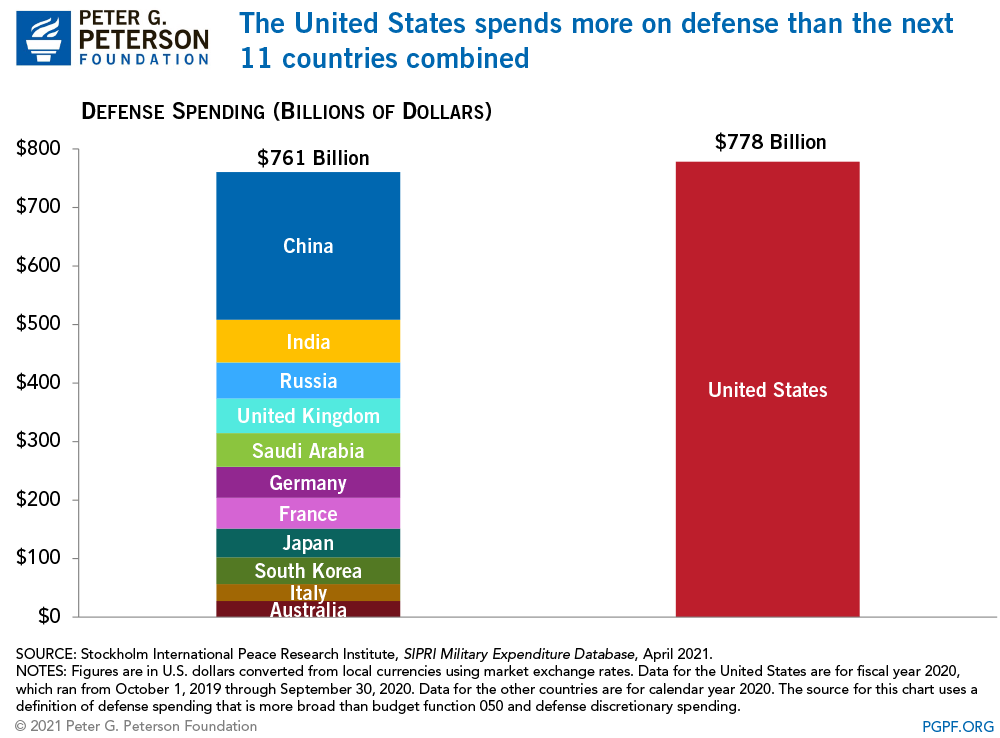
Most serious of all, there’s the problem of U.S. weapons feeding conflicts in ways the Pentagon didn’t foresee, but probably should have.
Compared to the $900 for Pentagon contractors, the average taxpayer contributed only about $27 to the Centers for Disease Control and Prevention, $171 to K-12 education, and barely $5 to renewable energy.
Average US Taxpayer Gave $900 to Military Contractors Last Year, https://truthout.org/articles/average-us-taxpayer-gave-900-to-military-contractors-last-year/?eType=EmailBlastContent&eId=1f951de0-ce82-4df9-b85e-0a76f6faf974
Lindsay Koshgarian, OtherWordsPUBLISHEDApril 17, 2022
ost of us want our tax dollars to be wisely used — especially around tax time.
You’ve probably heard a lot about corporations not paying taxes. Last year, individuals like you contributed six times more in income tax than corporations did.
But have you heard about how many of your tax dollars then end up in corporate pockets? It’s a lot — especially for corporations that contract with the Pentagon. They collect nearly half of all military spending.
The average taxpayer contributed about $2,000 to the military last year, according to a breakdown my colleagues and I prepared for the Institute for Policy Studies. More than $900 of that went to corporate military contractors.
In 2020, the largest Pentagon contractor, Lockheed Martin, took in $75 billion from taxpayers — and paid its CEO more than $23 million.
Unfortunately, this spending isn’t buying us a more secure world.
Last year, Congress added $25 billion the Pentagon didn’t ask for to its already gargantuan budget. Lawmakers even refused to let military leaders retire weapons systems they couldn’t use anymore. The extra money favored top military contractors that gave campaign money to a group of lawmakers, who refused to comment on it.
Then there’s simple price-gouging.
There’s the infamous case of TransDigm, a Pentagon contractor that charged the government $4,361 for a metal pin that should’ve cost $46 — and then refused to share cost data. Congress recently asked TransDigm to repay some of its misbegotten profits, but the Pentagon hasn’t cut off its business.
Somewhere between price-gouging and incompetence lies the F-35 jet fighter, an embarrassment the late Senator John McCain, a Pentagon booster, called “a scandal and a tragedy.”
Among the most expensive weapons systems ever, the F-35 has numerous failings. It’s spontaneously caught fire at least three times — hardly the outcome you’d expect for the top Pentagon contractor’s flagship program. The Pentagon has reduced its request for new F-35s this year by about a third, but Congress may reject that too.
Most serious of all, there’s the problem of U.S. weapons feeding conflicts in ways the Pentagon didn’t foresee, but probably should have.
When U.S. ground troops left Afghanistan, they left behind a huge array of military equipment, from armored vehicles to aircraft, that could now be in Taliban hands. The U.S. also left weapons in Iraq that fell into the hands of ISIS, including guns and an anti-tank missile.
Even weapons we sold to so-called allies like Saudi Arabia have ended up going to people affiliated with groups like al Qaeda.
Military weapons also end up on city streets at home. Over the years, civilian law agencies have received guns, armored vehicles, and even grenade launchers from the military, turning local police into near-military organizations.
Records also show that the Pentagon has lost hundreds of weapons which may have been stolen, including grenade launchers and rocket launchers. Some of these weapons have been used in crimes.
Taxpayers shouldn’t be spending $900 apiece for these outcomes. My team at the Institute for Policy Studies and others have demonstrated ways to cut up to $350 billion per year from the Pentagon budget, including what we spend on weapons contractors, without compromising our safety.
Even better, we could then put some of that money elsewhere.
Compared to the $900 for Pentagon contractors, the average taxpayer contributed only about $27 to the Centers for Disease Control and Prevention, $171 to K-12 education, and barely $5 to renewable energy.
How much more could we get if we invested even a fraction of what we spend on military contractors for these dire needs?
Compared to the $900 for Pentagon contractors, the average taxpayer contributed only about $27 to the Centers for Disease Control and Prevention, $171 to K-12 education, and barely $5 to renewable energy.
How much more could we get if we invested even a fraction of what we spend on military contractors for these dire needs?
Most Americans support shifting Pentagon funds to pay for domestic needs. Instead of making Americans fork over another $900 to corporate military contractors this year, Congress should put our dollars to better use.
Russia’s ‘broken arrow’: Fears that NUCLEAR MISSILES sank with Putin’s flagship Moskva
Russia’s ‘broken arrow’: Fears that NUCLEAR MISSILES sank with Putin’s flagship Moskva amid claims that 452 of the 510 crew have drowned and top admiral has been arrested after cruiser was ‘hit by Ukrainian missile’ , Daily Mail By WILL STEWART and CHRIS PLEASANCE and CHRIS JEWERS FOR MAILONLINE 16 April 2022
Moskva, the flagship of Russia’s Black Sea fleet, has been confirmed to have sunk near port of Sevastopol
Experts and analysts are now warning that the warship may have been carrying two nuclear warheads They are calling for an urgent probe into ‘broken arrow’ incident – military slang for an accident with nukes
Meanwhile questions remain over the fate of Moskva’s 510-strong crew, most of whom are unaccounted forIlya Ponomarev, a politician exiled from Russia, said as many as 452 members of the crew could have died
The Moskva, a Soviet-era guided missile cruiser, sank near the port of Sevastopol on Thursday after Ukraine said it hit the ship with two cruise missiles. Today, Mykhailo Samus, director of a Lviv-based military think-tank; Andriy Klymenko, editor of Black Sea News; and Ukrainian newspaper Defence Express all warned that the Moskva could have been carrying two nuclear warheads designed to be fitted to its P-1000 ‘carrier killer’ missiles.
If true, the loss of the warheads into the Black Sea could spark a ‘Broken Arrow’ incident – American military slang for potentially lethal accidents involving nuclear weapons.
‘On board the Moskva could be nuclear warheads – two units,’ Samus said, while Klymenko called on other Black Sea nations – Turkey, Romania, Georgia, and Bulgaria – to insist on an explanation. ‘Where are these warheads? Where were they when the ammunition exploded,’ he asked.
Meanwhile Ilya Ponomarev, a politician exiled from Russia for opposing Putin’s 2014 annexation of Crimea, said just 58 of the 510-strong crew have since been accounted for – raising the prospect that 452 men went down with the ship in what would be a bitter loss for Vladimir Putin’s already beleaguered army.
The figure, while unconfirmed, is consistent with losses suffered on exploding warships. During the Russian Navy’s infamous defeat at the Battle of Tsushima against Japan, an explosion on board the Borodino – slightly smaller than the Moskva – saw all-but one of her 855 crew killed.
Russia claims all the Moskva’s sailors were ‘successfully evacuated’ but video taken in Sevastopol overnight shows dozens of cars purportedly belonging to the sailors still parked in the port – suggesting their owners had not returned to collect them……………….. https://www.dailymail.co.uk/news/article-10721351/Ukraine-war-Fears-Moskva-warship-carrying-nuclear-weapons-sank.html
Pine Gap’s role in China–US arms race makes Australia a target
Rakesh, April 15, 2022 https://community99.com/pine-gaps-role-in-the-arms-race-between-china-and-the-united-states-makes-australia-a-target/
Developments at the U.S.-Australian satellite intelligence base at Pine Gap near Alice Springs give the United States an unprecedented ability to detect Chinese spacecraft from space and potentially destroy them.
Previously, detection was mainly based on ground-based radars, which are no longer seen as suitable for identifying these spacecraft if they were weapons. China has said it has only tested new space vehicles.
As shown below, two different versions of the latest Pine Gap satellites can do this job together. The difficulty is how to further destabilize the nuclear balance between China and the United States in order to help maintain peace.
Last October, it was reported that China had tested a nuclear-capable highly maneuverable hypersonic glider after it was lifted into space by a missile. The nuclear warheads released from US intercontinental ballistic missiles are also manoeuvrable and independently targeted. But the United States sees a serious threat from these hypersonic vehicles that can drive at more than five times the speed of sound.
This development makes Australia more closely integrated with any American offensive in space, as well as with defensive capabilities. Yet there has been no political debate in Australia about the consequences of avoiding war. No senior politician is trying to create momentum to support a new arms control deal, as Presidents Richard Nixon and Leonid Brezhnev did in 1971, when the number of nuclear weapons escalated alarmingly, to more than 30,000 each.
The latest arms build-up is highlighted by a meeting in late March between Australian intelligence and military officials and senior US military officers at Pine Gap. Although the United States clearly considers Pine Gap to be crucial in fighting war in space, these military officers did not speak to the Australian media. Instead, they choose to talk to a London-based journalist Financial Times.
It is unclear whether the government intends to inform the Australian public about developments at Pine Gap. These have implications for Australia’s own security and its potential obligations under the outer space treaty, which limits the militarization of space without completely banning it. If Pine Gap was not already a Chinese nuclear target, it probably will be now.
That Financial Times reported the head of the U.S. Indo-Pacific Command, Admiral John Aquilino, said the United States wanted to integrate all elements of the U.S. military power with its allies. In this context, Aquilino said Australia has capabilities that make it an “extremely advanced partner”. He said increased visibility in space would help counter Chinese hypersonic weapons. “The ability to identify and track and defend against these hypersonics is really key.”
The head of the U.S. Space Command, General James Dickinson, was also interviewed for the play, saying Australia was a “critical partner” in efforts to improve space domain awareness and monitor Chinese space operations. He said, “This is the perfect place for many things to do.”
The deputy head of the U.S. Cyber Command, Lieutenant General Charles Moore, said digital convergence between the United States and Australia gives the Unit
Pine Gap’s own satellites also pick up signals from radars and weapon systems, such as ground-to-air missiles, anti-aircraft artillery, fighter jets, drones and spacecraft, along with other military and civilian communications. From Pine Gap, a huge amount of military data is fed into the American war machine in real time.ed States “the potential to conduct offensive operations.” He added that cooperation with allies created an “asymmetric advantage” over China, which lacks similar partnerships. One consequence is that China cannot gather near as much electronic intelligence from across the globe as the United States.
An idea of the growing importance of Pine Gaps for the United States is given by its extraordinary growth. Originally, it was a ground station for a single satellite to collect what is called signal intelligence as it orbited 36,000 kilometers above the Earth. There are now at least four much more powerful satellites connected to the base. Their antennas automatically intercept everything that is transmitted within their frequency range. This includes a large selection of electronic signals for intelligence analysis, including text messages, emails, phone calls and more. In addition, terrestrial antennas at Pine Gap and other Australian locations pick up a large amount of information transmitted via commercial satellites.
Pine Gap’s own satellites also pick up signals from radars and weapon systems, such as ground-to-air missiles, anti-aircraft artillery, fighter jets, drones and spacecraft, along with other military and civilian communications. From Pine Gap, a huge amount of military data is fed into the American war machine in real time.
Pine Gap operates in connection with similar interception satellites attached to a base at Menwith Hill in England. Their use to lead counterfeit drone strikes that have killed a large number of civilians has been much debated in England. The combined coverage of the two bases includes the former Soviet Union, China, Southeast Asia, East Asia, the Middle East, Eastern Europe, and the Atlantic landmass.
Pine Gap is also linked to infrared satellites, which are of great interest to Americans. Their original function, which is still important, is to provide early warning of the firing of nuclear-armed Russian or Chinese ballistic missiles. Added options now allow them to use their infrared telescopes to detect and track heat from spacecraft as well as from large and small missiles and military jets. Some satellites have very elliptical orbits that can go close to Earth instead of being 36,000 kilometers above Earth.
These satellites now provide highly coveted information about Chinese spacecraft, amplified by the data from the signal intelligence satellites. Taken together, this gives access to signals and infrared intelligence, and its location relative to China, Pine Gap plays a crucial role in the United States’ plans to fight wars in space. This capability will be enhanced by a new space-based detection and tracking system called Next Generation Overhead Persistent Infrared (Next-Gen OPIR).
On April 6, the leaders of the AUKUS pact – Boris Johnson, Scott Morrison and Joe Biden – announced that they would develop hypersonic missiles and subterranean robots after previously promising to supply Australia with nuclear submarines from around 2040.
These new missiles will also travel at more than five times the speed of sound, but are air-breathing unlike those designed for use in space. The United States and Australia had already developed hypersonic cruise missiles using ramjet engines.
No figures are available, but the cost of developing, building and testing very long-range missiles will be high. A large part of the test is expected to take place in Australia. The new missiles are also intended for use against Chinese targets.
Again, China can be expected to build more missiles with the ability to target Australian and US forces in the region. Separately, Secretary of Defense Peter Dutton announced that the Australian government will spend $ 3.5 billion on new missiles with a longer range of 900 kilometers for Australian ships and fighter jets.
The background to what is happening at Pine Gap illustrates how much more important the base is to the United States than any contribution Australia may have made by a pair of fighter jets or frigates to the United States’ integrated international force that was at a distance from China. At this stage, neither side of Australian policy seems willing to refuse participation in yet another US-led war that violates Australia’s obligations under both the UN Charter and Article 1 of the ANZUS Treaty. Both documents oblige Australia to reject the use of force in international relations, other than defensively.
Although rarely mentioned, Pine Gaps’ growing importance to the United States increases Australia’s leverage with the United States to refuse to contribute ships, aircraft and troops to an integrated military force should it violate international rules. It may be harder to dismiss some aspects of Pine Gap’s operations. But there are provisions in the ground rules that Australia only acts with “full knowledge and agreement” with what is happening. Australia does not have to agree.
A further question is how to revive arms control negotiations between Russia and the United States and include China. The two large ones have 1550 intercontinental warheads, but they also have smaller ones. According to the Pentagon, China had only about 100 intercontinental ballistic missiles by 2021 and about 200 smaller warheads. This gives China reasonable cause for concern that it does not have enough strategic warheads to be able to retaliate against a US first attack and thus perpetuate deterrence.
To overcome this, the Pentagon projects that China will have around 1,000 intercontinental warheads by 2030. All sides must reach a new agreement to make major cuts in the number of warheads if the chances of nuclear war are to be reduced.
Whether or not China develops hypersonic spacecraft, it is already committed to getting more traditional intercontinental ballistic missiles that can disperse maneuverable warheads. Restraint on all sides is necessary.
I asked the Secretary of State, Marise Payne, and her Labor counterpart, Penny Wong, if Australia could refuse to integrate with the United States and other forces if they considered a proposed deployment in violation of Article 1 of the ANZUS Treaty or the UN Charter. I also asked if Australia could withdraw its military assets from integrated US operations if there was a more urgent need for Australia to confront a local threat that was not of interest to the US. None of them responded before the print deadline.
This article was first published in the print edition of The Saturday Paper on April 16, 2022 as “Mind Pine Gap”.
North Korea tests new weapon bolstering nuclear capability
North Korea says it has successfully test-launched a newly developed tactical guided weapon
- By HYUNG-JIN KIM – Associated Press
- Apr 17, 2022
SEOUL, South Korea (AP) — North Korea has test-fired a new type of tactical guided weapon designed to boost its nuclear fighting capability, state media reported Sunday, a day before its chief rivals the United States and South Korea begin annual drills that the North views as an invasion rehearsal.
The 13th weapons test this year came amid concerns that North Korea may soon conduct an even larger provocation. That may include a nuclear test in an effort to expand the country’s arsenal and increase pressure on Washington and Seoul while denuclearization talks remain stalled………………………….. https://www.news-gazette.com/coronavirus/north-korea-tests-new-weapon-bolstering-nuclear-capability/article_0413e1d9-3fb7-5c42-a63c-e1ea66b3e084.htm
Biden’s genocide comment raised concern
SOTT, Carol E. Lee, Josh Lederman, NBC News, Fri, 15 Apr 2022
President Joe Biden’s declaration this week that Russia is committing “genocide” in Ukraine raised concerns among some officials in his own government and has so far not been corroborated by information collected by U.S. intelligence agencies, according to senior administration officials.
At the State Department, which is tasked with making formal determinations of genocide and war crimes through an independent legal process, two officials said that Biden’s seemingly offhand declaration during a domestic policy speech in Iowa on Tuesday made it harder for the agency to credibly do its job.
U.S. intelligence agencies collect information when allegations are made of actions that could amount to genocide, but policymakers are the ones who actually decide whether to declare it. Intelligence reports on Ukraine currently do not support a genocide designation, officials said.
“Genocide includes a goal of destroying an ethnic group or nation and, so far, that is not what we are seeing.”…………..
The question of when to label Russia’s actions in Ukraine “genocide,” particularly the legal threshold for doing so had been discussed inside the White House ever since images of mass graves and civilian torture and assassinations emerged in Bucha, people familiar with the discussions said. Biden had recently begun to make his views clear in private, so White House officials weren’t surprised that he called what’s happening in Ukraine “genocide,” but they were taken aback that he did so offhandedly in a speech in Iowa about inflation, the people said.
The president’s declaration of genocide in Ukraine was the third time in recent weeks that the president has tried to separate what he says are his personal views from official U.S. policy to take a position that he believes is right even though it’s not aligned with the position of his own government.
Biden said Russia was committing war crimes in Ukraine — another symbolically and legally significant moment in which he got ahead of his own administration — a week before the U.S. government completed its legal process and formally made that declaration.
Biden also said Russian President Vladimir Putin should no longer be in power, prompting a scramble by his aides to say that’s not what he meant and stress that U.S. policy is not regime change in Moscow. Biden later said he did mean what he said — that it was his “personal” view — but not U.S. policy.
…………… “These aren’t gaffes,” said one person close to the White House. “He’s doing this very purposefully.”
Responding to questions about Biden’s genocide declaration, White House press secretary Jen Psaki told reporters this week, “The president was calling it like he sees it, and that’s what he does.”
The apparent disconnect between the president and the bureaucracy he oversees is striking given Biden’s extensive experience in foreign policy and government. Biden also has stressed since the 2020 campaign that “the words of a president matter.” And he’s gone out of his way to say he would not try to influence independent Justice Department decisions, but some administration officials see a willingness for him to do just that with other independent legal processes.
Once the president says he believes genocide and war crimes have been committed, administration officials said that puts immense pressure on career government officials to reach the same conclusion. The concern is that if and when the State Department’s Office of Global Criminal Justice reaches those conclusions on its own, the office risks appearing late to the game or like it’s trying to justify Biden’s public comments, the officials said. One of the administration officials said Biden’s comments had put particular pressure on Beth Van Schaack, the U.S. ambassador for global criminal justice, who was confirmed by the Senate last month. On Friday, Schaack met with Ukraine’s prosecutor general, Iryna Venediktova, to compare notes as Venediktvoa’s office investigates alleged Russian war crimes by Russia. Venediktova, like Ukrainian President Volodymyr Zelenskyy, has already accused Russia of genocide in Ukraine.
U.S. intelligence shows that the Russians have been told that Ukrainians in the eastern Donbas region, where fighting is expected to intensify, are Nazis and that the Ukrainian civilians are Nazi sympathizers, raising concerns about genocide, officials said. The Russians also have been told the same about Ukrainians in Mariupol, officials said, with one noting how brutal Moscow’s military campaign has been there.
Genocide is a specific crime defined under international law, and proving it requires showing an intent at high levels to commit genocide.
Biden’s early accusation against Russia, which was welcomed by Zelenskyy, came even ahead of human rights organizations that have often pushed U.S. administrations to declare that a regime has committed genocide.
Human Rights Watch, for instance, so far has not found evidence of a genocidal campaign waged by Russia, according to Tara Sepehri Far, acting deputy director of Human Rights Watch’s Washington office.
“Our research is not matching the definition yet,” said Sepehri Far. “It doesn’t mean it’s not happening.”
Biden has throughout his decades long career at times been quicker than others in the U.S. government to speak out about genocide………………………….. https://www.sott.net/article/466834-Biden-genocide-comment-raised-concern-among-some-U-S-officials
In Ukraine, with the blessing of the Western countries, those who are in favor of a negotiation have been eliminated – Jacques Baud

Retired Swiss Military-Intelligence Officer. Is it possible to actually know what has been and is going on in Ukraine? Jacques Baud, The Unz Review 02 Apr 2022
” ……………………………. Conclusions. As an ex-intelligence professional, the first thing that strikes me is the total absence of Western intelligence services in accurately representing the situation over the past year. In fact, it seems that throughout the Western world intelligence services have been overwhelmed by the politicians. The problem is that it is the politicians who decide — the best intelligence service in the world is useless if the decision-maker does not listen. This is what has happened during this crisis.
That said, while a few intelligence services had a very accurate and rational picture of the situation, others clearly had the same picture as that propagated by our media. The problem is that, from experience, I have found them to be extremely bad at the analytical level — doctrinaire, they lack the intellectual and political independence necessary to assess a situation with military “quality.”
Second, it seems that in some European countries, politicians have deliberately responded ideologically to the situation. That is why this crisis has been irrational from the beginning. It should be noted that all the documents that were presented to the public during this crisis were presented by politicians based on commercial sources.
Some Western politicians obviously wanted there to be a conflict. In the United States, the attack scenarios presented by Anthony Blinken to the UN Security Council were only the product of the imagination of a Tiger Team working for him — he did exactly as Donald Rumsfeld did in 2002, who “bypassed” the CIA and other intelligence services that were much less assertive about Iraqi chemical weapons.
The dramatic developments we are witnessing today have causes that we knew about but refused to see:
- on the strategic level, the expansion of NATO (which we have not dealt with here);
- on the political level, the Western refusal to implement the Minsk Agreements;
- and operationally, the continuous and repeated attacks on the civilian population of the Donbass over the past years and the dramatic increase in late February 2022.
In other words, we can naturally deplore and condemn the Russian attack. But WE (that is: the United States, France and the European Union in the lead) have created the conditions for a conflict to break out. We show compassion for the Ukrainian people and the two million refugees. That is fine. But if we had had a modicum of compassion for the same number of refugees from the Ukrainian populations of Donbass massacred by their own government and who sought refuge in Russia for eight years, none of this would probably have happened.
Whether the term “genocide” applies to the abuses suffered by the people of Donbass is an open question. The term is generally reserved for cases of greater magnitude (Holocaust, etc.). But the definition given by the Genocide Convention is probably broad enough to apply to this case.
Clearly, this conflict has led us into hysteria. Sanctions seem to have become the preferred tool of our foreign policies. If we had insisted that Ukraine abide by the Minsk Agreements, which we had negotiated and endorsed, none of this would have happened. Vladimir Putin’s condemnation is also ours. There is no point in whining afterwards — we should have acted earlier. However, neither Emmanuel Macron (as guarantor and member of the UN Security Council), nor Olaf Scholz, nor Volodymyr Zelensky have respected their commitments. In the end, the real defeat is that of those who have no voice.
The European Union was unable to promote the implementation of the Minsk agreements — on the contrary, it did not react when Ukraine was bombing its own population in the Donbass. Had it done so, Vladimir Putin would not have needed to react. Absent from the diplomatic phase, the EU distinguished itself by fueling the conflict. On February 27, the Ukrainian government agreed to enter into negotiations with Russia. But a few hours later, the European Union voted a budget of 450 million euros to supply arms to the Ukraine, adding fuel to the fire. From then on, the Ukrainians felt that they did not need to reach an agreement. The resistance of the Azov militia in Mariupol even led to a boost of 500 million euros for weapons.
In Ukraine, with the blessing of the Western countries, those who are in favor of a negotiation have been eliminated.This is the case of Denis Kireyev, one of the Ukrainian negotiators, assassinated on March 5 by the Ukrainian secret service (SBU) because he was too favorable to Russia and was considered a traitor. The same fate befell Dmitry Demyanenko, former deputy head of the SBU’s main directorate for Kiev and its region, who was assassinated on March 10 because he was too favorable to an agreement with Russia — he was shot by the Mirotvorets (“Peacemaker”) militia. This militia is associated with the Mirotvorets website, which lists the “enemies of Ukraine,” with their personal data, addresses and telephone numbers, so that they can be harassed or even eliminated; a practice that is punishable in many countries, but not in the Ukraine. The UN and some European countries have demanded the closure of this site — but that demand was refused by the Rada [Ukrainian parliament].
In the end, the price will be high, but Vladimir Putin will likely achieve the goals he set for himself. We have pushed him into the arms of China. His ties with Beijing have solidified. China is emerging as a mediator in the conflict. The Americans have to ask Venezuela and Iran for oil to get out of the energy impasse they have put themselves in — and the United States has to piteously backtrack on the sanctions imposed on its enemies.
Western ministers who seek to collapse the Russian economy and make the Russian people suffer, or even call for the assassination of Putin, show (even if they have partially reversed the form of their words, but not the substance!) that our leaders are no better than those we hate — sanctioning Russian athletes in the Para-Olympic Games or Russian artists has nothing to do with fighting Putin.
What makes the conflict in Ukraine more blameworthy than our wars in Iraq, Afghanistan or Libya? What sanctions have we adopted against those who deliberately lied to the international community in order to wage unjust, unjustified and murderous wars? Have we adopted a single sanction against the countries, companies or politicians who are supplying weapons to the conflict in Yemen, considered to be the “worst humanitarian disaster in the world?”
To ask the question is to answer it… and the answer is not pretty.
About the author
Jacques Baud is a former colonel of the General Staff, ex-member of the Swiss strategic intelligence, specialist on Eastern countries. He was trained in the American and British intelligence services. He has served as Policy Chief for United Nations Peace Operations. As a UN expert on rule of law and security institutions, he designed and led the first multidimensional UN intelligence unit in the Sudan. He has worked for the African Union and was for 5 years responsible for the fight, at NATO, against the proliferation of small arms. He was involved in discussions with the highest Russian military and intelligence officials just after the fall of the USSR. Within NATO, he followed the 2014 Ukrainian crisis and later participated in programs to assist the Ukraine. He is the author of several books on intelligence, war and terrorism, in particular Le Détournement published by SIGEST, Gouverner par les fake news, L’affaire Navalny. His latest book is Poutine, maître du jeu? published by Max Milo.
This article appears through the gracious courtesy of Centre Français de Recherche sur le Renseignement, Paris. more https://www.sott.net/article/466340-Retired-Swiss-Military-Intelligence-Officer-Is-it-Possible-to-Actually-Know-What-Has-Been-And-is-Going-on-in-Ukraine
1 This Month





PLEASE OPPOSE HR 8255 AND S.3639 – bills would accelerate satellite deployment, with no environmental review or safeguards – https://ncstd5li.quorum.us/campaign/169331/
To see nuclear-related stories in greater depth and intensity – go to https://nuclearinformation.wordpress.com
-
Archives
- October 2026 (29)
- September 2026 (339)
- August 2026 (330)
- July 2026 (355)
- June 2026 (287)
- May 2026 (306)
- April 2026 (356)
- March 2026 (251)
- February 2026 (267)
- January 2026 (308)
- December 2025 (358)
- November 2025 (359)
-
Categories
- 1
- 1 NUCLEAR ISSUES
- business and costs
- climate change
- culture and arts
- ENERGY
- environment
- health
- history
- indigenous issues
- Legal
- marketing of nuclear
- media
- opposition to nuclear
- PERSONAL STORIES
- politics
- politics international
- Religion and ethics
- safety
- secrets,lies and civil liberties
- spinbuster
- technology
- Uranium
- wastes
- weapons and war
- Women
- 2 WORLD
- ACTION
- AFRICA
- Atrocities
- AUSTRALIA
- Christina's notes
- Christina's themes
- culture and arts
- Events
- Fuk 2022
- Fuk 2023
- Fukushima 2017
- Fukushima 2018
- fukushima 2019
- Fukushima 2020
- Fukushima 2021
- general
- global warming
- Humour (God we need it)
- Nuclear
- RARE EARTHS
- Reference
- resources – print
- Resources -audiovicual
- Weekly Newsletter
- World
- World Nuclear
- YouTube
-
RSS
Entries RSS
Comments RSS

